Summary
This comprehensive, step-by-step guide helps SaaS founders and business leaders efficiently hire full-stack developers. Learn how to define project requirements, evaluate technical and SaaS-specific skills, choose the right hiring model, avoid common mistakes, and build scalable, high-performing products that accelerate growth and reduce development costs.
Key Takeaways:
- 72% of SaaS startups fail due to poor technical execution, hire the right talent to scale efficiently.
- Hiring the right full-stack developer accelerates MVP launch and reduces development costs.
- Cost to hire full-stack developers ranges from $30–$150+ per hour globally.
- Offshore, onsite, and hybrid models provide flexibility depending on project complexity.
- Technical and SaaS-specific skills ensure scalable, secure, and high-performing SaaS applications.
Many founders have spent months to conceptualize SaaS product, their roadmap is ready, and the MVP is planned. But, teh times comes to execute, their development team struggles to build a powerful SaaS product. Every day of delay costs potential users, revenue, and credibility. This is the reality for many SaaS founders, and it often comes down to one critical factor: the right full-stack developer.
A skilled full-stack SaaS developer does not just write code. They become a strategic partner who can transform your vision into a scalable, high-performing product. From building a robust architecture to rapid feature deployment, a top-tier full-stack developer is the backbone of any successful SaaS company.
This guide highlights a step-by-step hiring process for SaaS development designed specifically for SaaS founders and business leaders. You will learn how to define project requirements, identify essential technical and SaaS-specific skills, choose the best hiring model, avoid costly mistakes, and onboard developers who can take your product from a Minimum Viable Product (MVP) to full-scale success.
What is a Full Stack Developer in a SaaS?
A full-stack developer in a SaaS company is responsible for both front-end and back-end development, ensuring that the product functions smoothly from every angle. They manage databases, handle API integrations, and maintain secure, scalable cloud-based operations. By overseeing all layers of the application, full-stack developers make sure features are implemented quickly, performance stays optimal, and users enjoy a seamless experience.
Read More: Best iOS App Development Companies in USA Founders Must Know
Step-by-Step Hiring Process for SaaS Full Stack Developers
Hiring a full-stack developer for a SaaS company goes beyond reviewing resumes. It requires a structured process to evaluate technical skills, SaaS-specific expertise, and alignment with your product vision. A well-defined approach ensures you select developers who can deliver high-quality code, scale your application, and contribute to the long-term success of your SaaS product.
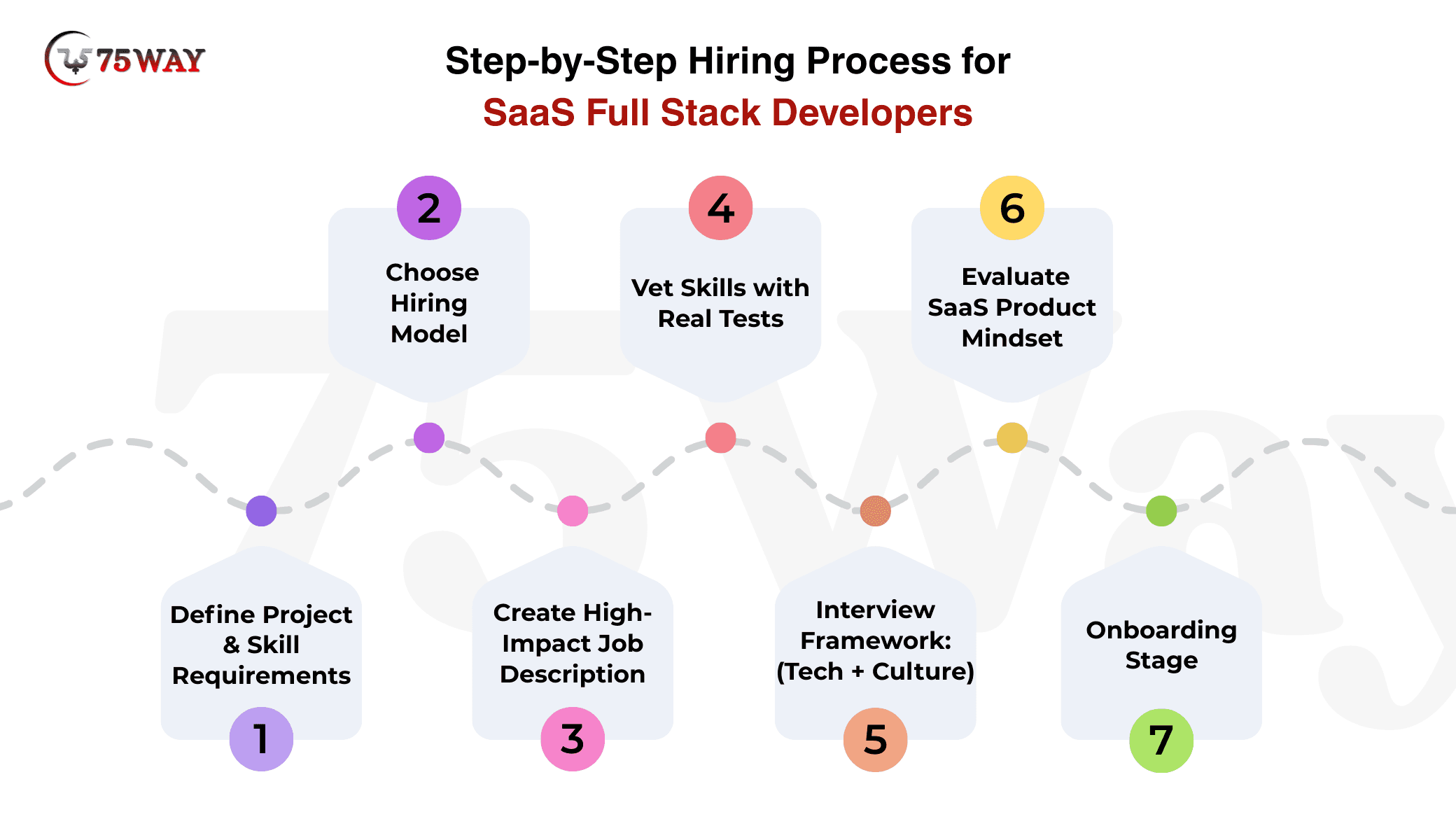
Step 1: Define Project & Skill Requirements
Before you start searching, clearly define what your SaaS project requires. Specify the technology stack (front-end and back-end frameworks, databases, cloud platforms) and the essential SaaS-specific skills, such as multi-tenant architecture, automated scaling, or API integrations. Include the project scope, deadlines, and expected deliverables. This clarity ensures that candidates are aligned with your technical needs and business goals, reducing mismatches later in the hiring process.
Step 2: Choose Hiring Model
The right hiring model is one of the most important decisions when bringing a full-stack developer onto your SaaS project. The model you select affects not only your budget but also project speed, team collaboration, and long-term scalability. Some startups prioritize cost savings and flexibility, while others focus on tight control, cultural alignment, or strategic growth. By carefully selecting the right hiring model, you can ensure that your development process remains efficient.
- In-house: Full-time employees working from your office, ideal for long-term, strategic projects.
- Remote: Dedicated developers working from anywhere, providing flexibility and access to global talent.
- Freelance: Short-term specialists for specific tasks or MVPs.
- Agency: Pre-vetted teams for faster project delivery.
- Hybrid: Combination of onsite and remote, balancing collaboration and scalability.
Step 3: Create High-Impact Job Description
You must create a clear, compelling job description that sets the tone for your hiring process. It communicates expectations, highlights required skills, and attracts candidates who are both qualified and aligned with your SaaS company’s culture and goals.
- Core responsibilities
- Required technical skills and SaaS experience
- Desired soft skills and culture fit
- Project duration, location flexibility, and compensation
Step 4: Vet Skills with Real Tests
Evaluation of resumes alone is not enough to find a suitable full-stack developer for your SaaS project. Candidates must demonstrate their skills through practical, real-world tests that reflect the challenges they will face on the job. This stage helps you identify SaaS developers who can write high-quality code, make sound architectural decisions, and solve problems efficiently in real SaaS environments.
Coding Challenges: Assign tasks that reflect your technology stack and product requirements to assess coding ability, problem-solving, and familiarity with frameworks.
Architecture Exercises: Simulate designing scalable systems or integrating multiple services to evaluate understanding of SaaS architecture, database management, and APIs.
Problem-Solving SaaS Scenario: Present scenarios such as multi-tenant data handling, performance optimization, or production bug fixes to see how candidates approach complex challenges and make informed technical decisions.
By combining these tests, you can ensure applicants are capable of handling the technical demands of your SaaS project and can adapt to the complexities of building a scalable, high-performing product.
Step 5: Interview Framework
Structured interviews are a critical stage in hiring full-stack developers for SaaS companies. The goal is to assess both technical expertise and cultural compatibility, as success depends not only on coding ability but also on how well a developer collaborates and aligns with the organization’s values and workflows.
Technical Interviews: You must explore candidates’ past projects, architecture decisions, coding logic, and problem-solving approach. You can ask scenario-based questions that reflect real SaaS challenges, such as multi-tenant systems, API integration, or scaling features. This helps evaluate their depth of knowledge, analytical thinking, and practical experience.
Culture-Fit Assessments: After that, you can evaluate communication style, teamwork, adaptability, and alignment with the company’s mission and values. Strong cultural compatibility facilitates collaboration, reduces friction during product development, and contributes to a productive, long-term working relationship.
A well-structured interview framework provides a comprehensive view of a candidate’s capabilities, balancing technical proficiency with behavioral and cultural traits. It allows SaaS companies to select developers who can contribute effectively to both immediate project goals and long-term product growth.
Step 6: Evaluate SaaS Product Mindset
A proficient full-stack developer does more than write code. They understand the unique challenges of building SaaS products. Beyond technical skills, they think about scalability, security, system performance, and long-term maintainability. You can evaluate a developer’s SaaS mindset to find their ability to design solutions that not only meet current requirements but also anticipate future growth, handle complex architectures, and adapt to evolving business needs. This perspective is critical for creating products that perform reliably under real-world usage and deliver consistent value to users.
Multi-Tenant Systems: Can design databases supporting multiple clients securely and efficiently.
Data Security & Compliance: Understands regulatory requirements and implements robust protection measures.
Performance Optimization: Develops systems that maintain speed under growing workloads.
Cloud System Management: Experienced with AWS, GCP, or Azure for reliable deployments.
Developers with a strong SaaS product mindset contribute strategically to both technical execution and product vision. Their approach minimizes risks, ensures smooth scaling, and accelerates feature delivery, positioning the SaaS product for sustained success in competitive markets.
Step 7: Onboarding Stage
Once a full stack developer is hired, a structured onboarding process becomes essential to maximize productivity from day one. Start by providing clear role definitions and responsibilities, outlining expectations for their contributions, and sharing project goals and timelines so developers understand priorities and deadlines. Grant access to development tools, repositories, and documentation, ensuring they have everything needed to begin work without delays. Early exposure to workflows and project context accelerates familiarity with your SaaS product and reduces the learning curve.
Additionally, introduce the developer to team members and collaboration processes to foster engagement and seamless communication. A well-organized onboarding process aligns expectations, cultivates accountability, and supports integration into both the technical and cultural fabric of your company. By setting developers up for success from the start, your SaaS project benefits from faster ramp-up, smoother collaboration, and immediate contributions to feature development and product scalability.
Explore More: AI App Development Partner for Health and Wellness Startup
Why SaaS Companies Need Full Stack Developers?
Full-stack developers play a critical role by managing both the front-end and back-end of your product, ensuring that every feature works seamlessly together. Their expertise not only accelerates development but also reduces errors, minimizes costs, and guarantees that your platform can scale as your business grows.
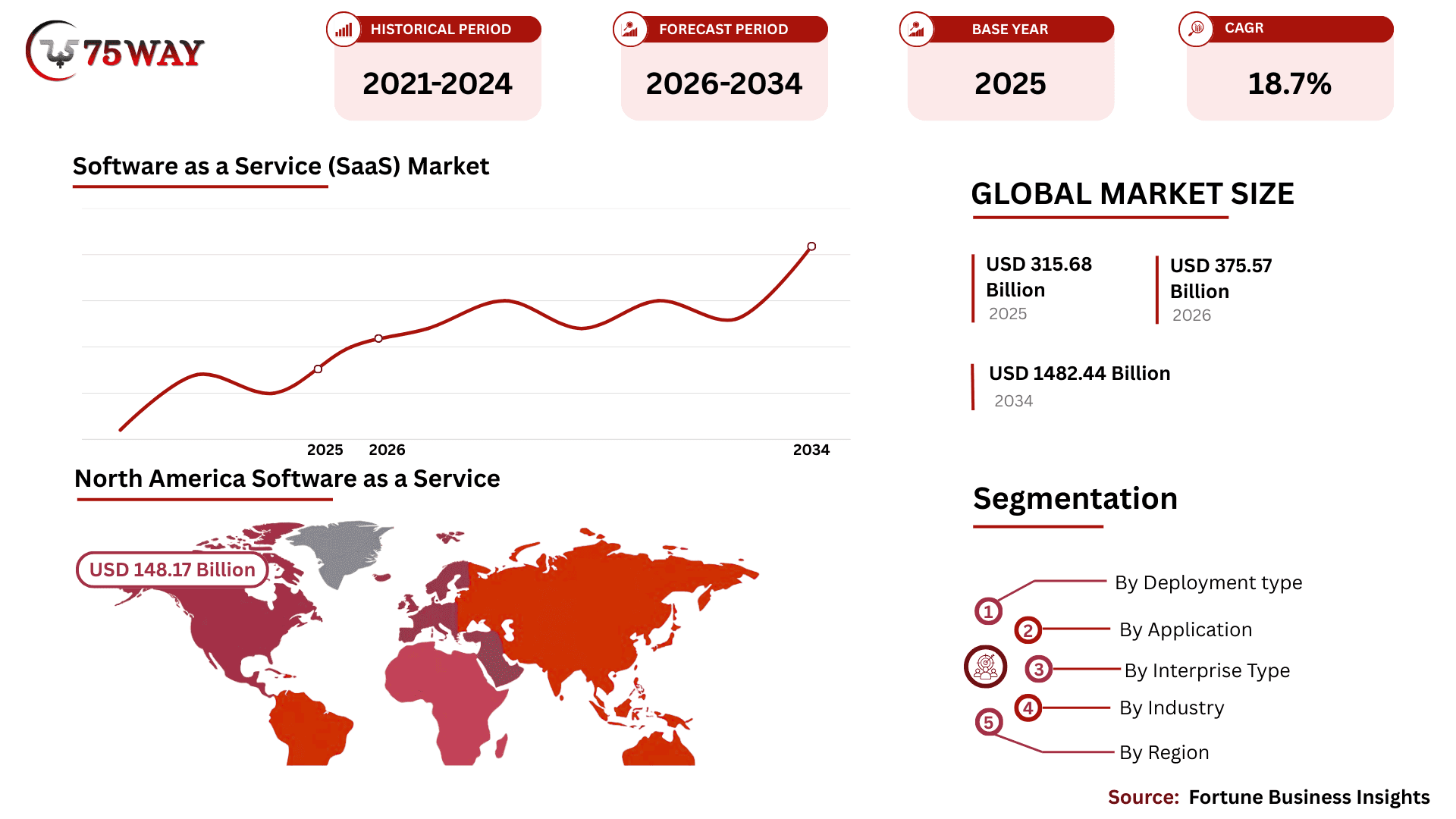
In SaaS development, products are complex, constantly evolving, and user expectations are high. Without a developer who understands both front-end and back-end, features may be delayed, performance can suffer, and scaling becomes a major challenge. Full-stack developers provide the expertise needed to handle all layers of the application, ensuring your product is reliable, fast, and adaptable to growth.
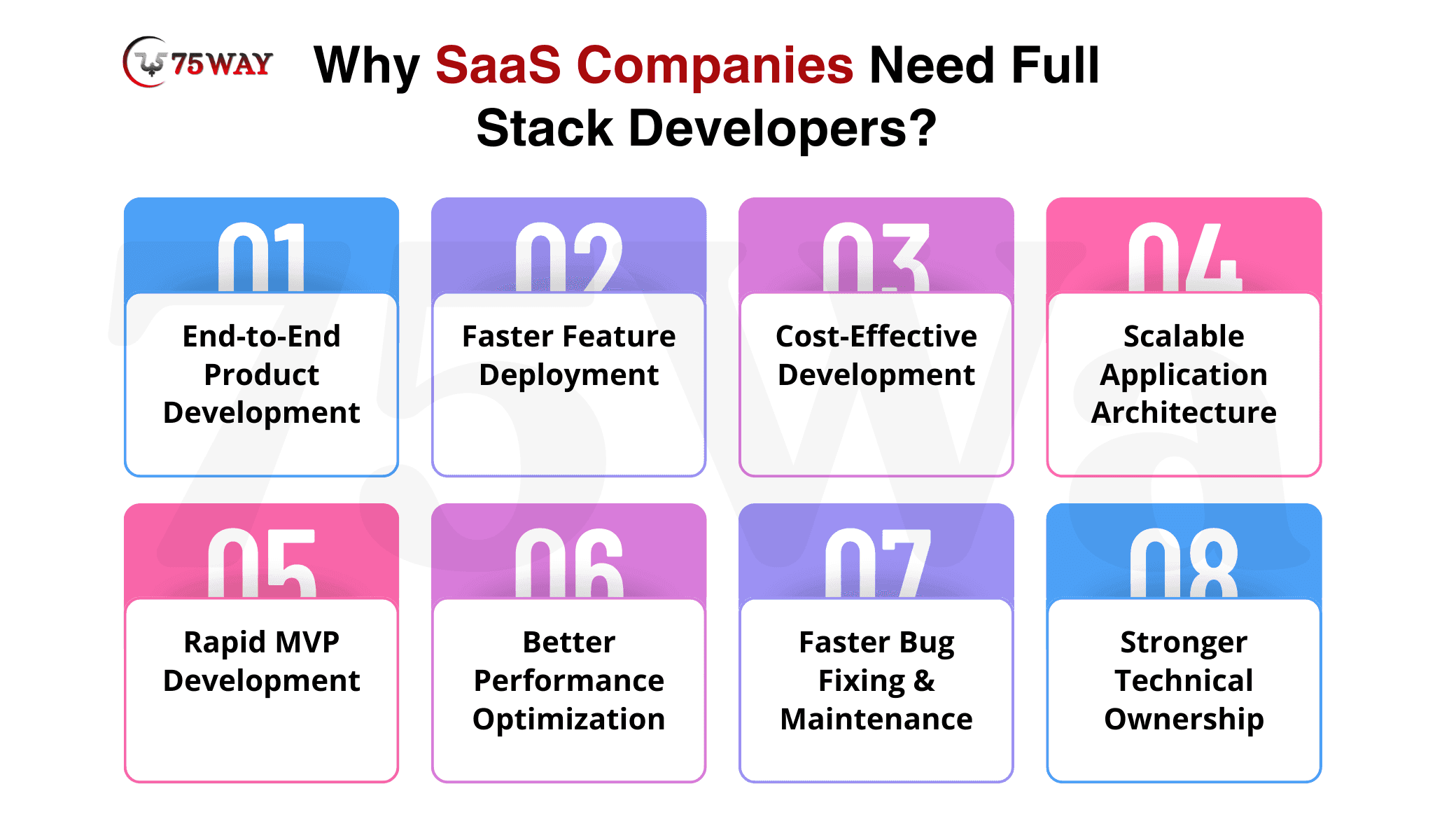
End-to-End Product Development: They handle the entire workflow from user interface to server logic, reducing integration errors and ensuring a smooth product experience.
Faster Feature Deployment: A single developer who understands the full stack can implement new features quickly, speeding up iteration cycles and responding to market demands.
Cost-Effective Development: By covering multiple layers of development, full-stack developers reduce the need for hiring multiple specialists, saving both time and budget.
Scalable Application Architecture: They design systems with scalability in mind, enabling your SaaS product to grow without costly re-engineering.
Rapid MVP Development: For startups, full-stack developers help launch a minimum viable product faster, allowing you to validate ideas and gain market feedback quickly.
Better Performance Optimization: Understanding the complete stack allows developers to fine-tune performance at every level, ensuring smooth operation under growing user loads.
Faster Bug Fixing & Maintenance: With a comprehensive view of the system, full-stack developers can identify and resolve issues faster, maintaining high product reliability.
Stronger Technical Ownership: They take responsibility for both architecture and implementation, fostering accountability and improving overall product quality.
Read Too: How to Build A Social Media App Like Upscrolled: 2026 Playbook
Core Skills to Look For While Hiring A Full-Stack SaaS Engineer
Hiring developers with the right mix of technical, SaaS-specific, and soft skills is essential to building scalable, reliable, and high-performing SaaS products. Here’s a detailed breakdown of the skills to evaluate:
Technical Skills
- Front-End: Front-end expertise ensures the SaaS product delivers an intuitive and responsive user interface. Developers should be proficient in JavaScript and frameworks like React.js, Angular, and Vue.js to build interactive dashboards, dynamic forms, and seamless content that enhance user engagement.
- Back-End: Strong back-end skills enable developers to handle server-side logic, data processing, and API management efficiently. Proficiency in Node.js (JavaScript), Python, or C# (.NET) ensures the application is fast, secure, and scalable to meet growing user demands.
- Databases: A full-stack engineer must manage structured and unstructured data, optimize queries, and ensure reliable storage. Familiarity with SQL and NoSQL databases allows flexible data handling for multi-tenant SaaS systems.
- APIs & Integrations: Developers should be able to create and integrate APIs for third-party services, internal modules, and cloud systems. This ensures seamless communication across different parts of the SaaS application and external tools.
- DevOps Basics: Understanding DevOps principles, including CI/CD pipelines, containerization, and automated deployments, allows developers to streamline releases, reduce downtime, and maintain system reliability while scaling the product.
SaaS-Specific Skills
- Multi-Tenant Architecture: A full-stack engineer should design SaaS applications to serve multiple clients from a single codebase while keeping each client’s data secure and isolated. This ensures scalability, cost efficiency, and easier maintenance as your user base grows.
- Automated Scaling: Developers must implement automated scaling strategies using containers like Docker and orchestration tools like Kubernetes, along with a microservices architecture. This allows the application to handle increased traffic seamlessly without downtime or performance issues.
- Security & Compliance: SaaS engineers need expertise in application security, data encryption, authentication protocols, and compliance standards like GDPR, HIPAA, and SOC2. Strong security practices protect sensitive customer data and reduce the risk of breaches.
- Cloud Platforms: Proficiency in cloud platforms such as Amazon Web Services, Google Cloud Platform, and Microsoft Azure enables developers to deploy scalable, high-performance SaaS applications. Knowledge of cloud services, storage, and serverless architecture is critical for reliability and efficiency.
Soft Skills
- Product Mindset: Developers should understand the product lifecycle, user needs, and business goals. A strong product mindset helps them make technical decisions that improve usability, enhance features, and align development with strategic objectives.
- Agile Experience: Experience with Agile methodologies enables developers to work in iterative cycles, deliver features faster, and adapt to changing requirements. This ensures your SaaS project stays on track and responds quickly to market demands.
- Communication & Collaboration: Skilled SaaS developers communicate clearly with stakeholders, designers, and other team members. Strong collaboration skills help coordinate tasks, resolve issues efficiently, and maintain alignment with product goals, especially in distributed or hybrid teams.
Read More: Top AI Agent Development Companies in USA in 2026
Full Stack Hiring Models: Which One Fits Best?
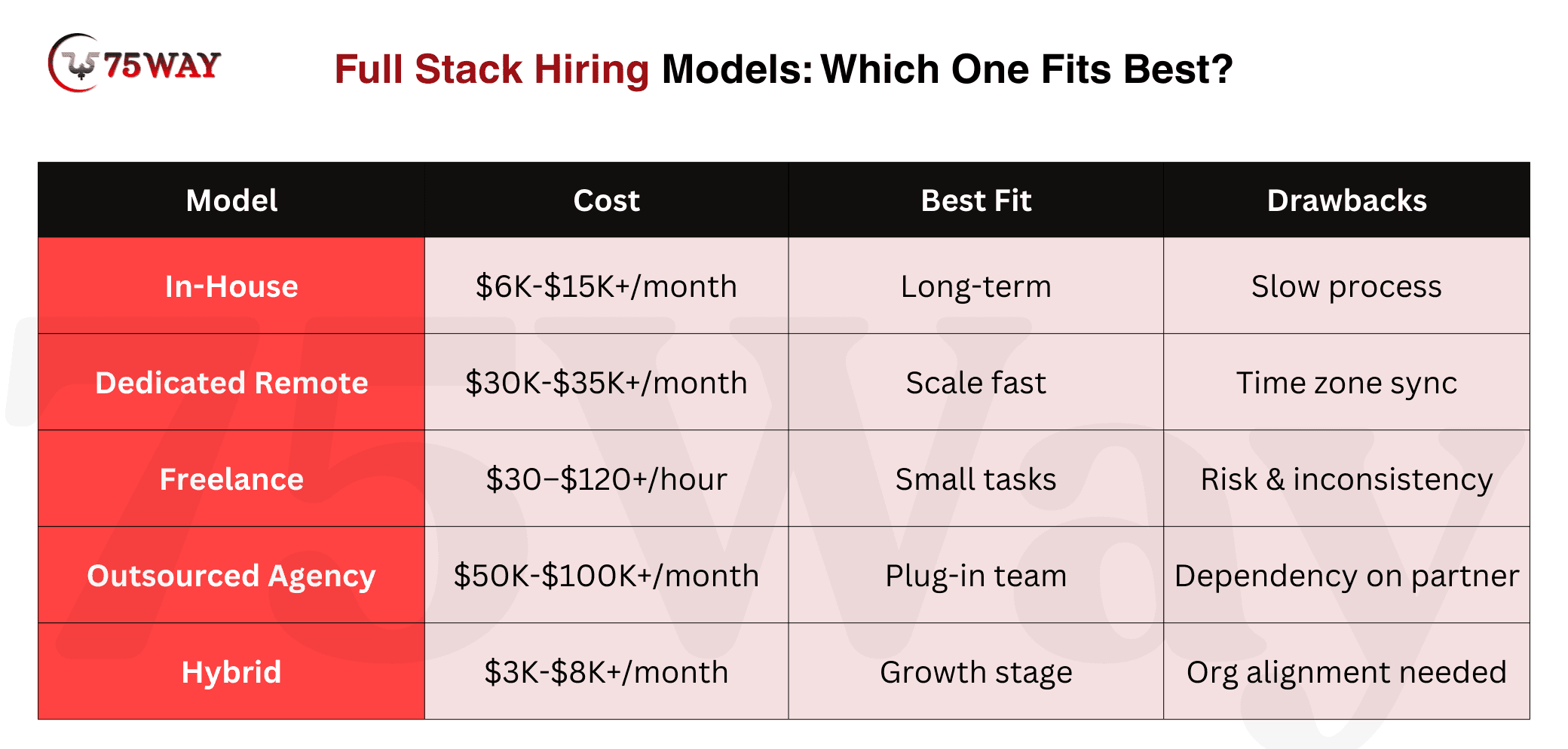
The selection of the right hiring model is critical for balancing cost, speed, and efficiency in your SaaS development. In-house developers work from your office, providing long-term stability and deep alignment with your company culture, but the hiring process can be slow and resource-intensive. Dedicated remote developers offer faster scaling and access to global talent, though time zone differences may require coordination. Freelancers are ideal for small, short-term tasks, but they carry risks of inconsistency and limited commitment.
Outsourced agencies provide pre-vetted teams that can plug into your project quickly, making them ideal for fast delivery, though you may face dependency on the partner for ongoing support. Hybrid models combine in-house and remote talent, offering flexibility for growing SaaS companies, but organizational alignment and communication are crucial to avoid bottlenecks. By evaluating project needs, timelines, and budget, SaaS founders can choose the hiring model that maximizes productivity while minimizing risks.
- Development rates in the USA typically range from $60–$150+ per hour.
- In Canada, hourly development costs generally fall between $60–$140+.
- Western Europe charges approximately $50–$120+ per hour for development services.
- Eastern Europe and Latin America offer rates ranging $30–$80 per hour.
- India and Southeast Asia provide affordable development services at $20–$50+ hourly.
Read Also: Top 10 IoT Development Companies in USA
Where to Find and Source Full Stack SaaS Talent?
Finding top-tier full-stack developers for your SaaS project requires exploring multiple talent sources. Each platform or community has unique advantages, helping you connect with skilled developers who match your technical and product needs.
Talent Platforms: Professional talent platforms like LinkedIn, Toptal, and Arc.dev give access to pre-vetted developers with detailed profiles, portfolios, and work histories. These platforms are ideal for finding experienced full-stack developers quickly while filtering by skills, experience, and SaaS expertise.
Industry-Specific Portals: Niche portals like TechCrunch Talent and AngelList Jobs focus on the startup and SaaS ecosystem. They attract candidates who understand product-driven environments and are familiar with fast-paced development cycles, making them ideal for founders seeking highly motivated talent.
Remote Talent Marketplaces: Freelance marketplaces such as Upwork and Freelancer offer access to developers worldwide. These platforms are best for short-term projects, MVP development, or augmenting your in-house team with specialized skills while maintaining flexibility and cost efficiency.
Technical Communities: Active participation in developer communities like GitHub, Stack Overflow, and Dev. to helps you identify contributors with real-world coding experience. Reviewing open-source contributions, problem-solving skills, and community reputation provides insight into a candidate’s expertise and SaaS development capabilities.
Know More: How AI Development Help US Companies Scale Faster
Offshore Vs Onsite Vs Hybrid Hiring for SaaS Development
Choosing the right hiring approach can significantly impact project efficiency, costs, and team collaboration.
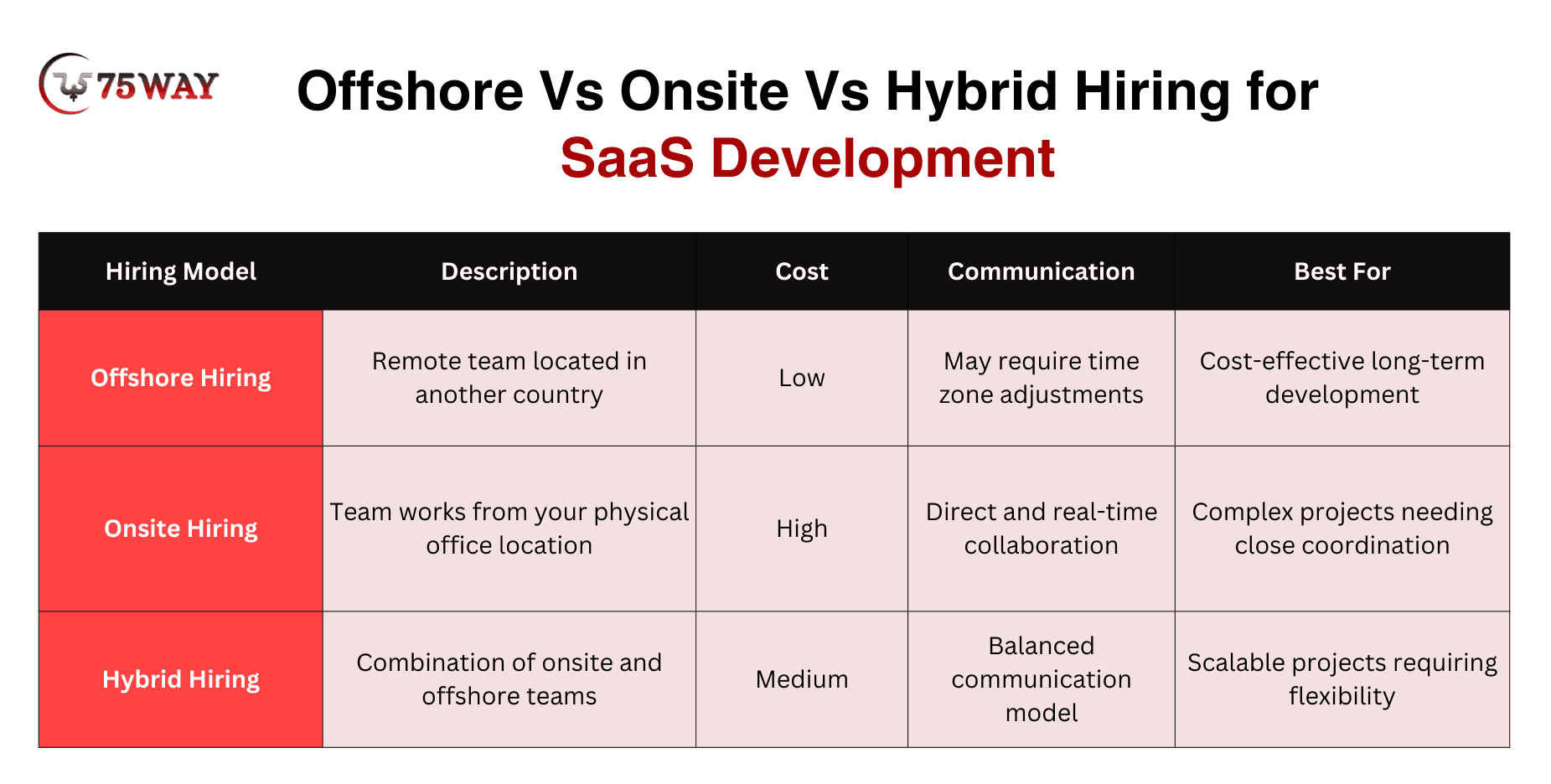
Offshore hiring allows SaaS companies to access a global talent pool at a lower cost. Developers work remotely from another country, which makes it ideal for long-term, cost-effective projects. However, managing offshore teams may require careful planning around time zone differences, communication channels, and cultural nuances to ensure smooth collaboration.
On-site hiring, on the other hand, involves bringing developers into your physical office. This model provides direct, real-time communication and close supervision, making it the best fit for complex projects that require frequent coordination.
Hybrid hiring combines both onsite and offshore teams, offering flexibility and scalability. It balances cost and collaboration, making it ideal for SaaS companies with growing projects that need a mix of local oversight and remote expertise. Choosing the right model depends on project complexity, budget, and your company’s long-term development goals.
Learn More: How to Start a Taxi Business? Guide for Beginners
Common Hiring Mistakes Every SaaS Company Must Avoid
Hiring the right full-stack developer is critical for SaaS success, but many companies make avoidable mistakes that can delay development, increase costs, or limit scalability. A single wrong hire can slow down your roadmap, affect product quality, and impact user satisfaction. Awareness of these common pitfalls helps founders and business leaders make informed hiring decisions and build high-performing SaaS teams.
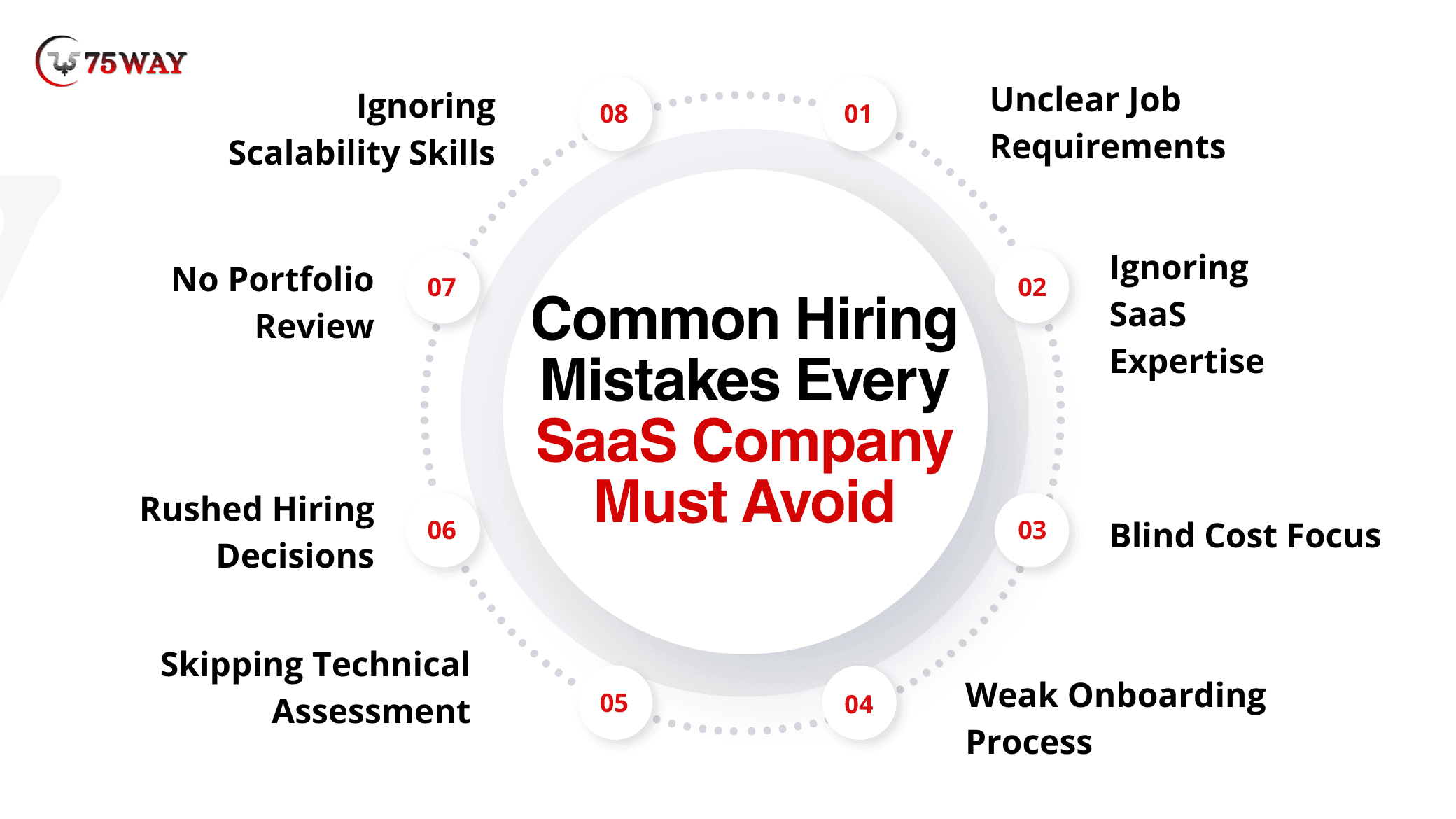
Unclear Job Requirements: Vague or incomplete job descriptions confuse candidates and attract unqualified applicants. Clearly define technical skills, SaaS experience, project scope, and desired outcomes to ensure alignment and reduce wasted time during hiring.
Ignoring SaaS Expertise: Developers without SaaS-specific experience may struggle with multi-tenant architecture, cloud scalability, or subscription-based models. Prioritize candidates who understand the unique challenges of SaaS platforms for long-term product success.
Blind Cost Focus: Choosing developers solely based on low rates can compromise quality, lead to delays, and increase technical debt. Balance cost with experience, skillset, and reliability to get the best ROI for your project.
Weak Onboarding Process: Even skilled developers need a structured onboarding plan. Without clear roles, access to tools, and project orientation, productivity drops, and errors increase. A strong onboarding process accelerates contributions and aligns developers with your goals.
Skipping Technical Assessment: Relying only on resumes or interviews overlooks real-world capabilities. Coding tests, architecture challenges, and problem-solving scenarios help validate technical expertise and SaaS readiness before making a hiring decision.
Rushed Hiring Decisions: Hiring under pressure often leads to poor cultural fit, skill mismatches, and higher turnover. Take the time to evaluate candidates thoroughly to ensure long-term team stability and product success.
No Portfolio Review: Ignoring a candidate’s past projects prevents assessment of their practical skills and SaaS experience. Reviewing portfolios or case studies provides insights into their coding quality, architecture approach, and ability to deliver complex solutions.
Ignoring Scalability Skills: Developers who do not understand scalable systems may create products that fail under growth. You must ensure candidates have experience in automated scaling, cloud infrastructure, and performance optimization to future-proof your SaaS application.
More Insights: Candy AI Chatbot Development Cost in 2026: Complete Breakdown
Conclusion
Hiring the right full stack developer is the backbone of any successful SaaS product. By following a structured, step-by-step process, defining project requirements, evaluating technical and SaaS-specific skills, choosing the right hiring model, and avoiding common pitfalls, founders and business leaders can ensure faster MVP launches, smoother feature deployment, and scalable, high-performing applications. A carefully selected developer not only reduces bugs and accelerates product growth but also strengthens technical ownership and long-term reliability. Partnering with a trusted SaaS development company simplifies recruitment, provides access to top-tier talent, and ensures your product remains competitive in a dynamic market.
Frequently Asked Questions (FAQ)
What Questions To Ask In SaaS Developer Interviews?
When interviewing full-stack developers for a SaaS company, focus on questions that evaluate technical expertise, problem-solving ability, and SaaS-specific knowledge. Ask about designing multi-tenant architectures, optimizing databases for scalability, integrating APIs, handling cloud deployments, and working in Agile teams. This approach ensures candidates can deliver both code quality and product-focused solutions.
What Is The Best Platform For Hiring Full Stack Saas Devs?
The ideal platform depends on your hiring model. Professional networks like LinkedIn provide access to experienced developers. Niche platforms like Total and Arc.dev offer pre-vetted SaaS specialists. Freelance marketplaces such as Upwork and Freelancer are useful for short-term projects or MVP development. Combining multiple sources often yields the best talent.
How Do I Hire A Full-Stack Developer For A SaaS Startup?
Start by defining your project requirements, desired skill set, and SaaS-specific expertise. Decide on the hiring model, freelance, remote, in-house, or hybrid, based on budget and project complexity. Screen candidates through real coding tests, technical interviews, and SaaS problem-solving scenarios. A structured onboarding process ensures immediate productivity and long-term contribution.
What Skills Should A SaaS Full-Stack Developer Have?
A strong full-stack developer should have front-end skills (React.js, Angular, Vue.js), back-end expertise (Node.js, Python, .NET), database management (SQL, NoSQL), API integration, DevOps basics, and SaaS-specific knowledge such as multi-tenant architecture, automated sca ling, cloud platforms (AWS, GCP, Azure), security, and compliance. Soft skills like a product mindset, communication, and Agile experience are equally important.
Should I Hire In-House or Outsource Full-Stack Developers for SaaS?
The choice depends on project goals, budget, and team structure. In-house developers are ideal for long-term, strategic projects requiring close collaboration. Outsourcing or dedicated remote developers offer scalability, cost efficiency, and access to global talent. Hybrid models balance both approaches, providing flexibility while maintaining alignment with your SaaS product vision.