AI Summary
This guide explains how to build a Starla-like app, covering astrology features, AI integrations, architecture, and development stages. It breaks down US costs and decisions shaping scope. Founders can assess needs and investment before planning launch with confidence.
Key Takeaways
- The global astrology app market will reach $13B by 2032, growing at a 20% CAGR.
- Starla-like app development costs $20,000–$280,000+, depending on scope and complexity.
- AI-powered astrology features enable personalized readings, predictions, and conversations.
- Scalable architecture supports birth-chart calculations, AI integrations, and personalization.
- Strategic development stages help control budgets, timelines, and launch risks.
A daily horoscope can tell someone what their zodiac sign might experience, but what if they want to ask,
"Does my birth chart say anything about my career?" or
"Why do I keep facing the same relationship challenges?"
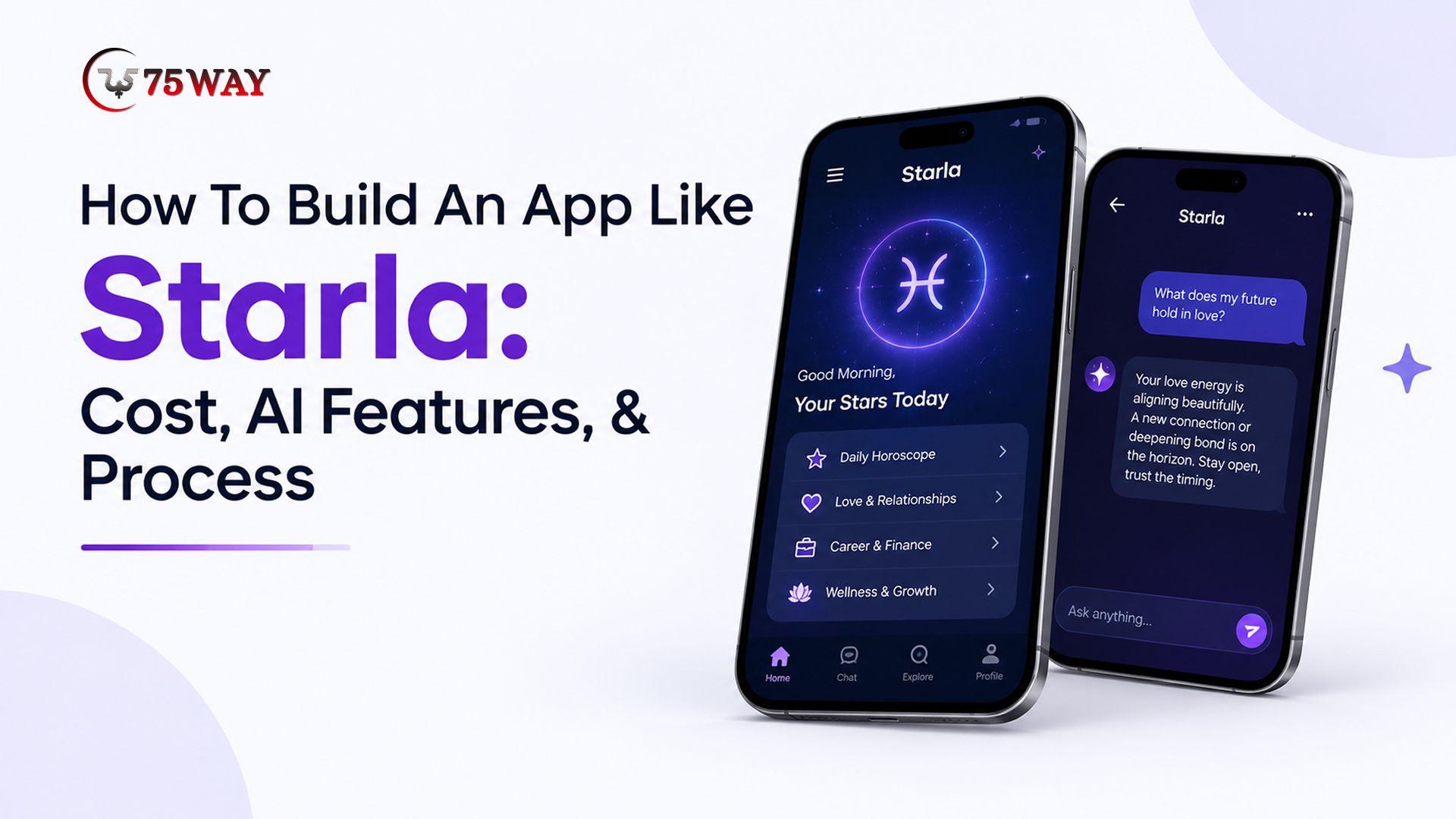
That's where an astrology app like Starla creates a different experience by bringing AI conversations into astrology. For businesses, this opens up an opportunity to build an app like Starla that gives users a reason to return with new questions.
The interesting part is how you make those conversations useful.
If you're planning Starla clone app development, this guide will help you understand the complete picture. We'll define how to develop an app like Starla, its essential features, AI integration, estimated development costs, and possible revenue streams.
What Is Starla? How It Works?
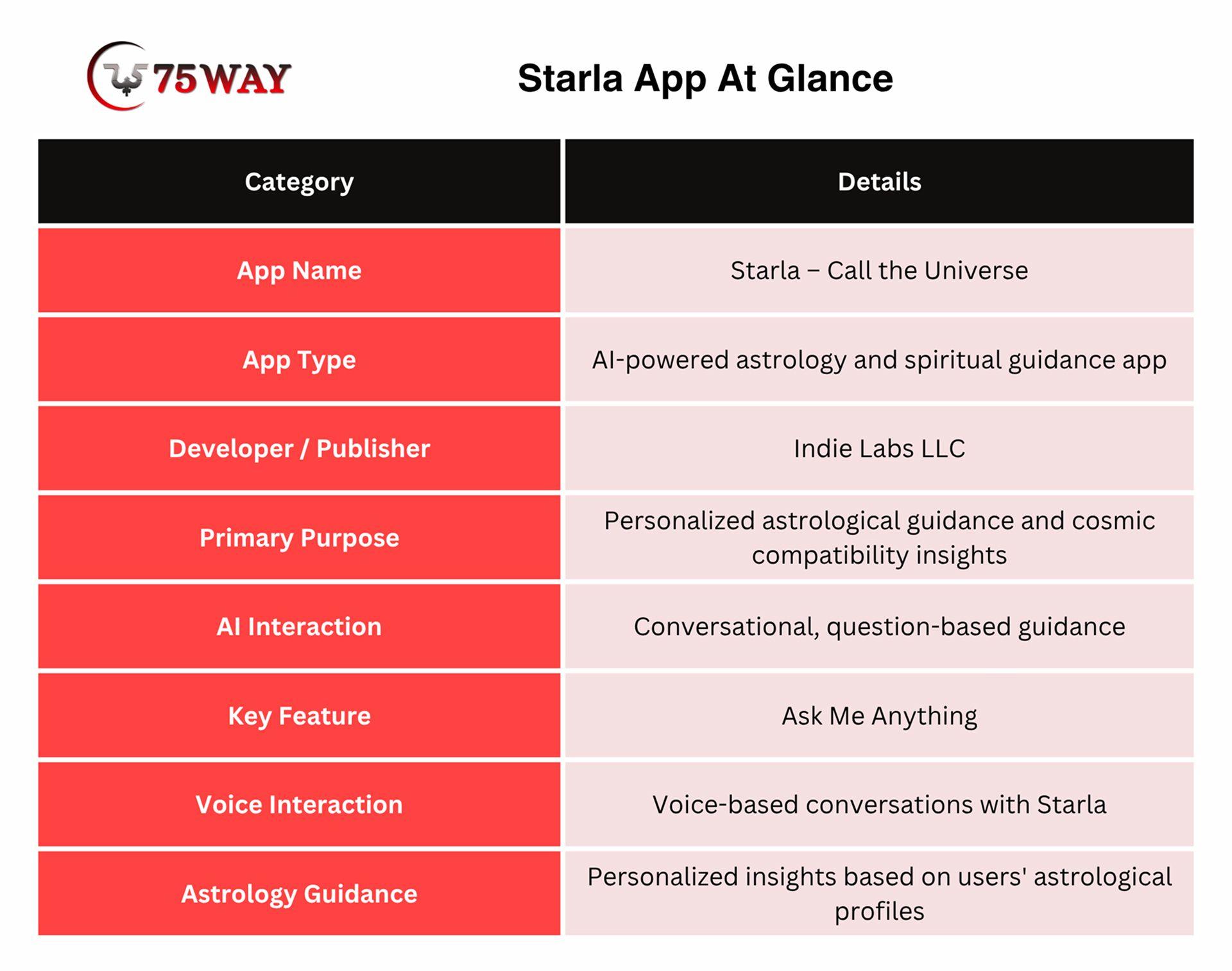
Starla (Starla – Call the Universe) is an AI-powered astrology and soulmate drawing app developed and published by Indie Labs LLC.
It combines personalized astrological guidance with conversational AI, voice interactions, and relationship compatibility insights.
During its initial viral surge on TikTok in mid-2025, the app reportedly accumulated approximately 2.2 million downloads.
Moreover, it is an astrology companion that lets users ask questions, receive guidance based on their astrological profiles, and explore cosmic connections. Here is a quick overview of the app and its key offerings.
An astrology application does not need to function as a traditional horoscope library. It can combine personalized data, interactive AI, voice experiences, and visual features to create a more engaging product.
For founders, the opportunity lies in developing an original experience around these capabilities instead of copying another application's branding, content, or interface.
Why Invest In Building An AI Astrology App Like Starla In The USA?
An AI astrology app development solution like Starla can offer US users more than daily horoscopes by giving them personalized guidance whenever they have questions about life, relationships, or careers. For businesses, this creates an opportunity to enter a growing digital astrology space with a more engaging product. Here’s why investing in a Starla-like app in the USA could be a promising business decision.
- The app attracted more than 2.2 million users during its initial growth phase, with cumulative downloads reportedly crossing the same milestone.
- Weekly downloads peaked at approximately 430,000, highlighting strong early adoption.
- Consumer spending exceeded $2.5 million soon after launch, while monthly or periodic revenue crossed $1 million, with some daily earnings topping $124,000.
- The app secured the No. 1 position in the U.S. App Store’s Lifestyle category.
- Growth was largely fueled by a $14.99 monthly subscription plan and focused promotional campaigns through TikTok micro-influencers.
For US-based founders, several business opportunities make this category worth evaluating.
1. Growing Demand For Personalized Digital Experiences
Generic horoscope content offers limited differentiation.
Personalized birth-chart interpretations, compatibility reports, and conversational experiences give businesses more opportunities to develop products around individual user interests.
2. Subscription-Based Revenue Opportunities
An astrology app can offer free daily horoscopes while reserving advanced readings, AI conversations, compatibility reports, and detailed birth-chart interpretations for paying subscribers.
This creates opportunities for recurring revenue instead of depending entirely on advertising or one-time purchases.
3. AI-Powered Customer Experiences
Generative AI can make astrology applications more interactive by allowing users to ask questions, explore different topics, and receive responses based on their saved astrological profiles.
However, AI should interpret verified astrological data rather than independently inventing planetary positions or birth-chart calculations.
4. Multiple Product Expansion Opportunities
Once the core application establishes an active audience, businesses can introduce additional services, such as:
- Premium relationship and compatibility reports.
- Personalized astrology consultations.
- AI-generated astrology illustrations.
- Birth-chart and transit analysis.
- Voice-based astrology interactions.
- Personalized astrology content subscriptions.
These opportunities can help founders expand their product offering without rebuilding the entire application.
Quick Read: CHANI-Like Astrology App Development: Process, Features, Tech Stack, & Cost
How Does The Architecture of A Starla-Like App Work?
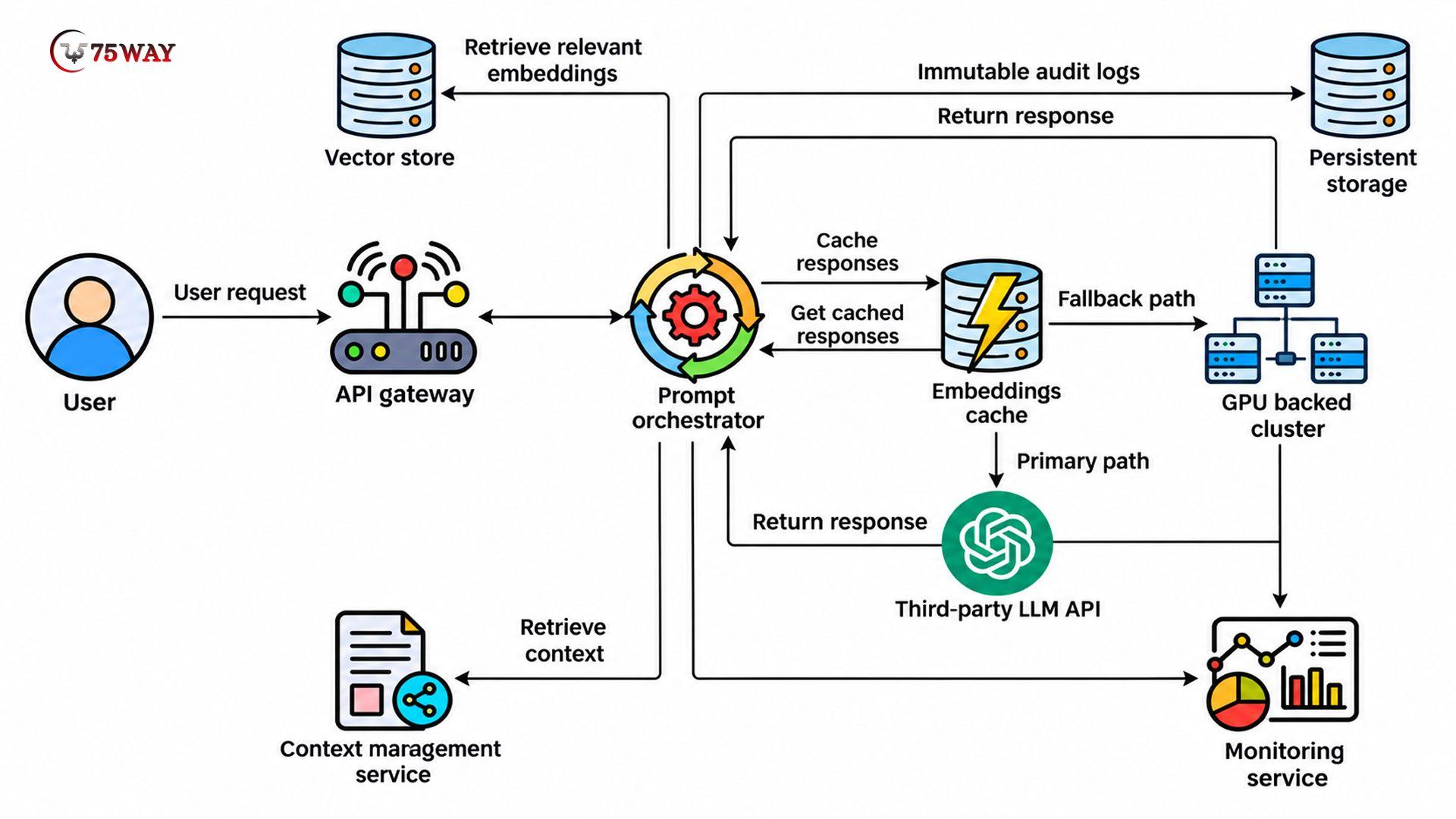
The architecture determines how different components communicate and process user requests. A Starla-like application requires a clear separation between mobile interfaces, backend services, astrology calculations, AI processing, and data storage.
1. Mobile Application Layer
This is the user-facing component developed using Swift, Kotlin, Flutter, or React Native.
It manages:
- User registration and onboarding.
- Astrology dashboards and charts.
- AI chat and voice interactions.
- Compatibility reports.
- Subscription screens and settings.
2. API Gateway And Authentication Layer
The API gateway receives requests from the mobile application and routes them to the appropriate backend services.
Authentication services verify user identities and control access to personal information.
Developers can implement token-based authentication, secure session management, rate limiting, and API authorization.
3. Backend Business Logic Layer
The backend coordinates the application's main operations.
For example, when a user requests a birth-chart interpretation, the backend retrieves their birth details, checks whether the chart already exists, and requests the necessary calculations.
It also manages subscription entitlements, user preferences, notifications, and conversation history.
4. Astrology Calculation Layer
This layer processes birth information and generates structured astrological data.
It handles planetary positions, houses, zodiac signs, and aspects according to the application's selected calculation methodology.
Separating this service from the AI layer makes calculations easier to test and update.
5. AI Orchestration Layer
This layer connects the application's AI capabilities.
It can manage:
- LLM API requests.
- RAG-based knowledge retrieval.
- Conversation context.
- Personalized prompts.
- AI response validation.
- Voice and image-generation workflows.
The orchestration layer should also manage model selection, usage limits, timeouts, and fallback responses.
6. Database And Cloud Infrastructure Layer
This layer stores and manages application information, including user profiles, birth charts, subscriptions, conversations, and generated media.
It also supports backups, monitoring, access control, and application scaling.
Discover More:Best Astrology Apps In USA: Features, Services, & User Experience
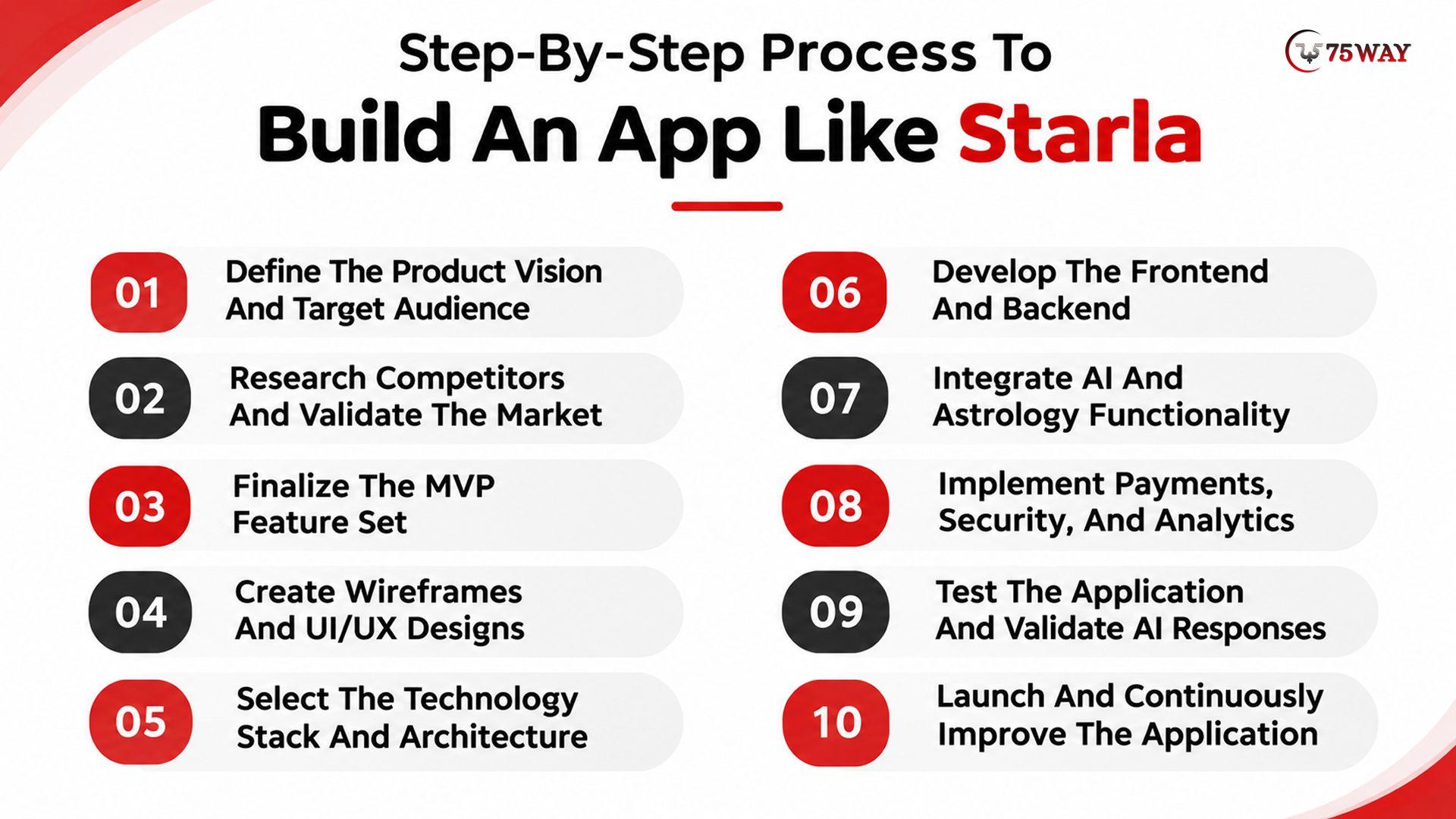
Step-By-Step Process To Build An App Like Starla
The idea of building a Starla-style AI astrology app might sound simple until you start planning its chatbot, birth chart system, user profiles, and personalized predictions. Each component needs to work together to deliver the kind of experience users expect from an app like Starla. A closer look at the development steps will help you understand what to build first and how to move from concept to launch.
Step 1: Define The Product Vision And Target Audience
Start by identifying the problem your application intends to solve and the audience it will serve.
An astrology application designed for casual horoscope readers will require a different feature set from one targeting users interested in detailed birth-chart interpretations and AI-powered conversations.
Define:
- Target user demographics and interests.
- Primary application purpose.
- Core user problems.
- Competitor positioning.
- Revenue model.
- Initial launch platforms.
For example, a startup may target US users interested in relationship compatibility and personalized astrology guidance. Its MVP can focus on birth-chart creation, AI interpretations, and compatibility reports.
Deliverable: Product requirement document, target audience definition, and initial feature roadmap.
Step 2: Research Competitors And Validate The Market
Competitor research helps identify existing product experiences, monetization approaches, and gaps that your application can address.
Study astrology applications such as:
- Co–Star.
- The Pattern.
- Nebula.
- Starla.
Compare their onboarding processes, personalization features, subscription offerings, user reviews, and application experiences.
However, avoid copying their interfaces or proprietary content. The purpose is to identify opportunities for differentiation.
Deliverable: Competitor analysis, feature comparison, and product positioning strategy.
Step 3: Finalize The MVP Feature Set
Building every advanced feature at once can increase development costs and delay the launch.
Instead, identify the smallest feature set that can deliver a complete user experience and validate demand.
An initial MVP could include:
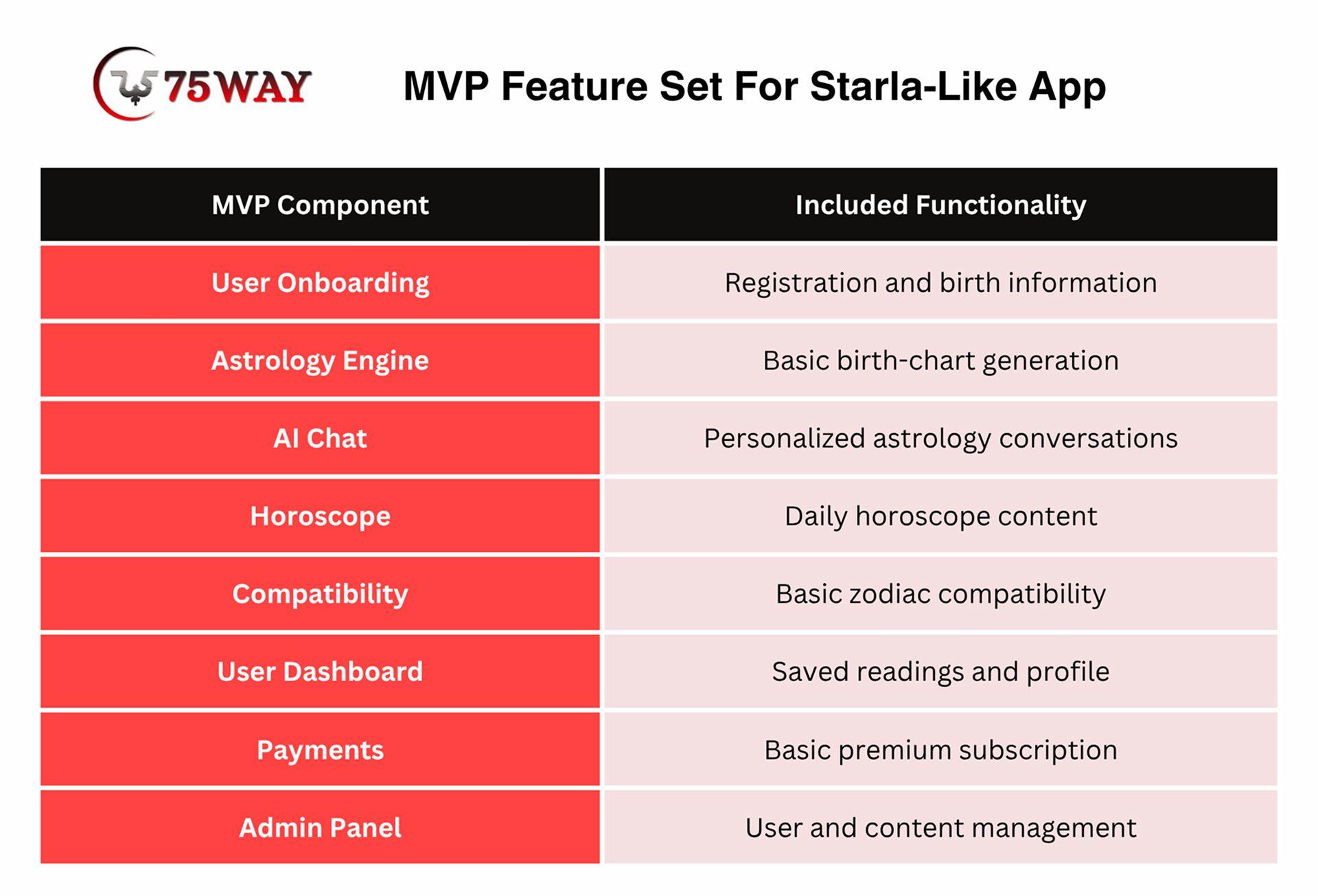
Advanced voice conversations, AI-generated soulmate portraits, and complex personalization can be introduced after the initial product receives user feedback.
Deliverable: Approved MVP scope and prioritized product backlog.
Step 4: Create Wireframes And UI/UX Designs
Once the MVP scope is finalized, the design team creates the application's user experience.
For an astrology application, the interface should communicate personalization and make complex astrological information easy to understand.
Important design areas include:
- Welcome and onboarding screens.
- Birth information forms.
- Astrology dashboard.
- Birth-chart visualization.
- AI conversation interface.
- Compatibility results.
- Subscription and payment screens.
The team should create clickable prototypes and test them with representative users before beginning full-scale development.
Deliverable: Wireframes, design system, high-fidelity screens, and interactive prototype.
Step 5: Select The Technology Stack And Architecture
Technology selection should follow the product requirements rather than personal developer preferences.
For example, a startup launching on iOS and Android with a limited initial budget might consider Flutter or React Native. A platform requiring deeper native integrations may benefit from separate Swift and Kotlin development.
The team should finalize:
- Mobile development framework.
- Backend programming language.
- Database and cloud provider.
- Astrology calculation engine.
- AI model and integration approach.
- Authentication and payment services.
- Monitoring and analytics tools.
Deliverable: Technical specification, architecture diagram, and development roadmap.
Step 6: Develop The Frontend And Backend
Frontend and backend development can proceed in parallel after the primary architecture and API contracts are approved.
Frontend developers implement the mobile interfaces, while backend engineers build the APIs, authentication, database operations, and application logic.
The development team should prioritize the complete user journey instead of developing isolated screens without functional integration.
For example, the birth-information form should connect to the backend, trigger the astrology calculation service, and display the generated chart within the user's dashboard.
Deliverable: Functional mobile application and integrated backend services.
Step 7: Integrate AI And Astrology Functionality
This stage brings the application's intelligent features together.
Developers integrate the selected LLM, connect the astrology calculation engine, configure contextual prompts, and implement the required personalization workflows.
A typical AI request can follow this sequence:
- User submits an astrology-related question.
- Backend authenticates the user and checks access.
- Application retrieves the relevant birth-chart information.
- AI orchestration retrieves supporting knowledge when required.
- The selected LLM generates an interpretation.
- Output validation checks the response.
- Application displays or speaks the response.
For voice and image-generation functionality, separate processing pipelines should handle audio and visual requests.
Deliverable: Integrated AI chatbot, astrology interpretation workflows, and advanced AI capabilities.
Step 8: Implement Payments, Security, And Analytics
Before release, the application needs complete payment workflows, security controls, and analytics.
For subscriptions, implement purchase validation, entitlement management, renewal handling, and cancellation support.
Security implementation should include:
- Encryption in transit and at rest.
- Secure authentication and authorization.
- API rate limiting.
- Access controls for personal data.
- Secure handling of payment information.
- Data retention and deletion workflows.
Analytics should track onboarding completion, active users, subscription conversion, AI usage, and feature engagement.
Deliverable: Production-ready payment, security, and analytics functionality.
Step 9: Test The Application And Validate AI Responses
Testing should cover both conventional application functionality and AI-specific behavior.
A birth-chart calculation may be technically correct while its AI interpretation is misleading. Similarly, an AI response may sound natural but fail to use the user's actual birth-chart information.
Therefore, test the application using a combination of functional tests and AI evaluation.
Create a representative test dataset containing different birth dates, locations, time zones, and daylight saving scenarios.
Deliverable: QA report, resolved defects, and release approval.
Step 10: Launch And Continuously Improve The Application
Once testing is complete, prepare the application for distribution through the Apple App Store and Google Play.
The launch process includes store listing preparation, privacy disclosures, subscription configuration, release builds, and production monitoring.
After launch, use real user behavior to identify improvement opportunities.
Monitor:
- App installation and onboarding completion.
- Daily and monthly active users.
- AI conversation frequency.
- Subscription conversion.
- Monthly recurring revenue.
- Churn and subscription cancellation.
- AI cost per active user.
- Crash rates and application performance.
A successful launch is the beginning of product development, not the end. Regular updates should address user feedback, improve AI response quality, and introduce features based on actual demand.
Deliverable: Published application, production monitoring, and post-launch improvement roadmap.
Explore More:
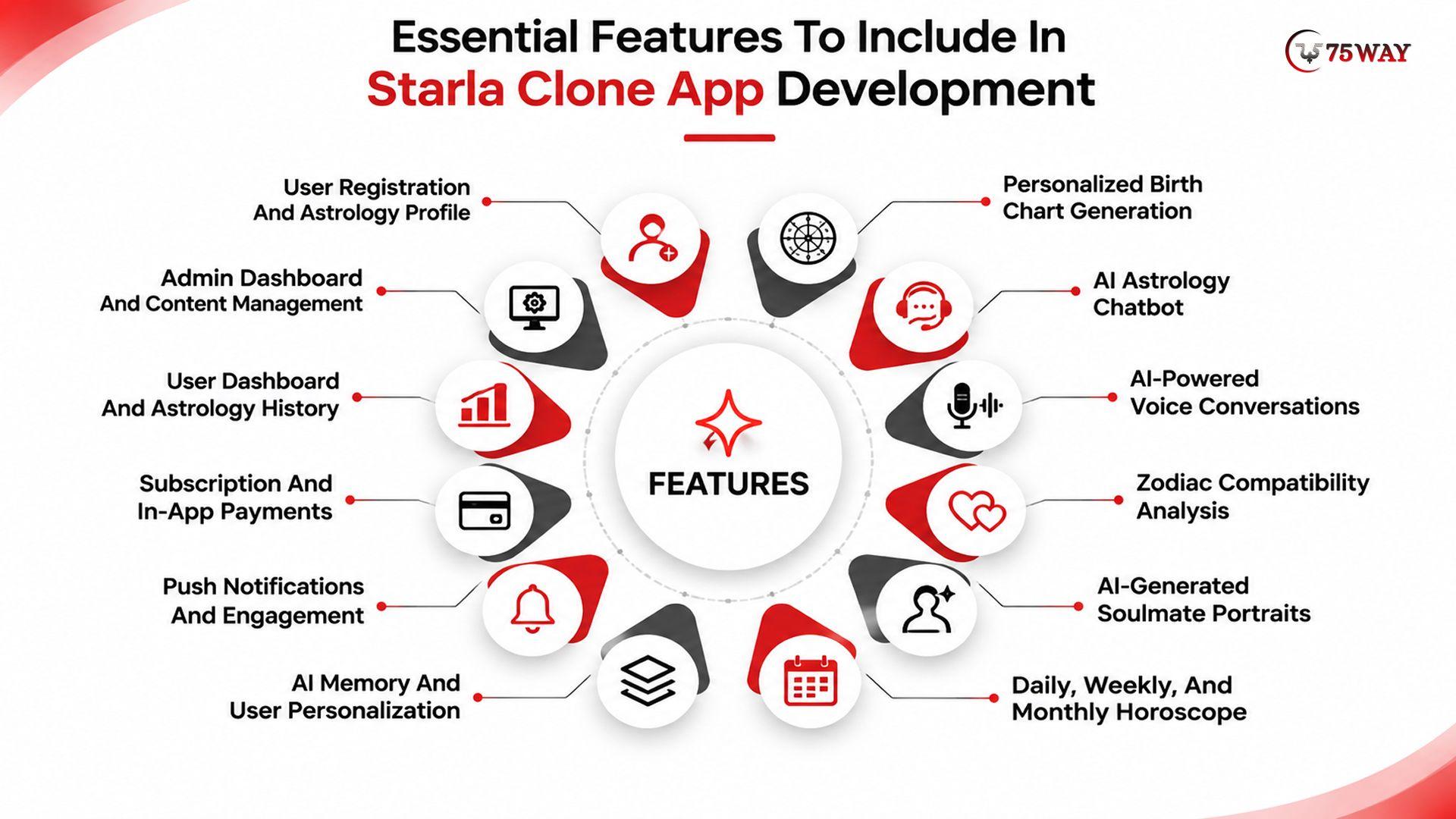
Essential Features To Include In Starla Clone App Development
A Starla-like app needs more than daily horoscopes to keep users interested and coming back with new questions. Here are the essential features to consider when developing your own Starla clone app.
1. User Registration And Astrology Profile
User registration is the starting point of the astrology experience. The application needs relevant birth information to generate personalized charts and interpretations.
The onboarding process should collect:
- Name and email address.
- Date of birth.
- Exact or approximate birth time.
- Birthplace and location.
- Preferred astrology system.
- Language and notification preferences.
2. Personalized Birth Chart Generation
A birth chart, also called a natal chart, represents planetary positions at the time and location of a person's birth.
Instead of asking an LLM to calculate planetary placements, developers should integrate an established astronomical or astrology calculation engine.
The feature can display:
- Sun, Moon, and rising signs.
- Planetary placements and houses.
- Zodiac signs and planetary aspects.
- Natal chart interpretations.
- Important astrological combinations.
3. AI Astrology Chatbot
An AI astrology chatbot allows users to ask questions about relationships, careers, personal interests, and other topics through a conversational interface.
For example, a user might ask, "What does my birth chart suggest about my relationships?"
The application can retrieve relevant astrological information from the user's profile and provide an interpretation through a connected language model.
4. AI-Powered Voice Conversations
Voice interaction can make an astrology application feel more like a personal companion than a conventional information platform.
Users should be able to speak questions, receive spoken responses, and continue conversations without repeatedly typing.
The feature generally requires:
- Speech-to-text processing.
- AI response generation.
- Text-to-speech conversion.
- Voice session management.
- Audio streaming and playback controls.
5. Zodiac Compatibility Analysis
Compatibility analysis allows users to compare their birth charts with another person's astrological profile.
For example, users can enter another person's birth information to explore romantic or friendship compatibility.
The feature can include:
- Zodiac sign compatibility.
- Planetary aspect comparisons.
- Relationship interpretations.
- Synastry chart generation.
- Personalized compatibility reports.
6. AI-Generated Soulmate Portraits
An AI image-generation feature can create personalized soulmate illustrations based on user inputs and a defined creative prompt.
The application can collect selected preferences, generate an image through an external image-generation service, and display the result within the user's account.
7. Daily, Weekly, And Monthly Horoscope
Horoscope functionality gives users a reason to revisit the application regularly.
The application can provide personalized readings using zodiac signs, natal chart information, and relevant planetary transits.
Useful content categories include:
- Daily horoscope.
- Weekly predictions.
- Monthly astrology reports.
- Love and relationship readings.
- Career and financial themes.
8. AI Memory And User Personalization
An astrology companion becomes more useful when it can refer to relevant information from previous conversations.
For example, if someone previously discussed relationship compatibility, the application could retrieve that conversation when the user asks a related follow-up question.
This functionality requires:
- Conversation history storage.
- User preference management.
- Context retrieval.
- Memory summarization.
- User-controlled memory settings.
9. Push Notifications And Engagement
Push notifications can encourage users to revisit the application for daily readings, new reports, and unfinished activities.
Examples include personalized horoscope alerts, new compatibility reports, and reminders selected by users.
10. Subscription And In-App Payments
A subscription system allows businesses to monetize premium astrology experiences.
Potential subscription benefits include:
- Unlimited or higher-volume AI conversations.
- Detailed natal chart reports.
- Advanced compatibility analysis.
- Premium horoscope content.
- Additional AI-generated portraits.
11. User Dashboard And Astrology History
A personalized dashboard brings important information into one place.
Users should be able to access their birth charts, saved conversations, previous readings, compatibility reports, and subscription details.
12. Admin Dashboard And Content Management
An administrative dashboard gives the business team control over application operations.
It should support:
- User and subscription management.
- Horoscope and content management.
- AI prompt configuration.
- Usage and revenue analytics.
- Customer support requests.
- Moderation and reporting.
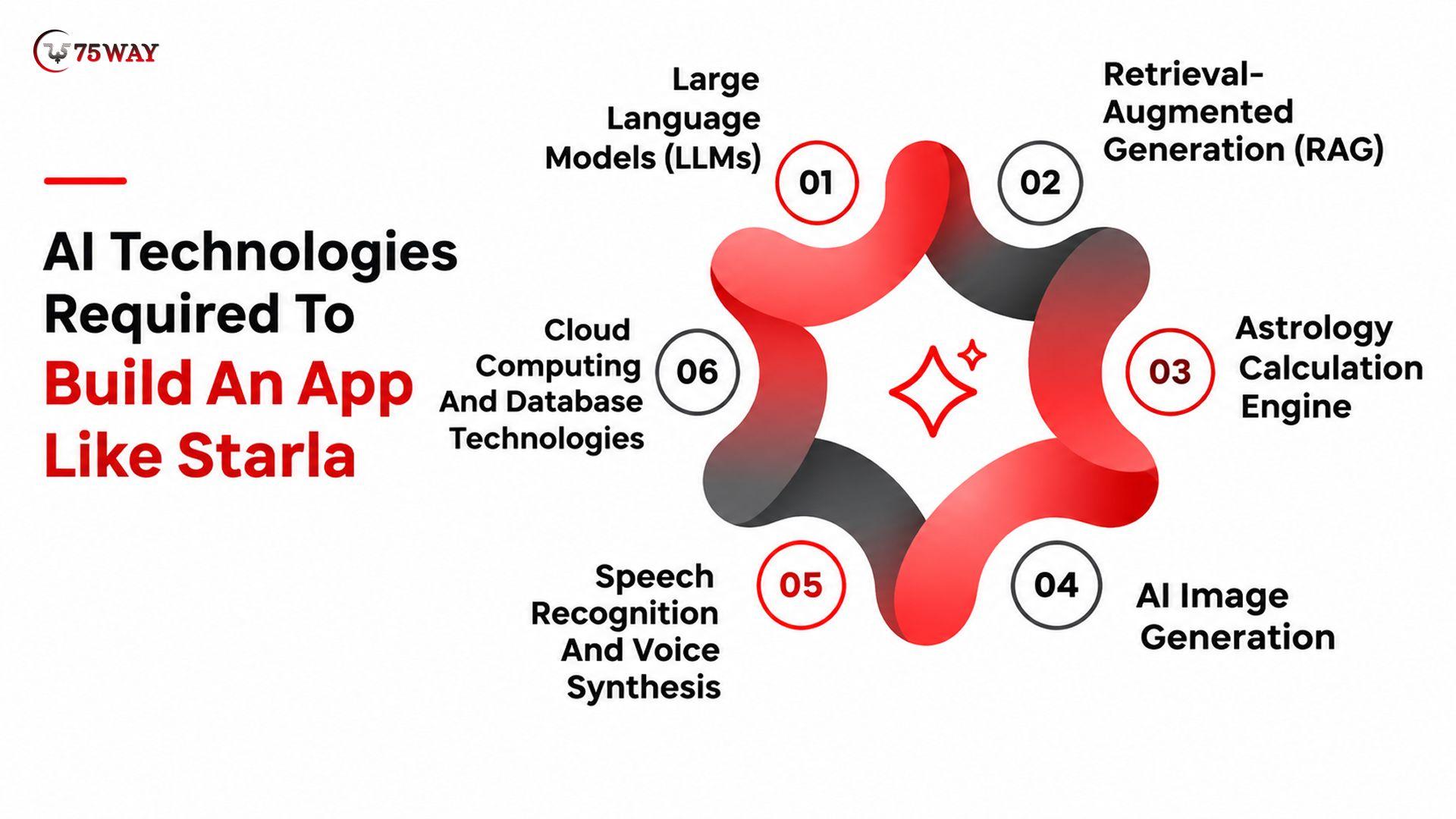
AI Technologies Required To Build An App Like Starla
An app like Starla needs several AI technologies working together to deliver personalized astrology conversations and meaningful readings. From large language models that understand user questions to recommendation systems that tailor insights, each technology has a specific role. Let’s explore the technologies that can bring a Starla-like experience to life.
1. Large Language Models (LLMs)
LLMs understand user questions, interpret conversational context, and generate natural-sounding astrology responses. They power personalized conversations and AI-driven guidance within the application.
2. Retrieval-Augmented Generation (RAG)
RAG retrieves relevant information from an approved astrology knowledge base before generating responses. It helps AI provide context-based explanations using predefined reference material.
3. Astrology Calculation Engine
An astrology calculation engine determines planetary positions, zodiac signs, houses, and aspects using birth details. It provides structured chart data for accurate AI-powered interpretations.
4. AI Image Generation
AI image-generation technology creates personalized soulmate portraits and other visual content based on user preferences. It transforms text prompts into customized images.
5. Speech Recognition And Voice Synthesis
Speech recognition converts users' spoken questions into text for AI processing. Voice synthesis transforms generated responses into natural-sounding audio for interactive conversations.
6. Cloud Computing And Database Technologies
Cloud computing provides the infrastructure to host application services, manage user requests, and store generated content. Databases organize user profiles, birth charts, conversations, and subscription records.
How Much Does It Cost To Build An App Like Starla?
The estimated cost to develop an app like Starla can range from $20,000 to $280,000+, based on the technology stack, integrations, design, and development scope. Here’s what you need to consider before deciding how much to invest in your Starla-like app.
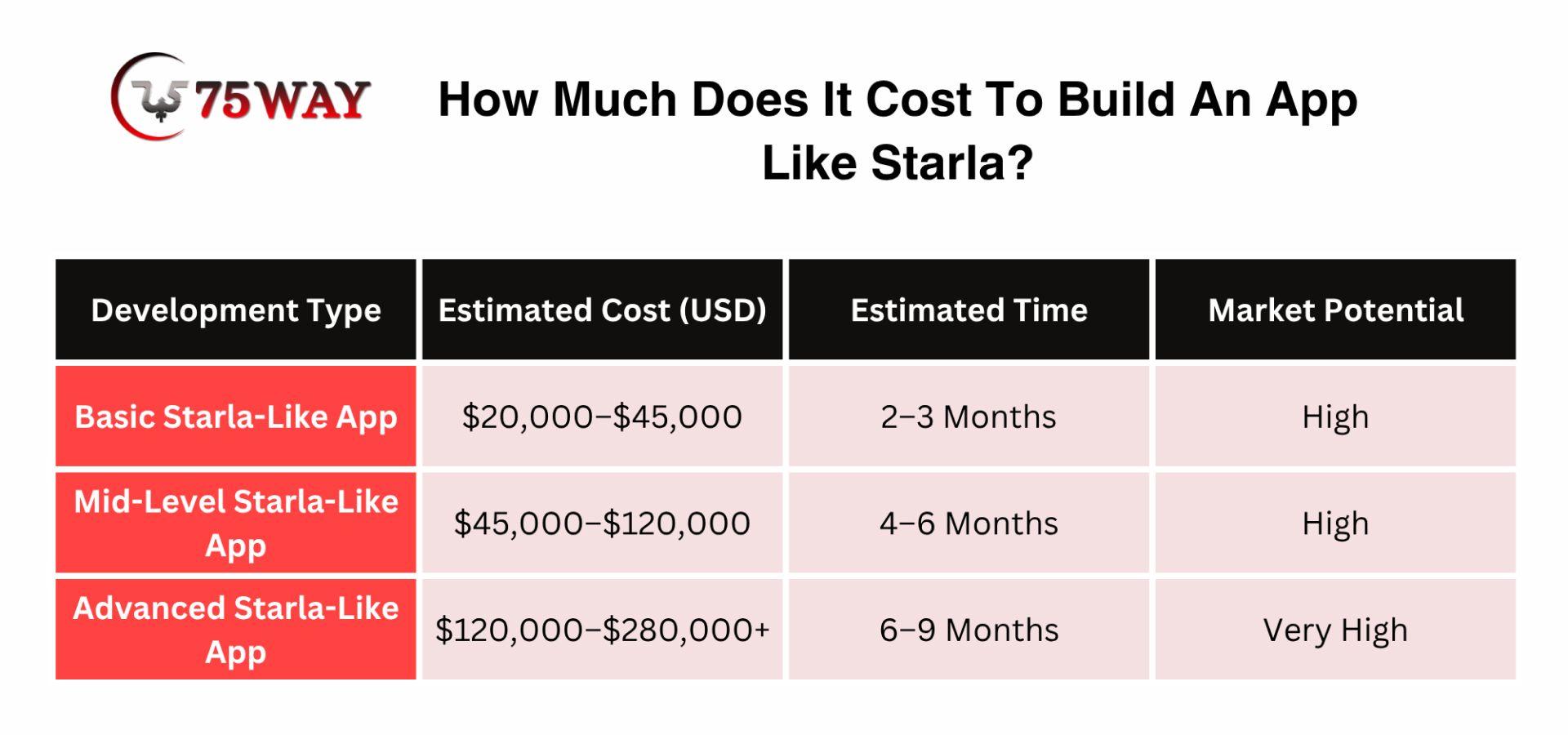
1. Basic Starla-Like App Cost: $20,000 – $45,000
- Offers daily horoscopes and basic astrology readings.
- Includes user registration and birth details.
- Provides essential astrology calculations and notifications.
Estimated Time: 2–3 months
Best For: Early-stage startups validating astrology app concepts.
2. Mid-Level Starla-Like App Cost: $45,000 – $120,000
- Integrates AI chat for personalized astrology conversations.
- Generates birth-chart interpretations and compatibility reports.
- Supports subscriptions, payments, and user personalization.
Estimated Time: 4–6 months
Best For: Growing startups launching commercial astrology platforms.
3. Advanced Starla-Like App Cost: $120,000 – $280,000+
- Supports AI astrologers with contextual memory.
- Generates personalized reports, compatibility insights, and predictions.
- Includes scalable infrastructure, analytics, and integrations.
Estimated Time: 6–9 months
Best For: Established startups and businesses building feature-rich AI astrology platforms.
👉 Quick Read:Astrology App Development Cost: Complete Pricing Breakdown For Businesses
Stage-Wise Cost For Starla Clone App Development In USA
The total cost of building a Starla clone app in the USA becomes easier to plan when you break it down into individual development stages. From market research and UI/UX design to AI integration, testing, and deployment, each phase adds a different expense to your budget. The following breakdown explains the estimated investment required at every stage.
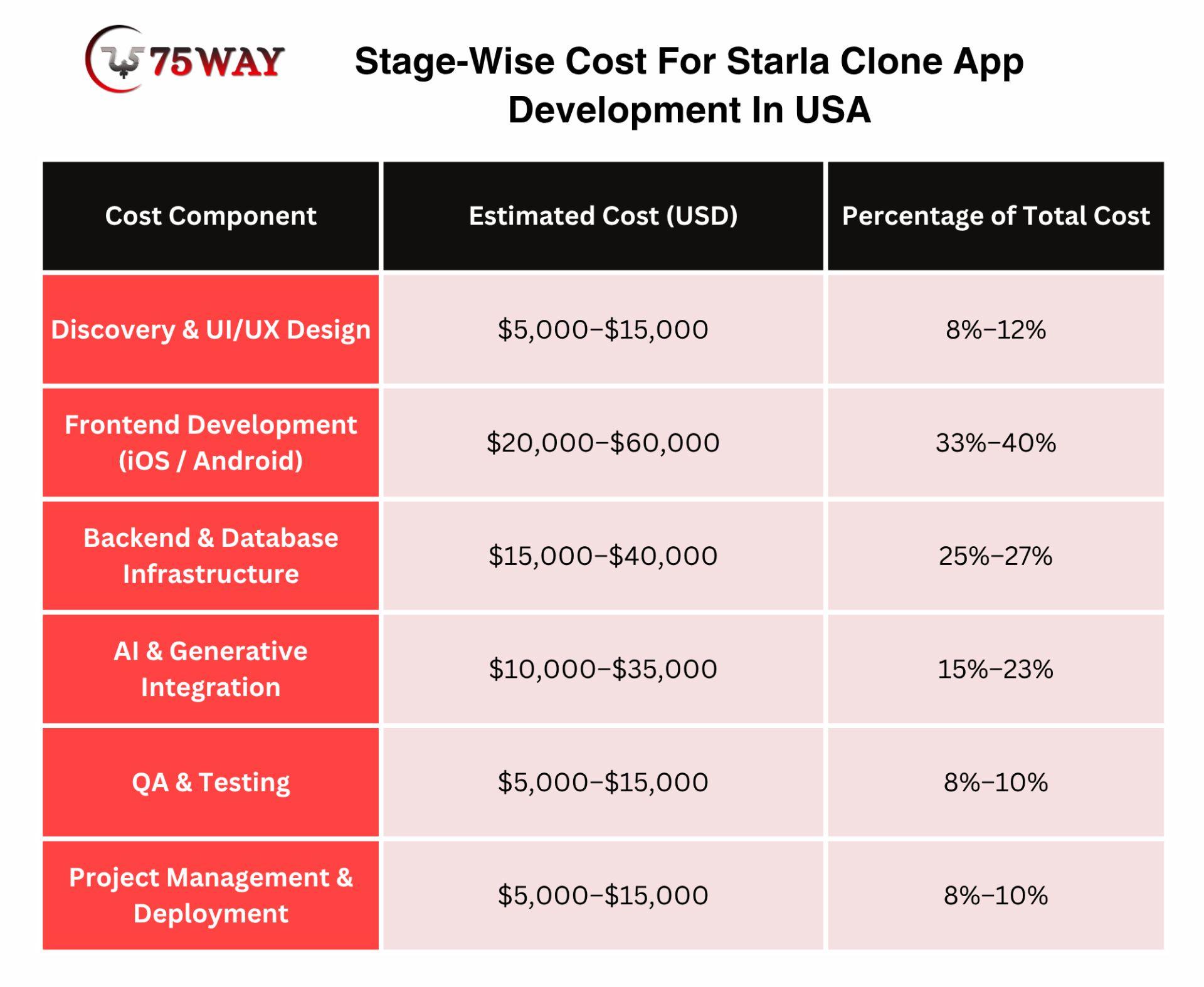
1. Discovery & UI/UX Design: $5,000 – $15,000
This stage covers the planning and design work required before engineering begins. The team identifies the target audience, defines product requirements, maps user journeys, and creates the application's visual experience.
2. Frontend Development (iOS / Android): $20,000 – $60,000
The development approach depends on the business requirements.
- Native Development: Swift for iOS and Kotlin for Android offer platform-specific implementation.
- Cross-Platform Development: React Native and Flutter allow teams to develop applications for multiple platforms using shared code.
The final cost depends on the number of screens, animation complexity, voice functionality, platform-specific requirements, and API integrations.
3. Backend & Database Infrastructure: $15,000 – $40,000
The backend manages the application's business logic, user accounts, astrology data, API communication, and database operations.
A Starla-like application needs a backend capable of managing birth information, chart calculations, AI conversations, subscriptions, and user preferences.
4. AI & Generative Integration: $10,000 – $35,000
AI integration costs depend on the number of intelligent features and how much customization the application requires.
5. QA & Testing: $5,000 – $15,000
Testing ensures that the application works as expected across supported devices, operating systems, and user journeys.
6. Project Management & Deployment: $5,000 – $15,000
- Coordinate engineering milestones, budgets, and stakeholder approvals.
- Manage store submissions, compliance checks, and releases.
The final release should include production configuration, crash monitoring, analytics, and a process for addressing issues identified after launch.
1Which platforms do you want to launch on?
Single choice2What level of application are you planning?
Single choice3Which AI features do you need?
Multiple choice4What is your expected user base?
Single choiceRevenue Models For A Starla-Like Astrology Application
A Starla-like astrology app can generate revenue through more than just paid subscriptions. Personalized AI readings, premium consultations, in-app purchases, and membership plans can give users different ways to access astrology services. Let’s explore the revenue models you can consider to turn your astrology app into a sustainable business.
1. Freemium Model
The freemium model provides basic astrology features at no cost while charging users for advanced functionality.
For example, users can access daily horoscopes and basic zodiac information for free, while detailed birth-chart reports and AI conversations require a premium subscription.
Best For: Startups looking to build an initial user base before introducing paid features.
2. Subscription-Based Model
A subscription model allows users to pay monthly or annually for access to premium features.
Potential subscription benefits include unlimited AI conversations within fair usage limits, personalized astrology reports, advanced compatibility analysis, and voice interactions.
Best For: Businesses seeking predictable recurring revenue.
3. In-App Purchases
In-app purchases allow users to purchase individual digital services without committing to a recurring subscription.
Examples include:
- Personalized compatibility reports.
- Detailed birth-chart interpretations.
- Additional AI-generated portraits.
- Premium astrology readings.
- One-time personalized reports.
Best For: Applications offering specialized astrology services with different pricing levels.
4. Consultation-Based Revenue
Businesses can introduce paid consultations with professional astrologers through the application.
Users can book sessions, select consultation durations, and communicate with astrologers through chat or video.
Best For: Astrology businesses combining automated experiences with human expertise.
5. Advertising-Based Revenue
An application can display relevant advertisements to free users while offering an ad-free premium subscription.
However, advertisements should not interrupt important interactions or reduce the overall user experience.
Best For: Applications with substantial free-user engagement.
75way’s Recommendation: A freemium subscription model with optional one-time purchases is a practical starting point. It gives users an opportunity to experience the application before paying for advanced features.
Read Too:AI Astrology Chatbot App Development: A Step-By-Step Guide
Ongoing Costs After Developing An App Like Starla
The initial development budget is only one part of the investment. Once the application goes live, businesses must account for infrastructure, AI consumption, maintenance, and ongoing product improvements.
1. AI API And Usage Costs
AI expenses depend on how frequently users interact with the application, the models selected, and the complexity of individual requests.
For example, an application offering short daily horoscope interpretations will generally have a different AI consumption profile from one providing long conversational sessions with contextual memory.
Founders should track:
- Average tokens consumed per conversation.
- AI requests per active user.
- Image-generation requests.
- Voice processing duration.
- Model pricing and usage limits.
2. Cloud Hosting And Database Expenses
Cloud infrastructure costs depend on the number of active users, storage requirements, database queries, and backend processing workloads.
As the application grows, businesses may need additional compute capacity, caching, database optimization, and media storage.
3. Maintenance And Updates
Regular maintenance is necessary to address bugs, operating system updates, API changes, security issues, and user feedback.
A maintenance budget should be established separately from the original development investment.
4. Marketing And Customer Acquisition
An astrology application needs a customer acquisition strategy to generate downloads and subscriptions.
Businesses can invest in app store optimization, paid advertising, influencer partnerships, content marketing, and referral campaigns.
Importantly, customer acquisition costs should be evaluated against subscription revenue and customer lifetime value.
How To Make A Starla Clone Development Solution Scalable And Reliable
A Starla-like astrology app may start with a small user base, but what happens when thousands of people begin asking AI-powered questions at the same time? Your app needs a strong technical foundation to handle growing traffic without slowing down or disrupting conversations. Here are the key ways to make your Starla clone solution scalable and reliable as your business grows.
1. Use Modular Backend Architecture
Separate major application responsibilities into independent modules, such as authentication, astrology calculations, AI processing, subscriptions, and notifications.
This makes individual components easier to maintain and improve without changing unrelated functionality.
2. Implement Caching For Repeated Calculations
Birth-chart information generally does not need to be recalculated for every request when the underlying birth details and calculation settings remain unchanged.
Store validated chart results and retrieve them when required. This can reduce unnecessary processing and improve response times.
3. Introduce Asynchronous Processing
Image generation, long-running reports, and some AI workflows may take longer than ordinary API requests.
Use background job queues and status tracking to process these tasks without blocking the mobile application.
For example, a soulmate portrait request can be submitted as a background job. The user can receive a notification when the image is ready.
4. Monitor AI Response Quality
A scalable AI system must maintain response quality as usage increases.
Implement evaluation datasets, response validation, logging, and monitoring to identify incorrect interpretations, irrelevant responses, and unexpected model behavior.
5. Optimize Infrastructure Based On Usage
Avoid investing in unnecessarily complex infrastructure before validating product demand.
Start with a suitable deployment architecture, monitor actual traffic, and scale databases, application servers, and AI processing capacity as required.
Security And Privacy Considerations For Starla-Style AI Astrology Apps
An astrology application may collect personal information, including names, dates of birth, birth times, locations, and conversation histories.
This information should be protected throughout the application lifecycle.
For businesses targeting US customers, privacy requirements should be reviewed according to the data collected, users' locations, and applicable federal and state laws.
1. Secure Personal Information
Use encryption for information transmitted between the mobile application and backend services. Apply suitable encryption and access controls to stored information.
2. Implement User Consent
Explain what information the application collects, why it is collected, and how it is used.
Users should be able to understand whether their information is used for personalization, analytics, or AI processing.
3. Protect AI Conversation Data
AI conversations may contain personal information that users do not expect to be shared.
Avoid sending unnecessary personal information to third-party AI providers. Review provider data-handling terms and configure retention settings where available.
4. Provide Data Deletion Controls
Users should have a clear way to request account deletion and understand how their associated data is handled.
The backend should support deletion workflows across relevant databases, storage services, and integrated systems.
5. Apply Role-Based Access Controls
Restrict access to sensitive information based on employee responsibilities.
For example, a customer support representative may need access to account status but should not automatically receive access to complete private conversation histories.
6. Review Third-Party Integrations
Evaluate the security practices and data policies of AI providers, payment services, analytics tools, and cloud infrastructure vendors.
Privacy and security should be considered during product design, not added only before launch. An application handling personal information needs a documented data-handling process and appropriate legal review.
Challenges In Developing An App Like Starla And How To Overcome Them
Building an AI astrology application involves challenges beyond standard mobile application development. The most important ones relate to calculation accuracy, AI response quality, personalization, operating expenses, and user trust.
Challenge 1: Maintaining Astrology Calculation Accuracy
Incorrect birth information, time-zone conversion errors, and inconsistent calculation settings can produce incorrect birth charts.
Solution: Use an established ephemeris-based calculation engine, standardize calculation settings, and test against verified reference cases.
Challenge 2: Preventing Generic AI Interpretations
An LLM may generate convincing astrology-related responses without considering the user's actual birth chart.
Solution: Retrieve structured astrological information and provide it as context for AI-generated interpretations. Validate important outputs before displaying them.
Challenge 3: Controlling AI Operating Expenses
Long conversations, voice sessions, and image-generation requests can increase ongoing operating costs.
Solution: Track AI usage by feature, optimize prompt length, apply usage limits, and select models based on task complexity.
Challenge 4: Building Long-Term User Engagement
Users may stop opening an astrology application if it repeatedly provides similar readings or generic responses.
Solution: Introduce relevant personalization, saved conversations, meaningful new reports, and user-controlled engagement notifications.
Challenge 5: Protecting User Privacy
Birth information and private conversations require appropriate data protection.
Solution: Minimize data collection, implement secure access controls, review third-party providers, and provide transparent privacy settings.
How 75way Technologies Can Help You Build An App Like Starla
75way Technologies helps businesses turn their astrology app ideas into engaging, AI-powered digital experiences. Our development team combines AI integration, astrology calculation engines, intuitive UI/UX design, and scalable architecture to build applications inspired by Starla. From initial planning to deployment, we focus on creating feature-rich solutions that support your business goals.
- Develop personalized AI-powered astrology experiences.
- Integrate LLMs for natural conversations.
- Build accurate birth chart calculation systems.
- Create AI-generated soulmate portraits and visuals.
- Implement secure, scalable cloud infrastructure.
Wrap Up
To sum up, building an app like Starla requires more than integrating an AI chatbot into a mobile application. It involves combining accurate astrology calculations, personalized user experiences, conversational AI, secure backend infrastructure, and suitable monetization strategies.
For US startups, development costs can range from $20,000 to $280,000+, depending on application complexity, AI integrations, and scalability requirements. Starting with a focused MVP, validating user demand, and introducing advanced features based on actual engagement can help businesses manage their investment.
The right development strategy should balance technical capabilities with customer expectations and long-term operating costs.
Planning to build an AI astrology app? Connect with KS Udayog to discuss your requirements, evaluate the development approach, and plan your application from concept to launch.
Frequently Asked Questions (FAQs)
How Long Does It Take To Develop An App Like Starla?
A basic astrology application can take approximately 2–3 months to develop. A mid-level application may require 4–6 months, while an advanced AI-powered platform can take 6–9 months, depending on integrations and testing requirements.
Can I Build An Astrology App Without Training My Own AI Model?
Yes. You can integrate existing LLM APIs to provide conversational astrology experiences without training a foundation model from scratch. A structured astrology calculation engine, appropriate prompts, and relevant reference information can support personalized interpretations.
How Can AI Generate Personalized Astrology Predictions?
AI can generate personalized interpretations by combining structured birth-chart information, planetary transit calculations, relevant astrology reference material, and user questions. The calculation engine should determine astrological inputs, while the LLM explains their interpretations.
Is It Better To Build A Native Or Cross-Platform Astrology App?
Cross-platform development using Flutter or React Native can reduce duplicated development work when launching on iOS and Android. Native development using Swift and Kotlin may be preferable when the application requires extensive platform-specific functionality or deeper device integrations.
How Can I Make My Astrology App Different From Starla?
You can differentiate your application through specialized astrology systems, original AI experiences, improved personalization, multilingual support, human astrologer consultations, or unique subscription offerings. Focus on solving a specific audience's needs instead of replicating another application's complete feature set.