AI Summary
Hiring AI app developers in Australia takes more than comparing hourly rates. This guide explains how to assess technical capability, industry experience, delivery processes, security, and commercial fit. It helps founders shortlist partners, reduce project risk, and plan.
Key Takeaways
- Define your AI app scope, users, outcomes, and constraints early.
- Assess developers through shipped products, technical depth, and verified references.
- Compare Australian AI app developers on communication, delivery models, and accountability standards.
- Check data privacy, security, governance, and ongoing maintenance plans carefully.
- Evaluate proposals against business value, costs, timelines, and risks realistically.
What if your AI app looks promising during development but fails to deliver the results your business expected? This is one of the risks several Australian founders and entrepreneurs face when choosing AI app developers based on attractive proposals, low prices, or impressive sales pitches rather than proven capabilities.
If you are planning to build an AI-powered app in Australia, you need a trusted AI development partner who understands more than artificial intelligence.
From selecting suitable machine learning models to ensuring data security, scalability, and a smooth user experience, every technical decision matters.
But how can you separate genuinely skilled AI app developers from companies that simply use AI as a selling point? Let's break down the hiring process, important evaluation criteria, potential costs, and practical considerations to help you make the right choice.
What Should You Know Before Hiring AI App Developers In Australia?
Before contacting AI development companies, understand what you want your AI application to achieve. AI development is not a single service. A customer support chatbot, an AI-powered healthcare application, a document intelligence platform, and an autonomous workflow system require different architectures, technologies, testing methods, and levels of human oversight.
For example, a business planning an AI customer support application may need natural language processing, LLM, RAG, customer relationship management (CRM) integration, and human escalation. A business developing a predictive analytics application may need historical datasets, machine learning models, data pipelines, and model monitoring instead.
That difference matters when evaluating AI developers. An app engineer with experience building basic chatbot interfaces might not have the engineering capability to develop a secure, data-intensive AI platform.
Before beginning your search, establish these five requirements:
- Business Objective: Identify the operational problem, customer need, or revenue opportunity the application should address.
- Target Users: Determine who will use the application, including customers, employees, partners, or administrators.
- AI Functionality: Decide whether you need generative AI, machine learning, computer vision, natural language processing, or AI agents.
- Integration Requirements: Identify existing systems, APIs, databases, payment gateways, and third-party services the application must connect with.
- Project Constraints: Establish your expected budget, delivery priorities, security requirements, and future expansion plans.
A clear project brief makes it easier to distinguish developers who understand your requirements from those who simply offer a list of popular AI technologies.
Types of AI Mobile App Developers You Can Hire in Australia
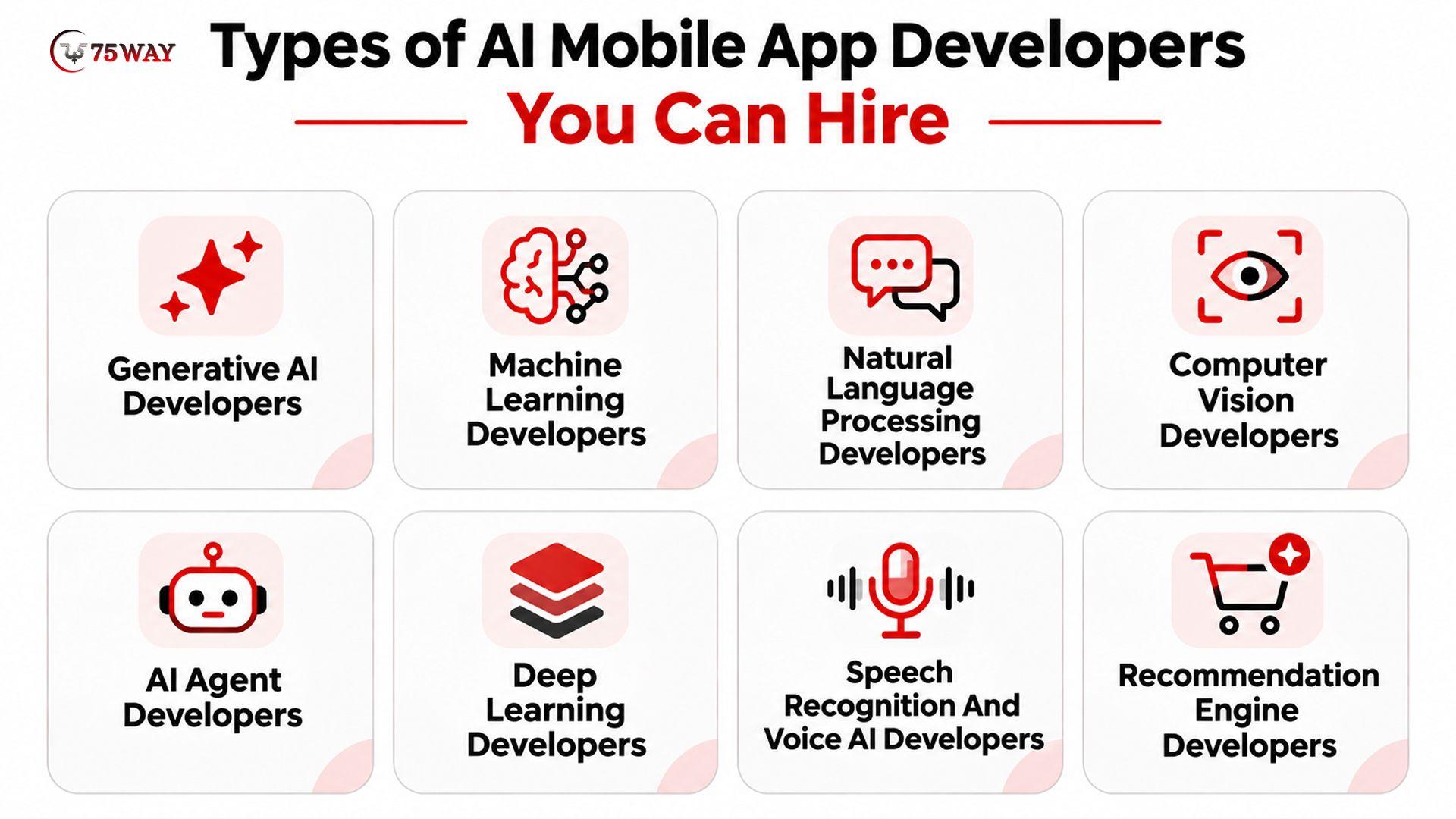
Whether you are planning to build a chatbot or AI shopping assistant app, each project calls for a different set of development skills, so understanding these specialisations can help you make a better hiring decision. Here's a closer look at the AI app developers available for different project requirements.
1. Generative AI Developers
Generative AI developers build applications that produce text, images, summaries, recommendations, and other outputs based on user instructions or contextual information.
They typically work with large language models, prompt engineering, model APIs, and application-level AI integrations.
Suitable Projects:
- AI writing and content generation applications.
- Intelligent customer support assistants.
- AI-powered personal productivity tools.
- Document summarisation and analysis platforms.
2. Machine Learning Developers
Machine learning developers create systems that identify patterns in datasets, make predictions, and improve their performance through data-driven learning.
Their work involves model training, feature engineering, data preparation, model evaluation, and deployment.
Suitable Projects:
- Sales and demand forecasting applications.
- Fraud detection and risk assessment systems.
- Personalised recommendation engines.
- Predictive maintenance platforms.
3. Natural Language Processing Developers
NLP developers specialise in applications that understand, process, and interpret human language. Their work can include text classification, sentiment analysis, language translation, information extraction, and conversational interfaces.
Suitable Projects:
- Multilingual customer service applications.
- Voice-enabled assistants.
- Sentiment analysis platforms.
- Intelligent document processing solutions.
4. Computer Vision Developers
Computer vision developers build applications that interpret visual information from photographs, videos, and live camera feeds.
They work with image recognition, object detection, image segmentation, and visual analysis technologies.
Suitable Projects:
- AI-powered quality inspection applications.
- Retail product recognition systems.
- Medical image analysis platforms.
- Automated inventory monitoring solutions.
5. AI Agent Developers
AI agent developers build systems that can interpret objectives, select tools, perform tasks, and interact with connected software under defined permissions.
Unlike a basic chatbot that primarily responds to questions, an AI agent may execute multi-step workflows, retrieve information, update records, or trigger approved actions.
Suitable Projects:
- Automated business workflow applications.
- AI-powered sales assistants.
- Intelligent booking and scheduling platforms.
- Enterprise process automation systems.
Hiring Insight: If your application combines several AI capabilities, look for a development team rather than a single specialist. A production-ready AI application may require AI engineers, backend developers, frontend developers, cloud engineers, and QA specialists working together.
6. Deep Learning Developers
Deep learning developers specialise in building AI systems that learn from large datasets using multi-layered neural networks.
They work with neural network architectures, model training, optimisation, and performance evaluation to develop applications that handle complex data and computational tasks.
Suitable Projects:
- Advanced image and speech recognition applications.
- AI-powered voice assistants.
- Autonomous decision-making systems.
- Complex pattern recognition applications.
7. Speech Recognition And Voice AI Developers
Speech recognition and voice AI developers create applications that understand spoken language, convert speech into text, and generate natural-sounding voice responses. They work with speech-to-text, text-to-speech, audio processing, and voice interaction technologies.
Suitable Projects:
- Voice-controlled mobile applications.
- AI-powered virtual assistants.
- Real-time speech translation applications.
- Automated voice-based customer support systems.
8. Recommendation Engine Developers
Recommendation engine developers build AI-powered systems that analyse user behaviour, preferences, and historical interactions to suggest relevant products, services, or content. They work with collaborative filtering, content-based filtering, ranking algorithms, and machine learning models.
Suitable Projects:
- Personalised shopping applications.
- Movie and music recommendation platforms.
- AI-powered travel planning applications.
- Personalised content discovery platforms.
Key Skills To Evaluate When Hiring AI App Engineers In Australia
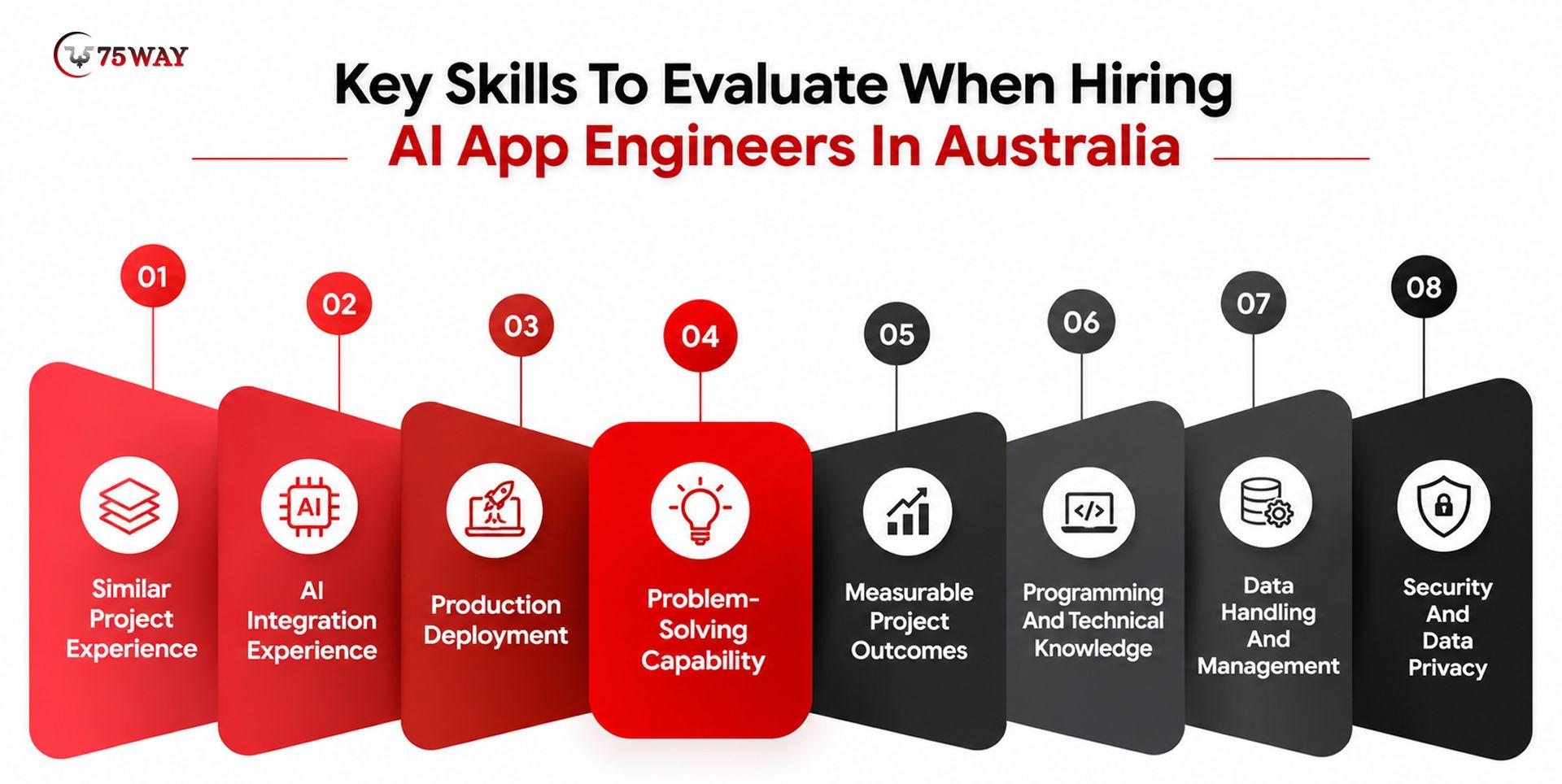
A professional AI app engineer's portfolio may look impressive, but can they actually build the AI features your mobile application requires? Before making a hiring decision, look beyond project screenshots and client lists to understand their technical capabilities. Here are the key skills worth evaluating when hiring AI app developers in Australia.
- Similar Project Experience
Check whether the developer has built applications resembling yours in terms of functionality, data requirements, user interactions, or technical complexity. A previous project in the same industry can be useful, but relevant engineering experience matters more than matching industry labels.
- AI Integration Experience
Ask which models, APIs, and frameworks they have integrated. Find out whether they understand model selection, prompt design, context management, retrieval systems, and API limitations.
- Production Deployment
A working prototype is not proof of production readiness. Ask whether their applications have been deployed, monitored, maintained, and used by actual customers or employees.
- Problem-Solving Capability
Ask developers to explain a technical challenge they encountered, the options they considered, and why they selected a particular solution. This reveals their ability to make engineering decisions rather than follow instructions blindly.
- Measurable Project Outcomes
Look for verifiable evidence, such as reduced manual processing time, improved prediction accuracy, fewer support escalations, or faster document processing. Ask how these outcomes were measured and whether the client can verify them.
- Programming And Technical Knowledge
Evaluate their proficiency in programming languages such as Python, JavaScript, Swift, or Kotlin, depending on your app requirements. Check whether they can develop application logic, connect backend services, and handle technical challenges.
- Data Handling And Management
Ask how they collect, clean, process, and manage data for AI applications. Their understanding of data quality, database management, and data security is important for building reliable AI features.
- Security And Data Privacy
Check whether developers understand secure API integration, data encryption, access controls, and privacy requirements. For Australian projects, ask how they approach the Australian Privacy Principles (APPs) when handling personal information.
What Should You Ask Australian AI App Expert During A Portfolio Review?
Instead of asking only whether developers have built AI applications, ask:
- What business problem did the application solve?
- Which AI model and architecture did you select, and why?
- How did you prepare and validate the application data?
- How did you test the accuracy of AI-generated responses?
- What happened when the model returned incorrect information?
- How did you manage latency, usage costs, and scalability?
- What security controls protected customer information?
- Who maintains the application after deployment?
A developer who can explain these decisions clearly is more likely to understand the engineering involved in building a dependable AI product.
AI Tech Stack & Engineering Capabilities To Check When Hiring AI App Developers
Technology selection directly affects an application's development effort, performance, maintenance requirements, and future flexibility.
You do not need developers who use every available framework. You need a team that can explain which technologies suit your requirements and what trade-offs come with those choices.
Evaluate their capabilities across the following areas.
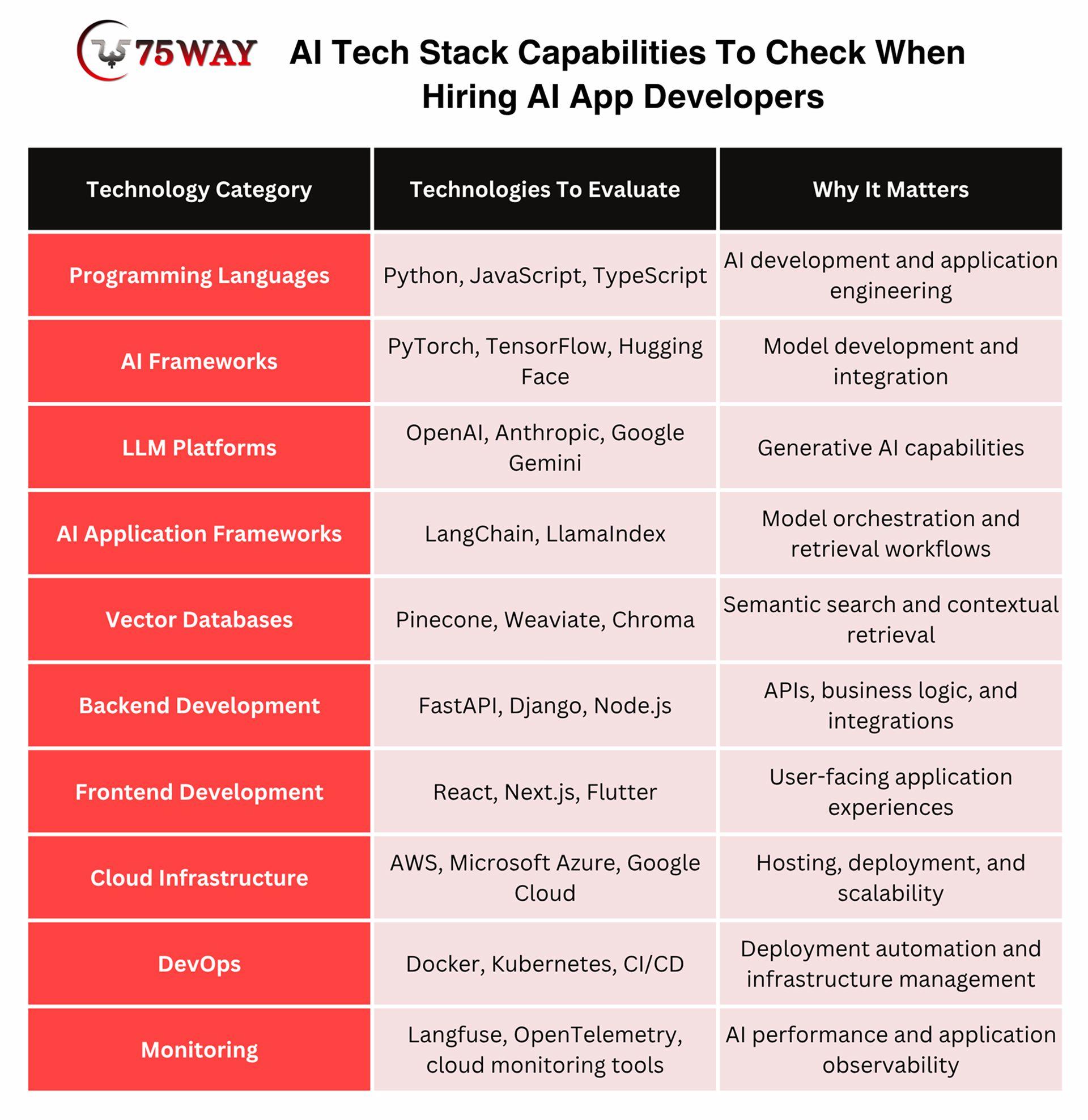
The technology stack should be selected according to the application, not simply because a particular framework is popular.
For example, a document intelligence application may require a vector database and RAG architecture, whereas a forecasting application may need a carefully evaluated machine learning pipeline.
Major Technical Capabilities Worth Evaluating
- Model Selection: Developers should compare available models based on accuracy, latency, context requirements, privacy, pricing, and deployment constraints.
- API Integration: They should understand how to connect AI models with payment systems, CRMs, databases, authentication services, and external business platforms.
- Data Engineering: AI applications depend on reliable data. Developers must understand data cleaning, transformation, validation, storage, and access management.
- Cloud Architecture: The team should know how to configure infrastructure, manage computing resources, handle traffic, and control deployment costs.
- Testing And Monitoring: They should establish methods to evaluate model outputs, identify failures, monitor performance, and improve the application after launch.
A useful hiring test is to ask developers to explain how they would build one important feature of your application, from the user's input to the final AI-generated result.
How AI Mobile App Developers Plan And Structure Application Architecture
This is one of the most important areas to assess before hiring.
An AI application is not simply a frontend connected to an AI API. It requires multiple components to communicate correctly, manage information, process requests, and deliver reliable outputs.
For instance, consider an AI-powered financial document analysis application.
A typical architecture may involve:
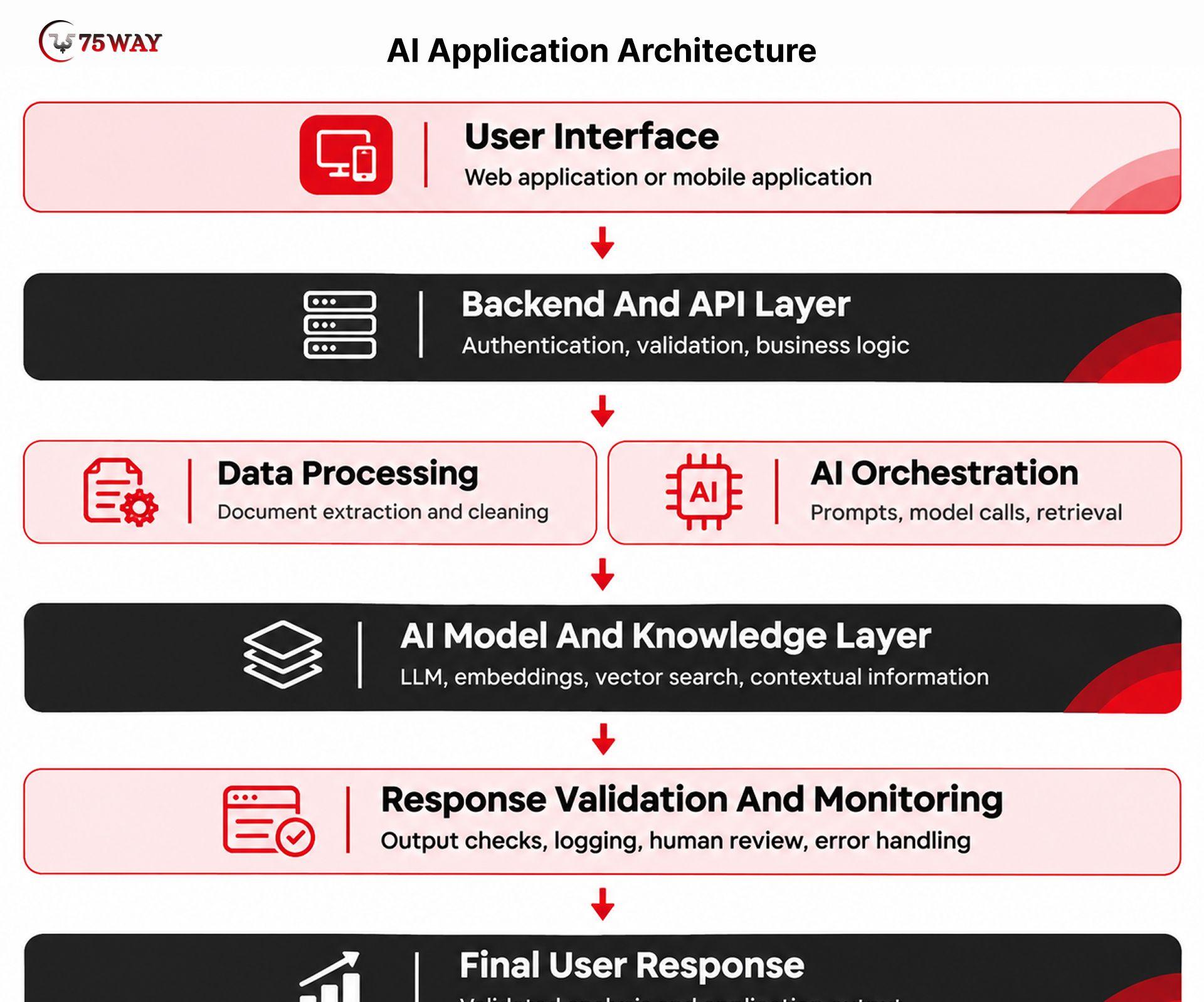
Moreover, actual components depend on the application's functionality, data, risk level, and deployment requirements.
Each component has a specific responsibility.
- The frontend collects documents and displays results.
- The backend validates requests and manages application logic.
- The data processing layer extracts relevant information.
- The AI orchestration layer manages prompts and model interactions.
- The knowledge layer retrieves relevant contextual information.
- The validation layer checks outputs and handles exceptions.
- Monitoring tools track application performance and potential failures.
Why this matters: Poor architectural decisions can create expensive problems later. For example, tightly coupling an application to one AI provider without an appropriate abstraction layer may make future model migration difficult.
Your development partner should be able to explain the architecture in business terms as well as technical language.
Evaluate AI App Experts’ Ability To Build RAG-Based Applications & AI Agents
Two capabilities deserve particular attention when hiring developers for modern AI applications: retrieval-augmented generation and agentic AI development.
They solve different problems, and understanding that difference will help you assess technical suitability.
Retrieval-Augmented Generation (RAG)
RAG connects a generative AI model with external information sources so it can retrieve relevant context before generating an answer.
For example, an Australian insurance business may want an internal assistant that answers employee questions using approved policy documents.
A RAG-based application could follow this process:
- Collect approved documents from business repositories.
- Extract and divide information into searchable sections.
- Generate embeddings representing the document content.
- Store embeddings in a vector database.
- Retrieve relevant sections when a user asks a question.
- Provide the retrieved information to the AI model.
- Generate a response with supporting source references.
The important point is that RAG does not automatically guarantee accurate answers. Developers must also consider retrieval quality, access permissions, document freshness, context limits, and response evaluation.
Ask developers: How will you prevent the system from retrieving outdated documents or exposing information that a particular user is not authorised to access?
AI Agent Development
AI agent development solutions extend beyond conventional question-and-answer interactions. They can use tools, access approved information, and perform defined actions to achieve a particular objective.
Consider an AI-powered sales operations application.
An agent might:
- Retrieve customer information from an approved CRM.
- Summarise previous customer interactions.
- Identify missing information.
- Prepare a follow-up email.
- Request approval before sending the email.
- Record the approved activity in the CRM.
Developers must design permissions, tool access, workflow controls, logging, and exception handling around these actions.
The Australian Signals Directorate's September 2026 guidance on agentic AI harnesses highlights the importance of least-privilege access, monitoring, audit logging, and human oversight for higher-impact actions.
Understanding The Difference Between RAG And AI Agents
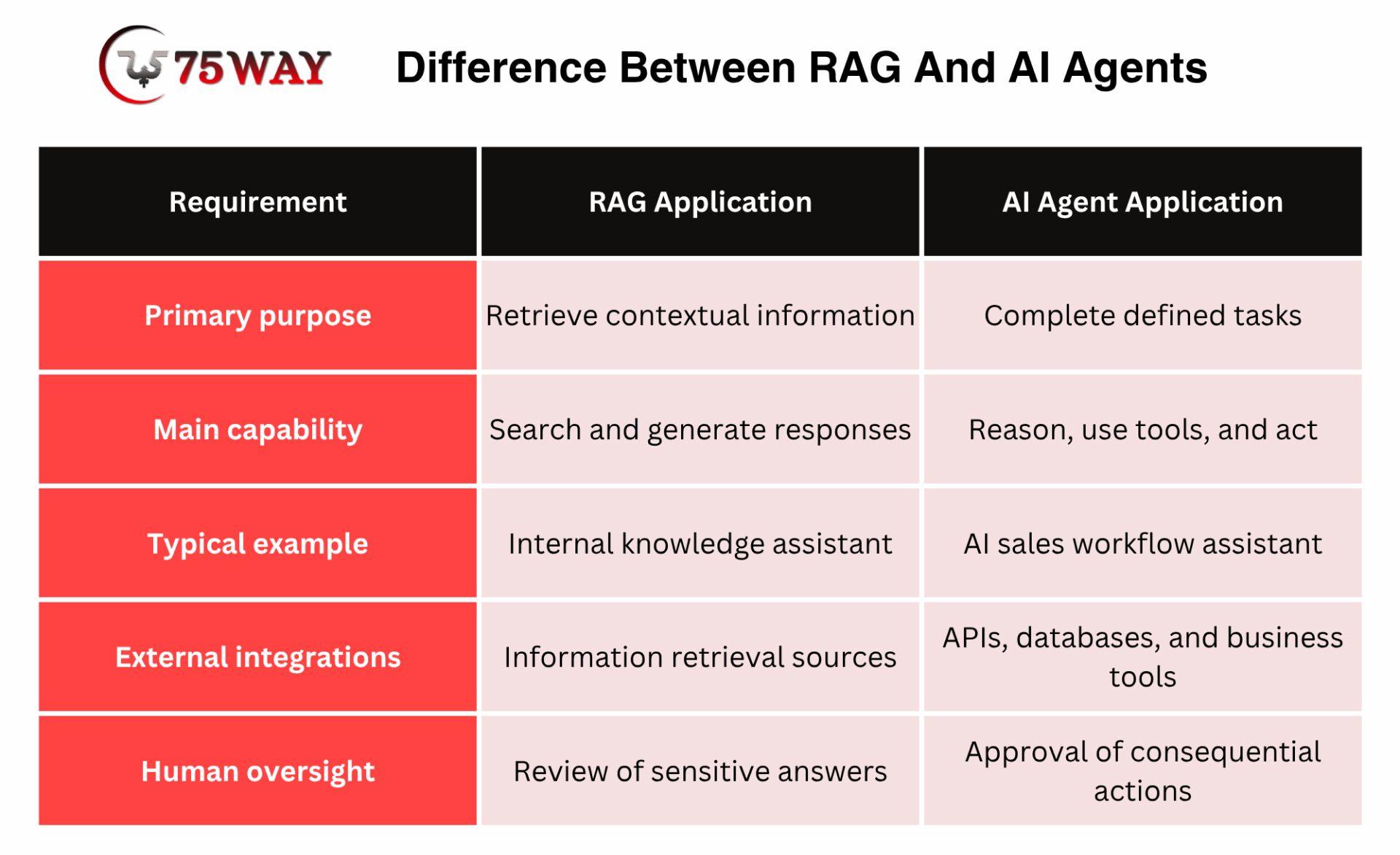
Some applications combine both approaches. For example, an AI agent may use RAG to retrieve company policies before performing an authorised workflow.
Your developer should recommend the simplest architecture that meets the business requirement rather than introducing agents or complex frameworks without a clear reason.
How To Assess UI/UX Design Skills While Hiring AI Engineer in Australia
When reviewing an AI developer's portfolio, don't just focus on the features they've built; pay attention to how those features work from a user's perspective.
Can users navigate the application easily, understand AI-generated responses, and complete tasks without unnecessary steps? These are important aspects to examine when evaluating UI/UX design capabilities.
- User Journey Mapping: Developers and designers should identify how users enter information, interact with AI features, review outputs, and complete tasks.
- Conversational Interface Design: Chat-based applications need readable messages, clear loading indicators, conversation history, and understandable error states.
- AI Output Presentation: Generated content, recommendations, confidence indicators, and supporting references should be presented without overwhelming users.
- Human Control: Users should be able to correct information, edit generated content, reject recommendations, and request human assistance where appropriate.
- Responsive Design: The application should provide a usable experience across mobile phones, tablets, and desktop devices.
- Accessibility: Interfaces should consider keyboard navigation, screen readers, readable typography, contrast, and accessible interaction patterns.
A Practical UI/UX Evaluation Example
Imagine your business is developing an AI-powered recruitment application.
A weak interface might display a candidate score without explaining what information influenced the result.
A better interface would present relevant assessment criteria, supporting information, limitations, and options for human review.
The difference is not just visual design. It affects trust, transparency, and how responsibly people use the application.
Ask the development team to show you an existing application or a clickable prototype and explain how its interface handles incorrect AI responses, processing delays, and user corrections.
Data Security & Australian Compliance Requirements AI App Developers Must Follow
Data protection should be part of the development process from the beginning, not something added just before launch.
AI applications may process customer details, employee information, financial records, health information, business documents, and other sensitive data. Every data transfer, storage location, model integration, and third-party service can introduce additional risks.
For Australian businesses, this makes privacy and security experience an important hiring criterion.
What Should Your AI App Developers Address?
- Data Collection: Identify what information the application actually needs. Avoid collecting unnecessary personal information.
- Data Storage: Establish where information will be stored, how long it will be retained, and how it will be deleted.
- Access Management: Use appropriate authentication, role-based permissions, and least-privilege access.
- Encryption: Protect sensitive information during transmission and storage through appropriate encryption controls.
- Third-Party AI Services: Review provider terms, data retention settings, processing arrangements, and whether submitted information may be used for model training.
- Audit Logging: Maintain appropriate records of sensitive actions, access events, and AI-assisted decisions.
- Incident Management: Establish procedures for investigating security incidents, containing exposure, and responding to affected parties.
Understand Australian Privacy Requirements
The Australian Privacy Principles (APPs) under the Privacy Act 1988 may apply to organisations handling personal information. Applicability depends on the organisation, its activities, and relevant exemptions.
The Office of the Australian Information Commissioner (OAIC) explains that privacy obligations can apply to personal information entered into AI systems and personal information contained in generated outputs.
Its guidance also recommends due diligence, appropriate human oversight, privacy impact assessments where relevant, and careful consideration of who can access information supplied to commercial AI products.
What’s the Cost To Hire AI App Developer in Australia
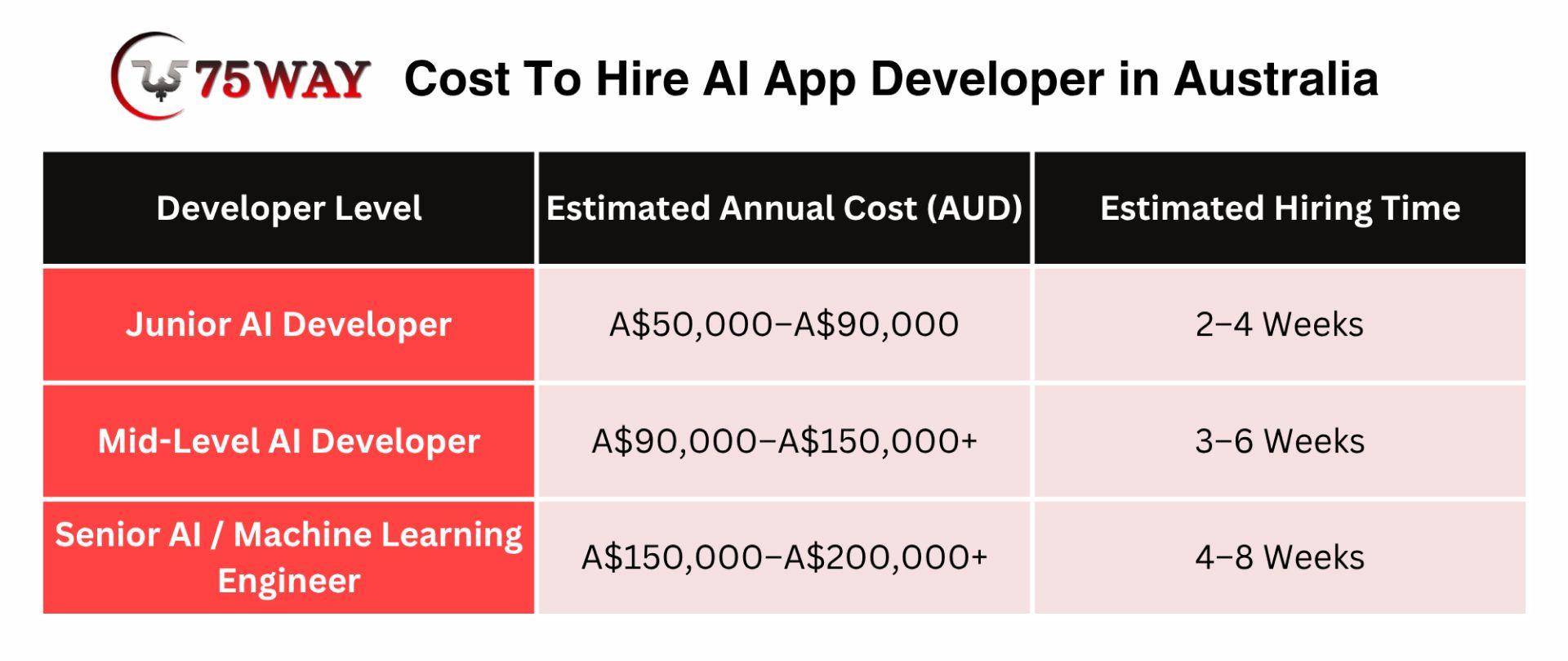
The cost of hiring AI app developers in Australia varies by experience level and hiring model. In-house AI developers typically earn A$50,000–A$220,000+ annually, while contractors charge around A$800–A$1,150+ per day, depending on their expertise and project requirements. The following breakdown explains the average salary ranges and hiring costs.
1. Junior AI Developer: A$50,000 to A$90,000
- Handles basic AI features and integrations.
- Assists senior engineers with development tasks.
2. Mid-Level AI Developer: A$90,000 to A$150,000+
- Builds and integrates AI application features independently.
- Selects, tests, and implements suitable AI models.
3. Senior AI / Machine Learning Engineer: A$150,000 to A$200,000+
- Leads AI development and architecture decisions.
- Builds and optimises complex AI solutions.
What Determines AI App Development Costs?
- Application Complexity: Number of features, workflows, and user roles.
- AI Functionality: Model integration, training, RAG, or AI agents.
- Data Requirements: Data collection, cleaning, labelling, and processing.
- UI/UX Design: Research, wireframes, prototypes, and interface development.
- Backend Engineering: APIs, authentication, databases, and integrations.
- Infrastructure: Cloud hosting, storage, computing, and deployment.
- Testing: Functional, security, performance, and AI evaluation.
- Maintenance: Monitoring, updates, model changes, and technical support.
Different Cost Components Influencing Cost of Hiring AI App Engineer in Australia
Hiring an AI app engineer in Australia involves more than agreeing on an hourly rate or monthly salary. Your actual hiring budget can change depending on experience, technical specialisation, project complexity, and the engagement model you choose. Let's break down the major cost components you should consider before finalising your budget.
1. Discovery And Planning Costs
The initial stage may include requirements gathering, technical feasibility assessments, architecture planning, and project documentation.
2. Design And Development Costs
These cover interface design, frontend engineering, backend development, AI integration, and third-party connections.
3. AI Infrastructure Costs
Depending on the application, you may need to pay for model API usage, embeddings, vector database services, cloud computing, and data storage.
4. Testing And Deployment Costs
These include application testing, model evaluation, security checks, infrastructure configuration, and production deployment.
5. Post-Launch Costs
AI applications require ongoing attention. Model providers can change their pricing, APIs can be updated, and application performance may need improvement as usage grows.
Diverse Pricing Model Should You Choose For Hiring AI Application Expert
Would you prefer paying only for the hours developers work, agreeing on a fixed project budget, or hiring a dedicated team for ongoing development? Each arrangement offers different levels of flexibility, cost control, and project involvement. Here's how to compare the available pricing models before hiring an AI application expert in Australia.
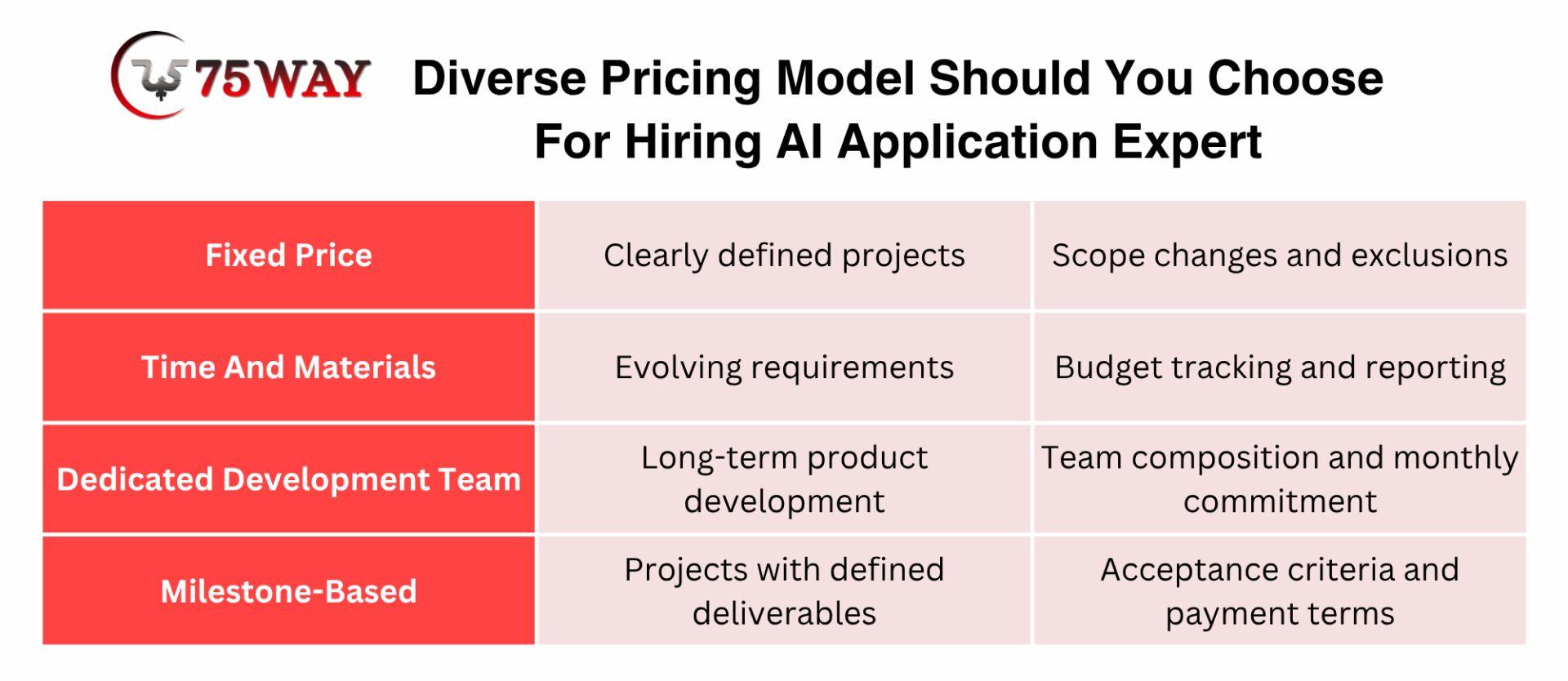
A fixed-price agreement can work well when requirements are stable. However, AI development often involves experimentation, model evaluation, and adjustments as real-world results become available.
For evolving products, milestone-based or time-and-materials arrangements may provide more flexibility.
How To Avoid Unexpected AI App Development Expenses
Before approving a proposal, ask whether it includes:
- AI model API usage estimates.
- Cloud hosting and infrastructure expenses.
- Third-party software subscriptions.
- Data preparation and migration.
- Testing and security assessments.
- Deployment and app store submission, where applicable.
- Documentation and source code handover.
- Post-launch maintenance and support.
My recommendation: Request an itemised proposal rather than accepting a single project figure. It helps you understand where the budget goes and identify services that may become additional expenses later.
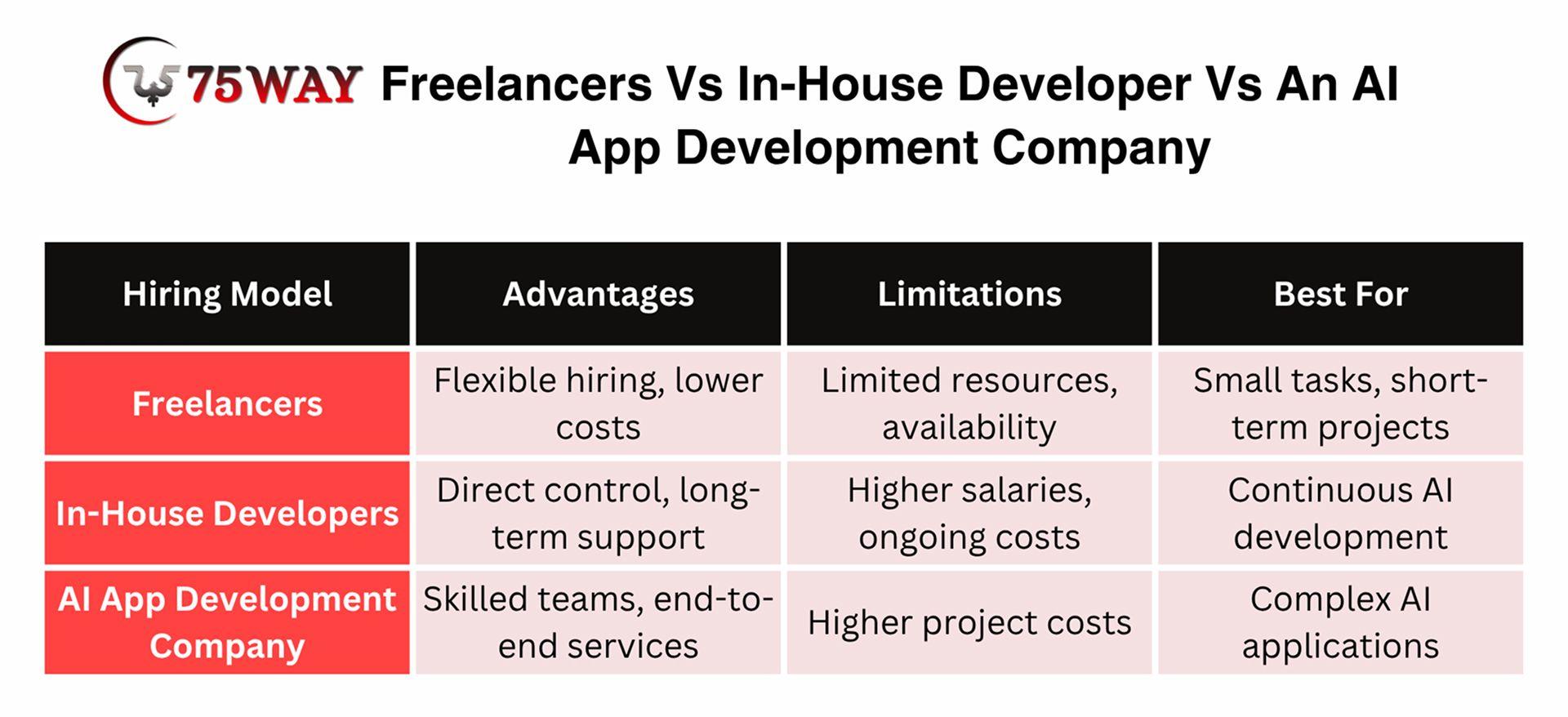
Hire Freelancers Vs In-House Developer Vs An AI App Development Company in Australia
Your choice of hiring model can affect everything from development costs and communication to project ownership and ongoing maintenance. For example, a startup building its first AI-powered product may have very different hiring needs from an established Australian business expanding its technology team. Let's examine the differences between freelancers, in-house developers, and AI app development companies.
Hiring Freelance AI Developers
Freelancers can be useful when you need specialist support for a defined task or a smaller development requirement.
For example, you might hire an experienced machine learning engineer to develop a recommendation model while your internal team handles the remaining application development.
Consider This Model When:
- Your project has a clearly defined technical requirement.
- You already have an experienced internal development team.
- You need short-term specialist expertise.
- You can manage development and quality assurance internally.
Potential Limitation: One freelancer may not have all the skills required for architecture, frontend development, backend engineering, AI integration, security, and deployment.
Building An In-House AI App Development Team
An in-house team provides greater day-to-day control over product development and internal collaboration.
This approach can be useful for businesses developing AI products as a core part of their long-term operations.
Consider This Model When:
- AI development is an ongoing business priority.
- You expect continuous product development.
- Your organisation can manage technical recruitment.
- You need developers closely involved in internal systems and processes.
Potential Limitation: Recruiting and retaining multiple specialists requires time, management resources, and ongoing employment costs.
Partnering With An AI App Development Company in Australia
An AI app development company can provide access to multiple specialists through one engagement.
Depending on its team structure, it may handle discovery, design, AI engineering, application development, testing, deployment, and maintenance.
Consider This Model When:
- You need a complete development team.
- Your internal technical resources are limited.
- You want coordinated delivery across multiple disciplines.
- Your project requires specialised AI and software engineering capabilities.
Potential Limitation: The company's actual delivery team, communication practices, project ownership arrangements, and availability of senior technical specialists must be verified.
Which Hiring Model Makes Sense?
- Small, isolated AI task: Freelancer
- Continuous internal AI product development: In-house team
- Complete AI application development: AI development company
- Existing product requiring specialist AI integration: Freelancer or specialist agency
- Large product with long-term technical requirements: In-house team or development partner
For startups and businesses without established engineering teams, an experienced AI development company can be a practical starting point. However, evaluate the actual team and delivery arrangements rather than relying on the company's size or marketing claims.
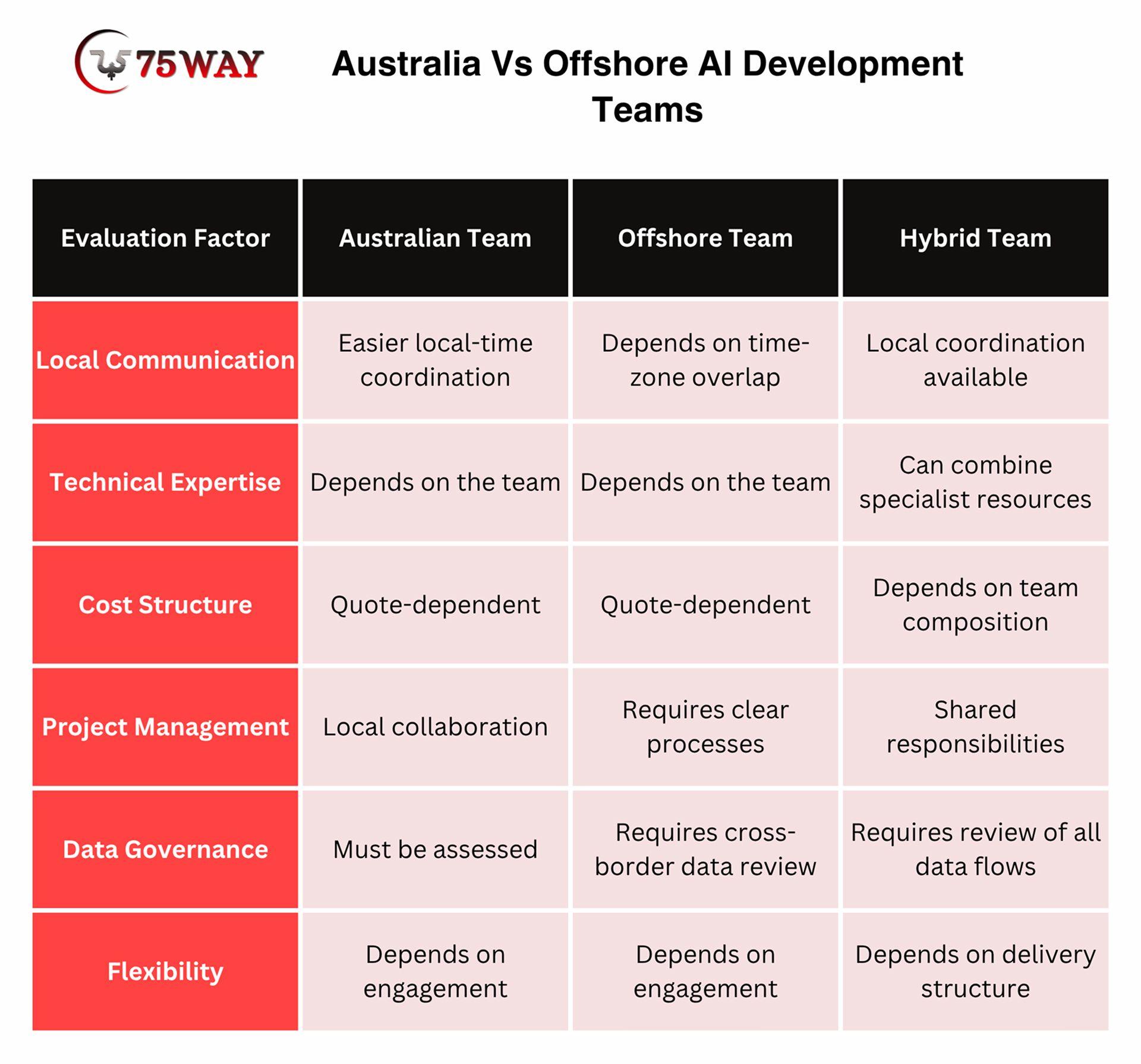
How To Evaluate Australian And Offshore AI Development Teams
When hiring AI app developers in Australia, you are not necessarily restricted to teams physically located within the country.
Australian businesses can work with local developers, offshore companies, or hybrid development teams.
Each option has different commercial and operational considerations.
Australian-Based Development Teams
Local development teams may offer easier communication during Australian business hours, access to in-person meetings, and familiarity with the Australian commercial environment.
They can be particularly useful when your project requires close collaboration with local stakeholders or on-site support.
Offshore Development Teams
Offshore teams can provide access to different specialist talent pools and team structures. Depending on the engagement, they may also offer a different cost structure.
However, you should evaluate communication arrangements, time-zone overlap, intellectual property ownership, security controls, and project accountability.
Hybrid Development Teams
A hybrid model combines local project coordination with offshore engineering resources.
For example, an Australian product manager or technical lead may coordinate requirements and stakeholder communication while an offshore engineering team handles selected development activities.
Choose a team based on technical suitability, accountability, communication, and the ability to protect your business interests.
Questions To Ask Before Hiring AI App Developers in Sydney, Australia
Before signing an agreement with an AI app developer, take the opportunity to understand exactly what you're getting. Ask about their experience with similar applications, AI model selection, and ownership rights. These questions will help you evaluate potential development partners in Sydney with greater confidence.
- Have you developed similar AI applications? Relevant projects and verifiable experience.
- How will you select the AI model? Performance, cost, data, and technical trade-offs.
- Can you explain your proposed architecture? Components, integrations, and scalability.
- How will you evaluate AI accuracy? Test datasets, evaluation criteria, and failure analysis.
- How will you protect our data? Access controls, encryption, retention, and privacy.
- Can the application support future model changes? Modular architecture and migration considerations.
- How will you handle hallucinations? Grounding, validation, safeguards, and human review.
- What happens after deployment? Monitoring, updates, support, and maintenance.
- Who owns the source code? Written intellectual property and handover terms.
- How will project progress be reported? Milestones, demonstrations, documentation, and communication.
Request A Small Technical Assessment
For larger or technically complex projects, consider asking shortlisted developers to complete a limited technical assessment.
For example, if you want to build an AI document assistant, ask them to demonstrate how they would:
- Extract information from a sample document.
- Retrieve relevant content using semantic search.
- Generate an answer using an AI model.
- Provide references to supporting information.
- Handle questions that cannot be answered from the available documents.
The assessment should be proportionate to the project and agreed in advance. Avoid asking multiple companies to complete substantial unpaid development work.
This exercise can reveal whether a team understands the actual engineering requirements behind your idea.
How To Finalise The Contract, Deliverables, And Intellectual Property Rights
Once you have selected a development team, document the engagement properly.
A development proposal may look comprehensive, but important responsibilities can remain unclear unless they are included in the contract.
Before signing, review these areas.
1. Project Scope And Deliverables
Define the application's features, technical requirements, integrations, supported platforms, and expected deliverables.
Specify what is included in the initial release and what will be treated as additional work.
2. Payment And Milestone Terms
Connect payments with clearly defined milestones and acceptance criteria.
For example, payments might be linked to requirements approval, design sign-off, development completion, testing, and deployment.
3. Intellectual Property Ownership
Clarify ownership and licensing rights for:
- Custom-developed source code.
- UI/UX designs and design files.
- Project documentation.
- Custom AI models and training assets, where applicable.
- Data pipelines and application-specific configurations.
- Third-party libraries, models, and licensed components.
Do not assume that paying for development automatically transfers every intellectual property right. Review the written assignment and licensing terms with appropriate legal advice.
4. Confidentiality And Data Protection
Include appropriate confidentiality provisions, data handling responsibilities, access restrictions, and requirements for third-party service providers.
5. Warranty And Maintenance
Define the defect correction period, support availability, maintenance responsibilities, and charges for additional work.
6. Exit And Handover Arrangements
Ensure that you can obtain the agreed source code, documentation, deployment configurations, credentials, and other project assets when the engagement ends.
These arrangements protect your ability to maintain and develop the application even if you change development partners later.
How To Choose The Best AI App Developers In Australia: Final Decision Checklist
You've compared portfolios, discussed project costs, evaluated technical skills, and shortlisted potential developers. Now comes the important part: deciding who deserves your investment. Use this final checklist to review the essential factors before choosing an AI app development partner in Australia.
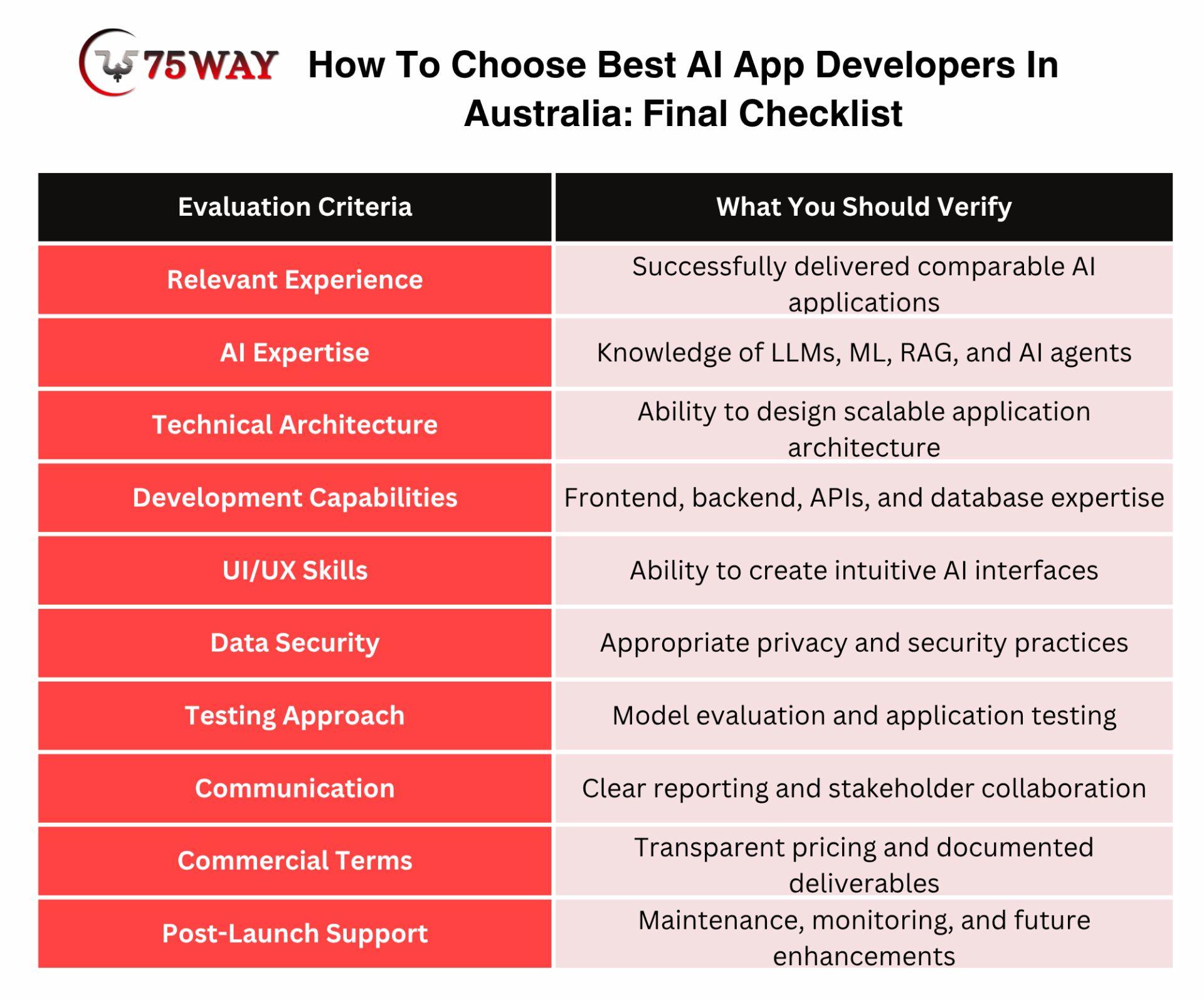
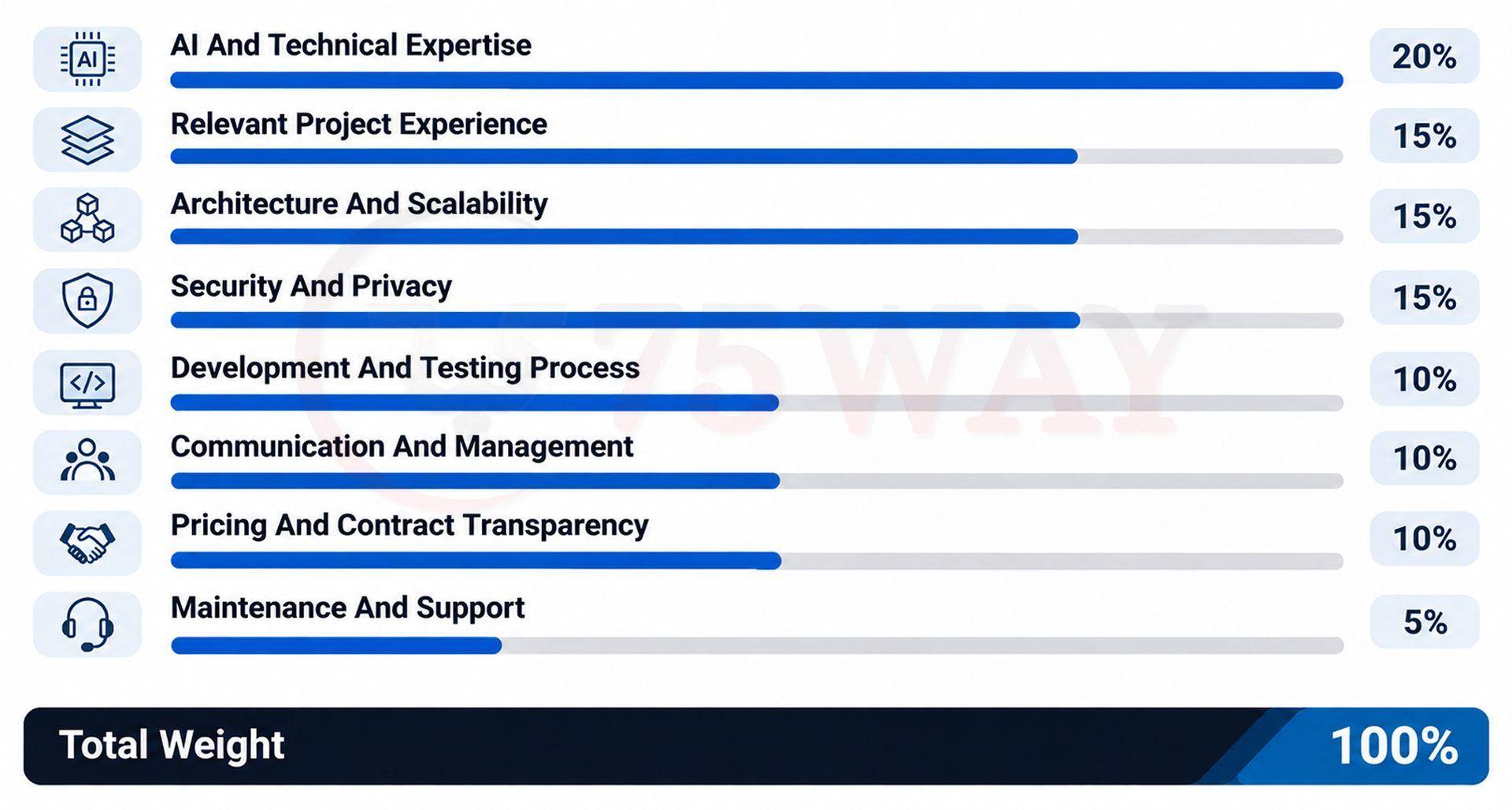
You can also use this suggested evaluation scorecard to compare shortlisted teams.
AI Developer Evaluation Scorecard
Suggested weighting for comparing shortlisted development partners. Adjust according to project risk and complexity.
Evaluate AI Developer Expertise Now
Score each shortlisted company against these criteria using evidence from its portfolio, technical discussions, proposals, and references.
Do not select a development partner based on the highest score alone. Security requirements, intellectual property terms, and technical suitability should be treated as essential conditions.
Final Thoughts
To sum up, hiring the best AI app developers in Australia requires more than finding a team that understands popular AI technologies.
You need developers who can translate your business requirements into a practical application, select suitable models, build reliable architecture, protect sensitive information, and support the product after launch.
Whether you are launching an AI-powered startup product or introducing intelligent applications into an established business, the right AI app developer can help turn your idea into a reliable digital solution. You can discuss your AI app requirements and request a detailed project proposal to get started.
Frequently Asked Questions (FAQs)
How Do I Hire The Best AI App Developers In Australia?
Start by defining your project requirements, identifying the necessary AI expertise, and reviewing developers' portfolios. Compare their technical capabilities, architecture, security practices, pricing, communication, and post-launch support before signing an agreement.
Should I Hire Freelancers Or An AI App Development Company?
Freelancers can suit smaller, clearly defined technical tasks, while an AI app development company can provide a coordinated team for end-to-end projects. Your decision should depend on project complexity, internal technical resources, budget, and long-term support requirements.
What Is The Difference Between AI App Developers And Machine Learning Engineers?
AI app developers build complete applications that incorporate artificial intelligence, including interfaces, APIs, databases, and AI integrations. Machine learning engineers primarily focus on developing, training, evaluating, and deploying machine learning models.
Can AI App Developers Build Applications Using ChatGPT Or Other LLMs?
Yes. Developers can integrate models from providers such as OpenAI, Anthropic, and Google into applications using APIs. They can also implement RAG, custom workflows, authentication, databases, and additional functionality to create complete AI-powered products.
Should I Build An AI MVP Before Developing A Complete Application?
An AI MVP is useful when you need to validate demand, test a core AI capability, and collect user feedback before committing to a larger investment. Start with the most important functionality and expand once its technical feasibility and business value have been established.