AI Summary
Building an astrology app like CHANI requires more than zodiac content and attractive visuals. Successful apps combine personalization, accurate calculations, engaging experiences, and intelligent automation. This guide explains essential features, AI capabilities, development steps, costs, and strategies required to create a competitive astrology app in 2026.
Key Takeaways
- Astrology apps require personalization beyond basic horoscope reading experiences.
- AI can transform astrology apps into intelligent self-reflection companions.
- Birth charts, predictions, and insights need accurate calculation systems.
- User engagement depends on content, community, and personalization.
- Building CHANI-like apps requires strong technology and strategy.
Why do some astrology apps become part of a user's morning routine while others are deleted after a few days? The difference often comes down to how well the app understands user expectations and delivers an experience that feels personal.Astrology apps like CHANI stand out because they transform astrology from a simple prediction tool into a personalized experience focused on self-awareness and reflection. For businesses entering this space, the opportunity is not about copying another astrology app.
It is about understanding why users return daily, what features create emotional connections, and how technology can make ancient practices more interactive through modern mobile experiences.
This guide explains how to develop an astrology app like CHANI in 2026, covering the features, development process, technology stack, and the estimated investment required to build a competitive astrology application.
What is CHANI App? How Does This Astrology App Work?
CHANI is a modern astrology and self-discovery app that transforms traditional astrological practices into a personalized digital experience. Instead of offering only generic horoscope readings, the app helps users explore their birth charts, understand planetary movements, receive daily cosmic insights, and practice mindfulness.
It also reflects on their personal growth journey through an intuitive mobile experience. Behind this simple and calming interface, multiple technologies work together to deliver personalized astrology guidance.
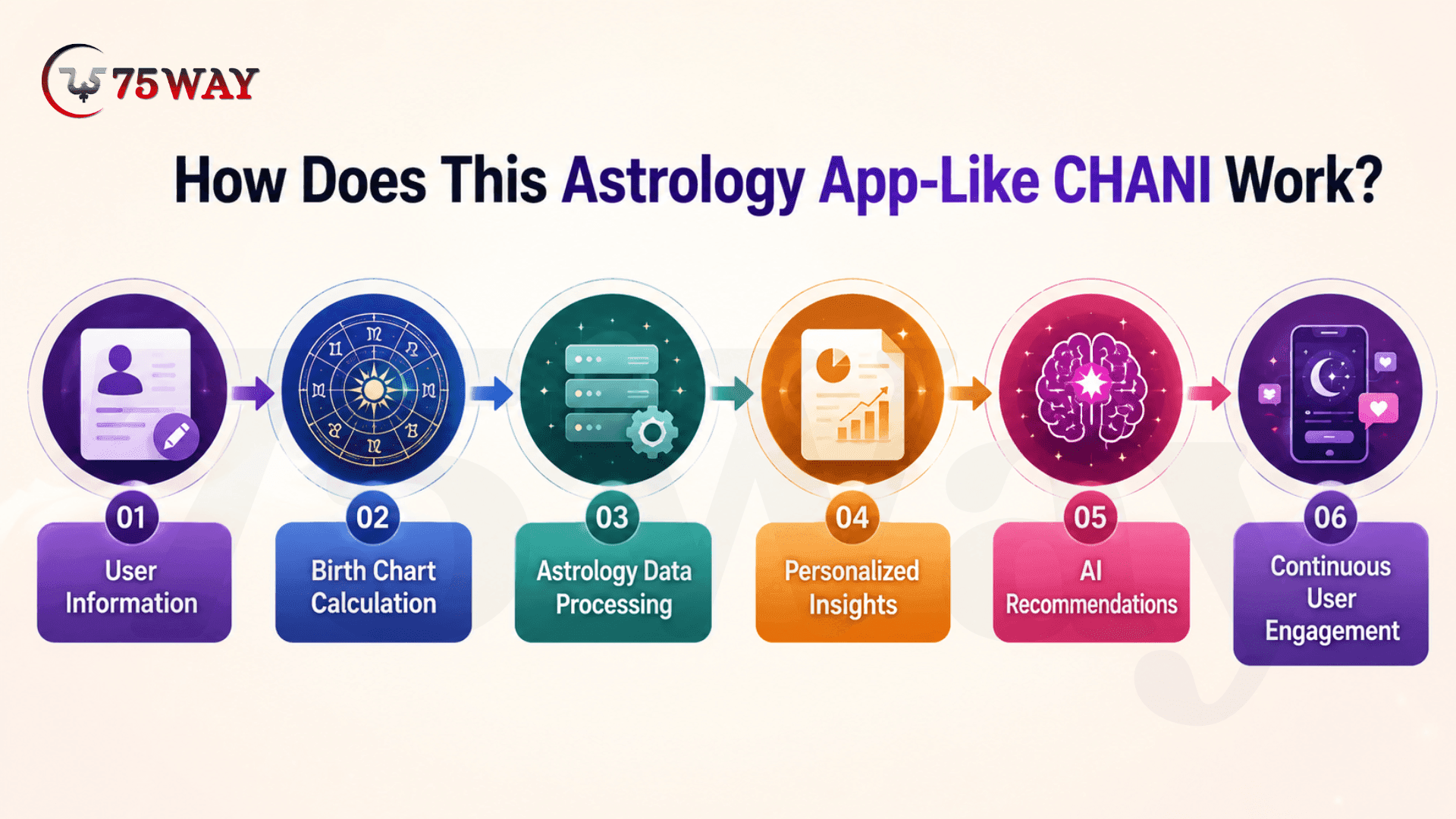
Phase 1
User Information: Users provide details such as birth date, exact birth time, and birthplace. The app securely collects this information to create a personalized astrology profile. These details become the foundation for accurate chart calculations and customized experiences.
Phase 2
Birth Chart Calculation: The app analyzes user details through astrology calculation engines and astronomical databases. It identifies planetary positions, zodiac signs, houses, and celestial relationships. This process creates a unique natal chart based on the user's birth moment.
Phase 3
Astrology Data Processing: The system combines birth chart information with current planetary movements and astrological rules. It continuously analyzes celestial changes to identify meaningful patterns. This data helps generate relevant interpretations connected to the user's personal profile.
Phase 4
Personalized Insights: The platform transforms complex astrology calculations into simple, meaningful guidance. Expert-created content and automated interpretations provide users with daily reflections, personality insights, and self-discovery information tailored to their astrological profile.
Phase 5
AI Recommendations: AI analyzes user preferences, content interactions, and engagement patterns to improve personalization. It recommends relevant readings, wellness practices, and astrology content. This creates a more customized experience based on individual interests and behavior.
Phase 6
Continuous User Engagement: The app maintains user interest through daily updates, reminders, personalized content, and interactive features. Ongoing engagement data helps improve future recommendations. This allows the platform to deliver a continuously evolving astrology experience.
For businesses planning to develop an astrology app like CHANI, the real opportunity lies in combining ancient astrology knowledge with modern technology. A successful platform does not simply provide predictions; it creates a personalized companion that helps users explore self-awareness, reflection, and daily decision-making.
Market Size & Revenue Opportunities For Astrology Apps
The rising demand for self-discovery, wellness, and personalised digital experiences is opening new possibilities for astrology app entrepreneurs. The given market insights reveal how changing user habits, subscription models, and personalized experiences are creating new revenue opportunities for astrology app businesses.
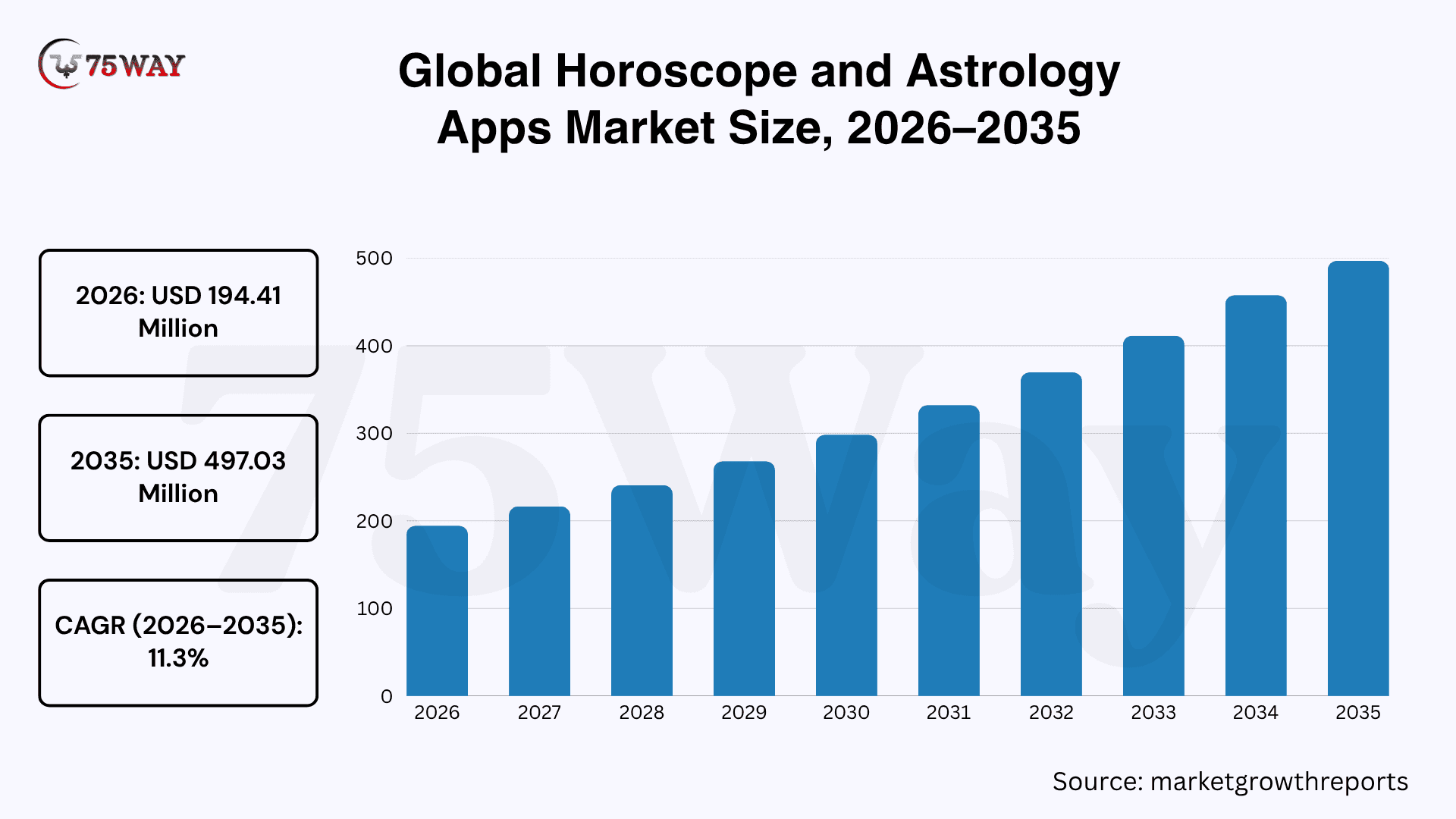
- According to Market Growth Reports, the horoscope and astrology apps market is projected to grow from $194.41 million in 2026 to $497.03 million by 2035, at a CAGR of 11.3%.
- The United States is one of the largest markets, with over 40–45 million active horoscope and astrology app users.
- Another industry report (The Business Research Company) estimates the astrology app market will grow from $5.69 billion in 2026 to $11.71 billion by 2030, registering a CAGR of 19.8%.
- Western astrology apps are expected to hold around 50% of the market share in 2026.
- The top five companies collectively account for approximately 25% of the astrology app market in 2026.
- North America accounts for up to 35% of global premium subscriptions and in-app purchases for horoscope and astrology platforms.
- Around 40% of U.S. women aged 18–49 engage with horoscopes or astrology content at least once a year, making young adults the most active user segment.
Must-Have Features Needed To Build An App Like CHANI in 2026
The difference between an ordinary astrology app and a platform users love often comes down to the features behind the experience. Here are the essential capabilities required to develop a mobile app like CHANI and deliver personalised astrological guidance.
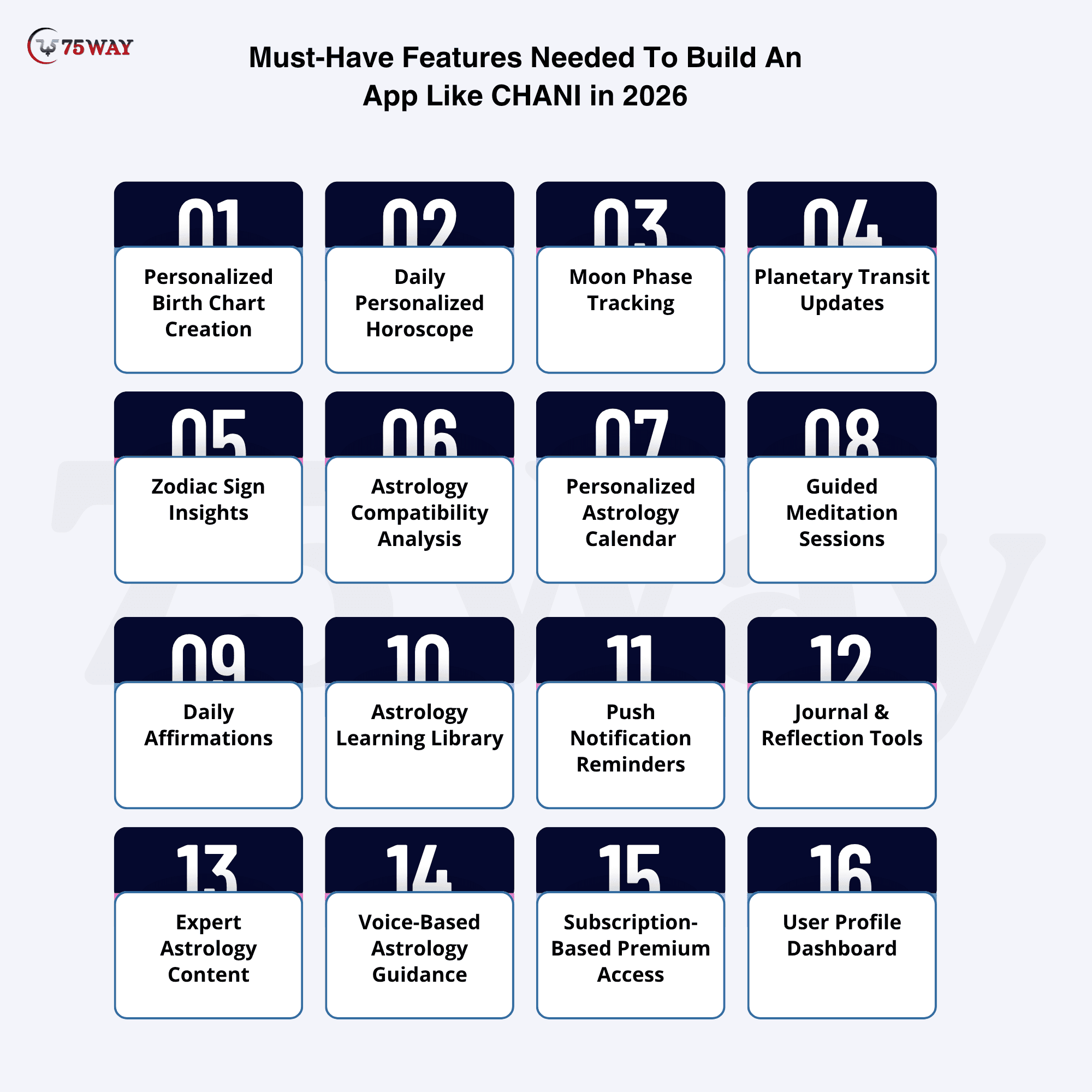
- Personalized Birth Chart Creation: The first step in creating a personal astrology experience is understanding the user. By entering their birth date, exact time, and location, users can generate a unique birth chart that becomes the base for future readings, insights, and recommendations.
- Daily Personalized Horoscope: People are not looking for the same horoscope everyone else receives. A smart astrology app delivers daily insights based on individual birth charts, planetary positions, and personal patterns, making every reading feel more relevant.
- Moon Phase Tracking: The moon has always been an important part of astrology. This feature allows users to follow lunar cycles, understand moon phases, and explore how different phases may connect with their emotions, energy, and daily activities.
- Planetary Transit Updates: Planetary movements change constantly, and users want to know what those changes mean for them. The app can track current transits and provide simple explanations about how these movements relate to their personal astrology.
- Zodiac Sign Insights: Users can explore deeper information about their sun sign, moon sign, and rising sign. Instead of basic descriptions, the app can provide insights into personality traits, strengths, challenges, and personal tendencies.
- Astrology Compatibility Analysis: Curiosity about relationships is one of the biggest reasons people explore astrology. This feature compares two birth charts and provides insights about compatibility, communication styles, and possible relationship dynamics.
- Personalized Astrology Calendar: Important astrological events can be difficult to track manually. A personalized calendar helps users stay updated on moon phases, retrogrades, planetary movements, and meaningful dates based on their chart.
- Guided Meditation Sessions: Modern astrology users often look for ways to improve mindfulness and self-awareness. Meditation sessions connected with astrology themes can help users relax, reflect, and create a deeper connection with the app.
- Daily Affirmations: Small daily reminders can create strong engagement habits. Personalized affirmations based on astrology profiles encourage users to reflect, stay positive, and build a consistent daily routine.
- Astrology Learning Library: Not every user understands astrology terms from day one. A learning section helps beginners explore planets, signs, houses, and birth charts through simple guides, articles, and educational resources.
- Push Notification Reminders: Even a great app can lose users without regular engagement. Personalized notifications remind users about daily readings, upcoming celestial events, meditation sessions, and new content.
- Journal And Reflection Tools: Astrology often encourages self-reflection, and a built-in journal supports that journey. Users can record thoughts, emotions, and experiences while connecting them with their astrology insights.
- Expert Astrology Content: Trust matters in astrology applications. Expert-written interpretations, articles, and guides help users receive valuable information while making the platform feel more authentic and reliable.
- Voice-Based Astrology Guidance: Reading long interpretations is not always convenient. Voice-based readings allow users to listen to personalized insights, creating a more engaging and accessible experience.
- Subscription-Based Premium Access: A premium model allows businesses to offer advanced experiences while creating recurring revenue. Users can access deeper readings, exclusive content, detailed reports, and additional personalization features through paid plans.
- User Profile Dashboard: A personalized dashboard keeps everything organized. Users can manage birth details, revisit previous readings, save favorite insights, track activities, and access recommendations from one central place.
How To Develop An Astrology App Like CHANI in 2026: Complete Roadmap
Every successful astrology app development begins with a clear roadmap rather than jumping directly into coding. The following steps explain how businesses can plan, design, develop, test, and launch an app like CHANI.
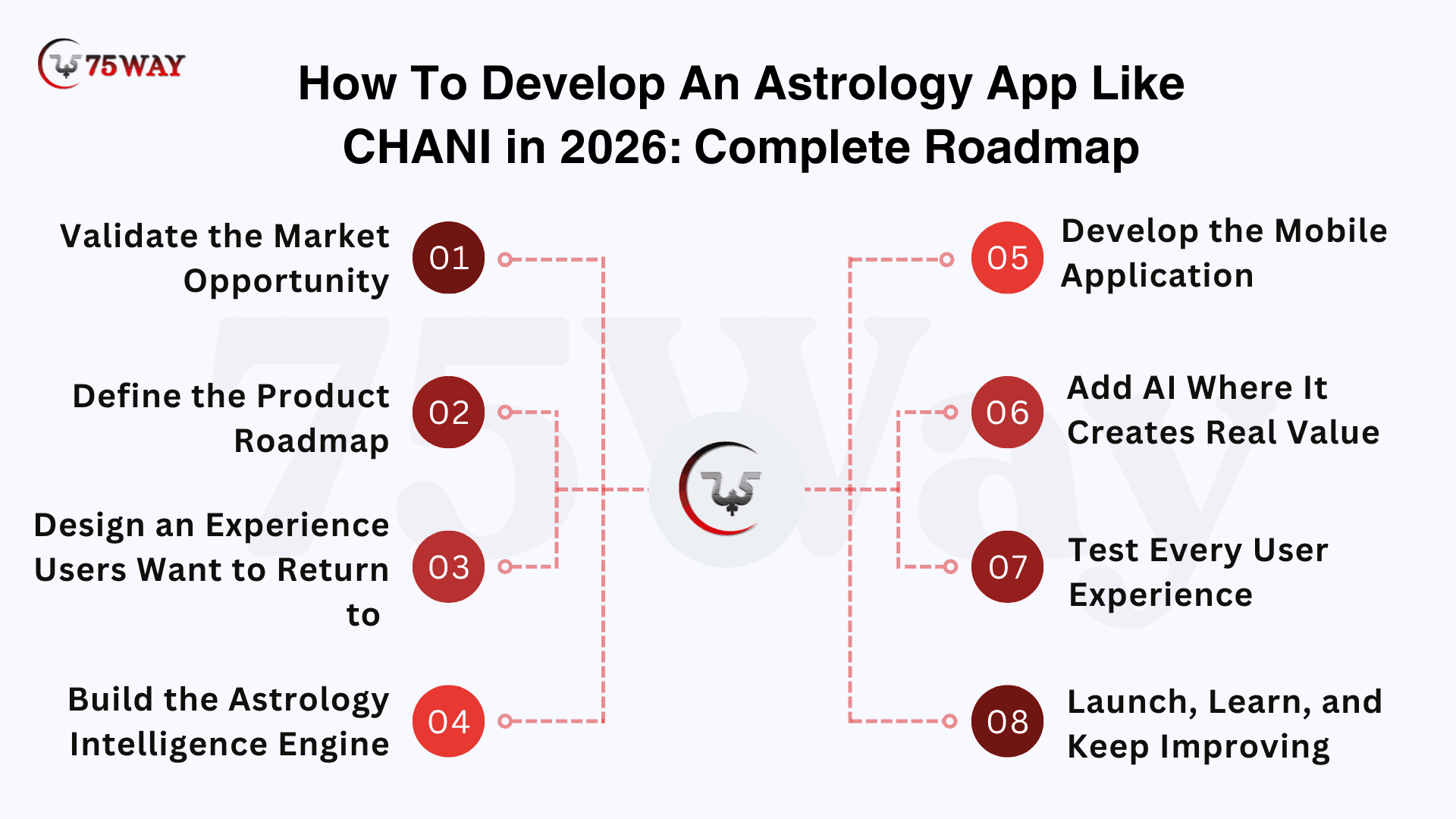
Step 1. Validate the Market Opportunity
Every successful app begins with one important question: Why will people choose your app instead of the dozens already available? The answer isn't "because it has horoscopes." It's because it offers a better experience, solves a specific problem, or serves an audience that existing apps overlook.
You can start by researching competitors, reading user reviews, and identifying what people love and what frustrates them. You may discover users want simpler birth chart explanations, stronger wellness features, or AI-powered guidance that feels more personal. Those insights become the foundation of your product strategy instead of assumptions.
Key priorities include:
- Understand Target Audience: Define whether you serve astrology beginners, wellness seekers, spiritual communities, Gen Z users, professionals, or premium subscribers.
- Study Competitor Landscape: Compare apps like CHANI, Co–Star, The Pattern, and Nebula to identify strengths, weaknesses, pricing, and feature gaps.
- Identify Unmet User Needs: Review App Store feedback to uncover recurring complaints, missing features, confusing experiences, and unmet user expectations.
- Define Unique Value Proposition: Decide why users should choose your app, whether through AI guidance, expert astrology, wellness tools, or exclusive content.
- Plan Monetization Strategy: Validate subscriptions, one-time purchases, premium reports, coaching sessions, or ad-supported models before development begins.
Step 2: Define the Product Roadmap
Once you've identified the opportunity, it's time to decide what your first version should actually include. Trying to launch every feature at once often leads to longer timelines, higher costs, and a confusing user experience.
Instead, prioritize the features users need most during their first interaction. Then create a roadmap that gradually introduces advanced capabilities as your platform grows. A phased approach keeps development focused while leaving room for future innovation.
At this stage, teams usually define:
- Prioritize MVP Features: Include essential features like birth charts, daily insights, onboarding, subscriptions, and user profiles for launch.
- Map User Journeys: Plan how new, returning, and premium users navigate every stage of the application experience.
- Choose Subscription Model: Decide between monthly plans, annual memberships, free trials, or premium content unlock strategies.
- Build Content Strategy: Outline horoscope updates, educational resources, meditation sessions, journals, and expert astrology content calendars.
- Set Product Milestones: Define launch goals, future feature releases, scalability plans, and measurable business success indicators.
Step 3: Design an Experience Users Want to Return To
Astrology is deeply personal, so the experience should feel welcoming from the very first screen. Every interaction, from onboarding to daily readings, should guide users naturally instead of overwhelming them with information.
Designers focus on reducing friction while creating moments that encourage curiosity and daily engagement. Small details like calming visuals, thoughtful animations, and intuitive navigation often make the difference between an app people try once and one they open every morning.
- Design intuitive onboarding that feels simple and welcoming.
- Create calming visuals supporting focus and emotional connection.
- Simplify navigation for effortless daily feature discovery.
- Encourage repeat visits through personalized engagement moments.
Step 4: Build the Astrology Intelligence Engine
This is where your app starts thinking like an astrologer. Every personalized insight depends on accurate birth chart calculations, reliable astronomical data, and well-structured interpretation logic working together behind the scenes.
Experienced development teams separate calculation systems from content management, allowing astrologers to update interpretations without changing application code. This approach improves flexibility while making future updates much easier.
Core development includes:
- Birth Chart Calculation Engine: Generate precise natal charts using birth details, planetary positions, zodiac signs, and astrological house calculations accurately.
- Planetary And Ephemeris Data Integration: Connect trusted astronomical databases to track planetary movements, retrogrades, eclipses, and celestial events continuously.
- Astrology Interpretation Logic: Transform complex astrological calculations into meaningful, personalized guidance users easily understand and confidently apply daily.
- Secure Backend Infrastructure: Protect sensitive user information through encrypted storage, secure authentication, and reliable cloud-based server architecture.
- Scalable APIs And Databases: Build flexible systems supporting growing users, faster processing, seamless integrations, and future feature expansion
Step 5: Develop the Mobile Application
With the intelligence layer in place, developers begin building the customer-facing experience. Every screen, feature, and interaction connects to the backend so users can explore insights without delays or technical issues.
Performance matters just as much as functionality. Fast loading times, smooth animations, and responsive interactions create an experience that feels polished from the first launch.
Development typically includes:
- iOS & Android Applications: Build responsive mobile apps delivering consistent experiences across different devices, screen sizes, and operating systems.
- User Authentication: Enable secure sign-up, login, profile management, and account recovery while protecting sensitive personal information.
- Subscription & Payment Integration: Support secure payments, recurring subscriptions, free trials, and premium membership upgrades without unnecessary friction.
- Push Notifications: Deliver timely reminders for daily readings, moon phases, personalized insights, and important astrological events automatically.
- Content Delivery Systems: Manage astrology content, expert articles, audio sessions, and updates through centralized, scalable content management infrastructure.
Step 6: Add AI Where It Creates Real Value
AI works best when it enhances the astrology experience instead of replacing authentic interpretations. By combining expert-written content with intelligent automation, your app can deliver guidance that feels more personal, relevant, and helpful throughout each user's journey.
- Personalized Content Recommendations: Suggest readings, meditations, and learning resources based on user interests, activity, and astrology profile.
- AI Astrology Assistant: Answer astrology questions instantly using natural conversations backed by trusted astrology knowledge and user context.
- Conversational Guidance: Explain birth charts, planetary transits, and zodiac concepts through simple, interactive, and engaging conversations.
- Smart Content Discovery: Recommend relevant articles, audio sessions, journals, and wellness activities users are most likely to explore.
- Behavioral Personalization: Adapt recommendations, reminders, and in-app experiences continuously using engagement patterns and evolving user preferences.
Step 7: Test Every User Experience
Before releasing your astrology app, verify that every feature works exactly as users expect. Even the most accurate birth chart loses credibility if the app is slow to respond, displays incorrect information, or creates friction during onboarding. Careful testing helps build trust from the very first interaction.
Quality assurance should evaluate every aspect of the application, including the accuracy of astrological calculations, app performance, data security, payment workflows, accessibility, device compatibility, and overall user experience. Testing with real users also reveals usability issues that internal teams often overlook, allowing you to refine the experience before launch.
Step 8: Launch, Learn, and Keep Improving
Publishing the app is not the finish line. It is the beginning of the next stage. Once real users start interacting with the platform, their behavior reveals which features they love, where they lose interest, and what improvements should come next.
Instead of treating the first release as the finished product, use it as the foundation for continuous growth. Monitor user analytics, review customer feedback, and identify opportunities to improve personalization, simplify navigation, and introduce features users genuinely want. Every update should solve a real problem or enhance the overall experience.
Successful astrology apps continue evolving with fresh horoscope content, new meditation sessions, AI enhancements, additional learning resources, and regular feature updates. A consistent improvement strategy keeps users engaged, strengthens retention, and helps your app remain competitive as user expectations and market trends continue changing.
Technology Stack Behind CHANI-Style Astrology App Development
A successful astrology platform is not built with a single technology. It requires multiple systems working together, including mobile development frameworks, backend infrastructure, databases, AI models, astrology calculation APIs, and cloud services.
1. Mobile App Development Technologies
The mobile application is the primary interaction point for users. Businesses can choose native or cross-platform app development approaches depending on budget, performance requirements, and target audience.
- iOS Development: Swift and SwiftUI can be used to create high-performance astrology applications for Apple users with smooth animations and native device experiences.
- Android Development: Kotlin and Jetpack Compose help developers build secure and responsive Android applications with modern user interface capabilities.
- Cross-Platform Development: Frameworks like React Native or Flutter allow businesses to launch astrology apps on both iOS and Android platforms while reducing development time.
2. Backend Development Technologies
The backend manages user accounts, astrology calculations, personalized recommendations, subscriptions, content management, and communication between different app components.
- Programming Languages: Node.js, Python, Java, or PHP can be used to develop scalable backend systems.
- API Architecture: REST APIs or GraphQL APIs help connect mobile applications with backend services and third-party astrology systems.
3. Database Technologies
Astrology app development requires efficient data management for storing user profiles, birth information, astrology calculations, content preferences, and subscription details.
- Relational Databases: PostgreSQL and MySQL help manage structured user and transaction data.
- NoSQL Databases: MongoDB and Firebase Firestore provide flexibility for storing dynamic content and user activity data.
4. Astrology Calculation Engine
The astrology calculation system is one of the most important components of the application. It processes astronomical information to generate accurate birth charts and planetary insights. The system may integrate astronomical libraries, planetary databases, and astrology APIs to calculate:
- Planetary positions
- Zodiac placements
- Birth charts
- Houses
- Moon phases
- Planetary transits
- Astrological aspects
5. Artificial Intelligence Technologies
AI technologies help create personalized and interactive experiences similar to modern astrology platforms.
- Machine Learning Models: Used for analyzing user behavior and improving recommendations.
- Natural Language Processing (NLP): Helps generate conversational astrology responses and AI chatbot interactions.
- Large Language Models: Can power astrology assistants that provide personalized explanations and guidance.
6. Cloud Infrastructure
Cloud platforms provide scalability, reliability, and secure data management for growing astrology applications. Popular cloud solutions like cloud hosting, database management, content delivery networks, serverless functions, and data storage systems are involved in this process. Cloud infrastructure helps handle increasing users, content updates, and AI processing requirements.
7. Analytics And User Behavior Tracking
Analytics tools help businesses understand user activity and improve the application experience. This data helps optimize personalization and create better user journeys.
8. Security Technologies
Astrology applications collect personal information such as birth details and user preferences, making security a critical requirement. Important security practices include: data encryption, secure authentication, privacy protection, API security, and regular vulnerability testing.
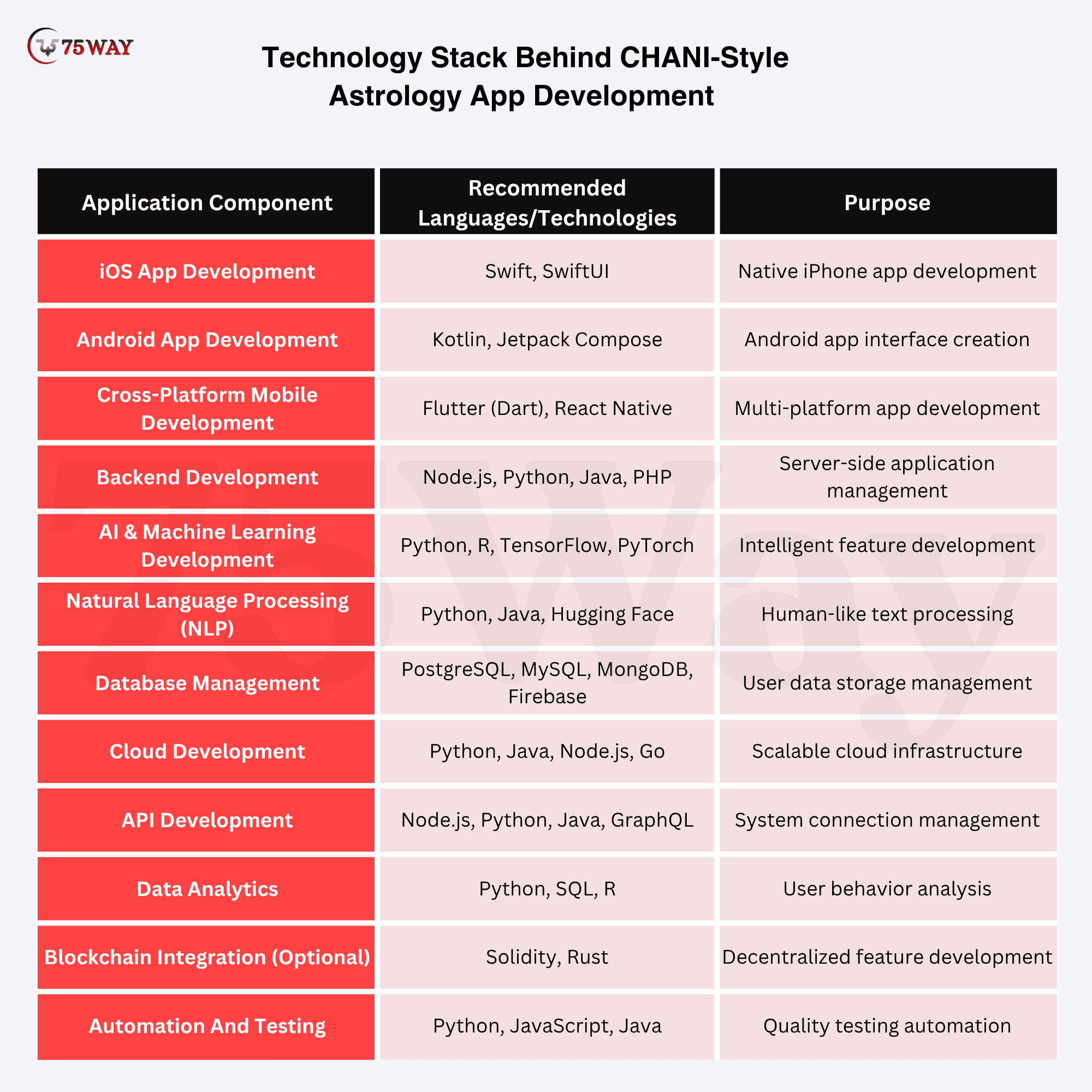
A carefully planned technology stack allows businesses to build an astrology application that is accurate, scalable, and capable of delivering personalized experiences. The right combination of mobile technologies, AI systems, cloud infrastructure, and astrology engines creates the foundation for a CHANI-like astrology platform in 2026.
Why Invest in Building an AI-Powered App Like CHANI?
The popularity of astrology apps reflects a broader shift toward personalised wellness and subscription-based digital experiences. Here are the strategic advantages of investing in an astrology app like CHANI and the opportunities it can unlock.
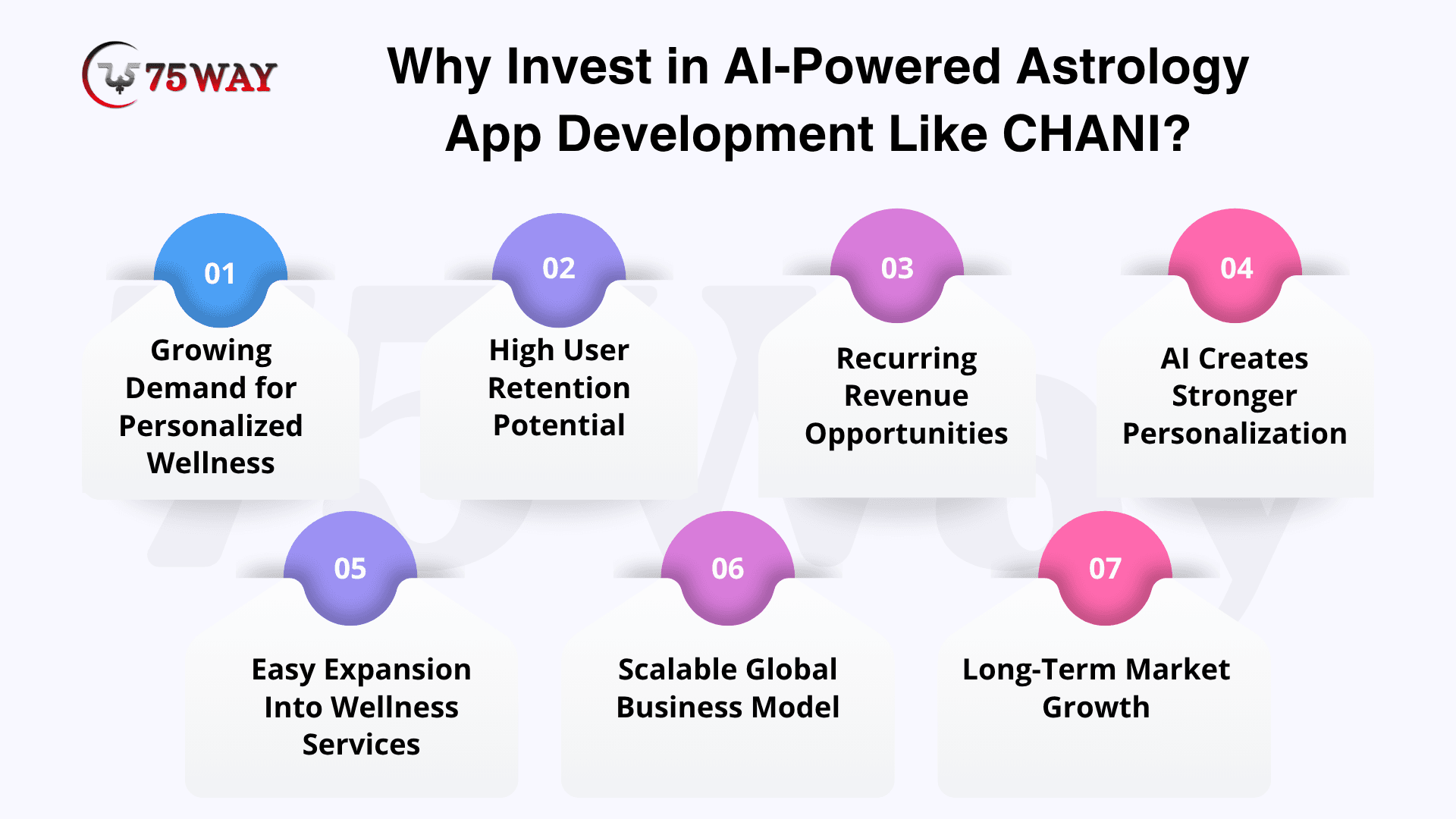
- Growing Demand for Personalized Wellness
People are actively looking for digital experiences that feel personal. An astrology app combines self-discovery, mindfulness, and daily guidance, making it relevant to users who want more than generic content.
- High User Retention Potential
Unlike many lifestyle apps that users open occasionally, astrology platforms encourage daily engagement through personalized horoscopes, birth chart updates, moon phases, affirmations, and timely notifications. Frequent interactions naturally improve long-term retention.
- Recurring Revenue Opportunities
A one-time download isn't the only way to generate revenue. Premium subscriptions, exclusive readings, personalized reports, audio content, and wellness programs create predictable recurring income while increasing customer lifetime value.
- AI Creates Stronger Personalization
Modern AI can recommend relevant content, explain complex birth charts in simple language, answer astrology questions, and personalize the user experience based on behavior. These capabilities make the app feel more interactive and encourage users to return more often.
- Easy Expansion Into Wellness Services
An astrology app can grow beyond horoscope content over time. Businesses can introduce guided meditation, manifestation journals, relationship coaching, sleep content, mood tracking, or personalized wellness experiences without changing the core platform.
- Scalable Global Business Model
Digital astrology services aren't limited by geography. With multilingual support, localized content, and secure payment systems, businesses can reach users across different countries while operating from a single platform.
- Long-Term Market Growth
Interest in astrology, mindfulness, and self-improvement continues to grow alongside demand for personalized digital products. Investing now allows businesses to establish their brand, build a loyal user base, and continuously introduce new features as the market evolves.
How Much Does It Cost To Build An App Like CHANI?
One of the first questions founders ask is, "How much does it cost to build an app like CHANI?" The answer depends on your feature set, AI capabilities, design complexity, platform selection, development location, and the level of personalization you want to offer.
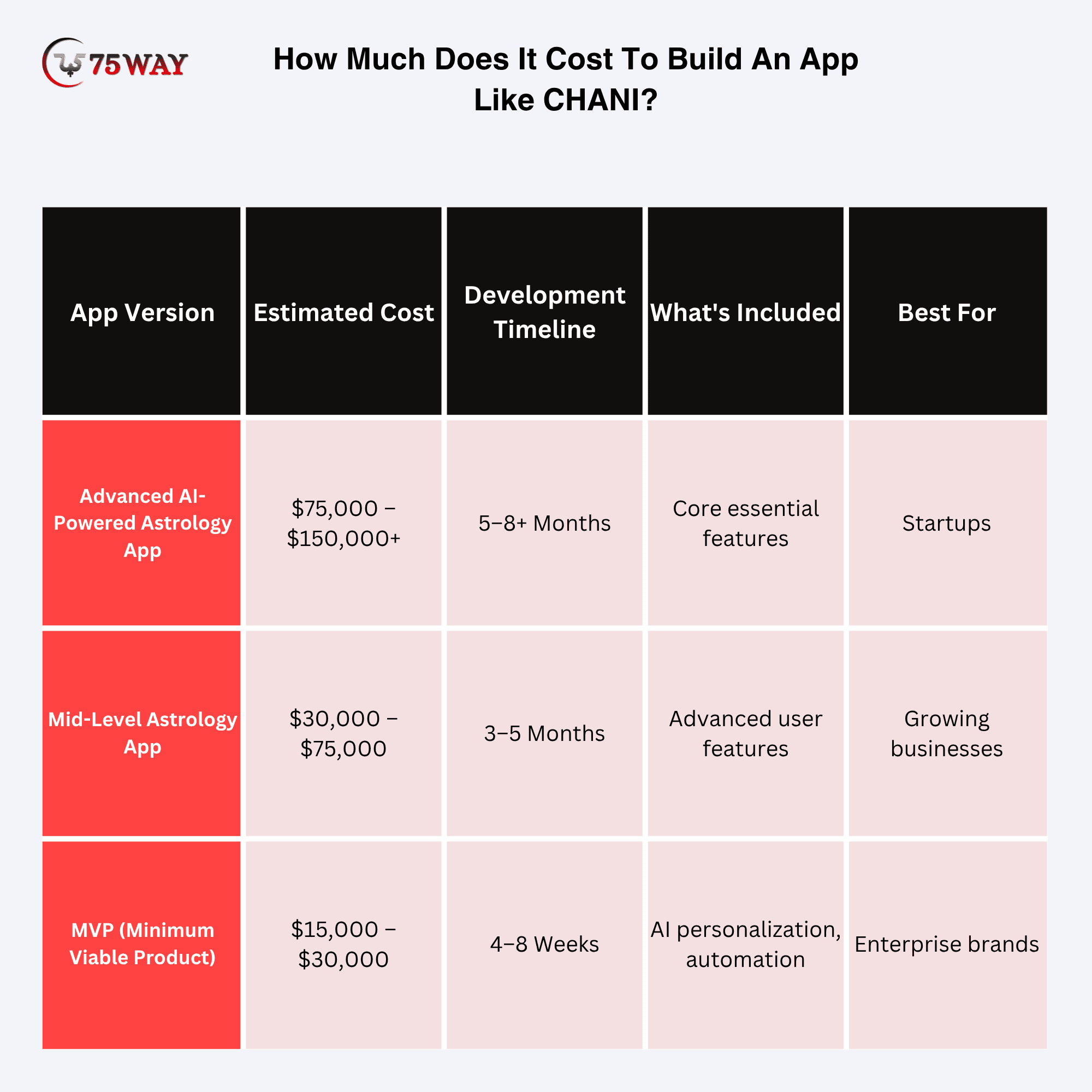
On average, astrology app development like CHANI costs range between $15,000 and $150,000+. However, the final budget depends on feature requirements, development location, technology stack, team expertise, and ongoing maintenance needs.
1. MVP Astrology App Like CHANI
Development Cost: $15,000–$30,000+
Suitable for startups that want to validate their business idea before making a large investment. It generally includes user registration, birth chart generation, zodiac profiles, push notifications,, and basic admin management.
Development Timeline: 4–8 weeks
2. Mid-Level Astrology App Like CHANI
Development Cost: $30,000–$75,000+
A mid-level astrology application introduces premium user experiences such as personalized birth chart interpretations, compatibility analysis, advanced subscriptions, and improved UI/UX.
Development Timeline: 3–5 months
3. Advanced Astrology App Like CHANI
Development Cost: $75,000–$150,000+
An enterprise-level platform similar to CHANI includes AI-powered personalization, astrology chat assistants, journaling, meditation libraries, cloud scalability, high-end security, and extensive content management.
Development Timeline: 5–8+ months
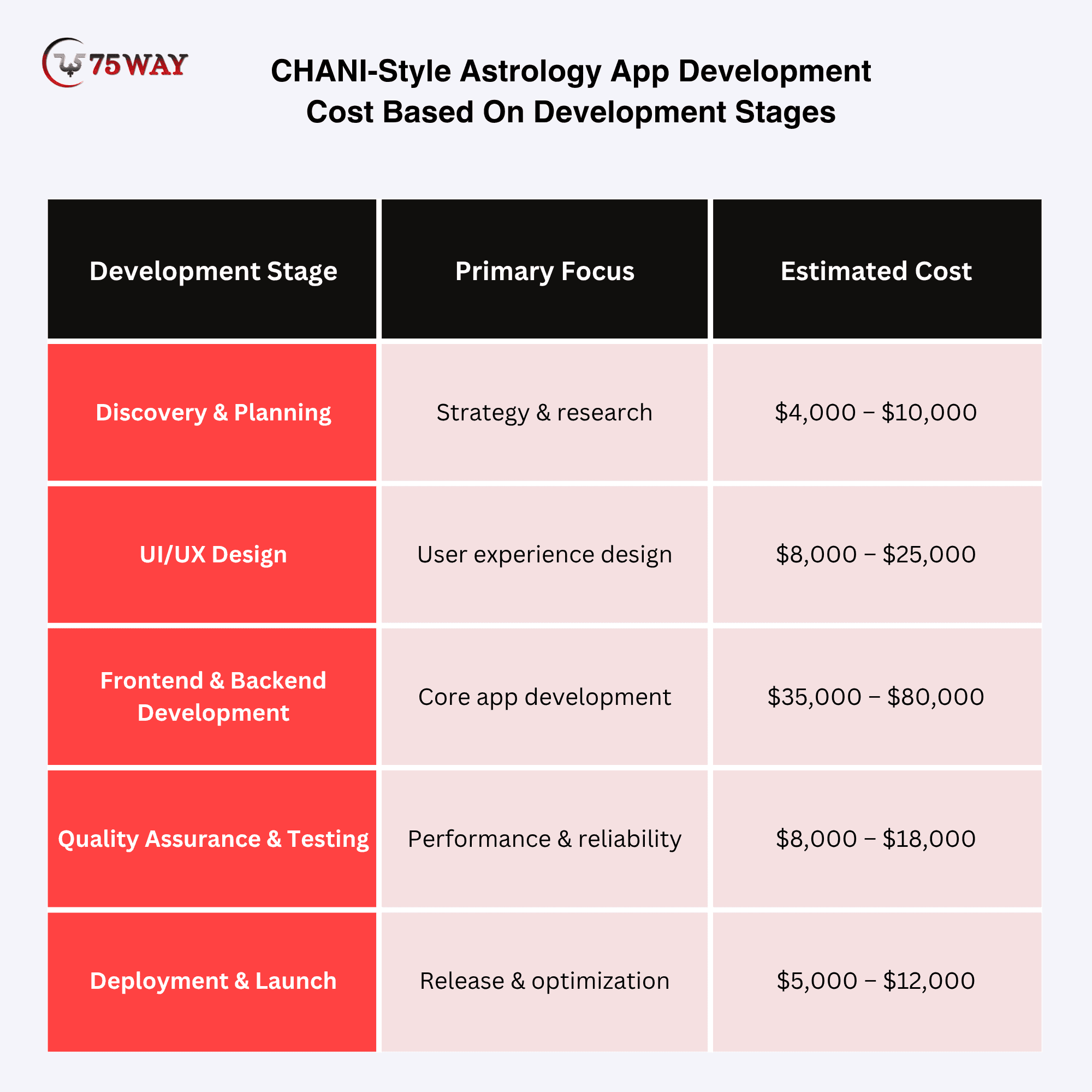
CHANI-Style Astrology App Development Cost Based On Development Stages
Each development phase contributes differently to the overall project budget. Understanding these costs helps businesses allocate resources more effectively and avoid unexpected expenses.
1. Discovery & Planning Cost: $4,000–$10,000
The project begins with market research, competitor analysis, feature planning, technical architecture, and product strategy. Investing in this phase reduces development risks and helps define a clear roadmap.
2. UI/UX Design Cost: $8,000–$25,000
A well-designed astrology app creates emotional engagement through intuitive navigation, calming interfaces, cosmic themes, and personalized user journeys. Design quality significantly impacts user retention.
3. Frontend & Backend Development Cost: $35,000–$80,000
This phase represents the largest portion of the budget because developers build the mobile applications, backend infrastructure, APIs, astrology engine, databases, AI integrations, and subscription systems.
4. Quality Assurance & Testing Cost: $8,000–$18,000
Testing ensures accurate astrology calculations, secure payment processing, responsive performance, device compatibility, and a seamless user experience before launch.
5. Deployment & Launch Cost: $5,000–$12,000
Deployment includes publishing the application, configuring cloud infrastructure, monitoring performance, optimizing app stores, and preparing the platform for real users.
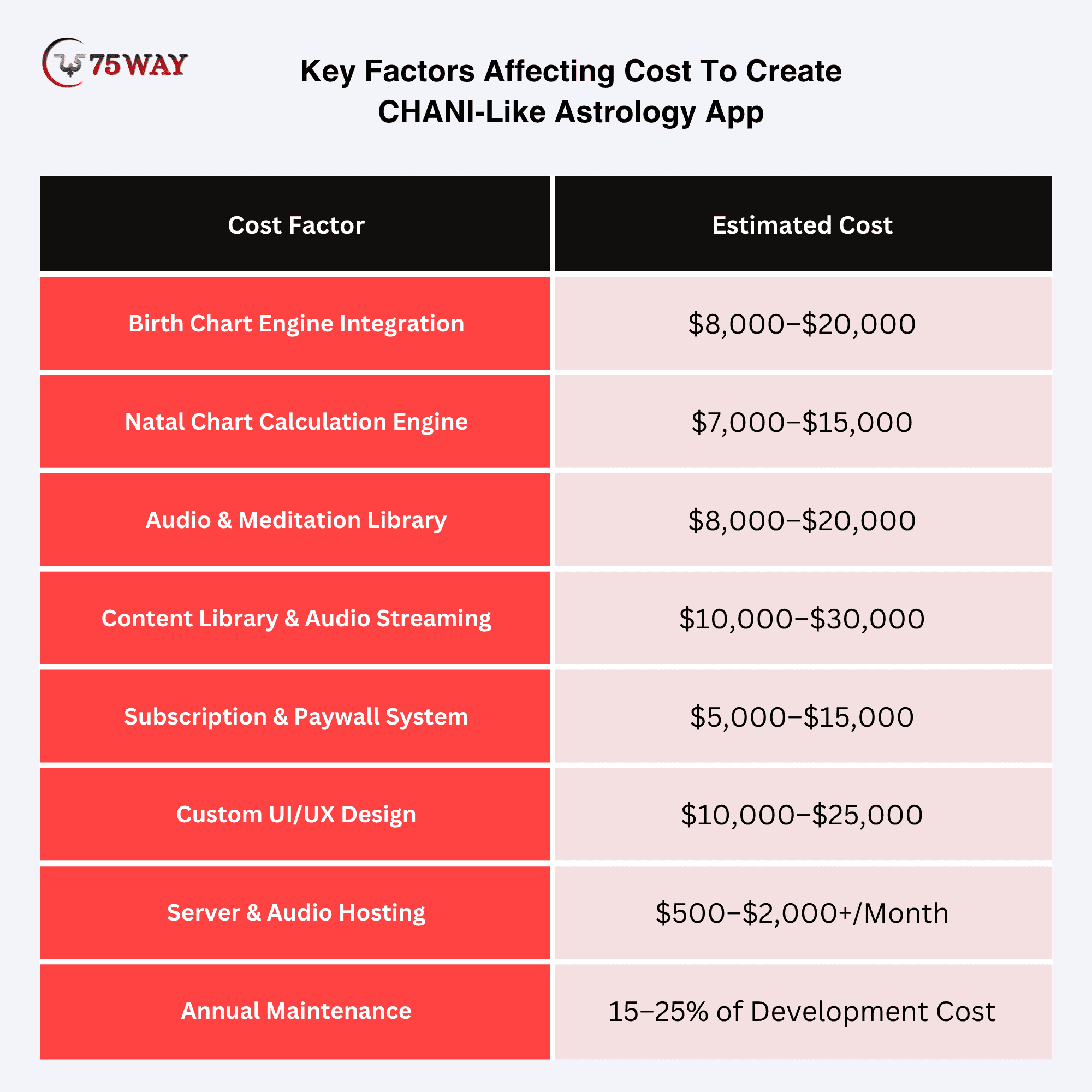
Key Factors Affecting Cost To Create CHANI-Like Astrology App
Several technical components directly influence the overall investment required to build an app like CHANI.
- Birth Chart Engine Integration: Accurate astrology calculations require reliable APIs or custom astronomical algorithms capable of processing planetary positions, transits, aspects, and house systems.
Estimated Cost: $8,000–$20,000
- Natal Chart Calculation Engine: Developing a precise natal chart engine requires astronomical calculations, planetary mapping, and advanced logic for generating personalized birth charts.
Estimated Cost: $7,000–$15,000
- Audio & Meditation Library: If your application includes guided meditations, podcasts, or affirmations, additional infrastructure is required for secure media storage, streaming, and playback.
Estimated Cost: $8,000–$20,000
- Content Library & Audio Streaming: A large content management system enables businesses to publish daily horoscopes, educational resources, meditation sessions, podcasts, and premium wellness content.
Estimated Cost: $10,000–$30,000
- Subscription & Paywall System: Subscription management includes recurring billing, payment gateways, premium memberships, in-app purchases, and App Store or Google Play integration.
Estimated Cost: $5,000–$15,000
- Custom UI/UX Design: Custom animations, cosmic visual themes, personalized dashboards, and interactive user experiences require additional design effort and increase development costs.
Estimated Cost: $10,000–$25,000
- Server & Audio Hosting: Monthly hosting costs vary depending on user traffic, database activity, AI processing, cloud storage, and audio streaming requirements.
Estimated Cost: $500–$2,000+ per month
- Annual Maintenance: Businesses should allocate approximately 15%–25% of the original development cost annually for operating system updates, bug fixes, security improvements, feature enhancements, and fresh astrology content.
Estimated Cost: 15%–25% of the original development cost annually
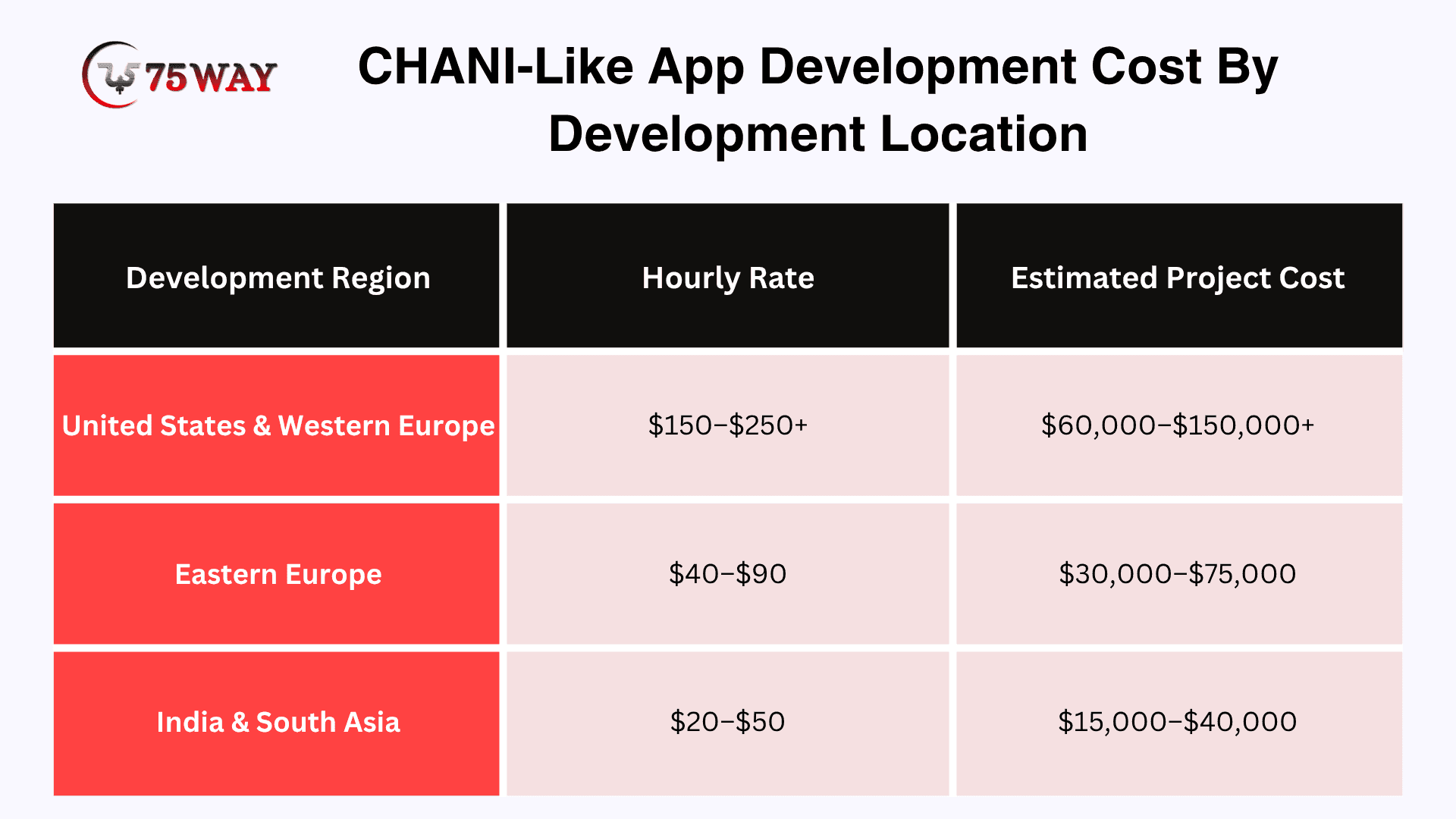
CHANI-Like App Development Cost By Development Location
Developer hourly rates vary significantly across regions, making location one of the biggest factors affecting the overall project budget.
- United States & Western Europe: $150–$250+
- Eastern Europe: $40–$90
- India & South Asia: $20–$50
Strategies To Reduce Cost of CHANI Clone App Development
The most successful products grow in phases, allowing businesses to validate the idea, control development costs, and improve the platform based on real user feedback instead of assumptions. A strategic development approach helps you launch faster, reduce unnecessary expenses, and allocate your budget where it delivers the greatest business value.
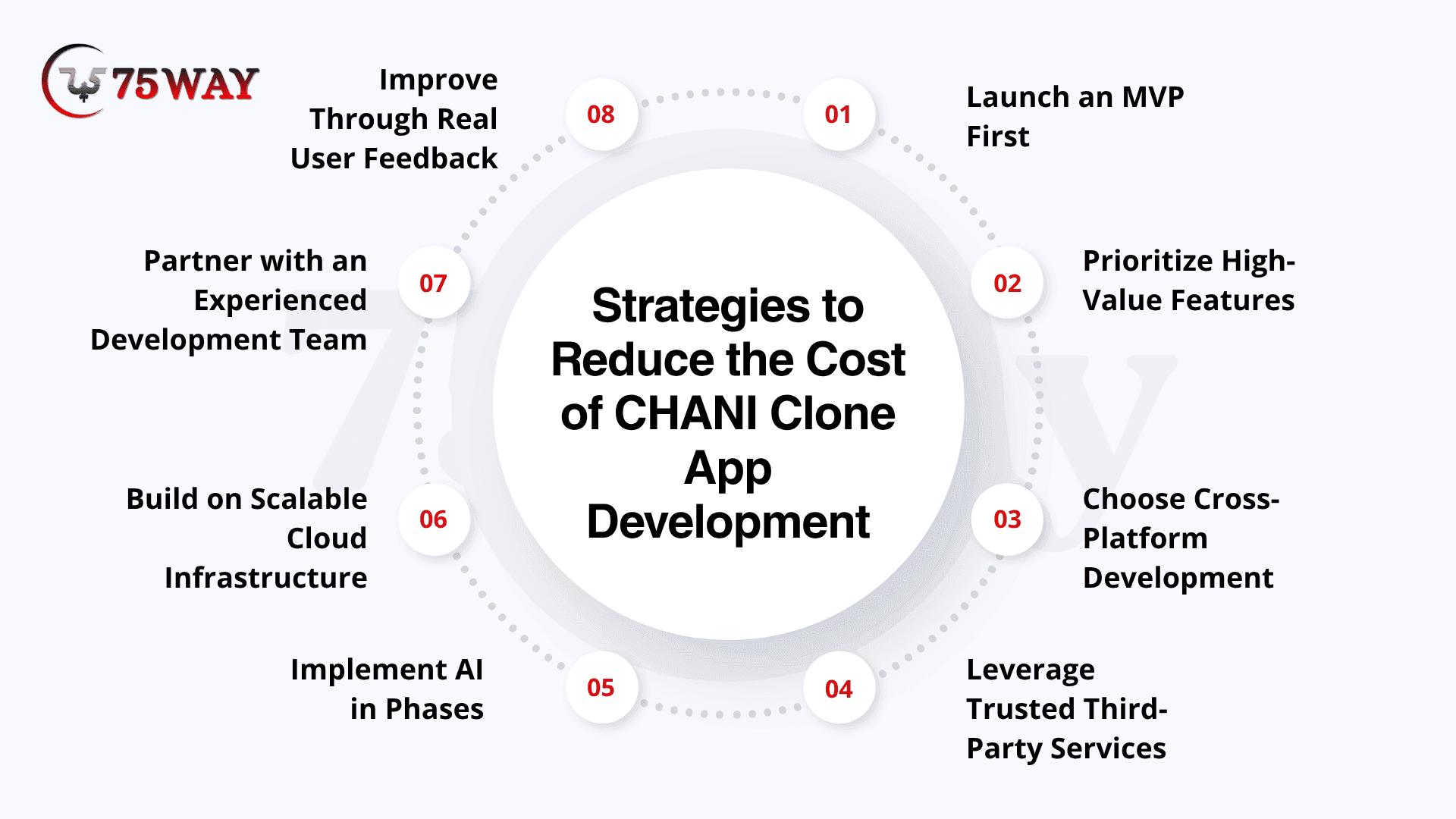
- Launch an MVP First: Focus on the core features users need most, such as birth chart generation, daily horoscopes, and user profiles. Once the app gains traction, expand it with AI capabilities, premium content, and advanced wellness features.
- Prioritize High-Value Features: Every feature adds to your development budget. Use market research and customer insights to identify the capabilities that solve real user problems instead of building features that may never be used.
- Choose Cross-Platform Development: Building a single codebase for both iOS and Android significantly reduces development time, engineering effort, and long-term maintenance costs while reaching a wider audience.
- Leverage Trusted Third-Party Services: Integrate proven APIs for payments, authentication, notifications, analytics, and astronomical data instead of developing every component from scratch. This shortens development time and lowers implementation costs.
- Implement AI in Phases: AI doesn't need to be part of the first release. Launch with essential astrology features, then introduce AI-powered recommendations, conversational guidance, and personalized insights after collecting enough user data.
- Build on Scalable Cloud Infrastructure: Cloud platforms allow your application to grow with user demand. Starting with scalable infrastructure prevents unnecessary upfront infrastructure investments while supporting future expansion.
- Partner with an Experienced Development Team: An experienced offshore or global development partner can reduce overall project costs while maintaining quality, provided they have proven expertise in building scalable mobile applications and AI-powered solutions.
- Improve Through Real User Feedback: Instead of guessing what users want next, analyze customer behavior, reviews, and usage patterns after launch. Investing in features backed by real data helps avoid unnecessary redevelopment and maximizes your development budget.
How To Estimate The Cost of Building An App Like CHANI
Every astrology app has unique business goals, which means development costs vary from one project to another. Before requesting development proposals, businesses should define their feature requirements, target platforms, expected user base, third-party integrations, and long-term scalability goals. A practical way to estimate your project budget is by answering the following questions:
- Do you need an MVP or a full-featured astrology app?
- Will the app launch on iOS, Android, or both?
- How many AI-powered features will be included?
- Will you integrate birth chart and planetary calculation APIs or build a custom astrology engine?
- Do you require audio streaming for meditations and podcasts?
- Will the application include subscriptions, in-app purchases, or premium memberships?
- Is multilingual support required?
- Do you need an admin panel and content management system?
- What level of UI/UX customization do you expect?
- Which development region will you choose?
Businesses can estimate their investment using a simple cost estimation formula.
Total Development Cost = (Development Hours × Hourly Rate) + Third-Party Integrations + Infrastructure Costs + Maintenance
Example:
If your project requires 1,200 development hours, your development partner charges $40 per hour, third-party integrations cost $8,000, infrastructure costs $4,000, and testing costs $10,000, then:
Total Cost = (1,200 × $40) + $8,000 + $4,000 + $10,000 = $70,000
This formula offers a practical starting point for estimating the budget. The final investment will vary based on your business objectives, feature complexity, AI implementation, customization level, and scalability requirements.
Monetization Strategies: How To Generate Revenue From an App Like CHANI
A growing user base creates opportunities, but the right monetization model determines long-term profitability. Here are the revenue strategies businesses can use to build a successful astrology app like CHANI without compromising the user experience.
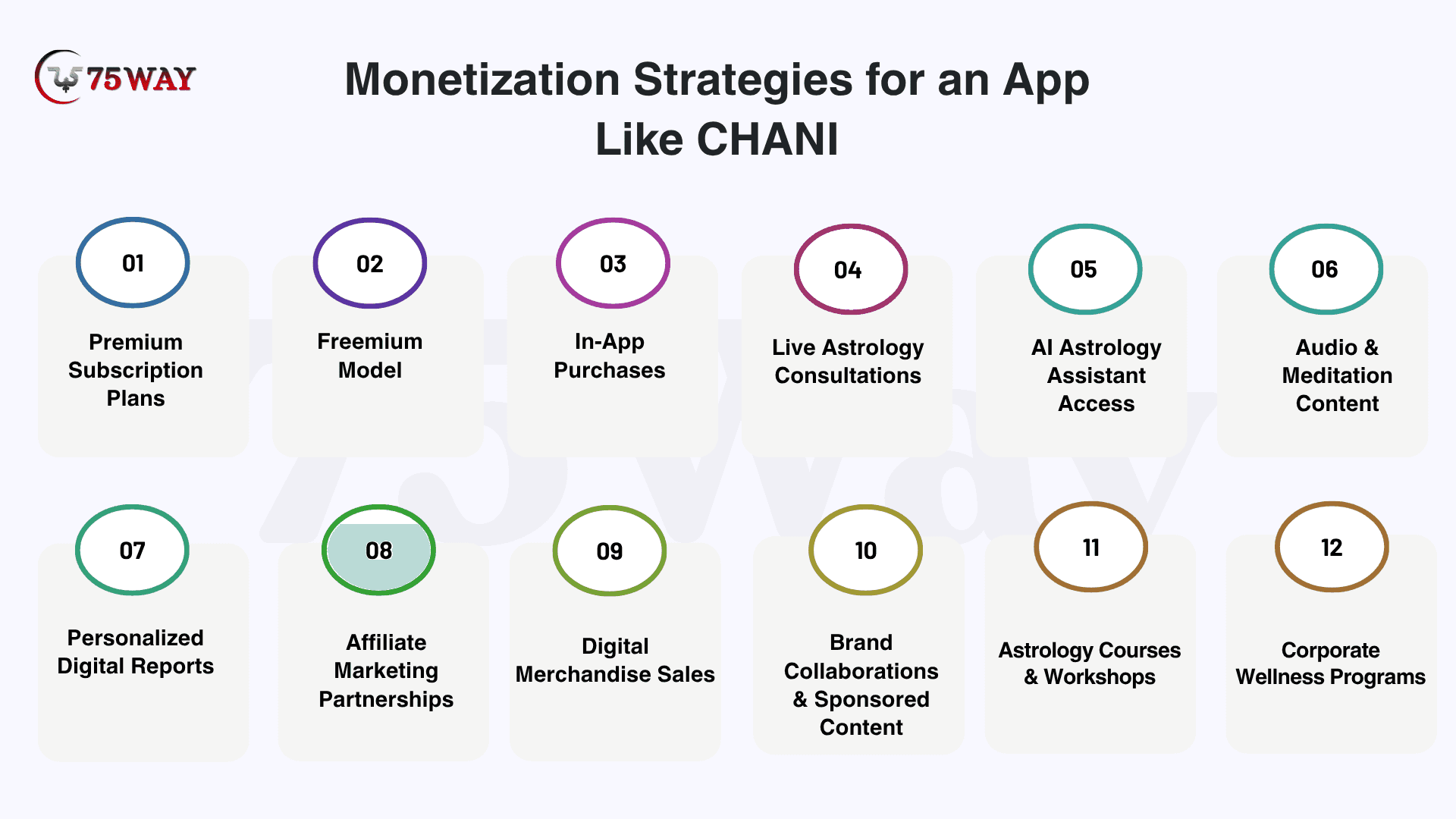
1. Premium Subscription Plans: Offer monthly and annual memberships that unlock exclusive features such as personalized birth chart interpretations, AI-powered insights, guided meditations, podcasts, and premium astrology content. For example, users could pay $9.99–$19.99 per month or $79.99–$149.99 annually for unlimited access to advanced experiences.
2. Freemium Model: Keep essential features like daily horoscopes and zodiac profiles free to attract new users, then encourage upgrades by placing advanced reports, compatibility analysis, and personalized guidance behind a premium plan. This approach helps grow your user base while increasing paid conversions.
3. In-App Purchases: Allow users to buy premium content whenever they need it instead of requiring a subscription. Detailed birth chart reports, relationship compatibility analyses, or yearly astrology forecasts can be offered individually, typically ranging from $4.99–$49.99, depending on the depth of the content.
4. Live Astrology Consultations: Connect users with certified astrologers through the app for one-on-one virtual consultations. Depending on the astrologer's expertise and session length, appointments can be priced anywhere between $50 and $300 per session.
5. AI Astrology Assistant Access: Introduce an AI-powered astrology companion that answers questions, explains birth charts, and provides personalized recommendations. Businesses can include basic AI access in premium plans or offer it as an add-on for around $4.99–$14.99 per month.
6. Audio And Meditation Content: Premium audio experiences such as guided meditations, sleep stories, moon rituals, affirmations, and astrology podcasts can be bundled into subscriptions or sold separately. Individual collections often sell for $9.99–$39.99, while unlimited access fits naturally into a premium membership.
7. Personalized Digital Reports: Generate customized reports covering topics like career growth, financial opportunities, relationship compatibility, or annual planetary forecasts. Since these reports are created specifically for each user, prices commonly range from $14.99 to $99.99, depending on the level of personalization.
8. Affiliate Marketing Partnerships: Recommend wellness products, mindfulness apps, astrology books, online courses, or self-care brands that align with your audience. Every successful referral generates a commission, creating passive revenue without charging users directly.
9. Digital Merchandise Sales: Sell downloadable astrology-themed journals, planners, affirmation cards, wallpapers, moon calendars, and printable guides. Digital products are inexpensive to distribute and often retail between $5 and $30, making them an easy upsell for engaged users.
10. Brand Collaborations And Sponsored Content: Partner with wellness, lifestyle, or self-care brands to feature sponsored experiences that naturally complement your platform. Revenue may come through fixed sponsorship agreements or campaign-based collaborations worth several thousand dollars per campaign, depending on audience size and engagement.
11. Astrology Courses And Workshops: Help users deepen their knowledge by offering paid online courses, live workshops, or certification programs. Introductory classes may start around $49, while advanced learning programs can exceed $500, depending on the instructor and course depth.
12. Corporate Wellness Programs: Expand beyond individual consumers by offering astrology-inspired wellness sessions, mindfulness workshops, and employee engagement programs for organizations. Businesses typically purchase these programs as custom packages, with engagements often ranging from $2,000 to $20,000+ based on team size and program scope.
Emerging Trends Transforming CHANI-Like Astrology App Development
The next generation of astrology apps will be shaped as much by technology as by astrology itself. Here are the innovations helping businesses build CHANI-like platforms that feel more interactive, personalised, and future-ready.
- AI-Driven Personalization: Future astrology apps will use AI to combine birth chart data, user preferences, reading habits, and wellness goals to deliver insights that feel increasingly personal and relevant over time.
- Voice-Based Astrology Experiences: Users will interact with astrology apps through natural conversations instead of only reading text. Voice assistants will explain birth charts, answer astrology questions, and deliver personalized daily guidance hands-free.
- Predictive Wellness Insights: Astrology platforms will connect celestial data with wellness activities such as mood tracking, journaling, sleep habits, and mindfulness practices to recommend more personalized self-care routines.
- Wearable Device Connectivity: Integration with smartwatches and fitness trackers will allow users to receive astrology updates, moon phase reminders, and wellness notifications directly on their wearable devices throughout the day.
- Augmented Reality Features: AR technology will transform learning into an interactive experience by allowing users to explore constellations, visualize planetary movements, and experience celestial events in an immersive way.
- Social Astrology Communities: Future platforms will place greater emphasis on community engagement through discussion groups, live astrology sessions, shared birth chart discussions, and collaborative learning experiences that keep users connected.
- Global Content Localization: As astrology gains popularity worldwide, businesses will expand into new markets by offering multilingual content, region-specific experiences, and culturally relevant recommendations without sacrificing personalization.
- Privacy-First User Experience: Strong security practices will become a competitive advantage. Advanced encryption, secure authentication, transparent data policies, and privacy-focused infrastructure will help protect sensitive birth information and strengthen user trust.
How 75way Develops Feature-Rich Astrology Apps Like CHANI?
At 75way Technologies, we take a strategy-first approach to astrology app development, helping businesses transform innovative ideas into scalable digital products. Our process begins with understanding your business goals, target audience, and monetization strategy before designing an intuitive user experience.
From birth chart engines and horoscope generation to AI-powered personalization, subscription management, and secure cloud infrastructure, we build every component with performance, accuracy, and scalability in mind. Our team leverages modern technologies such as AI, machine learning, cloud computing, and cross-platform frameworks to develop engaging astrology applications that keep users coming back.
Whether you need an MVP or a feature-rich platform like CHANI, 75way provides end-to-end development services, including UI/UX design, backend development, AI integration, testing, deployment, and ongoing support to ensure long-term business growth.
Success Story: A wellness startup approached 75way with an idea for an AI-powered astrology app but struggled with low user retention in its existing horoscope platform and lacked personalized experiences.
We developed a feature-rich solution with AI-generated horoscope insights, personalized birth chart analysis, smart recommendations, subscription management, and guided wellness content.
Within six months of launch, the app achieved a 42% increase in user retention, a 3.1X growth in premium subscriptions, a 38% rise in daily active users, and an average App Store rating of 4.8/5, helping the client build a sustainable recurring revenue model.
Final Thoughts
To develop and launch an app like CHANI requires more than horoscope functionality. It demands accurate astrology calculations, AI-driven personalization, intuitive design, secure infrastructure, and a scalable monetization strategy. Businesses that invest in innovative features, seamless user experiences, and continuous product improvements can establish a strong position in this growing industry.
Whether you're launching a startup or expanding your digital wellness portfolio, partnering with the right technology team can accelerate development and maximize long-term success. Partner with a trusted AI-powered astrology app development firm to transform your vision into a scalable, revenue-generating mobile application.
Frequently Asked Questions (FAQs)
Can An Astrology App Support Multiple Languages?
Yes. Multi-language support allows users from different regions to access astrology content in their preferred language. It also helps businesses expand globally and improve user engagement.
Is User Birth Information Stored Securely In Astrology Apps?
Yes. Modern astrology applications use encryption, secure authentication, and protected cloud storage to safeguard personal information. Security practices also help maintain user trust and regulatory compliance.
Can Astrology Apps Send Personalized Notifications?
Yes. Smart notification systems deliver reminders based on planetary events, moon phases, and individual preferences. Personalized alerts encourage regular engagement without overwhelming users.
Can Astrology Apps Work Without An Internet Connection?
Some features, such as previously downloaded reports or saved birth charts, can work offline. However, live updates, AI features, and cloud-based content require an internet connection.
What Third-Party Integrations Are Common In Astrology Apps?
Astrology apps often integrate payment gateways, push notification services, cloud storage, analytics platforms, and astronomical calculation APIs. These integrations improve functionality and simplify application management.
How Can Businesses Increase User Retention In Astrology Apps?
Businesses can improve retention through personalized experiences, engaging content, gamification, loyalty rewards, and regular feature updates. Consistent value encourages users to return frequently.
Can Businesses Customize An Astrology App For Different Niches?
Yes. The application can be customized for relationship guidance, wellness, spirituality, numerology, tarot, or mindfulness experiences. This flexibility helps businesses target specific audiences more effectively.
What Should Businesses Look For In An Astrology App Development Partner?
Businesses should evaluate technical expertise, AI capabilities, industry experience, security practices, scalability, and post-launch support. Choosing an experienced partner reduces development risks and improves long-term success.