AI Summary
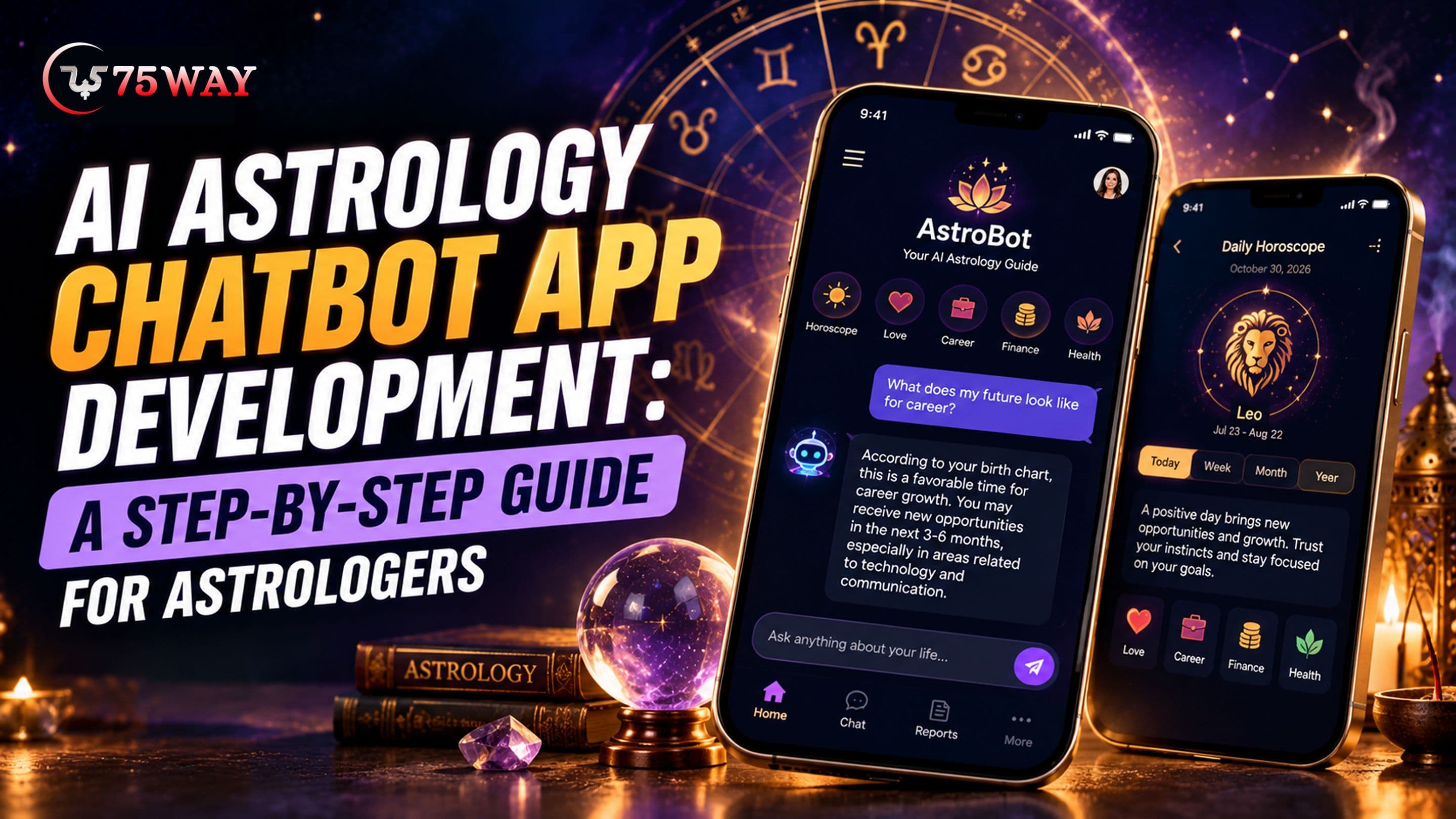
AI astrology chatbot apps are opening new opportunities for astrology businesses and startups. This guide covers AI astrology chatbot app development stages, cost, essential features, AI technologies, and architecture. Explore investment requirements and monetization models to attract users.
Key Takeaways
- AI astrology chatbot development combines LLMs, birth charts, and personalized conversations.
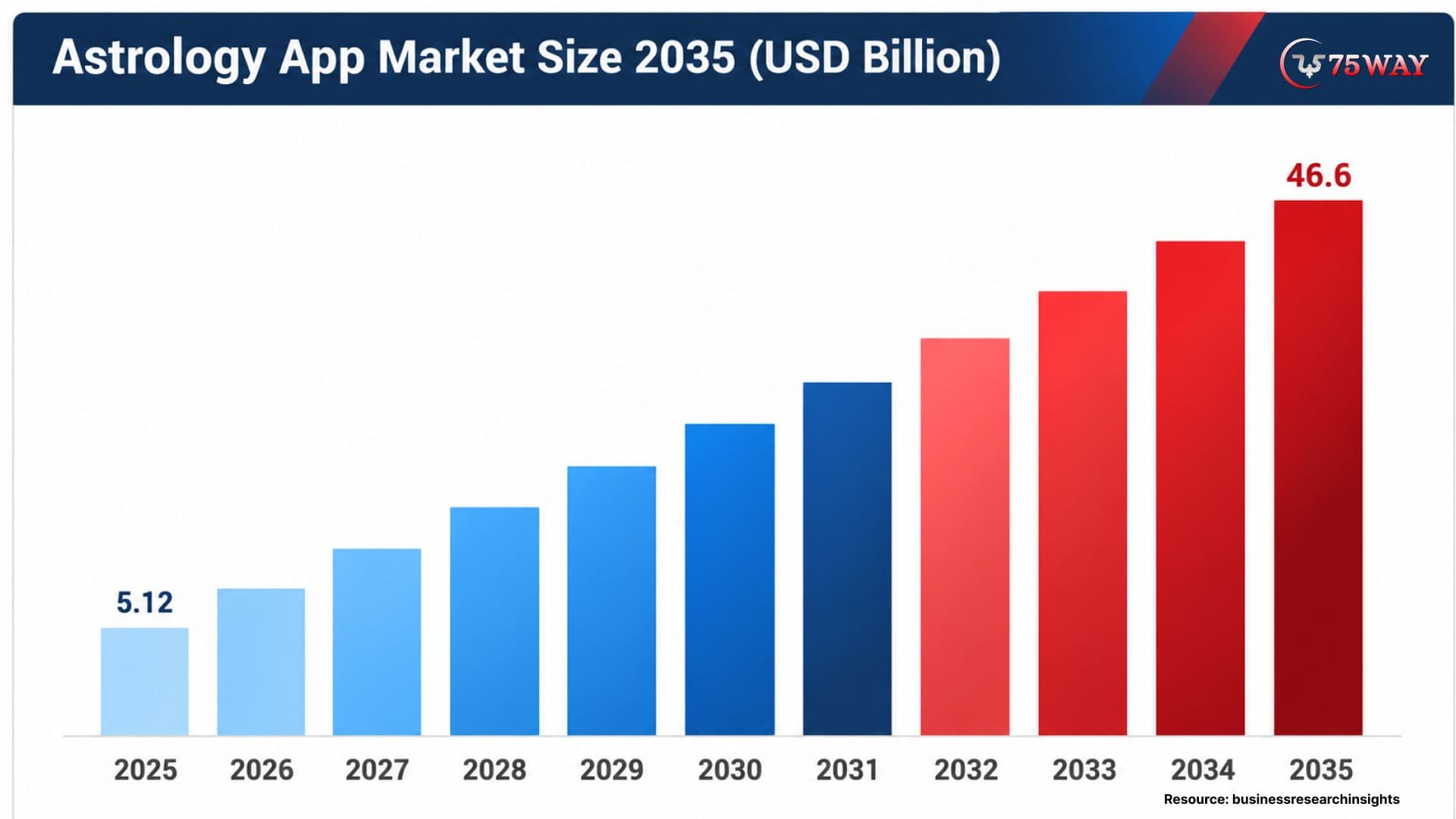
- Market forecasts indicate continued growth across digital astrology applications.
- AI astrology chatbot development costs range from $5,000 to $120,000+.
- Successful apps need intuitive UI/UX, reliable astrology data, and secure integrations.
- Strategic monetization, scalable architecture, and continuous improvements support business growth.
If you are an astrologer or run an astrology business, you know that every new customer means more consultations and more time spent answering questions. So, to overcome this challenge, we have one simple solution for you.
And that’s, of course, related to artificial intelligence. Yes! You are right. It is an AI astrology chatbot app development solution that can take some of that workload off by offering horoscope readings, birth chart interpretations, and personalized astrological guidance whenever users need it.
But building an AI-powered astrology chatbot app isn't as simple as adding an AI chatbot to your website or app. You need accurate birth chart calculations, reliable astrological data, AI responses that make sense, and a smooth user experience that keeps people coming back.
So, where should you start? This guide walks you through the process of building an AI astrology chatbot app, including its essential features, technology stack, development cost, and ways to generate revenue.
What Is AI Astrology Chatbot App Development?
AI astrology chatbot app development involves building a mobile or web application that uses artificial intelligence to answer astrology-related questions and deliver personalized interpretations. The application can combine large language models, astrology calculation engines, structured astrological data, and user profiles to create interactive experiences.
Unlike a traditional horoscope application that displays predefined predictions, an AI-powered platform can respond to individual questions and use relevant birth information to generate contextual explanations.
For example, a user might enter their date, time, and place of birth before asking about career opportunities. The astrology engine calculates the relevant planetary positions and chart details. The AI system then uses those results and an approved knowledge base to generate an understandable interpretation.
The final experience depends on the quality of the astrology data, calculation methods, AI instructions, and application architecture.
Why Should Businesses Invest In AI Astrology Chatbot Apps in USA?
AI-powered astrology apps create opportunities for businesses that want to serve users beyond traditional one-to-one consultations. Astrology AI chatbot development solutions can support self-service experiences, personalized content, and paid digital services within one application. Here are some business advantages worth considering in 2027.
1. Serve More Users Without Relying Only On Live Consultations
Traditional astrology consultations depend on an astrologer's availability. A conversational AI astrology app can answer common questions and provide automated interpretations at any time.
This model can help businesses handle more routine queries while reserving human consultations for complex or premium services.
2. Offer Personalized Astrology Experiences
Generic daily horoscopes do not always meet users' expectations. An AI astrology chatbot app can use birth details, zodiac signs, planetary placements, and conversation history to provide more relevant responses.
Personalization can cover topics such as:
- Career and professional development
- Relationships and compatibility
- Financial planning themes
- Daily and monthly horoscope insights
- Planetary transits
- Birth chart interpretations
The application should clearly explain that astrology insights are interpretive content, not guaranteed predictions or professional financial, medical, or legal advice.
3. Create Multiple Revenue Opportunities
An AI astrology chatbot platform can support several monetization methods, including subscriptions, premium readings, paid reports, and consultations with human astrologers.
Businesses can test different pricing models to understand which services users value most.
4. Build Direct Customer Relationships
A dedicated AI-driven astrology chatbot application gives businesses a channel to communicate with users through notifications, personalized content, account features, and subscription offers.
First-party customer relationships can also help businesses understand user preferences and improve their product experience.
5. Expand Into Different Astrology Categories
A well-planned platform can support different traditions and services, such as Vedic astrology, Western astrology, numerology, tarot-related content, and compatibility analysis.
Each category needs its own data sources, calculation rules, and content validation. Businesses should introduce additional services only when the application can support them reliably.
How Does An AI Astrology Chatbot Mobile App Work?
An AI astrology chatbot combines user input, astrological calculations, knowledge retrieval, and language generation. Each component has a separate responsibility, which helps the application produce more relevant and dependable responses. Here is how a typical interaction works.
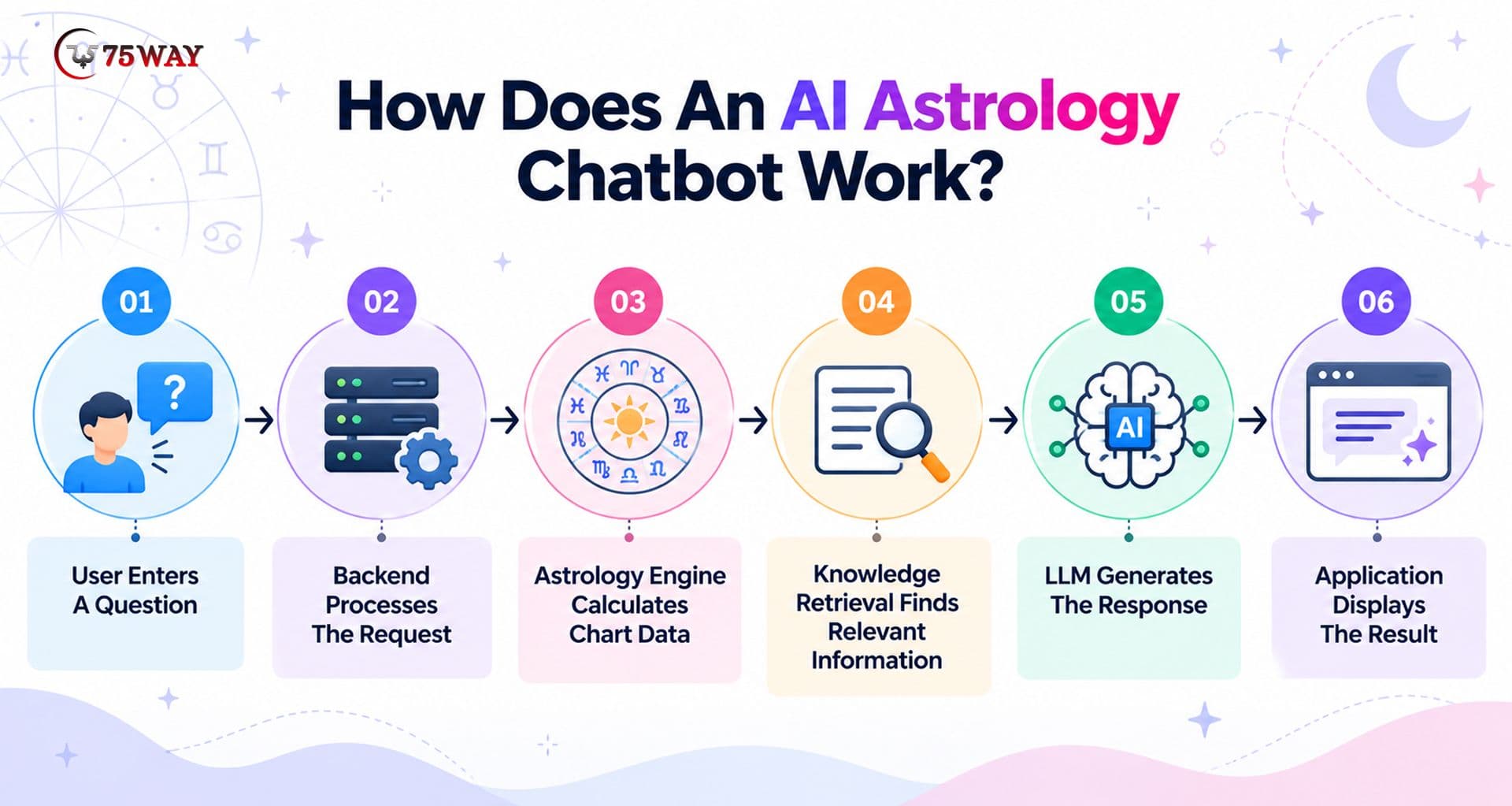
Stage 1: User Enters A Question
The user submits an astrology question and, where required, provides birth date, time, and location.
Stage 2: Backend Processes The Request
The backend validates the input, retrieves the user's saved profile, and identifies the requested astrology service.
Stage 3: Astrology Engine Calculates Chart Data
The calculation service determines planetary positions, houses, aspects, or other required chart details.
Stage 4: Knowledge Retrieval Finds Relevant Information
The system retrieves suitable interpretations from an approved astrology knowledge base.
Stage 5: LLM Generates The Response
The language model combines the retrieved information, calculation results, and conversation instructions to produce a readable answer.
Stage 6: Application Displays The Result
The chatbot presents the response and may save the conversation for future reference, subject to user permissions and privacy settings.
Let’s understand with an example of an AI astrology chatbot interaction
Suppose a user asks, "What does my birth chart suggest about my career?" The application can follow this process:
- Retrieve the user's saved birth details.
- Generate or retrieve the relevant natal chart.
- Identify career-related chart placements according to the selected astrology system.
- Retrieve validated interpretations for those placements.
- Ask the LLM to explain the information in simple language.
- Display the response with relevant chart details and a clear interpretive disclaimer.
This architecture helps separate factual calculations from AI-generated explanations. It also reduces the risk of a language model inventing planetary positions or presenting unsupported interpretations as calculated results.
Explore More: How to Build an Astrology App Like Co-Star? A Strategic Guide 2026
Step-By-Step AI Astrology Chatbot App Development Process
If you're planning to build an AI astrology chatbot app, one of your first decisions is how much of the astrology experience you want AI to handle. From birth chart calculations and knowledge base setup to chatbot training, payment integration, and testing, each stage has a role in the final product. The AI astrology chatbot app development process below breaks these decisions into manageable steps.
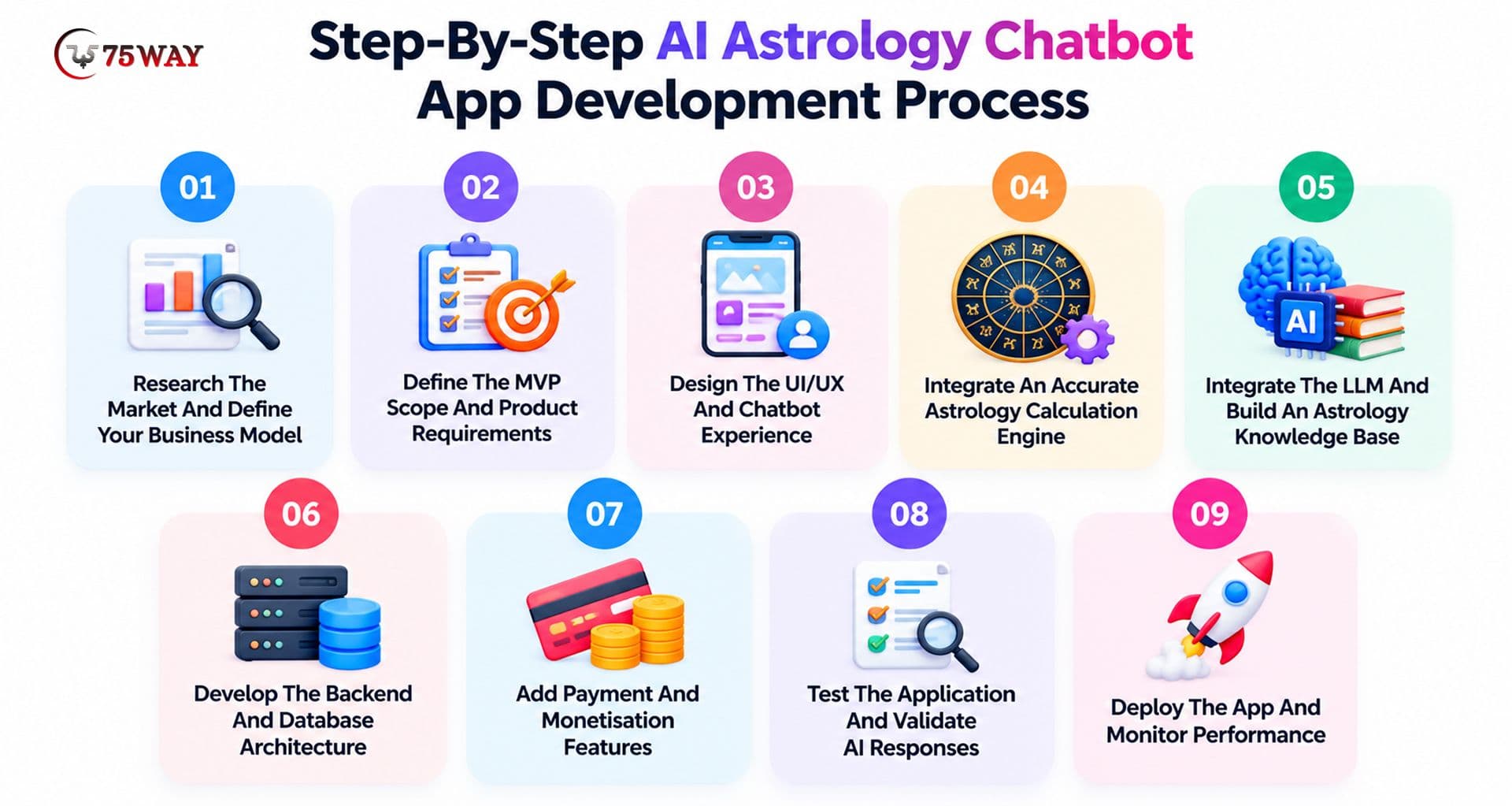
Step 1: Research The Market And Define Your Business Model
Start by identifying the audience, market opportunity, competing applications, and user problems your product will address.
Your research should answer questions such as:
- Will the application target beginners, astrology enthusiasts, or experienced users?
- Will it focus on Vedic astrology, Western astrology, or multiple systems?
- Will users pay for subscriptions, individual readings, or human consultations?
- Which features do competing apps provide?
- What gaps can your product address?
You should also study customer reviews of existing astrology applications. Complaints about generic predictions, confusing interfaces, inaccurate birth details, or limited personalization can help identify opportunities for differentiation.
Deliverable: A business model, target audience profile, competitor analysis, and initial product positioning.
Step 2: Define The MVP Scope And Product Requirements
An MVP should validate the core product idea without introducing every possible feature at launch. Prioritise the functions that demonstrate the main value of your astrology chatbot.
A practical MVP may include:
- User registration and profile management
- Birth date, time, and location input
- Basic birth chart generation
- AI-powered astrology conversations
- Daily horoscope content
- Conversation history
- Basic payment or subscription functionality
Create a product requirements document (PRD) that explains the application's user roles, feature behaviour, business rules, integrations, and technical expectations.
Also define how the application should handle missing birth times, unsupported locations, ambiguous questions, and requests outside its astrology scope.
Deliverable: An MVP feature list, user stories, acceptance criteria, and development roadmap.
Step 3: Design The UI/UX And Chatbot Experience
The user interface should make astrology services easy to discover and understand. A complicated experience can discourage users, especially when they need to enter detailed birth information before receiving a reading.
Design the main screens around user journeys such as:
- Registration and onboarding
- Birth detail collection
- Horoscope dashboard
- Birth chart display
- AI chatbot interface
- Reading history
- Subscription and payment
- User settings
The chatbot experience also needs careful planning. Decide how users will start a conversation, access saved information, ask follow-up questions, and understand the source of an interpretation.
Deliverable: Wireframes, interactive prototypes, design system, and approved screen layouts.
Step 4: Integrate An Accurate Astrology Calculation Engine
Astrological calculations form the foundation of a personalized astrology application. The system should calculate chart information using validated astronomical data and clearly defined astrology conventions.
For example, Swiss Ephemeris is one option for calculating planetary positions. Your development team should evaluate its licensing requirements and suitability before using it commercially.
The calculation service should account for:
- Birth date and exact birth time
- Birthplace coordinates
- Historical time-zone rules
- Daylight saving time where applicable
- Tropical or sidereal zodiac selection
- House system
- Ayanamsa selection for relevant Vedic systems
- Planetary positions and aspects
The application should also handle uncertain birth times appropriately. If a user does not know their exact birth time, the product should explain which calculations may be limited rather than presenting uncertain results as precise.
Deliverable: A tested astrology calculation service with documented settings and validated outputs.
Step 5: Integrate The LLM And Build An Astrology Knowledge Base
The language model helps transform structured astrology information into natural conversations. However, it needs reliable context and clear instructions to produce relevant responses.
You can integrate an LLM through an API and connect it to an approved knowledge base containing astrology definitions, interpretation rules, and content reviewed by domain experts.
A retrieval-augmented generation (RAG) architecture can support this process.
A typical RAG workflow includes:
- Store approved astrology content in a searchable knowledge repository.
- Divide documents into relevant sections.
- Convert the sections into embeddings.
- Store the embeddings in a vector database.
- Retrieve relevant information when a user submits a question.
- Pass the retrieved context and calculated chart data to the LLM.
- Generate a response based on the available information and system instructions.
The chatbot should also have guardrails for unsupported questions, contradictory information, sensitive topics, and requests that fall outside its intended purpose.
Deliverable: An integrated LLM, structured knowledge base, retrieval pipeline, and response-generation rules.
Step 6: Develop The Backend And Database Architecture
The backend connects the mobile or web interface with AI services, astrology calculations, user accounts, and payment systems.
It should manage the application's business logic and protect sensitive user information.
Important backend components include:
- Authentication and authorisation
- User profile management
- Birth chart calculation requests
- AI chatbot API
- Knowledge retrieval service
- Conversation management
- Subscription and payment processing
- Admin dashboard services
- Analytics and monitoring
The database should store only the information required by the application. Access permissions, encryption, retention policies, and deletion workflows should be planned from the beginning.
Deliverable: Backend APIs, database schema, authentication system, and integrated application services.
Step 7: Add Payment And Monetization Features
The payment experience should match your business model. A subscription-based platform needs recurring billing, while a pay-per-reading application needs individual transaction management.
Common payment requirements include:
- Subscription plan selection
- Secure payment processing
- Subscription renewals
- Payment history
- Refund and cancellation workflows
- Access control for premium features
- Transaction notifications
For mobile applications, payment implementation must follow the applicable Apple App Store and Google Play billing requirements. The business should review current platform policies before choosing its payment flow.
Deliverable: A tested payment system with subscription rules and premium feature access.
Step 8: Test The Application And Validate AI Responses
Testing should cover more than whether the chatbot produces a response. Your team must verify the calculations, application workflows, integrations, security controls, and AI output quality.
Important testing activities include:
- Verify registration, profiles, chat, payments, and other core features.
- Compare astrology calculation outputs against trusted references and expected results.
- Check relevance, factual grounding, tone, and consistency.
- Validate communication between the frontend, backend, AI model, and astrology engine.
- Review authentication, permissions, data handling, and common vulnerabilities.
- Evaluate response times and system behaviour under expected traffic.
- Test supported devices, operating systems, and screen sizes.
- Confirm that new updates do not break existing functionality.
You should also test unusual inputs, incomplete birth details, ambiguous questions, and prompts designed to make the chatbot ignore its instructions.
Deliverable: Test reports, resolved defects, and approval for production deployment.
Step 9: Deploy The App And Monitor Performance
Once testing is complete, prepare the application for release. Deployment includes configuring production infrastructure, securing API credentials, setting up monitoring, and submitting mobile applications for platform review.
After launch, monitor:
- Application crashes and errors
- Chatbot response times
- AI API usage and costs
- Astrology calculation failures
- Payment completion rates
- User retention and engagement
- Subscription cancellations
- User feedback and support requests
AI applications need ongoing evaluation because model behaviour, API pricing, user expectations, and third-party services can change over time.
Deliverable: A production-ready application with monitoring, support processes, and a post-launch improvement plan.
Discover More: Choosing Mobile App Development Agency for Astrology & Spirituality Platform (iOS + Android)
AI Astrology Chatbot Apps You Can Build For Different Audiences
AI astrology chatbot apps come in different forms, depending on the services your business wants to offer. Some focus on daily horoscopes and zodiac insights, while others provide birth chart analysis, kundli matching, or personalized astrological guidance. Here are the main types of AI astrology chatbot apps you can consider for your business.
1. AI Horoscope Chatbot App
A conversational platform for daily, weekly, and monthly horoscope insights.
An AI horoscope chatbot answers questions about zodiac signs, planetary movements, and general astrological themes. Users can ask questions instead of browsing multiple horoscope categories.
Useful features include:
- Daily, weekly, and monthly horoscopes
- Zodiac-based chatbot responses
- personalized notifications
- Horoscope history
- Premium horoscope subscriptions
This model can work for businesses targeting a broad audience that wants accessible astrology content.
2. AI Birth Chart Interpretation App
A personalized application built around natal chart calculations and explanations.
A birth chart interpretation app uses a person's birth date, time, and location to calculate planetary placements and other chart details. An AI assistant can explain those results in everyday language.
Useful features include:
- Natal chart generation
- Planetary placement interpretations
- House and aspect explanations
- Career and relationship readings
- Downloadable birth chart reports
The calculation engine must follow clearly defined astrological conventions. Even small differences in birth time, location, time zone, or house system can change chart results.
3. AI Relationship Compatibility App
A platform that compares two birth charts and explains relationship themes.
A compatibility chatbot can compare relevant chart placements and generate interpretations for couples, friends, or business partners.
Useful features include:
- Two-person birth chart comparison
- Compatibility reports
- Relationship-focused chatbot conversations
- Synastry interpretations
- Paid detailed reports
Businesses should explain the interpretive nature of compatibility readings rather than present them as definitive assessments of relationships.
4. AI Vedic Astrology Chatbot App
A specialised application focused on Vedic astrology calculations and interpretations.
A Vedic astrology chatbot can support services such as kundli generation, planetary placements, dasha interpretations, and transit analysis.
Useful features include:
- Kundli generation
- Rashi and nakshatra details
- Dasha and antardasha interpretations
- Panchang-related information
- Vedic astrology chatbot
- personalized reports
This application requires domain-specific calculation logic and validated Vedic astrology content. A general-purpose LLM should not independently calculate complex chart positions.
5. AI Astrologer Marketplace App
A hybrid platform connecting AI-powered guidance with human astrologers.
An astrologer marketplace app can combine automated chatbot support with paid consultations from professional astrologers. Users can begin with basic AI-generated information and choose a human consultation when they need additional guidance.
Useful features include:
- Astrologer profiles
- Appointment scheduling
- Chat and video consultations
- AI-powered initial assistance
- Payment integration
- Ratings and reviews
- Consultation history
This model can create multiple revenue streams while allowing human experts to remain part of the customer experience.
Read Too: CHANI-Like Astrology App Development: Process, Features, Tech Stack, & Cost
Key Features That Make An AI Astrology Chatbot Mobile App Development Solution Stand Out
An AI astrology platform can include three separate panels: a User AI Astrology Chatbot App, an Astrologer App, and an Admin Panel. Each offers specific tools and functionalities to support its intended purpose. The key features that can help your app stand out in a competitive astrology market are defined below.
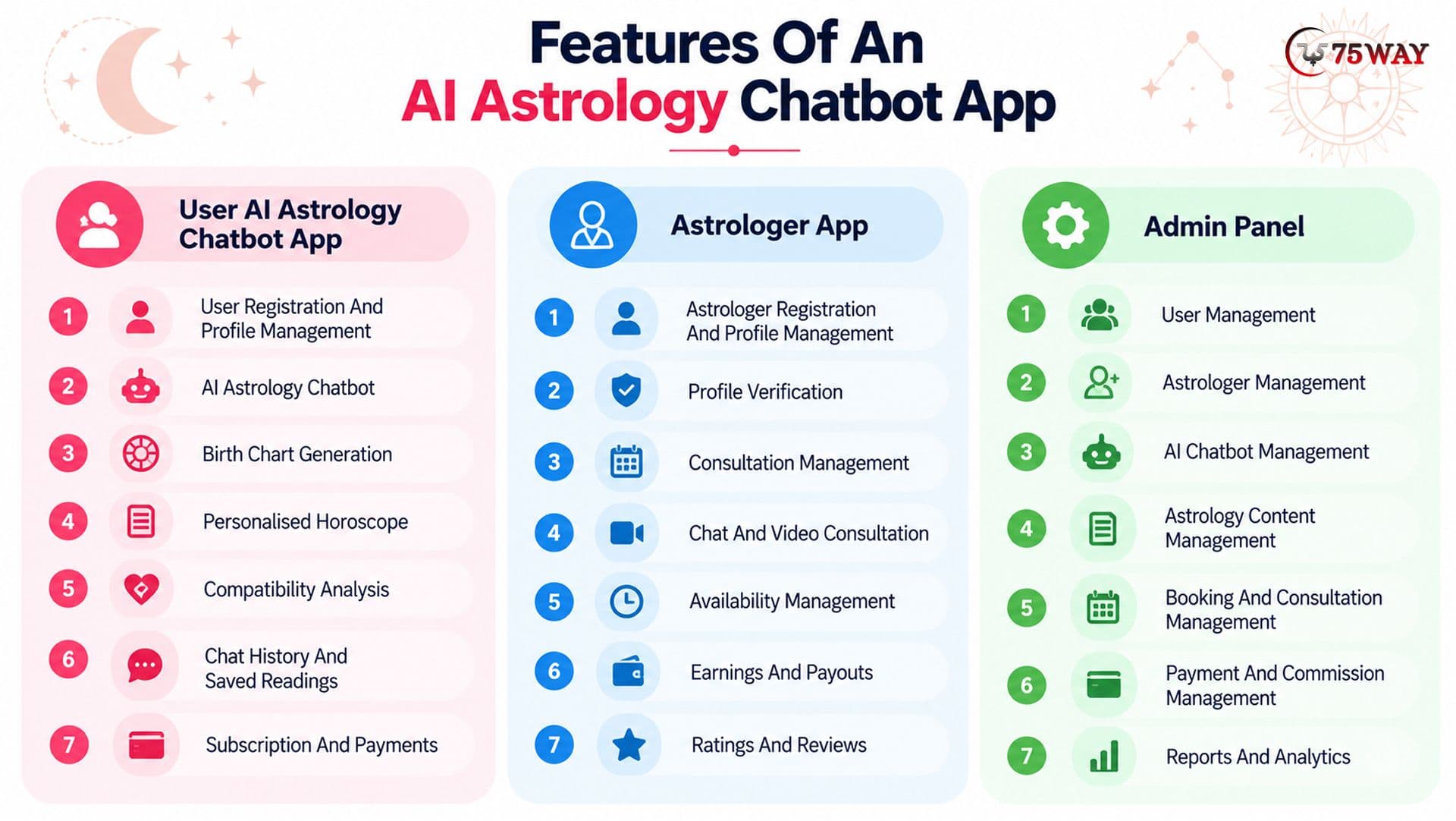
1. User AI Astrology Chatbot App
This panel focuses on personalized astrology experiences, allowing customers to explore predictions, ask questions, and access consultations.
- User Registration & Profile Management: Account creation and profile settings allow individuals to save their birth date, time, and birthplace for personalized astrology services.
- AI Astrology Chatbot: An interactive chatbot answers questions about career, relationships, finances, and daily horoscopes through personalized AI-generated interpretations.
- Birth Chart Generation: Kundli and natal chart creation uses birth details to calculate planetary positions and present relevant astrological information.
- Personalized Horoscope: Daily, weekly, and monthly predictions offer insights based on zodiac signs or individual birth chart details.
- Compatibility Analysis: Birth chart comparison helps individuals explore relationship compatibility through personalized astrological interpretations.
- Chat History & Saved Readings: Previous conversations, generated predictions, and astrology reports remain accessible for future reference.
- Subscription & Payments: Premium readings and monthly or yearly plans can be purchased, with payment history and subscription details available within the app.
2. Astrologer App
Designed for astrology professionals, this panel simplifies client interactions, appointment scheduling, consultation delivery, and earnings management.
Astrologer Registration & Profile Management: Professional profiles showcase experience, astrology specialisations, consultation charges, and other relevant information.
Profile Verification: Supporting documents and professional details can be submitted for review before paid consultation services become available.
Consultation Management: Incoming requests can be accepted or rejected, while appointments and ongoing consultations remain organised.
Chat & Video Consultation: Real-time messaging, audio calls, and video sessions enable direct communication with clients.
Availability Management: Working hours, consultation schedules, and unavailable time slots can be updated according to individual preferences.
Earnings & Payouts: A dedicated earnings dashboard displays consultation income, platform commissions, transaction history, and withdrawal requests.
Ratings & Reviews: Customer feedback and ratings provide insights into consultation experiences and professional reputation.
3. Admin Panel
Centralized administration gives the platform management team control over operations, service quality, payments, and overall performance.
- User Management: Registered accounts, personal information, activity records, and support-related issues can be monitored and managed.
- Astrologer Management: Registration approvals, profile verification, account status, and professional activity can be reviewed from one dashboard.
- AI Chatbot Management: Chatbot prompts, knowledge sources, response settings, and AI usage can be configured and monitored.
- Astrology Content Management: Horoscopes, astrology articles, kundli information, and approved interpretation content can be published and updated.
- Booking & Consultation Management: Appointment records, consultation requests, cancellations, and service-related disputes can be handled centrally.
- Payment & Commission Management: Transactions, subscription plans, platform commissions, refunds, and professional payouts can be managed through dedicated controls.
- Reports & Analytics: Performance dashboards present registration trends, chatbot interactions, consultation bookings, subscription activity, and revenue data.
Tech Stack & Technologies Required To Build An AI Astrology Chatbot App
After working with astrologers across the US, UK, Australia, India, and other global markets, we understand that every astrology platform needs a technology stack that supports accurate readings, engaging conversations, and reliable performance.
We combine carefully selected AI models, astrology calculation engines, mobile development frameworks, cloud services, and secure databases to build these experiences.
Instead of choosing expensive tools for every requirement, we focus on cost-effective technologies that deliver the right balance of performance, scalability, and flexibility.
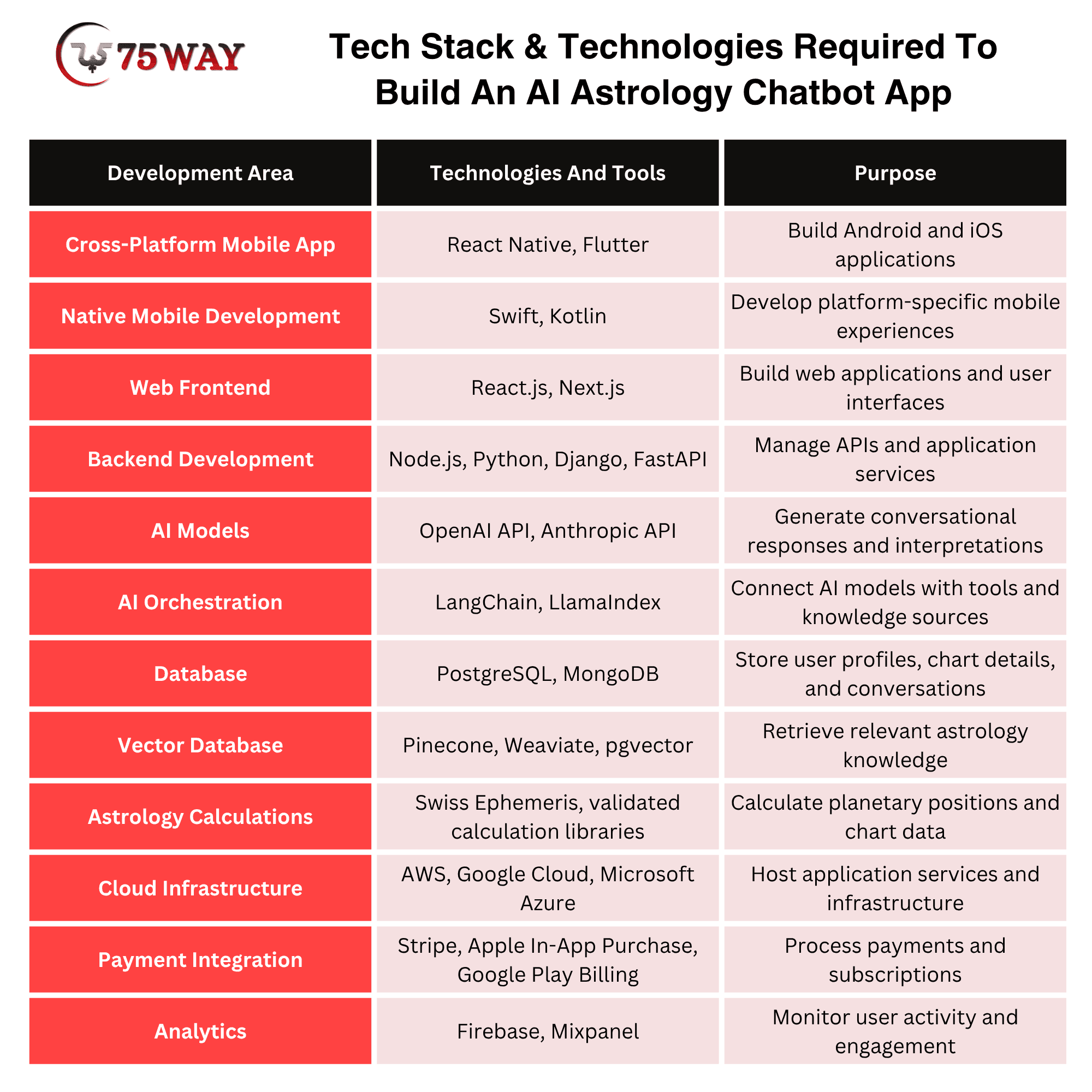
From integrating large language models for natural conversations to using specialized astrology APIs for birth chart calculations, every technology serves a specific purpose.
We select the right tools based on your app's features, target audience, expected user traffic, and long-term operating costs.
This approach helps us build responsive AI astrology chatbots, personalized user experiences, seamless astrologer consultations, and scalable infrastructure without adding unnecessary development or maintenance expenses.
How To Select The Right Technology Stack
A technology stack should support the product's immediate requirements without making future improvements unnecessarily difficult.
- For An MVP: Choose a cross-platform framework, managed database, established AI API, and reliable astrology calculation library.
- For A Growing Product: Add caching, monitoring, structured knowledge retrieval, and stronger backend separation as usage increases.
- For An Enterprise Platform: Consider custom AI services, advanced access controls, scalable cloud infrastructure, and detailed observability.
The final selection should follow a technical assessment. A large technology stack does not automatically produce a better astrology application.
Read Too: How to Build an Astrology App Like Astra in 2026: Step-by-Step Guide
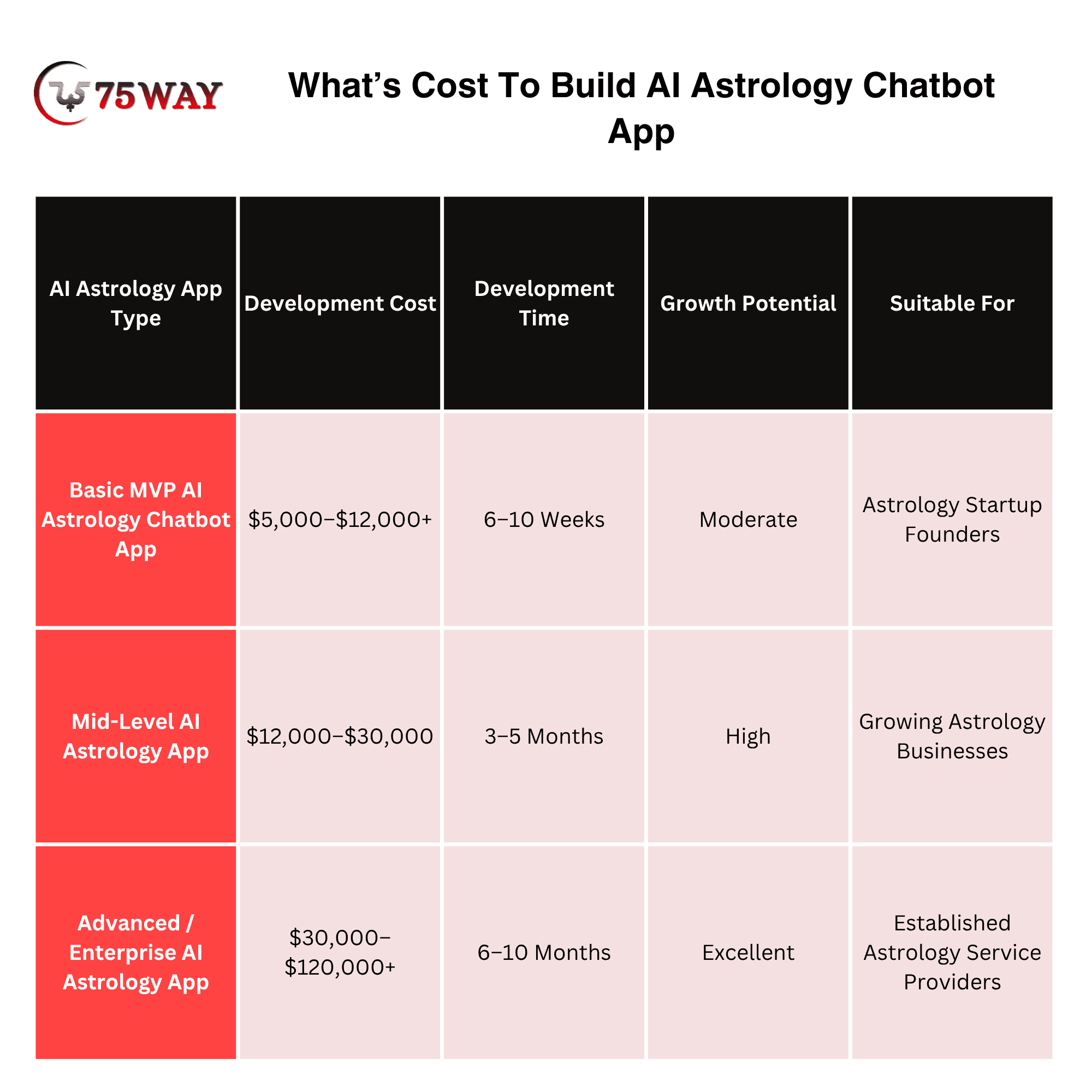
What’s Cost To Build AI Astrology Chatbot App: Pricing Breakdown
The cost to build an AI astrology chatbot app typically ranges from $5,000 to $120,000+, depending on its features and complexity. Your final budget will depend on AI integration, astrology APIs, personalized readings, platform choice, and the development team's rates.
1. Basic MVP AI Astrology Chatbot App: $5,000 – $12,000+
A basic MVP is suitable for startups and astrology businesses that want to validate their idea before investing in advanced functionality.
- Includes registration, login, and personalized user profile management.
- Integrates daily horoscopes and birth chart calculation APIs.
- Provides basic text-based AI astrology chat conversations daily.
2. Mid-Level AI Astrology Chatbot App: $12,000 – $30,000
A mid-level application supports more personalized experiences, detailed chart interpretations, and paid user journeys.
- Generates personalized natal charts and detailed astrological interpretations.
- Integrates custom LLM APIs, including OpenAI and Anthropic.
- Supports multi-turn chats, user profiles, and subscription payments.
3. Advanced/Enterprise AI Astrology Chatbot App: $30,000 – $120,000+
An advanced platform is suitable for established astrology businesses that need complex AI workflows, multiple services, and scalable infrastructure.
- Implements customized AI architecture and astrology knowledge bases.
- Integrates RAG, advanced personalization, and multiple AI services.
- Provides scalable infrastructure, advanced security, and enterprise integrations.
Important: These are indicative development estimates, not fixed market prices. They may exclude ongoing AI API usage, cloud hosting, third-party subscriptions, app store fees, maintenance, and marketing expenses.
Quick Read: Astrology App Development Cost: Complete Pricing Breakdown For Businesses
Factors That Affect AI Astrology Chatbot App Development Cost
Two astrology chat applications can have very different budgets, even when both include an AI chatbot. The following factors influence the overall investment.
1. AI Model Selection And Customization
The choice between a third-party LLM API and a more customized AI architecture affects development effort and operating expenses. Advanced prompt workflows, fine-tuning, model evaluation, and RAG implementation can add to the initial budget.
2. Astrology Calculation Complexity
A basic zodiac horoscope requires less calculation logic than a platform supporting detailed natal charts, divisional charts, transits, dashas, and multiple astrology systems.
The application may also need additional work for time-zone conversion, historical birth data, and location validation.
3. Features And Third-Party Integrations
Voice AI, video consultations, payment gateways, multilingual support, notifications, and astrologer marketplaces all add development and testing requirements.
Each integration should be evaluated for licensing, API limits, security, and ongoing fees.
4. UI/UX Design Requirements
A simple chatbot interface costs less to design than an application with interactive birth charts, dashboards, report builders, and multiple user journeys.
Custom animations, accessibility requirements, and platform-specific design can also affect the budget.
5. Security And Infrastructure
User profiles, birth details, conversations, and payment records require appropriate protection. Encryption, access controls, secure API management, monitoring, and backup systems contribute to development and infrastructure costs.
6. Development Team And Location
The team's experience, engagement model, and location can influence hourly rates and total project costs. A project may involve product managers, UI/UX designers, mobile developers, backend engineers, AI specialists, and quality assurance professionals.
Businesses should compare the complete delivery scope rather than selecting a vendor based only on the lowest quote.
Monetization Models Working Behind Custom AI Astrology Chatbot Apps
Your astrology app needs a revenue model that matches how users access readings and interact with the chatbot. Free daily predictions can attract users, while personalized reports, advanced AI consultations, and membership plans can turn regular engagement into paid services. The following monetization models explain how your app can generate income.
1. Freemium Model
Offer basic horoscope content and limited chatbot conversations at no cost. Users can upgrade to access personalized readings, detailed reports, and additional AI interactions.
2. Subscription Plans
Provide monthly or annual subscriptions for premium features. Subscription benefits may include unlimited or higher chatbot usage, advanced birth chart reports, compatibility analysis, and exclusive astrology content.
3. In-App Purchases
Allow users to purchase individual services without subscribing. Examples include detailed natal chart reports, relationship compatibility readings, and downloadable astrology reports.
4. Pay-Per-Consultation
Charge users for specific readings or consultations. This model works particularly well when the platform combines AI assistance with services from human astrologers.
5. Human Astrologer Consultations
Offer paid chat, audio, or video sessions with astrologers. The platform can charge a booking fee, service commission, or other clearly disclosed transaction fee.
6. Advertising
A free application can generate revenue through relevant advertising. However, businesses should avoid intrusive ad placements that interrupt readings or reduce user trust.
7. B2B Licensing And White-Label Solutions
Astrology businesses can license chatbot technology or offer branded versions of the platform to partners. This approach may create recurring business revenue through licensing, usage-based fees, or support agreements.
How To Reduce AI Hallucinations In Astrology Responses
This challenge deserves special attention because users expect chart interpretations to reflect their actual birth information. A practical approach separates the calculation process from the language-generation process:
- Calculate planetary positions through a dedicated astrology engine.
- Validate the calculation output before sending it to the AI service.
- Retrieve relevant interpretations from an approved knowledge base.
- Provide the chart data and retrieved content as structured context.
- Instruct the LLM not to invent missing placements or unsupported facts.
- Test responses against a collection of reviewed questions and expected answers.
The application should also acknowledge uncertainty when birth information is incomplete or a requested interpretation is unavailable.
Common Challenges In AI Astrology Chatbot Development And Their Solutions
AI astrology applications combine specialised calculations with open-ended conversations. This creates technical and product challenges that businesses should address before launch.
1. Astrology Calculation Accuracy: Incorrect birth details or calculation settings can produce misleading chart results.
How To Resolve: Use validated calculation libraries, consistent astrological conventions, and reference-based testing to verify chart accuracy.
2. AI Hallucinations: Large language models may invent planetary placements or generate interpretations unsupported by actual chart data.
How To Resolve: Ground AI responses in calculated chart details, structured astrology databases, and approved knowledge sources.
3. User Data Privacy: Birth details, personal profiles, and conversation histories may contain sensitive user information.
How To Resolve: Apply data encryption, role-based access controls, data minimisation, and clearly defined data retention policies.
4. AI API Costs: Frequent chatbot requests, lengthy conversations, and complex AI responses can increase operating expenses.
How To Resolve: Implement model routing, appropriate caching, usage limits, and token monitoring to control API consumption.
5. Inconsistent Response Quality: AI-generated interpretations may vary in accuracy, relevance, tone, and level of detail.
How To Resolve: Establish structured prompts, response evaluation processes, domain expert reviews, and regular regression testing.
6. Scalability: Increasing user traffic can place additional pressure on databases, AI services, and application infrastructure.
How To Resolve: Adopt scalable cloud services, caching mechanisms, processing queues, performance monitoring, and load testing.
Final Thoughts
AI astrology chatbot app development offers businesses an opportunity to combine personalized astrology services with conversational AI.
However, a competitive application needs more than a chatbot interface. Accurate birth chart calculations, reliable knowledge sources, secure architecture, intuitive design, and a practical monetization strategy all contribute to the product's success.
You can start with an MVP that solves a clear user problem, validate its performance, and expand the feature set based on customer feedback. The right astrology app development partner can help translate your business idea into a product roadmap, technical architecture, and realistic investment plan.
To build an AI astrology chatbot app, you can discuss your requirements and plan your development journey with a skilled AI astrology app development firm.
Frequently Asked Questions (FAQs) | People Also Ask (PAA)
How Much Does It Cost To Develop An AI Astrology Chatbot App?
An AI astrology chatbot app can cost approximately $5,000 – $12,000+ for a basic MVP, $12,000 – $30,000 for a mid-level application, and $30,000 – $120,000+ for an advanced platform. The final investment depends on features, AI integrations, astrology calculations, design, and infrastructure.
How Long Does It Take To Build An AI Astrology Chatbot App?
A basic MVP may take around 8–12 weeks, while a feature-rich application can require 3–5 months or longer. Custom AI architecture, advanced chart calculations, multiple integrations, and complex testing can extend the timeline.
Which AI Models Can Be Used For An Astrology Chatbot?
Businesses can consider LLM APIs from providers such as OpenAI and Anthropic. The right model depends on response quality, integration requirements, latency, context length, privacy needs, and operating costs. Model performance should be evaluated using astrology-specific test cases before launch.
Can ChatGPT Be Integrated Into An Astrology App?
Yes. Developers can integrate an OpenAI model through its API to support conversational astrology experiences. The application should provide structured chart data, relevant knowledge, and clear instructions so the model generates responses based on the available information.
What Is RAG In AI Astrology Chatbot Development?
Retrieval-augmented generation (RAG) connects an LLM with an external knowledge base. When a user asks a question, the system retrieves relevant astrology information and provides it as context to the model. This can improve response relevance and reduce unsupported answers.
Which APIs Are Required To Build An AI Astrology App?
The required APIs depend on the application's features. A typical platform may use an LLM API, astrology calculation service, authentication service, payment gateway, notification service, analytics tools, and cloud storage. Businesses should assess each provider's pricing, licensing, data handling, and service limits.
Can An AI Astrology Chatbot Generate Personalized Birth Charts?
Yes. An application can generate personalized birth charts using the user's birth date, time, and location. A dedicated astrology calculation engine determines planetary positions and chart details, while an LLM can explain the calculated results in conversational language.
Can I Build An AI Astrology Chatbot Without Training My Own LLM?
Yes. Most businesses can start with an existing LLM API and connect it to an astrology calculation engine and an approved knowledge base. RAG, prompt engineering, and structured data can support specialised responses without training a foundation model from scratch.