Summary
Healthcare CRM software development helps hospitals and clinics automate patient communication, improve engagement, and streamline operational workflows. Modern hospital CRM platforms integrate AI, analytics, telemedicine, and compliance-driven infrastructure to enhance healthcare experiences. Businesses investing in healthcare CRM systems gain better patient retention.
Quick Overview
- By 2034, the global healthcare CRM market is projected to grow $43.40 B.
- Healthcare CRM systems improve patient communication and operational work
- Healthcare CRM development includes planning, design, integrations, and deployment processes
- HIPAA compliance remains essential during healthcare CRM software development
- Development costs range from $30,000 to $1,000,000+ based on your requirements
Struggling to manage patient communication, appointment follow-ups, and healthcare operations? You’re not alone. This situation is faced by many healthcare organizations.
You’d not believe it, but this challenge is becoming increasingly common across hospitals, clinics, diagnostic centers, and healthcare networks in 2026. The reason is that patient expectations are rising fast, and healthcare providers are unable to handle massive volumes of consultations, records, and support requests every day.
That is exactly why healthcare CRM software development has become a strategic investment for providers aiming to improve patient satisfaction.
Modern healthcare CRM systems do much more than store patient information. From patient onboarding and follow-up care to analytics and workflow automation, everything becomes significantly more organized and efficient.
So, how do healthcare CRM platforms actually work, what features are most important, and how to build scalable healthcare CRM solutions in 2026? This guide delineates each and evry aspect of healthcare CRM development, costs, essential features, technologies, integrations, compliance requirements, and development stages. Let us explore now.
What Is Healthcare CRM Software?
Healthcare CRM software is a customer relationship management system specifically designed for hospitals, clinics, healthcare providers, and medical organizations. It helps manage patient interactions, automate communication, centralize healthcare data, and improve patient engagement experiences. Unlike traditional CRM platforms used in retail or finance industries, healthcare CRM systems focus on patient-centric workflows and regulatory compliance requirements. Healthcare CRM platforms commonly support:
- Patient communication
- Appointment scheduling
- Lead management
- Billing notifications
- Telemedicine coordination
- Marketing automation
- Patient feedback collection
- Follow-up management
- Healthcare analytics
- Support ticket management
In practical healthcare environments, CRM software centralizes patient contact details, appointment history, communication records, treatment journeys, preferences, referrals, and engagement activities. This centralized data structure helps healthcare organizations understand patient behavior, identify engagement gaps, improve outreach campaigns, and reduce operational inefficiencies affecting patient experiences and revenue growth.
Healthcare CRM platforms also automate repetitive administrative workflows such as appointment scheduling, reminders, follow-ups, recall notifications, billing communication, and patient engagement campaigns. This automation reduces manual workload for healthcare staff while improving communication consistency and operational productivity across healthcare systems.
Modern healthcare CRM software increasingly integrates AI-powered analytics, telemedicine capabilities, electronic health records, and predictive engagement tools that support personalized healthcare experiences. These systems transform disconnected healthcare interactions into coordinated patient-centric journeys focused on accessibility, communication, and long-term relationship management.
Healthcare CRM Market Trends & Growth Insights
Before you know how to develop a healthcare CRM software, you must have information regarding whether investing in this platform is beneficial or not. The global healthcare CRM market is projected to grow from $18.76 billion in 2025 to around $43.40 billion by 2034, at a CAGR of 9.76%. Not only this. You can explore another market insight into healthcare CRM systems.
- North America leads the healthcare CRM market with the largest share of 53.0%.
- The U.S. contributes the highest revenue share within the North American healthcare CRM industry.
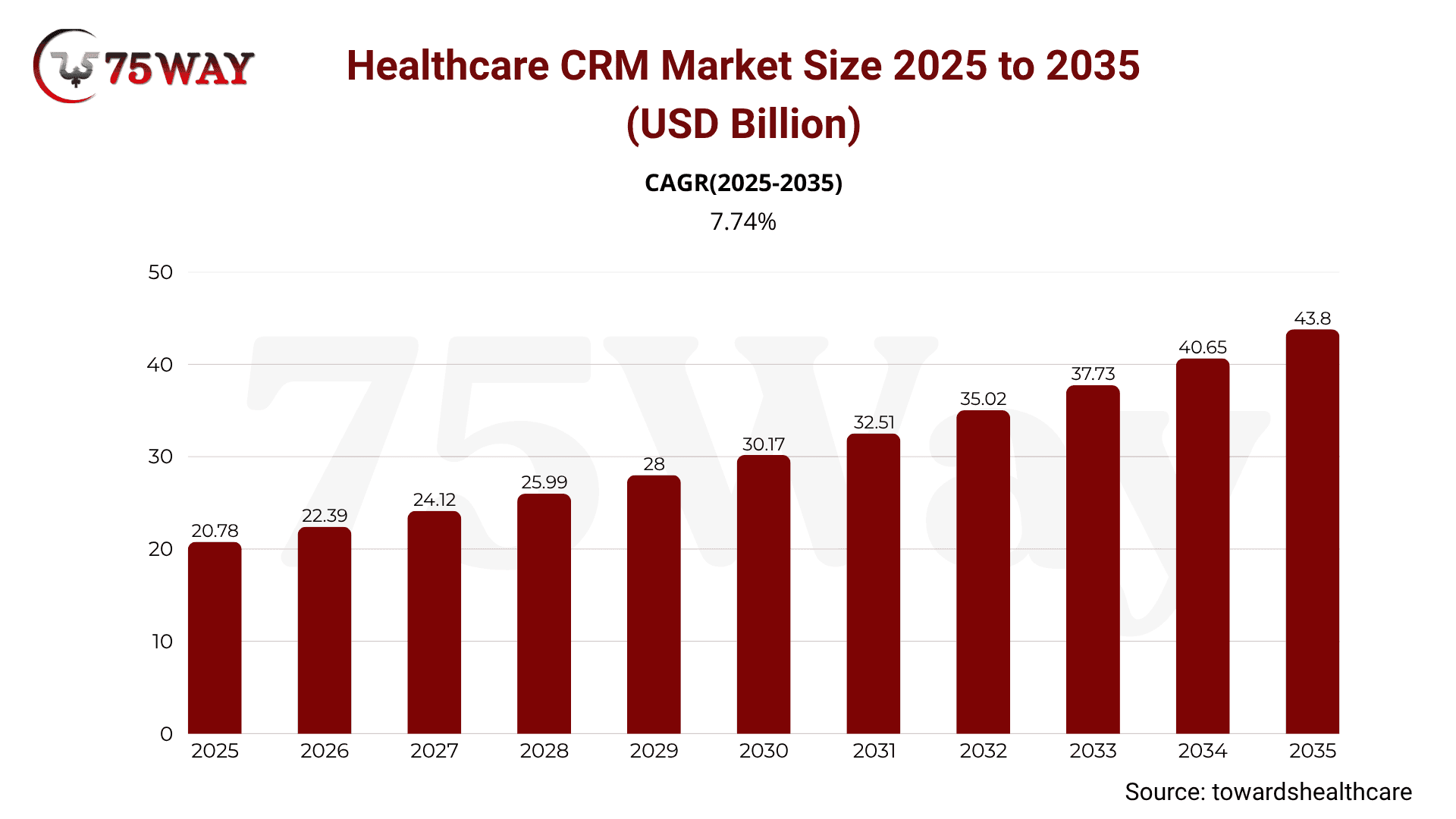
- Industry reports estimate the global healthcare CRM market could reach nearly $43.8 billion by 2035, growing at a CAGR of 7.74%.
- By functionality, the sales segment accounted for approximately 21% of total revenue.
- Healthcare providers dominate the end-use market, contributing around 44% of the market share.
- Healthcare CRM adoption has reached nearly 82%, making healthcare one of the most digitally advanced sectors.
Why Healthcare Organizations Need CRM Systems In 2026?
Healthcare organizations need CRM systems to improve patient engagement, automate communication, and streamline operational workflows. Modern healthcare ecosystems require centralized platforms that support personalized experiences, data management, and digital healthcare coordination.
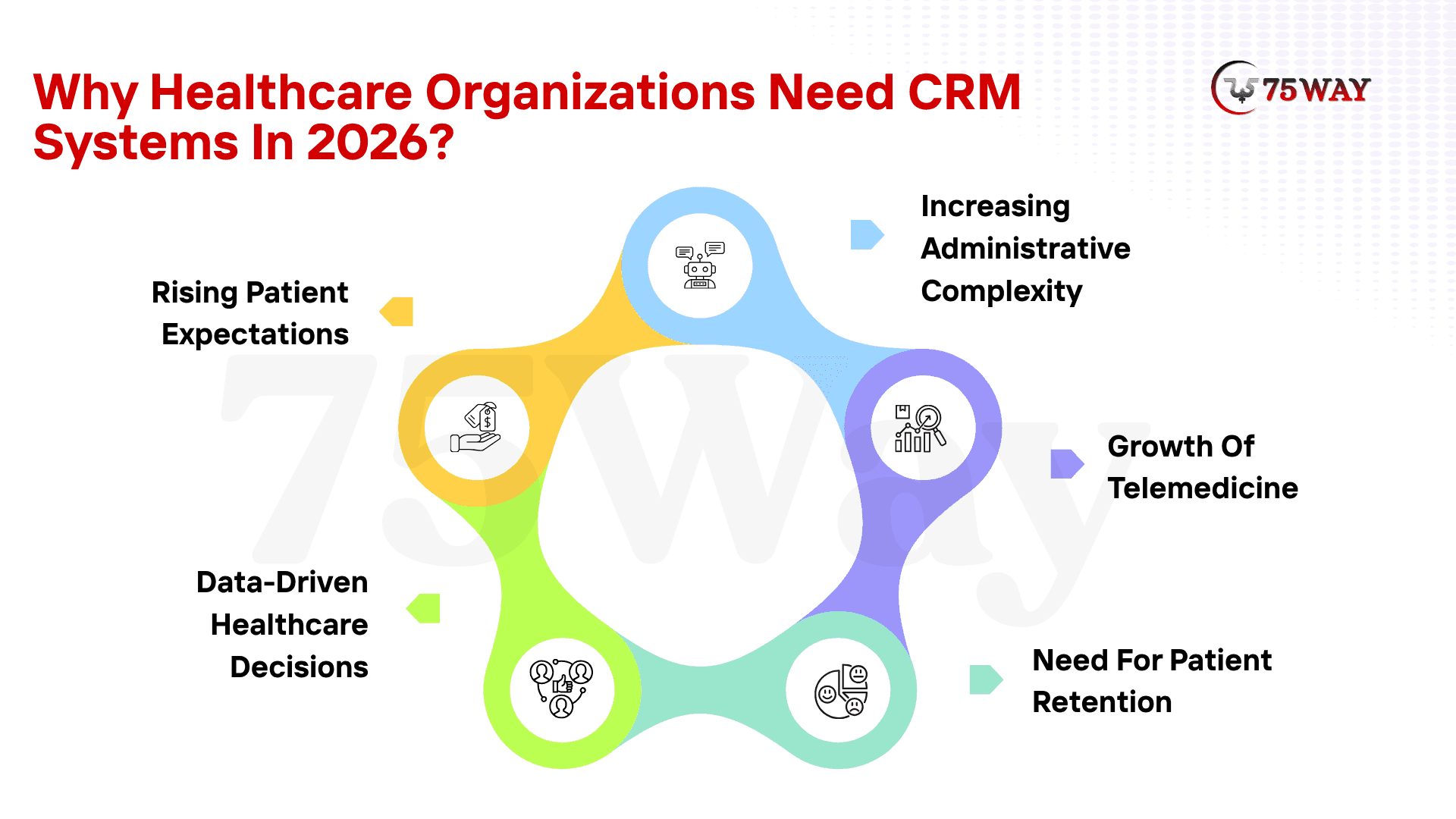
- Rising Patient Expectations: Modern patients expect personalized communication, faster appointment management, digital accessibility, and seamless healthcare experiences across channels.
- Increasing Administrative Complexity: Healthcare providers manage massive amounts of patient data, billing records, treatment coordination, and communication workflows daily.
- Growth of Telemedicine: Telehealth services require integrated communication and engagement systems capable of supporting virtual patient management.
- Need for Patient Retention: Healthcare competition is increasing globally, making patient loyalty and engagement more important than ever.
- Data-Driven Healthcare Decisions: Healthcare CRM platforms provide analytics and behavioral insights that support better operational and marketing strategies.
Step-By-Step Healthcare CRM Software Development Process
Building healthcare CRM software is far more complex than developing a standard customer relationship management platform. Healthcare systems require deeper workflow planning, clinical validation, regulatory compliance management, secure data handling, and seamless integration across healthcare ecosystems. The essential stages involved in healthcare CRM software development are defined below.
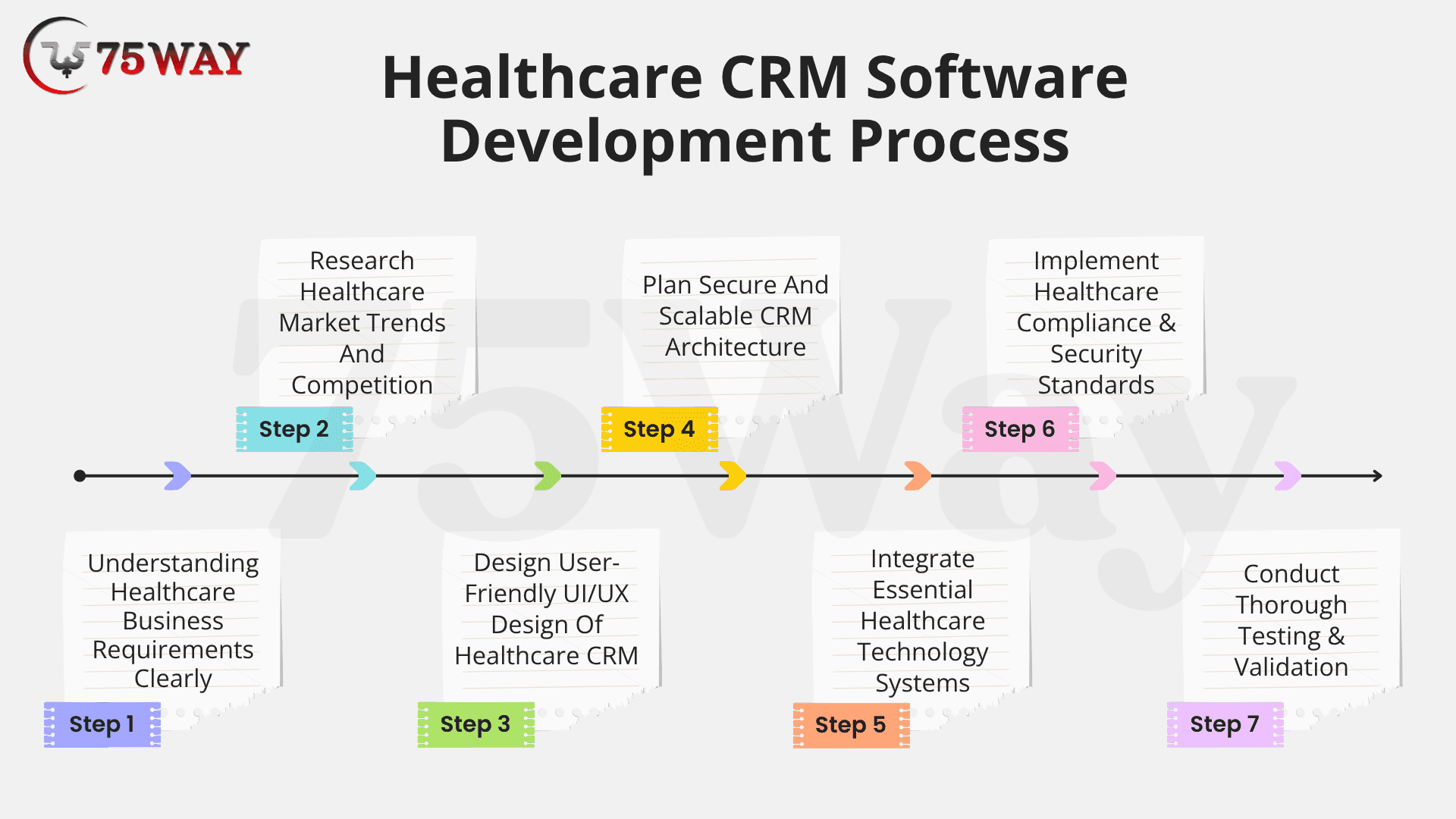
Step 1: Understanding Healthcare Business Requirements Clearly
The development process begins with detailed requirement analysis to understand healthcare workflows, patient engagement goals, operational challenges, and business objectives. Development teams collaborate with hospitals, clinics, healthcare providers, administrators, and stakeholders to identify core functionality requirements and workflow expectations.
This stage also defines compliance requirements, communication processes, security priorities, and healthcare operational structures. Requirement analysis helps organizations identify system limitations, patient management gaps, automation opportunities, and scalability expectations before development begins.
Step 2: Research Healthcare Market Trends And Competition
Market research helps organizations evaluate healthcare technology trends, patient engagement strategies, competitor platforms, and evolving healthcare CRM expectations across digital healthcare ecosystems. Development teams analyze successful healthcare CRM systems, emerging AI technologies, communication workflows, and healthcare operational models to identify valuable opportunities and feature requirements.
This stage also helps businesses understand user expectations, healthcare industry pain points, compliance trends, and digital transformation strategies affecting modern healthcare providers. Proper market research strengthens product planning, feature prioritization, competitive positioning, and long-term healthcare CRM scalability within highly competitive healthcare markets.
Step 3: Design User-Friendly UI/UX Design of Healthcare CRM
Healthcare CRM interfaces must provide intuitive, accessible, and workflow-friendly experiences for doctors, nurses, administrators, support staff, and patients. UI/UX designers create wireframes, dashboards, navigation systems, appointment workflows, communication panels, and patient interaction interfaces optimized for healthcare operations. Simplicity and accessibility remain critical throughout the design process.
Well-designed healthcare CRM systems improve productivity, reduce operational complexity, minimize workflow confusion, and improve healthcare communication experiences significantly. User-focused interfaces also reduce training challenges while helping healthcare professionals manage patient interactions and operational activities more effectively across healthcare ecosystems.
Step 4: Plan Secure And Scalable CRM Architecture
Architecture planning defines the technical foundation of healthcare CRM software including database structures, cloud infrastructure, APIs, cybersecurity frameworks, scalability strategies, and system integrations. Developers decide how healthcare data will be stored, processed, synchronized, and protected within secure digital environments. Infrastructure planning also supports future scalability and operational flexibility.
- Develop Interactive Frontend Interfaces: Frontend development focuses on building the visual and interactive components of healthcare CRM software used by healthcare providers, administrators, and patients. Developers create dashboards, appointment systems, patient portals, communication interfaces, analytics views, and operational management screens optimized for usability and responsiveness.
- Building Powerful Backend: Backend development handles the core functionality and operational logic powering healthcare CRM software. Developers must build databases, APIs, authentication systems, workflow automation engines, patient data processing systems, notification management, analytics modules, and communication infrastructures supporting healthcare operations securely.
Step 5: Integrate Essential Healthcare Technology Systems
Healthcare CRM systems require integration with multiple healthcare technologies and third-party platforms supporting connected healthcare operations. Common integrations include EHR systems, telemedicine platforms, billing software, insurance systems, payment gateways, laboratory systems, wearable healthcare devices, and IoT healthcare technologies.
Integrated healthcare ecosystems improve operational synchronization, healthcare communication, patient management visibility, and workflow coordination across departments and healthcare providers. Seamless integrations also reduce manual data transfer, operational duplication, and disconnected healthcare workflows significantly.
Step 6: Implement Healthcare Compliance & Security Standards
Healthcare CRM software must comply with strict healthcare regulations and cybersecurity standards protecting sensitive patient information. Compliance implementation includes HIPAA, GDPR, HITECH, HL7, PCI DSS, encryption systems, secure access management, audit trails, consent tracking, and healthcare data protection frameworks.
This stage helps organizations maintain legal compliance while protecting healthcare information from cybersecurity risks and unauthorized access. Strong compliance infrastructure also improves patient trust, operational accountability, healthcare transparency, and secure healthcare service delivery across digital ecosystems.
Step 7: Conduct Thorough Testing & Validation
Testing and quality assurance help validate healthcare CRM performance, security, functionality, compliance, and operational reliability before deployment. QA teams perform security testing, API validation, usability testing, workflow validation, compliance verification, load testing, and performance monitoring across healthcare environments.
Comprehensive testing reduces operational failures, communication issues, system vulnerabilities, and workflow disruptions significantly after deployment. Proper quality assurance also improves software stability, healthcare accessibility, user experience quality, and long-term healthcare CRM performance across organizations.
Step 8: Deploy & Maintain Healthcare CRM Platforms
After successful testing, healthcare CRM software is deployed within live healthcare environments for operational use. Deployment includes server configuration, cloud setup, data migration, user onboarding, workflow optimization, and system monitoring across healthcare organizations. Teams also provide training support for healthcare staff and administrators.
Ongoing maintenance remains essential after deployment to support updates, cybersecurity improvements, feature enhancements, performance optimization, and infrastructure monitoring. Continuous maintenance helps healthcare CRM systems remain secure, scalable, compliant, and operationally reliable within rapidly evolving healthcare ecosystems.
What’s The Difference Between Healthcare CRM & EHR?
Healthcare CRM and EHR systems serve different purposes within medical organizations, although both manage healthcare-related information. A Healthcare CRM system primarily focuses on patient engagement, communication management, appointment coordination, marketing automation, follow-ups, and relationship management. Its main objective is improving patient experiences, strengthening communication workflows, and increasing operational visibility across healthcare ecosystems.
An EHR (Electronic Health Record) system focuses mainly on clinical data management and medical documentation. It stores patient medical histories, prescriptions, diagnostic reports, treatment plans, physician notes, lab results, and clinical workflows. EHR platforms support healthcare professionals in delivering accurate medical care while maintaining regulatory compliance and centralized clinical records management.
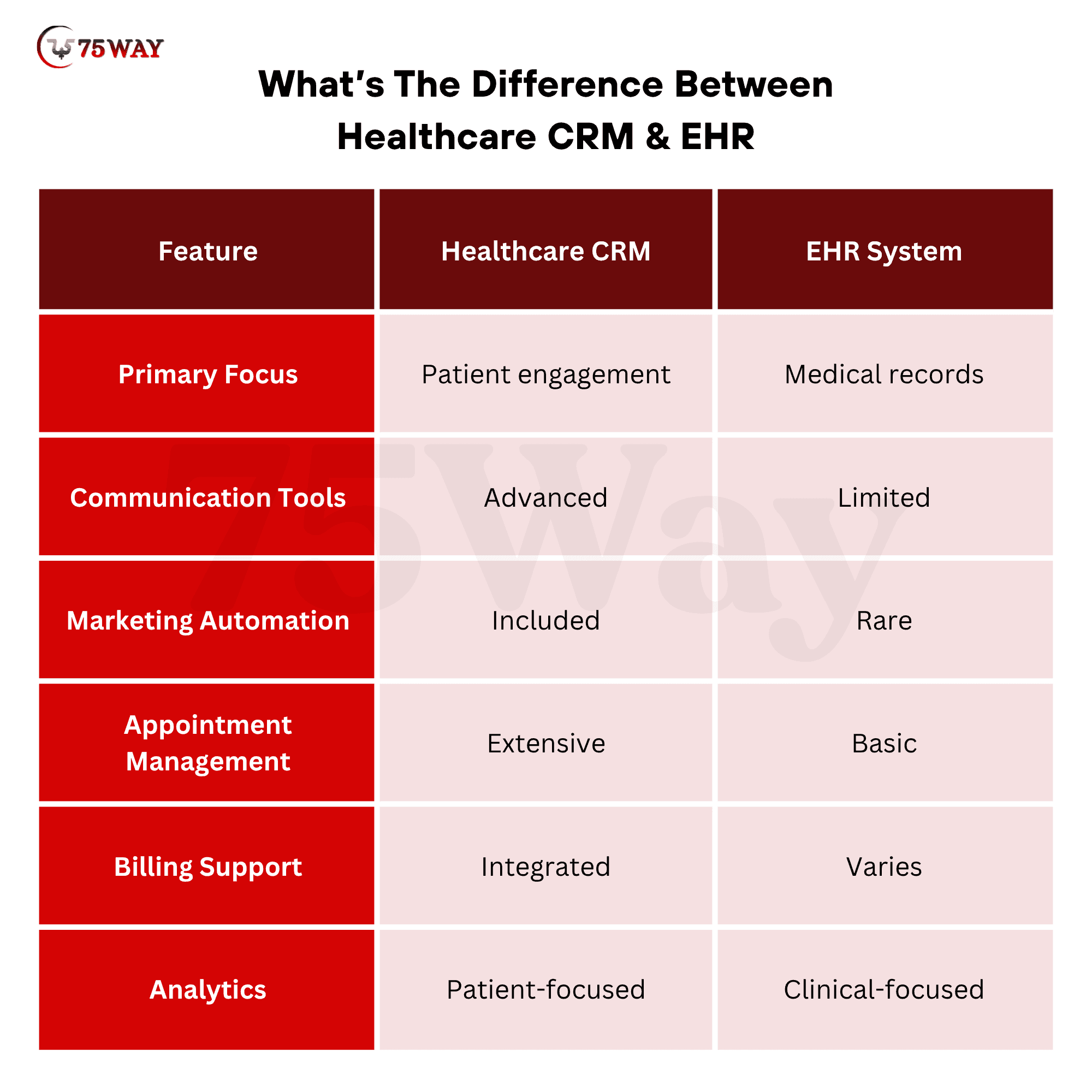
Despite their differences, healthcare CRM and EHR systems work more effectively when integrated together within a unified healthcare infrastructure. CRM platforms use patient engagement data while EHR systems provide medical and clinical information. This integration creates a connected ecosystem where healthcare providers gain complete visibility into both patient communication history and medical treatment records.
Integrated CRM and EHR systems improve appointment coordination, personalized communication, treatment follow-ups, telemedicine workflows, billing management, and patient support experiences. Healthcare organizations benefit from better operational synchronization, improved patient retention, reduced administrative inefficiencies, and stronger data-driven decision-making capabilities through centralized healthcare information management.
Types of Healthcare CRM Software Hospitals & Clinics Can Build
Healthcare CRM software is available in multiple categories designed to support different operational, communication, analytical, and patient engagement requirements within healthcare organizations. Each CRM type focuses on specific workflows. Understanding these CRM categories helps healthcare providers choose solutions aligned with organizational goals, operational structure, and patient experience strategies.
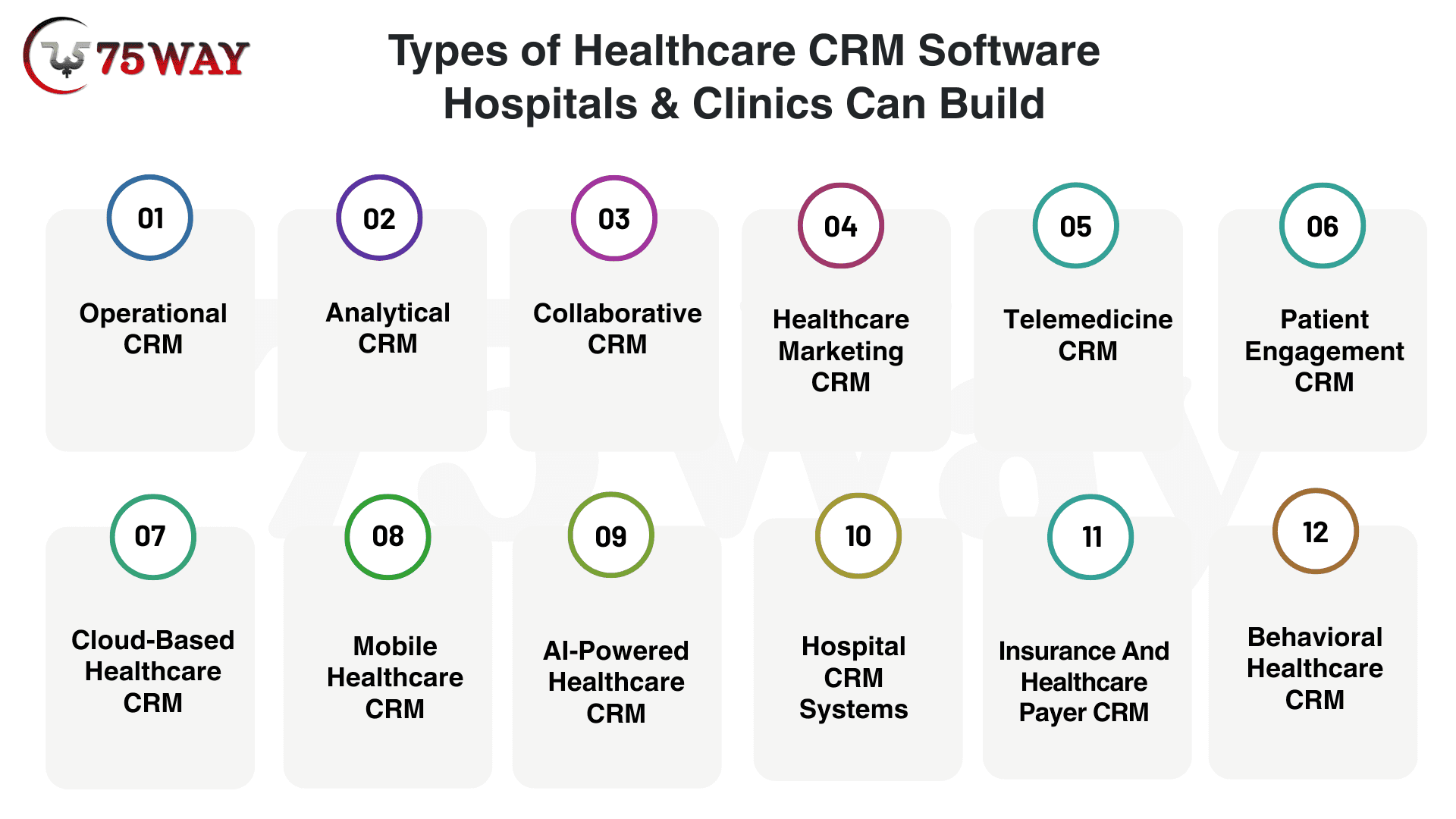
1. Operational CRM
Operational healthcare CRM systems focus on automating daily patient-facing activities across healthcare organizations. These platforms manage appointment scheduling, reminders, registration workflows, communication processes, and support interactions.
They reduce administrative workload while improving healthcare coordination and patient engagement experiences. Operational CRM platforms also streamline repetitive workflows across departments. For instance, Salesforce Health Cloud is widely recognized for operational healthcare CRM capabilities.
2. Analytical CRM
Analytical healthcare CRM systems focus on collecting, processing, and analyzing patient data for strategic decision-making. These platforms generate reports, predictive insights, engagement metrics, and behavioral analysis supporting healthcare optimization.
Organizations use analytical CRM systems to identify trends, improve campaigns, and strengthen patient retention strategies. Advanced analytics also improve operational visibility across healthcare ecosystems. To illustrate, HubSpot Healthcare CRM is commonly used for healthcare analytics and patient engagement monitoring.
3. Collaborative CRM
Collaborative healthcare CRM systems improve communication and coordination between healthcare providers, departments, support teams, and administrative staff. These platforms centralize information sharing to strengthen workflow synchronization across healthcare ecosystems.
Moreover, collaborative CRM solutions reduce communication gaps and improve patient management experiences significantly. They also support multi-department healthcare coordination for better operational productivity. For example, Microsoft Dynamics 365 Healthcare solutions are widely adopted for collaborative healthcare management.
4. Healthcare Marketing CRM
Marketing healthcare CRM platforms help healthcare organizations automate campaigns, patient outreach, promotional communication, and engagement strategies across digital channels. These systems support lead nurturing, patient acquisition, personalized messaging, and healthcare brand visibility improvement.
Marketing CRM solutions also help providers track campaign performance and communication effectiveness. Automation capabilities improve outreach scalability across healthcare markets. Zoho CRM is frequently used by healthcare organizations for healthcare marketing automation and patient communication management.
5. Telemedicine CRM
Telemedicine CRM systems integrate virtual healthcare delivery, remote consultations, digital communication, and online patient management within centralized healthcare environments. These platforms support video appointments, virtual engagement workflows, remote follow-ups, and telehealth coordination across distributed healthcare systems.
Telemedicine CRM software improves accessibility while simplifying remote healthcare operations significantly. These platforms continue expanding with growing telehealth adoption worldwide. Athenahealth is a well-known healthcare platform supporting telemedicine-integrated CRM capabilities for modern healthcare providers.
6. Patient Engagement CRM
Patient engagement CRM platforms focus on improving communication, satisfaction, and long-term patient relationships across healthcare journeys. These systems support personalized messaging, reminders, feedback collection, wellness programs, and patient education initiatives.
They help providers maintain stronger engagement outside clinical environments. AI-driven communication further improves interaction quality and patient retention rates. Solutionreach is widely recognized for its patient engagement healthcare CRM capabilities.
7. Cloud-Based Healthcare CRM
Cloud-based healthcare CRM systems operate on remote cloud infrastructure instead of on-premise servers within healthcare facilities. These platforms improve scalability, remote accessibility, system flexibility, and infrastructure cost management across healthcare organizations.
Cloud deployment also simplifies software updates and cybersecurity monitoring processes significantly. Healthcare providers increasingly prefer cloud environments for digital transformation strategies. Oracle Health CRM solutions are commonly used for cloud-based healthcare operations.
8. Mobile Healthcare CRM
Mobile healthcare CRM platforms provide healthcare access through mobile apps on smartphones and tablets for physicians, administrators, and patients. These systems support mobile scheduling, communication, notifications, telemedicine access, and healthcare workflow management remotely.
Mobile CRM solutions improve operational flexibility and healthcare accessibility across distributed environments. Real-time mobile communication also enhances patient engagement experiences significantly. Salesforce Mobile Health Cloud is widely adopted for mobile healthcare CRM operations in the United States.
9. AI-Powered Healthcare CRM
AI-powered healthcare CRM systems use machine learning, predictive analytics, and intelligent automation to optimize patient engagement and operational workflows. These platforms automate communication, identify patient behavior trends, predict risks, and personalize healthcare recommendations.
AI capabilities also improve workflow automation and healthcare decision-making processes substantially. Intelligent healthcare systems continue expanding rapidly across global healthcare markets. IBM Watson Health solutions have influenced AI-driven healthcare CRM innovation.
10. Hospital CRM Systems
Hospital CRM systems are designed specifically for large healthcare institutions managing multiple departments, patients, physicians, and operational workflows simultaneously. These systems centralize patient records, billing communication, appointment coordination, admissions, and engagement management across hospital ecosystems.
They improve operational synchronization while supporting large-scale healthcare administration requirements effectively. Enterprise-grade hospital CRM solutions also support compliance and analytics management. Epic Systems is one of the most recognized hospital-focused healthcare technology platforms.
11. Insurance And Healthcare Payer CRM
Healthcare payer CRM systems help insurance providers manage member communication, claims engagement, policy support, and healthcare relationship management workflows. These platforms improve customer support, retention, outreach campaigns, and claims coordination processes across healthcare insurance ecosystems.
Automation also strengthens operational visibility and member engagement experiences significantly. These systems are increasingly important within value-based healthcare environments. Pegasystems provides widely used payer-focused CRM solutions for healthcare organizations.
12. Behavioral Healthcare CRM
Behavioral healthcare CRM systems are designed for mental health clinics, rehabilitation centers, counseling organizations, and wellness providers managing long-term patient engagement workflows. These platforms support therapy scheduling, confidential communication, treatment follow-ups, patient monitoring, and personalized wellness programs across behavioral healthcare ecosystems.
They also improve coordination between therapists, support staff, and patients. Secure communication capabilities remain especially important within mental healthcare environments. For instance, Valant is a well-known behavioral healthcare platform supporting specialized mental health CRM workflows.
Essential Features Every Healthcare CRM Development Must Include For Future Growth
Modern healthcare CRM platforms improve communication, operational visibility, and patient engagement across healthcare ecosystems. These systems centralize workflows while supporting automation, analytics, and digital healthcare coordination. Advanced healthcare organizations increasingly depend on intelligent CRM infrastructure for scalable healthcare management.
1. Core Features For Building Healthcare CRM System
Healthcare CRM systems require intelligent features that improve patient engagement and centralize healthcare operations within unified digital platforms. Below are the major healthcare CRM features businesses should include while developing scalable healthcare relationship management solutions.
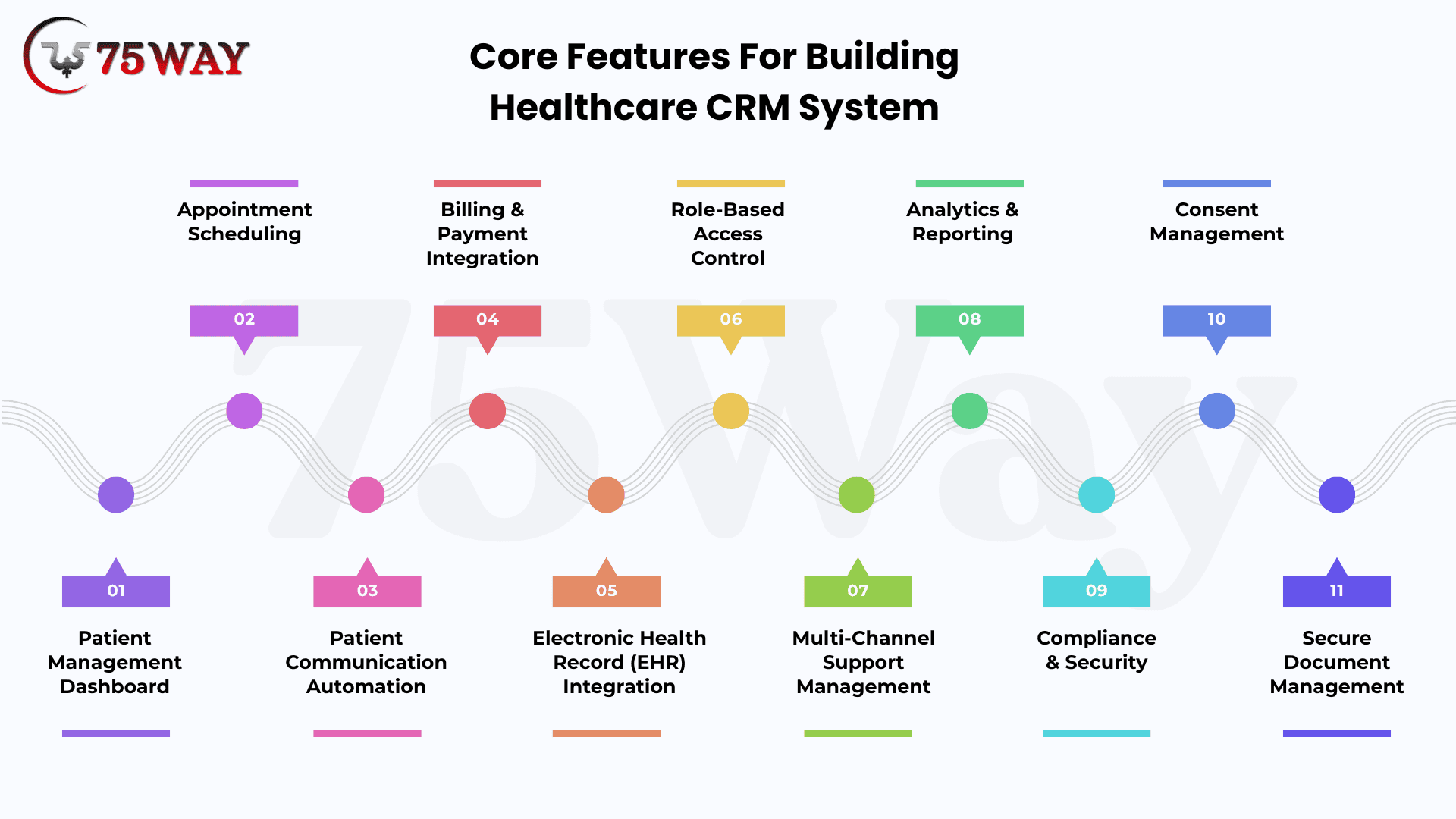
- Patient Management Dashboard: Centralized dashboards provide unified access to patient profiles, treatment history, appointment records, communication activities, and engagement timelines across healthcare operations.
- Appointment Scheduling: Automated scheduling systems simplify appointment booking, cancellations, reminders, physician availability tracking, and rescheduling processes for healthcare organizations and patients.
- Patient Communication Automation: Healthcare CRM platforms automate communication through SMS, email, WhatsApp, push notifications, reminders, follow-ups, and engagement campaigns across multiple digital channels.
- Billing & Payment Integration: Integrated billing modules support invoices, insurance communication, payment tracking, financial management, and secure digital transaction processing within healthcare systems.
- Electronic Health Record (EHR) Integration: Healthcare CRM systems synchronize with EHR and EMR platforms to centralize patient records, medical history, and clinical information management effectively.
- Role-Based Access Control: Access management systems restrict sensitive healthcare information visibility according to staff roles, improving data security and regulatory compliance management.
- Multi-Channel Support Management: Healthcare organizations manage communication requests from websites, apps, emails, calls, and social channels through centralized support environments efficiently.
- Analytics & Reporting: Advanced analytics tools monitor patient engagement, appointment performance, operational productivity, communication trends, and healthcare workflow efficiency through centralized dashboards.
- Compliance & Security: Healthcare CRM software includes compliance monitoring, encryption protocols, audit trails, and secure access controls supporting HIPAA, GDPR, and healthcare cybersecurity requirements.
- Consent Management: Healthcare CRM platforms manage patient consent forms, treatment approvals, communication permissions, and authorization records while maintaining regulatory healthcare compliance standards securely.
- Secure Document Management: Secure document management systems store prescriptions, reports, insurance files, and healthcare records within encrypted environments supporting controlled access and compliance protection.
Advanced Features To Develop Healthcare CRM
Modern healthcare organizations increasingly require intelligent CRM capabilities supporting automation, predictive analytics, remote healthcare delivery, and AI-powered patient engagement experiences. Below are advanced healthcare CRM features businesses should integrate to build scalable, future-ready, and technology-driven healthcare management ecosystems.
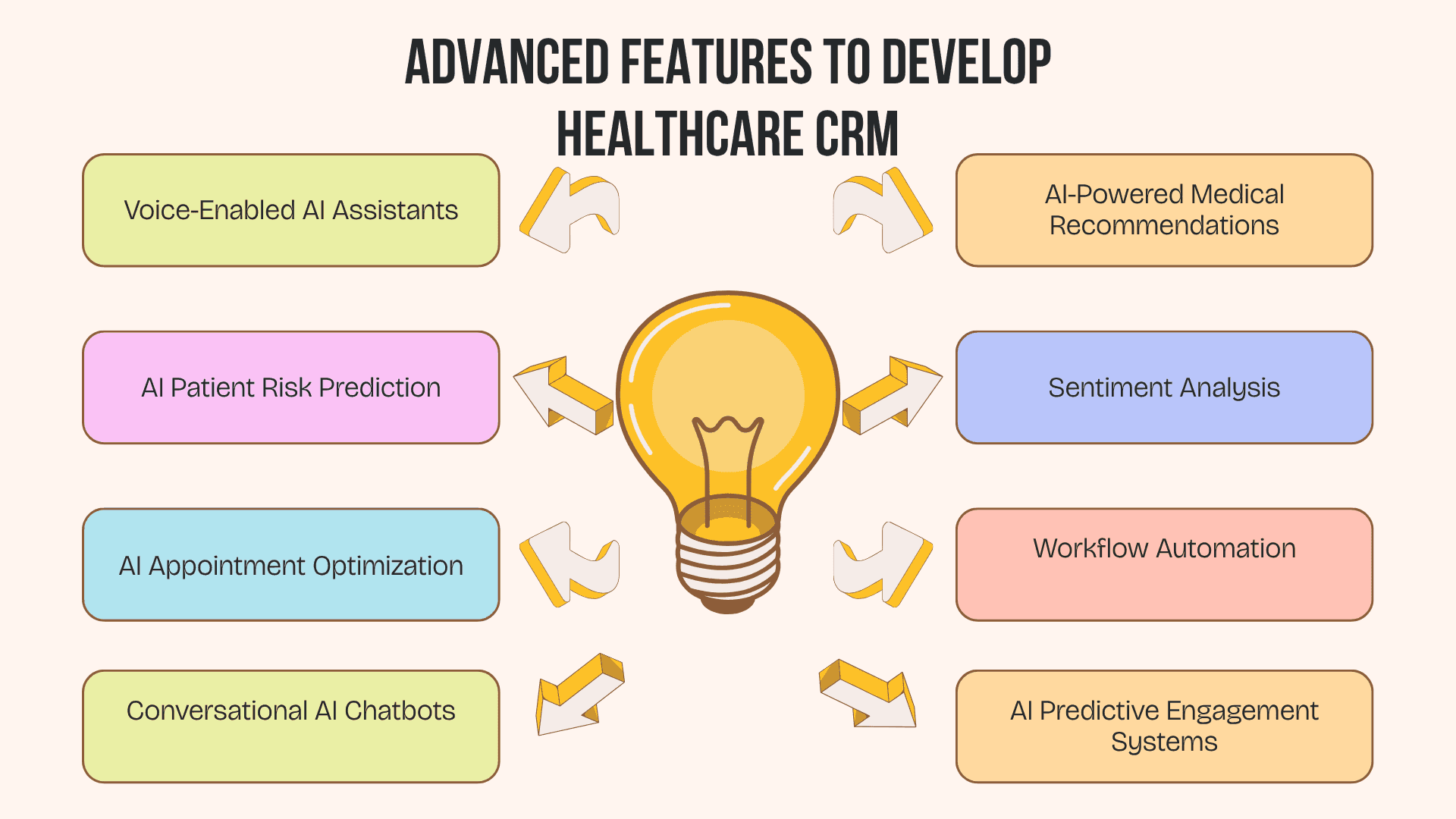
- Voice-Enabled AI Assistants:Voice AI agents in healthcare CRMs manage appointment booking, patient inquiries, reminders, and support conversations automatically. They improve accessibility significantly. Healthcare organizations reduce manual communication workload through intelligent conversational voice systems.
- AI Patient Risk Prediction: AI systems analyze behavioral patterns, medical history, and engagement data to identify high-risk patients. Predictive healthcare insights improve intervention planning. Healthcare providers strengthen preventive care strategies using intelligent risk monitoring.
- AI Appointment Optimization: AI-powered scheduling systems optimize physician availability, appointment distribution, and patient wait times automatically. Intelligent scheduling reduces operational bottlenecks considerably. Healthcare organizations improve workflow coordination and resource utilization with AI in patient communication systems.
- Conversational AI Chatbots: Conversational AI in healthcare systems provides instant patient assistance across websites, applications, and messaging platforms continuously. They answer healthcare queries accurately. Automated communication systems improve patient engagement while reducing administrative support pressure significantly.
- AI-Powered Medical Recommendations: Intelligent recommendation engines suggest healthcare services, wellness programs, and follow-up treatments based on patient behavior patterns. Personalized healthcare experiences improve engagement.
- Sentiment Analysis: AI sentiment analysis systems evaluate patient feedback, conversations, and communication patterns to identify satisfaction levels. Healthcare organizations detect experience gaps faster. Data-driven sentiment insights improve healthcare communication quality and patient relationship management.
- Workflow Automation: AI automation in healthcare CRM streamlines repetitive administrative processes, including approvals, documentation routing, patient onboarding, and communication management activities. Operational productivity improves.
- AI Predictive Engagement Systems: Predictive engagement technologies identify patients likely to miss appointments, discontinue treatments, or reduce healthcare interactions. AI-driven alerts improve retention strategies. You can enhance long-term patient engagement using intelligent behavioral forecasting systems.
Benefits of Adopting Healthcare CRM Platform
Healthcare organizations rely on CRM systems to streamline operations, strengthen patient experiences, improve healthcare accessibility, and support long-term digital transformation initiatives. Let us explore the major business benefits offered by advanced healthcare CRM software development solutions for hospitals, clinics, telemedicine providers, and healthcare enterprises.
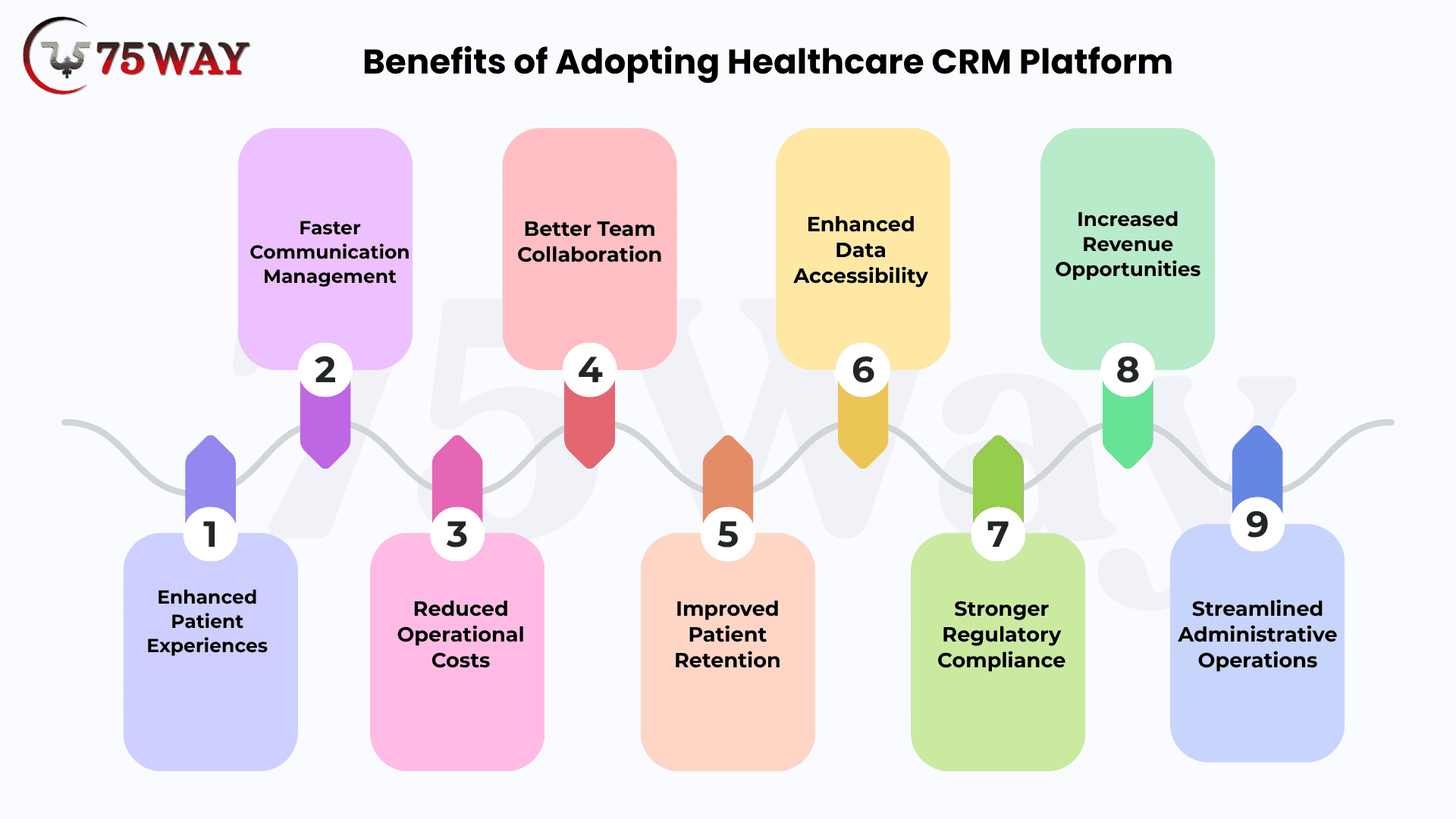
1. Enhanced Patient Experiences
Healthcare CRM software helps providers create personalized patient journeys through appointment reminders, wellness notifications, treatment follow-ups, secure communication, and patient portals. These capabilities encourage active healthcare participation while improving communication between patients and healthcare professionals. Personalized engagement also helps providers deliver healthcare recommendations based on medical history, preferences, demographics, and behavioral insights.
Additionally, CRM analytics tools help healthcare organizations understand patient needs more effectively and optimize communication strategies accordingly. This level of personalization improves patient satisfaction, strengthens loyalty, supports better treatment adherence, and contributes to improved healthcare outcomes across digital healthcare ecosystems.
2. Faster Communication Management
Healthcare CRM platforms improve communication by enabling providers to connect with patients through SMS, email, WhatsApp, mobile applications, patient portals, and automated notification systems. Faster communication helps healthcare organizations deliver appointment reminders, billing notifications, wellness campaigns, and follow-up instructions without delays. These systems reduce communication gaps while improving healthcare accessibility significantly.
Automated communication workflows also reduce dependency on manual coordination and repetitive administrative outreach processes. Faster patient interaction management improves responsiveness, increases patient trust, reduces missed appointments, and strengthens long-term engagement between healthcare organizations and patients.
3. Reduced Operational Costs
Healthcare CRM software reduces operational expenses by automating repetitive administrative processes, including scheduling, communication, billing coordination, and patient follow-up management. Automation minimizes manual workload, paperwork dependency, and operational inefficiencies across healthcare organizations. These improvements help providers allocate resources more effectively while reducing unnecessary administrative overhead.
Integrated healthcare workflows also reduce communication delays, duplicate tasks, scheduling conflicts, and process-related errors that often increase operational expenses. Lower administrative costs, improved productivity, and better resource utilization contribute directly to long-term financial sustainability and scalable healthcare business operations.
4. Better Team Collaboration
Healthcare CRM software improves coordination between doctors, nurses, support staff, billing teams, administrators, and healthcare departments through centralized communication environments. Teams can securely access patient information, treatment updates, communication records, and operational workflows from unified digital systems. This reduces information silos and improves healthcare workflow synchronization significantly.
Improved collaboration helps healthcare professionals coordinate treatments, manage patient support activities, share updates, and deliver connected healthcare experiences more effectively. Better teamwork also reduces operational confusion, strengthens healthcare communication quality, and improves patient care management across healthcare ecosystems.
5. Improved Patient Retention
Healthcare CRM platforms help providers maintain long-term patient relationships through proactive engagement strategies, personalized communication, wellness reminders, loyalty campaigns, and automated follow-up systems. Continuous patient engagement improves healthcare experiences while strengthening trust between healthcare providers and patients. These systems encourage patients to continue using the same healthcare services over extended periods.
CRM analytics capabilities also help organizations identify disengaged patients and create targeted retention strategies accordingly. Improved retention rates contribute directly to recurring healthcare revenue, stronger patient loyalty, improved brand reputation, and sustainable business growth across competitive healthcare markets.
6. Enhanced Data Accessibility
Healthcare CRM systems centralize patient records, billing information, communication history, treatment interactions, appointment details, and engagement data within unified digital platforms. Centralized information management improves accessibility for physicians, support teams, administrators, and operational departments across healthcare organizations. This reduces dependency on fragmented systems and disconnected manual workflows.
Better access to healthcare data also improves operational visibility, healthcare reporting, workflow coordination, and strategic decision-making capabilities significantly. Healthcare organizations can analyze patient behavior, monitor operational performance, identify service gaps, and improve healthcare planning using centralized healthcare information systems.
7. Stronger Regulatory Compliance
Healthcare CRM software supports HIPAA, GDPR, HITECH, and healthcare cybersecurity requirements through encryption systems, audit trails, secure document storage, consent management, and role-based access controls. These security frameworks help healthcare organizations protect sensitive patient information while reducing compliance risks and operational vulnerabilities significantly.
Compliance-focused healthcare CRM systems also improve accountability, transparency, and healthcare data governance across digital healthcare infrastructures. Strong compliance management strengthens patient trust, minimizes legal risks, improves operational security, and supports secure healthcare service delivery environments.
8. Increased Revenue Opportunities
Healthcare CRM platforms improve patient acquisition, appointment conversions, treatment engagement, and healthcare marketing performance through data-driven communication and outreach strategies. CRM analytics tools help providers understand campaign effectiveness, patient engagement trends, and healthcare service demand more accurately. These insights support better business and marketing decisions.
Additionally, improved operational productivity and stronger patient relationships contribute directly to higher revenue generation opportunities across healthcare organizations. Better engagement, improved retention, and optimized healthcare workflows help providers strengthen profitability while supporting scalable healthcare business growth.
9. Streamlined Administrative Operations
Healthcare CRM systems automate repetitive operational processes, like appointment scheduling, billing communication, patient registration, and document management. Automation reduces administrative workload while minimizing manual errors, scheduling conflicts, and operational inefficiencies across healthcare organizations. Staff members can dedicate more time to patient-focused responsibilities and healthcare delivery.
CRM integration with EHR systems, billing platforms, and healthcare databases further improves workflow coordination across departments and operational teams. These improvements optimize healthcare operations, reduce unnecessary administrative expenses, improve resource utilization, and support long-term financial sustainability for healthcare providers.
Technologies Used In Healthcare CRM Software Development
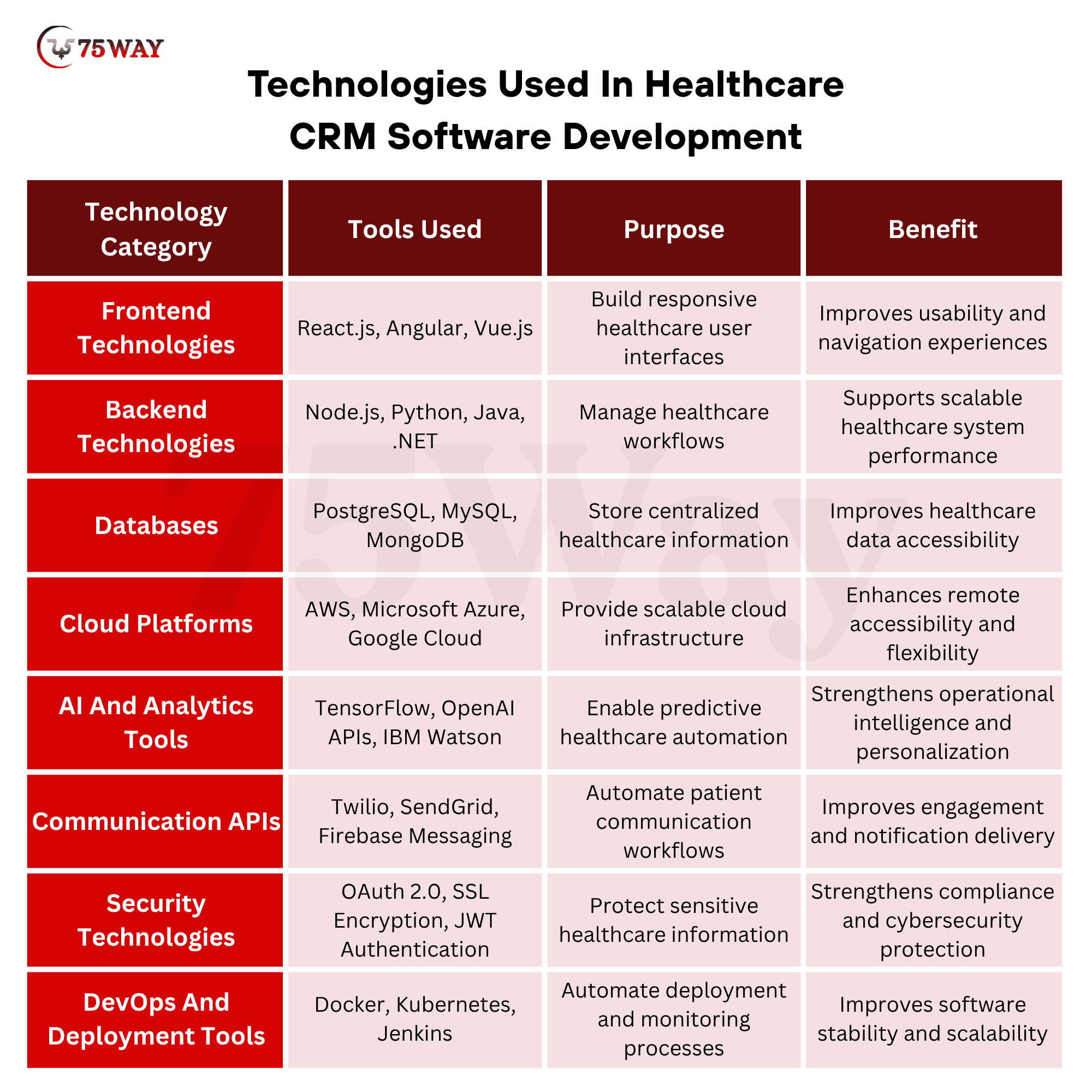
Healthcare CRM software development uses multiple technologies to support scalability, security, automation, integrations, analytics, cloud infrastructure, and patient communication workflows. Some of the major technologies used in healthcare CRM software development are defined below.
- Frontend Technologies: React.js, Angular, and Vue.js help developers build responsive healthcare CRM interfaces with faster navigation and interactive user experiences. These technologies improve accessibility significantly.
- Backend Technologies: Node.js, Python, Java, and .NET power healthcare CRM backend systems handling databases, APIs, workflows, authentication, and operational logic securely. These technologies support scalability.
- Databases: PostgreSQL, MySQL, and MongoDB store patient records, communication history, healthcare workflows, and operational data securely across healthcare CRM ecosystems. Database performance improves accessibility.
- Cloud Platforms: AWS, Microsoft Azure, and Google Cloud provide scalable infrastructure, secure storage, backup systems, and remote accessibility for healthcare CRM environments. Cloud infrastructure improves flexibility.
- AI & Analytics Tools: TensorFlow, OpenAI APIs, and IBM Watson support predictive analytics, intelligent automation, AI chatbots, and personalized healthcare engagement systems. These tools strengthen decision-making.
- Communication APIs: Twilio, SendGrid, and Firebase Messaging enable SMS alerts, emails, notifications, appointment reminders, and real-time patient communication workflows within healthcare CRM platforms. These APIs improve engagement.
Security & Compliance Requirements In Healthcare CRM Solution Development
Healthcare CRM software must follow strict compliance and cybersecurity standards to protect sensitive patient information and healthcare operations. Strong compliance frameworks help healthcare organizations maintain security, transparency, regulatory accountability, and patient trust across digital healthcare ecosystems.
- HIPAA Compliance: Healthcare CRM platforms handling patient data must implement HIPAA-compliant security standards.
- Data Encryption: Sensitive healthcare information requires end-to-end encryption during storage and transmission.
- Role-Based Access Control: Access permissions limit unauthorized exposure to patient information.
- Audit Trails: CRM systems track system activities and user actions for compliance monitoring.
- Secure Cloud Infrastructure: Cloud environments must support healthcare-grade cybersecurity protections.
Major Challenges In Building Healthcare CRM & Solutions
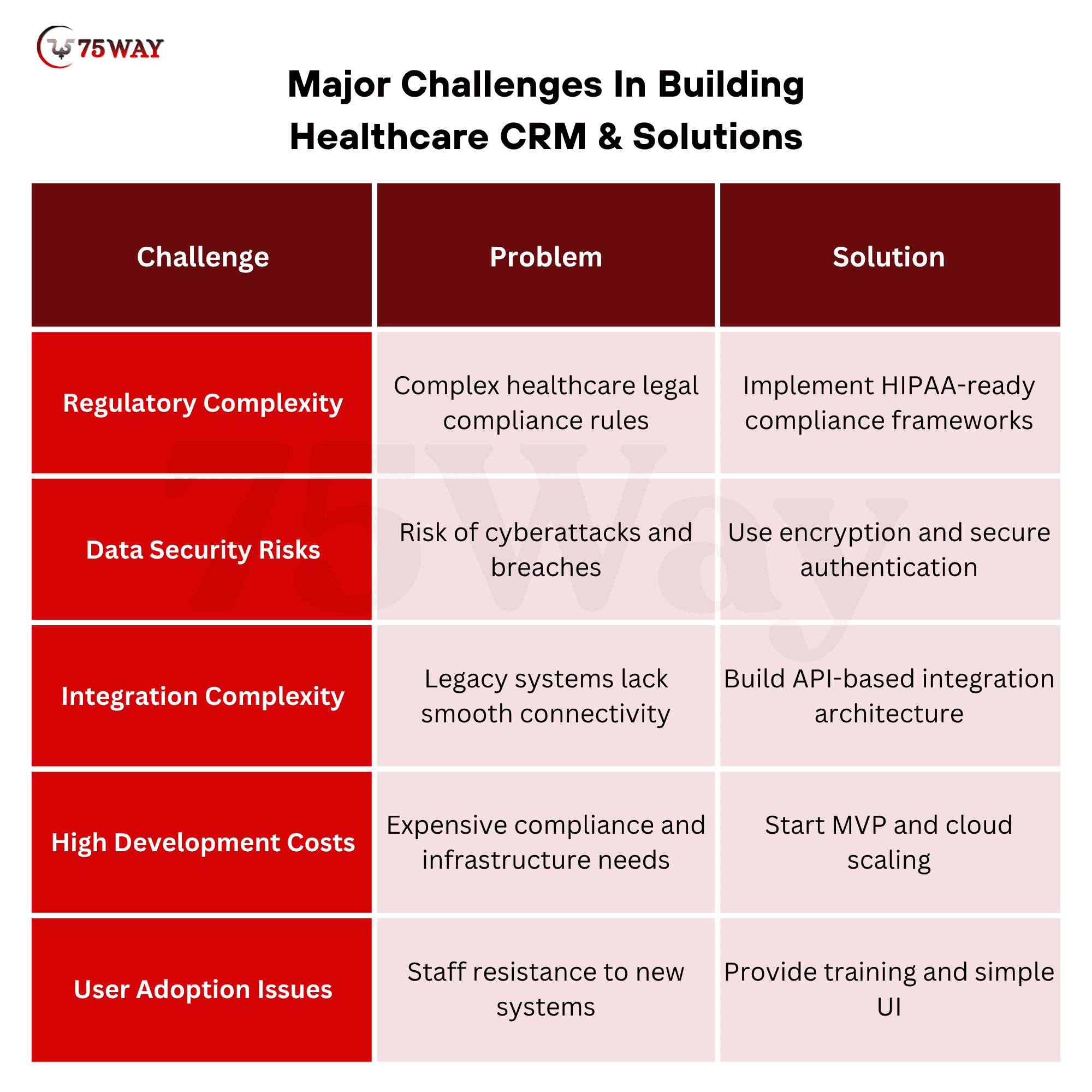
Healthcare CRM development involves technical, operational, security, and compliance-related challenges affecting scalability, performance, integrations, and healthcare workflow management across digital healthcare ecosystems.
- Regulatory Complexity
Healthcare regulations create significant development and compliance challenges.
Solution: Implement HIPAA-compliant frameworks, legal consultation, audit systems, and compliance-focused development processes from initial project stages.
- Data Security Risks
Healthcare systems remain prime targets for cyberattacks and data breaches.
Solution: Use encryption, multi-factor authentication, role-based access controls, and continuous cybersecurity monitoring to protect sensitive healthcare information.
- Integration Complexity
Healthcare providers often use fragmented legacy systems requiring extensive integration work.
Solution: Build API-driven architectures supporting seamless integration between EHR systems, billing platforms, telemedicine tools, and healthcare databases.
- High Development Costs
Advanced compliance and security requirements increase overall development expenses.
Solution: Start with MVP development, prioritize essential features, and use scalable cloud infrastructure to optimize healthcare CRM investment costs.
- User Adoption Issues
Medical staff may resist workflow changes without proper training and usability optimization.
Solution: Design intuitive interfaces, provide onboarding sessions, and involve healthcare staff during CRM planning and testing stages.
What’s The Cost of Healthcare CRM Software Development?
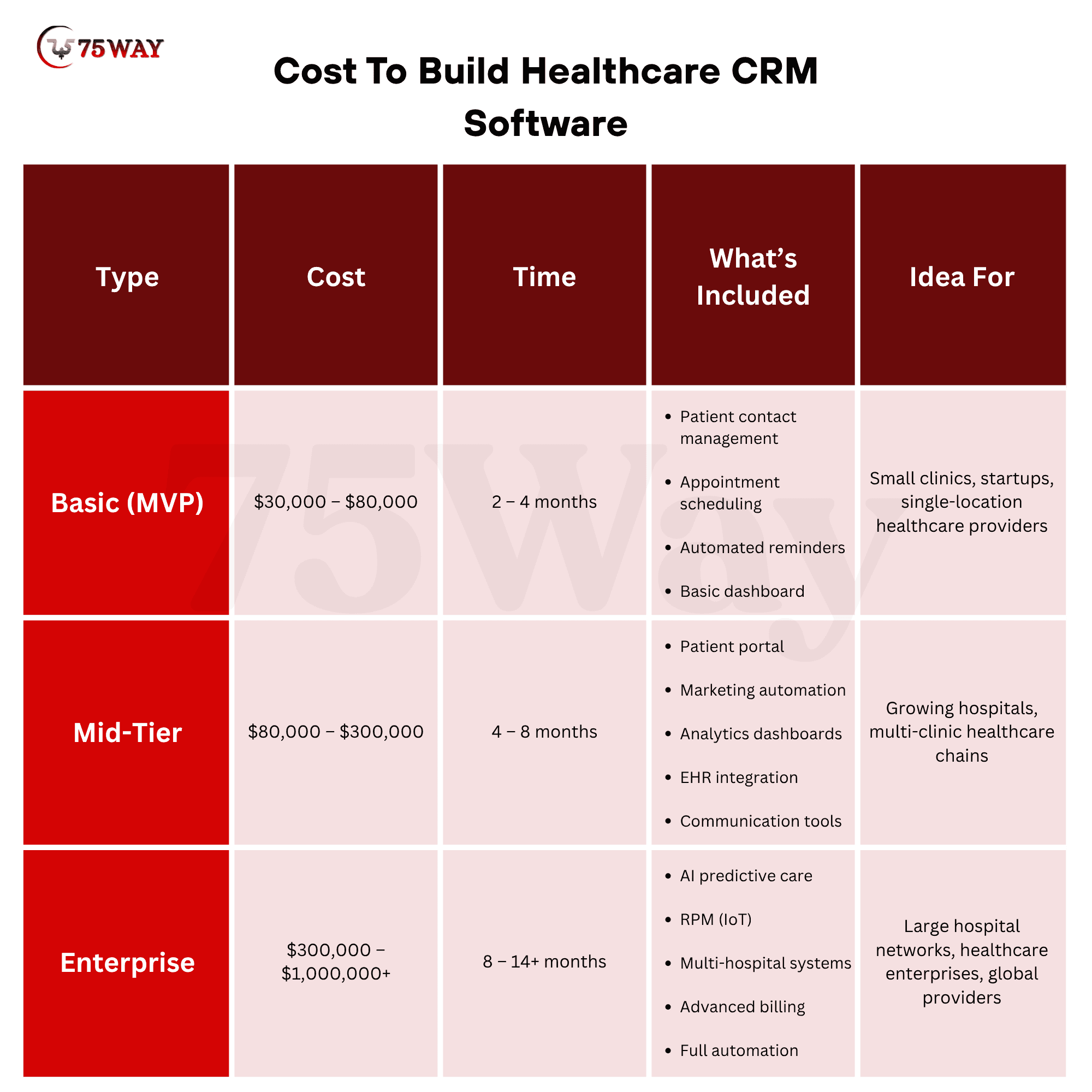
Healthcare CRM software development cost varies depending on features, complexity, integrations, compliance requirements, AI capabilities, and scalability needs. On average, healthcare CRM development can range from $30,000 to $1,000,000+, depending on the level of customization and enterprise-grade functionality required.
Basic/MVP Healthcare CRM: $30,000 – $80,000
Basic healthcare CRM systems include essential features such as patient contact management, simple appointment scheduling, basic dashboards, and automated reminders. These solutions are ideal for startups, small clinics, and early-stage healthcare providers looking for a cost-effective digital system.
Mid-Tier Healthcare CRM: $80,000 – $300,000
Mid-tier healthcare CRM platforms include advanced features such as marketing automation, patient portal integration, analytics dashboards, communication tools, and basic EHR integration. These systems are suitable for growing hospitals and healthcare networks requiring improved operational efficiency and patient engagement.
Enterprise Healthcare CRM: $300,000 – $1,000,000+
Enterprise-grade healthcare CRM solutions include AI-driven predictive analytics, IoT-based remote patient monitoring (RPM), multi-hospital network management, advanced billing integrations, and large-scale healthcare automation systems. These platforms are designed for large healthcare organizations and complex medical ecosystems.
Factors Affecting Cost To Build Healthcare CRM Software
Healthcare CRM development costs vary depending on:
- Complexity: Higher system complexity increases development time, architecture effort, and overall healthcare CRM cost.
- Compliance: 15% – 25% of total development cost. Strict healthcare regulations like HIPAA increase security implementation, auditing, and development expenses substantially.
- EHR/EMR Integration: $15,000 – $80,000 per system. More third-party integrations with EHR, billing, and telemedicine systems increase development effort and cost.
- Third-Party APIs: $5,000 – $30,000 depending on integrations. Add communication, payments, analytics, and notification capabilities to healthcare CRM systems.
- USA Developer Cost: $100 – $180 per hour. Higher cost reflects advanced expertise, compliance knowledge, and healthcare domain experience.
- Offshore Developer Cost: $25 – $60 per hour. Cost-effective option for scalable development with experienced global engineering teams.
- Annual Maintenance: 15% – 25% of initial development cost. Covers updates, security patches, compliance upgrades, and system performance improvements.
How To Reduce Healthcare CRM Development Costs?
Healthcare CRM development can become expensive due to compliance, integrations, and advanced feature requirements. However, you can reduce overall investment by following startgeis.
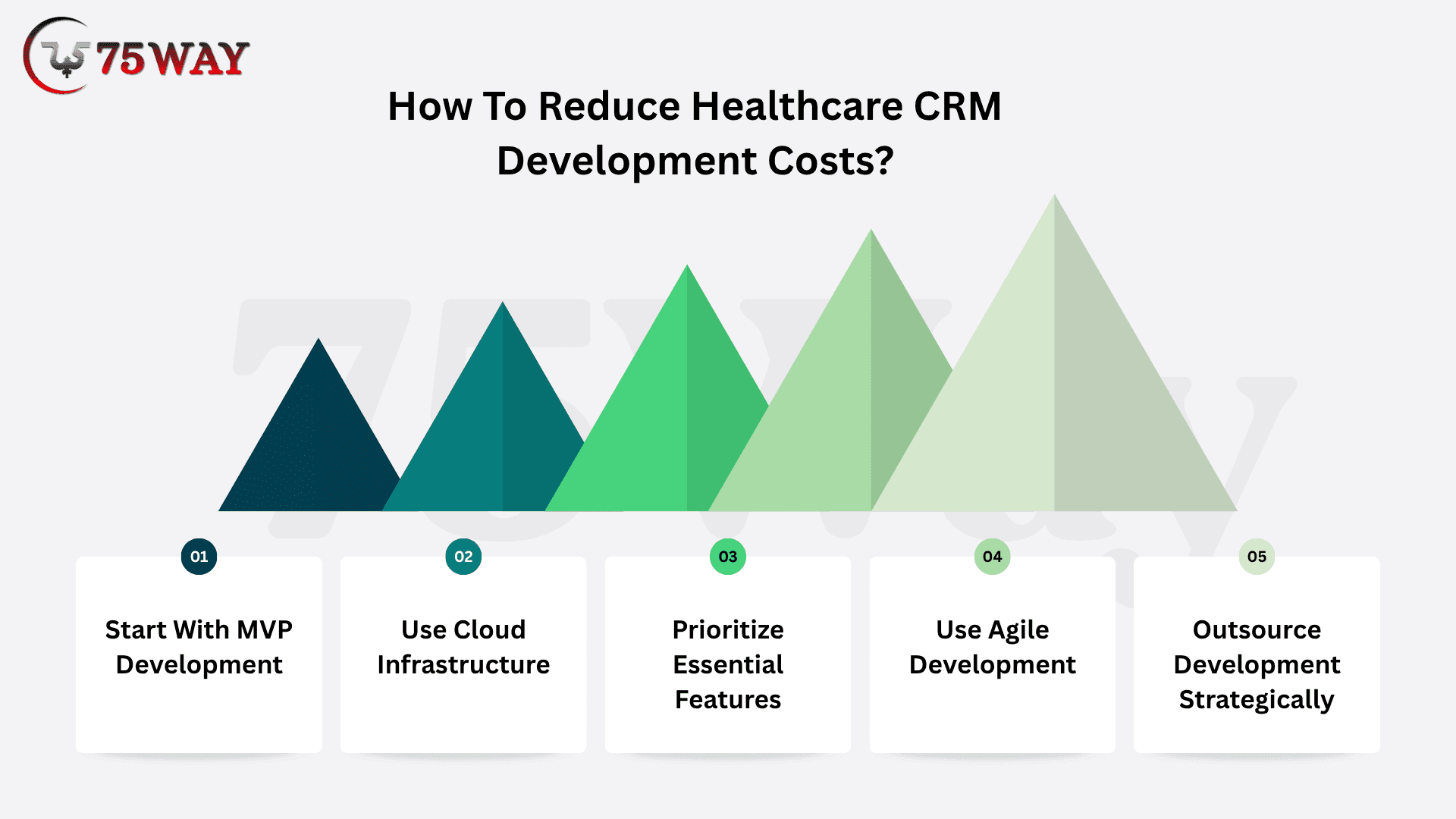
- Start With MVP Development: Building only core features first reduces initial cost and allows healthcare organizations to validate product performance before investing in advanced functionalities later. This approach minimizes risk and improves budget control.
- Use Cloud Infrastructure: Cloud systems eliminate expensive hardware investments and reduce maintenance costs while offering scalable resources. Healthcare organizations pay only for usage, improving cost efficiency and operational flexibility.
- Prioritize Essential Features: Focusing on core healthcare workflows avoids unnecessary development expenses and reduces complexity. This ensures faster delivery while keeping budgets controlled and improving system usability.
- Use Agile Development: Agile breaks development into smaller cycles, improving flexibility, reducing rework, and optimizing resources. Continuous feedback ensures better alignment with healthcare needs and cost-effective project execution.
- Outsource Development Strategically: Outsourcing to experienced healthcare CRM teams reduces hiring costs and speeds up development. It provides access to skilled talent while maintaining quality and compliance standards.
Future Trends You Must Consider for Healthcare CRM Software
Healthcare CRM software development is evolving rapidly with emerging technologies. These advancements are shaping more intelligent, connected, and patient-centric healthcare ecosystems across hospitals, clinics, and digital health platforms.
- AI-Powered Patient Engagement:AI systems will automate personalized communication, reminders, and healthcare interactions to improve patient engagement. These tools enhance responsiveness and support better patient relationship management across digital healthcare ecosystems.
- Predictive Healthcare Analytics: Predictive analytics will help healthcare providers analyze patient behavior, detect risks early, and optimize treatment strategies. This improves decision-making accuracy and supports proactive healthcare delivery across organizations.
- Voice-Based Healthcare Systems: Voice-enabled systems will simplify appointment booking, patient queries, and healthcare communication using natural language processing. These tools improve accessibility and reduce dependency on manual interaction channels in healthcare workflows.
- Hyper-Personalized Healthcare Journeys: CRM platforms will deliver highly tailored healthcare experiences based on patient data, behavior, and preferences. This improves satisfaction, treatment adherence, and long-term engagement across healthcare service providers.
- Blockchain Integration:Blockchain technology will enhance healthcare data security, transparency, and interoperability between systems. It ensures secure data sharing while reducing risks of tampering, fraud, and unauthorized access.
- IoT Healthcare Connectivity:IoT-enabled devices will connect directly with healthcare CRM systems to track patient health in real time. This improves monitoring, early diagnosis, and continuous healthcare management across digital ecosystems.
How 75way Helps Hospitals Build Healthcare CRM Software?
75way Technologies helps hospitals and healthcare organizations build custom healthcare CRM software tailored to clinical workflows, patient needs, and operational goals. We focus on scalable, secure, and user-friendly systems improving communication between patients, doctors, and administrative teams effectively.
We integrate advanced technologies like AI automation, predictive analytics, EHR/EMR systems, and cloud infrastructure. These features streamline appointments, billing, telemedicine, and patient engagement while ensuring compliance, security, and seamless interoperability across healthcare systems.
We also provide end-to-end support, such as consultation, UI/UX design, development, testing, deployment, and maintenance. This ensures continuous scalability, improved efficiency, and long-term digital transformation for hospitals adopting healthcare CRM solutions successfully.
Final Thoughts
Healthcare CRM software development is becoming essential for medical organizations seeking stronger patient engagement, operational visibility, and scalable healthcare management systems in 2026. Modern healthcare providers require intelligent platforms capable of automating communication, integrating healthcare ecosystems, and delivering personalized patient experiences while maintaining strict regulatory compliance. Businesses aiming to build healthcare CRM software can contact an expert CRM development company.
Frequently Asked Questions (FAQs)
Why Is Healthcare CRM Software Important For Hospitals?
Healthcare CRM software improves patient communication, appointment coordination, and engagement management. It helps hospitals automate workflows while strengthening operational visibility and patient satisfaction across healthcare services.
Can Small Clinics Use Healthcare CRM Systems?
Yes, healthcare CRM platforms support small clinics by automating scheduling, communication, and patient management workflows. Cloud-based systems provide affordable scalability for growing healthcare practices and medical centers.
Does Healthcare CRM Software Support Telemedicine?
Modern healthcare CRM systems integrate telemedicine capabilities, like video consultations, remote communication, and virtual appointment management. These integrations improve accessibility and patient engagement experiences significantly.
How Secure Is Healthcare CRM Software?
Healthcare CRM platforms implement encryption, role-based access control, audit logs, and compliance-driven security frameworks. These protections reduce cybersecurity risks and safeguard sensitive patient information effectively.
What Is The Difference Between CRM And Hospital Management Software?
CRM software focuses on patient engagement and communication workflows, while hospital management software handles operational and clinical administration processes. Many healthcare providers integrate both systems together.
Can AI Improve Healthcare CRM Performance?
Yes, AI improves healthcare CRM systems through predictive analytics, automated communication, personalized recommendations, and intelligent workflow management. These capabilities strengthen patient engagement and operational productivity.