AI For Patient Communication
Enhance patient engagement and streamline communication using AI-driven solutions. Deliver timely responses, personalized guidance, and automated reminders to ensure patients stay informed and satisfied.
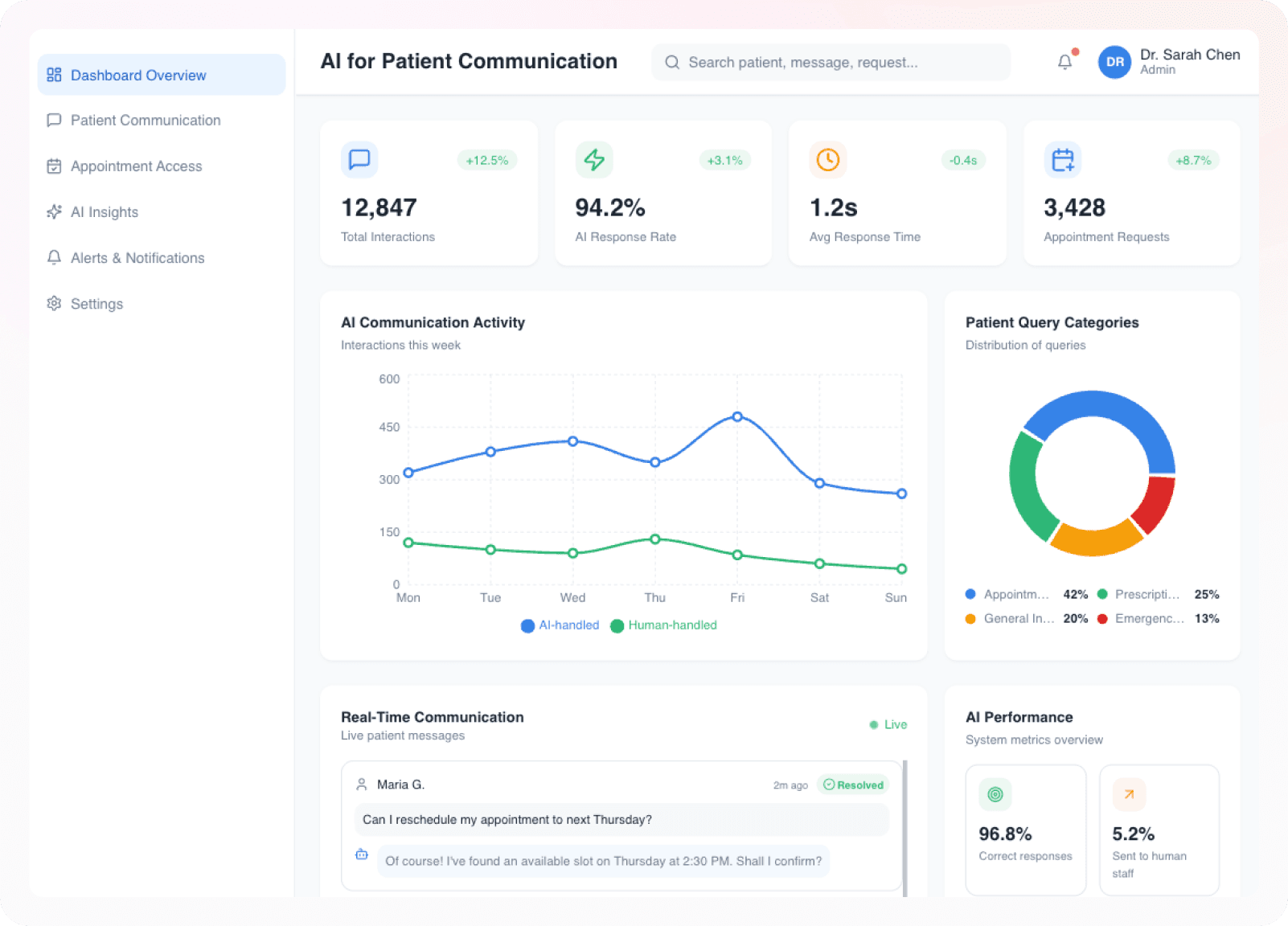
Enhance patient engagement and streamline communication using AI-driven solutions. Deliver timely responses, personalized guidance, and automated reminders to ensure patients stay informed and satisfied.
Bring Business Innovation With AI Automation, AI Agents, Apps, IoT, & Software Solutions. Connect Now!
Bring Business Innovation With AI Automation, AI Agents, Apps, IoT, & Software Solutions. Connect Now!
Bring Business Innovation With AI Automation, AI Agents, Apps, IoT, & Software Solutions. Connect Now!
AI for patient communication is an intelligent solution that automates and personalizes interactions between healthcare providers and patients efficiently. It ensures timely responses, guidance, and improved engagement using advanced AI technologies. This solution leverages natural language processing, predictive algorithms, and automated workflows to manage patient inquiries, appointment reminders, and follow-ups. It reduces manual workload, improves response accuracy, and enhances patient satisfaction while supporting HIPAA-compliant operations in hospitals, clinics, and telehealth platforms. By integrating seamlessly with existing healthcare systems, it strengthens operational efficiency, minimizes errors, and provides actionable insights, enabling healthcare teams to focus on delivering superior patient care consistently.
Automated AI sends tailored messages to patients, increasing engagement and adherence efficiently across healthcare platforms.
Predicts and schedules reminders, reducing no-shows and enhancing overall patient compliance.
Offers round-the-clock AI-powered responses for patient inquiries, improving service availability and satisfaction.
Directs patient queries to the appropriate department or clinician based on urgency and context automatically.
Gathers patient responses and satisfaction insights, helping improve services and streamline communication workflows.
Analyzes patient interaction patterns, generating actionable analytics for informed healthcare decisions and strategy improvement.
Discover how AI for patient communication transforms patient interactions. Our AI solution automates messaging, reminders, and support to elevate satisfaction and operational efficiency.
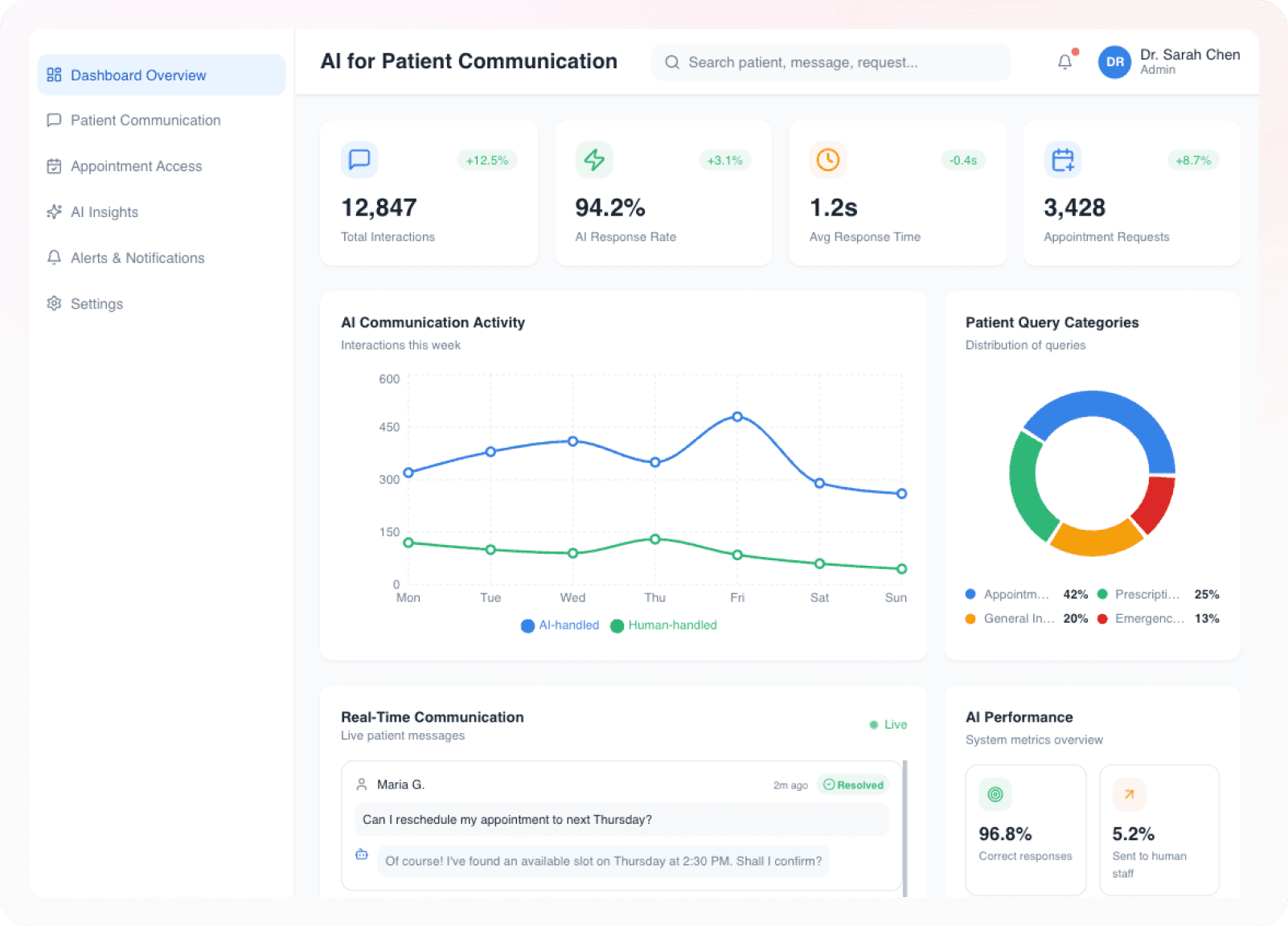
This solution works by integrating AI chatbots and intelligent automation to manage patient communications. Estimated results include 30% faster response times, 25% higher appointment adherence, and 20% improvement in patient satisfaction consistently across healthcare facilities.
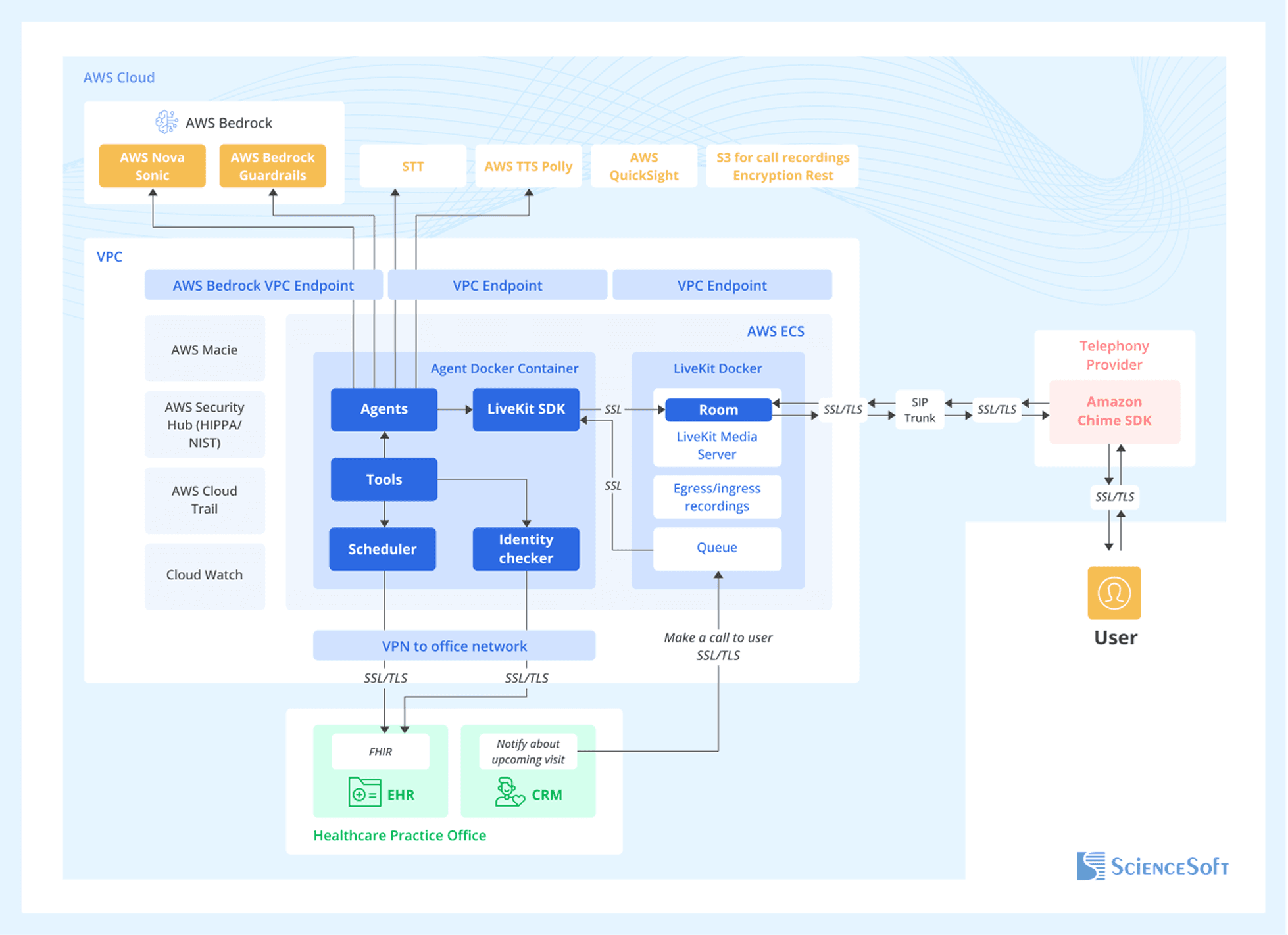
Our solution uses a hybrid AI agent combining natural language understanding with predictive analytics, designed on a cloud-based microservices architecture. AI models adapt to patient behaviors, learn patterns, and optimize communication strategies automatically. The system is powered by advanced conversational AI, secure data pipelines, and modular integration, ensuring scalable performance. Its architecture supports HIPAA-compliant storage, multi-channel messaging, and seamless analytics.
Enhance patient satisfaction and operational efficiency using AI-powered communication strategies. Accelerate engagement, reduce errors, and streamline healthcare workflows effectively.
We developed a system with AI-driven automated reminders and patient messaging for a major hospital, enhancing engagement and reducing manual workload. Our solution achieved 28% fewer missed appointments, 22% higher patient satisfaction, and 70% operational efficiency.
We implemented conversational AI to manage telehealth patient inquiries efficiently, providing timely responses and personalized guidance. Results included 35% faster response times, 25% higher follow-up adherence, and 65% improvement in virtual care satisfaction.
We integrated predictive AI reminders and tailored patient messages across outpatient clinics, improving workflow and communication efficiency. The solution delivered 32% reduction in no-shows, 20% higher patient engagement, and 60% streamlined administrative operations.
We deployed AI agents to automate communication and follow-ups for chronic care patients, reducing staff workload while ensuring care continuity. Achieved 25% higher compliance, 18% reduced administrative effort, and 68% improved patient outcomes.
Below are practical considerations that tend to matter most when introducing AI into patient communication and access. They can help you keep scope under control, avoid common safety and adoption pitfalls, and focus on early wins you can track with clear metrics.
Establishing measurable goals at the outset is critical for successful AI patient communication. Identify key metrics such as response times, engagement rates, follow-up adherence, and patient satisfaction levels. Align these objectives with organizational priorities and clinical workflows. Clearly defined targets guide AI model selection, implementation strategy, and team training. They also help monitor performance post-deployment. Setting precise goals ensures that every automated message, reminder, and interaction contributes meaningfully to improving patient engagement and operational efficiency consistently.
Carefully choosing AI models ensures alignment with patient needs and healthcare workflows. Conversational AI agents, predictive algorithms, and NLP models must integrate securely with EMRs, appointment systems, and communication platforms. Model selection should focus on accuracy, scalability, and adaptability across multiple patient demographics and medical contexts. Evaluating AI performance on historical interaction data helps refine model behavior. Properly selected models reduce manual intervention, enhance response personalization, and optimize resource allocation, ultimately improving patient satisfaction, engagement, and operational efficiency.
Creating intuitive and accessible interfaces is essential for patient engagement. Interfaces should offer clear navigation, personalization features, multi-channel communication (SMS, email, app notifications), and real-time interaction options. Patient usability studies help optimize design and reduce friction. Seamless interfaces empower patients to receive information efficiently while minimizing confusion or errors. By focusing on accessibility, clarity, and responsiveness, healthcare organizations enhance interaction quality, encourage adoption, and maintain consistent engagement across the patient journey, maximizing satisfaction and trust in AI-driven communication.
Continuous monitoring is essential to maintain high-performance AI communication. Track KPIs such as response accuracy, patient satisfaction, engagement rates, and follow-up adherence. Analyze system feedback, identify bottlenecks, and refine AI models regularly. Iterative improvements ensure predictive algorithms adapt to changing patient behaviors and organizational needs. Updating workflows and interfaces based on insights maintains efficiency. This ongoing optimization strengthens communication reliability, increases operational effectiveness, and ensures patient-centered interactions. A proactive approach delivers measurable improvements in engagement, satisfaction, and healthcare outcomes over time.
Implementation costs depend on solution scale, integration complexity, and AI customization levels. Investment ensures long-term efficiency, reduced administrative workload, and measurable improvements in patient engagement outcomes across healthcare operations.
An AI-powered assistant that drafts replies and summarizes messages across patient portals, contact center desktops, and EHR inboxes. Suggests next steps and organizes structured notes while allowing staff review before sending, ensuring accuracy and compliance.
An intelligent assistant that answers frequently asked patient questions about services, providers, locations, procedures, and pricing. Operates within approved content and safety guardrails, providing consistent, reliable responses to improve patient engagement and reduce staff workload.
A highly autonomous AI agent managing patient scheduling, confirmations, reminders, directions, and pre-visit instructions. Escalates complex cases to staff when needed. Optional real-time speech-to-speech interactions enhance patient experience and operational efficiency.
Comprehensive AI solutions integrating multiple agents across digital channels. Handles complex, multi-task conversations such as first-line triage, insurance coverage verification, and appointment scheduling, delivering seamless, scalable, and highly efficient patient engagement at enterprise scale.
Boost efficiency and satisfaction using AI for patient communication. Streamline workflows, automate messaging, and enhance patient engagement effectively today.


Integrating AI for Patient Communication enhanced our telehealth services. Response times decreased, patient inquiries were handled efficiently, and follow-up adherence increased by 28%, resulting in higher overall satisfaction and operational efficiency.
David Ramirez
Healthcare Operations Director
January 2024

Our hospital’s patient communication became seamless with AI for Patient Communication. Personalized messages, predictive reminders, and analytics improved engagement by 30% while reducing administrative workload and enhancing care coordination across departments.
Emily Carter
Chief Medical Officer
December 2023
AI for Patient Communication significantly improved our patient response rates and engagement. Our teams operate more efficiently, and patients are consistently satisfied with personalized interactions.
Michael Anderson
Chief Operations Officer
March 2024
AI for Patient Communication revolutionized our patient engagement strategy. Automated reminders and chatbot interactions reduced missed appointments, improved satisfaction, and freed our staff to focus on care delivery.
Jennifer Thompson
Chief Nursing Officer
February 2024
Integrating AI for Patient Communication enhanced our telehealth services. Response times decreased, patient inquiries were handled efficiently, and follow-up adherence increased by 28%, resulting in higher overall satisfaction and operational efficiency.
David Ramirez
Healthcare Operations Director
January 2024
Our hospital’s patient communication became seamless with AI for Patient Communication. Personalized messages, predictive reminders, and analytics improved engagement by 30% while reducing administrative workload and enhancing care coordination across departments.
Emily Carter
Chief Medical Officer
December 2023
AI for Patient Communication significantly improved our patient response rates and engagement. Our teams operate more efficiently, and patients are consistently satisfied with personalized interactions.
Michael Anderson
Chief Operations Officer
March 2024
AI for Patient Communication revolutionized our patient engagement strategy. Automated reminders and chatbot interactions reduced missed appointments, improved satisfaction, and freed our staff to focus on care delivery.
Jennifer Thompson
Chief Nursing Officer
February 2024
11+ years of expertise in delivering scalable AI communication solutions across hospitals and clinics.
Integration with existing healthcare systems, ensuring HIPAA-compliant operations.
Advanced AI models providing predictive insights, analytics, and patient engagement optimization.
Continuous support and updates for evolving patient communication needs.
Measurable results improving patient satisfaction and staff productivity consistently.
+
+
+