AI Summary
An AI snow removal app development solution helps contractors manage storm-driven demand, crews, routes, and customer updates from one platform. This guide explains essential features, AI capabilities, development stages, integrations, and costs. It also examines operational risks and launch decisions.
Key Takeaways
- AI-powered dispatching helps snow removal teams coordinate crews during storms.
- Global snow removal services may reach $11.96 billion by 2035.
- App development can cost $2,000–$120,000+, depending on scope and complexity.
- Route optimization combines weather, location, job priority, and crew availability.
- Strong integrations, field testing, and security shape long-term product reliability.
Winter is just around the corner, and snow removal companies are getting ready for another season of tight schedules, demanding customers, and unpredictable snowfall.
For business owners, the challenge isn't simply clearing snow. It's managing multiple properties, coordinating crews, and making sure every customer gets service on time.
An AI-powered snow removal app development solution can take some of that pressure off by bringing bookings, dispatching, and field operations together.
You can build a platform that does much more than accept service requests. Weather alerts, automated job assignments, GPS fleet tracking, route optimization, and customer notifications can help your team stay organized when demand rises.
If you're considering this idea for your business, there are a few important things to understand before investing. We'll walk you through the must-have features, development cost, technology requirements, and the complete snow removal app development process.
Quick Answer: AI Snow Removal App Development
AI snow removal app development involves building intelligent software that helps contractors manage snow plowing bookings, workforce scheduling, fleet tracking, and winter maintenance operations. It combines AI technologies, GPS tracking, weather APIs, and automated dispatching to simplify daily business activities.
Businesses can integrate features such as snowfall demand forecasting, smart crew assignments, route optimization, real-time job tracking, and automated customer notifications. These capabilities help contractors coordinate multiple properties, respond to changing weather conditions, and manage sudden increases in service requests.
The development cost typically ranges from $2,000 to $120,000+, depending on app complexity, AI capabilities, platforms, and integrations. A basic MVP can start with essential booking and management features, while advanced platforms can include predictive analytics and intelligent fleet management.
Market Outlook For Snow Removal Apps Across United States
In states like New York, Minnesota, Colorado, and Michigan, a heavy snowfall can turn snow removal from a routine service into an urgent necessity. For contractors, every storm brings more service calls, tighter deadlines, and pressure to cover more properties without overloading their crews. This growing operational demand makes the US market worth examining for businesses planning to invest in snow removal app development solutions.
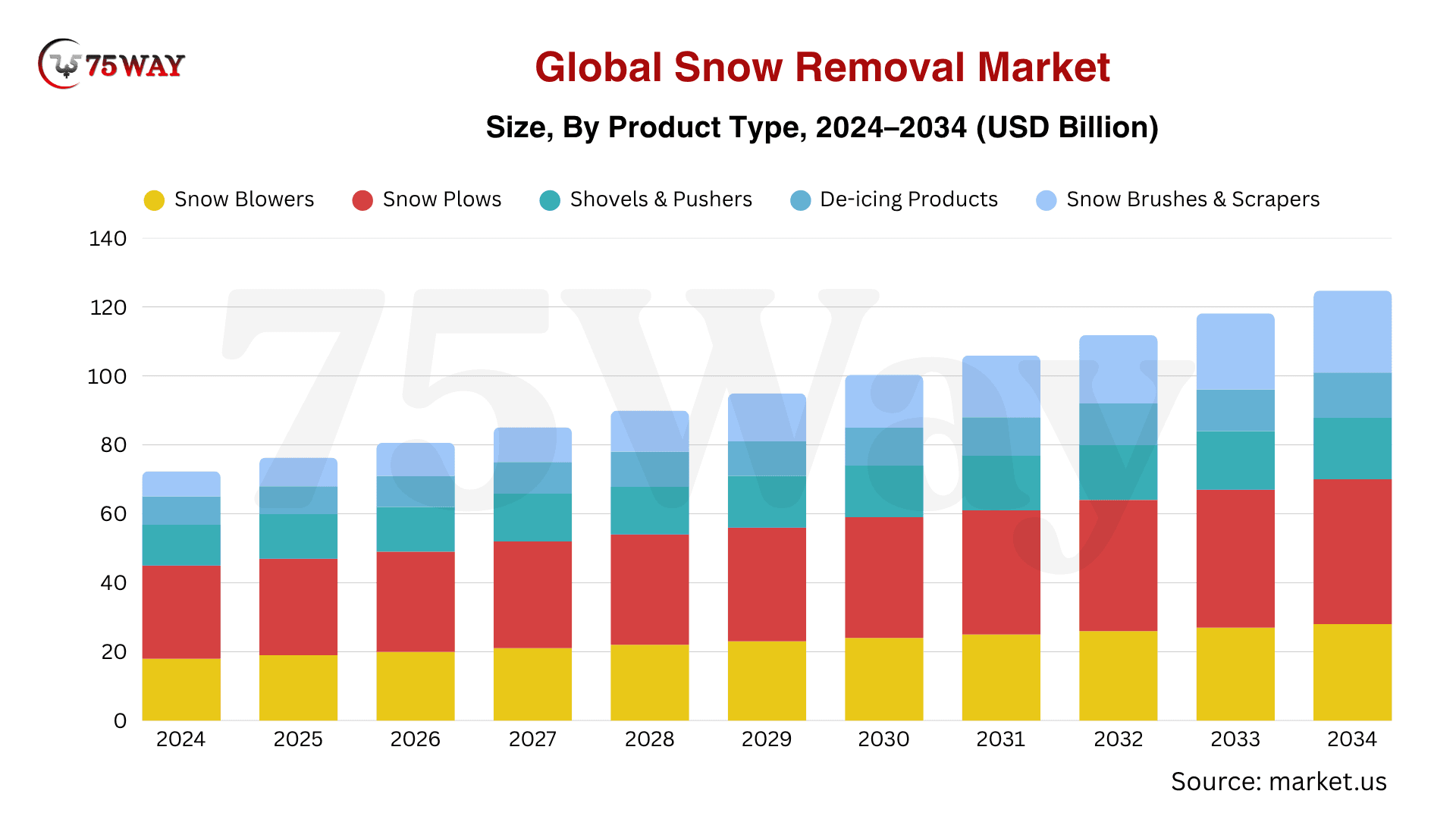
- The global snow removal services market is estimated at $5.37 billion in 2026 and is projected to reach $11.96 billion by 2035, growing at a 9.31% CAGR.
- Another forecast estimates that the global Snow Removal Market will reach $124.7 billion by 2034.
- Snow plowing services dominate the market, accounting for approximately 67% of the total market share.
- Municipal applications represent around 41% of the market, driven by public road safety requirements and winter infrastructure maintenance.
- North America holds an estimated 46% share of the global snow removal market.
- Plowz & Mowz operates in 50+ U.S. markets, supported by a network of over 8,000 contractors, and offers instant pricing, GPS tracking, and job completion verification.
- Approximately 80% of snow removal operators are sole proprietors, increasing the importance of digital dispatch systems and on-demand app platforms for connecting and managing available workers.
Why Are Businesses Investing In AI Snow Removal Mobile App Development?
A homeowner needs their driveway cleared before work, while a commercial property manager needs an entire parking lot ready before opening. Both may need snow removal at short notice, and businesses that make booking easier have an opportunity to win those customers. An on-demand snow removal app development solution is attracting business interest because it connects urgent customer needs with contractors who can fulfill them.
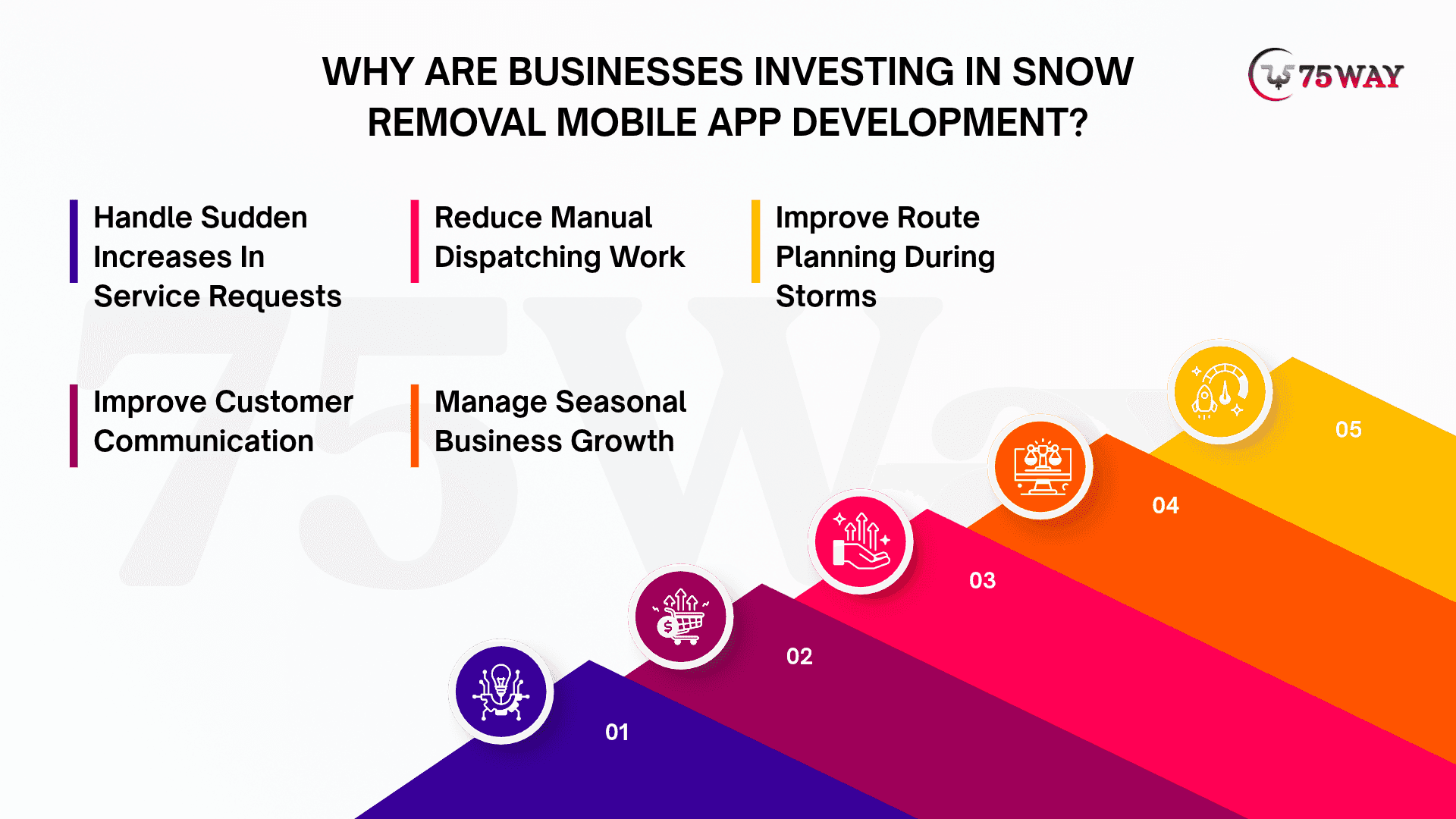
1. Handle Sudden Increases In Service Requests
During heavy snowfall, contractors may receive dozens or hundreds of service requests within a short period. Manual booking processes make it difficult to prioritise urgent jobs.
AI-powered demand forecasting can analyse historical bookings, weather forecasts, and previous service patterns to help managers anticipate workload increases.
2. Reduce Manual Dispatching Work
Dispatchers often spend considerable time assigning jobs, checking worker availability, and adjusting schedules.
Intelligent dispatching can recommend suitable crews based on location, equipment, skills, job priority, and availability.
3. Improve Route Planning During Storms
Snow-covered roads, temporary closures, and changing traffic conditions can disrupt planned routes.
Route optimization software can combine mapping data, road restrictions, job locations, and weather information to recommend practical travel sequences.
4. Improve Customer Communication
Customers want to know when their driveways, parking lots, or commercial properties will receive service.
Automated notifications, booking confirmations, estimated arrival updates, and completion alerts help businesses keep customers informed without requiring constant manual communication.
5. Manage Seasonal Business Growth
Snow removal contractors may experience substantial differences in demand between seasons.
A cloud-based platform can help businesses manage additional workers, service areas, customers, and equipment without rebuilding their operational systems.
Quick Read:Cleaning Service App Development For On-Demand Businesses in 2026
Technology Architecture For Local Snow Removal App Development
A scalable local snow removal app should separate its user interfaces, backend services, data storage, AI components, and external integrations.
A typical architecture looks like this:
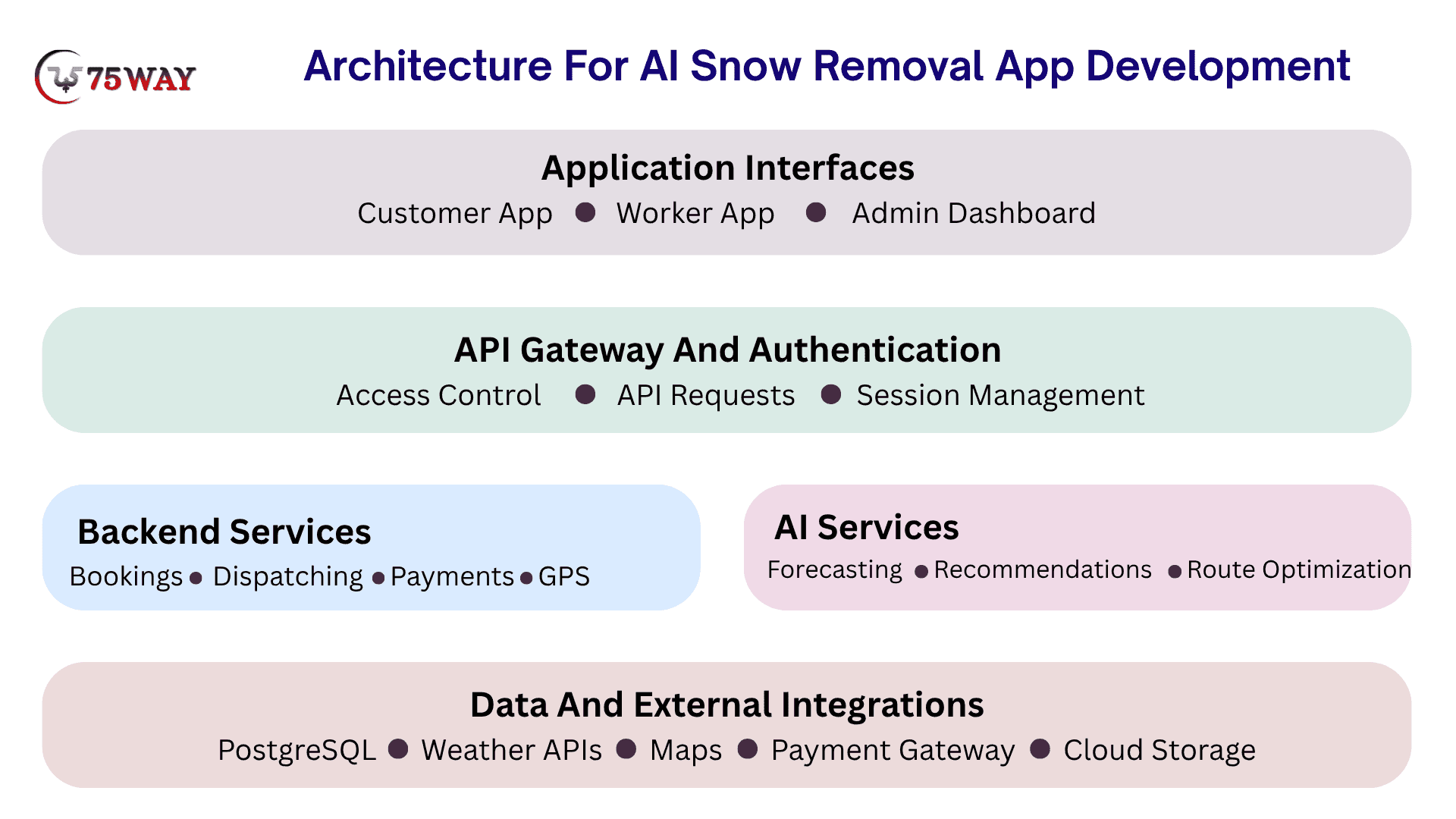
This architecture allows the application to process customer requests, retrieve operational information, generate AI recommendations, and send updates to the appropriate users.
For a growing platform, developers can introduce event queues, caching, background processing, and separate AI inference services as traffic increases.
Read Too: On-Demand Beauty Services App Development: Complete Business Guide 2026
How To Develop An AI Snow Removal App: Step-By-Step Process
A snow removal app designed for homeowners may look very different from one built for contractors managing hundreds of commercial properties. That's why the development process should begin with your service model, target users, and the challenges your business wants to address. The steps below explain how to plan, build, test, and launch an AI-powered snow removal app that fits those requirements.
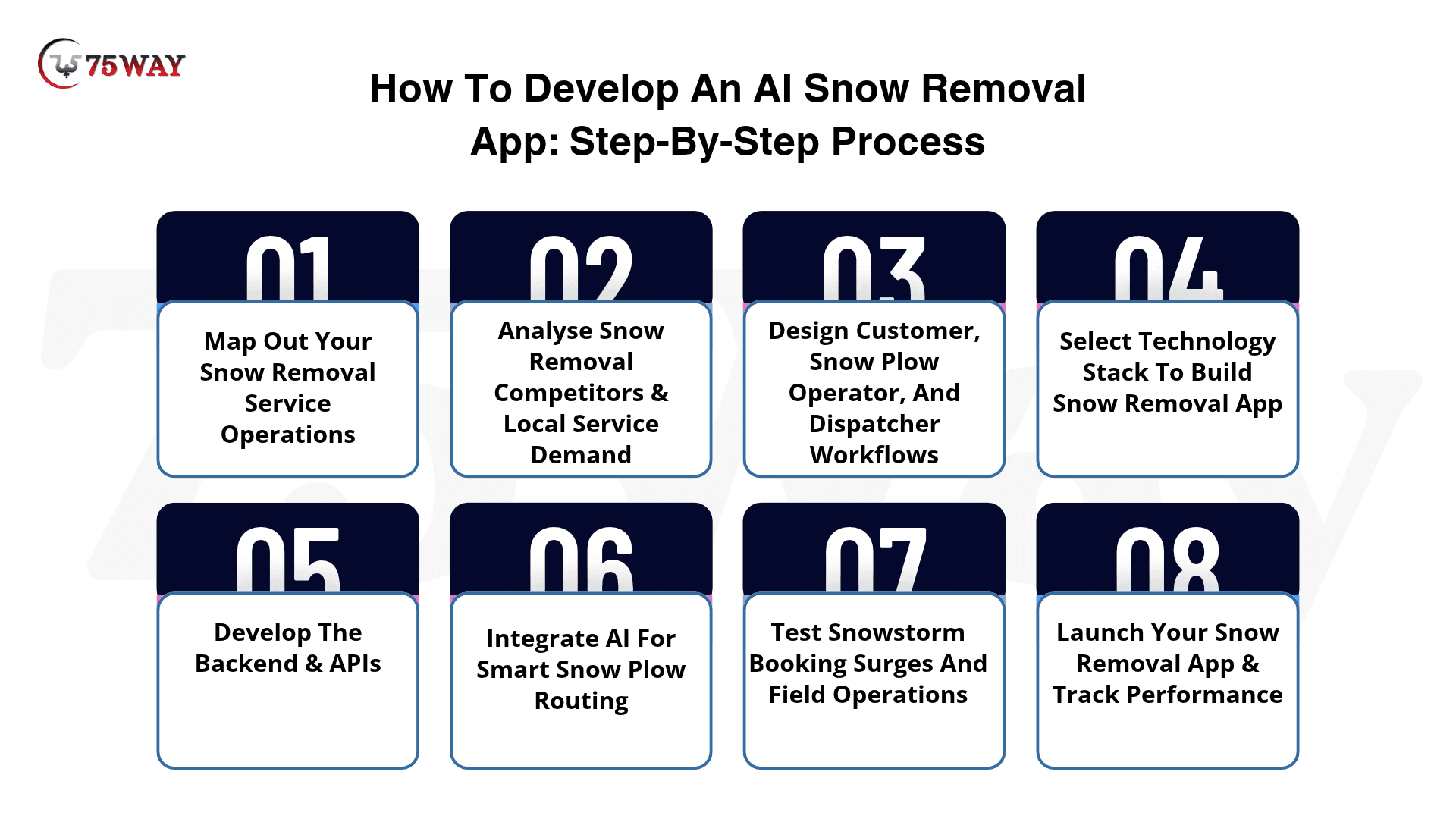
Step 1. Map Out Your Snow Removal Service Operations
Start by identifying the type of snow removal business the application will support.
Possible business models include:
- On-Demand Marketplace: Connects customers with independent snow removal contractors.
- Contractor Management Software: Helps individual businesses manage their workers, customers, and jobs.
- Commercial Property Management: Supports recurring winter maintenance contracts for large properties.
- Fleet Management Platform: Helps companies coordinate snow plows, vehicles, equipment, and field operations.
Your business model determines the application architecture, user roles, revenue model, and required integrations.
Step 2. Conduct Competitor Research & Local Service Demand
Analyse existing snow removal software and identify where customers or contractors experience operational difficulties.
Look beyond feature comparisons. Examine how competing products handle job assignments, recurring services, weather disruptions, pricing, and proof of completion.
Research should include:
- Customer interviews.
- Contractor workflow analysis.
- Competitor feature comparisons.
- Pricing model research.
- Service-area requirements.
- Market demand assessment.
This stage helps identify opportunities that a new application can address rather than simply replicating existing products.
Step 3. Prepare UI/UX Designs for Customer, Snow Plow Operator, & Dispatcher Panels
Once the business requirements are clear, designers can develop user flows, wireframes, and interactive prototypes.
The design should account for three important interfaces.
- Customer Application: Booking, property management, payments, notifications, and service tracking.
- Worker Application: Job assignments, navigation, task updates, photographs, and work completion.
- Admin Dashboard: Customer management, dispatching, scheduling, weather monitoring, reporting, and payments.
Field workers may operate in cold conditions, with gloves or limited connectivity. Therefore, interfaces should use large touch targets, clear status indicators, and simple navigation.
Step 4. Select Technology Stack To Build On-Demand Snow Removal App
The technology stack for building AI-driven snow removal app should support real-time updates, location tracking, AI integrations, and future expansion.
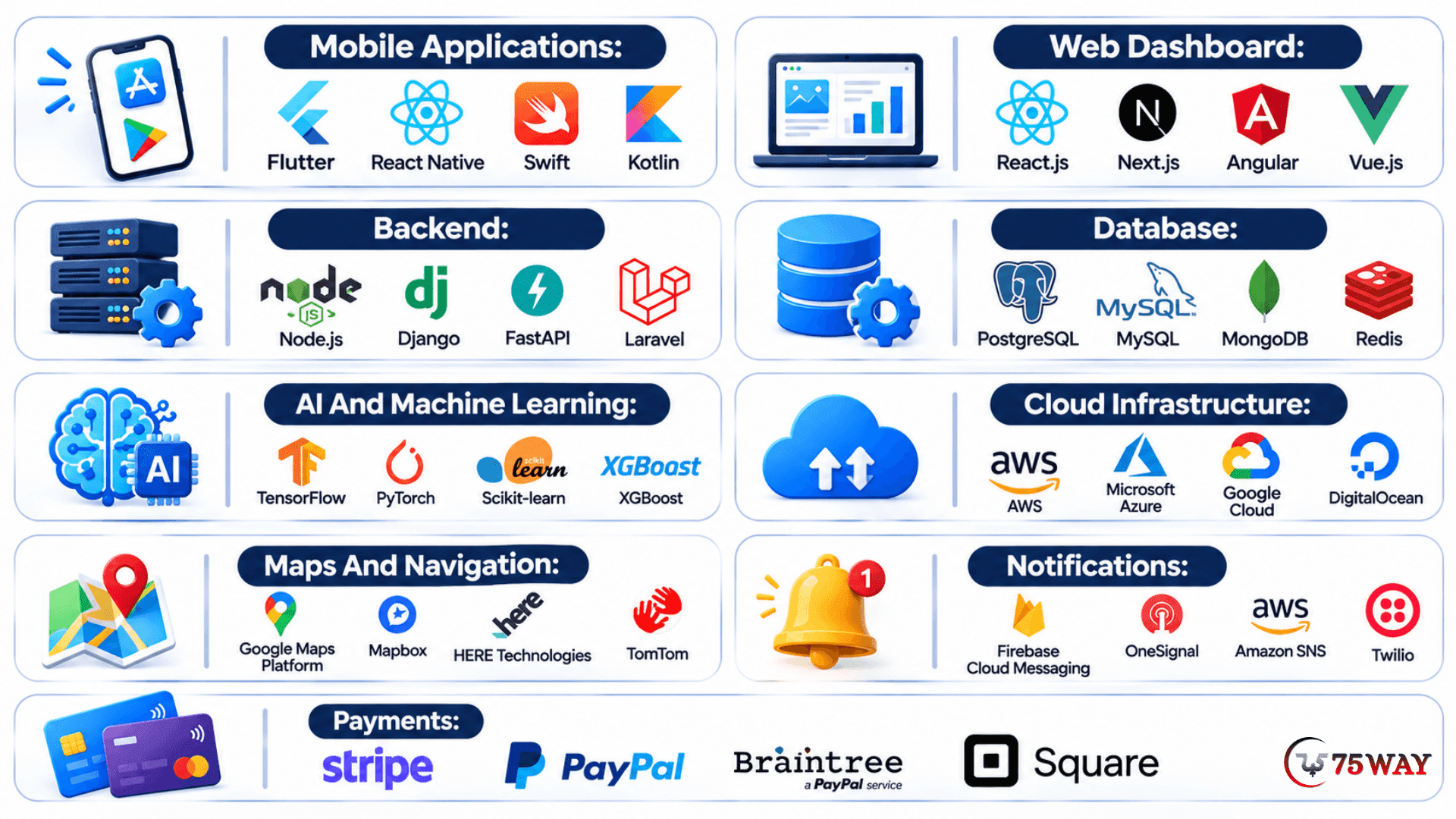
The final selection depends on application complexity, existing infrastructure, developer expertise, and integration requirements.
Step 5. Develop The Backend & APIs
The backend connects the different application interfaces and manages the business logic.
Developers should build APIs for:
- User authentication.
- Property management.
- Service bookings.
- Worker assignments.
- Payment processing.
- GPS tracking.
- Weather information.
- Notifications.
- Reporting and analytics.
A modular architecture can make it easier to update individual services without disrupting the entire application.
For example, the dispatching service can operate independently from the payment service while sharing relevant booking information through secure APIs or event-driven communication.
Step 6. Integrate AI For Smart Snow Plow Routing
AI integration should begin with clearly defined business problems.
Developers can start with demand forecasting, intelligent job recommendations, and route optimization before introducing more advanced capabilities.
A practical implementation might include:
- Collect historical booking, weather, and operational data.
- Clean and organise the information.
- Train and evaluate forecasting models.
- Connect model outputs to backend services.
- Build dispatching and scheduling recommendations.
- Monitor actual results and retrain models when necessary.
For route optimization, developers may use mathematical optimization techniques alongside AI models. Algorithms such as vehicle routing problem solvers can handle multiple destinations, capacity limits, time windows, and priority constraints.
AI is not required for every feature. Conventional business rules may be more reliable and less expensive for straightforward booking and payment workflows.
Step 7. Test Snowstorm Booking Surges And Field Operations
Testing is especially important because snow removal operations depend on unpredictable weather and time-sensitive assignments.
The testing process should cover:
- Functional testing.
- API testing.
- Payment testing.
- GPS accuracy.
- Route recommendation quality.
- AI model evaluation.
- Load and performance testing.
- Security testing.
- Offline and poor-network conditions.
Developers should simulate high-demand periods, such as multiple simultaneous bookings during a major snowstorm.
Step 8. Launch Your Snow Removal App & Track Performance
After successful testing, developers can deploy the application to cloud infrastructure and publish the mobile applications through the relevant app stores.
Post-launch monitoring should cover application crashes, API response times, booking failures, payment issues, model accuracy, and customer feedback.
Continuous improvements can then be prioritised based on actual usage and operational performance.
Discover More:Top 10 On-Demand App Development Companies in USA: Complete List 2026
Types of Snow Removal Apps To Build For Business Growth
Snow removal isn't a one-size-fits-all service, and your app shouldn't be either. Some businesses earn through residential driveway clearing, others handle large commercial contracts, while some operate platforms that connect customers with independent snowplow owners. These are the different app models you can explore before deciding what to build.
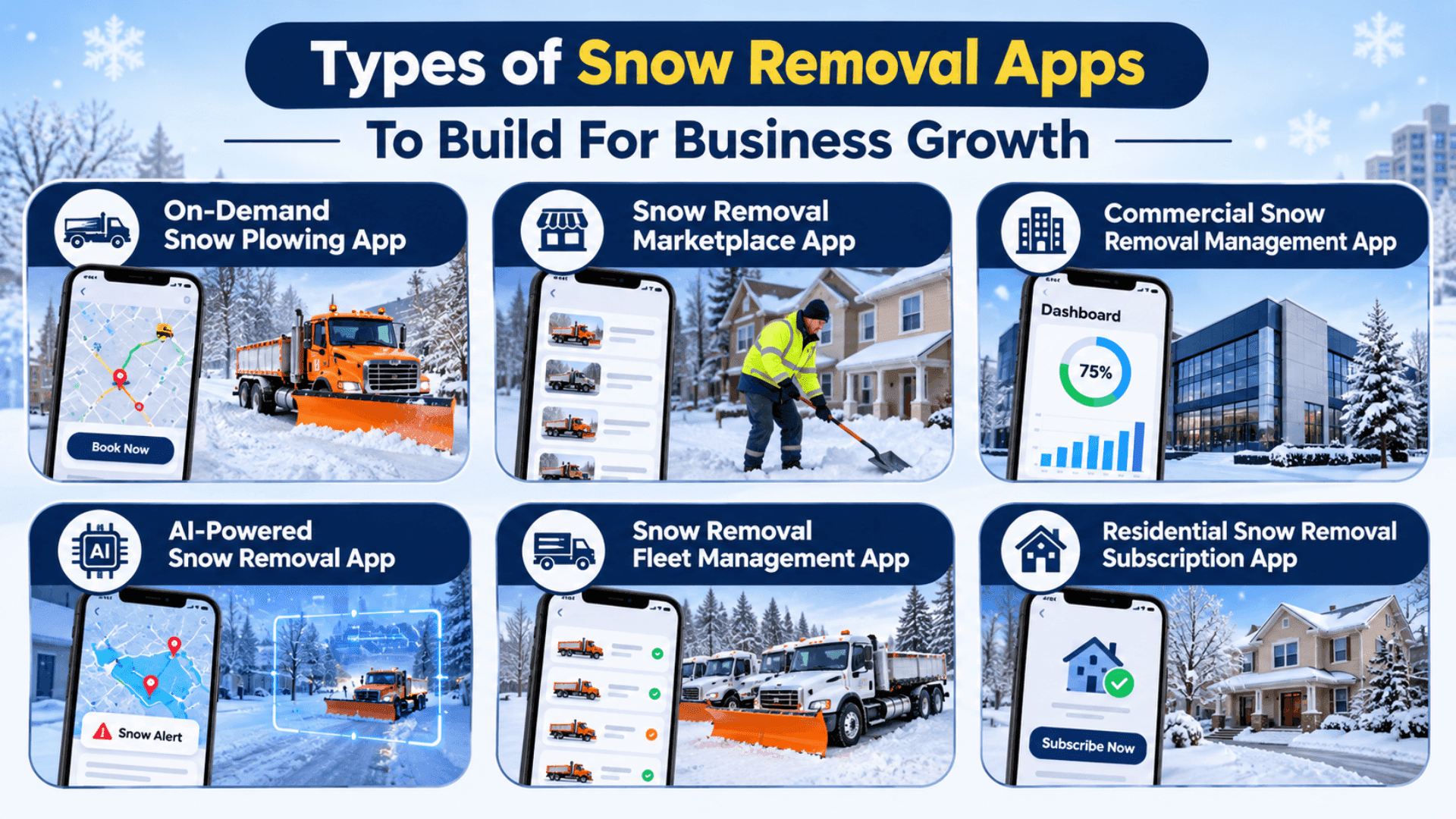
- On-Demand Snow Plowing App
An on-demand snow plowing app connects property owners with snow removal contractors for immediate or scheduled plowing services. Customers can submit requests, compare service providers, track assigned crews, and make online payments.
Estimated Cost: $10,000 – $25,000
Market Potential: Growing demand for convenient snow removal bookings, faster contractor connections, and automated service scheduling during winter storms.
Target Audience: Residential property owners, independent snow plow contractors, and local snow removal startups.
- Snow Removal Marketplace App
A snow removal marketplace connects multiple contractors with customers through a centralized service platform. Users can compare providers, review ratings, check pricing, and book services, while contractors receive opportunities to expand their customer base.
Estimated Cost: $20,000 – $45,000
Market Potential: Opportunities to generate revenue through booking commissions, contractor subscriptions, and premium marketplace listings across multiple service areas.
Target Audience: Marketplace startups, snow removal companies, independent contractors, and property management businesses.
- Commercial Snow Removal Management App
A commercial snow removal management app helps businesses coordinate winter maintenance across multiple properties, including parking lots, office buildings, retail centers, and industrial facilities. It supports recurring contracts, crew scheduling, equipment allocation, and digital proof of service.
Estimated Cost: $25,000 – $55,000
Market Potential: Commercial property owners require reliable winter maintenance, documented service completion, and centralized contractor management across multiple locations.
Target Audience: Commercial snow removal contractors, facility managers, property management companies, and retail property operators.
- AI-Powered Snow Removal App
An AI-powered snow removal app uses machine learning, weather intelligence, and optimization algorithms to support business operations. It can forecast service demand, recommend crew assignments, optimize routes, and help contractors prepare for changing snowfall conditions.
Estimated Cost: $35,000 – $80,000
Market Potential: Increasing interest in predictive operations, automated dispatching, intelligent scheduling, and data-driven winter maintenance management creates opportunities for AI-enabled platforms.
Target Audience: Established snow removal businesses, technology startups, large contractors, and multi-location winter maintenance companies.
- Snow Removal Fleet Management App
A snow removal fleet management app helps businesses monitor plow trucks, loaders, spreaders, and other equipment during winter operations. GPS tracking, vehicle maintenance records, fuel monitoring, and driver activity reports help managers oversee their fleets.
Estimated Cost: $20,000 – $50,000
Market Potential: Fleet-dependent contractors can benefit from improved vehicle visibility, equipment maintenance planning, and better coordination across large service territories.
Target Audience: Snow plowing companies, equipment rental businesses, fleet operators, and large winter maintenance contractors.
- Residential Snow Removal Subscription App
A subscription-based snow removal app allows homeowners to purchase recurring winter maintenance packages instead of booking individual services. Customers can select seasonal plans, manage subscriptions, receive scheduled service updates, and access payment records.
Estimated Cost: $12,000 – $30,000
Market Potential: Seasonal service packages create recurring revenue opportunities and help contractors build longer-term customer relationships throughout winter.
Target Audience: Residential snow removal companies, homeowners, property service startups, and local landscaping businesses.
Read More:Hire On-Demand App Developers For Custom Solutions In 2026
Features Your AI-Powered Snow Removal App Development Solution Must Include
A snow removal app needs to handle much more than online bookings, especially when several properties need attention after the same storm. From AI-based job assignments and weather alerts to live snowplow tracking and digital payments, each feature should solve a real problem in the service process. Let's look at the capabilities worth including in your app.
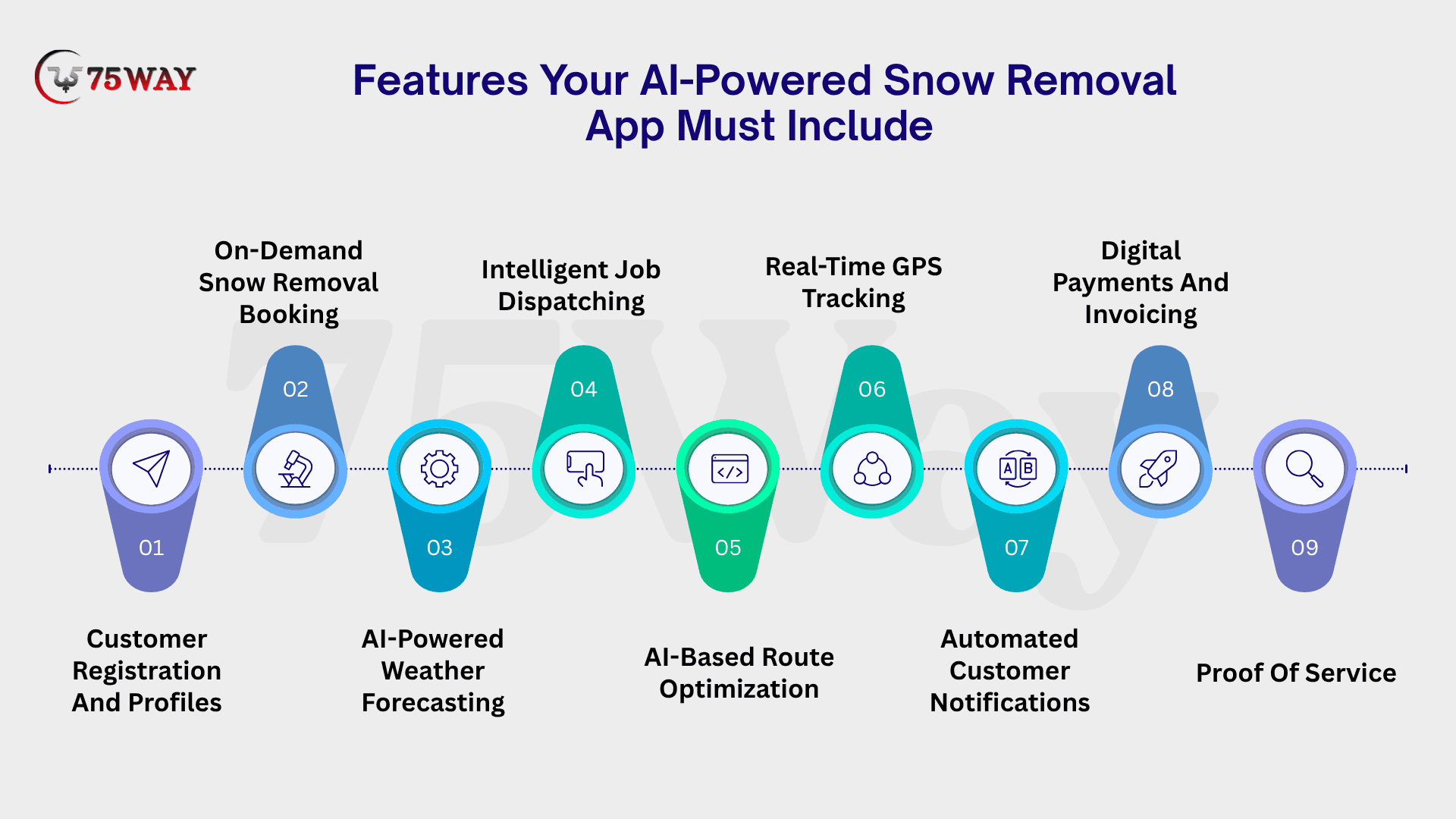
1. Customer Registration And Profiles
Customers should be able to create accounts, save property addresses, manage contact details, and view their previous service requests.
Useful capabilities include:
- Email and phone registration.
- Social login options.
- Multiple property management.
- Saved service preferences.
- Booking and payment history.
For commercial customers, property profiles should also support parking lot dimensions, access instructions, service agreements, and maintenance requirements.
2. On-Demand Snow Removal Booking
An online booking system allows customers to request snow plowing, driveway clearing, sidewalk cleaning, and deicing services.
Customers should be able to select their property, choose a service, specify preferred timing, and receive an estimated price.
Developers can integrate dynamic pricing rules based on property size, snowfall depth, service type, and additional requirements.
3. AI-Powered Weather Forecasting
Weather intelligence is particularly valuable because snow removal demand depends heavily on changing weather conditions.
The system can integrate weather APIs to retrieve:
- Expected snowfall accumulation.
- Temperature changes.
- Snowfall intensity.
- Freezing rain alerts.
- Storm warnings.
- Forecasted weather conditions.
Machine learning models can combine historical service records with weather data to estimate upcoming demand.
However, weather forecasts should remain inputs to operational decisions rather than guarantees of actual snowfall.
4. Intelligent Job Dispatching
Automated dispatching helps managers assign incoming service requests to suitable field workers.
The recommendation engine can consider:
- Crew availability.
- Current worker locations.
- Equipment availability.
- Job urgency.
- Service area coverage.
- Estimated job duration.
For example, if three residential properties request snow clearing within the same neighbourhood, the system can recommend assigning them to one available crew rather than sending separate teams.
Managers should retain the ability to approve or override assignments.
5. AI-Based Route Optimization
Route planning is one of the most valuable capabilities for snow removal contractors managing multiple properties.
An optimization engine can consider worker locations, job priorities, road conditions, travel distances, and service deadlines.
For example, a contractor managing 30 commercial properties may need to prioritize hospital access roads and high-traffic parking facilities before lower-priority locations.
The system can recommend routes based on business-defined priorities and available road information.
6. Real-Time GPS Tracking
GPS tracking allows administrators to monitor field workers and equipment during active jobs.
Important capabilities include:
- Live crew locations.
- Assigned job visibility.
- Estimated arrival times.
- Route progress.
- Service completion status.
GPS tracking should be designed with appropriate employee consent, access permissions, and location-data retention policies.
7. Automated Customer Notifications
Communication features reduce the number of calls customers need to make to check service progress.
The platform can automatically send notifications when:
- A booking is confirmed.
- A worker is assigned.
- A crew starts travelling.
- A service begins.
- A job is completed.
- A payment is processed.
Businesses can offer push notifications, SMS, and email updates.
8. Digital Payments And Invoicing
A payment system allows customers to pay for individual services or recurring maintenance agreements.
Developers can integrate payment gateways to support card payments, digital receipts, refunds, and invoicing.
For commercial customers, the platform may also require monthly billing, contract-based pricing, and downloadable service records.
9. Proof of Service (PoS)
Commercial property managers often need evidence that contracted work has been completed.
A proof-of-service feature can allow workers to upload before-and-after photographs, add completion timestamps, and record the services performed.
Administrators can use these records to resolve customer disputes and review contractor performance.
Panel-Wise Features For On Demand Snow Plow App Development
A snow plow app has different users, and each one needs a different set of tools to get the job done. Customers want to book a driveway clearing, drivers need their assigned routes, and business owners need to keep track of jobs, payments, and crews. Let's break down the features each panel should include to keep your on-demand snow plow app running smoothly.
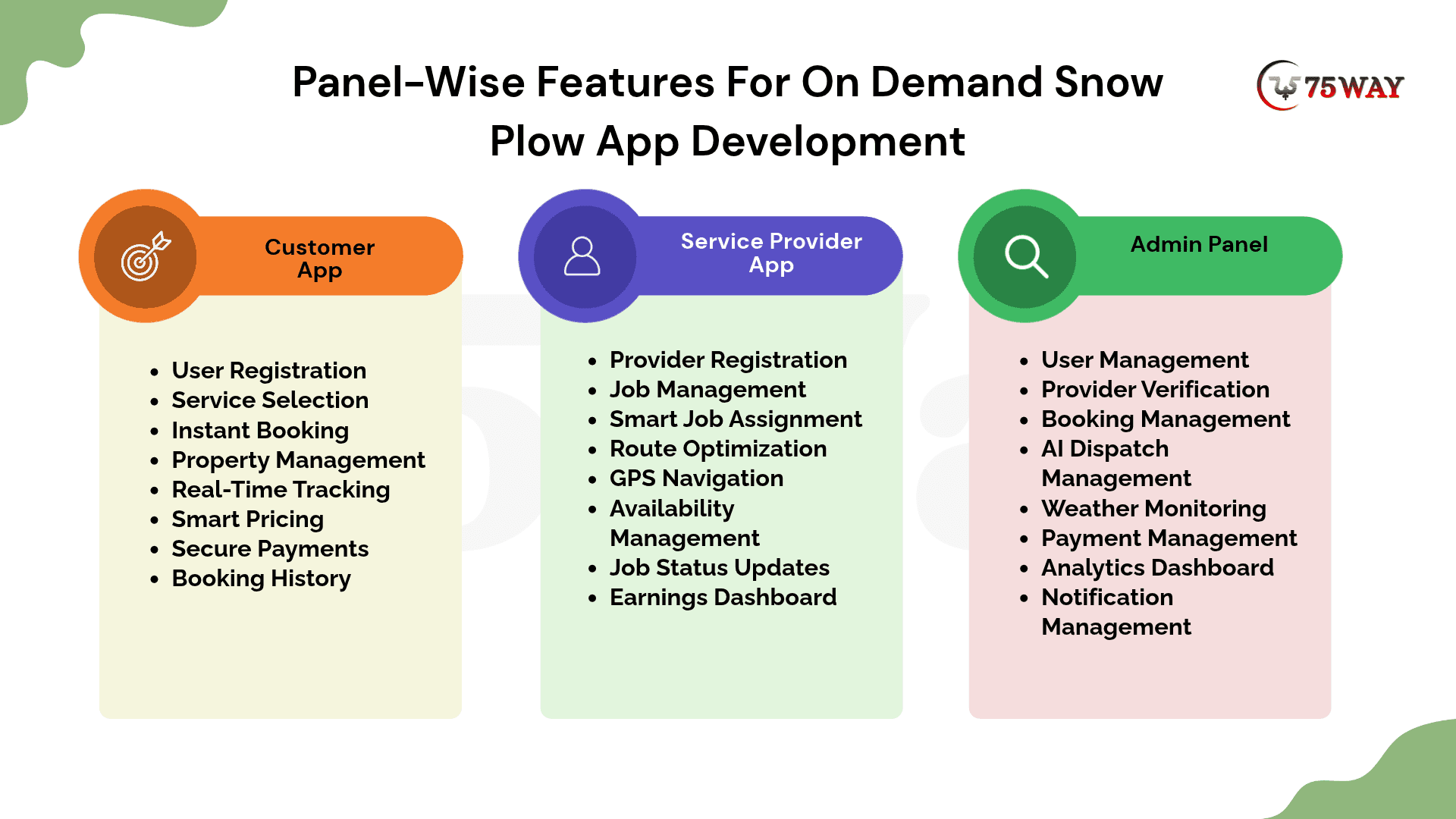
Module 1: Customer Snow Removal App
The customer panel allows property owners to book snow removal services, track assigned crews, manage payments, and receive service updates.
- User Registration: Create accounts using email, phone, or social authentication.
- Service Selection: Choose snow plowing, driveway clearing, or sidewalk cleaning.
- Instant Booking: Schedule snow removal services based on preferred availability.
- Property Management: Save multiple property addresses and specific service instructions.
- Real-Time Tracking: Monitor assigned snow removal crews through live GPS.
- Smart Pricing: View estimated charges based on property and service requirements.
- Secure Payments: Pay online using cards and supported digital payment methods.
- Booking History: Review previous bookings, invoices, and completed service records.
Module 2: Snow Removal Service Provider App
The service provider panel helps contractors manage incoming requests, coordinate field workers, update job statuses, and monitor daily operations.
- Provider Registration: Register businesses and submit details for account verification.
- Job Management: Accept, reject, and manage incoming service requests.
- Smart Job Assignment: Receive suitable jobs based on location and availability.
- Route Optimization: Follow optimized routes between assigned customer properties.
- GPS Navigation: Navigate directly to customer locations using integrated maps.
- Availability Management: Update working hours, service areas, and availability status.
- Job Status Updates: Mark assigned tasks as started, ongoing, or completed.
- Earnings Dashboard: Monitor completed jobs, payments, commissions, and earnings.
Module 3: Admin Console
The admin console provides centralized control over customers, contractors, bookings, payments, and platform-wide snow removal operations.
- User Management: Manage customer accounts, provider profiles, and access permissions.
- Provider Verification: Review contractor documents and approve service provider registrations.
- Booking Management: Monitor bookings, cancellations, assignments, and service completion.
- AI Dispatch Management: Automate job allocation using availability, location, and priorities.
- Weather Monitoring: Track snowfall forecasts and weather-related service alerts.
- Payment Management: Monitor transactions, refunds, commissions, and provider payouts.
- Analytics Dashboard: Analyze bookings, revenue, demand patterns, and performance.
- Notification Management: Send platform announcements, booking alerts, and operational updates.
How Does AI Work Inside A Snow Removal Application Development?
Adding an AI label to ordinary booking software does not make it an intelligent application. The real value comes from connecting suitable AI models to reliable operational data and allowing the system to support specific decisions.
Here are the main AI capabilities developers can integrate.
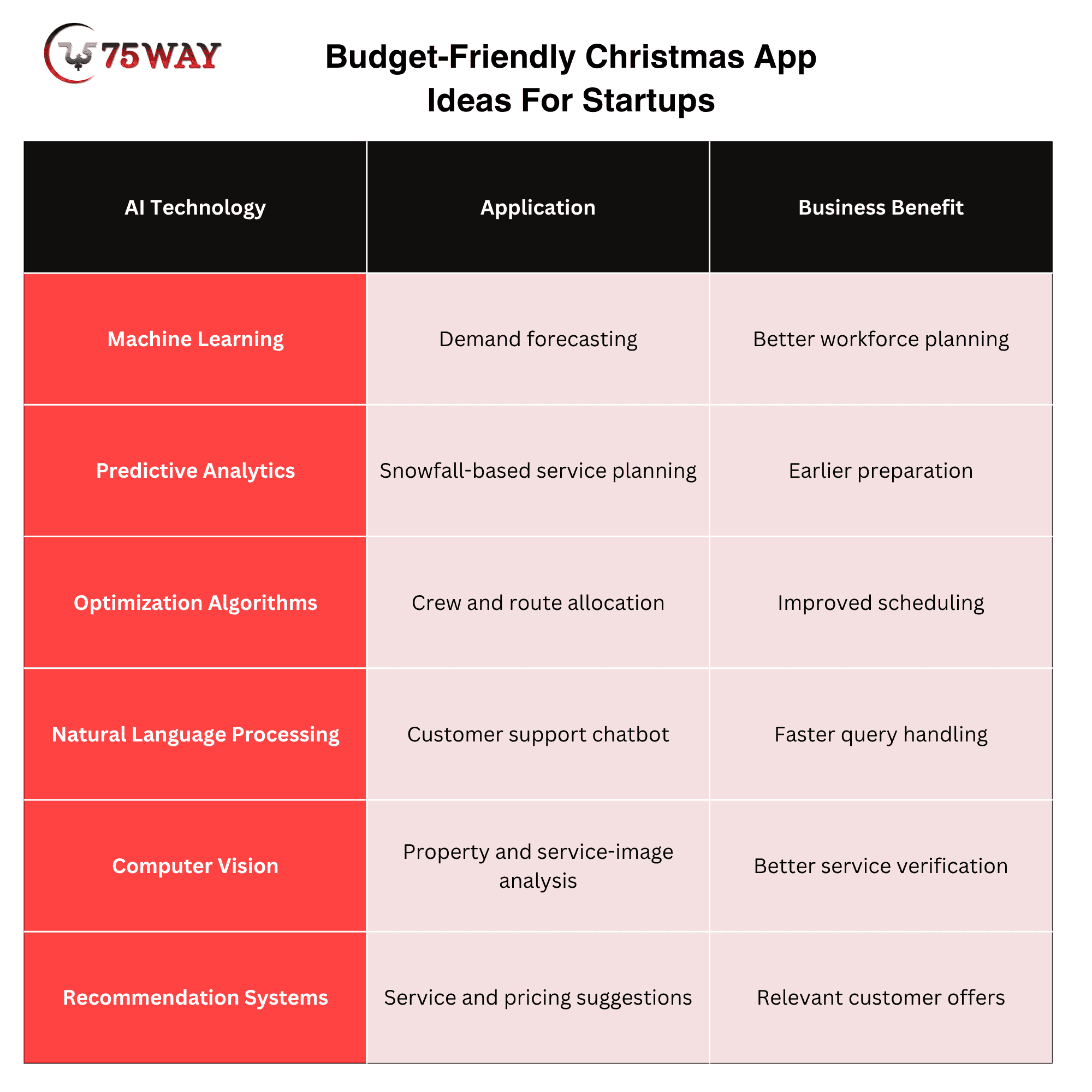
1. AI-Powered Demand Forecasting
Machine learning models can analyse historical bookings, previous snowfall patterns, local weather conditions, and seasonal demand.
The system can use these inputs to estimate the number of upcoming service requests.
For example, a contractor operating across several counties may use demand forecasts to prepare equipment and staffing for locations expected to receive heavier snowfall.
Model accuracy depends on data quality, historical coverage, and changing weather patterns. Forecasts should therefore be evaluated against actual outcomes.
2. Intelligent Resource Allocation
AI can help managers decide which workers and equipment should handle incoming jobs.
A recommendation model may consider worker availability, certifications, location, vehicle capacity, and the equipment required for each property.
This becomes especially useful when businesses operate multiple crews across different service zones.
3. Predictive Equipment Maintenance
Snow removal equipment includes plow trucks, spreaders, loaders, and other specialised machinery.
Where telematics or maintenance records are available, predictive models can analyse engine hours, usage patterns, maintenance history, and equipment alerts.
The system can flag vehicles that may require inspection before the next major storm.
This is a recommendation capability, not a guarantee that equipment failure can be predicted.
4. AI Customer Support
A conversational AI assistant can answer common questions about bookings, pricing, service availability, and payment status.
With suitable backend integrations, an AI customer support agent can also retrieve customer-specific information and help initiate service requests.
Sensitive actions, such as cancelling a commercial contract or issuing a refund, should require appropriate authorisation.
Snow Removal App Development Cost: Pricing And Key Factors
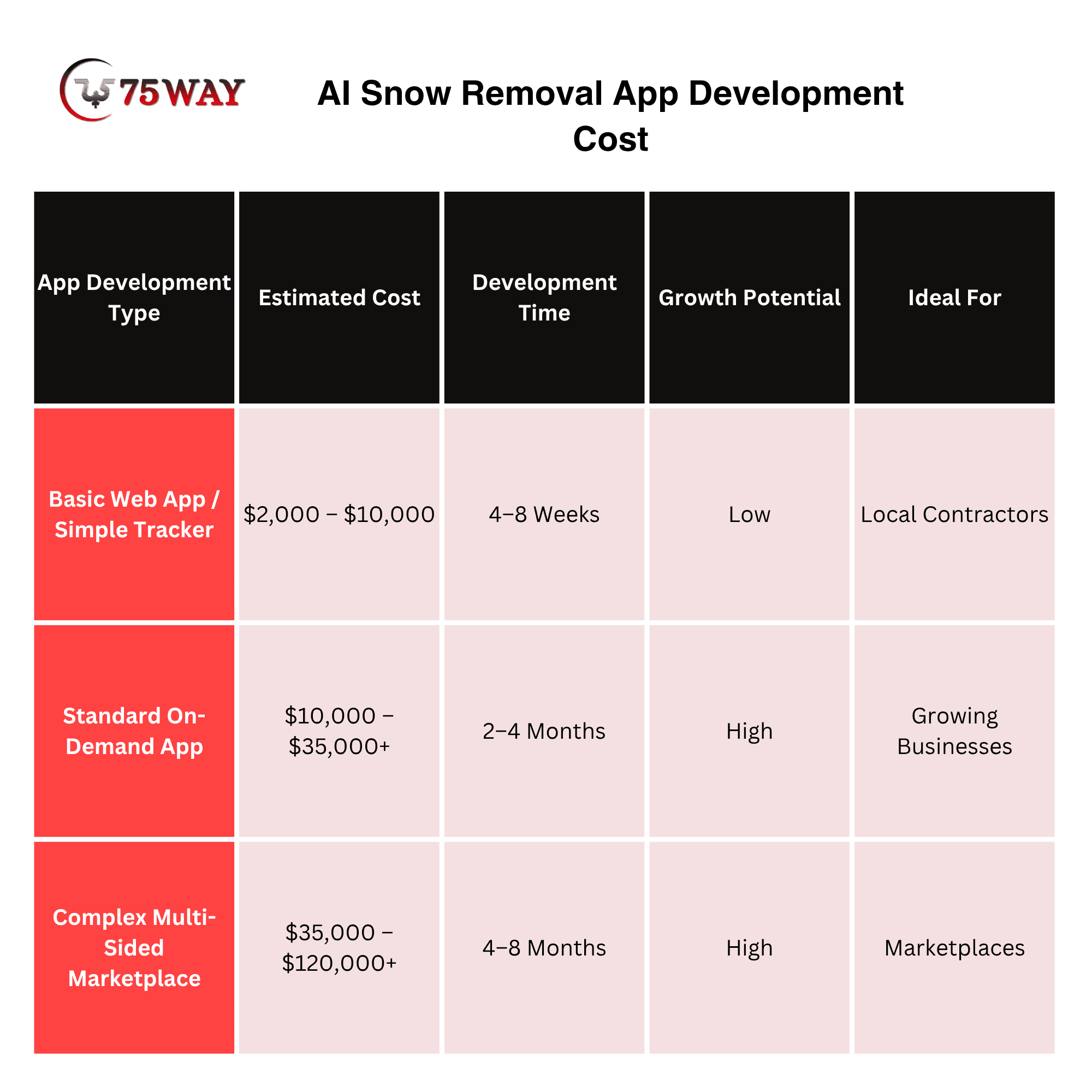
The cost of developing an AI snow removal app can range from $2,000 – $120,000+, depending on application complexity, platform requirements, AI integrations, development location, and the number of features.
1. Basic Web App/Simple Tracker Cost: $2,000 – $10,000
- Job creation and task management.
- Site photos and service logs.
- Basic user access and authentication.
- Data export and activity tracking.
Timeline: 4–8 Weeks
2. Standard On-Demand App Cost: $10,000 – $35,000+
- Customer registration and service booking.
- Provider profiles and job management.
- Real-time tracking and payment integration.
- Admin dashboard and booking management.
Timeline: 2–4 Months
3. Complex Multi-Sided Marketplace Cost: $35,000 – $120,000+
- Multi-vendor registration and verification.
- Advanced booking and dispatch management.
- AI-powered routing and demand forecasting.
- Commission management and advanced analytics.
Timeline: 4–8 Months
Factors Influencing Cost of Snow Plowing App Development
The final budget and cost of snow plowing app development depend on the snow removal workflows, equipment requirements, AI capabilities, and operational scale of the platform.
- Snow Removal Panel Requirements: Developing customer booking, contractor job management, and admin dispatch panels requires different workflows, interfaces, and backend functionality.
- AI-Powered Snow Forecasting: Integrating snowfall predictions, weather-based demand forecasting, and automated crew recommendations requires suitable datasets and model development.
- GPS And Mapping Integrations: Connecting live truck tracking, snow plow navigation, route optimization, and road condition data involves API integration and usage costs.
- Snow Removal Scheduling Logic: Building recurring driveway clearing, emergency plowing requests, priority-based bookings, and storm-triggered scheduling adds backend complexity.
- Fleet And Equipment Tracking: Monitoring snow plow trucks, salt spreaders, loaders, fuel usage, and equipment maintenance requires additional tracking capabilities and integrations.
- Winter Operations Infrastructure: Supporting sudden booking spikes during snowstorms, real-time crew updates, offline field operations, and large service areas requires reliable cloud infrastructure.
How Can Businesses Control AI Snow Removal App Development Costs?
An MVP is a practical starting point for startups and contractors that want to validate their business model before making a larger investment.
Begin with customer bookings, worker assignments, basic GPS tracking, payments, and an administrative dashboard. Introduce AI-powered forecasting and advanced dispatching after collecting sufficient operational data.
This approach helps businesses validate demand, test workflows, and make development decisions based on actual usage.
How Snow Removal Application Development Solution Generates Revenue?
A snow removal app doesn't have to depend on a single payment for every driveway or parking lot cleared. You can build recurring income through monthly plans, seasonal contracts, premium listings, and service provider commissions. The following monetization models explain how your app can earn from different users and services.
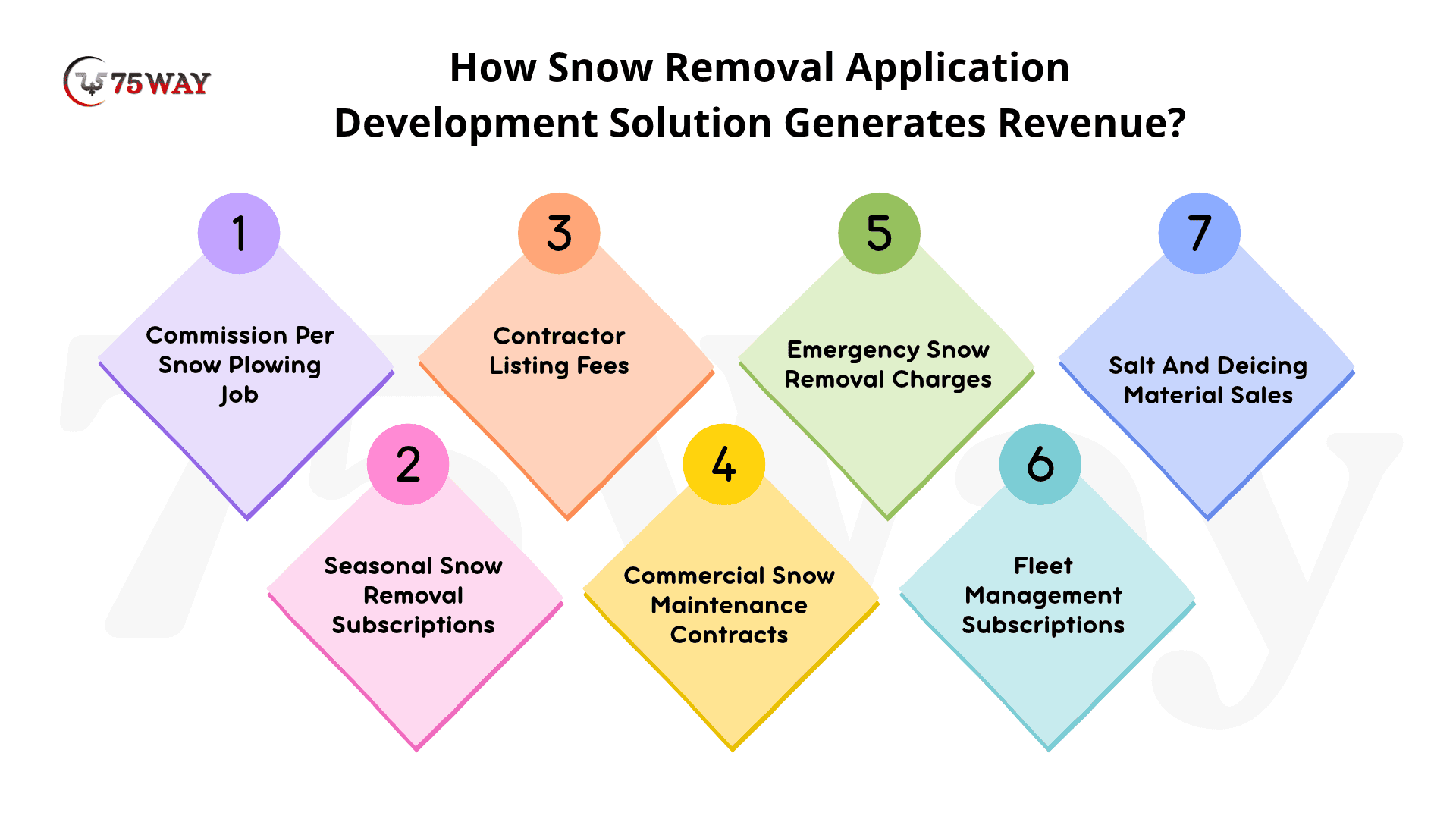
- Commission Per Snow Plowing Job
The platform can charge contractors a percentage of every completed snow removal booking. Revenue increases as more homeowners and commercial property managers book driveway clearing, parking lot plowing, and deicing services.
- Seasonal Snow Removal Subscriptions
Offer homeowners seasonal packages covering driveway clearing, sidewalk snow removal, and repeated snowfall services. Customers pay upfront or through monthly installments, creating recurring revenue for participating contractors and the platform.
- Contractor Listing Fees
Charge snow removal contractors for listing their businesses, service areas, equipment capabilities, and pricing. Premium listings can offer better visibility when customers search for local snow plowing services.
- Commercial Snow Maintenance Contracts
Connect property managers with contractors offering recurring snow removal agreements for parking lots, office complexes, retail centers, and industrial properties. The platform can earn contract facilitation fees or management charges.
- Emergency Snow Removal Charges
Allow customers to request urgent snow plowing during heavy snowfall or unexpected winter storms. The platform can earn additional service fees for coordinating priority bookings and connecting customers with available contractors.
- Fleet Management Subscriptions
Offer snow removal companies paid access to fleet tracking, equipment monitoring, crew scheduling, and route optimization tools. Monthly or annual subscriptions provide recurring revenue beyond individual service bookings.
- Salt And Deicing Material Sales
Partner with suppliers to sell road salt, ice melt, calcium chloride, and other winter maintenance materials through the application. Earn commissions from completed orders or charge suppliers for premium product placements.
For example, a contractor management platform could offer basic scheduling at an entry-level subscription while charging more for fleet tracking, advanced reporting, and AI-powered planning.
The right model depends on customer willingness to pay, operational costs, and the value each feature provides.
Common Mistakes To Avoid When Developing Snow Removal App & Solution
Even a feature-rich snow removal application can struggle if its development strategy overlooks actual winter maintenance operations. Identifying these mistakes early helps businesses build reliable software that meets contractor and customer expectations.
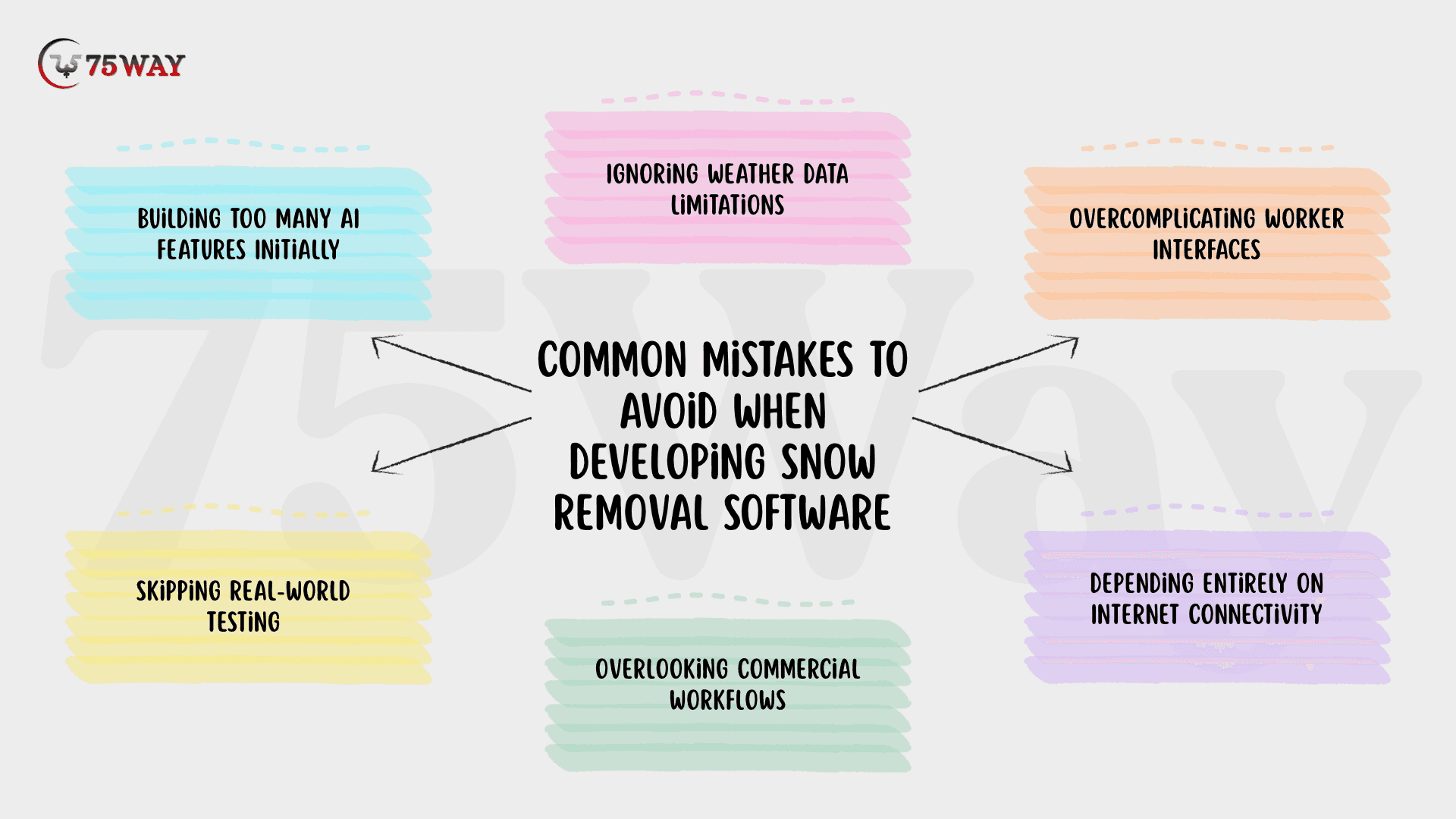
1. Building Too Many AI Features Initially: Introducing multiple machine learning models before validating snow removal workflows increases development complexity and costs.
Solution: Start with essential features such as automated dispatching and route recommendations. Introduce snowfall forecasting and predictive analytics as operational data becomes available.
2. Ignoring Weather Data Limitations: Weather forecasts can change, and actual snowfall or road conditions may differ from predictions, affecting scheduled services.
Solution: Integrate reliable weather APIs, monitor changing forecasts, and provide manual scheduling controls for unexpected weather conditions.
3. Overcomplicating Worker Interfaces: Complicated navigation and excessive screens make it difficult for snow plow operators to manage assigned jobs during harsh winter conditions.
Solution: Design simple worker interfaces with large buttons, clear job instructions, GPS navigation, and quick service status updates.
4. Depending Entirely On Internet Connectivity: Poor network coverage in remote service areas can interrupt job updates, GPS communication, and access to customer instructions.
Solution: Implement offline capabilities that allow workers to access assigned jobs, save service updates, and synchronize records when connectivity returns.
5. Overlooking Commercial Workflows: Commercial snow removal businesses require recurring contracts, property-specific instructions, priority scheduling, and documented service completion.
Solution: Include contract management, recurring booking options, property profiles, and digital proof-of-service features for commercial customers.
6. Skipping Real-World Testing: Applications tested only under normal conditions may experience performance issues during heavy snowfall and sudden increases in service requests.
Solution: Conduct storm-scenario simulations, load testing, GPS accuracy checks, and field testing to evaluate application performance under demanding winter conditions.
Security And Compliance Considerations To Build Snow Plow Applications
Security should be included in the development architecture rather than treated as a final deployment task.
A snow removal platform may store customer addresses, worker locations, payment information, business contracts, and operational records.
Developers should consider the following safeguards:
- Data Encryption: Protect sensitive information during transmission and storage.
- Role-Based Access: Restrict customer, worker, dispatcher, and administrator permissions.
- Secure Authentication: Implement appropriate authentication, session management, and account protection.
- Payment Security: Use established payment providers and avoid storing sensitive card information unnecessarily.
- Location Privacy: Limit GPS collection to legitimate operational purposes and define retention policies.
- Audit Logs: Record important administrative actions and changes to bookings.
- Backup And Recovery: Maintain secure backups and establish disaster recovery procedures.
Depending on the business model, applicable requirements may include state privacy laws, contractual obligations, and payment industry standards such as PCI DSS.
Why Choose 75way Technologies For AI Snow Removal App Development?
75way Technologies can position its development offering around the complete product lifecycle, from business requirement analysis and UI/UX planning to application engineering, AI integration, testing, and deployment.
Before starting a project, businesses should evaluate the development partner's ability to:
- Understand snow removal business workflows.
- Design customer, worker, and administrator interfaces.
- Integrate weather, mapping, payment, and notification services.
- Build practical AI-powered forecasting and dispatching capabilities.
- Develop secure and scalable backend infrastructure.
- Support testing, deployment, and future improvements.
A discovery discussion should establish the MVP scope, required integrations, expected user volume, and development budget before the final project estimate is prepared.
A startup, SnowRoute Pro, wanted to simplify US snow removal services through one platform. We built an on-demand solution connecting homeowners and contractors with smart bookings, GPS tracking, automated dispatching, and centralized management.
Final Thoughts
AI snow removal app development presents an opportunity for contractors, startups, and winter maintenance companies to improve how they manage bookings, crews, equipment, and customer communication.
However, successful software requires more than adding AI features. The right business model, practical workflows, reliable weather data, suitable technology architecture, and real-world testing all contribute to a product that customers and contractors can use.
Planning to build an AI-powered snow removal platform? Connect with a trusted on-demand app development company discuss your app idea, technical requirements, and development roadmap.
Frequently Asked Questions (FAQs)
What Is An AI Snow Removal App?
An AI snow removal app is a software platform that helps contractors manage service bookings, dispatching, crew scheduling, route planning, and customer communication using automation and AI-powered capabilities.
How Long Does It Take To Develop An AI Snow Removal App?
A basic application may take 4–8 weeks, while an advanced platform with custom AI models, GPS tracking, and multiple user interfaces can take 3–10 months or longer.
Can AI Predict Snow Removal Demand?
Yes. Machine learning models can analyse historical bookings, weather forecasts, seasonal patterns, and previous service demand to estimate upcoming workload. Their accuracy depends on the quality and availability of input data.
Can I Build An AI Snow Removal App As An MVP?
Yes. An MVP can include customer registration, service bookings, worker assignments, payments, GPS tracking, and an admin dashboard. Advanced AI capabilities can be introduced as the business collects operational data.
How Does Route Optimization Help Snow Removal Businesses?
Route optimization helps contractors plan job sequences using location, travel distance, worker availability, service priorities, and road conditions. It can reduce unnecessary travel and improve daily scheduling.