Summary
Want to create an ecommerce app? This guide highlights ecommerce app development process covering types of apps, essential features, advanced AI-driven tools, monetization strategies, the latest 2026 trends, and common challenges with solutions. It emphasizes strategic planning, intuitive UI/UX, and robust technology stacks.
Key Takeaways
- Ecommerce app development drives growth and long-term business success.
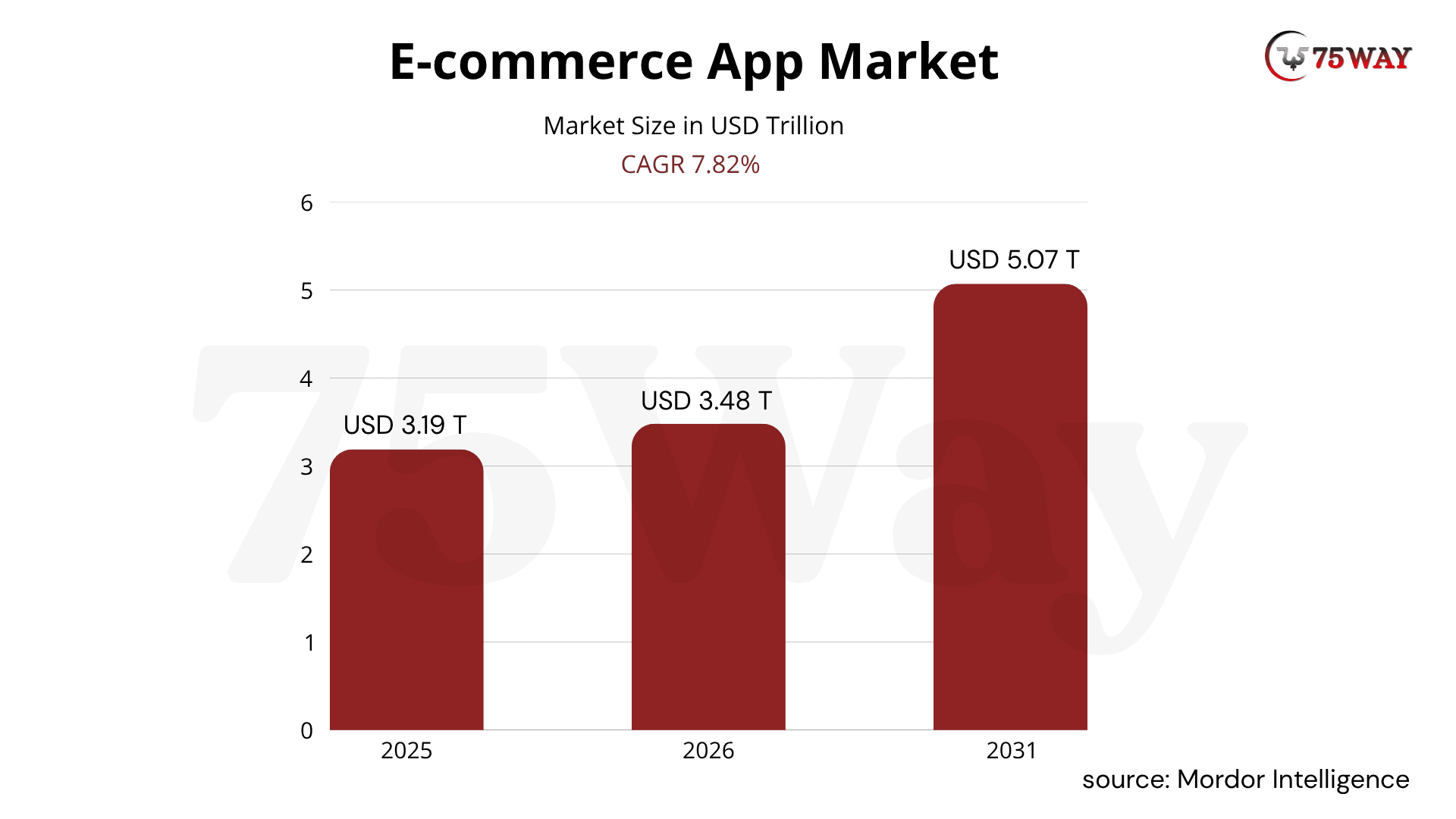
- Ecommerce app market will reach nearly $5.07 trillion by 2031.
- Average ecommerce app development costs range from $20,000 to $300,000.
- Advanced AI and AR integration boosts engagement and customer satisfaction.
- Strategic planning ensures feature-rich ecommerce app success.
eCommerce is no longer an emerging opportunity. It is becoming the foundation of how modern businesses grow and compete.
See, it is 2026. And now, customers don’t “visit” stores anymore. They scroll, compare, and purchase in seconds, often without switching apps. This shift has made eCommerce app development a strategic priority for businesses that want to stay competitive in global markets like the USA, India, and beyond.
The eCommerce app market is projected to grow from $3.19 trillion in 2025 to nearly $5.07 trillion by 2031, reflecting consistent demand for mobile-first shopping experiences. Moreover, nearly 60% of new app users return to make a second purchase when their first experience is smooth and reliable. This highlights the importance of building an ecommerce application.
With advancements in secure payment systems, cloud infrastructure, and scalable technologies, the process of building a multi-vendor marketplace for your ecommerce business has become more accessible than ever. At the same time, competition has increased significantly, making it essential to focus on performance, user experience, and feature strategy from the very beginning.
If you are planning to invest in custom eCommerce app development, understanding the complete process is critical. This comprehensive guide will delineate everything you need to know about how to build an eCommerce app, including development steps, key features, costs, and expert insights. By the end, you will have a clear roadmap to develop an ecommerce software application that not only launches successfully but also drives consistent growth and customer retention.
Why Invest in Ecommerce App Development? Market Insights & Revenue Growth Opportunities
Business decisions today are driven by data, not assumptions. Leaders such as startups, CMOs, CTOs, and founders rely on clear market signals before investing in any digital initiative, especially when it involves long-term commitments like eCommerce app development.
Understanding the direction of the mobile commerce market is essential before starting development. For businesses considering eCommerce application development, current market insights provide strong validation.
The following statistics highlight key trends, growth patterns, and user expectations. They offer a clear perspective on why investing in a well-planned eCommerce app becomes a strategic necessity for businesses aiming to compete and grow in the digital marketplace.
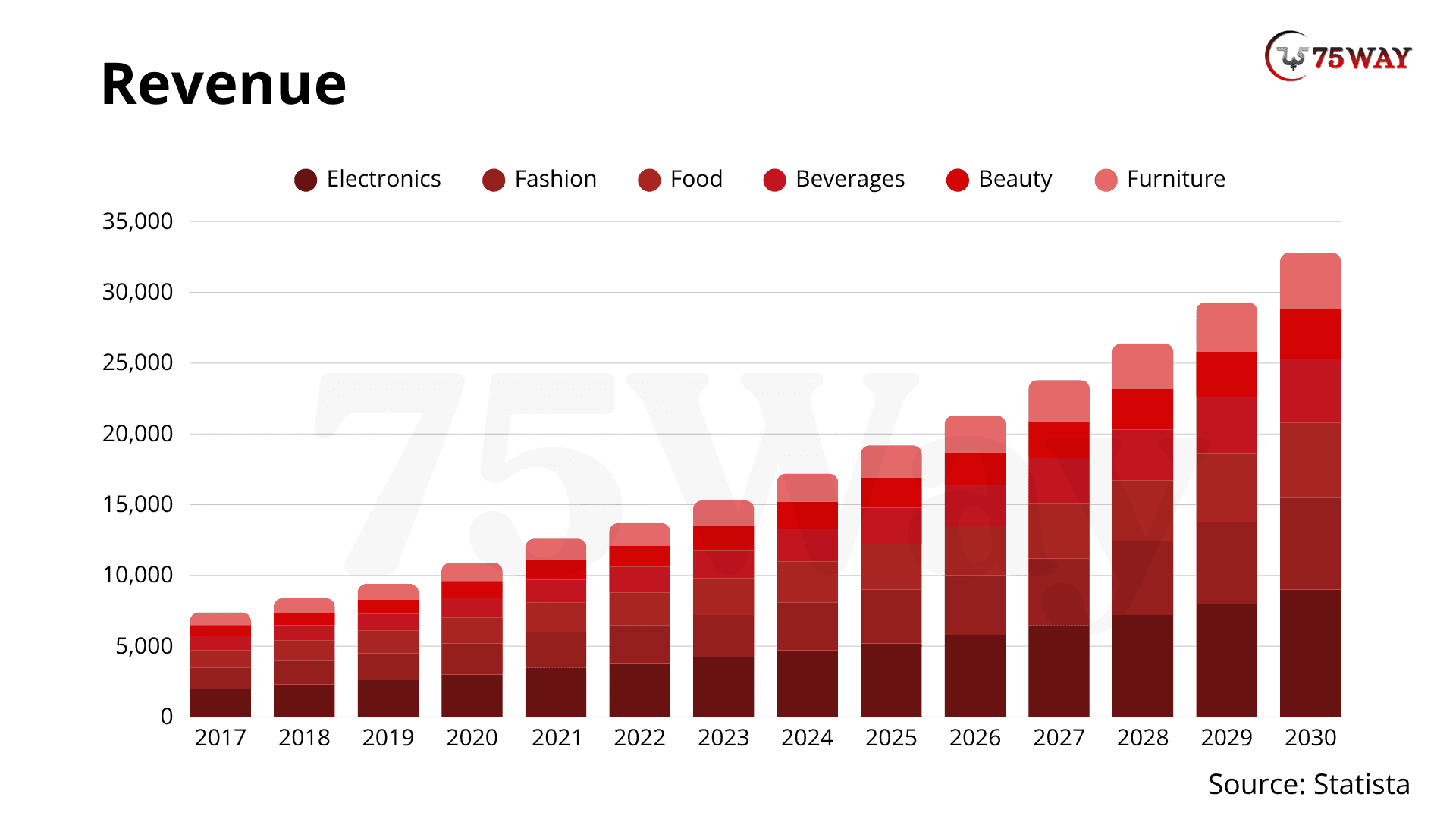
- The global eCommerce industry is forecasted to generate around $3.88 trillion in revenue by 2026, showcasing its massive economic scale, as stated by Statista.
- Between 2026 and 2030, the market is expected to expand at a compound annual growth rate of 6.84%, reaching an estimated US$5.05 trillion in total value by 2030.
- The United States is projected to dominate the sector, contributing the highest share with approximately US$1.22 trillion in revenue in 2026.
- By 2030, the total number of eCommerce users worldwide is anticipated to grow to about 4.1 billion people.
- User adoption is set to rise steadily, with penetration increasing from 54.3% in 2026 to around 58.1% by 2030.
- The average revenue per user (ARPU) in the eCommerce sector is expected to reach approximately US$1,100, reflecting higher consumer spending trends.
- Retail applications, especially in fashion and home décor, are increasingly using AR-based virtual try-ons, helping improve conversion rates by ~18–22%.
Now you might have a question, “What do we do with these statistics related to ecommerce app growth?” “Why ecommerce app solutions matter in 2026?”
The rapid growth of eCommerce is driven by a blend of advanced technology, evolving consumer expectations, and strong digital infrastructure. High-speed smartphones, intuitive interfaces, and secure mobile payment systems have made online shopping faster and more convenient than ever. Features such as AI-powered product recommendations, one-click checkout, and real-time inventory updates further enhance the user experience, encouraging customers to engage more frequently and complete purchases with minimal effort across multiple devices and platforms globally.
This growth signals a major opportunity for businesses aiming to expand their digital footprint. As mobile-first behavior continues to dominate, eCommerce applications have become essential tools for attracting, engaging, and retaining customers effectively. Investing in eCommerce mobile app development enables brands to strengthen customer relationships, explore new markets, and stay competitive in a rapidly evolving landscape. Before moving forward, it is important to understand the different types of eCommerce apps suited to various business models and growth objectives.
Types of eCommerce Apps to Develop for Your Business
A dynamic digital marketplace allows businesses to meet a wide range of customer needs through different types of eCommerce applications. Each category of app is designed to address specific shopping behaviors and preferences, allowing companies to create more targeted, personalized experiences. By selecting the right type of eCommerce application, businesses can optimize engagement, drive higher conversions, and maximize revenue while delivering a seamless and satisfying experience for their users.
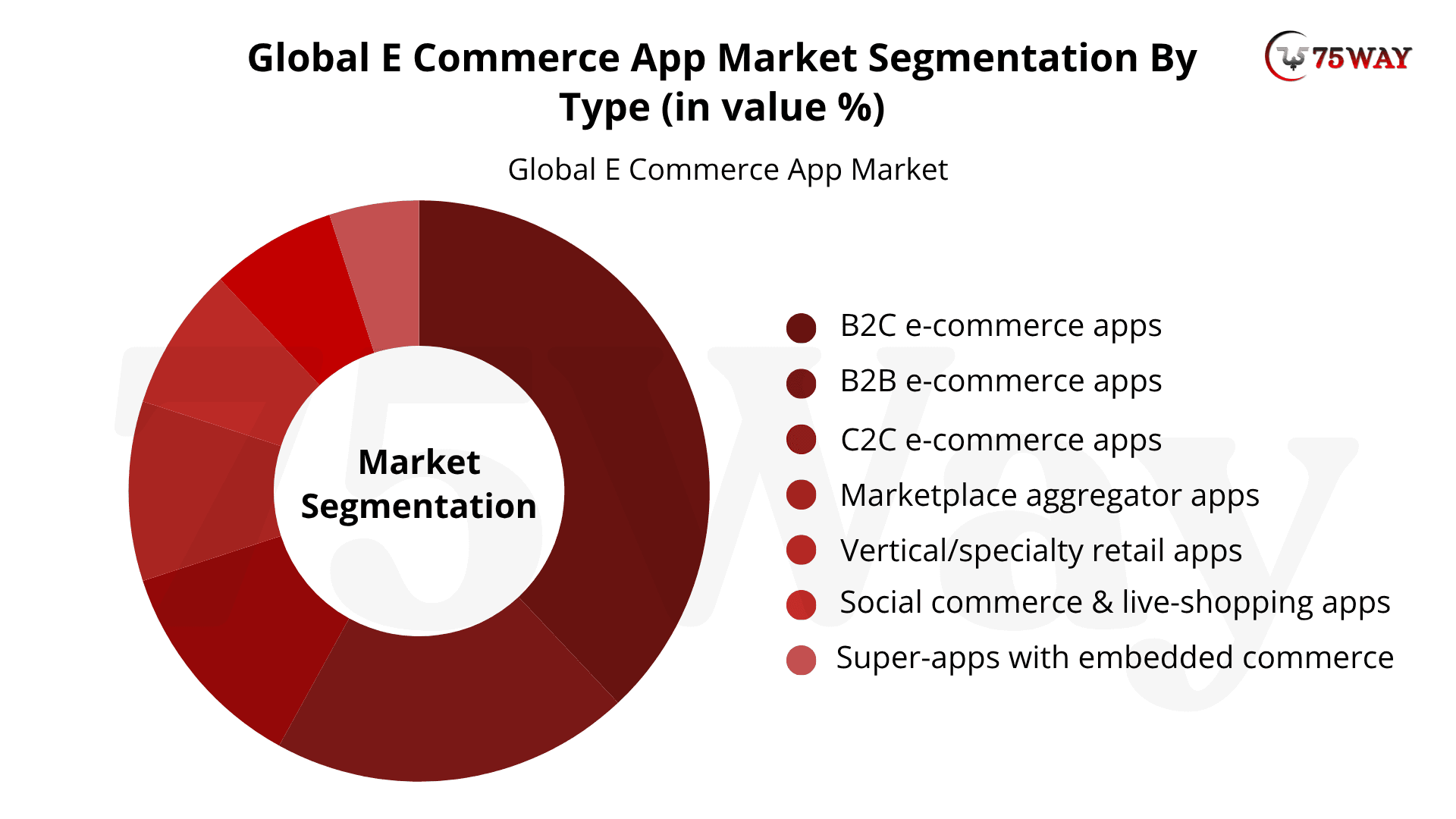
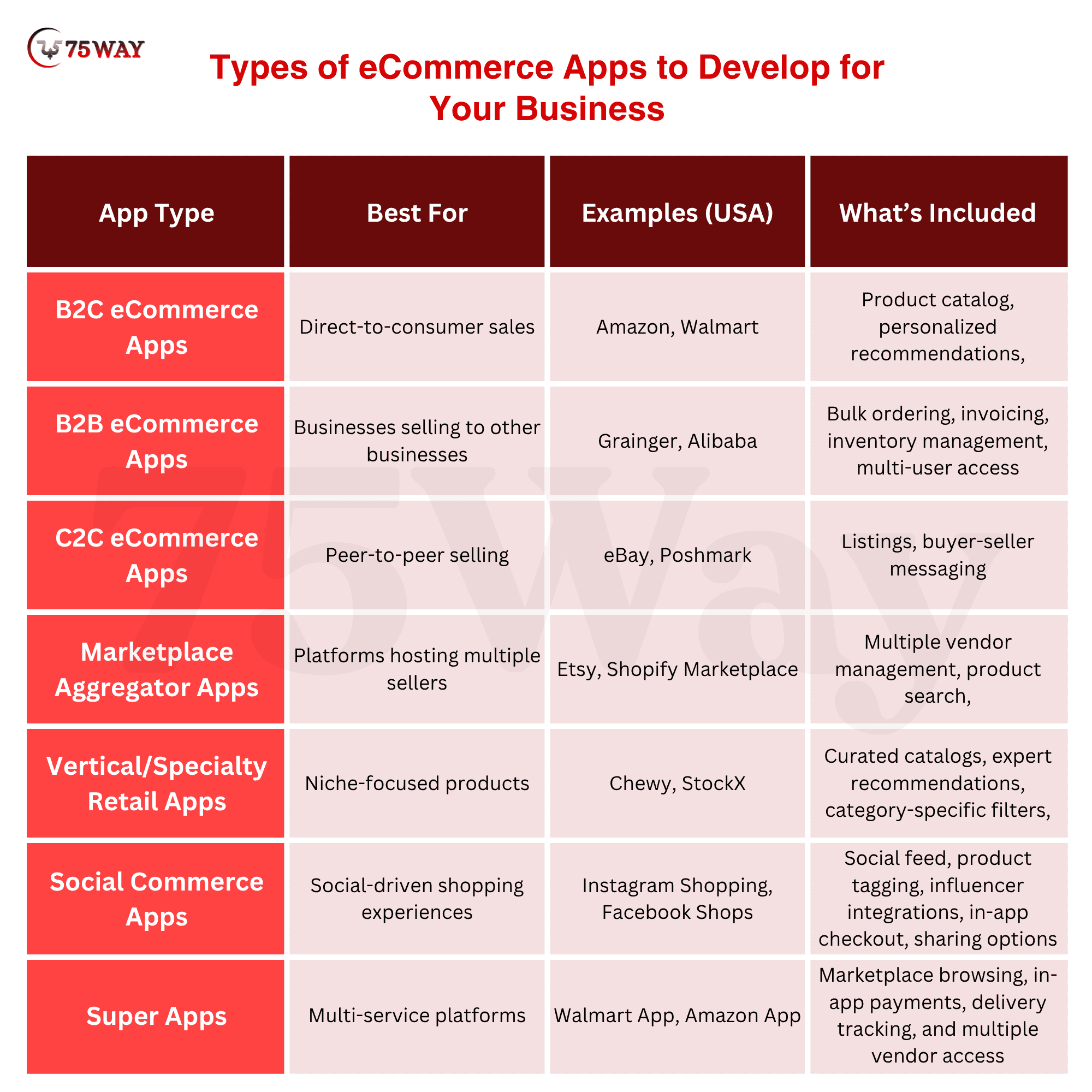
B2C eCommerce Apps: Connect businesses directly with individual consumers, offering products or services online. They focus on convenience, personalization, and user-friendly shopping experiences to drive sales and repeat purchases. For instance: Amazon, Walmart
B2B eCommerce Apps: Facilitate transactions between businesses, streamlining bulk orders, inventory management, and supplier interactions. These apps prioritize efficiency, secure payments, and features tailored to organizational purchasing processes. For example: Grainger, Alibaba
C2C eCommerce Apps: Enable consumers to sell products or services directly to other consumers. They focus on peer-to-peer transactions, trust-building features, and simple listing and payment processes. For instance: eBay, Poshmark
Marketplace Aggregator Apps: Aggregate multiple sellers under a single platform, offering diverse products and services. They simplify discovery, comparison, and purchasing for users while expanding reach for vendors. For example: Etsy, Shopify Marketplace
Vertical/Specialty Retail Apps: Target a specific niche or product category, providing curated experiences. They focus on specialized offerings, expert recommendations, and highly relevant content for their audience. To illustrate: Chewy, StockX
Social Commerce Apps: Integrate social media with shopping, enabling users to discover, share, and purchase products seamlessly. These apps emphasize engagement, community interaction, and influencer-driven marketing. For example: Instagram Shopping, Facebook Shops
Super Apps: Offer multiple services within a single platform, from shopping and payments to food delivery and messaging. They aim for convenience, engagement, and long-term user retention across activities. For instance: Walmart App, Amazon App
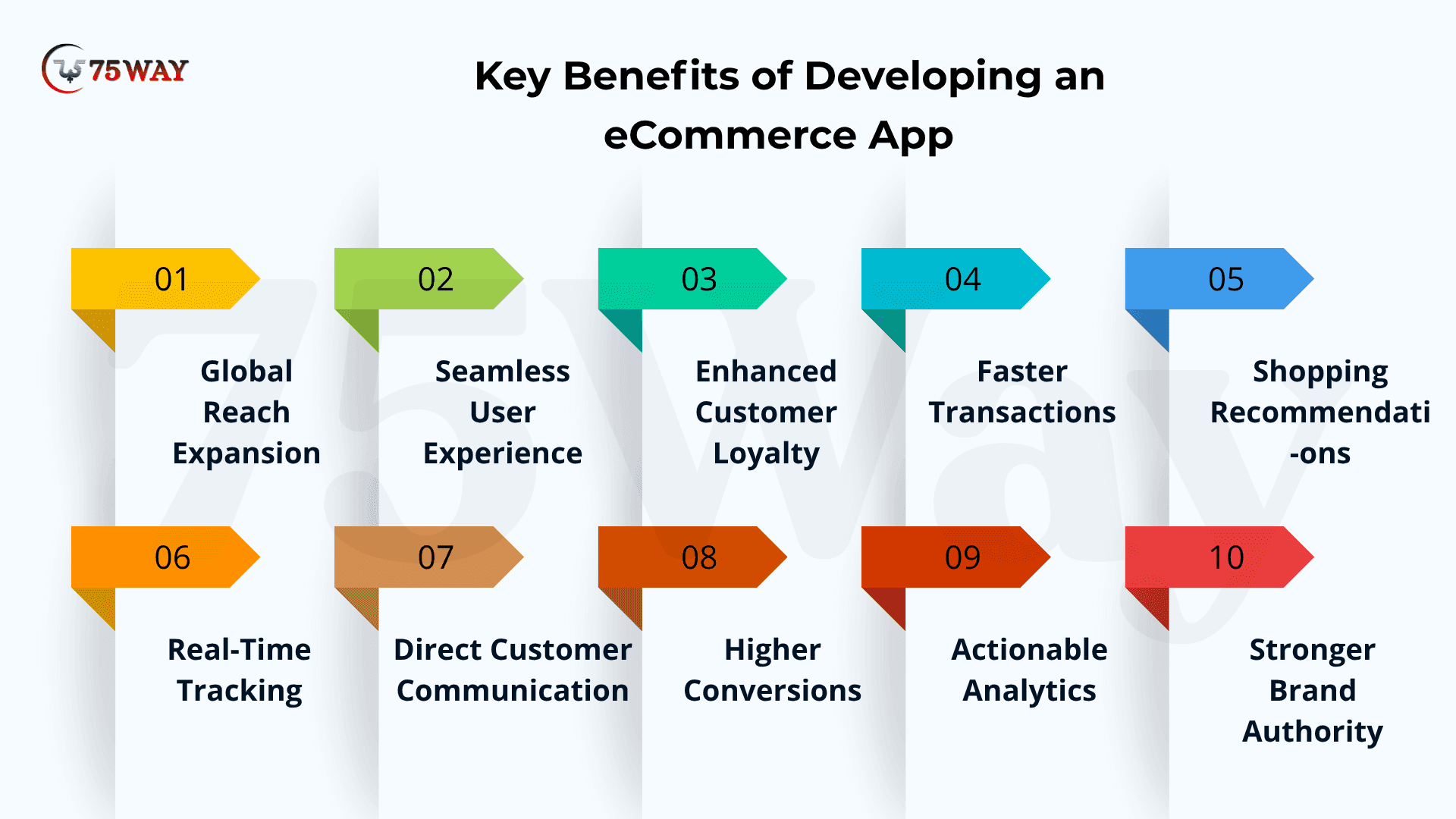
Key Benefits of Developing an eCommerce App for Your Business
Developing a custom eCommerce application provides numerous advantages that can streamline business operations, elevate customer experiences, and increase overall revenue. Beyond immediate sales growth, it also helps build long-term brand loyalty and sustained market presence. Here are some key advantages that businesses can gain by investing in an ecommerce app.
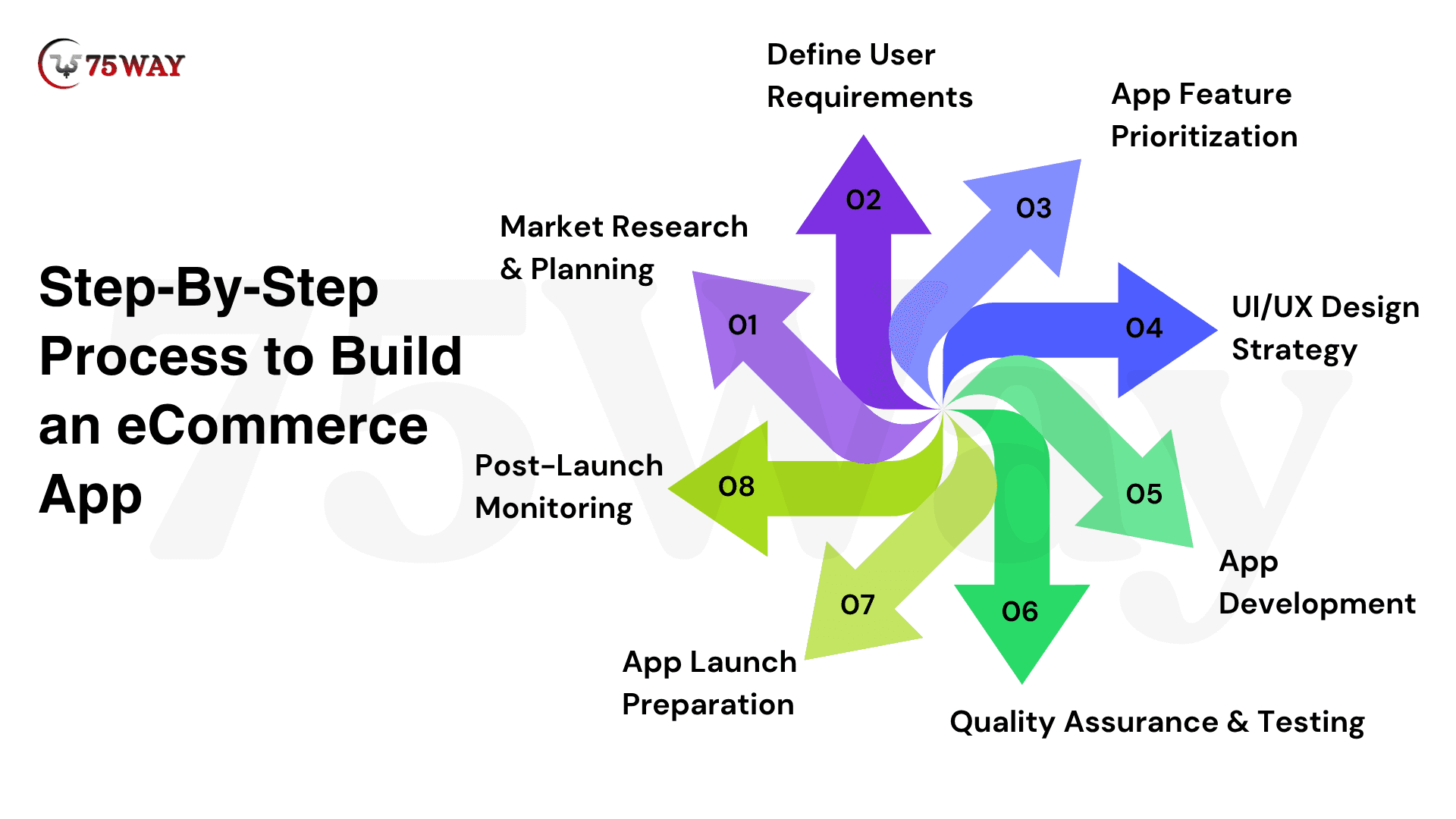
Step-By-Step Process to Build an eCommerce App from Scratch
Building an eCommerce app requires a strategic approach that blends technical skills with business understanding. The process involves multiple essential steps, each aimed at ensuring smooth functionality, high performance, and an engaging user experience that drives conversions and customer satisfaction.
Market Research & Planning
Before developing an eCommerce app, it is crucial to understand the market dynamics, target audience, and competitor landscape. Thorough research enables businesses to identify essential features, define unique value propositions, and create a strategic roadmap for successful app development.
- Identify target customers and their specific shopping behaviors.
- Analyze competitors’ apps and evaluate their strengths weaknesses.
- Research market trends and emerging eCommerce technology innovations.
- Define app goals, objectives, and expected performance metrics.
- Outline unique value propositions to differentiate from competitors.
Define User Requirements
The foundation of a successful eCommerce app lies in understanding the needs and expectations of its users. Identifying the target audience’s preferences, pain points, and shopping habits ensures the app delivers meaningful value while meeting customer demands.
Once the audience is clear, businesses can determine the essential features required in the app. These typically include user registration, product catalog, search and filter options, shopping cart, payment gateway integration, and customer support, all tailored to enhance usability and engagement.
Prioritizing these features according to business goals and user expectations guides the development process efficiently. Clear requirements reduce ambiguity for designers and developers, ensuring the app is functional, intuitive, and aligned with the brand’s overall objectives.
App Feature Prioritization
After defining user requirements, the next step is to prioritize app features based on business goals, user needs, and technical feasibility. Focusing on high-impact functionalities first ensures efficient development, improves user experience, and allows for iterative enhancements as the app evolves over time. Key actions:
- Rank features according to user impact and business value.
- Evaluate technical feasibility before committing to complex functionalities.
- Plan phased implementation to optimize development and resource allocation.
UI/UX Design Strategy
Designing an intuitive and engaging user interface is critical for eCommerce app success. A well-planned UI/UX design ensures smooth navigation, visually appealing layouts, and seamless interactions. Focusing on user-centered design enhances engagement, increases retention, and guides users effortlessly toward completing purchases.
- Visual Consistency: Maintain uniform colors, fonts, and styles to enhance brand recognition.
- Easy Navigation: Create intuitive menus and logical workflows for smooth app interaction.
- Interactive Elements: Incorporate buttons, gestures, and animations that improve user engagement.
- Responsive Design: Ensure layouts adapt seamlessly across devices and screen sizes.
App Development
The app development phase transforms your eCommerce app from concept to a working platform. It involves coding the frontend, backend, and database integration, ensuring smooth functionality, scalability, and secure operations. Selecting the right programming languages, frameworks, and tools ensures a reliable, responsive, and high-performing shopping experience.
- Frontend Implementation: Build responsive user interfaces using HTML, CSS, JavaScript, React Native, or Flutter for seamless mobile experiences.
- Backend Development: Use Node.js, Python, or Java to manage server-side operations, databases, and API integrations efficiently.
- Database Management: Integrate SQL or NoSQL databases like MySQL, PostgreSQL, or MongoDB to store user, product, and transaction data securely.
- API Integration: Connect third-party APIs for payment gateways, shipping, analytics, and marketing tools to enhance app functionality.
- Code Optimization: Ensure clean, modular, and maintainable code that improves app speed, security, and scalability for future growth.
- Cross-Platform Support: Develop apps for both Android and iOS using Flutter or React Native, ensuring consistent experiences across devices.
Quality Assurance & Testing
After completing the development phase, it is essential to rigorously test the eCommerce app. Quality assurance ensures all features function correctly, performance is optimized, and security is robust. Continuous testing identifies issues early, guarantees smooth operation, and provides users with a reliable, seamless, and satisfying shopping experience.
- Conduct functional testing to verify that all features work correctly.
- Perform usability testing to ensure intuitive navigation for all users.
- Run performance tests to evaluate app speed under heavy loads.
- Execute security testing to protect sensitive user and transaction data.
- Test cross-platform compatibility across Android and iOS devices thoroughly.
- Conduct regression testing to ensure updates do not break functionality.
App Launch Preparation
Once the app passes rigorous testing, the focus shifts to a successful launch. Preparing involves submitting the app to stores, creating marketing campaigns, and ensuring support systems are in place. Proper launch preparation maximizes visibility, drives downloads, and sets the foundation for a strong user base.
- Submit the app to the Google Play and Apple App Store platforms.
- Create engaging marketing campaigns to announce the app launch.
- Prepare press releases highlighting unique app features and benefits.
- Ensure customer support is ready to handle inquiries efficiently.
- Monitor early adoption and initial user feedback for quick adjustments.
Post-Launch Monitoring & Updates
After launching the ecommerce app, continuous monitoring is crucial to track performance, user behavior, and engagement. By analyzing metrics such as active users, session duration, and conversion rates, businesses can understand how the app is performing in real-world conditions and identify areas for improvement.
User feedback plays a vital role in post-launch activities. Collecting reviews, ratings, and direct suggestions allows businesses to address pain points, fix bugs, and enhance features. Proactively responding to feedback strengthens customer trust and ensures that the app remains aligned with user expectations.
Regular updates and feature enhancements are essential to keep the app competitive. By releasing improvements, adding new functionalities, and maintaining security standards, businesses can retain users, attract new customers, and future-proof their eCommerce platform for long-term growth.
Must-Have Features for Ecommerce Mobile App
A well-designed, feature-rich mobile app is vital for attracting new customers and keeping existing ones engaged. Incorporating essential functionalities ensures a smooth, convenient, and enjoyable shopping experience that encourages repeat purchases and strengthens brand loyalty. Significant features of ecommerce application are defined below.
Top User Features for a Successful Ecommerce App
For customers, a powerful eCommerce app should be simple, engaging, and easy to navigate, providing a smooth and enjoyable shopping journey. The following are the essential features that enhance user experience and make browsing, selecting, and purchasing products effortless.
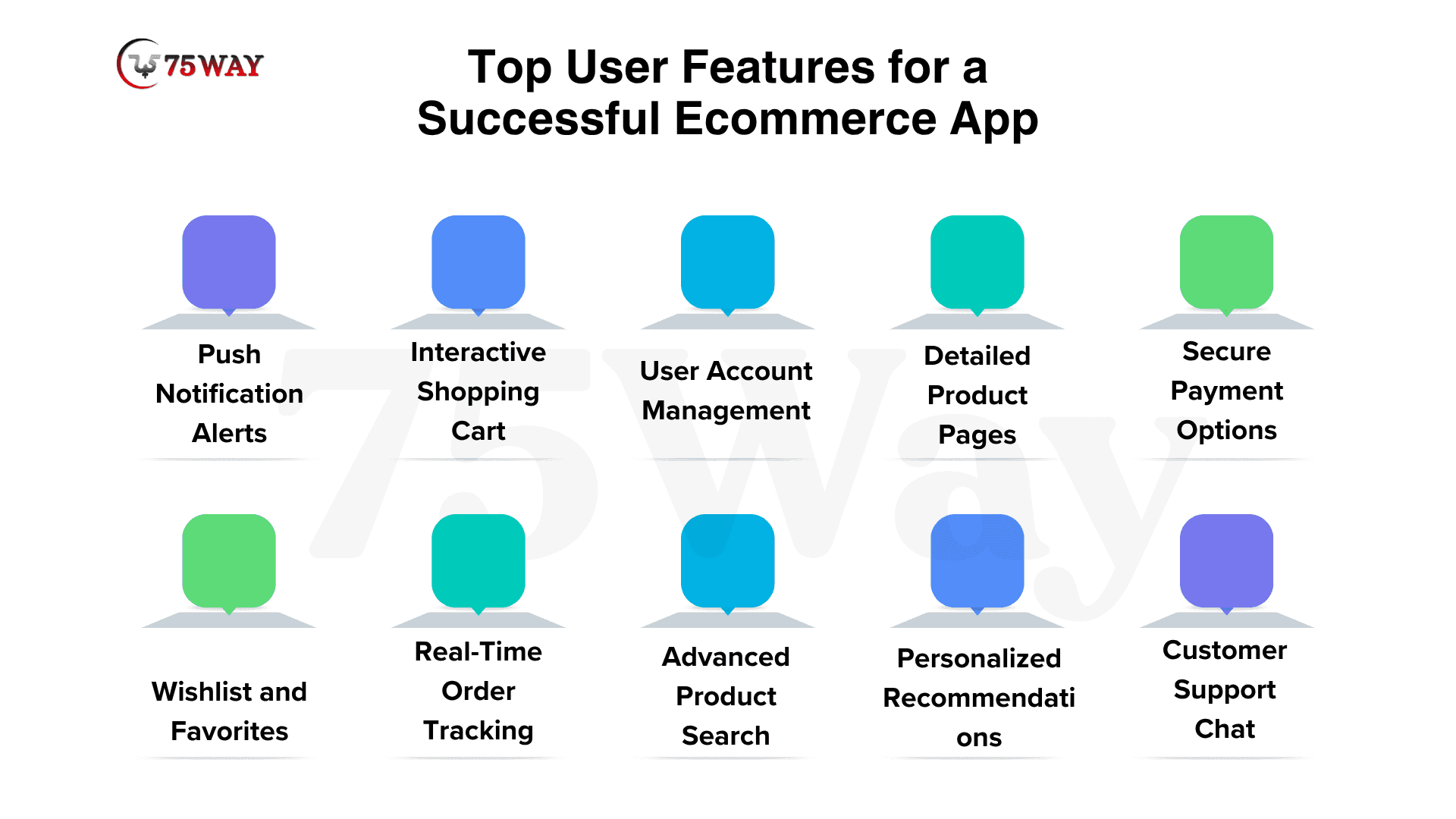
- Push Notification Alerts: Notify users about promotions, discounts, new arrivals, or abandoned cart reminders to encourage timely purchases.
- Interactive Shopping Cart: Let users add, remove, or adjust items while providing an easy path to checkout and confirmation.
- User Account Management: Allow customers to create and manage personal profiles, preferences, addresses, and order history for seamless shopping convenience.
- Detailed Product Pages: Provide high-resolution images, descriptions, pricing, and available options such as size, color, or variations for clarity.
- Secure Payment Options: Support multiple payment methods, including credit cards, digital wallets, and net banking for safe, fast transactions.
- Wishlist and Favorites: Enable users to save preferred products for future purchases, enhancing convenience and encouraging repeat engagement.
- Real-Time Order Tracking: Allow customers to monitor orders from confirmation to delivery, ensuring transparency and building trust.
- Advanced Product Search: Enable robust search with filters like category, price, and ratings to help users find desired products instantly.
- Personalized Recommendations: Display AI-driven suggestions based on browsing history, past purchases, and user preferences to boost engagement.
- Customer Support Chat: Provide an integrated chat or helpdesk to resolve queries, complaints, or provide guidance efficiently for better satisfaction.
Premium Features for Admin Panel of Ecommerce App
An advanced admin panel empowers businesses to efficiently manage products, inventory, orders, and users. It provides actionable insights, streamlines operations, and allows seamless control over marketing, payments, and analytics, ensuring smooth app management and informed decision-making for ecommerce success.
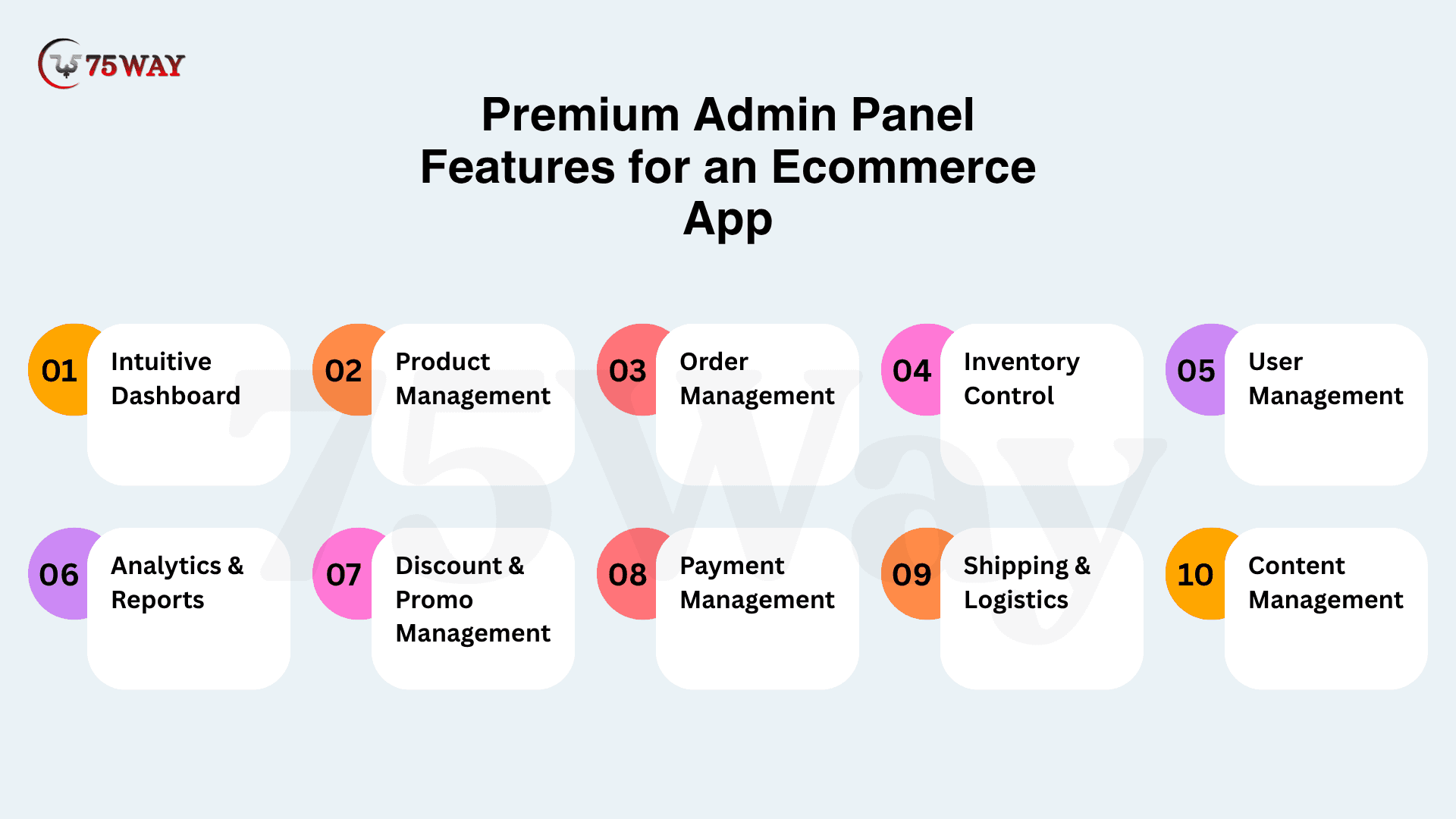
- Intuitive Dashboard: Provide a centralized interface to monitor sales, orders, inventory, and key performance metrics efficiently.
- Product Management: Allow admins to add, edit, or remove products with detailed descriptions, images, pricing, and categories.
- Order Management: Enable tracking, updating, and processing of customer orders from placement to delivery with accuracy.
- Inventory Control: Monitor stock levels in real-time, set alerts for low inventory, and prevent overstocking issues.
- User Management: Manage customer profiles, access levels, and permissions while maintaining secure and organized user data.
- Analytics & Reports: Generate comprehensive reports on sales, user behavior, and revenue trends for data-driven decisions.
- Discount & Promo Management: Create, schedule, and manage offers, coupons, and promotions to boost sales and customer engagement.
- Payment Management: Track and manage payment transactions, refunds, and payment gateways securely and efficiently.
- Shipping & Logistics: Configure shipping methods, rates, and track deliveries to ensure timely and cost-effective order fulfillment.
- Content Management: Update banners, product descriptions, blogs, and promotional content to keep the app engaging and relevant.
Advanced Features for Successful Ecommerce App Development
In a highly competitive ecommerce market, standing out requires incorporating innovative, technology-driven features. Leveraging AI in ecommerce along with machine learning, NLP, agentic AI, and other emerging tools can boost user engagement, streamline operations, and provide personalized experiences. The following advanced functionalities can give your ecommerce app a clear competitive advantage.
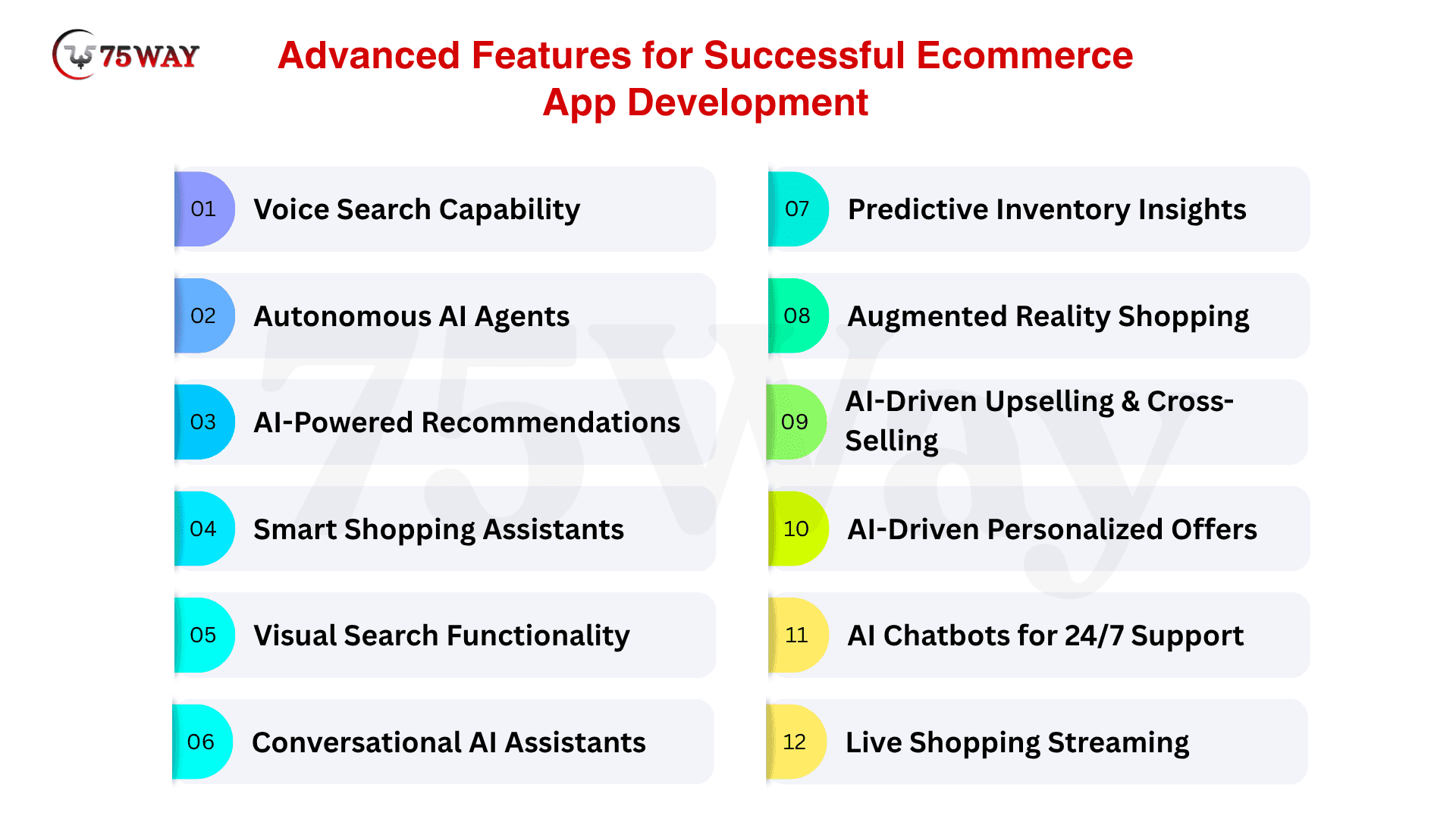
Voice Search Capability: Integrate an AI voice agent for recognition to let users search products using spoken commands, improving accessibility and convenience.
Autonomous AI Agents: Implement AI agents that handle complex queries, returns, and recommendations without human intervention, enhancing support efficiency.
AI-Powered Recommendations: Utilize machine learning to analyze user behavior and preferences, suggesting highly personalized products to boost engagement and sales.
Smart Shopping Assistants: Offer AI-powered shopping assistants that track user preferences, curate personalized collections, and recommend complementary products.
Visual Search Functionality: Enable users to upload images to find similar products, improving discovery and simplifying product searches.
Conversational AI Assistants: Deploy AI assistants that engage users in natural dialogue, helping with queries, product suggestions, and checkout guidance.
Predictive Inventory Insights: Leverage AI to forecast demand trends, optimize stock levels, and reduce out-of-stock or overstock situations.
Augmented Reality Shopping: Allow customers to visualize products in real-world settings, such as furniture placement or garment fitting, before purchase.
AI-Driven Upselling & Cross-Selling: Automatically suggest relevant upgrades or complementary products during browsing and checkout to increase average order value.
AI-Driven Personalized Offers: Analyze user behavior and purchase history to generate tailored discounts, promotions, and product bundles for higher engagement.
AI Chatbots for 24/7 Support: Deploy smart AI chatbots that provide instant support, answer queries, guide purchases, and enhance user engagement around the clock.
Live Shopping Streaming: Enable real-time video sessions where hosts showcase products, interact with viewers, and drive instant purchases through the app.
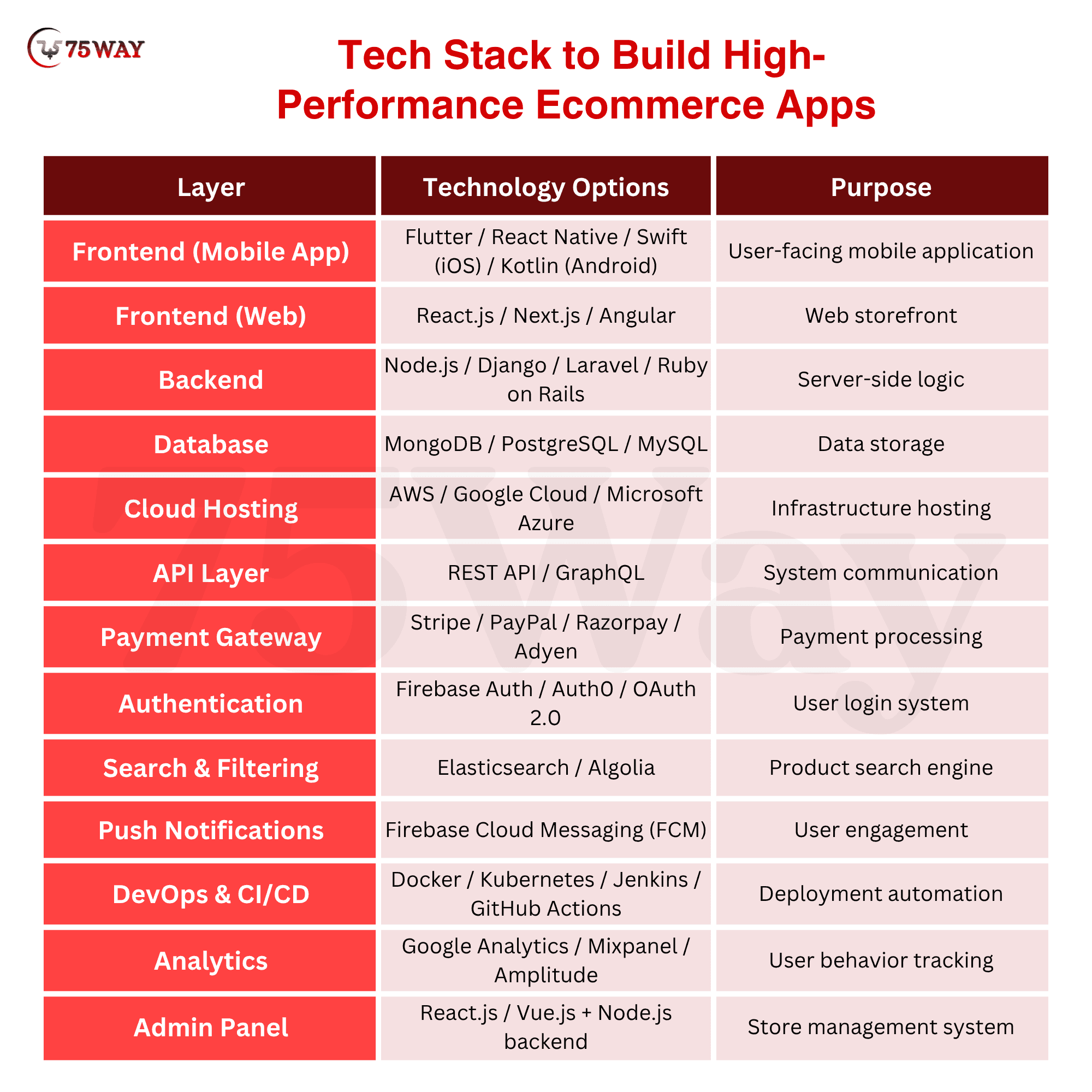
Tech Stack to Build High-Performance Ecommerce Apps
When selecting a technology stack, ecommerce mobile app developers often balance expertise, performance, and development costs. We leverage the following stack for building robust, scalable, and cross-platform ecommerce applications that deliver seamless user experiences.
Ecommerce Mobile App Development Cost: Quick Overview
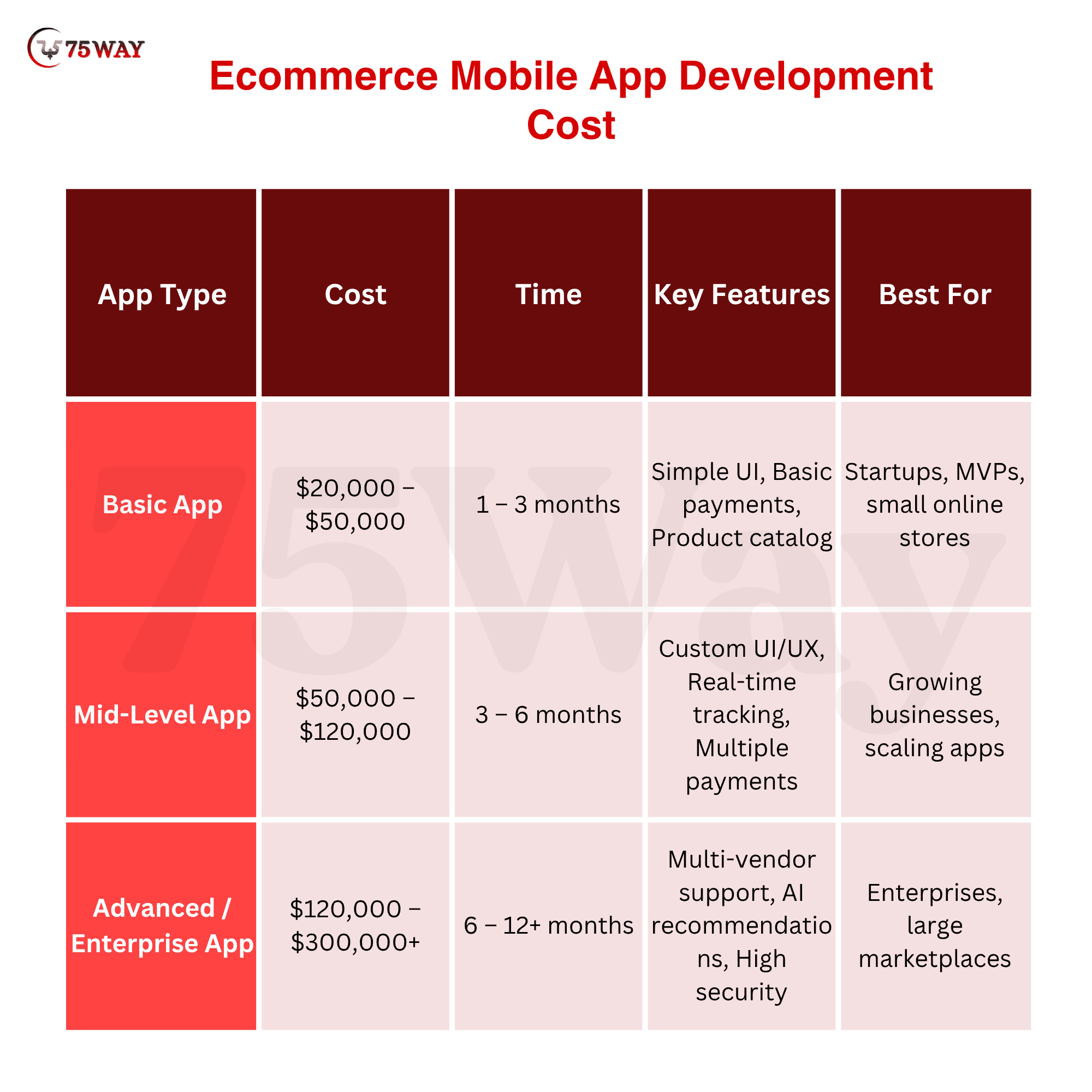
The cost of developing an ecommerce app depends on multiple factors, including app complexity, features, platform choice, and design requirements. On average, a custom ecommerce app development cost ranges between $20,000 and $300,000, covering basic to advanced functionalities.
Basic Ecommerce App Cost: $20,000 – $50,000These apps are ideal for simple ideas with basic features, limited functionality, and quick development without complex backend systems.
Mid-Level Ecommerce App Cost: $50,000 – $120,000Suitable for businesses needing custom features, backend integration, APIs, and a more polished and engaging user experience.
Advanced / Enterprise Ecommerce App Cost: $120,000 – $300,000+Designed for large-scale platforms with advanced features like AI, real-time processing, strong security, and high scalability requirements.
Other Factors Impacting the Cost of Ecommerce App Development
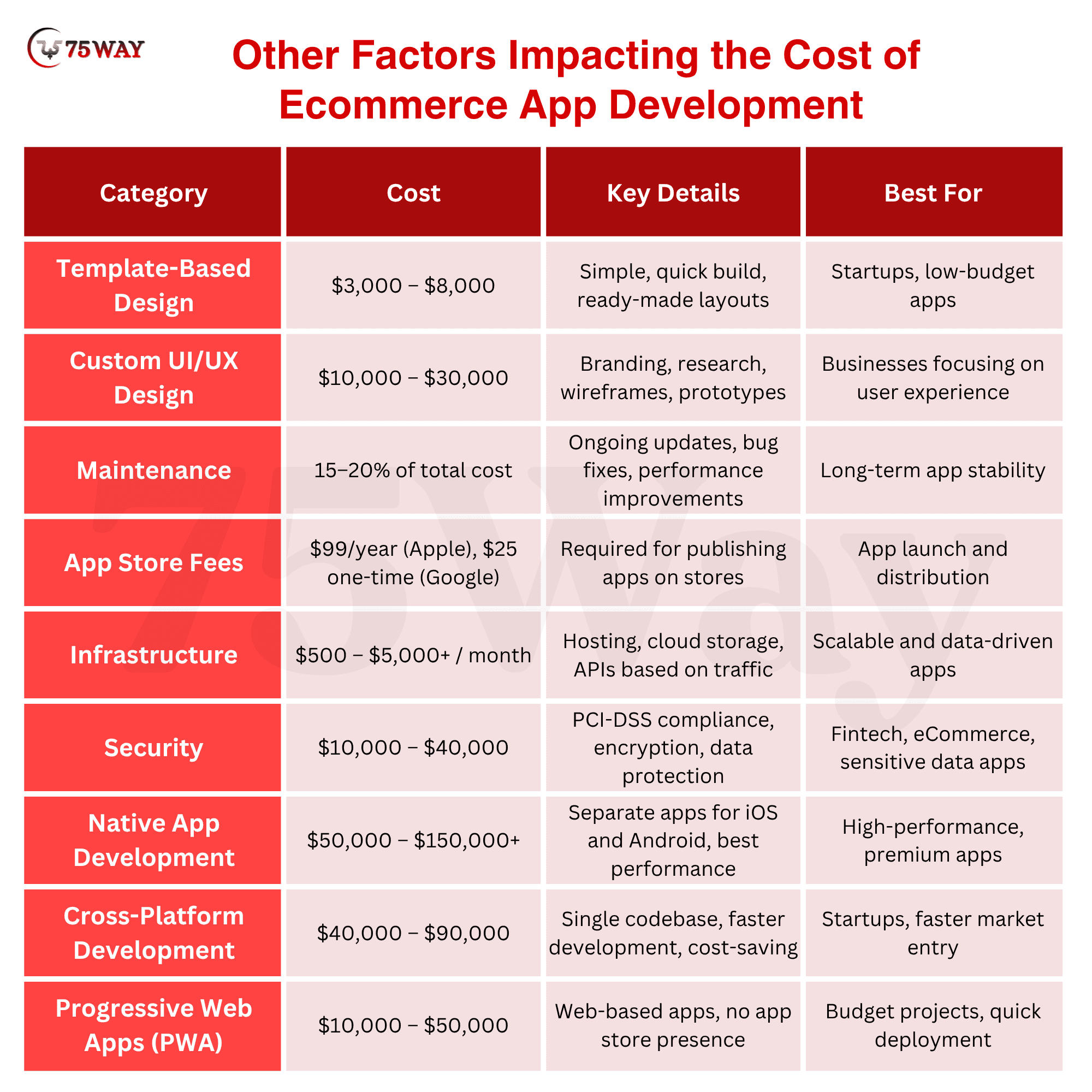
High-end apps with advanced AI functionalities, AR/VR shopping, personalized recommendations, and complex integrations require a higher investment. Planning, maintenance, and post-launch updates can further influence the total cost, ensuring long-term scalability and performance.
Template-Based Design: $3,000 – $8,000Uses pre-built templates with limited customization, suitable for quick launches where budget and speed are the main priorities.
Custom UI/UX Design: $10,000 – $30,000Fully tailored designs focused on branding, user experience, and interaction, ideal for apps aiming to stand out in the market.
Maintenance: 15–20% of total costCovers ongoing updates, bug fixes, performance improvements, and security patches required to keep the app stable over time.
App Store Fees: $99/year (Apple), $25 one-time (Google)Mandatory charges for publishing apps on platforms, allowing your app to be listed and accessible to global users.
Infrastructure: $500 – $5,000+ / monthIncludes servers, cloud hosting, databases, and scaling resources depending on app traffic, usage, and performance requirements.
Security: $10,000 – $40,000Involves data protection, encryption, secure authentication, and compliance measures to safeguard user data and prevent breaches.
Native App Development: $50,000 – $150,000+Built specifically for each platform, offering high performance, better responsiveness, and full access to device capabilities.
Cross-Platform Development: $40,000 – $90,000Uses a single codebase for multiple platforms, reducing cost and time while delivering a consistent user experience.
Progressive Web Apps (PWA): $10,000 – $50,000Web-based apps that work like mobile apps, offering faster development, lower costs, and accessibility across devices without installation.
Cost To Build an E-commerce App Based on Team Location
Hourly rates vary significantly depending on where your development team is based, directly impacting your overall project cost.
US / Canada: $100 – $200+ / hourHigher costs due to experienced teams, strong communication, and premium quality standards for complex and large-scale projects.
Eastern Europe: $40 – $100 / hour
Offers a balance between cost and quality, with skilled developers and reliable delivery for mid to high-level applications.
India & Southeast Asia: $20 – $50 / hour
More affordable option with skilled talent, allowing businesses to save significantly while still achieving quality development outcomes.
How eCommerce Apps Can Generate Revenue: Monetization Strategies 2026
In 2026, ecommerce apps have evolved beyond simple online stores. They now function as complete business ecosystems, enabling multiple revenue streams and ensuring consistent earnings despite changing buying trends. The following strategies highlight how brands are achieving sustainable growth and long-term profitability.
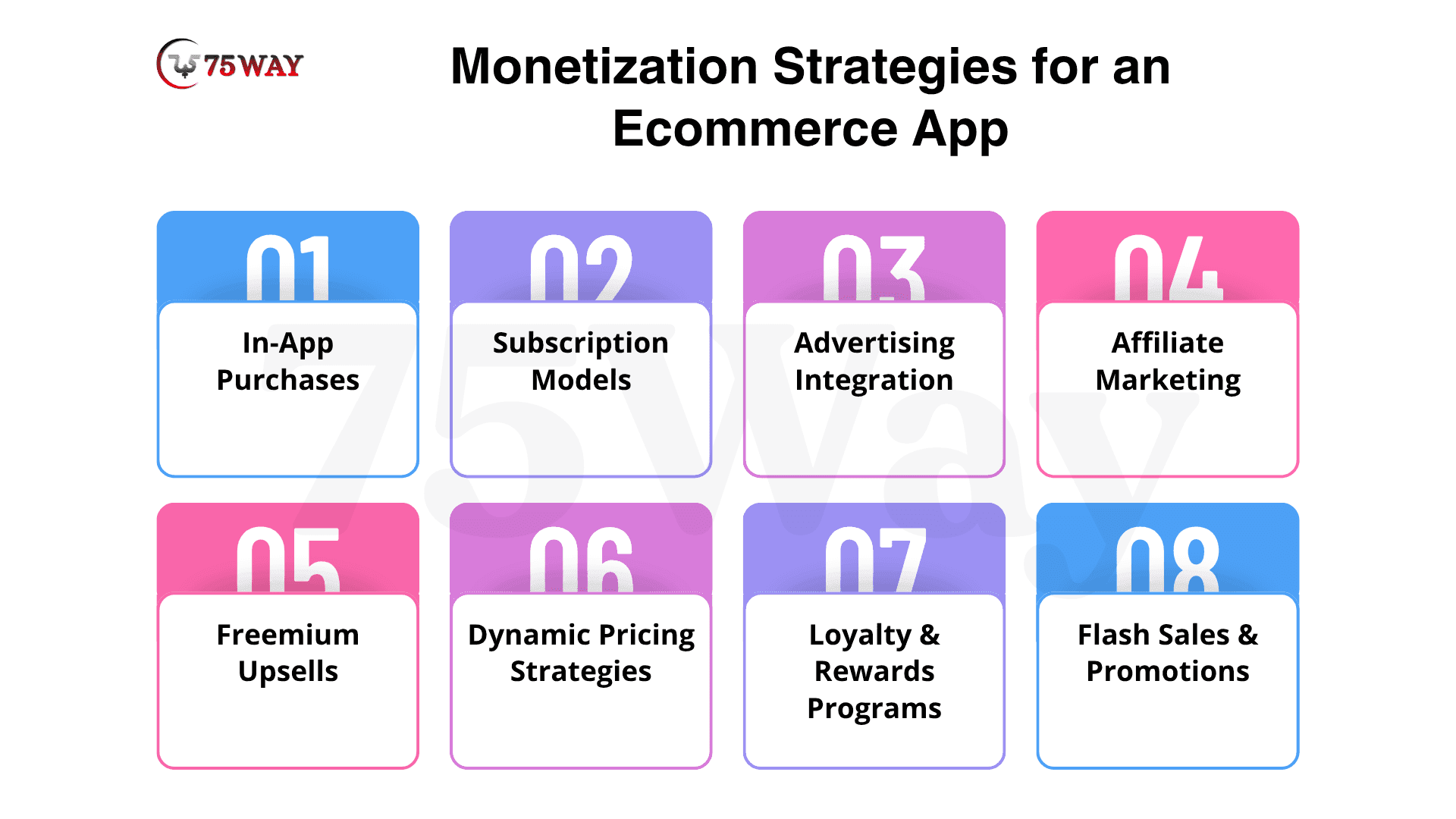
In-App Purchases: Offer users additional features, premium products, or virtual goods within the app, encouraging microtransactions and enhancing revenue while providing value-added experiences for loyal customers.
Subscription Models: Charge users recurring fees for exclusive content, premium features, or loyalty programs, creating a steady, predictable income stream and fostering long-term engagement.
Advertising Integration: Partner with relevant brands to display ads within the app, generating revenue from impressions, clicks, or sponsored content without disrupting user experience.
Affiliate Marketing: Promote third-party products or services through your app and earn commissions for each successful referral or purchase made by users.
Freemium Upsells: Provide a free app version with limited features while encouraging upgrades to paid versions, unlocking advanced tools or exclusive content for increased profitability.
Dynamic Pricing Strategies: Use AI to adjust prices in real-time based on demand, competition, or user behavior, maximizing revenue while maintaining customer satisfaction.
Loyalty & Rewards Programs: Encourage repeat purchases by offering points, discounts, or rewards, incentivizing continued engagement and increasing lifetime customer value for sustained earnings.
Flash Sales & Promotions: Run limited-time offers, seasonal discounts, or exclusive deals to create urgency, boost sales volume, and enhance overall revenue through time-sensitive campaigns.
Successfully monetizing an ecommerce app requires a strategic mix of revenue streams tailored to your business model and target audience. By combining in-app purchases, subscriptions, advertising, and AI-driven pricing strategies, brands can maximize profitability, foster customer loyalty, and ensure long-term growth in a competitive digital marketplace.
Ecommerce App Development Trends Businesses Must Follow
The latest trends in ecommerce app development are transforming how businesses connect with customers and drive revenue. By leveraging AI personalization, immersive shopping experiences, and seamless omnichannel strategies, brands can boost engagement, improve conversions, and secure higher returns in today’s competitive digital landscape.
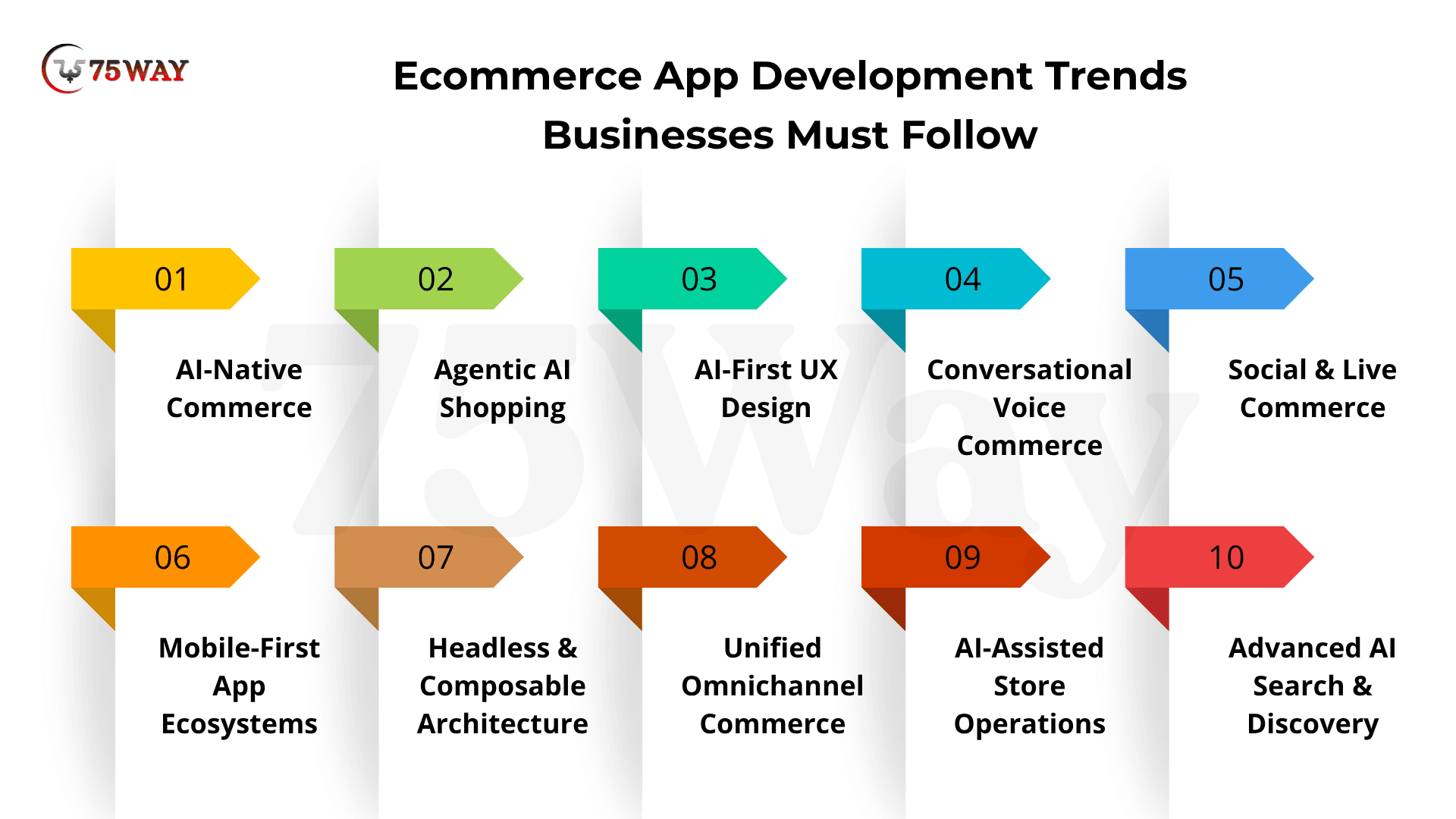
- AI-Native Commerce
Ecommerce apps are increasingly built with AI at their core, enabling predictive personalization, intelligent search, and automated customer journeys. This approach transforms how users interact with products, making every experience context-aware, dynamic, and data-driven, ultimately increasing engagement, conversions, and long-term customer loyalty in a competitive marketplace.
- Agentic AI Shopping
Intelligent AI agents can proactively assist users by comparing products, suggesting relevant options, and even completing purchases autonomously. These AI-driven assistants anticipate user needs, reduce friction, and optimize the shopping journey, providing a hands-free, highly personalized experience that enhances satisfaction and drives repeat sales across multiple product categories.
- AI-First UX Design
User interfaces are now adaptive, responding in real time to behavior and preferences. From predictive autofill to personalized navigation and context-sensitive suggestions, AI-first UX creates a seamless, intuitive experience. Businesses leveraging this approach achieve higher engagement, faster conversions, and reduced drop-offs, ensuring the app feels intelligent and user-centric.
- Conversational Voice Commerce
Voice commands have become a primary interface for ecommerce apps, allowing users to browse, reorder items, check order status, and complete transactions hands-free. Conversational AI interprets intent, handles multi-step queries, and makes interactions more natural, offering convenience, accessibility, and a faster, frictionless shopping experience.
- Social & Live Commerce
Live video sessions, influencer-driven streams, and integrated social feeds turn product discovery into immediate purchasing opportunities. Customers can interact in real-time, ask questions, and buy directly from the stream, blending entertainment with commerce. This trend boosts engagement, brand visibility, and conversion by leveraging social proof and immediacy.
- Mobile-First App Ecosystems
Ecommerce apps are designed for mobile-first interaction, delivering optimized performance, deep-linking, app-exclusive deals, and seamless integration with social platforms. This approach enhances accessibility, improves retention, and leverages mobile behaviors such as push notifications and geolocation, providing a faster, more engaging shopping experience than traditional web platforms.
- Headless & Composable Architecture
Separating frontend presentation from backend systems allows developers to innovate faster, customize interfaces, and integrate with multiple channels effortlessly. This flexible architecture supports omnichannel experiences, rapid experimentation, and scaling, enabling brands to respond to market trends, enhance user experience, and stay competitive in a fast-changing digital ecosystem.
- Unified Omnichannel Commerce
Real-time synchronization across web, mobile, physical stores, and voice interfaces ensures a consistent, seamless customer experience. Users can start shopping on one platform and continue on another without disruption. This integration builds trust, increases retention, and maximizes revenue opportunities by providing a cohesive, frictionless journey across all touchpoints.
- AI‑Assisted Store Operations
Ecommerce platforms increasingly use AI to automate internal tasks like product tagging, inventory planning, pricing optimization, and even post‑sale support. These intelligent systems streamline operations, reduce manual work, and improve efficiency, enabling brands to scale without proportional increases in staff while delivering smarter, data‑driven business workflows.
- Advanced AI Search & Discovery
AI‑driven search tools go beyond keyword matching to infer intent, preferences, and context. These systems interpret ambiguous queries, understand natural language, and surface highly relevant results, making product discovery faster and more intuitive. Visual search innovations also allow users to upload images to find visually similar items instantly.
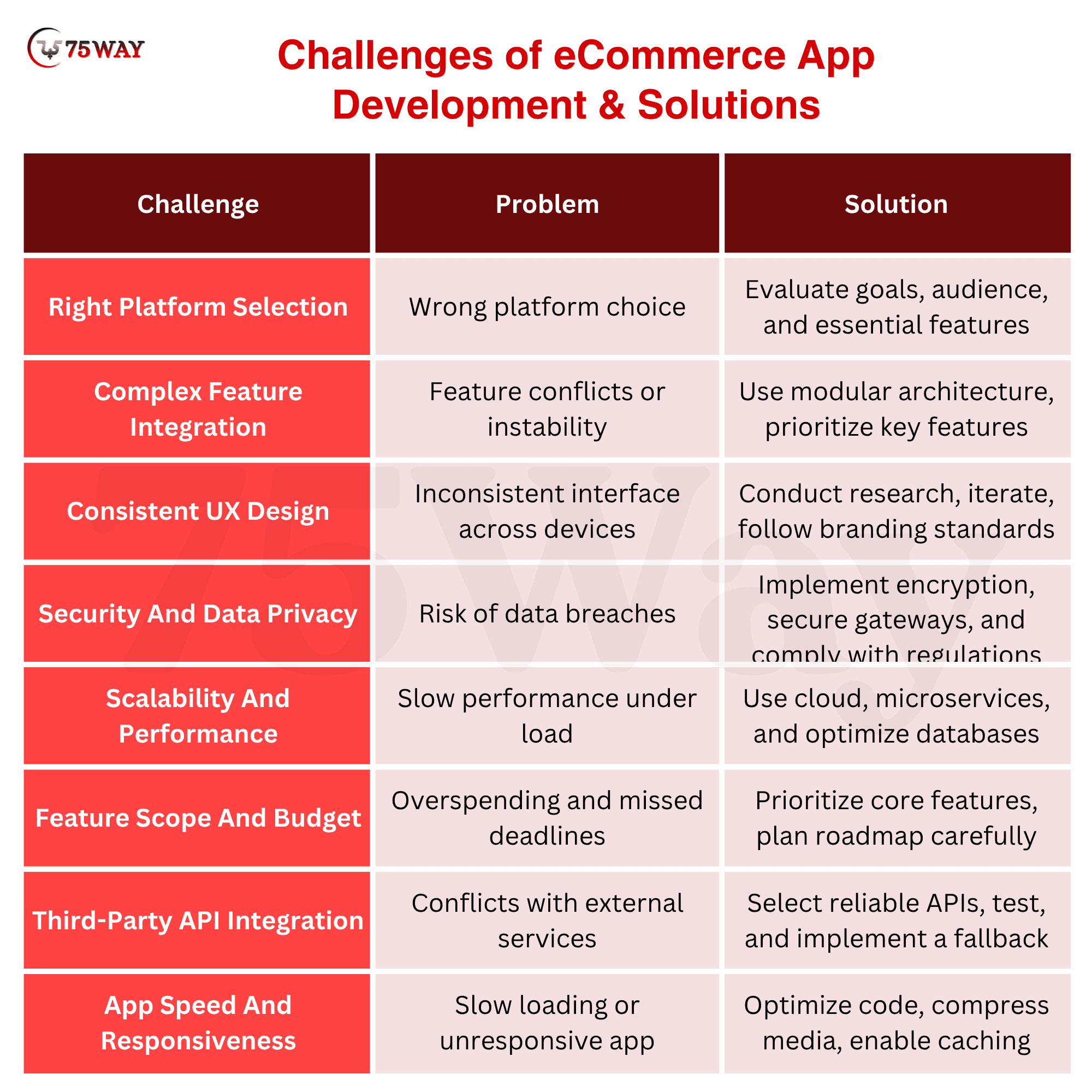
Common Issues in eCommerce App Development & Solutions
When developing an ecommerce app, businesses encounter several challenges that impact timelines, functionality, and user satisfaction. Understanding these hurdles and applying effective solutions is crucial to delivering a reliable, customer-ready platform that drives engagement, loyalty, and long-term business growth.
- Right Platform Selection
Choosing the correct platform, native, cross-platform, or PWA, is difficult, as the wrong choice can limit functionality and increase costs. Therefore, evaluate business goals, target audience, and essential features thoroughly. This ensures the platform supports future growth, allows smooth operations, and prevents technical or financial setbacks, providing a stable foundation for app development and long-term success.
- Complex Feature Integration
Integrating advanced features such as AI recommendations, AR shopping, or multiple payment gateways is challenging, as each component can affect system stability. Thus, use modular architecture and prioritize essential features while involving experienced developers. This approach maintains app reliability, reduces errors, and delivers a seamless, engaging experience that keeps users satisfied and encourages repeated use.
- Consistent UX Design
Ensuring a consistent and intuitive interface across devices is challenging because inconsistencies frustrate users and reduce engagement. Thus, conduct user research, design wireframes, iterate with feedback, and follow branding and accessibility standards. This creates a visually appealing, cohesive experience that improves navigation, builds trust, and encourages customers to return frequently.
- Security And Data Privacy
Protecting sensitive customer data is challenging, as weak security can result in breaches, financial loss, or reputational damage. Thus, implement encryption, secure payment gateways, multi-factor authentication, and comply with regulations. This approach safeguards user information, builds trust, and ensures the app meets industry standards for privacy and safety, reducing risk and liability.
- Scalability And Performance
Maintaining app performance during traffic surges is challenging, as slow or crashing apps frustrate users. Thus, leverage cloud infrastructure, microservices, optimized databases, and load balancing. This ensures stable performance, supports growth, and provides a responsive, seamless shopping experience even during peak traffic, keeping users engaged and conversions high.
- Feature Scope And Budget
Managing scope and budget is challenging, as expanding features can cause overspending, missed deadlines, and resource inefficiency. Thus, define a clear roadmap, prioritize core functionalities, and allocate contingency budgets. This strategy ensures controlled development, delivers high-quality results on time, and maximizes ROI while maintaining financial and operational stability throughout the project.
- Third-Party API Integration
Integrating external services like payment gateways, logistics, or analytics APIs is challenging, as conflicts or performance issues can arise. Thus, select reliable APIs, conduct thorough testing, and implement fallback mechanisms. This approach ensures smooth operations, uninterrupted functionality, and consistent performance across all connected services, enhancing user satisfaction and reliability.
- App Speed And Responsiveness
Maintaining fast loading times and responsive interfaces is challenging, as slow apps reduce engagement, conversions, and retention. Thus, optimize code, compress media, implement caching strategies, and monitor performance continuously. This ensures a fast, reliable, and enjoyable shopping experience, keeping users satisfied and encouraging repeat visits.
Why Hire 75way Technologies for eCommerce App Development?
75way Technologies has established itself as a trusted partner for businesses aiming to build robust, scalable, and feature-rich eCommerce applications. With over 10 years of experience, our team combines technical expertise and strategic insight to deliver solutions that meet modern customer expectations while maximizing business growth.
- Proven Industry Experience: With more than a decade in eCommerce app development, we bring deep industry knowledge to every project. Our expertise ensures apps are built using best practices, modern technologies, and scalable architectures that meet long-term business goals.
- Skilled Expert Team: Our team of 150+ experts includes developers, designers, and project managers who work collaboratively to craft customized solutions. Each member contributes specialized skills, ensuring your app is technically robust, visually appealing, and user-friendly.
- Extensive Project Portfolio: Having successfully completed 360+ projects, we have experience handling various eCommerce challenges and requirements. Our portfolio reflects our ability to deliver high-performing apps across different industries.
- End-to-End Solutions: From ideation and strategy to design, development, testing, and deployment, we offer comprehensive services. This 360-degree approach ensures a smooth workflow and faster time-to-market for your eCommerce app.
- Customer-Centric Approach: We focus on understanding your business objectives and target audience, ensuring each solution aligns with your goals. Our user-first approach guarantees apps that enhance engagement and retention.
- Commitment to Quality & Support: Quality assurance, post-launch support, and continuous updates are integral to our services. We ensure your app remains reliable, secure, and up-to-date.
Final Remarks
Every successful online business begins with understanding customer needs and market trends. A well-designed ecommerce app enhances user experience, simplifies purchasing, and strengthens customer loyalty. This kind of loyalty is especially visible among niche ecommerce brands. Stores like Shop Disco Cowboy Hat which focus on themed party and festival accessories, show how a well-optimized shopping experience paired with a clearly defined niche can turn first-time buyers into repeat customers, exactly the outcome a strong ecommerce app is built to support. Integrating advanced technologies such as AI, AR, and machine learning keeps your app competitive and future-ready. Optimizing your app with personalized features and analytics maximizes engagement and drives measurable business results. A strategic approach to ecommerce app development can define the success of your digital business. Choosing a reliable ecommerce app development company like 75way Technologies ensures your application drives higher engagement, conversions, and long-term growth.
Frequently Asked Questions (FAQs)
What Is Ecommerce App Development?
Ecommerce app development is the process of designing, building, and maintaining mobile applications that allow businesses to sell products or services online. These apps enhance user experience, provide secure transactions, and offer advanced features for customer engagement and operational efficiency.
What Are The Key Benefits of an Ecommerce App?Ecommerce apps increase customer engagement, boost sales, and improve loyalty. They provide personalized experiences, secure payments, easy navigation, and real-time updates, making shopping seamless while supporting business growth and long-term digital presence.
How Do I Choose The Right Ecommerce App Development Company?Look for proven experience, a skilled team, a strong portfolio, and expertise in advanced technologies. The right company should deliver scalable, secure, and feature-rich applications aligned with your business goals and industry standards.
How Do I Ensure High User Engagement In My App?
Focus on intuitive design, personalized recommendations, push notifications, loyalty programs, and seamless checkout processes. Monitoring user behavior and collecting feedback helps refine the app, increase retention, and maintain long-term engagement while encouraging repeat purchases.
Can Ecommerce Apps Increase Sales Significantly? Yes, ecommerce apps streamline the buying process, provide personalized recommendations, and offer loyalty programs. These features improve customer engagement, encourage repeat purchases, and help businesses maximize revenue while creating a seamless shopping experience that strengthens brand loyalty.
How Can AI Enhance Ecommerce Apps? AI powers personalized product suggestions, predictive analytics, chatbots, and smart search. Integrating AI enhances user engagement, optimizes inventory, reduces friction in purchasing, and provides actionable insights to improve decision-making, ultimately increasing customer satisfaction and boosting conversions for your ecommerce app.