AI Summary
Building a Faladdin-like app requires more than adding AI predictions and attractive screens. This guide explains the features, development process, technology, costs, and revenue model. It covers personalization, user trust, and launch planning. UAE founders can assess feasibility.
Key Takeaways
- Faladdin-like apps combine AI guidance, personalization, and engaging user experiences.
- Total development costs range from AED 30,000 to AED 450,000+.
- AI features include tarot readings, astrology insights, and personalized recommendations.
- Revenue models include subscriptions, paid consultations, credits, and premium features.
- Secure data handling and transparent guidance help build user trust.
Every astrology app user wants a different experience. Some want a quick daily prediction, others prefer detailed tarot interpretations, and some expect answers based on their birth details.
An astrology app like Faladdin brings these experiences under one roof. That's an interesting product idea for UAE businesses looking to enter the astrology and digital wellness app market.
Now, if you want to create something similar in the UAE, there are practical decisions to make. Will your app offer AI tarot readings, palm reading, birth chart analysis, or virtual consultations? How will you make the readings personalized, and what will users pay for?
Before investing in Faladdin-style astrology app development, you need to understand how the product should work as well as how it can earn revenue. Let's look at the AI features, development cost, and business model involved in building an app like Faladdin.
What Is Faladdin Clone App Development?
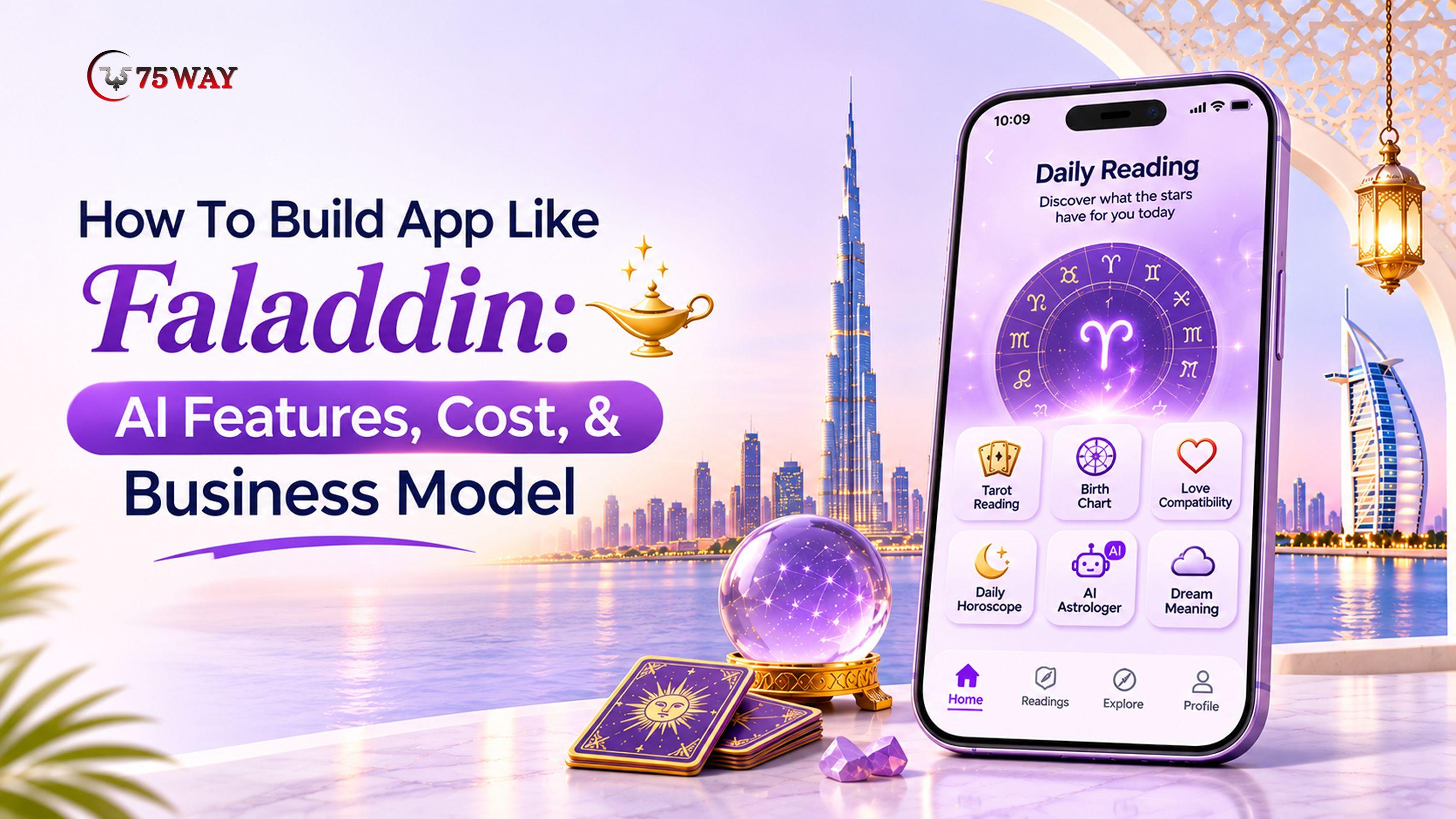
Faladdin clone app development refers to building an astrology and fortune-telling application inspired by Faladdin's features and user experience. It combines services such as AI-powered readings, tarot card interpretations, daily horoscopes, coffee cup readings, and personalized astrology insights within one mobile platform.
The development process involves creating user-friendly interfaces, integrating AI models, implementing astrology calculation engines, and setting up payment systems. Businesses can also introduce subscriptions, paid readings, and expert consultations to generate revenue from the application.
Market & Growth Insights of Faladdin Astrology & Horoscope App
- The platform has built a worldwide user base of more than 25 million registered accounts, while Android installs alone have reached approximately 26 million.
- Around 5 million users worldwide remain active on the platform, which handles nearly 1 million astrology and fortune-telling readings every day.
- Daily organic downloads for its flagship Android app listing have settled at approximately 270–370 new installs.
How Does The Faladdin App Work? Step-By-Step Workflow
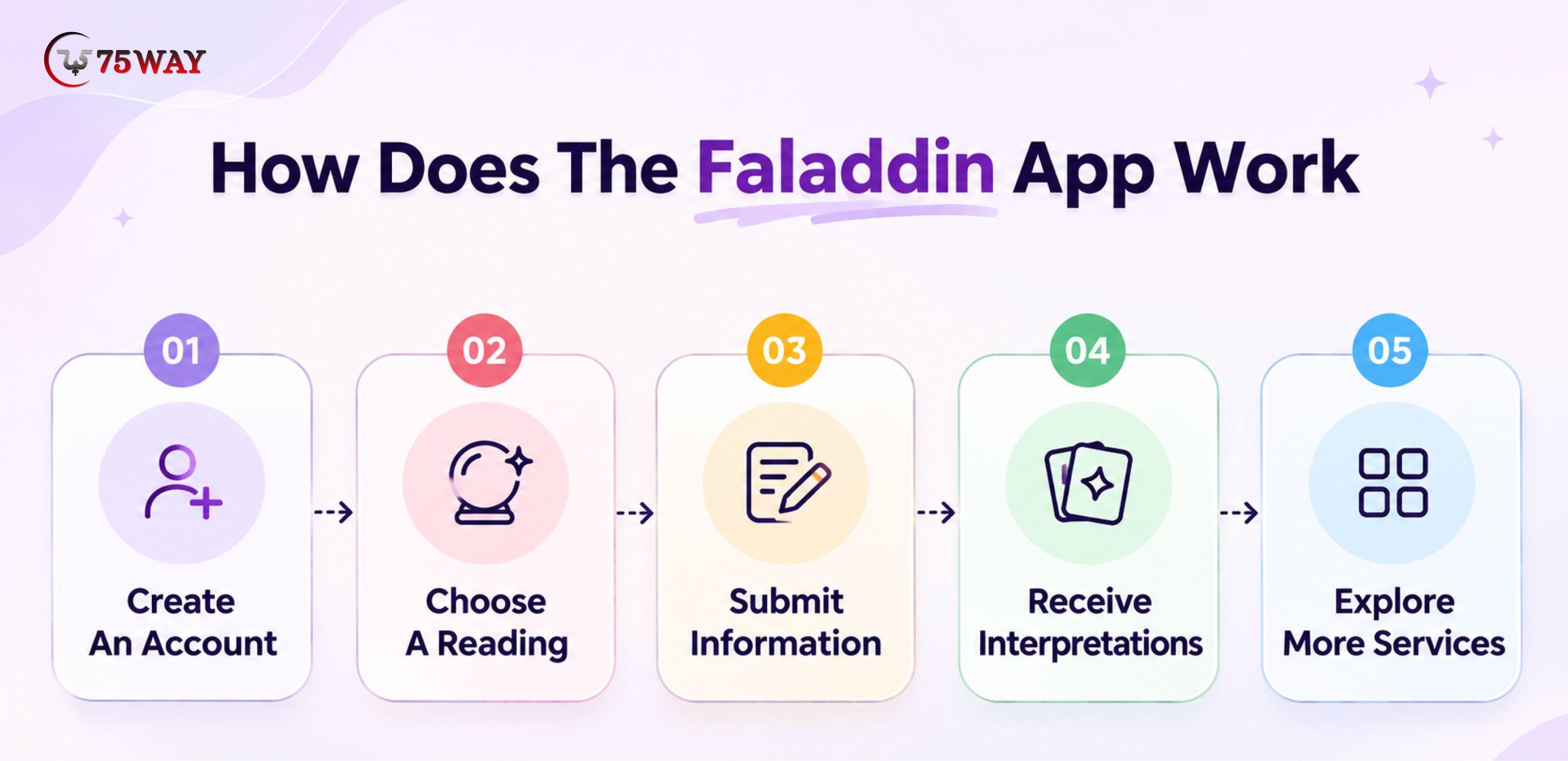
The Faladdin app works by combining user information, personalized readings, and interactive spiritual experiences. Users create an account, provide details such as their birth date, and explore services like daily horoscopes, tarot readings, coffee cup readings, and astrology interpretations.
When users request a reading, the application processes the relevant information and delivers a personalized interpretation.
For coffee cup readings, users can upload cup photographs for analysis. They can also explore different reading categories, save their experiences, and access additional services. The app offers a digital way to explore astrology and fortune-telling without arranging an in-person consultation.
1. Create An Account
Users register and provide the information required for personalized experiences.
2. Choose A Reading
Users select tarot, coffee cup readings, horoscopes, or other available services.
3. Submit Information
Depending on the service, users enter birth details, select cards, or upload coffee cup photographs.
4. Receive Interpretations
The application presents readings and personalized insights based on the selected experience.
5. Explore More Services
Users can discover additional readings and premium experiences within the application.
Quick Read: Best Astrology App Transit Features UI Design Trends in USA
Why Is The Faladdin Business Model Interesting?
Faladdin demonstrates how different spiritual services can become part of one digital experience.
Consider a user who opens an astrology application to check their daily horoscope. After reading it, they might explore a tarot reading, check relationship compatibility, or ask a question through an interactive chat feature.
Each experience creates another opportunity to engage the user.
For a business owner, this creates several monetization possibilities:
- Recurring Subscriptions: Charge users for premium readings and exclusive features.
- Paid Readings: Sell individual tarot, astrology, or personalized interpretations.
- Consultation Services: Connect users with professional astrologers.
- Credit-Based Purchases: Allow users to purchase credits for specific experiences.
- Premium Personalization: Offer detailed birth charts and advanced compatibility reports.
The business opportunity is not just to develop another astrology application. It is to create a digital platform that encourages repeat engagement through multiple services.
Why Build An Astrology App Like Faladdin In The UAE?
The UAE offers a commercially interesting environment for digital businesses targeting multilingual, mobile-first audiences. However, founders should validate demand for their particular astrology and spiritual guidance offering rather than assume that general smartphone usage automatically translates into paying customers.
A Faladdin-like application can serve users interested in astrology, tarot, personalized readings, and interactive spiritual experiences. Here are business opportunities worth considering.
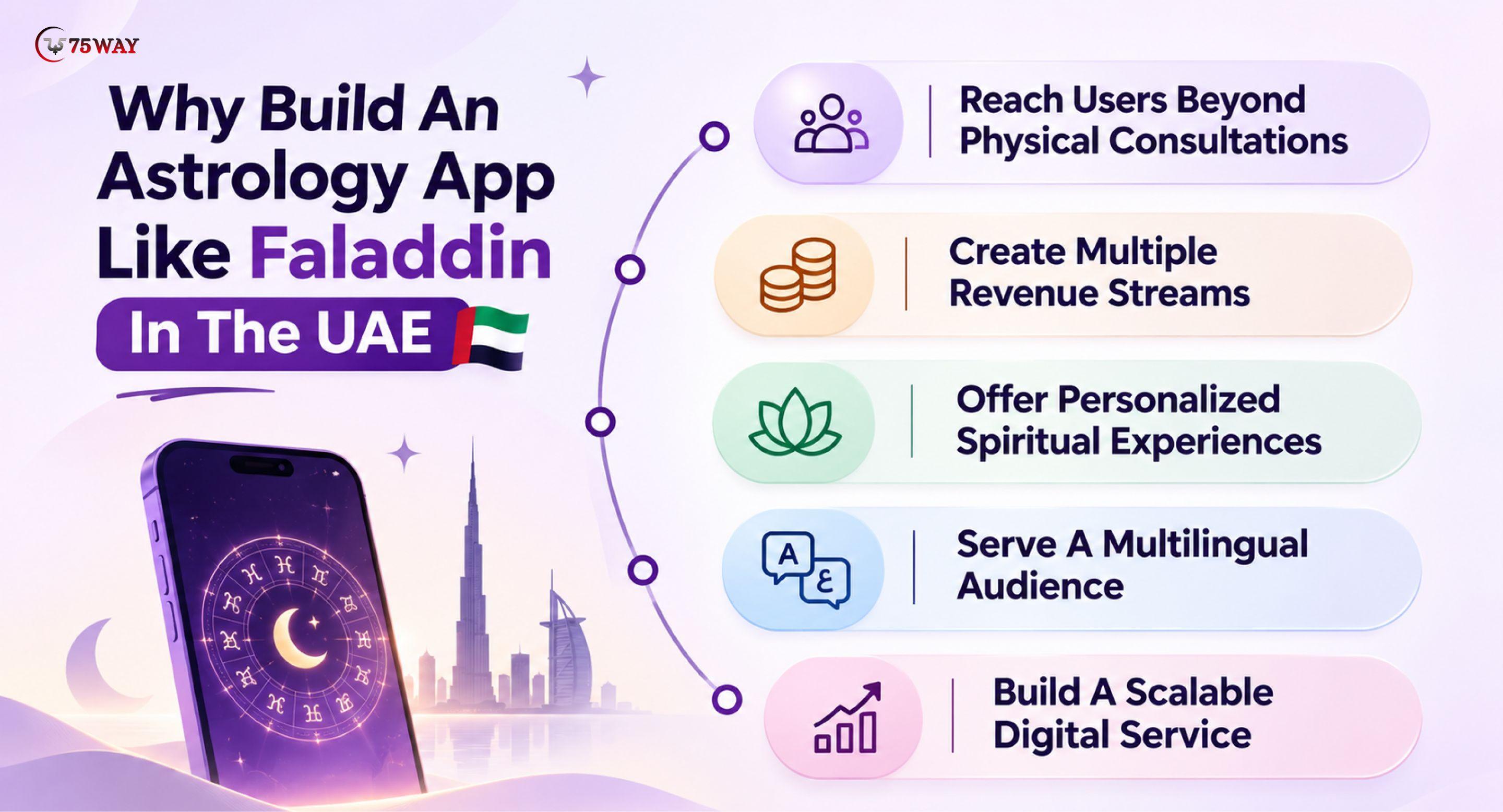
- Reach Users Beyond Physical Consultations
Traditional astrology consultations depend on appointment availability, location, and the astrologer's schedule.
A mobile application can make selected services accessible at any time. Users can check their horoscope, request readings, or purchase digital reports without arranging an in-person appointment.
- Create Multiple Revenue Streams
A single astrology service may limit the number of ways a business can earn revenue.
Combining subscriptions, paid readings, consultations, and premium reports gives founders more monetization options. Each service can target a different customer requirement and spending preference.
- Offer Personalized Spiritual Experiences
Generic horoscopes may not give users a reason to return.
Personalization using birth information, zodiac signs, reading preferences, and previous interactions can make the experience more relevant. AI can help adapt the presentation and language of readings to individual users.
- Serve A Multilingual Audience
The UAE has a diverse population, making language support an important product decision.
An application can offer Arabic and English initially, with additional languages introduced as demand grows. Translations should preserve the meaning of astrology terminology rather than simply convert words from one language into another.
- Build A Scalable Digital Service
Once the core platform is established, businesses can introduce additional readings, consultation categories, premium memberships, and regional offerings.
This allows founders to expand their services without rebuilding the entire application whenever a new revenue opportunity emerges.
The important decision is to start with a clearly defined audience and a focused product rather than attempting to introduce every possible spiritual service at launch.
How To Develop An App Like Faladdin: A Complete Roadmap
A user's first reading might spark curiosity, but a memorable app experience gives them a reason to come back. For a Faladdin-like app development, that means combining engaging spiritual features with AI capabilities, smooth navigation, and a sustainable business model. The roadmap ahead explains how to turn this concept into a fully functional astrology and fortune-telling app.
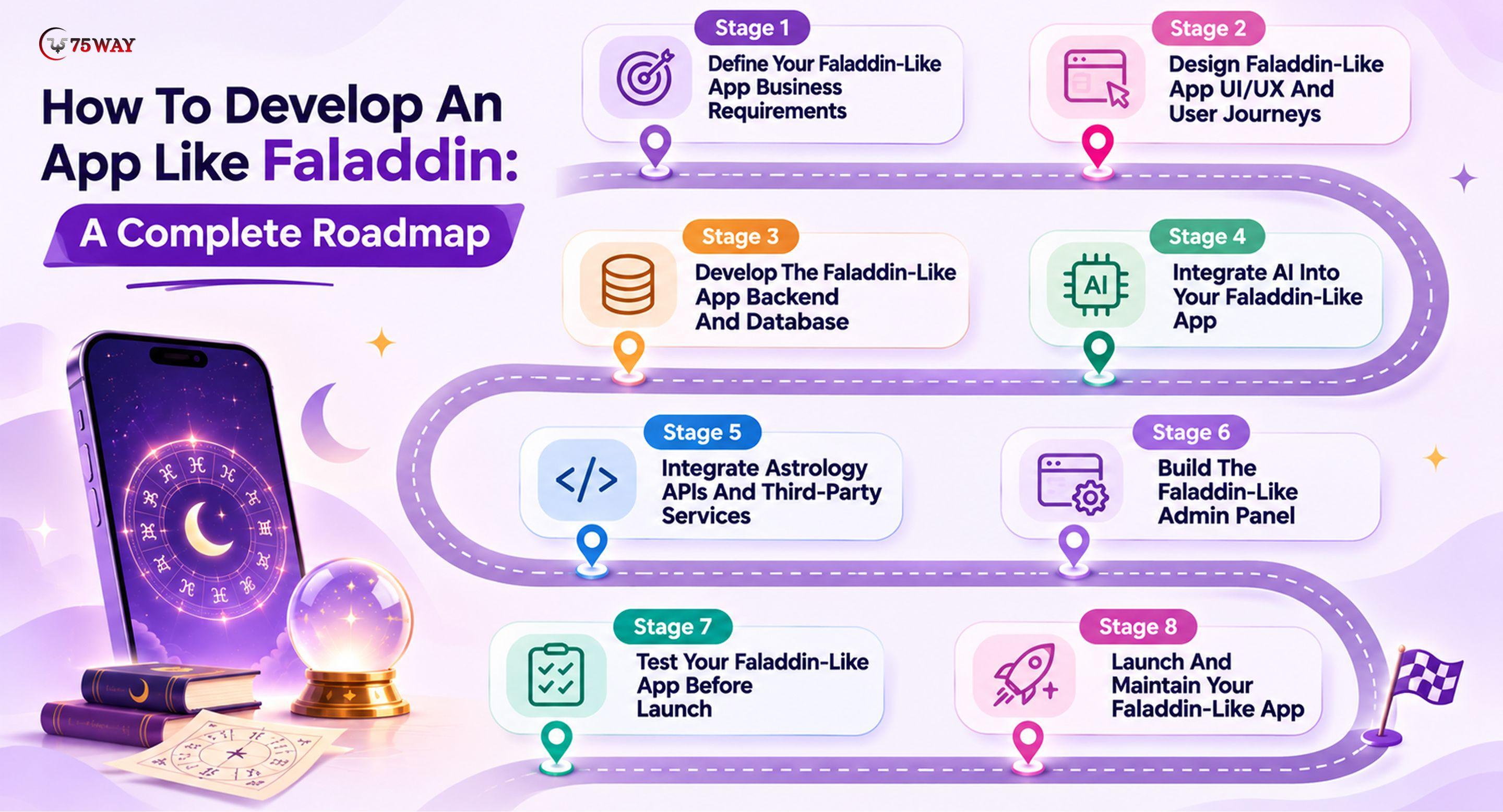
Stage 1: Define Your Faladdin-Like App Business Requirements
Before development begins, decide what your application will offer and how it will generate revenue.
A founder planning an AI astrology application needs to define the target audience, primary services, monetization strategy, and expected user journey.
Start by answering these questions:
- Will the application focus on astrology, tarot, coffee cup readings, or multiple services?
- Will readings be generated through AI, created by professional astrologers, or use a hybrid approach?
- Will users pay per reading or subscribe to a premium membership?
- Will the application support Arabic and English?
- Will consultations with professional astrologers be available?
Next, prepare a feature prioritization document. Separate essential launch features from capabilities that can be introduced later.
Development deliverable: Product requirements document (PRD), business model, feature scope, and initial development roadmap.
Stage 2: Design App UI/UX And User Journeys
An astrology application should make users feel comfortable exploring its services.
A complicated interface can discourage users before they even complete their first reading. Therefore, UI/UX design should focus on simple navigation, clear service categories, and an engaging reading experience.
The design team should prepare wireframes and interactive prototypes for the main application screens.
These typically include:
- Onboarding and registration screens.
- User profile and birth information.
- Daily horoscope dashboard.
- Tarot and coffee cup reading interfaces.
- AI chatbot and consultation screens.
- Subscription and payment pages.
For a UAE audience, consider Arabic and English interface support, including right-to-left layouts for Arabic.
The design should also make paid features understandable. Users should know which readings are free, which require credits, and what they receive after purchasing a subscription.
Development deliverable: Wireframes, UI designs, clickable prototypes, and design system.
Stage 3: Develop Backend And Database
Once the interface is approved, development moves to the backend.
The backend connects the application screens with databases, AI services, payment gateways, notification systems, and other integrations.
For example, when a user enters their birth date, time, and location, the backend securely stores the required information and makes it available to the astrology calculation engine.
The backend should support:
- User authentication and account management.
- Birth information and profile storage.
- Reading history and saved reports.
- Subscription and payment records.
- AI request management.
- Notifications and communication.
- Admin access and reporting.
Database design also requires careful consideration. Birth details, uploaded images, reading records, and payment information should not all be treated as the same type of data.
Use suitable access controls, encryption, secure API communication, and retention policies.
Development deliverable: Backend architecture, database schema, APIs, authentication, and administrative infrastructure.
Stage 4: Integrate AI Into Your Faladdin-Like App
This stage introduces the intelligence behind personalized interactions.
Rather than building every AI capability independently, the development team should identify which features can use existing AI services and which require specialized processing.
For example, an LLM can generate conversational explanations, while an astrology calculation engine determines planetary placements.
The integration process generally includes:
- Selecting suitable AI models and APIs.
- Preparing astrology-related knowledge sources.
- Designing prompts and response templates.
- Connecting AI with user context.
- Implementing response validation.
- Testing personalization and language quality.
For coffee cup readings, computer vision can be integrated to process uploaded images and identify visual patterns.
For tarot readings, the application can combine predefined card meanings, spread positions, and AI-generated explanations.
One important technical decision is whether to use a third-party LLM API or build a customized model. For most new businesses, an existing model with a controlled knowledge base is a more practical starting point. Custom model development can be evaluated when the business has sufficient data, specialized requirements, and resources.
Development deliverable: AI integrations, prompt architecture, knowledge base, personalization logic, and response safeguards.
Stage 5: Integrate Astrology APIs And Third-Party Services
AI integration alone does not provide all the information required by an astrology application.
The platform needs reliable data and specialized services to calculate charts, retrieve relevant information, process payments, and deliver notifications.
Depending on your feature requirements, integrations may include:
- Astrology calculation APIs
- Ephemeris and planetary data
- Geolocation services
- Payment gateway APIs
- Push notification services
- Email and SMS services
- Analytics platforms
For instance, when someone requests a birth chart, the application should calculate the planetary positions using the selected astrological system. The resulting data can then be passed to the AI service for a personalized explanation.
For UAE-focused businesses, payment integrations should support the intended AED payment journey and local customer requirements.
Development deliverable: Configured third-party APIs, payment integrations, astrology calculations, and notification services.
Stage 6: Build Admin Panel
A growing astrology application needs an administration system that allows business owners to manage daily operations without depending on developers for every update.
The admin panel should provide control over users, content, payments, consultations, and application settings.
Important administrative modules include:
- User Management: View profiles, manage accounts, and handle support requests.
- Reading Management: Manage reading categories, templates, and published content.
- AI Management: Review flagged responses, update prompts, and configure safeguards.
- Payment Management: Monitor transactions, subscriptions, and refunds.
- Astrologer Management: Manage expert profiles, availability, and bookings.
- Analytics Dashboard: Monitor registrations, engagement, and revenue.
One particularly important feature is AI usage monitoring.
Every AI request may have an associated processing cost. The admin panel should help business owners track API consumption, usage patterns, and spending by feature.
This information becomes useful when deciding whether a particular AI feature should remain free, require credits, or move into a premium subscription.
Development deliverable: Web-based admin dashboard, management modules, analytics, and AI usage controls.
Stage 7: Test Your Faladdin Clone App Before Launch
An application may look complete during development but still contain problems that affect actual users.
Testing should cover the complete journey, from registration and reading requests to payments and account management.
Special attention should be given to payment failures and interrupted AI requests.
For example, if a user purchases a reading but the AI service fails to generate the response, the system should handle the transaction correctly rather than charging the customer without delivering the service.
Development deliverable: QA reports, bug fixes, security checks, performance validation, and release approval.
Stage 8: Launch And Maintain Your Faladdin-Like App
After testing, the application can be prepared for release on the relevant app stores.
However, launching the application is not the end of development. Real users will reveal issues and opportunities that may not appear during testing.
The launch process includes:
- Preparing App Store and Google Play listings.
- Configuring production servers.
- Setting up monitoring and analytics.
- Publishing privacy policies and terms.
- Testing live payments.
- Monitoring crashes and API performance.
- Collecting initial customer feedback.
After launch, monitor important metrics such as registrations, completed readings, subscription conversions, customer retention, and revenue per paying user.
Use these insights to improve the product. If users regularly open the application but rarely purchase readings, investigate the value proposition and payment journey before investing in additional features.
Development deliverable: Published applications, production infrastructure, analytics, maintenance, and product improvement roadmap.
Explore More: CHANI-Like Astrology App Development: Process, Features, Tech Stack, & Cost
Features Required To Build An App Similar To Faladdin
Curiosity about the future can bring someone to an astrology app, but meaningful readings are what keep them exploring. An app like Faladdin combines personalized predictions, tarot readings, and spiritual insights to make that experience engaging. A closer look at its essential features can help you plan an app that captures the same appeal.
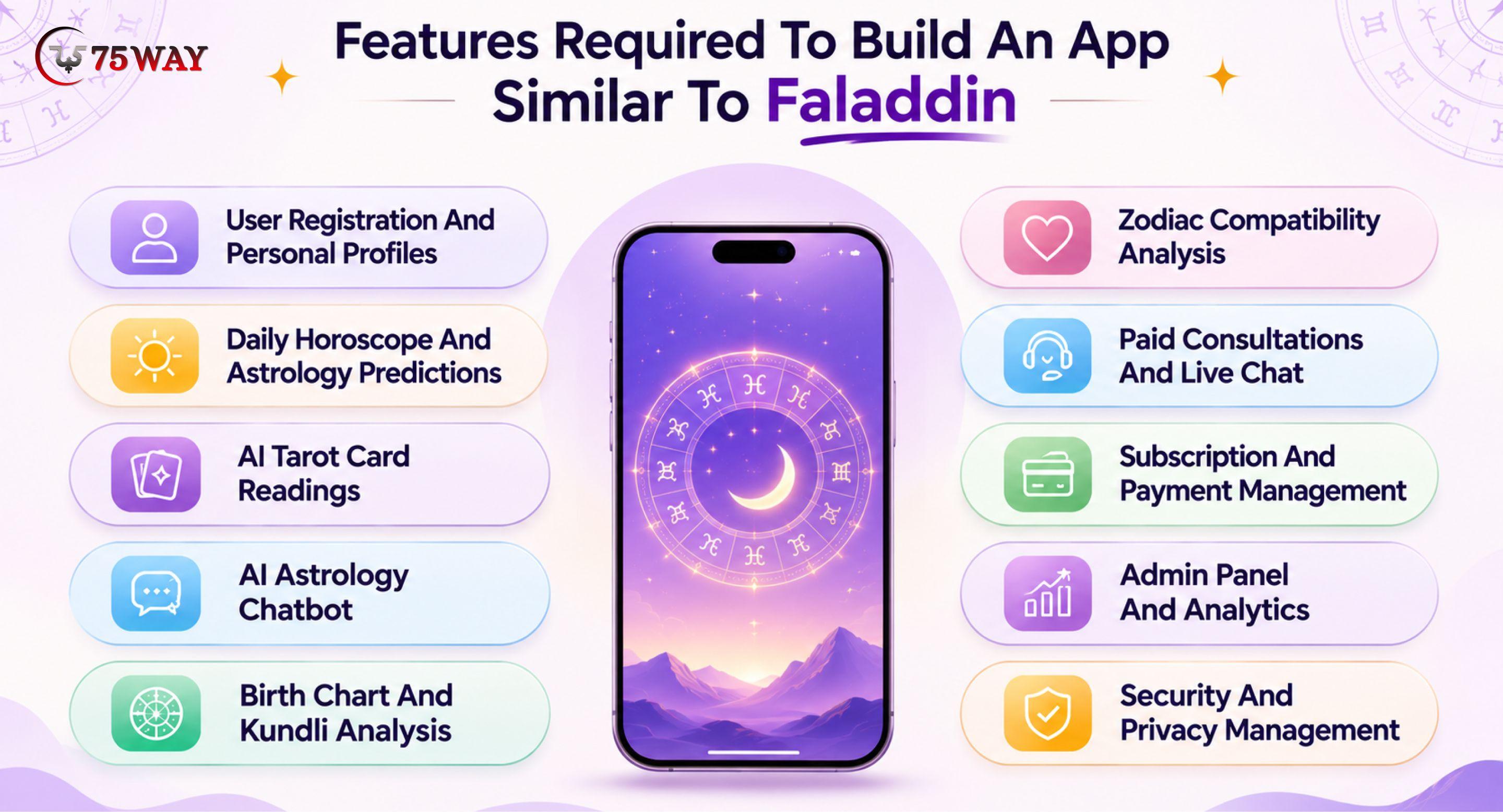
- User Registration And Personal Profiles
The registration process in astrology apps like Faladdin should collect only the information necessary to deliver the selected services.
Users can create profiles using email, phone numbers, or supported social login options.
- Daily Horoscope And Astrology Predictions
Daily horoscope functionality gives users a reason to open the application regularly.
The platform can generate readings based on zodiac signs, planetary positions, and predefined interpretation rules.
- AI Tarot Card Readings
Tarot readings can become one of the application's main interactive experiences.
Users select a question or reading category, choose cards, and receive an interpretation based on the selected spread.
- AI Astrology Chatbot
An interactive AI astrology chatbot allows users to ask questions without navigating through multiple sections.
For example, a user might ask about zodiac compatibility, planetary movements, or the meaning of a particular tarot card.
The AI chatbot can combine an LLM with structured astrology data, curated knowledge, and conversation context.
- Birth Chart And Kundli Analysis
A birth chart feature can make the application more valuable to users seeking detailed astrology information.
The system uses birth date, exact time, and geographical location to calculate planetary placements and chart information.
- Zodiac Compatibility Analysis
Compatibility tools allow users to explore relationship-related astrology information.
Users can enter the relevant birth details and receive an interpretation based on selected zodiac compatibility analysis and astrological systems.
- Paid Consultations And Live Chat
If your business model includes professional astrologers, consultation features can create an additional revenue stream.
Users can browse available experts, check their profiles, and book paid sessions.
- Subscription And Payment Management
A monetization system should be integrated into the application from the beginning.
It should allow users to purchase individual readings, subscribe to premium plans, and manage their payments.
- Admin Panel And Analytics
The admin panel gives business owners control over the application's operations.
It should provide visibility into users, readings, payments, content, subscriptions, and customer activity.
- Security And Privacy Management
Astrology applications may collect birth dates, birth times, locations, photographs, and personal conversations.
These details should be handled carefully, particularly when the platform serves customers in the UAE.
How Does AI Work In An App Like Faladdin?
AI is not a replacement for every component of an astrology application. It is one part of a larger system that combines calculations, content, user information, and interactive experiences.
Understanding this architecture is important before selecting an AI development approach.
Consider a user who enters their birth information and asks, "What does my birth chart indicate about my career?"
A well-designed application should not simply send that question to an LLM and display whatever response it generates.
Instead, the system needs to retrieve the relevant birth chart information, identify the applicable astrological interpretations, and generate an understandable response using the selected astrology framework.
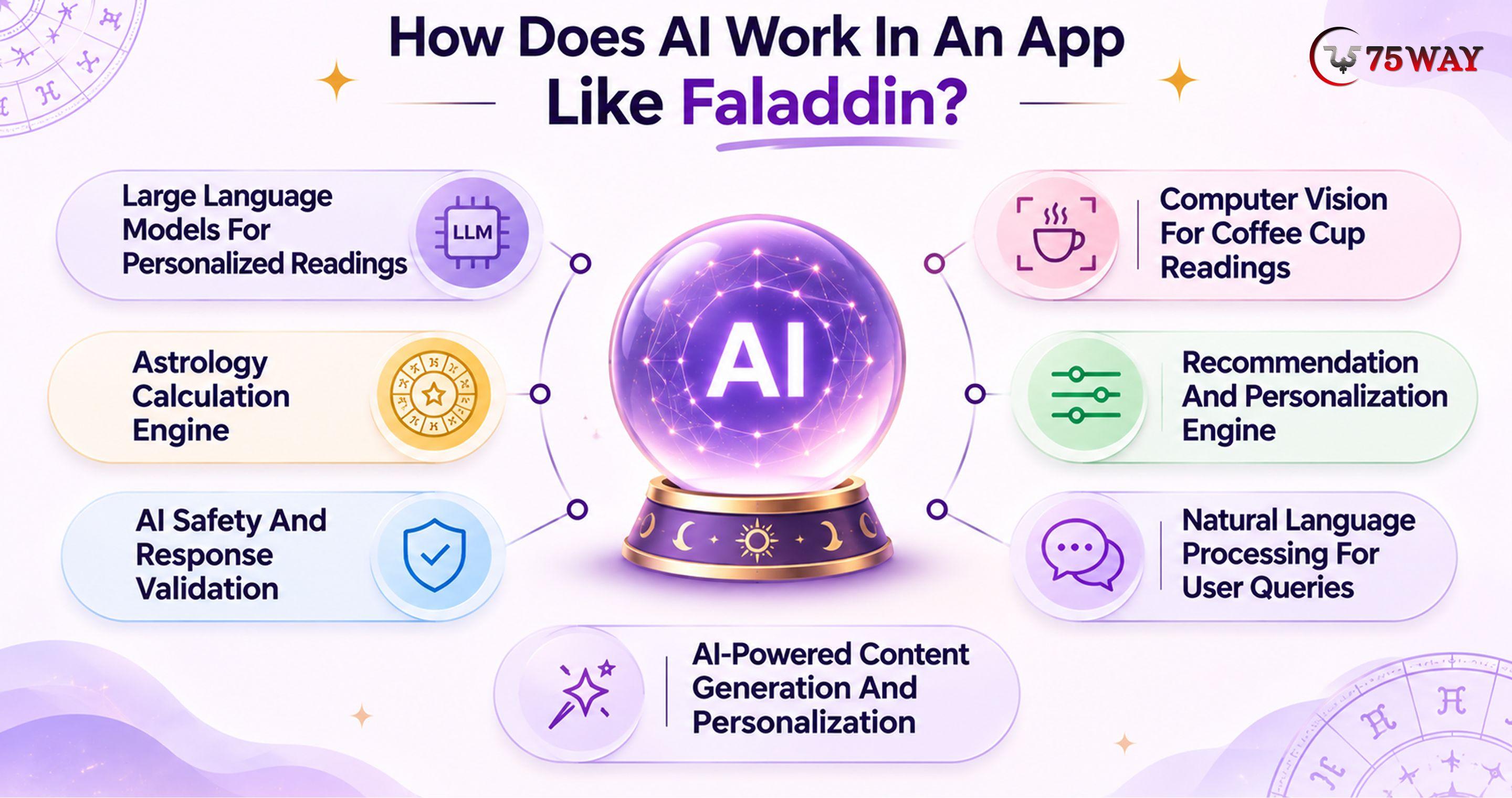
1. Large Language Models For Personalized Readings
An LLM can interpret structured information and generate natural-language responses.
For example, it can turn planetary placements and predefined interpretations into a readable explanation.
The development team can integrate an existing LLM through an API or evaluate a custom model approach when there is a justified business requirement.
2. Computer Vision For Coffee Cup Readings
Coffee cup reading is a distinctive feature associated with Faladdin.
A similar application can use computer vision to process uploaded cup photographs and identify visual patterns.
The workflow can include:
- Image upload and validation.
- Image preprocessing.
- Visual pattern detection.
- Interpretation mapping.
- AI-generated explanation.
However, recognizing shapes in coffee grounds does not scientifically establish future events. The application should present such readings as entertainment or spiritual interpretations rather than verified predictions.
3. Astrology Calculation Engine
This component handles the mathematical side of astrology.
It calculates planetary positions, zodiac placements, houses, and other relevant information using the selected astrological system.
An astronomy or astrology calculation library can be integrated to support these calculations.
The LLM should receive the calculated information instead of independently estimating planetary positions.
4. Recommendation And Personalization Engine
The recommendation engine uses permitted user preferences and interaction history to suggest relevant experiences.
For example, a user who frequently explores career-related readings might receive recommendations for career tarot spreads or relevant astrology reports.
Personalization should be transparent, permission-based, and configurable.
5. AI Safety And Response Validation
AI-generated responses need safeguards.
A responsible implementation should check for misleading claims, inappropriate content, unsupported medical or financial advice, and manipulative recommendations.
The application should not encourage users to make major life decisions solely on the basis of generated predictions.
6. Natural Language Processing For User Queries
Natural Language Processing (NLP) helps the application understand what users mean when they ask questions or interact with its chatbot.
For example, a user might ask, "Will I have a good career this year?" The NLP system identifies the user's intent, understands the context, and directs the query to the relevant astrology or AI service.
This makes conversations more natural and helps users access relevant readings without navigating multiple screens.
7. AI-Powered Content Generation And Personalization
AI can generate personalized horoscope explanations, tarot interpretations, and astrology reports using structured data and curated knowledge sources.
For example, instead of showing every user the same daily horoscope, the application can adapt the explanation based on their zodiac sign, selected reading category, and permitted profile information.
This helps businesses offer more varied digital experiences while maintaining control over the underlying astrology interpretations.
Should You Choose Flutter Or Native App Development To Make Faladdin-Style App?
The choice depends on your application requirements.
- Flutter: A practical option when you want to develop Android and iOS applications using a shared codebase. It can reduce duplicated development work and simplify interface maintenance.
- Native Development: Swift for iOS and Kotlin for Android provide platform-specific development. These approaches can be appropriate when you require deeper platform integration or specialized native capabilities.
For many startups building an MVP, Flutter is worth evaluating because it supports cross-platform development without requiring two entirely separate application codebases.
However, the final choice should follow a technical assessment rather than a blanket preference for one framework.
How Does App Like Faladdin Make Money: Revenue Models
An app like Faladdin can generate income from more than just paid horoscope readings. Premium predictions, virtual consultations, subscription plans, and digital spiritual products can each contribute to its revenue. A good monetization strategy should connect the value of each feature with a suitable payment method.
For example, users may enjoy free daily horoscopes but be willing to pay for detailed birth chart reports or personalized tarot readings. A closer look at these monetization models will help you identify the right earning strategy for your app.
1. Freemium Business Model
The freemium model allows users to access selected services without paying.
For example, your application could offer daily horoscopes, limited tarot readings, and basic zodiac compatibility for free.
Premium services can remain locked until users purchase a subscription or credits.
How it generates revenue: Free users discover the application, while interested customers upgrade to paid services.
Best suited for: New astrology startups building an initial user base.
2. Subscription-Based Business Model
A subscription model provides access to premium features through recurring payments.
You can introduce monthly, quarterly, or annual plans depending on your audience and service offerings.
For example:
- Basic membership with additional daily readings.
- Premium membership with advanced astrology reports.
- Exclusive membership with extended AI conversations and detailed compatibility analysis.
How it generates revenue: Customers pay recurring fees for continued access to premium services.
Best suited for: Applications offering regular astrology content and personalized experiences.
3. Pay-Per-Reading Business Model
Some users may not want a monthly subscription. They may prefer purchasing an individual reading whenever required.
This model allows users to pay for specific services, such as a detailed tarot spread, birth chart report, or coffee cup interpretation.
How it generates revenue: Each completed purchase generates revenue independently of subscription membership.
Best suited for: Applications offering specialized readings and occasional consultations.
4. Credit-Based Business Model
A credit system allows users to purchase a bundle of credits and spend them on different application services.
For example, a tarot reading might require a smaller number of credits, while an extended personalized report may require more.
The application should clearly display credit requirements before users confirm a purchase.
How it generates revenue: Users purchase credit packages and consume credits while accessing paid features.
Best suited for: Platforms with multiple paid reading categories.
5. Professional Astrologer Marketplace
You can introduce a marketplace where professional astrologers offer consultations through the application.
Users can browse expert profiles, compare services, and book sessions.
The platform can earn a commission from completed consultations.
For example, if an astrologer charges AED 100 for a session and the platform retains an agreed 20% commission, the platform earns AED 20 before applicable operating costs.
How it generates revenue: Commission on completed paid consultations.
Best suited for: Businesses connecting customers with independent astrology professionals.
6. Personalized Premium Reports
Detailed reports can become another revenue source.
Instead of limiting the experience to short readings, the application can offer downloadable reports covering birth charts, zodiac compatibility, and other selected astrology topics.
AI can assist in preparing these reports using structured calculations and curated interpretations.
How it generates revenue: Customers pay separately for detailed reports or access them through premium membership.
Best suited for: Applications targeting users interested in detailed astrology analysis.
Which Faladdin-Like App Business Model Should You Choose?
The right model depends on your target customers and the type of experience you want to offer.
For a new UAE startup, a freemium model combined with paid readings can be a practical starting point. It gives users an opportunity to explore the application before purchasing anything.
As the user base grows, you can introduce subscriptions, credit packages, professional consultations, and premium reports.
However, avoid introducing every monetization method immediately. Too many payment options can complicate the experience and make it harder to understand which services customers actually value.
How Much Does It Cost To Build An App Like Faladdin In The UAE?
The cost of developing an astrology app like Faladdin generally ranges from AED 30,000 – AED 450,000+, depending on its features, AI integrations, platform requirements, backend architecture, and overall complexity.
A basic application with user profiles and predefined readings requires a different investment from an advanced AI-powered platform with image analysis, personalized conversations, and live consultations.
Here are three development budgets to help you plan your investment.
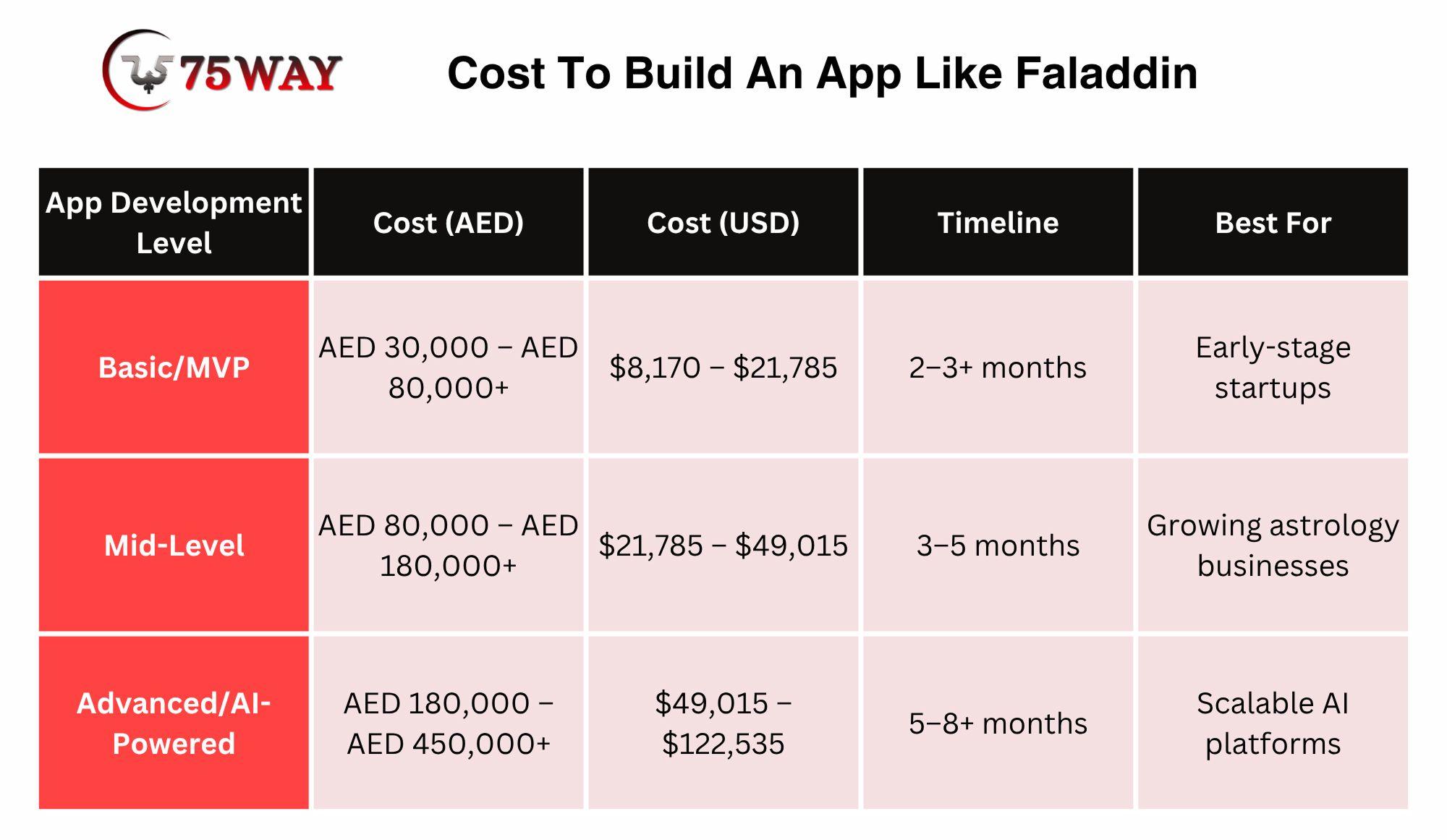
1. Basic/MVP Faladdin-Like App Cost: AED 30,000 – AED 80,000+ (~$8,170 – $21,785)
Timeline: 2–3+ months
Features: Basic profiles, daily horoscopes, tarot readings, payment integration, and notifications.
Suitable For: Startups testing initial market demand.
2. Mid-Level Faladdin-Like App Cost: AED 80,000 – AED 180,000+ (~$21,785 – $49,015)
Timeline: 3–5 months
Features: AI chatbot, personalized predictions, birth charts, subscriptions, and consultation booking.
Suitable For: Growing astrology businesses and established startups.
3. Advanced/AI-Powered Faladdin-Like App Cost: AED 180,000 – AED 450,000+ (~$49,015 – $122,535)
Timeline: Approximately 5–8+ months
Features: Advanced AI models, image recognition, personalized readings, live consultations, and analytics.
Suitable For: Businesses building scalable AI astrology platforms.
What Factors Affect Faladdin-Like App Development Costs?
Two applications can have similar interfaces but very different development budgets.
The difference usually comes from what happens behind those screens. AI processing, complex calculations, integrations, and operational requirements can significantly affect the overall investment.
1. Number And Complexity of Features
A basic horoscope application requires fewer development resources than a platform offering tarot readings, birth charts, coffee cup analysis, and live consultations.
Every additional feature introduces development, integration, and testing requirements.
2. AI Model And Integration Requirements
The cost depends on whether you use an existing LLM API, customized AI workflows, computer vision, or a specialized model.
You should also consider recurring API usage charges. A platform with thousands of daily reading requests can have different AI operating costs from a small MVP.
3. Astrology Calculation Requirements
Basic zodiac horoscopes and detailed natal charts have different technical requirements.
Advanced calculations may require specialized libraries, accurate birth information, time zone handling, and additional interpretation logic.
4. UI/UX Design Complexity
Custom interfaces, animated tarot cards, interactive charts, and multilingual layouts require additional design and implementation work.
5. Third-Party Integrations
Payment gateways, SMS services, astrology APIs, video consultations, and analytics tools can increase development expenses.
Some integrations also involve recurring subscription or transaction charges.
6. Backend And Cloud Infrastructure
The infrastructure must support user accounts, reading requests, payment processing, AI interactions, and application data.
The architecture should be designed around expected usage, with room to scale as demand increases.
7. Security And Compliance Requirements
Data protection, authentication, secure payment processing, and privacy management require dedicated development and testing.
For a UAE-facing application, the business should also review applicable privacy, consumer protection, electronic transaction, and payment requirements.
8. Post-Launch Maintenance
Application development does not end after publishing.
You need to account for bug fixes, operating system updates, API changes, cloud hosting, AI usage, security updates, and feature improvements.
Our Recommendation: Start with a clearly defined MVP, validate the payment model, and expand based on actual user behavior. Spending more on AI features before understanding customer demand can increase investment without improving business results.
How To Choose The Right Faladdin-Like Astrology App Development Company?
The selection of an astrology app development company to build a Faladdin clone is an important business decision because your technology partner will influence the application's architecture, user experience, AI capabilities, and long-term maintenance.
A company that only focuses on building mobile screens may not understand the requirements of an AI-powered astrology platform.
Before selecting a development partner, evaluate these factors.
1. Experience In AI App Development
Check whether the company understands LLM integrations, AI APIs, prompt engineering, personalization, and AI response validation.
Ask how it would implement a chatbot that uses structured astrology information rather than generating unsupported responses.
2. Mobile App Development Expertise
Review its experience with Android, iOS, cross-platform development, backend architecture, and third-party integrations.
Look for projects demonstrating the ability to build complete applications rather than isolated UI designs.
3. Understanding of Your Business Model
Your development partner should understand how subscriptions, credit systems, paid readings, and consultations work.
This helps the team build the required payment infrastructure from the beginning.
4. Data Security And Privacy Practices
Ask how the company handles user information, authentication, data encryption, access permissions, and secure integrations.
This is particularly important when your application collects birth information, personal photographs, and private conversations.
5. Post-Launch Support
Confirm whether the company provides application monitoring, bug fixes, security updates, and technical maintenance after launch.
A reliable development partnership should extend beyond the initial release.
Quick Read: Choosing Mobile App Development Agency for Astrology & Spirituality Platform (iOS + Android)
Final Remarks
Building an app like Faladdin is an opportunity to create more than a digital horoscope platform. With the right combination of astrology calculations, AI-powered personalization, interactive readings, and suitable monetization, you can develop a digital business with multiple revenue streams.
For UAE founders, the smartest approach is to begin with a focused MVP, understand what customers are willing to pay for, and expand the application based on real usage data. Your technology decisions, AI architecture, and customer experience will ultimately determine how well the platform supports business growth.
To launch your own AI-powered astrology application, you can contact with a reliable AI app development company to discuss your app idea, development requirements, and estimated project cost.
Frequently Asked Questions (FAQs)
Can I Launch An AI Astrology App In The UAE?
Yes. You can launch an astrology application targeting UAE customers, provided the business addresses applicable licensing, privacy, consumer protection, payment, and app distribution requirements. Arabic and English language support can also help serve different customer groups.
Should I Build A Faladdin-Like App For Android And iOS?
Developing for both Android and iOS can help you reach a broader customer base. Flutter or React Native can support cross-platform development, while native technologies are suitable when platform-specific requirements justify separate development.
Can I Add Arabic Language Support To My Faladdin-Like App?
Yes. Arabic language support can be integrated during UI/UX design and application development. The implementation should include right-to-left layouts, appropriate typography, localized content, and Arabic-compatible AI responses.
How Much Does It Cost To Build An App Like Faladdin?
Developing an app like Faladdin can cost between AED 30,000 and AED 450,000+, depending on the application scope. A basic MVP may cost AED 30,000–AED 80,000+, while advanced AI-powered applications can require AED 180,000–AED 450,000+.
How Long Does It Take To Develop An App Like Faladdin?
A basic Faladdin-like application may take 2–3+ months, while a mid-level application can require 3–5 months. Advanced platforms with AI integrations, image recognition, and live consultations may take 5–8+ months.
Can I Build An Astrology App Without Developing My Own AI Model?
Yes. You can integrate existing LLM APIs and connect them with an astrology knowledge base, structured calculations, and personalized user information. This approach can reduce initial development complexity compared with training a custom AI model.
How Does An AI Astrology App Generate Personalized Readings?
An AI astrology application can combine user-provided birth information, calculated planetary positions, curated astrology interpretations, and an LLM. The calculation engine supplies structured information, while the AI generates understandable explanations based on the selected astrology framework.