AI Summary
Developing a music app like Spotify requires more than streaming features. This guide covers essential features, technology, licensing, monetization, and development stages. It also explores AI-powered personalization for stronger music discovery and engagement. Spotify-like app development costs can range from $40,000 to $500,000+. The guide helps businesses plan scalable music apps for 2026.
Key Takeaways
- Learn the complete process to develop a music app like Spotify in 2026
- The music app market is valued at $37.62 billion and is growing at a 4.44% CAGR.
- Explore essential features, technology, licensing, monetization, and key development stages.
- Understand how AI can personalize discovery and strengthen user engagement.
- Music app development costs $30,000-$300,000+, depending on features and complexity.
Spotify is a good example of what happens when a music app grows into a full-scale digital business. Yes, we are talking about the USA or globally famous music streaming app Spotify. Do you know what’s more interesting?
In Q1 2026 alone, Spotify reported €715 million in operating income, alongside 761 million monthly active users and 293 million Premium subscribers. These numbers demonstrate why music streaming is no longer just about putting songs inside an app.
That scale is important if you are considering a similar product because a “Spotify-like app” can mean very different things. For an entrepreneur, that raises a more useful question than
“How much does a Spotify-like app development cost?”
The better question is “How to build an app like Spotify?” “Which parts of Spotify’s business model, technology, and user experience actually make sense?”
So, rather than treating Spotify as a screen-by-screen template, we curated a guide that examines the product from both a music app development and a business perspective.
You will learn how to plan a Spotify-like music app, what it should include, how the Spotify-like app development process works, what it may cost, and where the biggest revenue opportunities lie.
Why Invest In Building Music Apps Like Spotify In 2026?
The music streaming industry continues to create significant opportunities for businesses entering the digital audio market. Growing streaming adoption, subscription revenue, mobile usage, and connected devices are creating room for new platforms with differentiated experiences. Here are some key market statistics that highlight the opportunity:
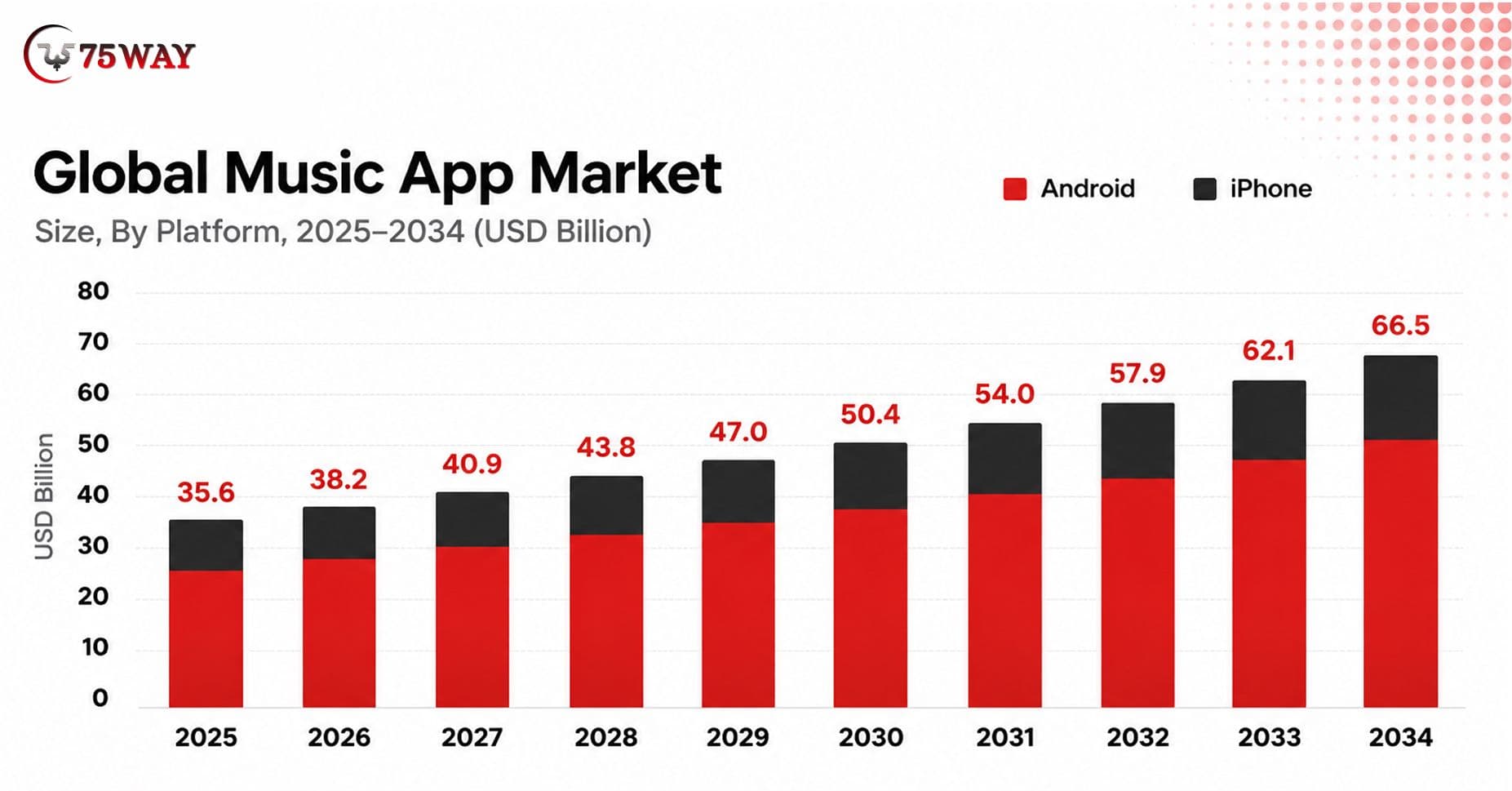
Spotify-Like Music App Market Size, Revenue Growth, & Insights
- The U.S. music streaming market is projected to reach $23.69 billion by 2030, making it the leading country by revenue.
- The global music app market is expected to grow from $30.28 billion in 2026 to $37.62 billion by 2031, at a CAGR of 4.44%.
- Another report indicates, “The global music app market will grow to approximately $66.5 billion by 2034, at a CAGR of 7.20%.”
- Subscription streaming accounted for 66.42% of the music app market, while the hybrid freemium model is forecast to grow at a 13.58% CAGR through 2031.
- Android dominates the music app market with a 71.05% share, while smart speakers and connected devices are projected to expand at a 17.25% CAGR.
- Spotify reached 300 million Premium subscribers in Q2 2026, marking a major milestone for the audio streaming industry, as stated in Spotify Reports Second Quarter 2026 Earnings.
- Spotify's monthly active users increased 12% year over year to 777 million, while total revenue reached €4.8 billion.
No doubt, these insights show why music streaming app development remains an attractive category for technology businesses. However, entering the market successfully requires more than launching another streaming application. You need a differentiated product proposition, a sustainable monetization model, a strong content strategy, and technology that supports long-term growth.
What Is Spotify Clone App Development?
Spotify clone app development means building a music streaming platform inspired by Spotify's core experience, but tailored to your own brand, audience, and business model. It can bring together music discovery, playlists, artist profiles, podcasts, personalized recommendations, offline listening, subscriptions, and smooth audio streaming in one place.
Think of it as creating your own music universe rather than simply copying Spotify. The interface, features, recommendation logic, content library, monetization model, and user experience can all be customized to suit your market.
For example, a startup could build a Spotify-style platform focused on independent artists, while another business might create a niche streaming app for regional music, devotional tracks, podcasts, or curated playlists. The development approach changes according to the audience and the experience you want to create.
How To Build A Music Streaming App Like Spotify? Step-By-Step Roadmap
A Spotify-like music app requires strong streaming infrastructure, proper music licensing, and a scalable backend. The way you build it will vary based on your target audience, the features you prioritise, and the monetisation model you choose. Thus, we break down the Spotify-style app development process in a clear flow to help you understand how such an app is built from the ground up.
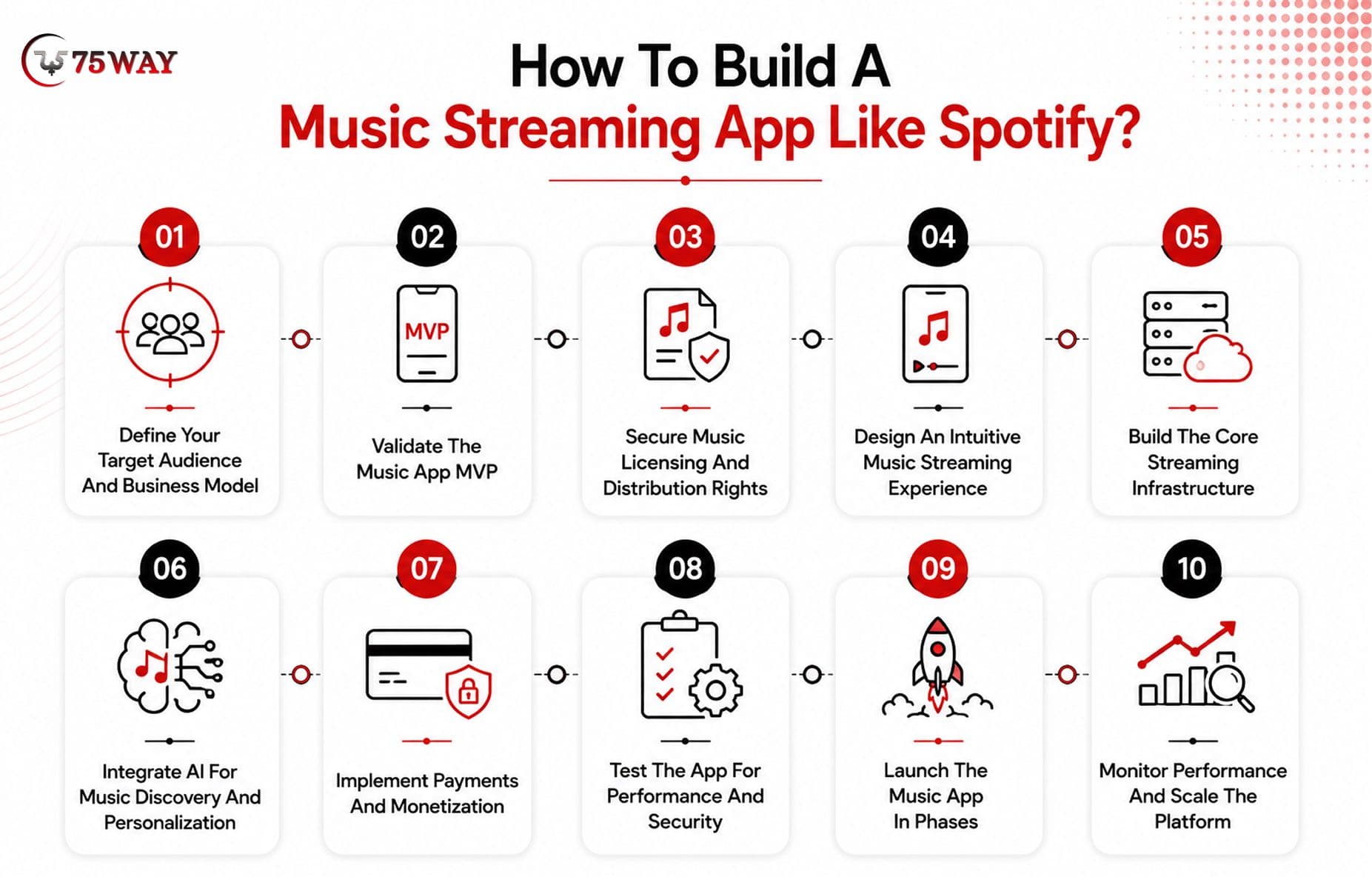
1. Define Your Target Audience And Business Model
Start by deciding who your music platform is designed for. Your audience could include mainstream listeners, independent artists, music communities, niche genres, regional audiences, fitness users, educational institutions, or businesses looking for specialized audio experiences.
Then determine how the platform will make money. You could use subscriptions, advertising, freemium access, creator plans, premium content, partnerships, or B2B licensing.
This decision affects the features you need to build. For instance, a subscription-based consumer application requires strong account management, payment integration, premium access controls, personalized recommendations, and retention features.
An artist-focused platform may require creator dashboards, content uploads, analytics, and audience engagement tools.
2. Validate The Music App MVP
Your MVP development for a music app like Spotify should solve the core problem without attempting to reproduce Spotify's entire ecosystem.
A practical first version could include user registration and profiles, a music catalog, search functionality, audio streaming, a music player, playlists, favorites, recently played history, basic recommendations, subscription management, push notifications, an admin dashboard, and listening analytics.
Instead of building everything at once, the goal is to test whether users actually engage with your core experience. Early user feedback and behavioral data will show what features matter most, what feels missing, and what can be improved or removed.
This approach is particularly useful for startups because it allows you to validate demand before committing to a large-scale platform.
3. Secure Music Licensing And Distribution Rights
Music licensing is one of the most important business considerations for a streaming platform. Owning the application does not automatically give you permission to stream commercially released music.
Depending on your catalog and business model, you may need rights covering sound recordings, compositions, publishing, performance, mechanical rights, territories, and specific forms of digital distribution.
The exact requirements depend on your market, catalog, agreements, and intended use. For a U.S.-focused platform, specialist legal advice should therefore be part of the planning process.
This should happen before development is too far along. A technically impressive streaming application cannot solve a rights problem after launch.
It is also important to distinguish between building your own music application and integrating with an existing music service. Third-party APIs may provide access to certain functionality, but their developer terms can restrict how content and streaming capabilities are used commercially.
4. Design An Intuitive Music Streaming Experience
Music is highly personal, so the interface needs to make discovery and playback feel effortless.
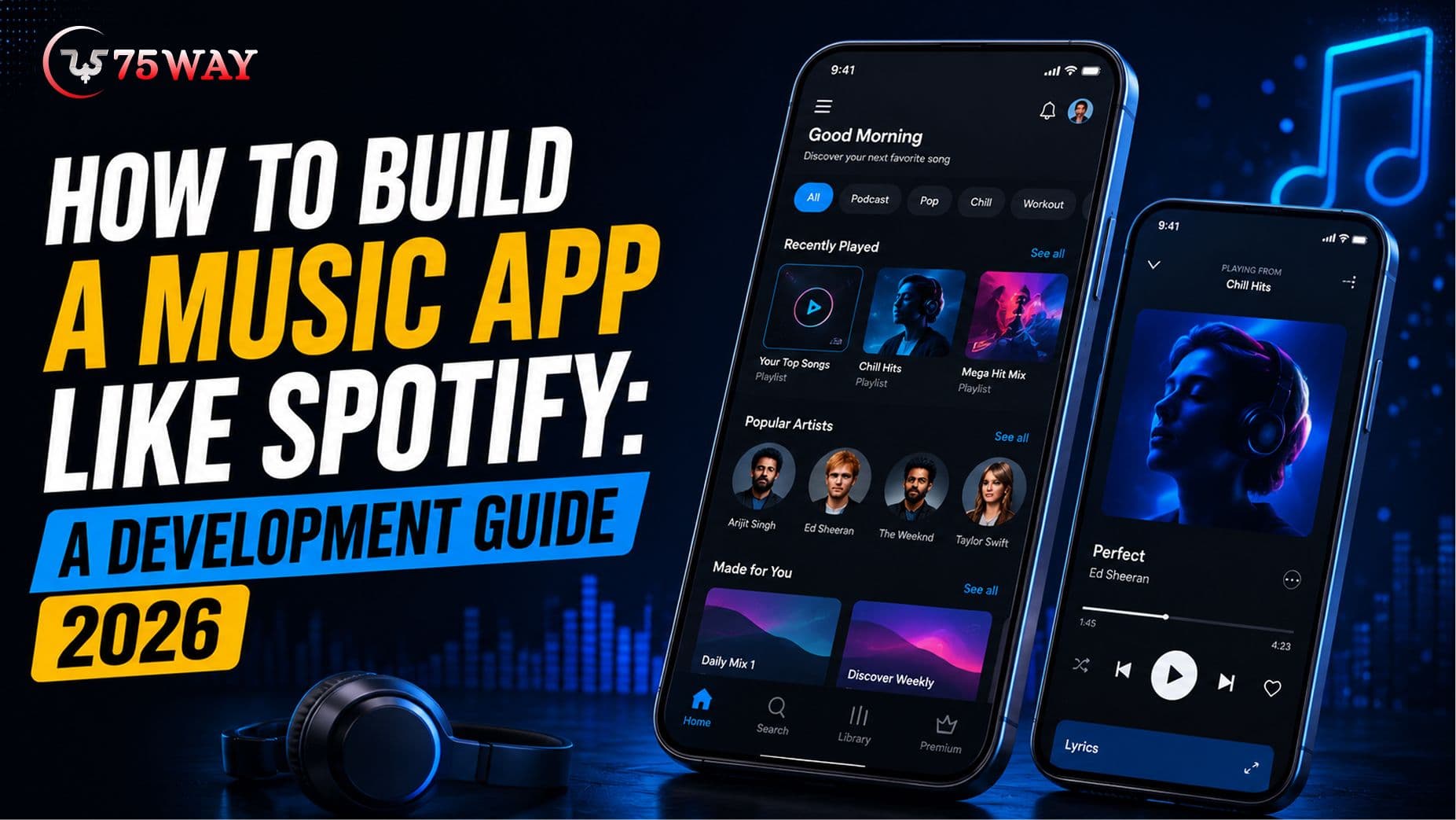
Core screens generally include home and discovery, search, artist profiles, album pages, a music player, queue management, playlist management, personal library, subscription pages, and settings.
The UI/UX design process should start by mapping how a user moves through the app. A typical flow might begin with onboarding, continue into discovering music, then playing a track, saving it, and finally adding it to a playlist or sharing it.
From there, wireframes are created to define structure, followed by high-fidelity designs that establish visual identity, spacing, typography, and interaction behavior.
The goal is not to copy Spotify's interface. Your product should have its own identity while still using familiar interaction patterns that reduce the learning curve and make the experience intuitive.
5. Build The Core Streaming Infrastructure
Streaming is the technical backbone of the application. Your architecture needs to manage audio storage, processing, delivery, playback, security, traffic, and scalability.
A typical high-level architecture can include:
Mobile/Web App → API Layer → Application Backend → Music Catalog → Storage → CDN → Audio Delivery
Additional services can handle authentication, payments, recommendations, analytics, notifications, and administration.
For growing platforms, separating application logic from media delivery is particularly important. It allows individual infrastructure components to scale according to demand instead of forcing the entire system to scale together.
You should also plan for audio quality, caching, secure access, monitoring, and offline functionality in line with the product requirements.
6. Integrate AI For Music Discovery And Personalization
Artificial Intelligence can become one of the strongest differentiators for a new music application. Rather than integrating AI simply because it is a current technology trend, identify specific listening problems it can solve.
- Personalized Recommendations: AI models can analyze signals such as listening history, skips, likes, saves, genres, artists, playlists, and session behavior to improve recommendations.
- Natural-Language Music Search: Users could search using conversational requests rather than exact titles. For example, a user might type: “Find upbeat indie music for a weekend road trip.” The system interprets intent and returns relevant results.
- AI Playlist Generation: Users can describe a mood, activity, occasion, or preferred sound, and the application can automatically generate a playlist based on those inputs.
- Voice-Based Music Assistance: A voice AI assistant can allow users to control playback, search music, or create playlists using natural speech commands.
- Smart Discovery: AI can combine behavioral data and content signals to surface tracks that users may not discover through traditional browsing.
The objective is simple: make finding the right music easier while giving users a reason to return to your platform.
7. Implement Payments And Monetization
Once the core streaming experience is stable, the next step is enabling revenue generation.
This includes integrating subscription plans, payment gateways, billing cycles, free vs premium access rules, and user entitlement management. If the platform uses advertising, ad placement logic, targeting rules, and reporting systems must also be implemented.
For creator-focused platforms, monetization may extend to artist payouts, revenue sharing models, and premium creator tools.
At this stage, the system must ensure that access control is tightly connected to payment status so users only receive features they are entitled to.
8. Test The App For Performance And Security
Testing ensures the application works reliably under real-world conditions. This includes functional testing of core features like login, search, playback, playlists, and payments.
It also includes performance testing to ensure smooth streaming under different network conditions, device testing across platforms, and security testing for authentication and data protection.
Load testing is especially important for music apps because streaming traffic can spike quickly when users play or discover content simultaneously.
The goal is to ensure the platform feels stable, fast, and consistent before public release.
9. Launch The Music App In Phases
Instead of launching to everyone at once, the rollout should happen in phases.
Start with internal testing, then move to a closed beta group, followed by a limited public release. This allows you to observe real user behavior, identify technical issues, and refine the experience before scaling.
During this phase, monitor engagement metrics such as session length, retention, most played tracks, search behavior, and subscription conversions.
Feedback collected here directly shapes the next development cycle.
10. Monitor Performance And Scale The Platform
After launch, the product enters a continuous improvement cycle.
Analytics help identify what users enjoy, where they drop off, which features drive engagement, and how monetization performs. Based on this data, the product team prioritizes updates and enhancements.
At the same time, infrastructure must scale to support more users, larger music catalogs, higher streaming demand, and more complex AI workloads.
Over time, the platform evolves from a basic MVP into a full-scale music ecosystem through repeated cycles of:
What Features Are Required to Build An App Like Spotify?
A Spotify-like platform should make music discovery, playback, personalization, and account management simple while giving your business the flexibility to introduce new revenue and engagement features over time. Here are the core features we recommend considering:
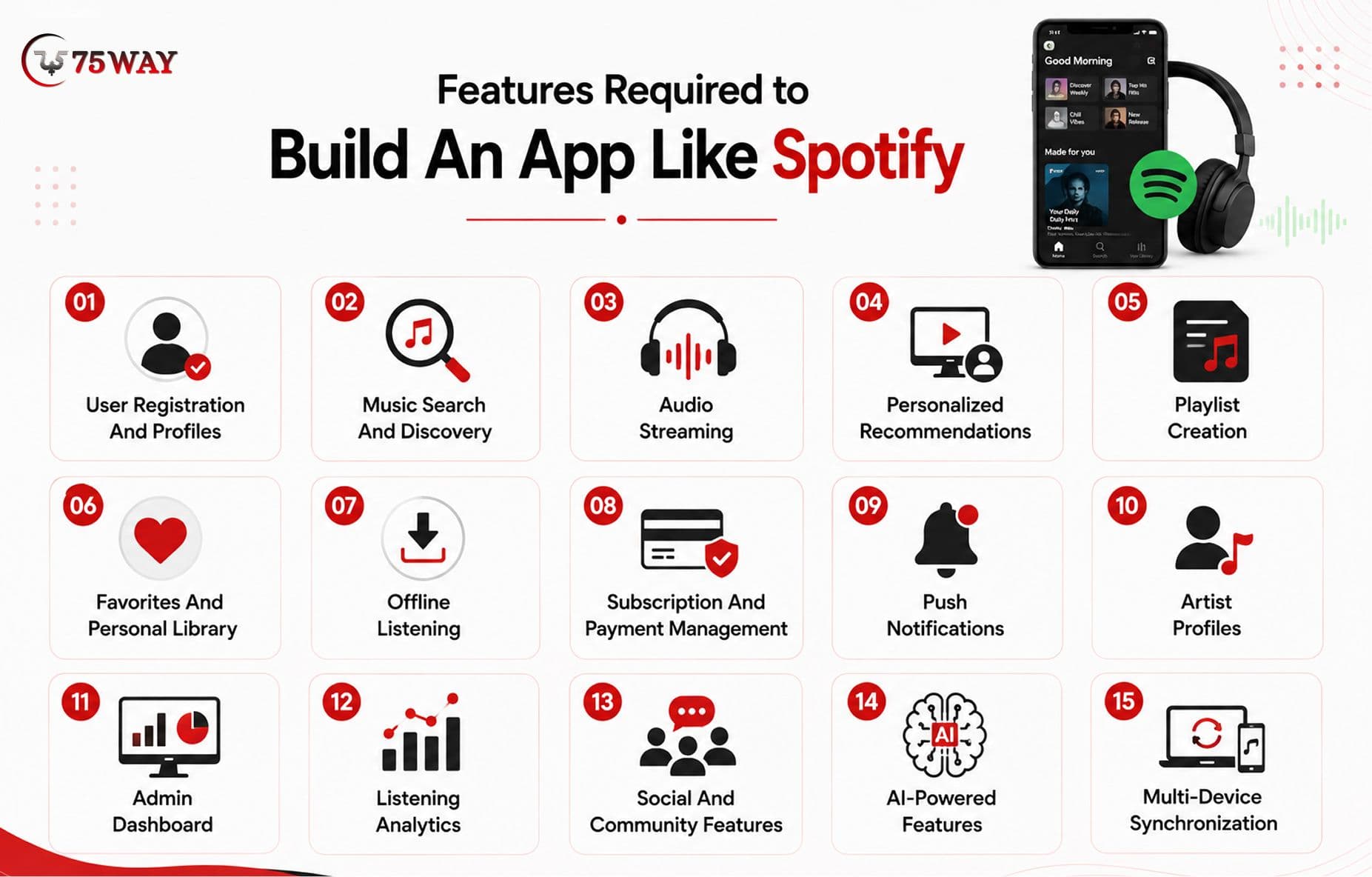
- User Registration And Profiles: Allow users to create accounts through email, phone numbers, or supported social sign-in options. Profiles can store listening preferences, favorite artists, playlists, subscriptions, and listening history to create a personalized experience.
- Music Search And Discovery: Search should help users quickly find songs, albums, artists, playlists, genres, and other available content. Intelligent search can go further by understanding conversational or descriptive queries rather than relying only on exact keywords.
- Audio Streaming: The audio player is the foundation of the application. Users should be able to play, pause, skip, replay, adjust volume, change playback modes, and manage their listening queue without interruptions.
- Personalized Recommendations: Recommendation systems can suggest songs, artists, albums, and playlists based on listening behavior and preferences. As more users interact with the platform, these recommendations can become increasingly personalized.
- Playlist Creation: Users should be able to create, edit, organize, and share playlists. Advanced platforms can introduce collaborative playlists where multiple users contribute songs to the same collection.
- Favorites And Personal Library: Give listeners an easy way to save songs, albums, artists, and playlists. A centralized library helps users return to content they already enjoy without searching again.
- Offline Listening: Premium users may expect the ability to download selected content for offline playback. This feature requires secure content management and appropriate rights for offline distribution.
- Subscription And Payment Management: If your application follows a subscription model, users should be able to select plans, make payments, upgrade or cancel subscriptions, and manage billing information through a straightforward interface.
- Push Notifications: Notifications can inform users about new releases, personalized recommendations, playlist updates, subscription events, or activity from followed artists. They should be carefully targeted so they provide value instead of becoming distracting.
- Artist Profiles: Artist pages can showcase music catalogs, albums, singles, biographies, playlists, and other relevant information. For creator-focused platforms, artist profiles can become an important part of the overall ecosystem.
- Admin Dashboard: Your internal team needs tools to manage users, music, artists, playlists, subscriptions, reports, promotions, and platform activity. A well-designed administration system reduces operational complexity as the platform grows.
- Listening Analytics: Advanced analytics can show what users listen to, when they listen, which content generates engagement, and where users drop off. These insights can support product decisions, recommendations, marketing, and monetization.
- Social And Community Features: Depending on your product strategy, you can introduce social profiles, playlist sharing, collaborative listening, music communities, comments, artist interactions, or other engagement features.
- AI-Powered Features: AI can add a new layer of personalization through intelligent recommendations, natural-language search, AI-generated playlists, mood-based discovery, voice commands, and conversational music assistants.
- Multi-Device Synchronization: Users increasingly move between phones, tablets, desktops, cars, smart speakers, and connected devices. Synchronizing playlists, preferences, playback state, and account information can create a more connected listening experience.
The final feature set should depend on your audience, business model, budget, and launch strategy. For an MVP, prioritize the capabilities that directly support your core value proposition instead of trying to build every feature simultaneously.
Tools & Technology Stack Used To Build Spotify Clone App
The technology stack behind a music app like Spotify needs to support fast playback, reliable content delivery, personalized experiences, secure transactions, and growing user demand. There is no single technology stack that works for every music platform. The right choices depend on your product scope, target platforms, expected users, AI requirements, and long-term scalability plans.
- Mobile App: The mobile application is where listeners interact with your music platform. For native development, Swift can be used for iOS and Kotlin for Android.
If you want to share development across platforms, consider technologies such as Flutter or React Native.
- Web Application: A web version can help users access their music libraries, playlists, subscriptions, and other account features through browsers. Technologies such as React and Next.js can be used to build responsive and interactive web experiences.
The final choice should depend on your application's functionality, SEO requirements, performance expectations, and frontend architecture.
- Backend Development: The backend manages the business logic that connects users, content, applications, payments, recommendations, and administrative systems.
Technologies such as Node.js, Python, Java, or other backend frameworks can be used depending on the architecture and engineering requirements.
- Database: Depending on the requirements, technologies such as PostgreSQL, MySQL, MongoDB, Redis, or a combination of databases can be used.
A music platform may use different storage technologies for different workloads rather than relying on a single database for everything.
- Cloud Infrastructure: AWS, Microsoft Azure, and Google Cloud can provide services for application hosting, object storage, databases, networking, analytics, security, and other infrastructure requirements.
The architecture should be designed around expected traffic and growth rather than selecting cloud services simply because they are popular.
- Audio Storage And Content Delivery: Music files can require significant storage and efficient delivery infrastructure, particularly as the catalog grows.
Cloud object storage can be used to store audio content, while a Content Delivery Network (CDN) can distribute media closer to listeners and reduce latency. The architecture can also incorporate audio processing, multiple quality levels, caching, secure access, and monitoring based on product requirements.
- AI & Machine Learning: Python is commonly used for machine learning workflows, while model APIs and specialized AI services can support capabilities such as:
The recommendation architecture should be designed to learn from relevant user signals while maintaining appropriate privacy and data-handling practices.
- Payment Integration: If your platform uses subscriptions or other paid features, payment processing needs to be integrated into the application.
The payment solution should be selected based on the target market, supported currencies, business model, and platform requirements.
- Analytics & Monitoring: You can monitor metrics such as listening sessions, searches, skips, playlist activity, retention, subscription conversions, crashes, and feature engagement.
Monitoring tools can also track application performance, infrastructure health, API response times, errors, and streaming-related issues.
- Security & Authentication: A music platform may need secure authentication, authorization, encrypted data transmission, protected APIs, payment security, access controls, monitoring, and appropriate data-management practices.
The exact security requirements depend on the type of information the platform collects, the services it integrates, and the markets it serves.
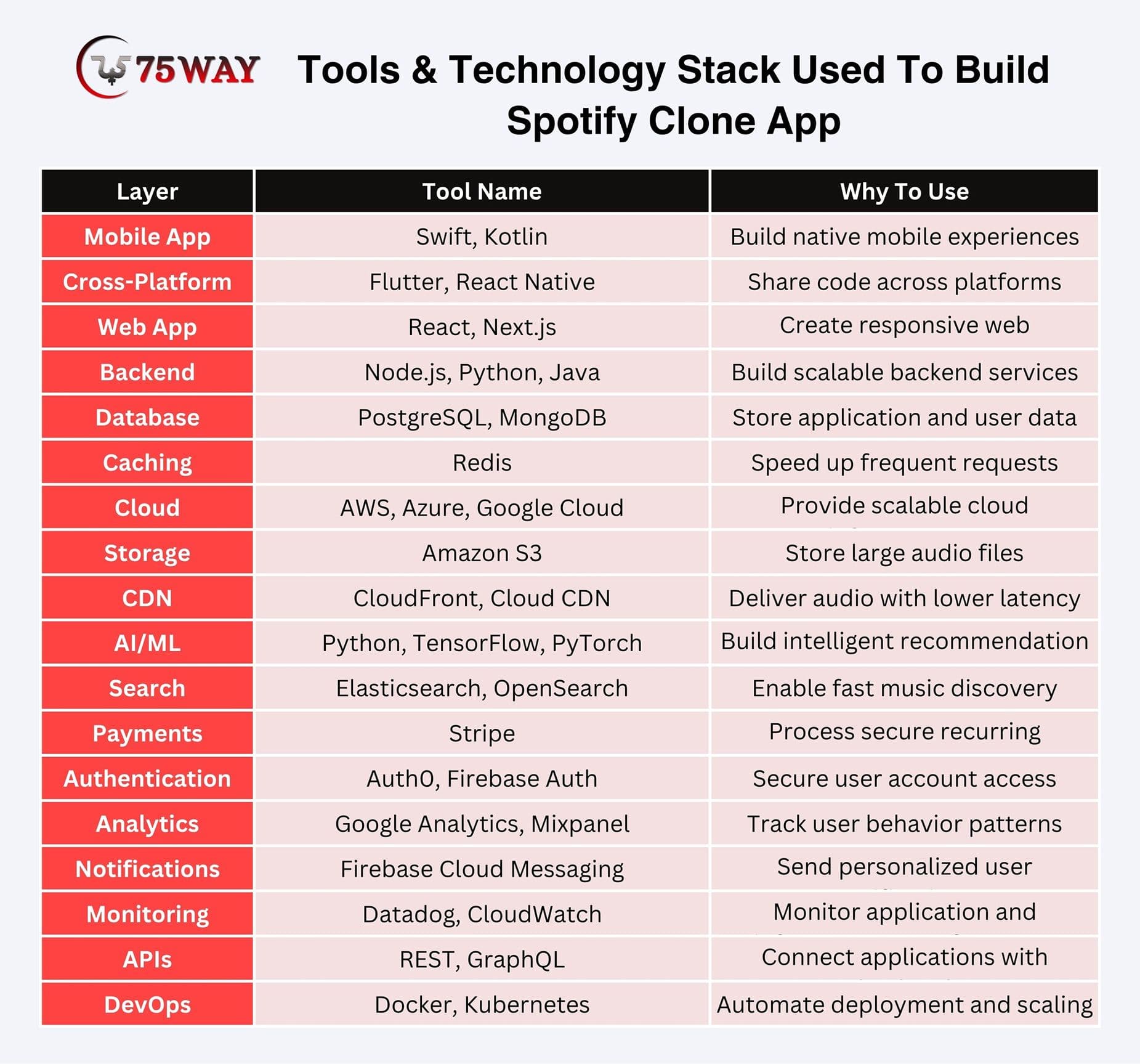
Recommended Architecture For A Scalable Music App
A simplified architecture could look like this:
Mobile/Web Apps → API Gateway → Backend Services → Databases & Business Logic → Music Storage → CDN → Audio Delivery
Supporting services can handle AI recommendations, payments, authentication, analytics, notifications, monitoring, and administration.
The key is not to select the most complicated architecture from day one. Build what the current product requires while keeping the foundation flexible enough to support additional users, platforms, features, and integrations as the business grows.
How Much Does It Cost To Develop A Music App Like Spotify?
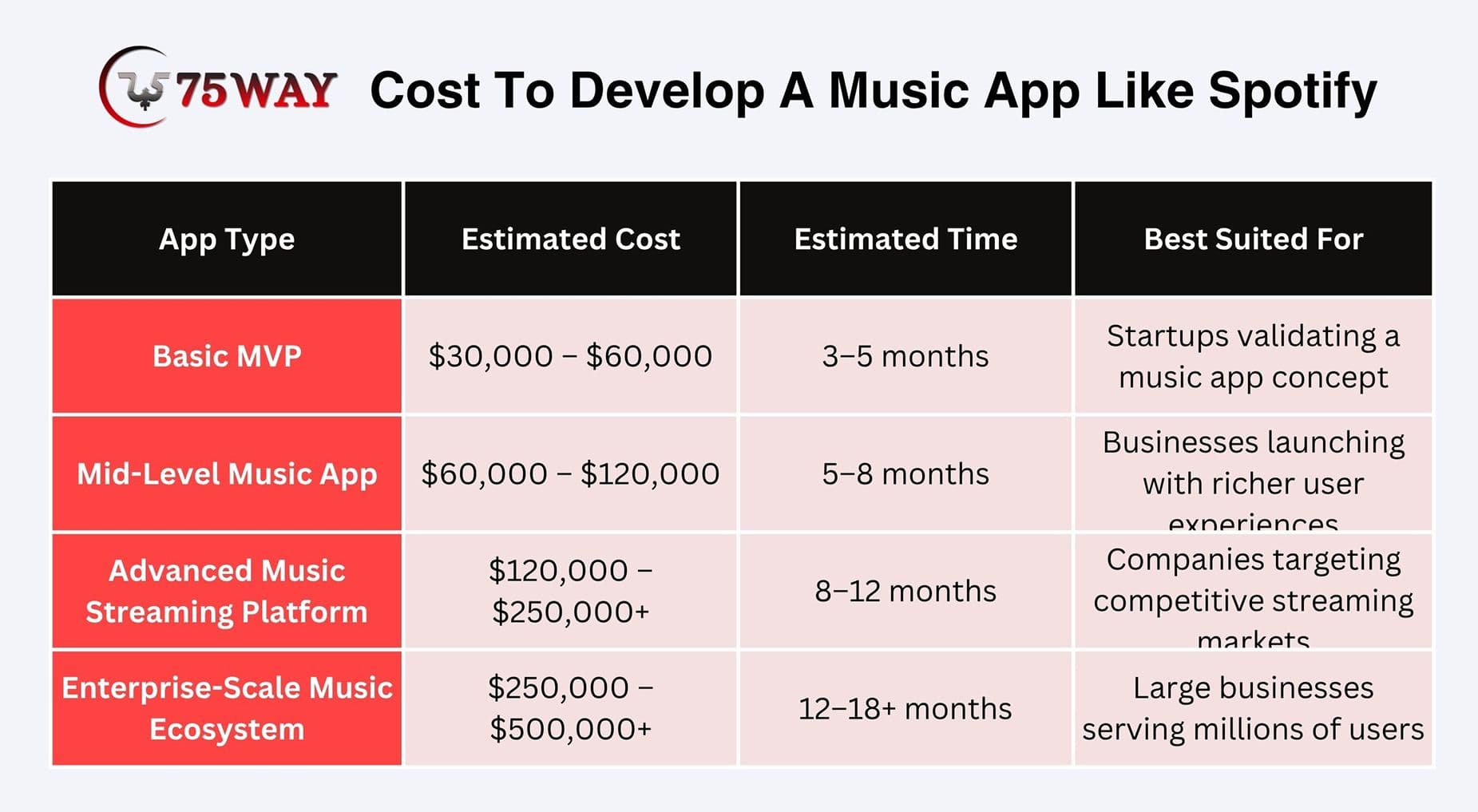
On average, the cost to develop a music app like Spotify ranges between $30,000 – $300,000+ based on project needs, business goals, features, AI capabilities, platforms, streaming infrastructure, integrations, and scalability requirements.
The right budget depends on what you want your music platform to achieve. A basic application focused on core streaming functionality will require a different investment than a platform with AI recommendations, offline downloads, social features, multiple platforms, artist tools, and advanced analytics.
- Basic MVP: A basic MVP for the Spotify app focuses on the essential music-listening experience. It can include a core music player, user registration, basic search, and simple playlist creation. This approach is suitable for startups that want to validate their concept before investing in advanced functionality.
Estimated Cost: $30,000 – $60,000
- Mid-Level Music App: A mid-level application similar to Spotify introduces more sophisticated functionality, such as offline downloads, AI-driven recommendations, social sharing, and cross-platform support. It is suitable for businesses that want to launch with a richer experience and stronger engagement capabilities.
Estimated Cost: $60,000 – $120,000
- Advanced Music Streaming Platform: An advanced platform can include AI-powered personalization, sophisticated recommendation engines, offline listening, social communities, artist dashboards, advanced analytics, multiple applications, voice capabilities, and scalable streaming infrastructure.
Estimated Cost: $120,000 – $250,000+
- Enterprise-Scale Music Ecosystem: An enterprise-grade platform requires considerably more infrastructure and engineering effort. It may support millions of users, multiple content providers, advanced AI systems, several device categories, extensive analytics, complex monetization, creator ecosystems, and high-availability architecture.
Estimated Cost: $250,000 – $500,000+
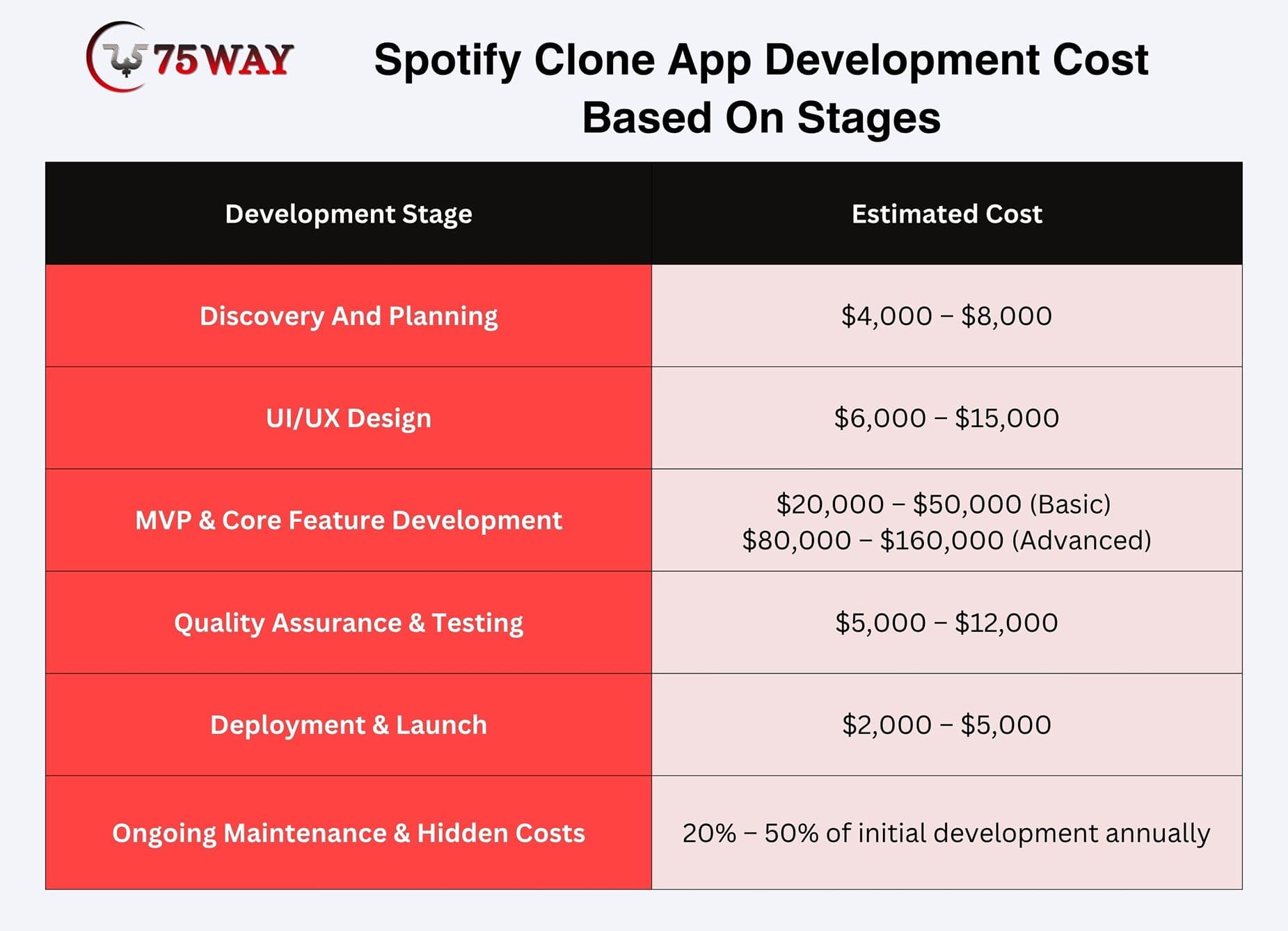
Spotify Clone App Development Cost Based On Stages
The overall investment is distributed across several stages, from product discovery and design to development, testing, launch, and ongoing maintenance. Understanding these individual stages gives business owners a clearer view of where their development budget is allocated.
1. Discovery And Planning: Include audience research, competitor analysis, product requirements, feature prioritization, business-model planning, technical feasibility, and the initial development roadmap.
Estimated Cost: $4,000 – $8,000
2. UI/UX Design: For a music platform, the design typically covers onboarding, discovery, search, music playback, playlists, profiles, subscriptions, and other important user journeys.
Estimated Cost: $6,000 – $15,000
3. MVP & Core Feature Development: Depending on the scope, development can cover authentication, music streaming, search, playlists, user profiles, recommendations, payments, APIs, notifications, analytics, and administration.
Estimated Cost: $20,000 – $50,000 (Basic) / $80,000 – $160,000 (Advanced)
4. Quality Assurance & Testing: Testing ensures that the application performs reliably across different devices, operating systems, network conditions, and user scenarios.
Estimated Cost: $5,000 – $12,000
5. Deployment & Launch: It can include server configuration, production deployment, application-store preparation, final testing, monitoring, release management, and launch support.
Estimated Cost: $2,000 – $5,000
6. Ongoing Maintenance & Hidden Costs: Music platforms require ongoing updates, security improvements, bug fixes, operating-system compatibility, performance optimization, technical support, and new feature development.
Estimated Cost: 20% to 50% of initial development annually
Cost To Hire Music App Developers for Spotify App Development Based On Location
Developer location can also influence the overall project budget because hourly development rates vary between markets. However, businesses should evaluate technical expertise, communication, project management, security practices, industry experience, and post-launch support alongside hourly rates.
- USA And UK Development Teams
Development teams in the USA and UK generally operate at higher hourly rates, but they can be suitable for businesses that prioritize close collaboration, overlapping working hours, specialized expertise, and direct communication with a local or Western market team.
Estimated Cost: $100 – $200 per hour
- Eastern Europe Development Teams
Eastern European development teams can offer a balance between development costs and access to experienced software engineering talent. The region is widely used for outsourcing complex web, mobile, SaaS, and software projects.
Estimated Cost: $40 – $80 per hour
- India Development Teams
India offers comparatively lower development rates while providing access to large software engineering teams across mobile development, backend engineering, AI, cloud, and other technology areas.
Estimated Cost: $15 – $50 per hour
What Factors Affect Cost To Develop Spotify-Like Music Application?
The costs to build a Spotify-like app defined above are starting points rather than fixed quotations. Several product decisions can significantly change the final budget.
Number of Platforms: Building for iOS, Android, web, desktop, smart TVs, vehicles, or connected devices increases development and testing requirements. Launching on fewer platforms initially can help control the first-stage investment.
AI And Personalization: Basic recommendations require less engineering than advanced AI capabilities such as natural-language music search, intelligent playlist generation, mood-based discovery, conversational assistants, voice AI, and sophisticated recommendation engines.
Streaming Infrastructure: Audio storage, transcoding, content delivery, caching, security, monitoring, and cloud infrastructure all influence development and operating expenses. The architecture also needs to accommodate expected concurrent listeners.
Offline Listening: Offline playback introduces additional technical and rights-related considerations. Secure downloads, content authorization, storage management, synchronization, and playback controls can increase development complexity.
Social Features: Collaborative playlists, user profiles, social sharing, communities, comments, activity feeds, and creator interactions require additional backend functionality, moderation workflows, and data management.
Artist And Creator Features: A platform that supports artists may require content uploads, artist profiles, analytics, dashboards, payouts, catalog management, and creator-specific workflows, adding another layer to the product architecture.
Third-Party Integrations: Payment gateways, analytics platforms, authentication services, cloud providers, notifications, content services, and other integrations can increase development, testing, and maintenance requirements.
How Can You Reduce the Initial Cost of Spotify-Like App Development?
The most practical way to control your initial investment is to launch with a focused MVP rather than attempting to reproduce Spotify's entire ecosystem.
Start with the features that directly support your core business proposition. Once users begin interacting with the product, analytics can show which capabilities generate engagement and which areas deserve additional investment.
For example, a startup could initially launch with user accounts, music search, streaming, playlists, favorites, and basic recommendations. Advanced AI, offline downloads, social listening, artist dashboards, voice capabilities, and additional platforms can then be introduced as the business grows.
It also gives founders greater control over their investment because every subsequent development phase can be informed by actual user behavior and business performance.
Monetization Strategies To Make Money From Music App Like Spotify
Rather than copying Spotify's business model exactly, businesses should choose a revenue strategy that fits their specific audience and product positioning.
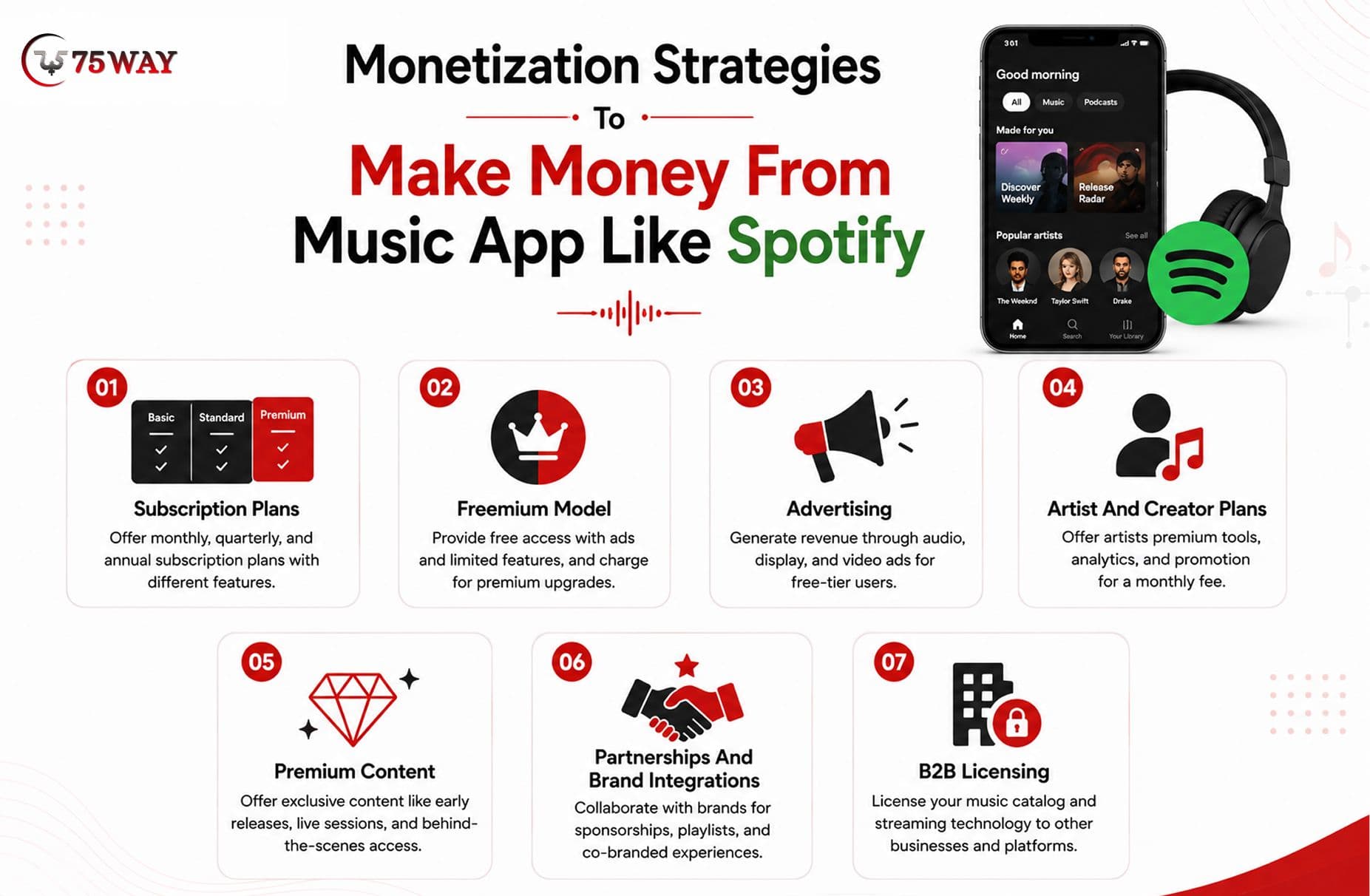
1. Subscription Plans
Subscriptions are one of the most common monetization models for music streaming platforms. Users pay a recurring monthly or annual fee to access premium capabilities.
For example, a platform could offer a $9.99/month individual plan, a $14.99/month family plan, or a higher-priced plan with additional benefits such as lossless audio, offline downloads, or exclusive content.
Subscription plans can provide benefits such as ad-free listening, higher audio quality, offline downloads, unlimited skips, exclusive content, or advanced personalization.
2. Freemium Model
A freemium strategy allows users to access a limited version of the platform for free while premium capabilities remain behind a paid subscription.
For example, you could offer a free plan with advertising and limited skips, then encourage users to upgrade to a $9.99/month premium plan for an ad-free experience, unlimited skips, and offline listening.
The free tier can help attract users and demonstrate the value of the platform before asking them to upgrade.
3. Advertising
Advertising allows businesses to monetize users who do not want to pay for subscriptions.
For example, a music app could offer free listening supported by audio or display advertising. If advertisers pay based on impressions, a platform generating 100,000 ad impressions at a $5 CPM could generate approximately $500 from those impressions.
Actual advertising revenue varies according to audience location, advertiser demand, format, engagement, and other factors.
Ads can appear between tracks, inside playlists, within discovery experiences, or through other carefully designed placements. However, excessive interruptions can negatively affect the listening experience.
4. Artist And Creator Plans
If your platform is designed around independent artists, creators can become another revenue source.
For example, you could offer a free artist account and a professional plan costing $19.99/month that provides enhanced analytics, promotional capabilities, advanced profile customization, audience insights, or additional creator tools.
This model can create a two-sided business where listeners use the platform for discovery while creators pay for additional capabilities.
5. Premium Content
Businesses can offer exclusive content that is unavailable through the free experience.
For example, an artist could release an exclusive live session for $4.99, or a platform could offer a premium collection as part of a $7.99/month content plan.
This could include exclusive albums, artist sessions, interviews, live recordings, educational audio, specialized playlists, or other premium experiences.
The effectiveness of this model depends heavily on the uniqueness and perceived value of the content.
6. Partnerships And Brand Integrations
Music platforms can work with brands, events, artists, media companies, fitness businesses, automobile companies, or other organizations.
For example, a fitness brand might pay $10,000 for a sponsored workout-music campaign, while a festival could pay for a branded discovery experience.
These figures are illustrative examples rather than standard market rates. Actual partnership revenue depends on audience size, campaign scope, reach, engagement, and commercial agreements.
7. B2B Licensing
A music technology platform can also monetize its infrastructure or specialized experience through business customers.
For example, a specialized music platform could charge a business $500/month for access to a customized audio solution, while larger enterprise customers could have contracts worth $5,000/month or more, depending on usage, features, support, and licensing arrangements.
This model can be attractive when the product solves a specific business problem rather than competing directly for mass-market listeners.
Which Monetization Model Should You Choose?
The best monetization strategy depends on your audience and product proposition.
- A consumer streaming service could combine freemium access, advertising, and $9.99/month subscriptions.
- An independent-artist platform could generate revenue through $19.99/month creator plans and premium tools.
- A specialized B2B platform could focus on $500/month or higher business subscriptions and enterprise contracts.
These examples are useful for understanding how different models can work, but they are not fixed pricing recommendations.
Your actual pricing should consider customer willingness to pay, content costs, licensing requirements, competitor positioning, acquisition costs, and expected margins. You can also combine multiple revenue models as the product matures.
For a new music platform, the goal should not simply be to maximize the number of revenue streams. It should be to build a monetization model that supports the user experience, works with your content rights, and creates sustainable economics as the platform grows.
How Can You Make Your Music App Stand Out From Spotify?
A stronger strategy is to identify an underserved audience or listening problem and build an experience around it. Your competitive advantage could come from personalization, niche content, creator-focused tools, social experiences, AI-powered discovery, or a business model that gives users and artists more value.
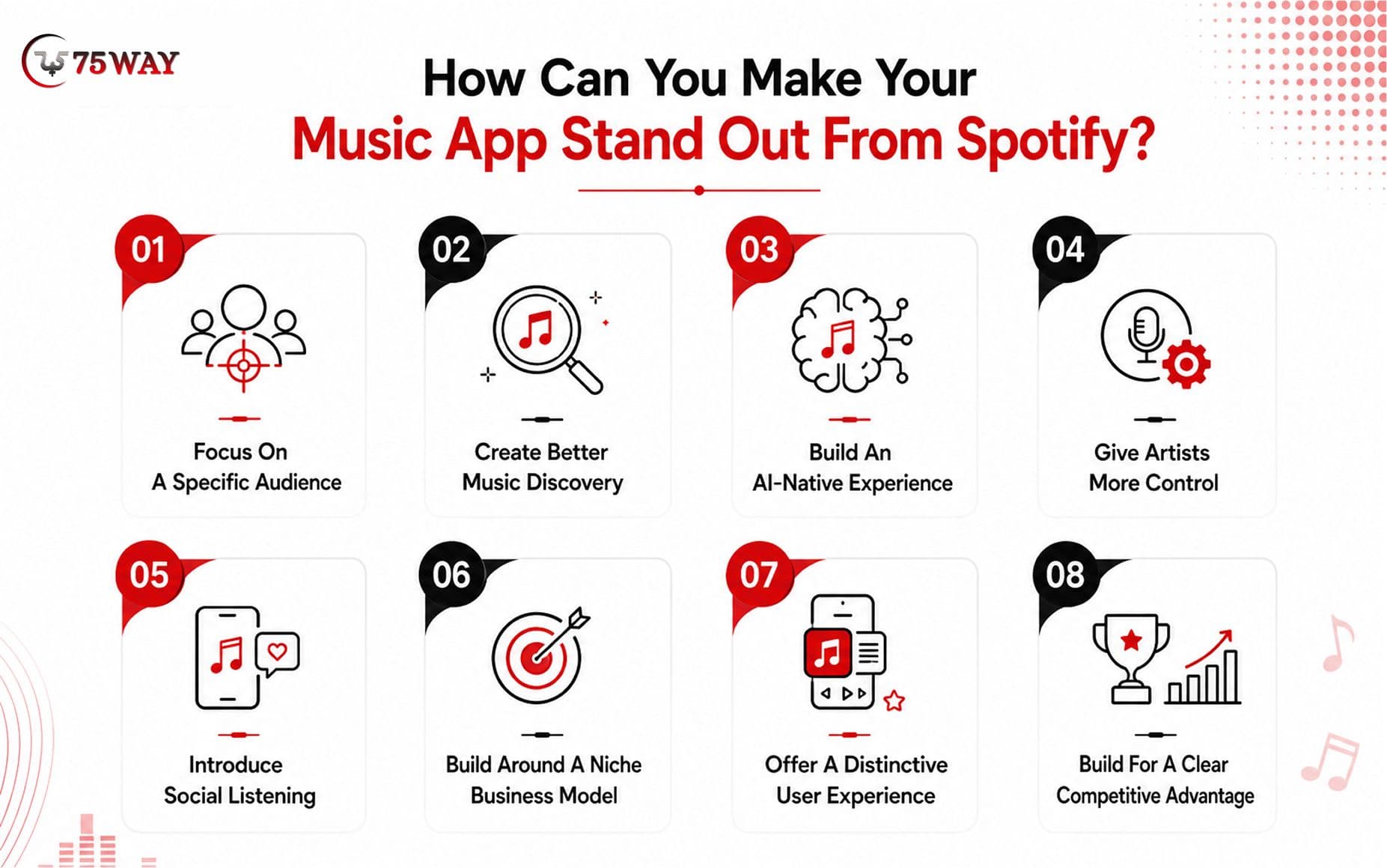
- Focus On A Specific Audience: Instead of trying to attract every music listener, consider building around a clearly defined audience.
You could target independent artists, regional music communities, specific genres, fitness enthusiasts, music students, audiophiles, or listeners looking for specialized content. A focused audience makes it easier to understand user expectations and develop features that directly address them.
- Create Better Music Discovery: Discovery is one of the biggest opportunities for differentiation. A new platform could use behavioral signals, contextual information, semantic search, and AI recommendations to help users find music that matches their interests.
Instead of presenting the same popular tracks to everyone, your application could continuously learn from listening behavior and provide more personalized suggestions.
- Build An AI-Native Experience: AI can become part of the product's core interaction rather than an additional feature. For example, users could type:
“Give me energetic music for a 30-minute workout.”
The application could interpret the request and generate a suitable listening experience. You could also introduce conversational music assistants, AI-generated playlists, mood-based discovery, voice controls, and intelligent recommendations.
- Give Artists More Control: Independent artists may represent another strong opportunity. A platform could provide creators with better audience analytics, direct fan engagement, promotional tools, customizable profiles, content management, and alternative monetization opportunities.
For example, instead of simply uploading a track, an artist could understand which audiences are listening, where listeners are discovering their music, and which songs generate the strongest engagement.
- Introduce Social Listening: Music is naturally social, which makes community features another potential differentiator.
Depending on the business model, your platform could support collaborative playlists, music sharing, listening rooms, artist communities, fan profiles, group discovery, or social recommendations. These capabilities can give users additional reasons to return beyond simply playing songs.
- Build Around A Niche Business Model: A specialized business model can help a new platform avoid direct competition with mainstream streaming services.
For example, you could create a platform dedicated to a specific music community and combine streaming with premium content, creator tools, events, merchandise, education, or community membership.
A niche platform does not need Spotify's audience size to become commercially valuable if its users have a strong reason to choose it.
- Offer A Distinctive User Experience: Your application should have its own product identity rather than becoming a visual copy of Spotify. Navigation patterns can remain familiar while the branding, discovery experience, social functionality, personalization, and overall product journey are designed around your target audience.
The objective is not to answer:
“How can we build another Spotify?”
The better question is:
“What can we help listeners or creators do better than existing platforms?”
That answer should guide your feature roadmap, technology choices, AI strategy, monetization model, and marketing.
- Build For A Clear Competitive Advantage: A successful music app needs a reason for users to switch, stay, or pay.
That advantage might be better discovery, exclusive content, stronger artist relationships, niche communities, personalized AI experiences, specialized audio, or a more attractive business model.
Once that advantage is clearly defined, development becomes much more focused because every major feature can be evaluated against the same question: Does this make the product more valuable to our target users?
What Happens After Launching A Spotify-Inspired Music App?
Launching your music app is the beginning of the product's growth phase, not the end of development. Once real users start streaming music, creating playlists, searching for artists, and subscribing to plans, you gain data that can reveal what is working and where the experience needs improvement.
- Monitor User Behavior: Analytics should help you understand how people interact with the platform. Track metrics such as daily and monthly active users, listening sessions, average listening duration, skips, searches, playlist creation, retention, subscription conversions, cancellations, and feature engagement.
These insights can show whether users are discovering the right content and which parts of the application need attention.
- Improve Recommendations: Your recommendation system should become more useful as the platform collects legitimate user interaction data. Listening history, favorites, skips, searches, playlists, and other relevant signals can help improve personalized recommendations.
The objective is not simply to recommend more songs. It is to recommend content that feels increasingly relevant to each listener.
- Optimize Streaming Performance: Monitor playback failures, buffering, loading times, API response times, CDN performance, and infrastructure utilization. As the number of listeners increases, you may need to optimize caching, storage, content delivery, database performance, and backend services.
Reliable playback should remain a priority because technical interruptions can directly affect user satisfaction and retention.
- Introduce New Features Based On Demand: Do not add features simply because competitors have them. Use customer feedback and product analytics to identify capabilities that can genuinely improve the platform.
For example, if users frequently create playlists but struggle to discover suitable tracks, AI playlist generation may be a better investment than adding an unrelated social feature. This creates a roadmap based on actual product behavior rather than assumptions.
- Scale Your Infrastructure: A growing music application may eventually need to support more users, larger music catalogs, additional platforms, higher streaming traffic, and more sophisticated AI workloads.
Cloud infrastructure can be scaled as demand increases, while databases, APIs, storage, CDNs, recommendation systems, and monitoring services can be optimized independently. This is why scalable architecture should be considered during the initial development stage.
- Strengthen Security: As the user base grows, security becomes increasingly important.
Regular security reviews, dependency updates, access-control checks, API protection, authentication improvements, monitoring, and vulnerability testing can help protect the platform and its users. Payment systems and sensitive account information require additional attention.
- Expand Monetization: Once you understand user behavior, you can experiment with pricing and monetization. For example, you could introduce additional subscription tiers, family plans, creator packages, premium content, advertising options, or business partnerships.
Changes should be guided by customer value and measurable results rather than adding revenue streams simply for the sake of diversification.
- Build A Continuous Improvement Cycle: A successful music application should evolve continuously. The post-launch cycle can look like:
Monitor → Analyze → Prioritize → Improve → Test → Measure → Scale
This approach allows your product team to invest in features and infrastructure based on real-world evidence.
For founders, that means the initial development budget is not the entire product investment. A successful music platform requires ongoing product development, infrastructure management, user research, optimization, and innovation as the market and audience evolve.
What Music Licensing Do You Need For A Spotify-Like App?
Music licensing is one of the most important considerations when developing a commercial music streaming application. For a U.S.-focused music streaming platform, licensing can involve multiple rights holders and organizations. The exact requirements depend on your catalog, business model, type of use, and how users access the music.
1. Understand The Different Rights
A commercially released song can involve multiple rights.
The sound recording is the specific recorded performance, while the musical composition covers the underlying music and lyrics. Different parties may control these rights, which means your business may need agreements with different rights holders.
Depending on your service and distribution model, you may also need to consider rights related to reproduction, performance, synchronization, and other forms of use.
The important point is that music rights are not a single checkbox.
2. Music Licensing Organizations You Must Consider To Build Music App Like Spotify
For businesses planning a music streaming app in the U.S., several organizations and rights holders may become relevant depending on the music and functionality your platform offers.
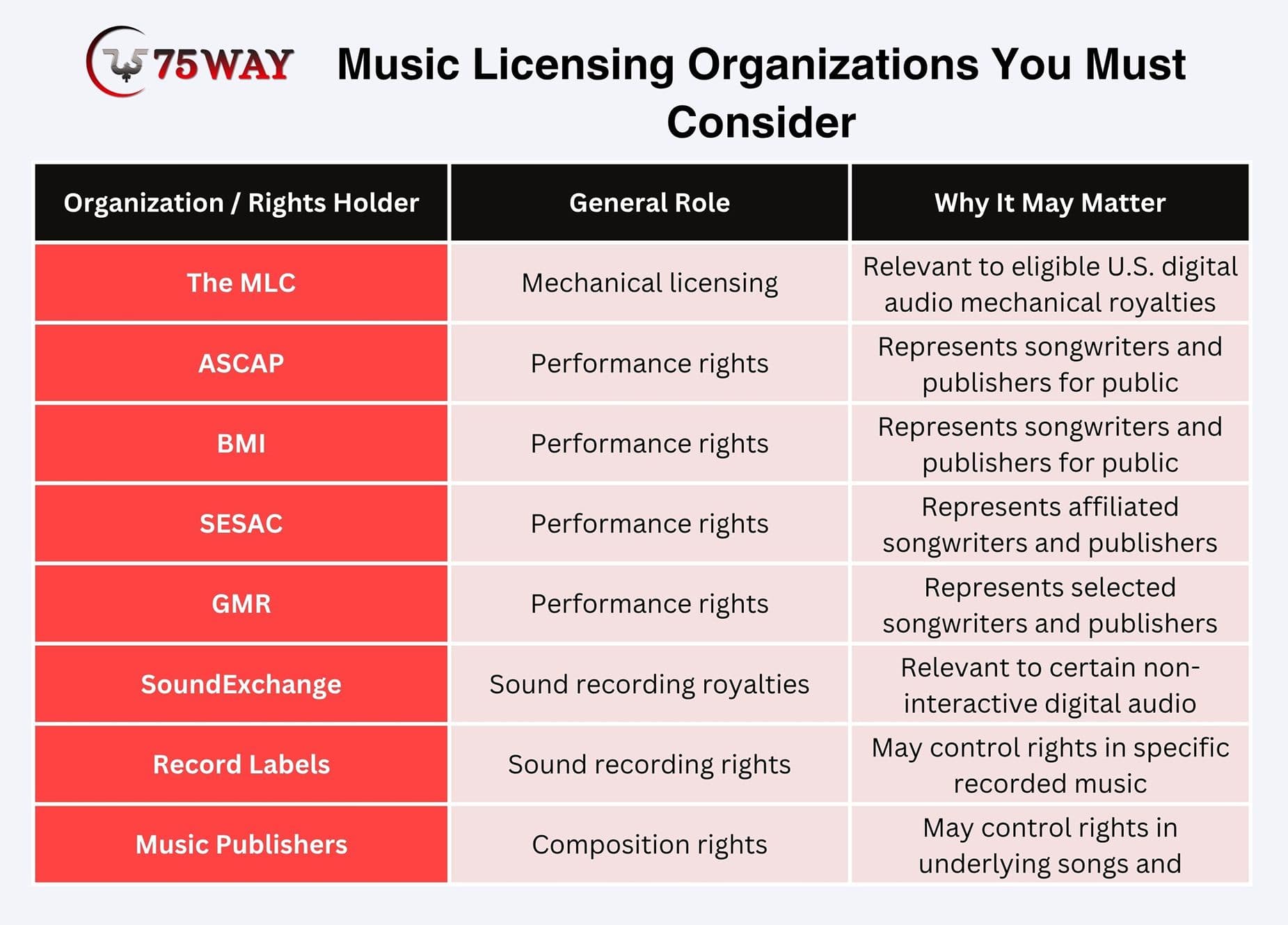
These organizations do not all provide the same type of license, and a single agreement does not necessarily give your platform every right required to stream a particular song.
- The MLC: If your platform uses musical compositions in qualifying digital audio services, mechanical licensing and royalty obligations need to be evaluated as part of the business and legal planning.
- ASCAP, BMI, SESAC And GMR: Theseare performance-rights organizations associated with songwriters, composers, and music publishers. Their relevance depends on how music is performed or communicated through your service and the repertoire represented by each organization.
For a commercial music platform, your legal and licensing team should determine which performance rights apply to your specific service.
- SoundExchange: Itis associated with statutory sound-recording royalties for certain eligible non-interactive digital audio transmissions in the United States. This distinction is important because an interactive on-demand streaming service may involve different licensing arrangements from a non-interactive digital radio-style service.
Therefore, you should not assume that a SoundExchange license alone covers an on-demand music streaming platform.
- Record Labels And Music Publishers: If your application intends to offer commercially released recordings, you may also need agreements with the companies or rights holders controlling those recordings.
Record labels can control rights associated with specific sound recordings, while music publishers and other rights holders can control interests in the underlying compositions.
This is why building a large commercial catalog can involve negotiations beyond simply approaching a single licensing organization.
What Licenses Does A Spotify-Like App Actually Need?
The answer depends on how your application works.
An on-demand music streaming service may need to address rights associated with both the sound recording and the underlying musical composition.
A non-interactive streaming service can operate under a different licensing framework.
An artist-focused platform that primarily distributes music from independent creators may structure agreements directly with artists or other rights holders.
A platform offering podcasts, original recordings, or user-generated content can introduce additional rights and contractual considerations.
Your product model therefore needs to be defined before determining the final licensing structure.
Why Licensing Should Be Planned Before Development
Licensing decisions can directly influence your technology and product architecture.
For example, geographic restrictions may determine which users can access particular tracks. Content agreements may affect whether downloads are permitted. Rights expiration can determine when content needs to be removed. Royalty reporting can also require additional backend and analytics functionality.
Your platform may therefore need a rights-management system that tracks:
- Content ownership
- Licensing agreements
- Geographic availability
- Usage restrictions
- License expiration
- Artist and publisher information
- Royalty-related data
- Takedown requirements
- Content-specific permissions
These rules can then be connected to your catalog and streaming infrastructure.
Do You Need All These Licenses?
Not necessarily. There is no universal licensing package that applies to every music application. The rights you need depend on whether your platform offers interactive streaming, non-interactive streaming, downloads, user uploads, original content, podcasts, or other forms of audio.
For a U.S.-focused commercial music app, the safest approach is to define your catalog and product model first, then have qualified music-rights or entertainment counsel determine the applicable licenses and agreements.
Your development partner can then build the platform around those confirmed requirements.
Note: Licensing organizations, statutory frameworks, and agreements can change, so businesses should verify current requirements directly with the relevant organizations and qualified legal professionals before launching a commercial music service.
How Can AI Improve A Music App Like Spotify?
AI can improve music apps by making discovery, recommendations, playlists, and user interactions more personalized and conversational.
- AI Music Recommendations: Analyzes listening behavior to suggest songs, artists, albums, and playlists users may enjoy.
- Natural-Language Search: Understands conversational searches such as “play relaxing music for a Sunday morning.”
- AI Playlist Generation: Creates personalized playlists based on moods, activities, genres, preferences, or user requests.
- Mood-Based Discovery: Recommends music based on emotions, activities, listening patterns, and contextual preferences.
- AI Music Assistant: Helps users discover songs, create playlists, find artists, and control supported app functions through conversation.
- Voice AI: Enables hands-free music searches and playback commands through natural voice interactions.
- AI User Segmentation: Identifies listener behavior patterns to support personalized recommendations, retention, and targeted experiences.
- Artist Insights: Uses analytics and AI to help artists understand listeners, track performance, and identify audience trends.
- AI Content Discovery: Connects users with relevant music by combining catalog information, user preferences, and behavioral signals.
- Conversational Recommendations: Lets users describe what they want to hear and receive personalized music suggestions.
Challenges And Solutions of Developing A Music App Like Spotify
A music app like Spotify comes with challenges that can affect everything from streaming quality and licensing to recommendation accuracy, scalability, and subscription management. The right technical and business decisions can address these hurdles before they turn into costly problems.
1. Music Licensing: Securing music rights, agreements, and territorial permissions can be complex and may affect your catalog and features.
Solution: Define your content model early and work with qualified music-rights professionals to identify the applicable licenses and agreements.
2. Streaming Performance: Buffering, playback failures, and slow loading can quickly damage the listening experience.
Solution: Use scalable cloud infrastructure, CDN delivery, caching, monitoring, and performance testing to support reliable audio streaming.
3. Large Music Catalogs: Managing thousands or millions of tracks requires accurate metadata, artist information, content availability, and catalog controls.
Solution: Build structured content-management and metadata systems with automated validation and administration tools.
4. User Retention: Users already have many music platforms to choose from, making long-term engagement difficult.
Solution: Focus on personalized discovery, relevant recommendations, playlists, exclusive content, and features designed around your specific audience.
5. AI Personalization: Recommendation systems need relevant data, suitable models, continuous improvement, and responsible data handling.
Solution: Start with clear recommendation use cases and gradually improve AI models using appropriate user interaction signals.
6. Platform Scalability: Increasing users, music catalogs, and concurrent streams can place significant pressure on infrastructure.
Solution: Design modular cloud architecture that allows databases, APIs, storage, CDN, and AI services to scale according to demand.
7. Data Security: User accounts, payments, subscriptions, and APIs can create significant security requirements.
Solution: Implement secure authentication, authorization, encryption, access controls, monitoring, regular testing, and appropriate security practices from the beginning.
8. Cross-Platform Development: Supporting iOS, Android, web, and connected devices can increase development and testing complexity.
Solution: Select platforms based on your target audience and use native or cross-platform technologies according to product requirements.
9. Monetization: Subscription pricing, advertising, content costs, and user acquisition expenses can affect profitability.
Solution: Validate your monetization model early and use analytics to optimize pricing, premium features, advertising, and other revenue channels.
10. Market Competition: Competing directly with established platforms such as Spotify can make customer acquisition challenging.
Solution: Focus on a specific audience, underserved use case, distinctive content strategy, stronger personalization, creator tools, or another clear competitive advantage.
11. Development Costs: Building advanced streaming, AI, social, and multi-platform capabilities can quickly increase the initial investment.
Solution: Launch a focused MVP, validate demand, measure user behavior, and introduce advanced capabilities as the business gains traction.
12. Content Discovery: Users may struggle to find relevant music when the catalog becomes large.
Solution: Combine search, categories, curated playlists, behavioral recommendations, AI discovery, and personalized experiences.
13. Post-Launch Maintenance: Operating a music platform requires continuous updates, infrastructure management, security improvements, and feature enhancements.
Solution: Establish a dedicated maintenance and optimization process with monitoring, analytics, regular releases, and technical support.
The key is to address these challenges during product discovery and architecture planning, rather than treating them as problems to solve after launch. A well-planned music platform can reduce technical risk, control development investment, and create a stronger foundation for long-term growth.
Should You Build A Music App From Scratch Or Use A Development Partner?
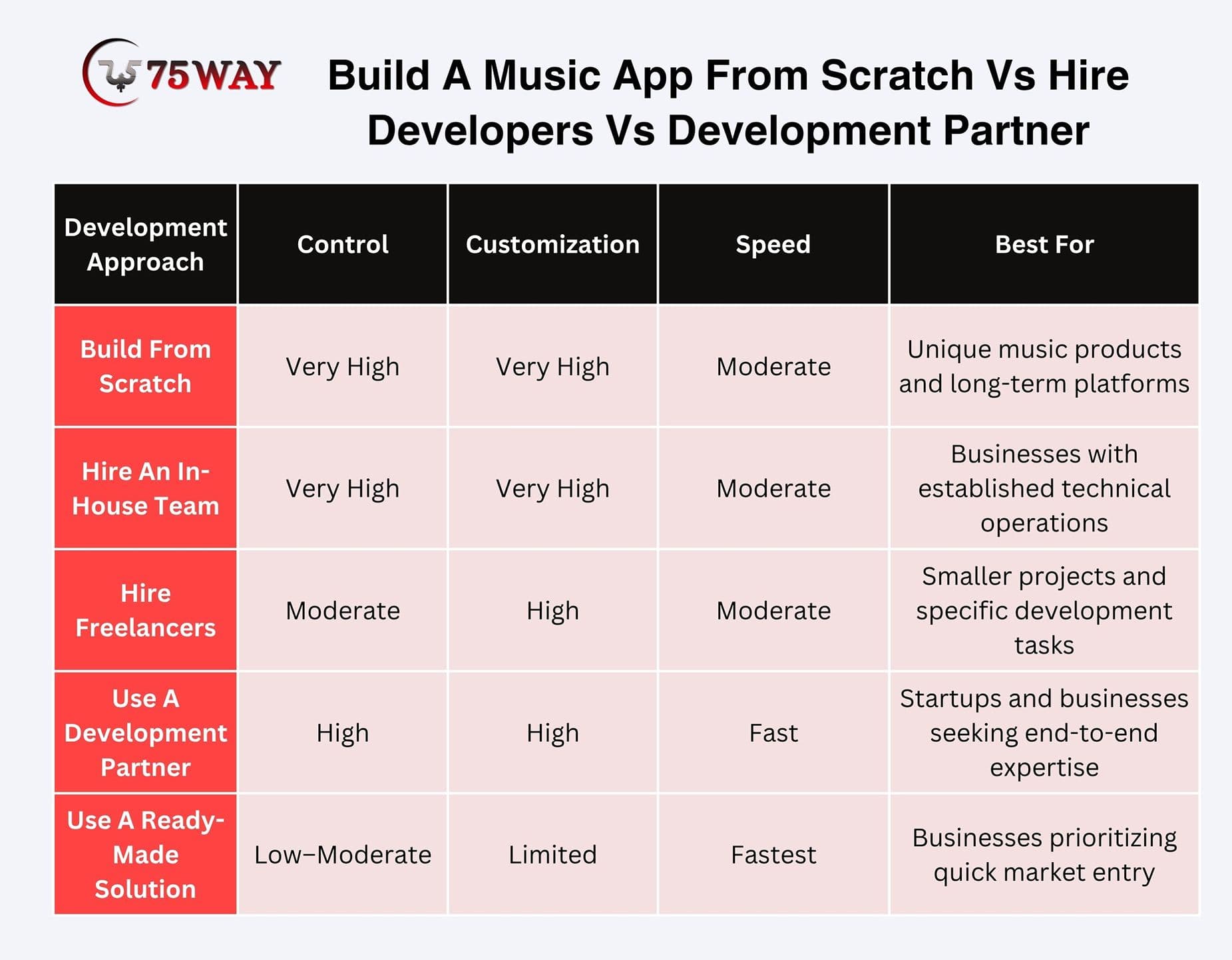
The right development approach depends on your budget, technical capabilities, product complexity, launch timeline, and long-term business goals. For most startups and businesses entering music streaming, choosing between an internal team, freelancers, a development partner, or a ready-made solution should be based on the level of customization and control required.
1. Build From Scratch: Building from scratch gives you maximum control over the product architecture, user experience, features, integrations, and future roadmap. It is suitable when your music platform has unique requirements, or you plan to develop a long-term technology product.
2. Hire An In-House Team: An internal team provides direct control over development and product decisions. However, recruiting specialists across mobile development, backend engineering, cloud, AI, DevOps, QA, and security can increase hiring costs and operational complexity.
3. Hire Freelancers: Freelancers can work well for smaller projects or specific development tasks. However, managing multiple freelancers across design, development, QA, infrastructure, and AI can become challenging for a complex streaming platform.
4. Use A Development Partner: A specialized development company can provide product strategy, UI/UX, engineering, AI, cloud, QA, deployment, and ongoing support under one development structure. This can be useful when you want to move from idea to launch without building a large internal technology team.
5. Use A Ready-Made Solution: Pre-built solutions can reduce initial development time, but they may limit customization, scalability, integrations, branding, and control over the underlying technology.
Which Approach Is Best For Your Music App?
For a business that wants to build a differentiated music platform with custom streaming, AI, monetization, or industry-specific capabilities, custom development is generally the more flexible approach.
A development partner can also help you begin with an MVP and gradually expand the platform instead of investing in every feature before validating the business model.
The best choice ultimately depends on your product requirements. If your competitive advantage depends on technology, personalization, AI, user experience, or a specialized business model, owning a customizable technology foundation can provide greater flexibility as the platform grows.
How Can 75way Help You Develop A Music App Like Spotify?
75way Technologies creates custom music apps and platforms around real listening experiences, from music discovery and streaming to playlists, subscriptions, artist profiles, social listening, and AI-powered recommendations.
We design the product around your target listeners, music catalog, monetization model, and content strategy, whether you are launching a niche streaming service or a broader Spotify-inspired platform.
Our team handles the technical foundation behind the experience, including audio streaming, music search, personalized recommendations, offline listening, AI playlist generation, voice-based discovery, payment integration, artist dashboards, and scalable cloud infrastructure.
As a prominent music app development company, we can take your concept from product planning and MVP development through launch, performance optimization, and future feature expansion.
Final Thoughts
To summarize, a music app development like Spotify is not simply about adding a player, search bar, and playlists. A commercially viable product needs the right combination of music licensing, streaming infrastructure, AI capabilities, and scalable architecture. Your first version does not need Spotify's entire feature set. It needs a clear reason for your target audience to choose it. For founders and businesses, the strongest approach is to start with a focused product concept, validate the core experience through an MVP, and expand using real user behavior and market demand. With the right product strategy and mobile app development partner, your idea can evolve from a focused music application into a scalable audio platform without taking on the cost and complexity of building everything at once.
Frequently Asked Questions (FAQs)
Can I Launch A Music App For A Specific Genre?
Yes, niche music platforms can focus on specific genres, communities, languages, or listener interests. A focused audience can create stronger positioning and differentiated user experiences.
Can A Music App Support Multiple Languages?
Yes, multilingual support can be included for interfaces, search, recommendations, notifications, and account experiences. Localization should be planned early to avoid costly architectural changes later.
Can Users Upload Their Own Music To The App?
Yes, you can create artist or user-upload features that allow approved creators to submit tracks. The platform should include moderation, metadata management, permissions, and content controls.
Can A Music App Connect With Smart Devices?
Yes, music platforms can support connected devices such as smart speakers, televisions, vehicles, headphones, and wearable devices. Device integration depends on available APIs, operating systems, and hardware requirements.
Can I Add Podcasts To My Music Streaming App?
Yes, podcasts can be incorporated alongside music to create a broader audio experience. You can support podcast discovery, subscriptions, episodes, categories, playback controls, and personalized recommendations.
Can I Migrate An Existing Music Platform To A New Application?
Yes, existing users, playlists, metadata, and other eligible information can potentially migrate into a new application. Migration planning should protect data integrity while minimizing disruption for existing users.
Can A Music App Integrate With Existing Business Systems?
Yes, custom APIs can connect the application with CRM, analytics, payment, marketing, content-management, and other business systems. Integration requirements depend on your existing software architecture and workflows.