AI Summary
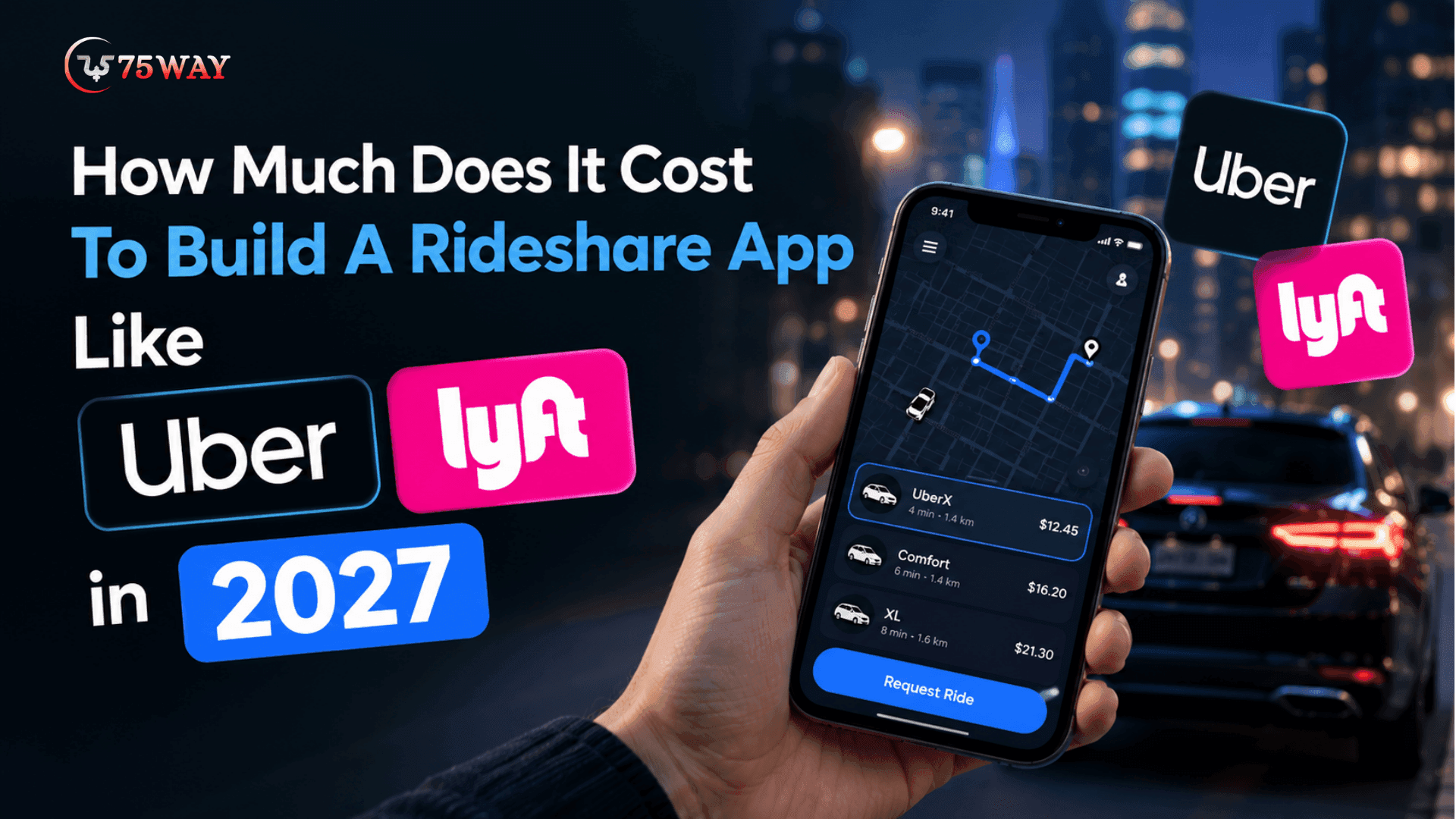
Building a rideshare app like Uber or Lyft can cost $30,000–$300,000+ depending on complexity. This guide explores features, timelines, technology, infrastructure, and hidden expenses. It also explains practical budgeting strategies. Learn what shapes your final development investment.
Key Takeaways
- Rideshare app development can cost $30,000–$300,000+ depending on complexity and scope.
- MVP features help startups validate rideshare concepts before larger technology investments.
- Advanced tracking, payments, dispatch, and safety increase overall development costs.
- Infrastructure, APIs, maintenance, and support create significant recurring expenses.
- Strategic planning helps control $30,000–$300,000+ development budgets without sacrificing quality.
The cost to build a rideshare app like Uber or Lyft typically ranges between $30,000 and $70,000 for an MVP, $70,000 to $120,000+ for a feature-rich platform, and $120,000 to $300,000+ for an advanced, highly customized ecosystem.
The actual budget depends on your launch market, number of apps, features, integrations, design complexity, technology choices, security requirements, and development team.
For founders planning a rideshare business in the USA market, the bigger question is not simply “How much does a Lyft & Uber-like rideshare app development cost?” It is “What level of platform do I need to launch, validate demand, and scale without rebuilding the product later?”
This guide breaks down rideshare app development costs, feature-level expenses, development stages, ongoing costs, and the factors that can move your budget up or down.
Why Are Businessess Investing In A Ride-Sharing App Like Uber or Lyft?
An Uber-like ride-sharing app can give a business a digital channel that reaches customers whenever they need transportation. The opportunity goes beyond individual bookings, as a well-planned platform can create new commercial value while supporting a scalable service model. The key reasons to invest in ride-sharing app development are explained below.
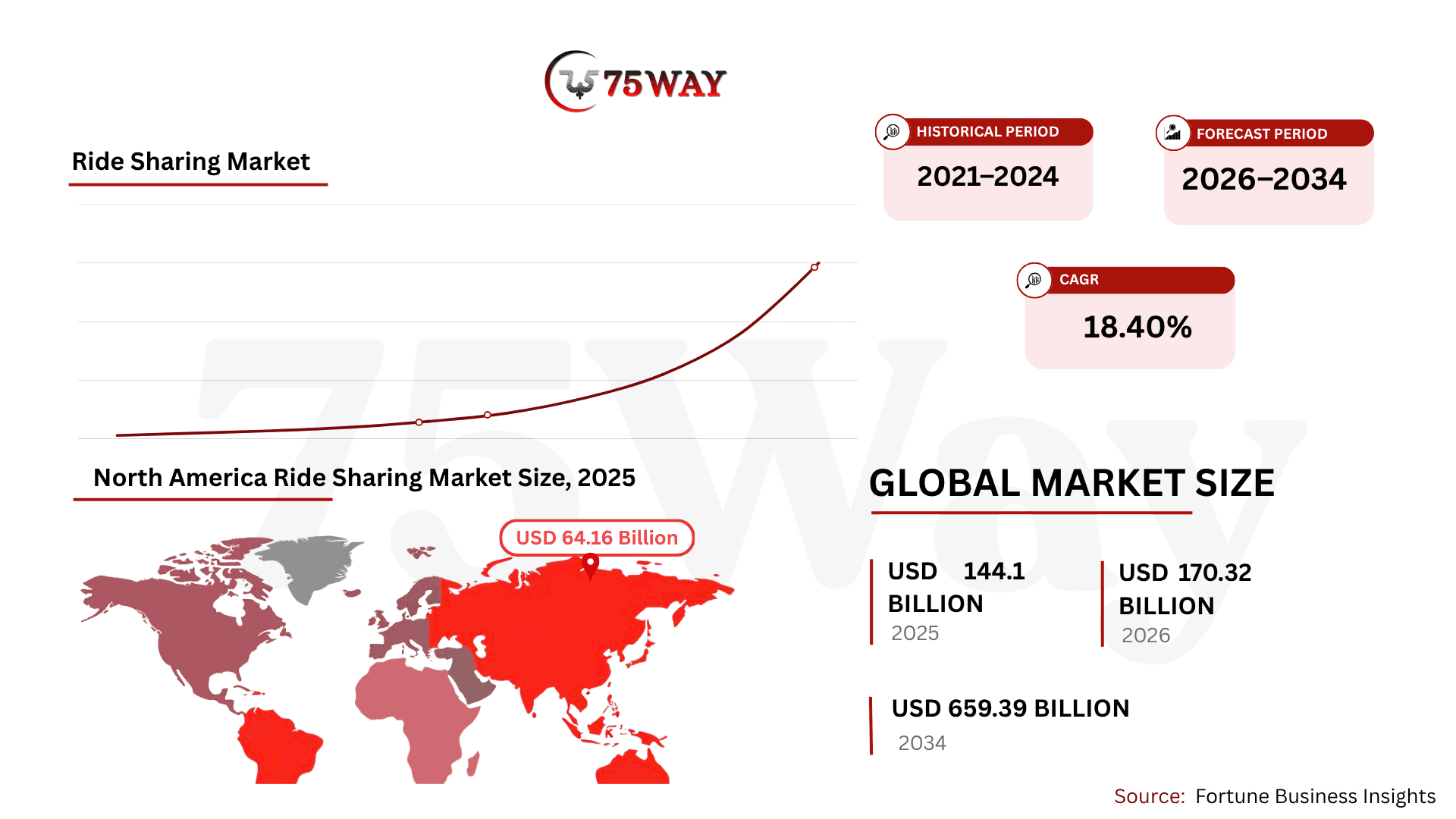
- The global ride-sharing market is forecast to expand from $170.32 billion in 2026 to US$659.39 billion by 2034, reflecting an 18.40% CAGR.
- North America held the largest share of the global ride-sharing market, accounting for 44.52%.
- The e-hailing segment led the market, contributing 57.9% of total global revenue.
- Uber generated $25 billion from mobility services, while its delivery business contributed $13.7 billion in revenue.
- Uber’s monthly active platform consumers reached 156 million, marking a 13.8% year-over-year increase.
- Lyft surpassed 1 billion annual rides, with its active rider base reaching a record 30+ million.
- Lyft reported $6.3 billion in revenue, highlighting continued growth in its ride-hailing business.
Rideshare App Development Cost: A Quick Pricing Overview
The first question most entrepreneurs ask about a rideshare app is simple: how much will it cost to build? A realistic development range is $30,000–$500,000+, but that figure can change substantially as the product becomes more sophisticated. The breakdown below explains the pricing so you can understand what your budget could actually deliver.
1. Basic MVP Rideshare App Cost: $30,000–$50,000
This version of a rideshare app focuses on the essential ride-booking journey, including user sign-up, GPS tracking, ride requests, driver matching, and simple payment integration.
Development Timeline: 2–3 months
Ideal For: Startups testing a rideshare concept, launching in one location, or validating market demand with essential features.
2. Intermediate Rideshare App Cost: $50,000–$100,000
This version adds more functionality to improve the rider and driver experience, including advanced routing, ratings and reviews, push notifications, in-app chat, and enhanced ride management.
Development Timeline: 4–6 months
Ideal For: Growing businesses planning a broader launch with improved customer engagement and operational capabilities.
3. Advanced Custom Rideshare App Cost: $100,000–$300,000+
This solution includes advanced capabilities such as dynamic pricing, scheduled rides, multiple vehicle categories, sophisticated driver matching, advanced analytics, safety tools, and scalable backend infrastructure.
Development Timeline: 6–10 months
Ideal For: Established businesses and startups requiring a highly customized platform designed for expansion and complex operations.
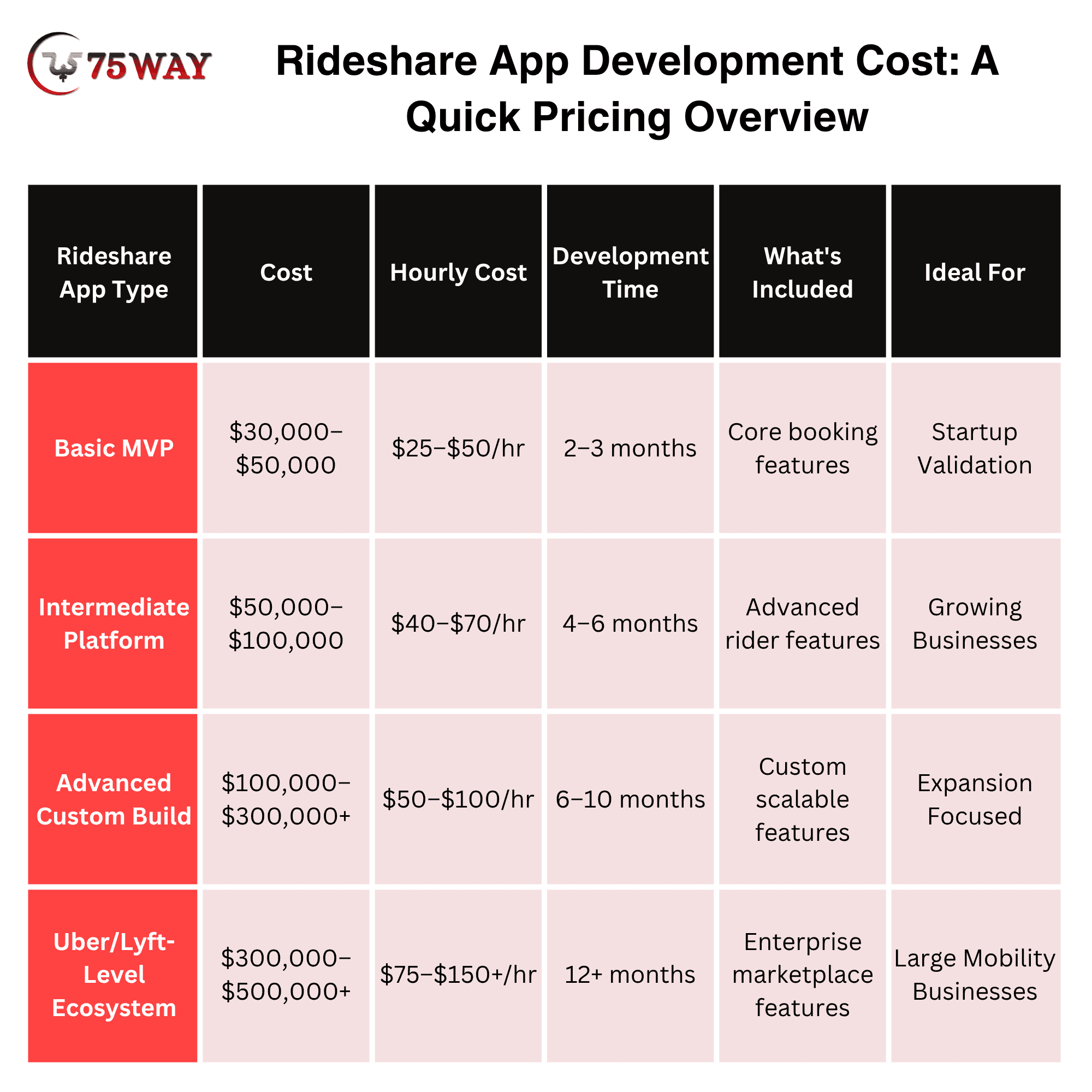
These are planning ranges rather than fixed quotes. A rideshare platform with two mobile apps, an admin dashboard, real-time location services, payments, driver onboarding, automated dispatch, safety features, analytics, and multiple third-party integrations requires substantially more engineering than a simple taxi-booking MVP.
What Is the Exact Cost to Build a Rideshare App Like Uber?
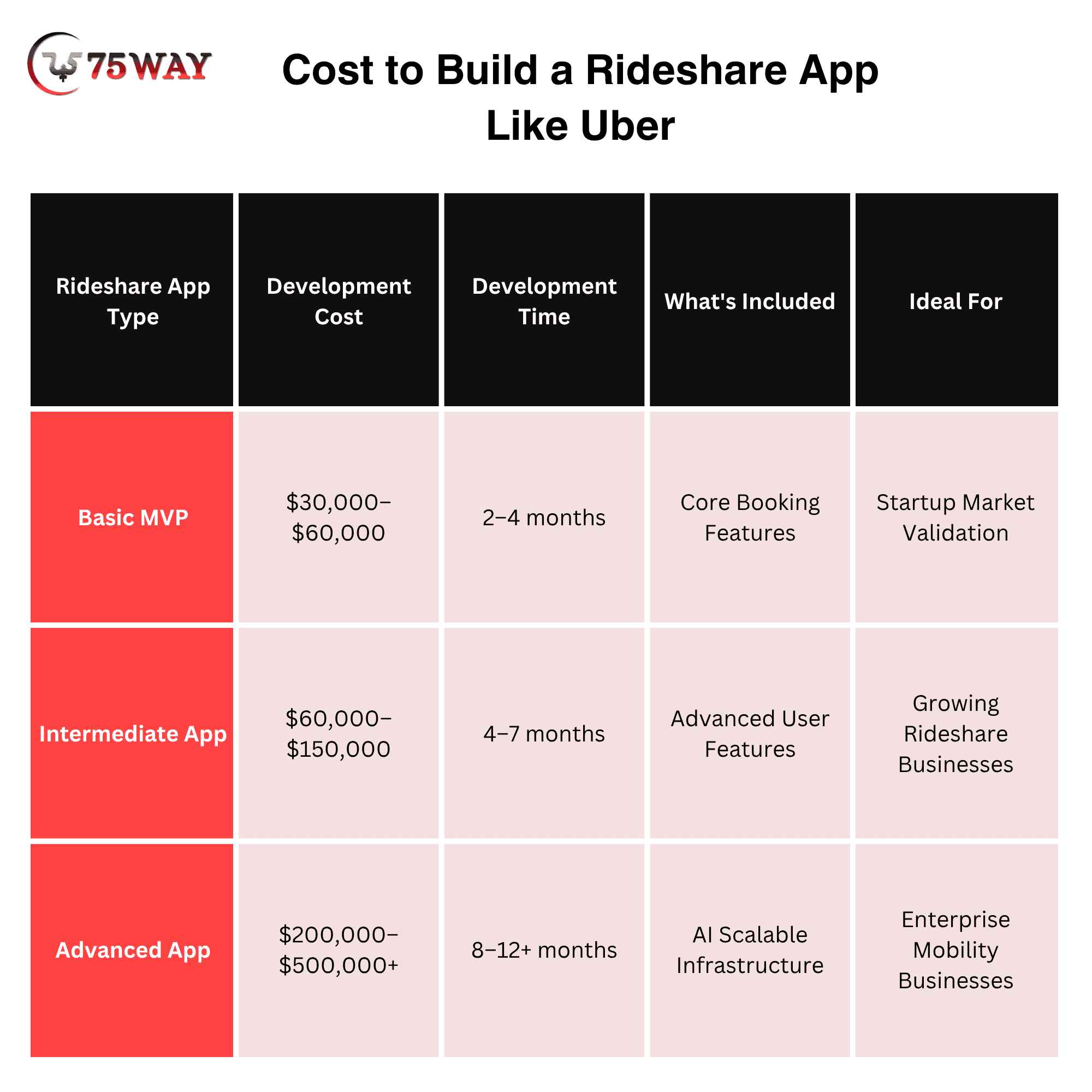
The familiar “book a ride” button is only one small part of what makes a platform like Uber work. The average cost to build a rideshare app like Uber falls between $30,000 and $500,000+, with the budget changing as the platform takes on more complex requirements. The pricing details below show where the money goes when turning an Uber-like concept into a working product.
1. Basic MVP Uber-Like App:$30,000–$60,000
A basic MVP covers the essential ride-booking journey, including user registration, ride requests, basic driver matching, real-time GPS tracking, and simple in-app payments. This approach is suitable for startups that want to test their rideshare concept with core functionality before expanding the platform.
2. Intermediate Uber-Like App:$60,000–$150,000
An intermediate rideshare platform adds capabilities that create a more complete experience for riders and drivers. Scheduled rides, multiple payment options, ratings, push notifications, improved booking management, and polished UI/UX can be included at this stage.
3. Advanced/Feature-Rich Uber-Like App:$200,000–$500,000+
An advanced platform requires considerably more engineering and infrastructure. It can include AI-assisted demand forecasting, advanced analytics, custom routing, multi-language support, sophisticated dispatch, dynamic pricing, enhanced safety capabilities, and architecture designed for high-volume operations.
Cost To Develop a Ride-Sharing App Like Lyft
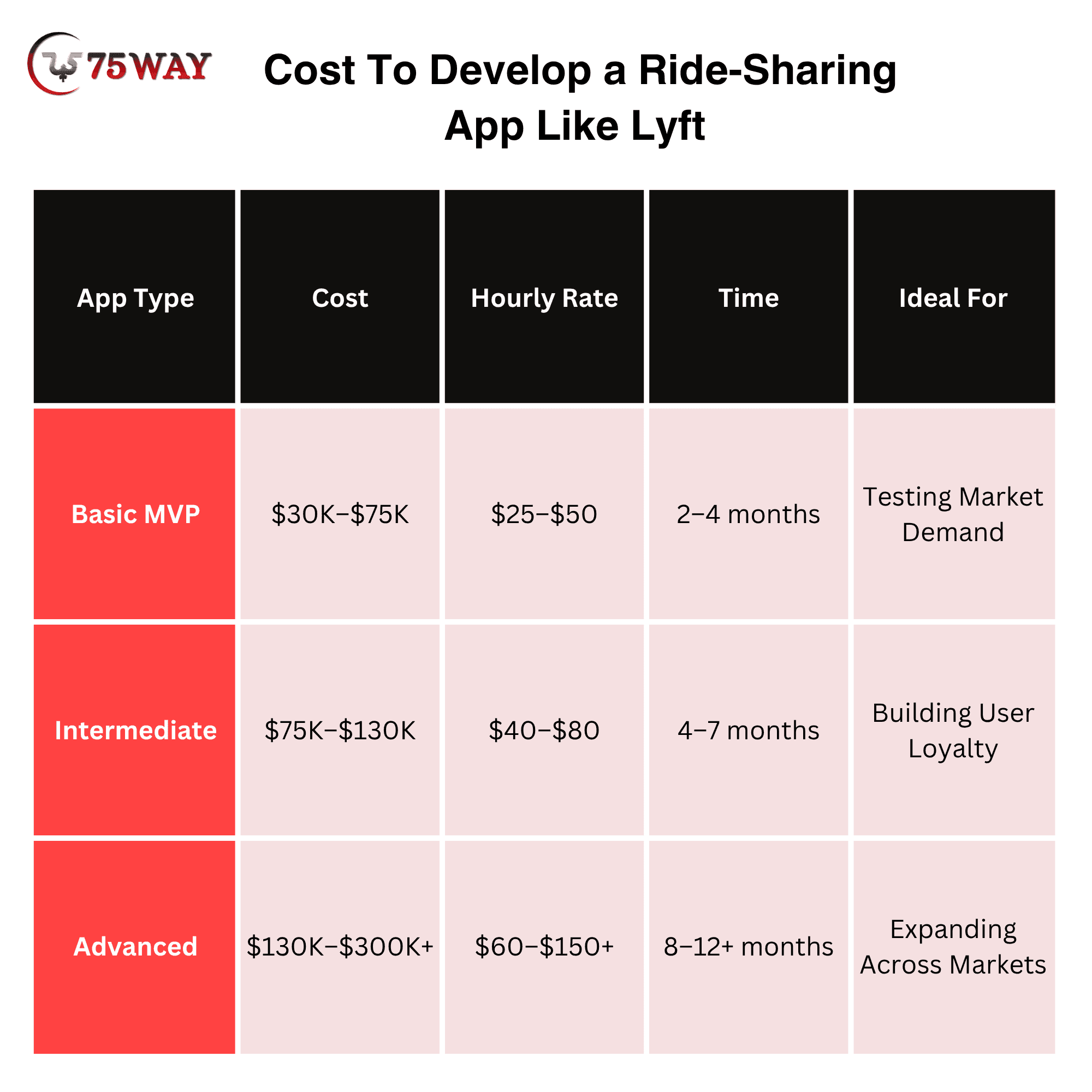
The cost to develop a ride-sharing app like Lyft ranges from $30,000 to $300,000+, but the number alone does not tell you what the finished product will include. A lean launch version may require a far smaller investment than a platform designed to handle complex ride operations at scale. The pricing details below show how the development budget changes as the app becomes more advanced.
- Basic MVP: $30,000–$75,000
Core rider/driver apps, GPS, booking, payments, and admin panel.
- Intermediate App: $75,000–$130,000
Adds refined UI/UX, notifications, analytics, loyalty, and surge pricing.
- Advanced/Enterprise App: $130,000–$300,000+
Covers advanced analytics, intelligent dispatch, multi-city support, security, and scalable infrastructure.
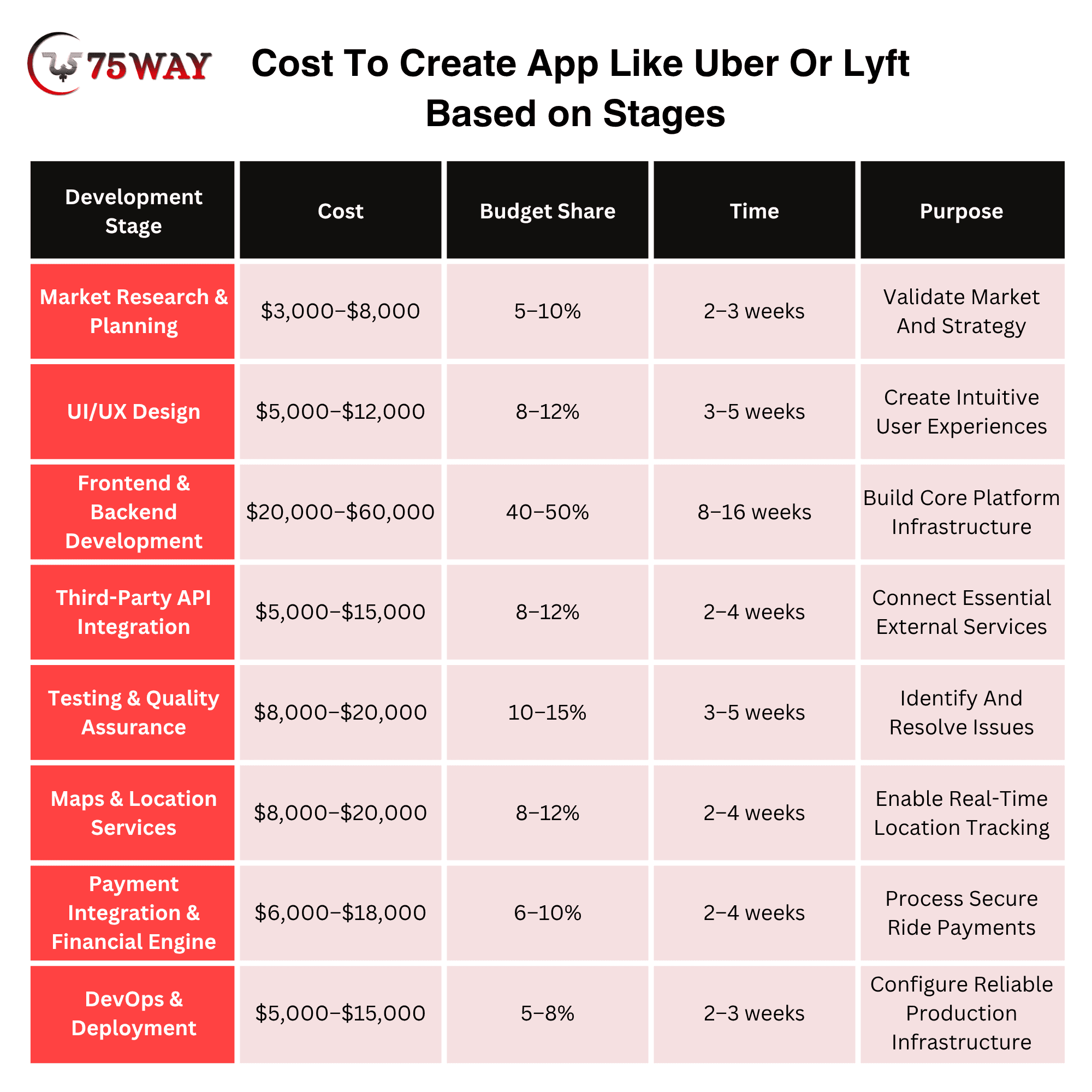
How Much Does It Cost To Create App Like Uber Or Lyft Based on Stages
A ride-sharing app does not require the same level of investment from the first day to the final launch. The budget grows as the product takes shape, with development work, technical expertise, and project requirements contributing differently to the overall expense. The breakdown below explains how the cost of creating an Uber- or Lyft-like app is distributed throughout the project.
- Market Research & Planning: Competitor analysis, audience research, feature planning, and technical requirements establish a practical development roadmap.
Estimated Cost: $3,000–$8,000
- UI/UX Design: Wireframes, user flows, interface design, and prototypes shape the rider and driver experience.
Estimated Cost: $5,000–$12,000
- Frontend & Backend Development: Developers build the mobile interfaces, server-side logic, databases, booking system, payments, and real-time ride functionality.
Estimated Cost: $20,000–$60,000
- Maps & Location Services: GPS tracking, route mapping, driver locations, distance calculation, and navigation features support real-time ride coordination.
Estimated Cost: $8,000–$20,000
- Payment Integration & Financial Engine: Payment gateways, fare calculations, refunds, driver payouts, and transaction handling manage the app’s financial operations.
Estimated Cost: $6,000–$18,000
- Third-Party API Integration: Maps, payment gateways, notifications, location services, and other external tools are connected to support core app functions.
Estimated Cost: $5,000–$15,000
- Testing & Quality Assurance: Functional, performance, security, and usability testing help identify problems before the rideshare app reaches customers.
Estimated Cost: $8,000–$20,000
- DevOps & Deployment: Cloud setup, server configuration, CI/CD pipelines, monitoring, security, and production deployment prepare the app for launch and scaling.
Estimated Cost: $5,000–$15,000
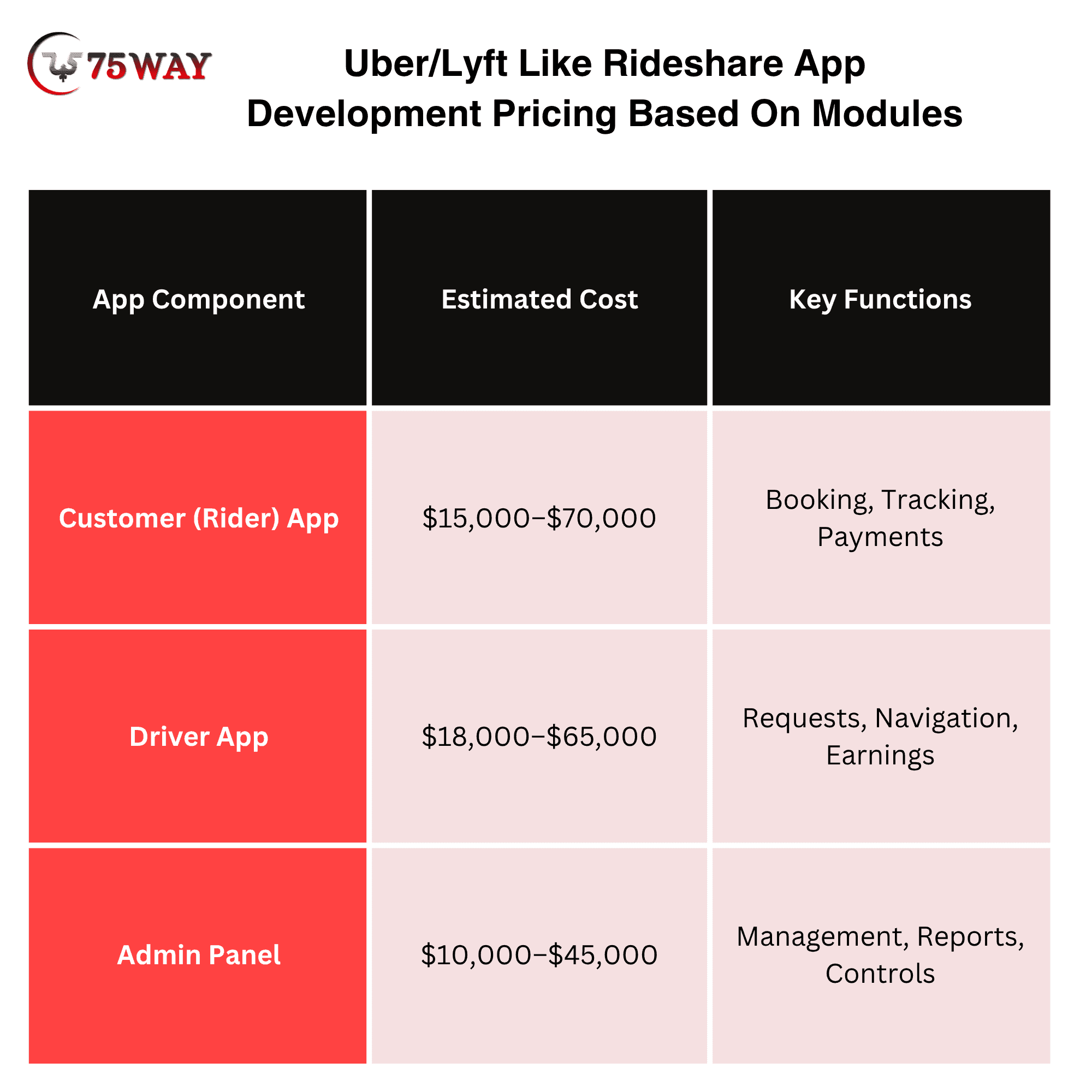
Uber/Lyft Like Rideshare App Development Pricing Based On Modules
A ride-sharing platform may look like one product to the customer, but its development involves several connected experiences working together behind every booking. The amount of engineering required for each experience can vary based on functionality, real-time operations, integrations, and the level of control the business needs. The pricing breakdown below shows how the overall development budget is distributed across the core modules.
- Customer (Rider) App: The rider-facing application covers registration, ride booking, scheduling, GPS tracking, fare estimation, and secure in-app payments.
Estimated Cost:$15,000–$70,000
- Driver App: The driver application supports profile verification, document uploads, ride requests, navigation, earnings tracking, and online/offline availability.
Estimated Cost:$18,000–$65,000
- Admin Panel Development: The dashboard provides tools for managing drivers, riders, bookings, payments, promotions, reports, and platform activity.
Estimated Cost:$10,000–$45,000
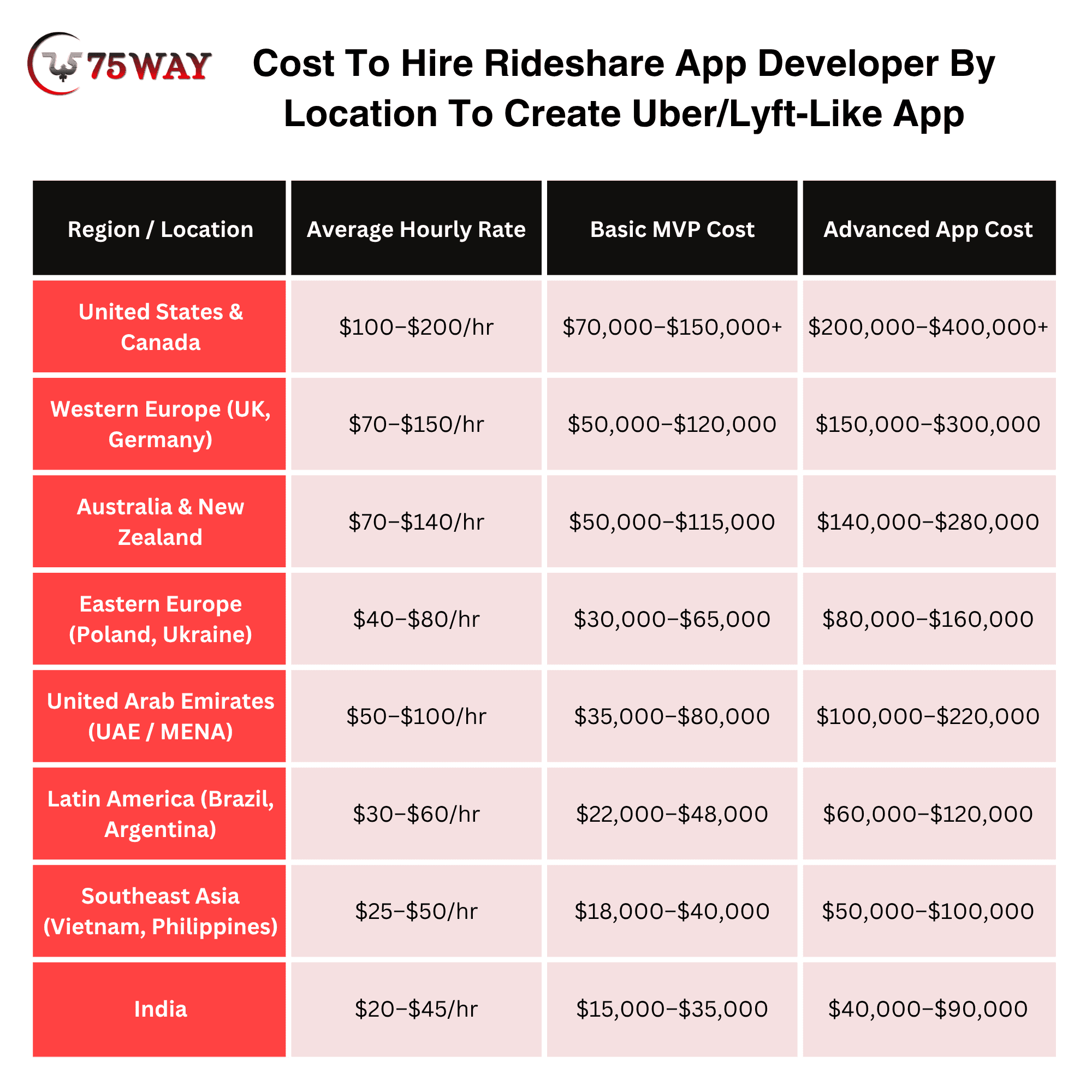
Cost To Hire Rideshare Mobile App Developer By Location To Create Uber/Lyft-Like App
The same Uber- or Lyft-like rideshare app can require a very different investment depending on where the development team is based. The location of a rideshare app developer can influence hourly rates and the overall project budget, making the same product cost considerably more or less across different markets. The detailed comparison below explains how location affects the cost of creating an on-demand rideshare app like Uber or Lyft.
- United States & Canada: Higher developer rates make these regions among the costliest options, particularly for advanced, scalable rideshare platforms.
Average Hourly Rate: $100–$200/hr
Project Cost: $70,000–$400,000+
- Western Europe: Experienced development teams offer strong technical capabilities, although higher labor rates increase the overall rideshare app budget.
Average Hourly Rate: $70–$150/hr
Project Cost: $50,000–$300,000
- Australia & New Zealand: Development rates remain relatively high, making these markets better suited to businesses with larger technology budgets.
Average Hourly Rate: $70–$140/hr
Project Cost: $50,000–$280,000
- Eastern Europe: Skilled developers are available at moderate rates, offering a practical option for building feature-rich rideshare applications.
Average Hourly Rate: $40–$80/hr
Project Cost: $30,000–$160,000
- UAE / MENA: Development pricing sits between premium and offshore markets, supporting businesses targeting regional mobility services.
Average Hourly Rate: $50–$100/hr
Project Cost: $35,000–$220,000
- Latin America: Competitive development rates make the region attractive for businesses seeking capable teams with closer time-zone alignment.
Average Hourly Rate: $30–$60/hr
Project Cost: $22,000–$120,000
- Southeast Asia: Lower development rates can help startups build MVPs and mid-level rideshare platforms within tighter budgets.
Average Hourly Rate: $25–$50/hr
Project Cost: $18,000–$100,000
- India: Competitive development rates make India a practical choice for startups and businesses seeking scalable rideshare solutions.
Average Hourly Rate: $20–$45/hr
Project Cost: $15,000–$90,000
Cost To Hire A Rideshare App Development Company Vs. Offshore Team Vs. No-Code
The hiring model can change your rideshare app budget, development control, and long-term scalability. A specialized development company usually costs more upfront but offers end-to-end expertise, while offshore teams reduce rates and no-code platforms suit simpler MVPs.
1. Rideshare App Development Company
A professional rideshare app development company handles planning, UI/UX, development, integrations, testing, deployment, and post-launch support. This option works well for businesses that need custom features, reliable infrastructure, and room to scale.
Estimated Cost: $30,000–$300,000+
Best For: Custom, scalable platforms
2. Offshore Development Team
An offshore team can lower development costs through competitive hourly rates. Businesses can access developers, designers, and testers remotely, although project management, communication, and quality control require closer attention.
Estimated Cost: $20,000–$150,000+
Best For: Budget-conscious development
3. No-Code Solutions
No-code platforms provide prebuilt components for launching simpler rideshare concepts without extensive programming. They can reduce initial costs and development time but may become limiting when advanced dispatch, custom integrations, or large-scale operations are required.
Estimated Cost: $5,000–$30,000+
Best For: Basic MVP validation
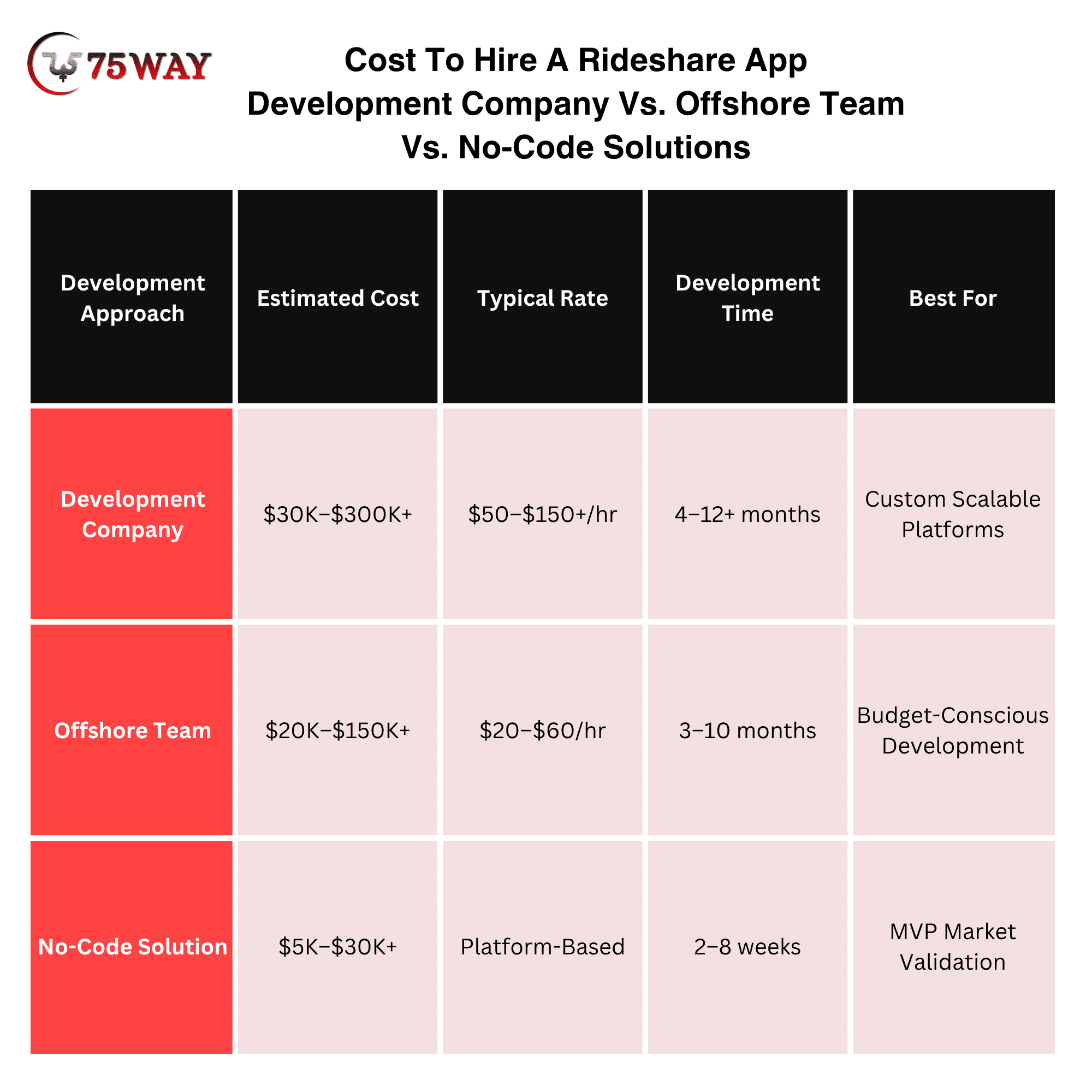
Key Difference: A rideshare app development company provides the most comprehensive support, an offshore team offers lower development rates, and no-code delivers the quickest route to testing a basic rideshare concept.
Cost To Build Uber or Lyft-Style Rideshare Platform Based On Features
A simple ride-booking app and a sophisticated rideshare platform may share the same basic concept, yet their development costs can be dramatically different. The difference comes largely from how much the app needs to handle, automate, integrate, and support behind the scenes. The detailed pricing below explains how your rideshare app budget changes as its functionality expands.
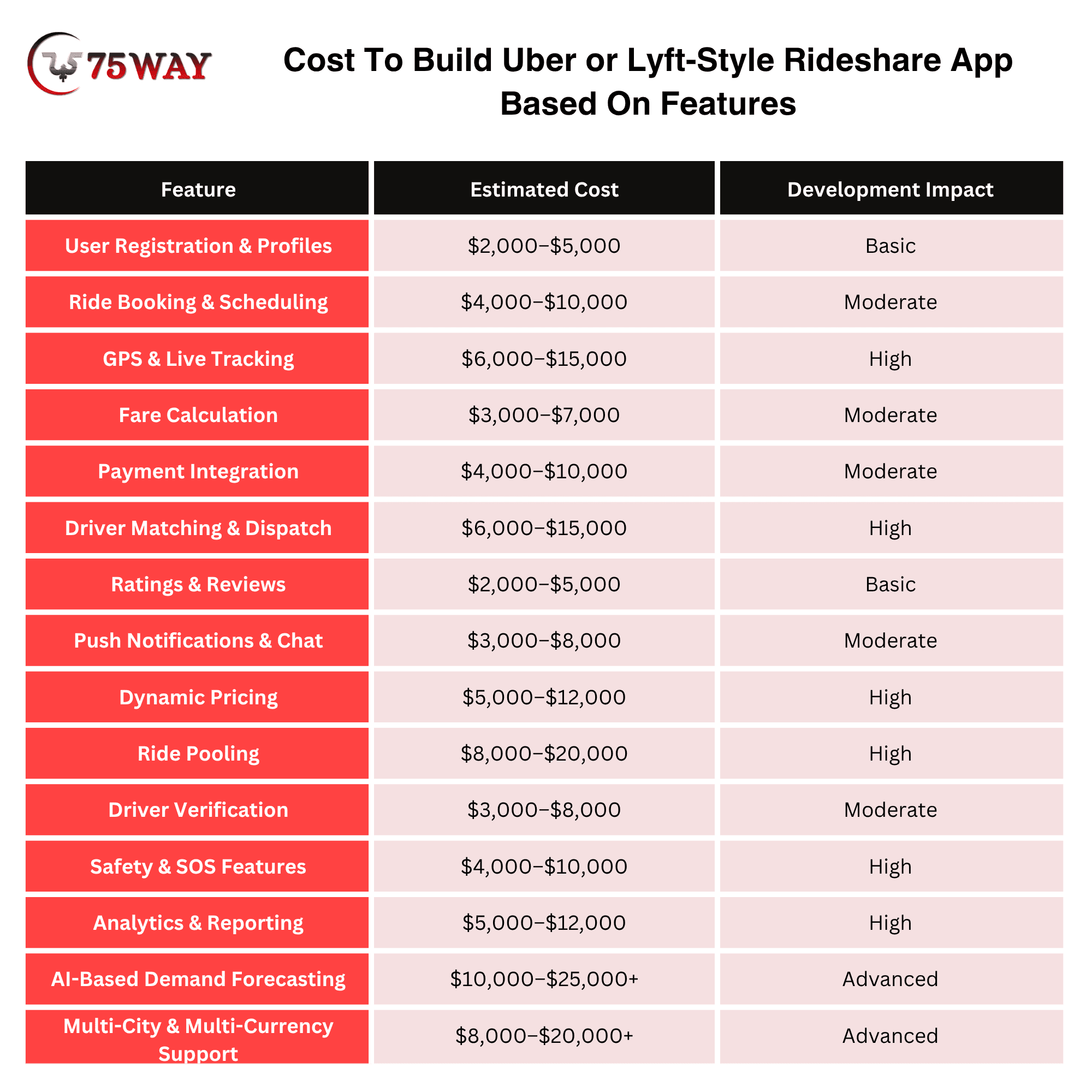
Basic features such as registration, booking, ratings, and notifications can keep the initial budget lower. Advanced capabilities like intelligent dispatch, dynamic pricing, pooling, AI forecasting, and safety tools require more backend logic, integrations, and testing.
For a complete rideshare platform, these individual feature costs should not simply be added together because several features share the same backend, design, and infrastructure. A practical overall budget generally falls within $30,000–$300,000+, depending on the final scope.
How Do You Calculate Your Rideshare App Budget?
A simple budgeting formula is:
Total development cost = development hours × hourly rate + third-party integrations + infrastructure setup + QA + deployment + contingency
For example, assume your initial platform requires 3,000 engineering hours at an average blended rate of $60 per hour.
3,000 × $60 = $180,000
Add design, testing, integrations, deployment, and a reasonable contingency, and your launch budget could move beyond the initial engineering estimate.
This method is more useful than copying a single “Uber clone cost” number because it connects the budget directly to your actual product scope.
Why Is a Rideshare App More Expensive Than a Normal Mobile App?
A rideshare app involves multiple user roles, usually riders, drivers, and administrators, with separate interfaces and permissions. Building these connected systems requires more development work than a typical single-user mobile application.
Real-time functionality also adds complexity. GPS tracking, driver matching, route updates, fare calculation, ride status, notifications, and in-app communication must work together with minimal delays. These requirements demand stronger backend architecture, third-party integrations, and extensive testing.
Security and scalability further increase the budget. Payment processing, driver verification, SOS features, fraud prevention, cloud infrastructure, and high-traffic support require additional development and maintenance. As a result, a rideshare platform can cost significantly more than a standard mobile app with basic features.
What Are the Hidden Costs While Building Uber or Lyft Clone App?
The initial development quote for an Uber or Lyft clone rarely represents the full amount you will spend to bring the app into operation. Expenses can continue to appear around the product even after the core development work is complete, making the original estimate look very different from the actual investment. The hidden cost areas worth budgeting for are explained below.
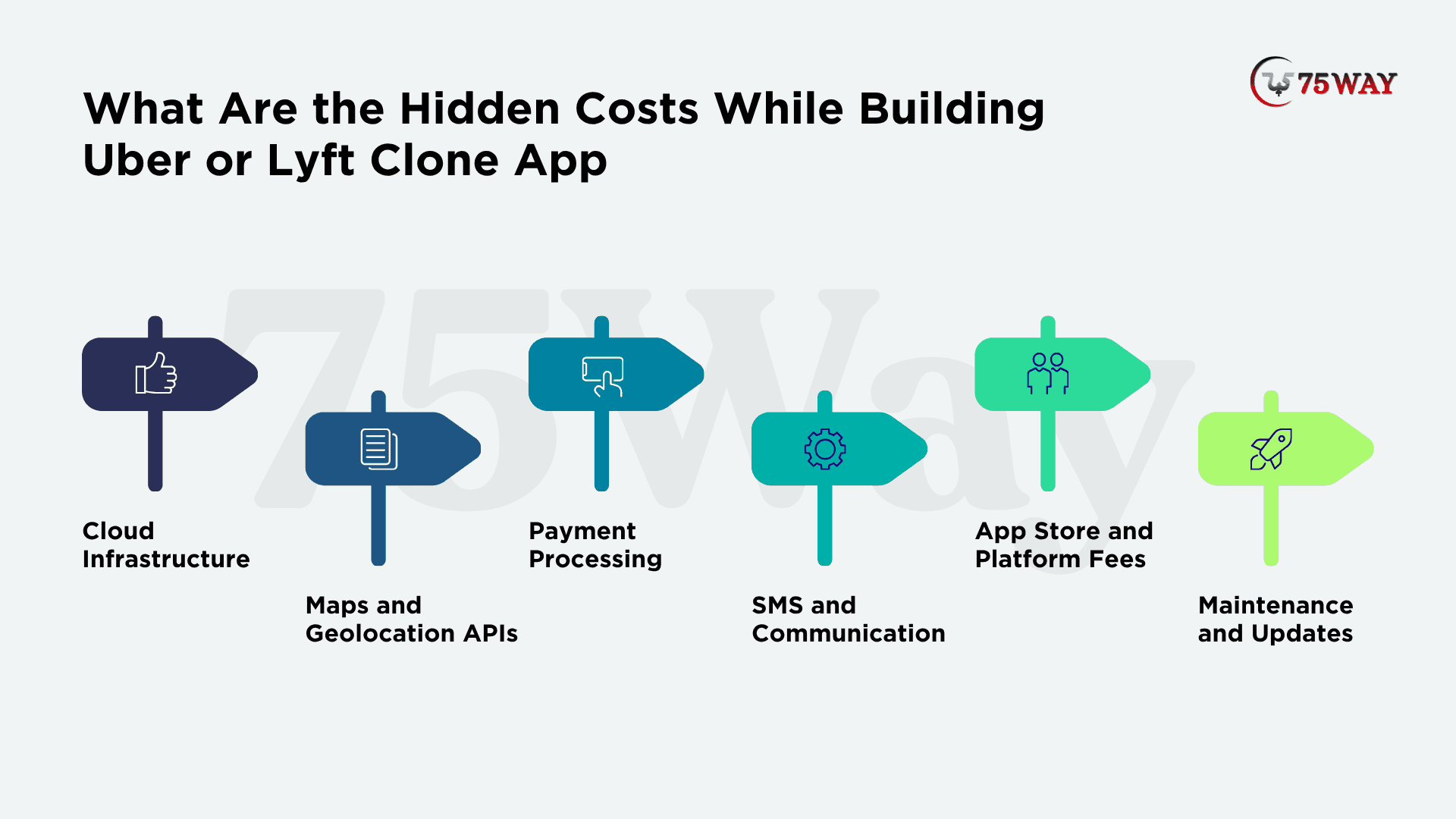
- Cloud Infrastructure
Your costs can increase as trips, location updates, users, and transactions increase.
- Maps and Geolocation APIs
Mapping providers may charge based on usage. High-volume location and routing activity can become a meaningful operating expense.
- Payment Processing
Payment providers generally charge transaction fees. Your financial model should account for these fees rather than treating payment integration as a one-time development expense.
- SMS and Communication
OTP verification, alerts, and communication services can generate recurring usage costs.
- App Store and Platform Fees
Publishing and operating mobile applications also involves platform-related costs and compliance requirements.
- Maintenance and Updates
Your product will need security patches, OS compatibility updates, bug fixes, performance improvements, API updates, infrastructure monitoring, new device support, and feature enhancements.
A useful planning assumption is to reserve 15%–25% of the initial development budget annually for maintenance and ongoing improvements, depending on product complexity and support requirements.
How to Reduce Rideshare App Development Costs Without Cutting Critical Quality
A smaller development budget does not automatically require a weaker rideshare app. The real savings come from avoiding unnecessary work and investing the available budget where it can have the greatest impact on the product. The cost-saving approach below shows how to reduce development expenses while keeping essential quality intact.
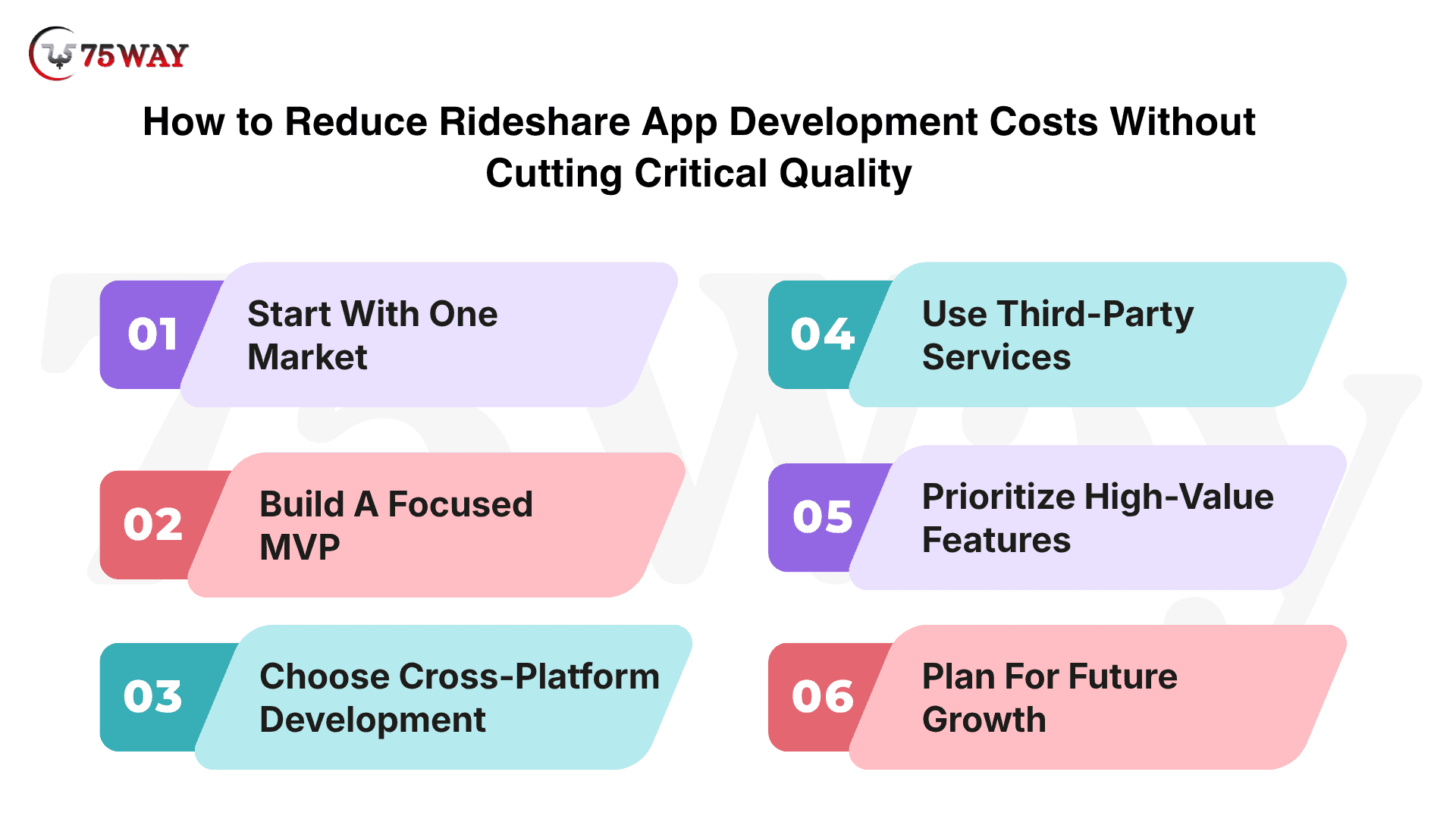
1. Start With One Market
A single-city launch keeps the initial scope manageable while helping you test demand, pricing, driver acquisition, and customer response before expanding.
2. Build A Focused MVP
Begin with essential workflows such as registration, ride booking, GPS tracking, payments, driver matching, and trip management instead of replicating every Uber or Lyft feature.
3. Choose Cross-Platform Development
Flutter or React Native can reduce duplicate mobile development when native-level functionality is not essential. The final choice should consider performance, integrations, team expertise, and long-term requirements.
4. Use Third-Party Services
Prebuilt services for maps, payments, authentication, SMS, analytics, cloud hosting, and verification can reduce development time and infrastructure expenses compared with building every component internally.
5. Prioritize High-Value Features
Rank features according to customer demand, business value, and operational importance. Developing revenue-generating and ride-critical functions first helps avoid spending on features that may not be immediately needed.
6. Plan For Future Growth
A cost-conscious MVP should still have a scalable foundation. Flexible architecture makes future additions such as new cities, vehicle categories, pricing models, and advanced features easier to introduce.
What Should Your First Rideshare MVP Include?
For most startups, the first release should answer one fundamental question:
Can we reliably connect riders and drivers, complete trips, collect payments, and create enough value for both sides of the marketplace?
A practical first release can therefore focus on:
- Rider: Registration, location, booking, fare estimate, tracking, payment, history, ratings.
- Driver: Onboarding, document upload, availability, ride requests, navigation, trip completion, earnings.
- Admin: Driver management, rider management, trip monitoring, pricing, payments, support, reporting.
Everything else should be prioritized according to actual customer and operational requirements.
Build a Lyft/Uber Clone or Build Your Own Rideshare Business?
A common mistake is treating Uber or Lyft as a feature checklist. Your business may need something completely different.
For example, a startup could focus on:
- Airport transportation
- Corporate transportation
- Senior transportation
- Women-focused transportation
- Medical transportation
- College transportation
- Luxury rides
- Local taxi services
- Rural transportation
- Fleet-based transportation
- Scheduled commuter services
The technology should support your business model rather than force your business to imitate an established competitor.
Uber's own 2025 results demonstrate the scale of a mature mobility marketplace: the company reported more than 200 million monthly users and more than 40 million trips per day, with 2025 gross bookings of approximately $193.5 billion.
Lyft's 2025 filing likewise shows how substantial the underlying marketplace becomes at scale, reporting 29.2 million active riders in Q4 2025 and 945.5 million rides during the quarter.
That scale is precisely why “building Uber” and “launching an Uber-inspired rideshare MVP” are two very different technology investments.
What Makes a Rideshare App Scalable?
Scalability should be considered before your first paying customer, not after your platform starts slowing down. A scalable architecture should account for:
- Concurrent users
- Real-time location updates
- High-volume trip requests
- Payment transactions
- Notification traffic
- Database growth
- Geographic expansion
- Driver availability
- Peak-hour demand
- Monitoring and logging
- Disaster recovery
Your development team should also define measurable performance requirements before implementation.
For example, instead of saying “the app should be fast,” define acceptable response times for booking, driver matching, payment confirmation, and trip-status updates.
That gives engineering and QA teams something measurable to validate.
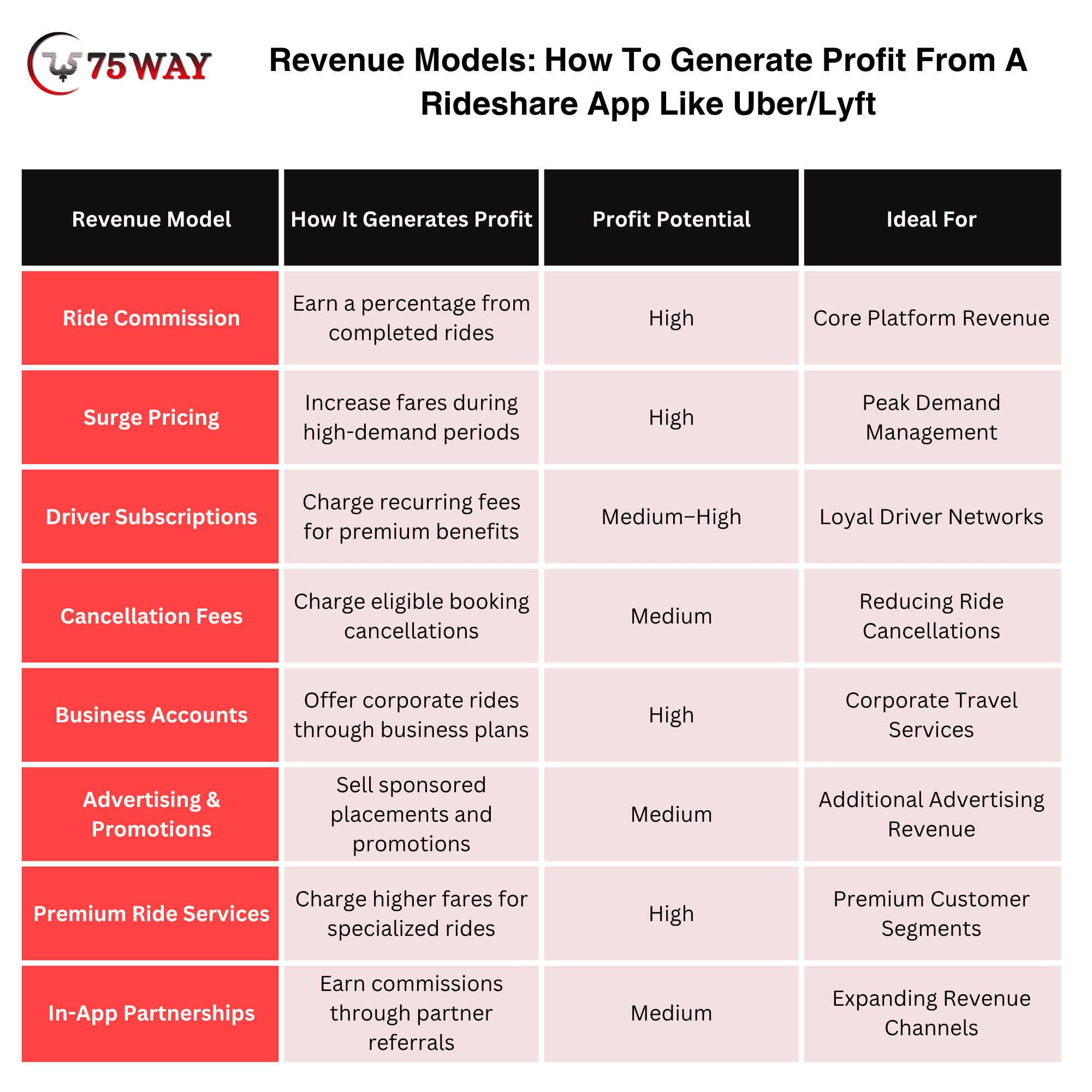
Revenue Models: How To Generate Profit From A Rideshare App Like Uber/Lyft
A rideshare app can generate revenue through several channels rather than depending only on ride commissions. The right mix depends on your market, pricing strategy, driver network, and customer base.
1. Ride Commission
Charging drivers or taking a percentage from each completed ride is the primary revenue model. The platform can set different commission rates based on ride type, location, or service category.
2. Surge Pricing
Higher fares during peak hours, bad weather, events, or high-demand periods can increase revenue while helping balance rider demand with driver availability.
3. Driver Subscription Plans
Drivers can pay a recurring fee to access premium benefits, reduced commissions, better visibility, analytics, or additional earning tools.
Cancellation Fees
The platform can charge riders or drivers when eligible cancellations occur after a defined waiting period or booking stage.
4. Business Accounts
Corporate customers can use the platform for employee transportation, business travel, and scheduled rides. Companies can be offered monthly plans, negotiated rates, or dedicated account services.
5. Advertising & Promotions
Local businesses can pay to display offers, sponsored listings, or promotions within the app. Relevant advertising can create an additional income stream without changing the core ride experience.
6. Premium Ride Services
Higher-priced options such as luxury vehicles, priority pickups, airport rides, pet-friendly rides, or larger vehicles can generate greater revenue per booking.
7. In-App Partnerships
Partnerships with restaurants, hotels, airports, travel companies, or automotive services can create referral or commission-based income from related bookings and services.
How 75way Technologies Helps You Build An Affordable Rideshare App Like Uber/Lyft?
75way Technologies helps businesses control rideshare app development costs by focusing the initial build on essential features and business-critical workflows. Our team can create rider, driver, and admin applications with core capabilities such as booking, GPS tracking, payments, notifications, and ride management.
Our ridesharing app development approach prioritizes reusable technologies, suitable third-party integrations, and scalable architecture to avoid unnecessary development expenses. Instead of adding complex features from the beginning, we can structure the product around an MVP and gradually introduce advanced capabilities as your user base and business requirements grow.
From planning and UI/UX design to development, testing, deployment, and ongoing support, 75way Technologies provides end-to-end development assistance. This approach helps startups and established businesses launch a reliable rideshare solution within a controlled budget while keeping the foundation ready for future expansion.
Final Thoughts
The cost to build a rideshare app like Uber or Lyft depends less on the number of screens and more on the complexity of the marketplace behind them.
A focused MVP can launch within a controlled budget, while real-time dispatch, advanced pricing, safety systems, multiple apps, analytics, and multi-city scalability can quickly push an enterprise platform into the hundreds of thousands of dollars.
For founders, the smartest approach is not to replicate every Uber feature from day one. Define the transportation problem you want to solve, launch the smallest product capable of proving the business model, measure real user behavior, and invest in advanced capabilities as demand validates them.
If you have a rideshare app idea, you can contact a reliable ridesharing app development company that helps you plan, build, and scale a custom rideshare platform around your business goals.
Frequently Asked Questions (FAQs)
How Much Does It Cost To Build A Rideshare App Like Uber?
A rideshare MVP can cost around $50,000–$100,000, while a feature-rich platform may require $100,000–$300,000+. Large-scale custom ecosystems can exceed $500,000.
How Long Does It Take To Develop A Rideshare App?
A basic MVP can take roughly 3–5 months, while a more advanced rideshare platform can take 8–12 months or longer depending on integrations, platforms, testing, and business requirements.
What Is The Most Expensive Part Of A Rideshare App?
Backend engineering, real-time dispatch, location services, complex marketplace logic, advanced security, and multiple mobile applications can represent significant portions of the development budget.
Is It Cheaper To Build A Rideshare MVP First?
Yes. An MVP lets founders validate the marketplace with essential rider, driver, payment, tracking, and administrative workflows before investing in advanced functionality.
Can I Build A Rideshare App With Flutter Or React Native?
Yes. Cross-platform technologies can be appropriate for many rideshare products, particularly when the business wants to support iOS and Android with a shared codebase. The final decision should depend on technical requirements and long-term architecture.
What Recurring Costs Should I Expect After Launch?
Common recurring expenses include cloud hosting, maps and geolocation APIs, payment processing, SMS, monitoring, maintenance, security, customer support, app updates, and ongoing development.
Can I Build An App Exactly Like Uber Or Lyft?
You can develop a rideshare platform with similar core functionality, but your product should have its own branding, business model, user experience, and implementation rather than simply copying another company's protected assets or proprietary technology.
How Can I Get An Accurate Rideshare App Development Estimate?
Start with your target market, business model, platforms, required features, integrations, expected launch scale, and operational requirements. A development team can then convert that scope into estimated hours, milestones, technology requirements, and a project budget.