AI Summary
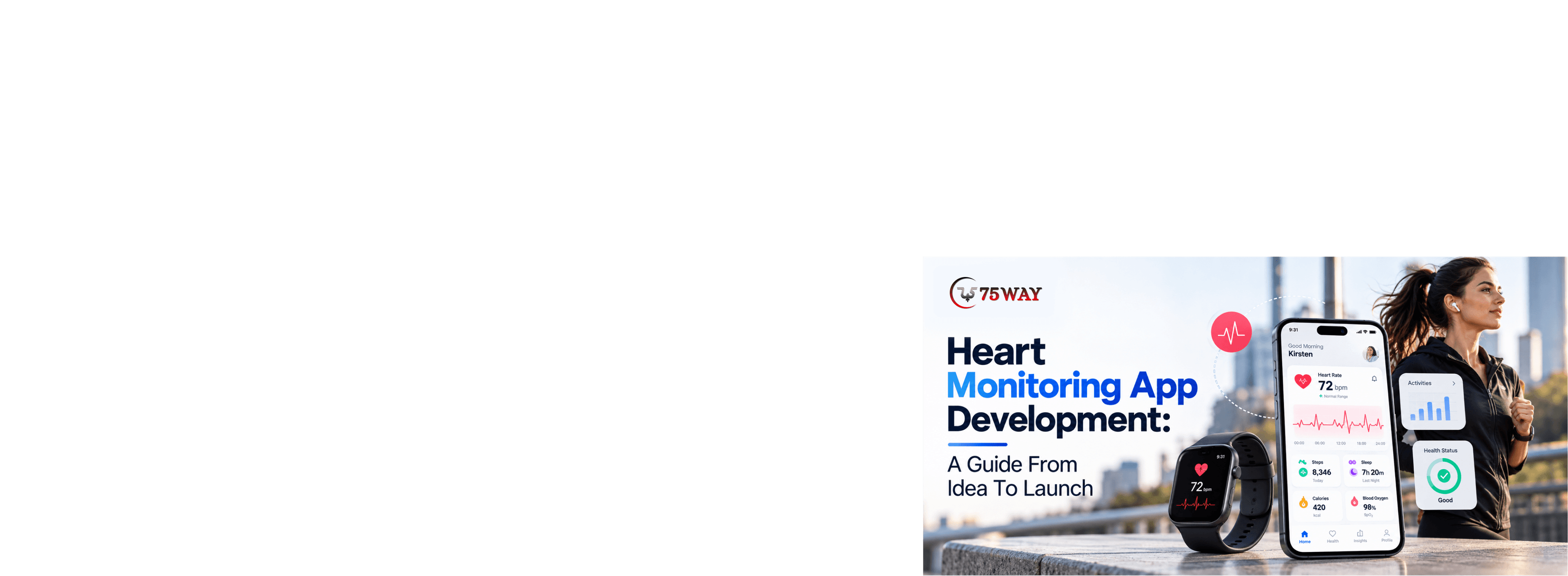
Heart monitoring apps are reshaping how cardiovascular data reaches users and healthcare providers. This guide explores Heart monitoring app development costs, essential features, wearable integration, AI, security, and compliance. A heart monitoring app can cost anywhere from roughly $80,000 to $300,000+ for a serious U.S.-market product
Key Takeaways
- Heart monitoring apps combine health data, wearables, analytics, security, and clinical workflows.
- The heart rate monitor market could reach $5.84 billion by 2035.
- Heart monitoring app development can cost $20,000–$450,000+ depending on scope.
- FDA, HIPAA, privacy, security, and intended use shape development requirements.
- AI, ECG, RPM, and wearable integrations create advanced product opportunities.
A heart monitoring app is not simply a mobile app that displays beats per minute. For a healthcare startup, medical device company, provider, or digital health business, it can become a connected platform involving sensors, wearable devices, health data, clinical workflows, privacy controls, analytics, and potentially medical-device regulation.
The app development strategy depends heavily on what your product actually does. A wellness and healthcare app that records historical heart-rate data has a very different technical and regulatory path from an application that analyzes ECG signals, detects cardiac abnormalities, or supports remote patient monitoring.
This guide explains the product, technical, regulatory, security, development, and business decisions you should make before investing in heart monitoring app development.
What Is a Heart Monitoring App?
A heart monitoring app is a mobile or connected software product that collects, displays, analyzes, or helps users share cardiovascular data. Depending on the product, that data may include:
- Heart rate
- Resting heart rate
- Heart rate variability
- ECG or EKG signals
- Activity-related heart-rate changes
- Blood pressure readings from connected devices
- Rhythm-related events
- Historical cardiovascular trends
- User-reported symptoms
- Sleep and activity data
- Alerts generated from predefined thresholds or algorithms
The important distinction is what the app does with the data.
An application that simply records and visualizes historical heart-rate information has a different risk profile from healthcare software that analyzes ECG data or controls a medical device. The FDA evaluates software functions based on their intended use and potential patient-safety risk, not merely because the software runs on a smartphone.
That distinction should influence your product architecture from day one.
Why Invest In A Heart Monitoring App Development: Market Insights
Heart monitoring apps can create a strong digital health opportunity as consumers and providers seek more accessible ways to track cardiovascular data. Market demand, connected devices, remote monitoring, and preventive care are creating new possibilities for health-tech businesses. The market insights, investment factors, and business opportunities behind heart monitoring app development are explored below.
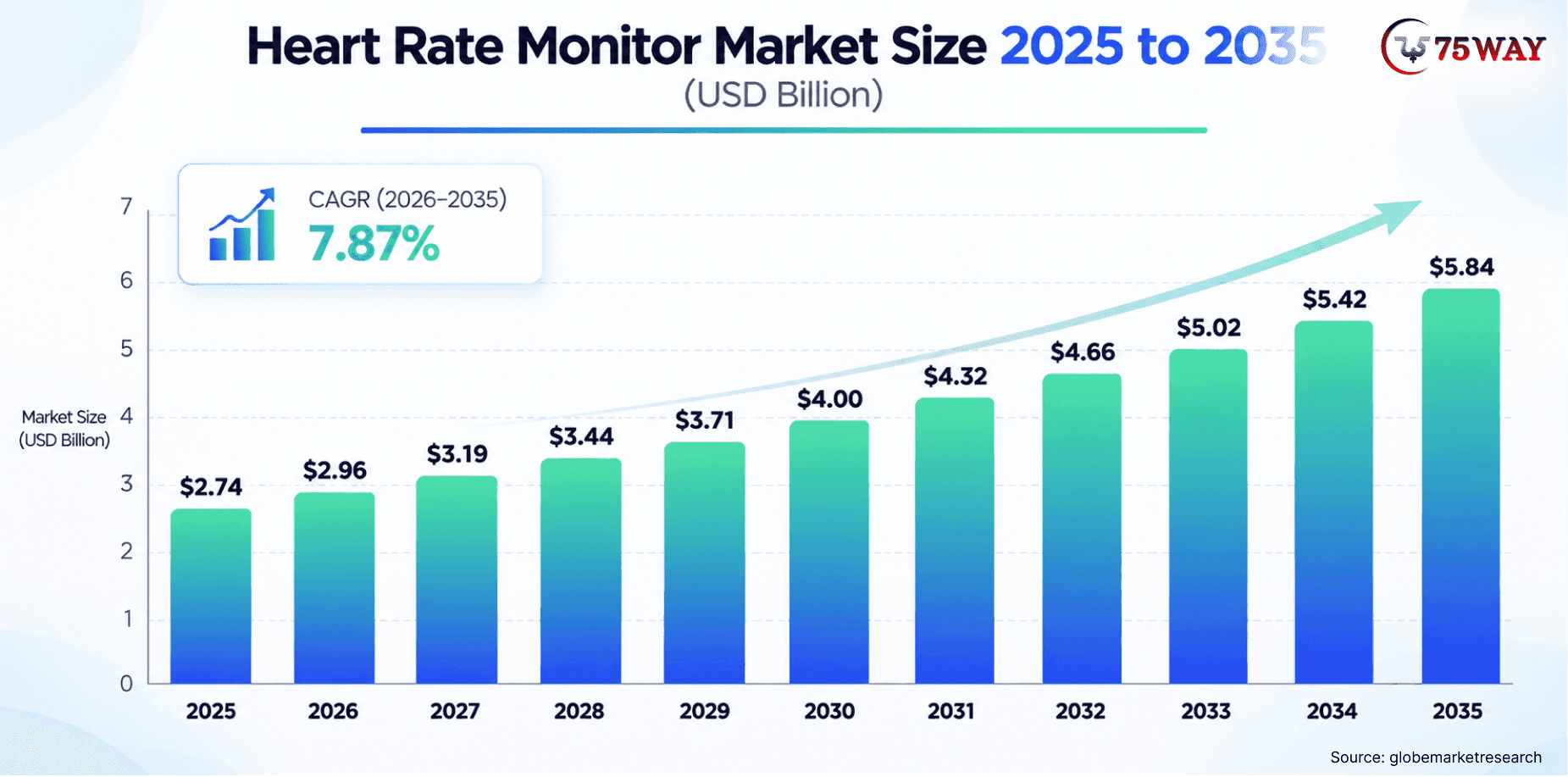
- The global heart rate monitor market is valued at $2.96 billion in 2026 and is projected to reach $5.84 billion by 2035, growing at a 7.87% CAGR.
- North America accounted for the largest regional revenue share, representing 40% of the global market.
- Wearable heart rate monitors dominated the product segment with a 50% market share.
- Chest strap monitors are projected to record the highest CAGR, with the segment holding a 20% market share.
- Consumers and fitness enthusiasts generated the highest end-user revenue share, accounting for 55% of the market.
How Does a Heart Monitoring App Work?
A heart monitoring app typically processes cardiovascular data through five connected stages, from capturing readings to delivering actionable information.
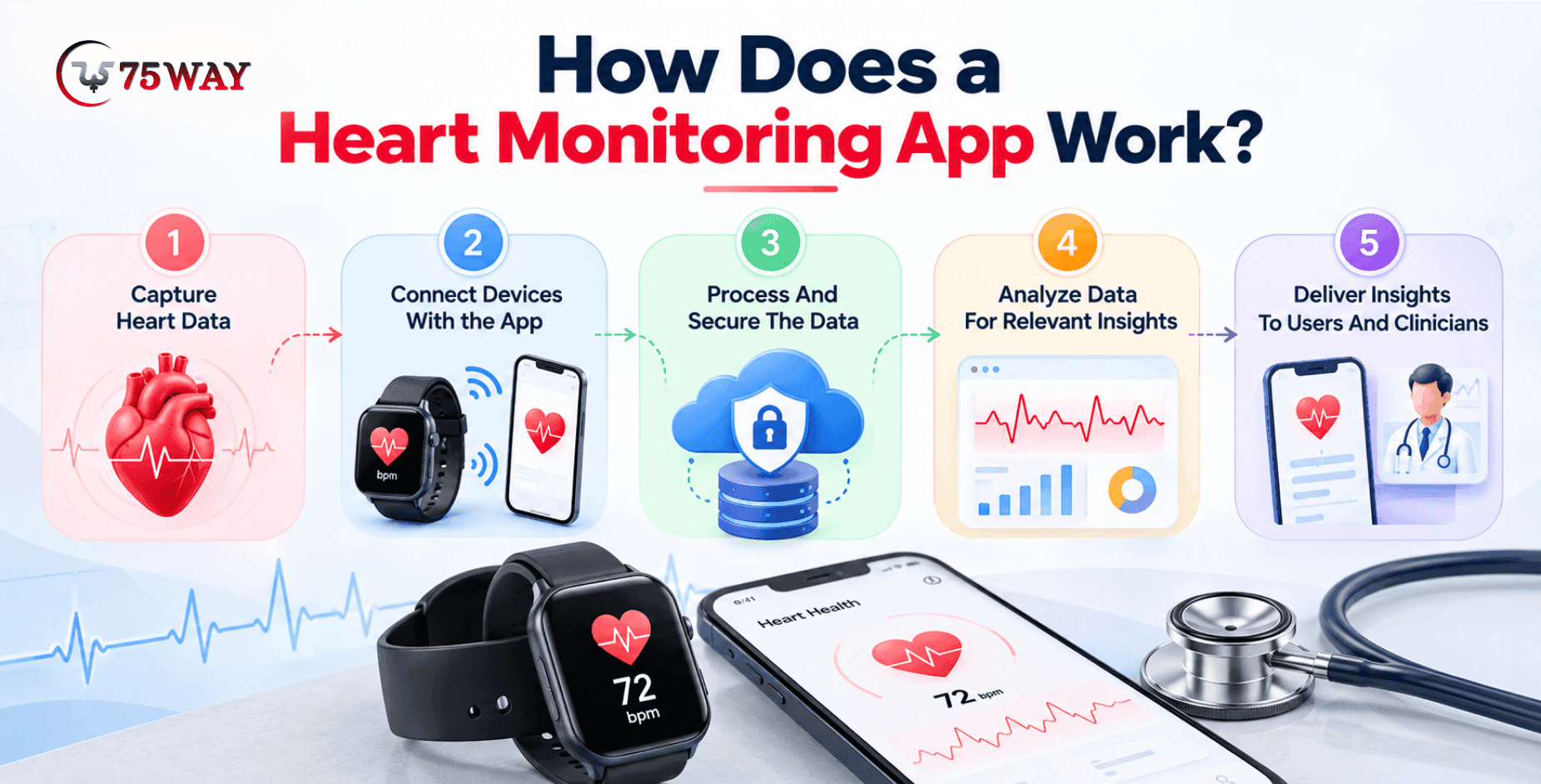
Layer 1: Capture Heart Data
The process begins when wearable devices, ECG sensors, smartwatches, or other connected devices capture heart-related measurements. This raw information becomes the foundation for everything the app does next.
Layer 2: Connect Devices With the App
The collected readings are transmitted to the mobile application through Bluetooth, health APIs, or device-specific integrations. Once connected, the app can receive, organize, and display incoming cardiovascular data.
Layer 3: Process And Secure The Data
The application sends relevant information to a secure backend, where data is processed, organized, stored, and prepared for further analysis while appropriate access and security controls are applied.
Layer 4: Analyze Data For Relevant Insights
Processed information can then pass through predefined rules, algorithms, or AI models to identify trends, patterns, or configured events according to the app's intended purpose.
Layer 5: Deliver Insights To Users And Clinicians
Finally, the resulting information appears through user dashboards, reports, alerts, or clinician portals, helping authorized users monitor cardiovascular data and determine appropriate next steps.
How To Develop A Healthy Heart Monitor App: Comprehensive Roadmap
A strong heart monitor app starts with a clear development plan, not just a list of health features. Reliable monitoring, meaningful insights, device compatibility, privacy safeguards, and scalable infrastructure all deserve attention before development begins. The complete journey from product planning to deployment involves several important steps and technical considerations.
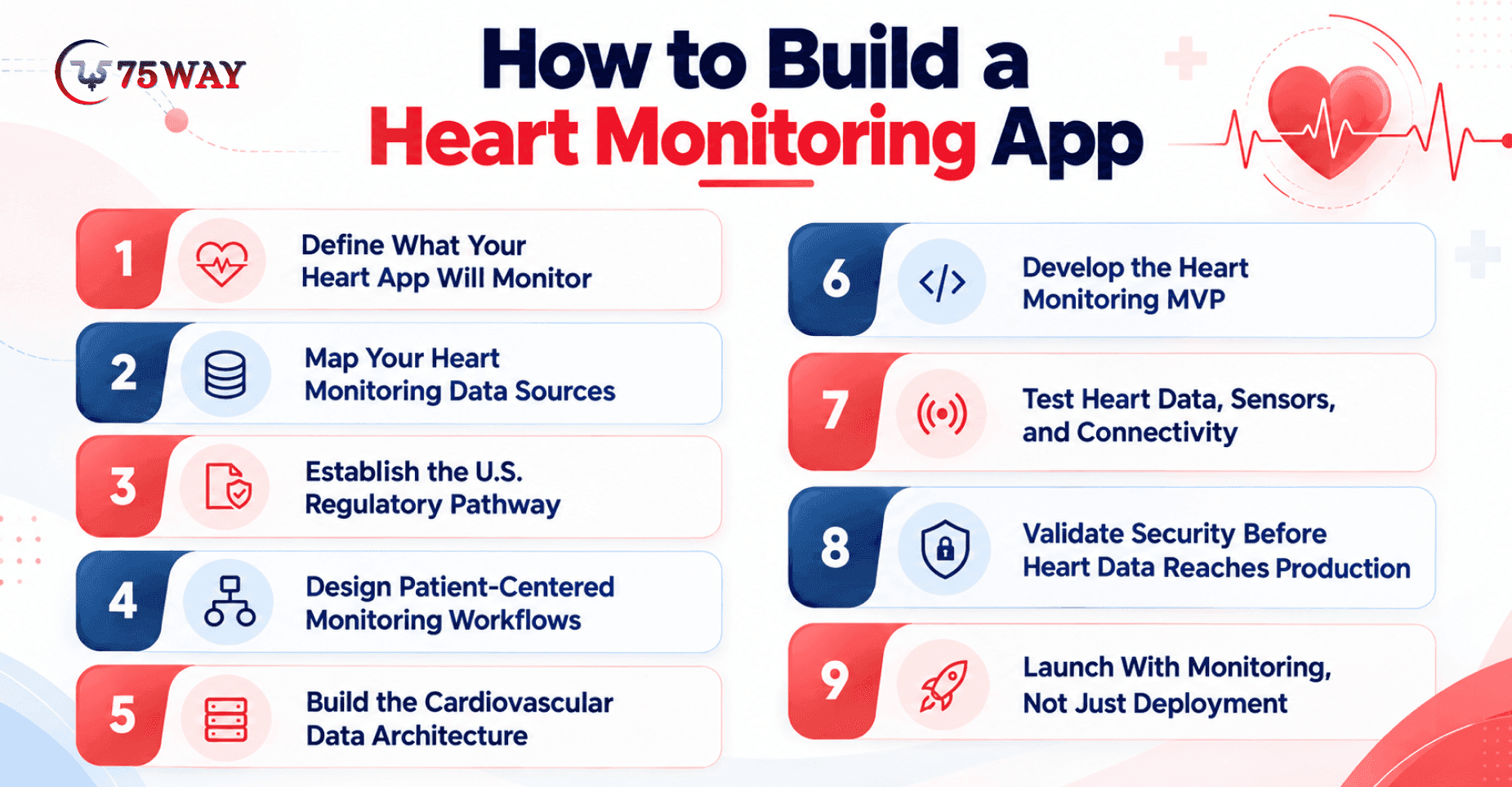
1. Define What Your Heart App Will Monitor
Start by defining the cardiovascular problem your product will address and the type of monitoring it will provide.
Determine whether the app will focus on:
- Heart-rate tracking
- ECG monitoring
- Heart-rate variability
- Blood pressure tracking
- Activity-related heart data
- Continuous monitoring
- Periodic measurements
- Remote patient monitoring
Then define your primary users, such as consumers, patients, caregivers, clinicians, or healthcare organizations.
Most importantly, document what the app will do with the collected data. Displaying historical readings is fundamentally different from analyzing ECG signals or generating clinically relevant alerts.
A clear intended use gives your product team a foundation for its technical and regulatory decisions.
2. Map Your Heart Monitoring Data Sources
Once the monitoring purpose is clear, determine exactly where cardiovascular data will originate.
Your app might receive information from:
- Smartwatches
- ECG devices
- Chest straps
- Fitness trackers
- Blood pressure monitors
- Bluetooth medical devices
- Smartphone sensors
For each source, define the data format, collection frequency, connectivity method, API availability, synchronization behavior, and failure scenarios.
This prevents your development team from designing a backend around assumptions that the selected devices cannot support.
3. Establish the U.S. Regulatory Pathway
Your intended functionality should be evaluated before development becomes deeply technical.
Determine whether your software could involve FDA-regulated medical-device functionality and assess HIPAA applicability based on your business relationships and data flows. You should also evaluate applicable FTC requirements and state privacy obligations.
For example, software that uses connected ECG electrodes to measure, store, and display ECG signals can involve device software functionality considered by the FDA.
Do this before finalizing features, because changing a regulated workflow after development can increase both cost and timeline.
4. Design Patient-Centered Monitoring Workflows
Design the experience around what users actually need to accomplish with their cardiovascular data.
A consumer might need:
Connect Device → Start Monitoring → View Reading → Understand Trend
A clinical product may require:
Enroll Patient → Collect Data → Detect Configured Event → Review Alert → Follow Up
These workflows should determine your screens, notifications, permissions, dashboards, and backend requirements.
Avoid filling the interface with every available metric. The goal is to make relevant information understandable and actionable for the intended user.
5. Build the Cardiovascular Data Architecture
Now translate your monitoring workflow into a technical architecture.
Your architecture should account for real-time streams, intermittent connectivity, duplicate readings, missing measurements, timestamps, device identification, permissions, data retention, and synchronization.
For continuous monitoring products, the architecture must also handle substantially more data than an application that records occasional manual readings.
6. Develop the Heart Monitoring MVP
Build the smallest product capable of validating your core monitoring workflow.
A focused MVP might include device integration, heart monitoring, dashboard, secure storage, and basic notifications.
Additional capabilities such as AI analysis, multiple wearable ecosystems, telehealth, advanced clinician workflows, or extensive reporting can be introduced after validating the primary use case.
This approach helps founders test product-market fit without committing the initial budget to every possible cardiovascular feature.
7. Test Heart Data, Sensors, and Connectivity
Healthcare app testing needs to go beyond checking whether buttons and screens work.
Test the product across:
- Different supported devices
- Weak Bluetooth connections
- Network interruptions
- Missing readings
- Duplicate readings
- Delayed synchronization
- Low battery conditions
- Background app behavior
- Poor signal quality
- Different operating-system versions
Also verify that the application handles incomplete or unexpected data safely rather than presenting it as a reliable measurement.
For ECG or other medically significant functionality, testing and validation requirements should be aligned with the product's intended use and regulatory strategy.
8. Validate Security Before Heart Data Reaches Production
Before launch, test whether sensitive cardiovascular information is adequately protected across its entire lifecycle.
Review authentication, authorization, encryption, API security, device pairing, role-based permissions, audit logs, cloud configuration, data retention, backup, recovery, and vulnerability management.
For a clinical platform, verify that patients, clinicians, administrators, and other users can access only the information appropriate to their roles.
9. Launch With Monitoring, Not Just Deployment
Launching the app is the beginning of operational learning, not the end of development.
Track device connection failures, data synchronization issues, app crashes, alert behavior, user engagement, data quality, support requests, battery impact, and clinician workflow issues.
Use these findings to improve device compatibility, monitoring workflows, usability, and platform reliability.
For healthcare products, establish a clear process for handling software updates, security issues, changing device integrations, and applicable regulatory obligations as the product evolves.
Core Features To Consider In Custom Heart Monitoring App Development
A heart monitoring app needs more than a clean interface to deliver meaningful value to users and healthcare businesses. Accurate tracking, timely alerts, wearable integration, secure data handling, and useful insights can shape the app experience. The core features worth considering in custom heart monitoring app development are explained below.
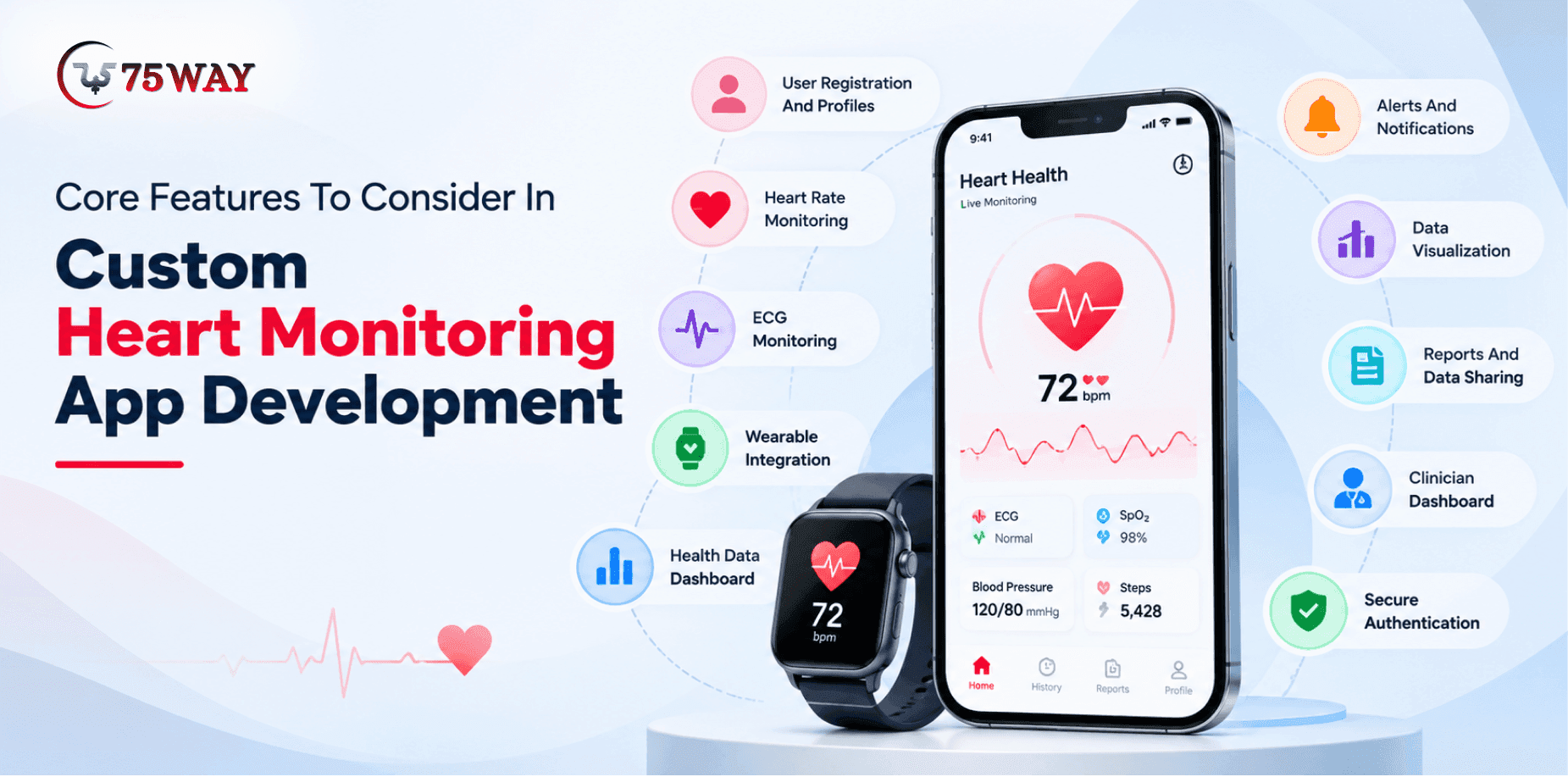
- User Registration And Profiles: Users create secure profiles to manage personal information, preferences, and connected devices. Clinical products can additionally connect profiles with patient identities and healthcare workflows.
- Heart Rate Monitoring: Heart-rate tracking brings vital readings into one place for easier monitoring. Users can view current measurements, resting rates, activity changes, and historical patterns based on available data.
- ECG Monitoring: ECG functionality captures electrical heart signals through compatible devices for deeper cardiovascular monitoring. Because ECG can involve regulated medical-device functionality, its intended use requires careful planning.
- Wearable Integration: Wearable connectivity brings cardiovascular data directly into the application from supported devices. Integrations can include smartwatches, chest straps, ECG devices, fitness trackers, and Bluetooth-enabled medical sensors.
- Health Data Dashboard: A centralized dashboard turns scattered cardiovascular readings into an organized health picture. Users can quickly explore measurements, trends, device status, reports, and important monitoring information.
- Alerts And Notifications: Smart notifications can bring attention to predefined readings, missed measurements, or device issues. Carefully designed alerts keep users informed without presenting notifications as medical diagnoses.
- Data Visualization: Clear charts transform complex cardiovascular measurements into easy-to-follow visual trends. Users can compare readings over time and understand meaningful changes without confusing data with clinical conclusions.
- Reports And Data Sharing: Structured reports make cardiovascular information easier to review and communicate with authorized professionals. Users can share selected readings, trends, timestamps, symptoms, and device information securely.
- Clinician Dashboard: A dedicated provider dashboard brings patient monitoring information into one convenient workspace. Healthcare professionals can review measurements, trends, alerts, reports, communication, and monitoring parameters.
- Secure Authentication: Strong authentication protects sensitive cardiovascular information from unauthorized access. Features such as multi-factor authentication, role-based permissions, secure sessions, and account recovery strengthen overall application security.
Advanced Features for AI-Powered Heart Monitoring App Development
Once the core product is validated, advanced functionality can be added. AI-driven risk insights, personalized health recommendations, and predictive analytics can make the app more valuable for users and healthcare providers. These capabilities can also support better engagement and create new opportunities for long-term product growth.
1. AI-Based Pattern Analysis
AI can potentially support signal processing, classification, anomaly detection, personalization, or risk-oriented workflows.
But AI should not be added simply because it is commercially attractive.
If an algorithm makes medical claims, you need to evaluate its intended use, validation requirements, data quality, monitoring, and applicable regulatory pathway.
2. Remote Patient Monitoring
RPM functionality can connect patients with clinical teams outside traditional healthcare settings.
This can include scheduled measurements, continuous data collection, clinician dashboards, alerts, and patient communication.
3. Telehealth Integration
A heart monitoring product can connect monitoring data with virtual-care workflows.
4. Medication and Care Reminders
Depending on the product, reminders can support adherence to an established care plan.
5. Emergency Workflows
Emergency-related functionality requires careful product and clinical design.
The application should clearly distinguish between a software notification and professional emergency medical care.
6. Personalized Insights
Personalized dashboards can surface trends based on individual data.
For medical applications, these insights should be developed and validated according to the product's intended clinical purpose.
Recommended Technology Stack To Develop A Heart Rate Monitor App
One technology stack may work perfectly for a basic fitness tracker and fall short for a heart rate monitoring product. Wearable connections, continuous data streams, cloud processing, user accounts, and health data protection create very different technical demands. A closer look at the recommended stack can help businesses understand what belongs in each layer and why.
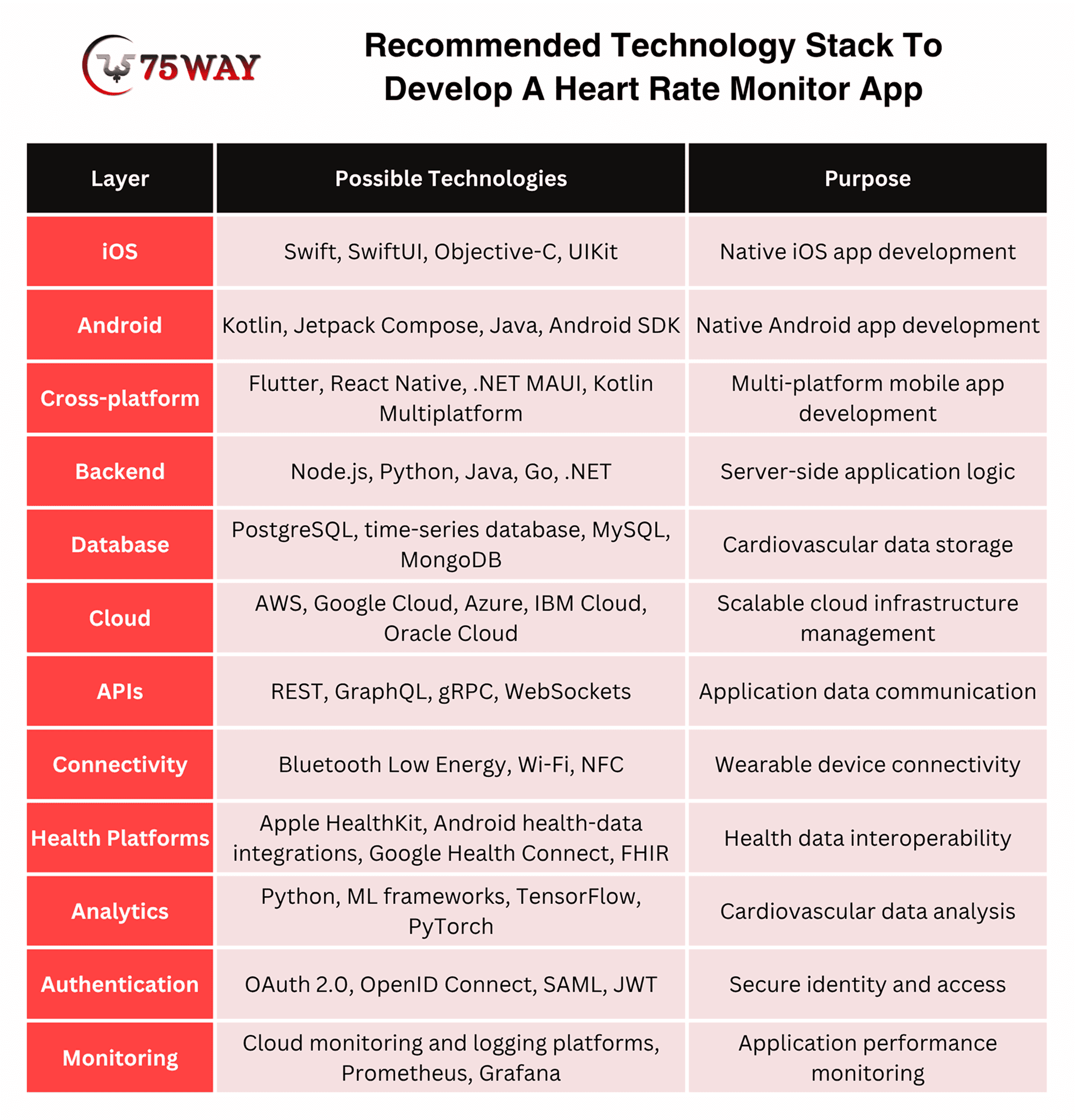
The final choice should follow the product's device requirements, performance needs, security model, team capabilities, and regulatory strategy.
Business Models: Who Can Develop a Healthy Heart Monitor App?
A Healthy Heart Monitor app can create value through several revenue paths, from subscriptions and premium features to partnerships with healthcare providers. The right business model depends on your target users, app capabilities, monetization strategy, and long-term growth plans. The key business models and their revenue potential are discussed in detail below.
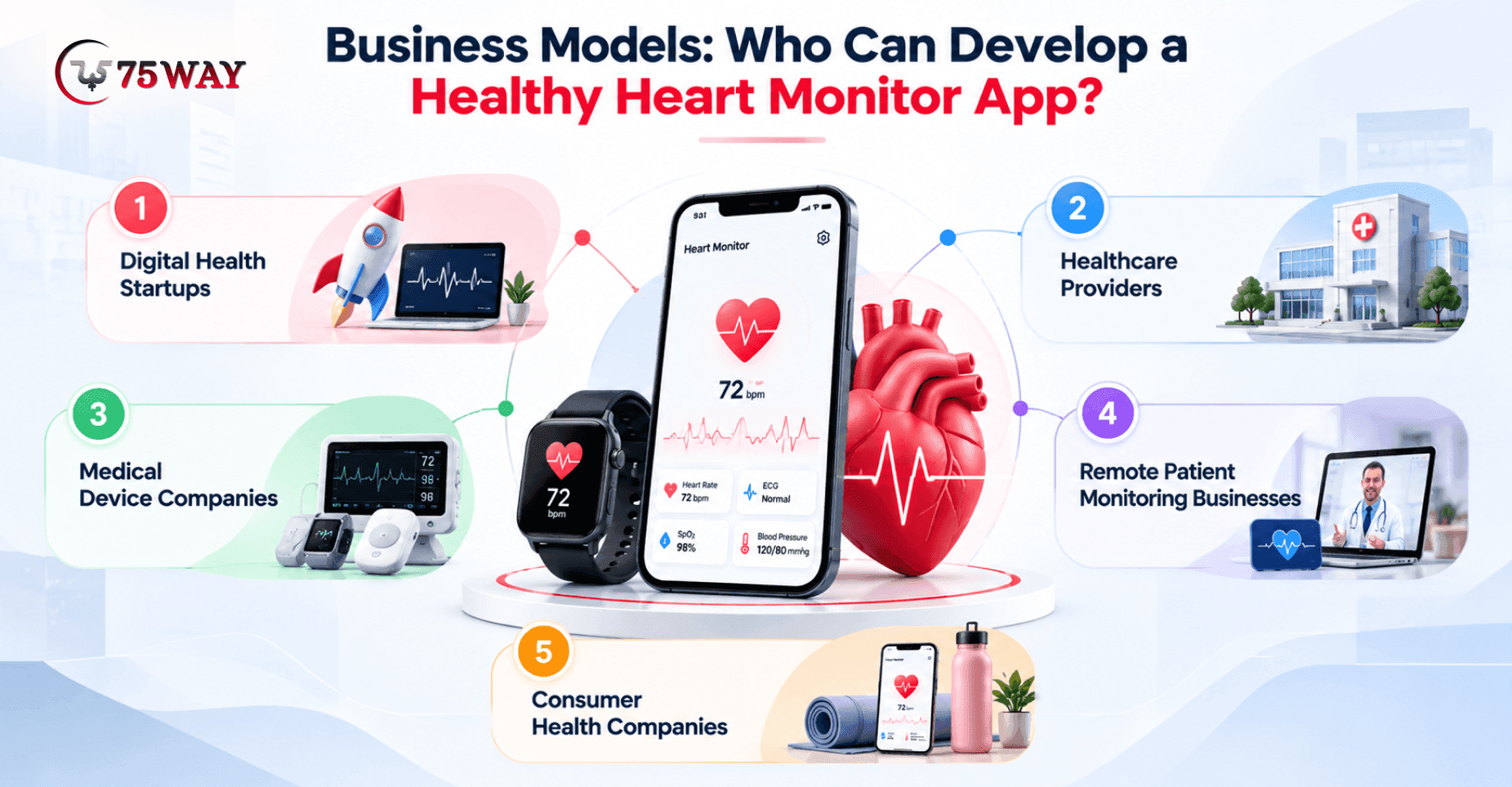
1. Digital Health Startups
Startups can develop consumer-facing heart health products, remote monitoring platforms, chronic-care tools, or specialized cardiovascular applications.
The product may combine mobile monitoring with subscriptions, provider services, wearable integration, or B2B partnerships.
2. Healthcare Providers
Hospitals, cardiology practices, and health systems can use connected applications to collect patient data outside traditional clinical settings and support remote monitoring workflows.
3. Medical Device Companies
A medical device company may need a companion application that receives, displays, stores, or analyzes information generated by its hardware.
This becomes particularly important when the software is connected to or performs functions associated with a regulated medical device.
4. Remote Patient Monitoring Businesses
RPM companies can use heart monitoring applications to connect patients and clinicians through continuous or periodic health-data collection.
5. Consumer Health Companies
Consumer products can focus on wellness, fitness, heart-rate trends, activity, sleep, and other non-diagnostic use cases.
The intended use statement should be defined before development, because it can affect architecture, claims, validation, regulatory obligations, and go-to-market strategy.
Heart Monitoring App Development Cost: Pricing Breakdown
There is no single reliable price for heart monitoring app development because the scope can range from a consumer heart-rate tracker to a regulated clinical platform. However, an average cost to build a heart monitoring app lies between 20K–450K+.
1. Basic Heart-Rate App Cost: $20,000–$50,000
- Essential tracking with basic heart-rate monitoring capabilities.
- Simple dashboards, history, and notification functionality included.
Estimated Time: 2–4 Months
2. Clinical/RPM Platform Cost: $50,000–$120,000+
- Patient monitoring with clinician-facing dashboards and workflows.
- Secure data exchange, alerts, and healthcare integrations included.
Estimated Time: 5–9 Months
3. Wearable-Connected App Cost: $80,000–$150,000
- Wearable integrations supporting continuous cardiovascular data collection.
- Device synchronization, dashboards, and historical analytics included.
Estimated Time: 4–7 Months
4. Advanced Monitoring Platform Cost: $150,000–$250,000+
- Advanced analytics supporting complex cardiovascular monitoring requirements.
- AI capabilities, real-time processing, and integrations included.
Estimated Time: 6–10 Months
5. Regulated Medical Device / SaMD Cost: $120,000–$450,000+
- Medical-grade functionality requiring extensive validation and documentation.
- Regulatory planning, cybersecurity, testing, and compliance activities included.
Estimated Time: 9–18+ Months
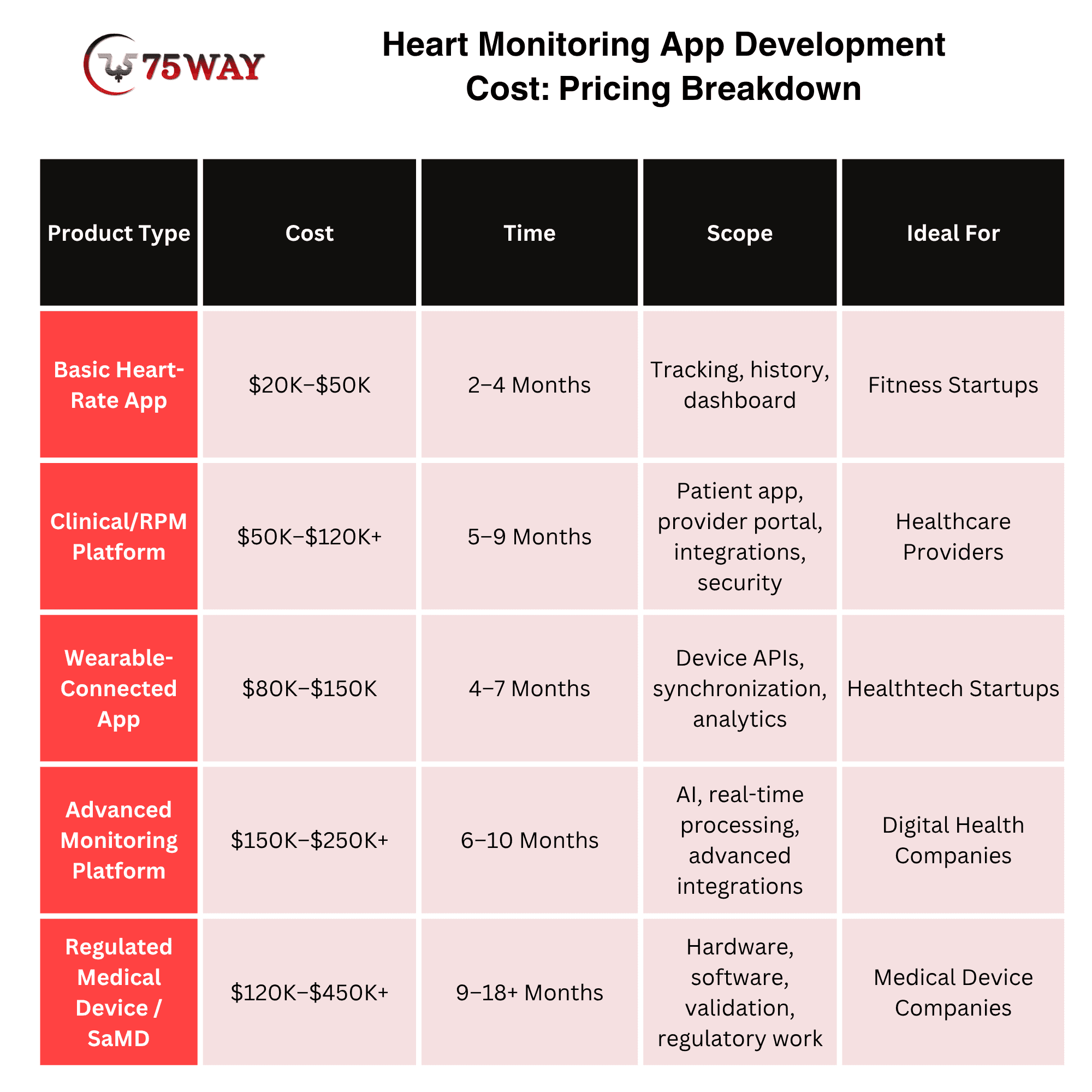
These are planning estimates, not fixed development prices. The final cost depends on your heart rate monitoring app’s features, integrations, technology, compliance requirements, development team, and overall project scope.
What Makes Heart Monitoring App Development Expensive?
Heart monitoring app development costs can rise quickly when the product requires medical-grade integrations or advanced security. The major cost factors and their impact on your development investment are explained.
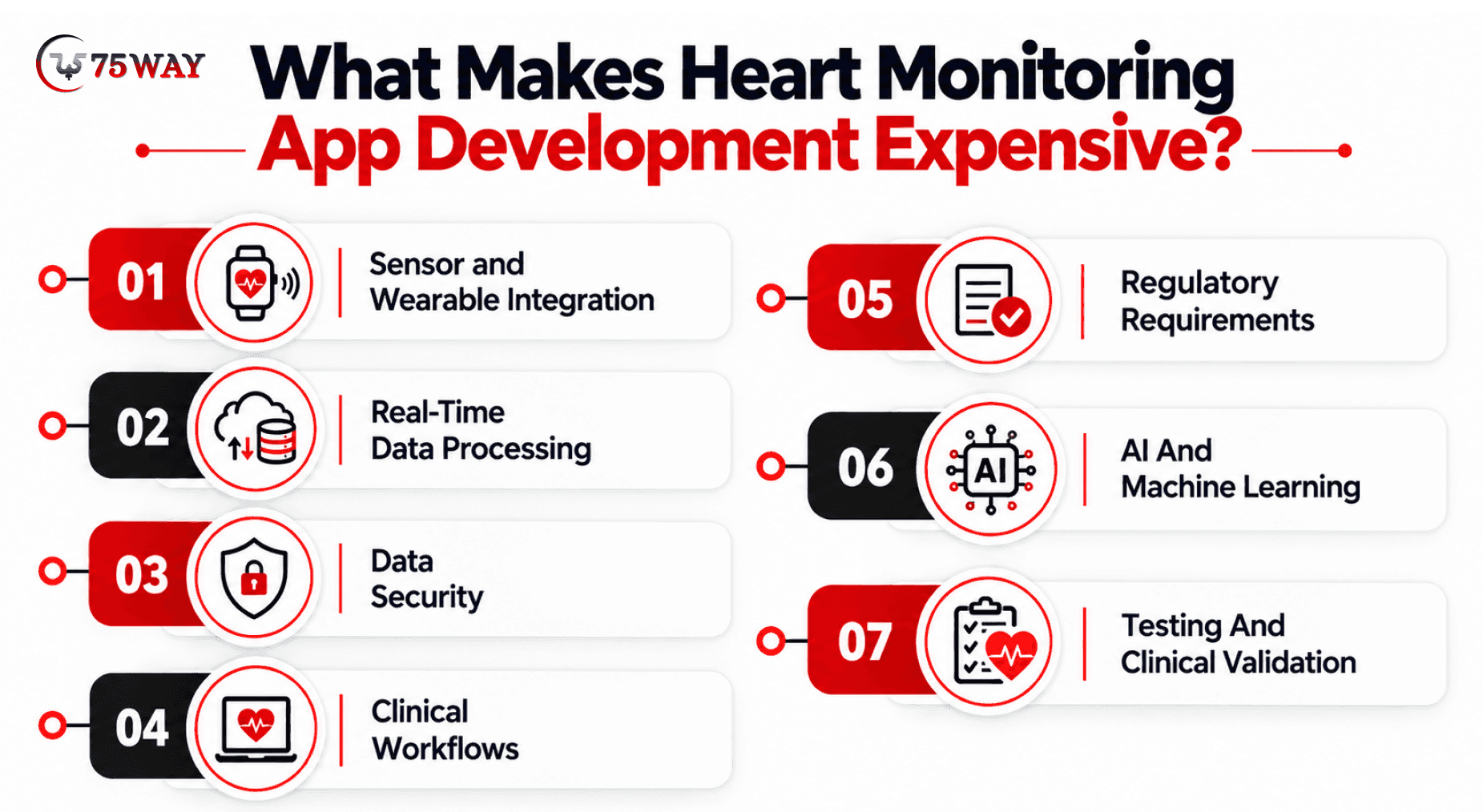
- Sensor and Wearable Integration
Different devices produce different data formats, sampling rates, APIs, and connectivity requirements.
Your engineering team needs to normalize that information before presenting it consistently inside the application.
- Real-Time Data Processing
Continuous monitoring creates substantially different infrastructure requirements from occasional manual measurements.
The backend may need to process large volumes of time-series data while maintaining reliability and low latency.
- Data Security
Health information requires stronger security planning than a typical consumer application.
Encryption, access control, authentication, audit trails, secure APIs, data retention, and incident-response processes all influence the architecture.
- Clinical Workflows
A patient application is only one component of an RPM ecosystem.
A clinical platform may require dashboards, alert management, patient assignment, reporting, communication, integrations, and administrative workflows.
- Regulatory Requirements
Regulatory analysis can affect product requirements before engineering begins.
That is particularly important when software analyzes medical-device data or performs functions that could affect patient safety.
- AI And Machine Learning
AI-powered monitoring requires quality datasets, model development, validation, inference infrastructure, and ongoing performance monitoring.
More sophisticated cardiovascular analysis can therefore add substantial development and testing costs.
- Testing And Clinical Validation
Heart monitoring apps require rigorous testing across devices, operating systems, connectivity conditions, and data scenarios.
Products with clinical functionality may also require additional validation to demonstrate that intended functions perform reliably.
U.S. Regulatory Considerations for Building Heart Monitoring Mobile Apps
This is one of the sections that should differentiate your article from generic app-development blogs. Do not treat “HIPAA compliant” and “FDA approved” as interchangeable concepts. They address different issues.
1. FDA Considerations
The FDA's software policy is function-specific.
Some health applications are outside the definition of a medical device, while certain software functions are subject to FDA oversight.
For example, software that connects to a medical device to control it or analyze medical-device data may fall within FDA oversight. The FDA specifically provides ECG-related examples involving software that uses connected electrodes to measure, store, and display cardiac electrical signals.
Conversely, some lower-risk software functions, such as historical trending and comparison of vital signs, may fall within areas where FDA intends to exercise enforcement discretion.
The practical takeaway: determine your product's intended use and regulatory classification before finalizing the feature set.
2. HIPAA Considerations
HIPAA applicability depends on the business relationships and how protected health information is handled.
HHS explains that an app developer can become a business associate when it creates, receives, maintains, or transmits electronic protected health information on behalf of a covered entity or business associate. An app receiving information directly at an individual's request does not automatically create a business-associate relationship.
That means simply writing “HIPAA-compliant app” in a product specification is not enough.
Your team should map data, source, transmission, storage, access, sharing, retention, and deletion.
Then determine which legal and security requirements apply.
HHS maintains dedicated resources for mobile health app developers covering HIPAA and other potentially applicable federal laws, including the FTC Act and Health Breach Notification Rule.
3. FTC Privacy And Breach Requirements
Health apps can also fall under FTC requirements, particularly when they collect identifiable health information outside HIPAA. The FTC’s Health Breach Notification Rule can require covered businesses to notify consumers, the FTC, and sometimes the media after certain breaches.
This means your privacy policy, data-sharing practices, security controls, and breach-response process should be designed alongside the product rather than added after launch.
4. Medical Device Cybersecurity
If your heart monitoring product qualifies as a medical device, cybersecurity becomes part of the regulatory lifecycle, not simply an IT concern. The FDA’s 2026 guidance addresses cybersecurity design and documentation for devices with cybersecurity risks, including information relevant to premarket submissions.
Your development plan should therefore consider threat modeling, security controls, vulnerability management, updates, and post-market cybersecurity throughout the product lifecycle.
Security Architecture Used To Develop A Heart Monitoring App
Security should be designed into the product rather than added immediately before launch.
A robust architecture may include:
- Encryption in transit
- Encryption at rest
- Strong authentication
- Role-based access control
- API security
- Secure device pairing
- Audit logging
- Access monitoring
- Data minimization
- Secure cloud configuration
- Backup and recovery controls
- Vulnerability testing
- Incident-response procedures
For clinical applications, access permissions should reflect actual roles.
A patient should not have the same permissions as a cardiologist, administrator, or support employee.
Native vs. Cross-Platform Heart Monitor App Development
This decision deserves more attention than it usually receives.
Native Heart Monitor App Development
Native iOS and Android development can provide deeper access to platform-specific health APIs, Bluetooth functionality, background processing, and device capabilities.
It can make sense when your product depends heavily on platform-specific health or hardware functionality.
Cross-Platform Heart Monitor App Development
Cross-platform frameworks can reduce duplicated UI and business-logic development.
They can work well when the application has substantial shared functionality, and the required device capabilities are supported reliably.
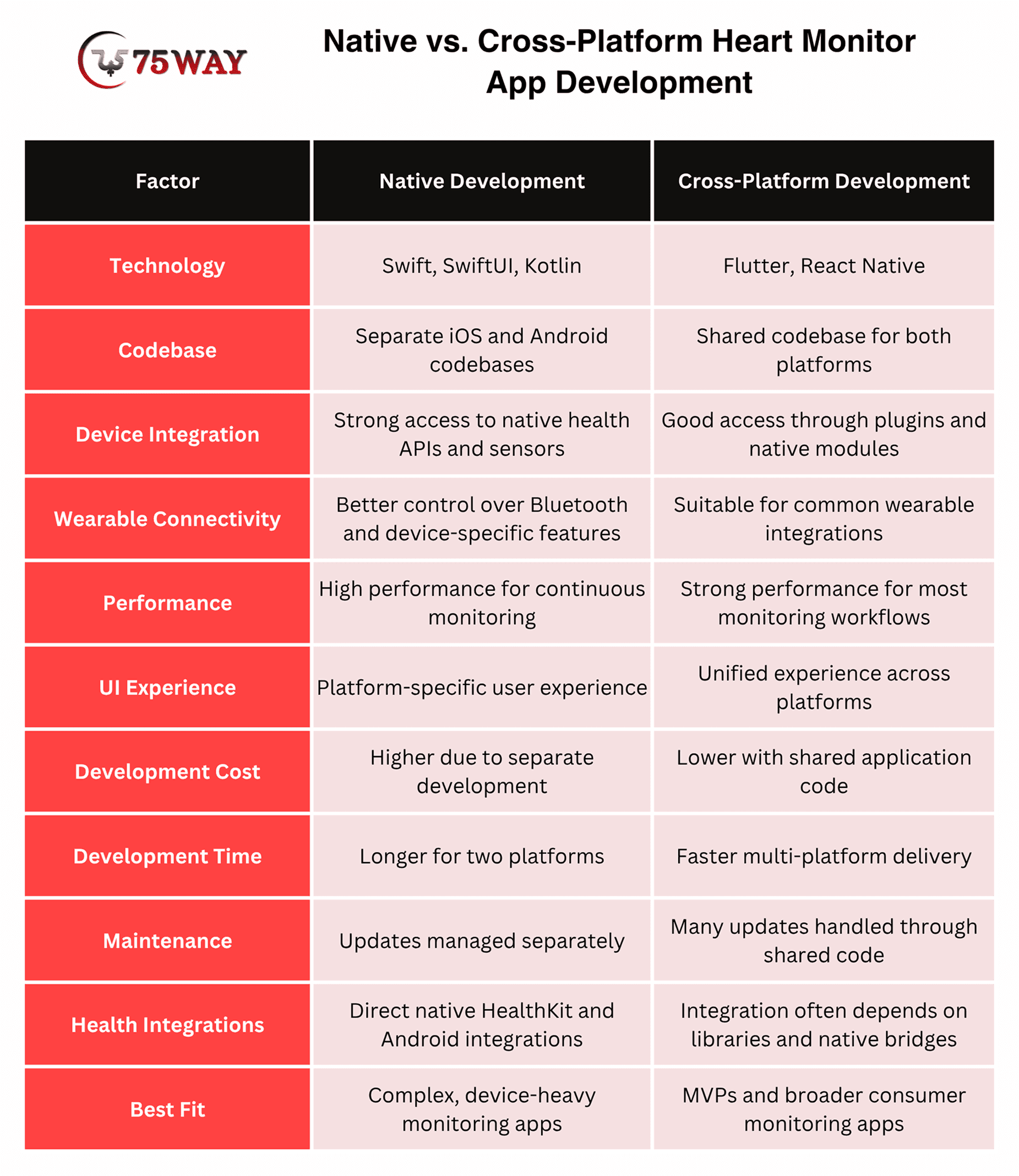
Which Approach Should You Choose?
The answer depends on the hardware and health-data requirements, not simply on development cost.
If your product depends heavily on specialized sensors, Bluetooth behavior, background processing, or platform-specific health capabilities, evaluate those requirements before choosing the framework.
Challenges in Cardio App Development & How To Resolve Them
A cardio app can collect plenty of health data and still fall short if that information is unreliable or difficult to interpret. Wearable differences, connectivity issues, sensitive records, alert accuracy, and regulatory requirements can create difficult development decisions. The common obstacles in cardio app development and practical solutions for handling them are discussed below.
- Data Accuracy
Sensor readings can be affected by motion, device placement, signal quality, hardware differences, and environmental conditions.
Your application should distinguish between a measurement and a clinically validated conclusion.
- Device Fragmentation
Different wearables and sensors may produce different data.
Your integration layer should normalize incoming information without losing important source metadata.
- Battery Consumption
Continuous monitoring can increase battery usage.
Developers need to balance monitoring frequency, background processing, Bluetooth connections, and user experience.
- False Alerts
Excessive notifications can reduce user trust.
Alert logic should be designed around the intended clinical or wellness use case and validated appropriately.
- Data Privacy
Users expect sensitive health information to be handled securely.
Security should cover the complete lifecycle of the data, not just the backend database.
- Regulatory Uncertainty
A feature that appears technically simple can create regulatory implications depending on its intended use.
That is why regulatory discovery should happen before development rather than after the product has already been built.
Revenue Models to Generate Profit From Heart Disease Monitoring App
User downloads alone do not create a profitable heart monitoring business. The real opportunity lies in choosing a monetization approach that matches user needs, app capabilities, and the value delivered through ongoing monitoring. The revenue models, pricing approaches, and commercial opportunities worth considering are covered ahead.
1. Consumer Subscription Model
Consumer users pay monthly or annually for advanced tracking, reports, analytics, or premium functionality. This model works well when users receive recurring value from ongoing heart monitoring and personalized insights.
2. B2B Licensing Model
Healthcare organizations or businesses pay to use the platform. Revenue can come through annual contracts based on organizational requirements, users, or selected capabilities.
3. Enterprise SaaS Model
Providers can pay based on users, clinicians, facilities, or monitoring volume. This approach supports larger healthcare operations that need centralized administration and scalable monitoring infrastructure.
4. Device & Software Model
Medical device companies can bundle the application with connected hardware. Revenue can combine hardware purchases with software subscriptions, monitoring services, or extended digital features.
5. Remote Patient Monitoring Model
Healthcare businesses can incorporate monitoring software into reimbursable or contracted remote-care workflows where applicable. The platform can support patient enrollment, connected-device data, alerts, reporting, and clinician review within established care programs.
6. White-Label Platform Model
A technology provider can license the infrastructure to healthcare companies under their own brand. This allows organizations to launch branded heart monitoring experiences without developing the underlying platform independently.
How Long Does It Take to Create a Heart Monitoring App?
Development time depends on product complexity. A basic tracking application may take a few months, while a wearable-connected platform can require substantially longer.
A clinical RPM product involving device integrations, provider dashboards, secure infrastructure, interoperability, validation, and regulatory work can take considerably longer. A realistic planning framework is:
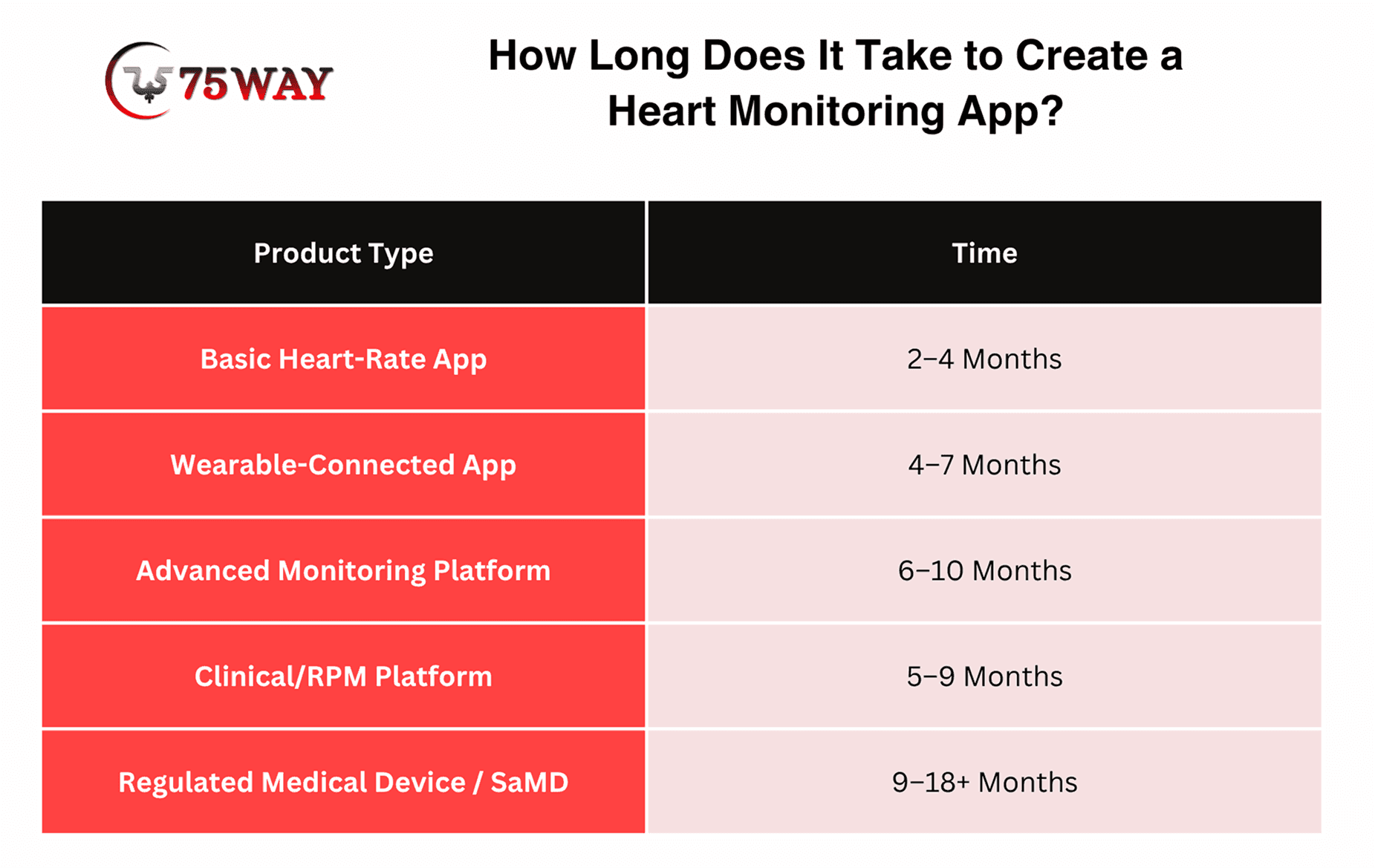
These are project-planning ranges rather than guaranteed schedules. Hardware dependencies, regulatory review, integration complexity, testing requirements, and scope changes can materially affect timelines.
How to Reduce Heart Rate Monitoring App Development Costs
Reducing cost does not mean removing critical safety or security controls. Instead:
1. Start With One Primary Use Case
Do not build a fitness tracker, RPM platform, ECG analyzer, telehealth system, and AI diagnostic product simultaneously.
2. Limit Initial Device Integrations
Start with the devices most important to your target users.
3. Build a Focused MVP
Validate the core workflow before investing heavily in secondary functionality.
4. Design Compliance Early
Late regulatory changes can be much more expensive than early product discovery.
5. Use Modular Architecture
Separate device integration, data processing, analytics, authentication, and presentation layers so future capabilities can be added without rebuilding the entire system.
What Should Founders Decide First Before Hiring Heart Monitoring App Development Company?
Before speaking with a development company, answer these 10 questions:
- Who is the primary user?
- Is the product wellness-focused or clinical?
- What data will the app collect?
- Which sensors or devices will provide that data?
- Will ECG functionality be included?
- Will clinicians access the data?
- Will the product analyze or interpret medical data?
- Which U.S. regulatory requirements may apply?
- What is the MVP budget?
- What business outcome should the first release prove?
These answers can reduce uncertainty around scope, technology, compliance, cost, and timeline before development begins.
How 75way Delivers Heart Monitor App Development Solutions
75way Technologies helps businesses turn heart monitoring concepts into secure, scalable digital health applications tailored to specific monitoring requirements. Our heart monitor app development approach can cover wearable and Bluetooth device integration, real-time heart-rate tracking, ECG connectivity, health dashboards, alerts, historical data, secure APIs, cloud infrastructure, and healthcare data workflows.
From MVP development to advanced fitness platforms, 75way can support the complete development lifecycle, including product planning, UI/UX design, mobile development, backend engineering, device integration, testing, security, and deployment. We also help structure the application around its intended use, user type, data flow, and required integrations, giving businesses a practical foundation for expanding their heart monitoring solution.
Final Thoughts
Successful heart monitoring app development starts with product definition, not coding. The most important decisions involve intended use, data sources, device connectivity, clinical workflows, security, regulatory requirements, validation, and the business model.
For a consumer wellness product, the architecture may remain relatively focused. For an ECG-enabled or remote patient monitoring platform, the product becomes a larger healthcare technology ecosystem involving devices, data infrastructure, clinicians, security controls, and potentially FDA-regulated software functions.
If your goal is to build a commercially viable product for the U.S. market, validate the use case and regulatory path before committing to the full feature set. To turn your heart monitoring app idea into a scalable healthcare product, you can discuss your product requirements with a professional healthcare app development firm.
Frequently Asked Questions (FAQs)
Can A Heart Monitoring App Connect To Wearables?
Yes. Wearable connectivity can be implemented through platform health APIs, manufacturer APIs, Bluetooth Low Energy, or specialized device integrations, depending on the hardware.
What Is The Difference Between A Heart-Rate App And A Cardiac Monitoring App?
A heart-rate app may focus on recording and displaying pulse measurements, while a cardiac monitoring platform can involve ECG data, specialized devices, clinical workflows, remote monitoring, and potentially regulated medical functions.
Can A Heart Monitoring App Send Data To Doctors?
Yes. A platform can provide secure data sharing, clinician dashboards, reports, messaging, and remote monitoring workflows. The appropriate architecture depends on the healthcare organization's requirements and regulatory context.
How To Create A Heart Monitor?
Define the monitoring purpose, choose compatible sensors or wearables, design the data architecture, develop the mobile app and backend, integrate health platforms, add security controls, test measurements, and address applicable regulatory requirements.
Do Heart Monitor Apps Really Work?
They can work for tracking and displaying heart-related measurements when supported by compatible sensors or wearables. However, accuracy varies by device, measurement method, software, and usage conditions, so consumer apps should not automatically be treated as medical diagnostic tools.
Can A Heart Monitor App Detect An Irregular Heartbeat?
Some apps and connected devices can identify patterns that may indicate an irregular heart rhythm, such as atrial fibrillation, when their intended functionality supports it. Such alerts are not necessarily a diagnosis and may require confirmation through appropriate medical evaluation.