AI Summary
Growing businesses need more than an AI receptionist that simply answers calls. This guide explains how to evaluate software based on workflows, integrations, costs, scalability, and customer experience. It also compares alternatives and highlights smarter buying decisions for 2027.
Key Takeaways
- Evaluate AI receptionist software around business growth, workflows, and customer needs.
- Test conversation quality using realistic calls before choosing any vendor.
- Compare integrations, scheduling, escalation, security, pricing, and scalability carefully.
- Choose automation based on measurable outcomes, not impressive feature lists.
- The global AI receptionist market could reach $31.3 billion by 2035
A missed call from a ready-to-buy customer can turn a successful marketing campaign into a lost opportunity, especially when your team is too busy to answer every ring. Modern AI receptionists can provide phone coverage around the clock while handling tasks such as appointment booking, lead qualification, call routing, and CRM updates.
That does not mean every AI agent development solution is suitable for a growing business. Some platforms focus mainly on answering calls, while others combine scheduling, CRM integration, qualification, analytics, and workflow automation, so the right choice depends heavily on what you expect the software to handle.
A growing company needs software that can solve today’s call-handling problem without becoming another system to replace six months later. This guide covers the key considerations for choosing AI receptionist software development solution that can support your customers, team, and expanding operations.
What Is AI Receptionist Software?
AI receptionist software is a voice-based business communication system that uses artificial intelligence to answer incoming calls, understand caller requests, provide relevant information, and perform predefined business actions.
Depending on the platform, a virtual answering service for small businesses may:
- Answer inbound calls
- Identify caller intent
- Answer frequently asked questions
- Capture caller information
- Qualify leads
- Schedule appointments
- Reschedule or cancel appointments
- Route calls to employees
- Send messages or notifications
- Create or update customer records
- Provide after-hours coverage
- Escalate conversations to humans
The important difference between a basic automated phone system and a conversational AI receptionist is what happens after the call is answered.
A traditional system might tell the caller:
“Press 1 for sales. Press 2 for support.”
A conversational system can potentially understand:
“I need an estimate for replacing the HVAC system at my office next week.”
It can then identify the request, collect qualifying information, check the appropriate workflow, and route or schedule the next step.
That is why growing businesses should evaluate an AI receptionist voice agent as a workflow automation system, rather than simply a phone answering tool.
AI Caller Assistant Market Size And Business Opportunities in USA & Worldwide
The business potential of AI caller assistants extends far beyond answering routine phone calls, especially as companies seek scalable ways to handle leads and customer conversations. Stronger adoption can create opportunities for startups, software providers, enterprises, and entrepreneurs across several customer-facing industries. The market size, adoption factors, revenue possibilities, and emerging opportunities are discussed here.
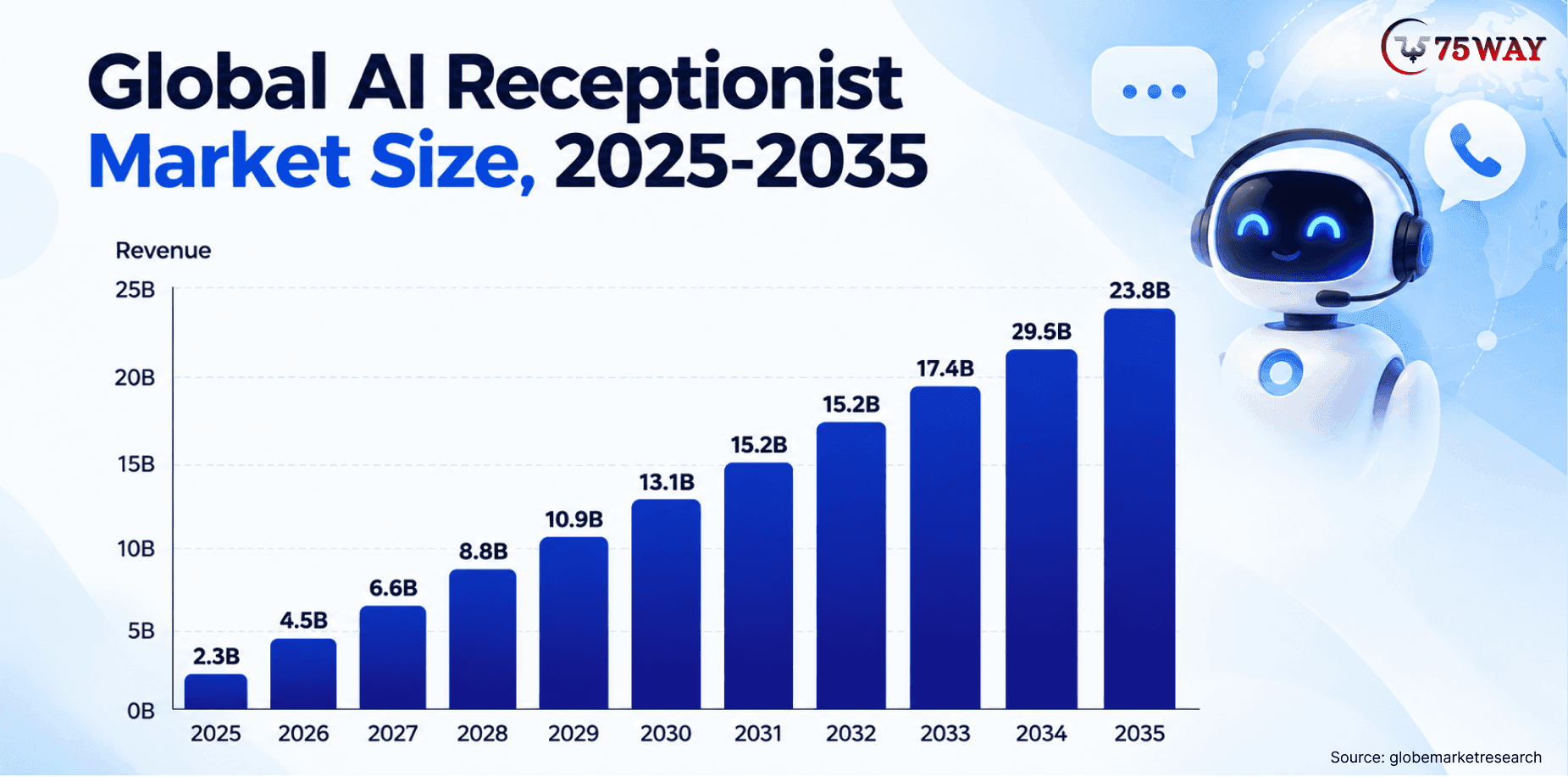
- The global AI receptionist market was valued at $2.7 billion in 2025 and is projected to reach $31.3 billion by 2035, expanding at a 27.8% CAGR.
- North America dominated the market with over 42.0% share, generating approximately $1.1 billion in revenue.
- Voice reception services held the largest service-type share at over 54.5%, driven by the continued need for calls in urgent support and appointment booking.
- According to Intercom, 87% of senior customer service leaders have invested in AI.
- 87% of mature AI support teams reported improvements in their performance metrics after adopting AI.
- AI-powered customer service teams resolved tickets in an average of 32 minutes, compared with up to 36 hours for less advanced teams.
- 83% of executives expect AI agents to enhance process efficiency and overall output.
Why Virtual Receptionist Software Selection Gets Harder As Your Business Grows
The AI receptionist that feels perfect for a growing company today may become a frustrating bottleneck once call traffic, departments, and customer interactions start multiplying. Business growth brings new demands for intelligent routing and support, so the simplest option may no longer fit. A closer look at these growing demands and the right selection criteria follows in the discussion below.
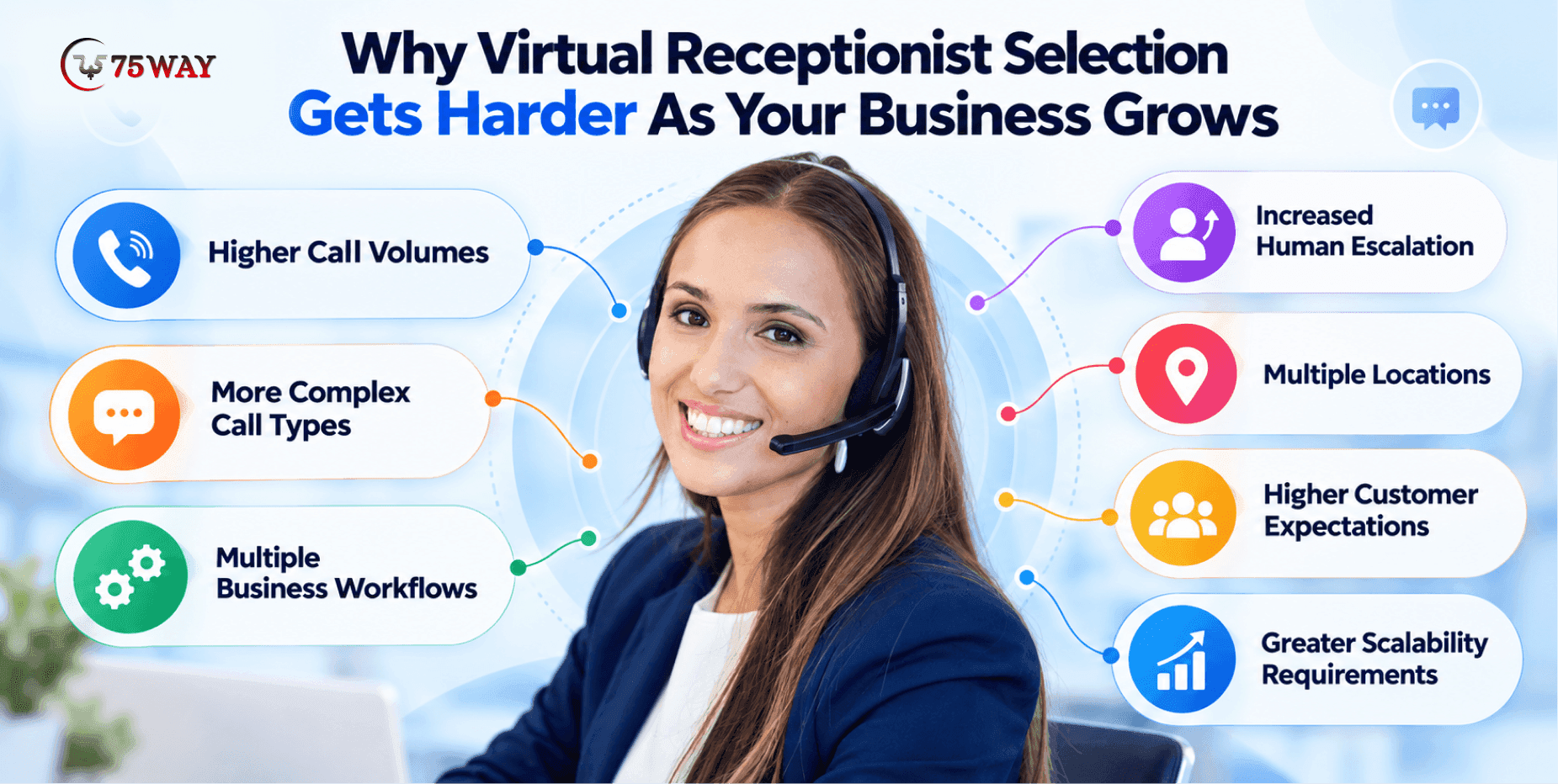
- Higher Call Volumes: More customers naturally bring more inbound calls, especially during busy periods, marketing campaigns, and seasonal peaks.
The AI answering service software can help manage rising demand, but you should check whether it can handle simultaneous conversations without creating missed opportunities or frustrating delays.
- More Complex Call Types: Growth brings a wider mix of conversations, from sales inquiries and appointment requests to billing questions and support issues.
A reliable virtual receptionist should recognize caller intent, provide relevant answers, and know when a conversation needs to move beyond basic message taking.
- Multiple Business Workflows: As operations expand, answering calls becomes only one part of the job.
Look for an AI phone answering system that can connect with calendars, CRM platforms, booking tools, notifications, and other workflows instead of operating as an isolated phone answering service.
- Increased Human Escalation: Some conversations require employee expertise, approval, or personalized assistance that automation should not attempt to replace.
A strong virtual receptionist services agent should identify these situations, route callers to the appropriate person, and transfer useful context so customers do not have to repeat everything.
- Multiple Locations: Adding offices, branches, or service areas creates another layer of call-handling complexity.
A virtual phone answering service agent should support location-specific information, operating hours, employee routing, and calendars so callers reach the right team without unnecessary transfers.
- Higher Customer Expectations: Customers increasingly expect quick answers, accurate information, convenient scheduling, and smooth communication whenever they call.
For a growing company, an answering service agent for small business should therefore do more than pick up calls. It should help create a reliable customer experience across common interactions.
- Greater Scalability Requirements: Software that works well for a small team may become restrictive as call volumes, employees, locations, and workflows increase.
Before choosing an AI receptionist for small business, check whether the platform can support additional users, changing processes, higher demand, and new integrations as your company expands.
How To Select AI Receptionist Software: A Strategic Roadmap
The right AI receptionist software can do more than answer calls; it can shape how prospects, customers, and partners experience your business from the first conversation. Yet, differences in voice quality, integrations, automation, pricing, and scalability can make the selection process surprisingly difficult. The practical steps for evaluating these factors and choosing software that fits your business are outlined below.
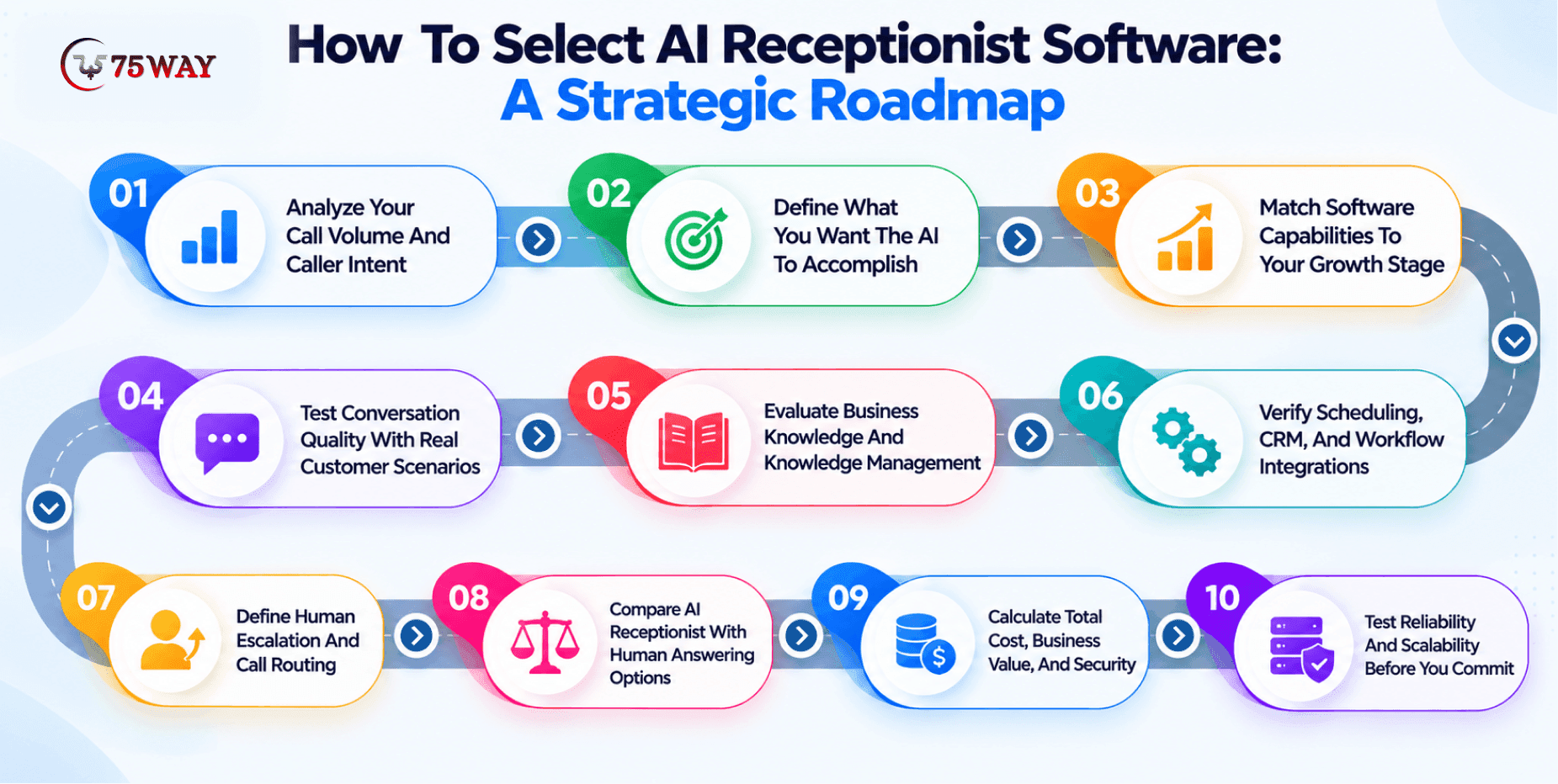
Step 1: Analyze Your Call Volume And Caller Intent
Your phone lines reveal more about your business than dashboards ever will. Every caller brings a specific need, urgency, and potential value. Clear call patterns reveal where automation can help most. Better buying decisions begin with real conversations.
Categorize Your Calls
- Information: Business hours, locations, services, policies, availability, and common questions.
- Scheduling: New appointments, cancellations, rescheduling, and availability checks.
- Sales: Product inquiries, quote requests, service inquiries, and lead qualification.
- Support: Order information, account questions, troubleshooting, and status updates.
- Exceptions: Complaints, unusual requests, sensitive conversations, and situations requiring human judgment.
This classification gives you a practical foundation for deciding what should be automated and what should remain human-led.
Step 2: Define What You Want The AI To Accomplish
Your software choice becomes easier when the desired outcome is already clear. Every automation should solve a measurable business problem. A defined goal separates useful capabilities from attractive extras. Strong outcomes create a practical buying framework from day one.
Possible Business Outcomes
- Capture qualified leads immediately.
- Schedule appointments without employee involvement.
- Reduce repetitive phone conversations.
- Provide after-hours phone coverage.
- Route callers to the correct department.
- Collect information before employee callbacks.
- Automate routine customer inquiries.
- Reduce administrative workload.
The more specific your desired outcomes are, the easier it becomes to compare competing AI receptionist solutions.
Step 3: Match AI Answering Service Software Capabilities To Your Growth Stage
Your business stage shapes what your AI receptionist software needs today. Early operations may need simple coverage, while growing teams demand deeper automation. Future expansion matters too. A practical fit prevents expensive replacements when call demands increase over time.
Early-Stage Business
- Call answering
- FAQ handling
- Message capture
- Basic scheduling
- After-hours coverage
Growing Business
- Appointment scheduling
- Lead qualification
- CRM integration
- Calendar integration
- Call transfers
- Analytics
- Follow-up automation
Scaling Or Multi-Location Business
- Advanced call routing
- Multiple locations
- Multiple calendars
- Higher call concurrency
- Location-specific information
- Employee permissions
- Centralized reporting
- Workflow automation
The right platform should have a realistic growth path rather than simply offering a long feature list.
Step 4: Test Conversation Quality With Real Customer Scenarios
Real customer conversations reveal AI virtual phone answering service software quality far better than polished vendor demonstrations. Natural voices mean little when callers ask unexpected questions. Realistic scenarios expose misunderstandings, weak responses, and poor handoffs. Testing creates stronger evidence before making a software commitment.
- Straightforward question: “Are you open this Saturday?”
- Multi-part question: “Do you offer installation, what does it cost, and can I schedule it next week?”
- Ambiguous request: “I need to talk to someone about my account.”
- Correction: “No, that's not what I meant.”
- Unknown question: Ask something outside the information provided to the AI.
- Human transfer: “I need to speak with someone in billing.”
Evaluate whether the AI business phone answering software understands the request, responds accurately, maintains context, and reaches the appropriate outcome.
Step 5: Evaluate Business Knowledge And Knowledge Management
Accurate business knowledge forms the foundation of every useful AI conversation. Customers expect answers that reflect current services, policies, hours, and availability. Simple updates should never require technical expertise. Reliable knowledge management keeps conversations accurate as your business changes.
Check Whether You Can Manage
- Services and products
- Business and holiday hours
- Locations and service areas
- Pricing information
- Appointment policies
- Frequently asked questions
- Employee information
- Escalation rules
- Promotions and temporary announcements
Ask the vendor: “How quickly can an authorized employee update the AI's information?”
The answer can reveal how practical the platform will be after implementation.
Step 6: Verify Scheduling, CRM, And Workflow Integrations
Connected systems can turn an AI phone answering system from a call handler into an operational tool. CRM records, calendars, and workflows can transform conversations into completed actions. Integration depth matters because disconnected automation can create additional work. Smooth data movement protects productivity as operations grow.
- Can it create or update CRM contacts?
- Can it add call notes?
- Can it qualify and tag leads?
- Can it check real-time calendar availability?
- Can it create, reschedule, and cancel appointments?
- Can it trigger follow-up workflows?
- Can it transfer caller context?
- Is the integration native, API-based, or dependent on another platform?
- Is data synchronized in one direction or both directions?
Your goal is to determine whether the AI receptionist completes your workflow or simply creates another task for employees.
Step 7: Define Human Escalation And Call Routing
Human escalation remains essential when conversations become sensitive, complex, or unpredictable. Customers should reach the right person without repeating their entire story. Clear routing rules protect customer experience and revenue. Reliable handoffs make automation feel supportive rather than restrictive.
AI Can Handle
- Routine questions
- Common requests
- Appointment scheduling
- Basic lead qualification
- Message capture
- General business information
Humans May Need To Handle
- Complex complaints
- Sensitive situations
- High-value sales opportunities
- Negotiations
- Technical issues
- Unusual requests
- Exceptions requiring judgment
Ask: “What happens when the AI cannot confidently complete the request?”
Possible escalation methods: Warm transfers, direct transfers, callback requests, employee notifications, escalation queues.
Step 8: Compare AI Caller Assistant With Human Answering Options
Different answering models solve different communication problems, and no single approach fits every business. AI caller assistant can manage structured demand at scale, while people handle judgment-heavy conversations. Hybrid models combine both strengths. The right comparison starts with call complexity and customer expectations.
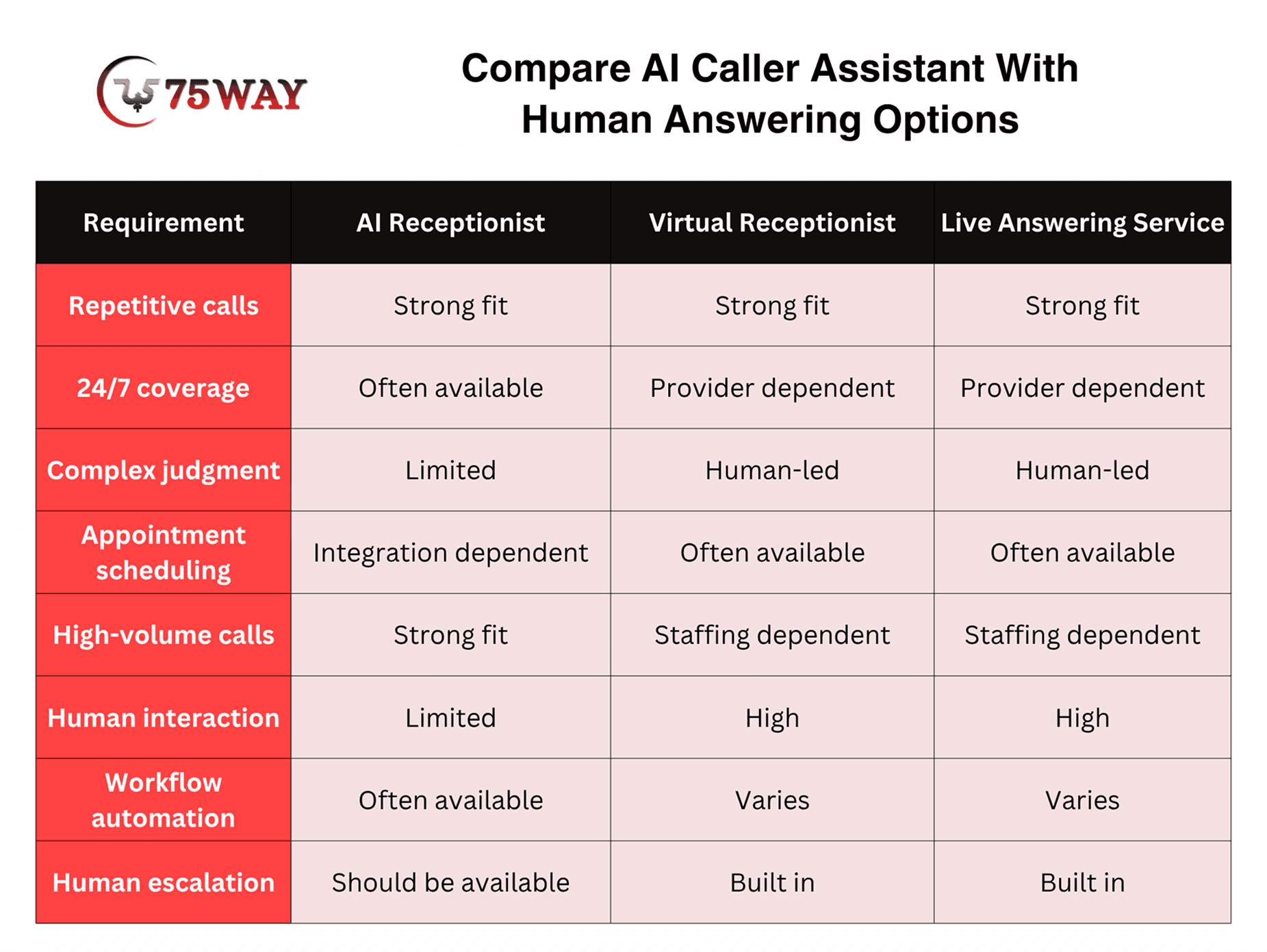
The goal is not to select the most advanced technology. It is to select the communication model that fits your business.
Step 9: Calculate Total Cost, Business Value, And Security
Software pricing tells only part of the financial story behind an AI receptionist. Usage charges, integrations, add-ons, and internal savings can change the real equation. Security adds another layer of responsibility. A complete evaluation considers cost, value, and data handling together.
Estimated monthly cost = subscription + usage + overages + required add-ons + integration costs
Measure Potential Business Value
- Recovered missed calls
- Additional qualified leads
- Additional appointments
- Employee hours saved
- After-hours opportunities captured
- Completed automated workflows
The objective is to understand both the financial cost and operational responsibility of adopting the software.
Step 10: Test Reliability And Scalability Before You Commit
Reliable performance matters most when your business depends on every incoming call. Growth can bring higher volumes, additional locations, and more complex routing. Strong scalability protects service quality under pressure. Backup plans determine what happens when technology becomes unavailable.
Ask Vendors About
- Uptime and reliability
- Concurrent call capacity
- Peak-volume handling
- Failover procedures
- Backup call routing
- Support response
- Number portability
- Additional phone numbers
- Multi-location support
- Additional calendars
- User permissions
- Reporting and analytics
- Future workflow expansion
Most important question: “What happens if the AI receptionist becomes unavailable during business hours?”
A reliable implementation should have a defined fallback, such as routing calls to employees, a backup number, or a live answering service.
Features You Should Consider When Adopting AI Caller Assistant
The right caller assistant can save your team from repetitive calls, missed enquiries, and routine customer requests. Its real value, however, depends on the features behind the voice, from call routing and scheduling to integrations and analytics. The essential features worth checking before adoption are explained below.
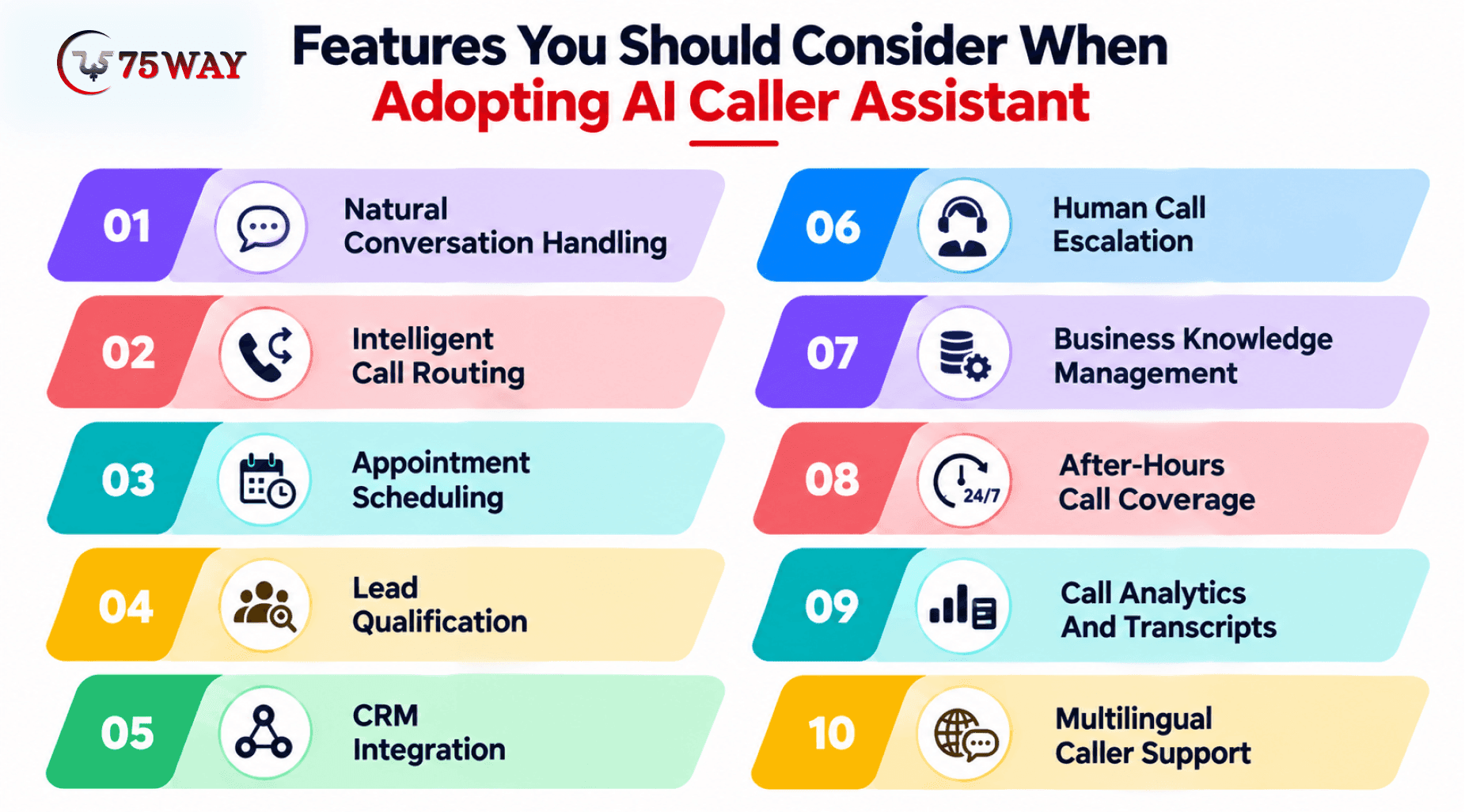
- Natural Conversation Handling
Every caller speaks differently, so your AI should understand natural phrases, interruptions, and follow-up questions. Smooth conversations make interactions feel less robotic and more human.
- Intelligent Call Routing
The right caller should reach the right destination without unnecessary transfers. Intelligent routing recognizes intent, understands context, and connects conversations with relevant teams or workflows.
- Appointment Scheduling
Missed bookings can quickly become missed revenue. Automated scheduling lets callers book, reschedule, or cancel appointments while keeping availability updated across connected calendars.
- Lead Qualification
Not every caller represents the same opportunity. Smart qualification gathers essential details, identifies promising prospects, and gives sales teams useful context before follow-up conversations.
- CRM Integration
Customer conversations become more valuable when information reaches your existing systems. CRM integration captures caller details, updates records, and supports follow-up without repetitive manual data entry.
- Human Call Escalation
Some conversations simply need a person behind them. Seamless escalation transfers complex or sensitive calls to employees while preserving relevant context throughout the handoff.
- Business Knowledge Management
Accurate answers depend on current business information. Centralized knowledge management keeps services, pricing, policies, locations, and operating hours aligned as your business continues changing.
- After-Hours Call Coverage
Customers do not always call during convenient business hours. Extended coverage keeps your phone lines available overnight, capturing questions, leads, bookings, and urgent messages.
- Call Analytics And Transcripts
Every conversation can reveal something about your customers. Detailed analytics and transcripts expose recurring questions, transfer patterns, missed opportunities, and areas needing operational improvement.
- Multilingual Caller Support
Language should not become a barrier between your business and potential customers. Multilingual support helps callers communicate comfortably while expanding accessible phone service across diverse markets.
Evaluation Scorecard For Virtual Answering Service Software For Small Business
A virtual answering service software can save a small business from missed calls, but not every provider delivers the same level of support. Service quality, pricing, availability, integrations, and call handling can all affect its real business value. The key criteria for evaluating this software are laid out in the scorecard below.
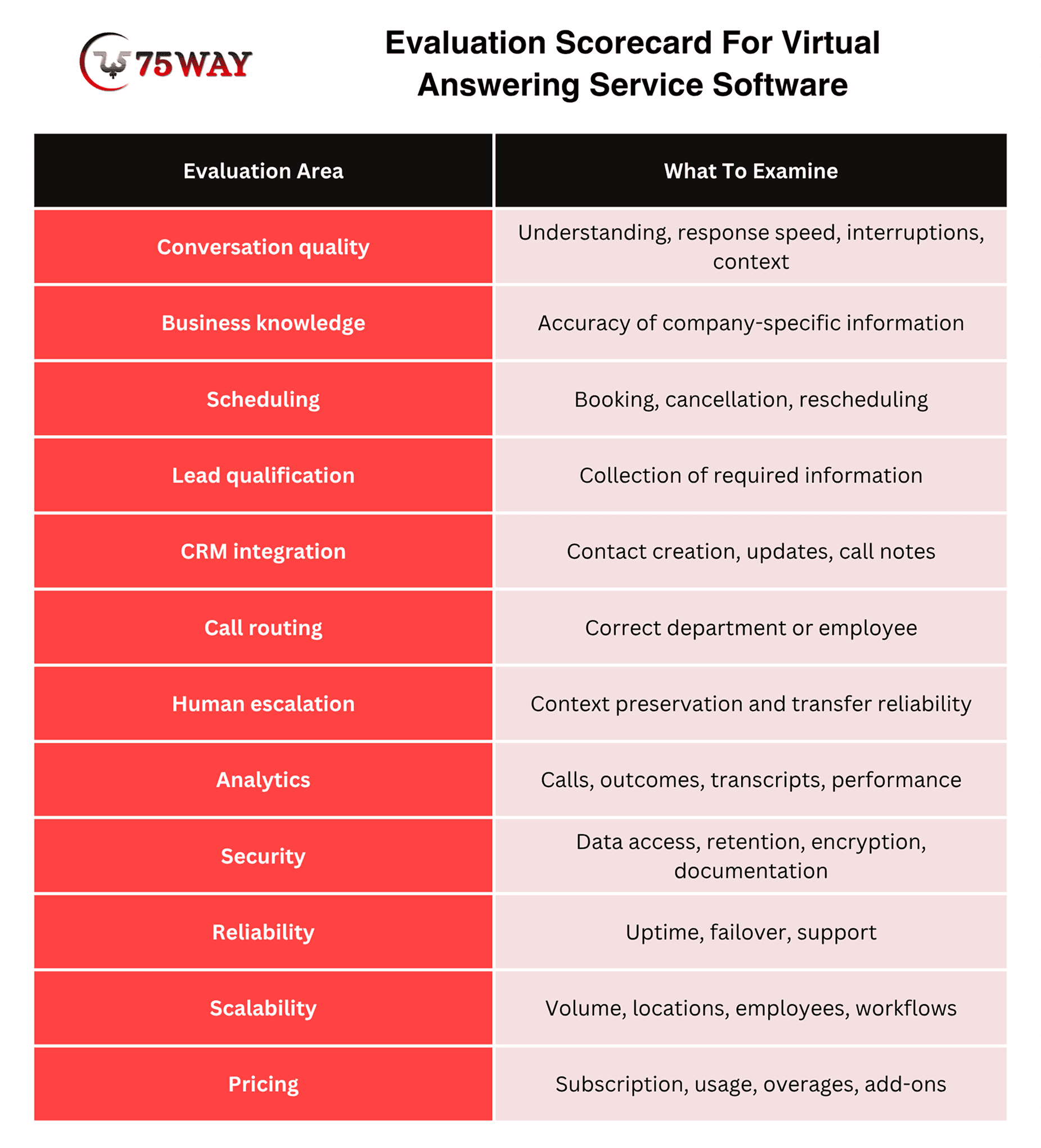
You can assign your own weights based on business priorities. For an appointment-driven business, scheduling may carry more importance.
For a sales organization, lead qualification and CRM integration may matter more. For a multi-location company, routing and location-specific knowledge may become critical.
Different Types of AI-Powered Receptionist Software You Can Adopt
Every business handles calls differently, so one AI receptionist software model may not suit every team. A plumber may need instant job scheduling, while a travel agency may prioritize lead qualification and property enquiries. The main types of AI receptionist software and the businesses they serve are explained in the sections ahead.
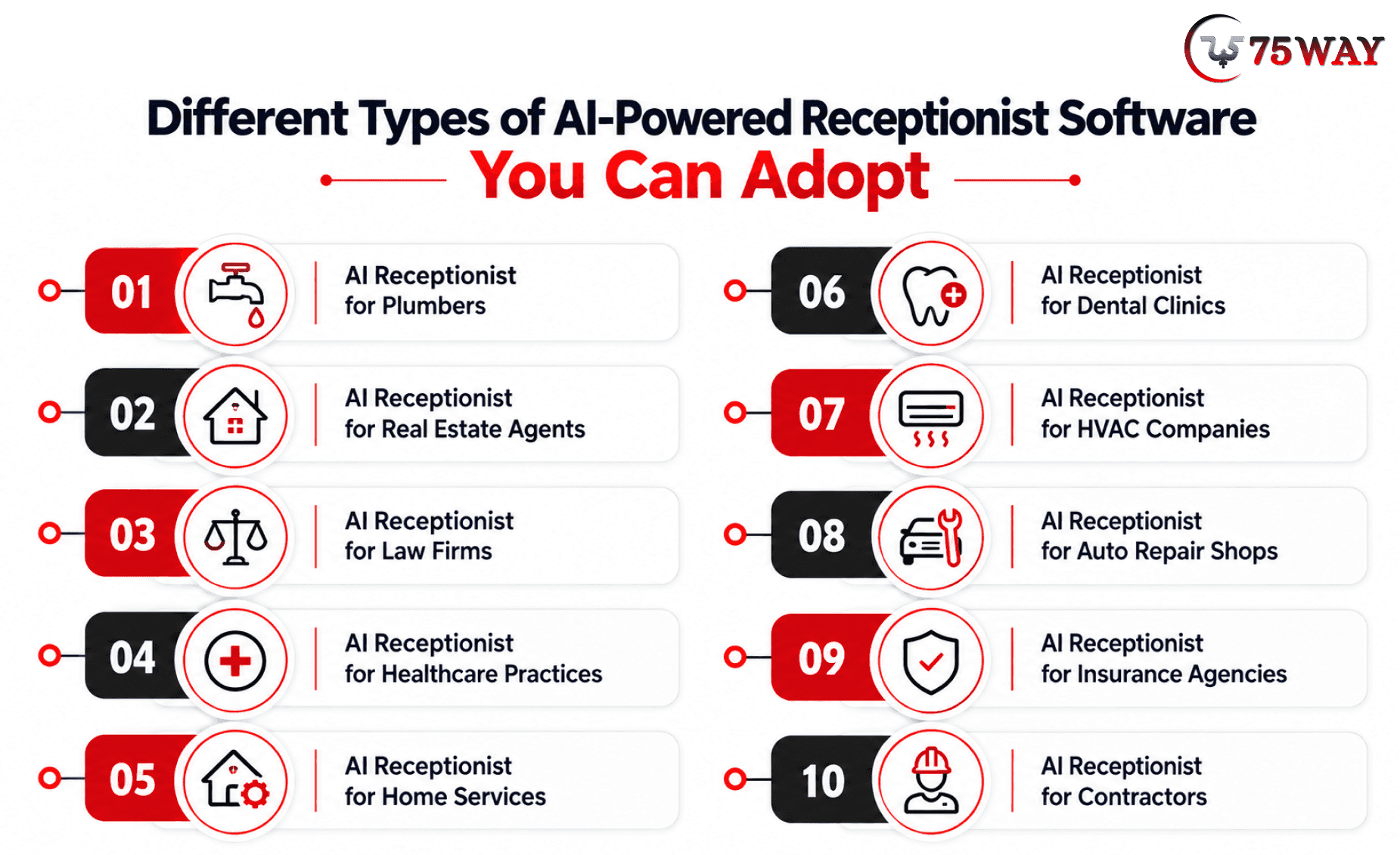
- AI Receptionist for Plumbers
Missed service calls can quickly become lost jobs when technicians are busy on-site. An AI assistant software answers every inquiry, captures the plumbing issue, and identifies urgency. Customers can book visits without waiting.
Emergency requests can reach the right technician faster, keeping valuable new opportunities from slipping away entirely.
- AI Receptionist for Real Estate Agents
Property inquiries often arrive while agents are showing homes or meeting clients. An AI virtual receptionist appointment scheduling software responds instantly, qualifies buyers and sellers, answers listing questions, and schedules viewings.
Every conversation can capture useful lead details. Agents gain more time for negotiations while prospects receive immediate, personalized customer attention today.
- AI Receptionist for Law Firms
Potential clients may call when attorneys are unavailable, especially during busy consultations or court schedules.
An AI assistant collects essential case information, handles routine questions, and books consultations. Sensitive or complex matters can be routed to appropriate staff. This creates a smoother intake experience without losing opportunities consistently today.
- AI Receptionist for Healthcare Practices
Patient calls can pile up when reception teams are managing check-ins, appointments, and administrative work.
An AI answering service software handles routine inquiries, books or changes appointments, confirms visits, and gathers details. Urgent concerns can follow defined escalation paths. Patients receive quicker responses while staff stay focused on patient care.
- AI Receptionist for Home Services
Customers searching for home repairs usually want quick answers and convenient scheduling.
A 24-hour virtual receptionist identifies the requested service, collects property details, qualifies the job, and books technician visits. Routine questions receive immediate responses. Businesses can capture more inquiries without adding another person to the front desk operations.
- AI Receptionist for Dental Clinics
Dental practices regularly handle appointment requests, cancellations, confirmations, insurance questions, and routine patient inquiries.
A virtual phone answering service software manages these conversations while keeping scheduling organized. Patients can receive answers outside regular hours. Staff spend less time handling repetitive calls and more time supporting people inside the dental practice smoothly.
- AI Receptionist for HVAC Companies
Heating and cooling problems rarely wait for convenient business hours, making missed calls particularly costly. An AI assistant identifies equipment concerns, gathers service details, schedules appointments, and prioritizes urgent situations.
Customers receive immediate guidance. HVAC companies can capture more service opportunities while technicians remain focused on essential fieldwork.
- AI Receptionist for Auto Repair Shops
Vehicle owners often call repair shops when they need quick answers about services, availability, or repairs.
A virtual receptionist services software gathers vehicle information, understands the requested work, and schedules appointments. Customers receive timely responses without waiting for staff. Shops can organize inquiries while reducing interruptions during busy shop hours.
- AI Receptionist for Insurance Agencies
Insurance prospects frequently need quick answers before deciding whether to request a quote or consultation.
An AI voice agent software collects relevant information, handles routine questions, schedules conversations, and routes complex matters appropriately. Prospects receive prompt assistance. Agencies can maintain better call coverage while staff focus on higher-value client needs.
- AI Receptionist for Contractors
Construction and renovation leads often call while contractors are working on active projects. An AI assistant captures project requirements, property details, timelines, and contact information before scheduling estimates.
Potential customers receive immediate attention. Contractors can review qualified opportunities later without constantly interrupting crews or missing valuable incoming calls.
What Should A Growing Business Expect From AI-Powered Receptionist Software In 2027?
By 2027, growing businesses should expect AI-powered receptionist software to handle more than basic call answering. The right solution should support customer conversations, business workflows, appointments, lead management, and human handoffs while adapting as call volumes and operational needs increase.
1. More Natural Customer Conversations
AI receptionists should understand conversational language, interruptions, follow-up questions, accents, and context rather than forcing callers through rigid scripts or menu options.
What to expect:
- Context-aware conversations
- Better interruption handling
- Natural responses
- Caller intent recognition
- Fewer repetitive prompts
2. Smarter Call Handling And Routing
AI should identify why someone is calling and determine the appropriate action, whether that means answering a question, routing the call, collecting information, or escalating to an employee.
What to expect:
- Intent-based call routing
- Department or employee transfers
- Priority caller identification
- Automated message taking
- Custom call-handling workflows
3. Automated Appointment Management
For appointment-driven businesses, AI receptionist software should manage scheduling without requiring staff to answer every booking-related call.
What to expect:
- Appointment booking
- Rescheduling and cancellations
- Availability checking
- Calendar synchronization
- Appointment confirmations
- Reminder workflows
4. Stronger Lead Qualification
AI-powered receptionist software should do more than capture names and numbers. It should ask relevant questions, gather prospect information, and determine whether a caller requires sales follow-up.
What to expect:
- Lead information collection
- Qualification questions
- Inquiry categorization
- Sales-team notifications
- CRM lead creation
5. Deeper CRM And Business Integrations
Growing companies should expect their AI caller assistant to connect with the systems already used for customer management, scheduling, communication, and daily operations.
What to expect:
- CRM integration
- Calendar integration
- Helpdesk connectivity
- Contact synchronization
- Automated data updates
- Workflow triggers
6. Reliable Human Escalation
AI should not attempt to handle every situation independently. When a caller needs human expertise, the system should recognize the situation and transfer the conversation smoothly.
What to expect:
- Human call transfers
- Escalation rules
- Department-specific routing
- Context sharing before transfer
- Emergency or priority handling
7. Business-Specific Knowledge
Generic answers will not be enough for growing businesses. AI receptionists should be configurable around company services, operating hours, policies, locations, pricing information, and frequently asked questions.
What to expect:
- Custom knowledge bases
- Business-specific responses
- Easy information updates
- Location-aware answers
- Policy-based call handling
8. 24/7 Phone Availability
Growing businesses should be able to maintain business phone answering beyond standard working hours without requiring employees to remain available around the clock.
What to expect:
- After-hours answering
- Weekend coverage
- Holiday call handling
- Message collection
- Appointment booking outside business hours
9. Useful Call Analytics
AI receptionist software should turn phone conversations into operational insights, helping businesses understand what customers ask, where calls are transferred, and which opportunities may require attention.
What to expect:
- Call summaries
- Transcripts
- Transfer rates
- Caller intent data
- Missed-opportunity tracking
- Conversation trends
10. Multilingual Customer Support
Businesses serving diverse customer groups should expect AI receptionists to support multiple languages and switch between supported languages naturally when appropriate.
What to expect:
- Multilingual conversations
- Language detection
- Language-specific responses
- Broader customer accessibility
- Reduced communication barriers
When Should A Growing Business Not Buy AI Receptionist Software?
AI receptionist software is not automatically necessary. You may want to delay adoption if:
- Your business receives very few calls.
- Almost every call requires specialized human judgment.
- Your current receptionist already handles demand effectively.
- Your scheduling or CRM systems cannot support the required workflow.
- You have not defined what the AI should accomplish.
- You cannot establish a reliable human escalation process.
- The expected business value does not justify the cost.
This is an important part of the buying decision. The goal is not to adopt AI because it is available. The goal is to determine whether automation solves a meaningful operational problem.
Final Thoughts
Choosing AI receptionist software in 2027 should not begin with a list of vendors or a search for the lowest monthly price. It should begin with your calls, customers, workflows, systems, and growth plans.
A useful AI receptionist should do more than answer the phone. It should understand why customers are calling, provide accurate information, complete appropriate tasks, update business systems, and involve employees when automation is no longer appropriate.
For a growing business, the strongest buying process is therefore straightforward: analyze your calls, define your desired outcomes, map your workflows, test realistic scenarios, verify integrations, calculate total cost, evaluate security, and plan for growth.
To build an AI receptionist around your business workflows, you can talk to a reliable AI software development agency and discuss your AI receptionist development requirements.
Frequently Asked Questions (FAQs)
What Is The Best AI Receptionist Software For A Growing Business?
There is no single best option for every business. The right choice depends on call volume, workflows, integrations, human escalation needs, pricing structure, security requirements, and expected growth.
How Do I Choose AI Receptionist Software For My Business?
Start with your call types and desired outcomes, then evaluate conversation quality, scheduling, integrations, routing, escalation, security, pricing, analytics, and scalability using real business scenarios.
Is Virtual Receptionist Software Worth It For A Small Business?
It can be valuable when missed calls, repetitive questions, appointment requests, or after-hours inquiries create measurable operational or revenue problems. The value depends on your call volume and workflows.
What Should I Test Before Buying an AI Receptionist?
Test realistic customer questions, interruptions, appointment booking, lead qualification, CRM updates, transfers, unknown questions, and failure scenarios. Compare how each platform handles the same situations.
Can AI Receptionists Schedule Appointments?
Many AI receptionist platforms support appointment scheduling through calendar or booking integrations. Verify whether the platform can directly check availability, create appointments, reschedule, and cancel them.
How Much Does AI Receptionist Software Cost?
Costs vary according to subscription structure, call volume, minutes, calls, integrations, transfers, and add-ons. Businesses should calculate expected total monthly costs using their actual call patterns.