AI Summary
Alcohol delivery app development requires more than ordering and payments. This guide explores business models, essential features, compliance, technology, costs, and development stages. It also explains monetization and scalability considerations. Read on to understand the complete development journey.
Key Takeaways
- Alcohol delivery apps connect customers, retailers, payments, and delivery operations.
- Compliance, age verification, and location rules shape alcohol delivery platforms.
- US Alcoholic Drinks market could reach $441 billion by 2032.
- Development can cost $12,000 – $30,000+ depending on platform scope, complexity.
- The guide covers features, models, technology, compliance, costs, and scaling.
A customer ready to order wine for dinner or drinks for a weekend gathering does not want to search multiple stores, call for availability, and wait for someone to confirm delivery. That gap creates a clear opportunity for businesses that can bring product discovery, ordering, payment, and delivery into one convenient experience.
For founders, however, an alcohol delivery app is more than another ecommerce product. The liquor delivery mobile app development solution may need retailer management, inventory synchronization, secure payments, delivery coordination, customer verification, notifications, and location-based rules, all of which can influence the development investment.
The regulatory side for on-demand delivery app development also needs to be considered from the beginning, since alcohol businesses can face federal requirements alongside state and local rules. The discussion ahead covers the alcohol delivery app development cost, process, core functionality, technology requirements, and compliance areas involved in building an alcohol delivery app.
What Is an Alcohol Delivery App?
An alcohol delivery app is a mobile or web-based platform that allows eligible customers to browse alcoholic beverages, place orders, make payments, and receive deliveries from participating licensed retailers or businesses.
Depending on the business model, the platform can connect:
Customers → Retailers → Delivery Partners → Administrators
The application may support beer, wine, spirits, cocktails, mixers, or other permitted products.
However, the important difference from an ordinary eCommerce app is the restricted-item workflow.
For alcohol, the platform may need to account for:
- Customer age eligibility
- Identity verification
- Delivery-time ID checks
- Restricted delivery locations
- Product and quantity restrictions
- Delivery windows
- Retailer licensing
- Driver eligibility
- Failed-delivery handling
- Return-to-store workflows
- Regional compliance rules
- Transaction and payment controls
Major delivery platforms demonstrate how these controls can become part of the customer and courier experience. DoorDash, for example, describes a two-stage age-verification process involving an initial check and another ID examination when the order is delivered.
Why Build an Alcohol Delivery App?
For founders and retailers, the opportunity is not simply “selling alcohol online.” The larger opportunity is creating a digital sales channel that connects local inventory with customers at the moment of purchase intent.
A well-designed platform can help businesses:
- Reach Customers Beyond Storefronts: A digital alcohol delivery channel puts your inventory in front of customers who prefer ordering from their phones instead of visiting physical stores. Broader digital access can help you reach customers beyond traditional foot traffic. It also creates an additional sales channel across eligible delivery areas.
- Turn Local Demand Into Revenue: Local customer demand becomes easier to capture when nearby products are visible through a convenient digital platform. Real-time inventory can connect shoppers with available products before they choose another retailer. This approach can turn more high-intent searches into completed purchases.
- Make Every Order More Convenient: A smoother ordering experience gives customers access to product discovery, digital payments, scheduled delivery, and order tracking in one place. Less friction can make the purchasing journey more appealing. Greater convenience can also encourage customers to return for future orders.
- Build Stronger Customer Relationships: Customer preferences, purchase history, and loyalty activity can provide valuable insights for creating relevant experiences. Personalized recommendations and targeted promotions can support meaningful engagement. These insights can also help businesses develop stronger retention strategies over time.
- Unlock Multiple Revenue Streams: Multiple monetization options can give an alcohol delivery platform greater commercial flexibility as it grows. Commissions, delivery fees, subscriptions, service charges, and retailer plans can contribute to platform revenue. The right combination can depend on the business model and market structure.
- Scale Into New Markets: A scalable alcohol delivery platform can support expansion across additional retailers, customers, products, and eligible service areas. A strong backend reduces the need for rebuilding core systems during growth. This creates a stronger foundation for entering new markets over time.
The business case becomes particularly interesting when the platform is designed around a specific market rather than launched as a generic liquor-delivery clone.
For example, a founder could build around:
- Local liquor stores: Digital ordering and delivery infrastructure.
- Multi-store retailers: Centralized inventory and location management.
- Alcohol marketplace: Multiple licensed sellers with a shared customer interface.
- Restaurant groups: Alcohol ordering alongside permitted food and beverage sales.
- B2B alcohol ordering: Business purchasing workflows for eligible commercial customers.
The right model determines the technology, integrations, operational workflow, and compliance requirements you need to build.
Market Size & Outlook Of Online Liquor Delivery App Development
The opportunity behind an online liquor delivery app depends on more than customer convenience. It depends on whether digital alcohol purchasing can support a scalable business model. Market growth can indicate where demand and investment opportunities are emerging. The latest market outlook and growth potential are covered below.
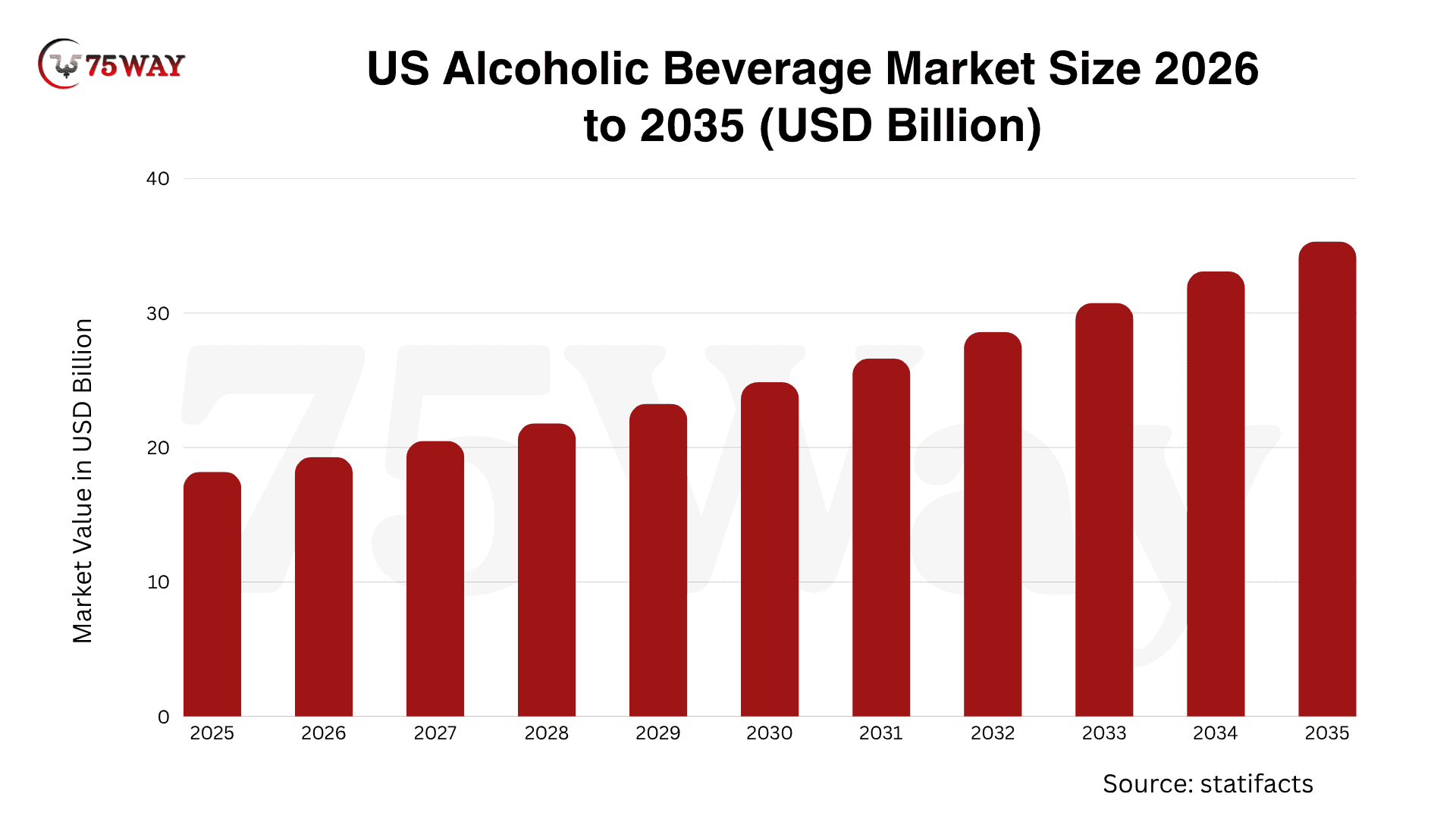
- The global alcoholic beverages market is projected to expand from $2,723.94 billion in 2026 to $4,325.99 billion by 2034, representing a 5.95% CAGR.
- The U.S. alcoholic beverage market is expected to grow from $18.19 billion in 2025 to approximately $35.31 billion by 2035, at a 6.86% CAGR from 2026–2035.
- U.S. consumers are increasingly embracing premium and craft drinks, ready-to-drink products, and low- or no-alcohol options, supporting continued market growth.
- 31% of adults reported using AI to help choose alcoholic beverages, while 76% expect AI to influence their alcohol shopping experience over the next five years.
Popular Business Models For Alcohol Delivery App Development
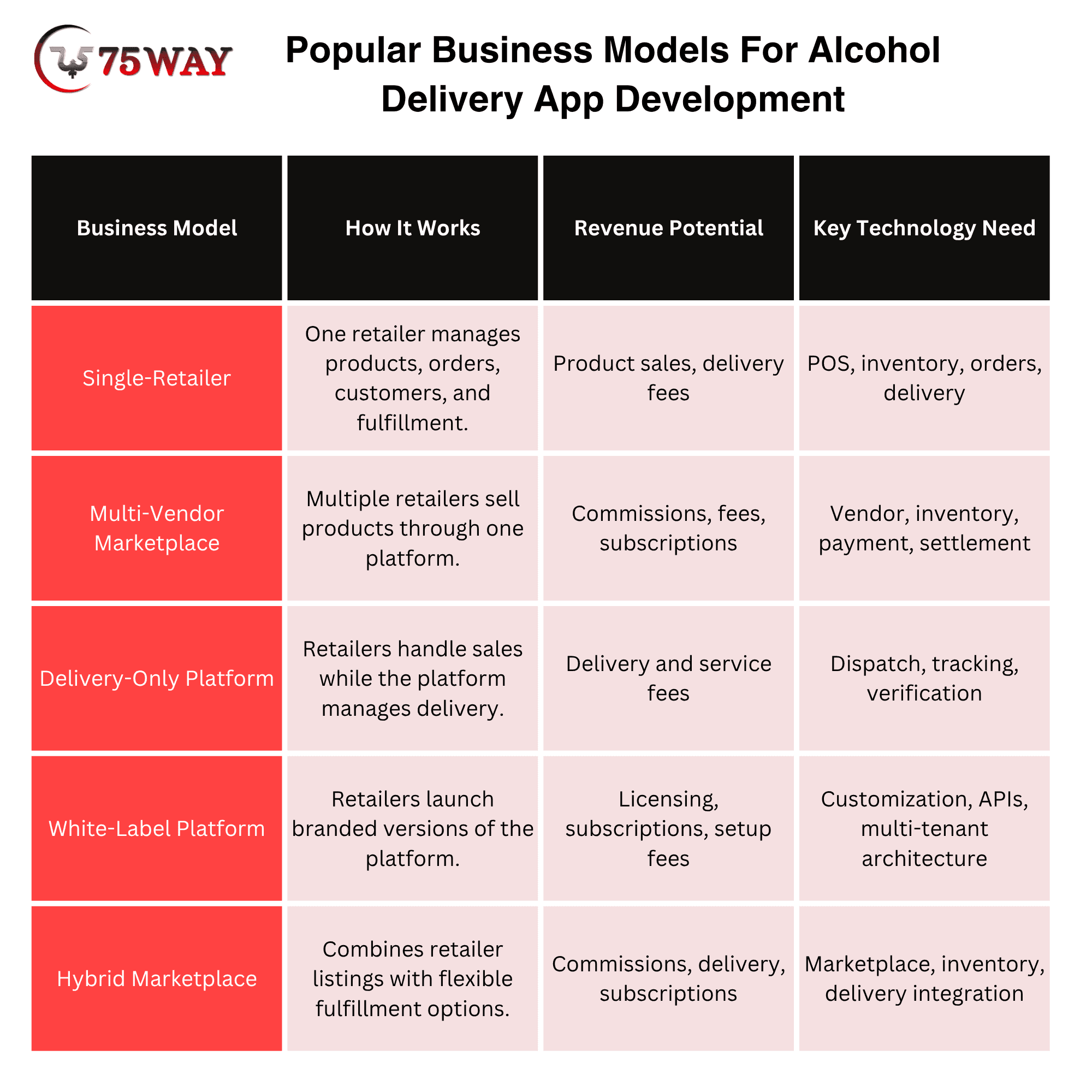
Before development starts, decide who owns the inventory, who completes the sale, and who performs delivery. An alcohol delivery app can make money in several ways, but the model you choose will shape your revenue, partnerships, and operating structure. A retailer-led app may work differently from a marketplace connecting multiple liquor stores. The main business models for developing an alcohol delivery app are explained below.
1. Single-Retailer Model
One licensed retailer owns the catalog, customer relationship, ordering process, and fulfillment.
This model can be suitable for a liquor-store chain or regional retailer that wants to move its existing business online.
Core requirement: strong inventory, POS, order, customer, and delivery integration.
2. Multi-Vendor Marketplace
Multiple licensed retailers list products through one platform.
Customers browse products across participating stores, while retailers manage their own inventory and fulfillment.
The platform can generate revenue through commissions, service fees, delivery fees, subscriptions, or promotional placements.
The technology becomes more complex because the system needs vendor onboarding, catalog management, inventory synchronization, settlements, commissions, and marketplace administration.
3. Delivery-Only Platform
In this model, licensed retailers remain responsible for selling the alcohol while the technology platform manages delivery operations.
This distinction can be important because alcohol regulations can determine who is permitted to sell, collect payment, or deliver alcoholic beverages.
California, for example, states that third-party services are not authorized to buy and sell alcoholic beverages where they do not hold the required license, although they may charge a separate delivery or service fee under the state's rules.
4. White-Label Alcohol Delivery Platform
A technology provider supplies a configurable platform that retailers can brand as their own.
This approach can reduce initial development effort, but customization, integrations, compliance workflows, ownership of the source code, scalability, and vendor dependency should be examined before choosing it.
5. Hybrid Marketplace
A hybrid model combines multiple fulfillment methods.
For example:
Retailer inventory + marketplace discovery + third-party delivery + scheduled fulfillment
This model provides greater flexibility but requires a more sophisticated backend and operational control layer.
How Does A Scalable Alcohol Delivery App Work?
A liquor delivery app turns a traditionally store-based purchase into a digital buying experience, giving customers a convenient way to browse products and place orders. For alcohol retailers, the same platform can become another sales channel for reaching customers beyond the physical store. A typical alcohol delivery platform follows this workflow:
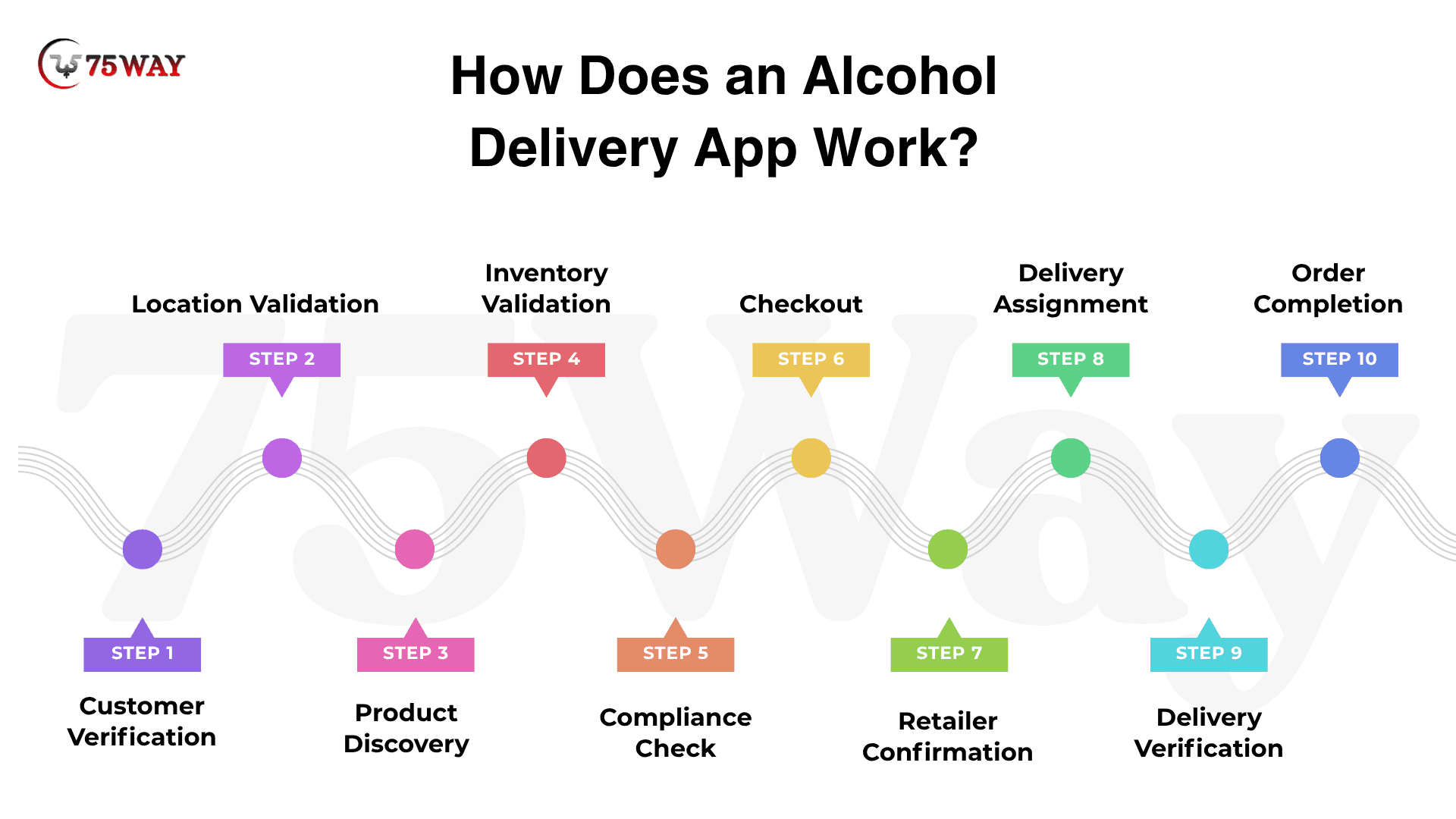
Step 1: Customer Verification
The customer creates an account and completes the required age or identity verification process.
Step 2: Location Validation
The application determines whether alcohol delivery is available at the customer's location.
Step 3: Product Discovery
Customers browse available beer, wine, spirits, or other permitted products.
Step 4: Inventory Validation
The system confirms that selected products are available from an eligible retailer.
Step 5: Compliance Check
The platform checks applicable restrictions, including age, quantity, delivery area, and permitted delivery timing.
Step 6: Checkout
The customer selects a permitted payment method and delivery option.
Step 7: Retailer Confirmation
The order reaches the appropriate retailer or fulfillment location.
Step 8: Delivery Assignment
The system assigns the order to an eligible delivery partner.
Step 9: Delivery Verification
The recipient presents acceptable identification and completes the required verification process.
DoorDash and Instacart both document delivery-time ID verification for alcohol orders, demonstrating why this step needs to be designed directly into the delivery workflow rather than treated as a basic checkout checkbox.
Step 10: Order Completion
After successful verification, the order is handed over, and the transaction is closed.
If verification fails, the platform should trigger the appropriate cancellation, refund, or return workflow.
Must-Have Features For On-Demand Liquor Delivery App Development
A liquor delivery app can attract customers with a polished storefront, but the real test begins when an order needs to be verified, paid for, assigned, tracked, and delivered correctly. A business needs more than basic ordering screens to turn on-demand alcohol delivery into a workable operation. The must-have features for a liquor delivery app are explained below.
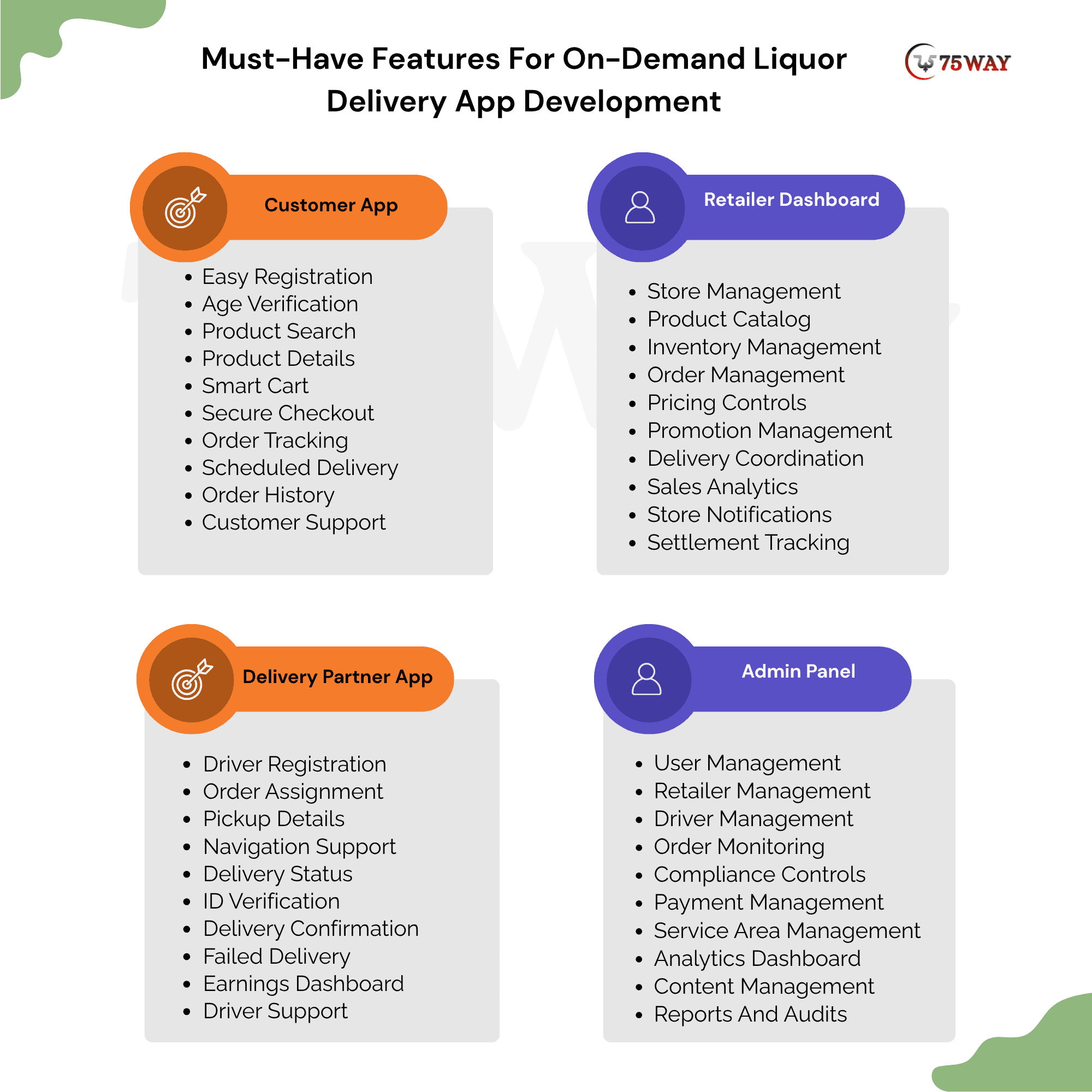
1. Customer App
The customer-facing application should provide simple discovery, secure ordering, convenient payments, and transparent delivery updates throughout the purchasing journey.
- Easy Registration: Customers can create accounts using essential details, enabling personalized experiences, order history, saved preferences, and smoother future purchases.
- Age Verification: Built-in age verification helps confirm customer eligibility before alcohol purchases proceed through the application's ordering and checkout workflow.
- Product Search: Customers can quickly find preferred beverages using keywords, categories, brands, product types, and other relevant search filters.
- Product Details: Detailed product pages can display descriptions, sizes, prices, availability, retailer information, and other purchasing information clearly.
- Smart Cart: A flexible shopping cart lets customers review selected products, adjust quantities, remove items, and check applicable charges.
- Secure Checkout: Customers can complete purchases through a streamlined checkout experience with delivery details, verification requirements, and available payment options.
- Order Tracking: Real-time tracking provides customers with order status updates, estimated delivery information, and relevant notifications throughout fulfillment.
- Scheduled Delivery: Customers can select available delivery windows that match their convenience while remaining subject to applicable operational and regulatory requirements.
- Order History: A centralized order history allows customers to review previous purchases, access receipts, and quickly reorder eligible products.
- Customer Support: Integrated support gives customers convenient access to assistance for order issues, payment concerns, delivery questions, and account problems.
2. Retailer Dashboard
The retailer dashboard should give licensed sellers centralized control over inventory, orders, pricing, store operations, and customer fulfillment activities.
- Store Management: Retailers can manage store information, operating hours, delivery areas, contact details, and other essential business settings.
- Product Catalog: Retailers can add, edit, organize, and manage beverage listings with relevant product information, pricing, and availability.
- Inventory Management: Real-time inventory controls help retailers monitor stock levels and reduce orders involving unavailable products during customer checkout.
- Order Management: Retailers can receive, review, accept, prepare, update, and manage incoming customer orders from one centralized dashboard.
- Pricing Controls: Flexible pricing tools allow retailers to maintain product prices, promotional pricing, and other permitted commercial adjustments.
- Promotion Management: Retailers can create eligible discounts, promotional campaigns, and customer offers according to their business strategy and applicable requirements.
- Delivery Coordination: Retailers can monitor preparation status and coordinate eligible orders with assigned delivery partners for smoother fulfillment.
- Sales Analytics: Business dashboards provide insights into orders, revenue, popular products, customer activity, and overall store performance.
- Store Notifications: Automated alerts can notify retailers about new orders, inventory issues, cancellations, delivery updates, and important operational events.
- Settlement Tracking: Retailers can review transaction records, platform fees, commissions, payouts, and settlement information through centralized financial reporting.
3. Delivery Partner App
The delivery partner application should simplify dispatch, navigation, verification, delivery completion, and exception handling for eligible couriers.
- Driver Registration: Delivery partners can submit required profile information and documentation through a structured onboarding and eligibility verification process.
- Order Assignment: Available delivery partners can receive eligible orders based on location, availability, capacity, and platform dispatch rules.
- Pickup Details: Clear pickup information helps drivers identify the retailer, order details, collection instructions, and relevant fulfillment requirements.
- Navigation Support: Integrated navigation helps delivery partners reach pickup and delivery destinations using familiar mapping and route guidance tools.
- Delivery Status: Drivers can update order statuses as they accept, collect, transport, and complete assigned deliveries through simple controls.
- ID Verification: Delivery workflows can support required recipient identification checks before eligible alcohol orders are handed over to customers.
- Delivery Confirmation: Drivers can record successful handoffs using permitted confirmation methods, creating an auditable completion record for each order.
- Failed Delivery: Dedicated workflows help drivers handle unavailable recipients, unsuccessful verification, restricted deliveries, or other permitted delivery exceptions.
- Earnings Dashboard: Delivery partners can review completed deliveries, applicable earnings, payment information, and historical activity through one interface.
- Driver Support: In-app support gives delivery partners access to assistance when facing verification issues, navigation problems, customer concerns, or delivery exceptions.
4. Admin Panel
The admin panel should provide centralized oversight across customers, retailers, drivers, transactions, compliance workflows, and platform performance.
- User Management: Administrators can manage customer accounts, permissions, profiles, activity, and account-related issues from a centralized control panel.
- Retailer Management: Platform administrators can review retailer profiles, manage onboarding information, configure stores, and monitor marketplace participation.
- Driver Management: Administrators can oversee delivery partners, eligibility information, activity, assignments, performance records, and account status.
- Order Monitoring: Centralized order visibility helps administrators track transactions, fulfillment progress, cancellations, delivery issues, and operational exceptions.
- Compliance Controls: Configurable controls can support applicable age, location, product, delivery, and transaction requirements across supported markets.
- Payment Management: Administrators can monitor transactions, refunds, platform fees, commissions, payment statuses, and other financial activities.
- Service Area Management: Administrators can define eligible delivery zones, manage supported locations, and configure market-specific availability for platform operations.
- Analytics Dashboard: Comprehensive analytics can reveal order trends, revenue metrics, customer activity, retailer performance, delivery performance, and operational patterns.
- Content Management: Administrators can manage banners, categories, promotional content, notifications, policies, and other customer-facing application information.
- Reports And Audits: Detailed reports and activity logs help businesses review platform operations, investigate issues, and maintain records for internal oversight.
Advanced Features That Differentiate AI-Powered Alcohol Delivery App Development
An alcohol delivery platform can offer ordering, payments, tracking, and age verification yet still look almost identical to dozens of competing apps. Stronger differentiation comes from features that make discovery more personal, increase repeat purchases, improve store operations, or create a more engaging buying experience. The advanced capabilities that can give your platform a stronger market identity are covered below.
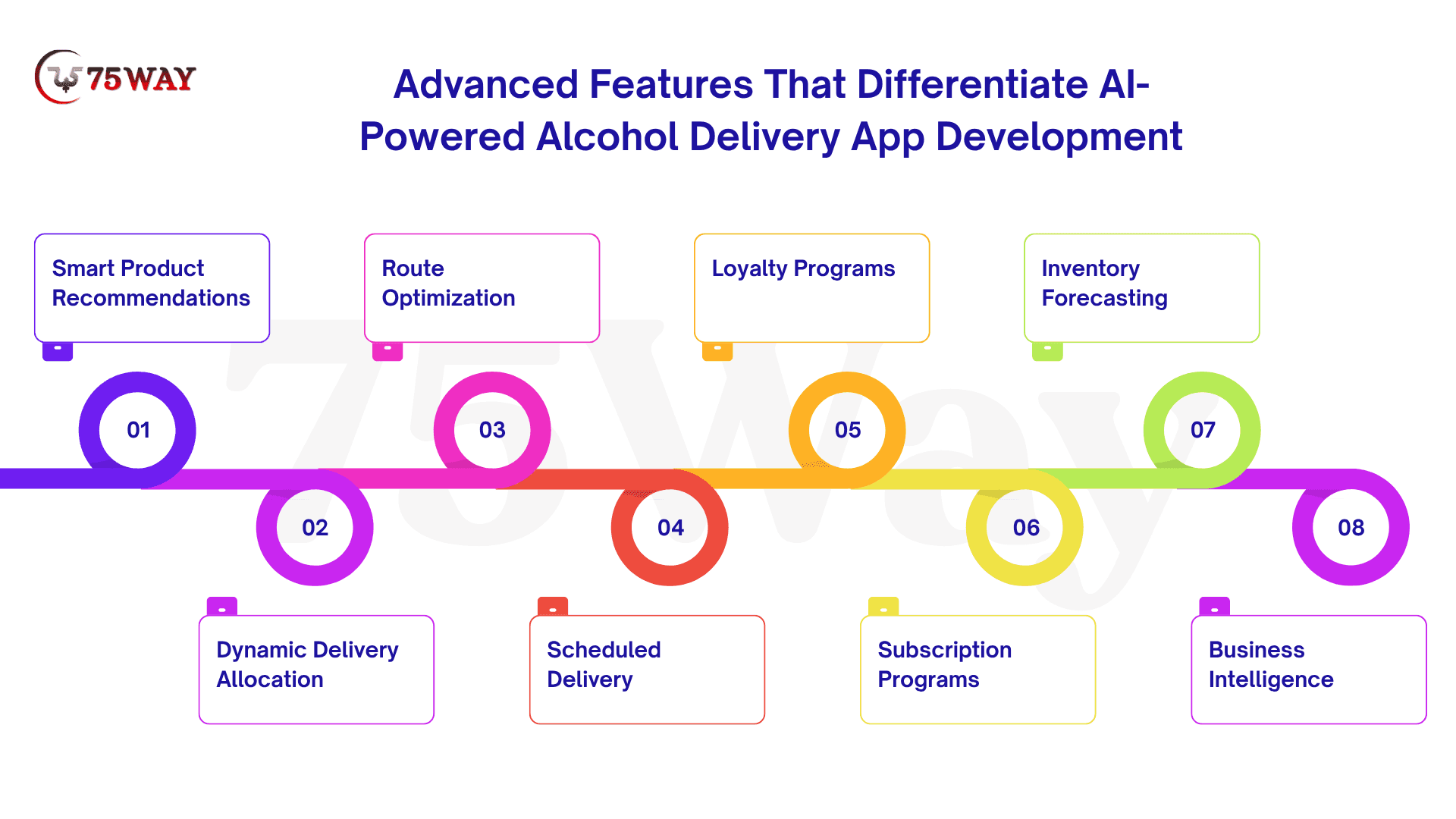
- Smart Product Recommendations
Analyze permitted customer behavior and purchasing patterns to surface relevant products. Personalized suggestions can help customers discover suitable products while creating additional opportunities for repeat purchases.
- Dynamic Delivery Allocation
Match orders with available delivery partners based on location, capacity, and operational rules. Automated assignment can help balance delivery workloads and reduce unnecessary waiting between order acceptance and pickup.
- Route Optimization
Optimize delivery sequences to reduce unnecessary travel and improve dispatch planning. Route intelligence can help delivery teams manage multiple eligible orders while keeping estimated arrival information more accurate.
- Scheduled Delivery
Allow customers to choose eligible delivery windows instead of relying entirely on instant fulfillment. Flexible scheduling can help retailers prepare orders in advance and give customers greater control over delivery timing.
- Loyalty Programs
Reward repeat customers through points, memberships, discounts, or retailer-specific benefits. A structured loyalty experience can encourage repeat engagement while giving businesses useful insights into customer purchasing patterns.
- Subscription Programs
Create recurring membership models for customers who frequently purchase eligible products. Membership benefits can include permitted discounts, delivery-related benefits, or exclusive offers designed around applicable market requirements.
- Inventory Forecasting
Use historical sales data to help retailers identify demand patterns and potential stock shortages. Predictive insights can support purchasing decisions, improve inventory planning, and reduce instances of unavailable products.
- Business Intelligence
Provide dashboards covering order volume, average order value, retailer performance, delivery performance, repeat purchases, and customer acquisition. Clear reporting helps business owners identify operational trends and make informed decisions using platform-generated data.
Alcohol Delivery App Compliance: The Part You Cannot Treat as Optional
This is where many generic development guides become too shallow. Alcohol delivery compliance is jurisdiction-specific.
The legal requirements can vary by state, license type, product, delivery method, retailer, location, and transaction structure. Therefore, a technology team should not treat a nationwide launch as though one universal rule applies everywhere.
A platform should instead be designed around a compliance rules engine that can accommodate applicable requirements.
1. Age Verification
A simple “Are you 21?” checkbox should not be treated as the entire compliance workflow.
Depending on the jurisdiction and business model, verification may involve:
- Identity document verification
- Date-of-birth validation
- ID scanning
- Recipient matching
- Delivery-time verification
- Signature collection
- Failed verification handling
Instacart currently states that alcohol recipients must provide valid government-issued identification and that shoppers verify IDs during delivery.
2. Delivery-Time Verification
The customer who places an order is not necessarily the person who physically receives it.
Therefore, the platform needs to distinguish between:
Order eligibility and Recipient eligibility
That distinction should be reflected in the product architecture.
DoorDash's current alcohol workflow requires delivery personnel to physically examine and scan the recipient's ID before completing the handoff.
3. Intoxication Checks
Age is not the only consideration.
Alcohol delivery workflows can also require the delivery person to refuse delivery when the recipient appears intoxicated.
DoorDash, Instacart, and Uber's current consumer or delivery guidance all describe restrictions involving intoxicated recipients.
Your app should therefore provide a clear refusal and return workflow, rather than treating every order as successfully deliverable once payment is completed.
4. Restricted Locations
A compliance engine may need to identify restricted destinations.
Depending on applicable rules, restrictions can involve locations such as:
- Schools
- College campuses
- Correctional facilities
- Certain businesses
- Storage or package facilities
- Other prohibited locations
Instacart and DoorDash both publish examples of restricted delivery destinations in their alcohol policies.
5. Delivery Windows and Quantity Rules
The platform may also need to account for:
- Permitted delivery times
- Product restrictions
- Quantity limits
- Local restrictions
- Store licensing conditions
- Delivery-area limitations
Instacart's developer documentation specifically notes that regional rules can affect available delivery slots, alcohol quantities, and whether an order remains compliant after changes to the cart.
This is a strong reason to design compliance as a dynamic system, rather than hard-coding one set of rules into the application.
Example: Why State-Level Rules Matter
A nationwide product should not assume that an alcohol-delivery workflow valid in one state will automatically work in another.
California's Alcoholic Beverage Control guidance, for instance, states that licensed businesses remain responsible for deliveries made through employees or third-party delivery services.
Its current guidance also shows that particular categories of alcoholic beverages and delivery arrangements can have different conditions.
Business takeaway: Before development begins, identify the exact states, licenses, products, retailers, and fulfillment arrangements involved. Then have qualified legal counsel validate the intended operating model.
The software team should implement the resulting requirements; it should not invent the legal rules.
How to Build an Alcohol Delivery App: Development Process
Building an alcohol delivery app requires more than developing customer-facing screens. The development process should connect business strategy, compliance, technology, integrations, fulfillment, and market validation into a practical launch plan.
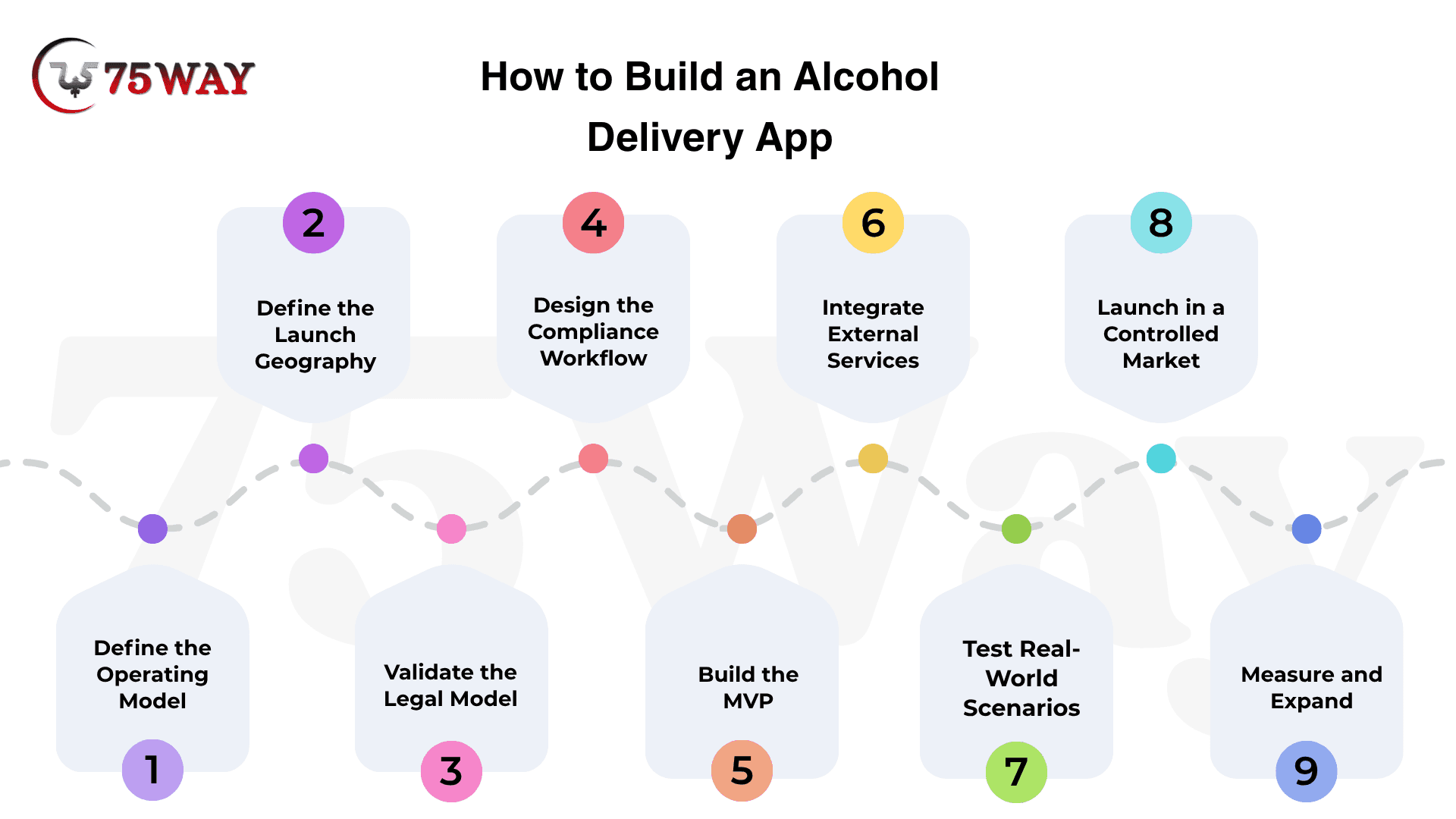
1. Define the Operating Model
Your business model determines how the platform will manage inventory, sales, retailers, payments, and deliveries. Decide whether the product will operate as a single-retailer app, multi-vendor marketplace, delivery platform, white-label solution, or hybrid marketplace.
2. Define the Launch Geography
The launch geography directly affects your compliance requirements, retailer partnerships, delivery coverage, and operational setup. Select the initial states, cities, and service areas where you intend to operate, rather than designing for every market immediately.
3. Validate the Legal Model
Alcohol delivery involves requirements that can vary according to jurisdiction, license, product, retailer, and transaction structure. Work with qualified legal counsel to identify applicable licensing, sales, delivery, age-verification, location, and operational requirements before converting them into software requirements.
4. Design the Compliance Workflow
Validated legal requirements should translate into specific application workflows instead of remaining as documentation. Define age checks, identity verification, restricted locations, delivery conditions, failed verification, cancellations, refunds, returns, and audit events within the product architecture.
5. Build the MVP
The MVP should contain the capabilities necessary to test your business model without unnecessarily increasing the initial development scope. Prioritize product discovery, inventory, ordering, payments, verification, fulfillment, delivery tracking, retailer management, and administration.
6. Integrate External Services
Third-party integrations connect the platform with essential business and operational systems. Depending on your model, integrate payment processing, maps, notifications, identity verification, POS, inventory, analytics, and delivery services while ensuring each integration supports your required workflows.
7. Test Real-World Scenarios
A production-ready platform needs testing that goes beyond successful order completion. QA teams should test both normal transactions and compliance-related exceptions that can occur during actual alcohol delivery operations.
- Underage customer
- Invalid ID
- Expired ID
- Recipient mismatch
- No recipient present
- Restricted address
- Product unavailable
- Delivery window violation
- Order cancellation
- Refund
- Failed delivery
- Return to retailer
8. Launch in a Controlled Market
A focused launch provides an opportunity to validate customer demand, retailer operations, delivery workflows, and platform performance before broader expansion. Begin with a defined geography and manageable retailer network, then use real operating data to identify issues.
9. Measure and Expand
Post-launch data can reveal which parts of the business model are working and where improvements are needed. Track conversion, average order value, repeat purchases, delivery completion, failed deliveries, retailer performance, customer acquisition, and contribution margins before expanding into additional markets.
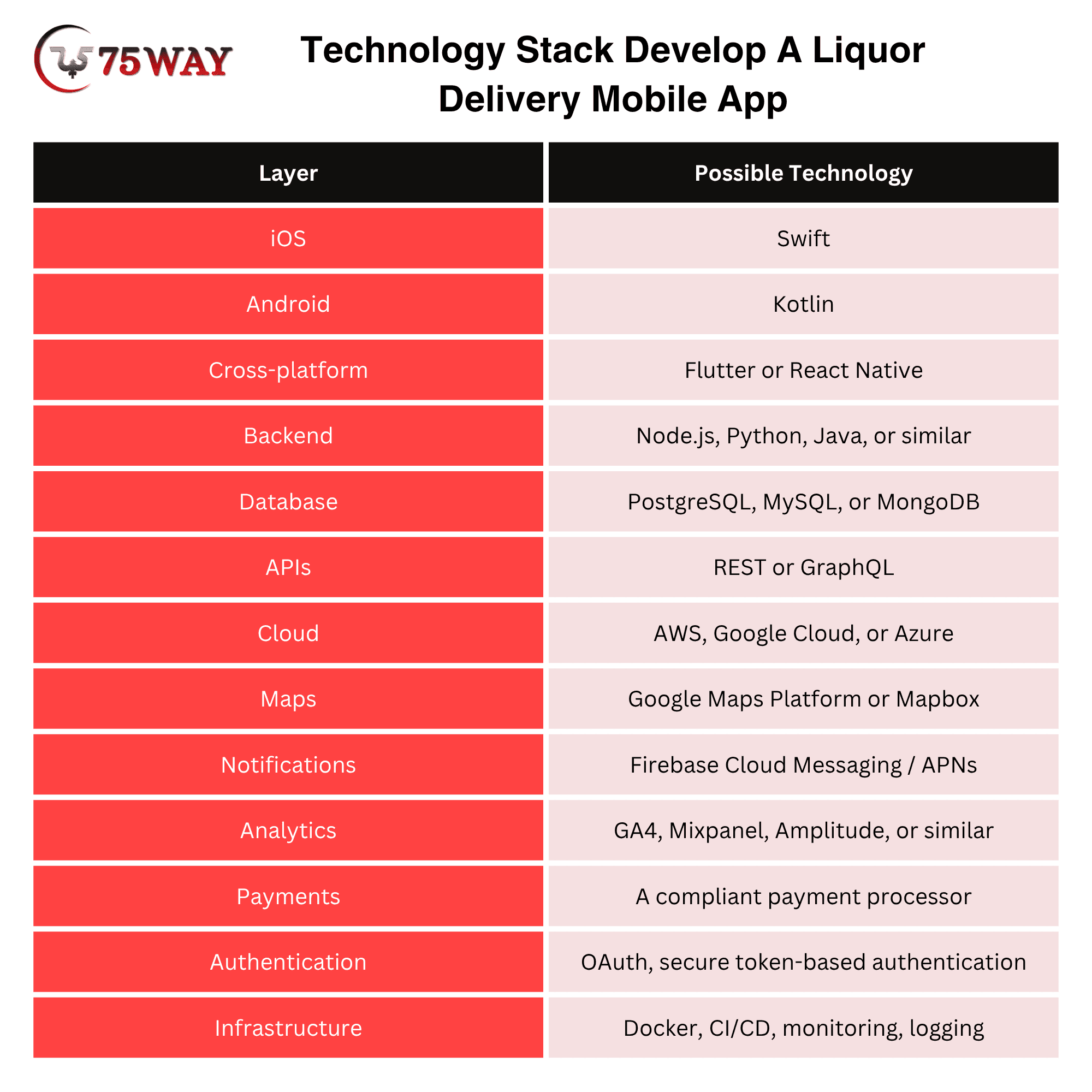
Technology Stack Develop A Liquor Delivery Mobile App
A liquor delivery app can look like a simple ordering platform to customers, but behind every order sits technology handling age verification, payments, inventory, location data, delivery coordination, and account security. The wrong technology choices can create performance, integration, and maintenance problems as order volumes grow. The technology stack used to develop a liquor delivery mobile app is explained below. A typical architecture could include:
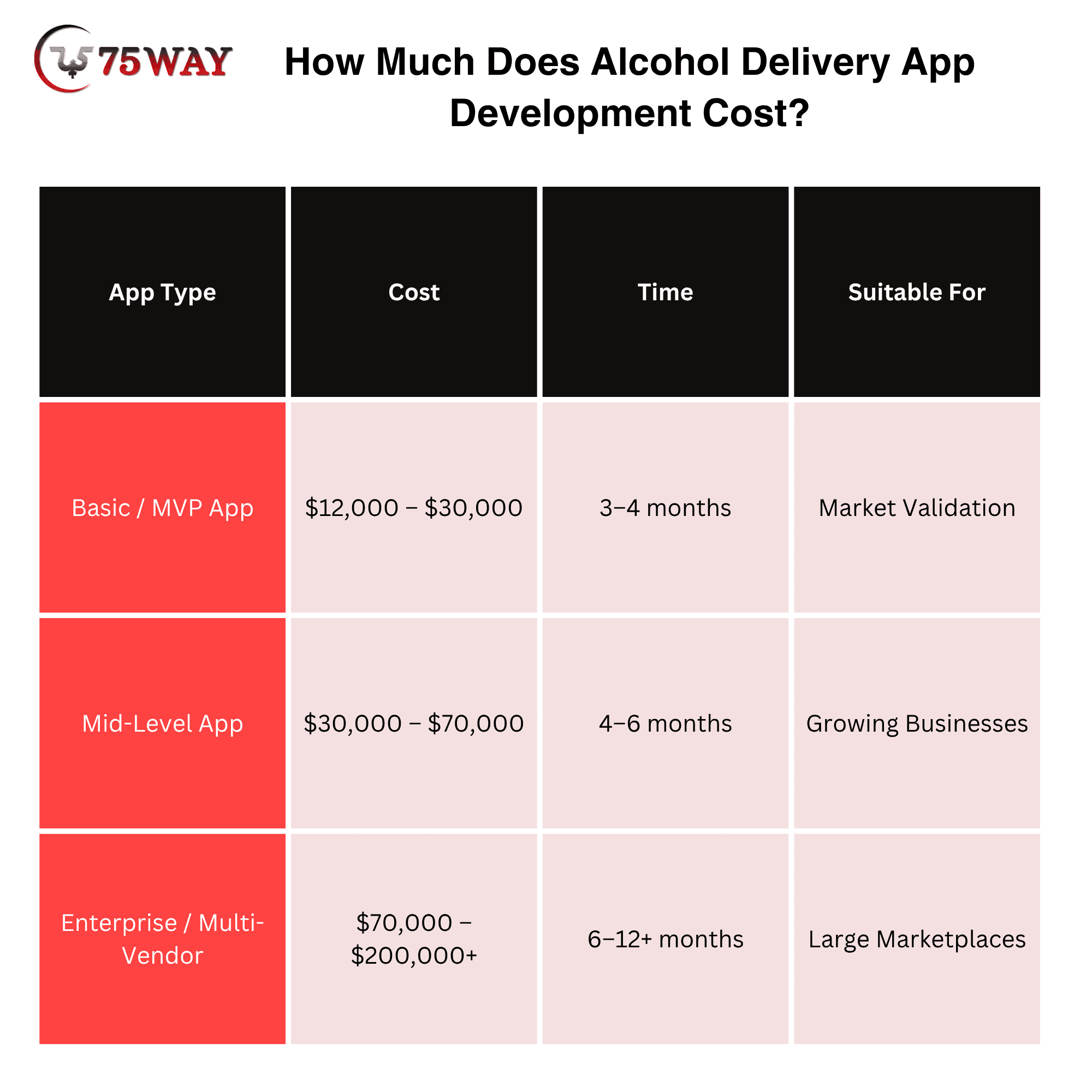
How Much Does Alcohol Delivery App Development Cost?
There is no universal development price because an alcohol marketplace and a single-store ordering application have very different scopes. As a practical planning framework:
1. Basic / MVP App: $12,000 – $30,000
Essential features for validating the concept, attracting early users, and testing market demand.
Estimated Time: 3–4 months
2. Mid-Level App: $30,000 – $70,000
Advanced features for growing businesses, broader customer reach, and stronger operational management.
Estimated Time: 4–6 months
3. Enterprise / Multi-Vendor Platform: $70,000 – $200,000+
Scalable capabilities for large marketplaces, multiple retailers, complex operations, and extensive integrations.
Estimated Time: 6–12+ months
How Long Does It Take to Build an Alcohol Delivery App?
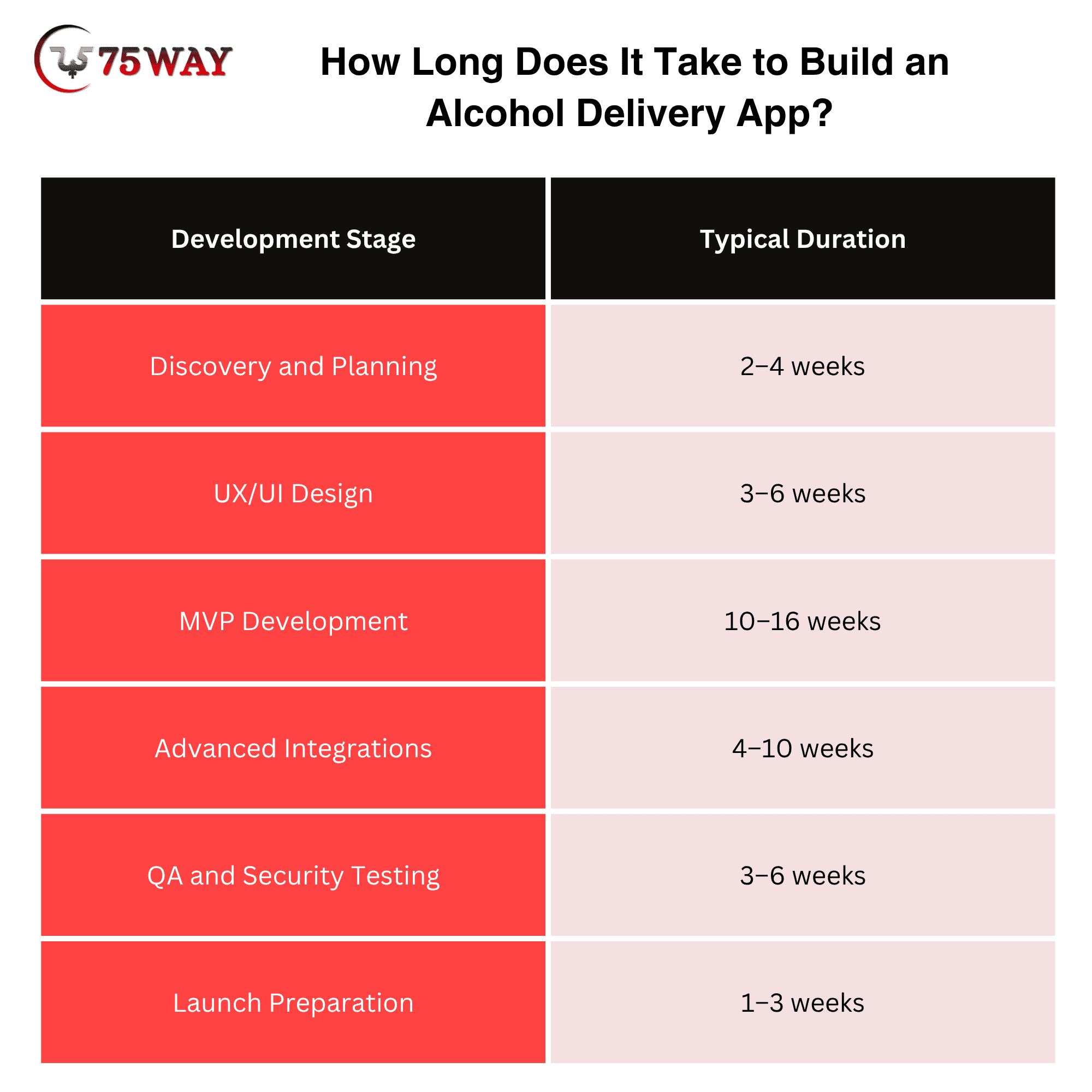
A basic liquor ordering app can reach launch much faster than a multi-vendor platform handling stores, drivers, inventory, payments, age verification, and state-specific delivery rules. Custom alcohol delivery builds commonly take several months, with recent industry estimates ranging from around 3–4 months for simpler apps to 5–9 months for more complex platforms. The timeline below explains where that development time goes and what can extend the launch schedule.
How Does an Alcohol Delivery App Make Money?
The real commercial opportunity in an alcohol delivery app goes beyond charging for delivery. A platform can earn by connecting customers with licensed retailers, helping brands reach high-intent shoppers, and offering additional value to frequent users. The key revenue channels that can turn the app into a sustainable business are outlined below.
- Commission
Charge participating retailers a percentage of eligible transactions. This model creates recurring platform revenue as order volumes and retailer participation increase.
- Delivery Fee
Charge customers a fee based on delivery distance, order size, or service level. Flexible delivery pricing can help cover fulfillment costs while creating an additional revenue stream.
- Service Fee
Add a platform fee to qualifying transactions. A clearly disclosed service charge can generate revenue from completed orders without relying solely on retailer commissions.
- Subscription
Offer memberships with benefits such as reduced delivery fees or other permitted perks. Recurring memberships can provide predictable revenue while encouraging customers to place more orders through the platform.
- Retailer Subscription
Charge retailers a recurring software or marketplace fee. Subscription plans can provide retailers with ongoing access to marketplace tools, analytics, and operational features.
- Promotional Placement
Allow eligible retailers or brands to purchase promotional visibility where legally permissible. Sponsored visibility can create advertising revenue while helping participating businesses gain greater exposure within the platform.
- White-Label Licensing
License the technology to retailers or alcohol businesses under their own branding. Licensing allows businesses to use an established technology platform without developing the entire delivery solution internally.
A hybrid model can combine several revenue streams, but the transaction structure should be validated against applicable alcohol laws and payment requirements before launch.
Security Considerations for Alcohol Delivery Apps
Because the platform can handle identity information, payment data, addresses, and customer behavior, security needs to be part of the architecture.
Important areas include:
- Encryption in transit
- Encryption at rest
- Secure authentication
- Role-based access control
- API security
- Payment-tokenization practices
- Secure ID handling
- Audit logging
- Data retention controls
- Monitoring
- Vulnerability testing
- Incident response
ID information deserves particular attention.
DoorDash, for example, explains that alcohol ID information is handled with security controls and limited retention/use purposes.
The exact data-handling approach for your application should be established with security and legal professionals based on the jurisdictions and verification providers involved.
How to Choose an Alcohol Delivery App Development Company
Do not evaluate development companies only by their quoted price. Ask prospective partners:
Have you built marketplace platforms?
A marketplace requires substantially different backend workflows than a basic eCommerce application.
How will you handle compliance?
The development team should be able to explain how legal requirements will translate into configurable software rules.
What happens when delivery verification fails?
The answer should cover cancellation, refund, retailer notification, driver instructions, and return handling.
How will retailer inventory synchronize?
Ask whether the solution can integrate with existing POS or inventory systems.
How will sensitive ID information be handled?
The company should explain its approach to data minimization, security, storage, retention, and third-party verification services.
What is included in the quoted cost?
Ask whether the proposal includes:
- UI/UX
- Backend
- Customer application
- Driver application
- Retailer portal
- Admin panel
- QA
- DevOps
- Integrations
- Deployment
- Maintenance
A low initial quote can become expensive if critical components are excluded.
What Makes an Alcohol Delivery App Successful?
A successful platform needs more than a polished customer interface.
It needs a reliable operating system connecting:
Demand → Inventory → Compliance → Payment → Fulfillment → Delivery → Verification → Repeat Purchase
If any link breaks, the customer experience and business economics can suffer.
For founders, that means the initial product strategy should focus on market selection, licensing structure, retailer relationships, operational workflows, compliance architecture, and unit economics before adding advanced features.
Final Takeaway
Alcohol delivery app development is a combination of marketplace engineering, eCommerce, logistics, identity verification, payments, inventory management, and jurisdiction-aware compliance. The strongest product strategy starts with the operating model and launch geography, then converts validated business and legal requirements into the application's workflows.
For founders, the goal should not be to build the largest possible application on day one. Build the smallest commercially viable platform that can support your target market, validate demand, handle critical compliance workflows, and generate reliable operational data for the next stage of growth.
If you are planning an alcohol delivery platform, partner with an experienced on-demand app development company to scope the architecture, compliance workflows, integrations, MVP, and long-term roadmap around your business model.
Frequently Asked Questions
How much does it cost to develop an alcohol delivery app?
A practical planning range can start around $30,000 for a focused MVP and exceed $250,000 for advanced enterprise platforms. Actual cost depends on scope, integrations, compliance requirements, platforms, and architecture.
How long does it take to build an alcohol delivery app?
A focused MVP can take roughly four to six months, while a sophisticated multi-vendor platform may require six to twelve months or longer. The final timeline depends on functionality and integrations.
What features does an alcohol delivery app need?
Core features include product discovery, inventory, checkout, payments, age verification, order tracking, retailer management, delivery workflows, notifications, and administration. Marketplace apps also need vendor and settlement functionality.
How does age verification work in alcohol delivery apps?
The exact workflow varies by jurisdiction and provider, but platforms can use identity-document verification, ID scanning, date-of-birth checks, and delivery-time recipient verification. DoorDash and Instacart both document delivery-time ID verification.
Can an alcohol delivery app operate nationwide?
Potentially, but nationwide operation should not be treated as one uniform compliance environment. Requirements can differ by state, license, product, retailer, location, and delivery arrangement, so each launch market requires legal validation.
Can I build an alcohol delivery app like DoorDash?
Yes, a similar marketplace architecture can be developed, but copying another company's proprietary software or processes is not the objective. The platform should be designed around your own business model, licensed partners, technology requirements, and applicable regulations.
Can AI be integrated into an alcohol delivery app?
Yes. AI can support recommendations, demand forecasting, customer segmentation, support automation, inventory insights, and route planning. Its use should solve a measurable business problem rather than simply increase feature count.