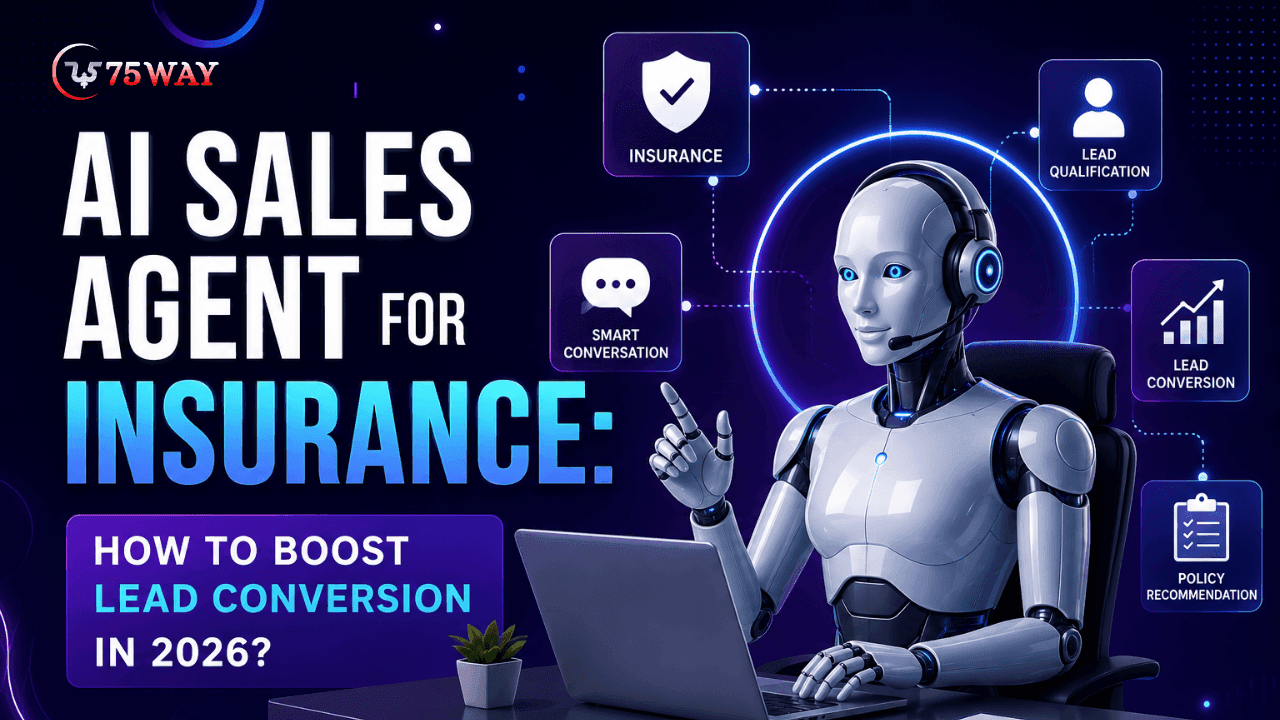
Summary
AI sales agents integrate intelligent automation, predictive analytics, conversational engagement, and personalized communication workflows to enhance insurance customer acquisition. Modern insurance businesses leverage AI-driven systems to accelerate response times, qualify prospects, reduce operational overhead, and improve customer retention.
Quick Overview
- AI sales agents boost insurance lead qualification with behavioral customer data.
- Automated customer engagement improves policy conversion rates.
- Predictive analytics identifies high-intent prospects before competitors capture opportunities.
- Personalized insurance interactions increase customer trust and policy retention.
- Scalable AI insurance sales agents support rapid business growth.
Insurance sales in 2026 are getting tougher than ever. If a potential buyer does not get a response within minutes, they often move on to the next provider. That is exactly where most insurance companies are losing revenue without even realizing it.
At the same time, customers now want instant quotes and personalized policy recommendations across channels like WhatsApp, email, and web chat. To meet both ends, AI sales agents have come to light, which are adopted by 79% of organizations.
Instead of waiting for human agents to respond, these AI solutions can instantly engage new leads, qualify prospects based on intent, suggest relevant insurance plans, and automatically follow up until conversion happens. It feels less like automation and more like having a 24/7 digital sales assistant that never misses a lead.
And the impact is already visible. Insurance companies using AI-driven sales automation in insurance apps and software are reporting higher lead conversion rates, reduced drop-offs, and significantly faster sales cycles. So how exactly do sales AI agents improve insurance lead conversion in 2026, and what makes them so effective in a highly competitive market?
This comprehensive guide explores the role of AI sales agents in insurance lead conversion, major technologies powering these systems, implementation strategies, and business benefits.
What is AI Sales Agent In Insurance?
AI sales agents are intelligent software systems designed to automate and optimize insurance sales interactions across digital channels. These systems use artificial intelligence technologies to analyze customer behavior, engage prospects conversationally, recommend policies, qualify leads, and support sales representatives throughout customer acquisition workflows.
Unlike traditional chatbots offering scripted responses, AI sales agents operate dynamically using machine learning models, contextual data analysis, and conversational AI assistants. They interpret customer intent, recognize behavioral signals, adapt conversations based on user responses, and continuously improve interactions through data-driven learning mechanisms.
The core advantage of AI sales agents lies in their ability to maintain scalable customer interactions without compromising personalization quality. Modern insurance consumers prefer instant engagement rather than waiting hours for human representatives to respond. AI-driven systems address this expectation through 24/7 conversational accessibility and automated customer engagement.
Why Insurance Lead Conversion Challenges Continue Growing?
Insurance providers face numerous lead conversion obstacles due to changing consumer expectations, digital competition, and fragmented communication environments. Several operational challenges reduce conversion performance across modern insurance businesses.
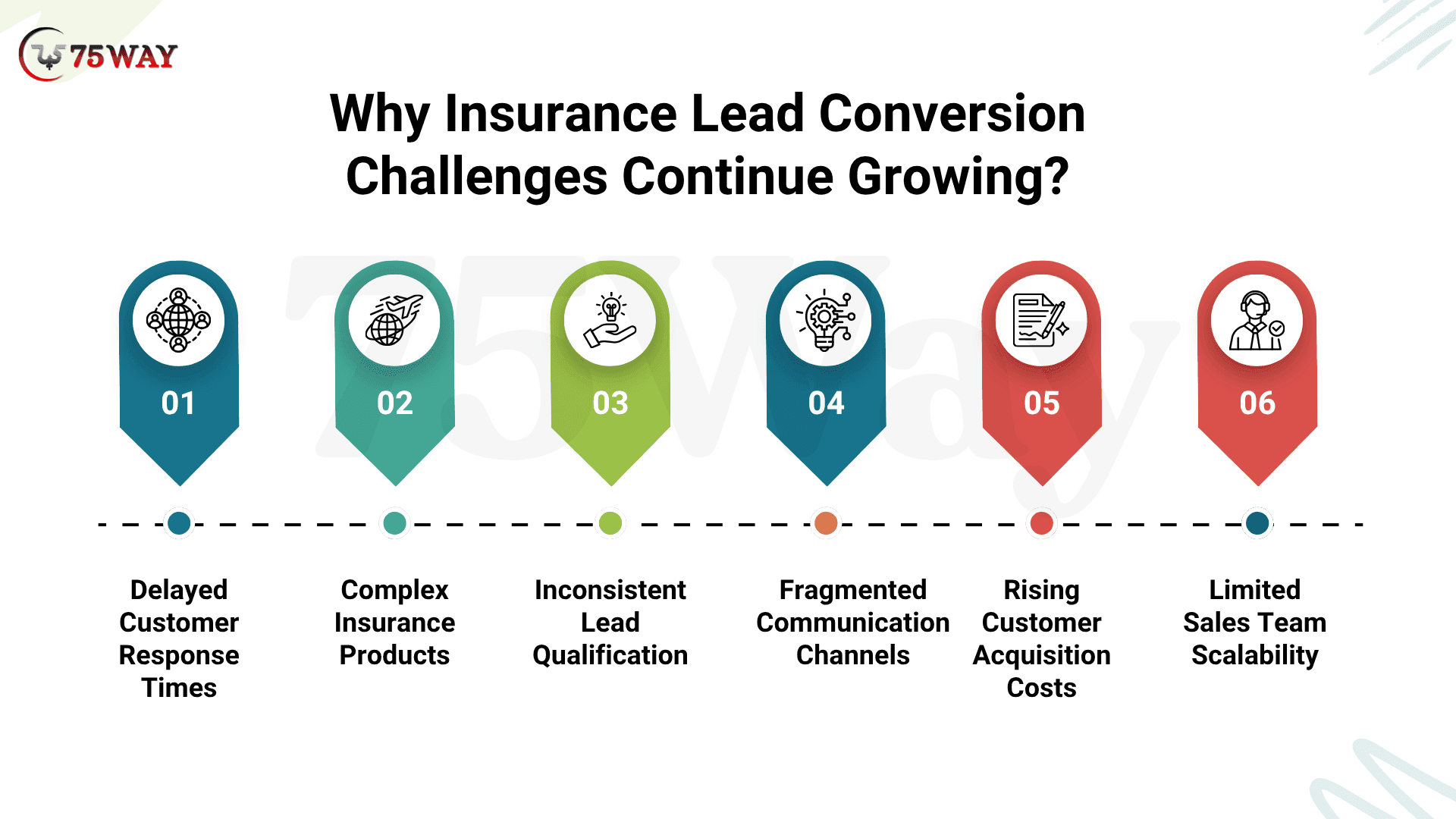
- Delayed Customer Response Times
Potential insurance customers often contact multiple providers simultaneously while researching policies online. Businesses failing to respond quickly frequently lose high-intent leads to competitors offering faster engagement experiences.
- Complex Insurance Products
Insurance policies involve complicated terms, coverage structures, exclusions, and pricing variations. Prospects may abandon applications if explanations appear confusing or overwhelming during early interactions.
- Inconsistent Lead Qualification
Manual lead qualification processes often depend on subjective judgment and limited customer data. Sales teams may spend excessive time pursuing low-intent prospects while missing valuable conversion opportunities.
- Fragmented Communication Channels
Customers interact through multiple platforms during their insurance purchasing journey. Maintaining consistent communication across channels becomes operationally difficult without centralized automation systems.
- Rising Customer Acquisition Costs
Digital advertising expenses continue increasing across insurance markets. Businesses must maximize conversion rates from existing leads to maintain profitable customer acquisition strategies.
- Limited Sales Team Scalability
Human sales representatives can manage only a limited number of customer conversations simultaneously. Growing lead volumes often create operational bottlenecks and delayed customer engagement.
How AI Sales Agents Improve Insurance Lead Conversion?
AI sales agents improve insurance conversion by optimizing every stage of the sales funnel, from first contact to final policy purchase. They reduce response time, improve lead quality, and deliver personalized experiences while supporting sales teams with data-driven decision-making and automation.
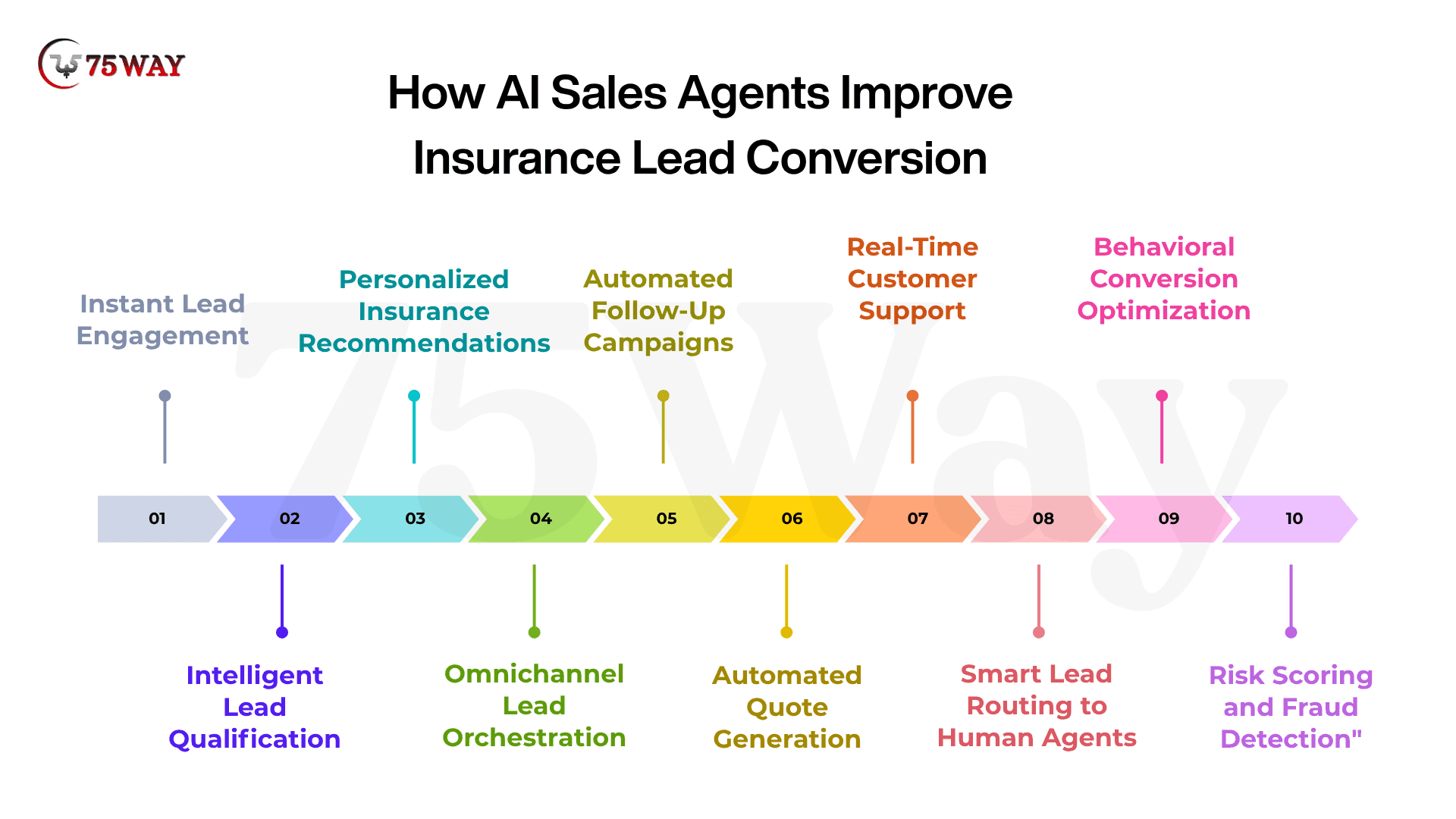
1. Instant Lead Engagement
Fast response time directly impacts insurance conversion rates. AI sales agents engage users immediately after inquiry submission through chat, WhatsApp, email, or voice assistants. Early interaction builds trust, captures intent while it is still strong, and reduces the chance of losing leads to competitors.
2. Intelligent Lead Qualification
AI systems evaluate lead quality using demographic data, income range, browsing behavior, policy interest, and engagement signals. This helps insurance teams prioritize high-value prospects, reduce time spent on low-intent users, and improve overall sales efficiency through structured lead scoring models.
3. Personalized Insurance Recommendations
AI agents map customer profiles with suitable insurance products such as health, life, motor, or travel policies. Recommendations are based on age, income, family size, risk appetite, and past behavior, helping users understand complex policy options more easily and improving decision clarity.
4. Automated Follow-Up Campaigns
Insurance conversion often requires repeated engagement. Enterprise AI systems automate follow-ups across SMS, email, WhatsApp, and app notifications based on user behavior. These reminders are triggered based on inactivity, abandoned forms, or partial application completion to maintain lead engagement without manual effort.
5. Real-Time Customer Support
AI assistants handle customer queries related to policy coverage, claim processes, premiums, exclusions, and documentation requirements. Instant responses reduce confusion during decision-making stages and prevent lead drop-offs caused by delayed human support availability.
6. Behavioral Conversion Optimization
AI systems track user interaction patterns across digital touchpoints and identify intent signals. These insights help optimize funnel performance and improve conversion strategy design. Key signals include:
- Policy page visits
- Quote comparison behavior
- Application drop-off points
- Time spent on pricing pages
- Channel preference (chat, call, email)
7. Omnichannel Lead Orchestration
AI sales agents unify communication across multiple channels, including web chat, mobile apps, CRM systems, email, WhatsApp, and voice assistants. This ensures consistent messaging and prevents lead leakage between channels during the insurance buying journey.
8. Automated Quote Generation
AI systems generate instant insurance quotes based on user inputs such as age, coverage type, and risk profile. For products such as funeral cover, customers may also review funeral insurance quotes alongside relevant policy features and premium information before deciding whether to proceed. This reduces dependency on manual underwriting for early-stage filtering and accelerates the decision-making process for customers.
9. Smart Lead Routing to Human Agents
High-intent leads are automatically routed to human insurance advisors based on priority score, product type, and urgency level. This hybrid model ensures that complex cases receive human attention while automation handles early funnel stages.
10. Risk Scoring and Fraud Detection
AI evaluates leads for potential fraud patterns, duplicate entries, or inconsistent data submissions. This protects insurance companies from financial risk and improves data quality across CRM systems.
Market Insights for Adoption of AI Insurance Agents
In fact, AI in insurance improves insurance sales conversions by 10–20% with new agents, boosts premium growth by 10–15%, reduces onboarding costs by 20–40%, and increases claims accuracy by 3–5%.
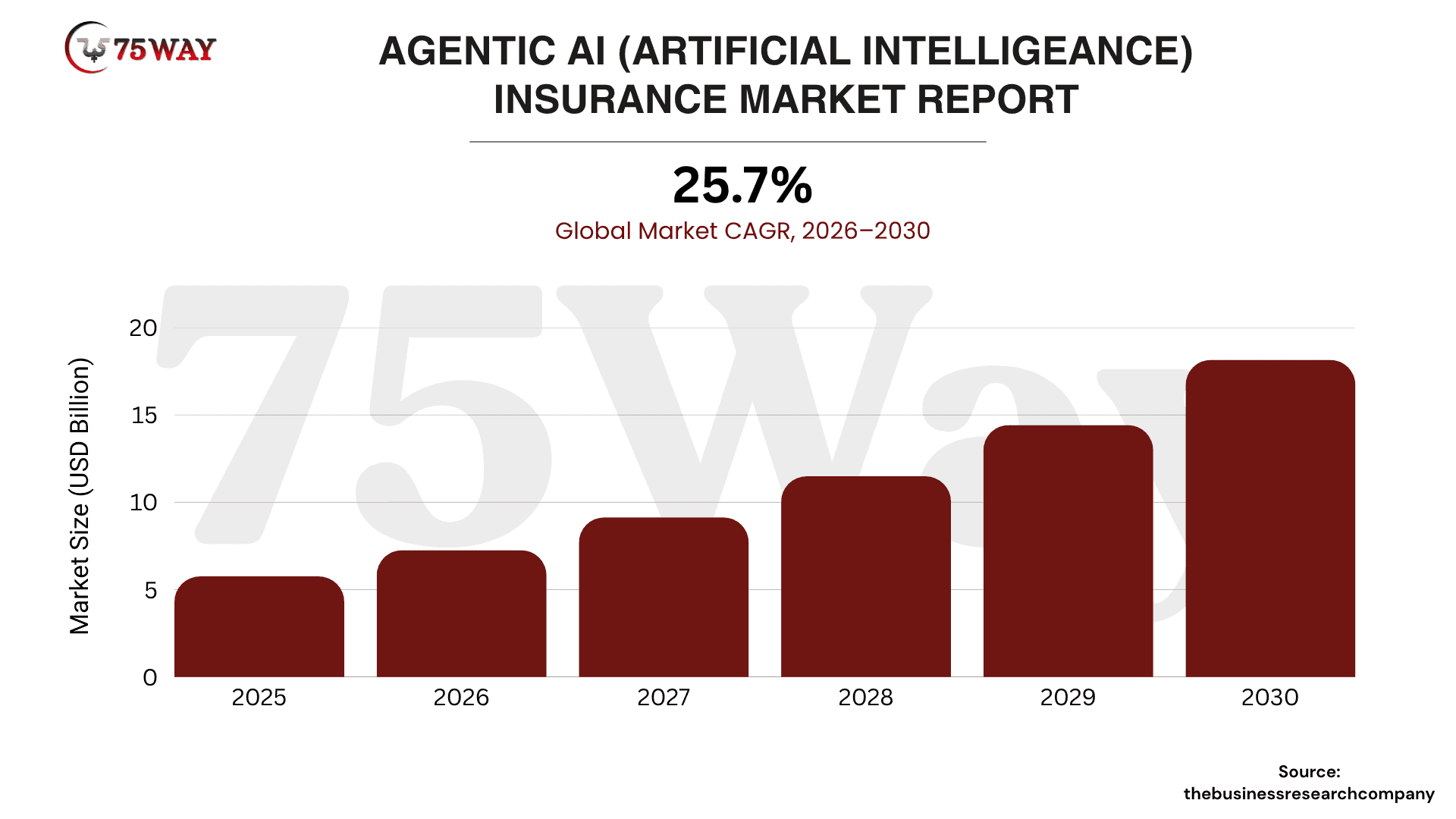
- The AI in the insurance market is projected to reach $13.45 billion, growing at a CAGR of over 33%.
- AI voice agents can manage 300+ outbound calls daily per seat, compared to 50–110 handled by humans.
- AI-powered inbound call handling reduces average resolution time from 7.8 minutes to 4.2 minutes.
- AI underwriting agents can cut decision-making time from 3–10 days to just 4 minutes for simplified life insurance.
- Around 34% of insurance carriers have fully integrated AI agents into their operational value chain.
- Nearly 82% of insurance carriers are either planning to adopt agentic AI or actively testing it to support insurance agents.
- Around 78% of agents under 40 view AI adoption positively, compared to 41% of agents aged over 55.
Major Benefits of Sales AI Agents For Insurance Companies
AI sales agents help insurance companies improve sales efficiency, reduce operational pressure, and deliver personalized customer interactions across multiple channels. These AI assistants for insurance enhance conversion performance by combining automation with predictive intelligence for better decision-making across the insurance sales funnel.
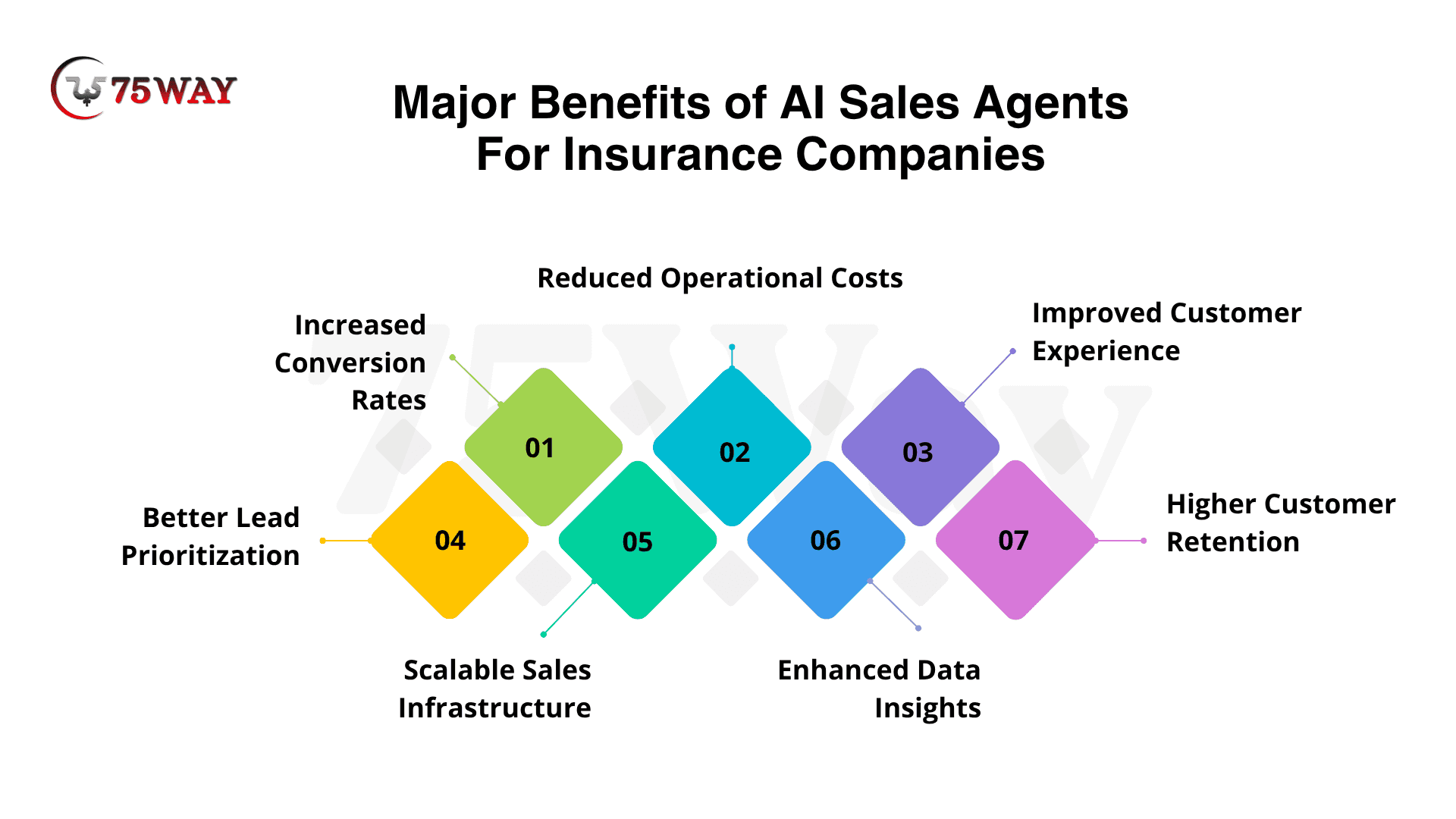
- Increased Conversion Rates: Faster response times and personalized engagement help insurance companies convert more leads into paying customers. AI systems interact instantly, reducing drop-offs during inquiry stages and improving overall policy adoption rates through timely communication and better user experience across digital touchpoints.
- Reduced Operational Costs: Automation reduces the need for large sales teams handling repetitive tasks like follow-ups and data entry. Insurance companies lower operational expenses while maintaining high engagement levels, allowing resources to focus on strategic activities and high-value customer interactions across sales pipelines.
- Improved Customer Experience: AI-driven conversations provide consistent, accurate, and fast responses to customer queries. Conversational AI in insurance reduces confusion during policy selection, improves clarity on insurance terms, and ensures smooth communication across channels, creating a more reliable and user-friendly experience throughout the decision-making journey.
- Better Lead Prioritization: Predictive scoring models help identify high-intent prospects based on behavior, demographics, and engagement history. Sales teams focus on leads with higher conversion potential, improving productivity, reducing wasted effort, and increasing efficiency in managing insurance pipelines and customer acquisition processes.
- Scalable Sales Infrastructure: AI assistants for insurance handle increasing lead volumes without requiring proportional workforce expansion. Insurance companies can scale operations easily during peak demand periods while maintaining response quality, ensuring consistent performance across large customer bases and growing digital sales channels efficiently.
- Enhanced Data Insights: InsuranceAI tools analyze customer interactions, campaign performance, and buying behavior patterns. These insights help insurance companies refine marketing strategies, improve targeting accuracy, and optimize sales funnels using data-driven decisions that enhance overall business performance and customer acquisition outcomes.
- Higher Customer Retention: Personalized engagement, timely follow-ups, and continuous support strengthen long-term customer relationships. Sales AI agents help insurance providers maintain ongoing communication with policyholders, improving renewal rates, reducing churn, and increasing lifetime customer value.
Role of Personalization In Insurance Sales Conversion
Modern insurance customers expect personalized experiences throughout their purchasing journey. Generic communication strategies often fail to establish trust or engagement. AI sales agents for insurance personalize interactions using:
- Behavioral analytics
- Geographic data
- Demographic information
- Policy interests
- Purchase history
- Financial preferences
- Communication behavior
Personalization increases:
- Customer engagement
- Lead response rates
- Conversion opportunities
- Customer satisfaction
- Policy retention performance
For example, sales AI agents for insurance may recommend family health insurance plans to married users while suggesting retirement-oriented products to older customers based on demographic analysis.
How AI Sales Agents Enable Omnichannel Insurance Engagement?
Insurance customers move across multiple digital platforms before finalizing a policy, and AI sales agents unify these interactions into a single connected journey without losing conversation history or intent signals.
AI agents in insurance integrate website chat, mobile apps, WhatsApp, email, SMS, voice assistants, and social media messaging into one synchronized communication layer. Mobile apps play a central role by enabling push notifications, in-app chat, and instant policy updates, ensuring continuous engagement even when users are not actively browsing.
This unified structure improves conversion rates by maintaining consistent communication across every channel. Customers receive timely updates, reminders, and personalized responses on their preferred platforms, reducing drop-offs and creating a smoother insurance purchasing experience from inquiry to policy activation.
How AI Insurance Sales Agents Improve Lead Nurturing?
AI insurance sales agents improve lead nurturing by maintaining continuous engagement with prospects across multiple channels until they are ready to purchase a policy. These systems analyze user behavior, personalize communication, and automate follow-ups to move leads smoothly through each stage of the insurance sales funnel with better timing and relevance.
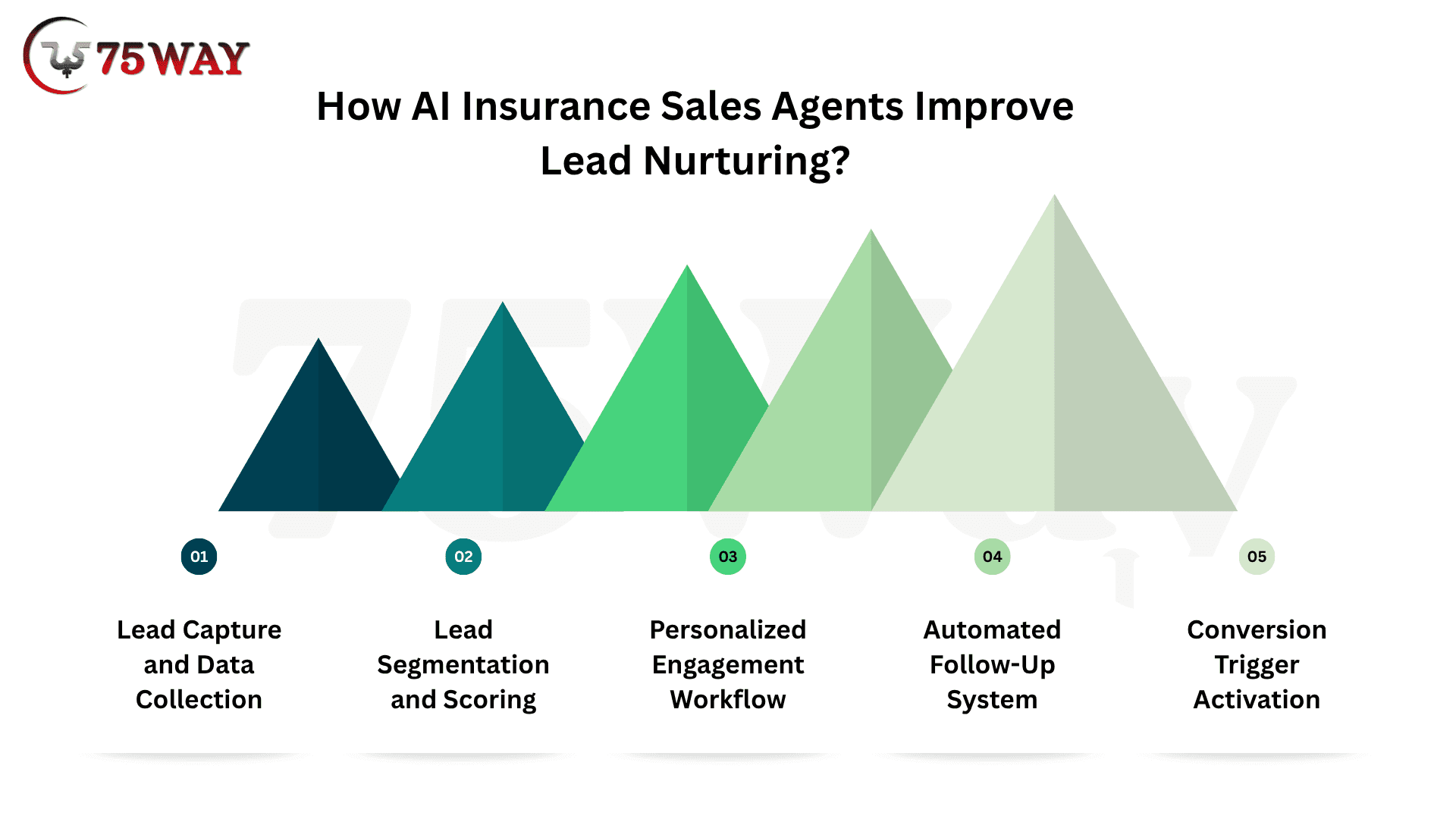
1. Lead Capture and Data Collection
AI systems capture leads from websites, ads, landing pages, and social media platforms and immediately store structured customer data in CRM systems. This includes contact details, policy interest, and behavior signals. Early data collection helps build accurate customer profiles for future engagement and segmentation.
2. Lead Segmentation and Scoring
AI evaluates each lead based on demographics, engagement activity, and intent signals to assign a priority score. Leads are grouped into categories like hot, warm, and cold for better targeting. This helps insurance teams focus on high-intent prospects while maintaining automated engagement for lower-intent users.
3. Personalized Engagement Workflow
AI agents send personalized messages based on user behavior, such as policy views, quote requests, or incomplete applications. Communication is delivered through email, WhatsApp, SMS, or app notifications. Personalization increases relevance and encourages users to continue progressing through the decision-making process.
4. Automated Follow-Up System
AI platforms automatically schedule follow-ups at optimized intervals based on customer inactivity or partial engagement. These follow-ups include reminders, policy updates, and educational content. Consistent communication keeps potential buyers engaged without requiring manual effort from insurance sales teams.
5. Conversion Trigger Activation
AI systems detect high-intent signals such as repeated policy visits, quote generation, or pricing comparisons. Once identified, leads are automatically routed to human agents or offered instant policy options. This ensures timely intervention at the point where purchase probability is highest.
How To Build AI Sales Agents For Insurance In 2026?
Building AI sales agents for insurance in 2026 requires a structured approach combining data intelligence, automation workflows, compliance frameworks, and conversational AI systems. These agents must handle lead engagement, qualification, policy recommendations, and customer support while integrating securely with CRM and insurance platforms for real-time decision making.
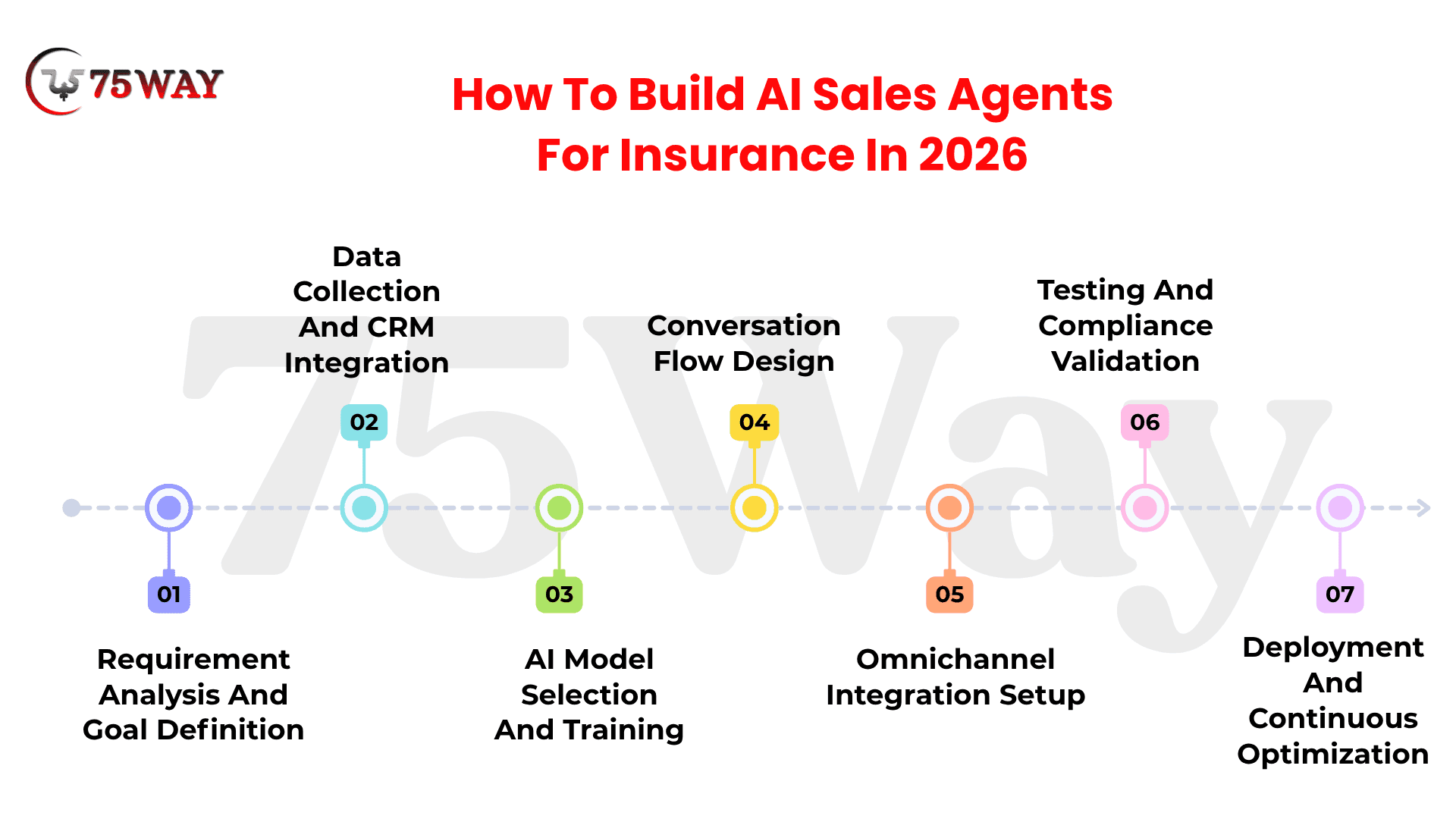
1. Requirement Analysis And Goal Definition
This stage defines business objectives, target insurance segments, and expected outcomes from AI sales agents. It includes identifying lead conversion goals, customer journey stages, and automation scope. Clear requirements help align AI capabilities with insurance sales workflows and operational needs from the beginning. It also reduces development gaps later in implementation.
2. Data Collection And CRM Integration
Insurance data from CRM systems, websites, ads, and customer interactions is collected and structured for AI processing. This includes user profiles, policy interest data, and communication history. Clean and organized data improves AI accuracy and decision-making quality. Integration ensures real-time synchronization between AI agents and sales systems.
3. AI Model Selection And Training
Appropriate machine learning models and NLP systems are selected based on use cases like lead scoring and conversation handling. Training uses historical insurance data, customer queries, and policy datasets. This stage improves response accuracy and contextual understanding. Proper training ensures the AI system can handle real customer interactions effectively.
4. Conversation Flow Design
Conversation design defines how AI agents interact with customers across different scenarios. It includes greetings, lead qualification questions, policy explanations, and follow-up messages. Structured flows ensure smooth communication and reduce user confusion. Well-designed conversations improve engagement quality and increase the likelihood of lead conversion.
5. Omnichannel Integration Setup
AI agents are connected across multiple platforms such as websites, mobile apps, WhatsApp, email, and voice systems. This ensures consistent communication regardless of channel. Users can switch platforms without losing context. Omnichannel setup improves engagement continuity and reduces drop-offs during the insurance decision journey.
6. Testing And Compliance Validation
AI systems are tested for accuracy, response quality, and performance across real insurance scenarios. Compliance checks ensure alignment with regulations like GDPR, HIPAA, and data protection standards. Security testing validates encryption, authentication, and data handling processes. This stage ensures safe and reliable deployment.
7. Deployment And Continuous Optimization
Once deployed, AI sales agents are monitored for performance metrics like conversion rate, response time, and lead quality. Feedback loops help refine models and conversation flows. Continuous optimization improves accuracy and user experience over time. System updates ensure long-term scalability and adaptability in insurance operations.
Compliance And Data Privacy Considerations
Insurance businesses operate under strict regulations where customer data protection, consent management, and secure AI usage are mandatory requirements across all digital interactions and automated sales processes.
- GDPR Compliance: Ensures customer data is collected with consent, securely processed, and users retain control over personal information rights consistently.
- HIPAA Requirements: Protects sensitive health-related insurance data through strict access controls, confidentiality rules, and secure handling of medical information records.
- Data Encryption Standards: Secures customer information using advanced encryption methods during storage and transmission to prevent unauthorized access or cyber threats.
- Consent Management Protocols: Manages user permissions for data usage, ensuring transparency, tracking approvals, and allowing customers to modify preferences anytime.
- Secure Authentication Systems: Uses multi-factor verification and identity validation to protect accounts and prevent unauthorized access to sensitive insurance data.
- Secure Data Storage: Stores customer data in protected environments with controlled access, regular monitoring, and security audits for risk prevention.
- Transparent AI Interactions: Clearly informs users when interacting with AI systems, ensuring trust, clarity, and ethical communication across insurance platforms.
- Bias Monitoring: Continuously evaluates AI models to detect unfair patterns, ensuring unbiased decisions in lead scoring and policy recommendations.
- Regulatory Documentation: Maintains detailed records of AI operations, customer interactions, and workflows to support audits and compliance verification processes.
Best Practices For Successful AI Sales Agent Deployment
Successful deployment of AI sales agents in insurance requires a balanced approach that combines technology, data quality, compliance, and customer-centric design. These systems must not only automate sales processes but also enhance trust, improve engagement quality, and support human teams in achieving better conversion outcomes across the entire insurance lifecycle.
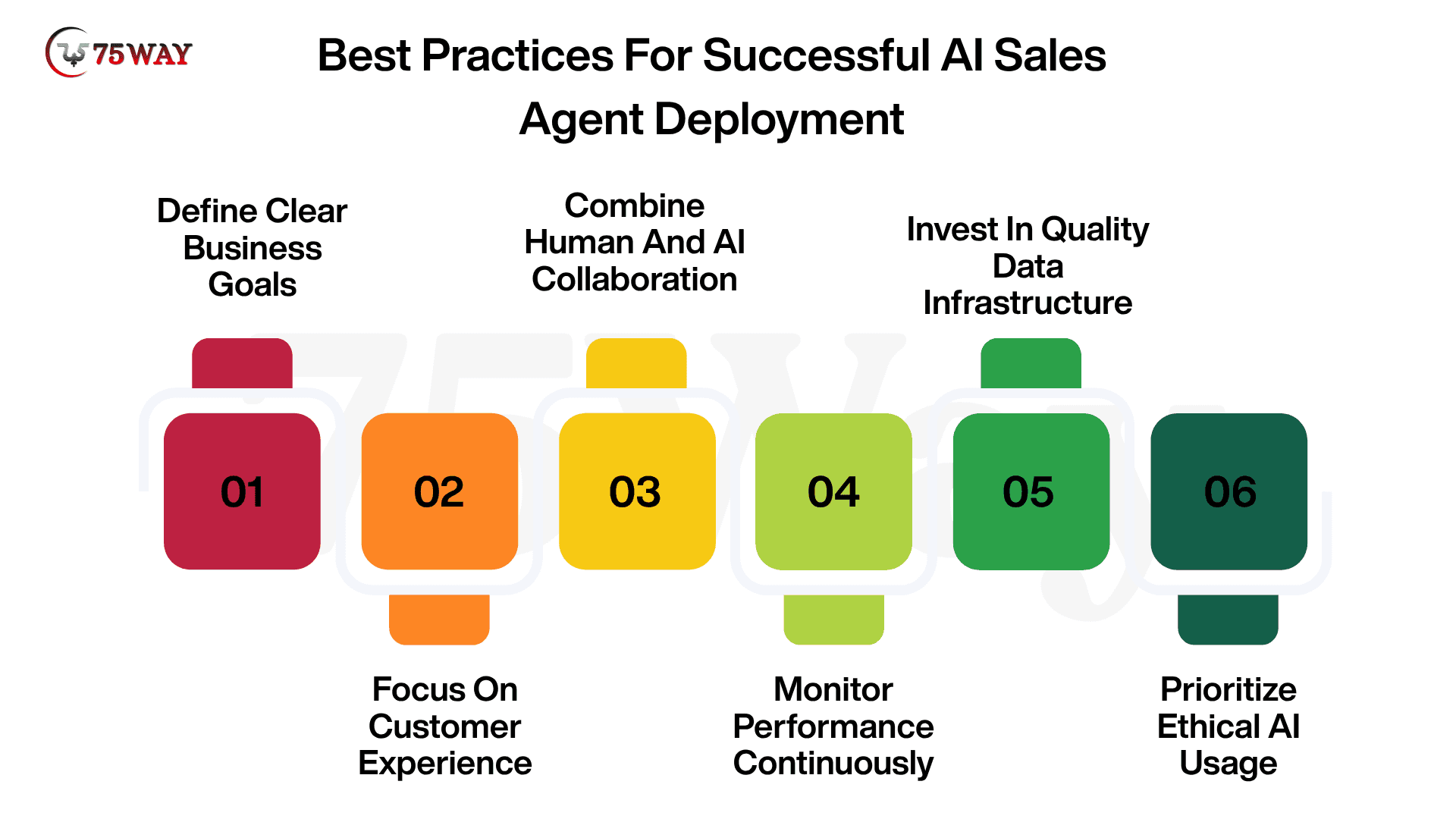
- Define Clear Business Goals: Organizations should identify specific objectives such as improving conversion rates, reducing response times, or increasing retention. Clear goals help align AI system design with measurable business outcomes and prevent unnecessary feature complexity during implementation.
- Focus on Customer Experience: AI interactions should remain conversational, personalized, and contextually relevant. A strong user experience increases engagement, builds trust, and improves the likelihood of customers progressing through insurance purchase journeys without confusion or friction.
- Combine Human & AI Collaboration: Complex customer scenarios should transition smoothly from AI systems to human representatives. This hybrid model ensures sensitive cases receive human attention while AI handles repetitive tasks and early-stage lead qualification efficiently.
- Monitor Performance Continuously: Businesses should evaluate engagement metrics, customer satisfaction, and conversion outcomes regularly. Continuous monitoring helps identify performance gaps, improve response accuracy, and refine AI workflows for better insurance sales results over time.
- Invest In Quality Data Infrastructure: Reliable customer data improves predictive accuracy and personalization quality. Strong data pipelines ensure AI systems receive clean, structured, and updated information for better decision-making across lead scoring and customer engagement processes.
- Prioritize Ethical AI Usage: Transparent policies strengthen customer trust and regulatory compliance. Ethical AI practices ensure fairness in decision-making, prevent bias in recommendations, and maintain accountability in all automated insurance interactions.
Future Trends Shaping AI Sales Agents In Insurance
AI sales technologies are evolving rapidly, transforming how insurance companies engage, convert, and retain customers across digital ecosystems with more intelligence, automation, and personalization capabilities.
- Voice-Based Insurance Sales: Voice AI systems will manage increasingly sophisticated customer conversations.
- Hyper-Personalized Insurance Experiences: AI platforms will deliver highly individualized policy recommendations using behavioral intelligence.
- Predictive Customer Retention: Advanced analytics will identify policyholders likely to cancel or switch providers.
- AI-Powered Risk Assessment: Machine learning models will improve underwriting and pricing analysis capabilities.
- Generative AI Integration: Generative AI will create dynamic communication workflows, proposal generation, and customer education systems.
- Advanced Conversational Interfaces: AI systems will become more human-like through emotional intelligence and contextual reasoning improvements.
Why Insurtech Startups Are Rapidly Investing In AI Sales Automation?
Insurtech startups operate within highly competitive digital markets where customer acquisition speed significantly influences growth performance.
AI sales automation helps startups:
- Reduce operational expenses
- Scale customer engagement rapidly
- Improve investor confidence
- Accelerate policy conversions
- Build data-driven growth models
Many emerging insurance platforms now position AI-driven customer engagement as a core differentiator within crowded digital insurance ecosystems.
Final Remarks
AI sales agents are reshaping insurance customer acquisition through automation, predictive analytics, personalization, and omnichannel engagement. These systems help insurance companies improve lead qualification, response speed, and conversion performance while reducing operational workload. Modern customers expect instant responses and personalized policy experiences, which AI systems deliver across digital channels. Businesses adopting AI-driven sales agents gain stronger retention, better engagement, and scalable growth potential in competitive markets. So, don’t wait! Partner with a trusted AI agent development company to build scalable insurance automation systems for higher conversions and growth.
Frequently Asked Questions (FAQs)
Can AI Sales Agents Handle Multilingual Insurance Conversations?
Yes, modern AI sales agents support multilingual communication across websites, apps, and messaging platforms effectively. This improves accessibility, engagement, and customer understanding across diverse regions.
Do AI Sales Agents Replace Human Insurance Advisors Completely?
AI sales agents do not fully replace human advisors in insurance operations. They handle repetitive tasks while humans manage complex consultations and emotional decision-making processes.
Which Insurance Businesses Benefit Most From AI Sales Automation?
Health, life, auto insurance providers, brokers, and insurtech startups benefit most from AI automation systems. High lead volume businesses see stronger conversion improvements overall.
Can Small Insurance Agencies Afford AI Sales Agent Technology?
Yes, scalable cloud-based AI solutions make adoption affordable for small insurance agencies. These systems grow gradually with business expansion and increasing customer acquisition needs.
Are AI Sales Agents Suitable For Offline Insurance Businesses?
Yes, offline insurance agencies benefit through appointment automation, lead management, and digital engagement support. Hybrid models combining offline and online channels perform especially well.
Can AI Systems Predict Insurance Customer Buying Intent?
Yes, AI analyzes behavior, demographics, and engagement signals to predict buying intent. This helps insurance companies prioritize high-quality leads and improve conversion efficiency.