AI Summary
LangGraph and CrewAI solve different AI challenges. Their architectures support distinct development approaches. Choosing correctly improves scalability and maintainability. Production goals should guide framework selection. This guide compares features, performance, use cases, and enterprise readiness.
Key Takeaways
- Compare LangGraph and CrewAI before selecting your production AI development framework.
- Match framework architecture with business objectives and workflow complexity requirements.
- Production AI systems require scalability, observability, and secure workflow orchestration capabilities.
- Multi-agent collaboration and workflow orchestration solve different automation challenges.
- Choose frameworks supporting future growth instead of today's immediate development requirements.
If you've narrowed your choices to LangGraph and CrewAI, you're already looking at two of the most popular frameworks for building an autonomous AI agent. The real question isn't which one is better overall. It's which one is better for the type of AI agent you want to build.
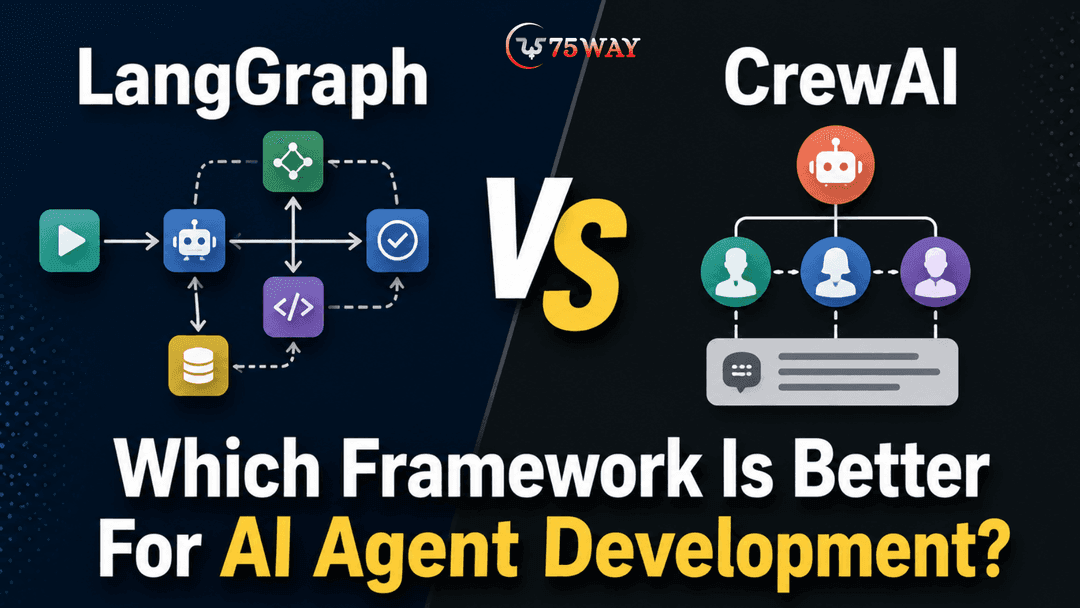
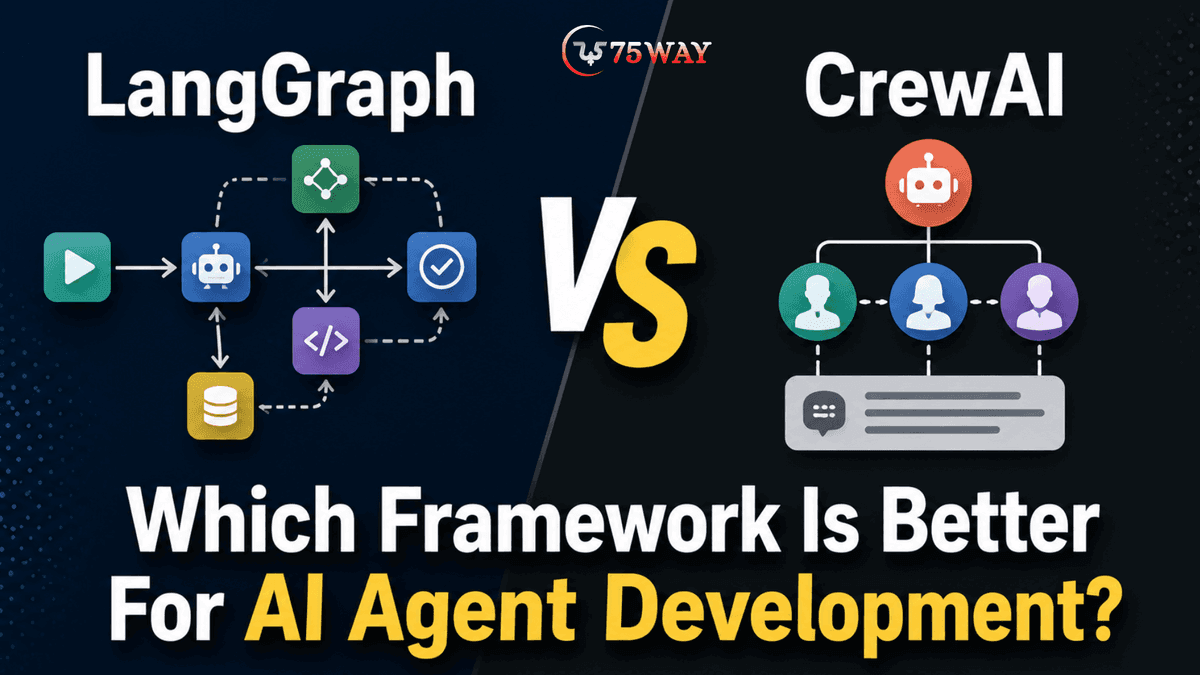
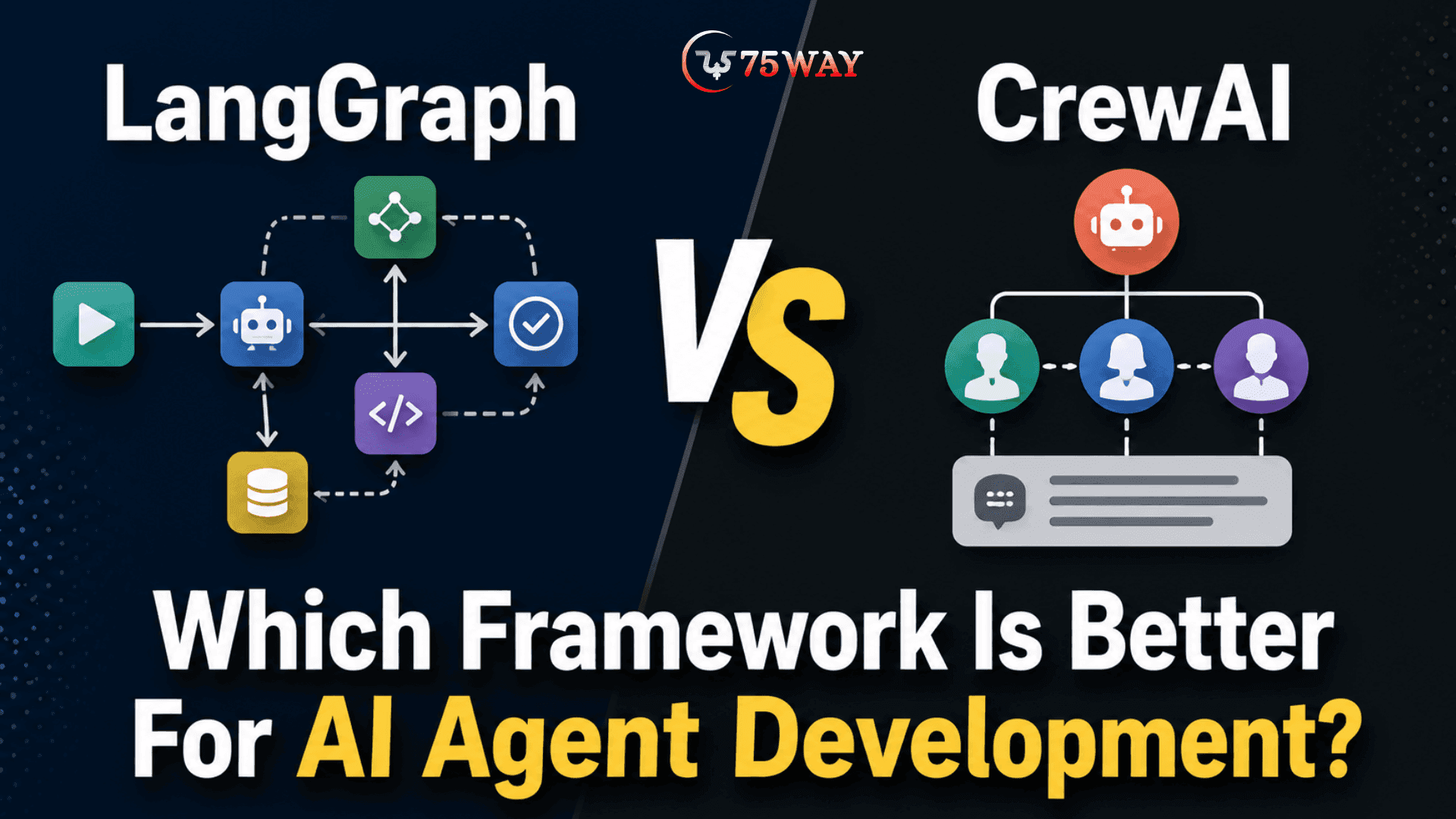
The key difference is that LangGraph focuses on stateful, graph-based control over agent workflows, while CrewAI emphasizes role-based collaboration among multiple agents working as a team. Although both AI agent frameworks support autonomous AI systems, they solve different problems and follow different design philosophies. This guide compares LangGraph and CrewAI across architecture, workflows, scalability, development experience, and real-world use cases to help you make the right decision.
What Are LangGraph and CrewAI?
Before you know the difference between LangGraph and CrewAI, it is better to learn what these AI agent frameworks actually are. The design philosophy behind each framework is the first step toward choosing the right one.
What Is LangGraph? Know in Detail
LangGraph is an open-source framework designed for building stateful AI agents capable of executing structured, multi-step workflows. Developed by the LangChain team, it represents AI workflows as interconnected graphs, where each node performs a specific operation and each connection defines how the agent transitions between decisions or tasks.
Instead of generating a response and stopping, LangGraph continuously tracks execution state throughout the workflow. This allows AI agents to pause for approvals, revisit earlier decisions, retry failed operations, call external tools, maintain memory, and recover gracefully from interruptions.
Its graph-based architecture provides exceptional flexibility for complex business processes that require predictable execution, making LangGraph a strong choice for enterprise AI systems where reliability is critical.
Best suited for:
- Enterprise workflow automation
- Customer support platforms
- AI coding assistants
- Financial process automation
- Healthcare AI applications
- Multi-step business workflows
- Production AI systems requiring high reliability
What Is CrewAI?
CrewAI is an open-source framework built around a different philosophy: collaboration instead of orchestration.
Rather than relying on one highly capable AI agent to perform every task, CrewAI enables you to create multiple specialized agents that work together as a coordinated team. Each agent is assigned a specific role, objective, expertise, and responsibility, allowing the overall system to solve complex problems more.
For example, one agent may gather market data, another analyzes competitors, a third writes recommendations, while a fourth reviews the final report for quality before delivery. This role-based collaboration closely mirrors how human teams operate within organizations.
Because of its intuitive design, CrewAI has become popular among startups, consultants, product teams, and organizations experimenting with collaborative AI workflows.
Best suited for:
- Research automation
- Content operations
- Market intelligence
- Business analysis
- Collaborative AI assistants
- Multi-agent task delegation
- Rapid AI prototyping
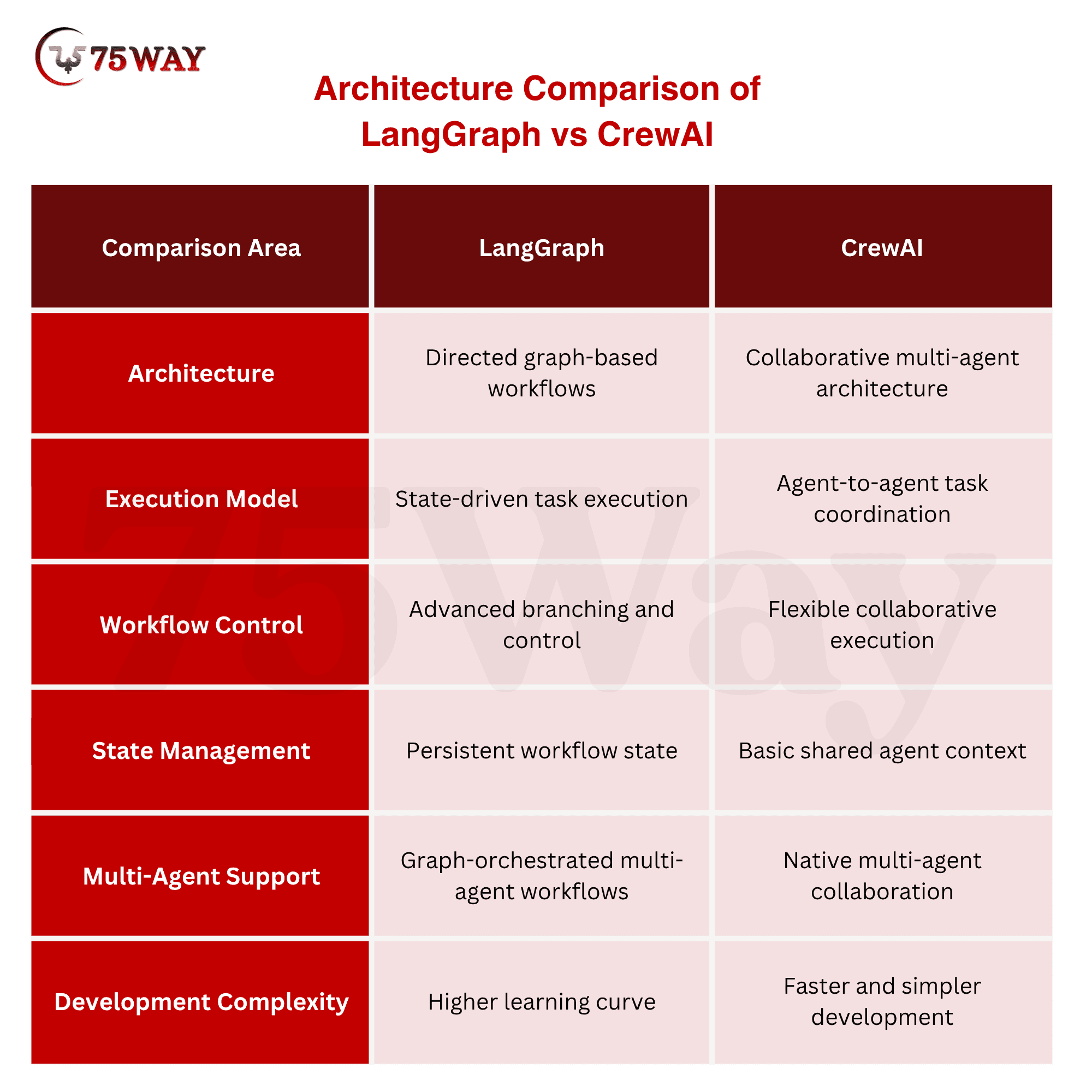
LangGraph Vs CrewAI: Quick Comparison
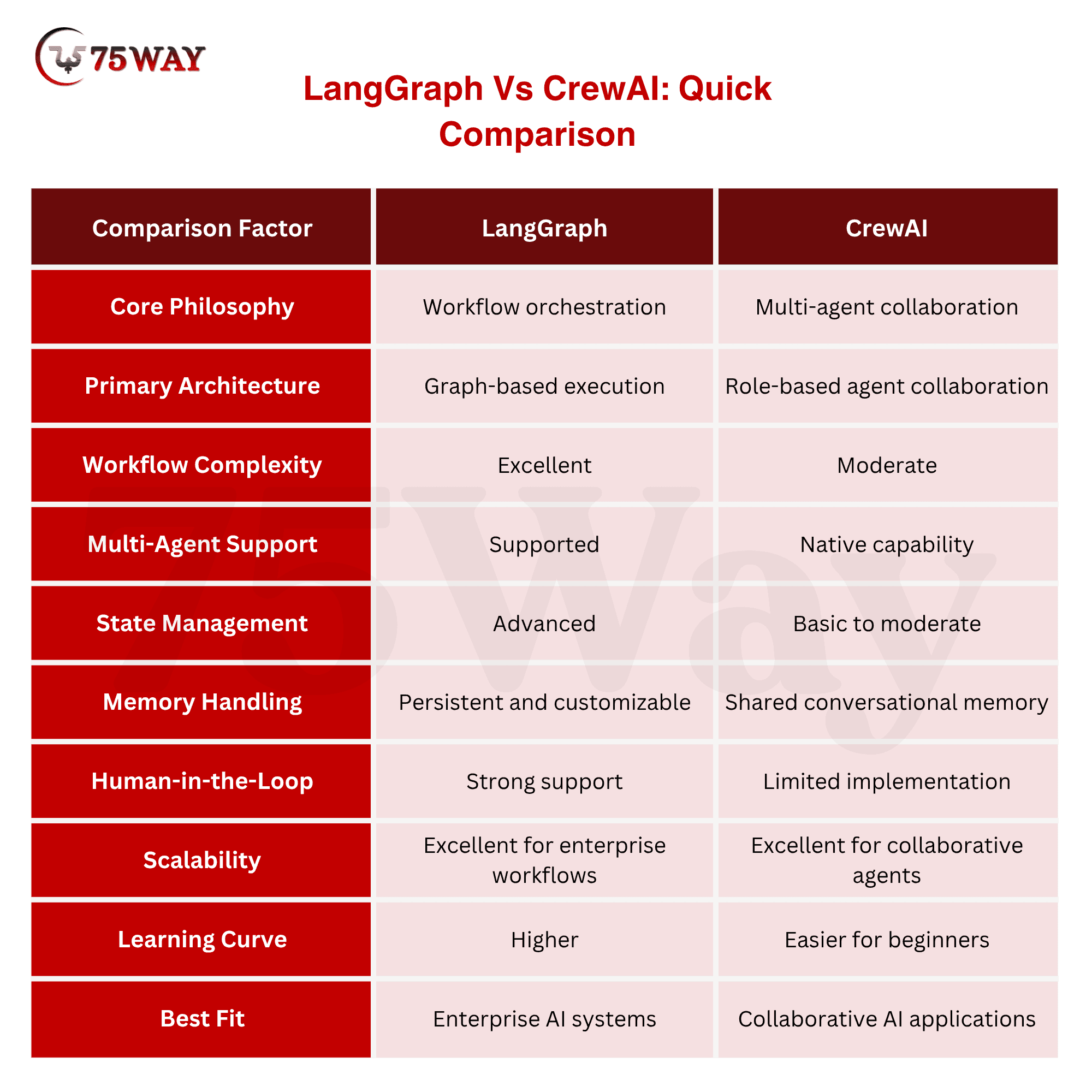
Difference Between LangGraph And CrewAI Based On Architecture
The biggest difference between LangGraph and CrewAI isn't found in their APIs or feature lists. It's in how each framework approaches problem-solving. Architecture influences everything from scalability and debugging to long-term maintenance, making it one of the most important factors to evaluate before choosing a framework.
LangGraph Architecture
LangGraph organizes AI workflows as a directed graph, where every node performs a specific action and every edge determines what happens next. Instead of following a rigid sequence of prompts, the framework continuously evaluates the current state before deciding which operation should execute next.
This graph-based approach provides exceptional flexibility for business processes involving approvals, conditional logic, retries, branching workflows, and long-running tasks. Since execution state is preserved throughout the process, AI agents can pause, resume, recover from failures, or revisit earlier decisions without losing context.
Think of LangGraph as a workflow engine that happens to use AI for reasoning. The workflow itself remains structured, transparent, and highly controllable.
Strengths
- Advanced workflow orchestration
- Reliable state management
- Flexible branching logic
- Fault recovery
- Enterprise scalability
- Long-running process support
Potential Challenges
- More architectural planning required
- Steeper learning curve
- Greater complexity for simple AI applications
CrewAI Architecture
CrewAI approaches AI systems differently by modeling them as collaborative teams rather than structured workflows. Instead of controlling every execution path, developers define specialized agents with distinct roles, goals, and responsibilities.
When a task begins, CrewAI coordinates communication between these agents until the shared objective is completed. One agent may perform research, another analyzes information, another writes content, while another validates the final output.
This architecture feels natural because it resembles how human organizations divide responsibilities across departments and specialists.
The result is a highly modular system that encourages reusable AI expertise rather than centralized workflow management.
Strengths
- Natural multi-agent collaboration
- Easy task delegation
- Modular agent design
- Faster prototyping
- Simple collaboration model
- Beginner-friendly development
Potential Challenges
- Less precise workflow control
- Limited state orchestration
- Complex enterprise processes may require additional customization
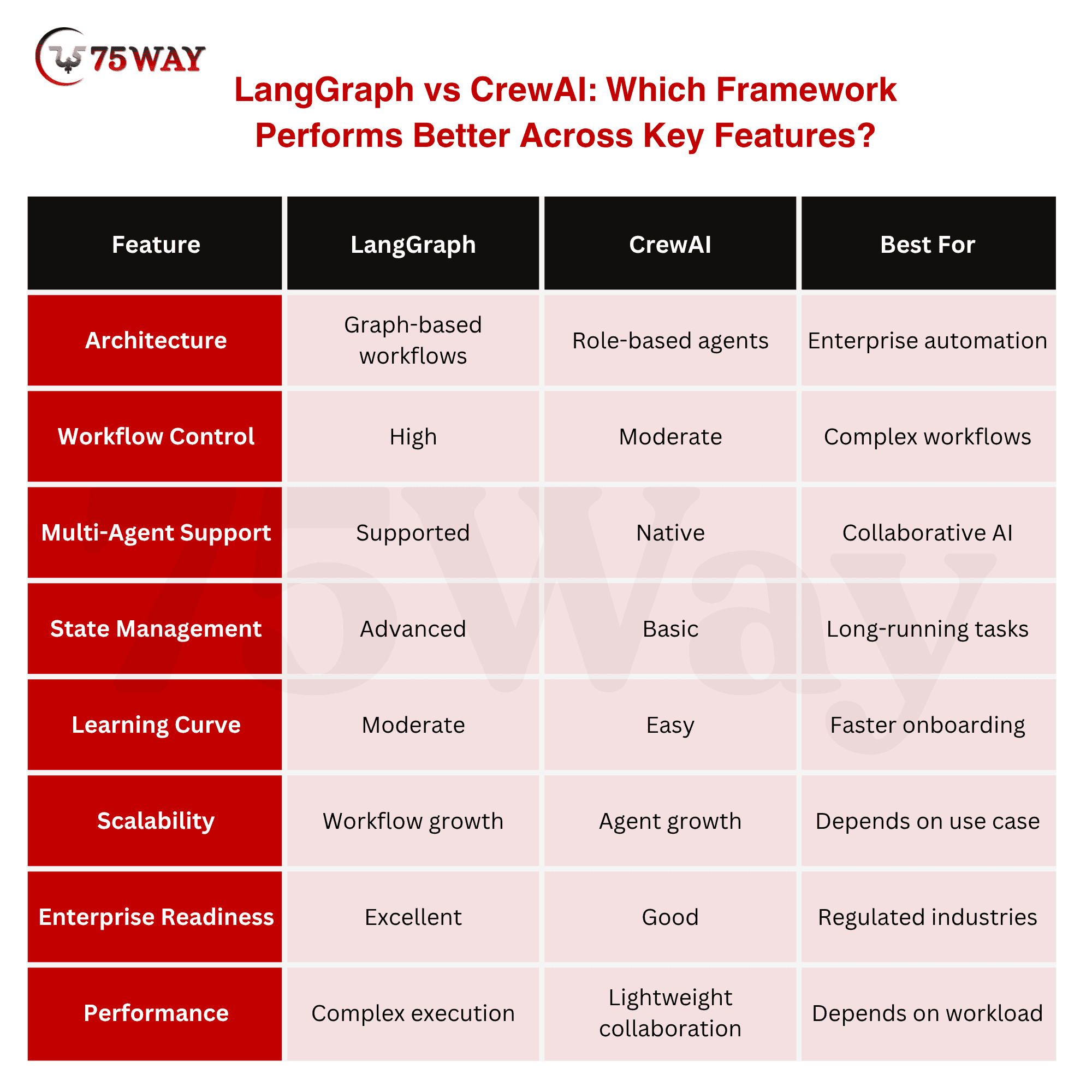
LangGraph vs CrewAI: Which Framework Performs Better Across Key Features?
Both frameworks can help you build capable AI agents. The difference lies in how they solve problems. One focuses on controlling workflows from start to finish. The other focuses on helping multiple AI agents work together efficiently. Here's how they compare where it matters most.
1. State Management and Memory
Memory isn't just about remembering previous conversations. It's about helping an AI agent know where it is in a workflow, what it has already completed, and what should happen next. This becomes critical as projects grow more complex.
LangGraph keeps track of every stage in the workflow. If an API fails or a user pauses the process, the agent doesn't have to start over. It resumes from the last successful step. That makes long-running workflows much more reliable.
Meanwhile, CrewAI shares information between collaborating agents instead of maintaining detailed workflow states. If one agent finishes research, another agent can immediately use those findings to continue the task. This approach works well for collaborative projects but offers less control over execution history.
Which framework performs better? For applications that need persistent workflows and reliable recovery, LangGraph has the advantage. If your focus is helping multiple AI agents share context while working together, CrewAI keeps things simple and effective.
2. Tool Integration
AI agents become far more useful when they can interact with business applications. Calling APIs, querying databases, updating CRMs, or sending emails often matters more than generating text.
CrewAI makes it easy to assign different tools to different agents. For example, one agent can search the web, another can analyse internal documents, while another prepares the final response. Each agent only uses the tools needed for its role, keeping collaboration organised.
In contrast, LangGraph gives developers much finer control over when and how tools are used. A workflow can decide whether to call an API, retry after a failure, or skip a step entirely based on the current state. That flexibility becomes valuable in enterprise automation where workflows rarely follow a straight path.
Which framework performs better?
CrewAI simplifies tool usage across multiple agents. LangGraph provides greater control when tool execution depends on complex business logic.
3. Learning Curve
No team wants to spend weeks learning a framework before building its first AI agent. The easier it is to understand, the faster development can begin.
CrewAI is generally easier to learn because its design mirrors how people already work. Developers create agents, assign responsibilities, and define how those agents collaborate. The concept feels familiar, even for teams new to agentic AI.
By comparison, LangGraph requires developers to think in terms of graphs, execution states, transitions, and workflow orchestration. There's more to learn upfront, but that extra complexity gives you greater control as projects become more advanced.
Which framework performs better?
CrewAI is usually the better starting point for beginners. LangGraph demands a larger initial investment, but rewards experienced teams with much greater flexibility.
4. Debugging and Monitoring
Even the best AI agent won't work perfectly every time. When something goes wrong, your team needs to understand why it happened.
LangGraph makes debugging easier because every workflow follows a defined execution path. Developers can trace each decision, identify where a failure occurred, and inspect the workflow without guessing. That visibility becomes especially valuable in production systems.
Conversely, CrewAI focuses on tracking interactions between agents. You can review how tasks move from one agent to another and understand how collaboration influenced the final result. As more agents join the system, however, those interactions can become harder to follow.
Which framework performs better?
For structured debugging and workflow visibility, LangGraph offers more detailed insights. CrewAI provides enough visibility for collaborative systems but may require additional monitoring as projects grow.
5. Enterprise Readiness
Enterprise AI projects demand more than strong reasoning. They also require security, reliability, governance, and long-term maintainability.
LangGraph was built with these requirements in mind. Its support for checkpoints, human approvals, persistent execution, and structured workflows makes it a strong fit for industries, where every action must be traceable.
CrewAI, however, shines when organisations need AI teams that collaborate across research, content creation, software development, or internal operations. While it can support enterprise deployments, larger organisations often add extra governance layers as their AI ecosystem expands.
Which framework performs better?
For highly regulated enterprise environments, LangGraph is typically the safer choice. For businesses focused on collaborative AI workflows and faster delivery, CrewAI remains a compelling option.
6. Performance and Execution Speed
Performance becomes increasingly important as AI agents handle larger workloads, interact with multiple tools, and process thousands of user requests. A framework should deliver reliable responses without adding unnecessary execution overhead.
CrewAI keeps workflows lightweight by allowing specialized agents to handle independent tasks. For straightforward collaborations, this often results in faster development and efficient execution. However, response times can increase as more agents join the conversation and exchange information before reaching a final decision.
In comparison, LangGraph spends more effort managing workflow states, checkpoints, and execution paths. While this may introduce slightly more orchestration overhead, it delivers greater consistency for long-running and complex workflows. That trade-off often becomes worthwhile in production environments where reliability matters more than raw speed.
Which framework performs better?
CrewAI is a strong choice for lightweight collaborative workflows. LangGraph performs better when consistency and controlled execution take priority over execution speed.
7. Flexibility and Customization
Every AI project is different. Some require simple task automation, while others involve complex workflows with unique business rules. The more flexible the framework, the easier it becomes to adapt as requirements evolve.
LangGraph gives developers extensive control over workflow behavior. Every branch, transition, retry, or approval stage can be customized to match specific business logic. This makes it easier to build AI systems that mirror real-world operational processes instead of forcing them into predefined patterns.
Meanwhile, CrewAI focuses on customizing agent roles rather than workflow structures. You can quickly create researchers, analysts, reviewers, or planners and define how they collaborate. This simplifies development, although it offers fewer options for controlling every execution path.
Which framework performs better?
If your workflows require extensive customization, LangGraph offers greater flexibility. If you mainly need specialized AI agents working together, CrewAI provides a faster and more intuitive approach.
8. Community Support and Ecosystem
Good documentation, active contributors, tutorials, and third-party integrations make it easier to solve problems and adopt new capabilities.
CrewAI has built a rapidly growing developer community thanks to its simple learning curve and popularity among startups experimenting with collaborative AI systems. New examples, templates, and community resources continue to appear as adoption grows.
On the other hand, LangGraph benefits from its close relationship with the broader LangChain ecosystem. Developers gain access to extensive documentation, integrations, community projects, and a mature collection of tools that support enterprise AI development.
Which framework performs better?
CrewAI offers an active and beginner-friendly community. LangGraph provides a broader ecosystem with stronger resources for developers building production-scale AI applications.
9. Long-Term Maintenance
Building an AI agent is only the first step. As business requirements change, workflows expand, and new integrations are added, maintaining the application often becomes more challenging than the initial development.
LangGraph is designed with long-term maintainability in mind. Its structured workflow model makes it easier to update individual workflow stages without affecting the entire application. Teams can introduce new logic, integrations, or approval steps while keeping the overall architecture organised.
Conversely, CrewAI simplifies maintenance by keeping agent responsibilities separate. Updating one specialized agent rarely impacts the others, making iterative improvements straightforward. However, as the number of collaborating agents increases, managing communication and dependencies may require additional planning.
Which framework performs better?
LangGraph is generally easier to maintain for workflow-driven enterprise systems. CrewAI remains highly maintainable for collaborative applications, provided agent interactions stay well organised.
10. Scalability
A framework shouldn't only solve today's problem. It should continue supporting your AI systems as users, workflows, and business requirements grow.
LangGraph scales by expanding workflows without changing the overall architecture. You can introduce additional decision points, integrations, or approval stages while keeping the workflow structured. This makes large enterprise projects easier to maintain over time.
On the other hand, CrewAI scales by adding more specialized agents. Need an agent for compliance? Add one. Need another for quality review? Create another role. This modular design works well as responsibilities become more specialised.
Which framework performs better?
If your growth comes from increasingly complex workflows, LangGraph scales more naturally. If your roadmap involves building larger teams of specialised AI agents, CrewAI offers a cleaner expansion path.
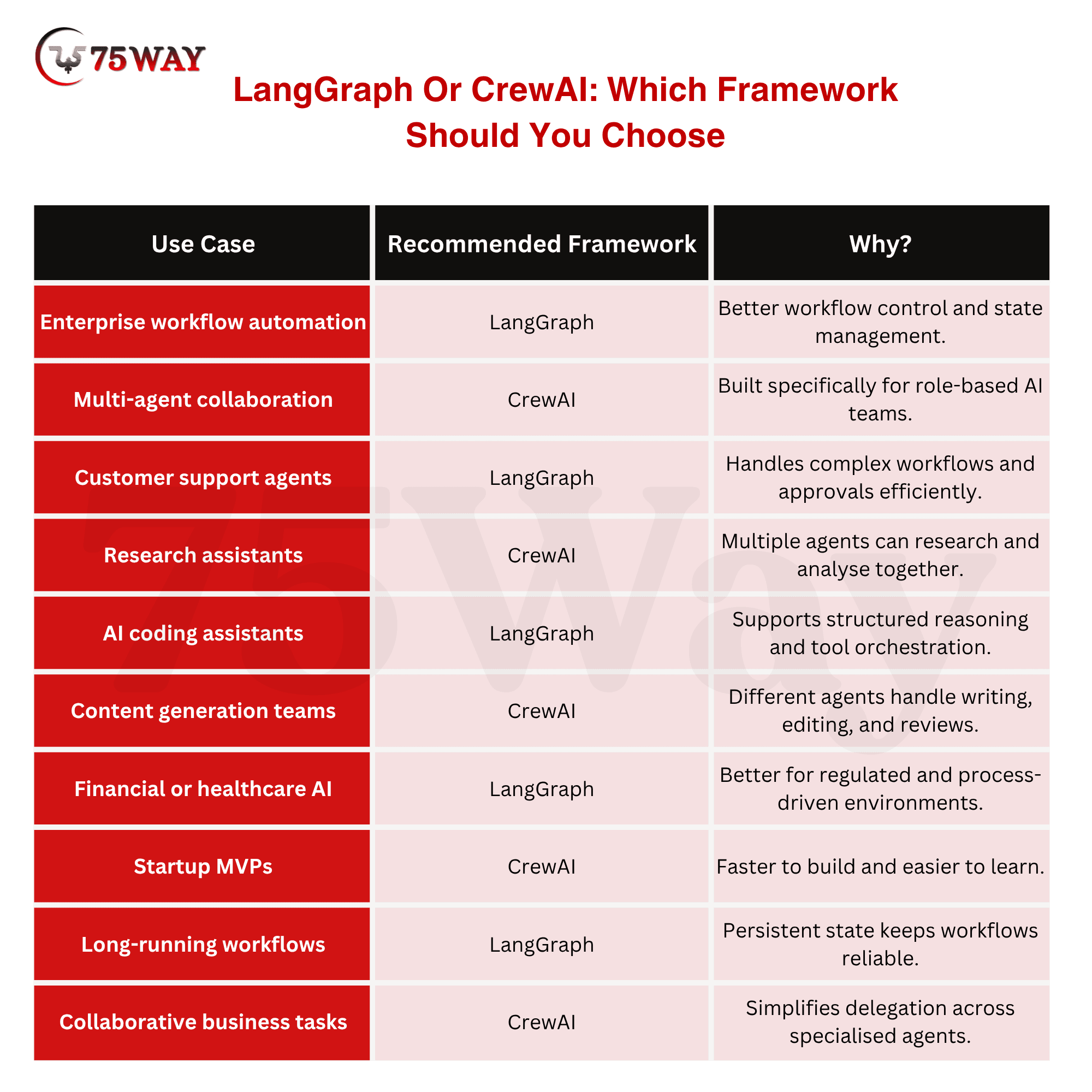
LangGraph Or CrewAI: Which Framework Should You Choose?
After comparing their features, it's clear that neither framework is universally better. The right choice depends on what you're building and how your AI agents are expected to work. If your priority is structured workflows with predictable execution, one framework stands out. If you're creating teams of AI agents that collaborate on tasks, the other is likely a better fit. Here's a quick breakdown based on common business scenarios.
Common Mistakes When Choosing Between LangGraph and CrewAI
Most of the teams run into problems because they evaluate tools based on trends instead of project requirements. Here are some common mistakes to avoid before starting AI agent development.
- Choosing the Most Popular Framework
It's easy to assume that the framework with more GitHub stars or social media buzz is automatically the better option. In reality, popularity doesn't guarantee the best fit for your project.
For example, LangGraph may be ideal for workflow-heavy enterprise applications, while CrewAI could be the smarter choice for collaborative AI teams. Focus on your business requirements instead of community hype.
- Ignoring Future Scalability
Many teams only think about their first AI agent. Six months later, they need additional workflows, integrations, and specialized agents.
Choosing a framework that can't support future growth often leads to expensive migrations and unnecessary redevelopment.
Tip: Pick a framework that fits your long-term AI roadmap, not just today's requirements.
- Overlooking Team Expertise
A powerful framework isn't always the right one if your development team struggles to use it effectively.
CrewAI's simpler learning curve can help smaller teams deliver projects faster. LangGraph offers greater flexibility but usually requires stronger workflow design experience.
Choose a framework your team can confidently build and maintain.
- Focusing Only on Features
Comparing feature lists rarely tells the whole story. Two frameworks may offer similar capabilities but solve problems in completely different ways.
Instead of asking, "Which framework has more features?" ask, "Which framework makes solving our business problem easier?"
That question usually leads to a better decision.
Forgetting Production Requirements
Many AI projects work well during testing but encounter challenges after deployment.
Before making a final decision, you must analyze some factors like monitoring, debugging, security, approvals, integrations, maintenance, and long-term support. These often have a bigger impact on project success than individual features.
Best Practices for Selecting an AI Agent Framework From LangGraph & CrewAI
There's no universal framework that works best for every project. The smartest teams evaluate their options against technical requirements, business goals, and long-term scalability before making a decision. Here are a few best practices to keep in mind.
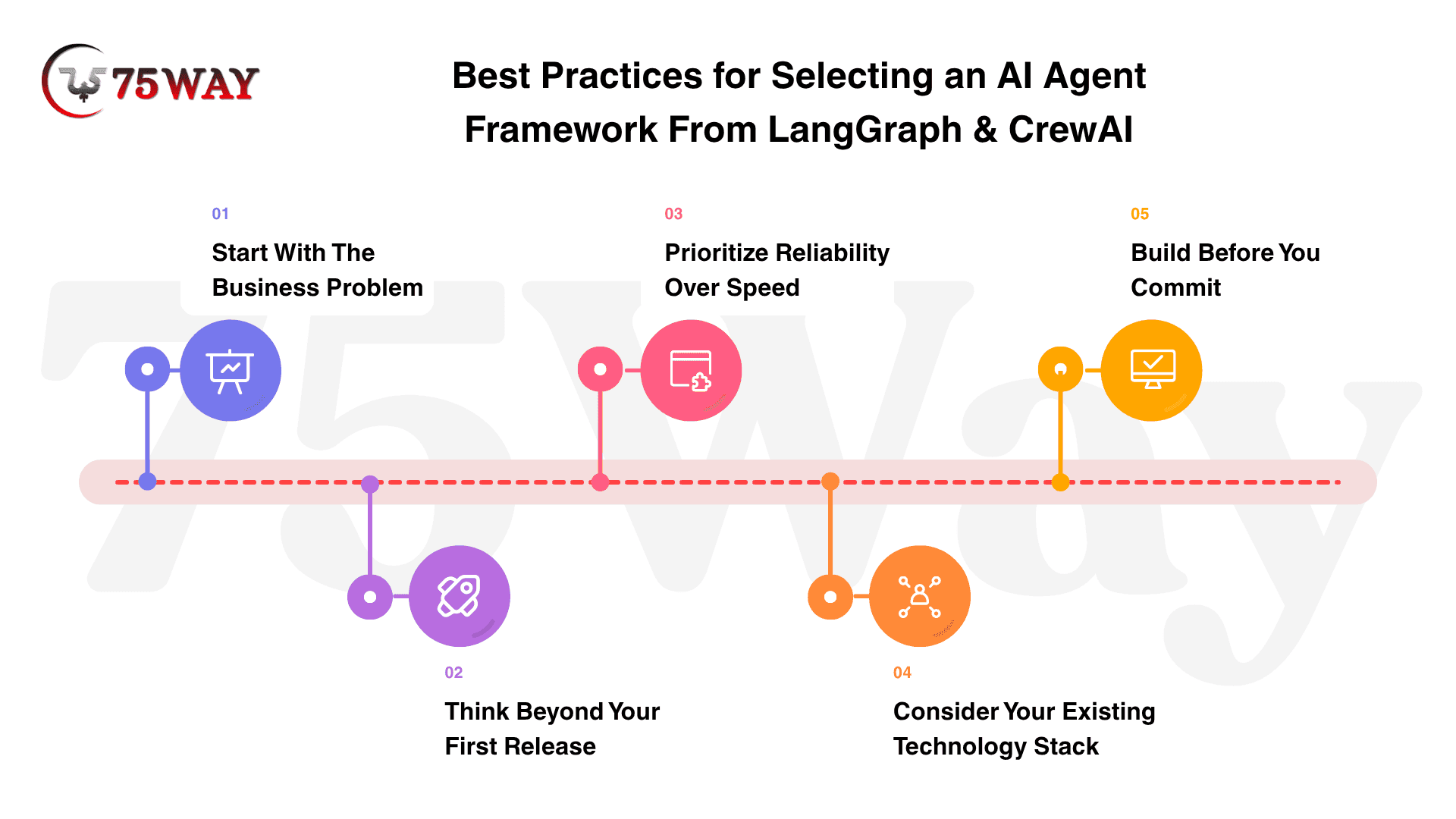
1. Start With the Business Problem
Don't choose a framework because it's trending. Define what your AI agent needs to accomplish first, then evaluate which framework supports those requirements.
2. Think Beyond Your First Release
Your AI application will likely evolve over time. New workflows, integrations, and agents are almost inevitable.
Selecting a framework that can grow with your business helps avoid costly migrations later.
3. Prioritize Reliability Over Speed
Launching quickly is important, but reliable AI systems deliver greater long-term value.
Choose a framework that supports monitoring, debugging, recovery, and maintainability instead of focusing only on rapid development.
4. Consider Your Existing Technology Stack
Think about how the framework will integrate with your APIs, databases, cloud services, and internal applications.
A framework that fits naturally into your existing infrastructure will usually reduce development time and ongoing maintenance.
5. Build Before You Commit
Whenever possible, create a small proof of concept using both frameworks.
Testing a real business workflow often reveals practical differences that feature comparisons alone can't capture.
Final Decision Checklist For LangGraph Vs CrewAI
Before selecting either framework, ask yourself these questions.
- Does it support my current use case?
- Will it scale with future AI projects?
- Can my team learn and maintain it comfortably?
- Does it integrate with existing business systems?
- Does it provide the level of control my workflows require?
- Will it remain a good choice two years from now?
If your answer is yes to these questions, you're far more likely to choose a framework that supports both your immediate project and your long-term AI strategy.
Real-World Examples: When LangGraph or CrewAI Makes More Sense
Sometimes, the easiest way to choose a framework is to picture it solving a real business problem. The following examples illustrate where each framework naturally fits based on its architecture and strengths.
Example 1: Automating Insurance Claims Processing
Imagine a global insurance provider like Allianz or State Farm building an AI-powered claims assistant. The system needs to verify customer information, analyze submitted documents, check policy coverage, identify missing details, request additional files, and escalate complex cases to human experts.
LangGraph is the better fit because insurance claims follow structured workflows with multiple decision points. Its state management and checkpoint capabilities allow the AI process to pause, resume, recover from errors, and maintain complete visibility throughout the claim journey.
Why it fits: Insurance operations require predictable execution, regulatory compliance, audit trails, and accurate decision tracking.
Example 2: Building an AI Marketing Team
Consider a technology company like HubSpot or Salesforce creating an AI-powered content marketing team. One AI agent researches market trends, another analyzes keywords, a third creates content drafts, and another reviews SEO performance before publishing.
CrewAI works naturally in this scenario because each agent can operate as a specialized team member with a specific responsibility. The research agent gathers insights, the writing agent creates content, and the review agent improves quality, similar to how human marketing departments collaborate.
Why it fits: Marketing workflows benefit from creativity, specialization, and collaboration rather than strict step-by-step execution.
Final Remarks
To conclude, LangGraph excels at structured workflows, advanced orchestration, and enterprise-grade reliability, while CrewAI shines in collaborative, role-based AI systems that prioritize speed and simplicity. Evaluate your workflow complexity, scalability goals, team expertise, and long-term business requirements before making a decision. The right foundation will help your AI agents perform reliably as your business grows. For secure AI solutions, partner with a reliable AI agent development firm that understands enterprise AI architectures.
Frequently Asked Questions
Can LangGraph And CrewAI work With Multiple AI Models?
Yes, both frameworks support integrations with different language models through APIs. This flexibility helps businesses choose models based on performance, pricing, and project requirements.
Which AI Agent Framework Is Easier To Learn For Beginners?
CrewAI generally has a shorter learning curve because of its role-based approach. LangGraph requires more workflow planning but offers greater flexibility for complex AI systems.
Can I Build Enterprise AI Applications With CrewAI?
Yes, CrewAI supports enterprise applications that rely on collaborative AI agents. Larger deployments may require additional governance, monitoring, and workflow management for long-term scalability.
Is LangGraph Only Suitable For Complex AI Projects?
No, LangGraph also works for smaller applications with structured workflows. Its advanced orchestration capabilities become increasingly valuable as projects grow in complexity.
How Important Is Workflow Orchestration In AI Agent Development?
Workflow orchestration keeps AI agents organized while managing decisions, tool usage, and execution paths. Strong orchestration improves reliability, especially in production environments with complex business processes.
Can These Frameworks Integrate With Third-Party Business Tools?
Yes, both frameworks connect with APIs, databases, cloud platforms, and enterprise software. Integration capabilities allow AI agents to automate workflows beyond simple conversational tasks.
Do LangGraph and CrewAI Support Human Approvals During Workflows?
Yes, human oversight can be incorporated into AI workflows when needed. Approval stages are particularly valuable for regulated industries and high-impact business decisions.
Should Startups Choose LangGraph or CrewAI First?
Startups often prefer CrewAI for faster prototyping and easier onboarding. LangGraph becomes a stronger choice when products require advanced workflow orchestration and enterprise scalability.