AI Summary
Modern AI agents require reliable frameworks. Learn how to choose the best AI agent framework for your business. Explore framework comparisons, production architecture, implementation strategies, security considerations, and expert recommendations for building intelligent AI agents that scale.
Key Takeaways
- Compare leading AI agent frameworks before building autonomous enterprise systems.
- Match framework capabilities with business goals, complexity, and deployment requirements.
- Production AI agents require memory, planning, orchestration, and monitoring capabilities.
- Framework selection directly impacts scalability, performance, and long-term success.
- Enterprise AI projects succeed through strategic framework evaluation and governance.
Everyone wants to build an AI agent these days. The harder question is this: can it actually work outside a demo? An agent that plans tasks, remembers context, calls tools, and handles unexpected situations needs far more than a powerful language model. It needs the right framework underneath.
That is where AI agent frameworks make the difference. While building an AI agent, these frameworks provide the architecture for orchestrating workflows, managing memory, integrating external tools, and enabling autonomous decision-making without building everything from scratch.
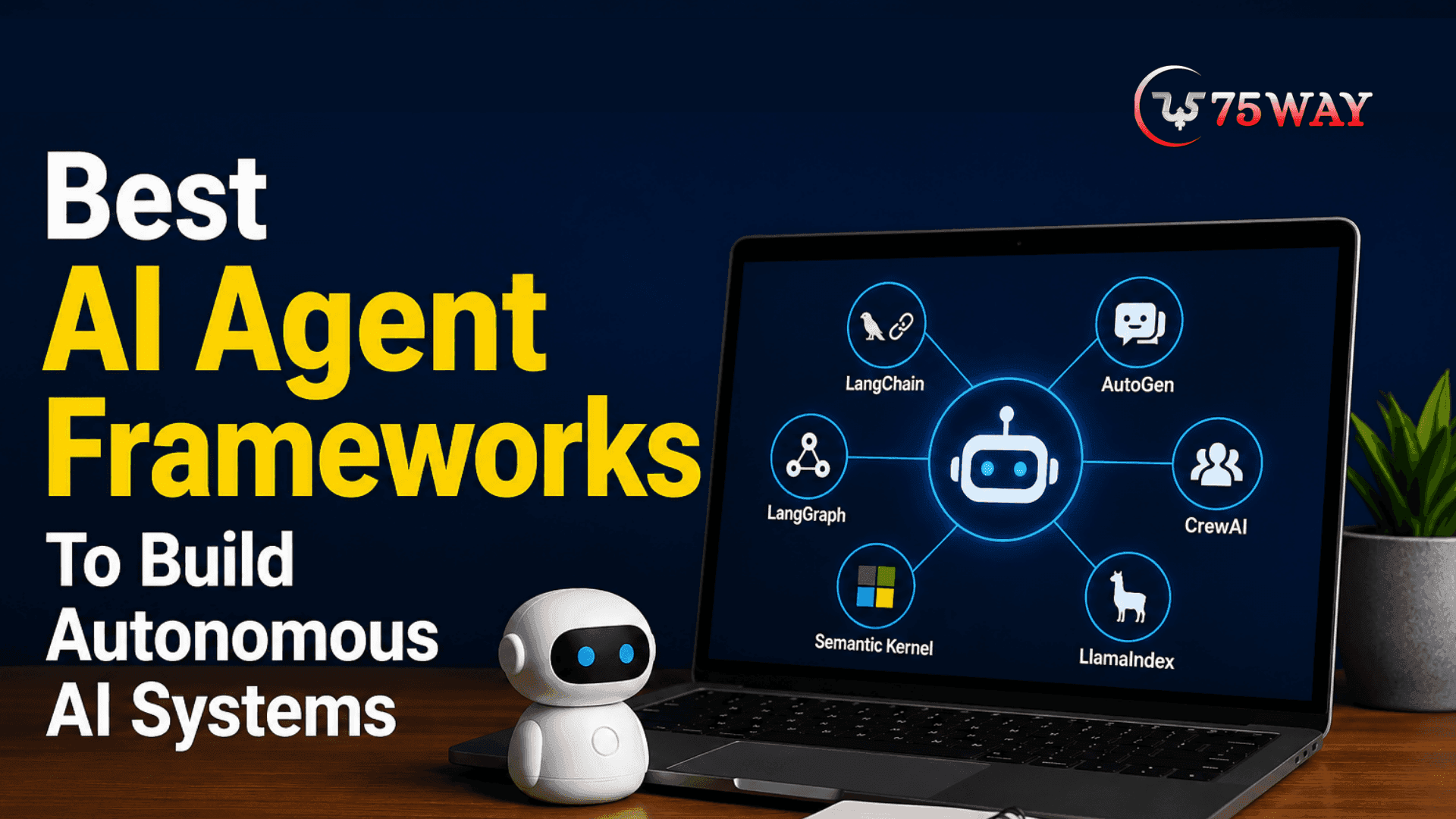
If you're planning to develop a production-ready autonomous AI system, choosing the right framework is one of the most important technical decisions you'll make. This guide compares the best AI agent frameworks, explains where each one excels, and helps you identify the right fit for your use case in 2026.
What Is an AI Agent Framework?
If you've ever tried building an AI agent from scratch, you quickly realize the language model is only one piece of the puzzle. The bigger challenge is coordinating how the agent thinks, remembers previous interactions, chooses the right tools, and completes tasks without constant human guidance. That's exactly where an AI agent framework comes in.
An AI agent framework is a development platform that provides the structure needed to create intelligent, autonomous software agents. Instead of writing custom logic for every workflow, developers use these frameworks to orchestrate reasoning, memory, planning, tool usage, communication, and execution within a unified architecture.
Imagine asking an AI agent to research competitors, summarize findings, update a CRM, send a report to Slack, and schedule a follow-up meeting. Completing that request requires much more than generating text.
The agent must break the request into smaller tasks, determine the correct execution order, access multiple applications, verify responses, recover from errors if something fails, and remember relevant information throughout the workflow. An AI agent framework manages all of these moving parts behind the scenes.
Why AI Agent Frameworks Matter More Than the AI Model?
Many organizations spend weeks comparing large language models but only a few hours evaluating the framework that will manage those models. In practice, that decision often has a greater impact on long-term success.
Two companies can use the same language model and achieve dramatically different outcomes. One builds an AI agent that consistently completes complex workflows, handles unexpected situations gracefully, and scales across departments.
The other struggles with repeated failures, inconsistent responses, and growing maintenance costs. The difference usually isn't the model. It's the architecture surrounding it.
An AI agent framework determines how information flows through the system, how decisions are made, how memory is stored, when tools are invoked, and how failures are handled. These operational capabilities directly influence reliability, response quality, execution speed, and user trust.
For example, if an external API temporarily becomes unavailable, a production-ready framework can retry requests, switch to an alternative workflow, log the failure for investigation, and continue processing without disrupting the entire task. Without these safeguards, even a highly capable language model may abandon the workflow or produce incomplete results.
The framework also becomes increasingly valuable as AI initiatives grow. What begins as a single customer support assistant often expands into multiple specialized agents handling sales, operations, finance, analytics, and internal knowledge management. Coordinating these agents efficiently requires orchestration capabilities that extend far beyond prompt engineering.
Simply put, language models generate intelligence, while AI agent frameworks transform that intelligence into dependable business systems.
How AI Agent Frameworks Work?
Think of an AI agent framework as the operating system behind an AI employee. Instead of simply answering one question, it helps an AI understand a goal, create a plan, use the right tools, remember important information, make decisions, and keep working until the job is complete. Here's how the process typically works:
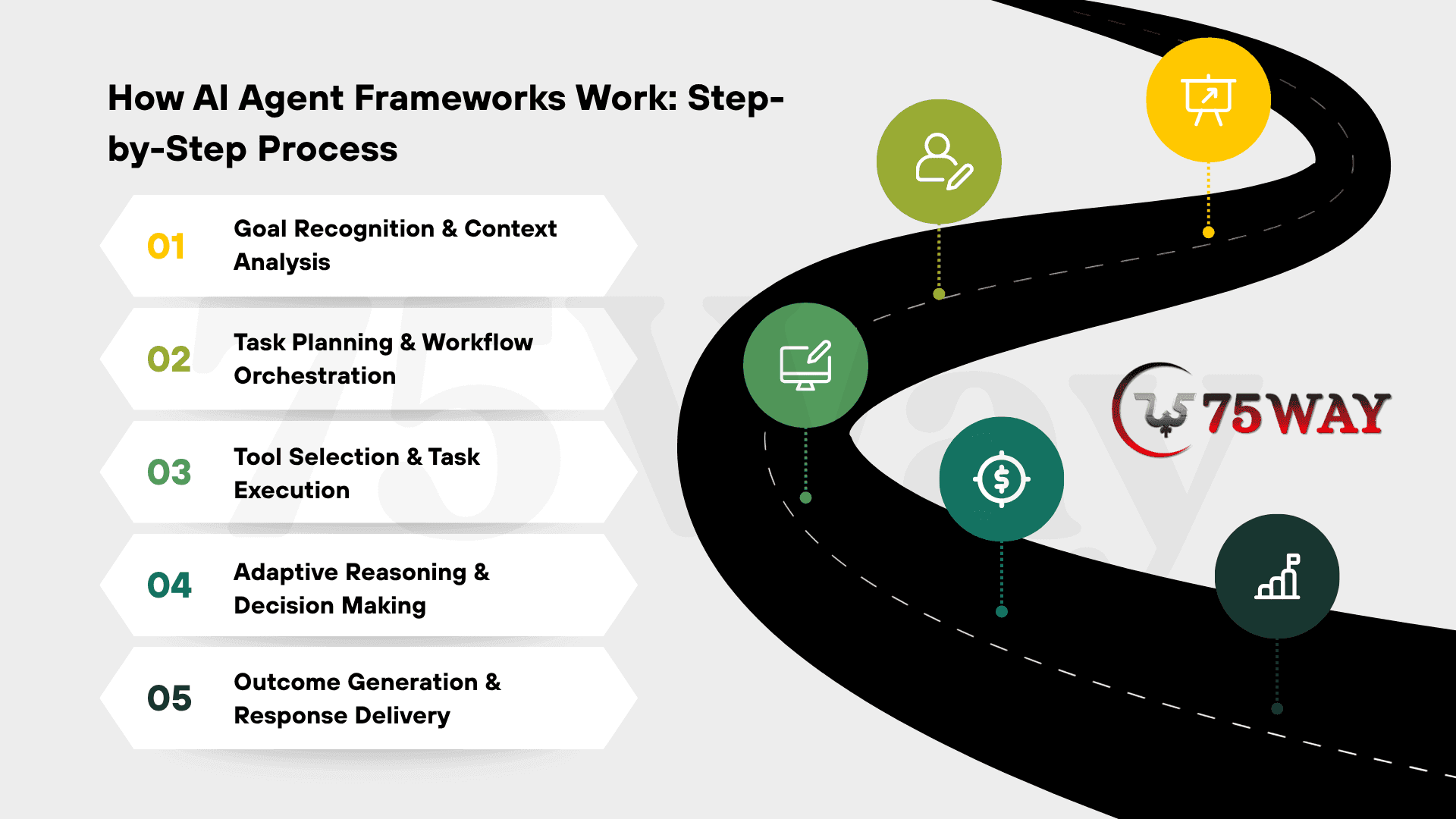
Phase 1: Goal Recognition & Context Analysis
Everything starts with a request. You give the AI a task, such as "Analyze our competitors and create a marketing strategy." Rather than jumping straight to an answer, the framework first interprets what you're asking, identifies the objective, understands the context, and determines what success should look like.
Phase 2: Task Planning & Workflow Orchestration
Instead of trying to solve everything at once, the framework creates a step-by-step action plan. It decides what needs to happen first, what depends on previous results, and which tasks can run simultaneously. This structured planning helps the AI handle complex workflows more accurately.
Phase 3: Tool Selection & Task Execution
Now the agent gets to work. Depending on the task, it may search the web, access databases, call APIs, read documents, execute code, or interact with other business applications. The framework manages these tool integrations so the AI can gather reliable information instead of relying only on its trained knowledge.
Phase 4: Adaptive Reasoning & Decision Making
As new information comes in, the AI continuously evaluates its progress. If something doesn't work, the framework allows it to revise the plan, correct mistakes, ask follow-up questions when needed, or explore alternative approaches. This ability to adapt makes AI agents far more capable than traditional chatbots.
Phase 5: Outcome Generation & Response Delivery
Once every step is completed, the framework combines all the collected information into a clear, accurate result. Whether that's a report, software code, customer response, business recommendation, or completed workflow, the AI delivers an output that's based on reasoning rather than a single generated response.
Types of AI Agent Frameworks and Their Best Use Cases
Not every AI agent framework is built to solve the same problem. Some are designed to automate repetitive business workflows, while others coordinate teams of AI agents or support enterprise-scale deployments. These categories help you to identify which framework actually fits your business goals instead of simply choosing the most popular option.
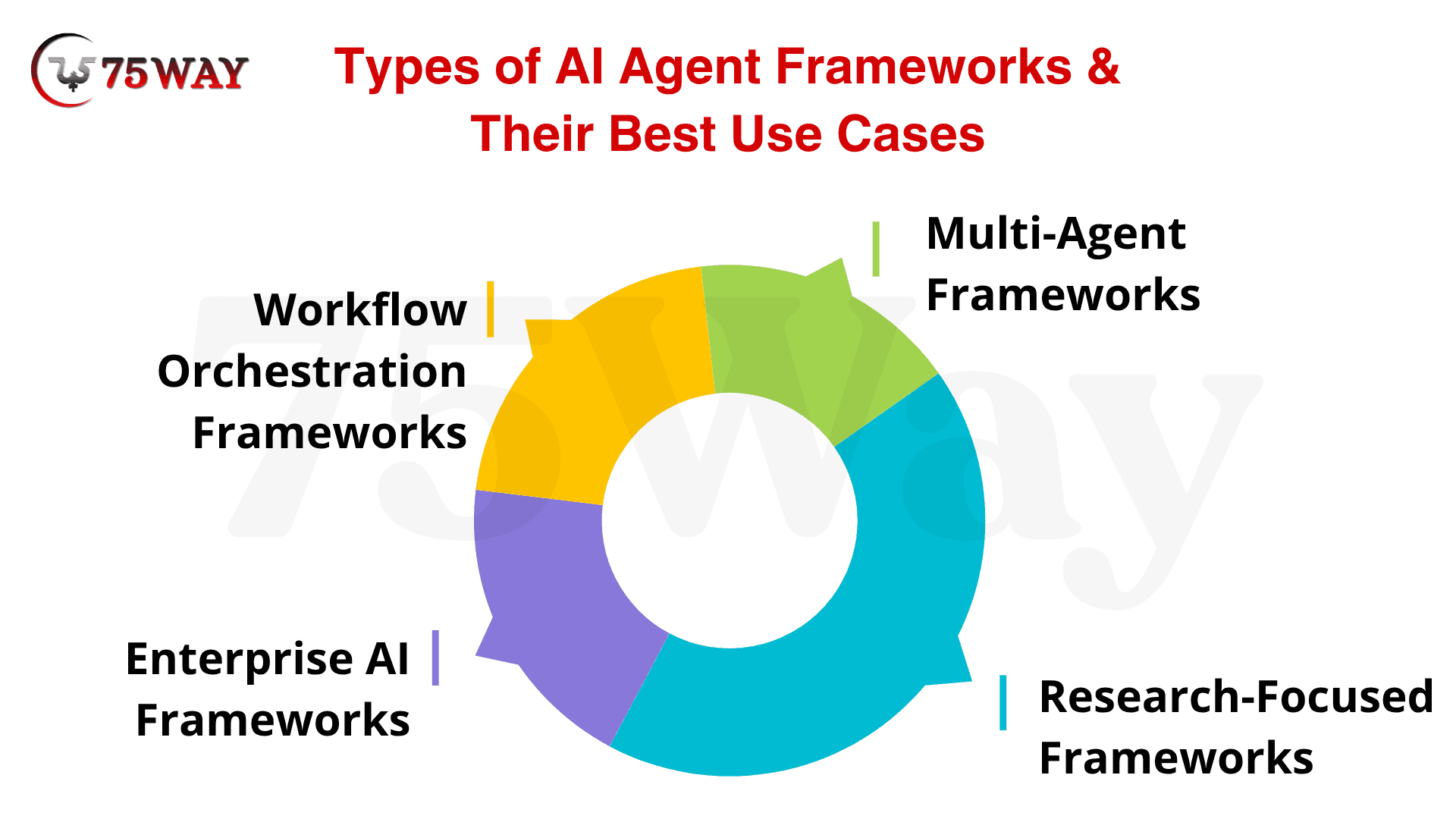
1. Workflow Orchestration Frameworks
Imagine giving an AI a complex assignment with dozens of moving parts. Instead of figuring everything out on its own, a workflow orchestration framework creates a clear roadmap, deciding what should happen first, what comes next, and how every step connects.
That's why businesses rely on these frameworks for customer support automation, document processing, approvals, and other structured processes where consistency is critical.
2. Multi-Agent Frameworks
Why assign one AI to do everything when several specialized agents can work together? Multi-agent frameworks create a collaborative team where each agent has a dedicated role: one researches, another analyses, another writes, and another reviews the final output.
By dividing responsibilities, organizations can tackle software engineering, financial analysis, research, and operational planning faster and with greater accuracy.
3. Enterprise AI Frameworks
As AI adoption grows, businesses need more than powerful models. They need control. Enterprise AI frameworks are built with governance, security, compliance, and scalability at their core.
They integrate with existing business systems, manage user permissions, maintain audit trails, and support organization-wide deployments, making them the preferred choice for companies operating in regulated or large-scale environments.
4. Research-Focused Frameworks
Innovation starts with experimentation, and that's exactly where research-focused frameworks shine. They give developers the flexibility to test new reasoning techniques, explore advanced agent behaviours, and prototype ideas quickly without being limited by production requirements.
While they're excellent for learning and innovation, most still require additional engineering before they're ready for enterprise deployment.
The right framework category first simplifies every decision that follows. Once you know the type of problem you're solving, comparing individual platforms becomes far more meaningful because you're evaluating the right capabilities instead of following industry hype.
Best AI Agent Frameworks at a Glance: Complete Comparison 2026
10 Leading AI Agent Frameworks to Build Autonomous AI Systems
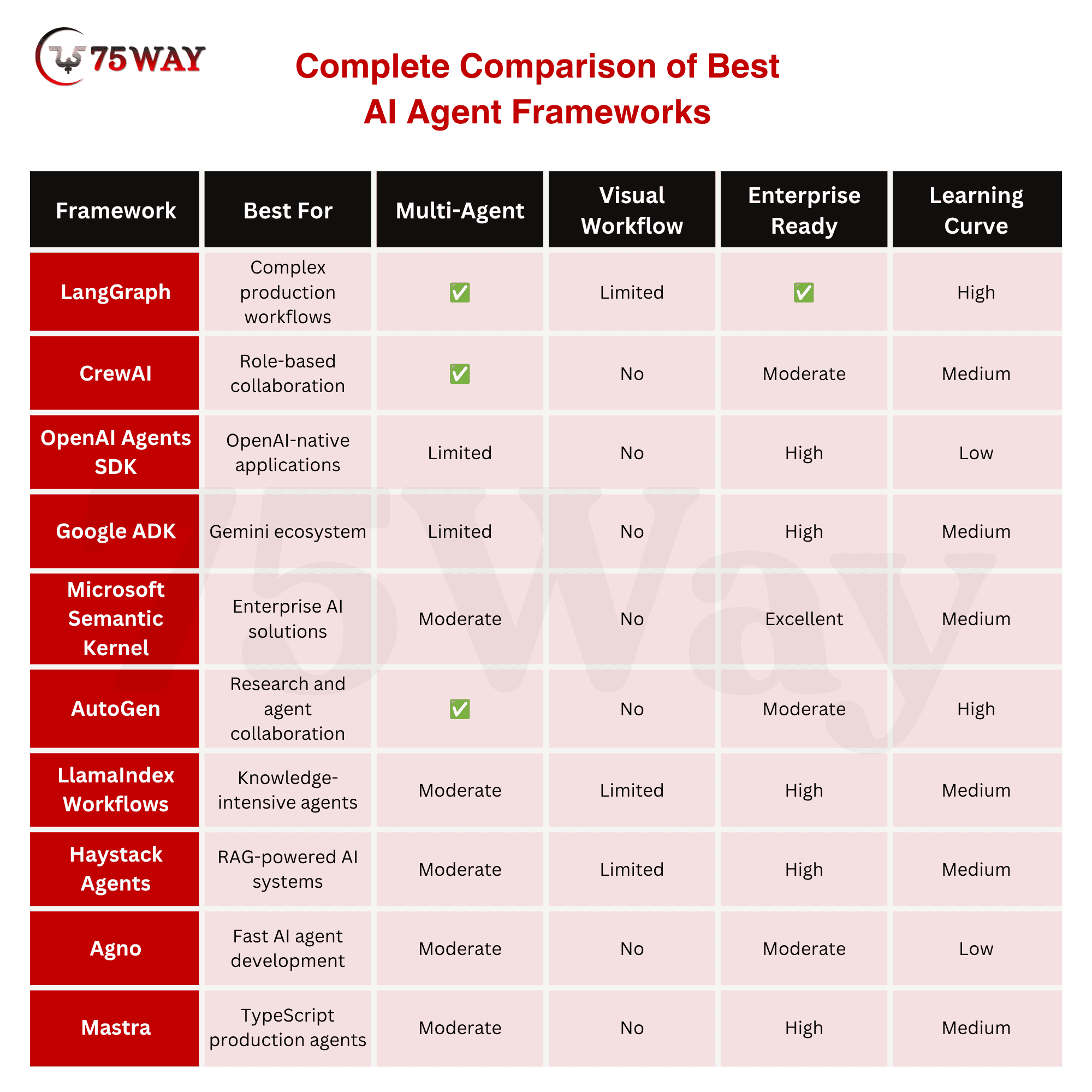
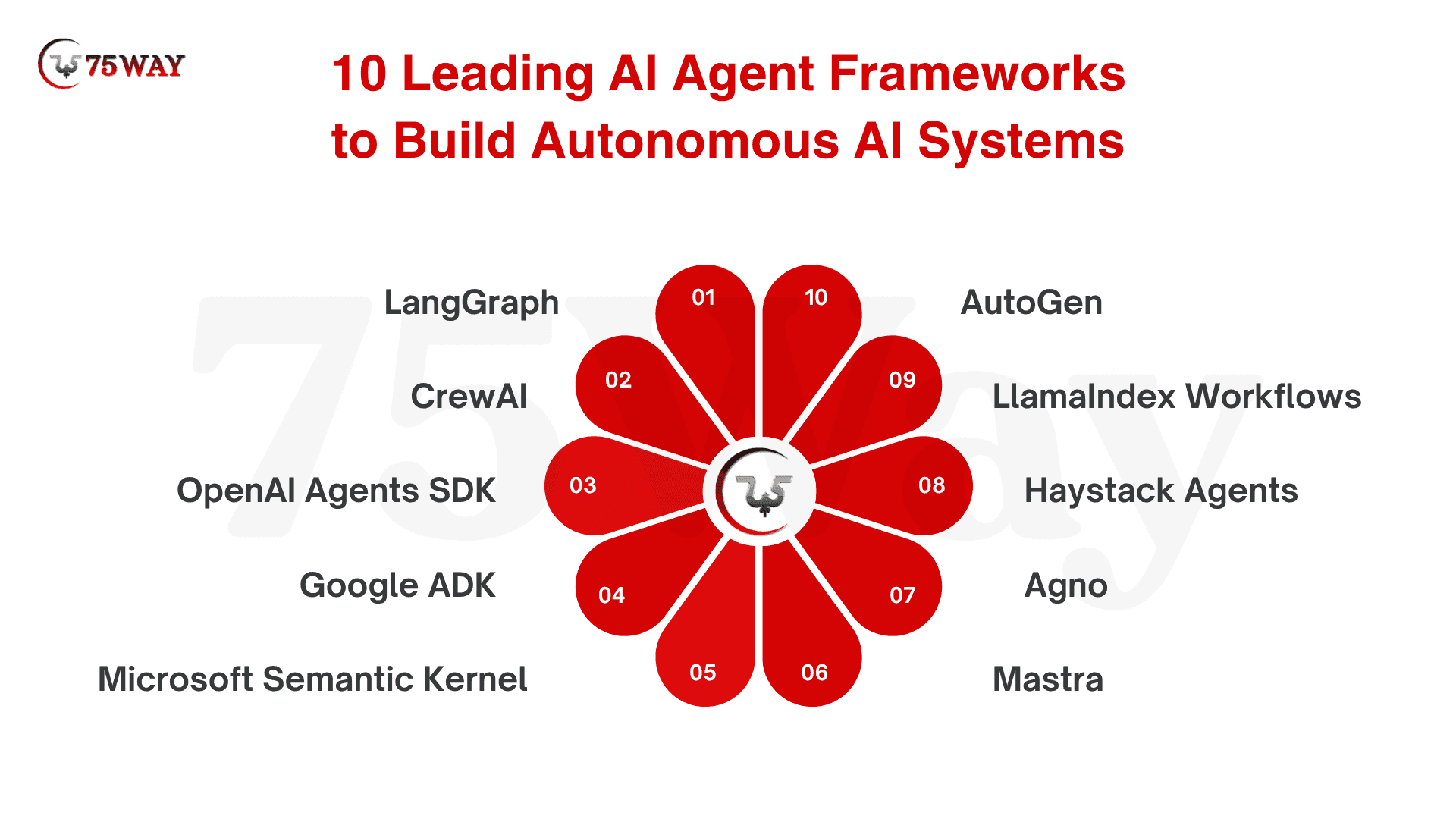
Every AI agent framework offers a different approach to orchestration, memory, reasoning, and tool integration. The comparison below features 10 leading frameworks that developers and enterprises rely on to build autonomous AI systems with confidence.
1. LangGraph
When engineering teams need fine-grained control over how AI agents reason, make decisions, and recover from failures, LangGraph has become one of the most trusted frameworks for production deployments.
Built by the creators of LangChain, it introduces a graph-based architecture that gives developers complete control over every stage of an agent's execution.
Instead of forcing AI agents through rigid linear workflows, LangGraph models applications as interconnected nodes and transitions. Each node represents a specific action, such as retrieving data, calling an API, validating information, or generating responses. The framework determines how agents move between these states, enabling sophisticated decision-making that adapts to changing conditions.
This architecture makes LangGraph particularly effective for applications where reliability matters more than speed. Enterprise customer support systems, financial assistants, healthcare automation, legal research platforms, and software engineering agents often require workflows that pause for approvals, recover from failures, revisit earlier decisions, or execute parallel tasks. LangGraph handles these scenarios naturally.
Another major strength is persistent state management. Instead of losing context after every interaction, AI agents can resume complex workflows even after interruptions, making long-running business processes significantly more dependable.
Key Features
- Graph-based workflow orchestration
- Persistent execution state
- Human-in-the-loop approvals
- Long-running workflow support
- Advanced memory integration
- Flexible tool orchestration
- Checkpoint recovery
- Fine-grained execution control
Best For: Engineering teams building enterprise AI applications that require dependable multi-step workflows, complex orchestration, and production-grade reliability.
Advantages of LangGraph
- Exceptional workflow flexibility
- Highly scalable architecture
- Strong ecosystem support
- Excellent production reliability
- Supports sophisticated agent reasoning
Limitations of LangGraph
- Steeper learning curve than simpler frameworks
- Requires architectural planning before development
- May be excessive for straightforward automation tasks
2. CrewAI
Not every AI project requires intricate workflow graphs. Many business problems are easier to solve by assigning specialized responsibilities to multiple AI agents working together as a coordinated team. That's exactly where CrewAI excels.
CrewAI approaches AI development from an organizational perspective. Instead of building one all-purpose assistant, developers create multiple agents, each with a clearly defined role, expertise, objectives, and responsibilities. These agents collaborate to complete larger business processes, much like departments within an organization.
For example, a market research workflow could involve one agent gathering industry data, another analyzing competitors, a third writing executive summaries, and a fourth reviewing quality before delivering the final report. Each agent focuses on its specialty while the framework manages collaboration.
This role-based architecture improves task quality because every agent operates within a narrower domain of expertise rather than attempting to perform every responsibility simultaneously.
CrewAI has gained widespread adoption among startups, consulting firms, product teams, and AI solution providers because it simplifies multi-agent collaboration without requiring extensive infrastructure engineering.
Key Features of CrewAI
- Role-based AI collaboration
- Multi-agent task delegation
- Shared memory support
- Sequential and hierarchical workflows
- Tool integration capabilities
- Modular architecture
- Lightweight implementation
- Developer-friendly APIs
Best For:Collaborative AI assistants, research automation, content operations, business intelligence systems, and workflow automation requiring multiple specialized agents.
Advantages of CrewAI
- Easy to learn and implement
- Excellent multi-agent collaboration
- Rapid development cycles
- Flexible task delegation
- Strong community adoption
Limitations of CrewAI
- Less control over execution than graph-based frameworks
- Limited enterprise governance capabilities
- Large-scale orchestration may require additional customization
Why LangGraph and CrewAI Often Lead Enterprise Evaluations
Although dozens of AI agent frameworks are available today, LangGraph and CrewAI consistently appear in enterprise evaluations because they solve different problems exceptionally well rather than trying to solve every problem. The difference between LangGraph and CrewAI is:
LangGraph focuses on workflow reliability, orchestration, and production resilience, making it a strong choice for complex enterprise systems where execution accuracy and recoverability are critical.
CrewAI focuses on intelligent collaboration between specialized AI agents, making it particularly attractive for organizations designing AI-powered digital workforces that divide responsibilities across multiple autonomous agents.
This distinction prevents one of the most common mistakes engineering teams make: selecting a framework based solely on popularity instead of matching it to the intended architecture.
3. OpenAI Agents SDK
As AI agents become more capable, developers need a reliable way to build applications that can reason through tasks, call tools, and hand work off between specialized agents without writing excessive orchestration code. The OpenAI Agents SDK was designed to simplify exactly that.
Unlike general-purpose orchestration frameworks, the OpenAI Agents SDK focuses on creating intelligent agents within the OpenAI ecosystem. It provides a structured way to define agents, connect them with tools, manage conversations, and coordinate handoffs while taking advantage of OpenAI's latest models and built-in capabilities.
One of its biggest strengths is simplicity. Developers familiar with the OpenAI API can begin building production-grade AI agents without learning an entirely new orchestration paradigm. Instead of assembling multiple third-party components, the SDK provides a cohesive development experience for creating assistants that interact with users, execute tasks, and integrate with business applications.
This makes the SDK especially attractive for startups and software teams that primarily rely on OpenAI models and want to move from proof of concept to production quickly. However, organizations requiring extensive multi-agent orchestration or vendor-independent architectures may eventually outgrow its ecosystem-focused design.
Key Features of OpenAI Agents SDK
- Native OpenAI integration
- Built-in agent handoffs
- Tool calling support
- Structured conversation management
- Safety guardrails
- Streaming responses
- Developer-friendly APIs
- Production-ready architecture
Best For: To build AI applications primarily around OpenAI models and looking for a streamlined development experience with minimal infrastructure overhead.
Advantages of OpenAI Agents SDK
- Fast implementation
- Excellent documentation
- Seamless OpenAI integration
- Clean developer experience
- Reduced orchestration complexity
Limitations of OpenAI Agents SDK
- Optimized primarily for the OpenAI ecosystem
- Less flexible than vendor-neutral frameworks
- Limited advanced workflow orchestration compared to graph-based architectures
4. Google Agent Development Kit (ADK)
Organizations already investing in Google's AI ecosystem often look for tighter integration between their AI agents, Gemini models, cloud infrastructure, and enterprise services. Google Agent Development Kit (ADK) addresses that need by providing a framework designed specifically for building intelligent agents within the Google ecosystem.
Rather than functioning as a standalone orchestration engine, ADK acts as a foundation for creating AI agents that interact naturally with Google's models, cloud services, and enterprise development tools. This reduces integration effort while giving developers access to Google's rapidly evolving AI capabilities.
One area where ADK stands out is enterprise scalability. Businesses already using Google Cloud can build AI agents that connect with internal data, automate business workflows, and leverage existing cloud infrastructure without introducing unnecessary architectural complexity.
As Google's agent ecosystem continues to mature, ADK becomes the top choice among enterprises standardizing on Gemini-powered applications.
Key Features of Google Agent Development Kit (ADK)
- Native Gemini integration
- Google Cloud connectivity
- Enterprise deployment support
- Tool orchestration
- Workflow automation
- Security integration
- Scalable cloud architecture
- Developer APIs
Best For: Enterprise AI solutions within the Google Cloud ecosystem and leveraging Gemini models across business operations.
Advantages of Google Agent Development Kit (ADK)
- Excellent Google Cloud integration
- Enterprise-focused architecture
- Strong scalability
- Secure deployment capabilities
- Growing ecosystem
Disadvantages of Google Agent Development Kit (ADK)
- Best suited for Google-centric environments
- Smaller community than some open-source frameworks
- Ecosystem still evolving rapidly
5. Microsoft Semantic Kernel
While many AI agent frameworks prioritize experimentation, Microsoft Semantic Kernel takes a different approach by emphasizing enterprise software engineering, governance, and seamless integration with existing business systems.
Rather than treating AI as an isolated capability, Semantic Kernel allows organizations to combine traditional application logic with AI-powered reasoning inside the same architecture. Developers can orchestrate prompts, business rules, APIs, plugins, and enterprise workflows without abandoning established software development practices.
This hybrid design makes Semantic Kernel particularly appealing for organizations modernizing existing enterprise applications instead of building entirely new AI products from scratch.
Another major advantage is Microsoft's enterprise ecosystem. Businesses using Azure, Microsoft 365, Dynamics, or GitHub can integrate AI agents into familiar infrastructure while maintaining governance, authentication, and security standards expected in large organizations.
Key Features of Microsoft Semantic Kernel
- AI orchestration with traditional code
- Plugin architecture
- Enterprise workflow integration
- Azure AI compatibility
- Memory management
- Planning capabilities
- Cross-language SDKs
- Enterprise security
Best For: To integrate AI into existing enterprise applications while maintaining governance, compliance, and software engineering best practices.
Pros of Microsoft Semantic Kernel
- Strong enterprise architecture
- Excellent Microsoft ecosystem integration
- Flexible plugin model
- Mature security capabilities
- Long-term maintainability
Cons of Microsoft Semantic Kernel
- More enterprise-oriented than startup-friendly
- Requires familiarity with Microsoft's development ecosystem
- Advanced implementations may involve additional architectural complexity
6. AutoGen
Some AI applications benefit from multiple agents discussing ideas, reviewing each other's work, and refining solutions before producing a final answer. AutoGen was built specifically for this collaborative style of AI problem-solving.
Instead of assigning every responsibility to one agent, AutoGen enables several specialized agents to communicate with each other until they complete a shared objective. One agent might write code, another tests it, while a third reviews quality and identifies improvements.
This conversational collaboration makes AutoGen especially valuable for research, software engineering, data analysis, and complex reasoning tasks where multiple perspectives improve overall outcomes.
However, organizations should remember that increased collaboration often introduces additional computational cost and longer execution times. Multi-agent conversations are powerful but require thoughtful orchestration to remain efficient in production environments.
Key Features of AutoGen
- Multi-agent conversations
- Collaborative reasoning
- Human-agent interaction
- Code generation workflows
- Flexible orchestration
- Tool integration
- Extensible architecture
- Research-friendly design
Best For: To experiment with collaborative AI systems, autonomous coding assistants, research workflows, and advanced reasoning applications.
Benefits of AutoGen
- Powerful collaborative capabilities
- Excellent for experimentation
- Flexible architecture
- Strong academic adoption
- Supports sophisticated reasoning
Limitations of AutoGen
- Higher infrastructure costs
- Increased execution complexity
- Requires optimization before enterprise-scale deployment
7. LlamaIndex Workflows
Many enterprise AI projects revolve around one challenge: helping AI agents retrieve, understand, and act on proprietary business knowledge. LlamaIndex Workflows addresses this challenge by combining workflow orchestration with advanced knowledge retrieval.
With this framework, AI agents can access documents, databases, internal knowledge bases, cloud storage, and vector indexes as they complete tasks. This significantly improves factual accuracy and reduces hallucinations when working with company-specific information.
For organizations building AI assistants that answer questions from internal documentation, legal contracts, technical manuals, financial records, or healthcare data, LlamaIndex Workflows provides a practical foundation for production-ready retrieval-augmented generation (RAG).
Key Features of LlamaIndex Workflows
- Knowledge retrieval
- Workflow orchestration
- Vector database integration
- Document indexing
- RAG pipelines
- Data connectors
- Context management
- Enterprise search support
Best For: To create knowledge assistants, enterprise search platforms, document intelligence solutions, and AI systems that depend on proprietary data.
Advantages of LlamaIndex Workflows
- Outstanding knowledge retrieval
- Excellent RAG support
- Broad data integrations
- Strong developer ecosystem
- Production-ready document processing
Disadvantages of LlamaIndex Workflows
- Focused primarily on knowledge-driven workflows
- Less comprehensive for complex multi-agent orchestration
- Large deployments require retrieval optimization
8. Haystack Agents
Many organizations are focused on one priority: delivering accurate answers from their own business data. Haystack Agents is designed with that objective in mind.
Originally built around search and retrieval, Haystack has evolved into a powerful framework for developing AI agents that combine reasoning with Retrieval-Augmented Generation (RAG). Instead of relying only on an LLM's training data, Haystack Agents can retrieve relevant information from knowledge bases, databases, document repositories, and enterprise search systems before generating a response.
This approach makes a significant difference in industries where factual accuracy is essential. Financial institutions, healthcare providers, legal firms, and enterprise support teams often need AI agents to reference company policies, contracts, product documentation, or compliance guidelines rather than generating answers from memory alone.
Another advantage is flexibility. Haystack integrates with multiple language models, vector databases, search engines, and cloud providers, making it an attractive choice for organizations that want vendor independence while building knowledge-intensive AI applications.
Key Features of Haystack Agents
- Retrieval-Augmented Generation (RAG)
- Enterprise document search
- Multi-model support
- Vector database integration
- Modular pipelines
- Tool orchestration
- Knowledge retrieval
- Flexible deployment options
Best For: Enterprise search platforms, document intelligence systems, customer support assistants, and AI applications that rely heavily on proprietary knowledge.
Pros of Haystack Agents
- Excellent retrieval capabilities
- Vendor-neutral architecture
- Strong enterprise integrations
- Reliable document processing
- Mature open-source ecosystem
Cons of Haystack Agents
- Less focused on advanced multi-agent orchestration
- Requires thoughtful retrieval pipeline design
- Large knowledge bases need optimization for maximum performance
9. Agno
Agno is designed to reduce development complexity while still providing the essential building blocks required for production AI agents. Developers can create intelligent assistants, connect external tools, integrate memory, and deploy applications without assembling a large collection of third-party libraries.
Its lightweight architecture makes it particularly appealing for teams that value developer productivity. Rather than spending weeks configuring infrastructure, engineers can focus on solving business problems and iterating on user experiences.
Although Agno continues to mature, its simplicity has made it increasingly popular among startups, SaaS companies, and product teams experimenting with agentic AI.
Key Features of Agno
- Lightweight architecture
- Fast agent development
- Tool integrations
- Memory support
- API connectivity
- Multi-model compatibility
- Simple deployment
- Developer-friendly design
Best For: Startups, SaaS companies, internal business tools, and engineering teams looking to build AI agents quickly without excessive infrastructure complexity.
Benefits of Agno
- Rapid implementation
- Easy learning curve
- Clean developer experience
- Flexible integrations
- Ideal for MVP development
Limitations of Agno
- Smaller ecosystem than established frameworks
- Fewer enterprise governance capabilities
- May require additional customization for highly complex deployments
10. Mastra
As TypeScript continues to dominate modern web application development, many engineering teams want an AI framework that fits naturally into their existing technology stack. Mastra addresses that need by providing a TypeScript-first approach to building production AI applications.
Instead of forcing developers to learn an entirely new ecosystem, Mastra embraces familiar JavaScript and TypeScript development patterns. This reduces onboarding time while enabling teams to build intelligent workflows, integrate APIs, manage memory, and deploy AI-powered applications using technologies they already know.
Mastra also emphasizes modular development. Components such as memory, workflows, tools, and integrations remain reusable across projects, making long-term maintenance significantly easier.
For organizations building customer-facing AI products with React, Next.js, Node.js, or similar technologies, Mastra provides a practical balance between flexibility and developer productivity.
Key Features of Mastra
- TypeScript-first architecture
- Modular workflows
- Tool integrations
- Memory management
- API orchestration
- Cloud deployment support
- Modern developer experience
- Reusable components
Best For: Creating AI-powered web applications using JavaScript and TypeScript technologies.
Advantages of Mastra
- Familiar development experience
- Excellent TypeScript support
- Rapid product development
- Modular architecture
- Strong productivity for web teams
Limitations of Mastra
- Newer ecosystem than mature frameworks
- Smaller community
- Enterprise adoption still expanding
Which AI Agent Framework Should You Choose For Your Enterprise AI Development?
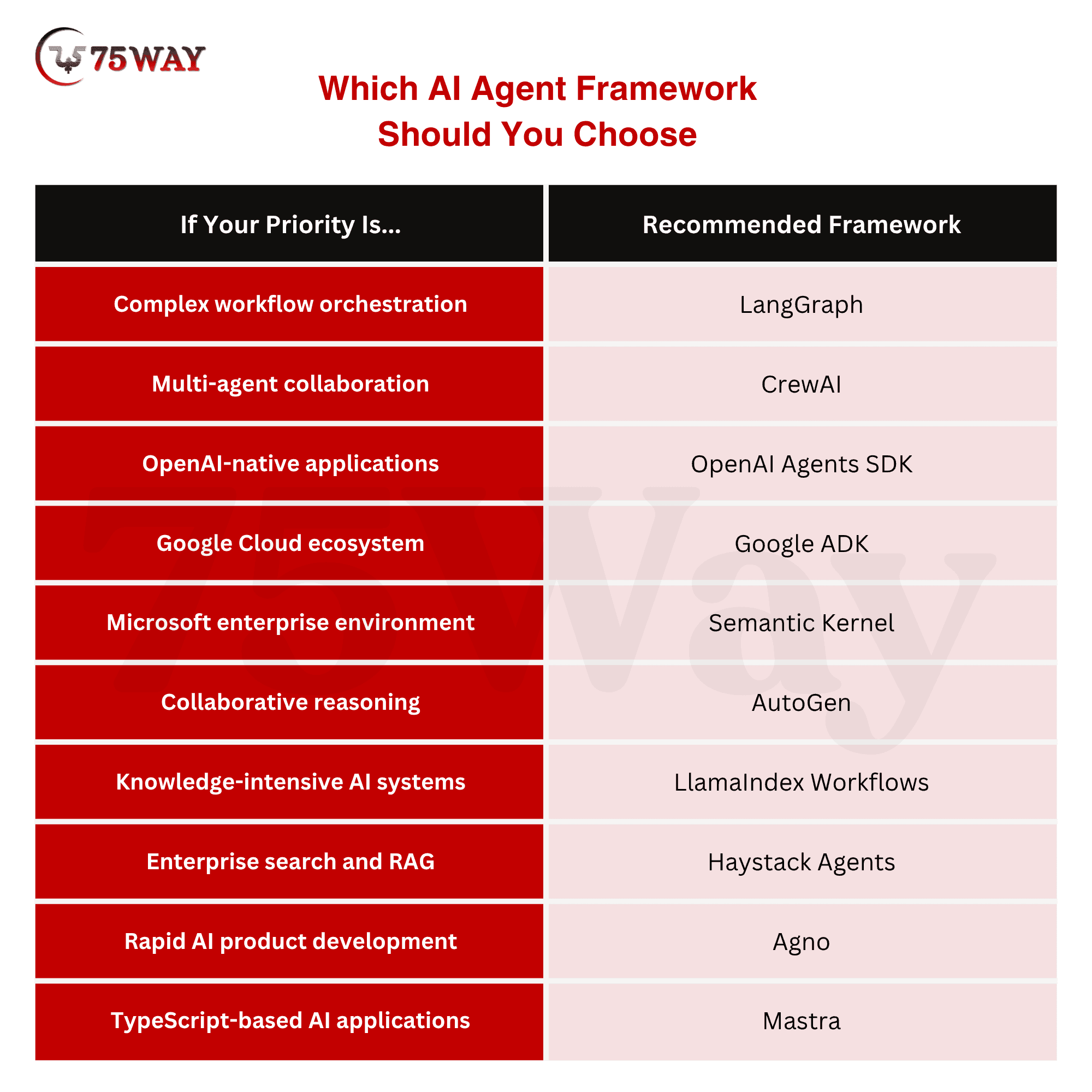
After comparing leading frameworks, one thing becomes clear: the best choice of AI agent framework to develop an enterprise AI system depends less on popularity and more on the problem you're trying to solve.
A startup building its first AI-powered product has very different requirements than a global enterprise automating mission-critical operations. Likewise, an engineering team creating a customer support AI assistant faces different challenges than one developing an AI coding assistant or a research automation platform.
Rather than asking which framework ranks highest on comparison lists, focus on which one aligns with your architecture, development resources, infrastructure, and long-term roadmap. The following decision matrix can help narrow your options.
AI Agent Frameworks Based on Your Business Use Case
Instead of starting with technology, start with the business problem you're solving. That approach almost always leads to a better architectural decision.
1. Customer Support Automation
Support agents must access knowledge bases, understand customer history, retrieve account information, and escalate conversations when necessary. Frameworks with strong retrieval, workflow orchestration, and tool integration capabilities typically perform best in these environments.
Recommended Choices: LangGraph, Haystack Agents, LlamaIndex Workflows
2. Enterprise Process Automation
Automating approvals, document processing, HR operations, finance workflows, or procurement often involves multiple business systems and clearly defined processes. These projects benefit from frameworks that provide reliable orchestration, checkpoints, and human approvals.
Recommended Choices: LangGraph, Microsoft Semantic Kernel, Google ADK
3. AI Research Assistants
Research assistants continuously gather information, evaluate sources, summarize findings, and collaborate across multiple reasoning steps. Multi-agent communication significantly improves performance for these workloads.
Recommended Choices: CrewAI, AutoGen
4. AI Coding Assistants
Software engineering agents must understand repositories, generate code, review pull requests, execute tools, and iterate based on feedback. Collaborative reasoning and workflow flexibility become especially important.
Recommended Choices: AutoGen, OpenAI Agents SDK, LangGraph
5. Knowledge Management Systems
Organizations with large volumes of internal documentation need AI agents capable of retrieving accurate information instead of relying solely on model memory.
Recommended Choices: LlamaIndex Workflows, Haystack Agents
6. Startup MVPs
Early-stage companies typically prioritize speed over architectural complexity. Lightweight frameworks enable teams to validate ideas quickly before investing in more sophisticated infrastructure.
Recommended Choices: Agno, OpenAI Agents SDK, Mastra
Agentic AI Framework Selection Checklist Before You Start Building
Before making your final decision, make sure your chosen framework can answer "yes" to most of these questions.
✔ Can it scale as additional AI agents are introduced?
✔ Does it support the language models your business plans to use?
✔ Can it integrate with your existing APIs, databases, and enterprise software?
✔ Does it provide sufficient monitoring, debugging, and observability?
✔ Can it recover gracefully from workflow failures?
✔ Does it support secure authentication and access controls?
✔ Will your engineering team be able to maintain it over the next three to five years?
If several answers are "no," it's worth reevaluating your choice before development begins. Selecting the right foundation early is far easier than migrating an entire AI platform after deployment.
How to Evaluate an AI Agent Framework Before Choosing One
Before committing to a framework, ask a simple question:
Can this platform support where your AI strategy will be two years from now, not just where it is today?
Many businesses begin with a single AI assistant. Within months, that assistant evolves into multiple specialized agents handling customer support, internal operations, software development, marketing, sales, and knowledge management.
Migrating to a different framework later can be expensive, time-consuming, and disruptive. Evaluating the right criteria upfront helps avoid costly architectural decisions.
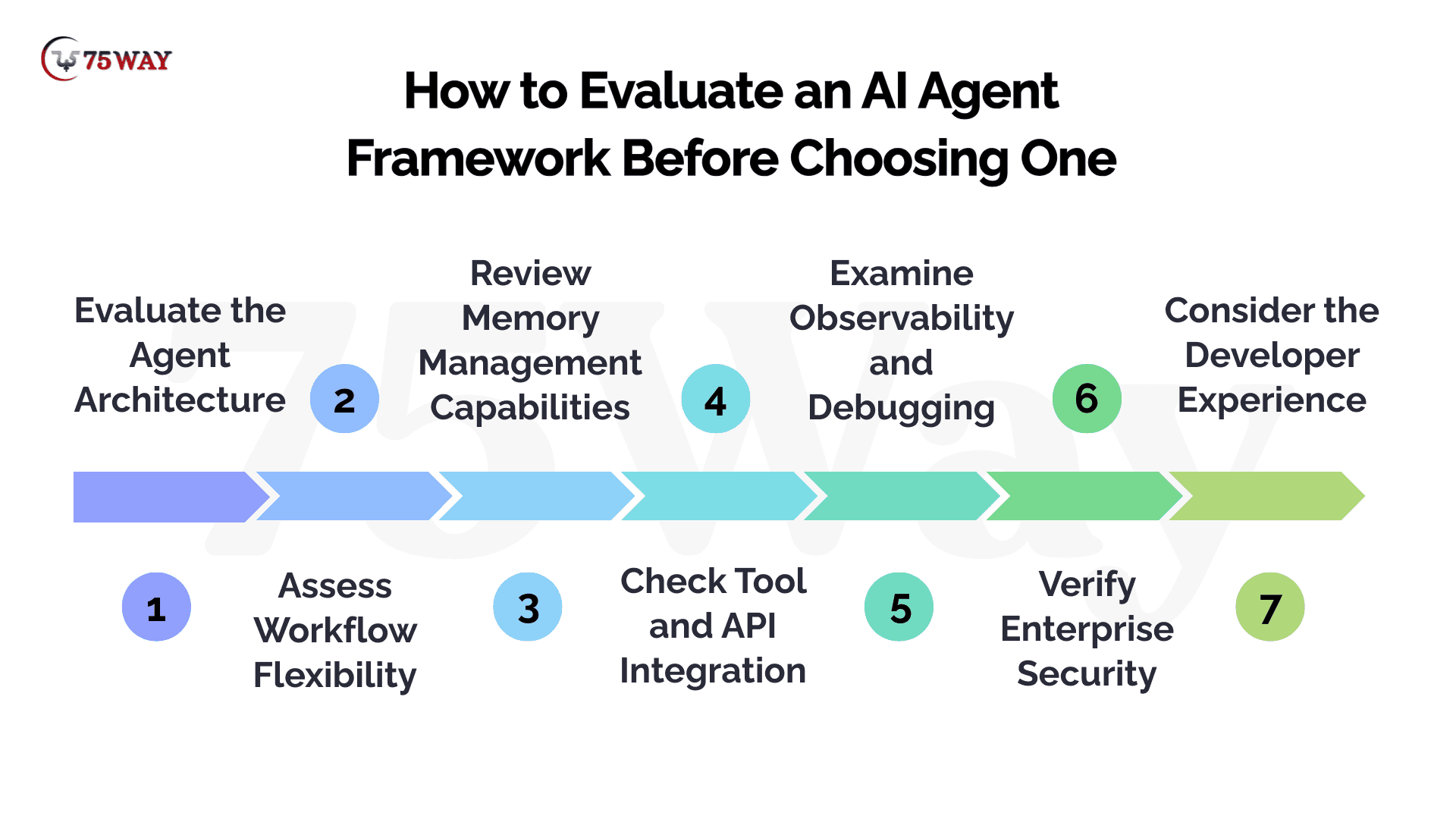
Instead of focusing only on features, consider these factors
- Evaluate the Agent Architecture
Some frameworks excel at single-agent workflows, while others are purpose-built for complex multi-agent collaboration. If your roadmap includes specialized AI agents working together, choose a framework that supports distributed orchestration rather than isolated conversations.
- Assess Workflow Flexibility
Business processes rarely follow a straight line. Look for frameworks that support branching logic, conditional execution, retries, checkpoints, and dynamic decision-making instead of rigid sequential workflows.
- Review Memory Management Capabilities
Persistent memory significantly improves user experience by allowing AI agents to retain relevant information across sessions. Evaluate whether the framework supports short-term context, long-term memory, retrieval mechanisms, and customizable memory strategies.
- Check Tool and API Integration
Production AI agents spend much of their time interacting with external systems rather than generating text. Native support for APIs, databases, cloud services, enterprise software, and Model Context Protocol (MCP) servers can dramatically reduce development effort.
- Examine Observability and Debugging
As AI systems become more sophisticated, troubleshooting grows increasingly difficult. Comprehensive logging, execution tracing, performance metrics, and debugging tools make diagnosing issues far easier during production deployments.
- Verify Enterprise Security
Organizations handling sensitive customer information should prioritize frameworks that support authentication, role-based access control, encryption, audit logging, compliance requirements, and secure credential management.
- Consider the Developer Experience
A framework with excellent documentation, active community support, reusable components, and intuitive APIs enables engineering teams to build and maintain AI agents more efficiently.
Evaluating these capabilities before writing production code leads to more reliable AI systems and reduces technical debt as projects scale.
Security and Governance Considerations For Selecting AI Agent Frameworks
As AI agents gain access to business systems, security becomes just as important as intelligence.
Unlike traditional chatbots, autonomous agents often retrieve confidential information, execute workflows, interact with external services, and make decisions affecting real business operations. Without proper governance, these capabilities introduce operational and compliance risks.
- The first priority should be access control. AI agents should only receive the permissions necessary to complete their assigned responsibilities.
Restricting unnecessary access reduces the impact of accidental actions or compromised credentials.
- Organizations should also implement authentication and authorization before allowing agents to interact with customer data, financial systems, internal applications, or cloud infrastructure.
Integrating with existing identity providers simplifies user management while maintaining consistent security policies.
- Every production deployment should include audit logging.
Recording prompts, tool usage, execution paths, and workflow outcomes helps engineering teams investigate issues, improve system behavior, and demonstrate compliance during security reviews.
- Data privacy deserves equal attention.
Sensitive customer information should be encrypted during transmission and storage, while retention policies should clearly define what information the agent remembers and for how long.
- Finally, maintain human oversight for high-impact decisions. Tasks involving legal approvals, financial transactions, healthcare recommendations, or regulatory compliance should include human review before execution.
AI agents can accelerate decision-making, but accountability should remain with qualified professionals.
Final Thoughts
The ideal framework should align with your business goals, support your architecture, scale with growing workloads, and simplify long-term maintenance. Rather than following trends, evaluate each option based on reliability, flexibility, integrations, and production readiness. As AI agents become central to enterprise operations, building on the right foundation will determine how successfully your solutions evolve. If you're planning to build secure, scalable, and production-ready AI agents, partnering with a prominent AI agent development company can accelerate delivery while reducing implementation risks.
Frequently Asked Questions
Can I Migrate From One AI Agent Framework To Another Later?
Yes, but migrations often require rebuilding workflows, integrations, memory systems, and orchestration logic. Choosing the right framework initially minimizes future engineering effort, costs, and operational disruptions.
Do AI Agent Frameworks Support On-Premises Deployments?
Many enterprise-focused frameworks support on-premises, private cloud, and hybrid deployments for organizations with strict security requirements. Deployment flexibility depends on the framework's architecture and infrastructure compatibility.
How Long Does It Take To Build A Production-Ready AI Agent?
Development timelines vary based on workflow complexity, integrations, testing, and compliance requirements. Simple agents may launch within weeks, while enterprise solutions typically require several months.
Can AI Agent Frameworks Integrate With Existing Enterprise Software?
Yes, most modern frameworks connect with CRMs, ERPs, databases, cloud services, and internal applications through APIs. Integration capabilities reduce manual work while improving operational efficiency.
How Do AI Agent Frameworks Reduce Hallucinations In Production Systems?
Frameworks improve reliability through retrieval, validation workflows, tool execution, and structured reasoning instead of relying only on model-generated responses. These mechanisms increase factual accuracy across business tasks.
What Skills Should A Development Team Have Before Building AI Agents?
Successful AI agent development requires expertise in APIs, cloud infrastructure, workflow orchestration, prompt engineering, and software architecture. Understanding security, testing, and observability further strengthens production readiness.