Summary
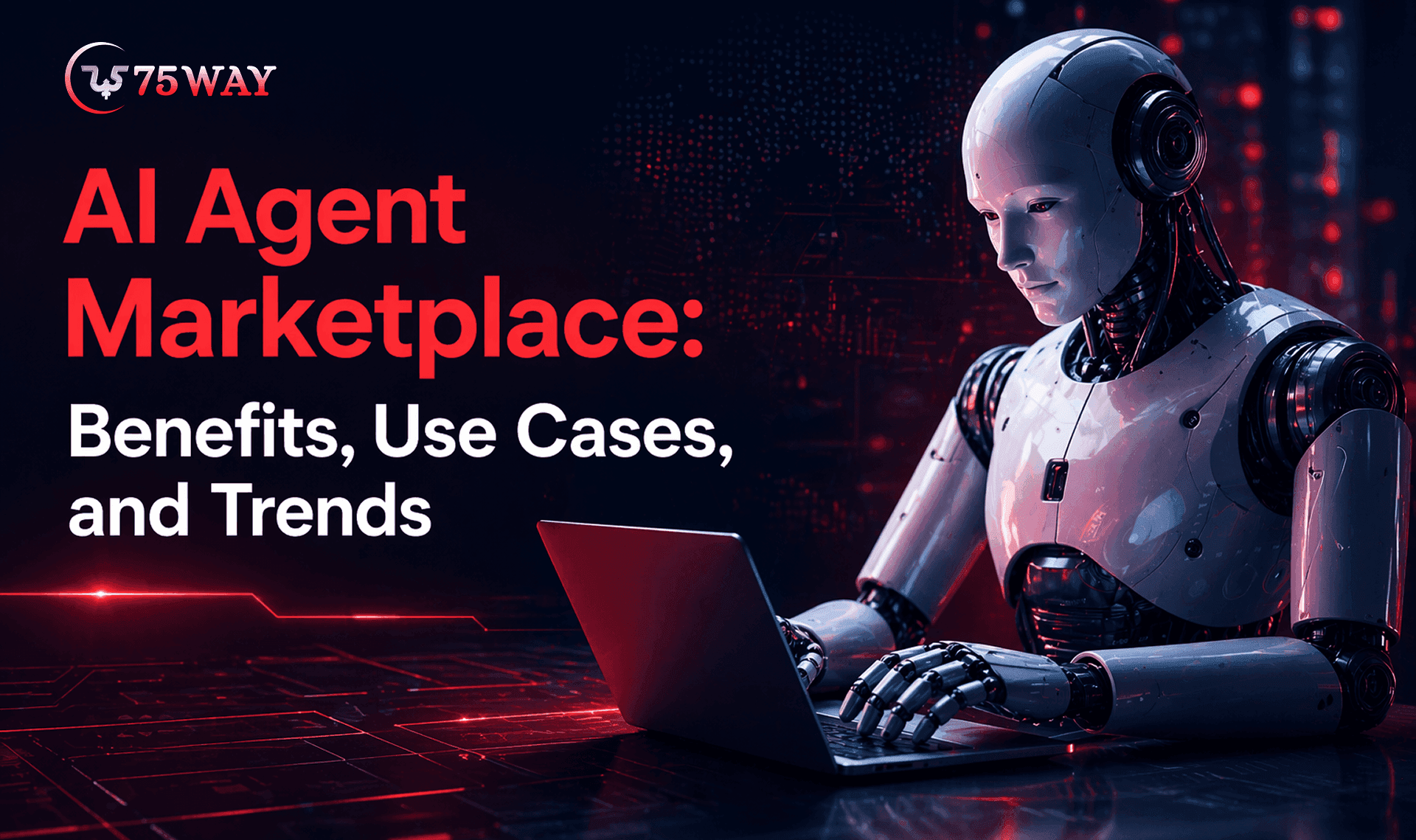
AI agent marketplaces are transforming how businesses access and deploy intelligent automation tools. These platforms allow companies to discover, integrate, and scale AI agents for sales, operations, and customer engagement. This guide explores benefits, real-world use cases, development models, and emerging trends shaping the future of AI-powered marketplaces.
Quick Overview
- AI agent marketplaces simplify access to scalable automation across business functions
- Businesses deploy ready-made AI agents without long development cycles or complexity
- Marketplaces improve efficiency by connecting multiple specialized AI agents seamlessly
- Adoption accelerates digital transformation across sales, support, and operations teams
- Future marketplaces will evolve into fully autonomous AI ecosystem platforms
The demand for intelligent automation is increasing faster than traditional development cycles can support. Businesses no longer want to build AI solutions from scratch. Instead, they prefer ready-to-deploy AI agents, chatbots, and AI systems that can be customized, integrated, and scaled quickly.
This shift has led to the rise of AI agent marketplaces, like 75AI Agent Store, where intelligent agents are created, customized, shared, and deployed across different business functions. These marketplaces function like digital ecosystems, offering pre-built AI capabilities for sales, marketing, operations, and customer support.
Instead of investing months in development, organizations can now access tested AI agents and deploy them within existing workflows. This reduces time-to-value and accelerates adoption across industries. This guide highlights how AI agent marketplaces work, their benefits, real-world use cases, and emerging trends shaping their future.
What Is an AI Agent Marketplace?
An AI agent marketplace is a platform where businesses can discover, deploy, and manage intelligent agents designed for specific tasks. These agents are built to perform functions such as lead generation, customer support, data analysis, and workflow automation.
Unlike traditional software marketplaces, AI agent marketplaces focus on autonomous systems that can act, learn, and adapt. Each agent is designed to perform specialized roles and can work independently or in coordination with other agents.
This ecosystem enables businesses to build modular AI systems with minimal development effort, accelerating digital transformation.
Why AI Agent Marketplaces Are Growing Rapidly?
AI agent marketplaces are expanding rapidly as businesses seek faster automation adoption without the complexity of in-house development. These platforms simplify access to ready-made AI solutions, reduce technical barriers, and support scalable deployment across diverse business operations and industries.
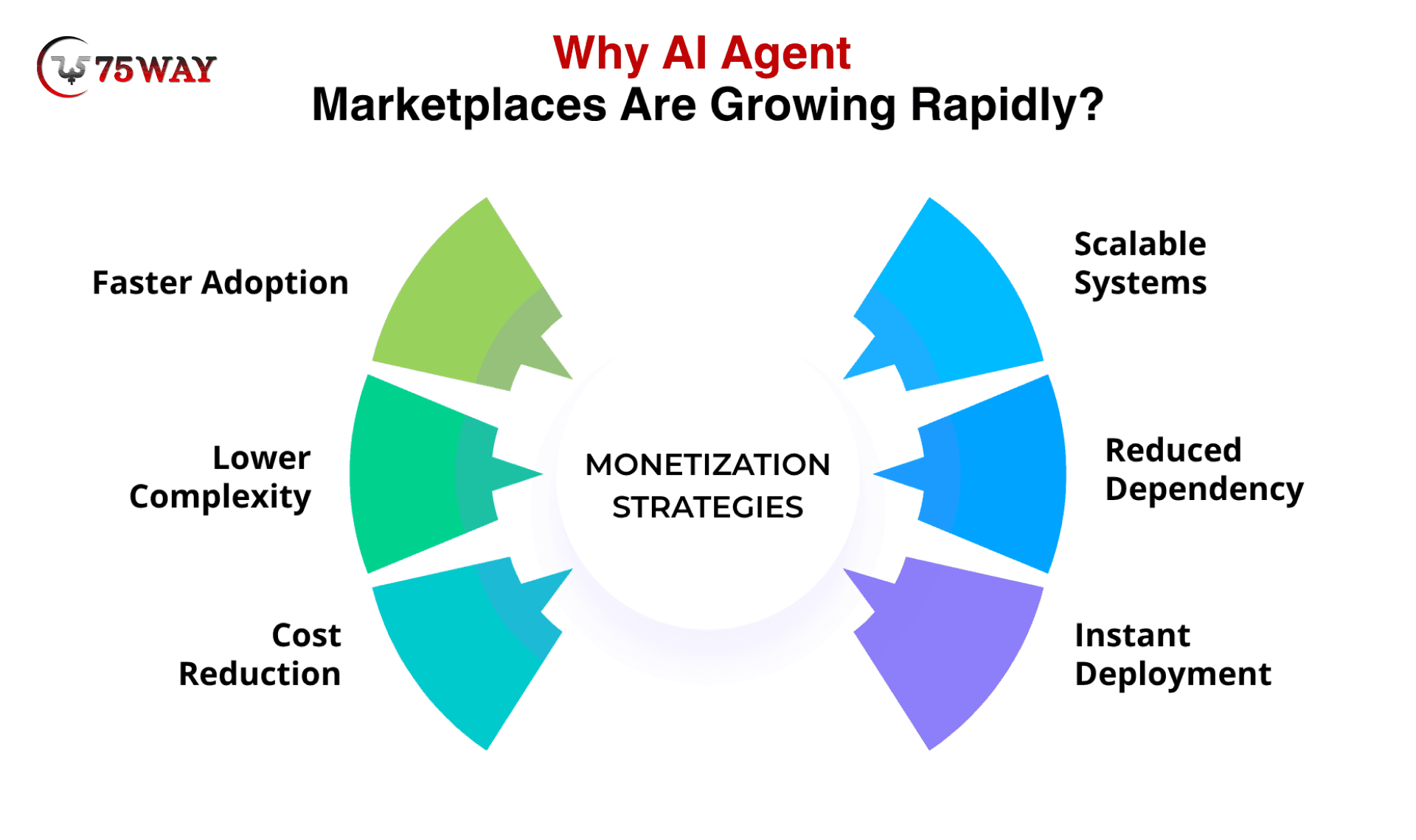
- Faster Adoption: Businesses implement AI solutions quickly using pre-built agents without waiting for long development timelines or complex setup processes.
- Lower Complexity: Pre-configured systems remove technical barriers, allowing organizations to use AI tools without deep engineering expertise or heavy infrastructure planning.
- Cost Reduction: Ready-made agents reduce development expenses, eliminating the need for large teams and long customization cycles across projects.
- Scalable Systems: AI Marketplaces support easy expansion by adding new agents as business requirements grow across multiple functions and workflows.
- Reduced Dependency: Organizations rely less on internal engineering teams, allowing faster execution and smoother integration of automation tools.
- Instant Deployment: AI agents become operational quickly, enabling businesses to start automation without delays caused by traditional development processes.
Key Benefits of AI Agent Marketplaces
AI agent marketplaces help businesses access ready-to-use automation tools that reduce development effort and speed up deployment. These agentic AI platforms support cost control, flexible customization, and scalable growth across multiple operations. They also improve system coordination by integrating specialized agents.
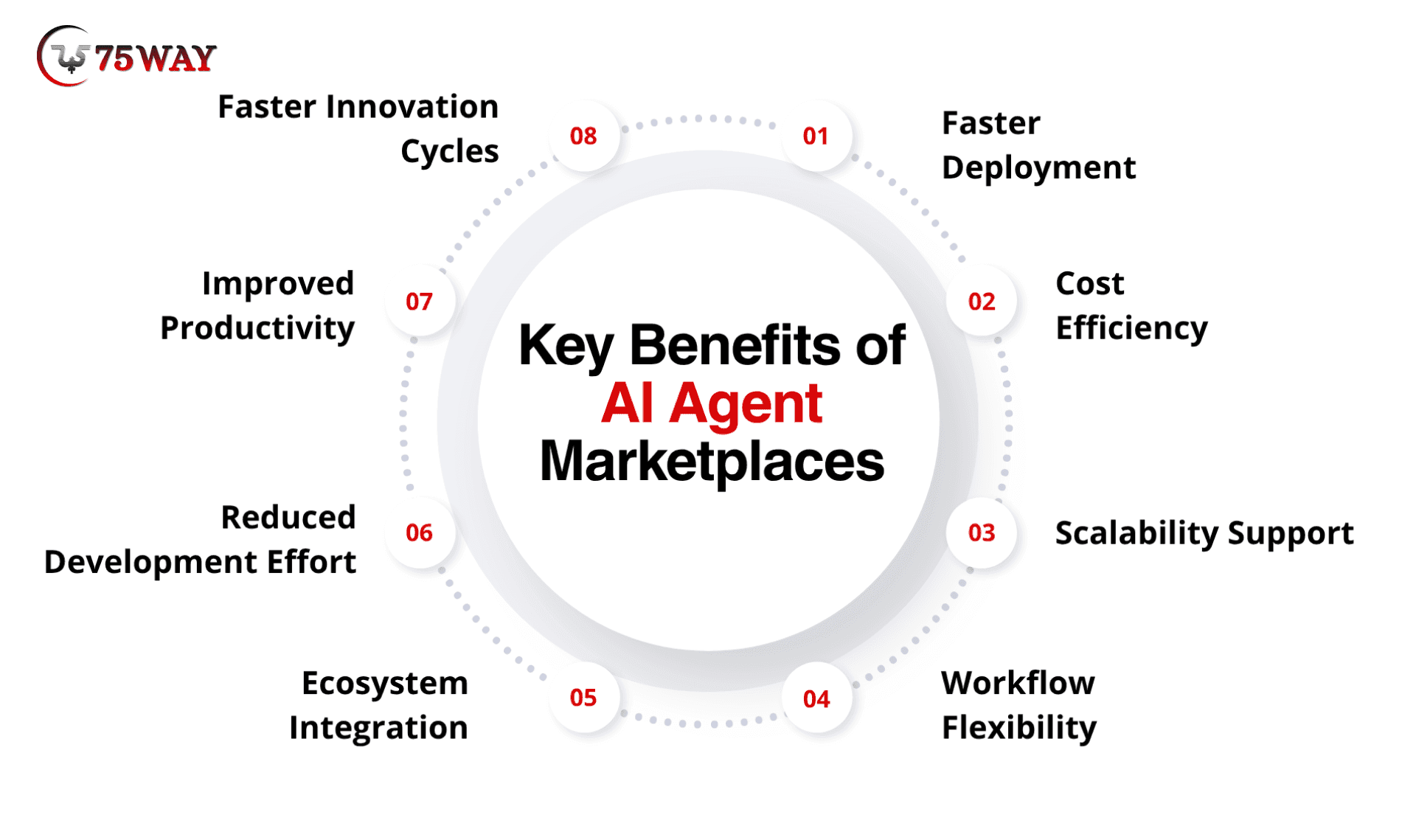
- Faster Deployment: Ready-made AI agents allow quick implementation without long development cycles or complex setup requirements across business workflows.
- Cost Efficiency: Reduce spending on custom development, infrastructure, and large engineering teams needed to build AI systems from scratch.
- Scalability Support: Enable easy expansion by adding new agents as business operations grow and requirements evolve across departments.
- Workflow Flexibility: Allow customization of AI agents to match specific business processes, industry needs, and operational goals.
- Ecosystem Integration: Connect multiple agents to work together across sales, marketing, support, and internal business functions.
- Reduced Development Effort: Eliminate the need for building AI solutions from scratch, saving time and technical resources.
- Improved Productivity: Automate repetitive tasks, allowing teams to focus on higher-value strategic business activities.
- Faster Innovation Cycles: Speed up experimentation and adoption of new AI capabilities across different business areas.
Use Cases of AI Agent Marketplaces
AI agent marketplaces support multiple business functions by delivering automation tools that improve efficiency, reduce manual effort, and enhance decision-making across departments.
- Sales Automation:AI sales Agents handle lead generation, outreach, and pipeline qualification. Sales teams use automation to identify prospects faster and maintain consistent engagement across multiple channels.
- Customer Support: An AI customer support agent manages query handling, ticket resolution, and response management. Support teams rely on automation to deliver faster replies and maintain service consistency across interactions.
- Marketing Operations:AI marketing agents manage campaign execution, personalization, and engagement tracking. Marketing teams use automation to improve targeting accuracy and optimize campaign performance across channels.
- Data Analysis: Processes large datasets and generates actionable business insights. Organizations use automation to identify patterns, improve decisions, and support strategic planning across operations.
- HR Operations:HR AI agents automate recruitment, onboarding, and employee support processes. HR teams use automation to reduce manual workload and streamline workforce management activities.
- Finance Operations:AI finance agents handle transaction monitoring, reporting, and financial data processing. Finance teams use automation to improve accuracy and control operational workflows.
- Legal Operations: AI legal agent supports document review, contract analysis, and case data organization. Legal teams use automation to reduce manual effort and improve document handling efficiency.
- E-commerce Operations: Automate product recommendations, order tracking, and customer interaction management. Businesses use agentic AI in ecommerce for automation to improve the shopping experience and streamline order processes.
- Healthcare Support: Agentic AI in healthcareassists in patient data handling, appointment coordination, and administrative workflows. Healthcare teams use automation to improve service delivery and reduce operational delays.
How AI Agent Marketplaces Work?
AI agent marketplaces operate as structured digital ecosystems where developers build specialized AI agents, and businesses access them for direct deployment. This model removes the need for building automation systems from scratch and enables faster adoption of intelligent solutions across industries.
Each agent is designed for a specific function, such as sales, marketing, support, or analytics, and is categorized based on capability and industry use case. Businesses browse these categories, select suitable agents, and integrate them into existing workflows with defined objectives and configurations aligned to operational needs.
After deployment, agents begin interacting with real-time business data and user inputs. They continuously refine outputs based on feedback and usage patterns, which helps improve accuracy, adaptability, and performance over time while aligning with changing business requirements and workflows.
Development Model Behind AI Agent Marketplaces
AI agent marketplaces are built on a layered development model that connects agent creation, deployment, and continuous optimization into a unified ecosystem. This structure allows developers to design specialized agents while enabling businesses to access, configure, and scale them across different operational needs.
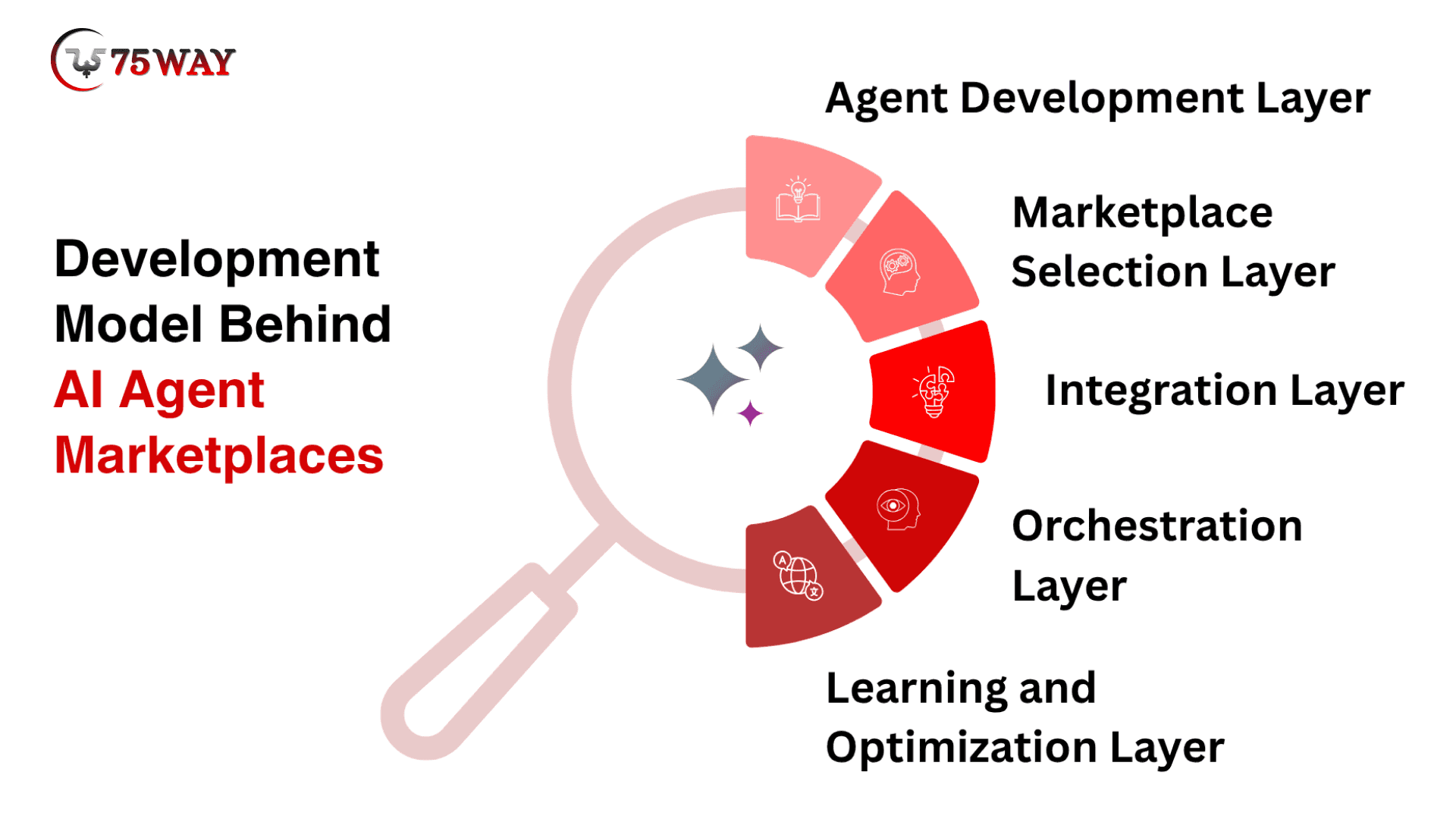
- Agent Development Layer
AI agent Developers design these agents for specific tasks such as sales, support, marketing, or data analysis. Each agent is trained with domain-focused data to perform defined business functions with accuracy and contextual understanding.
- Marketplace Selection Layer
Businesses browse categorized agents based on function, industry, and capability. Relevant agents are selected and configured to match workflows, ensuring alignment with business objectives and operational requirements.
- Integration Layer
Selected agents are integrated into existing systems such as CRM, communication tools, or internal platforms. This connection allows smooth data flow and coordination across business operations.
- Orchestration Layer
Multiple agents collaborate to complete complex tasks by sharing data and responsibilities. This coordination enables seamless execution of workflows where each agent contributes to a unified business outcome.
- Learning and Optimization Layer
After deployment, agents analyze interaction data and performance patterns. Continuous learning improves decision quality, enhances responses, and adapts behavior based on evolving business needs and user engagement.
Emerging Trends in AI Agent Marketplaces
AI agent marketplaces are evolving into advanced ecosystems where intelligent systems collaborate across business processes with minimal manual coordination. These platforms are shifting toward adaptive automation models that support scalability, flexibility, and continuous improvement across industries and operational environments.
- Autonomous Collaboration: Independent systems coordinate tasks by sharing data and completing workflows together without manual intervention across business operations.
- Self-Learning Systems: Performance improves through continuous analysis of interactions, allowing behavior adjustments based on real-time patterns and outcomes.
- Cross-Platform Integration: Multiple tools and applications connect seamlessly, enabling smooth data exchange across different business environments and software systems.
- Workflow Automation Expansion: Entire operational processes execute automatically through coordinated system actions across sales, marketing, and support functions.
- Subscription-Based Access: Businesses access intelligent automation capabilities through flexible subscription models instead of investing in full system development.
- Dynamic AI Composition: Organizations assemble and configure multiple intelligent units on demand to create tailored automation solutions for specific goals.
Challenges in Adoption
The deployment of AI agent marketplaces brings several operational and technical challenges for businesses. These include system integration issues, security risks, inconsistent agent quality, lack of standards, and dependency on evolving ecosystem maturity across platforms.
- Integration complexity with legacy systems
Connecting modern AI agents with outdated systems creates technical difficulties and workflow disruptions.
- Data security and compliance concerns
Handling sensitive business data raises privacy risks and requires strict regulatory alignment across systems.
- Quality control across third-party agents
Ensuring consistent performance from external agents remains difficult due to varying development standards.
- Lack of standardization in agent performance
Different agents follow inconsistent benchmarks, making comparison and reliability assessment challenging for businesses.
- Dependency on ecosystem maturity
Market effectiveness depends on platform growth, stability, and the availability of advanced agent capabilities.
Final Thoughts
AI agent marketplaces are reshaping how businesses access and deploy automation by eliminating long development cycles and enabling instant scalability. These platforms provide a structured ecosystem where intelligent agents can be discovered, customized, and integrated into existing workflows with minimal effort.
As organizations continue to prioritize speed, efficiency, and flexibility, marketplaces are becoming a preferred model for AI adoption. They reduce operational complexity while enabling continuous innovation through reusable and specialized agents.
Businesses that adopt this approach gain a competitive advantage by accelerating automation across sales, marketing, support, and operations. Partnering with a reliable AI agent development company ensures successful implementation and helps organizations build scalable, future-ready AI ecosystems tailored to their growth objectives.
Frequently Asked Questions (FAQs)
Can AI Agents Be Customized?
Yes, most AI agents can be customized to match specific business workflows, data sources, and operational requirements. Businesses adjust logic, integrations, and responses to align with goals, ensuring agents perform tasks suited to unique processes, industries, and customer engagement needs.
Are AI Agent Marketplaces Secure?
Yes, security in AI agent marketplaces depends on platform standards, encryption methods, and compliance frameworks implemented by providers. Trusted platforms follow strict data protection practices, access controls, and monitoring systems to safeguard sensitive business information and maintain operational trust across deployments.
Who Uses AI Agent Marketplaces?
AI agent marketplaces are used by startups, SaaS companies, enterprises, and agencies to automate sales, marketing, support, and operations. These organizations adopt agents to reduce manual effort, improve scalability, and enhance efficiency across multiple business functions and workflows.
Do AI Agents Require Technical Expertise?
Basic AI agent deployment requires minimal technical skills, allowing easy setup through marketplace interfaces. However, advanced customization, system integration, and workflow optimization may require developer support or technical understanding to align agents with complex business requirements.
What Is The Future Of AI Agent Marketplaces?
AI agent marketplaces will evolve into fully autonomous ecosystems where agents collaborate across systems, learn continuously, and manage entire business workflows. Future platforms will support deeper automation, improved interoperability, and dynamic configuration based on real-time business needs.