Summary
Agentic AI for business enables autonomous systems that can plan, decide, and execute complex workflows without human intervention. It transforms enterprise operations through automation, intelligence, and adaptive decision-making. This guide explores architecture, benefits, use cases, implementation strategies, cost factors, and future trends shaping autonomous AI systems across industries in 2026.
Quick Overview
- Agentic AI enables fully autonomous business operations
- Enterprises reduce operational dependency on manual processes
- AI agents improve decision-making speed and accuracy
- Businesses achieve scalable workflow automation across departments
- Customer experience becomes more personalized and responsive
Agentic AI represents the next evolution of artificial intelligence, where systems move beyond passive responses and become autonomous decision-making entities. Instead of simply answering queries or generating outputs, Agentic AI systems can plan tasks, execute workflows, interact with tools, and continuously adapt based on outcomes.
For businesses, this shift is transformative. Traditional automation tools rely on predefined rules, while Agentic AI introduces intelligence that can operate independently across complex environments. This allows organizations to automate entire business functions such as sales, marketing, operations, customer support, and analytics without continuous human oversight.
In 2026, enterprises across industries are rapidly adopting Agentic AI to improve efficiency, reduce costs, and gain competitive advantages in fast-moving digital markets. These systems are no longer experimental. They are becoming core infrastructure for modern businesses.
This guide explains how Agentic AI works, its business applications, benefits, implementation approach, challenges, and future impact on enterprise ecosystems.
How Agentic AI Works in Business Processes?
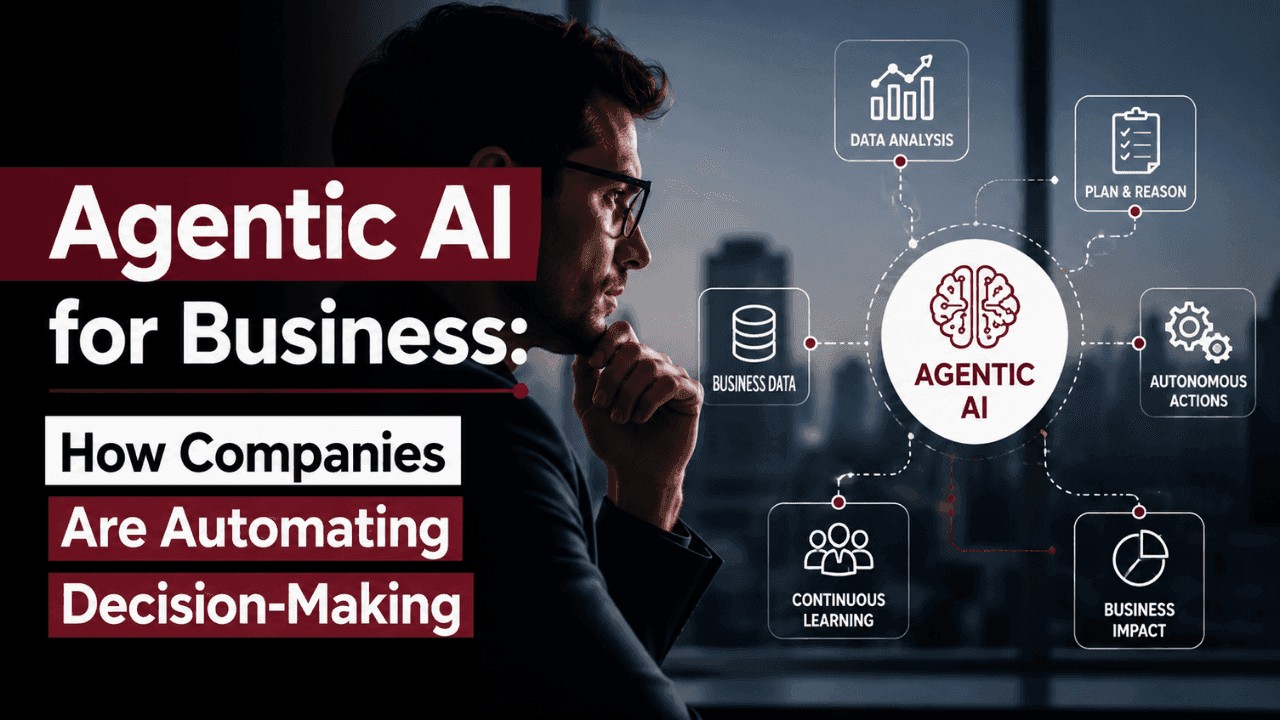
Agentic AI functions as an autonomous decision-making system that understands objectives, plans actions, executes tasks, and continuously improves outcomes. It enables businesses to automate complex workflows while adapting dynamically to changing conditions and user inputs.
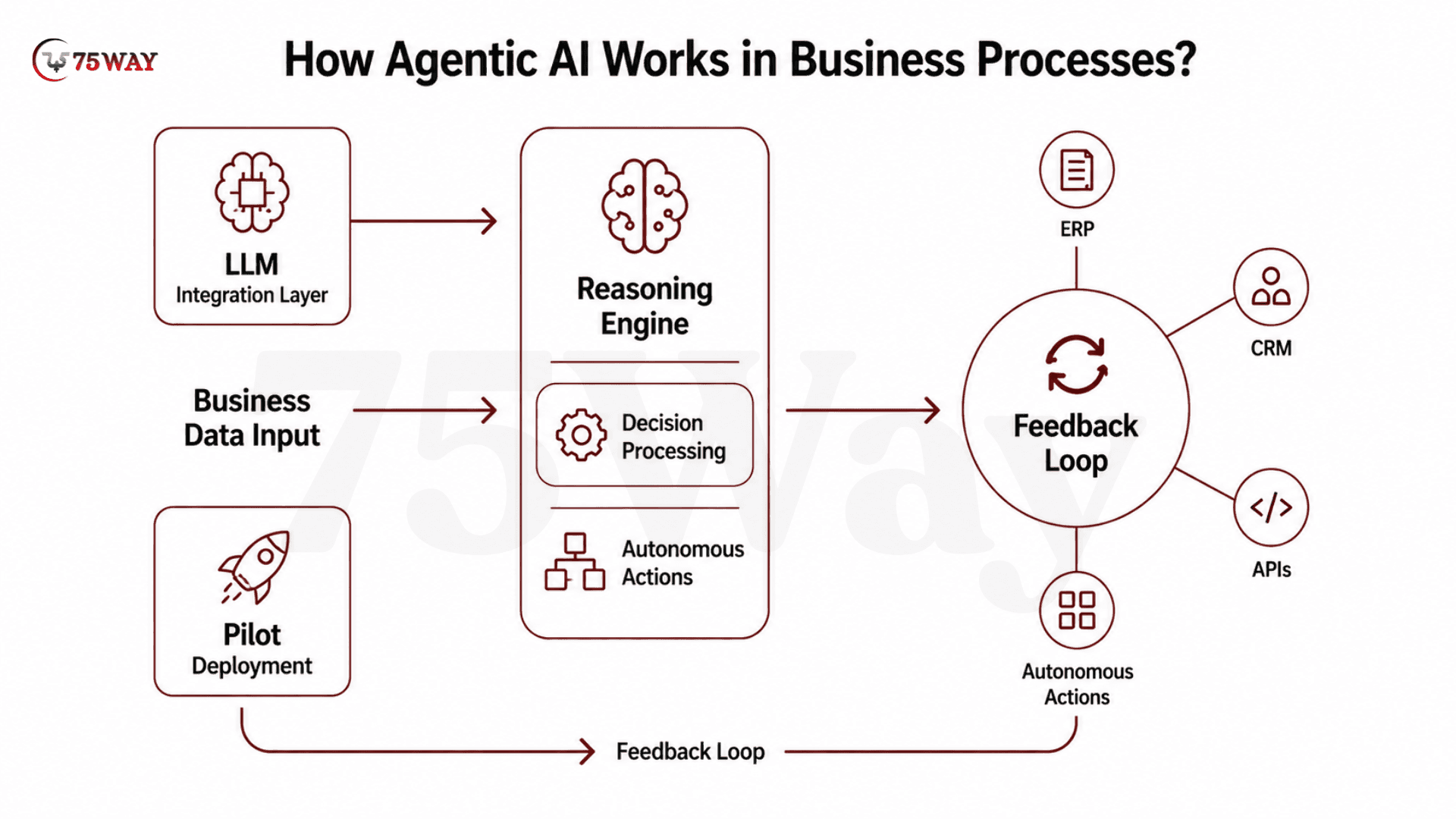
1. Goal Interpretation
The system analyzes business objectives and converts them into structured goals it can process. It identifies intent, priority, and expected outcomes to ensure alignment with business requirements.
2. Planning Phase
It breaks down the main goal into smaller actionable steps and determines the best sequence for execution. This structured planning helps optimize efficiency and decision accuracy.
3. Tool Usage
The system connects with APIs, databases, and external software tools to gather information and perform required actions. This enables real-time data access and system interaction.
4. Execution Phase
Tasks are executed autonomously based on the defined plan, reducing the need for human intervention. The system performs operations across integrated business workflows.
5. Feedback Loop
Outcomes are evaluated against expected results to identify improvements. The system learns from performance data and adjusts future actions accordingly for better accuracy.
Key Components of Agentic AI Systems
Agentic AI systems are built using multiple interconnected components that enable autonomous decision-making, execution, and continuous learning. These components work together to ensure the system can plan, act, and improve across complex business workflows.
- AI Reasoning Engine: Handles decision-making and planning logic by analyzing goals, evaluating options, and selecting the most effective actions for task completion.
- Memory System: Stores contextual data, past interactions, and learned patterns to improve continuity, personalization, and long-term decision accuracy across workflows.
- Tool Integration Layer: Connects the AI system with external APIs, CRMs, databases, and business tools to enable real-time data access and system interoperability.
- Execution Engine: Carries out planned tasks across connected systems by automating actions such as data updates, communications, and workflow operations efficiently.
- Monitoring Layer: Tracks system performance, decision accuracy, and execution outcomes to identify issues and continuously improve overall system reliability and effectiveness.
How Agentic AI Transforms Business Operations and Decision-Making?
Agentic AI is reshaping modern enterprises by enabling autonomous decision-making, intelligent automation, and adaptive workflows. It helps organizations move from manual, rule-based systems to self-improving AI-driven operations that enhance speed, accuracy, and strategic outcomes across business functions.
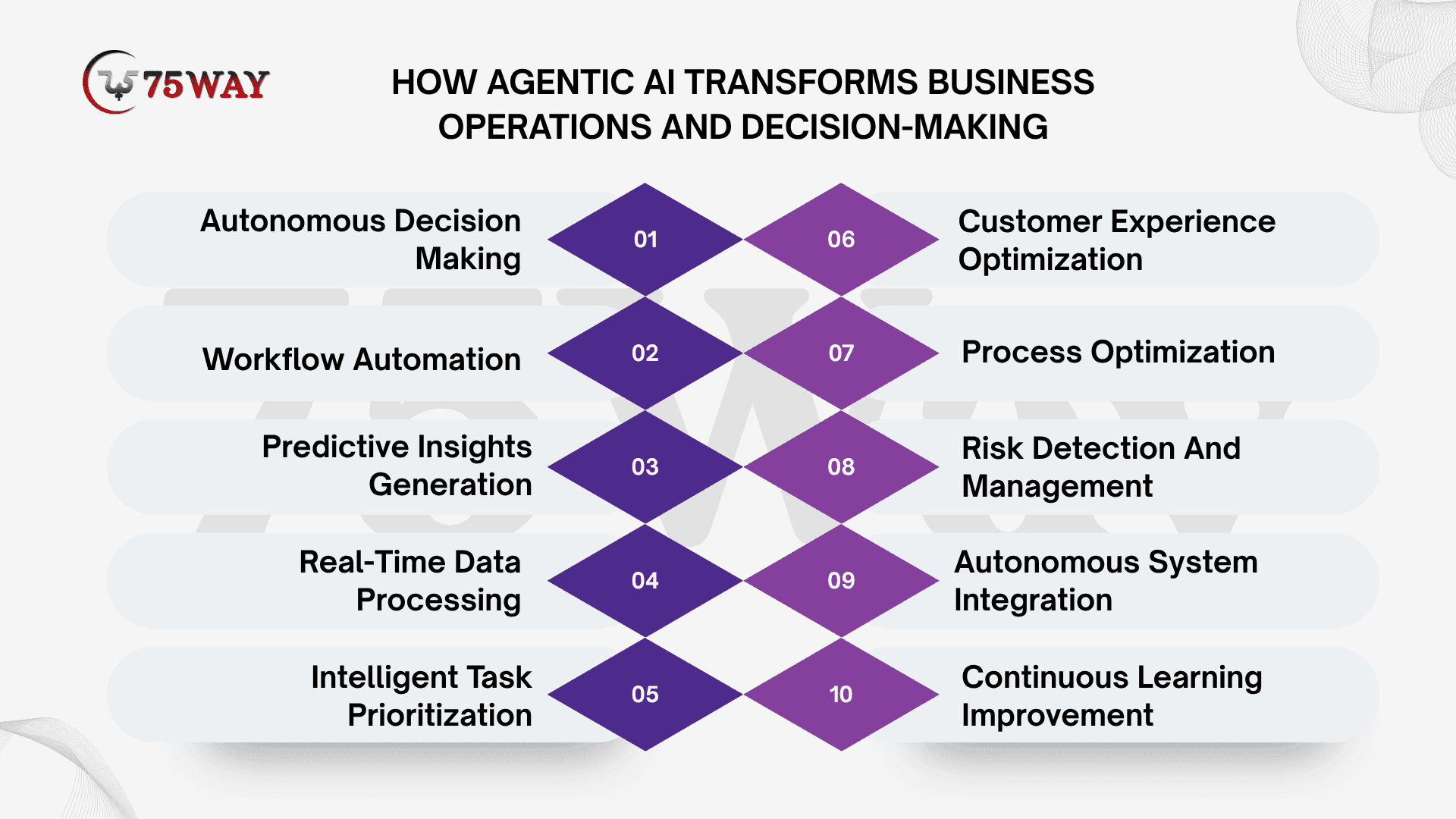
- Autonomous Decision Making: Agentic AI independently evaluates data, identifies options, and selects optimal actions without constant human supervision. It improves decision speed, reduces dependency on manual approvals, and ensures consistent execution across repetitive and complex business scenarios.
- Workflow Automation: It automates end-to-end business workflows by connecting multiple systems and executing tasks. This reduces manual effort, eliminates delays, and ensures smoother operational flow across departments and integrated digital platforms within organizations.
- Predictive Insights Generation: Agentic AI analyzes historical and real-time data to predict future outcomes and trends. It helps businesses anticipate risks, customer behavior, and market changes, enabling more informed and proactive strategic planning decisions.
- Real-Time Data Processing: It processes large volumes of incoming data instantly to support faster decision-making. This ensures businesses always operate with the most up-to-date information, improving accuracy and responsiveness across dynamic operational environments.
- Intelligent Task Prioritization: The system prioritizes tasks based on urgency, importance, and business impact. It ensures critical operations are handled first, improving efficiency and resource allocation across teams, systems, and automated processes.
- Customer Experience Optimization: Agentic AI personalizes interactions by analyzing user behavior and preferences. It delivers tailored recommendations and responses, improving customer satisfaction, engagement, and long-term relationship building across digital communication channels.
- Process Optimization: It continuously evaluates business workflows to identify inefficiencies and improve performance. This leads to streamlined operations, reduced operational costs, and enhanced productivity across organizational systems and departments over time.
- Risk Detection And Management: Agentic AI identifies anomalies, fraud patterns, and operational risks early in processes. It helps businesses mitigate potential issues before they escalate, improving security and decision reliability across systems.
- Autonomous System Integration: It connects multiple enterprise tools, APIs, and platforms to enable unified operations. This eliminates data silos and ensures seamless coordination between different business systems and applications in real time.
- Continuous Learning Improvement: Agentic AI learns from every interaction and outcome to refine future decisions. It enhances accuracy over time, making business operations smarter, more adaptive, and increasingly efficient across evolving environments.
How Different Industries Are Leveraging Agentic AI?
Agentic AI is transforming industries by enabling autonomous decision-making, intelligent automation, and real-time workflow optimization. It helps organizations improve efficiency, reduce costs, and enhance customer experiences through self-learning and adaptive systems across complex business environments.
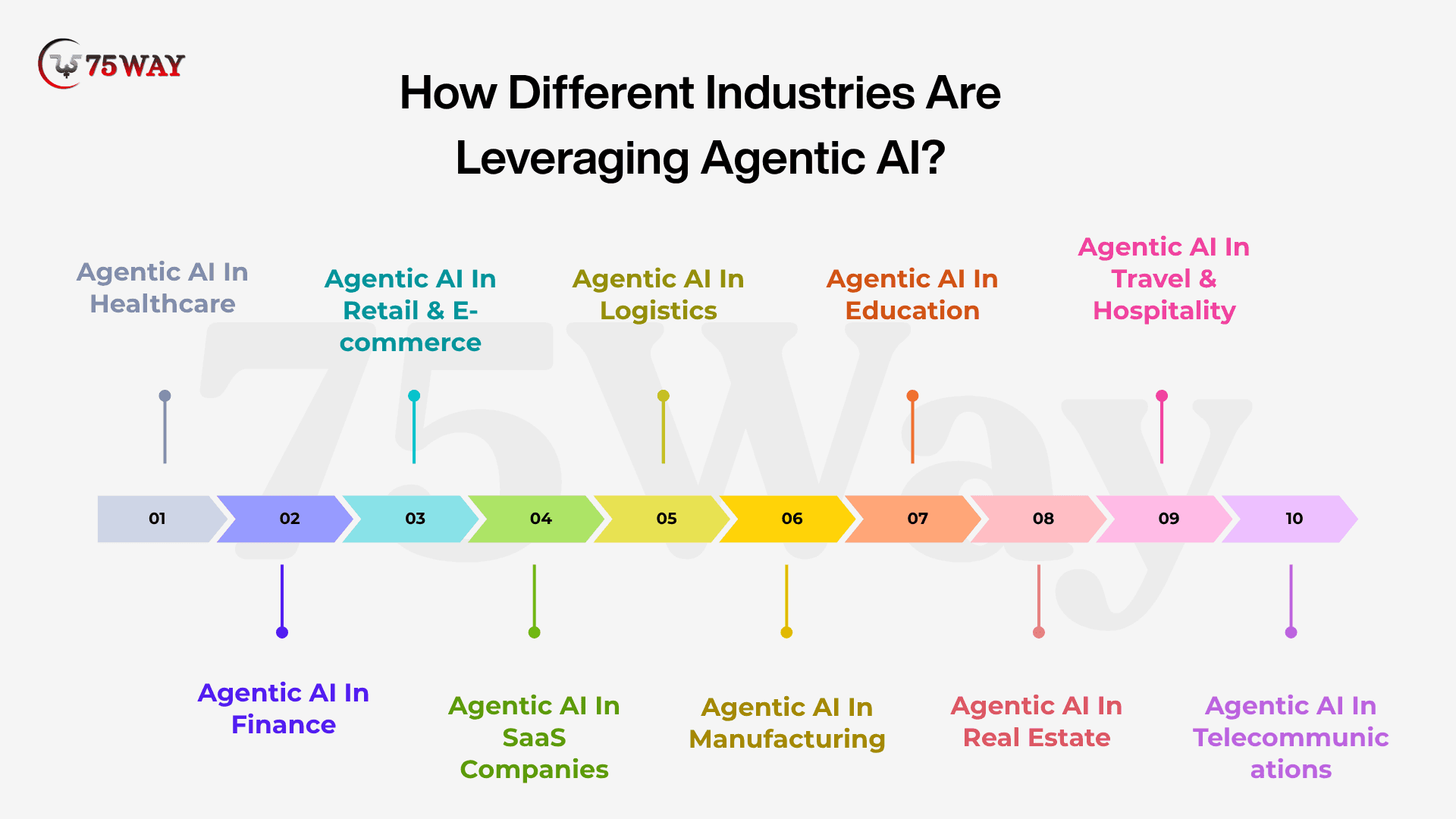
- Agentic AI In Healthcare
Agentic AI in healthcare improves patient outcomes by supporting diagnosis, monitoring health conditions, and automating administrative workflows. It enables faster clinical decisions and reduces manual workload for medical professionals.
It tracks patient health data in real time using connected devices and systems. It assists doctors by analyzing symptoms, history, and medical patterns for better diagnosis. It automates hospital administration tasks like scheduling, reporting, and record management. It improves overall healthcare efficiency and patient care delivery.
- Agentic AI In Finance
Agentic AI in banking and finance enhances security, compliance, and decision-making by automating risk analysis, fraud detection, and reporting workflows. It helps financial institutions operate more efficiently and accurately.
It detects fraudulent transactions using intelligent pattern recognition systems. It evaluates financial risks through predictive data modeling and analytics. It automates regulatory reporting and compliance documentation. It improves accuracy and speed in financial decision-making processes.
- Agentic AI In Retail & E-commerce
Agentic AI in ecommerce and retail improves personalization, demand forecasting, and pricing strategies while enhancing customer shopping experiences across digital platforms.
It acts as a personalized shopping assistant for customers. It forecasts inventory demand using sales and behavior data. It enables dynamic pricing based on market trends. It improves customer engagement and operational efficiency in retail systems.
- Agentic AI In SaaS Companies
Agentic AI in SaaS improves onboarding, customer support, and sales automation by streamlining digital workflows and user engagement systems.
It automates customer onboarding processes for faster activation. It streamlines support workflows for quicker issue resolution. It enhances sales automation through intelligent lead handling. It improves customer retention and platform efficiency.
- Agentic AI In Logistics
Agentic AI in logistics improves supply chain visibility, delivery optimization, and route planning for faster and more efficient operations.
It optimizes delivery routes for reduced transit time. It forecasts supply chain demand using predictive analytics. It improves coordination between warehouses and transport systems. It enhances logistics performance and delivery accuracy.
- Agentic AI In Manufacturing
Agentic AI in manufacturing improves production efficiency, predictive maintenance, and quality control through intelligent automation systems.
It predicts machine failures before breakdowns occur. It automates production line monitoring and adjustments. It enhances quality control through real-time inspection systems. It improves manufacturing efficiency and reduces downtime.
- Agentic AI In Education
Agentic AI in education personalizes learning experiences, automates administrative tasks, and improves student performance tracking systems.
It creates personalized learning paths for students. It automates grading and administrative tasks. It tracks student progress using data analytics. It improves learning outcomes and engagement.
- Agentic AI In Real Estate
Agentic AI in real estate enhances property search, valuation, and customer engagement through intelligent automation systems.
It recommends properties based on user preferences. It analyzes market trends for accurate property valuation. It automates client communication and scheduling. It improves property buying and selling efficiency.
- Agentic AI In Travel & Hospitality
Agentic AI in travel improves booking systems, customer service, and personalized travel planning experiences.
It suggests personalized travel itineraries. It automates booking and reservation systems. It manages customer queries through intelligent assistants. It improves travel experience and operational efficiency.
- Agentic AI In Telecommunications
Agentic AI in telecom enhances customer support, network optimization, and service automation systems.
It resolves customer issues through automated support systems. It predicts network failures using data analytics. It automates billing and service management tasks. It improves telecom service reliability and efficiency.
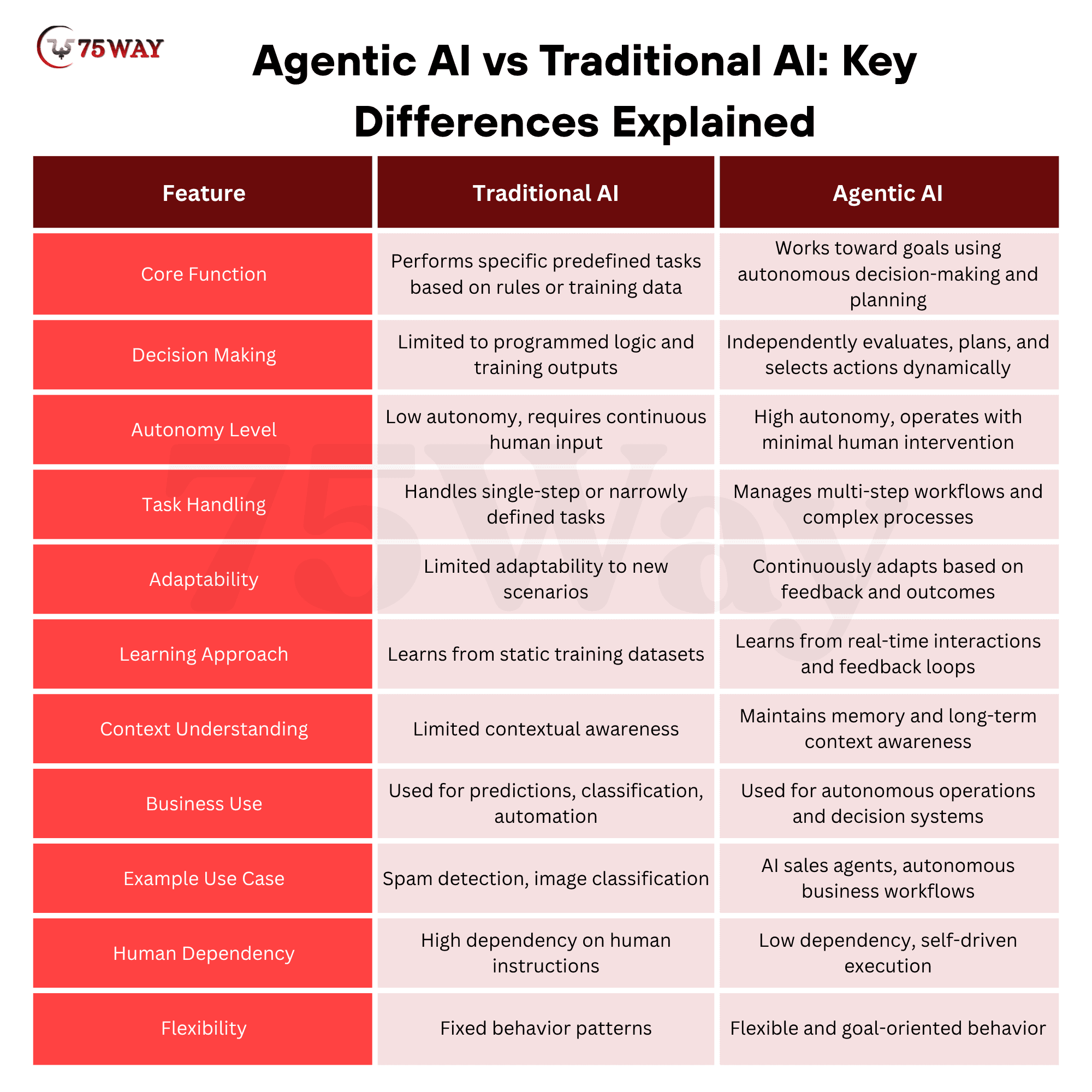
Agentic AI vs Traditional AI: Key Differences Explained
Agentic AI and Traditional AI differ primarily in autonomy, decision-making ability, and adaptability. Traditional AI systems operate within predefined rules and require explicit instructions for each task. They are designed to perform specific functions such as classification, prediction, or automation without independently planning or adjusting their actions beyond programmed logic.
Agentic AI, on the other hand, can independently interpret goals, plan multi-step actions, use external tools, and adapt based on outcomes. It operates as a goal-driven system that continuously learns and improves its decisions through feedback loops. While Traditional AI focuses on task execution, Agentic AI focuses on end-to-end problem-solving with minimal human intervention.
How To Implement Agentic AI In Business Operations?
Implementing Agentic AI in business requires a structured approach that aligns automation capabilities with organizational goals. It involves understanding existing workflows, designing intelligent architectures, integrating enterprise systems, and deploying autonomous agents that can execute tasks with minimal human intervention.
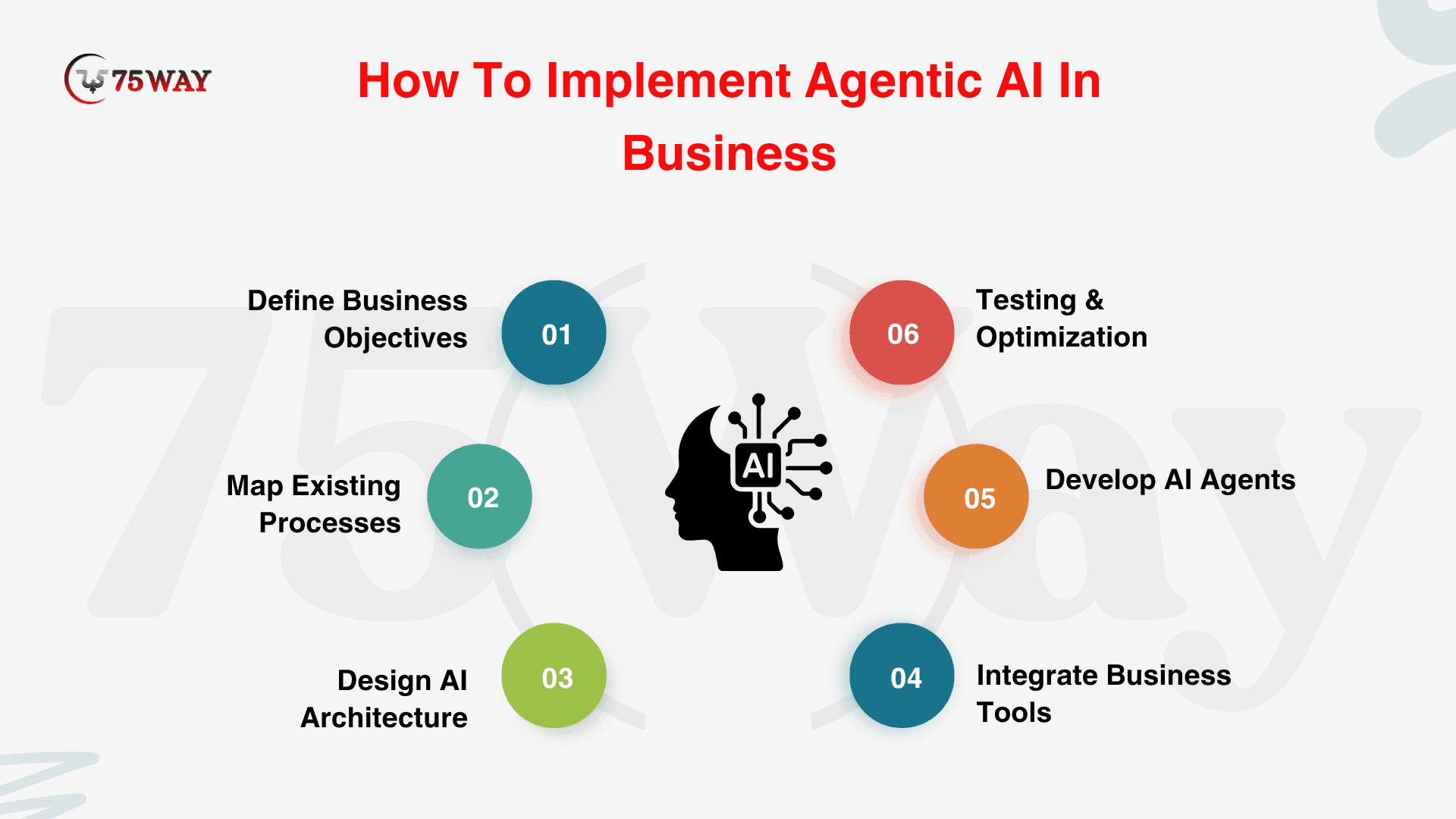
Step 1: Define Business Objectives: Identify key workflows and processes that need automation or optimization. This step ensures Agentic AI implementation is aligned with business goals and delivers measurable outcomes across operations.
Step 2: Map Existing Processes: Analyze current operational structures to understand how tasks are performed today. This helps identify inefficiencies, bottlenecks, and areas where AI-driven automation can provide the most value.
Step 3: Design AI Architecture: Develop the foundational structure, including reasoning, memory, and execution layers. This ensures the system can think, store context, and perform actions in a coordinated and intelligent manner.
Step 4: Integrate Business Tools: Connect essential systems like CRM, ERP, APIs, and databases. This enables seamless data flow and allows AI agents to interact with existing enterprise infrastructure effectively.
Step 5: Develop AI Agents: Build autonomous agents designed for specific tasks such as customer support, sales, or analytics. These agents operate independently while contributing to broader business workflows.
Step 6: Testing & Optimization: Evaluate system performance using real-world data and scenarios. Continuous optimization improves accuracy, efficiency, and decision-making quality over time.
Business Impact of Agentic AI: How It Is Transforming Enterprises
Agentic AI is reshaping how modern enterprises operate by introducing autonomous systems that can plan, decide, and execute complex business workflows. It moves organizations beyond traditional automation toward intelligent systems that continuously learn, adapt, and optimize performance across departments, enabling faster execution, improved accuracy, and stronger business outcomes at scale.
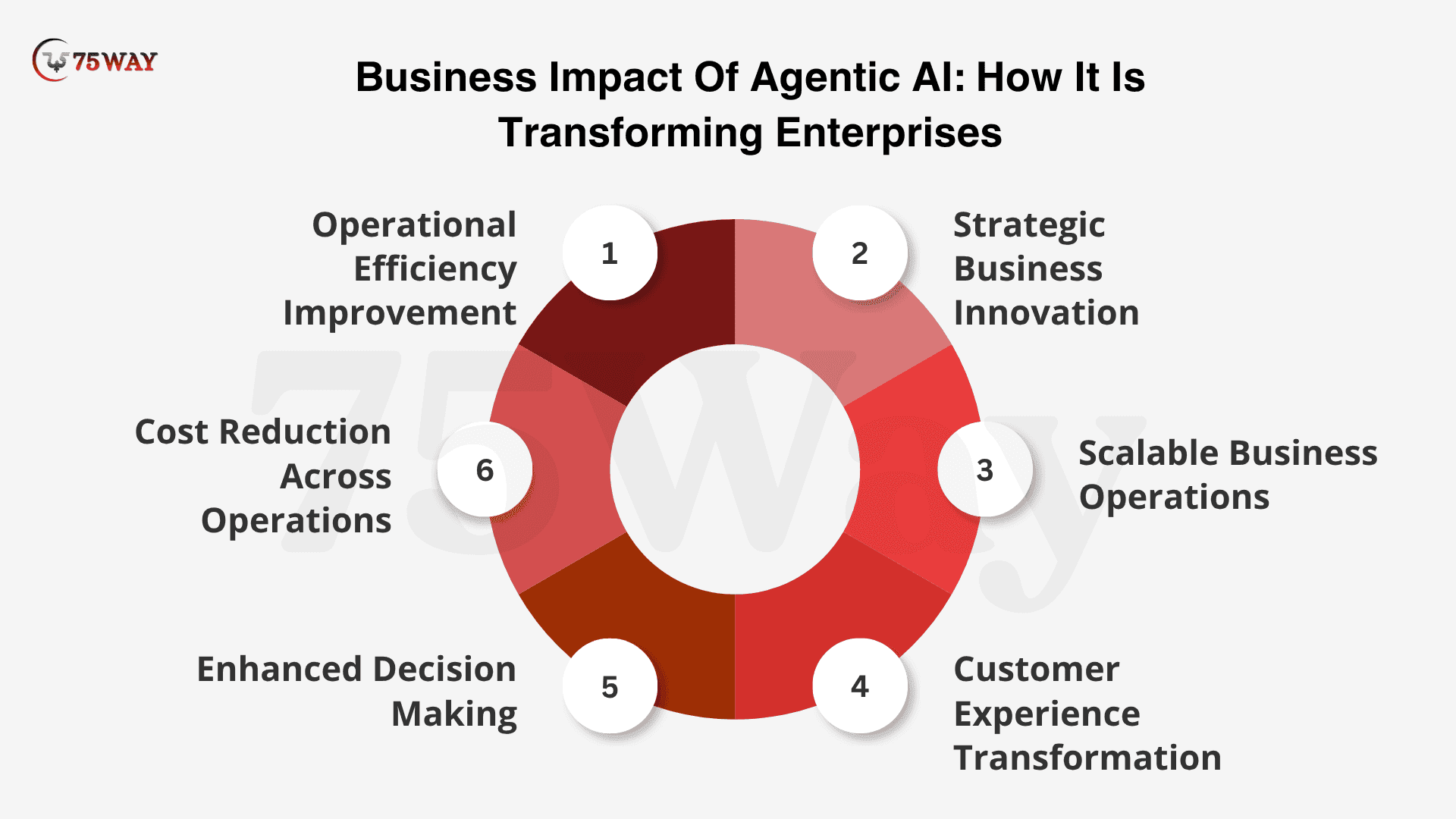
- Operational Efficiency Improvement
AutonomousAgentic AI streamlines business operations by automating repetitive tasks and optimizing workflows across departments. It reduces manual intervention, minimizes errors, and ensures faster execution of processes, allowing teams to focus on strategic and high-value activities that improve overall organizational productivity and performance.
- Cost Reduction Across Operations
Enterprises reduce operational expenses by replacing manual workflows with autonomous AI systems. Agentic AI minimizes staffing needs for repetitive tasks, lowers process inefficiencies, and optimizes resource utilization, resulting in significant long-term cost savings across multiple business functions and operational layers.
- Enhanced Decision Making
Agentic AI solutions support data-driven decision-making by analyzing large datasets and generating actionable insights. It identifies patterns, predicts outcomes, and recommends optimal strategies, enabling business leaders to make faster, more accurate, and more confident decisions across complex enterprise environments and scenarios.
- Customer Experience Transformation
Agentic AI personalizes customer interactions through intelligent automation and real-time context understanding. It delivers faster responses, tailored recommendations, and seamless support experiences, improving customer satisfaction, engagement, and long-term loyalty across digital and offline business communication channels.
- Scalable Business Operations
A system powered by Agentic AI enables enterprises to scale operations without proportional increases in human resources. It manages growing workloads efficiently through autonomous agents, ensuring consistent performance, reliability, and service quality even as business demand increases across multiple markets and customer segments.
- Strategic Business Innovation
Agentic AI drives innovation by enabling organizations to experiment with new business models and automation strategies. It fosters continuous improvement, supports rapid adaptation to market changes, and empowers enterprises to develop advanced digital capabilities that enhance competitiveness and long-term growth.
Wrap up
Agentic AI is redefining how modern businesses operate by introducing fully autonomous systems capable of executing complex workflows with minimal human intervention. In 2026, it is becoming a core driver of enterprise transformation, enabling organizations to scale faster, reduce costs, and improve operational intelligence. Whether you are a startup or an enterprise owner, if you want to build intelligent autonomous systems for your business, you can look for a leading agentic AI development company to design and deploy custom Agentic AI solutions that automate workflows, enhance decision-making, and scale your enterprise operations in 2026.
Frequently Asked Questions (FAQs)
How Does Agentic AI Improve Business Decision-Making?
Agentic AI analyzes large datasets in real time and identifies actionable insights. It evaluates multiple scenarios before making decisions. This leads to faster, more accurate, and data-driven business outcomes across operations.
Can Small Businesses Use Agentic AI?
Yes, small businesses can adopt lightweight Agentic AI tools for automation. These systems help manage marketing, customer support, and workflows. They reduce workload while improving efficiency and scalability.
What Skills Are Needed To Build Agentic AI Systems?
Developing Agentic AI requires knowledge of machine learning, backend development, and API integration. Experience with frameworks like LangChain or AutoGen is valuable. Understanding business workflows also improves system design.
How Does Agentic AI Handle Complex Workflows?
Agentic AI breaks complex tasks into smaller steps and executes them sequentially. It uses reasoning models to adapt during execution. This ensures structured and reliable workflow completion.
What Are The Risks of Using Agentic AI In Business?
Risks include data security issues, incorrect outputs, and integration challenges. Without proper monitoring, autonomous systems may make flawed decisions. Governance and human oversight are essential for safe usage.
Does Agentic AI Require Continuous Training?
Yes, Agentic AI systems improve through continuous feedback and data updates. Regular optimization enhances accuracy and performance. This helps the system adapt to changing business environments.
How Does Agentic AI Integrate With Existing Software?
It integrates using APIs, middleware, and automation platforms. Systems like CRMs and ERPs can be connected easily. This enables seamless data flow and workflow automation across tools.
What Is The ROI of Implementing Agentic AI?
ROI depends on automation scale and business size. Companies save costs by reducing manual labor and improving efficiency. Over time, it leads to higher productivity and revenue growth.