AI Summary
Building an app like DubaiNow requires more than convenient interfaces. Businesses must connect essential services, secure payments, and trusted identity. Strong integrations and accessible design shape the user experience. Explore features, development stages, technology choices, and estimated costs.
Key Takeaways
- Start with one focused service category before expanding across sectors.
- UAE PASS integration can simplify secure digital identity and authentication.
- Reliable APIs connect users with relevant government and private services.
- Clear payment flows support bills, fees, and payment tracking securely.
- Scalable architecture helps new services join without disrupting existing journeys.
Living in Dubai means dealing with different services for everyday needs, from paying DEWA bills and renewing vehicle registrations to managing residency matters. Having to visit separate websites or apps for these tasks can take more time than expected.
That's where a smart city app like DubaiNow makes life easier by bringing multiple services together in one place.
Now, imagine building a similar platform where residents can access essential government services without jumping between different applications.
Sounds useful, right? But bringing this experience together requires more than a mobile app interface. You also need secure logins, government department integrations, digital payments, and reliable service connections.
If you're planning to develop an app like DubaiNow, you'll need a clear understanding of how digital government services work in Dubai. This guide walks you through the features, DubaiNow clone app development process, technology requirements, and estimated costs involved.
What Is DubaiNow, And Why Is It A Useful App Model?
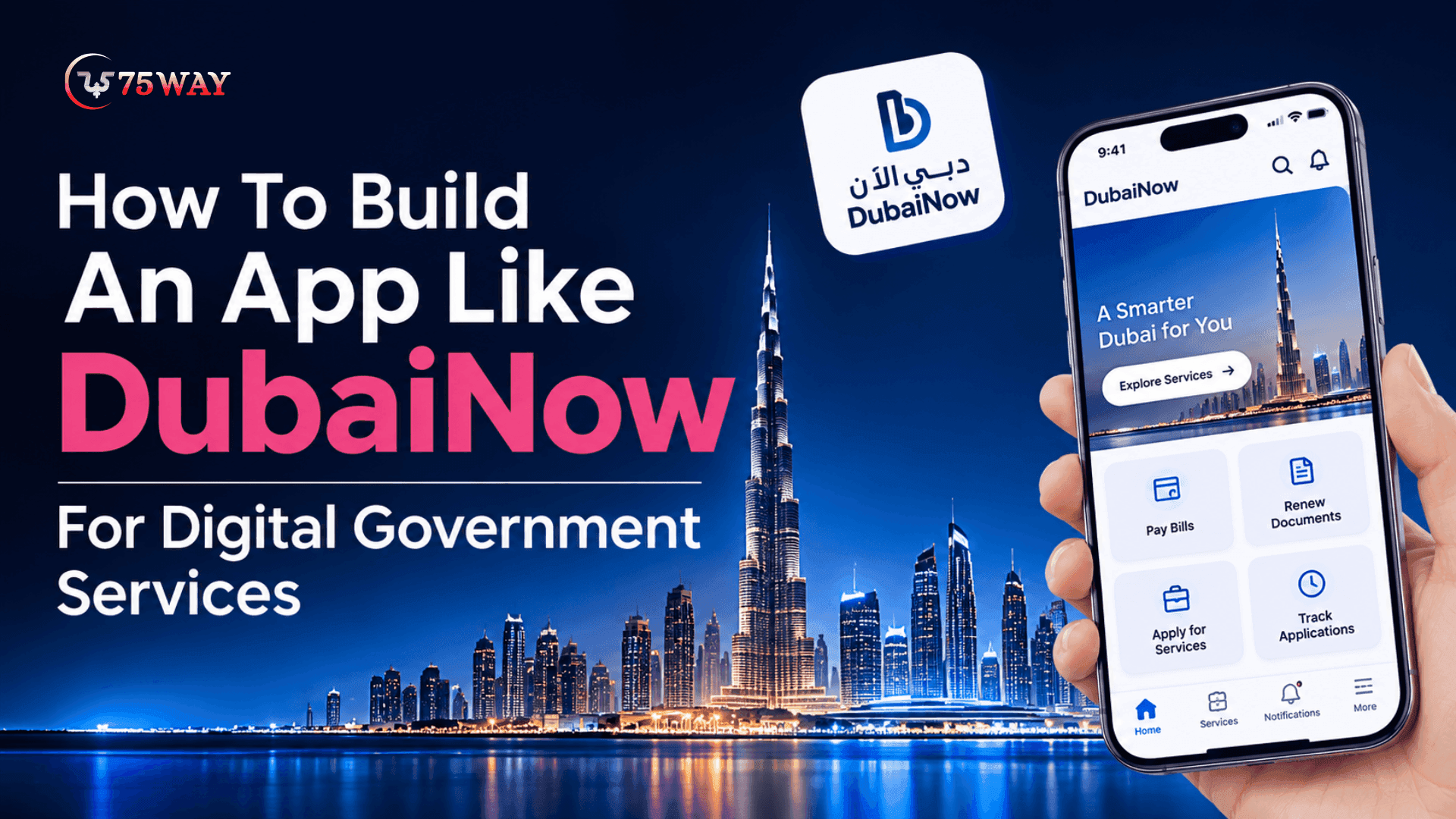
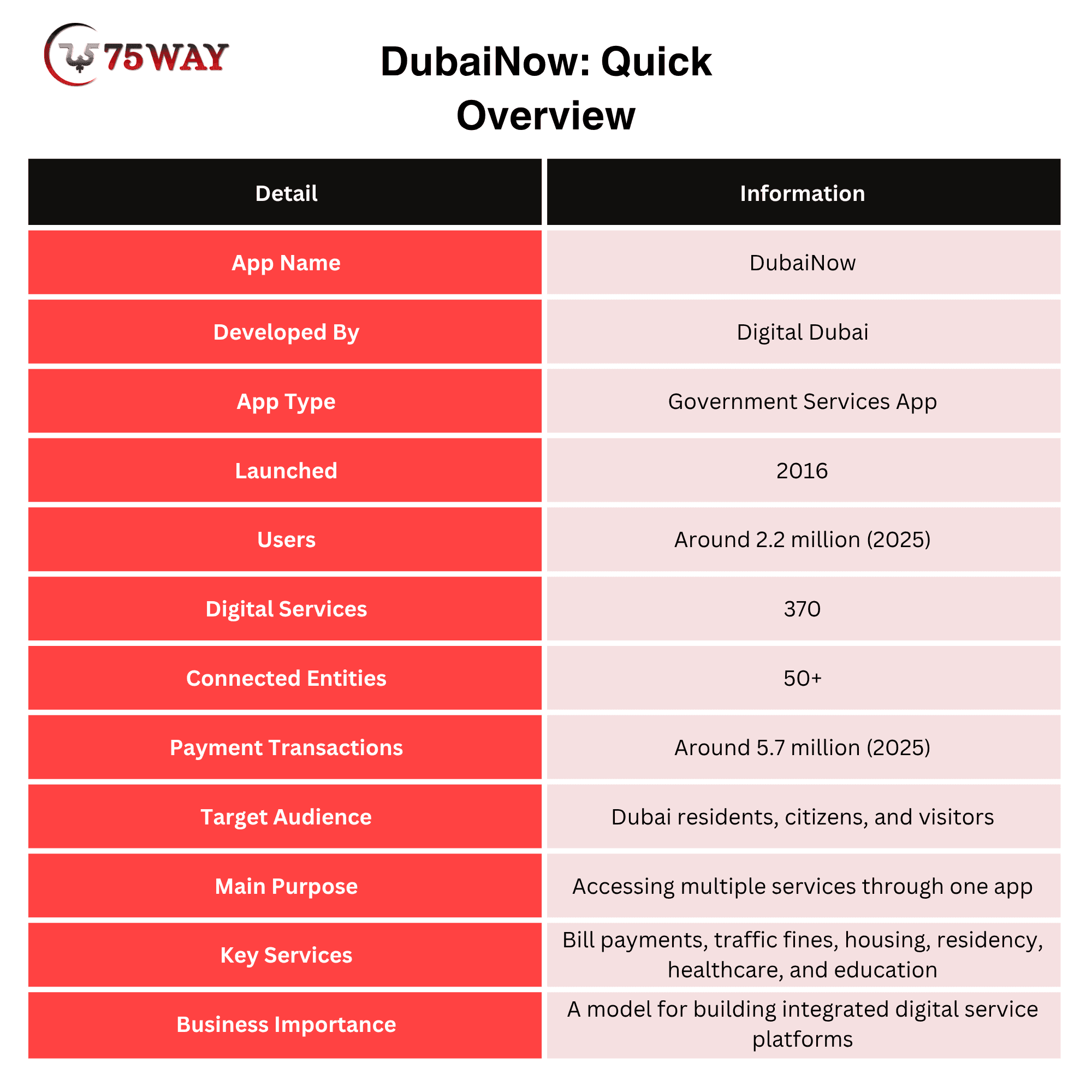
DubaiNow is an official government app developed by Digital Dubai to bring essential government and private-sector services into one platform. People in Dubai can use it to pay bills, check traffic fines, manage residency-related services, and access housing, healthcare, education, and other everyday services without using multiple apps.
DubaiNow is an important business model because it shows how one app can make different services easier to access. It had around 2.2 million users in 2025 and offered 370 digital services. For businesses, it provides a useful example of how connecting service providers, payments, and customer needs in one place can create a valuable digital platform.
DubaiNow: Quick Overview
Market Insights of DubaiNow-Style App Development
People in Dubai increasingly expect everyday services to be available at their fingertips, including government transactions. This demand makes integrated platforms an interesting development opportunity for businesses and technology providers. Here are the market insights worth understanding before investing in a DubaiNow-style app.
- The platform's user base grew to 2.2 million, including 400,000 new users acquired during 2025.
- It processed approximately 5.7 million payments and transactions throughout 2025.
- The app holds an average rating of 4.5 stars across app stores.
- Users can access more than 320 essential services offered by 50+ government and private-sector entities, covering bill payments, driving, housing, healthcare, education, and residency.
- Digital Dubai is planning to integrate more than 180 additional services into the platform.
Why Should Businesses Build An App Like DubaiNow In Dubai?
Dubai's digital environment creates opportunities for platforms that make everyday services easier to access. However, the business opportunity depends on solving a genuine user problem rather than simply putting multiple features into one application. Here are some reasons businesses may consider this model.
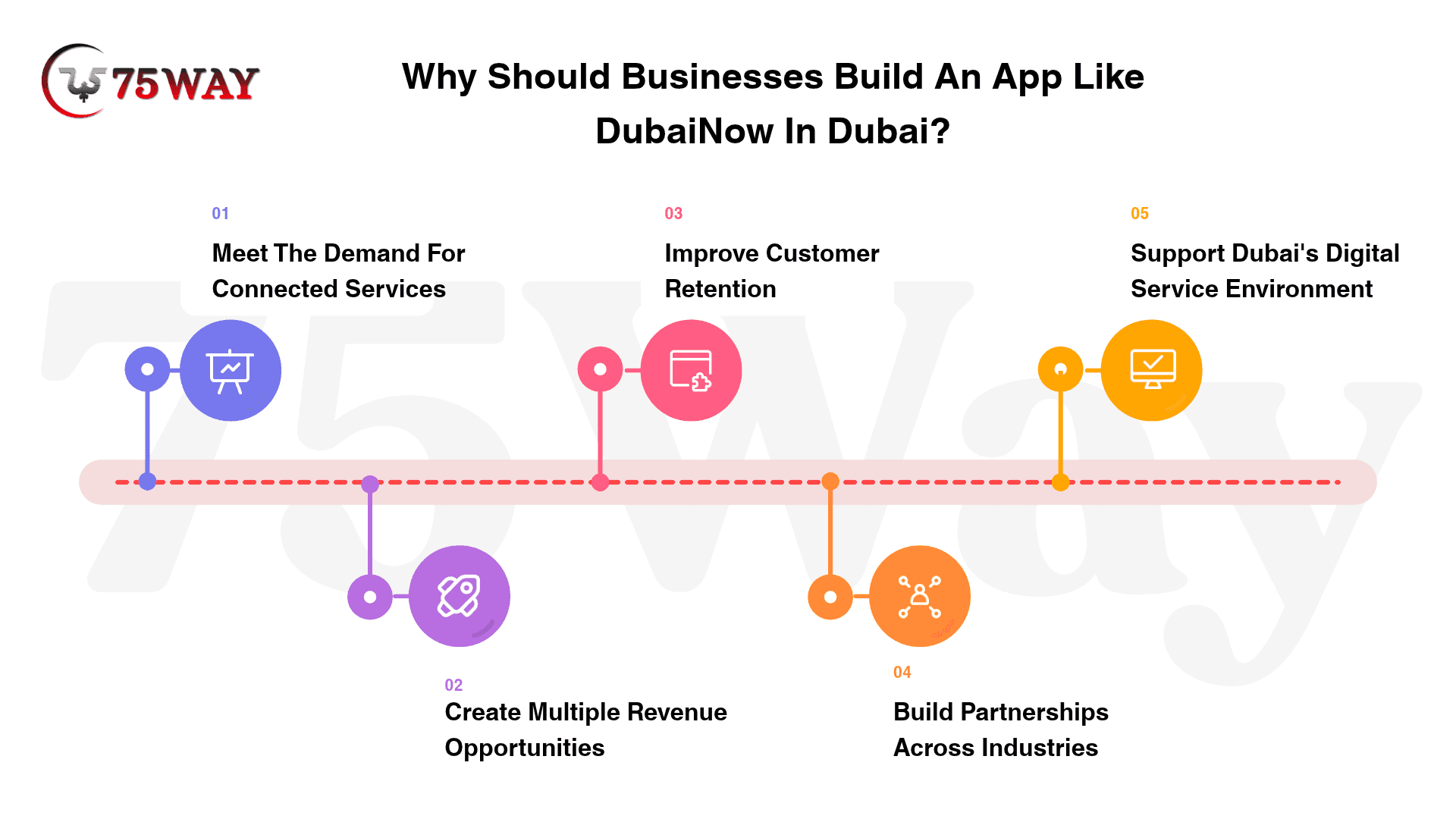
1. Meet The Demand For Connected Services
Residents and businesses often deal with different service providers for payments, bookings, documents, property matters, and other daily requirements. A unified platform can bring selected services into one place, reducing the need to switch between applications.
For example, a property-focused app could connect tenancy management, maintenance requests, rent payments, and utility setup. This gives users a more connected experience without attempting to cover every city service.
2. Create Multiple Revenue Opportunities
A multi-service platform can support different commercial models, depending on the services offered and the agreements with participating providers.
Potential revenue streams include:
- Subscription plans for premium account features.
- Service fees where permitted by provider agreements.
- Business listings and verified partner placements.
- Commission-based bookings for eligible private services.
- B2B plans for property managers or service companies.
Government service fees and payment arrangements should not be treated as a private app's revenue automatically. These depend on the relevant entity's commercial and legal agreements.
3. Improve Customer Retention
An application that supports several relevant tasks gives users more reasons to return. Instead of opening it for a single transaction, they may use it for recurring activities such as bill payments, appointment bookings, document access, or service updates.
The key is relevance. Adding unrelated features can make the interface difficult to navigate, so each service should support a clear customer need.
4. Build Partnerships Across Industries
A connected services application can create opportunities to work with property companies, maintenance providers, transport operators, healthcare businesses, and other service organizations.
For Dubai-based businesses, partnerships can help expand the platform's service catalogue without developing every service internally. Each partner can manage its own service delivery while the app provides a common customer-facing experience.
5. Support Dubai's Digital Service Environment
Dubai has established digital platforms and infrastructure for connecting services across government and private-sector entities. Digital Dubai's developer portal, for example, lists APIs covering areas such as health, justice, business, housing, residency, UAE PASS, and DubaiPay.
Essential Features Required in DubaiNow Clone App Development
A DubaiNow-inspired application needs more than a login screen and a payment gateway. Its features should help users discover services, complete transactions, access information, and track requests without confusion. The following features can form a practical starting point.
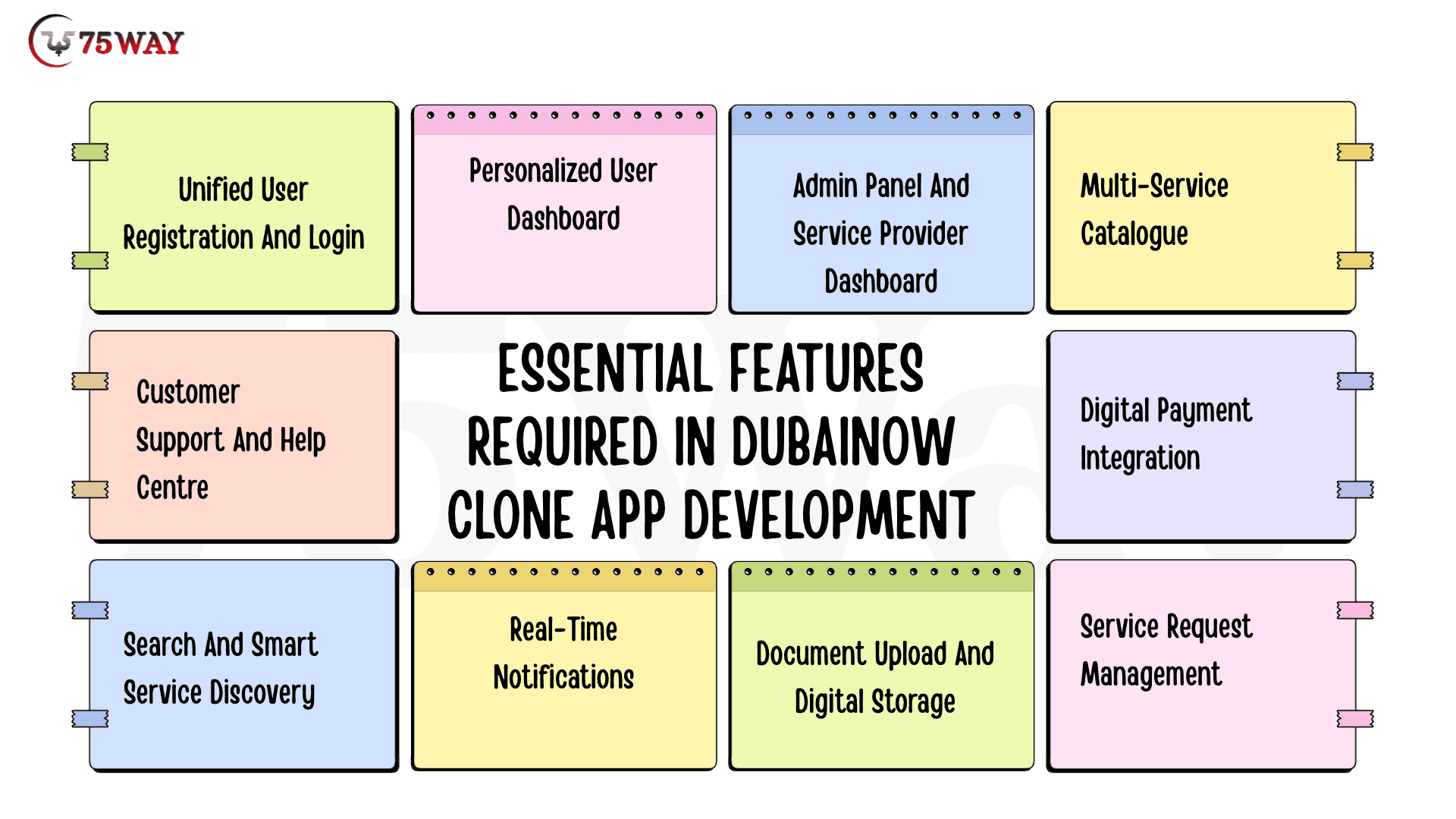
1. Unified User Registration And Login
Users should be able to create an account, verify their details, and access relevant services through a straightforward login process.
For a UAE-focused application, consider whether UAE PASS integration is appropriate for the intended service. UAE PASS supports authentication, digital signatures, and data or document-sharing capabilities, subject to the applicable service-provider arrangements.
For a private application, the integration process should be planned with the UAE PASS team rather than assumed to be a standard plug-and-play login.
2. Personalized User Dashboard
The dashboard should display the services and information most relevant to each user. A resident, property owner, tenant, and business customer may have different requirements, so a single generic dashboard may not work for everyone.
Useful dashboard elements include:
- Frequently used services.
- Recent transactions and requests.
- Pending payments or actions.
- Important service notifications.
- Saved documents and account details.
- Quick access to support.
Personalization should be based on user permissions and service relevance, not unnecessary data collection.
3. Multi-Service Catalogue
A service catalogue allows users to browse available services through clear categories. It should make it easy to find a task without knowing which provider manages it.
Depending on the business model, categories may include:
- Bills And Payments: Utility payments, subscriptions, and eligible service charges.
- Property And Housing: Maintenance, tenancy-related support, and property services.
- Transport: Parking services, vehicle-related support, and mobility bookings.
- Healthcare: Appointment discovery and connected healthcare services.
- Business Services: License support, document requests, and business-related assistance.
- Residency Support: Information and eligible services for residents and visitors.
These are possible categories for a private platform, not a guarantee of access to official Dubai government services.
4. Digital Payment Integration
Payments are an important part of a service application because users should be able to complete eligible transactions without leaving the app unnecessarily.
Depending on the business model, payment functionality may include:
- Debit and credit card payments.
- Supported digital wallets.
- Payment confirmations and receipts.
- Transaction history.
- Refund and cancellation tracking.
- Failed-payment notifications.
Dubai's digital payment ecosystem includes DubaiPay, a shared payment service for government entities and service providers. A private app should assess the relevant payment provider's onboarding requirements and commercial eligibility before planning an integration.
5. Service Request Management
Users should be able to submit a request, provide the required information, and track its progress through the application.
For example, a tenant could raise a maintenance request, upload supporting images, and receive updates from the service provider. A business customer could submit a document request and track its status.
The backend should record request details, assigned teams, status changes, timestamps, and communication history.
6. Document Upload And Digital Storage
Some services require users to submit identity details, agreements, invoices, certificates, or supporting documents. A secure document feature can help users upload and retrieve files when required.
Useful capabilities include:
- Secure document uploads.
- File type and size validation.
- Permission-based access.
- Document expiry reminders.
- Download and sharing controls.
- Audit logs for sensitive actions.
The application should only collect documents that are necessary for the service and should define retention and deletion rules.
7. Real-Time Notifications
Notifications keep users informed about important changes without requiring them to check the application repeatedly.
Examples include payment confirmations, appointment reminders, request updates, document expiry alerts, and booking changes.
Users should be able to manage notification preferences. Sensitive information should not appear in lock-screen messages unless the user has explicitly enabled an appropriate display option.
8. Search And Smart Service Discovery
A search function helps users locate services by name, category, provider, or task. This is especially important when the application offers several service categories.
You can also introduce suggested services based on recent activity, saved preferences, or location permissions. Keep suggestions relevant and provide a clear way to control personalization.
9. Customer Support And Help Centre
A multi-service application needs a clear support system because users may have questions about payments, documents, service providers, or technical issues.
Consider adding FAQs, searchable help articles, support tickets, live chat, and escalation options. Where a service is managed by an external partner, the app should clearly explain who is responsible for resolving the request.
10. Admin Panel And Service Provider Dashboard
The admin panel helps the platform operator manage users, service categories, content, permissions, and system activity.
A separate partner dashboard can allow approved service providers to manage their own listings, incoming requests, service updates, and customer communication.
Role-based permissions are important here. A partner should only access the records and functions relevant to its own services.
How To Develop An App Like DubaiNow: A Step-By-Step Process
If you're planning to create a digital government services app, knowing where to begin can save you time and development effort. From choosing the services to include to integrating UAE PASS and payment gateways, every stage needs careful planning. Here's how to approach each step of building an app like DubaiNow.
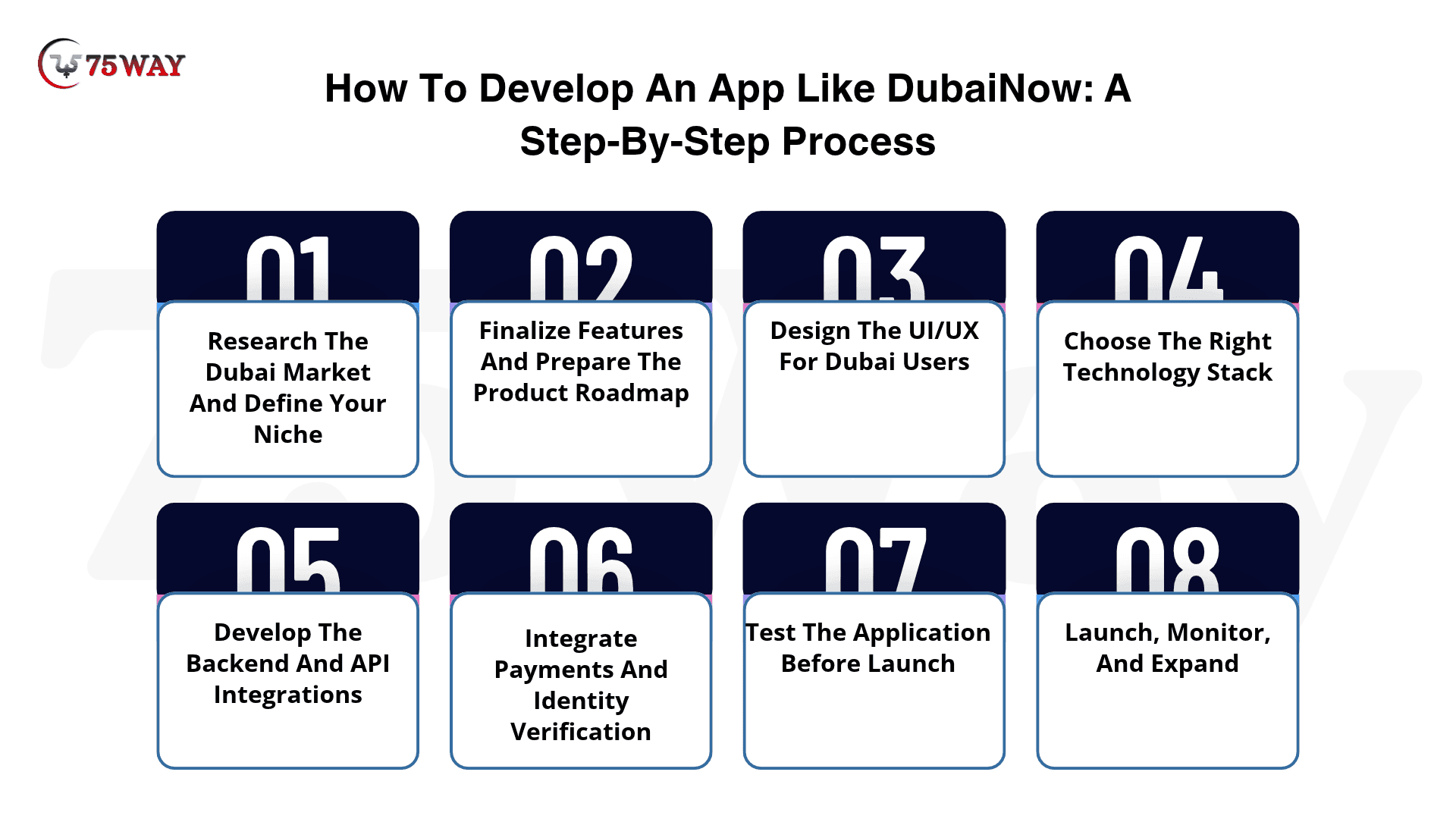
Step 1: Research The Dubai Market And Define Your Niche
Start by identifying the audience and the problem your application will solve. Avoid trying to serve every resident, visitor, and business customer from day one.
Study the service categories that already exist in Dubai and identify gaps where a private platform could provide a better experience.
For example, you could focus on:
- Property management and tenant services.
- Household maintenance and utility support.
- Business administration and document workflows.
- Appointment discovery and service bookings.
- A marketplace connecting residents with verified providers.
Research existing competitors, service providers, user expectations, and possible partnership opportunities. This will help you define a realistic product scope.
Step 2: Finalise Features And Prepare The Product Roadmap
Once the target market is clear, divide features into launch requirements and future enhancements.
Your first release should focus on a small number of connected services. It should allow users to register, discover services, complete the main action, receive confirmation, and contact support.
A feature roadmap can be divided into three stages:
- MVP: Account creation, service catalogue, basic requests, payment integration where needed, and an admin panel.
- Expansion: More service categories, partner dashboards, document management, and advanced notifications.
- Enterprise Growth: Complex integrations, analytics, automation, advanced security controls, and larger-scale infrastructure.
This approach gives the business an opportunity to validate demand before investing in a large platform.
Step 3: Design The UI/UX For Dubai Users
The interface should make everyday tasks easy to understand, especially for users who may not be familiar with every service provider or process.
Use clear categories, readable typography, familiar icons, and short instructions. Since Dubai has a multilingual population, plan for English and Arabic support from the design stage.
Important design considerations include:
- Provide clear English and Arabic navigation.
- Support right-to-left layouts for Arabic screens.
- Keep payment and confirmation steps easy to follow.
- Display service charges before users proceed.
- Make request status visible from the dashboard.
- Ensure accessibility across different screen sizes.
Test the design with people who represent your intended Dubai audience. Their feedback can reveal confusing labels, unnecessary steps, and language issues before development begins.
Step 4: Choose The Right Tech Stack For DubaiNow-Style Smart City App Development
The technology stack should support the app's service workflows, integrations, security requirements, and expected user volume. A possible stack for a commercial platform includes:
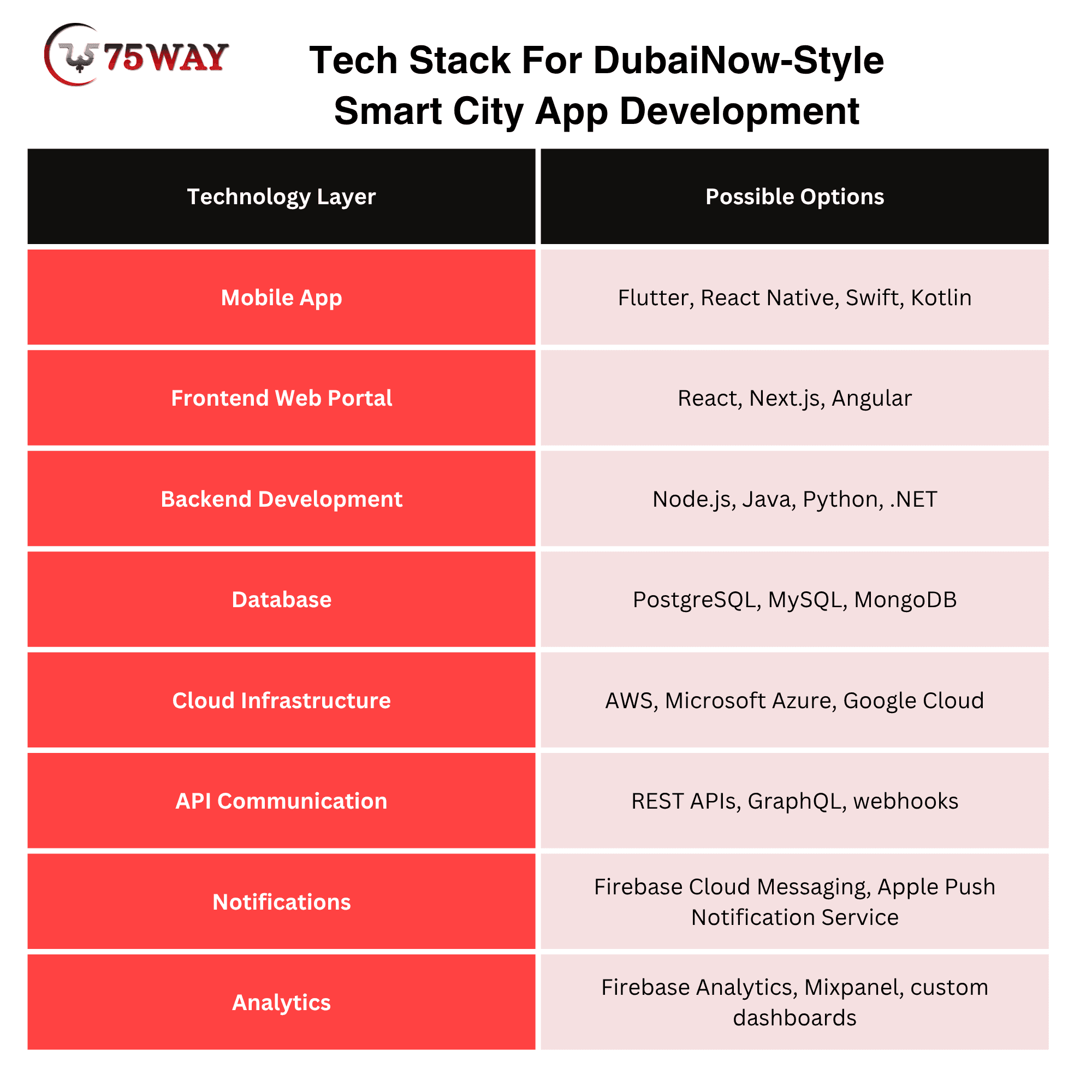
These are technology options, not mandatory choices. The final selection should depend on the team's experience, integration requirements, expected traffic, security needs, and long-term maintenance plan.
Step 5: Develop The Backend And API Integrations
The backend connects the mobile application with its database, service providers, payment systems, and administrative tools.
For a multi-service app, the architecture should keep individual service modules separate while allowing them to communicate through controlled APIs.
For example, a payment module should manage payment requests and transaction records, while a service-request module handles submissions, assignments, and status updates.
Dubai's developer portal provides information about available digital government APIs and enablers, including UAE PASS and DubaiPay. However, businesses must confirm access conditions, provider eligibility, technical documentation, approvals, and service agreements before relying on any official integration.
Step 6: Integrate Payments And Identity Verification
Payment and identity features need careful planning because they involve sensitive user information and transaction records.
Choose a payment provider that supports your business model and intended transaction types. Confirm settlement processes, supported payment methods, refund handling, fees, and compliance requirements.
For identity verification, assess whether UAE PASS is available and suitable for your application. Its developer resources provide service-provider enrollment information and integration toolkits.
Do not build the product around an assumed government integration. First confirm that the required service can be accessed by your organization.
Step 7: Test The Application Before Launch
Testing should cover more than whether each button works. A service platform must handle different user roles, payment outcomes, external API failures, and incomplete requests.
Your QA process should include:
- Functional testing of every service journey.
- Payment success, failure, and refund scenarios.
- API response and timeout testing.
- Arabic and English interface testing.
- Security and access-control testing.
- Performance testing under expected traffic.
- Device and operating-system compatibility testing.
Also test what happens when an external service provider is unavailable. The application should communicate the issue clearly rather than showing a misleading success message.
Step 8: Launch, Monitor, And Expand
Start with a controlled launch involving a limited service catalogue or selected partner group. Monitor how users discover services, complete transactions, and seek support.
Review app crashes, payment failures, incomplete requests, customer feedback, and service response times. Use this information to improve the experience before adding more categories.
Once the initial service journeys work reliably, expand through additional partners and features.
Security & Compliance Considerations To Create App Like DubaiNow App For The UAE Market
Security is a core requirement for an application that handles identity information, payments, personal documents, and service requests.
The UAE's Federal Decree-Law No. 45 of 2021 on the Protection of Personal Data establishes a framework for processing personal data and protecting individual privacy. Its requirements include controls around data processing, confidentiality, and cross-border transfers.
The law also has specific scope and exclusions, so businesses should assess the rules applicable to their entity and sector rather than treating one law as the only compliance requirement.
Important safeguards include:
- Encrypt sensitive data in transit and at rest.
- Apply role-based access controls.
- Use secure authentication and session management.
- Maintain audit logs for sensitive activities.
- Collect only the information required for each service.
- Establish data retention and deletion procedures.
- Review third-party vendors and integration permissions.
- Conduct security assessments before major releases.
If the app handles healthcare, financial, government, or other regulated information, additional sector-specific requirements may apply. Take legal and compliance advice before launch.
How Much Does It Cost To Build An App Like DubaiNow?
One of the first things you'll want to figure out is how much development will cost. On average, building a DubaiNow-style app can cost between AED 25,000 and AED 450,000+, depending on its features, integrations, and complexity. For planning purposes, the following are estimated development ranges for a commercial DubaiNow-inspired application.
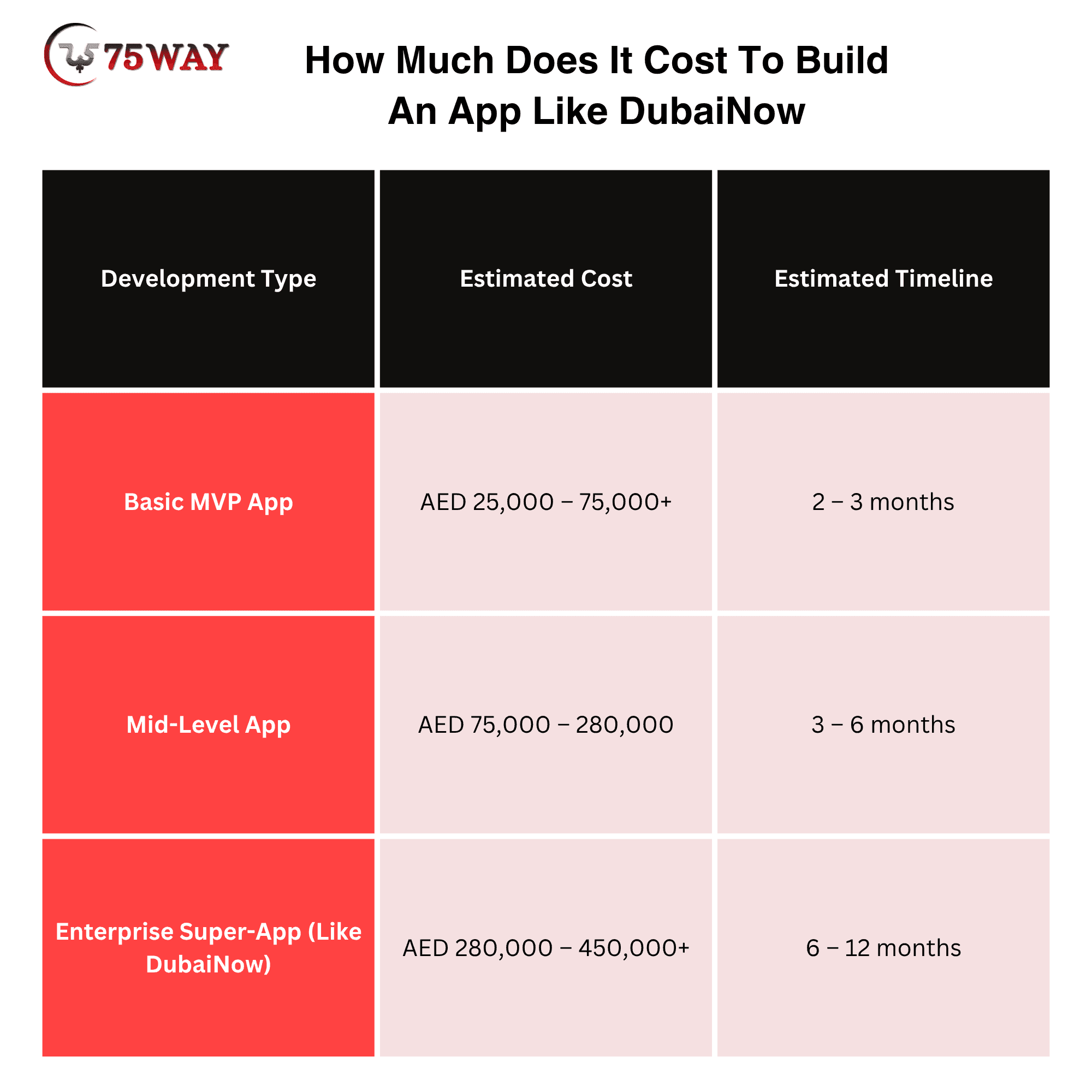
Basic MVP App: AED 25,000 – 75,000+
- Includes essential services, login, payments, and notifications.
- Suitable for validating demand before broader expansion.
Mid-Level App: AED 75,000 – 280,000
- Adds multiple service categories, dashboards, and integrations.
- Supports stronger administration, reporting, and user personalization.
Enterprise Super-App: AED 280,000 – 450,000+
- Includes complex workflows, integrations, security, and scalability.
- Designed for large user bases and operations.
What Factors Affect The DubaiNow Clone App Development Cost?
- Number of Service Categories: Each additional category may require new screens, workflows, backend logic, and provider integrations.
- Third-Party Integrations: Payment gateways, identity services, and external provider APIs can increase development and testing effort.
- UI/UX Complexity: Multilingual interfaces, Arabic right-to-left layouts, accessibility, and personalized dashboards require additional design and testing.
- Security Requirements: Sensitive data, identity verification, audit trails, and compliance controls add engineering and assessment work.
- Scalability And Infrastructure: Larger user volumes and high transaction activity may require more advanced cloud architecture and monitoring.
- Maintenance And Updates: Ongoing support, security patches, operating-system updates, and new integrations should be included in the long-term budget.
Common Challenges When Developing A DubaiNow-Style Application
A connected services app can create a convenient experience, but managing several service providers introduces technical and operational challenges.
1. Getting Access To External Services
Not every service provider offers a public API or allows unrestricted integration. Some integrations require technical assessments, business agreements, approvals, or specific eligibility conditions.
How to address it: Confirm integration access before finalizing the product roadmap. Build the first release around services you can legally and technically support.
2. Managing Different Service Workflows
A payment request, property maintenance booking, document submission, and appointment reservation do not follow the same process.
How to address it: Create separate service modules with shared account, notification, and support capabilities. This keeps workflows manageable as the platform grows.
3. Protecting Sensitive Information
A multi-service application may handle personal details, payment records, identity information, and uploaded documents.
How to address it: Apply data minimization, encryption, access controls, security testing, and clear retention policies from the beginning.
4. Maintaining A Simple User Experience
A large service catalogue can overwhelm users when categories, labels, and navigation are not planned carefully.
How to address it: Organize services around user tasks, highlight frequently used actions, and test the interface with Dubai-based users.
5. Handling Third-Party Downtime
The app may depend on external systems for payments, verification, bookings, or service updates. If one provider becomes unavailable, the user journey can be interrupted.
How to address it: Add timeout handling, retry rules, transaction reconciliation, and clear status messages. Never show a completed transaction until the relevant system confirms it.
How 75way Technologies Can Help You Build A Multi-Service App-Like DubaiNow
75way Technologies helps businesses turn their DubaiNow-like app ideas into practical digital platforms designed around Dubai's service needs. Our team can plan an application that brings multiple services, user accounts, payments, and service requests together in one place.
From UI/UX design and mobile app development to backend architecture and third-party API integrations, we manage the key stages of development. We also consider Arabic and English language support, secure user access, and the specific requirements of the UAE market.
Whether you want to connect property services, bill payments, bookings, or business support, we can help define the right features and development roadmap. Our focus is to build a platform that is easy to use today and ready to accommodate new services as your business grows.
Conclusion
To wrap up, building an app like DubaiNow is an opportunity to create a connected digital experience around the everyday needs of Dubai residents and businesses. However, the success of such a platform depends on choosing the right service categories, securing reliable integrations, protecting user information, and making every journey simple to complete.
A focused MVP is a practical starting point for businesses that want to validate demand before investing in a larger super app. With the right development strategy, technology architecture, and local partnerships, the platform can expand as its users and service network grow.
To build a multi-service app like DubaiNow for the Dubai market, you can connect with a reliable on-demand app development company to discuss your idea, development requirements, and project estimate.
Frequently Asked Questions (FAQs)
How Much Does It Cost To Build An App Like DubaiNow?
A DubaiNow-inspired application may cost AED 25,000 – 450,000+ depending on its complexity. A basic MVP may take 2–3 months, while an enterprise-level platform can take 6–12 months or longer.
How Long Does It Take To Develop A DubaiNow-Like App?
A basic MVP may take 2–3 months. A mid-level application may require 3–6 months, while an enterprise platform with several integrations may take 6–12 months. Actual timelines depend on scope, approvals, and external dependencies.
Can A Private Company Integrate UAE PASS Into Its App?
Private organizations can explore UAE PASS integration by following the service-provider enrollment process. Access to its developer toolkit, technical flows, and integration capabilities is subject to the applicable requirements and agreements.
Is DubaiPay Available For Private Applications?
DubaiPay is a shared payment service associated with government entities and service providers. A business should contact the relevant authority to confirm its eligibility, onboarding process, and integration requirements.
Which Features Should An MVP Include?
An MVP can include user registration, a service catalogue, service requests, payment integration where required, notifications, customer support, and an admin panel. The exact scope should reflect the first target audience.
Does A DubaiNow-Like App Need Arabic Language Support?
Arabic support is strongly worth considering for an application targeting Dubai users. The interface should account for right-to-left layouts, Arabic typography, translated content, and language switching across key user journeys.
Can AI Be Integrated Into A Multi-Service Application?
Yes. AI can support conversational search, service recommendations, customer support, document classification, and automated assistance. Sensitive actions such as payments, identity verification, and official submissions should still follow verified workflows and user authorization.
How Can A Business Start Building An App Like DubaiNow?
Start by identifying a specific user problem, selecting the first service categories, validating integration access, and preparing an MVP roadmap. Then work with an experienced development team to plan the design, architecture, budget, and launch process.