
AI Summary
An AI tax app can be profitable in the UAE if it solves VAT, Corporate Tax, and e-invoicing problems. This guide examines demand, customers, revenue models, development costs, compliance risks, and viability. Founders can assess opportunities before investing.
Key Takeaways
- UAE tax digitization creates opportunities for AI-powered compliance software.
- VAT and Corporate Tax automation address recurring business requirements.
- SMEs, enterprises, and accounting firms represent potential paying customers.
- SaaS subscriptions and enterprise licensing create recurring revenue opportunities.
- Regulatory compliance, development investment, and retention influence long-term profitability.
If you're planning to launch a fintech product in the UAE, an AI tax app is an idea worth looking into. Think about how many businesses need help tracking VAT, understanding corporate tax obligations, organizing invoices, and preparing financial reports.
Now imagine offering these services through one application that can automate calculations and answer tax-related questions. The opportunity comes from a practical business need. UAE companies, freelancers, and accounting professionals need reliable ways to manage tax responsibilities without spending hours on repetitive financial tasks.
AI features such as automated expense categorization, document scanning, tax estimates, and conversational assistance can make these processes easier to manage.
Of course, market demand alone doesn't guarantee profitability. Your app needs the right features, a clear pricing strategy, accurate tax logic, and compliance with UAE regulations. So, before investing in AI tax app development, let's look at the business potential, estimated costs, revenue models, and challenges involved in launching an AI tax app in the UAE.
Is AI-Powered Tax App Development Profitable In UAE?
Yes, AI tax app development can be a profitable opportunity in the UAE, especially as companies adapt to Corporate Tax, VAT, and mandatory e-invoicing. Many still rely on manual records and disconnected accounting tools, creating demand for smarter tax solutions.
The real opportunity lies in solving everyday compliance challenges. Features such as automated tax calculations, invoice processing, Arabic and English document recognition, and tax liability forecasting can help attract startups, SMEs, accounting firms, and larger enterprises.
Revenue can come from monthly subscriptions, premium features, enterprise plans, and accounting software integrations. However, long-term profitability depends on development costs, regulatory accuracy, customer trust, and the ability to offer features that existing accounting platforms do not fully address.
What Makes The UAE A Distinct Market For AI Tax Platforms?
The UAE has a tax environment that requires more than standard calculation and filing tools. VAT, corporate tax, free zone regulations, and digital compliance requirements create specific needs that AI tax platforms must address. Let's explore the market conditions that make the UAE a distinct opportunity for AI tax app development.
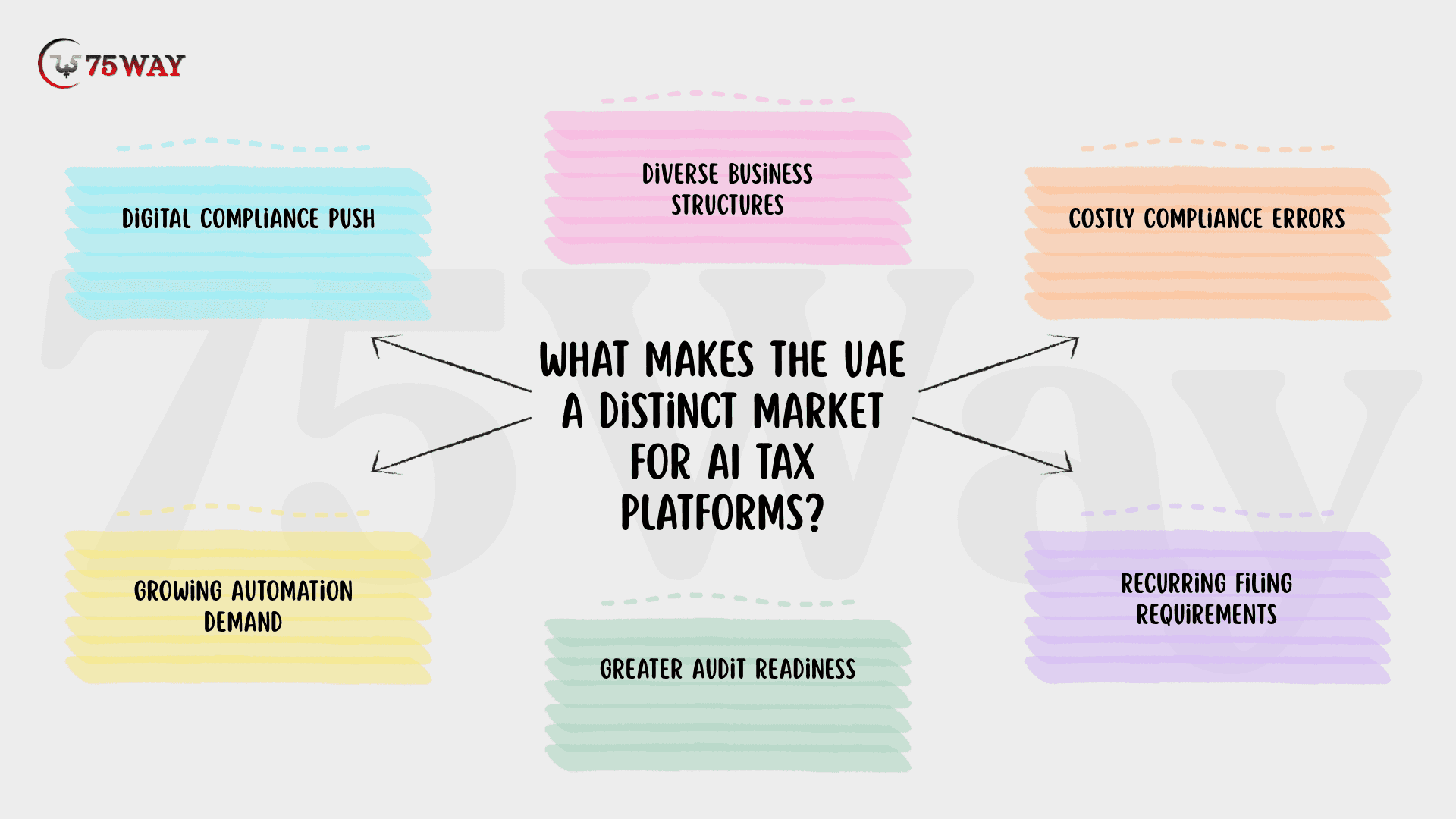
- Digital Compliance Push
The UAE government continues to expand digital services across taxation and financial administration. Businesses need accurate records, structured information, and traceable transactions to meet reporting requirements. AI can help organize financial data, identify missing details, and prepare records according to applicable Federal Tax Authority rules.
- Diverse Business Structures
Mainland companies, Free Zone entities, and international operations can face different tax requirements. A single approach may not suit every organization. AI tax platforms can support different tax treatments, assess relevant transactions, and help users manage requirements based on their business activities.
- Costly Compliance Errors
Incorrect VAT classification, reverse charge treatment, or Free Zone income reporting can result in additional liabilities and potential penalties. Businesses need more than basic tax calculations. AI tools can flag unusual entries, explain calculation results, and identify records that require professional review.
- Recurring Filing Requirements
VAT returns, Corporate Tax obligations, and upcoming e-invoicing requirements involve regular financial administration. Companies need software that supports these activities throughout the year. This recurring demand also creates opportunities for subscription-based platforms offering reporting, document management, and tax monitoring.
- Greater Audit Readiness
Businesses need reliable calculations and organized records when responding to tax reviews. Applications with transparent tax calculations, detailed activity logs, and accessible supporting documents can make record verification easier. These capabilities can also help build user confidence in an AI tax platform.
- Growing Automation Demand
Finance teams often spend considerable time reviewing invoices, entering transaction details, and matching financial records. AI can reduce repetitive manual work through document recognition, automated categorization, and data analysis. This creates an opportunity for platforms that save time while keeping important financial decisions open to human review.
Key Capabilities That Make AI Tax Apps Valuable In The UAE
A business owner shouldn't have to open five different tools to manage invoices, check tax estimates, and organize financial records. That's where AI tax apps can offer real value by bringing document processing, expense categorization, tax calculations, and compliance assistance into one platform. Here are the capabilities worth prioritizing when developing an AI tax app for the UAE market.
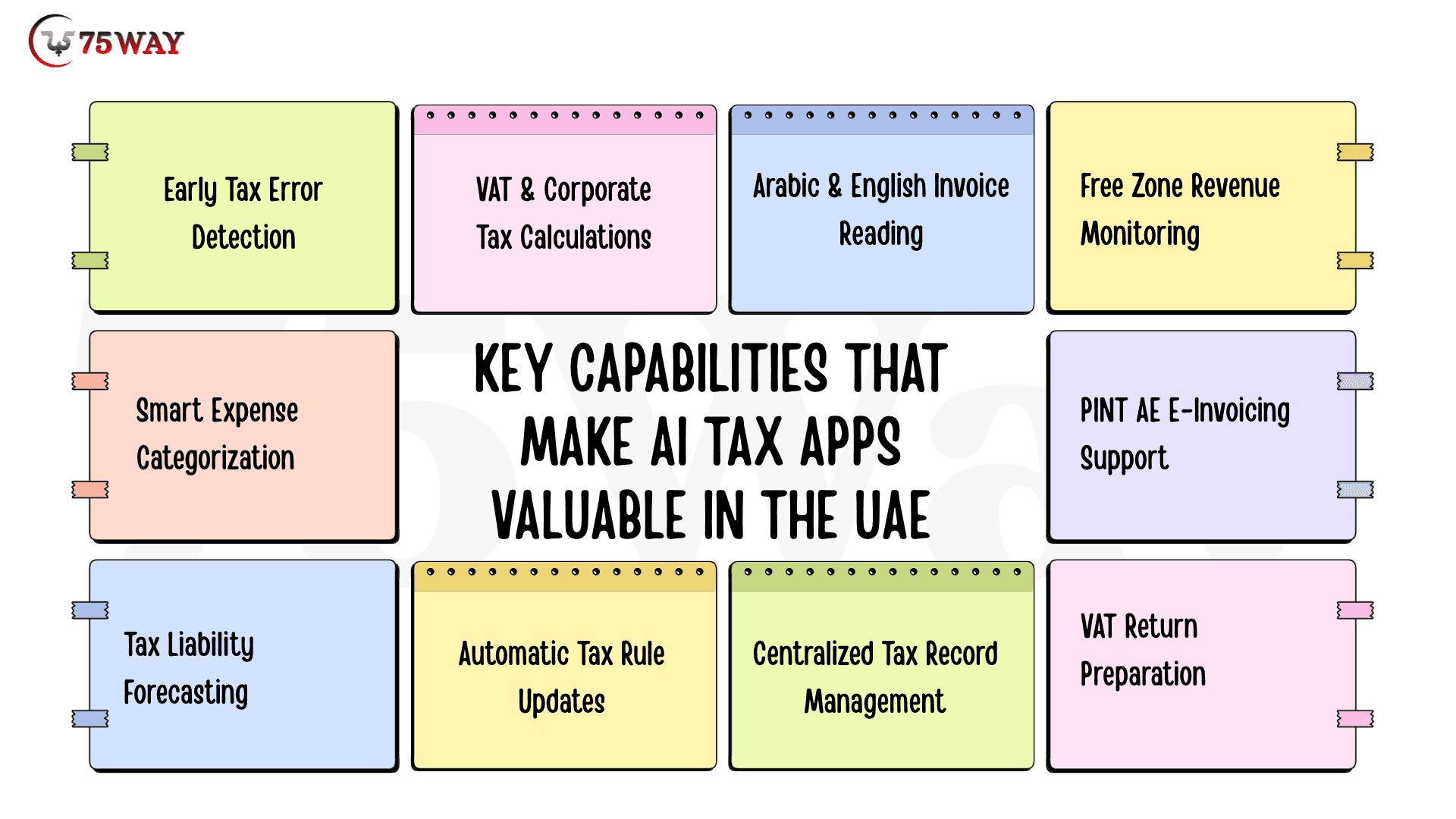
- Early Tax Error Detection: A missing invoice detail or incorrect tax entry can create filing problems. AI can review financial records, detect unusual transactions, and alert users when something needs attention.
- VAT & Corporate Tax Calculations: UAE tax requirements involve different rules for VAT and Corporate Tax. An AI tax engine can check input VAT recovery, identify eligible Corporate Tax deductions, and apply relevant restrictions, including the 50% deduction limit for qualifying entertainment expenses.
- Arabic & English Invoice Reading: Invoices may arrive in Arabic, English, or different digital formats. AI document recognition can extract supplier names, invoice dates, tax amounts, and other important details without requiring users to enter every figure manually.
- Free Zone Revenue Monitoring: Qualifying Free Zone Persons must monitor their non-qualifying revenue to maintain their tax status. An AI application can track this amount against the de minimis threshold, generally the lower of 5% of total revenue or AED 5 million, and send alerts when the limit is approached.
- PINT AE E-Invoicing Support: The UAE's e-invoicing framework requires structured digital invoice data. An AI tax platform can validate invoice details and prepare PINT AE-compliant information for exchange through an approved service provider.
- VAT Return Preparation: VAT return preparation involves reviewing transactions, checking tax amounts, and organizing supporting records. AI tax app can classify entries, calculate relevant figures, and prepare VAT 201 information for review before submission through the appropriate channel.
- Centralized Tax Record Management: A missing invoice can take time to locate when records are scattered across emails and spreadsheets. A centralized dashboard can keep invoices, receipts, tax calculations, and transaction histories together for easy access.
- Automatic Tax Rule Updates: Tax regulations can change, and outdated calculations may create compliance risks. A regularly maintained tax engine can incorporate verified updates and help users apply the relevant rules to new transactions.
- Tax Liability Forecasting: Unexpected tax payments can affect financial planning. AI can analyze income, expenses, and previous tax records to estimate upcoming liabilities and help users prepare their budgets.
- Smart Expense Categorization: Large transaction volumes can make manual expense classification difficult. AI can suggest suitable categories, recognize recurring payments, and flag entries that require an accountant's review.
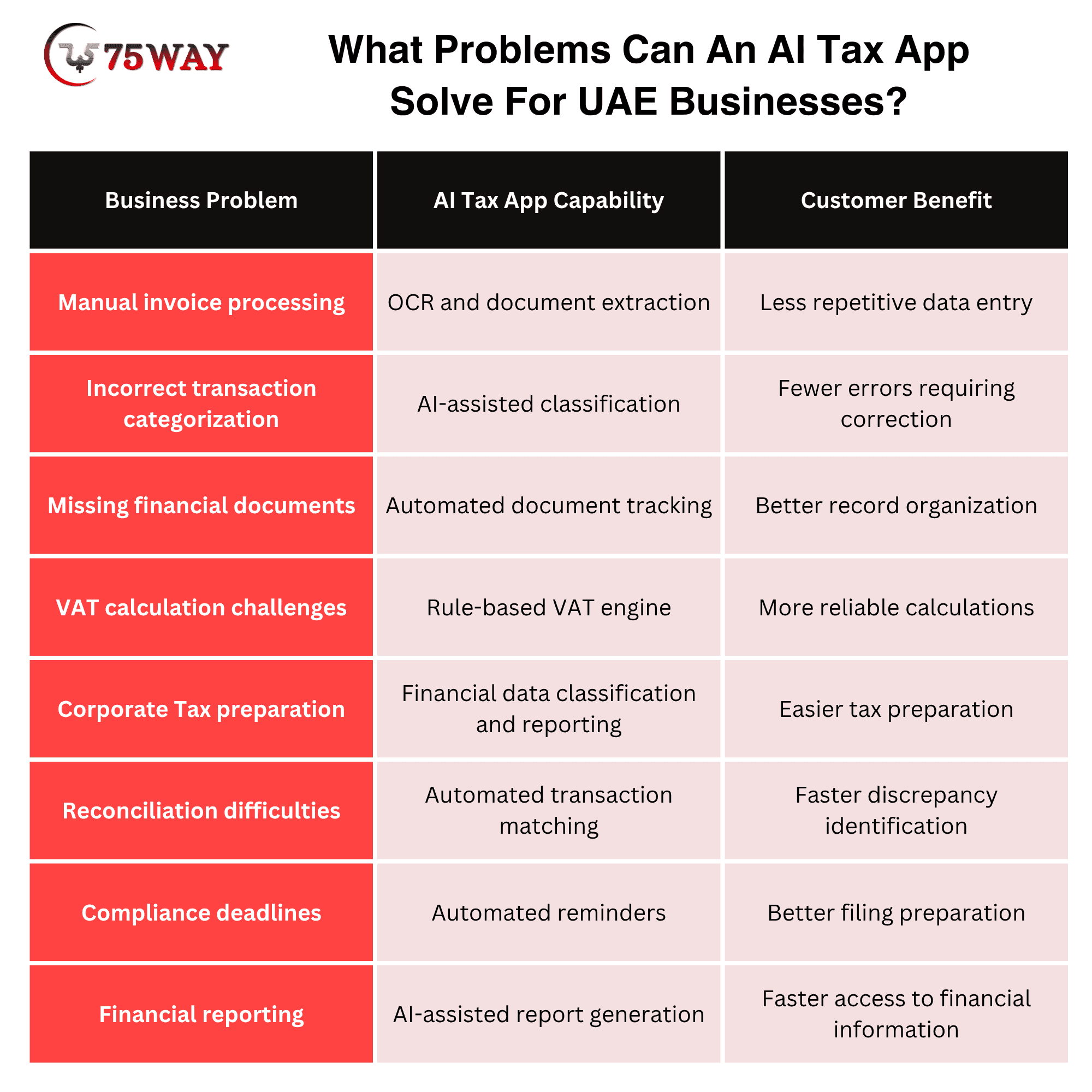
What Problems Can An AI Tax App Solve For UAE Businesses?
The profitability of a tax application depends on the problems it solves and how frequently customers experience them.
A product that only calculates VAT may struggle to justify a premium subscription. However, an application that reduces repetitive finance work and helps businesses organize their compliance processes can deliver greater ongoing value.
Consider these use cases:
How Does an AI-Powered App Process A Tax Invoice?
Consider a UAE-based company receiving hundreds of supplier invoices each month. Without automation, its accounting team may need to open individual documents, extract the information, enter transaction details, and assign accounting categories. An AI tax application can simplify this workflow:
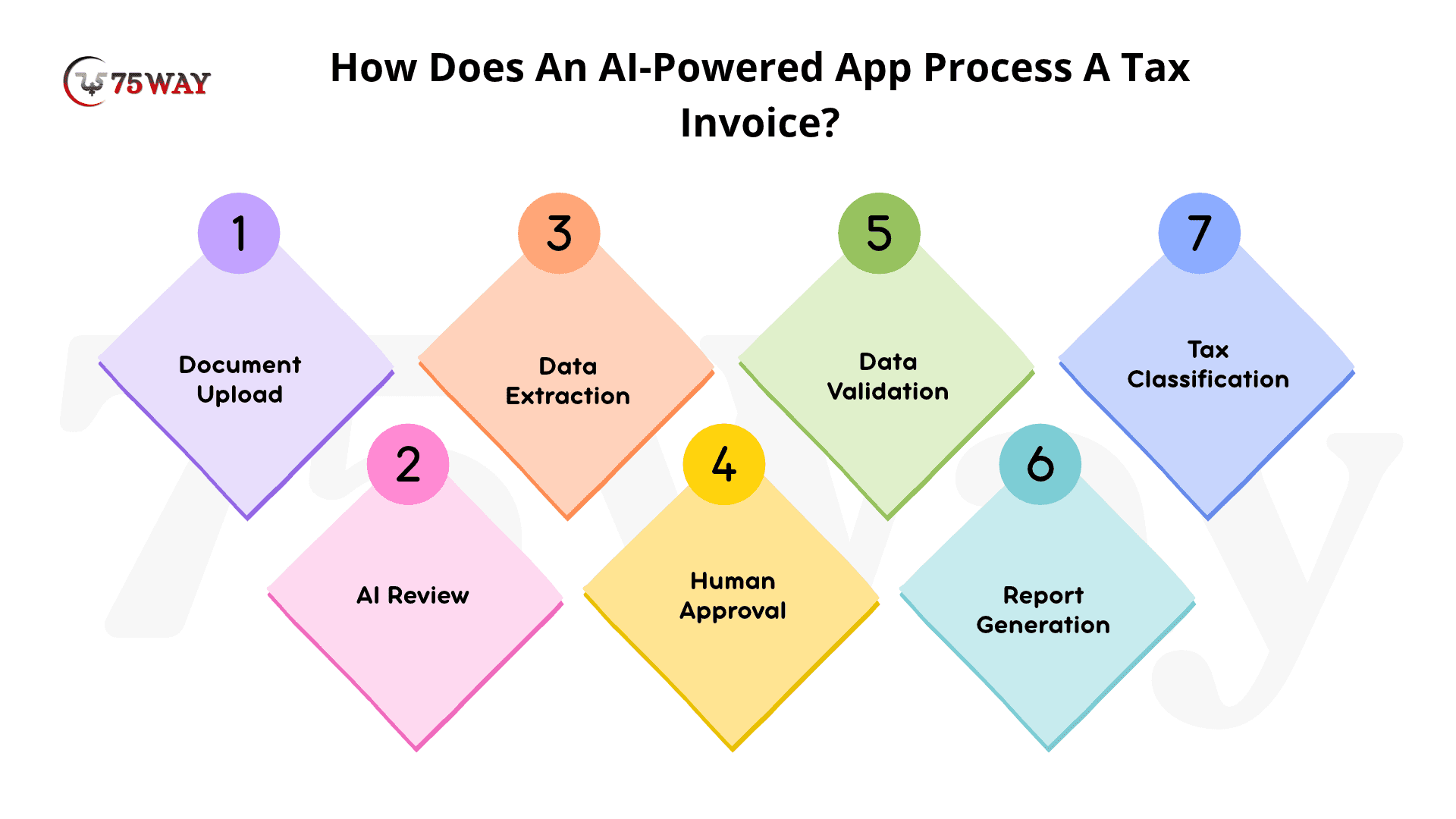
- Document Upload
The user uploads an invoice through the application or connects an approved document source.
- Data Extraction
OCR and document intelligence extract supplier details, invoice numbers, dates, amounts, and tax information.
- Data Validation
The system checks required fields, mathematical calculations, and inconsistencies.
- Tax Classification
A rules engine evaluates the transaction against the applicable UAE tax rules.
- AI Review
An AI model identifies unusual entries and explains potential issues.
- Human Approval
An accountant reviews uncertain or high-risk transactions before approval.
- Report Generation
The application prepares organized records and reports for further accounting or tax workflows.
This combination of AI and deterministic tax rules is more reliable than asking a general-purpose language model to calculate taxes independently.
For founders, the commercial value comes from reducing the time spent on repetitive work while keeping important tax decisions traceable.
Who Will Pay For An AI Tax Application In The UAE?
Identifying paying customers is more important than simply estimating how many businesses might use the application.
Different customer groups have different requirements, budgets, and purchasing decisions.
1. Small And Medium-Sized Businesses
SMEs are a potential customer segment because many need accounting support without maintaining large internal finance departments.
Their requirements may include:
- VAT calculations and return preparation.
- Expense and invoice tracking.
- Corporate Tax reporting support.
- Financial document organization.
- Compliance deadline notifications.
A simple subscription-based application can serve this segment if its onboarding process is straightforward and its pricing reflects the customer's transaction volume.
2. Accounting And Tax Consultancy Firms
Accounting firms represent an attractive B2B opportunity because one firm may manage financial information for several clients.
A specialized platform can provide:
- Multiple client accounts.
- Centralized document management.
- Bulk invoice processing.
- Review and approval workflows.
- Client-level compliance dashboards.
- Consolidated reporting.
Instead of selling one subscription to each individual business, the software provider can offer practice-management plans to accounting firms.
3. Large Enterprises
Larger companies typically have more complicated financial workflows, multiple departments, and existing ERP systems.
They may require:
- Enterprise resource planning integrations.
- Multi-entity tax reporting.
- Role-based access controls.
- Audit trails.
- Advanced transaction monitoring.
- Custom reporting.
- Dedicated support and service-level agreements.
This segment can generate higher contract values, although enterprise sales cycles and implementation requirements are usually more demanding.
4. Startups And Free Zone Businesses
Startups and Free Zone companies can also become potential users, especially when they need support organizing financial records and understanding their tax obligations.
Their requirements may include entity-level reporting, document management, expense categorization, and Corporate Tax preparation.
However, founders should avoid treating every Free Zone company as having identical tax obligations. Qualifying Free Zone Person status and the treatment of income depend on specific legal conditions.
5. Freelancers And Independent Professionals
Freelancers and independent professionals may need simple tools for expense tracking, invoice management, and tax-related record organization.
A low-cost subscription with limited features can serve this audience.
However, product owners must distinguish between individuals carrying on business activities and employees receiving employment income. Their tax obligations are not necessarily the same.
AI Technologies That Are Required To Develop A Tax Application
A tax application needs to do more than process numbers. It must read financial documents, recognize transaction patterns, and provide useful tax-related insights. Technologies such as machine learning, natural language processing, optical character recognition, and generative AI make these capabilities possible.
1. Optical Character Recognition (OCR)
OCR technology extracts text from invoices, receipts, statements, and other financial documents.
It can identify information such as:
- Supplier names and tax registration numbers.
- Invoice dates and reference numbers.
- Taxable amounts.
- VAT amounts.
- Total invoice values.
- Currency details.
Document extraction should include confidence scores and validation checks because poor scans, handwritten information, and inconsistent layouts can affect accuracy.
2. Large Language Models (LLMs)
LLMs can power the application's conversational tax assistant.
For example, a business owner could ask:
"Why does this invoice have a different VAT amount from the previous one?"
The AI assistant can retrieve relevant transaction information, explain possible reasons, and identify the applicable tax rules for further review.
However, an LLM should not independently determine legal tax liability or submit unverified calculations.
3. Retrieval-Augmented Generation (RAG)
RAG allows an AI assistant to retrieve information from an approved knowledge base before generating an answer.
For a UAE tax application, this knowledge base may contain:
- Federal Tax Authority guidance.
- Corporate Tax legislation.
- VAT regulations.
- Ministry of Finance publications.
- Approved internal compliance documentation.
The application should track the source, publication date, and applicable version of the retrieved information.
This is particularly important because tax rules and administrative decisions can change.
4. Machine Learning And Anomaly Detection
Machine learning can identify unusual financial patterns, repeated transactions, unexpected amounts, and potentially duplicated invoices.
For example, an application may flag two invoices with similar supplier details, dates, and amounts.
The system should present such findings as alerts for investigation, not automatically label every unusual transaction as fraud.
5. Rule-Based Tax Engine
A tax engine is one of the most important components of the application.
It should handle calculations and eligibility checks using verified rules rather than relying on probabilistic AI responses.
For example, the engine can apply configured VAT rates, evaluate registration thresholds, and calculate Corporate Tax using the relevant tax period and applicable legislation.
The engine should also support versioning so that changes in tax rules do not silently alter historical calculations.
The final technology selection depends on the application's data volume, security requirements, integration needs, and deployment model.
UAE Tax Challenges That Create Opportunities For AI Solutions
The UAE tax system brings several responsibilities that require accurate financial records, careful calculations, and regular reporting. Corporate Tax, Free Zone regulations, VAT, and transfer pricing can make compliance difficult, particularly for companies managing large transaction volumes. These challenges create opportunities for AI applications that simplify tax processes and help finance teams make informed decisions.
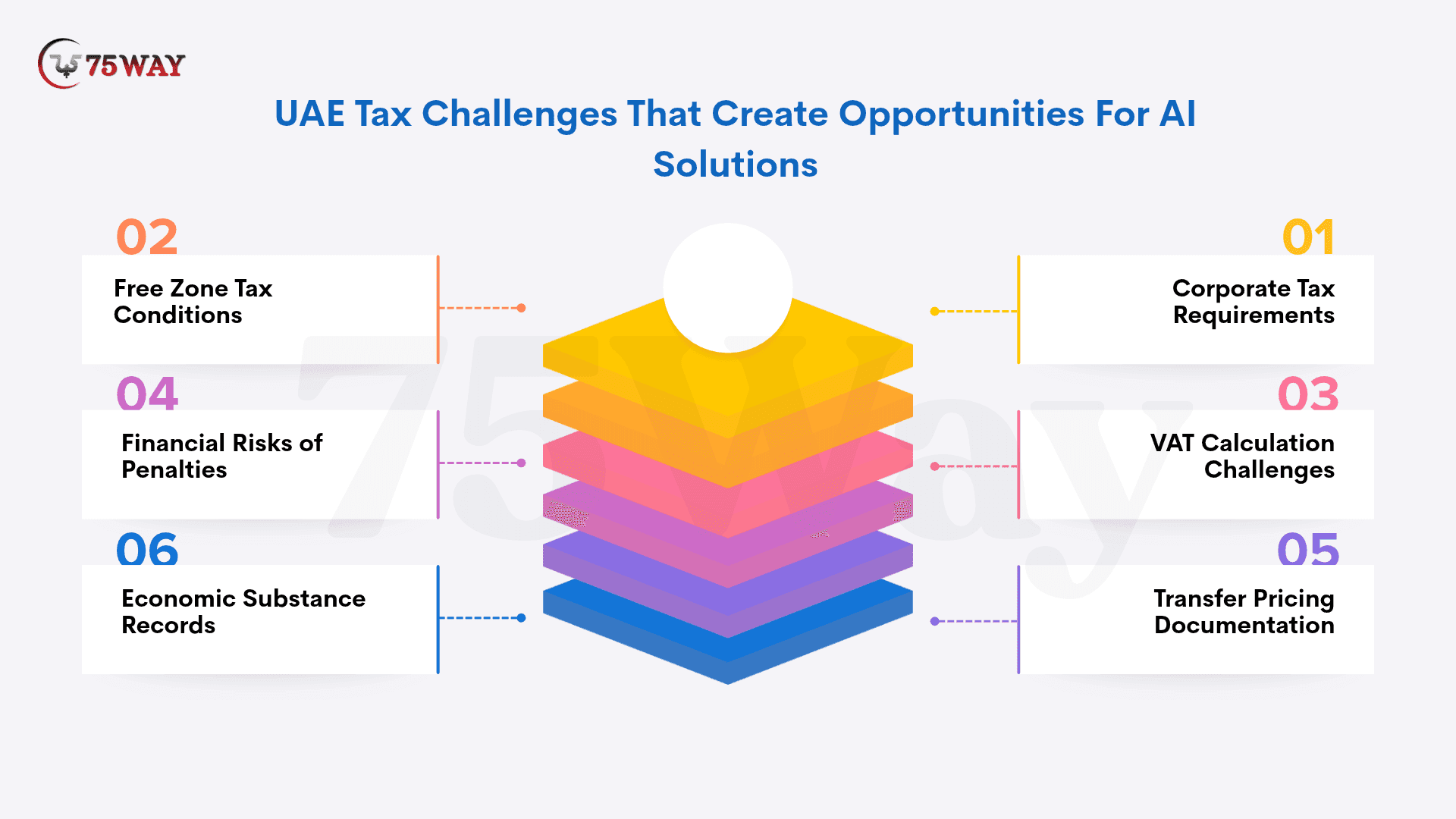
1. Corporate Tax Requirements
The introduction of Federal Corporate Tax for financial years beginning on or after June 1, 2023, changed how companies manage their financial reporting. Organizations must now understand their taxable income, identify applicable exemptions, and meet registration and filing requirements.
The standard Corporate Tax rates are:
- 0% on taxable income up to AED 375,000.
- 9% on taxable income exceeding AED 375,000.
Calculating taxable income involves more than applying a tax rate to annual profits. Companies must distinguish taxable and exempt income, account for allowable deductions, review realized and unrealized gains or losses under applicable rules, and assess available tax relief options.
How AI Helps: An AI tax application can organize income and expense records, identify transactions that need further classification, estimate taxable income, and track important filing dates. Accountants can review flagged entries before final calculations and submissions.
2. Free Zone Tax Conditions
Free Zone companies can qualify for a 0% Corporate Tax rate on qualifying income, but they must satisfy specific conditions. These include maintaining adequate substance, earning qualifying income, following transfer pricing requirements, and meeting the prescribed de minimis test.
Under this test, non-qualifying revenue must generally remain within the lower of:
- 5% of total revenue.
- AED 5 million.
A Qualifying Free Zone Person that fails the applicable conditions can lose its qualifying status for the relevant tax period and the following four tax periods.
How AI Helps: An AI platform can classify revenue by source, monitor transactions with different customer categories, and calculate the non-qualifying revenue ratio. Automated alerts can help users identify potential threshold breaches and review transactions before they affect their tax position.
3. VAT Calculation Challenges
Value Added Tax (VAT) has been applied in the UAE since January 2018 at a standard rate of 5%. However, the correct treatment depends on the type of supply, transaction location, and applicable tax rules.
Companies must pay attention to several areas:
- Place of Supply: The location of the supplier, customer, or service can determine the applicable VAT treatment.
- Input VAT Recovery: Businesses must check whether an expense qualifies for VAT recovery and whether any restrictions apply.
- Reverse Charge Mechanism: Certain purchases from overseas suppliers require the UAE recipient to account for VAT.
- Return Reconciliation: VAT figures must match relevant invoices, accounting entries, and supporting records.
How AI Helps: AI applications can extract invoice details, suggest VAT classifications, identify missing information, and compare transaction records with return figures. These checks can help finance teams identify discrepancies before submitting VAT returns.
4. Financial Risks of Penalties
Tax errors can affect a company's finances and create additional administrative work. The UAE has established penalties for violations such as late registration, delayed returns, incorrect declarations, and failure to maintain required records.
For example, late Corporate Tax registration can attract an administrative penalty of AED 10,000. Delayed Corporate Tax return submissions and payments can also result in penalties under the applicable rules.
How AI Helps: Tax applications can track filing deadlines, send timely reminders, identify incomplete records, and flag unusual calculations. These features help users address potential issues before they develop into more serious compliance problems.
5. Transfer Pricing Documentation
Companies that conduct transactions with related parties or connected persons must follow the arm's length principle. This means their transaction terms should be comparable to those agreed between independent parties under similar circumstances.
Depending on applicable conditions and thresholds, companies may need to prepare:
- Master File: Information about the multinational group's structure, operations, and transfer pricing policies.
- Local File: Details of local operations, related party transactions, and supporting analysis.
- Disclosure Form: Relevant information about related party transactions submitted with the Corporate Tax return.
- Country-by-Country Report: Additional reporting for multinational groups that meet the applicable requirements.
How AI Helps: AI can organize intercompany transaction records, compare pricing information, identify unusual differences, and collect financial details for transfer pricing documentation. Tax professionals can then review the analysis and confirm whether the transactions meet the required standards.
6. Economic Substance Records
Economic Substance Regulations (ESR) previously required certain UAE entities conducting relevant activities to demonstrate adequate economic presence in the country. These requirements covered business activities, employees, assets, and operating expenditure.
However, ESR reporting requirements were cancelled for financial years ending after December 31, 2022. Historical reporting obligations and outstanding requests may still need attention.
How AI Helps: AI document management tools can organize historical information about employees, assets, expenditure, and business activities. Similar capabilities can also support current Corporate Tax recordkeeping and other applicable reporting responsibilities.
How Much Does It Cost To Develop An AI Tax App In The UAE?
The cost of AI tax app development depends on the number of features, AI capabilities, integrations, security requirements, and complexity of the tax workflows.
A basic tax calculator requires less development work than a multi-tenant SaaS platform that processes financial documents, integrates with accounting systems, and supports electronic invoicing.
For business planning, the following are illustrative development budgets based on the scope of a custom software project.
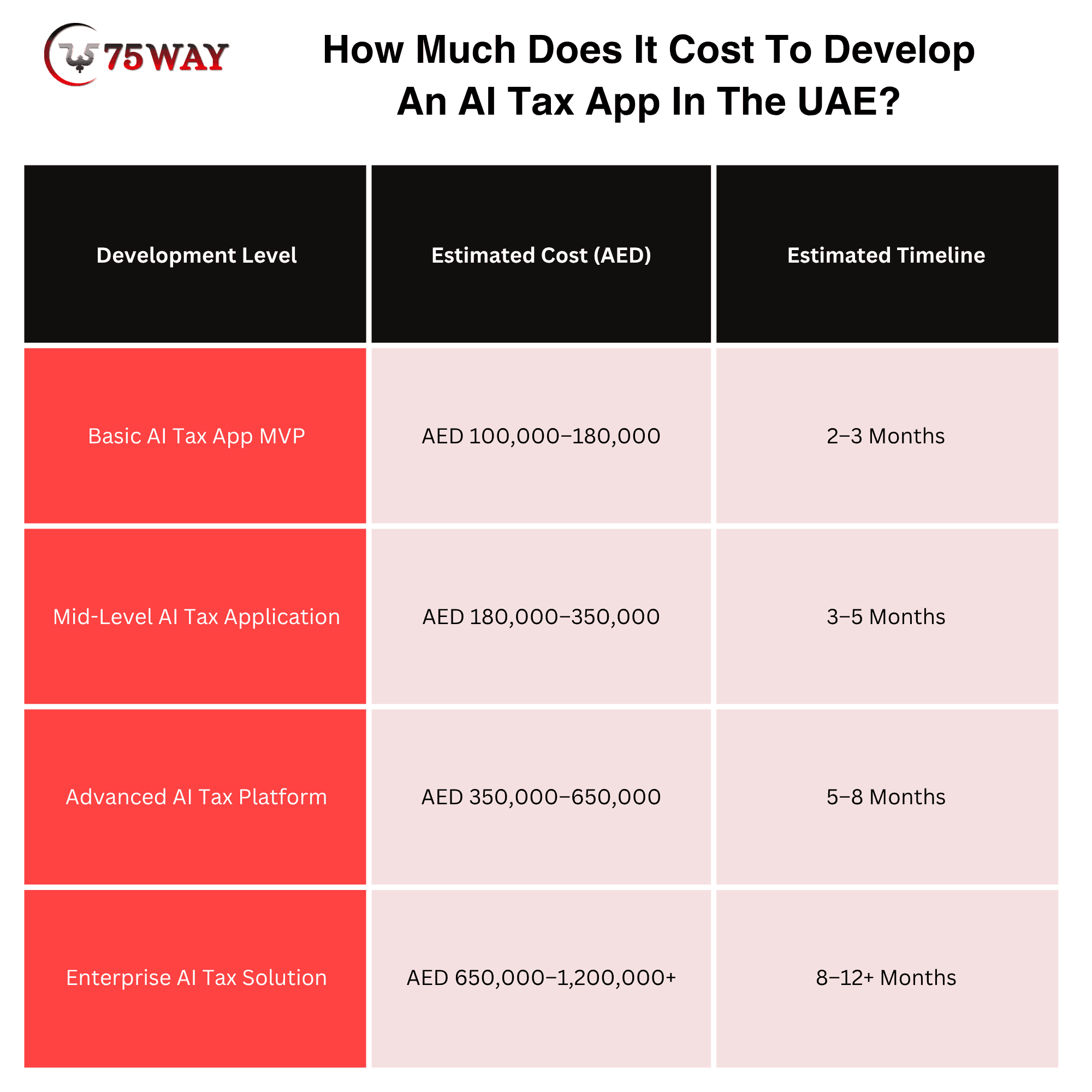
These are planning estimates, not supplier quotations or verified market averages. Actual budgets depend on the project specification, development location, integrations, and compliance requirements.
Revenue Models That Make An AI Tax Mobile App Profitable
A good revenue model should match how customers use the application and the financial value it provides.
For UAE-focused AI tax software, subscription-based pricing is a strong starting point because tax and accounting activities recur throughout the year.
However, founders should evaluate multiple monetization options.
1. Monthly And Annual SaaS Subscriptions
Businesses pay a recurring fee to access the application.
For example:
- Starter Plan: AED 99–199 per month
- Professional Plan: AED 299–499 per month
- Business Plan: AED 699–999 per month
- Enterprise Plan: Custom pricing
These are proposed pricing tiers for business modeling, not established market averages.
Subscription plans can be differentiated by invoice volume, number of company profiles, AI usage, reporting features, and user accounts.
2. Pay-Per-Use Pricing
Customers pay according to the number of documents, invoices, or transactions processed.
For example, a business could purchase additional invoice-processing credits when it exceeds its monthly subscription limit.
This model can help startups monetize customers with irregular transaction volumes.
However, AI inference and OCR costs must be monitored carefully to protect margins.
3. Enterprise Licensing
Large organizations can pay annual licensing fees for access to advanced features, custom integrations, and dedicated support.
This model is suitable for companies with multiple entities, complex reporting requirements, and larger finance teams.
It can generate higher contract values, but enterprise onboarding and sales cycles require additional resources.
4. Accounting Firm Partnerships
Accounting firms can purchase a multi-client subscription and use the application to manage financial workflows for their customers.
For example, a software company could charge according to the number of active client accounts managed by each accounting firm.
This approach can help acquire several business customers through one partnership.
5. API-Based Monetization
An AI tax application can offer APIs that allow other financial platforms to access specific capabilities.
Potential paid services include:
- Invoice data extraction.
- VAT calculation.
- Expense classification.
- Financial document validation.
- Tax-related reporting.
API pricing can be based on requests, document volume, or monthly usage commitments.
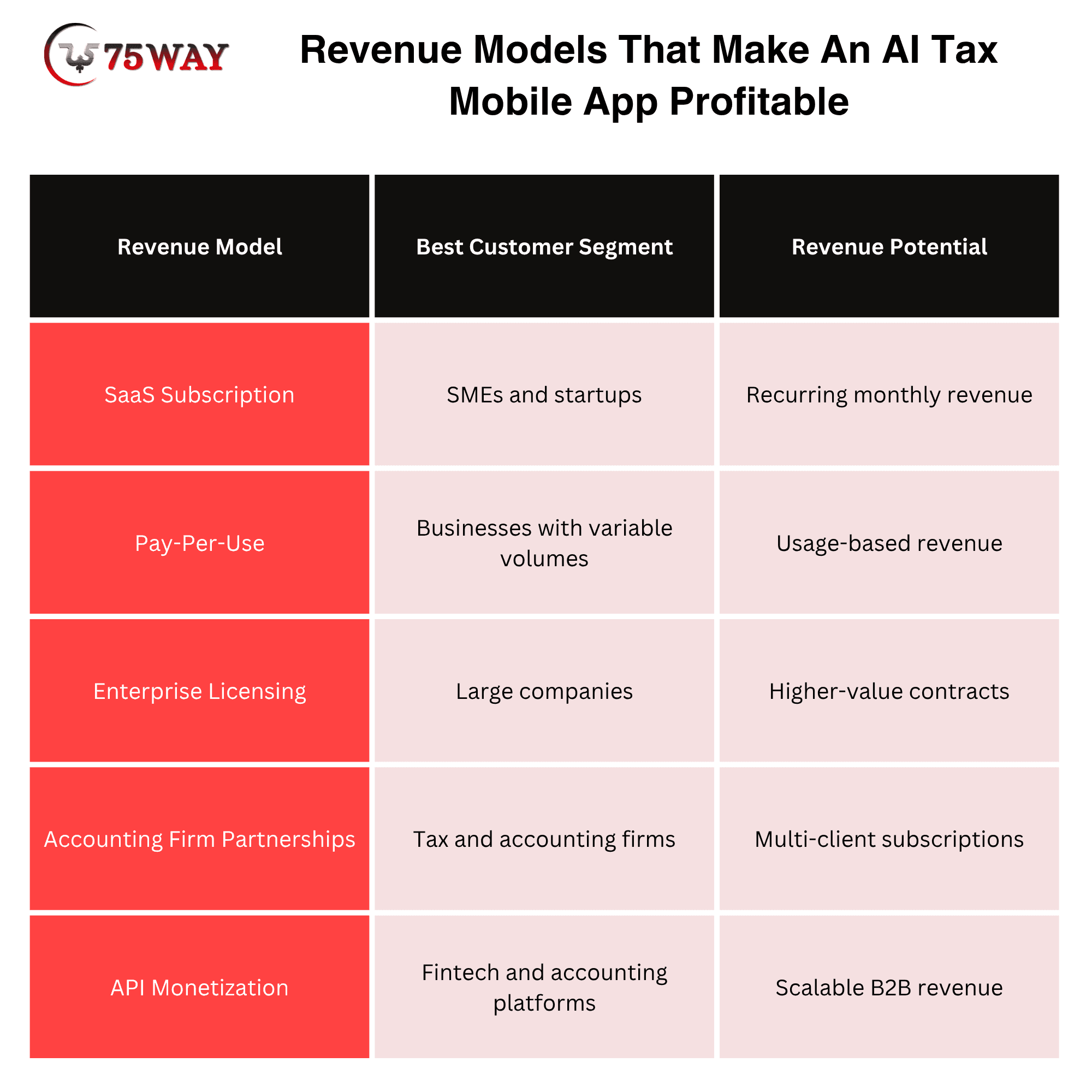
For a new business, a combination of SaaS subscriptions and usage-based pricing can be a practical starting point.
Enterprise licensing and API monetization can be introduced after the application establishes product-market fit.
How Much Revenue Can An AI Tax App Generate In The United Arab Emirates?
Revenue potential depends on the number of paying customers, subscription prices, customer retention, and additional services.
Rather than claiming that every AI tax application will generate a particular amount, founders should calculate revenue using realistic customer acquisition assumptions.
Consider three hypothetical subscription scenarios.
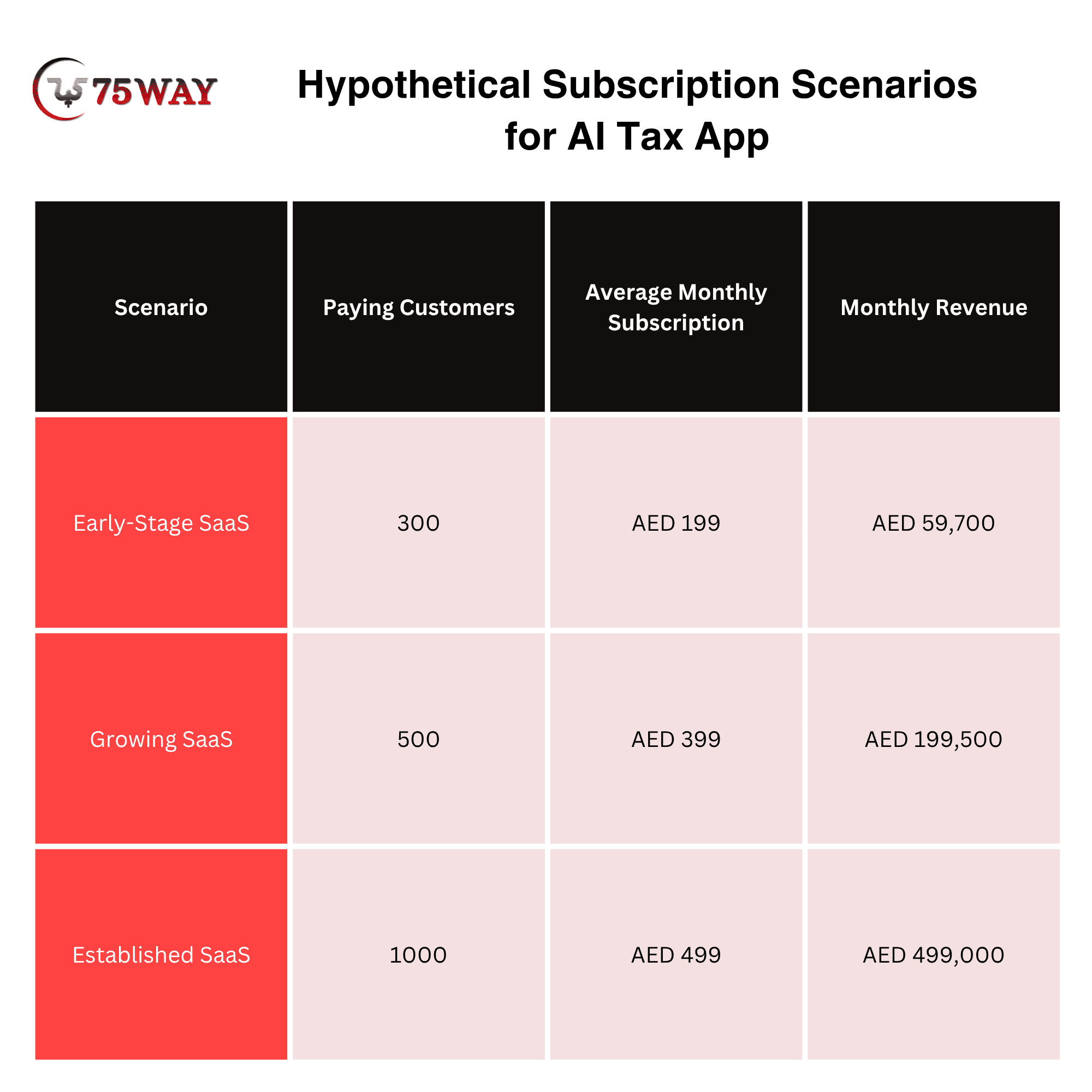
All three scenarios are illustrative calculations, not actual company earnings or forecasts.
Revenue Calculation Example
Suppose a startup acquires 500 paying customers, each paying AED 399 per month.
Monthly recurring revenue:
500399 = AED 199,500
Annual recurring revenue:
199,50012 = AED 2,394,000
The business would generate AED 2.394 million in annualized subscription revenue if the customer count and subscription price remained unchanged for 12 months.
However, revenue is not profit.
The company must deduct hosting, AI API usage, salaries, customer acquisition, customer support, maintenance, payment processing, and other operating expenses.
Well-Known App Competitors In The UAE AI Tax Software Market
The UAE already has accounting and financial software providers serving businesses with tax-related requirements.
This means a new AI tax application must compete on product value, not simply the presence of AI features.
Some relevant products include:
1. Zoho Books
Zoho Books provides accounting functionality, invoicing, and UAE tax-related capabilities. It is relevant for businesses seeking an integrated accounting workflow.
2. Wafeq
Wafeq offers accounting software with UAE-focused VAT, Corporate Tax, and AI-assisted accounting capabilities.
3. Xero
Xero provides cloud accounting, invoicing, reconciliation, and financial reporting tools for businesses.
4. QuickBooks
QuickBooks offers accounting, expense tracking, invoicing, and financial management features for small and medium-sized businesses.
These platforms demonstrate that customers already have established accounting software options. A new entrant should therefore identify a specific unmet need rather than assume that existing solutions lack AI or UAE tax functionality.
Competitive Advantages For New AI Tax Apps In UAE Market
For a startup entering the AI tax market, the biggest opportunity may lie in addressing the everyday frustrations that existing tools don't solve well. Small businesses may value simpler invoice management, accounting firms may need faster document processing, and growing companies may look for better tax visibility. These unmet needs can help a new AI tax app differentiate itself, and the following advantages explain where to focus.
- Specialized Compliance Workflows: Focus on a specific industry or type of tax-related transaction.
- Better Document Processing: Handle inconsistent invoice formats and multilingual financial documents.
- Accountant Collaboration: Provide centralized review and approval workflows.
- Explainable AI: Show why the application flagged a transaction and which rules support the recommendation.
- Flexible Integrations: Connect accounting, ERP, and accredited e-invoicing providers.
- Multi-Entity Management: Support businesses handling several legal entities through one account.
The strongest opportunity may not be another all-in-one accounting platform. It could be a focused AI product that solves a particular problem better than existing alternatives.
Major Risks of Developing An AI Tax App In The UAE
UAE tax rules can influence almost every decision involved in building a tax application, from calculation logic to reporting workflows. A feature that works today may need changes when regulations, filing procedures, or compliance requirements are updated. Founders should assess the following risks before launching.
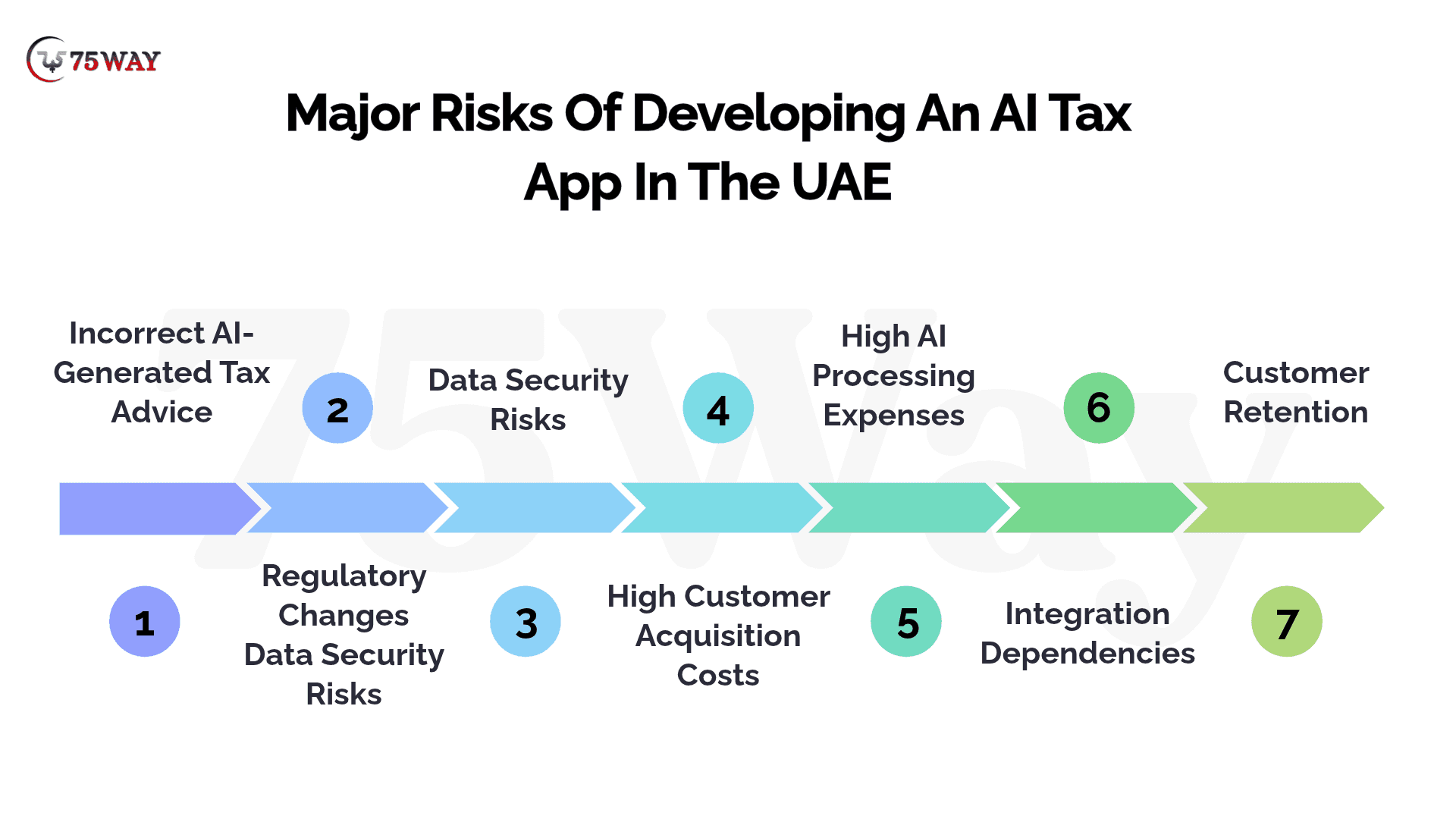
1. Incorrect AI-Generated Tax Advice
An LLM can produce incorrect or outdated explanations.
Solution: Use an approved knowledge base, retrieval-based answers, deterministic tax calculations, and professional review for complex cases.
2. Regulatory Changes
Tax laws, implementation decisions, and administrative requirements can change.
Solution: Maintain a version-controlled tax rules engine and establish a regulatory review process.
3. Data Security Risks
Financial applications store confidential business documents and personal information.
Solution: Implement encryption, access controls, secure authentication, monitoring, and documented data-handling procedures.
4. High Customer Acquisition Costs
Business customers may already use accounting platforms and hesitate to switch.
Solution: Target specific industries, accounting firms, and businesses with clear workflow problems instead of pursuing every potential customer.
5. High AI Processing Expenses
Processing large volumes of documents and generating AI responses can increase operating expenses.
Solution: Use smaller models for straightforward tasks, optimize document processing, cache appropriate results, and apply premium AI features selectively.
6. Integration Dependencies
Accounting systems, banking providers, and e-invoicing service providers may have different APIs and technical requirements.
Solution: Develop modular integrations, test failure scenarios, and establish service agreements where required.
7. Customer Retention
Businesses may cancel subscriptions if the application does not deliver measurable value.
Solution: Focus on recurring workflows, useful reporting, dependable support, and features that become part of customers' regular finance operations.
How Can Founders Validate An AI Tax App Idea Before Investing?
One of the most expensive mistakes is developing a complete application before confirming that customers are willing to pay for it.
A better strategy is to validate the business model through a structured process.
Step 1: Identify A Specific Customer Problem
Start with one target segment, such as accounting firms, SMEs, or companies preparing for e-invoicing.
Interview potential customers and identify their most time-consuming accounting and tax-related activities.
Step 2: Research Existing Solutions
Compare competing applications based on:
- Pricing and subscription plans.
- Invoice-processing capabilities.
- UAE tax functionality.
- Accounting integrations.
- AI features.
- Customer support.
- Enterprise capabilities.
Look for a specific problem that existing products do not address adequately.
Step 3: Build A Focused MVP
Develop only the features required to test the primary business proposition.
For example, an initial product could focus on invoice extraction, VAT validation, and document organization for accounting firms.
Step 4: Run A Pilot Program
Invite a small group of businesses or accounting firms to test the application using appropriate, authorized data.
Measure:
- Document extraction accuracy.
- Time saved per invoice.
- Number of errors identified.
- User adoption.
- Willingness to pay.
- Customer feedback.
Step 5: Evaluate Commercial Viability
Calculate customer acquisition costs, monthly recurring revenue, gross margin, retention, and support expenses.
Expand the feature set only when the pilot demonstrates genuine customer demand.
This process helps founders avoid spending their entire development budget on features that customers may not need.
Final Thoughts
AI tax app development can be a profitable business opportunity in the UAE, but success depends on more than integrating artificial intelligence into accounting software. Founders need to identify paying customers, select the right revenue model, understand tax regulations, and develop reliable financial workflows.
The strongest opportunities may lie in specialized solutions for SMEs, accounting firms, and enterprises that need better invoice processing, tax preparation, and financial data management. A focused MVP, validated customer demand, and a scalable SaaS architecture can help reduce initial investment risks.
To build an AI tax application for the UAE market, connect with a leading mobile app development team to discuss your product idea, technical requirements, and development roadmap.
Frequently Asked Questions (FAQs)
Is AI Tax App Development Profitable In UAE?
Yes, AI tax app development can be profitable through SaaS subscriptions, enterprise licensing, and API services. Profitability depends on customer acquisition, retention, operating costs, and product differentiation.
Can AI Automatically Calculate UAE Corporate Tax?
AI can assist with financial data extraction and classification, but Corporate Tax calculations should use validated tax rules and professional review where necessary.
Who Can Use AI Tax Applications In UAE?
Potential users include SMEs, accounting firms, tax consultancies, startups, enterprises, and independent professionals with relevant business and financial management requirements.
What Is The UAE VAT Registration Threshold?
The mandatory VAT registration threshold is AED 375,000, while the voluntary registration threshold is AED 187,500, subject to applicable FTA requirements.
How Does AI Help With UAE VAT Compliance?
AI can extract invoice information, identify potential VAT classification issues, organize transactions, flag discrepancies, and assist with VAT return preparation.
Does An AI Tax App Need FTA Approval?
Not every tax application requires the same approval. However, businesses providing regulated tax services or operating as electronic invoicing service providers must assess the applicable legal and accreditation requirements.