AI Summary
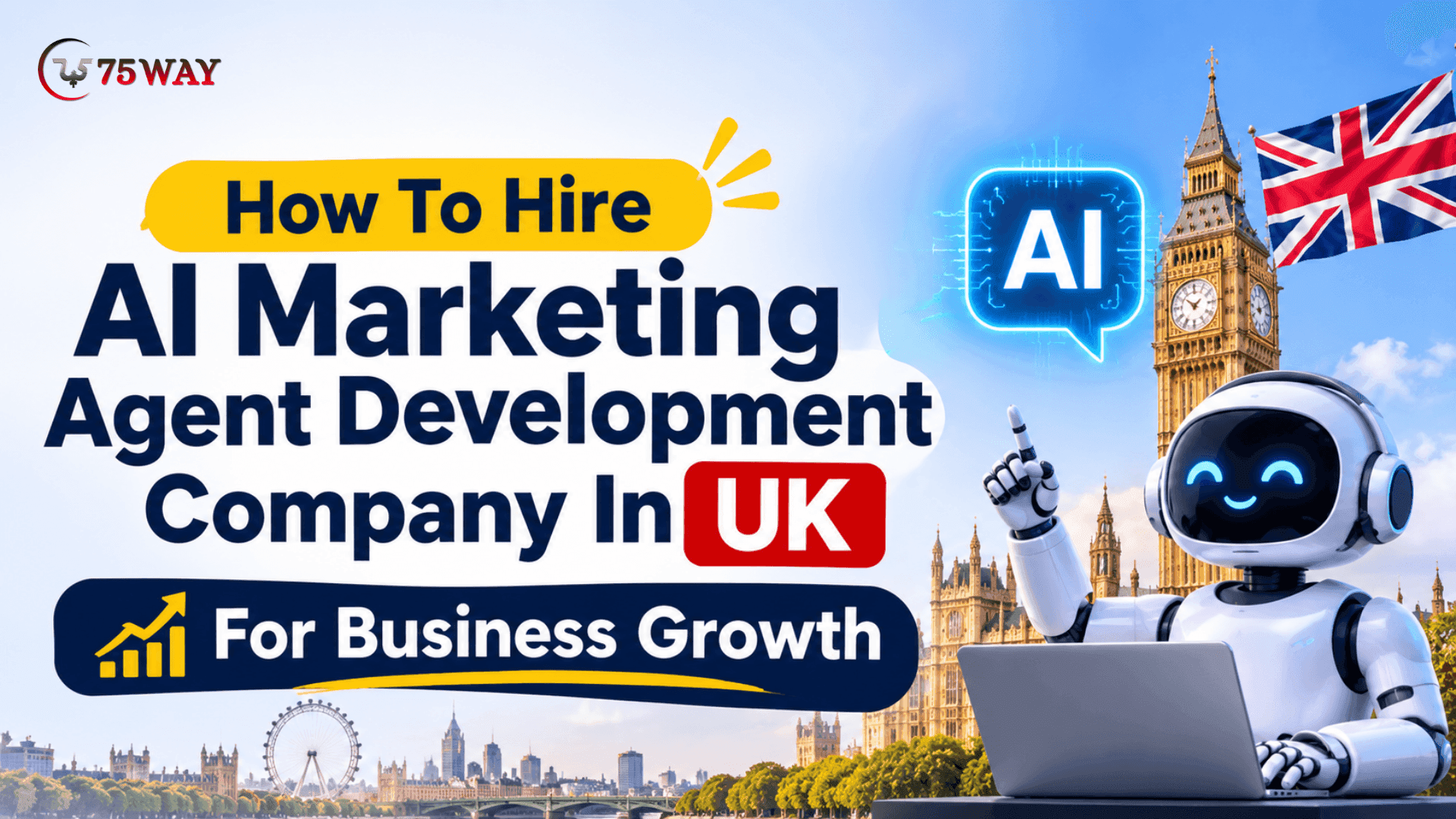
Hiring the right AI marketing agent development company can transform how your business attracts, engages, and converts customers. This guide explores essential capabilities, technical expertise, development costs, and hiring considerations. Discover how to choose a partner for sustainable growth.
Key Takeaways
- Identify business requirements before hiring an AI marketing agent development company.
- Understand how AI marketing agents improve campaigns, engagement, and conversions.
- Evaluate technical expertise, integrations, security, and customisation capabilities before partnering.
- Choose a development partner aligned with your long-term marketing goals.
More leads do not always mean better marketing results, especially when your team is juggling multiple campaigns, customer enquiries, and performance reports.
So, how to manage leads, engage customers 24/7, and generate revenue? Truly speaking, there’s no magic stick. But yes, we have a simple solution!
It is an AI marketing agent that can help UK businesses handle these activities by automating workflows and supporting decisions across different marketing functions. But getting the right solution starts with choosing the right marketing AI agent development company.
An agency with AI expertise alone may not be enough. You should also look at its experience with marketing automation, CRM integrations, data security, agent workflows, and the ability to build solutions that fit your existing systems.
So, how do you find a reliable AI marketing agent development company in the UK? Let's look at the key factors to consider, the questions to ask, and the capabilities to assess before making your decision.
Why Does Your Business Need A Custom AI Marketing Agent?
Not every business needs an AI marketing agent. If your marketing activities are limited to scheduling social media posts or sending basic email sequences, conventional automation software may already meet your requirements.
A custom AI marketing agent becomes worth considering when your marketing workflows involve multiple tools and repetitive tasks that require coordination between different systems.
Here are some practical situations where businesses may benefit from custom development.
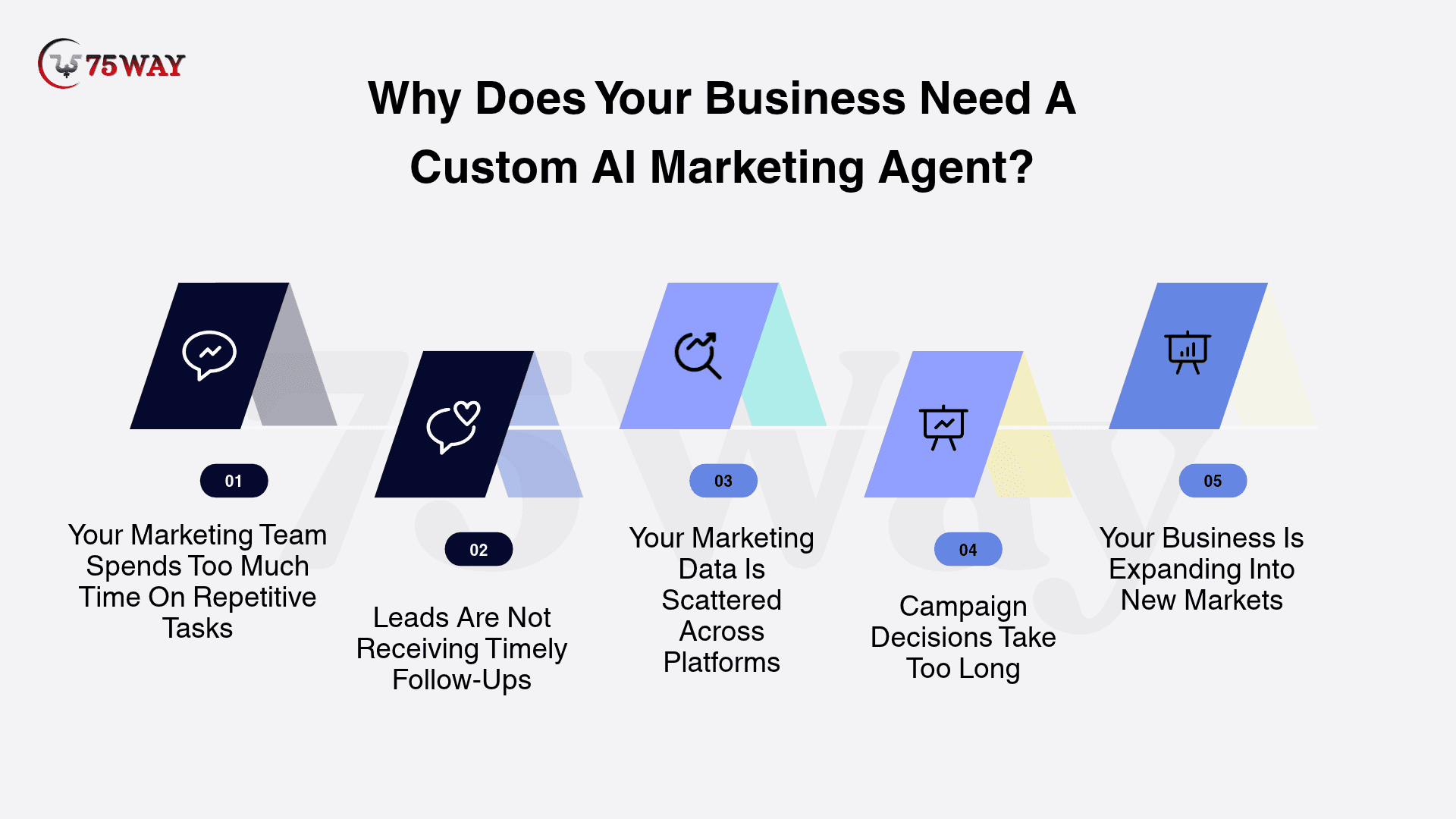
- Your Marketing Team Spends Too Much Time On Repetitive Tasks
Marketing professionals often spend considerable time researching prospects, categorising leads, preparing reports, updating CRM records, and coordinating campaigns. These activities can reduce the time available for planning and creative work.
A marketing AI agent development solution can collect relevant information, organise records, prepare campaign inputs, and trigger approved workflows. Your team can focus on strategy, customer relationships, and decisions that require human judgement.
- Leads Are Not Receiving Timely Follow-Ups
A potential customer may submit an enquiry, download a resource, or request a product demonstration. If the sales team takes too long to respond, the prospect may move to a competitor.
An AI lead management agent can assess incoming enquiries, identify their requirements, assign priority scores, update CRM records, and recommend the next action. Depending on your approval rules, it can also initiate personalised follow-up sequences.
- Your Marketing Data Is Scattered Across Platforms
Many businesses use separate platforms for advertising, email marketing, customer relationships, analytics, and content management. When these systems do not communicate properly, teams struggle to develop a complete picture of campaign performance.
A custom AI agent can connect approved data sources, retrieve relevant information, and produce consolidated insights. This gives decision-makers a clearer understanding of customer behaviour and marketing opportunities.
- Campaign Decisions Take Too Long
Marketing teams regularly analyse audience behaviour, campaign results, advertising expenditure, and conversion patterns before making adjustments.
An ad campaign AI marketing agent can monitor selected performance indicators, identify unusual changes, compare results against defined targets, and recommend adjustments. Higher-risk decisions, such as increasing advertising budgets or changing campaign settings, should remain subject to appropriate approval controls.
- Your Business Is Expanding Into New Markets
Entering new regions introduces additional research, audience segmentation, localisation, and customer communication requirements.
AI market research agents can collect information from approved sources, organise competitor observations, identify audience patterns, and prepare research summaries. Human specialists should validate the findings before they influence business decisions.
If your marketing operations involve repeated decisions across multiple platforms, a custom AI marketing agent may provide more value than adding another standalone automation tool.
Services A UK-Based AI Marketing Agent Company Should Offer
A reliable development partner should understand the complete journey, from identifying suitable marketing workflows to deploying and maintaining the final solution. Simply offering an AI chatbot or connecting an LLM to your CRM does not necessarily demonstrate the ability to build a dependable marketing agent. Evaluate whether the company can provide the following services.
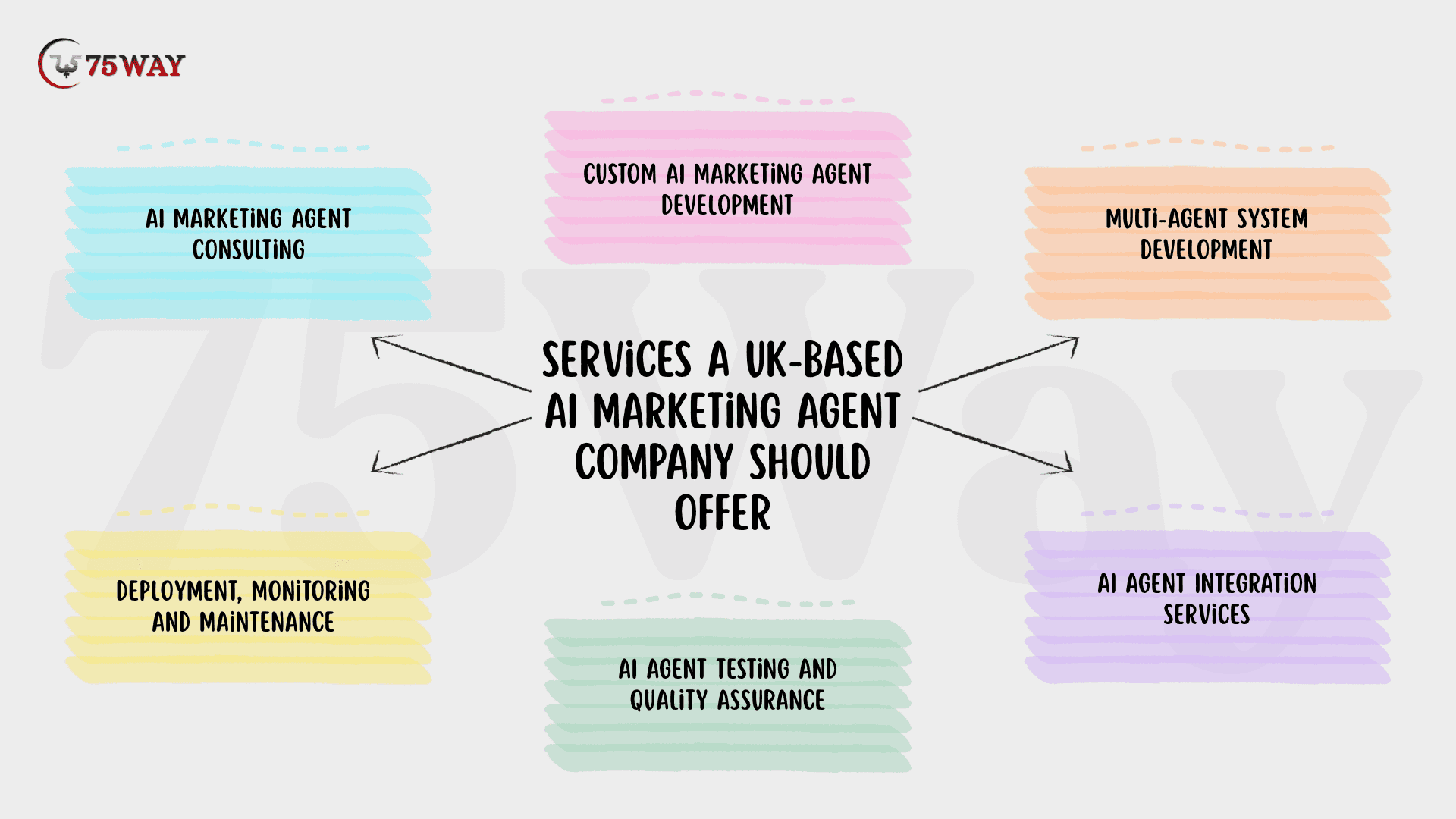
1. AI Marketing Agent Consulting
A development team should identify which tasks are suitable for AI agents, which require conventional automation, and which should remain under human control.
Expected deliverables include:
- Business requirement documentation.
- Marketing workflow assessment.
- AI feasibility analysis.
- Agent functionality recommendations.
- Technical architecture planning.
- Implementation roadmap.
2. Custom AI Marketing Agent Development
Every business has different customer journeys, marketing channels, data sources, and internal processes.
Custom development allows the agent's capabilities to be designed around those requirements rather than forcing your team to work within a generic product.
Depending on your objectives, the development company may create specialized agents for lead qualification, email marketing, campaign analysis, content research, customer engagement, or marketing reporting.
3. Multi-Agent System Development
Some marketing operations are too complex for a single agent to handle reliably.
A multi-agent architecture divides responsibilities between specialized agents that collaborate through a defined coordination mechanism.
For example, consider a B2B marketing workflow:
- Research Agent: Collects information about potential business customers.
- Qualification Agent: Evaluates prospects against your ideal customer profile.
- Content Agent: Prepares relevant communication based on approved brand guidelines.
- CRM Agent: Updates prospect information and records interactions.
- Reporting Agent: Summarizes engagement and campaign performance.
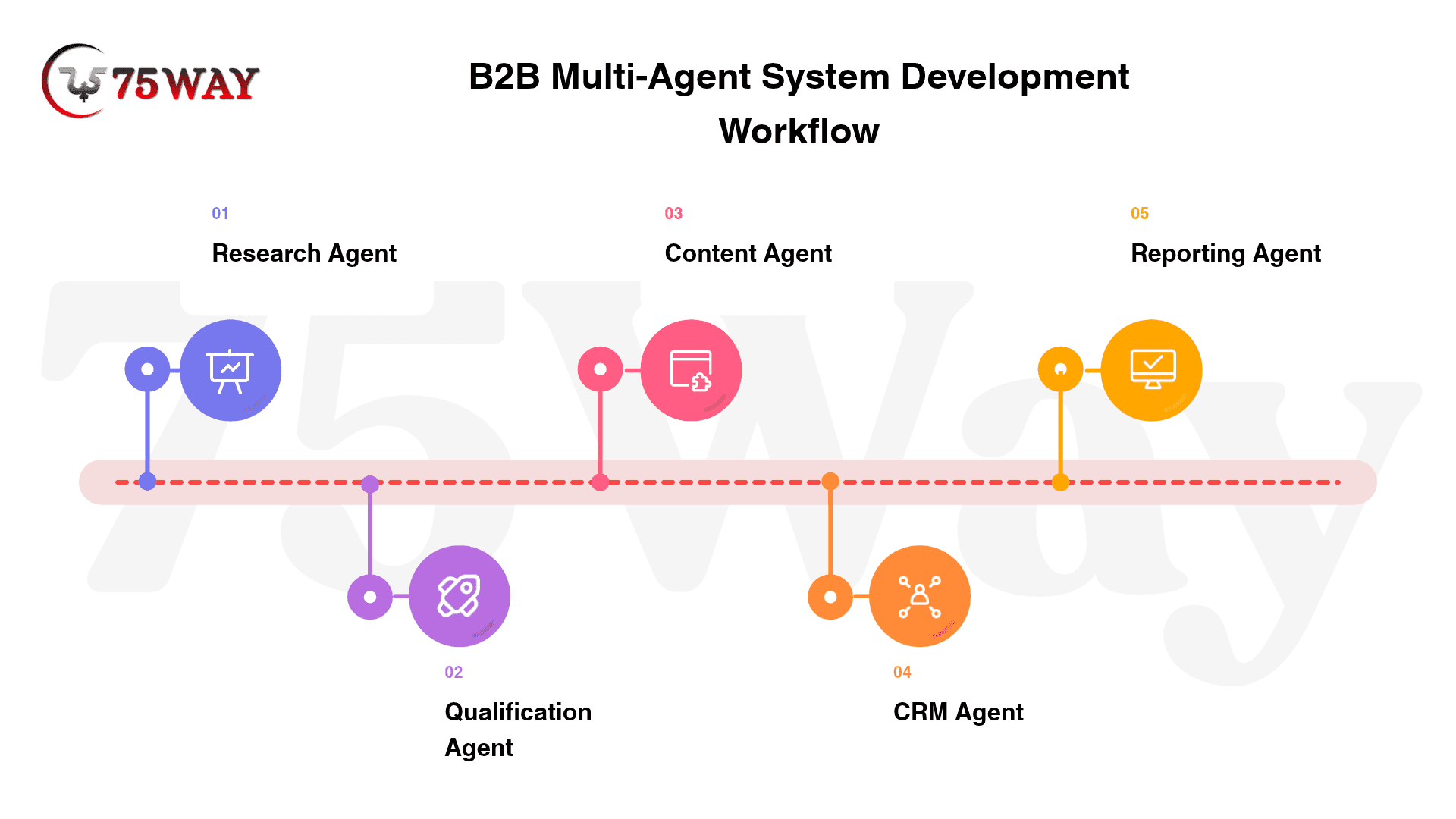
An orchestrator manages task allocation, information exchange, and workflow progression. Human approval can be introduced before important customer-facing actions.
This approach is useful when multiple responsibilities require different instructions, permissions, and evaluation criteria.
4. AI Agent Integration Services
Your new marketing agent should work with the systems your business already uses.
A development company should be capable of integrating suitable solutions with:
- Customer relationship management platforms.
- Email marketing software.
- Advertising platforms.
- Website content management systems.
- Customer support applications.
- Marketing analytics platforms.
- Internal databases and business applications.
The integration approach may involve REST APIs, webhooks, authentication protocols, middleware, or custom connectors.
Before development begins, ask how the company will handle API limitations, synchronisation failures, duplicate records, access permissions, and data conflicts.
5. AI Agent Testing And Quality Assurance
An agent that produces convincing responses is not necessarily ready for business use.
Testing should cover more than the quality of its generated content. It should also evaluate whether the agent selects the correct tools, retrieves accurate information, respects permissions, and completes tasks within the required boundaries.
Important testing activities include:
- Functional and integration testing.
- Prompt and instruction testing.
- Tool-calling validation.
- Accuracy and hallucination testing.
- Security and permission testing.
- Performance and load testing.
- Human approval and escalation testing.
6. Deployment, Monitoring And Maintenance
An AI marketing agent requires attention after launch.
Marketing platforms change their APIs, business rules evolve, customer expectations shift, and AI model behaviour can vary. A development partner should explain how the system will be monitored and maintained.
Look for services covering error monitoring, usage tracking, model updates, workflow improvements, security reviews, and performance evaluation.
Strategy To Evaluate And Hire The Right AI Marketing Agent Firm In United Kingdom
A development firm's promises may sound impressive, but can its AI marketing agents actually solve your business challenges? The answer depends on its experience, development approach, understanding of marketing workflows, and ability to deliver measurable outcomes. Here's what to evaluate before hiring a firm to build your AI marketing solution.
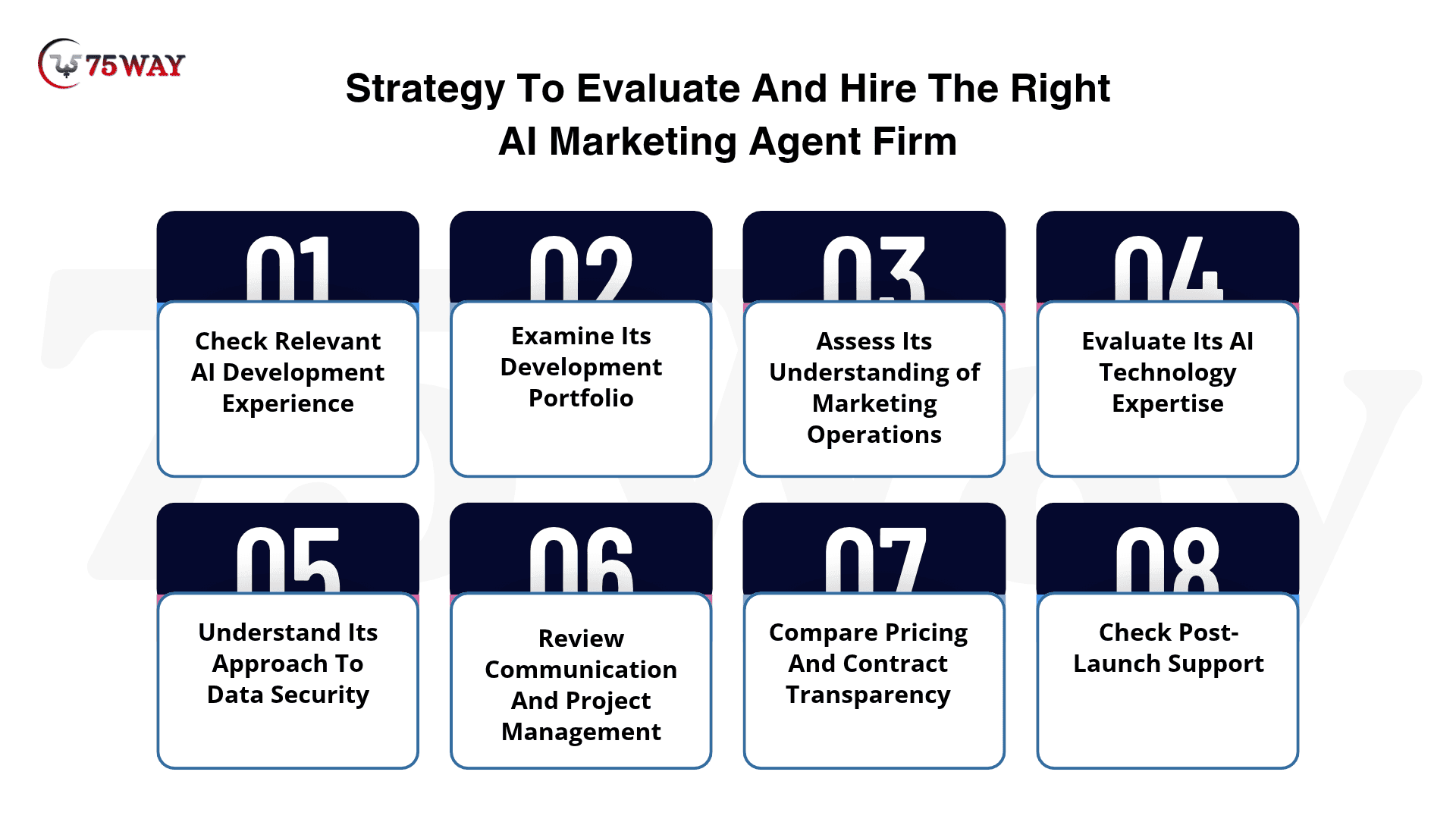
1. Check Relevant AI Development Experience
Start by reviewing the company's background in AI development, agentic AI, LLM-powered applications, and business process automation.
Ask whether its team has worked on systems involving multi-step reasoning, external tool usage, data retrieval, and API integrations.
A company that has only developed basic conversational chatbots may not have the engineering experience needed for autonomous marketing workflows.
Ask: Can you demonstrate a project where an AI system completed multiple connected business tasks rather than simply generating responses?
2. Examine Its Development Portfolio
A portfolio should help you understand what the company actually built, which business problem it addressed, and how the technology was implemented.
Do not stop at screenshots or attractive interface designs.
Examine:
- The original business challenge.
- The agent's responsibilities.
- The technology and architecture used.
- Third-party integrations.
- Human approval mechanisms.
- Testing and deployment approach.
- Verified business outcomes, where available.
If the company cannot share confidential project information, request an anonymized architecture diagram or a controlled product demonstration.
3. Assess Its Understanding of Marketing Operations
An AI development company should understand the business processes behind your requirements.
For example, a lead qualification agent requires more than an LLM and a CRM connection. It needs a defined ideal customer profile, qualification criteria, data sources, lead scoring logic, routing rules, and escalation conditions.
Similarly, an advertising optimization agent needs access to reliable campaign data, performance benchmarks, budget restrictions, and clear approval policies.
Ask the development team to explain how it would translate your marketing objectives into an executable technical workflow.
4. Evaluate Its AI Technology Expertise
The company should be able to justify its choice of AI models, frameworks, databases, and integration methods.
Look for experience with relevant technologies such as:
- OpenAI and Anthropic models.
- LangChain and LangGraph.
- LlamaIndex.
- Python and TypeScript.
- Vector databases.
- Retrieval-Augmented Generation (RAG).
- REST APIs and webhooks.
- AWS, Microsoft Azure, or Google Cloud.
You do not need every technology in your project. The right development team should select components according to functionality, data requirements, latency, security, and operating costs.
5. Understand Its Approach To Data Security
Marketing agents may access customer records, contact information, campaign performance data, and internal business documents.
Before hiring, understand how the company handles authentication, encryption, access control, data retention, third-party model providers, and audit logs.
Ask whether your data will be used for model training, how credentials will be stored, and what happens when an employee or external system no longer needs access.
6. Review Communication And Project Management
AI development involves ongoing decisions about business rules, model behaviour, integrations, and testing.
You should know who will manage the project, how often progress will be shared, and how technical decisions will be documented.
A suitable partner should provide clear milestones, project responsibilities, communication channels, and a process for managing scope changes.
7. Compare Pricing And Contract Transparency
The cheapest proposal may not represent the lowest long-term investment.
A quote should clearly explain development costs, third-party API charges, cloud infrastructure, integrations, testing, deployment, maintenance, and any recurring subscription expenses.
Check whether additional changes, new integrations, or increased usage will attract extra charges.
8. Check Post-Launch Support
Ask what happens when an agent generates an incorrect response, an integration stops working, or an AI provider changes its API.
Your development agreement should clarify support availability, issue resolution procedures, monitoring responsibilities, maintenance costs, and ownership of source code and documentation.
Hiring tip: Ask shortlisted companies to prepare a small technical discovery proposal for one real marketing workflow. Their questions and proposed architecture can reveal more than a sales presentation.
Tech Capabilities You Must Consider Before Partnering With Marketing AI Agent Provider
Not every provider offering AI marketing solutions has the technical expertise to develop reliable, business-ready agents. You should know how their team approaches agent architecture and data security before committing to a partnership. These capabilities will help you assess whether a provider can turn your marketing requirements into a practical AI solution.
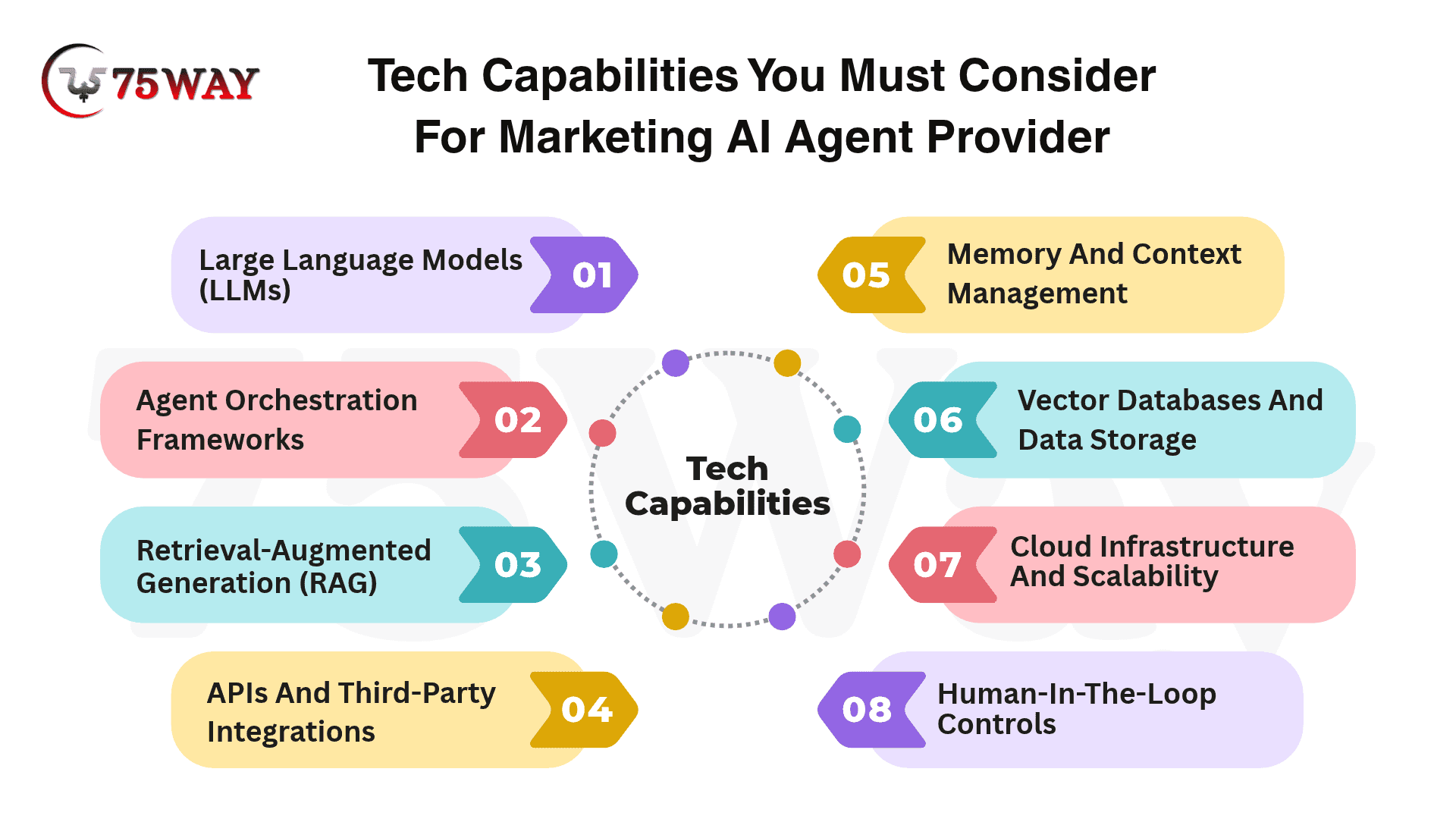
- Large Language Models (LLMs): Understand instructions, interpret information, generate content, and support decision-making within AI marketing agents.
- Agent Orchestration Frameworks: Coordinate agent tasks, manage workflows, connect tools, and control multi-step execution.
- Retrieval-Augmented Generation (RAG): Retrieve relevant business information to generate accurate, context-specific responses.
- APIs & Third-Party Integrations: Connect AI marketing agents with CRMs, advertising platforms, databases, and business applications.
- Memory & Context Management: Retain relevant information across interactions to understand context and manage ongoing tasks.
- Vector Databases & Data Storage: Store information and enable semantic searches across documents, knowledge bases, and business records.
- Cloud Infrastructure & Scalability: Host AI agents, manage computing resources, and support growing workloads and application availability.
- Human-In-The-Loop Controls: Ensure critical agent decisions receive human approval, reducing operational risks and maintaining accountability.
Different AI Marketing Automation Agents UK Businesses Can Use To Drive Growth
Diverse AI marketing agents handle specific responsibilities, from finding potential customers and qualifying leads to analysing campaigns and personalising customer interactions. Understanding what each type actually does can help you identify where AI automation fits into your marketing strategy.
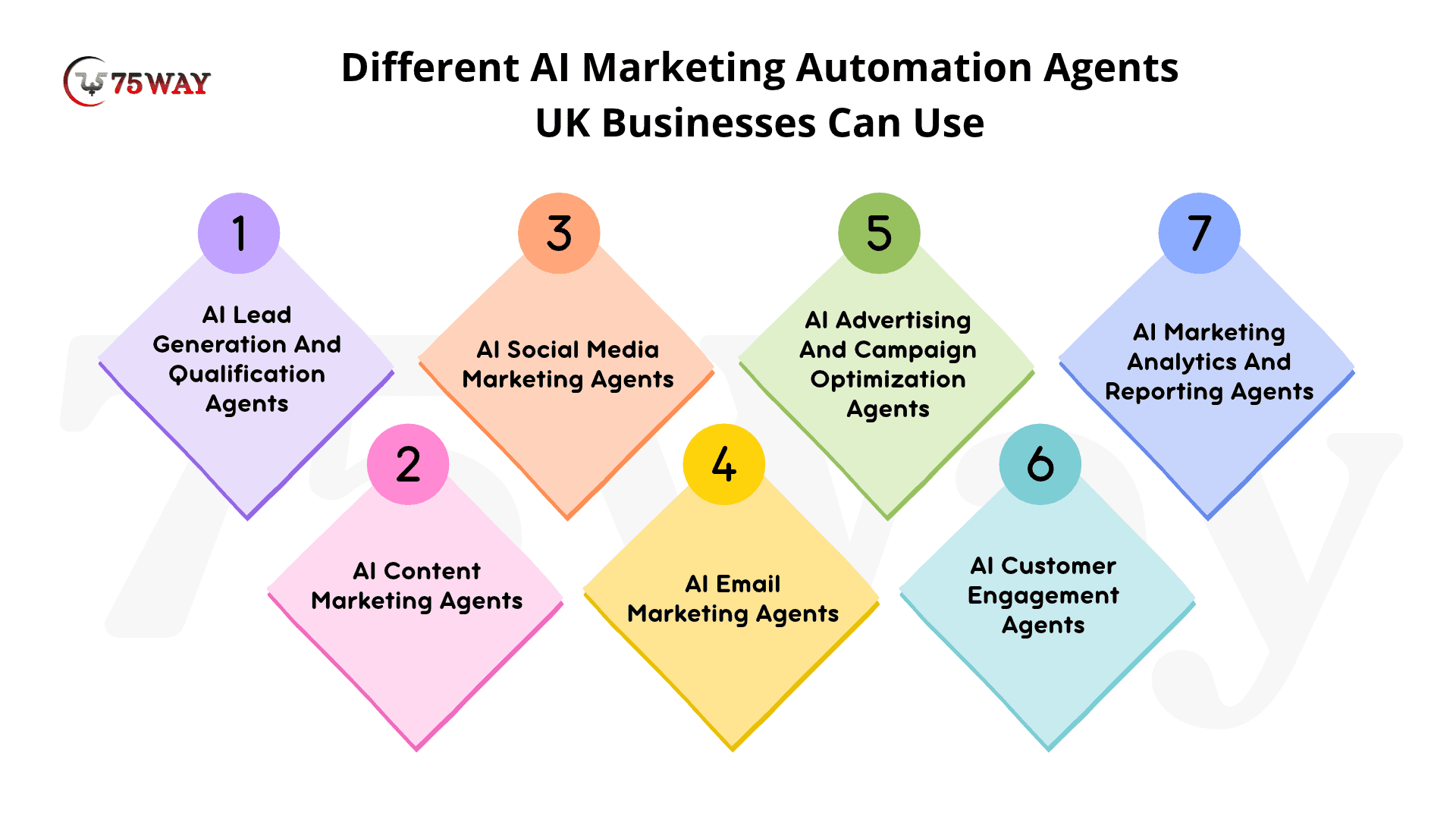
1. AI Lead Generation And Qualification Agents
AI lead generation and qualification agents help businesses organize prospect research and manage incoming enquiries.
They can:
- Collect prospect information from approved sources.
- Categorize enquiries based on business requirements.
- Identify potential customer interests and buying signals.
- Enrich CRM records using permitted data sources.
- Assign lead priority based on defined qualification criteria.
- Recommend suitable follow-up actions to sales representatives.
Business application: A B2B technology company can use a lead qualification agent to review incoming enquiries, identify businesses that match its ideal customer profile, and route high-priority prospects to the appropriate sales representative.
2. AI Content Marketing Agents
AI content marketing agents support research, planning, drafting, and content management.
Their responsibilities can include:
- Researching topics and audience questions.
- Grouping keywords according to search intent.
- Preparing content briefs and article outlines.
- Drafting content based on approved brand guidelines.
- Identifying internal linking opportunities.
- Checking content against editorial requirements.
However, publishing should not be fully automated without editorial oversight. Original research, factual verification, brand expertise, and human review remain important.
3. AI Social Media Marketing Agents
AI-powered social media agents can help businesses coordinate activities across connected platforms.
They can analyze approved engagement data, prepare content suggestions, organize publishing schedules, identify frequently discussed topics, and generate performance summaries.
For example, an e-commerce business could use an agent to analyze engagement patterns across its social channels and recommend content themes for upcoming product campaigns.
4. AI Email Marketing Agents
Email marketing AI agents can support campaign planning and personalized communication.
Their capabilities may include:
- Segmenting customers using permitted CRM information.
- Preparing audience-specific email drafts.
- Recommending suitable communication times.
- Identifying inactive subscribers.
- Analyzing campaign engagement.
- Suggesting improvements to subject lines and messaging.
Sending campaigns should follow consent, unsubscribe, and applicable electronic marketing requirements.
5. AI Advertising And Campaign Optimization Agents
Advertising agents can monitor campaign information from connected advertising platforms and identify opportunities for improvement.
AI ad copy generator agents may compare acquisition costs, conversion rates, click-through rates, and budget utilization. Based on these observations, they can recommend changes to targeting, bidding, creative variations, or campaign allocation.
Businesses should establish spending limits and approval requirements before allowing agents to make advertising changes.
6. AI Customer Engagement Agents
Customer engagement agents can support conversations across websites, messaging platforms, and connected customer service systems.
AI customer support agents can answer approved product questions, retrieve information from business knowledge bases, identify customer requirements, and transfer complicated enquiries to human representatives.
For example, a UK retailer could use a customer engagement agent to answer questions about product availability, delivery policies, and order status while escalating complaints or unusual requests.
7. AI Marketing Analytics And Reporting Agents
Analytics agents bring together information from multiple marketing systems to support business decisions.
They can:
- Retrieve campaign and customer performance data.
- Compare results against business targets.
- Identify unusual performance changes.
- Summarize customer acquisition trends.
- Generate scheduled management reports.
- Recommend areas that require investigation.
The real advantage is not simply producing another dashboard. It is connecting business information with actionable recommendations and, where appropriate, controlled execution.
Custom AI Marketing Agents Vs Traditional Marketing Automation
Before approaching an AI marketing agent development company in the United Kingdom, it is important to understand what you are actually investing in. Traditional automation and AI agents can both reduce manual work, but they operate differently.
Traditional marketing automation follows predefined instructions. For example, when a customer fills out a form, the system sends an email, updates a CRM record, or assigns the lead to a sales representative.
A marketing AI agent can go further. It can interpret the enquiry, retrieve relevant customer information, assess the prospect against your qualification criteria, select an appropriate next action, and execute permitted tasks through connected systems.
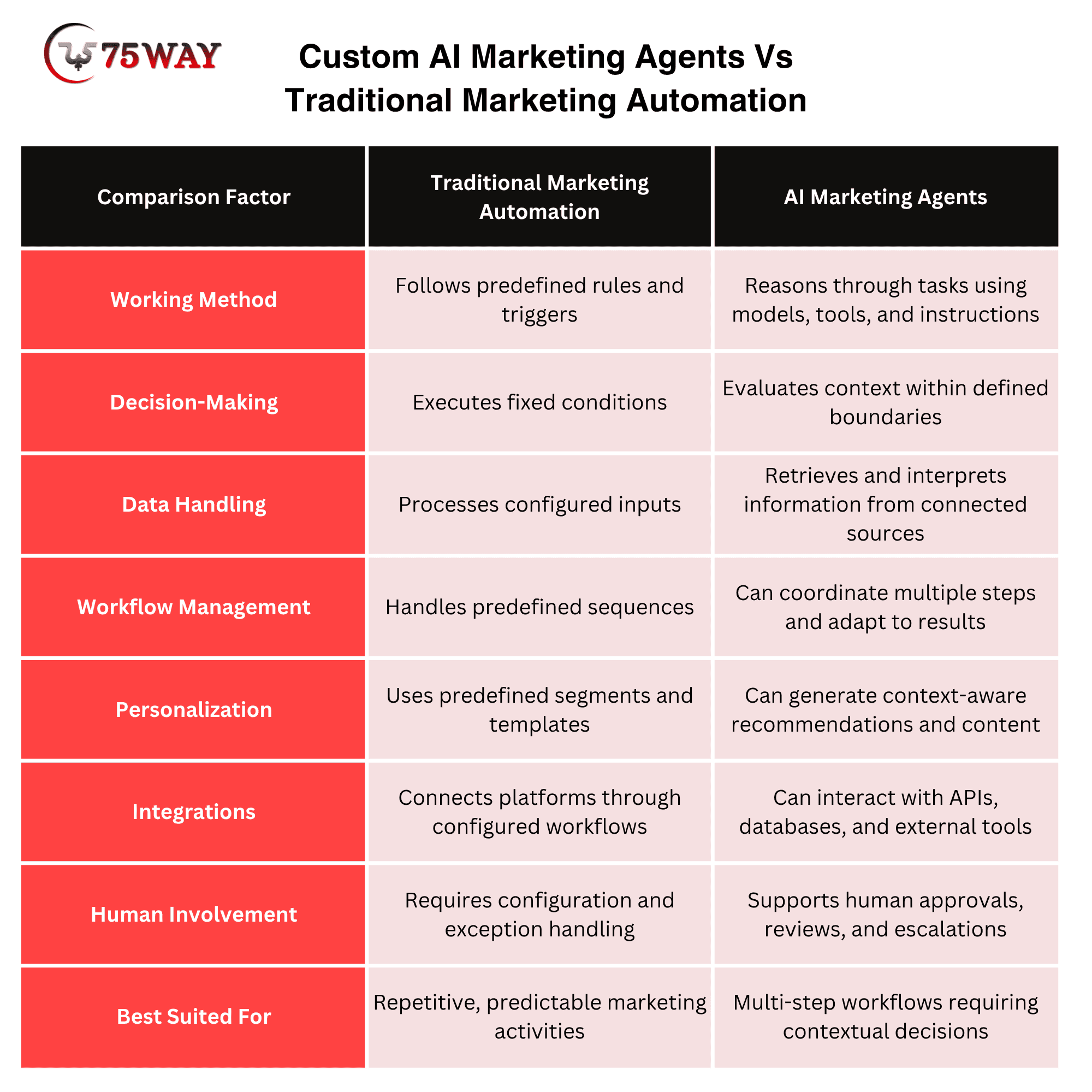
Custom Vs Traditional AI Marketing Agents: Which Option Should Your Business Choose?
The answer depends on the complexity of your marketing operations.
If you need to send welcome emails, schedule posts, or notify sales teams when leads arrive, traditional automation may be sufficient.
However, if your business needs a system that researches prospects, interprets customer information, coordinates multiple tools, and recommends or executes next steps, custom AI agent development deserves consideration.
You can also combine both approaches. For example, an AI agent can assess a prospect and recommend a follow-up strategy, while your existing marketing automation platform handles the approved email sequence.
The objective is not to replace every marketing tool with AI. It is to introduce intelligence where fixed workflows cannot address the complexity of your business requirements.
Process To Build AI Marketing Agent: From Discovery To Deployment
Whether the goal is to automate lead qualification, personalize campaigns, or manage customer interactions, the development team needs a structured approach to turn those requirements into a working solution. Here's how the process moves from initial discovery and planning to development, testing, and deployment.
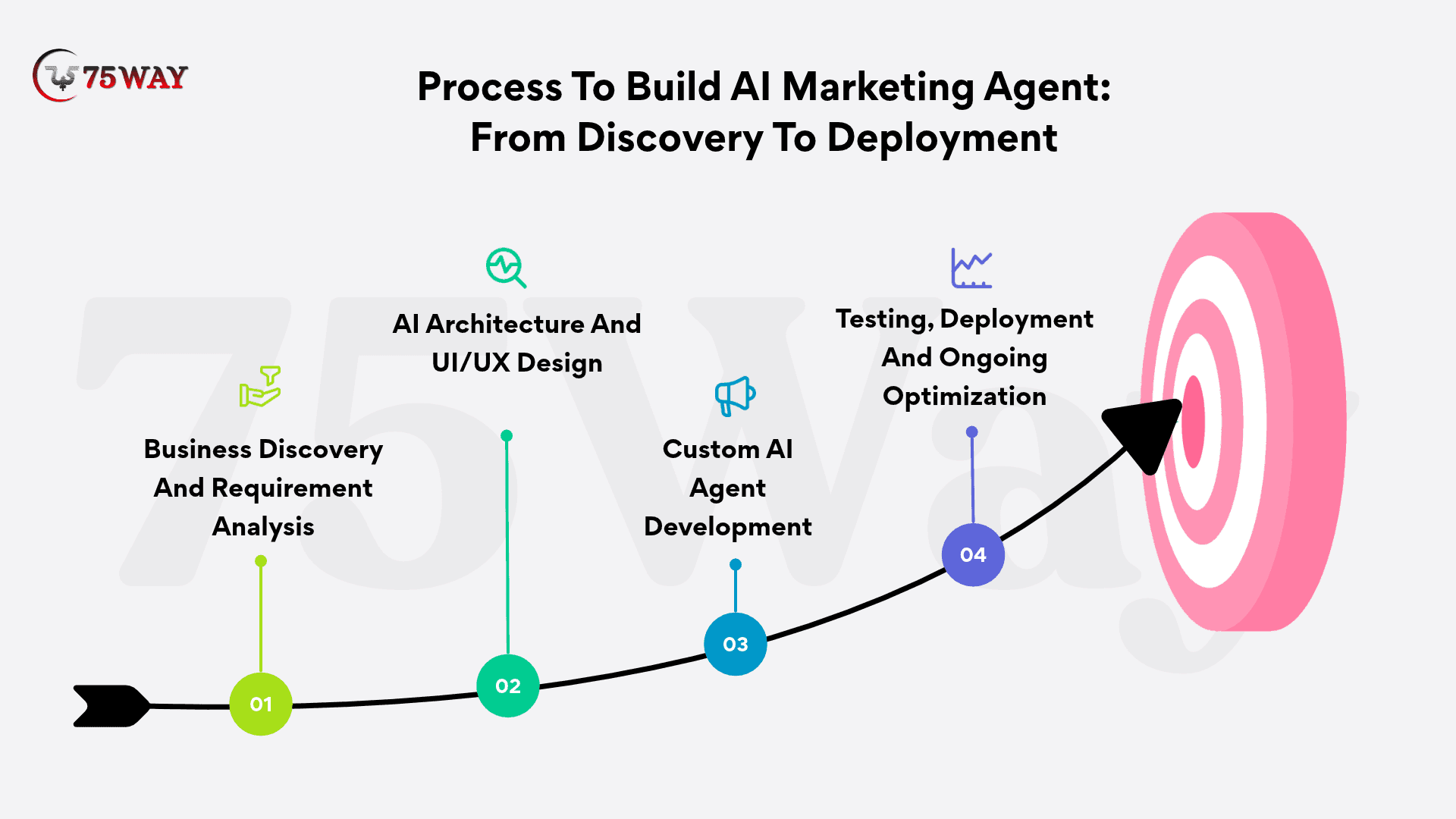
Step 1: Business Discovery And Requirement Analysis
The first stage is understanding what your business wants to achieve.
The development team works with your stakeholders to identify marketing bottlenecks, existing tools, customer journeys, and tasks that could benefit from AI.
For example, if your primary challenge is slow lead qualification, the team should examine how enquiries arrive, which information sales representatives need, how leads are scored, and what happens after qualification.
Key Activities:
- Identify business objectives and success criteria.
- Map existing marketing workflows.
- Review current software and data sources.
- Identify suitable AI agent use cases.
- Define human approval requirements.
- Prepare a project scope and roadmap.
Deliverable: A business requirements document and a prioritized AI marketing agent development roadmap.
Step 2: AI Architecture And UI/UX Design
Once requirements are clear, the development team designs the technical structure and user experience.
This stage determines whether your solution needs one specialized agent or multiple collaborating agents. It also defines model selection, orchestration, data retrieval, memory, integrations, permissions, and deployment infrastructure.
The UI/UX team designs the interface through which your employees will monitor tasks, review recommendations, approve actions, and access reports.
For example, a marketing manager may need a dashboard showing qualified leads, pending approvals, campaign observations, completed tasks, and agent errors.
Key Activities:
- Select appropriate AI models and frameworks.
- Design single-agent or multi-agent architecture.
- Plan API and database integrations.
- Define authentication and permission controls.
- Create wireframes and interface prototypes.
- Establish data management and monitoring requirements.
Deliverable: Technical architecture documentation, workflow diagrams, and approved UI/UX designs.
Step 3: Custom AI Agent Development
This is where the planned architecture becomes a working application.
Developers implement the agent's instructions, reasoning workflows, tool-calling capabilities, knowledge retrieval, and business logic. They also build the backend services and frontend interfaces required to manage the solution.
For a lead qualification agent, developers may implement the following workflow:
- Receive a new enquiry from the website or CRM.
- Retrieve relevant prospect information.
- Evaluate the prospect against approved qualification criteria.
- Identify missing information or inconsistencies.
- Assign a recommended lead priority.
- Send the result for approval or route it to the relevant team.
- Update the CRM after the authorized action.
The agent should also handle incomplete records, unavailable APIs, unexpected responses, and failed tasks through defined recovery procedures.
Key Activities:
- Develop agent instructions and reasoning workflows.
- Implement tool calling and orchestration.
- Configure RAG and knowledge retrieval where required.
- Build backend APIs and frontend interfaces.
- Connect approved marketing applications.
- Implement logging, permissions, and error handling.
Deliverable: A working AI marketing agent with the agreed business functionality.
Step 4: Testing, Deployment And Ongoing Optimization
Before launch, the development team should validate the agent against realistic business scenarios.
Testing should examine whether it retrieves accurate information, follows instructions, uses the correct tools, respects permissions, and escalates situations outside its capabilities.
Once approved, the solution can be deployed to the selected cloud environment or business infrastructure.
Post-launch monitoring helps identify performance issues, unexpected outputs, integration failures, and opportunities for improvement.
Key Activities:
- Perform functional and integration testing.
- Validate agent responses and tool execution.
- Test security and access permissions.
- Conduct performance and reliability checks.
- Deploy the approved application.
- Monitor results and refine workflows.
Deliverable: A deployed AI marketing agent with documented operational procedures and an ongoing support plan.
How Much Does It Cost To Develop An AI Marketing Agent In UK
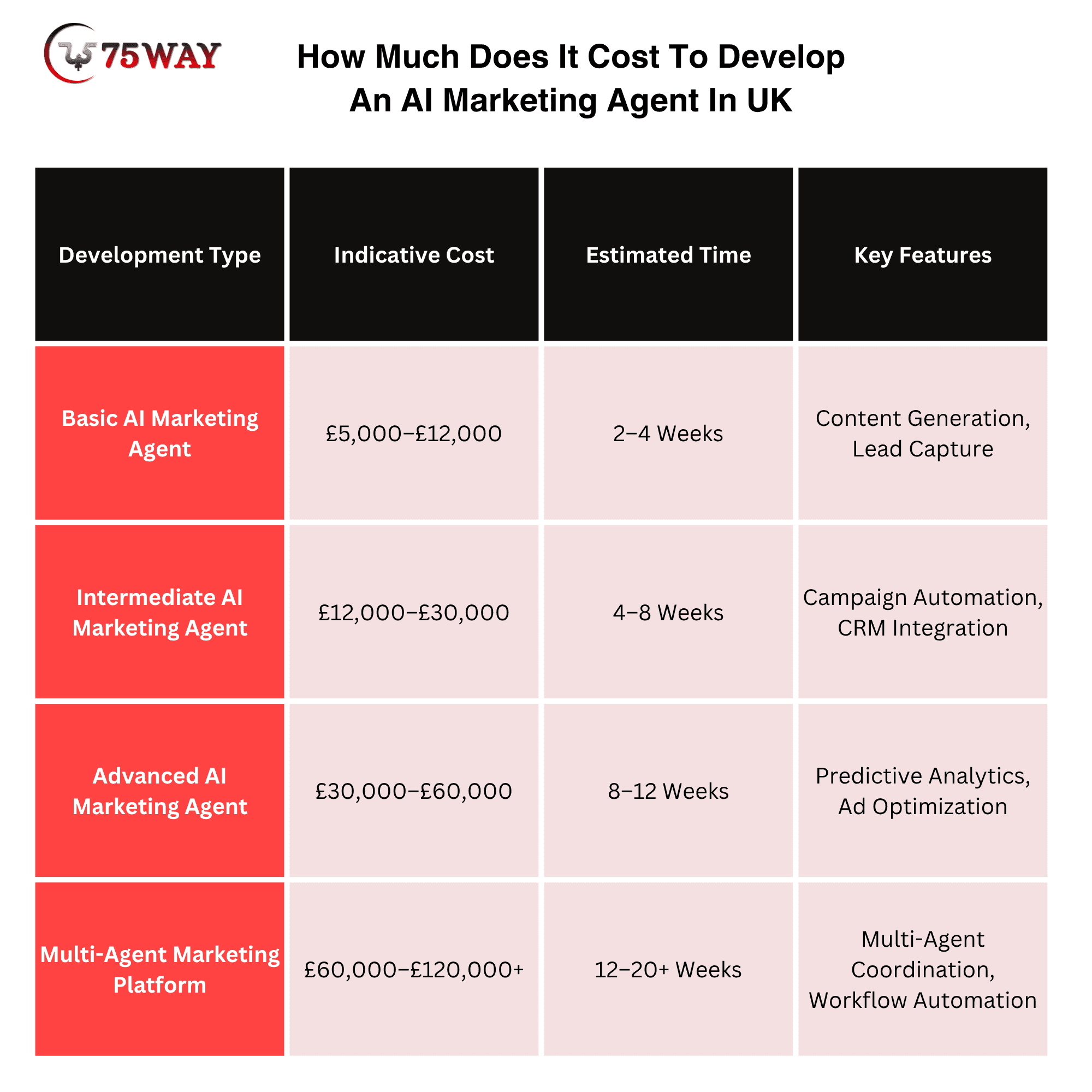
The cost of developing an AI marketing agent depends on what you expect the system to accomplish. There is no reliable single price that applies to every business. A development company should estimate the project after assessing its functional and technical requirements.
- Basic AI Marketing Agent: £5,000–£12,000
- Intermediate AI Marketing Agent: £12,000–£30,000
- Advanced AI Marketing Agent: £30,000–£60,000
- Multi-Agent Marketing Platform: £60,000–£120,000+
What Do These Budget Levels Include?
- Basic: A focused agent for lead classification, enquiry handling, or content assistance, with limited integrations.
- Intermediate: A custom agent with CRM integration, knowledge retrieval, workflow automation, and a management interface.
- Advanced: A more capable solution with multiple integrations, advanced reasoning workflows, analytics, and approval mechanisms.
- Multi-Agent Platform: A coordinated system of specialized agents, central orchestration, extensive integrations, monitoring, and enterprise-oriented controls.
These are indicative budget bands rather than verified market averages. Third-party subscriptions, cloud hosting, LLM usage, and ongoing maintenance may be charged separately.
How Can 75way Technologies Help Manage Costs To Build a Marketing AI Agent?
At 75way Technologies, the sensible approach is to prioritize the business functions that offer the clearest operational value.
Instead of building every possible feature at once, businesses can begin with a focused MVP, validate its performance, and introduce additional capabilities based on actual usage and business requirements.
This approach helps avoid unnecessary development expenditure while giving your team a practical foundation for future expansion.
Which Factors Can Delay Your Project?
Several factors can extend the development timeline:
- Unstructured Data: Incomplete or inconsistent marketing data requires additional preparation.
- API Restrictions: Limited third-party access can complicate integrations.
- Changing Requirements: Adding features during development can affect scope and delivery.
- Complex Workflows: Multi-agent coordination requires additional engineering and testing.
- Security Requirements: Enterprise permissions and compliance reviews may require further validation.
- Testing Dependencies: Customer-facing agents need realistic scenarios and careful approval before deployment.
Practical recommendation: Agree on a clearly defined MVP, delivery milestones, testing criteria, and acceptance requirements before development begins.
Data Security And Compliance Rules UK’s AI Agent Firms Follow
When an AI marketing agent handles customer information, campaign data, or business records, security cannot be an afterthought. UK businesses need to understand how development firms protect this information and follow relevant data protection requirements. Let's explore the key security practices and compliance rules worth checking before partnering with an AI agent provider.
1. UK GDPR And Data Protection Act 2018
The UK GDPR and Data Protection Act 2018 establish important requirements for organisations processing personal information.
Depending on the processing activity, businesses must consider:
- Lawful basis for processing personal data.
- Transparency and privacy notices.
- Purpose limitation and data minimization.
- Accuracy and retention requirements.
- Individual rights and access requests.
- Appropriate security measures.
- Accountability and documentation.
Your organisation must determine its responsibilities as a data controller or processor, depending on the actual arrangement. Development companies should clearly document their role and contractual obligations.
2. PECR And Electronic Marketing
The Privacy and Electronic Communications Regulations (PECR) are particularly relevant to marketing agents that manage email, SMS, and other electronic marketing activities.
Your system should account for applicable consent requirements, subscriber preferences, opt-outs, and rules governing marketing communications.
For example, an email marketing agent should not automatically add every newly discovered contact to a promotional campaign. It must follow the organisation's lawful marketing processes and applicable PECR requirements.
3. Secure API Integrations
Marketing agents often connect with multiple external applications, creating additional security considerations.
Your development partner should implement:
- Secure authentication and authorization.
- Encrypted data transmission.
- Appropriate credential management.
- Role-based access controls.
- API permission restrictions.
- Audit trails for important actions.
- Secure error and incident handling.
4. Human Oversight And AI Governance
Autonomous actions should have clearly defined boundaries.
For example, an agent may prepare a customer response independently but require human approval before issuing a refund, making a contractual promise, or changing a significant advertising budget.
Your company should also consider whether a particular AI workflow involves automated decision-making with legal or similarly significant effects, as additional safeguards may apply.
5. Data Processing Agreements And Third-Party Providers
If your agent uses external LLM providers, cloud platforms, or data processing services, review their data handling arrangements.
Understand where information is processed, whether international data transfers occur, what retention controls are available, and whether the provider uses submitted data for model training.
A development company should help document these dependencies rather than treating third-party AI services as invisible components.
Important: AI development does not automatically make a business GDPR-compliant. Compliance depends on the actual data processing activities, business practices, contractual arrangements, and safeguards implemented.
Common Mistakes To Avoid When Hiring An AI Marketing Agent Development Agency
Hiring the wrong development partner can create more problems than it solves. A technically impressive system may still fail if it does not address your marketing processes, integrate with your infrastructure, or produce measurable business value. Here are mistakes UK businesses should avoid.
1. Choosing A Company Based Only On Price
A low quotation may exclude essential services such as integration testing, security controls, monitoring, or post-launch support.
Compare proposals based on deliverables, architecture, technical responsibilities, and long-term operating costs rather than the initial price alone.
2. Confusing Chatbots With AI Marketing Agents
A chatbot that answers questions is not automatically a fully functional AI marketing agent.
Ask whether the proposed solution can retrieve information, use external tools, manage multi-step workflows, and complete authorized actions within defined business rules.
3. Ignoring Existing Marketing Infrastructure
A new agent should complement your existing systems wherever practical.
Before development, evaluate your CRM, email marketing software, analytics platforms, advertising accounts, and internal databases. Poor integration planning can lead to duplicated records and fragmented workflows.
4. Expecting Complete Autonomy From Day One
Allowing an agent to make every marketing decision independently can introduce unnecessary risks.
Start with clearly defined responsibilities, restricted permissions, and approval requirements. Expand autonomy only after the system demonstrates reliable performance in realistic business conditions.
5. Overlooking Data Quality
AI agents cannot consistently produce reliable business insights when their underlying data is incomplete, outdated, or contradictory.
Evaluate your existing data before development and establish validation, synchronization, and data maintenance processes.
6. Ignoring Maintenance And Operating Costs
Initial development is only part of the investment.
LLM usage, hosting, database services, API subscriptions, monitoring, and ongoing engineering support may create recurring expenditure. Include these costs in your business case.
7. Failing To Define Success Metrics
An agent should have measurable objectives from the beginning.
Depending on its purpose, track lead response time, qualified lead rates, campaign conversion rates, cost per acquisition, manual hours saved, or task completion accuracy.
Without clear performance indicators, it becomes difficult to determine whether the investment is delivering meaningful value.
Why Choose 75way Technologies For AI Marketing Agent Development in UK?
75way Technologies helps UK businesses develop custom AI marketing agents aligned with their marketing goals, workflows, and customer requirements. From strategy and technology selection to development and integration, the team focuses on building solutions that address practical business challenges.
The development approach prioritizes data security, scalability, and seamless integration with existing marketing tools. Businesses can work with 75way Technologies to create AI-powered solutions that automate marketing tasks, support informed decisions, and improve customer engagement.
Final Thoughts
To wrap up, hiring an AI marketing agent development company in UK is a business decision that deserves more attention than comparing development quotations or technology stacks.
The right partner should understand your marketing operations, identify suitable automation opportunities, design a reliable architecture, and explain how the solution will deliver measurable business value.
Before making your decision, evaluate the company's technical capabilities, development approach, integration experience, security practices, and post-launch support. Start with a clearly defined use case, establish realistic performance targets, and expand your AI capabilities as your requirements evolve.
To explore AI marketing agents for your business, contact a leading AI development firm today to discuss your requirements and plan your next step towards smarter marketing operations.
Frequently Asked Questions (FAQs)
What Is An AI Marketing Agent Development Company?
An AI marketing agent development company designs and builds intelligent software systems that perform marketing tasks using AI models, connected tools, business data, and defined workflows. These companies can develop solutions for lead qualification, campaign analysis, customer engagement, and marketing automation.
What Is The Difference Between An AI Marketing Agent And A Marketing Chatbot?
A marketing chatbot primarily responds to user queries, whereas an AI marketing agent can interpret information, retrieve data, use connected tools, and execute multi-step tasks. Its capabilities depend on the architecture, permissions, and workflows implemented during development.
Can AI Marketing Agents Integrate With Existing CRM Systems?
Yes. Custom AI marketing agents can integrate with CRM platforms through APIs, webhooks, and suitable connectors. They can retrieve customer information, categorize leads, update records, and recommend follow-up actions based on defined business rules.
Are AI Marketing Agents Suitable For Small Businesses And Startups?
Yes. Small businesses and startups can use focused AI marketing agents for lead qualification, customer enquiries, content research, and campaign reporting. Starting with a limited MVP helps control initial development costs while validating business value.
Are AI Marketing Agents GDPR-Compliant In UK?
AI marketing agents can be developed with technical safeguards that support UK GDPR and Data Protection Act 2018 requirements. However, compliance depends on the organisation's actual data processing activities, lawful basis, security controls, privacy practices, and applicable PECR obligations.
Can An AI Marketing Agent Manage Multiple Marketing Tasks?
Yes. A properly designed AI marketing agent can manage multiple connected tasks, such as prospect research, lead qualification, content preparation, CRM updates, and campaign reporting. More complex operations may require a coordinated multi-agent architecture.