AI Summary
Cleaning service app development requires more than connecting customers with cleaners. This guide explains each stage from planning through launch and growth, covering essential features, technology, design, development, testing, and maintenance. You’ll also understand cleaning service app development costs, monetization strategies, and key business considerations for a scalable solution.
Key Takeaways
- Cleaning service app development planning defines your cleaning app’s users, services, marketplace, and business objectives.
- Features create convenient booking, scheduling, payments, tracking, and service management.
- Design connects customers, cleaners, and administrators through intuitive digital experiences.
- Cleaning service app development integrates technology, security, APIs, and real-time functionality.
- The cost to build a cleaning service app lies between $10,000-$300,000+ based on needs.
What happens when your cleaning business suddenly doubles its bookings next month? If the answer is "We will need more people to manage everything," your current operating model may already be limiting your growth.
A well-designed cleaning service app development solution can take a different approach. Customers can find and book services themselves, professionals can manage their schedules, and your operations team can oversee the business with AI without manually coordinating every individual job.
The catch is that AI automation does not fix a poorly designed business process. Before development starts, you need clear decisions around bookings, availability, service pricing, payments, cancellations, locations, notifications, and the roles of customers, cleaners, and administrators.
This guide takes you through the cleaning service app development journey step by step, including features, monetization strategies, and cleaning app development cost, with a focus on the decisions that matter to make the app a scalable part of your cleaning business rather than just another booking application.
What Is a Cleaning Service App?
A cleaning service app is a digital platform that allows customers to discover cleaning services, choose their preferred service, schedule appointments, make payments, and manage bookings from their smartphones. Depending on the business model, the application can also connect customers with individual cleaners, cleaning agencies, or specialized service providers.
For businesses, the app acts as more than a customer-facing booking channel. It can provide tools for managing service providers, assigning jobs, monitoring appointments, processing transactions, communicating with customers, and analyzing operational performance.
A cleaning service platform generally includes three primary interfaces:
1. Customer App
The customer application enables users to search for available cleaning services, compare options, select service requirements, schedule appointments, make secure payments, communicate with cleaners, and provide reviews after service completion.
2. Cleaner App
The cleaner application helps service professionals create profiles, define availability, accept or reject assignments, view customer requirements, navigate to service locations, update job status, communicate with customers, and track their earnings.
3. Admin Panel
The administration dashboard provides centralized control over users, cleaners, bookings, services, payments, commissions, promotions, reviews, complaints, and platform analytics. Administrators can also monitor service quality and manage the overall marketplace.
How Does a Cleaning Service App Work?
A cleaning service app works by connecting customers with cleaning professionals through a simple digital booking process. But what actually happens after a customer taps the booking button? The steps below outline the complete cleaning service app workflow, from the initial search to post-service feedback.
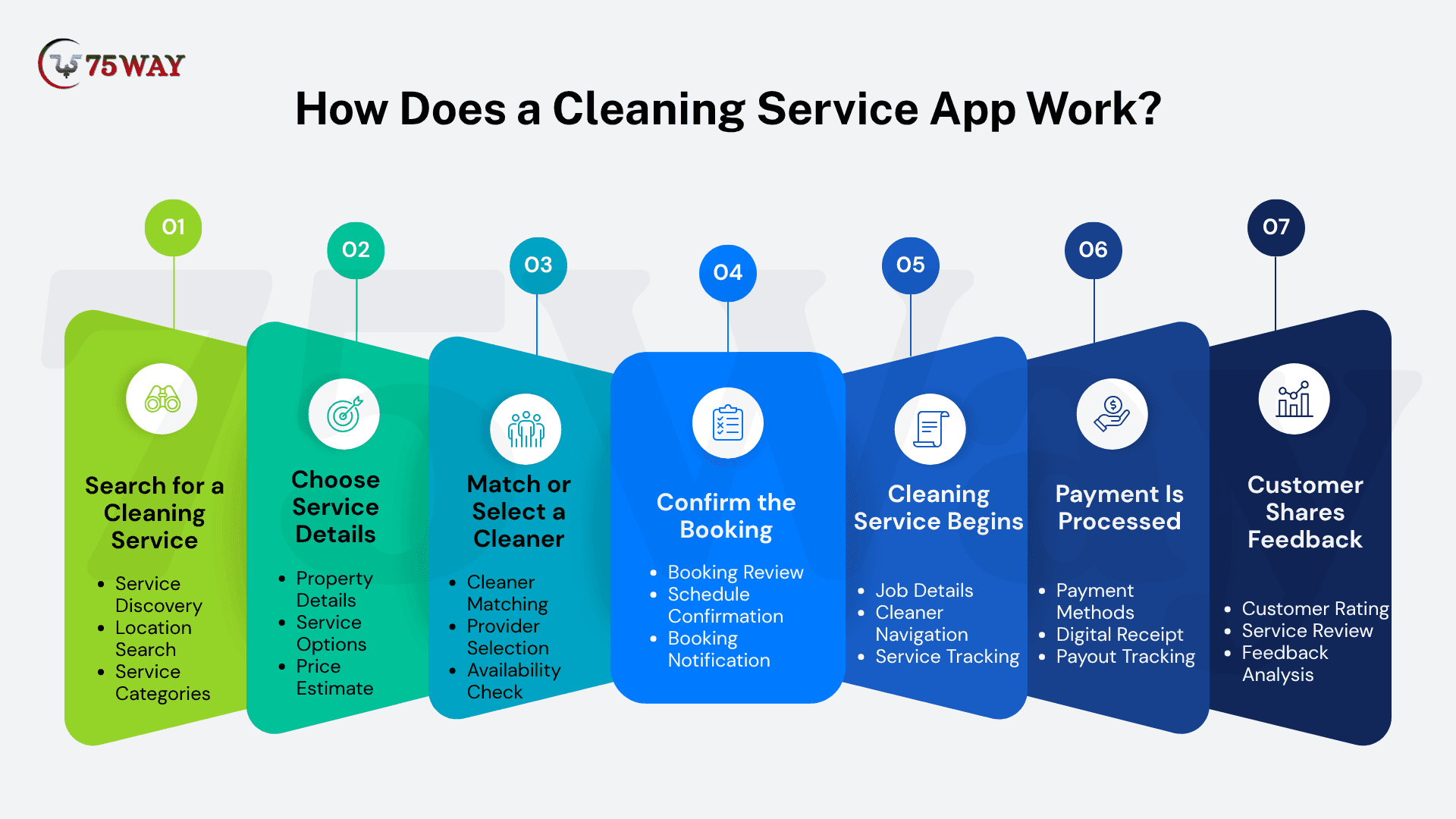
1. Search for a Cleaning Service
The process usually starts when a customer opens the app and searches for the cleaning service they need. They may enter their location and choose an option such as home cleaning, deep cleaning, office cleaning, move-in cleaning, or another service offered through the platform.
A clear service menu helps customers find the right option without making the process feel complicated. Location details can also help the platform show services and cleaners available nearby.
2. Choose Service Details
Once the customer selects a service, the app asks for the details needed to complete the booking. This can include property type, number of rooms, cleaning requirements, preferred date, available time slot, and any additional services.
For example, a customer booking a home deep cleaning service might add carpet cleaning, window cleaning, or appliance cleaning. The app can use these selections to calculate the estimated price before the customer confirms the booking.
3. Match or Select a Cleaner
After the service details are submitted, the platform needs to connect the customer with the right cleaning professional. Depending on the business model, the app can automatically assign an available cleaner based on location, availability, skills, ratings, or workload.
Alternatively, customers can browse available professionals and select the cleaner they prefer. This approach works particularly well for marketplace-style platforms where multiple independent cleaners operate through the app.
4. Confirm the Booking
Once the cleaner is assigned or selected, the customer can review the complete booking before confirming it. The app can display the service type, scheduled date and time, property details, estimated cost, and cleaner information in one place.
After confirmation, the customer receives a booking notification. This gives them peace of mind because they know who is coming, when the service will happen, and what they are expected to pay.
5. Cleaning Service Begins
When the scheduled time arrives, the cleaner travels to the customer's location and starts the requested work. A provider-side app can help the cleaner view job details, customer instructions, navigation information, and service requirements before arriving.
Some advanced cleaning platforms also include arrival updates, check-in features, task checklists, before-and-after photos, or service status updates. These features can make the process more transparent for both customers and business owners.
6. Payment Is Processed
After the cleaning is completed, the platform processes the payment using the method selected by the customer. Depending on the app, customers may be able to pay through credit or debit cards, digital wallets, or other supported payment options.
The app can also generate a digital receipt and update the booking status automatically. For businesses, integrated payment processing makes it easier to track transactions, commissions, refunds, and cleaner payouts.
7. Customer Shares Feedback
The workflow does not necessarily end when the cleaner leaves. Customers can rate their experience, leave comments, report an issue, or request another cleaning appointment directly through the app.
These reviews can help future customers make better decisions while giving cleaning businesses useful insights into service quality. The platform can also use ratings and feedback to identify reliable professionals and improve its overall service experience.
How Can This Workflow Be Customized?
There is no single workflow that every cleaning service app needs to follow. The process can change depending on how your business operates.
For example, a cleaning marketplace can allow customers to compare cleaners, check ratings, view prices, and select a professional themselves. In contrast, an established cleaning company may assign jobs directly to its own employees based on their schedules, locations, and availability.
You can also introduce features such as recurring bookings, subscription plans, real-time cleaner tracking, automated reminders, promotional offers, cancellation management, and customer support as your business grows.
The goal is simple: make booking a cleaning service easier for customers while giving your business enough control to manage cleaners, payments, schedules, and service quality.
Cleaning Service App Market Size, Revenue Opportunities in USA
How large is the opportunity, and where can the revenue actually come from home cleaning service app development? The figures and market insights below give you a clearer view of the US cleaning service app opportunity, customer demand, and potential earning avenues.
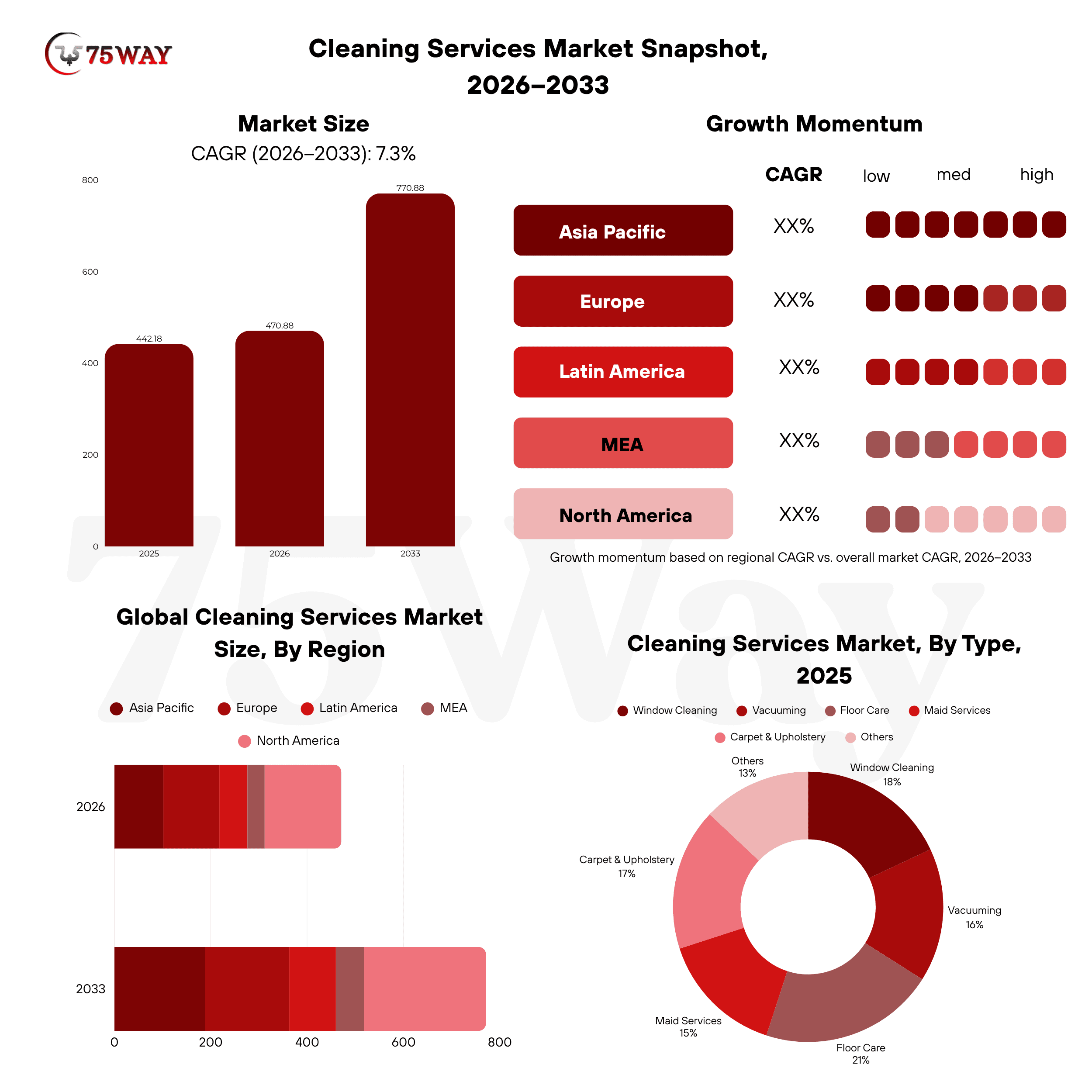
- The global cleaning services market is projected to grow from $470.8 billion in 2026 to $770.8 billion by 2033, at a CAGR of 7.3%, according to Grand View Research.
- Another forecast estimates the global cleaning services market will grow from $481.75 billion in 2026 to $859.20 billion by 2034, at a CAGR of 7.5%.
- North America dominates the cleaning services market, holding a 37.52% share.
- The commercial segment holds a 27.2% market share by end use.
- The commercial segment is projected to account for 80.53% of the market in 2026.
- The floor care segment holds the largest market share at 30.7%.
- The floor care and vacuuming segment is expected to account for 43.85% of the market in 2026.
- Approximately 58% of dual-income households regularly outsource their cleaning needs.
- Healthcare facilities and corporate offices are increasing their focus on professional sanitization to meet stringent workplace health and safety requirements.
- Government support, including local grants for small cleaning businesses, along with growing adoption of eco-friendly cleaning practices, is supporting market expansion.
How to Plan Your Home Cleaning Service App Development Solution?
A successful cleaning service app starts with a clear business plan and potential app idea rather than a long feature list. Before investing in design and development, you need to determine who will use the platform, which cleaning services you will offer, how bookings will work, and how the business will generate revenue. These decisions create the foundation for your product, technology, and future growth.
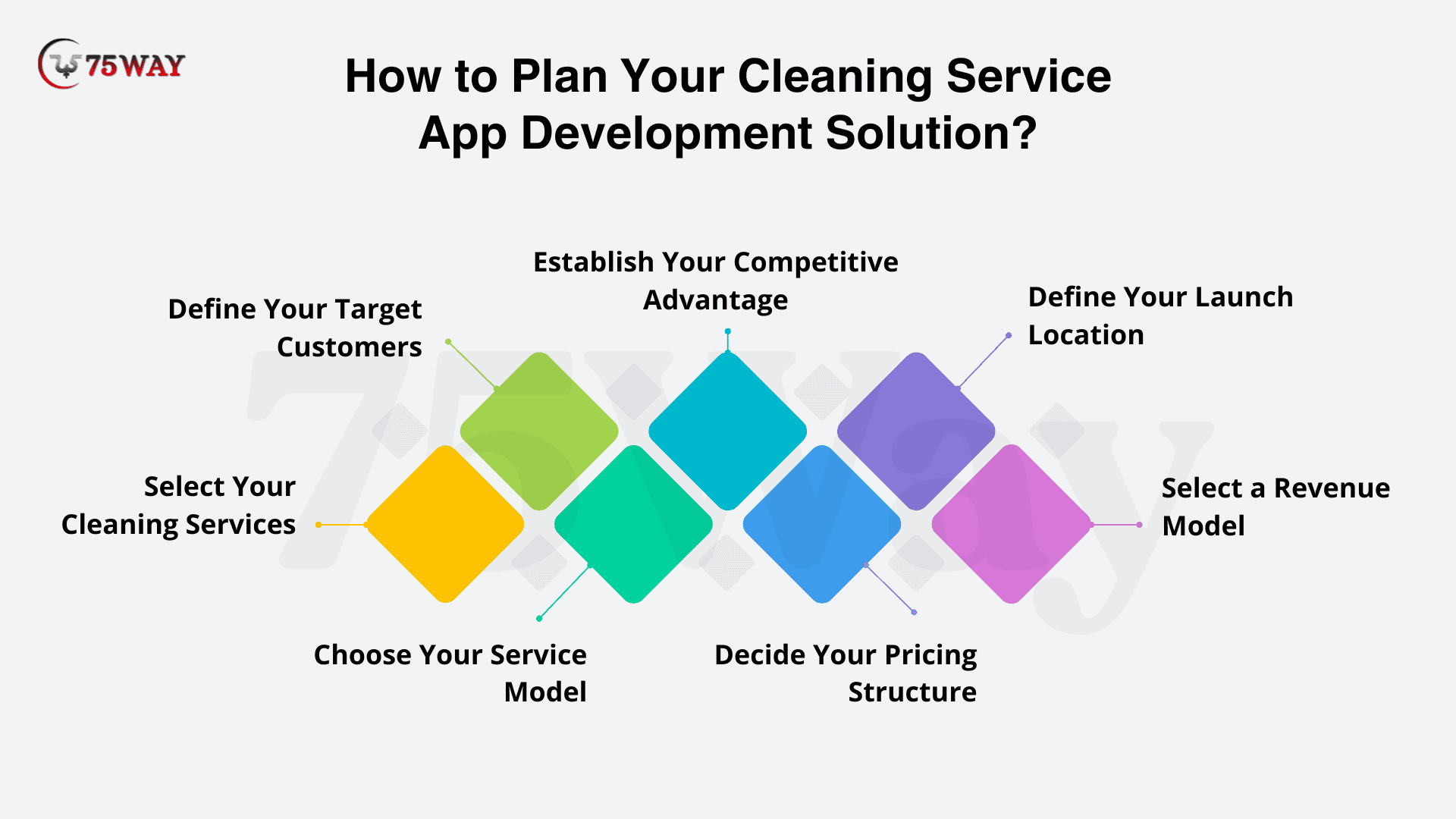
1. Define Your Target Customers
Start by identifying the customers you want to serve. Your audience could include homeowners, renters, landlords, property managers, offices, restaurants, retail stores, or businesses requiring recurring commercial cleaning.
Understanding your audience helps determine the services, pricing, booking options, communication methods, and user experience your application should provide.
2. Select Your Cleaning Services
Decide which services customers can book through your platform. A focused launch can help you validate demand before expanding into additional categories. Common options include:
- Residential house cleaning
- Deep cleaning
- Move-in and move-out cleaning
- Office cleaning
- Commercial cleaning
- Carpet cleaning
- Window cleaning
- Bathroom cleaning
- Kitchen cleaning
- Post-construction cleaning
- Disinfection services
- Recurring cleaning packages
You can later introduce specialized services based on customer demand and operational capacity.
3. Choose Your Service Model
Your operating model determines how customers and cleaning professionals interact through the platform.
- On-Demand Marketplace: Customers book independent cleaners or cleaning companies available on the platform.
- Managed Cleaning Service: Your company employs or contracts cleaners and manages bookings, assignments, pricing, and service quality.
- Hybrid Model: The platform combines company-managed cleaners with independent service providers to increase coverage and capacity.
For entrepreneurs entering a competitive market, the marketplace or hybrid model can provide opportunities to expand across locations without maintaining an entirely in-house workforce.
4. Decide Your Pricing Structure
Cleaning services can be priced according to several factors, including property size, cleaning type, number of rooms, service duration, location, and additional requirements. You can offer:
- Fixed service pricing
- Hourly pricing
- Property-based pricing
- Dynamic pricing
- Recurring service discounts
- Premium or urgent booking charges
- Add-on service fees
Transparent pricing is particularly important because customers want to understand their expected cost before confirming a booking.
5. Select a Revenue Model
Your monetization strategy should be considered before development because payment flows, subscriptions, commissions, and administrative features may depend on it.
Potential revenue streams include:
- Booking Commission: Charge cleaners or service providers a percentage of every completed booking.
- Customer Service Fee: Add a platform fee to each customer transaction.
- Subscription Plans: Offer recurring cleaning packages or membership plans with discounts and additional benefits.
- Provider Subscription: Charge cleaning professionals a recurring fee for access to leads, bookings, or premium platform tools.
- Featured Listings: Allow cleaning companies to pay for greater visibility within relevant service searches.
- Cancellation Fees: Apply reasonable charges when customers cancel bookings outside the permitted cancellation window.
A diversified revenue model can provide greater flexibility as the platform grows, but the initial monetization strategy should remain simple enough for customers and service providers to understand.
6. Define Your Launch Location
Geographic planning is another important consideration. Decide whether the application will initially serve one city, several metropolitan areas, or a broader region.
Starting with a defined service area can make it easier to manage cleaner availability, service quality, customer acquisition, pricing, and operational logistics. Once the model demonstrates consistent demand, you can expand into additional markets.
7. Establish Your Competitive Advantage
The cleaning app market already includes booking platforms and established cleaning businesses. Your application therefore needs a clear reason for customers and cleaners to choose it.
Your competitive advantage could come from faster bookings, verified cleaners, transparent pricing, recurring cleaning plans, specialized commercial services, flexible scheduling, better customer support, loyalty programs, or technology-driven service matching.
The goal is not to include every possible feature. It is to build the features that solve the most important problems for your specific audience better than competing alternatives.
What Are the Different Types of Cleaning Apps Businesses Can Build?
Cleaning service apps are not limited to one business model. The right application type depends on the services you provide, your target customers, operating model, and revenue strategy. Understanding these options can help you choose the right product structure before starting cleaning service app development.
1. On-Demand Cleaning App
An on-demand cleaning app allows customers to request cleaning services whenever they need them. Users can select a service, enter their location, choose a preferred time, view pricing, and book an available cleaner.
This model is suitable for businesses targeting customers who need convenient residential or commercial cleaning without long-term commitments. Apps like TaskRabbit and Thumbtack have popularized this model by connecting users with nearby service providers in real time.
2. Residential Cleaning App
A residential cleaning app focuses on household services such as regular house cleaning, deep cleaning, kitchen cleaning, bathroom cleaning, carpet cleaning, and move-in or move-out services.
The platform can support recurring bookings, saved preferences, favorite cleaners, household details, and customized cleaning requirements. In the United States, platforms like Molly Maid and Handy (Angi Services) are widely used for home cleaning and recurring household maintenance services.
3. Commercial Cleaning App
Commercial cleaning apps are designed for businesses that require recurring cleaning services for offices, retail stores, restaurants, warehouses, hotels, and other commercial properties. Similar to how LinkedIn connects professionals in the business world, these apps connect enterprises with verified cleaning providers for long-term contracts.
These platforms may require recurring contracts, multiple locations, employee access, invoices, service-level agreements, approval workflows, and detailed reporting. Companies like Jani-King and ABM Industries have established strong digital and operational systems for managing large-scale commercial cleaning contracts.
4. Cleaning Marketplace App
A cleaning marketplace connects customers with multiple independent cleaners or professional cleaning companies. Customers can compare providers based on availability, ratings, experience, pricing, and service categories before placing a booking.
The platform owner can generate revenue through commissions, service fees, subscriptions, featured listings, or other marketplace monetization strategies. Thumbtack and Angi (formerly Angie’s List) are leading examples of service marketplaces that include cleaning as a major category.
5. Cleaning Company Management App
This type of application is designed for an established cleaning company that manages its own workforce rather than operating as an open marketplace.
Customers can book services while administrators assign employees, manage schedules, monitor appointments, process payments, and track business performance from a centralized system.
6. Recurring Cleaning Subscription App
A subscription-based cleaning application allows customers to schedule cleaning services on a recurring basis, such as weekly, biweekly, or monthly. Services like Homeaglow and subscription-style offerings from platforms like Handy have made recurring cleaning plans increasingly popular among busy households.
Businesses can offer subscription tiers, discounted bookings, priority scheduling, recurring payment options, loyalty benefits, and personalized service plans to encourage long-term customer relationships.
7. Specialized Cleaning App
A specialized cleaning platform focuses on a specific service category instead of offering a broad range of cleaning solutions. Stanley Steemer (carpet and upholstery cleaning) and Window Genie (window cleaning services) are strong examples of niche-focused cleaning businesses.
Examples include:
- Carpet cleaning
- Window cleaning
- Pool cleaning
- Vehicle cleaning
- Post-construction cleaning
- Disinfection services
- Laundry services
- Appliance cleaning
- Move-in and move-out cleaning
A specialized platform can help businesses target a clearly defined customer segment and build focused service workflows.
8. Multi-Service Home Services App
A broader home services application can combine cleaning with other household services, such as plumbing, electrical repairs, painting, appliance maintenance, pest control, or home organization.
Cleaning can serve as one service category within a larger marketplace, allowing businesses to increase customer lifetime value by offering additional services through the same platform. Angi and Thumbtack are leading examples of multi-service platforms that offer cleaning alongside a wide range of home services.
9. AI-Powered Cleaning Service App
An AI-powered cleaning platform uses artificial intelligence to improve selected customer or operational workflows. Depending on the business requirements, AI can support cleaner matching, demand forecasting, customer support, personalized recommendations, review analysis, scheduling optimization, and workflow automation.
AI should be introduced where it creates measurable value rather than being added simply to make the application appear technologically advanced.
Types of Cleaning Service App At a Glance
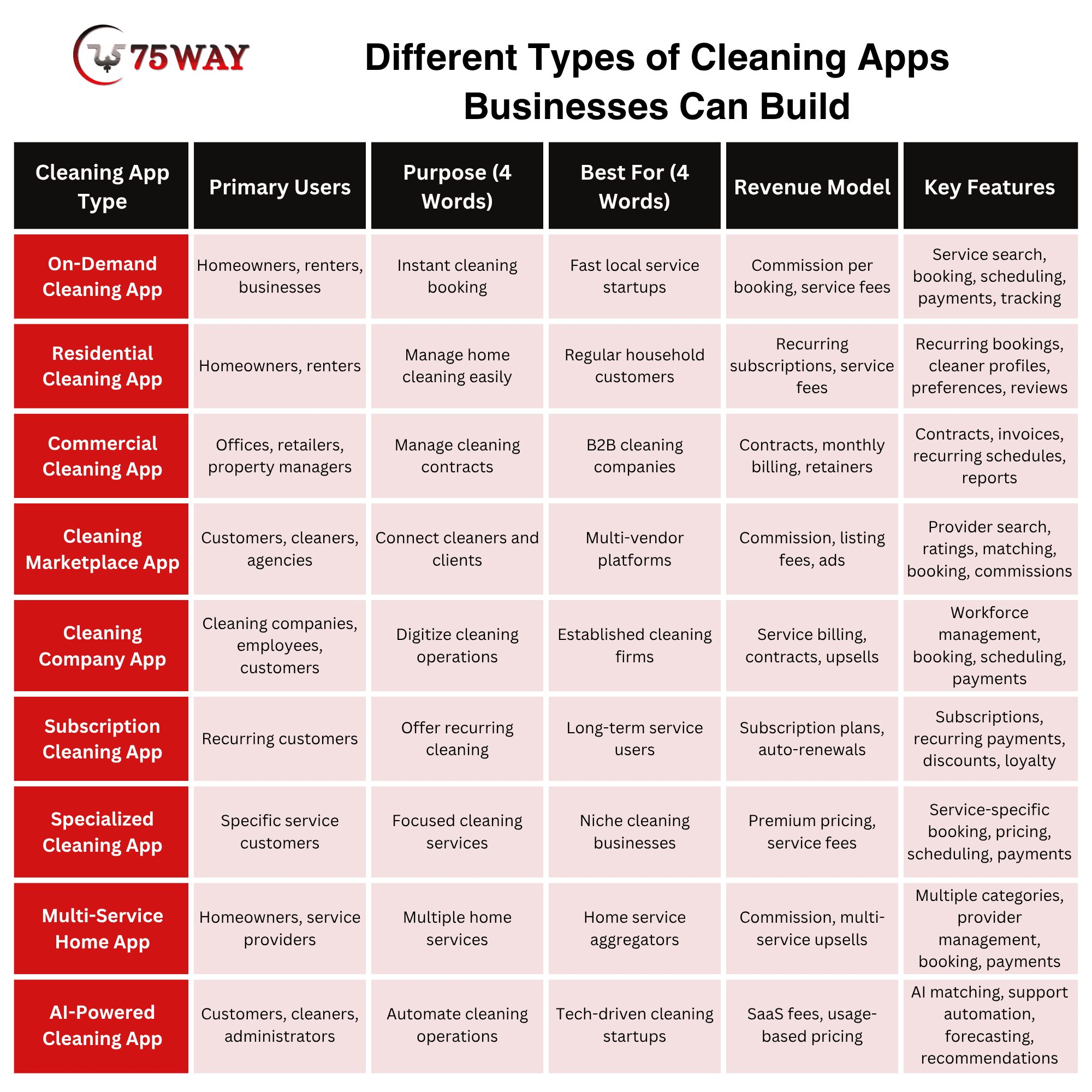
Which Type of Cleaning App Development Solution Should You Launch?
The best app type depends on your business objectives. A startup testing local demand may begin with an on-demand MVP, while an established cleaning company may need a workforce management and booking platform. A marketplace entrepreneur may require separate customer, cleaner, and admin applications, while a commercial cleaning business may prioritize contracts, recurring schedules, invoices, and multi-location management.
Defining the app type first makes it easier to determine the required features, development scope, technology architecture, timeline, and investment.
How to Build a Cleaning Service App: A Comprehensive Development Roadmap
Cleaning service app development process becomes easier to manage when the project is divided into clear stages. Each stage addresses a different business or technical requirement, from validating the concept to building, testing, launching, and improving the platform. Following a structured process can reduce unnecessary development costs and help prevent major changes later.
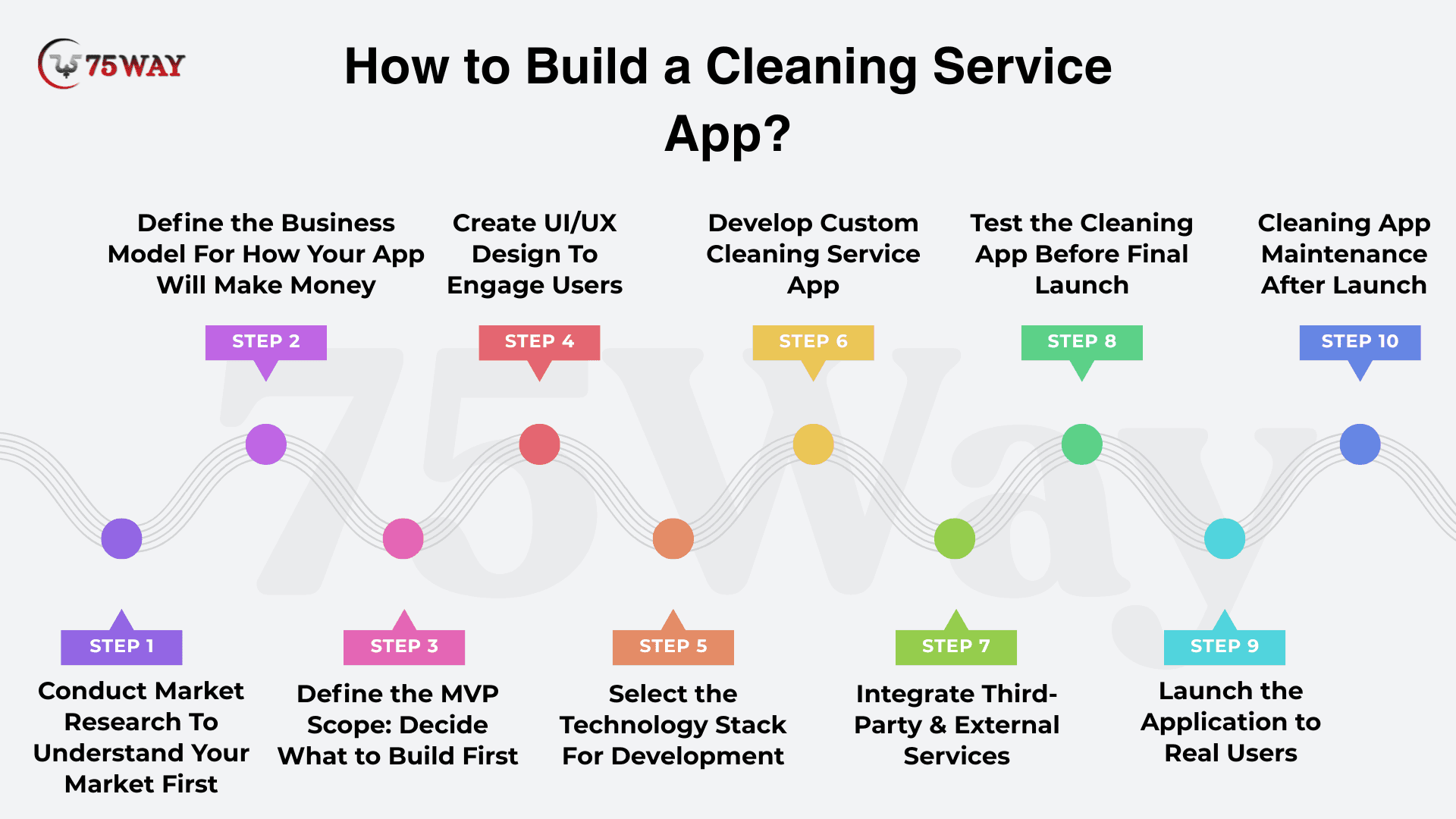
Step 1: Conduct Market Research To Understand Your Market First
Begin by studying the cleaning services market, target customers, competitors, pricing models, and existing applications. The goal is not to copy competing platforms but to understand what customers expect and where current solutions leave room for improvement.
Research should examine:
- Target customer segments
- Popular cleaning services
- Local demand
- Competitor features
- Pricing structures
- Customer complaints and reviews
- Provider challenges
- Existing service gaps
- Geographic opportunities
Customer interviews, surveys, competitor analysis, keyword research, and industry research can provide useful insights before development begins.
Step 2: Define the Business Model For How Your App Will Make Money
Once the market opportunity is understood, determine how your platform will operate and generate revenue.
Decide whether the application will function as:
- An on-demand cleaning marketplace app
- A cleaning company booking platform
- A subscription-based cleaning service
- A commercial cleaning management platform
- A hybrid cleaning marketplace
At this stage, define your commission structure, pricing method, service areas, cancellation policies, payment process, provider relationship, and customer acquisition strategy.
A clear business model prevents technology decisions from being made without understanding the commercial requirements behind them.
Step 3: Define the MVP Scope: Decide What to Build First
You do not need to build every possible feature in the first version. An MVP should contain the capabilities required to test your core business proposition.
For a cleaning marketplace, this could include customer registration, service browsing, booking, scheduling, cleaner management, payments, notifications, ratings, and an administrative dashboard.
Advanced features such as AI matching, predictive analytics, loyalty programs, and sophisticated automation can be introduced after the platform generates enough usage data to justify them.
This approach helps control initial investment while allowing the business to validate demand with real users.
Step 4: Create UI/UX Design To Engage Users
The design stage transforms business requirements into usable digital experiences.
Designers should create separate journeys for customers, cleaners, and administrators. The customer should be able to discover a service and complete a booking without unnecessary steps. Cleaners should quickly understand their assignments and availability.
Administrators should be able to manage operations without navigating complicated interfaces. The design process generally includes:
- User flow mapping
- Wireframes
- Interface design
- Interactive prototypes
- Design system creation
- Usability evaluation
- Responsive layouts
A well-designed booking journey can reduce abandoned bookings and make the application easier to use across different customer segments.
Step 5: Select the Technology Stack For Development
Technology selection should support the expected user volume, feature requirements, security standards, integrations, and long-term scalability of the platform. A typical cleaning service application may use:
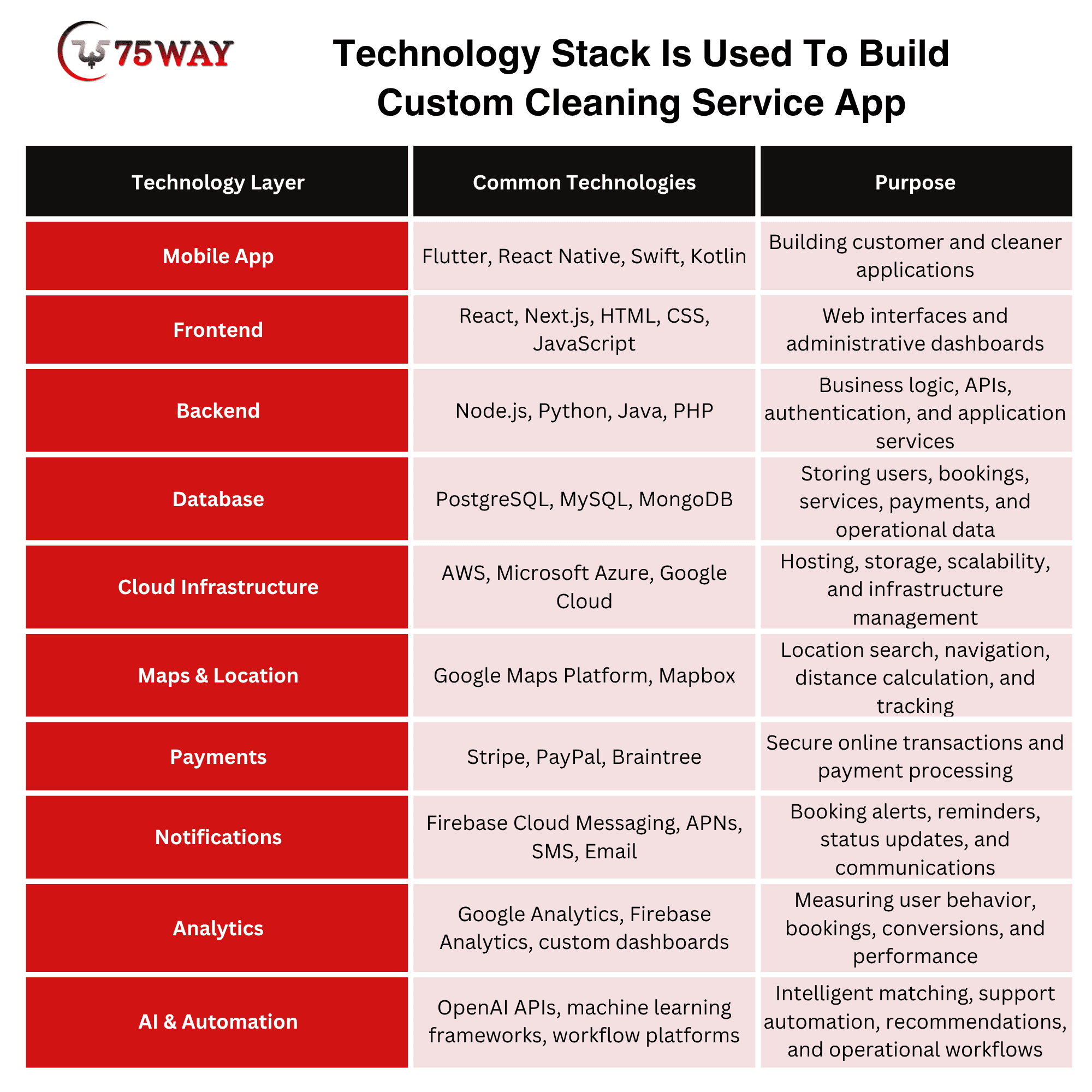
- Frontend: React Native, Flutter, Swift, Kotlin, or other suitable technologies depending on platform requirements.
- Backend: Node.js, Python, Java, PHP, or another framework appropriate for the application's architecture.
- Database: PostgreSQL, MySQL, MongoDB, or another database selected according to data requirements.
- Cloud Infrastructure: AWS, Microsoft Azure, Google Cloud, or another cloud environment.
- Maps and Location: Google Maps Platform or comparable mapping services.
- Payments: Stripe, PayPal, Braintree, or regionally appropriate payment providers.
- Notifications: Firebase Cloud Messaging, Apple Push Notification service, email, and SMS integrations.
The best technology stack depends on the application architecture rather than following a universal combination.
Step 6: Develop Custom Cleaning Service App
After the designs and technical architecture are approved, developers begin implementing the platform.
Development generally covers the customer application, cleaner application, backend infrastructure, APIs, database, payment processing, notifications, location services, and administration dashboard.
Developers should also implement security controls throughout the process instead of treating security as a final-stage activity.
Agile development can divide the project into manageable sprints, allowing stakeholders to review progress, identify issues, and adjust priorities before the entire application is completed.
Step 7: Integrate Third-Party & External Services
A cleaning service app often depends on external services to provide capabilities that would be inefficient to build entirely from scratch.
Common integrations include:
- Payment gateways
- Mapping and geolocation services
- SMS providers
- Email services
- Push notification systems
- Identity verification
- Analytics platforms
- Customer support tools
- Calendar integrations
- Cloud storage
Each integration should be evaluated for reliability, security, pricing, API limitations, and long-term suitability.
Step 8: Test the Cleaning App Before Final Launch
Testing is essential because a cleaning platform manages customer information, bookings, payments, locations, and communication.
Quality assurance teams should test:
- Functional performance
- Booking workflows
- Payment processing
- Login and authentication
- Location accuracy
- Notifications
- API responses
- Device compatibility
- Application performance
- Security
- Usability
- Load handling
Real-world scenarios should also be tested. For example, the team should verify what happens when a cleaner rejects a booking, a customer cancels at the last moment, a payment fails, or two customers attempt to book the same availability slot.
Step 9: Launch the Application to Real Users
Once testing is complete, prepare the application for release through the relevant app stores and production infrastructure. Before launch, confirm that:
- App store requirements are satisfied
- Privacy policies are available
- Terms and conditions are published
- Payment systems are operational
- Customer support processes are ready
- Analytics are configured
- Error monitoring is active
- Provider onboarding is complete
- Service areas are clearly defined
A controlled launch in a limited market can help identify operational issues before expanding into additional locations.
Step 10: Cleaning App Maintenance After Launch
App development does not end when the application reaches the app stores. User behavior, reviews, technical performance, and business results should be monitored continuously.
Post-launch activities can include:
- Bug fixes
- Security updates
- Performance optimization
- Operating system compatibility updates
- New feature releases
- User experience improvements
- Analytics review
- Conversion optimization
- Infrastructure scaling
- Third-party API maintenance
Regular improvements help the platform remain competitive while allowing the business to respond to changing customer expectations.
The strongest cleaning service apps are not built around a single launch. They evolve through customer feedback, operational data, market changes, and measurable business results.
Which Features to Integrate in On-Demand Cleaning Service App Development?
A good cleaning service app should make booking feel simple while giving cleaners and business owners the tools they need to manage every service request. Here are the essential features your platform may need, divided into customer, cleaner, admin, and advanced categories.
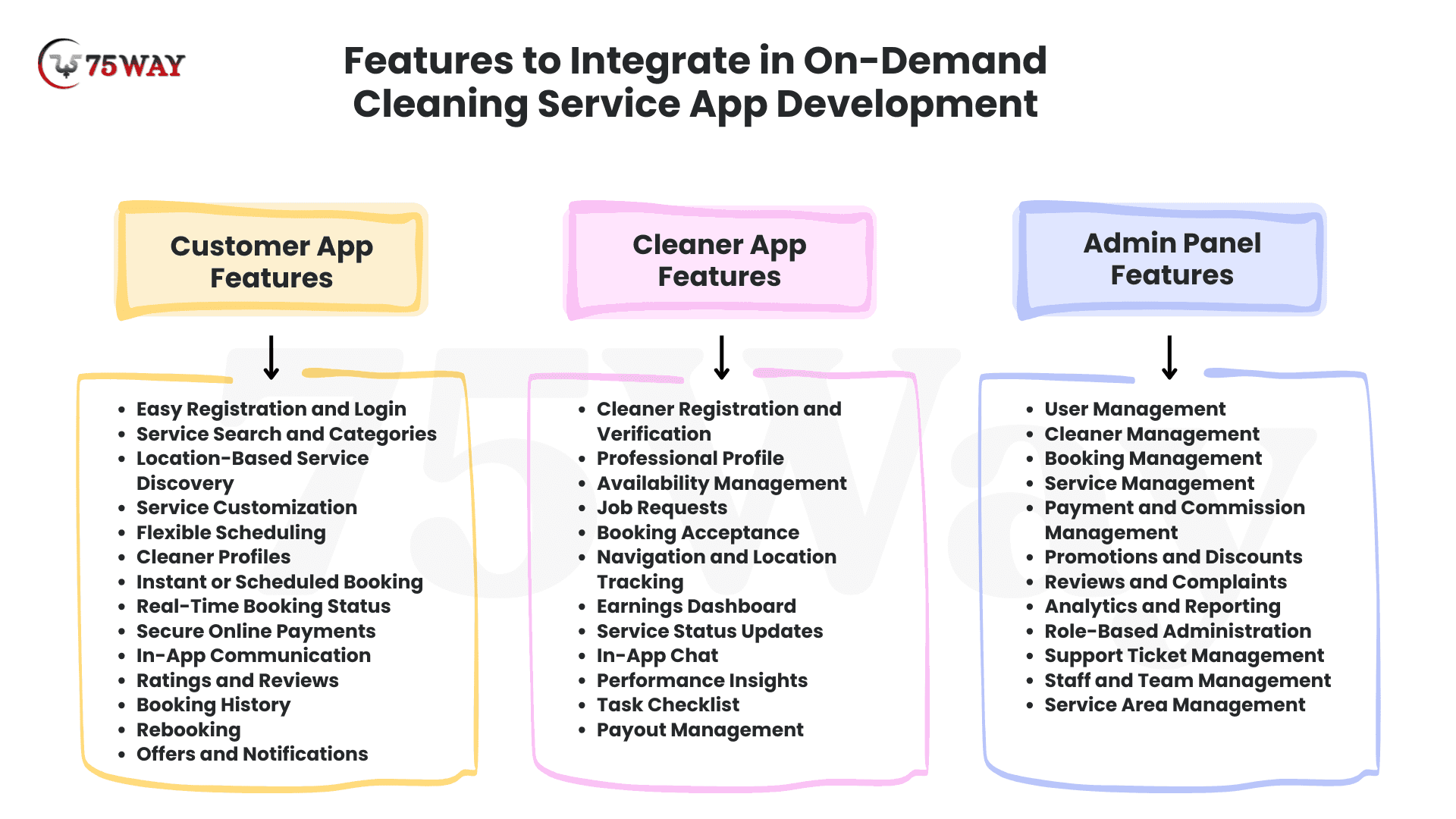
Module 1: Customer App Features
The customer side should make it easy to discover services, arrange appointments, communicate with cleaners, and manage bookings without unnecessary steps.
- Easy Registration and Login: A simple sign-up process lets people create accounts with a phone number, email address, or supported social login. Once registered, they can access bookings, saved information, payment records, and other account details from one place.
- Service Search and Categories: Well-organized service categories help users quickly find options such as deep cleaning, home cleaning, office cleaning, or move-out cleaning. Service pages can explain what each option includes, how long it may take, and whether additional charges apply.
- Location-Based Service Discovery: Entering an address or using device location helps the platform identify whether cleaning services are available nearby. It can also narrow down suitable professionals based on their service areas.
- Service Customization: A standard cleaning package may not suit every property, so users can add details such as room count, property size, pets, or special cleaning requests. These selections give the platform better information for calculating the price and preparing the right service.
- Flexible Scheduling: Choosing a preferred date and time gives people more control over when the cleaner arrives. Recurring schedules can also support households and businesses that need cleaning every week, two weeks, or month.
- Cleaner Profiles: Before making a booking, users can explore information about available professionals, including experience, specialties, ratings, and completed jobs. This gives them a better basis for choosing someone they feel comfortable inviting into their property.
- Instant or Scheduled Booking: Some situations call for a cleaner today, while others can be planned well in advance. Supporting both options allows the platform to handle urgent requests alongside future appointments.
- Real-Time Booking Status: Booking updates can show whether a request has been confirmed, assigned, accepted, started, or completed. Clear status information keeps people informed without requiring them to contact support for every update.
- Secure Online Payments: Built-in payment options allow users to pay for services through supported cards, wallets, or other available methods. Receipts and transaction records can then remain accessible inside the account for future reference.
- In-App Communication: A private chat gives the two sides a convenient way to discuss access instructions, parking, property details, or special requests. Keeping these conversations within the platform can reduce the need to share personal phone numbers.
- Ratings and Reviews: After the appointment, users can share their experience through a rating and written review. This feedback helps future users compare professionals while giving the business a clearer picture of service quality.
- Booking History: A dedicated history section keeps previous and upcoming appointments, invoices, service details, and payment records easy to find. It also saves users from searching through emails or messages whenever they need an old booking detail.
- Rebooking: Returning users can repeat a previous service without filling out the same booking information again. This is especially useful for regular cleaning customers who prefer familiar services or professionals.
- Offers and Notifications: Timely alerts can remind users about upcoming appointments, booking changes, promotions, cancellations, and completed services. Personalized offers can also encourage people to return when they have not booked for some time.
Module 2: Cleaner App Features
The cleaner app should help professionals discover suitable jobs, organize their schedules, communicate with customers, and monitor their earnings.
- Cleaner Registration and Verification: A dedicated onboarding process allows professionals to submit their identity, experience, and required documents before accepting jobs. Depending on the business and local regulations, verification may include background checks, certifications, or insurance information.
- Professional Profile: A profile gives each cleaner space to present their experience, specialties, service areas, ratings, and completed work. This information can help potential customers decide whether the professional matches their needs.
- Availability Management: Professionals can mark their working hours, days off, preferred areas, and periods when they cannot accept bookings. Keeping this information updated helps prevent appointments from being offered at unsuitable times.
- Job Requests: Each new request can display important details such as cleaning type, property location, appointment time, customer instructions, and expected earnings. Having this information before acceptance helps cleaners decide whether the job fits their schedule and preferences.
- Booking Acceptance: Incoming jobs can be accepted or declined directly from the professional dashboard. When a cleaner turns down a request, the platform can make it available to another suitable provider.
- Navigation and Location Tracking: Integrated maps can guide cleaners to the service address and make the journey easier to plan. For business models that support it, location sharing can also give customers an idea of when their cleaner is approaching.
- Earnings Dashboard: A financial dashboard can show completed jobs, pending amounts, commissions, bonuses, and total earnings. Having these figures in one place makes it easier for professionals to understand their income from the platform.
- Service Status Updates: Simple status controls can mark important moments such as arrival, service start, and completion. These updates keep customers and administrators aware of what is happening with an active booking.
- In-App Chat: Direct messaging provides a place to discuss entry arrangements, cleaning instructions, or unexpected issues before and during an appointment. It also keeps service-related conversations connected to the relevant booking.
- Performance Insights: Ratings, completed jobs, customer feedback, and earnings trends can give professionals a clearer view of their activity. Seeing this information can help them identify strengths and areas that may need attention.
- Task Checklist: Cleaners can view a task-by-task list for each booking, including specific rooms, cleaning activities, and customer requests. Checking off completed tasks helps them keep track of the agreed work before closing the appointment.
- Payout Management: Professionals can view payout schedules, completed payment transfers, pending amounts, and transaction details from their accounts. This gives them a clear record of when and how their earnings are being released.
Module 3: Admin Panel Features
The admin panel gives business owners a central place to oversee users, bookings, finances, services, and day-to-day platform activity.
- User Management: Account management tools let administrators review customer information, monitor account activity, and handle reported issues. Suspensions or other account actions can also be managed when platform rules are broken.
- Cleaner Management: A dedicated dashboard can handle professional applications, verification documents, profiles, availability, complaints, and service records. This gives the business a clearer view of the provider network.
- Booking Management: All current, upcoming, completed, and cancelled appointments can be monitored from one dashboard. When a problem occurs, authorized staff can update assignments, resolve scheduling conflicts, or assist with cancellations.
- Service Management: Business owners can add new cleaning packages, update descriptions, change pricing, manage service areas, and introduce additional services. This makes it easier to keep the app aligned with the company's current offerings.
- Payment and Commission Management: Financial tools can track customer payments, refunds, platform fees, cleaner payouts, and other transactions. Having these records together simplifies financial monitoring and helps resolve payment-related questions.
- Promotions and Discounts: Coupon codes, referral rewards, seasonal deals, and special campaigns can be created and managed from the admin panel. Rules can be set for eligibility, validity periods, usage limits, and discount amounts.
- Reviews and Complaints: Feedback and complaints can be collected in one place for staff to review. This allows the business to investigate serious issues, respond to concerns, and take action when service standards are not met.
- Analytics and Reporting: Business dashboards can reveal booking volume, revenue, cancellations, repeat bookings, customer acquisition, and cleaner activity. These figures help owners understand demand and make better decisions about services, staffing, and growth.
- Role-Based Administration: Different employees can receive access only to the sections required for their responsibilities. For example, finance staff may manage payments while operations staff handle bookings and cleaner assignments.
- Support Ticket Management: A centralized support system lets administrators track customer and cleaner complaints, questions, and service-related requests. Staff can assign tickets, monitor responses, and close issues once the matter has been resolved.
- Staff and Team Management: Business owners can create staff accounts and assign responsibilities based on individual roles. Access permissions can control which employees can view bookings, payments, users, reports, or other administrative sections.
- Service Area Management: Administrators can define the locations where cleaning services are available and expand coverage as the business grows. Area-based settings can also help manage cleaner availability, pricing, and booking eligibility across different regions.
Advanced Features for a Competitive Cleaning App
Once the core booking system is in place, advanced features can add greater automation and give the platform capabilities that go beyond basic scheduling.
- AI-Based Cleaner Matching: An AI system can compare location, availability, service requirements, ratings, previous jobs, and other factors before recommending a cleaner. This can help the platform find a suitable match without relying entirely on manual assignment.
- Smart Pricing: Pricing engines can consider service type, property size, location, demand, timing, and additional requirements when calculating a quote. Businesses can also define pricing rules to maintain control over how charges are generated.
- Automated Customer Support: An AI customer support assistant can handle common questions about bookings, prices, cancellations, services, and policies at any hour. More complicated matters can then be passed to a human support representative.
- Demand Forecasting: Historical booking data can reveal patterns around busy periods, seasonal demand, and popular services. Business owners can use these insights when planning workforce availability, marketing campaigns, and service capacity.
- Automated Notifications: Event-based notifications can send reminders, booking confirmations, payment alerts, status updates, and review requests at the appropriate point in the customer journey. This reduces the need for staff to send routine messages manually.
- AI-Powered Review Analysis: AI can examine customer reviews to identify recurring complaints, common preferences, and service issues across bookings. Admin teams can use these findings to spot problems that may not be obvious from individual reviews.
- Voice Booking Assistant: Voice technology can let users search for services, check booking details, or request an appointment through spoken commands. AI voice agent can make the platform easier to use for people who prefer talking rather than navigating multiple screens.
- Predictive Customer Retention: Machine learning can identify booking patterns that suggest when a customer may stop using the service. The business can then create timely reminders, personalized offers, or service suggestions to encourage another booking.
- Smart Route Planning: Route optimization can consider cleaner locations, appointment times, traffic conditions, and service duration when arranging daily jobs. This can help professionals plan their visits while reducing unnecessary travel between appointments.
- Fraud Detection: Automated monitoring can flag unusual payment activity, suspicious booking patterns, repeated refund requests, or other behavior that may require investigation. Administrators can review flagged transactions before taking further action.
The goal is not to pack the platform with every feature available in the market. Start with the functions your customers, cleaners, and operations team genuinely need, then introduce advanced capabilities as the business gains users and more data becomes available.
How Much Does It Cost to Develop a Cleaning Service App?
The cost of cleaning service app development can range from $10,000 to $300,000+, depending on the app's complexity, number of platforms, features, integrations, development location, security requirements, and level of customization. A basic MVP designed to validate a cleaning marketplace can require a significantly smaller investment than an enterprise platform supporting advanced automation, real-time operations, multiple user roles, and large-scale infrastructure.
- Basic MVP: $10,000–$30,000
- Mid-Level App: $30,000–$70,000
- Advanced/Custom App: $70,000–$150,000+
- Enterprise Platform: $150,000-300,000+
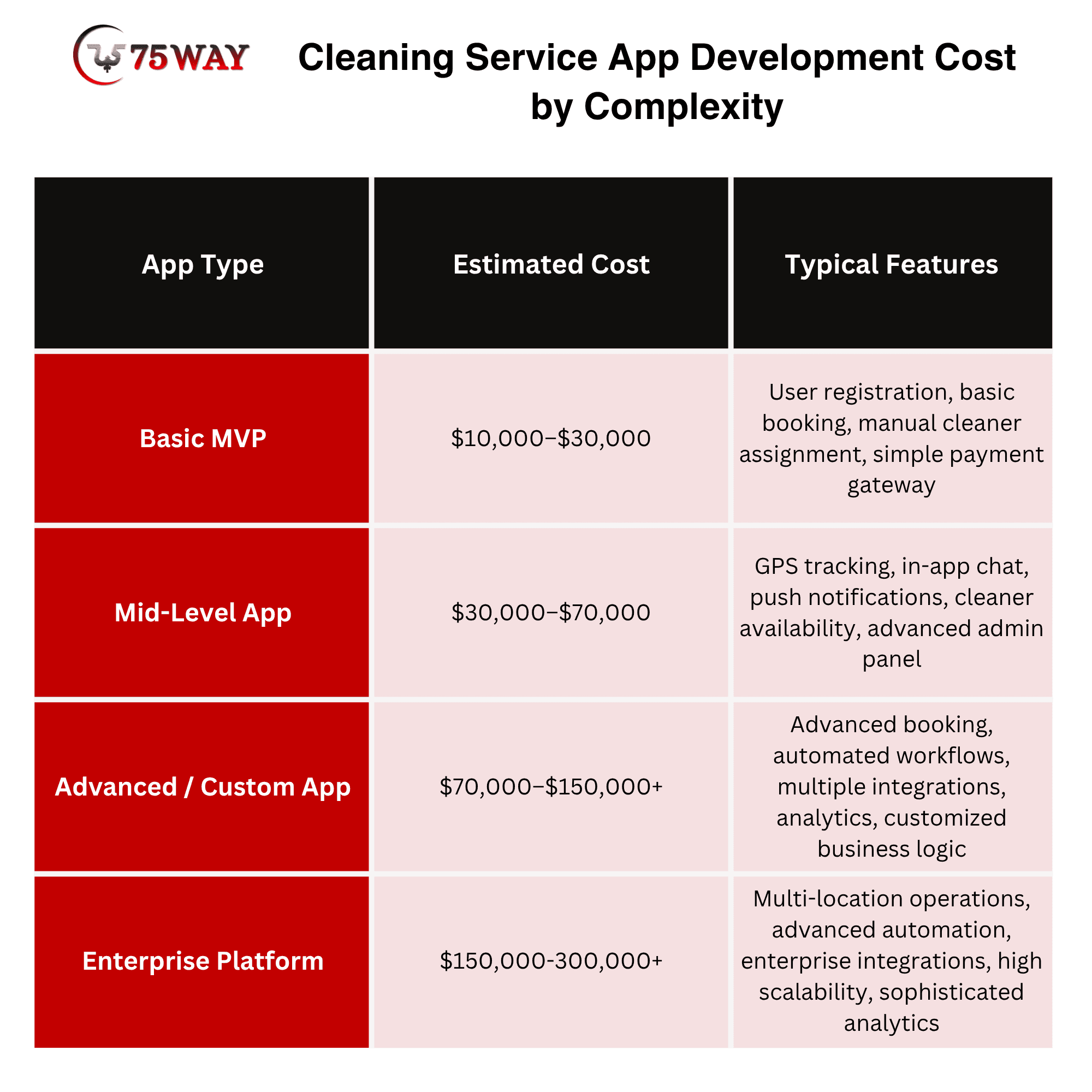
These costs are planning ranges rather than fixed quotes. The actual cost depends on the number of applications being developed, feature depth, design complexity, backend architecture, integrations, security requirements, development team location, and expected user volume.
On-Demand Cleaning Service App Cost Breakdown by Development Stage
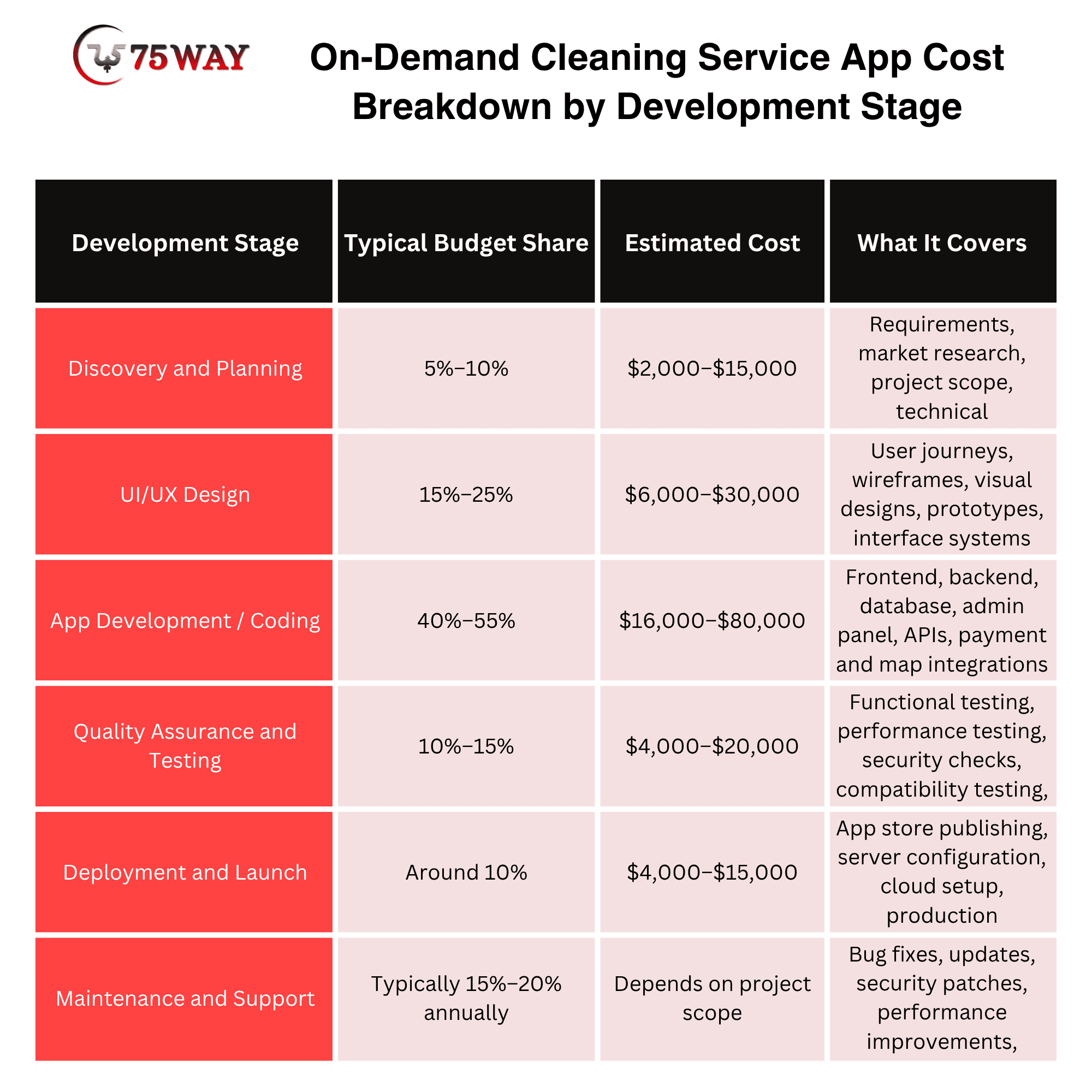
Looking at development costs by stage provides a clearer understanding of where your investment goes. Each phase contributes differently to the final product, and the percentage can change according to project complexity.
- Discovery and Planning: 5%–10%
- UI/UX Design: 15%–25%
- App Development/Coding: 40%–55%
- Quality Assurance and Testing: 10%–15%
- Deployment and Launch: Around 10%
- Maintenance and Support: Typically 15%–20% annually
What’s The Cost To Hire Cleaning Service App Developers Based On Their Locations
The cost of hiring cleaning service app developers is significantly affected by their locations. The total project budget may vary because developer and specialist rates vary between markets. The following ranges provide a general comparison for planning purposes.
- North America (US/Canada): $120–$250/hour
- Australia: $110–$190/hour
- Western/Eastern Europe: $40–$130/hour
- India/South Asia: $25–$50/hour
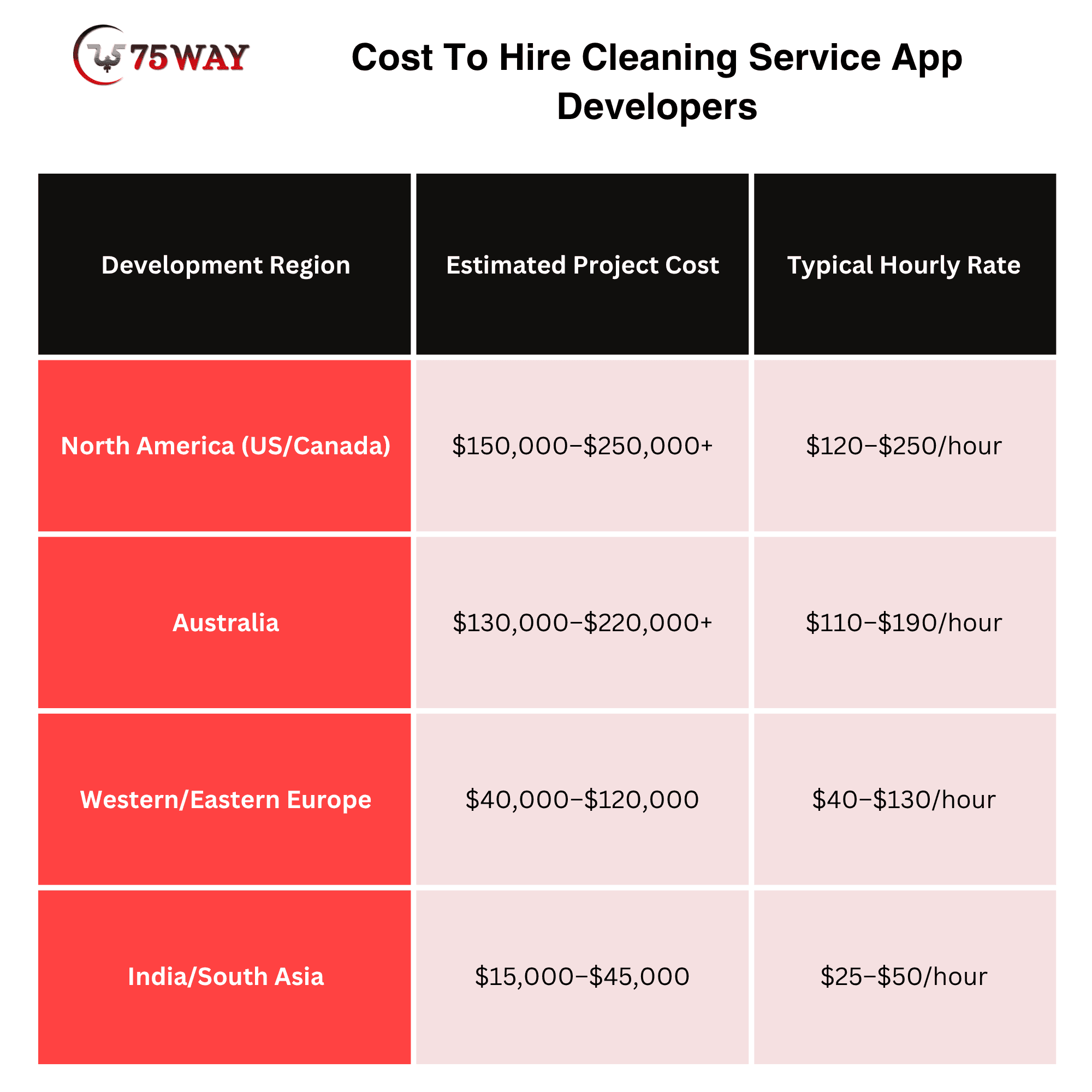
Regional figures should not be treated as a direct measure of development quality. The final budget depends on the team's technical expertise, project management capabilities, architecture, communication process, security practices, and experience developing platforms with comparable complexity.
For a U.S. business, choosing a cleaning app development partner should therefore involve more than comparing hourly rates. A lower initial rate can become expensive if poor architecture, weak testing, inadequate communication, or repeated redevelopment increases the overall project cost.
What Factors Affect On-Demand Cleaning App Development Cost?
Several variables can move the development budget significantly:
- Number of Platforms: Building separate native iOS and Android applications can require more resources than using a suitable cross-platform approach.
- Feature Complexity: Advanced booking, automated matching, dynamic pricing, real-time tracking, and analytics require more development effort than basic functionality.
- Number of User Roles: Customer, cleaner, manager, support agent, and administrator workflows increase the number of interfaces and permissions.
- Third-Party Integrations: Payment gateways, maps, SMS, email, identity verification, analytics, and CRM integrations add development and testing requirements.
- UI/UX Customization: Highly customized interfaces and complex user journeys require additional design and development work.
- Security Requirements: Applications handling payments, personal information, locations, and business data require appropriate security controls.
- Scalability: A platform intended to support multiple cities or large user volumes requires infrastructure and architecture designed for future growth.
- AI and Automation: AI-powered matching, customer support, forecasting, recommendations, and workflow automation can increase both development and infrastructure costs.
- Development Team: The location, expertise, team structure, and engagement model of the development partner influence the overall investment.
How Can You Control Costs of Building On-Demand Home Cleaning App?
The best way to control development costs is not to randomly remove important functionality. Instead, prioritize the features that directly support your core business model.
Start with an MVP that enables customers to book services, allows cleaners to manage assignments, gives administrators operational control, and supports secure payments. Once real users provide measurable feedback, you can prioritize additional capabilities according to customer demand and business performance.
A phased approach can also make budgeting easier:
Phase 1: Core booking and service management
Phase 2: Payments, tracking, communication, and provider tools
Phase 3: Analytics, automation, loyalty, and advanced operational features
Phase 4: AI capabilities, multi-location expansion, enterprise integrations, and advanced scalability
This approach allows the product to generate market feedback before substantial resources are committed to features that customers may not actually use.
Is Building a Cleaning Service App Worth the Investment?
A cleaning service app can be a worthwhile investment when there is a clearly defined market need, repeat booking potential, strong operational execution, and a business model capable of generating sustainable revenue. The technology itself does not guarantee profitability. Success depends on customer acquisition, service quality, cleaner availability, pricing, retention, and the ability to operate efficiently as demand grows.
Before development begins, calculate your expected customer acquisition cost, average booking value, platform commission or service fee, repeat booking rate, cleaner payout, operating expenses, and projected break-even point. These numbers can help determine whether the proposed development budget aligns with realistic business returns.
What Technology Stack Is Used For Custom Cleaning Service App Development?
The technology stack determines how reliably a cleaning service app performs, how easily it can integrate with external services, and how effectively it can scale as bookings and users increase. There is no single technology combination that fits every cleaning platform. The right stack depends on the application's features, target platforms, expected traffic, security requirements, budget, and future expansion plans.
A typical cleaning service app may use the following technologies:
How to Choose the Right Technology Stack?
Technology selection should begin with the product requirements rather than developer preference. A platform expecting rapid geographic expansion may require a different architecture from a small cleaning company serving one local market.
Consider these factors before finalizing your stack:
- Scalability: Choose technologies that can accommodate increasing customers, bookings, cleaners, and locations without requiring major architectural changes.
- Performance: Booking, payment, location, and communication workflows should respond quickly, particularly during periods of high demand.
- Security: The technology architecture should support appropriate protection for personal information, payment data, authentication credentials, and location information.
- Integration Support: The selected technologies should work reliably with payment gateways, mapping services, communication tools, analytics platforms, CRM systems, and other third-party services.
- Development Speed: For an MVP, technologies that allow faster development can help businesses validate their concept sooner.
- Long-Term Maintenance: A technology stack should have reliable documentation, community support, available developers, and a practical maintenance path.
- Budget: The selected architecture should match the available investment without sacrificing essential performance, security, or scalability.
Native vs Cross-Platform: Which Home Cleaning App Development Approach To Choose
One important decision is whether to build separate native applications or use cross-platform development.
For most home cleaning apps, cross-platform development is a practical choice because one codebase can support both iOS and Android while keeping development time and costs under control. Native development is a better option when your cleaning app requires highly specialized device features, advanced platform-level performance, or deep customization for each operating system. For a typical cleaning app with bookings, cleaner profiles, GPS, payments, chat, and notifications, both approaches can work well.
Native development uses Swift for iOS and Kotlin for Android, while Flutter and React Native are commonly used for cross-platform apps. Native development gives developers more control over device-specific features but requires separate development for each platform. Cross-platform development allows the same core application to serve iPhone and Android users, making it easier to launch an MVP and maintain the product as the cleaning business grows.
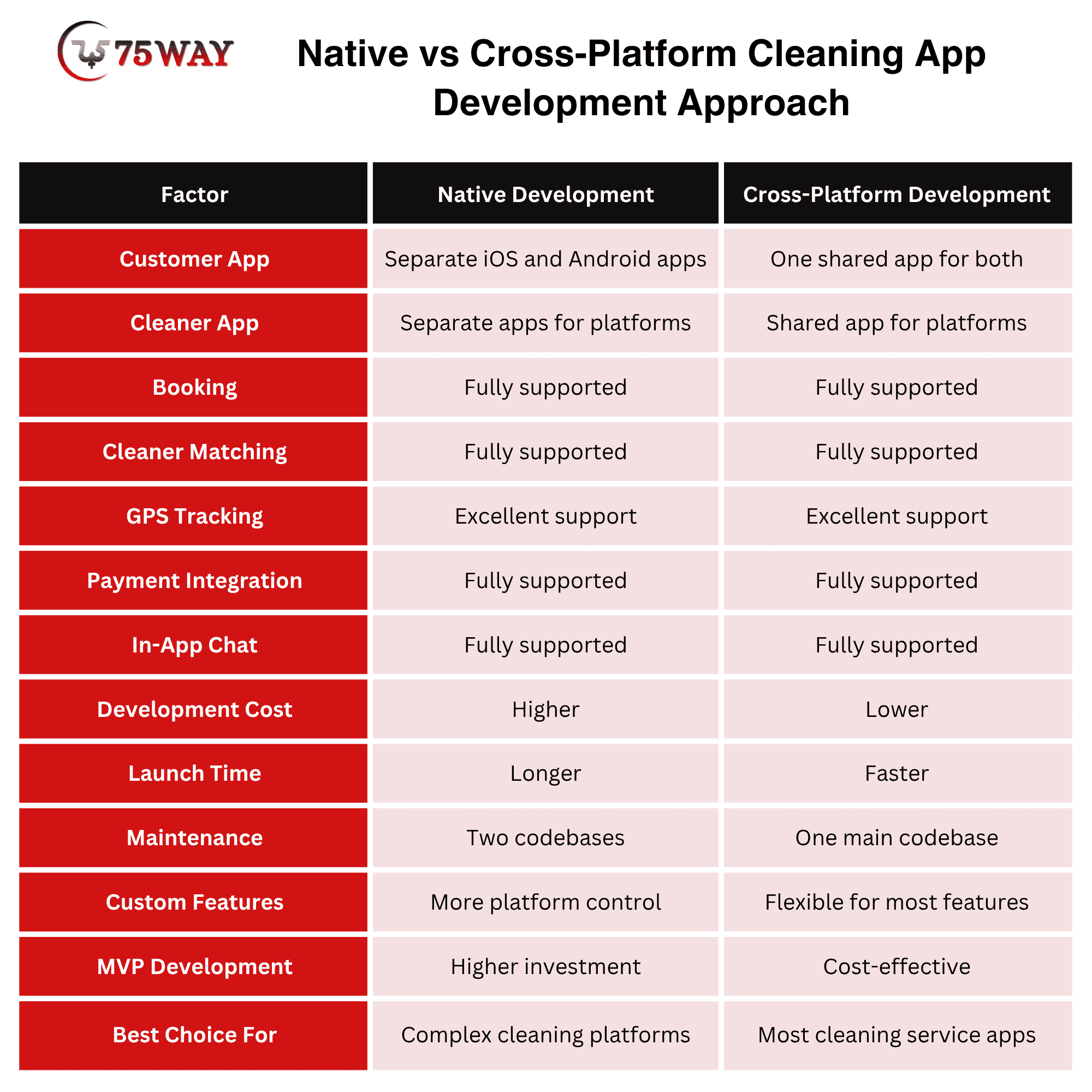
The best choice depends on the application's technical requirements. A cleaning platform with standard booking, payments, maps, notifications, and account management may be well suited to cross-platform development, while highly specialized platform functionality may justify native development.
Why Cloud Infrastructure Matters in Home Cleaning App Creation?
Cloud infrastructure provides the foundation required to handle application data, APIs, databases, media, notifications, and increasing user demand.
A scalable cloud architecture can allow businesses to increase computing resources as traffic grows rather than investing in fixed infrastructure from the beginning. Cloud environments can also support automated backups, monitoring, security controls, load management, and disaster recovery strategies.
For a growing cleaning marketplace, this matters because demand may increase sharply when expanding into new cities or launching promotional campaigns.
Where Can AI Improve a Cleaning Service App?
AI can add value when it addresses a measurable operational or customer problem.
For example, an AI-powered matching system can consider cleaner availability, location, service requirements, ratings, workload, and customer preferences when recommending providers. AI assistants can handle routine customer questions, while predictive models can help businesses anticipate demand and plan cleaner capacity.
Potential applications include:
- AI-based cleaner matching
- Automated customer support
- Intelligent booking recommendations
- Demand forecasting
- Personalized service suggestions
- Automated review analysis
- Fraud and anomaly detection
- Lead qualification
- Workflow automation
- Revenue and demand insights
However, AI should be introduced based on business requirements and available data. Adding complex AI functionality without a clear use case can increase development costs without producing meaningful returns.
How to Make a Cleaning Service App Successful?
Launching a cleaning service app does not automatically create a successful cleaning business. The application is only one part of the overall operation. Customer acquisition, cleaner supply, service quality, pricing, retention, technology performance, and continuous optimization all influence whether the platform can grow sustainably. If you want your cleaning app to compete effectively, focus on the following areas.
1. Prioritize a Frictionless Booking Experience
Customers should be able to understand available services, view pricing, select a suitable time, provide property details, and complete their booking without unnecessary steps.
Every additional screen or confusing decision can increase booking abandonment. Keep the core journey straightforward and provide clear information before the customer reaches payment.
2. Build Trust Into the Platform
Customers are allowing cleaners to enter their homes, offices, or other properties. Trust is therefore a critical part of the customer experience. Consider incorporating:
- Cleaner identity verification
- Background checks where appropriate
- Provider ratings and reviews
- Transparent pricing
- Clear cancellation policies
- Secure payments
- Service guarantees
- Customer support
- Verified business profiles
Trust-building features can become an important differentiator when customers compare multiple cleaning providers.
3. Focus on Cleaner Retention
A marketplace cannot grow if it consistently struggles to maintain enough reliable service providers.
Give cleaners practical tools for managing availability, assignments, earnings, schedules, and communication. Transparent payouts and predictable workflows can help attract and retain quality professionals.
You can also introduce performance incentives, loyalty programs, training resources, or bonuses based on your business model.
4. Offer Recurring Cleaning Plans
Cleaning is naturally suited to recurring services. Instead of relying entirely on one-time bookings, create weekly, biweekly, or monthly plans where appropriate.
Recurring services can improve customer retention and provide businesses with more predictable booking volume. The application can simplify recurring appointments by allowing customers to manage schedules, payment preferences, service instructions, and cleaner preferences from their accounts.
5. Use Data to Improve Operations
Your application can generate valuable operational data from bookings, cancellations, customer behavior, cleaner availability, service duration, reviews, and revenue. Use this information to identify:
- Most requested services
- High-demand locations
- Peak booking periods
- Frequently cancelled services
- Highest-performing cleaners
- Repeat booking patterns
- Customer acquisition sources
- Average booking value
- Customer retention
- Service quality issues
These insights can help management make decisions based on actual platform behavior rather than assumptions.
5. Develop a Strong Customer Acquisition Strategy
A technically strong cleaning service app still needs a strong customer acquisition strategy to generate bookings and grow. Your marketing plan can combine local SEO, search engine advertising, social media campaigns, referral programs, content marketing, email campaigns, promotional offers, and customer loyalty programs.
You can also expand your reach through partnerships with property managers, real estate companies, and corporate clients. For a location-based cleaning business, local search visibility can be particularly valuable because customers often search for services within a specific city or area.
6. Optimize for Repeat Bookings
A cleaning service app should make the second booking easier than the first. Instead of making returning customers search for the same service again, build retention features directly into the app.
One-tap rebooking, saved cleaning preferences, favorite cleaners, recurring schedules, personalized offers, loyalty rewards, booking reminders, and post-service follow-ups can encourage customers to return. The objective is to turn a successful first booking into a predictable customer relationship.
7. Maintain Consistent Service Quality
Technology can simplify the booking process, but customers ultimately judge the business based on the cleaning service itself.
Monitor ratings, complaints, cancellations, late arrivals, service completion times, refund requests, and repeat bookings. When performance falls below defined standards, administrators should have processes for investigation, provider support, retraining, or replacement.
8. Scale Only After Validating the Model
Expanding into multiple cities may appear attractive, but geographic growth increases operational complexity. Before expanding, evaluate whether your existing market demonstrates:
- Consistent booking demand
- Adequate cleaner supply
- Positive customer retention
- Sustainable unit economics
- Reliable service quality
- Stable technology performance
- Repeatable customer acquisition
Once these indicators are healthy, the same operating model can be adapted for additional locations.
9. Continuously Improve the Product
Customer expectations and technology continue to change after launch. Monitor user feedback, analytics, competitor developments, and operational challenges to determine what should be improved next.
Instead of releasing features based on assumptions, prioritize improvements according to their potential impact on bookings, customer satisfaction, provider retention, operational efficiency, and revenue.
A cleaning service app should therefore be treated as an evolving business platform rather than a one-time software project.
White-Label vs Custom Cleaning Service App Development: Which Is Better?
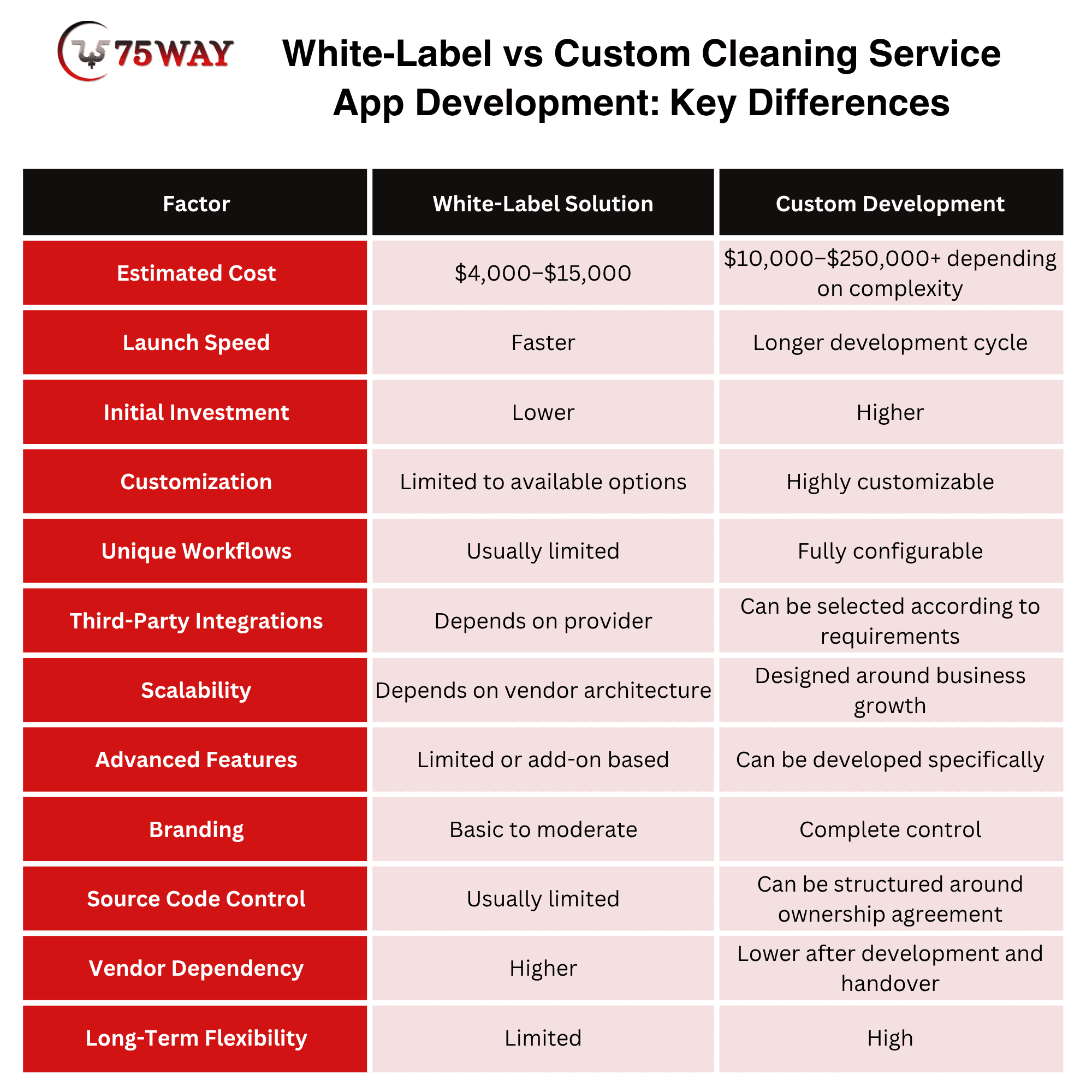
Choosing between a white-label solution and custom cleaning service app development depends on your budget, launch timeline, business model, and long-term product goals. A white-label platform can help businesses enter the market quickly with pre-built functionality, while custom development provides greater control over the product, user experience, integrations, and future scalability.
White-Label Cleaning Service App
A white-label cleaning service app is a pre-built solution that can be customized with your business name, logo, branding, colors, and selected configurations. It typically includes standard functionality such as customer registration, service listings, booking management, payments, notifications, cleaner management, and an administrative dashboard.
Estimated Cost: $4,000–$15,000
This approach can be suitable for businesses that want to test a cleaning service concept, launch within a shorter timeframe, or minimize their initial technology investment.
However, white-label platforms generally have limitations when a business requires unique workflows, advanced integrations, specialized features, or complete control over the underlying architecture. Businesses should also evaluate licensing terms, customization limitations, vendor dependency, data ownership, and ongoing fees before choosing this approach.
Custom Cleaning Service App
Custom development involves designing and building the application specifically around your business requirements. The platform can include customized customer, cleaner, and admin workflows, unique booking logic, specialized pricing, custom integrations, advanced analytics, AI capabilities, and architecture designed around future expansion.
Custom development generally requires a higher initial investment and longer development timeline, but it provides greater flexibility when the application is intended to become a core business platform.
Which Option Should You Choose?
Choose a white-label cleaning app when your priority is rapid market entry, lower initial investment, and testing a relatively standard cleaning service business model.
Select custom cleaning service app development when you need differentiated functionality, unique business workflows, advanced integrations, greater scalability, or complete control over the product experience.
For businesses planning to build a long-term cleaning technology platform, custom development can provide stronger flexibility because the product can evolve alongside customer expectations and business requirements. However, a white-label solution can be a practical starting point when validating the market before committing to a larger technology investment.
The right decision should ultimately be based on your expected business model, required functionality, growth plans, available budget, and desired level of control.
How Long Does It Take to Develop a Cleaning Service App?
The development timeline for a cleaning service app can range from a few weeks for a basic white-label solution to several months for a fully customized platform. The exact duration depends on the number of user interfaces, feature complexity, integrations, design requirements, testing scope, and development approach.
A realistic timeline should account for more than coding. Discovery, UI/UX design, development, testing, deployment, and post-launch preparation all influence the time required to take the product from concept to market.
Cleaning Service App Development Timeline by Complexity
These are general planning estimates rather than guaranteed delivery periods. A project with a clearly defined scope can move faster, while frequent requirement changes, complex integrations, custom designs, or extensive compliance and security requirements can extend the timeline.
- White-Label Solution: 2–6 weeks
- Basic MVP: 2–4 months
- Mid-Level App: 4–7 months
- Advanced Custom App: 6–10+ months
- Enterprise Platform: 9–15+ months
On-Demand Cleaning App Timeline by Development Stage
Some stages can overlap when development follows an agile methodology. For example, backend development can begin while the design team finalizes later screens, and quality assurance can test completed modules while other development work continues.
- Discovery and Planning: 1–3 weeks
- UI/UX Design: 2–5 weeks
- Backend and API Development: 5–10 weeks
- Mobile App Development: 6–12 weeks
- Admin Panel Development: 2–5 weeks
- Third-Party Integrations: 1–4 weeks
- Quality Assurance and Testing: 2–5 weeks
- Deployment and Launch: 1–2 weeks
What Can Increase Cleaning Service Application Development Timeline?
Several factors can extend the project schedule:
- Complex Booking Logic: Dynamic pricing, recurring appointments, multi-cleaner assignments, availability management, and complex cancellation rules require additional development and testing.
- Multiple User Roles: Customer, cleaner, manager, support agent, and administrator workflows create additional interfaces and permissions.
- Advanced Integrations: Payment gateways, maps, CRM systems, accounting software, identity verification, communication platforms, and external scheduling systems may require additional integration work.
- Real-Time Functionality: Live location tracking, instant status updates, real-time chat, and availability synchronization require more complex backend infrastructure.
- AI Features: AI-based matching, customer support, demand forecasting, recommendations, and workflow automation require additional data, testing, integration, and monitoring.
- Custom UI/UX: A highly customized interface requires more design iterations, prototypes, usability testing, and frontend development.
- Requirement Changes: Changing the scope after development begins can affect completed work and introduce additional testing requirements.
How Can You Reduce Cleaning Service Mobile Application Development Time?
A shorter timeline does not mean skipping important development stages. Instead, focus on making decisions early and maintaining a clearly controlled scope.
You can accelerate development by:
- Defining the MVP before coding begins
- Prioritizing features according to business value
- Finalizing core user flows early
- Using proven technologies and integrations
- Considering cross-platform development where appropriate
- Preparing content and business policies in advance
- Using Agile development with regular reviews
- Testing completed modules throughout development
- Avoiding unnecessary feature changes during active sprints
The objective should be to launch a reliable product quickly enough to collect real market feedback without sacrificing security, usability, or core functionality.
How to Choose the Right Cleaning Service App Development Company?
A cleaning service app development company is an important business decision because the development partner can influence the application's quality, scalability, security, timeline, and long-term maintenance. Comparing companies only by development cost can create problems later if the team lacks experience with marketplace workflows, real-time functionality, payment systems, or scalable application architecture. Before selecting a development partner, evaluate the following factors.
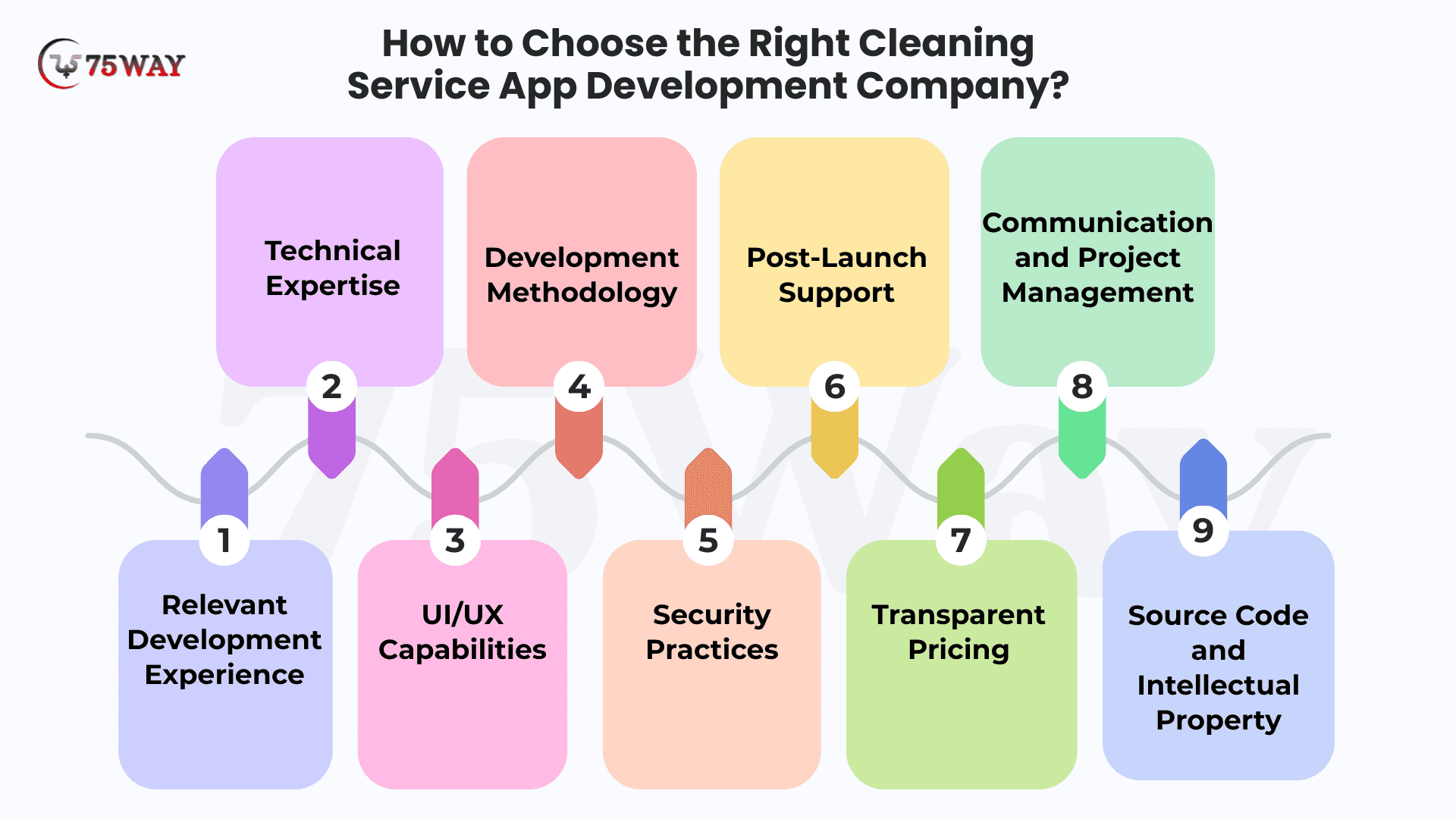
- Relevant Development Experience: Look for a company that has experience building on-demand service platforms, marketplaces, booking applications, or applications with comparable operational workflows. Relevant experience can help the development team understand challenges such as provider availability, booking conflicts, location management, payments, cancellations, and customer communication.
Ask to review relevant projects, case studies, product demonstrations, and technical capabilities rather than relying only on general claims.
- Technical Expertise: The development team should have expertise in the technologies required for your product. Depending on your requirements, this can include mobile development, backend engineering, cloud infrastructure, APIs, databases, payment integrations, maps, real-time communication, analytics, and AI.
A capable partner should also be able to explain why a particular architecture or technology stack is appropriate for your business instead of simply recommending technologies based on familiarity.
- UI/UX Capabilities: A cleaning service app involves several different user journeys. Customers need a simple booking experience, cleaners need efficient job management, and administrators need clear operational controls.
Review the company's previous interface designs and assess whether its products are intuitive, consistent, responsive, and designed around real user behavior.
- Development Methodology: Ask how the company manages development, communication, testing, milestones, and feedback.
An Agile approach can provide greater visibility because development is divided into manageable iterations. Regular demonstrations and reviews also allow business owners to identify issues before they become expensive to correct.
- Security Practices: A cleaning service platform may handle personal information, payment details, addresses, location information, communication records, and provider verification data. Ask potential development partners how they approach: authentication, authorization, data encryption, secure API design, and security monitoring.
Security should be incorporated into the architecture from the beginning rather than added immediately before launch.
- Post-Launch Support: The relationship with a development company should not necessarily end when the application is published. Ask whether the company provides ongoing maintenance, technical support, bug fixing, performance optimization, infrastructure management, security updates, and feature enhancements.
A long-term support arrangement can be particularly useful when the platform becomes responsible for a growing volume of customer bookings and business operations.
- Transparent Pricing: A professional development partner should provide a clear explanation of what is included in the proposed budget. Review development scope, features, number of platforms, UI/UX services, backend development, third-party integrations, and additional or recurring costs.
Avoid selecting a company solely because it offers the lowest estimate. A significantly lower quote may exclude important development, testing, infrastructure, or support requirements.
- Communication and Project Management: Effective communication becomes increasingly important as the project becomes more complex. Determine who will manage the project, how often progress will be reported, which communication channels will be used, how changes will be handled, and how quickly issues are expected to receive a response.
Clear ownership and communication processes can reduce misunderstandings and help keep development aligned with the original business objectives.
- Source Code and Intellectual Property: Before signing an agreement, clarify ownership and access to the application source code, designs, databases, documentation, credentials, and other project assets.
The contract should clearly explain intellectual property ownership, licensing arrangements, third-party dependencies, confidentiality, and access to production infrastructure.
A Practical Evaluation Checklist For On-Demand Cleaning App Development Firm
Before choosing your development partner, ask:
- Has the company built similar service or marketplace applications?
- Can it demonstrate relevant previous work?
- Does the team understand your target market and business model?
- Can it explain the proposed architecture clearly?
- Are design, development, testing, and deployment included?
- What security practices are followed?
- What third-party integrations can the team support?
- How are project changes managed?
- What post-launch support is available?
- Who owns the source code and intellectual property?
- Is the pricing and project scope clearly documented?
A development partner should function as a technology advisor as well as an implementation team. The right company will help you determine what should be built, what can wait, how the platform can scale, and where technology can create measurable business value.
How Can You Monetize a Cleaning Service App?
A cleaning service app can generate revenue through several models, depending on whether you operate a marketplace, manage your own cleaning workforce, or combine both approaches. The most effective monetization strategy should balance business revenue with reasonable pricing for customers and sustainable earnings for cleaning professionals.
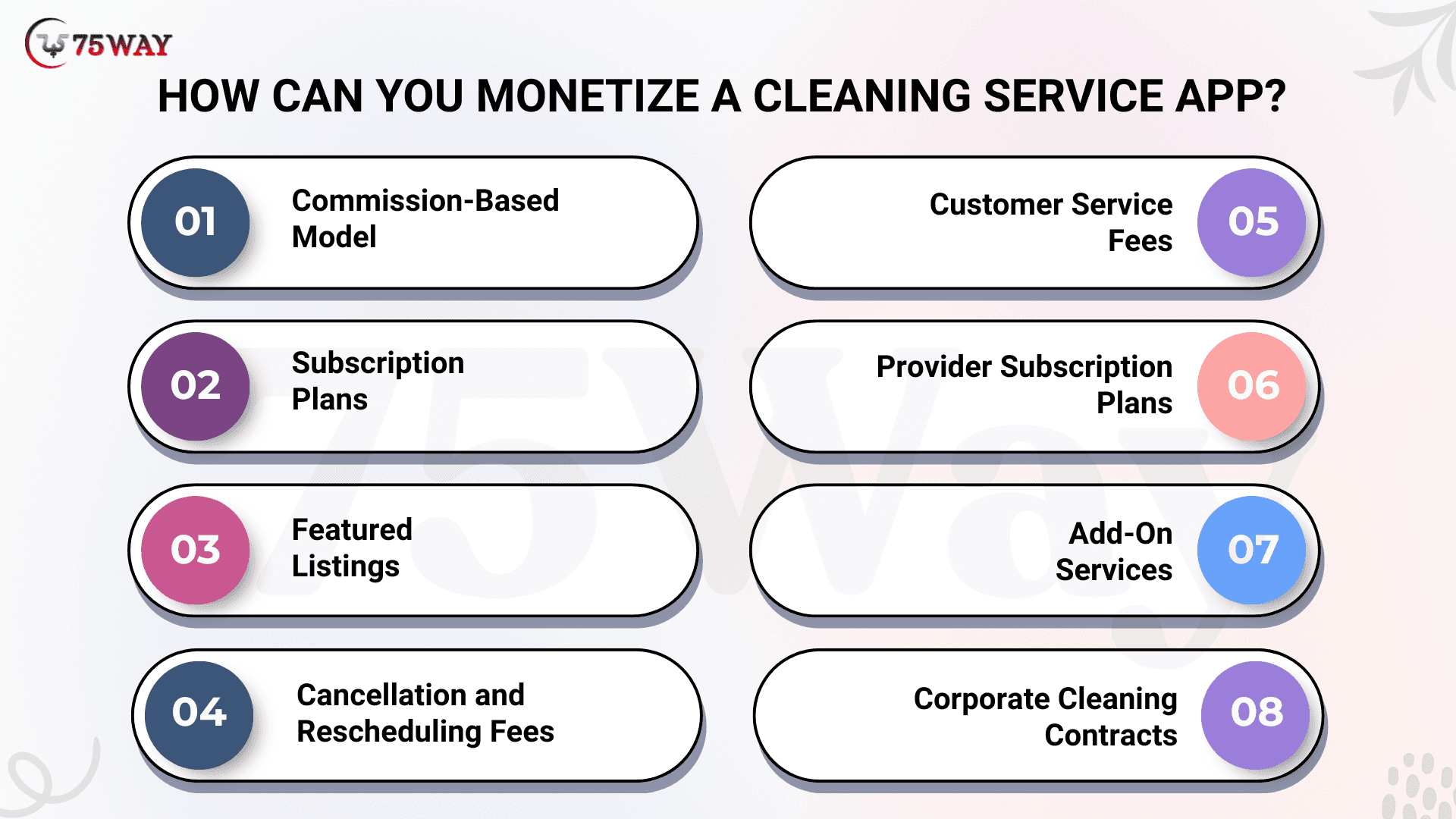
1. Commission-Based Model
In a marketplace model, the platform can charge cleaning professionals a percentage of each completed booking. For example, if a customer pays $100 for a service and the platform applies a 15% commission, the platform retains $15, while the cleaner receives the remaining $85 (before any additional provider fees or expenses).
This model allows revenue to increase as booking volume grows without requiring customers to pay a separate membership fee.
2. Customer Service Fees
The platform can apply a service or convenience fee to customer bookings. The amount can vary according to booking value, location, service type, or other business rules.
For instance, a customer booking a $80 standard home cleaning might see an additional $5–$10 service fee added at checkout, while a larger $200 deep cleaning service may include a $15–$20 platform fee.
The fee should be displayed clearly before payment to maintain pricing transparency and avoid unexpected charges.
3. Subscription Plans
Recurring cleaning customers can be offered subscription plans that provide benefits such as discounted bookings, priority scheduling, free add-ons, or reduced service fees.
For example, a customer might pay $29/month for a subscription that includes 10% off every booking and one free add-on service per month, making it attractive for households that book cleaning services regularly.
Subscription models can create predictable recurring revenue while encouraging customers to schedule services consistently.
4. Provider Subscription Plans
Cleaning professionals or companies can pay a recurring fee to access platform tools, customer leads, advanced analytics, promotional opportunities, or premium marketplace visibility.
For example, a cleaner might pay $49/month to receive more booking requests and appear higher in search results, or a premium plan of $99/month could include featured placement and reduced commission rates.
This model can work particularly well when the platform provides consistent business value to service providers.
5. Featured Listings
Cleaning companies can pay to receive greater visibility within relevant searches or service categories.
For example, a provider may pay $10–$25 per day to appear in the top three results for “home cleaning in New York,” or a $150 monthly package to stay highlighted in a specific service category.
Sponsored listings should remain clearly identifiable to maintain user trust.
6. Add-On Services
The platform can generate additional revenue by offering complementary services during checkout.
Examples may include:
- Carpet cleaning (additional $30–$80 depending on size)
- Window cleaning (around $20–$50 per session)
- Appliance cleaning (approximately $15–$40 per appliance)
- Interior organization services (starting at $25/hour)
- Disinfection services (extra $20–$60 per visit)
- Laundry services (around $10–$25 per load)
- Move-in or move-out packages (typically $150–$400+)
Relevant add-ons can significantly increase average booking value without requiring the business to acquire a completely new customer.
7. Cancellation and Rescheduling Fees
Reasonable cancellation or late-rescheduling charges can help compensate cleaners for lost appointment time.
For example, a cancellation made within 24 hours of a $120 booking might incur a $20–$30 fee, while last-minute cancellations could be charged up to 50% of the booking value depending on platform policy.
However, the rules should be clearly communicated during booking and should account for legitimate circumstances where fees may need to be waived.
8. Corporate Cleaning Contracts
A platform serving commercial customers can develop recurring contracts with offices, property managers, retail businesses, hospitality companies, and other organizations.
For example, a small office might sign a $500/month contract for weekly cleaning, while larger commercial spaces could generate $2,000–$10,000+ monthly agreements depending on size and frequency.
Corporate contracts can produce larger and more predictable booking volumes compared with individual one-time bookings.
Which Monetization Model Is Best?
There is no universal revenue model for every cleaning service application. A marketplace may benefit from commissions, service fees, and provider subscriptions, while a cleaning company may generate revenue primarily through direct bookings and recurring service plans.
A hybrid strategy can provide multiple revenue streams, but introducing too many charges at launch can make the platform difficult to understand and reduce customer adoption.
The better approach is to begin with one or two revenue mechanisms that align naturally with the customer experience. Once booking volume and user behavior provide sufficient data, additional monetization options can be introduced without compromising the simplicity of the platform.
What Are the Challenges in Cleaning Service App Development?
Building a cleaning service app involves more than developing booking and payment features. The platform must coordinate customers, cleaning professionals, schedules, locations, payments, and service quality at the same time. Identifying these challenges early can help businesses make better product and technology decisions.
1. Managing Cleaner Availability
A customer may request a specific time slot when no suitable cleaner is available. Poor availability management can lead to rejected bookings, delayed services, and customer dissatisfaction.
To resolve this, the platform should implement a real-time scheduling system that continuously updates cleaner availability based on location, working hours, active bookings, and service duration. Smart matching algorithms and buffer time rules can also help ensure that only genuinely available cleaners are shown to customers, reducing booking failures.
2. Preventing Double Bookings
Booking conflicts can occur when multiple customers attempt to reserve the same cleaner or time slot simultaneously. The backend should validate availability in real time before confirming a booking.
This can be resolved by using database-level locking, atomic transactions, and real-time synchronization between the app and server. Implementing a single source of truth for booking status ensures that once a slot is reserved, it is immediately blocked across all user sessions and devices.
3. Maintaining Service Quality
A marketplace depends on independent service providers, which can make quality consistency difficult to maintain.
This can be addressed by introducing a structured quality control system that includes cleaner verification, training guidelines, performance scoring, customer feedback loops, and periodic audits. Automated rating systems combined with manual review of complaints can help maintain consistent service standards across all providers.
4. Handling Last-Minute Cancellations
Cancellations can affect both customers and cleaners, particularly when they occur shortly before the scheduled service.
To manage this, the platform should enforce a clear cancellation policy with time-based rules and automated fee calculations. Real-time notifications, instant schedule updates, and optional replacement booking suggestions can help minimize disruption for both customers and service providers.
5. Managing Location-Based Operations
Cleaning services depend heavily on location. The platform needs to determine whether a service is available in a specific area, calculate travel distances, and potentially match customers with nearby professionals.
This can be resolved by integrating accurate geolocation services, defining serviceable zones using map-based boundaries, and applying distance-based matching logic. Optimizing cleaner allocation based on proximity can also reduce travel time and improve operational efficiency.
6. Protecting Customer and Payment Data
The platform may process names, addresses, phone numbers, payment information, location data, booking details, and provider documentation.
To address this, security must be built into every layer of the system. This includes encrypted data transmission, secure authentication methods, role-based access control, tokenized payments, regular vulnerability testing, and continuous monitoring to detect suspicious activity early.
7. Scaling Across Multiple Locations
A platform that works well in one city may encounter different operational requirements when expanding into additional markets.
This challenge can be resolved by designing a scalable, modular architecture that supports location-based configurations. Features such as dynamic pricing rules, localized service categories, multi-region databases, and cloud-based infrastructure can help the platform expand smoothly without major redevelopment.
8. Balancing Automation With Human Support
Automation can improve efficiency, but not every customer issue can be resolved through automated workflows.
The solution is to build a hybrid support system that combines automated workflows with accessible human assistance. In-app chat support, ticket escalation systems, and admin dashboards for manual intervention ensure that complex issues are resolved quickly and effectively.
9. Handling Third-Party Dependencies
Payment gateways, mapping platforms, SMS providers, analytics tools, and other external services can introduce dependencies outside the development team's direct control.
This can be managed by selecting reliable providers, implementing fallback mechanisms, caching critical data where possible, and designing the system to support easy replacement of third-party services. Regular monitoring and API version management also help reduce the risk of unexpected disruptions.
Addressing these challenges during the planning and architecture stages can make the final application more reliable, easier to maintain, and better prepared for commercial growth.
What Should You Consider Before Launching a Cleaning Service App?
Launching a cleaning service app requires more preparation than publishing the application on the App Store or Google Play. Your technology, service providers, pricing, customer support, policies, payment systems, and marketing channels should be ready before customers begin placing real bookings. A structured pre-launch checklist can help identify operational gaps before they affect your reputation.
1. Validate the Core Booking Experience
Test the complete customer journey from registration to completed service. Customers should be able to find a service, select requirements, choose a time, confirm pricing, make payment, receive updates, and review the completed booking without unnecessary friction.
Test the same workflow from the cleaner's perspective to ensure assignments, schedules, navigation, status updates, and earnings are accurate.
2. Prepare Your Cleaning Provider Network
An app cannot deliver a reliable service without enough qualified cleaners or cleaning companies. Before launch, determine:
- How providers will be recruited
- What verification is required
- Which service areas they cover
- How availability will be managed
- How providers receive assignments
- How payouts will work
- What service standards they must follow
- How complaints and performance issues will be handled
Launching with too few available providers can result in unfulfilled bookings and poor customer experiences.
Finalize Pricing and Policies
Customers should understand the cost and rules before confirming a booking. Prepare clear policies for:
- Service pricing
- Additional charges
- Cancellation
- Rescheduling
- Refunds
- Late arrivals
- Service complaints
- Damaged property
- Provider no-shows
- Customer no-shows
- Dispute resolution
Transparent policies can reduce confusion and provide your support team with consistent guidelines for resolving disputes.
3. Set Up Payment and Payout Operations
Verify that customers can make payments successfully and that cleaners can receive their earnings according to the agreed schedule.
Test successful payments, failed transactions, refunds, partial refunds, cancellations, commission calculations, receipts, and provider payouts before launch.
4. Establish Customer Support
Customers may need assistance with booking changes, payments, cleaner availability, cancellations, or service complaints.
Provide accessible support through appropriate channels such as in-app chat, email, phone support, or a ticketing system. Make sure support staff have sufficient access to booking information to resolve issues without repeatedly asking customers for details.
5. Configure Analytics and Monitoring
Analytics should be active from the first day so that you can understand how users interact with the application. Track metrics such as:
- App registrations
- Service searches
- Booking attempts
- Completed bookings
- Booking abandonment
- Payment failures
- Cancellation rates
- Repeat bookings
- Average order value
- Customer acquisition
- Provider acceptance rates
- Customer ratings
Technical monitoring should also identify crashes, slow API responses, server errors, failed integrations, and other performance problems.
6. Prepare Your Launch Marketing
Do not wait until launch day to begin customer acquisition.
Prepare your website, local search presence, social profiles, paid campaigns, referral strategy, promotional offers, email campaigns, and partnership outreach before the application becomes publicly available.
For a location-based cleaning business, launching in a focused geographic market can make customer acquisition and provider management easier to control.
7. Run a Controlled Launch
Instead of immediately targeting a large geographic market, consider launching with a limited customer and provider group.
A controlled launch allows your team to observe real bookings, identify operational problems, collect customer feedback, and improve workflows before increasing marketing spend.
Once the platform demonstrates reliable service fulfillment and acceptable customer satisfaction, gradually expand the service area and acquisition channels.
A successful launch is therefore not simply an app-store milestone. It is the point at which your technology, cleaning operations, customer experience, and revenue model are ready to work together in the real market.
How to Maintain and Scale a Cleaning Service App After Launch?
Launching the application is the beginning of its operating lifecycle, not the end of development. As bookings increase, customers provide feedback, operating systems change, and the business expands into new locations, the platform needs continuous maintenance and technical improvements. A structured post-launch strategy helps protect performance while preparing the application for growth.
- Monitor Application Performance: Track application speed, server response times, API performance, crashes, database activity, payment failures, and other technical indicators.
Performance monitoring can help identify issues before they significantly affect customers or cleaning professionals.
- Release Regular Updates: Mobile operating systems, third-party APIs, security requirements, and user expectations change over time.
Regular updates can maintain compatibility and introduce improvements without requiring major redevelopment.
- Strengthen Security Continuously: Security should remain an ongoing responsibility after launch. Review authentication, permissions, APIs, payment workflows, databases, cloud infrastructure, and third-party integrations regularly.
Security testing and monitoring can help identify vulnerabilities before they become serious operational problems.
- Scale Cloud Infrastructure: As the number of users, bookings, locations, and transactions increases, the platform may require additional infrastructure capacity.
Cloud-based architecture can support scaling through resources such as load balancing, caching, database optimization, content delivery networks, automated deployment, and flexible computing resources. The objective is to increase capacity without allowing infrastructure costs to grow unnecessarily.
- Optimize the Database: A growing cleaning platform can generate significant amounts of booking, payment, customer, provider, location, and communication data. Database indexing, query optimization, archiving strategies, caching, and appropriate data structures can help maintain performance as data volume increases.
- Improve Based on User Behavior: Analytics should influence product decisions after launch. For example, if customers frequently abandon bookings at the payment stage, the payment experience may need improvement. If cleaners regularly reject particular booking types, the assignment or pricing logic may require adjustment.
This creates a continuous improvement cycle:
Measure → Identify → Improve → Test → Measure Again
- Expand Into New Locations: Geographic expansion can increase revenue opportunities, but each new market may introduce different operational requirements. Before entering a new location, evaluate cleaner availability, customer demand, service pricing, competition, local operating requirements, taxes, payment preferences, and expected acquisition costs.
The technology should support location-specific configurations without requiring separate applications for every market.
- Introduce Advanced Automation Gradually: Once the platform has sufficient usage data, automation can improve operational efficiency. Automation should be introduced where it produces measurable improvements in efficiency, customer experience, or revenue.
- Build a Long-Term Product Roadmap: A product roadmap helps prevent random feature development. Prioritize improvements according to customer feedback, operational problems, business objectives, market opportunities, and measurable return on investment. A mature cleaning service platform should continuously evolve rather than remain fixed after its initial launch.
With the right maintenance and scaling strategy, the application can move from a basic booking solution into a broader technology platform capable of supporting more customers, service providers, locations, and revenue opportunities.
Why Choose 75way for Cleaning App Development Services?
Choosing the right app development partner can determine how effectively your cleaning service app moves from an initial concept to a reliable, revenue-generating platform. 75way Technologies approaches cleaning service app development by combining business strategy, product design, software engineering, AI integrations, and ongoing technical support rather than treating the application as a standalone piece of software. This ensures that the final product is not only technically strong but also aligned with real-world cleaning operations and customer expectations.
With a focus on scalability, automation, and user experience, 75way builds platforms that can grow with your business. From MVP development to enterprise-grade systems, the goal is to create a solution that improves bookings, streamlines cleaner management, and increases customer retention. The approach is practical, data-driven, and designed to support long-term business growth rather than just initial launch success.
Case Study 1: UrbanClean Booking Platform
Developed an on-demand cleaning marketplace for a metro-based startup with real-time booking and cleaner assignment features.
Results: Achieved 60% faster booking confirmations and 3X increase in monthly active users within 4 months.
Case Study 2: HomeShine Service App
Built a multi-city cleaning service app with subscription plans, automated scheduling, and payment integration.
Results: Improved customer retention by 45% and reduced operational scheduling effort by 50% through automation.
Final Thoughts
To conclude, cleaning service app development requires the right business model, user experience, features, technology, development strategy, and post-launch plan to create a platform customers trust and cleaners want to use. Starting with a focused MVP can help validate demand before investing in advanced capabilities such as AI, automation, and multi-location operations. Whether you choose white-label software or custom development, your decision should align with your growth objectives and budget. For building a conversion-driven cleaning app, contact a trusted on-demand app development agency to plan, build, and launch your solution.
Frequently Asked Questions (FAQs)
How Much Does It Cost To Develop A Cleaning Service App?
Cleaning service app development can cost anywhere from $10,000 to $250,000+, depending on features, platforms, design complexity, integrations, development location, and customization. A basic MVP may cost $10,000–$30,000, while advanced and enterprise platforms require a substantially larger investment.
How Long Does It Take To Build A Cleaning Service App?
A basic MVP can take around 2–4 months, while a mid-level application may require 4–7 months. Advanced custom platforms can take 6–10 months or longer, depending on functionality, integrations, testing requirements, and project scope.
Can A Cleaning Service App Support Multiple Cities?
Yes, a properly designed platform can support multiple cities and service areas. The architecture can include location-specific pricing, service availability, cleaner networks, operating rules, and administrative controls so the business can expand without creating a separate application for every market.
Can A Cleaning App Support Recurring Appointments?
Yes. Recurring booking functionality can support weekly, biweekly, or monthly cleaning schedules. Customers can manage upcoming appointments, preferences, payment methods, and cancellation options from the app.
How Can A Cleaning App Handle Last-Minute Bookings?
The platform can check real-time cleaner availability and service areas before displaying eligible time slots. Businesses can also define rules for urgent bookings, additional charges, and minimum notice periods.
Can a Cleaning App Integrate With CRM Software?
Yes, CRM integration can help businesses synchronize customer information, booking activity, communication history, leads, and other relevant data with their existing sales and customer management systems.