Summary
On-demand app developers assist businesses in building scalable digital solutions tailored to evolving market needs. Organizations leverage flexible development models, faster deployment cycles, and specialized technical expertise to accelerate innovation. Custom-built applications improve user engagement and long-term digital growth across industries adopting mobile-first transformation strategies.
Quick Overview
- On-demand developers provide flexible access to app development expertise.
- Businesses reduce hiring costs while accelerating product development cycles.
- On-demand development supports innovation and faster time-to-market strategies.
- Expert developers build secure applications tailored to business goals.
- Flexible hiring models allow startups and enterprises to scale development resources.
- The cost to hire skilled on-demand app developers ranges between $25 – $250+/hour
From startups building MVPs to enterprises launching complex digital platforms, on-demand app development models are transforming how mobile applications are created. Companies today need fast, flexible, and scalable development support to keep up with changing customer expectations and rapid digital transformation.
On-demand developers allow businesses to quickly access skilled talent without long hiring cycles or high overhead costs. Whether it’s building a startup MVP, upgrading an existing platform, or scaling enterprise applications, this model provides speed and efficiency.
Businesses are increasingly choosing on-demand app development teams to reduce time-to-market, control costs, and launch high-quality digital products faster than traditional hiring models.
This guide explores how to hire on-demand app developers in 2026, key benefits, hiring models, cost factors, technologies involved, and strategies to ensure successful project execution.
What's The Role of On-Demand App Developers?
On-demand app developers play a crucial role in building, scaling, and maintaining digital applications that support real-time service delivery across industries. They help businesses quickly transform ideas into functional mobile and web apps that can respond to user demand instantly, enabling faster market entry and competitive advantage.
These developers specialize in creating flexible, scalable, and high-performance solutions such as ecommerce apps, delivery platforms, booking systems, and AI-powered applications. They manage the full development lifecycle, including UI/UX design, backend architecture, API integrations, testing, deployment, and post-launch support.
Their role also extends to optimizing app performance, ensuring security compliance, integrating third-party services, and continuously improving user experience based on analytics and feedback. By providing expertise on demand, they help businesses reduce development costs, speed up innovation, and adapt quickly to changing market needs.
Why Businesses Are Hiring On-Demand App Engineers In 2026?
Hiring on-demand app developers has become a strategic choice for businesses in 2026 as companies prioritize speed, flexibility, and cost efficiency in digital product development. With rapidly evolving technologies, organizations prefer scalable development resources that can be accessed instantly. This approach enables faster innovation and more agile product delivery.
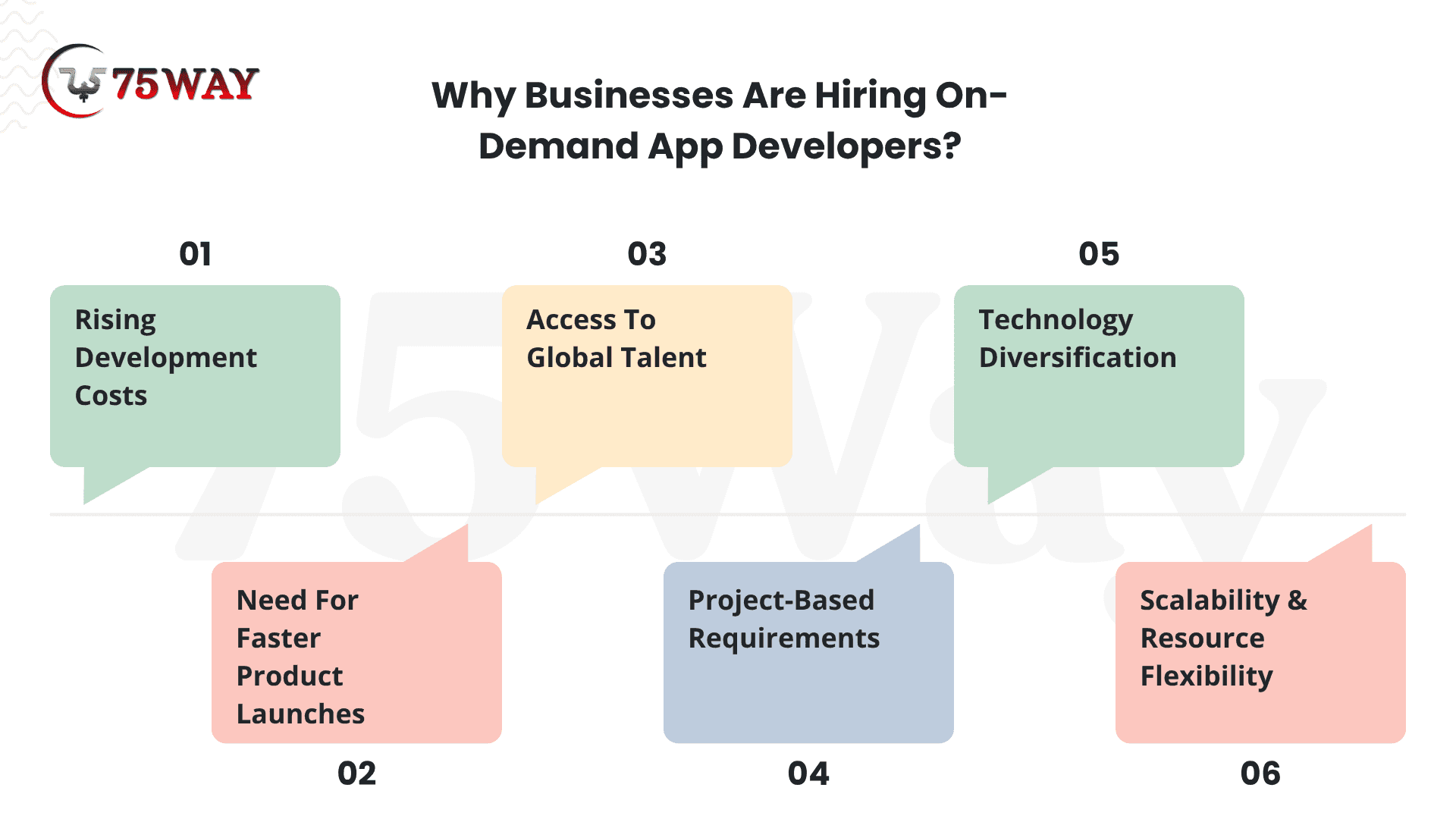
- Rising Development Costs: Full-time hiring has become expensive due to salary inflation, benefits, and infrastructure costs. On-demand developers reduce financial pressure while maintaining quality output.
- Need For Faster Product Launches: Time-to-market is critical in competitive industries. On-demand developers help businesses launch apps faster by working in parallel development cycles.
- Access To Global Talent: Companies can hire experts worldwide without geographical limitations, gaining access to advanced technical skills and niche expertise.
- Project-Based Requirements: Many businesses require developers only for specific phases, such as MVP development, scaling, or feature upgrades.
- Technology Diversification: Modern apps require expertise in multiple technologies, including AI, blockchain, cloud computing, and real-time systems.
- Scalability & Resource Flexibility: Businesses can easily scale development teams up or down based on project demands without long-term operational commitments.
Types of Hiring Models To Build On-Demand Applications
On-demand application development relies on flexible hiring models that allow businesses to access skilled developers based on project requirements, budget, and scalability needs. Choosing the right hiring structure ensures efficient collaboration and successful product delivery.
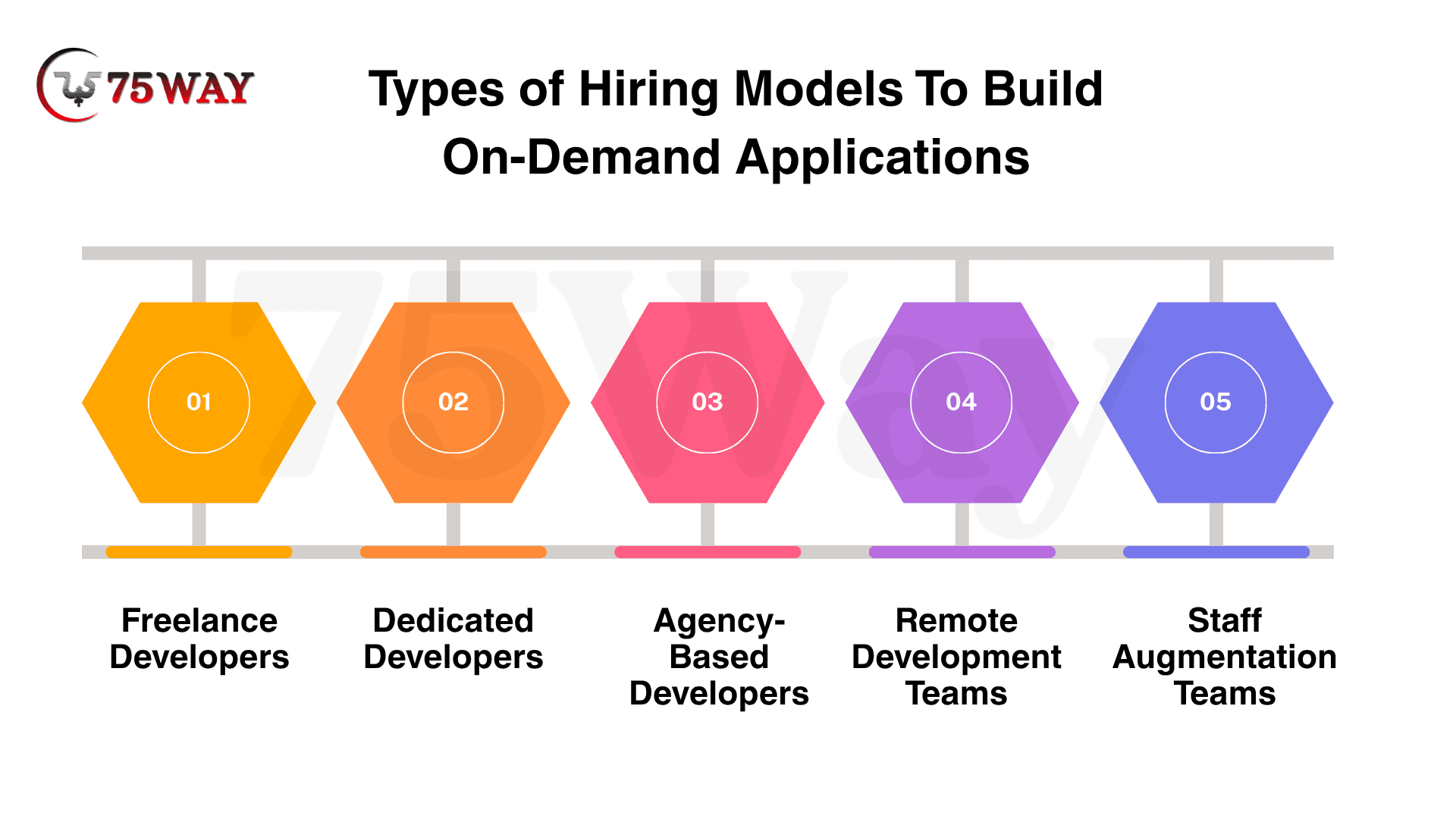
- Freelance Developers: Independent developers hired for short-term or task-specific projects. They offer flexibility and cost efficiency for small features, prototypes, or quick development tasks without long-term commitments.
- Dedicated Developers: Professionals assigned exclusively to a single project for long-term development cycles. They provide focused attention, consistent progress, and a deeper understanding of business requirements throughout the project lifecycle.
- Agency-Based Developers: Teams provided by development agencies offering end-to-end app development solutions. They manage planning, design, development, testing, and deployment under one structured workflow.
- Remote Development Teams: Distributed teams working across different time zones for continuous development support. They enable faster turnaround times and 24/7 development productivity across global projects.
- Staff Augmentation Teams: External developers integrated into in-house teams to fill skill gaps and accelerate ongoing development. They enhance team capacity without increasing permanent workforce overhead.
What Are The Benefits of Hiring On-Demand Mobile App Experts?
Hiring on-demand app developers offers businesses a flexible and efficient approach to building digital products without the limitations of traditional hiring models. This approach enables companies to access specialized talent, reduce operational overhead, and accelerate development timelines while maintaining high-quality output. It is particularly valuable for startups and enterprises aiming to scale quickly in competitive markets.
- Cost Efficiency: Businesses pay only for actual development work instead of full-time salaries and overhead costs. This helps optimize budgets and reduce unnecessary long-term financial commitments.
- Faster Development Cycles: On-demand developers accelerate project timelines through focused execution and agile workflows. This ensures quicker product launches and faster time-to-market.
- Scalable Resources: Companies can increase or reduce developer resources based on project requirements. This allows flexible scaling without long-term staffing obligations.
- Specialized Expertise: Access to experts in AI, mobile frameworks, backend systems, and cloud infrastructure. This ensures high-quality development across complex technical requirements.
- Reduced Hiring Complexity: Eliminates lengthy recruitment processes and onboarding delays. This helps businesses start development work almost immediately.
- Improved Project Flexibility: Businesses can adjust development strategies based on evolving market needs. This supports continuous improvement and adaptive product development.
Skills You Must Look For In On-Demand App Development Experts
On-demand app developers must possess a strong combination of technical, analytical, and integration skills to build scalable applications. Their expertise directly impacts app quality. Businesses should evaluate developers based on their proficiency in modern programming languages and integration capabilities to ensure successful project delivery.
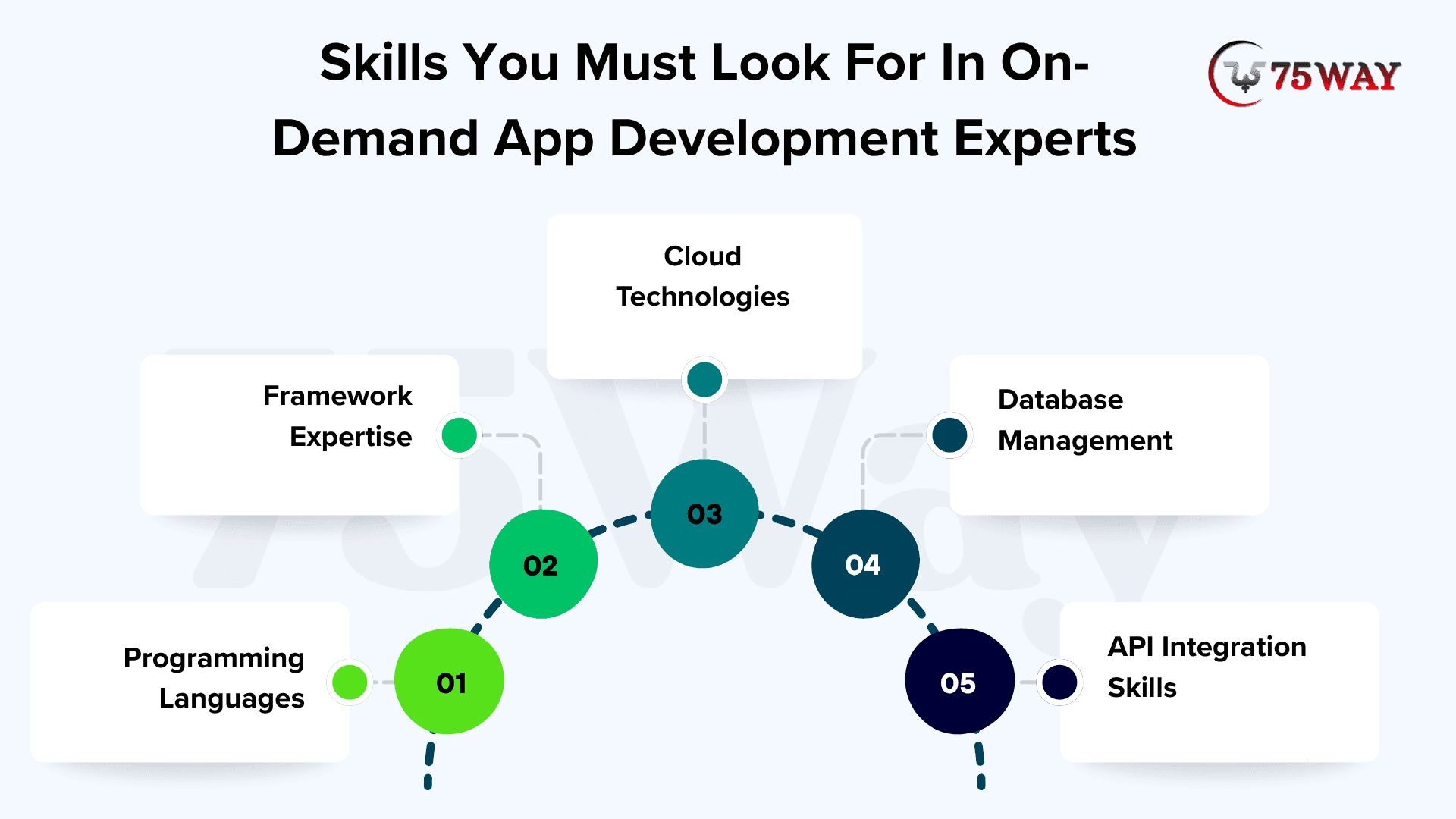
- Programming Languages: Programming languages form the core foundation of app development, enabling developers to build functional and interactive applications. Commonly used languages include Swift, Kotlin, Java, JavaScript, Dart, and Python, each supporting different platforms and development needs.
- Framework Expertise: Frameworks help developers accelerate development and maintain structured codebases for scalable applications. Popular frameworks include Flutter, React Native, Node.js, Angular, and Django, widely used for mobile and web app development.
- Cloud Technologies: Cloud platforms support app hosting, scalability, and real-time data processing for modern applications. Key providers include AWS, Google Cloud, and Microsoft Azure, ensuring reliable and secure infrastructure support.
- Database Management: Databases store, organize, and manage application data efficiently for seamless performance and retrieval. Common systems include MySQL, PostgreSQL, MongoDB, and Firebase, supporting both structured and unstructured data needs.
- API Integration Skills: API integration skills enable developers to connect third-party services such as payment gateways, CRM systems, maps, and analytics tools. This ensures enhanced functionality and seamless communication between different software systems.
Must-Have Technology Expertise For On-Demand App Developers
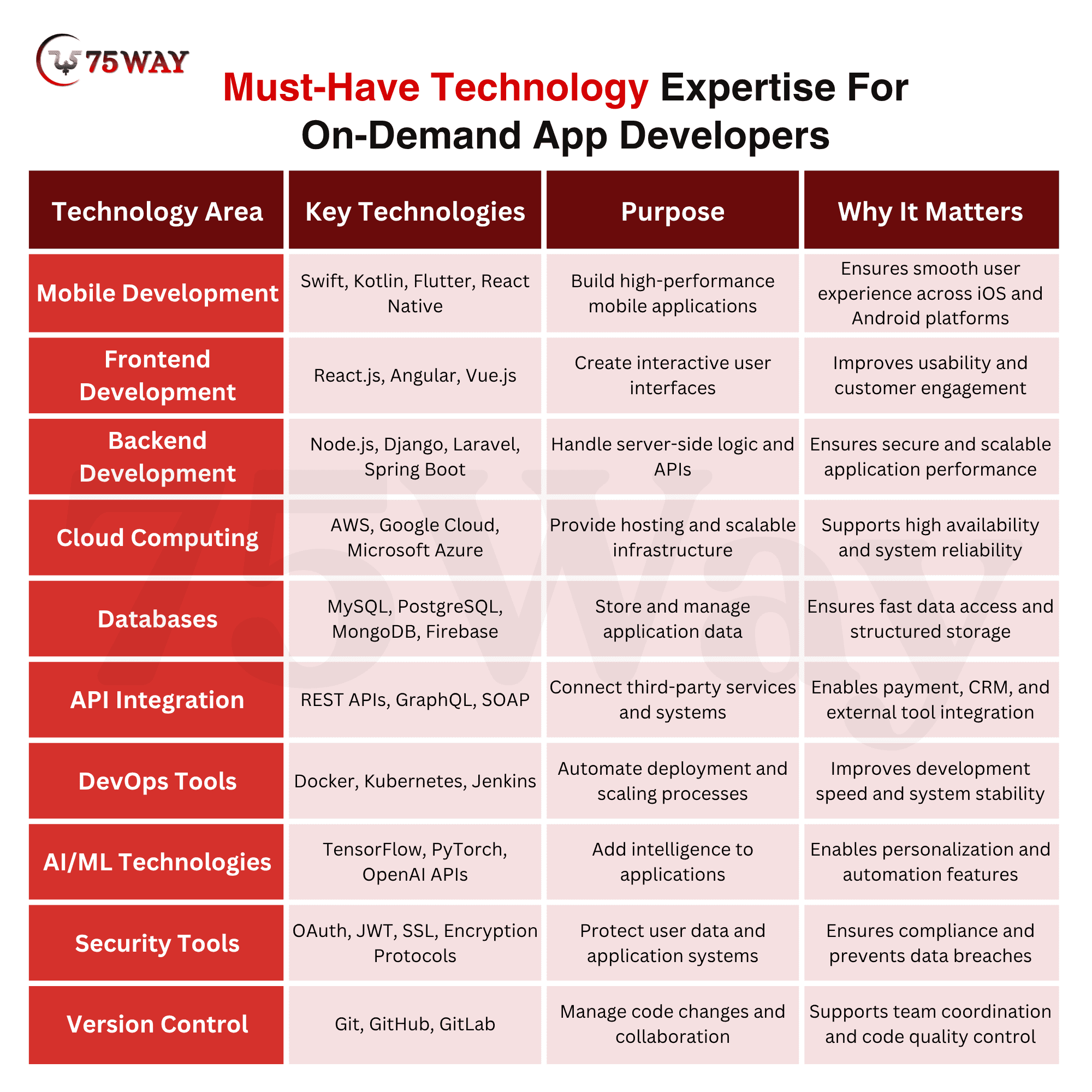
On-demand app developers must have strong expertise in modern technologies to build scalable, secure, and high-performance applications. Their technical knowledge determines how efficiently they can design, develop, and integrate complex app systems across mobile, web, and cloud environments. A well-rounded technology stack ensures smooth development, faster deployment, and long-term application stability.
How To Hire On-Demand Application Programmers in 2026?: Complete Roadmap
Hiring on-demand app developers requires a structured approach to ensure businesses select the right talent for their project needs. A well-defined hiring process helps reduce risks, improve collaboration, and ensure successful app delivery within timelines and budget. By following a step-by-step evaluation strategy, you can identify skilled developers who align with technical requirements and business goals.
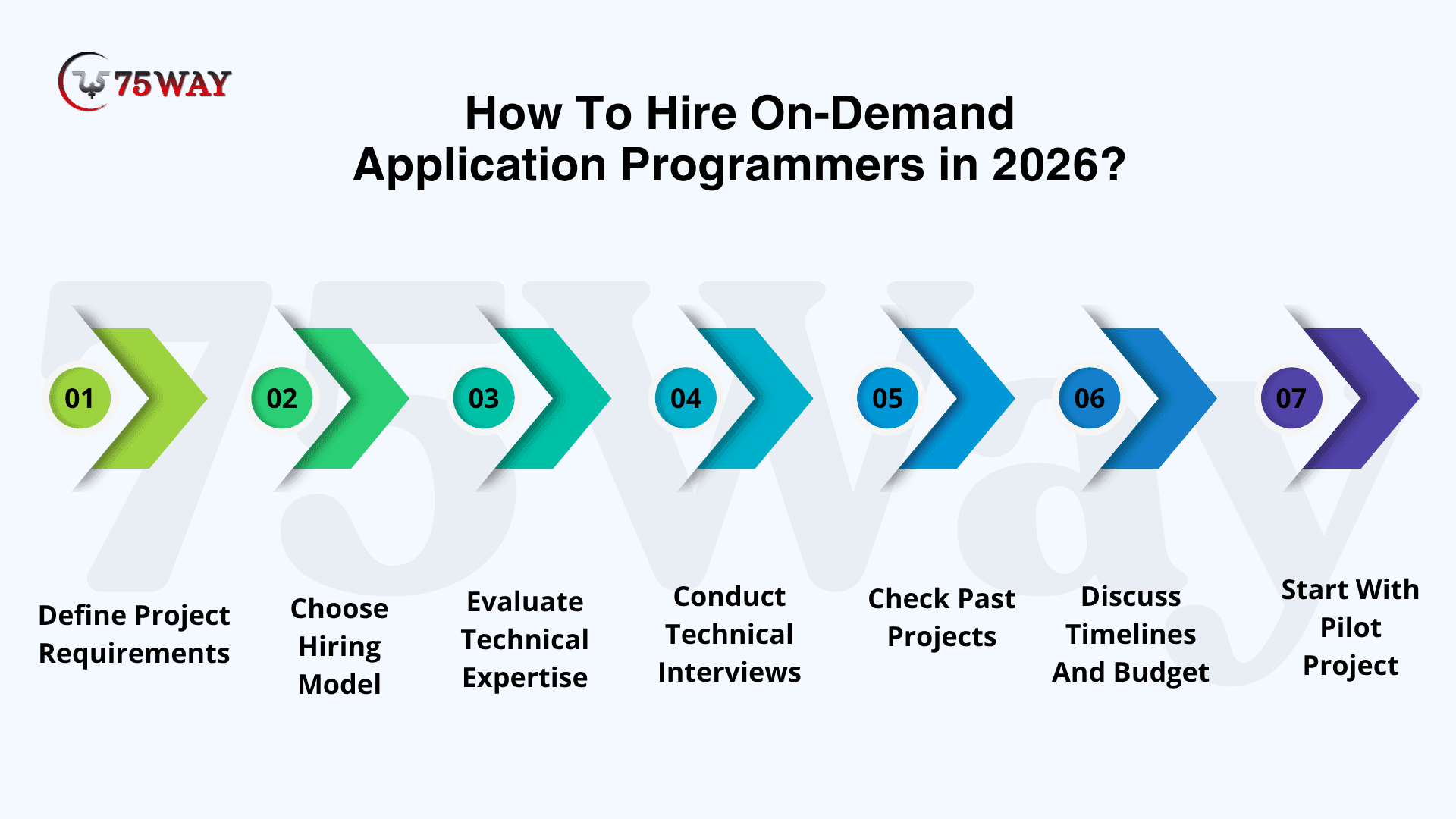
1. Define Project Requirements
Clearly outline app objectives, features, target audience, and technical expectations. Strong requirement planning improves development clarity and reduces scope confusion. Well-defined goals help developers build scalable and business-aligned solutions.
2. Choose Hiring Model
Select between freelance, dedicated, or agency-based developers based on project complexity. Each model offers different advantages in cost, control, and delivery speed. The right choice improves collaboration efficiency and project success.
3. Evaluate Technical Expertise
Assess developers based on portfolio, coding skills, and industry experience. Strong technical evaluation ensures candidates can handle real-world challenges effectively. Skilled developers deliver stable, scalable, and high-performance applications.
4. Conduct Technical Interviews
Test problem-solving abilities, system design thinking, and coding approach during interviews. Practical assessments reveal logical reasoning and development efficiency. Structured interviews help identify developers with a strong architectural understanding.
5. Check Past Projects
Review case studies, live applications, and client feedback before selection. Past work reflects consistency, reliability, and technical capability. Verified experience increases confidence in development quality and delivery performance.
6. Discuss Timelines And Budget
Set clear expectations for delivery milestones, costs, and payment structure. Transparent discussions reduce misunderstandings and project delays. Well-defined planning ensures smooth execution and financial control throughout development.
7. Start With Pilot Project
Begin with a small module before full-scale engagement. Pilot testing helps evaluate coding quality, communication, and reliability. Early validation reduces risks and improves long-term collaboration success.
Major Industries Hiring On-Demand Development Talent
On-demand app developers are widely used across multiple industries where businesses require scalable, secure, and high-performance digital solutions. Their expertise supports the development of mobile applications, enterprise platforms, and real-time systems that improve user experience, operational efficiency, and business growth across different sectors.
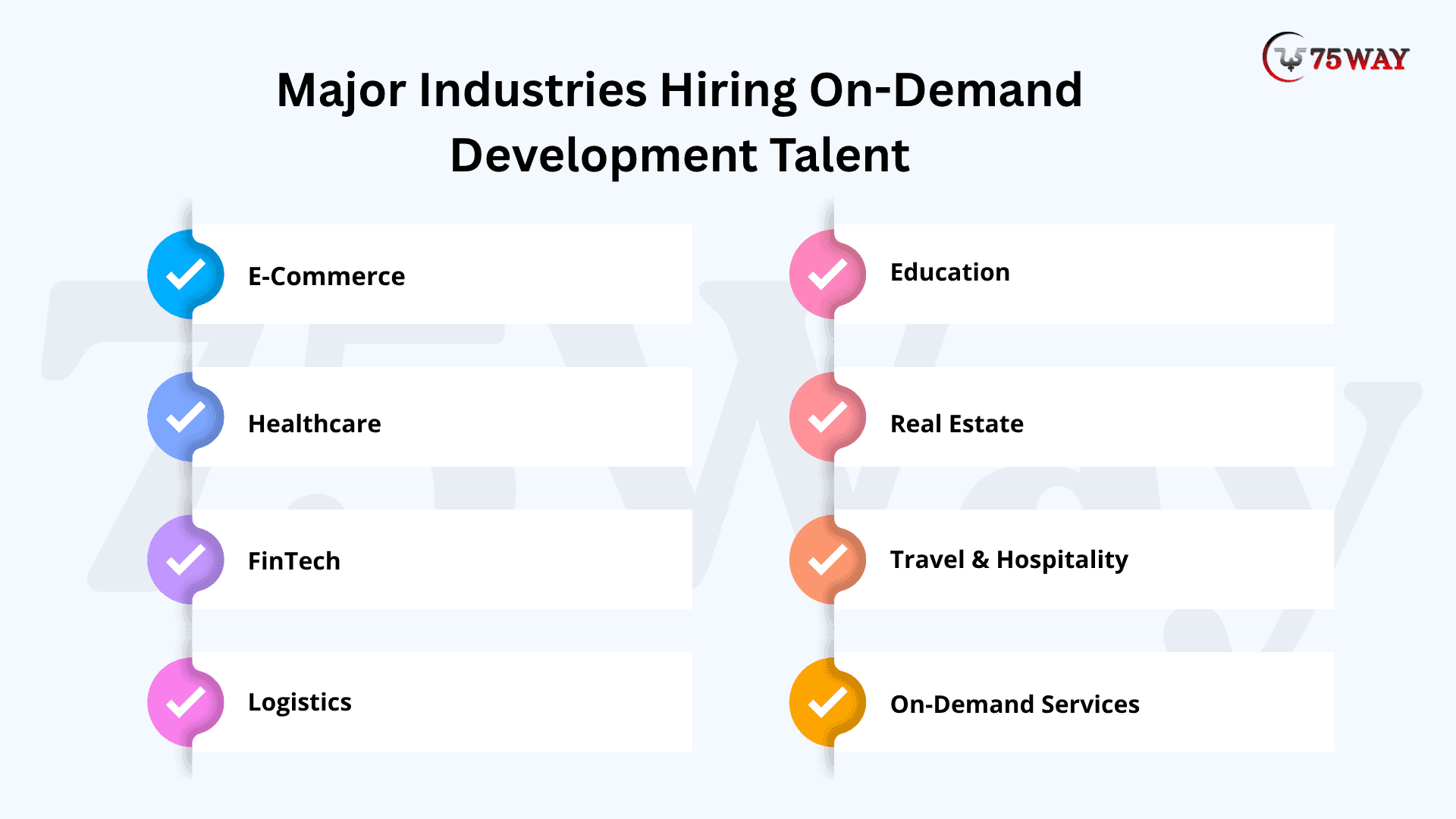
- E-Commerce: On-demand ecommerce app developers build mobile shopping apps, delivery platforms, and customer engagement systems that enhance user experience and drive conversions. These solutions support personalized recommendations, secure payments, and real-time order tracking to improve online retail performance.
- Healthcare: On-demand healthcare app engineers create telemedicine apps, patient management systems, and appointment booking platforms that improve healthcare accessibility. These applications ensure secure data handling, remote consultations, and efficient hospital workflow management.
- FinTech: On-demand finance app developers design digital banking apps, payment gateways, and investment platforms with high security standards. These systems enable fast transactions, fraud detection, and seamless financial service delivery.
- Logistics: On-demand supply chain app engineers develop tracking systems, fleet management tools, and delivery optimization apps that improve supply chain efficiency. These experts build solutions that provide real-time tracking, route optimization, and better operational control.
- Education: On-demand education app developers build e-learning platforms, virtual classrooms, and student engagement apps that enhance digital learning experiences. These systems support interactive content, live sessions, and performance tracking for students.
- Real Estate: On-demand real estate app developers create property listing apps, virtual tour platforms, and lead management systems. These solutions simplify property discovery, improve buyer engagement, and streamline agent workflows.
- Travel & Hospitality: They develop booking platforms, itinerary management apps, and customer support systems. These applications enhance travel planning, reservation management, and guest experience personalization.
- On-Demand Services: Developers build service booking apps such as home services, food delivery, and ride-hailing platforms. These systems ensure real-time service matching, scheduling efficiency, and user convenience.
Types of Mobile Apps Businesses Can Build With On-Demand App Experts
On-demand app experts help businesses build scalable mobile applications tailored to different service-based and product-based industries. These applications improve customer engagement, streamline operations, and enable real-time service delivery across digital platforms.
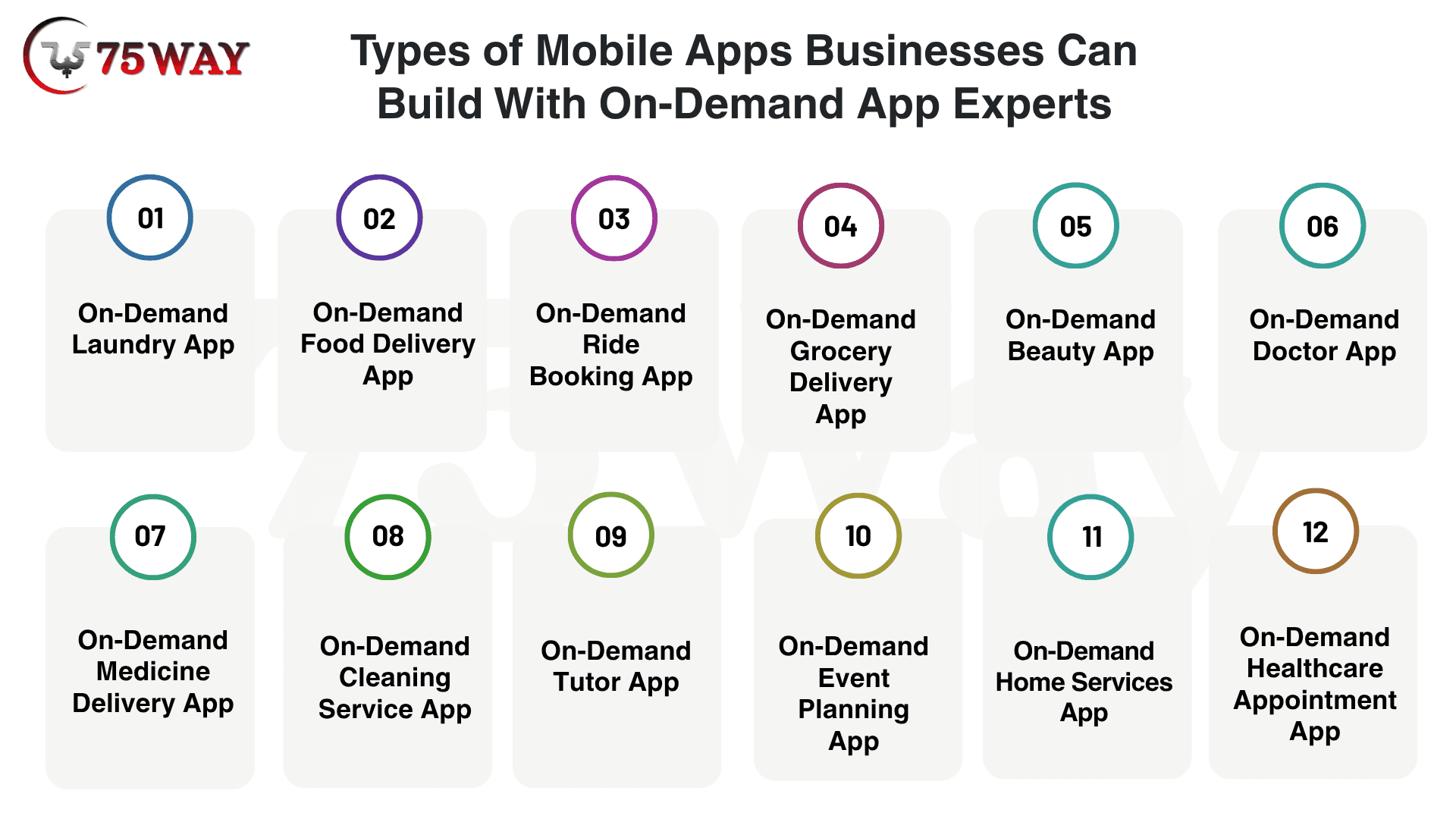
- On-Demand Laundry App
On-demand laundry apps allow users to schedule pickups, track orders, and manage payments seamlessly. These platforms streamline laundry service operations through real-time booking and delivery tracking. Businesses improve customer convenience and operational efficiency through automated workflows.
- On-Demand Food Delivery App
Food delivery applications connect customers with restaurants for quick ordering and doorstep delivery. These apps support real-time order tracking, menu browsing, and secure payment processing. Businesses increase sales and customer retention through faster service experiences.
- On-Demand Ride Booking App
Ride booking platforms match passengers with nearby drivers instantly using GPS technology. These apps offer fare estimation, live tracking, and in-app payments. Businesses enhance transportation accessibility and user convenience through efficient ride management systems.
- On-Demand Grocery Delivery App
Grocery delivery applications enable users to order daily essentials online with scheduled delivery options. These apps include product catalogs, cart management, and order tracking features. Businesses improve customer satisfaction through fast and reliable delivery services.
- On-Demand Beauty App
Beauty service apps enable users to book salon services, makeup artists, and grooming professionals at their preferred location and time. These platforms include service selection, stylist profiles, and appointment scheduling features. Businesses increase customer convenience and expand service reach through mobile-first beauty solutions.
- On-Demand Doctor App
Doctor consultation apps connect patients with certified healthcare professionals for online or in-person appointments. These systems support appointment scheduling, video consultations, and medical record access. Healthcare providers improve patient accessibility and consultation efficiency through digital healthcare delivery.
- On-Demand Medicine Delivery App
Medicine delivery applications allow users to order prescribed and over-the-counter medicines with doorstep delivery options. These platforms include prescription uploads, pharmacy integration, and real-time order tracking. Pharmacies enhance customer convenience and improve medication accessibility through faster delivery systems.
- On-Demand Cleaning Service App
Cleaning service apps connect users with professional cleaners for home and office cleaning requirements. These platforms offer booking management, service customization, and schedule tracking. Businesses improve operational efficiency and customer satisfaction through verified service providers.
- On-Demand Tutor App
Tutor booking applications enable students to connect with qualified educators for personalized learning sessions. These systems support subject selection, live classes, and progress tracking. Educational providers enhance learning outcomes through flexible and accessible tutoring services.
- On-Demand Event Planning App
Event planning apps help users organize weddings, corporate events, and private gatherings with professional planners. These platforms include vendor management, budgeting tools, and scheduling features. Event businesses streamline coordination and improve client experience through structured planning solutions.
- On-Demand Home Services App
On-demand home service platforms that connect users with professionals for cleaning, repair, and maintenance services. These apps offer service booking, provider selection, and real-time scheduling features. Businesses streamline service delivery and improve customer trust through verified professionals.
- On-Demand Healthcare Appointment App
On-demand healthcare appointment apps that allow patients to book doctor consultations and manage appointments digitally. These platforms include scheduling, reminders, and teleconsultation features. Healthcare providers improve patient management and accessibility through structured digital systems.
What’s The Cost of Hiring On-Demand App Developers In 2026?
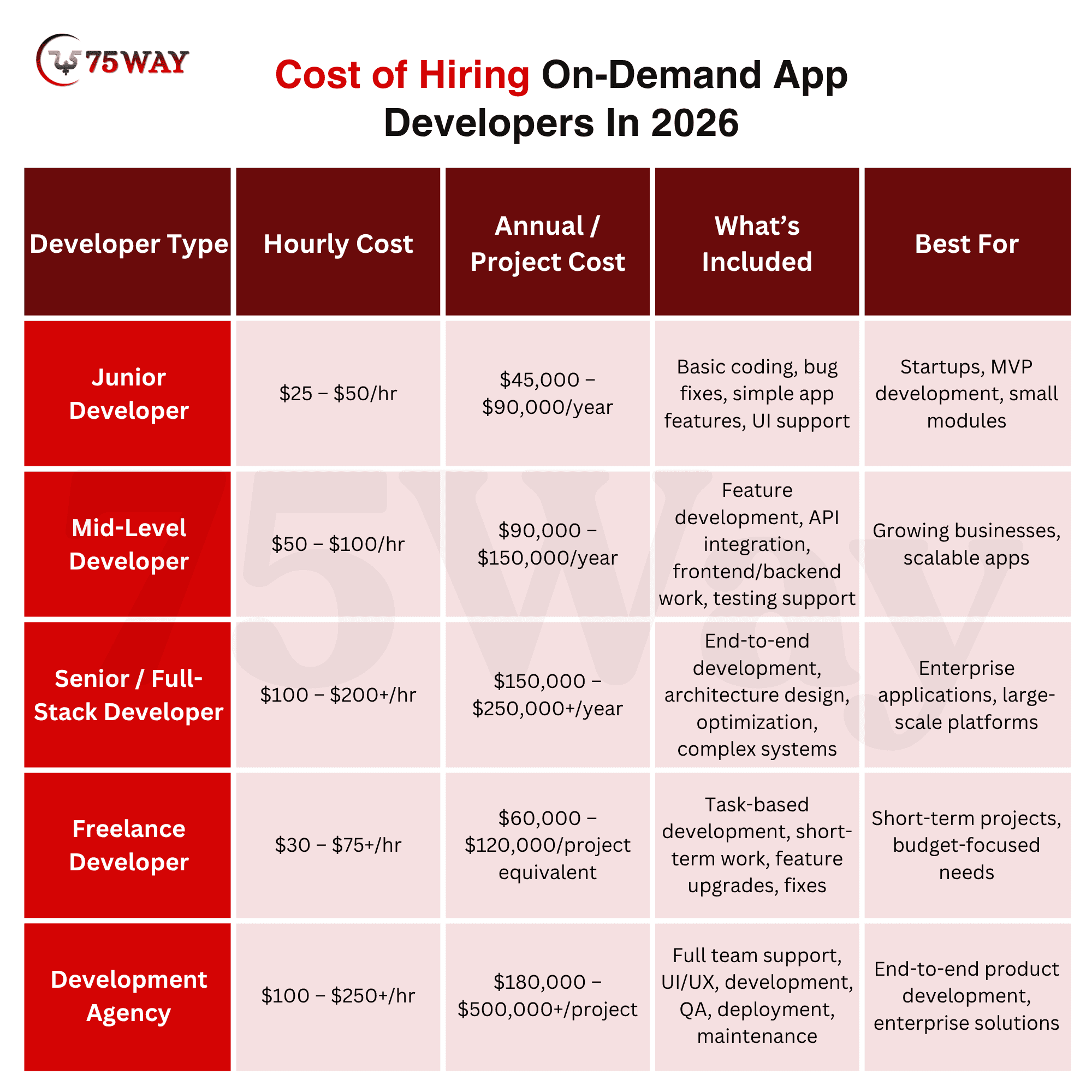
The cost of hiring on-demand app developers in 2026 varies significantly based on project complexity, technology requirements, and engagement models. An average cost to hire an on-demand app engineer is $25 – $250+ per hour. You can choose developers based on project complexity, required expertise, and long-term scalability needs.
- Junior Developer: $25 – $50 per hour | $45,000 – $90,000 per year
Limited experience makes them suitable for smaller modules and learning-based execution environments.
- Mid-Level Developer: $50 – $100 per hour | $90,000 – $150,000 per year
Balanced experience allows efficient handling of frontend, backend, and mobile app development tasks.
- Senior / Full-Stack Developer: $100 – $200+ per hour | $150,000 – $250,000+ per year
Strong expertise supports end-to-end development, system design, and high-performance application delivery.
- Freelance Developers: $30 – $75+ per hour | $60,000 – $120,000 per year
Flexible engagement allows businesses to scale development needs without long-term commitments.
- Development Agencies: $100 – $250+ per hour | $180,000 – $500,000+ per year.
Agencies provide complete teams, including designers, developers, QA, and project managers for structured delivery.
Cost To Hire Offshore On-Demand App Developers
Hiring on-demand app developers varies significantly across countries due to differences in talent availability, experience levels, and market demand.
- USA: $60 – $150+ per hour.
Developers typically offer advanced expertise in enterprise-grade applications and complex system architecture. This region is best suited for high-budget, large-scale digital transformation projects.
- India: $15 – $50 per hour.
Provide cost-effective solutions with strong technical skills across mobile, web, and AI applications. India remains a top choice for startups and scalable product development.
- Vietnam: $10 – $30 per hour.
Deliver affordable app development services with growing expertise in modern technologies. It is suitable for budget-friendly MVPs and early-stage products.
- The Philippines: $20 – $40 per hour. Developers are known for strong communication skills and reliable outsourcing support. This region is widely used for long-term remote development partnerships.
- Poland: $35 – $55+ per hour.
Specialize in high-quality engineering and strong European tech standards. It is ideal for businesses seeking a balance between cost and technical excellence.
- Romania: $25 – $50 per hour.
Offer strong backend and enterprise software development capabilities. This region is popular for scalable and secure application development projects.
- Ukraine: $30 – $50 per hour.
Developers are highly skilled in complex software engineering and AI solutions. It is widely recognized for its strong technical talent in Europe.
- Brazil: $25 – $50 per hour.
Provide competitive pricing with growing expertise in mobile and web development. This region supports both startups and mid-sized business needs.
- Mexico: $30 – $60 per hour.
Developers offer nearshore advantages for North American businesses with strong collaboration. It is ideal for real-time communication and agile development projects.
Development Process Followed By Skilled On-Demand App Developers
Dedicated on-demand app developers follow a structured development process to ensure high-quality, scalable, and performance-driven applications. Each stage from planning to deployment helps businesses reduce risks and achieve faster time-to-market outcomes.
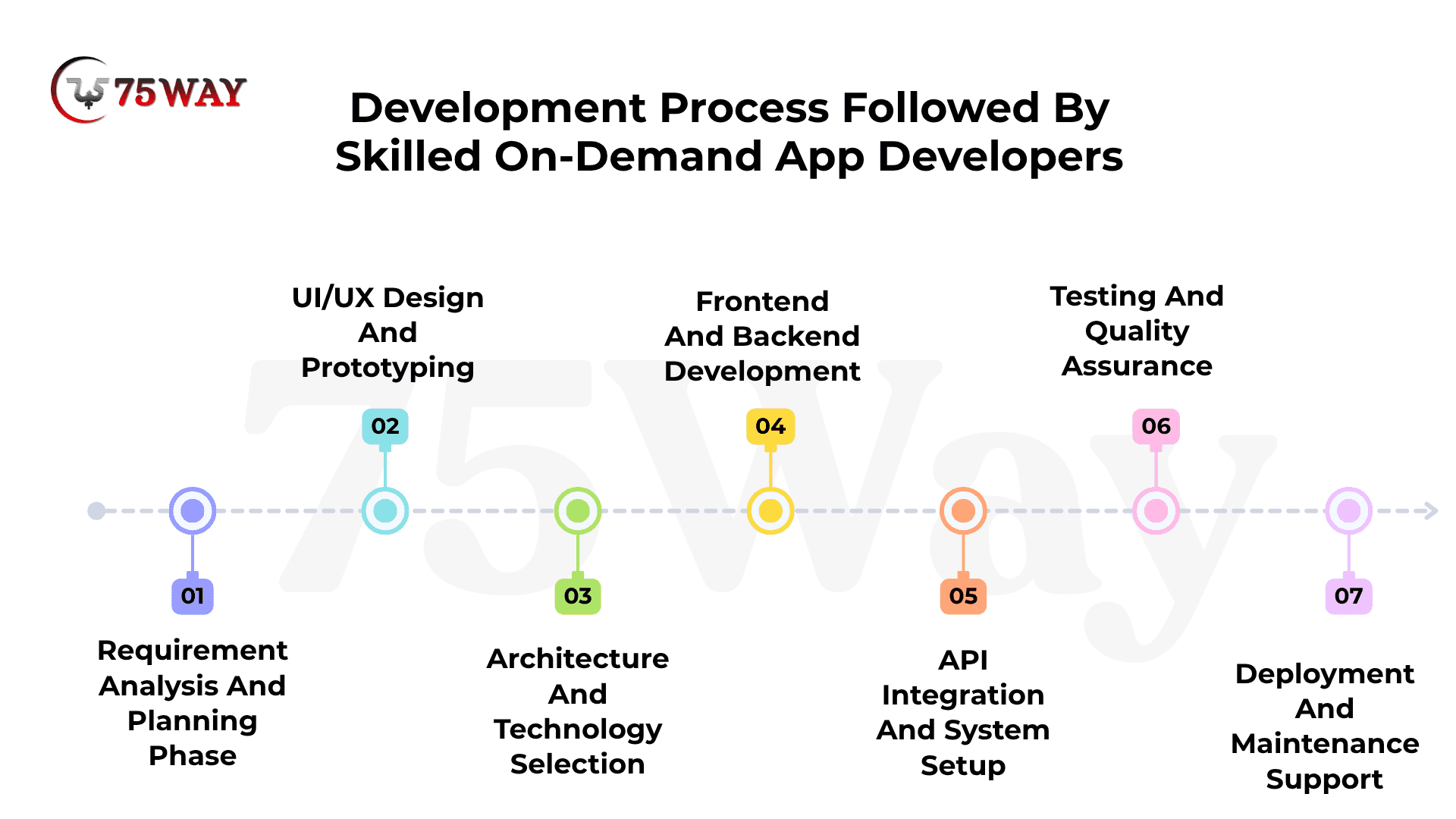
1. Requirement Analysis And Planning Phase
This phase focuses on understanding business goals, user needs, and technical requirements in detail. Developers analyze project scope, target audience, and key functionalities. Clear documentation is created to define features and workflows. Planning helps avoid scope changes and development delays. It sets a strong foundation for the entire project lifecycle.
2. UI/UX Design And Prototyping
On-demand UI/UX designers create wireframes and interactive prototypes to visualize app structure and user flow. Focus remains on usability, simplicity, and engagement-driven interfaces. Visual design elements are aligned with brand identity and user expectations. Feedback is collected before finalizing design concepts. This stage ensures better user experience and interface consistency.
3. Architecture And Technology Selection
Developers choose suitable architecture models and technology stacks based on project requirements. Decisions include frontend, backend, database, and cloud infrastructure selection. Scalability, performance, and security factors are carefully evaluated. System design ensures smooth integration between all components. Strong architecture improves long-term application stability and flexibility.
4. Frontend And Backend Development
Frontend development focuses on building user interfaces and interactive elements. Backend development handles server logic, APIs, and database operations. Both layers are developed in parallel for faster execution. Code quality and performance optimization are maintained throughout development. This stage transforms designs into functional applications.
5. API Integration And System Setup
APIs are integrated to connect third-party services like payments, CRM, and analytics tools. System setup includes configuring servers, databases, and cloud environments. Secure data exchange is ensured between all connected systems. Integration enhances app functionality and real-time capabilities. Proper setup supports smooth application performance.
6. Testing And Quality Assurance
Testing is performed to identify bugs, performance issues, and usability problems. Multiple testing types include functional, security, and performance testing. Developers ensure app works smoothly across devices and platforms. Issues are fixed before final deployment. Quality assurance ensures a stable and reliable application.
7. Deployment And Maintenance Support
The application is deployed on app stores or cloud servers after final approval. Developers monitor performance and fix post-launch issues. Regular updates improve features, security, and user experience. Maintenance ensures long-term stability and scalability of the app. Continuous support helps businesses adapt to changing market needs.
Best Practices For Hiring On-Demand Mobile App Development Partner
A structured hiring approach improves collaboration, enhances productivity, and ensures long-term scalability of digital products. Following proven practices also helps organizations select the right talent aligned with technical and business goals.
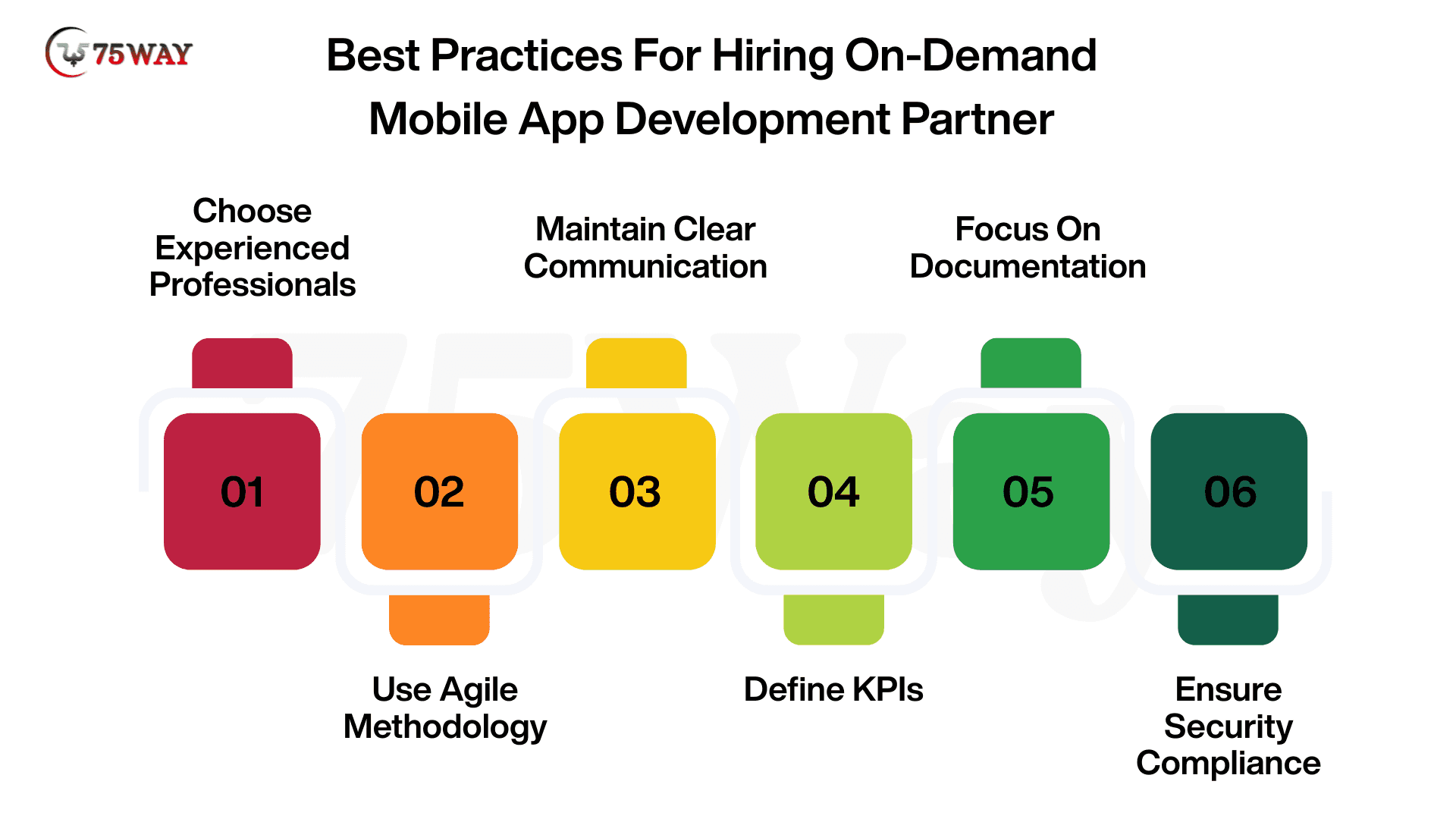
- Choose Experienced Professionals: Select developers with proven industry experience and strong portfolios. Experienced professionals deliver reliable code quality and handle complex development challenges more effectively.
- Use Agile Methodology: Break projects into sprints for better tracking and faster delivery. Agile approach improves flexibility, transparency, and continuous product improvement throughout development cycles.
- Maintain Clear Communication: Use collaboration tools like Slack, Jira, or Trello. Consistent communication reduces misunderstandings and ensures smooth coordination between teams and stakeholders.
- Define KPIs: Set measurable performance indicators for development progress. KPIs help track productivity, quality, and timely delivery of project milestones effectively.
- Focus On Documentation: Maintain proper technical documentation for long-term scalability. Well-structured documentation supports future updates, maintenance, and onboarding of new developers.
- Ensure Security Compliance: Protect sensitive data through strict access control and encryption protocols. Security-focused development reduces risks and ensures compliance with industry standards.
Final Thoughts
To summarize, hiring on-demand app developers has become a strategic advantage for businesses aiming to build scalable, cost-efficient, and high-performance mobile applications in 2026. This flexible development model enables companies to access global talent, reduce hiring complexities, and accelerate product delivery without compromising quality.
As digital transformation continues across industries, on-demand development will play a critical role in shaping future mobile ecosystems. Businesses that adopt this model early will gain stronger competitive advantages, faster innovation cycles, and improved customer experiences. To build scalable mobile solutions, you can hire expert on-demand app developers who deliver custom mobile applications.
Frequently Asked Questions (FAQs)
What Is The Difference Between On-Demand And Full-Time App Developers?
On-demand developers work on flexible contracts based on project needs, while full-time developers are permanent employees. On-demand hiring reduces costs and increases scalability for businesses requiring temporary or specialized expertise.
Are On-Demand App Developers Reliable For Long-Term Projects?
Yes, many businesses successfully use on-demand developers for long-term projects. Reliability depends on choosing experienced professionals or agencies with proven delivery records, communication systems, and structured workflows.
Can On-Demand Developers Work With Existing Development Teams?
On-demand developers can integrate with in-house teams using collaboration tools and agile workflows. This hybrid model improves productivity and allows businesses to scale development resources.
Which Platforms Are Best To Hire On-Demand App Developers?
Popular platforms include freelance marketplaces, agency networks, and dedicated development companies. Businesses often prefer agencies for better reliability, quality assurance, and project management support.
Do On-Demand Developers Provide Post-Launch Support?
Many on-demand developers offer maintenance and post-launch support services. These include bug fixes, feature updates, performance optimization, and system monitoring, depending on contract agreements.