AI Summary
Metaverse app development brings together immersive technology, business strategy, and scalable digital experiences. This guide explores essential features, technologies, development stages, costs, monetization, and challenges. It helps businesses evaluate opportunities before building.
Key Takeaways
- The metaverse app market will reach $507.8 billion globally by 2030.
- Metaverse app development requires strategic planning, design, engineering, testing, deployment, and ongoing optimization.
- Essential metaverse features include avatars, 3D environments, communication, marketplaces, analytics, and personalization.
- Choosing technologies based on business goals helps create scalable, engaging metaverse apps.
- Metaverse app development costs $20,000–$1,000,000+ depending on complexity, features, platforms, and integrations.
A $50,000 metaverse project and a $500,000 one can both be called “metaverse apps,” but the development work behind them can be worlds apart. A virtual showroom, social platform, gaming environment, or immersive ecommerce app needs a different approach to architecture, 3D technology, real-time interaction, and infrastructure.
Before approving development, business leaders need to know what actually goes into building a metaverse app. The choice of platform, development approach, core features, immersive technologies, backend infrastructure, and security can all change the product experience as well as the investment required.
That makes understanding the metaverse app development journey just as important as understanding the price. This guide explains how to build a metaverse app in 2027, which features and technologies matter, how the development process works, and what businesses should expect to invest.
What Is Metaverse App Development?
Metaverse app development involves designing and engineering an interactive digital environment in which users can communicate, navigate spaces, participate in activities, and interact with virtual objects or services.
Unlike a conventional application that primarily presents screens and menus, a metaverse application may combine:
- 3D Environments: Interactive virtual spaces where users explore and engage.
- Avatars: Digital representations allowing users to express their identities.
- Real-Time Communication: Enables instant voice, video, text, and messaging.
- Spatial Interactions: Allows users to interact naturally within virtual spaces.
- AR/VR Experiences: Creates immersive experiences through augmented or virtual reality.
- Digital Assets: Virtual items users can own, trade, or customize.
- AI-Powered Interactions: Enables intelligent, personalized, and responsive virtual experiences.
- Virtual Commerce: Allows users to discover, purchase, and sell products.
- Identity & Access Management: Secures user identities, permissions, accounts, and platform access.
The exact combination depends on the product.
For instance, Nike entered the metaverse through NIKELAND, a virtual experience created on Roblox where users could explore digital spaces, participate in games, customize avatars with Nike products, and engage with the brand in an interactive environment.
A metaverse app does not necessarily need every emerging technology. Blockchain, NFTs, VR headsets, cryptocurrency, and other components should only be included when they solve a genuine product or business requirement.
That distinction matters because unnecessary technology can increase development complexity without increasing customer value.
Metaverse App Market Size & Revenue Growth in USA: Complete Insights
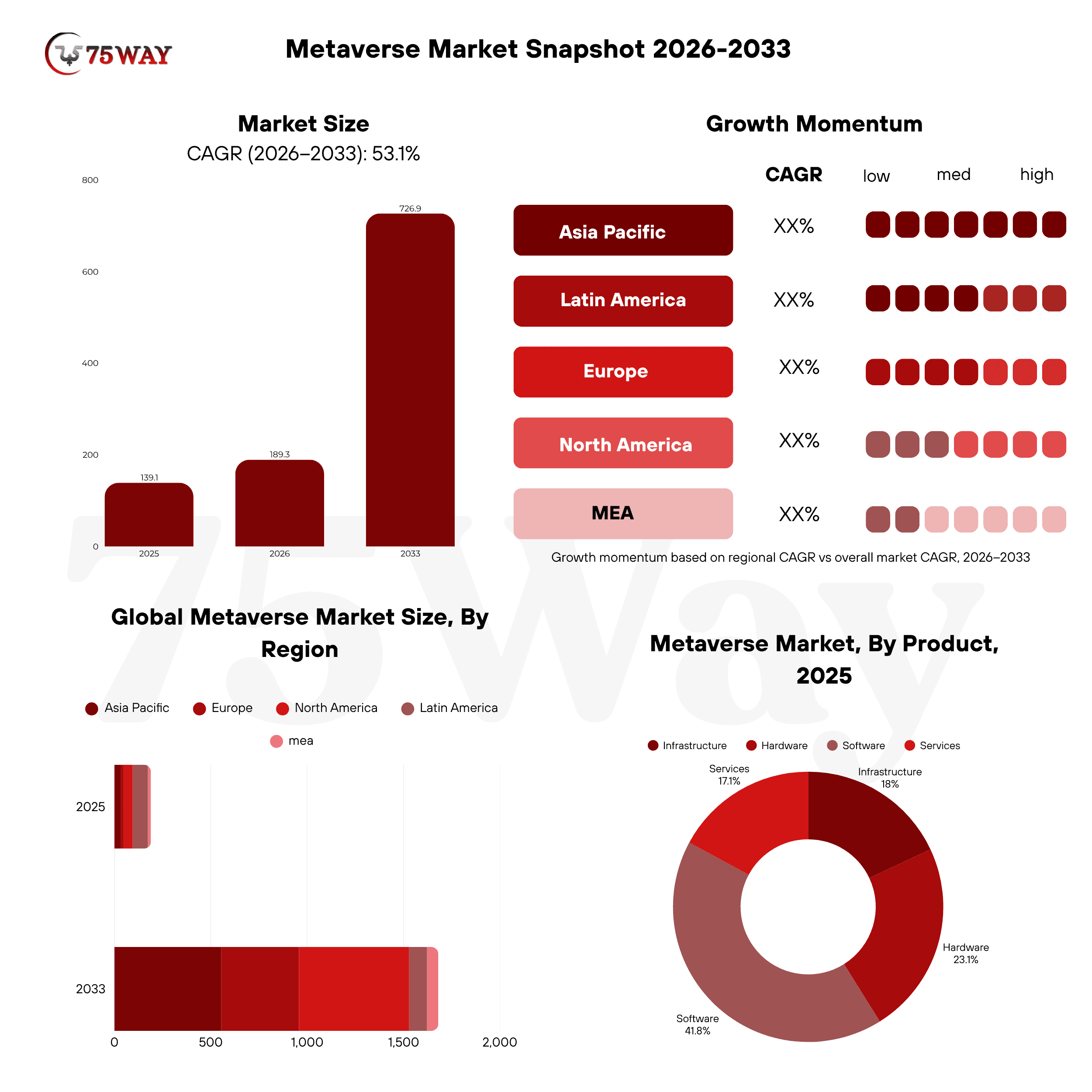
The metaverse market is moving beyond a futuristic concept into a sizeable commercial opportunity, with global market estimates pointing to strong revenue expansion ahead. Grand View Research projects the market to grow from $189.3 billion in 2026 to $3,726.9 billion by 2033, reflecting a 53.1% CAGR. The market size, revenue trajectory, and growth opportunity for businesses are examined below.
- In 2026, the United States is expected to lead the Metaverse market, generating an estimated $46.5 billion in market value, according to Statista.
- Metaverse user penetration is projected to reach 21.2% in 2026, rising to 39.7% by 2030.
- The projected average revenue per user (ARPU) in the Metaverse market is expected to reach US$109.0.
- The global Metaverse market is forecast to expand from US$2,114.25 billion in 2026 to US$10,808.57 billion by 2034, registering a 22.60% CAGR, according to Fortune Business Insights.
- North America held the largest share of the Metaverse market, accounting for 70.70% of the industry.
- Roblox Corporation partnered with retail brand Gucci through Gucci Garden, using virtual experiences to strengthen brand awareness among younger audiences and recreate Gucci footwear and apparel digitally.
- The software segment accounted for the largest market share, contributing 41.8% of total Metaverse market revenue.
How To Build A Metaverse App: Step-By-Step Process
The difficult part of building a metaverse app is not creating a virtual space; it is making that space work when real users, multiple devices, live interactions, and growing traffic enter the picture. Metaverse app development process therefore has to move from a validated concept to the world, interactions, backend, testing, and release without treating any layer in isolation. The complete build process is outlined below.
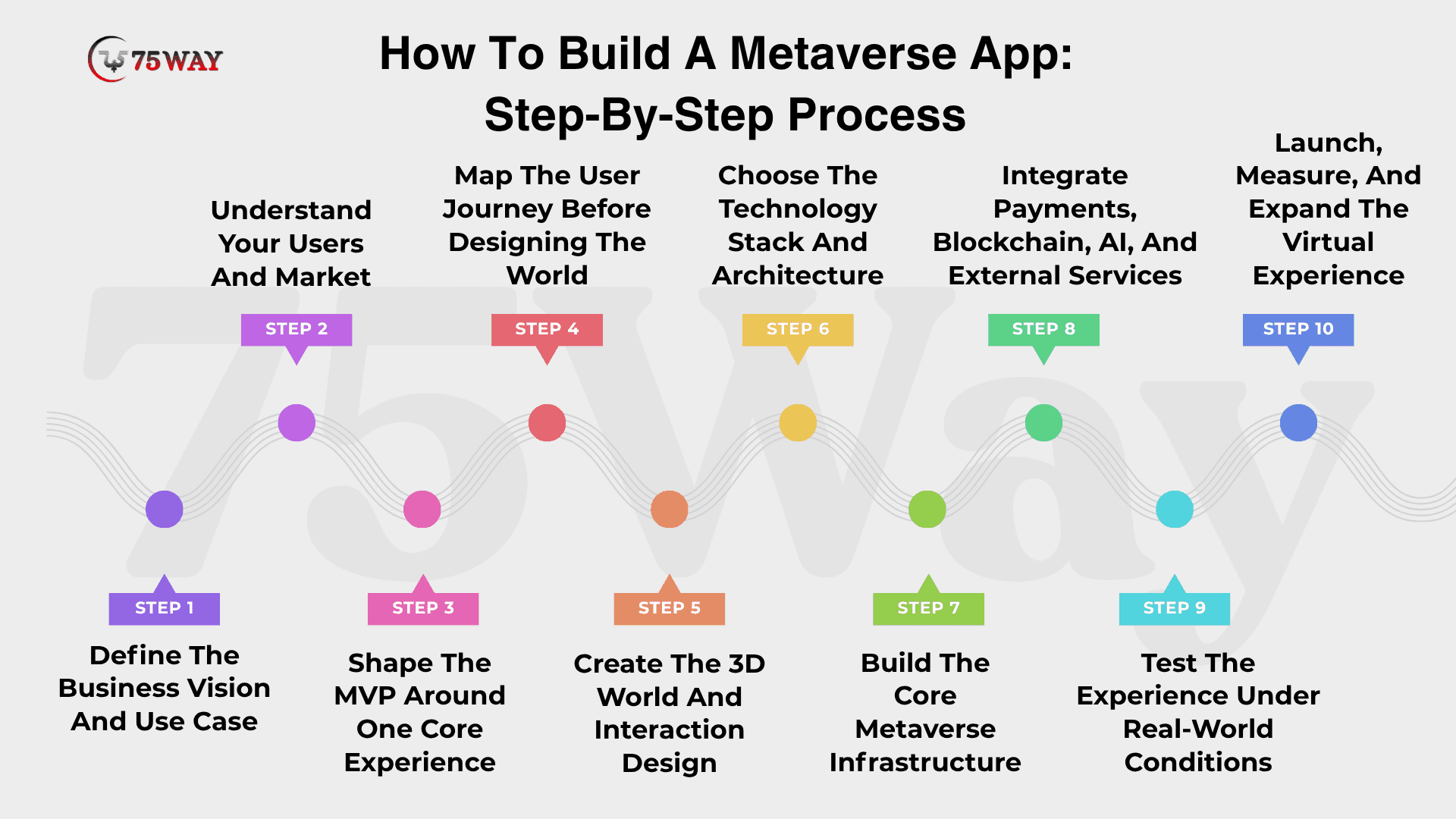
Step 1: Define The Business Vision And Use Case
Every metaverse project should begin with a clear reason for existing. Before choosing a game engine, blockchain network, or immersive technology, determine what the application is expected to accomplish.
Identify your target users, the problem you want to solve, the experience you want to create, and the business outcome you expect. A virtual showroom may aim to increase product engagement, while a virtual event platform may focus on participation and networking.
The clearer the business objective, the easier it becomes to decide which features, technologies, and experiences actually deserve development.
Step 2: Understand Your Users And Market
Once the business direction is clear, research the people who will actually use the application. Study their expectations, digital habits, preferred devices, accessibility needs, and reasons for entering a virtual environment.
Market research should also extend beyond products marketed specifically as metaverse platforms. Gaming communities, virtual events, social platforms, AR/VR applications, e-commerce experiences, and digital collaboration tools can reveal valuable patterns.
The objective is not to copy existing platforms. It is to discover what users enjoy, where existing experiences fall short, and what your application can do differently.
Step 3: Shape The MVP Around One Core Experience
A metaverse app can quickly become too ambitious. Instead of attempting to build an enormous virtual world from the beginning, identify the smallest experience capable of proving your concept.
For example, a virtual retail MVP might include account creation, avatars, one showroom, product exploration, real-time interaction, product information, checkout, and basic analytics.
The MVP should answer one critical question: Will users find enough value in this experience to return, interact, or pay?
Features that do not contribute to that validation can be introduced later.
Step 4: Map The User Journey Before Designing The World
After defining the MVP, map what users will actually do inside the application. Think beyond individual screens and consider the complete journey from the moment someone enters the virtual environment.
Determine how users will register, create or select an avatar, navigate the environment, discover content, interact with objects, communicate with others, complete important actions, and eventually return.
This is where metaverse UX becomes different from conventional app design. Movement, spatial awareness, interaction methods, sound, accessibility, onboarding, and device limitations all influence whether the experience feels intuitive or confusing.
Step 5: Create The 3D World And Interaction Design
Now the virtual experience can begin taking visual shape. Designers and developers can establish environments, avatars, objects, animations, lighting, navigation systems, interaction points, and visual cues.
However, attractive graphics should support the experience rather than become the experience itself. Every virtual environment should have a purpose, whether that is helping users explore products, attend events, collaborate, socialize, learn, or participate in a game.
A well-designed virtual space makes it obvious where users can go, what they can interact with, and what they can accomplish next.
Step 6: Choose The Technology Stack And Architecture
With the product experience defined, select the technologies needed to bring it to life. The architecture should be based on the application's actual requirements rather than whichever technology happens to be trending.
Consider the target devices, expected concurrent users, graphics complexity, real-time interactions, AI requirements, blockchain functionality, security needs, integrations, development expertise, budget, and future growth.
Depending on the project, the stack may include Unity or Unreal Engine, AR/VR technologies, cloud infrastructure, databases, real-time networking, AI services, blockchain networks, smart contracts, Web3 wallets, APIs, and decentralized storage.
The goal is to create an architecture that can support today's MVP without making future expansion unnecessarily difficult.
Step 7: Build The Core Metaverse Infrastructure
Development can now move into multiple interconnected layers. The frontend team creates the virtual environments, avatars, interfaces, animations, and interaction systems, while backend development handles authentication, profiles, APIs, databases, and application logic.
At the same time, the real-time layer manages multiplayer synchronization, presence, messaging, and interactions between users. If the product requires blockchain or AI, those components can be integrated according to the previously defined architecture.
This stage transforms the approved designs and technical plans into a functioning metaverse experience.
Step 8: Integrate Payments, Blockchain, AI, And External Services
Not every metaverse app needs every emerging technology. Integrations should be introduced only when they contribute directly to the product experience or business model.
For blockchain-based applications, this may involve connecting wallets, deploying smart contracts, creating NFTs, supporting token transactions, or establishing digital ownership mechanisms. AI may power conversational avatars, recommendations, intelligent characters, personalization, or content generation.
Other integrations can include payment gateways, CRM platforms, analytics tools, identity providers, content management systems, and enterprise software.
The result should feel like one connected product, rather than a collection of technologies added simply because they are available.
Step 9: Test The Experience Under Real-World Conditions
A metaverse app can perform perfectly in a development environment and still struggle when real users enter the experience. Testing therefore needs to cover both technical performance and actual user behavior.
Evaluate frame rates, loading times, network latency, multiplayer synchronization, device compatibility, authentication, payments, security, accessibility, 3D interactions, and connection recovery.
Testing across representative smartphones, computers, browsers, and supported headsets can expose problems that remain invisible during development. User testing is equally important because technical stability does not guarantee that people will understand or enjoy the experience.
Step 10: Launch, Measure, And Expand The Virtual Experience
Launching the app is not the final step. It is the point where assumptions about users can finally be compared with real behavior.
Monitor metrics such as user retention, session duration, feature engagement, conversion, virtual purchases, navigation patterns, drop-off points, and returning users. Feedback can reveal which environments deserve expansion, which features need refinement, and which ideas should be removed altogether.
Use these insights to plan subsequent releases instead of expanding the metaverse blindly. The strongest products grow from validated user behavior, not from the size of the virtual world.
Types of Metaverse Apps You Can Build For Different Business Needs
Not every metaverse app needs to create an entire virtual world. Businesses can build focused experiences around social interaction, gaming, virtual commerce, events, education, or immersive collaboration, depending on what they want users to accomplish. The main types of metaverse apps are explained below, along with where each fits best.
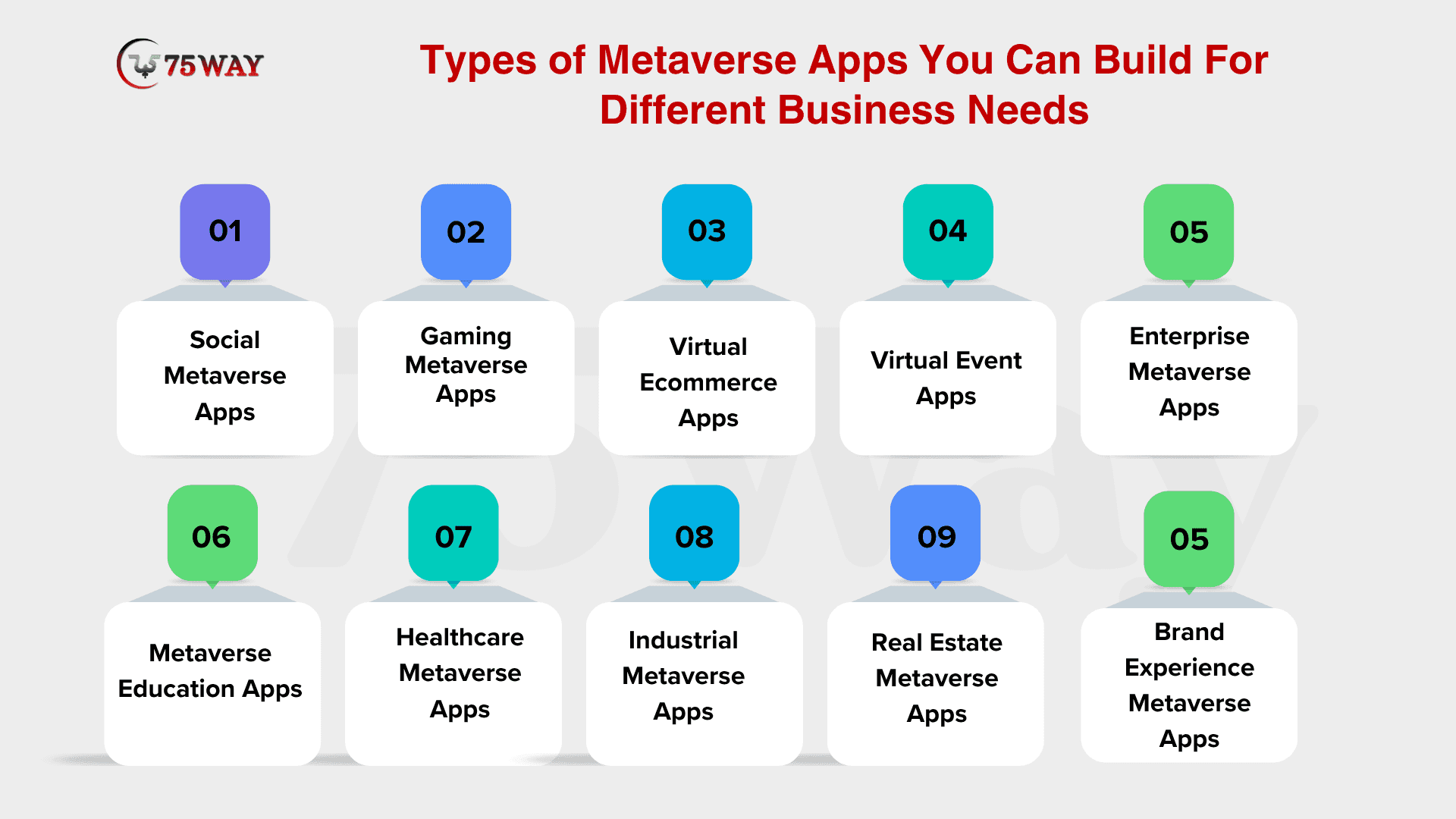
1. Social Metaverse Apps
A social metaverse app turns online interaction into a shared digital experience. Instead of communicating through flat profiles and chat windows, users can enter virtual spaces, represent themselves through avatars, attend activities, and interact with others in real time.
A business could build this model around a private community, creator ecosystem, entertainment platform, or branded social destination. VRChat is a well-known example, showing how virtual spaces can become places where users socialize and create their own experiences.
Ideal For: Communities, entertainment companies, social startups
Pros: Creates deeper interaction and stronger community engagement.
Cons: Requires ongoing moderation, content, and infrastructure investment.
Estimated Development Cost: $100,000–$1,000,000+
2. Gaming Metaverse Apps
Gaming is one of the most natural environments for metaverse experiences because players already expect persistent worlds, digital characters, multiplayer interaction, and virtual rewards.
Businesses can go beyond conventional gameplay by allowing users to socialize, create content, purchase virtual items, or participate in an evolving digital economy. Roblox is a strong real-world example of this model, combining gaming with user-generated experiences and social interaction.
Ideal For: Game studios, media companies, entertainment startups
Pros: Supports strong engagement, communities, and diverse revenue streams.
Cons: Complex gameplay and multiplayer systems can increase development requirements.
Estimated Development Cost: $150,000–$1,000,000+
3. Virtual Ecommerce Apps
Imagine entering a digital store instead of scrolling through a product catalog. Virtual commerce apps bring that concept to life by letting customers walk through 3D spaces, examine products, interact with digital representatives, and then move toward a purchase.
Retailers, fashion companies, furniture brands, and other businesses can use these experiences to make product discovery more engaging. Decentraland has hosted virtual retail experiences from recognizable brands, demonstrating how commerce can become part of an immersive environment.
Ideal For: Retailers, fashion brands, e-commerce businesses
Pros: Makes product discovery more interactive and memorable.
Cons: Requires quality 3D assets and seamless commerce integration.
Estimated Development Cost: $75,000–$500,000+
4. Virtual Event Apps
A virtual event app can transform a traditional conference, exhibition, concert, or product launch into an interactive digital venue. Attendees can move between spaces, join sessions, interact with other participants, visit sponsor areas, and experience activities without being physically present.
This model is particularly useful when a business wants to extend an event beyond geographical boundaries. Fortnite has demonstrated how virtual environments can attract audiences around large-scale entertainment experiences.
Ideal For: Event organizers, enterprises, entertainment brands
Pros: Expands audience reach beyond physical event limitations.
Cons: Large audiences demand reliable real-time performance and infrastructure.
Estimated Development Cost: $50,000–$400,000+
5. Enterprise Metaverse Apps
An enterprise metaverse app can provide virtual meeting rooms, training areas, employee onboarding spaces, workshops, and collaborative environments where distributed teams interact through avatars.
Meta Horizon Workrooms represents this direction by bringing workplace collaboration into an immersive environment. For enterprises, the opportunity is less about creating a flashy virtual office and more about solving practical collaboration and training needs.
Ideal For: Large enterprises, remote teams, training organizations
Pros: Supports immersive collaboration and employee learning experiences.
Cons: Security, integrations, and enterprise requirements add complexity.
Estimated Development Cost: $100,000–$750,000+
6. Metaverse Education Apps
Education becomes more experiential when students can step inside what they are learning. A metaverse education app could let learners explore historical locations, conduct virtual experiments, examine 3D models, or practice skills inside simulated environments.
Schools, universities, training companies, and EdTech businesses can tailor these experiences to specific subjects rather than creating a generic virtual classroom. Minecraft Education is a familiar example of how an interactive virtual environment can support learning and collaboration.
Ideal For: EdTech companies, schools, universities, training providers
Pros: Turns abstract lessons into interactive learning experiences.
Cons: Educational content and device accessibility require careful planning.
Estimated Development Cost: $60,000–$400,000+
7. Healthcare Metaverse Apps
Hospital decision-makers can use immersive healthcare applications where visualization, simulation, or controlled practice adds value. A metaverse healthcare product could support medical education, procedure simulations, rehabilitation, patient education, or virtual environments for specialized training.
Unlike a consumer-focused virtual world, these applications need to place accuracy, privacy, security, and clinical requirements at the center of product development. The opportunity is strongest where immersive technology can improve understanding or training without unnecessarily complicating existing workflows.
Ideal For: Health-tech companies, hospitals, medical institutions
Pros: Enables immersive training, simulation, and medical visualization.
Cons: Requires stringent privacy, security, and clinical considerations.
Estimated Development Cost: $100,000–$750,000+
8. Industrial Metaverse Apps
An industrial metaverse app connects digital environments with real-world operations. A manufacturer, engineering company, or energy business could create a digital representation of equipment or facilities and use it for simulation, employee training, design reviews, remote collaboration, or operational planning.
This is where concepts such as digital twins become particularly valuable because the virtual environment can represent something that already exists in the physical world. The business value comes from making complex systems easier to understand, test, and manage.
Ideal For: Manufacturers, engineering firms, energy companies
Pros: Improves simulation, visualization, training, and operational planning.
Cons: Connecting physical systems with digital environments can be complex.
Estimated Development Cost:$150,000–$1,000,000+
9. Real Estate Metaverse Apps
Real estate doesn't have to begin with a physical property visit. A metaverse real estate app can allow potential buyers or investors to explore a property's layout, rooms, amenities, or surrounding environment through an immersive digital representation.
Developers can also use virtual spaces to showcase projects that are still under construction, giving prospects a better sense of the finished property. The model can therefore complement traditional property tours rather than attempting to replace every physical interaction.
Ideal For: Property developers, brokers, real estate platforms
Pros: Gives prospects an interactive way to explore properties remotely.
Cons: Detailed property modeling can require substantial design effort.
Estimated Development Cost: $50,000–$300,000+
10. Brand Experience Metaverse Apps
Some businesses don't need a permanent virtual world; they need an experience people remember. A brand-focused metaverse app can create a digital destination around a campaign, product launch, community, game, or customer experience.
Users might explore branded spaces, participate in challenges, customize avatars, discover products, or attend exclusive activities. Gucci Garden on Roblox is a notable example of how a fashion brand used an interactive virtual environment to turn brand storytelling into an experience.
Ideal For: Fashion, consumer brands, media, marketing agencies
Pros: Creates distinctive experiences that encourage brand interaction.
Cons: Experiences need fresh content to maintain audience interest.
Estimated Development Cost: $50,000–$500,000+
You don't necessarily need to build a massive virtual world to enter the metaverse. The right starting point is the experience your customers or employees actually need.
A retailer may benefit from an immersive showroom, while a manufacturer may gain more value from a digital twin and a training environment.
Key Features Required To Build Successful Metaverse App
A metaverse app becomes valuable when users can do more than explore a virtual environment. They need to interact, communicate, create, transact, and return without friction. The right feature set depends on the experience being built, but several capabilities form the foundation of a strong product. Those essential features are detailed below.
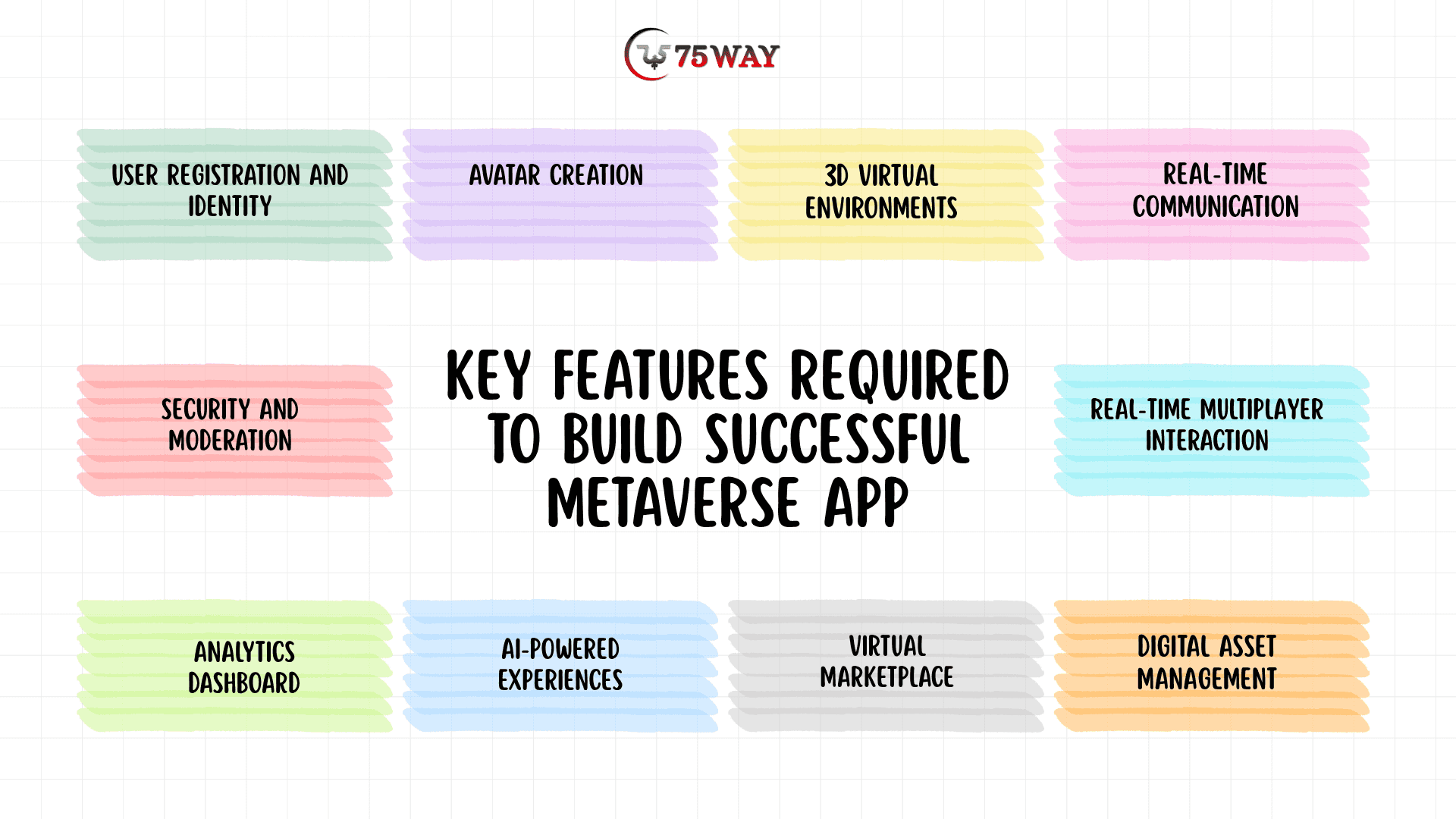
- User Registration And Identity
Your metaverse needs to know who is entering the experience and what they can access. Users can create profiles, sign in securely, and manage personal details. Flexible login options also make onboarding easier.
- Avatar Creation
An avatar becomes the user's identity inside your virtual world. Let people personalize clothing, appearance, accessories, gestures, and animations to feel represented. A well-designed avatar system can also turn customization into another revenue opportunity.
- 3D Virtual Environments
The environment is where your metaverse experience actually comes alive for users. You might build virtual stores, offices, classrooms, factories, or event spaces. Each environment should have a purpose, clear navigation, and meaningful interactions.
- Real-Time Communication
A shared virtual space becomes far more valuable when people can actually communicate within it. Depending on your use case, users may talk through voice, video, text, spatial audio, gestures, or reactions. These interactions make experiences feel more natural.
- Real-Time Multiplayer Interaction
Multiple users should feel like they are genuinely sharing the same virtual space. The app needs to synchronize movements, actions, interactions, and activities without noticeable delays. Strong networking keeps the experience responsive when communities grow.
- Digital Asset Management
Virtual worlds can quickly accumulate products, collectibles, objects, and other digital assets. A dedicated system lets users create, store, display, transfer, and manage them without confusion. Blockchain can add verifiable ownership when your business model needs it.
- Virtual Marketplace
Give users a place to discover and purchase things that add value to their virtual experience. Your marketplace might sell digital goods, tickets, physical products, premium experiences, or creator content. Integrated transactions can turn engagement into revenue.
- AI-Powered Experiences
AI can make your virtual world feel less static and more responsive to individual users. Intelligent assistants, conversational characters, recommendations, generated content, and automated support can personalize interactions. The result is an experience that adapts as users engage.
- Analytics Dashboard
You need more than downloads to understand whether your metaverse is actually working. An analytics dashboard reveals sessions, engagement, retention, purchases, conversions, participation, and revenue. These insights show what users value and where the product needs improvement.
- Security And Moderation
A virtual community needs protection just as much as any digital platform. Security measures can safeguard accounts, transactions, assets, and personal information, while moderation helps control abuse and harmful content. Together, they create a safer environment users can trust.
Why Businesses Must Invest in Metaverse App in 2027?
The strongest business case for metaverse development is not simply “being present in the metaverse.” It is creating an experience that conventional digital channels cannot deliver as effectively. A well-planned application can help businesses create:
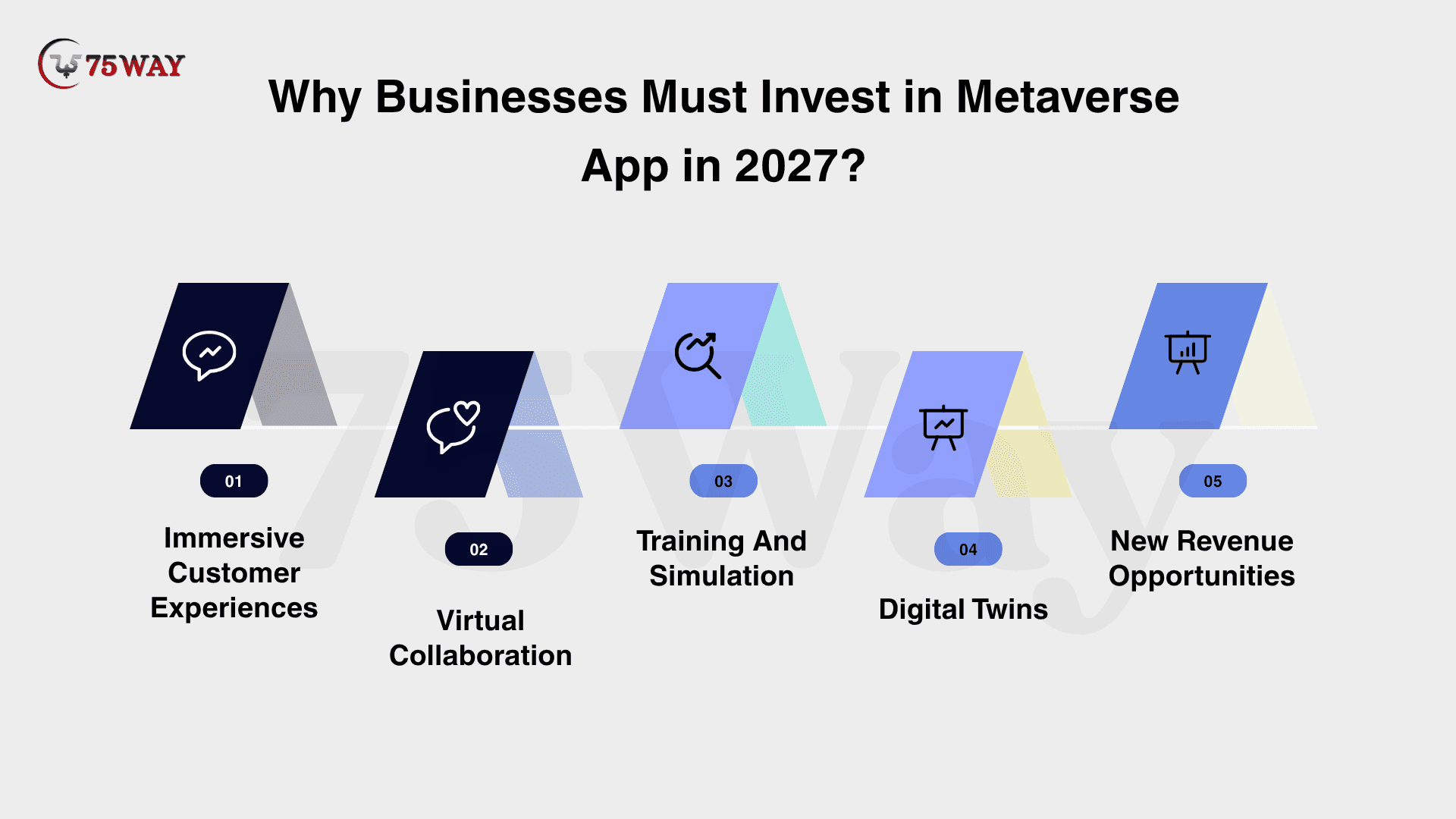
- Immersive Customer Experiences
Businesses can allow customers to explore products, spaces, events, or services through interactive 3D environments rather than relying exclusively on conventional product pages.
For example, a furniture business could create a virtual showroom where customers explore different room layouts before purchasing products.
- Virtual Collaboration
Companies can create interactive environments for meetings, workshops, conferences, training, and distributed collaboration.
The value comes from making collaboration more visual and interactive rather than simply recreating a traditional video call in a 3D room.
- Training And Simulation
Metaverse environments can simulate situations that would otherwise be expensive, dangerous, or difficult to reproduce physically.
Enterprises can use virtual environments for equipment training, onboarding, technical demonstrations, and scenario-based learning.
- Digital Twins
A digital twin can represent a physical facility, product, machine, or operational environment digitally.
Teams can use these representations to visualize operations, identify potential issues, test scenarios, and support decision-making.
- New Revenue Opportunities
Depending on the business model, revenue can come from subscriptions, virtual goods, premium experiences, commerce, licensing, events, sponsorships, or enterprise contracts.
The important question is not “How can we monetize the metaverse?” It is: “Which monetization model naturally fits the experience our users are willing to pay for?”
Technologies Used To Create Blockchain-Based Metaverse App
The technology stack behind a blockchain-based metaverse app determines how securely users interact, own digital assets, and complete transactions within the virtual environment. Different technical layers work together to support these experiences while keeping the application scalable and reliable. The key technologies involved in this development are explained below.
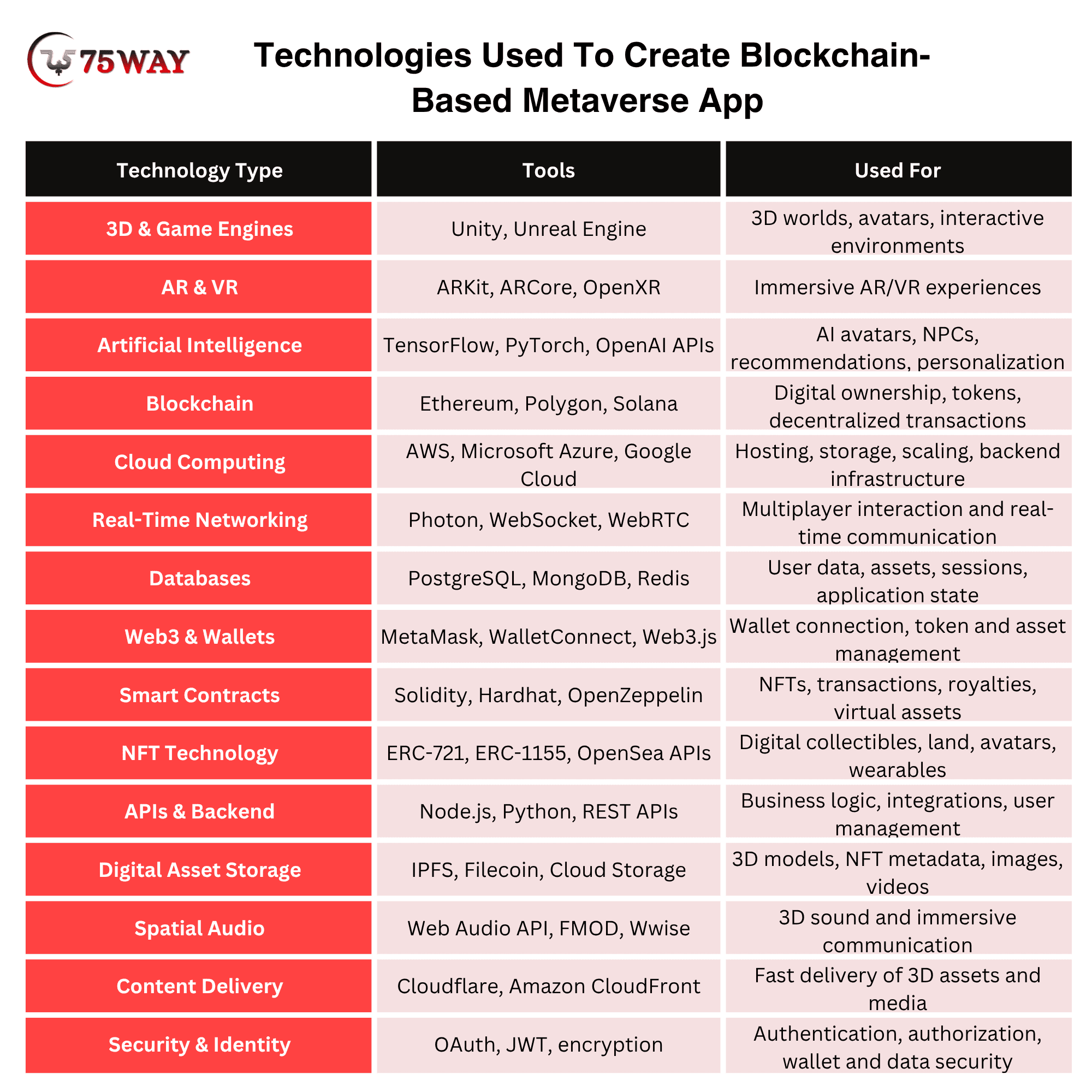
1. 3D And Game Engines
Unity and Unreal Engine are common choices for interactive 3D experiences.
The choice depends on factors such as graphics requirements, target devices, team expertise, performance expectations, and project complexity.
2. AR And VR
Extended reality technologies enable immersive experiences across supported smartphones, browsers, and headsets.
The technology selection should follow the intended user journey rather than forcing users to purchase specialized hardware.
3. Artificial Intelligence
AI can support:
- Conversational avatars
- Personalization
- Recommendation systems
- Intelligent NPCs
- Automated content generation
- Behavioral analysis
- Moderation
4. Blockchain
Blockchain can support digital ownership, decentralized transactions, token-based ecosystems, and certain digital asset models.
However, its inclusion should be justified by a specific requirement.
5. Cloud Computing
Cloud infrastructure supports backend services, data storage, user management, content delivery, analytics, and scaling.
For large multi-user experiences, infrastructure planning becomes especially important because performance depends on more than the visual client.
6. Real-Time Networking
Multiplayer environments require networking architecture capable of synchronizing users and interactions with low latency.
7. Databases
The application may need databases for user profiles, sessions, transactions, virtual assets, content, analytics, and application state.
8. Web3 And Wallet Integration
Web3 technologies connect the metaverse application with blockchain networks and decentralized services. Wallet integration allows users to manage tokens, digital assets, transactions, and blockchain-based identities. Technologies such as WalletConnect, MetaMask, and blockchain SDKs can be used depending on the supported ecosystem.
9. Smart Contracts
Smart contracts automate blockchain-based actions without requiring manual intervention. They can manage NFT ownership, token transfers, marketplace transactions, royalties, virtual land, memberships, and other predefined digital-asset operations.
10. NFT Technology
NFT infrastructure can represent unique digital items such as avatars, virtual land, collectibles, wearables, accessories, and in-game assets. NFT standards and metadata storage help establish ownership and enable assets to interact with compatible blockchain ecosystems.
11. APIs And Backend Services
APIs connect the metaverse client with backend systems, blockchain networks, payment services, social features, analytics platforms, and external applications. A well-designed backend architecture is essential for handling authentication, user profiles, transactions, content, and application logic.
12. Digital Asset Storage
Blockchain does not necessarily store every piece of an application's media directly. IPFS, decentralized storage, and cloud storage can be used for larger files such as 3D models, images, videos, avatar assets, and NFT metadata.
13. Spatial Audio
Spatial or 3D audio can make virtual environments feel more immersive by adapting sound based on users' positions, movements, and surroundings. It is particularly useful for virtual events, gaming, social spaces, and collaborative environments.
14. Content Delivery And Streaming
CDNs, asset streaming, and related content-delivery technologies help deliver large 3D assets, textures, videos, and other media without unnecessarily increasing loading times. These technologies become increasingly important as virtual environments grow in size and complexity.
How Much Does Metaverse App Development Cost?
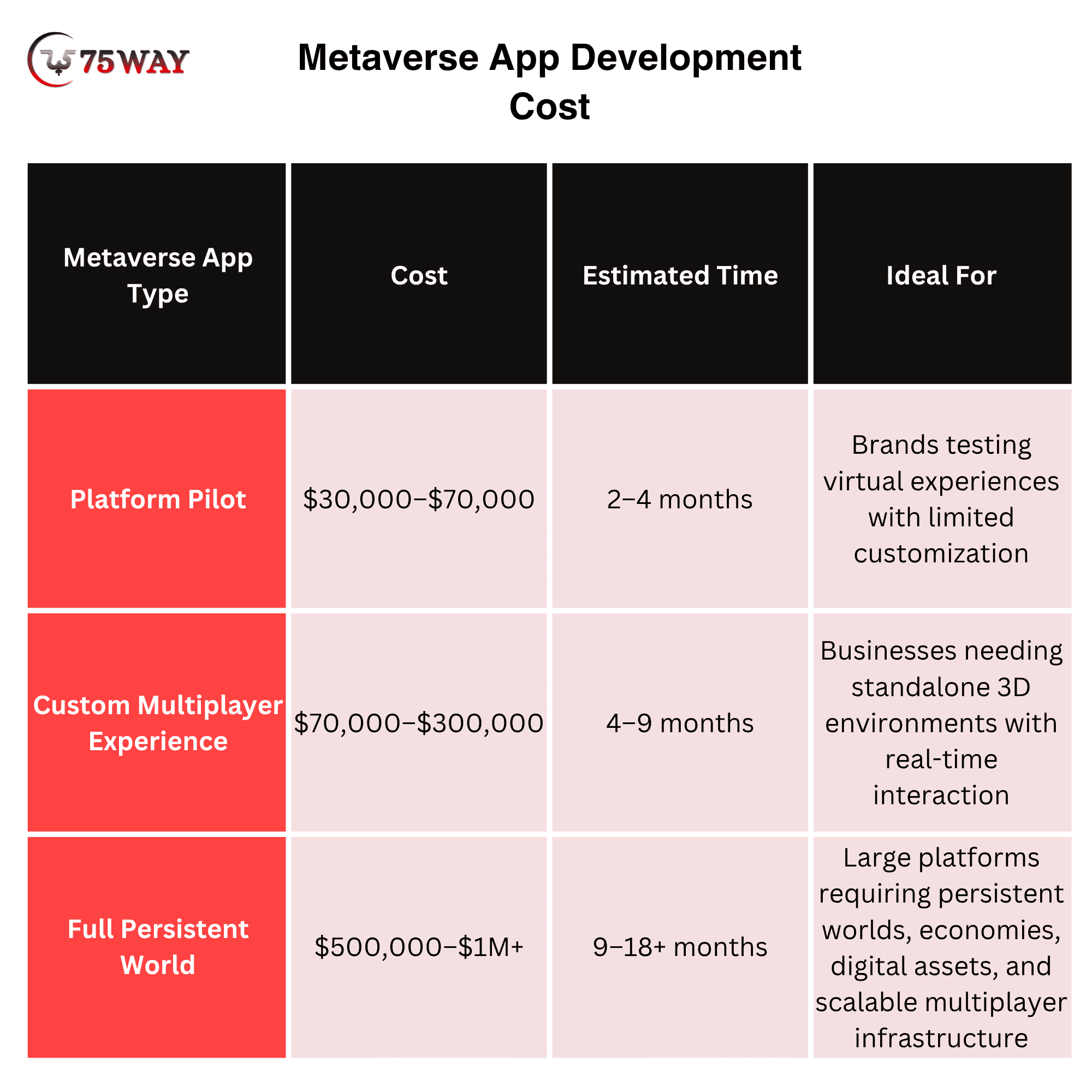
There is no reliable single price for metaverse app development because project scope can vary dramatically. The cost of metaverse app development generally ranges from $20,000 for a basic experience to $500,000+ for an advanced, highly customized platform. Large persistent virtual worlds with complex multiplayer infrastructure, blockchain ecosystems, AI, and extensive 3D environments can exceed this range.
- Platform Pilot Cost: $30,000 – $70,000
A branded virtual experience built within an existing platform, with limited customization and core immersive features.
- Custom Multiplayer Experience Cost: $70,000 – $300,000
A standalone 3D environment designed for real-time interaction among a moderate number of concurrent users.
- Full Persistent World Cost: $500,000 – $1M+
A large-scale, continuously available virtual world with persistent environments, users, digital assets, economies, and scalable multiplayer infrastructure.
Metaverse Application Development Cost Based On Complexity
1. Basic / Simple Metaverse App: $20,000–$50,000
A basic metaverse app usually focuses on one core experience, such as a small virtual showroom, branded environment, social space, or interactive 3D experience.
2. Medium-Complexity Metaverse App: $50,000–$200,000
A medium-complexity application can support richer 3D environments, multiplayer functionality, customized avatars, real-time communication, advanced interactions, analytics, and third-party integrations.
3. Advanced / High-Complexity Metaverse App: $200,000–$500,000+
Advanced platforms require significantly more engineering because they may include multiple interconnected environments, large-scale multiplayer functionality, sophisticated AI, blockchain assets, virtual economies, complex user interactions, and cross-platform support.
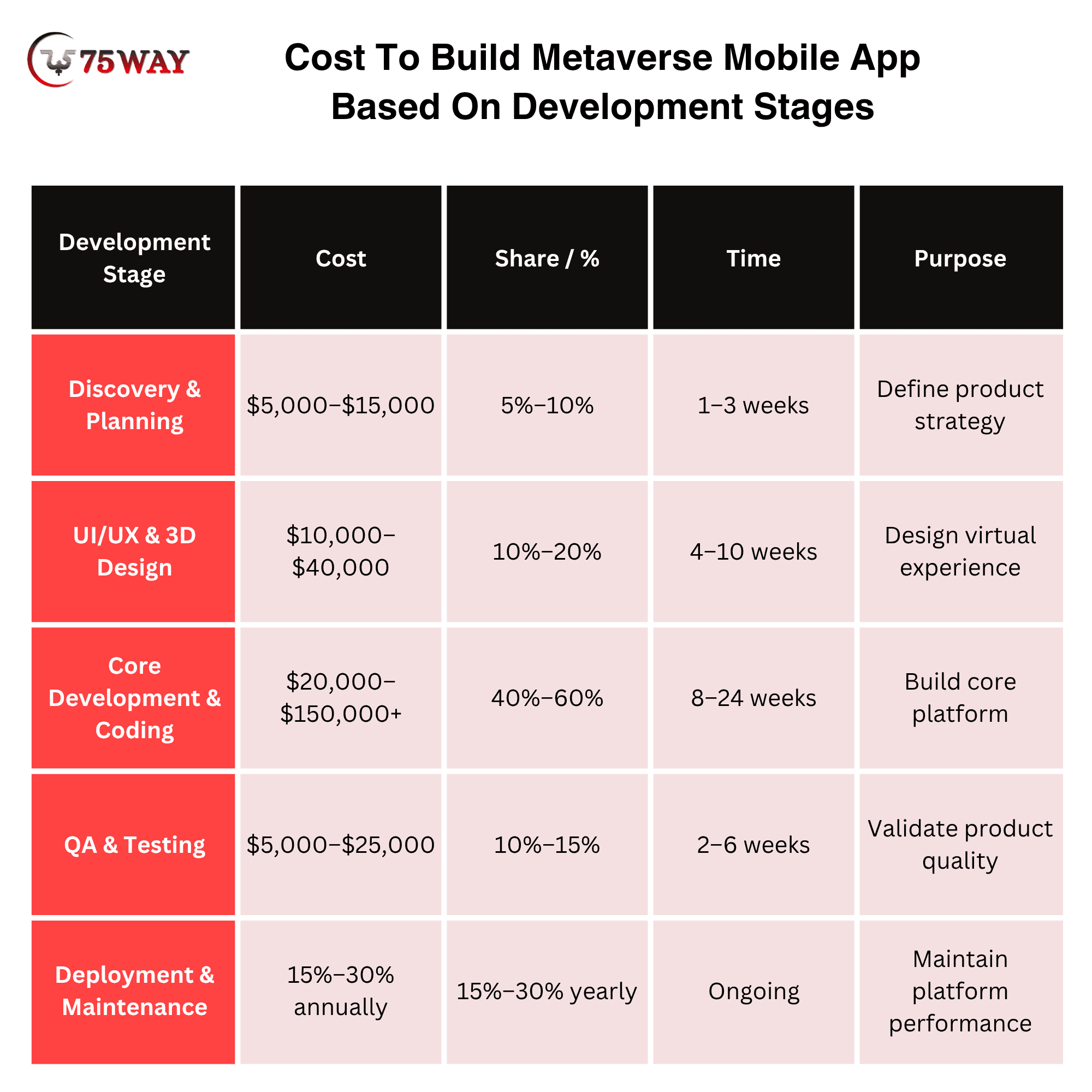
Cost To Build Metaverse Mobile App Based On Development Stages
- Discovery & Planning: $5,000–$15,000
This stage establishes the product vision, target audience, business model, MVP scope, technical requirements, platform strategy, and development roadmap. Investing in planning helps prevent expensive architectural or feature decisions later.
- UI/UX & 3D Design: $10,000–$40,000
The cost covers user journeys, interfaces, virtual environments, avatars, 3D objects, interaction concepts, animations, and visual assets. More detailed environments and customized 3D assets naturally require greater design effort.
- Core Development & Coding: $20,000–$150,000+
This is usually the largest development expense and covers frontend experiences, backend systems, databases, real-time networking, APIs, integrations, and required AI or blockchain functionality. The final cost depends heavily on feature depth and platform requirements.
- QA & Testing: $5,000–$25,000
Testing covers device compatibility, performance, multiplayer synchronization, network conditions, security, payments, authentication, accessibility, and user interactions. Metaverse applications generally require broader testing because the experience depends on both software and hardware conditions.
- Deployment & Maintenance: 15%–30% Of Development Cost Annually
Post-launch expenses can include cloud infrastructure, bug fixes, security updates, performance optimization, content updates, third-party services, and new feature releases. Ongoing costs depend on the application's user base and infrastructure requirements.
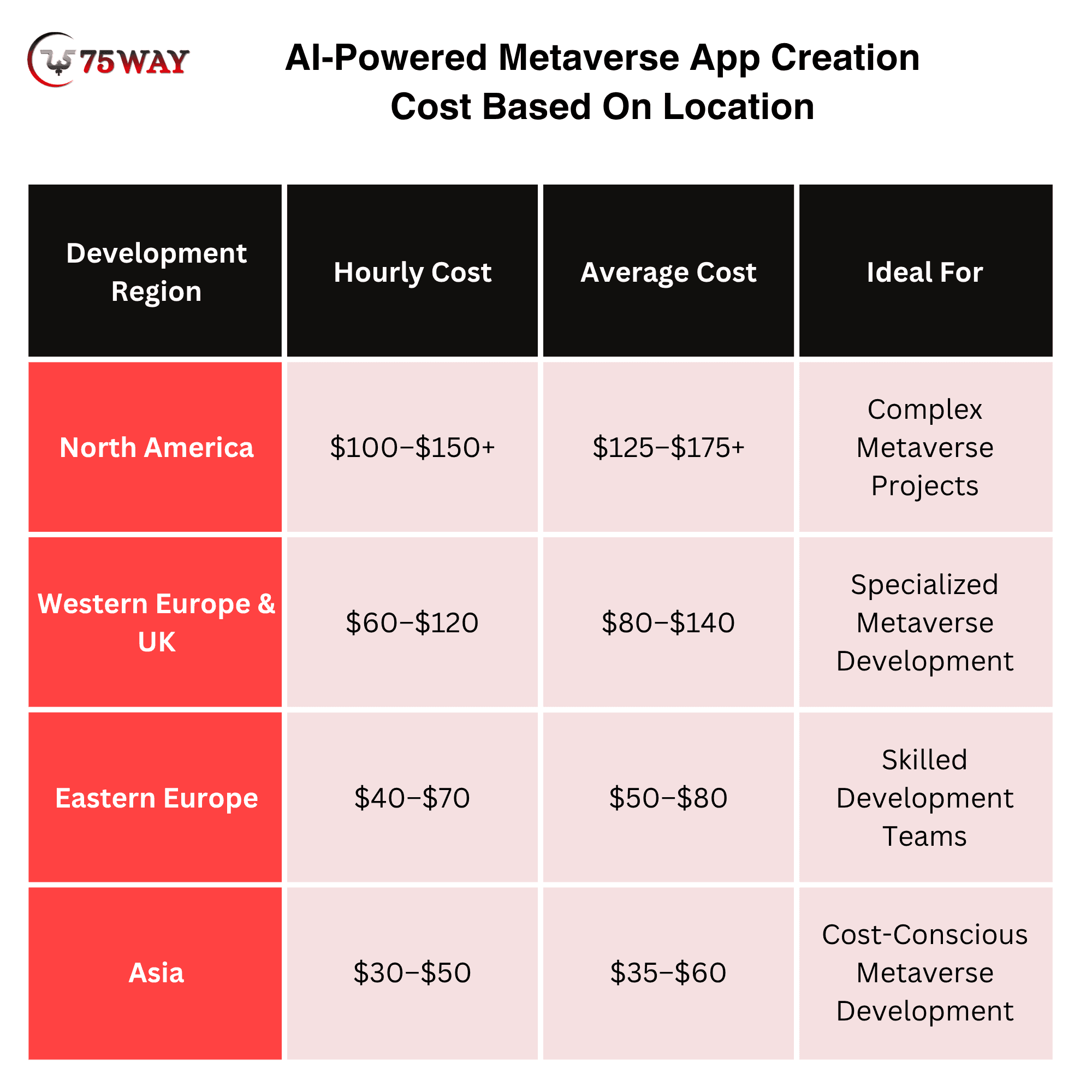
AI-Powered Metaverse App Creation Cost Based On Location
Developer location can significantly influence the hourly rate and therefore the overall project budget.
- North America: $100–$150+ Per Hour
Teams in this region generally have higher development rates, particularly for experienced metaverse engineers, 3D specialists, blockchain developers, and technical architects.
- Western Europe And UK: $60–$120 Per Hour
Development teams in Western European markets generally charge higher rates than offshore teams, with pricing varying according to technical specialization and agency experience.
- Eastern Europe: $40–$70 Per Hour
Eastern European development teams can provide access to experienced engineering talent at comparatively moderate rates, although specialized skills can command higher prices.
- Asia: $30–$50 Per Hour
Development rates across Asian markets can be comparatively lower, while established agencies and highly specialized developers may charge up to $80 or more per hour.
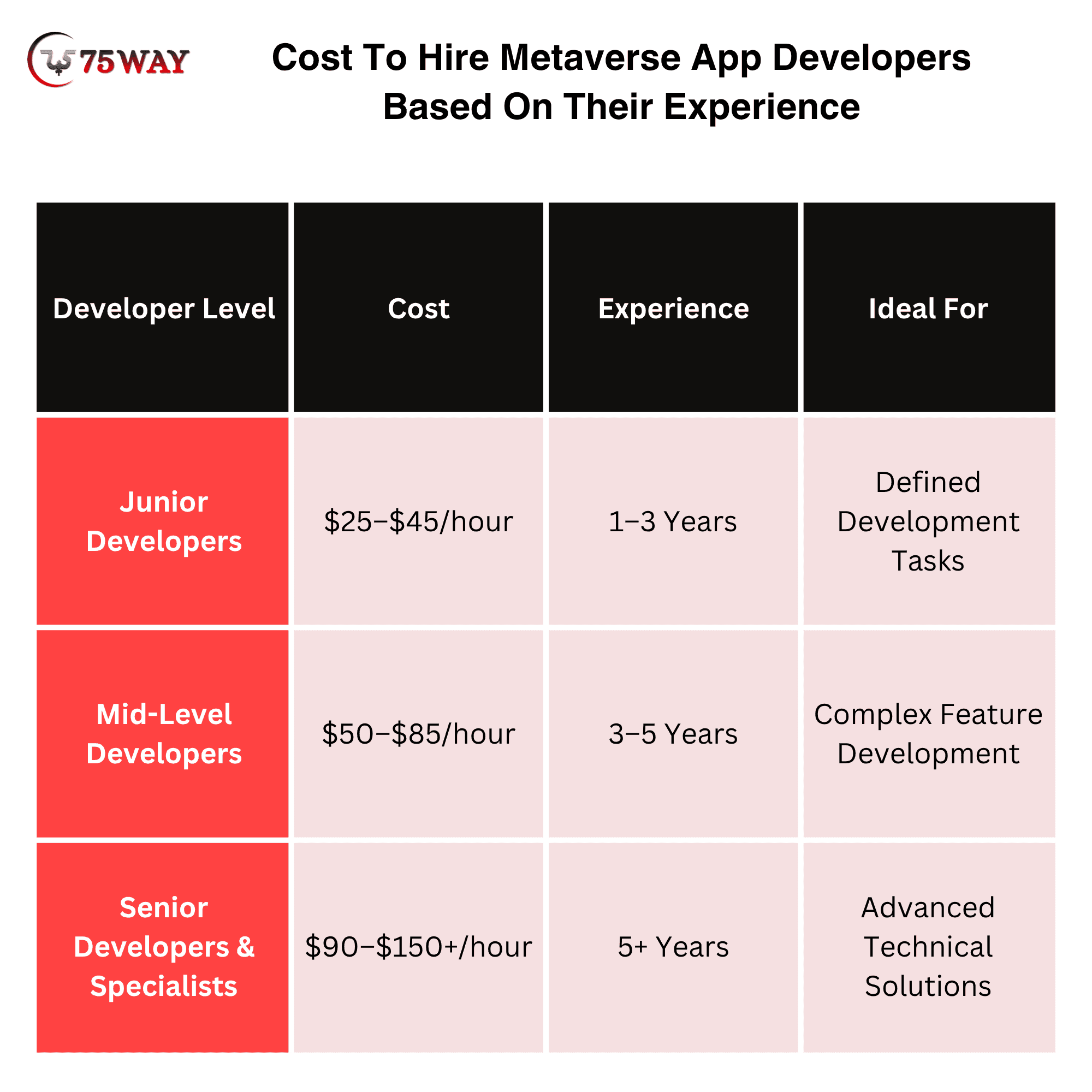
Cost To Hire Metaverse App Developers Based On Their Experience
Developer expertise also influences the overall cost because complex metaverse applications require specialized knowledge across 3D development, multiplayer networking, cloud infrastructure, AI, blockchain, and backend engineering.
- Junior Developers: $25–$45 Per Hour
Developers with around 1–3 years of experience are generally suitable for well-defined development tasks under experienced technical supervision. They can contribute to specific modules but may require guidance for complex architecture and integrations.
- Mid-Level Developers: $50–$85 Per Hour
Developers with 3–5 years of experience can independently handle more complex features and contribute to application architecture, integrations, performance improvements, and multiplayer functionality.
- Senior Developers And Specialists: $90–$150+ Per Hour
Senior professionals with 5+ years of experience are typically involved in architecture, advanced 3D systems, blockchain integration, real-time infrastructure, security, optimization, and technically demanding features. Their higher rates can be justified when the project requires specialized expertise and complex decision-making.
Factors Affecting Cost To Build a Metaverse App
A metaverse app can move from a manageable project to a major investment once you add richer environments, more user interactions, multiple devices, real-time activity, or blockchain functionality. That is why two seemingly similar metaverse projects can have dramatically different budgets. The elements that have the biggest impact on development cost are covered below.
- Product Complexity
More environments, users, interactions, and business workflows increase development effort.
- 3D Asset Requirements
Custom environments, characters, animations, simulations, and digital objects can significantly influence project costs.
- Supported Platforms
Building for web, mobile, desktop, and multiple XR devices increases testing and engineering requirements.
- Real-Time Infrastructure
Applications supporting large numbers of simultaneous users require more sophisticated backend and networking architecture.
- AI Integration
Conversational AI, intelligent characters, personalization, and content generation can add development and infrastructure costs.
- Blockchain Integration
Wallets, smart contracts, digital asset management, marketplaces, and transaction infrastructure add another technical layer.
- Security Requirements
Enterprise and regulated use cases may require more extensive security controls, testing, monitoring, and compliance work.
- Integrations
Connecting the application with CRM, ERP, payment, identity, analytics, commerce, or other systems can expand the project significantly.
The most useful way to estimate cost is to define the MVP scope first and then calculate development effort by feature, platform, integration, infrastructure, and team composition.
Revenue Models: How Do Metaverse Apps Make Money?
A metaverse app can generate revenue long after the initial download, provided its virtual experience gives users something worth paying for. Businesses can monetize access, digital experiences, transactions, and virtual goods in different ways depending on how users interact with the platform. The main revenue models for metaverse apps are explained below.
1. Subscriptions
Charge users monthly or annually for premium access, advanced features, exclusive communities, or enterprise capabilities. For example, 500 users paying $10 per month can generate $5,000 in monthly revenue.
2. Virtual Goods
Sell digital clothing, accessories, environments, collectibles, avatars, or other virtual items. If 1,000 users purchase virtual items worth $8 each in a month, the platform can generate $8,000 in monthly sales.
3. Transaction Fees
A marketplace can charge a percentage or fixed fee on purchases between users, creators, and businesses. For example, processing $100,000 in monthly transactions at a 5% fee can generate $5,000 in monthly revenue.
4. Advertising And Sponsorship
Brands can sponsor virtual environments, experiences, events, branded assets, or premium placements. A platform securing four brand campaigns worth $5,000 each could generate $20,000 from sponsorships during a campaign period.
5. Virtual Events
Businesses can monetize conferences, exhibitions, workshops, entertainment, product launches, and premium virtual experiences. For instance, selling 2,000 event passes at $15 each can generate $30,000 in event revenue.
6. Enterprise Licensing
Companies can pay for private virtual environments, employee training platforms, collaboration systems, or industry-specific applications. For example, licensing a customized virtual workspace to five businesses at $10,000 each can generate $50,000 in contract revenue.
7. Physical-Commerce Integration
A virtual experience can drive sales of physical products or services through product showcases, virtual stores, demonstrations, and direct purchasing journeys. If virtual visitors generate $50,000 in physical product sales and the business earns a 20% margin, that represents $10,000 in gross profit.
The strongest monetization strategy combines the revenue models that naturally fit the audience, virtual experience, and business objectives rather than forcing users to pay at every interaction.
What Are The Biggest Challenges In Metaverse App Development?
Metaverse projects introduce technical, business, and user-experience challenges that should be addressed during planning. Identifying these challenges early helps teams control development complexity, improve reliability, and create an experience users have a reason to revisit.
1. Performance And Scalability
Rich 3D experiences consume significant computing resources. As simultaneous users increase, infrastructure, rendering, database, and networking requirements also become more demanding.
Solution: Use scalable cloud infrastructure, optimized 3D assets, load balancing, content delivery networks, and server-side performance monitoring. Start with realistic concurrency targets and gradually increase capacity as adoption grows.
2. Device Fragmentation
Users may access the experience through different phones, computers, browsers, or headsets. Differences in processing power, screen sizes, controls, and hardware capabilities can create inconsistent experiences.
Solution: Establish device priorities during planning and use responsive interfaces, adaptive graphics, performance tiers, and cross-device testing. Support the most important platforms first instead of trying to optimize for every device simultaneously.
3. Complex Development
A metaverse platform can combine 3D development, backend engineering, networking, AI, cloud infrastructure, payments, identity, and security. A poorly defined scope can quickly turn an MVP into an expensive engineering project.
Solution: Define a focused MVP around one core user experience and establish technical requirements before development begins. Build the essential architecture first, then introduce advanced capabilities such as AI, blockchain, and complex multiplayer systems in later phases.
4. User Adoption
Users will not return simply because an environment is immersive. There must be a clear reason to participate, return, interact, purchase, collaborate, or create.
Solution: Design the experience around a specific user need or activity. Validate the concept with target users, track engagement and retention, and continuously improve features based on actual user behavior rather than adding technology for novelty.
5. Privacy And Security
Virtual environments can process substantial amounts of user, identity, payment, and behavioral data. Security architecture, identity controls, privacy practices, moderation, and abuse prevention should therefore be considered early.
Solution: Apply secure authentication, encryption, access controls, data minimization, moderation systems, and regular security testing. Define clear data-handling policies and build security requirements into the architecture rather than treating them as a final-stage feature.
6. Interoperability
Moving users or assets between different platforms can involve significant technical and ecosystem constraints. Differences in standards, asset formats, wallets, identity systems, and platform policies can limit interoperability.
Solution: Use established standards and compatible asset formats wherever practical, and verify platform support before promising cross-platform functionality. Build interoperability in phases, beginning with the ecosystems that provide the strongest business value.
Metaverse App Development Services You Can Avail
Your metaverse project may need a complete build or support for only one part of the experience. From developing a new virtual platform to extending an existing application with immersive capabilities, the required expertise can vary considerably. The services available for metaverse app development are covered below.
1. Metaverse 3D Space App Development
Immersive virtual environments allow users to explore spaces, interact with objects, communicate with others, and participate in engaging digital experiences across supported devices.
- Immersive environments for users
- Interactive avatars and objects
- Real-time multiplayer experiences
- Custom 3D world design
- Cross-device experience optimization
2. Metaverse Workspace App Development
Virtual workplaces enable teams to collaborate, communicate, conduct meetings, share resources, and manage professional activities through interactive digital environments.
- Virtual meeting rooms
- Interactive team collaboration spaces
- Digital presentations and whiteboards
- Real-time workplace communication
- Secure employee access
3. Metaverse Integration Services
Connected ecosystems bring together existing applications, payment gateways, wallets, APIs, databases, and third-party technologies to create unified metaverse experiences.
- Existing system integration
- Wallet and payment integration
- API and database connectivity
- Third-party platform integration
- Secure data synchronization
4. Metaverse NFT Development
Blockchain-powered assets enable digital ownership, collectibles, avatars, virtual items, and tradable experiences within immersive virtual ecosystems.
- Custom NFT asset creation
- Smart contract implementation
- Digital ownership management
- NFT minting functionality
- Blockchain wallet connectivity
5. Metaverse Dating App Development
Virtual dating environments create new ways for users to discover matches, interact through avatars, communicate privately, and participate in shared experiences.
- Personalized avatar creation
- Interactive virtual dating spaces
- Real-time messaging and communication
- Matchmaking and profile discovery
- Privacy-focused user controls
6. Metaverse NFT Marketplace Development
Digital marketplaces facilitate the discovery, purchase, sale, trading, and management of blockchain-based assets through secure and user-friendly interfaces.
- NFT buying and selling
- Secure blockchain transactions
- Creator royalty management
- Digital asset discovery
- Wallet-based user authentication
7. Metaverse Product Development
End-to-end product creation combines immersive experiences, real-time functionality, blockchain capabilities, and scalable architecture to transform concepts into market-ready digital solutions.
- Product strategy and planning
- Immersive experience design
- Core feature development
- Technology stack implementation
- Testing and product launch
8. Metaverse Platform Development
Scalable virtual ecosystems support immersive environments, user interactions, digital assets, communities, economies, and multiple business applications within a unified platform.
- Scalable platform architecture
- Virtual environment development
- User identity and profiles
- Digital economy infrastructure
- Ongoing platform enhancement
How To Choose A Metaverse App Development Company?
Choosing the right development partner can significantly influence the quality, scalability, and long-term viability of a metaverse application. Unlike conventional apps, metaverse products often require expertise across 3D environments, real-time interactions, immersive technologies, blockchain, cloud infrastructure, and digital economies. Before selecting a company, evaluate:
- Metaverse Experience
Review previous projects involving virtual worlds, 3D environments, avatars, AR/VR experiences, multiplayer applications, digital assets, or immersive communities. Relevant experience indicates familiarity with the unique technical and UX requirements of metaverse products.
- 3D And Immersive Expertise
Check whether the team has practical experience with 3D modeling, game engines, spatial environments, animation, AR, VR, and interactive experiences. This expertise directly affects visual quality, performance, navigation, and user engagement.
- Real-Time Technology
Metaverse applications often depend on real-time communication and multiplayer interaction. Assess experience with networking, synchronization, voice and video communication, low-latency systems, and architectures capable of supporting simultaneous users.
- Blockchain Capabilities
For projects involving NFTs, virtual assets, tokens, wallets, or decentralized transactions, evaluate blockchain development expertise. Review experience with smart contracts, NFT standards, wallet integration, transaction security, and blockchain selection.
- Scalable Architecture
Ask how the proposed architecture will handle growing users, virtual environments, digital assets, transactions, and concurrent activity. Experience with cloud infrastructure, distributed systems, databases, and content delivery is particularly important for persistent metaverse platforms.
- Product And UX Thinking
A capable partner should understand why users would enter, interact within, and return to the virtual environment. Look for a team that can prioritize meaningful experiences, simplify complex interactions, and recommend an MVP without adding technology simply for novelty.
- Security And Moderation
Metaverse platforms can involve identities, payments, digital assets, communications, and behavioral data. Examine how the company approaches authentication, authorization, encryption, wallet security, fraud prevention, content moderation, and user safety.
- Cross-Platform Capability
Users may access the metaverse through smartphones, desktops, browsers, AR devices, or VR headsets. Confirm that the development team understands platform-specific limitations and can create suitable experiences across the devices relevant to your target audience.
Metaverse App Development: KPIs To Track After Launch
Downloads alone do not tell you whether a metaverse product is working. Depending on your business model, monitor:
- Monthly active users
- Daily active users
- Average session duration
- Day 7 and Day 30 retention
- Conversion rate
- Paid-user percentage
- Average revenue per user
- Virtual transaction volume
- Repeat purchases
- Event participation
- Customer acquisition cost
- User-generated content
- Churn rate
For an enterprise training platform, completion rates and training outcomes may matter more than daily active users.
For a virtual commerce platform, product engagement and purchase conversion may be more meaningful.
Your KPI framework should reflect your business objective, not generic app metrics.
Is Metaverse Mobile App Creation Right For Every Business?
No. That may be the most important strategic answer in this entire guide.
A metaverse application makes sense when immersive interaction creates measurable value that a conventional website or app cannot provide as effectively.
It may be worth considering when you need:
- 3D product experiences
- Virtual collaboration
- Simulation
- Digital twins
- Immersive training
- Virtual communities
- Interactive events
- Spatial commerce
- Persistent digital environments
If your objective is simply to provide account management, basic e-commerce, content publishing, or a conventional workflow, a traditional application may be the better investment.
The goal should not be to build a metaverse because the technology is interesting. The goal should be to use immersive technology where it creates a better business or customer outcome.
What Does The Future of Enterprise Metaverse App Development Look Like?
The next phase of metaverse development is likely to be less about creating isolated virtual worlds and more about combining immersive experiences with practical digital products.
AI can make virtual environments more responsive and personalized. Digital twins can connect virtual representations with physical operations. Cloud infrastructure can support increasingly complex experiences, while improvements in XR hardware can reduce friction for immersive interactions.
For businesses, this creates a more practical question:
Where can a persistent, interactive 3D experience create value that conventional digital channels cannot?
That question is more valuable than simply asking whether a company needs a “metaverse strategy.”
Final Thoughts
Metaverse app development is ultimately a product and business strategy challenge supported by immersive technology. The strongest applications begin with a defined audience and measurable business objective, then use 3D, AR/VR, AI, cloud infrastructure, real-time networking, blockchain, or other technologies only where they strengthen the experience.
From MVP planning and UX design to architecture, development, security, monetization, and post-launch optimization, every decision should connect back to user value and business outcomes.
If you are planning a metaverse product, the right first step is not building the virtual world. It is defining the experience, users, business model, MVP, technology requirements, and success metrics that make that virtual world worth building.
Frequently Asked Questions (FAQs)
What Is Metaverse App Development?
Metaverse app development involves building interactive digital environments where users can communicate, explore, collaborate, transact, or interact with virtual objects through immersive technologies.
How Long Does It Take To Develop A Metaverse App?
Development time depends on the application's scope, number of platforms, 3D complexity, real-time functionality, integrations, and advanced technologies included in the product.
What Technologies Are Used For Metaverse App Development?
Common technologies include 3D engines, AR/VR, AI, cloud computing, real-time networking, databases, APIs, and blockchain when digital ownership or decentralized transactions are required.
Can A Metaverse App Work Without VR Headsets?
Yes. A metaverse experience can be designed for smartphones, browsers, desktops, or other supported devices, depending on the product's interaction model and technical requirements.
How Do Metaverse Apps Generate Revenue?
Common models include subscriptions, virtual goods, marketplace fees, enterprise licensing, sponsored experiences, virtual events, advertising, and physical-commerce integration.
What Is A Metaverse MVP?
A metaverse MVP is a limited version containing the core experience needed to test user demand, validate business assumptions, collect feedback, and determine which capabilities deserve further investment.
Does Every Metaverse App Need Blockchain?
No. Blockchain should be included only when the product requires capabilities such as verifiable digital ownership, tokenized assets, or decentralized transactions.
How Can Businesses Measure Metaverse App Success?
Businesses can track metrics such as retention, engagement, session duration, conversions, transactions, revenue, customer acquisition, participation, and other KPIs aligned with the application's specific business objective.