AI Summary
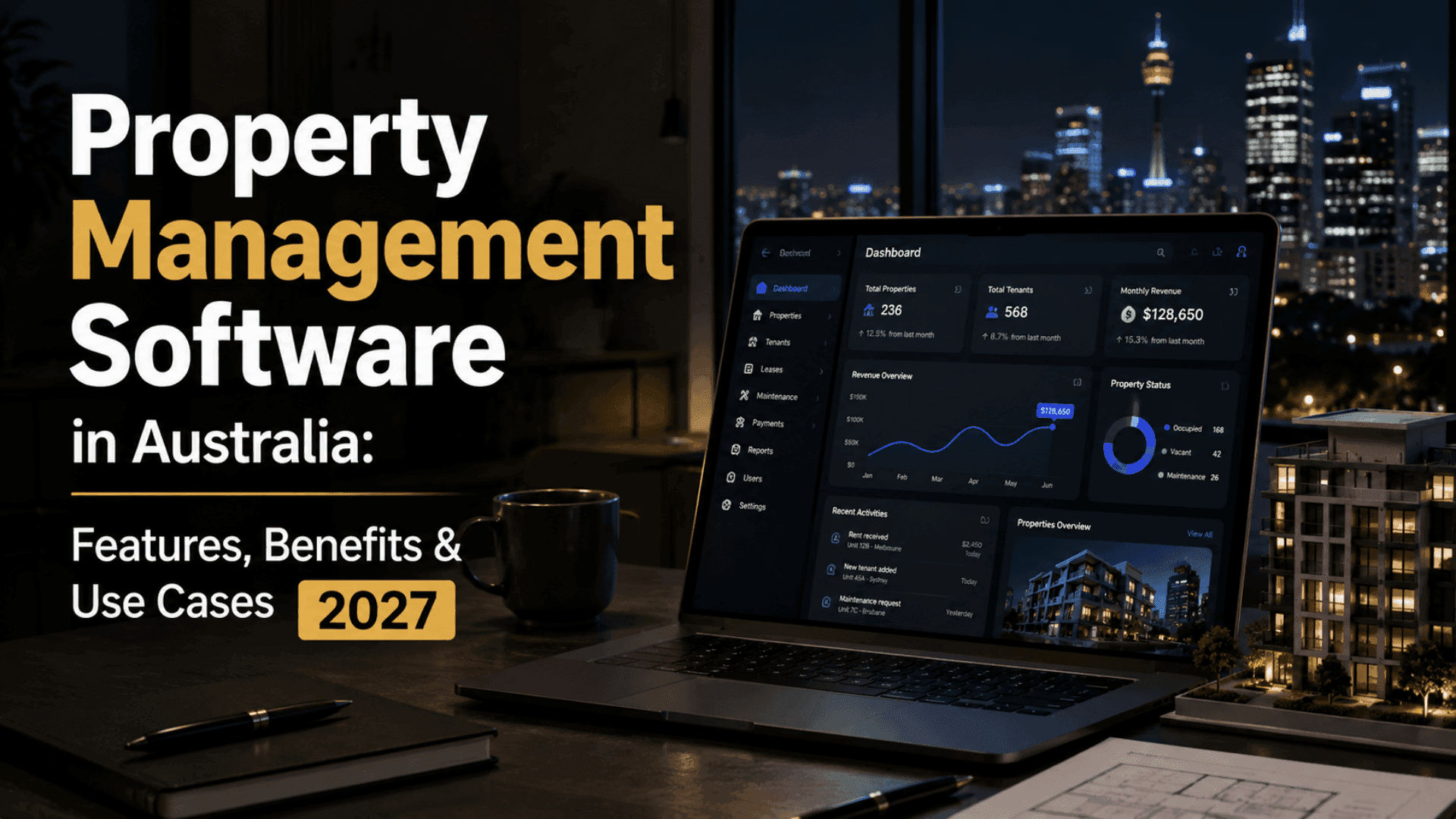
Property management software is reshaping how Australian businesses manage properties, tenants, owners, and daily operations. This guide explores essential features, practical benefits, and real-world use cases. It also covers costs, integrations, automation, and selection considerations. Discover what matters most in 2027.
Key Takeaways
- Essential features simplify property, tenant, maintenance, payment, and reporting management.
- Automation reduces manual work across everyday property management operations significantly.
- Real-world use cases reveal software value across different businesses.
- Integrations connect property platforms with essential business systems seamlessly.
- Choosing software requires balancing features, costs, scalability, security, and usability.
Managing properties manually can become difficult long before a portfolio looks unmanageable on paper. Tenant requests, maintenance jobs, inspections, rent tracking, and communication can quickly create a workload that teams struggle to keep under control.
Property management software in Australia gives businesses a way to bring these daily responsibilities into one connected system. The value goes beyond replacing spreadsheets, with the right platform helping teams save time, improve tenant experiences, and gain better visibility across their properties.
For property managers, owners, and real estate businesses, knowing what real estate software can actually handle matters before investing in a platform. The features, benefits, and practical use cases for 2027 are explored below.
What Is Property Management Software in Australia?
Property management software is a digital platform that helps businesses manage the operational, financial, administrative, and communication activities involved in managing properties.
Depending on the platform, it can support:
- Property and portfolio management
- Tenant and lease management
- Rental payments and arrears
- Owner communication and reporting
- Maintenance requests and contractor coordination
- Property inspections
- Document management
- Trust and property accounting
- Compliance tracking
- Automated workflows
- Reporting and analytics
- Tenant and owner portals
- Mobile access
- Third-party integrations
- AI-assisted tasks and communication
The important distinction is that a property management software development solution is not simply a database of properties. Modern platforms connect information and workflows so that an event in one part of the operation can trigger an action elsewhere.
For example, a tenant can submit a maintenance request, the property manager can review and assign it, a contractor can receive the job, and the business can retain the related communication, photos, invoices, and property history in one workflow.
Australian software requirements can also be different from those of businesses operating elsewhere because tenancy processes and regulatory requirements vary between states and territories. That makes local workflow support and configuration an important consideration when choosing a platform.
How Does Property Management Software Work?
A property manager may see one dashboard, but several workflows are running behind it. Tenant details, rent payments, maintenance requests, documents, and property updates move through the system as tasks are completed. The working process behind property management software is covered below.
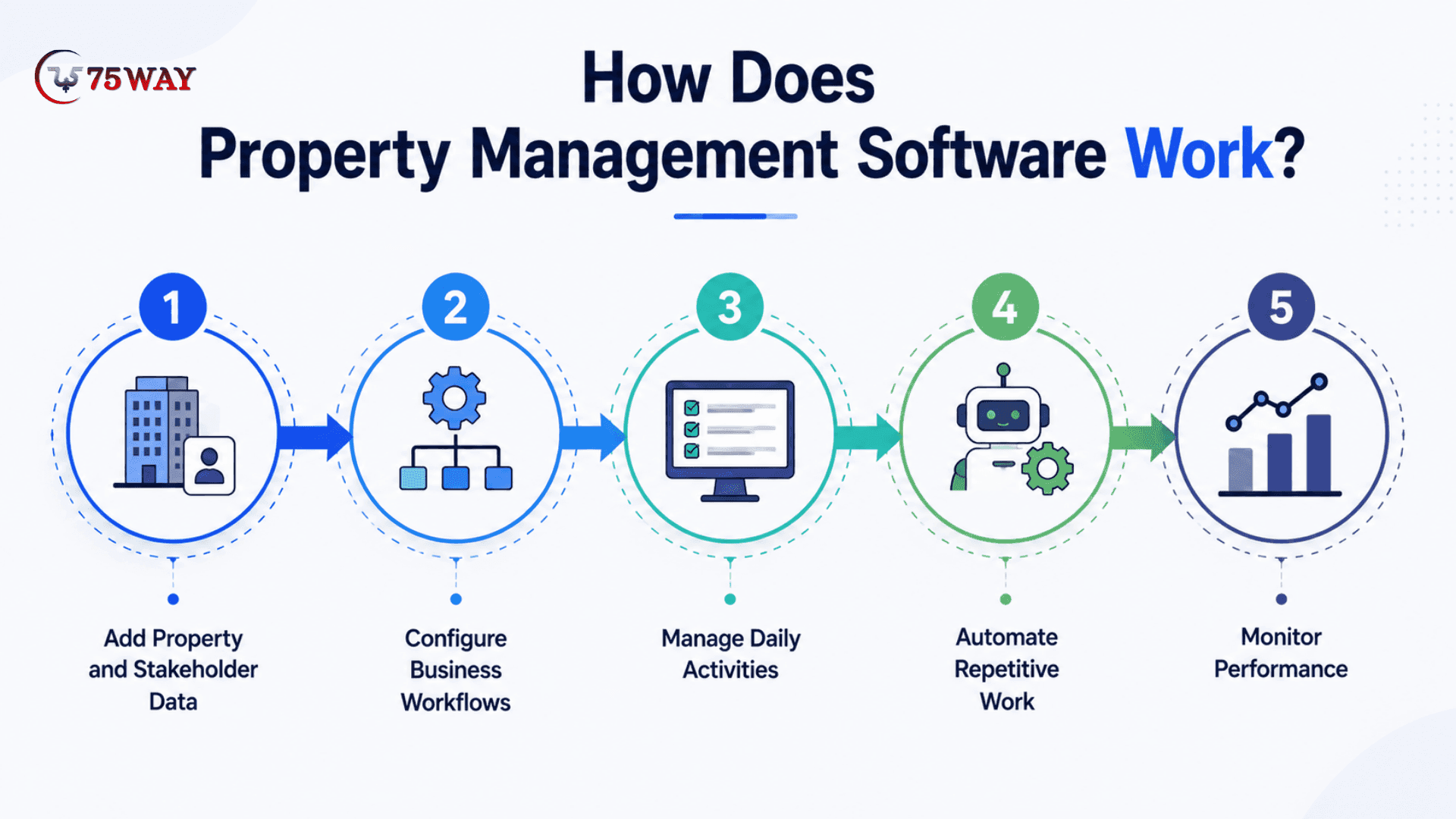
Step 1: Add Property and Stakeholder Data
The business creates property records and adds relevant owners, tenants, leases, contractors, documents, and financial information.
Step 2: Configure Business Workflows
The platform is configured around the company's operating processes, including notifications, approvals, inspections, maintenance, payments, and reporting.
Step 3: Manage Daily Activities
Property managers use the platform to manage routine activities such as tenant communication, rent tracking, inspections, maintenance, lease administration, and owner updates.
Step 4: Automate Repetitive Work
Rules and triggers can automate recurring actions such as reminders, notifications, task creation, and scheduled communications.
Step 5: Monitor Performance
Dashboards and reports provide visibility into property activity, financial information, arrears, vacancies, maintenance, and other operational indicators.
The exact workflow should be designed around the business rather than forcing the business to change every process simply because the software works that way.
Why Is Property Management Software Important for Australian Businesses?
Property management software gives Australian businesses a central system for managing properties, tenants, owners, finances, and daily workflows. By bringing these activities together, it can reduce fragmented processes, improve visibility, and give teams better control as their portfolios grow.
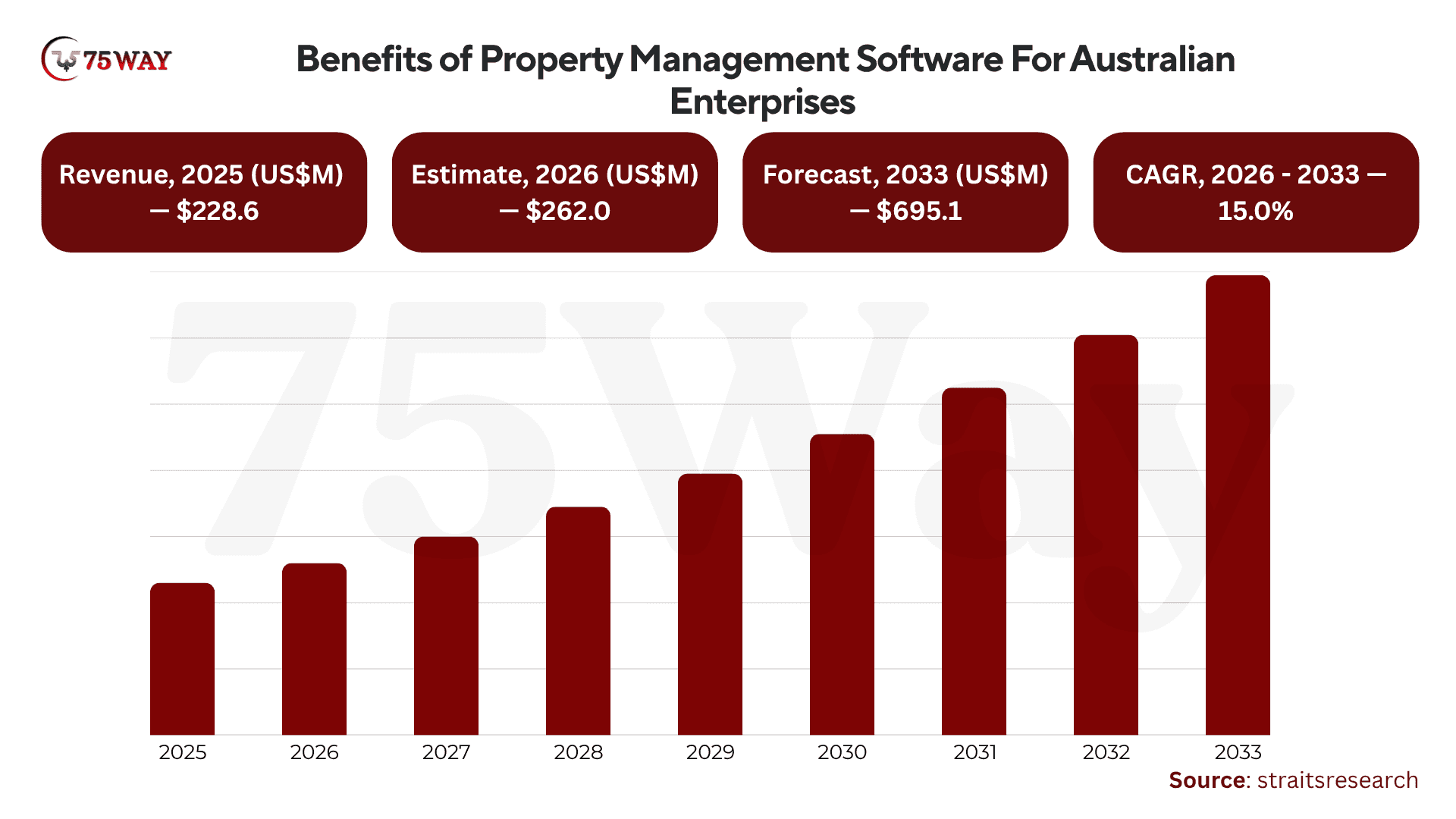
Even so, Australia’s real estate software market generated $228.6 million in 2025 and is projected to reach $695.1 million by 2033. The market is expected to expand at a 15% CAGR from 2026 to 2033.
1. Centralises Property Operations
A central platform brings property records, leases, tenant information, documents, inspections, maintenance requests, and communication into one accessible system. This reduces dependence on spreadsheets, emails, and disconnected tools while giving teams a clearer view of portfolio activity.
2. Simplifies Tenant Management
Property managers can manage applications, tenant records, lease information, requests, communications, and important updates from a single workflow. A more organised tenant-management process can also help teams respond faster without repeatedly searching across different systems.
3. Improves Maintenance Coordination
Maintenance often involves property managers, tenants, owners, and external contractors. Software can organise maintenance requests, assign tasks, track progress, store relevant records, and provide status visibility, helping businesses manage issues without relying on scattered messages or manual follow-ups.
4. Supports Financial Management
Property management platforms can connect rent tracking, payments, invoices, expenses, owner statements, and financial reporting within the broader property workflow. This gives businesses better visibility into financial activity and reduces repetitive administrative work.
5. Adapts to Local Requirements
Australian property management requirements can differ between states and territories. Software should therefore support configurable workflows, records, notifications, documents, and processes that align with the jurisdictions in which a business operates rather than assuming one process fits every portfolio.
6. Creates a Foundation for Growth
As portfolios expand, manual processes can become harder to control and increasingly dependent on individual employees. A scalable software platform creates structured workflows, shared data, automation opportunities, and reporting capabilities that can support growth without simply adding more administrative workload.
7. Prioritises Process Simplification
Property Council Australia’s 2026 APAC PropTech report found that 52% of respondents identified streamlining business processes as their first priority for information management, ahead of data quality and revenue growth. This reinforces why Australian property businesses can benefit from software that simplifies core workflows before adding more advanced technology.
What Features Should Property Management Software Have in Australia?
The right feature set depends on the business model, portfolio size, property type, and operational complexity. However, several capabilities are becoming fundamental for Australian property businesses.
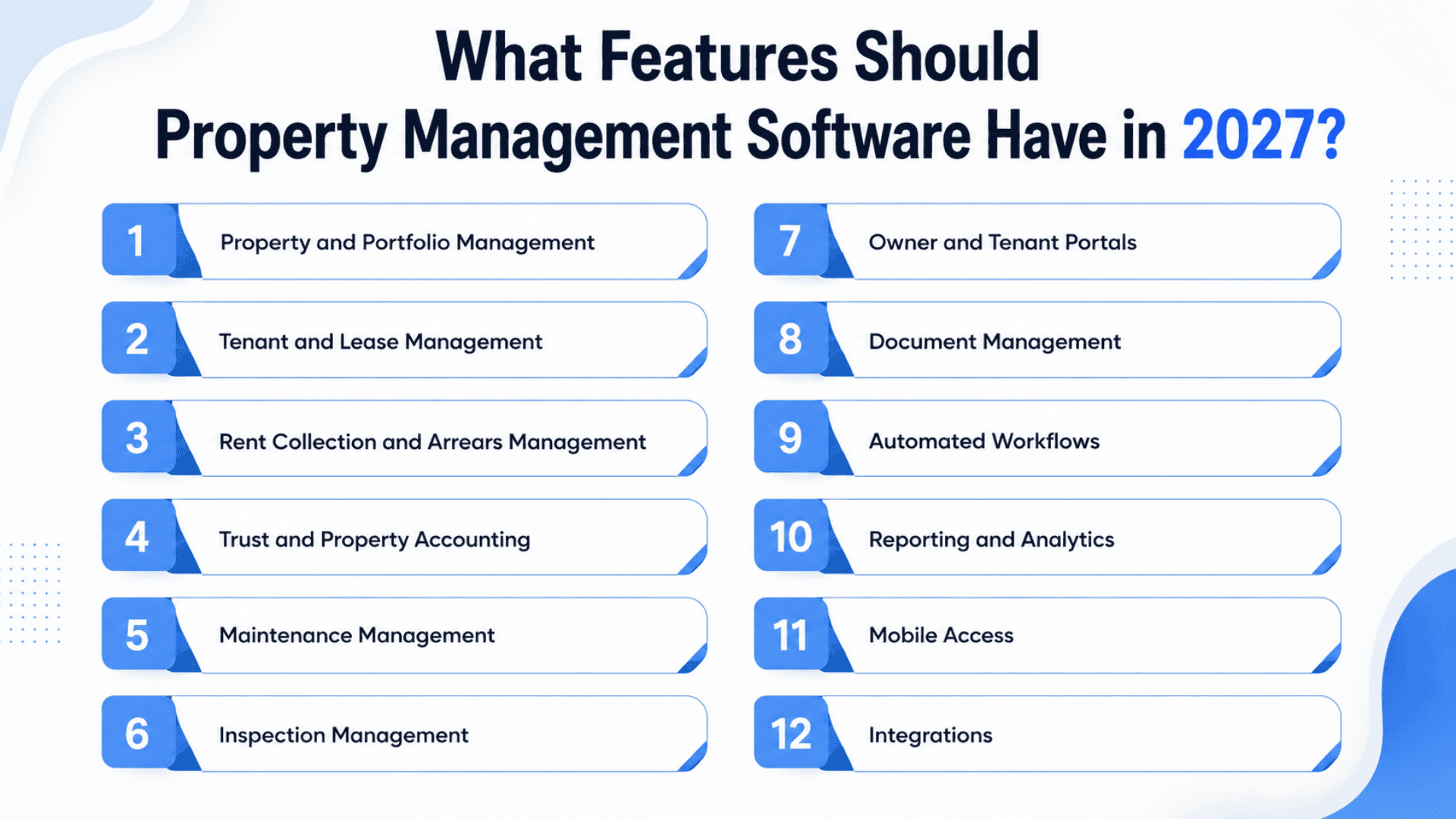
1. Property and Portfolio Management
The platform should provide a central view of properties, units, leases, owners, tenants, financial information, documents, tasks, and activity.
Useful capabilities include:
- Property profiles
- Portfolio dashboards
- Unit and occupancy information
- Lease records
- Property history
- Document storage
- Task management
- Activity logs
- Search and filtering
- Portfolio-level reporting
A strong portfolio module should help a manager understand the current status of a property without opening multiple systems.
2. Tenant and Lease Management
Tenant management should cover the complete tenancy lifecycle rather than simply storing contact information.
Depending on the platform, this may include applications, tenant records, lease creation, lease dates, renewals, rent changes, correspondence, inspections, maintenance requests, and tenancy documents.
Lease management becomes particularly valuable when a business manages hundreds or thousands of agreements because important dates can otherwise become difficult to monitor manually.
3. Rent Collection and Arrears Management
Rent management is one of the core workflows of property management software.
A platform may provide:
- Rent schedules
- Payment tracking
- Rental ledgers
- Payment reconciliation
- Arrears monitoring
- Automated reminders
- Receipts
- Payment histories
- Owner disbursement workflows
Some Australian platforms now combine payment processing with property management workflows, giving managers real-time visibility into rental activity.
4. Trust and Property Accounting
Accounting requirements can become significantly more complex when an agency manages money on behalf of owners.
Depending on the business and jurisdiction, relevant capabilities may include:
- Trust accounting
- Owner statements
- Rent receipts
- Expense management
- Invoices
- Reconciliation
- Payment records
- Audit trails
- Financial reporting
Businesses should verify that a platform supports the accounting and record-keeping processes applicable to their operations rather than assuming every accounting module meets the same requirements.
5. Maintenance Management
A maintenance module should turn an issue into a trackable workflow.
For example:
Tenant request → Property manager review → Owner approval → Contractor assignment → Work completion → Invoice → Record update
Useful functionality can include photo uploads, job assignment, contractor communication, cost tracking, status updates, invoices, and maintenance history.
This is especially valuable because maintenance information can otherwise become fragmented across phone calls, emails, messaging applications, and spreadsheets.
6. Inspection Management
Property inspections generate significant operational information.
Software can help teams schedule inspections, capture photos, record observations, prepare reports, store documents, and maintain a history for each property.
Digital inspection functionality is already common among Australian property platforms, with some supporting photographs, comments, signatures, document storage, and mobile workflows.
7. Owner and Tenant Portals
Portals give stakeholders controlled access to relevant information without requiring property managers to manually answer every routine question.
A tenant portal may provide access to:
- Rent information
- Maintenance requests
- Inspection details
- Documents
- Messages
- Property information
An owner portal may provide:
- Property performance
- Statements
- Maintenance updates
- Documents
- Financial information
- Communication history
The objective is not to remove human interaction. It is to make routine information easier to access.
8. Document Management
Property management creates a large volume of documents.
A platform should make it possible to securely store and retrieve leases, inspection reports, invoices, correspondence, statements, compliance records, and other property-related documents.
Searchability matters as much as storage. A folder that simply replaces a physical filing cabinet does not necessarily solve the underlying retrieval problem.
9. Automated Workflows
Automation is one of the biggest opportunities for reducing repetitive administration.
Examples include:
- Lease renewal reminders
- Inspection notifications
- Arrears reminders
- Maintenance updates
- Scheduled communications
- Recurring tasks
- Compliance reminders
- Owner notifications
- Document generation
The best automation is not about automating everything. It is about identifying repetitive, rules-based activities where automation can reduce manual handling while keeping people involved in decisions that require judgement.
10. Reporting and Analytics
Decision-makers need more than a list of properties.
Useful reporting can cover:
- Occupancy
- Vacancy
- Arrears
- Rental income
- Expenses
- Maintenance
- Portfolio performance
- Property-level activity
- Team workloads
- Lease renewals
- Financial performance
Dashboards should turn operational data into information that helps managers identify problems and make decisions.
11. Mobile Access
Property managers are not always working at a desk.
Mobile access can allow teams to review property information, communicate with stakeholders, complete inspections, update tasks, capture photographs, and respond to maintenance issues while working in the field.
12. Integrations
Property management software rarely operates in isolation.
Potential integrations include:
- Accounting platforms
- Payment gateways
- CRM systems
- Listing platforms
- Communication tools
- Identity or tenant screening services
- Document and e-signature platforms
- Maintenance and contractor systems
- Business intelligence tools
Integration capability becomes increasingly important as businesses scale because replacing one disconnected application with another does not solve data fragmentation.]
Real-World Benefits of AI-Powered Property Management Software For Australian Enterprises
AI-powered property management software can change how Australian enterprises handle large and complex property portfolios. From reducing administrative workload to spotting issues sooner, its value becomes visible across everyday operations. The real-world benefits of AI-powered software for Australian enterprises are explained below.
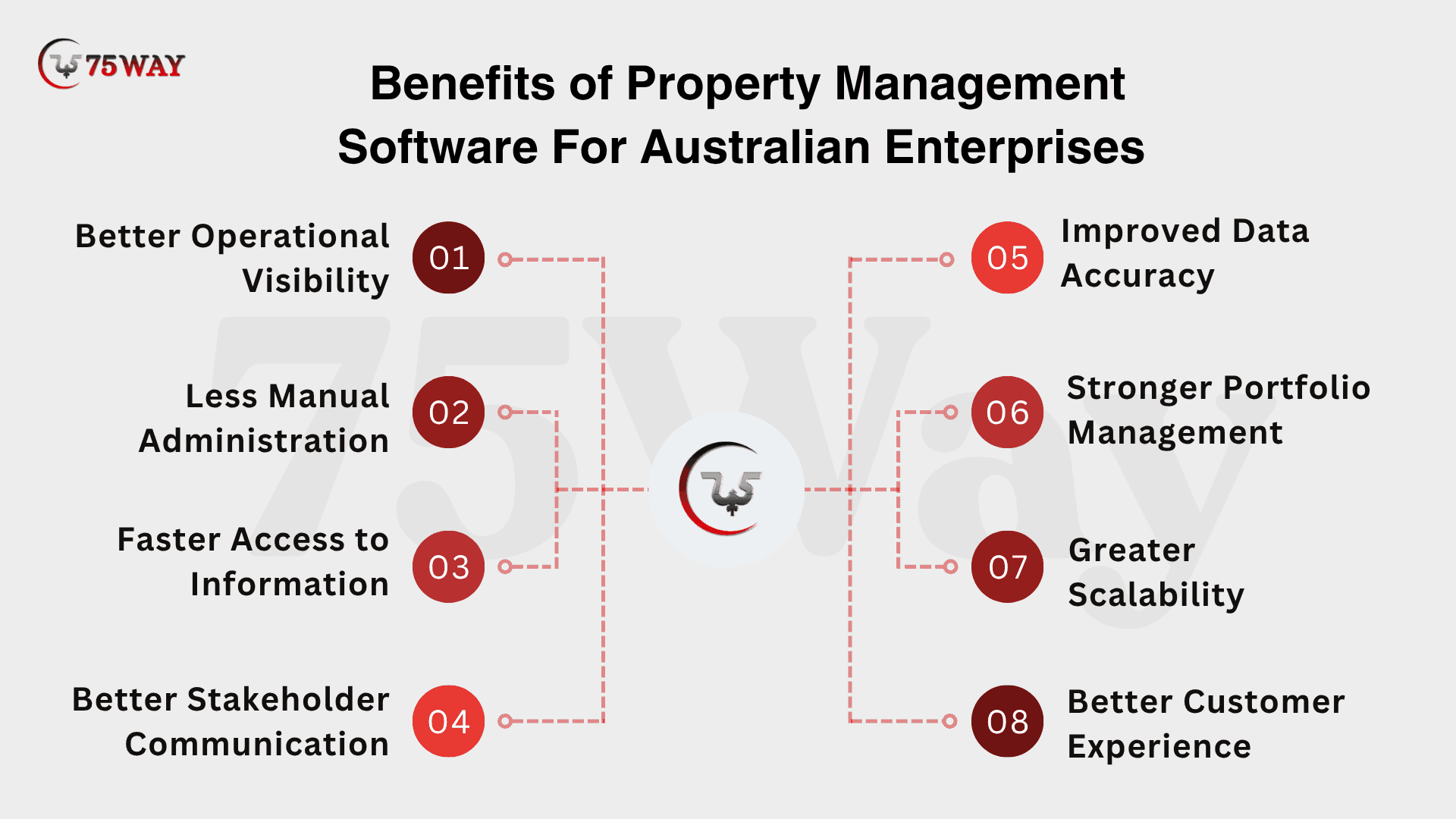
- Better Operational Visibility
Managers can see properties, tasks, arrears, maintenance, inspections, leases, and communications from a connected system. This makes it easier to identify outstanding work and portfolio-level issues.
- Less Manual Administration
Automated reminders, workflows, payments, reporting, and document processes can reduce repetitive data entry and follow-up.
- Faster Access to Information
A central database means employees do not have to repeatedly search emails, spreadsheets, folders, and different applications for the same property information.
- Better Stakeholder Communication
Owners and tenants can receive relevant updates through structured channels rather than relying entirely on individual property managers to relay every update manually.
- Improved Data Accuracy
Centralised records can reduce duplicate data entry and inconsistencies created when teams maintain the same information across several systems.
- Stronger Portfolio Management
Managers can evaluate multiple properties through dashboards and reports rather than reviewing each property independently.
- Greater Scalability
A structured software environment can help businesses manage additional properties and transactions without relying solely on proportional increases in administrative effort.
- Better Customer Experience
Tenants and owners increasingly expect quick access to information, digital communication, online payments, and transparent updates. Software can support these expectations when the underlying processes are designed properly.
Property Management Software Use Cases Across Business Operations
Property management software becomes most valuable when it solves a specific operational problem for the business. Different property teams can use the same platform in very different ways, depending on their portfolio and daily responsibilities. The practical use cases are covered below.
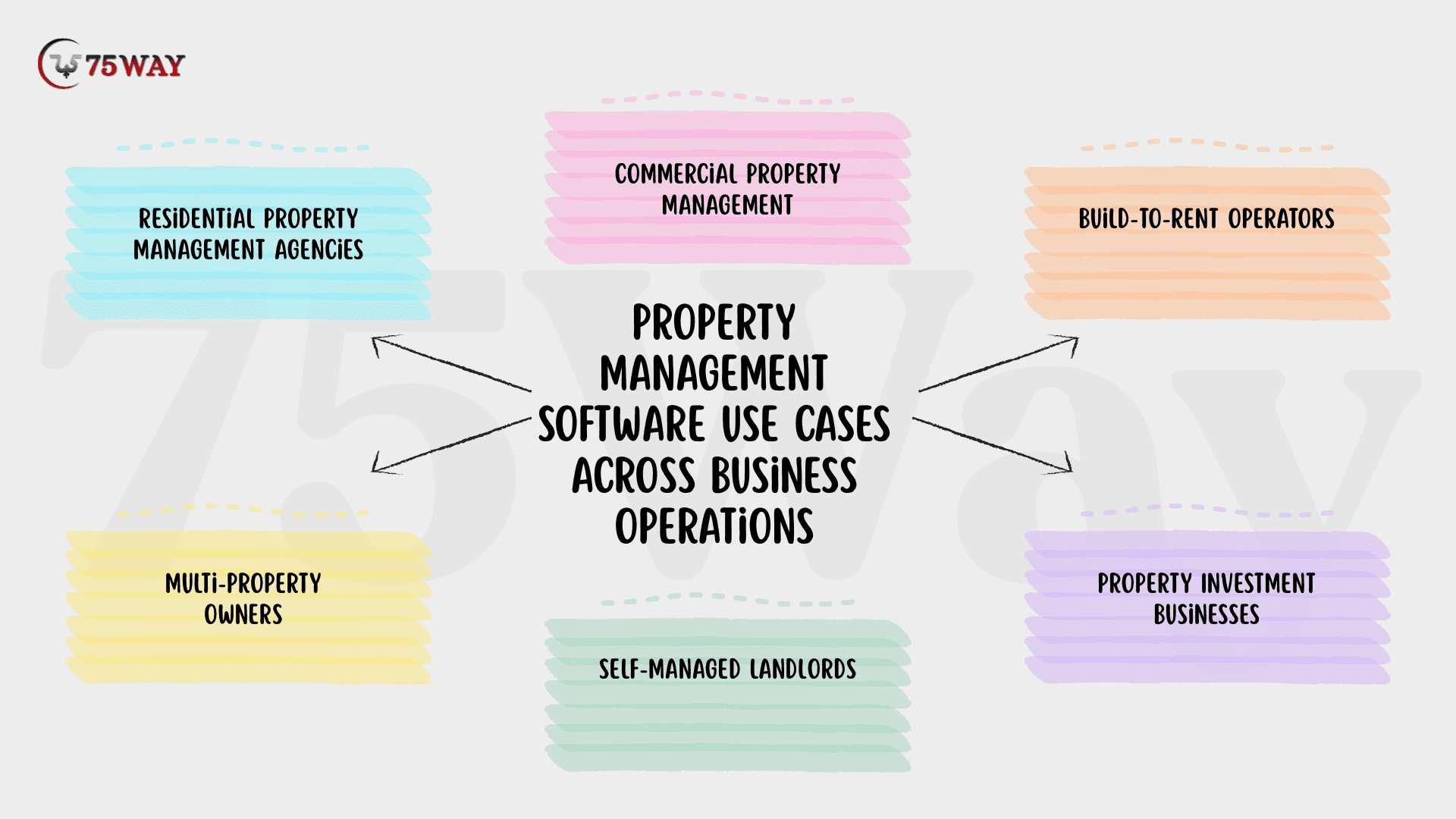
- Residential Property Management Agencies
Residential agencies can use software to manage rent rolls, tenants, owners, inspections, maintenance, leases, arrears, payments, and reporting from one platform.
For agencies, workflow standardisation can be particularly valuable because multiple property managers may need to follow similar processes across a large portfolio.
- Commercial Property Management
Commercial property management may require additional capabilities around leases, outgoings, tenant obligations, financial reporting, and property-specific workflows.
Businesses managing commercial assets should assess whether a platform supports their lease structures and financial requirements rather than assuming a residential platform can simply be adapted.
- Build-to-Rent Operators
Build-to-rent businesses manage properties at portfolio scale and may require strong tenant lifecycle management, digital communication, maintenance workflows, payments, reporting, and integrations.
The software needs to support the operating model rather than treating every property as an isolated record.
- Property Investment Businesses
Investors managing multiple properties can use software to track rental income, expenses, leases, maintenance, documents, and portfolio performance.
The emphasis may be more heavily weighted toward financial visibility and portfolio reporting than the workflow requirements of a large property agency.
- Self-Managed Landlords
Individual landlords generally need a simpler feature set than professional agencies.
Common requirements include rent tracking, tenant communication, document storage, maintenance management, inspection scheduling, and financial reporting.
Australian software offerings increasingly distinguish between self-managed landlords and professional agencies because the workflows and complexity are different.
- Multi-Property Owners
Owners with larger portfolios can use software to bring multiple properties into one environment, monitor performance, track expenses, manage maintenance, and organise tenancy information.
How Can Artificial Intelligence (AI) Improve Property Management Software in 2027?
Property management software already brings daily operations into one place, but AI can make those workflows far more intelligent. From spotting maintenance issues early to helping teams make better portfolio decisions, the possibilities extend well beyond automation. The key ways AI can improve these platforms in 2027 are covered below.
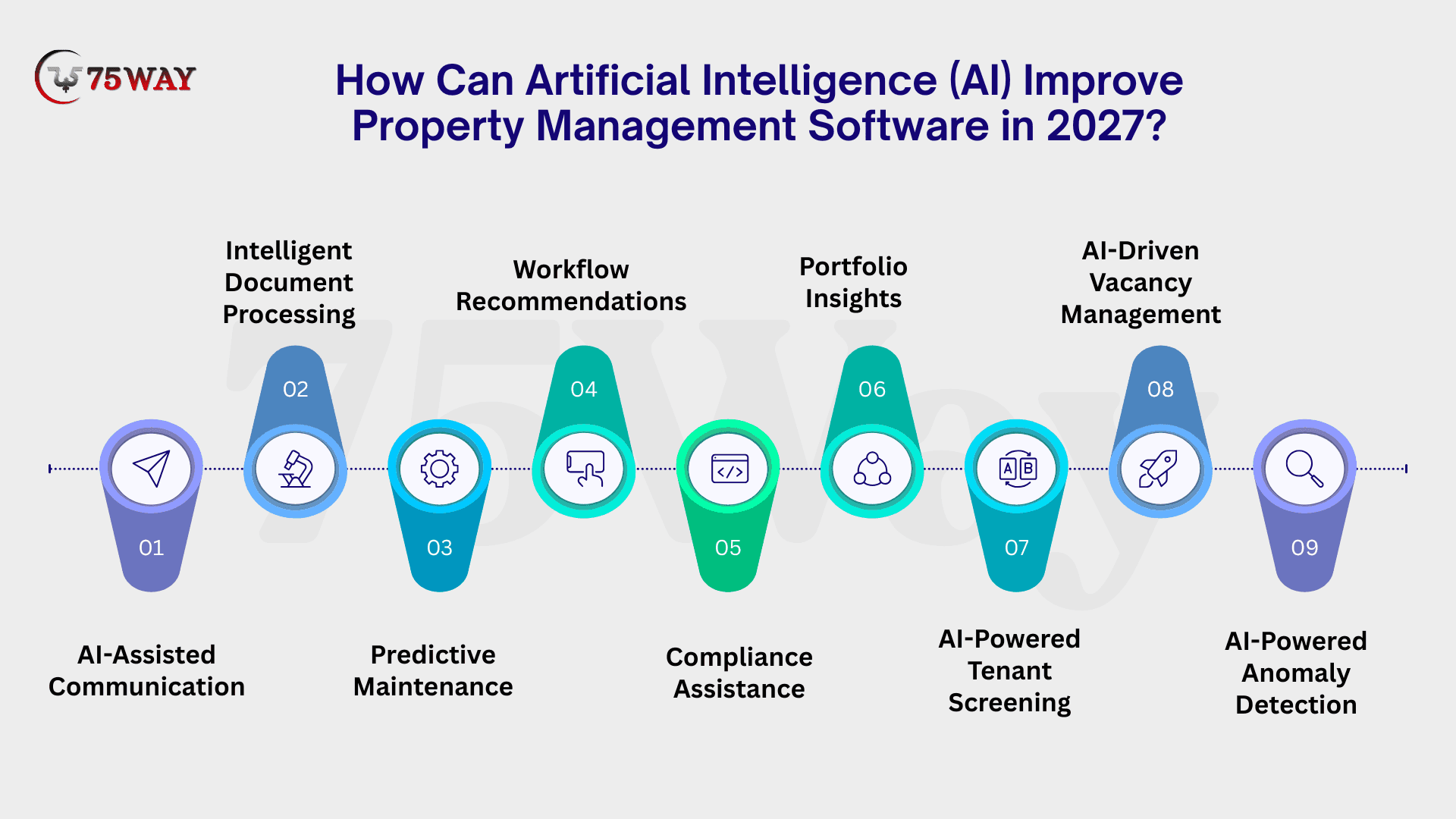
- AI-Assisted Communication
Routine communication can consume a surprising amount of a property manager’s day. AI can help draft responses to tenants, owners, contractors, and other stakeholders based on the relevant context, allowing staff to review, adjust, and approve messages before they are sent.
This can be particularly useful for repetitive enquiries, maintenance updates, inspection reminders, payment follow-ups, and general property communications.
- Intelligent Document Processing
A lease, invoice, inspection report, or contractor document can contain information that teams would otherwise need to enter manually. AI can extract relevant details from these documents and help organise them within the appropriate property or tenancy record.
That reduces repetitive data entry and makes large volumes of property documentation easier to manage.
- Predictive Maintenance
Maintenance history can reveal patterns that are difficult to spot when information is spread across spreadsheets, emails, and individual records. By analysing historical maintenance data, AI can identify recurring issues, unusual patterns, or properties that may require closer attention.
For example, repeated repairs involving the same asset could prompt a property manager to investigate the underlying problem rather than repeatedly handling individual maintenance requests.
- Workflow Recommendations
Property management involves many recurring actions, from following up on applications to scheduling inspections and responding to maintenance requests. AI can analyse workflow patterns and suggest the next action based on current information and previous activity.
Instead of replacing the property manager, this approach can act as an intelligent assistant that helps teams decide what deserves attention next.
- Compliance Assistance
Australian property management requires businesses to work within applicable state and territory requirements. AI can help users locate relevant information, organise compliance-related records, and highlight potentially important requirements within a workflow.
However, AI should support—not replace—professional judgement. Businesses remain responsible for verifying information and meeting the legislation applicable to their operations.
- Portfolio Insights
Large property portfolios generate substantial amounts of operational and financial data. AI-powered analytics can help turn that information into useful patterns across vacancies, maintenance costs, rental performance, arrears, expenses, and other portfolio indicators.
Rather than requiring managers to manually compare multiple reports, intelligent insights can help highlight areas that may deserve further investigation.
- AI-Powered Tenant Screening
Applicant information can be difficult to organise when property businesses handle a high volume of applications. AI can help structure application data, identify missing information, and compare applications against predefined business criteria.
The final assessment should remain with authorised staff and must follow applicable Australian tenancy, privacy, and anti-discrimination requirements.
- AI-Driven Vacancy Management
A vacant property represents lost rental income, so identifying potential vacancy risks early can be valuable. AI can examine historical vacancy patterns, enquiry activity, property characteristics, and leasing data to identify situations that may require attention.
Property managers can then use these insights to review listings, follow up with prospects, assess leasing strategies, or investigate why a property is taking longer to lease.
- AI-Powered Anomaly Detection
Not every unusual event is a problem, but unusual patterns deserve attention. AI can monitor property and financial information to flag activity that differs significantly from historical patterns, such as unexpected maintenance costs, payment irregularities, sudden vacancy changes, or unusual expenses.
These alerts can give property teams an earlier opportunity to investigate potential issues instead of discovering them after they have affected the wider portfolio.
The value of AI in property management will ultimately depend less on how many AI features a platform advertises and more on where those capabilities solve genuine operational problems.
For Australian businesses, the strongest platforms will combine automation with human oversight, reliable data, privacy controls, transparent workflows, and configurable processes. AI should make property teams more informed and productive—not make important decisions without appropriate review.
What Integrations Should Property Management Software Support?
A property management platform becomes more valuable when it can exchange information with the other systems a business already uses.
Common integration categories include:
- Accounting: Connect financial information, expenses, invoices, reconciliation, and reporting.
- Payments: Support rental payments and other relevant transactions through connected payment services.
- CRM: Connect property management activity with customer, owner, and prospect information.
- Communication: Integrate email, SMS, messaging, and notification workflows.
- Listing Platforms: Connect property and listing information where appropriate.
- Maintenance Platforms: Share maintenance requests, contractor information, job status, and costs.
- Document Services: Connect e-signatures and document workflows.
- Analytics: Send operational information to business intelligence and reporting systems.
Before selecting a platform, businesses should examine whether integrations are native, API-based, partner-supported, or dependent on third-party middleware. “Integration available” does not always mean “integration works seamlessly.”
How Much Does Property Management Software Cost in Australia?
There is no single price for property management software because pricing depends on the product, number of properties, users, modules, integrations, implementation requirements, and whether the business chooses an off-the-shelf or custom platform.
A basic solution for a self-managed landlord may cost considerably less than an enterprise platform for a large property agency.
Costs may include:
- Subscription fees
- Per-property charges
- Per-user charges
- Setup or implementation fees
- Data migration
- Customisation
- Integration development
- Training
- Support
- Maintenance
- Premium modules
For a business evaluating software, the cheapest subscription is not necessarily the lowest-cost option.
A platform that requires extensive manual work, duplicate data entry, additional third-party applications, or expensive workarounds can have a higher total cost of ownership.
A better approach is to calculate the total cost of ownership against the operational value the platform is expected to provide.
Off-The-Shelf Vs Custom Property Management Software: Key Differences
This is one of the most important decisions for a growing property business. Off-the-shelf software offers a ready-to-use starting point, while custom property management software is built around the way your business actually operates. The better option depends on how much flexibility, control, and scalability your property portfolio requires.
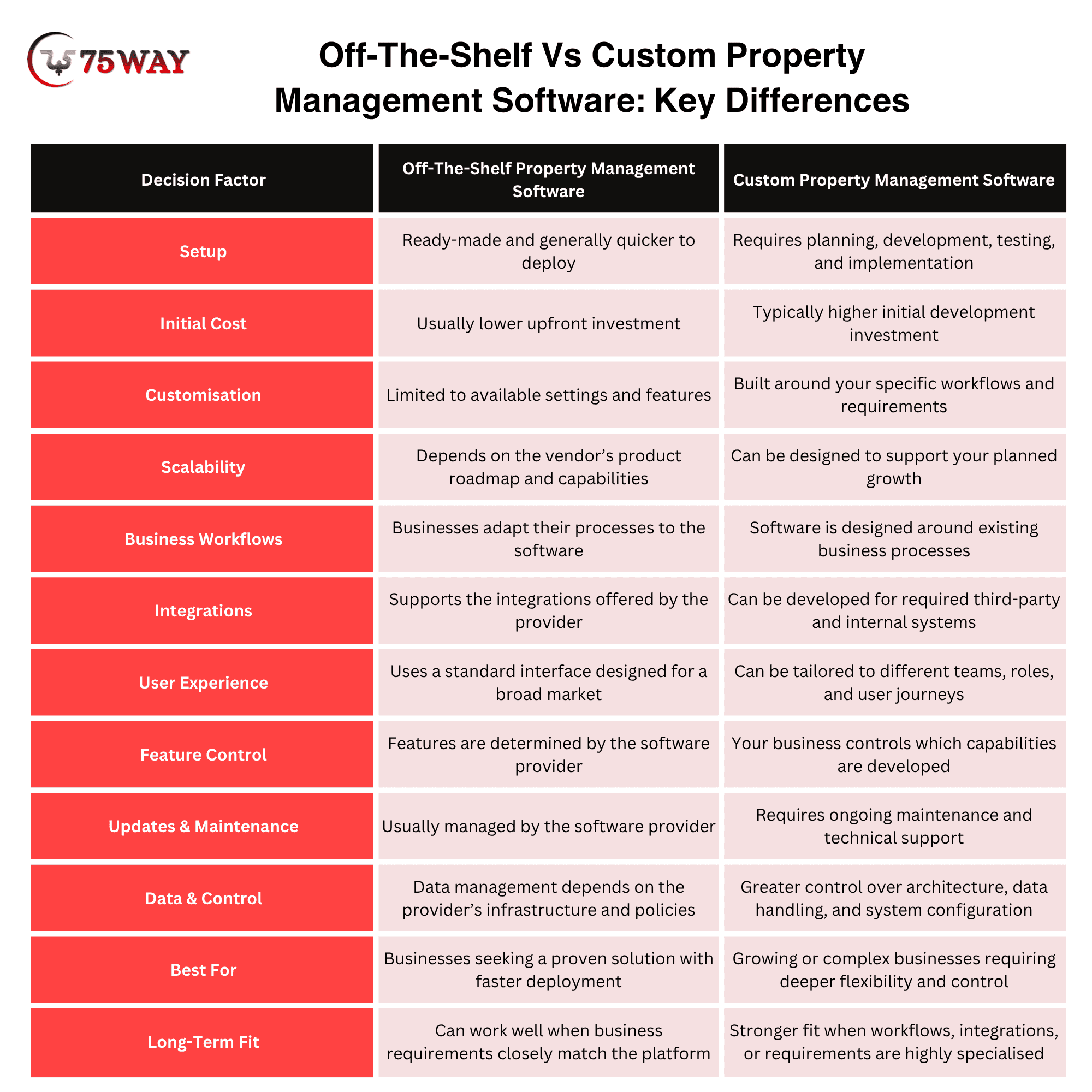
Off-the-Shelf Software
Off-the-shelf platforms can be suitable when the business follows relatively standard workflows and does not require extensive differentiation.
Advantages include:
- Faster implementation
- Established functionality
- Predictable subscription model
- Existing integrations
- Vendor support
- Regular product updates
Potential limitations include:
- Limited customisation
- Vendor-defined workflows
- Feature restrictions
- Integration constraints
- Dependence on the provider's roadmap
Custom Property Management Software
Custom development can make more sense when a business has complex workflows, proprietary processes, unusual integrations, multiple business models, or a need to create a differentiated platform.
A custom system can be designed around the company's actual operating model rather than asking employees to work around software limitations.
However, custom development also requires greater planning and investment across discovery, design, development, testing, infrastructure, security, maintenance, and future upgrades.
The right question is therefore not “Is custom software better?”
It is:
“Does our operational complexity justify owning a platform built around our business?”
What Should Australian Businesses Consider Before Choosing Property Management System?
A property management system may look impressive during a demo and still fall short once your team starts using it every day. Australian businesses need to look beyond the feature list and understand how the system will fit their actual operations. The important considerations before choosing a system are covered below.
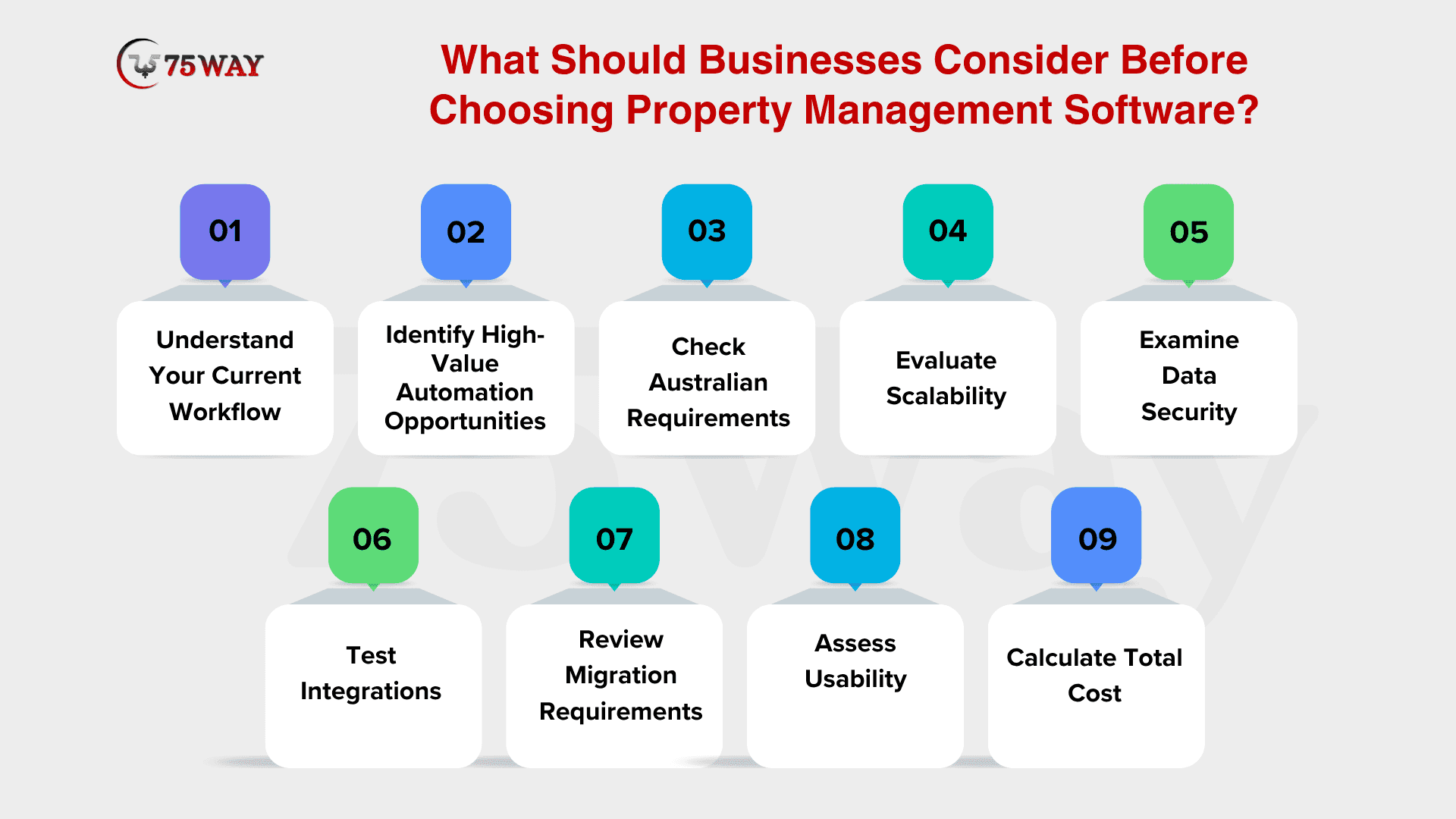
- Understand Your Current Workflow
Map how properties, tenants, owners, payments, maintenance, inspections, documents, and communications currently move through the business.
This reveals where the real bottlenecks are.
- Identify High-Value Automation Opportunities
Do not automate a process simply because automation is available. Identify repetitive activities that consume meaningful staff time or create avoidable errors.
- Check Australian Requirements
Confirm that the platform supports the relevant processes for the states and territories in which the business operates.
- Evaluate Scalability
Ask what happens when the portfolio doubles.
Will the platform continue to support additional properties, users, transactions, documents, integrations, and reporting requirements?
- Examine Data Security
Ask where data is stored, how access is controlled, how backups are managed, what security practices are followed, and how the provider handles incidents.
- Test Integrations
Do not rely only on an integration list. Request demonstrations or technical documentation for the integrations that matter to your business.
- Review Migration Requirements
Moving from spreadsheets or another platform can involve substantial data-cleaning and migration work. Understand what information can be migrated and what will need manual preparation.
- Assess Usability
A platform can have dozens of features and still fail if employees find it difficult to use.
Ask whether the people who will use the system every day can complete their core workflows without unnecessary complexity.
- Calculate Total Cost
Consider subscriptions, implementation, migration, integrations, support, training, customisation, and future costs rather than looking only at the advertised monthly price.
When Should an Australian Business Build Custom Property Management Software?
Custom development may be worth considering when existing platforms cannot adequately support the business's operating model.
Typical indicators include:
- Complex property workflows
- Large or rapidly growing portfolios
- Multiple property types
- Proprietary business processes
- Complex approval structures
- Multiple external integrations
- Specialised reporting requirements
- Need for a branded owner or tenant experience
- Strong automation requirements
- Need for complete control over product functionality
- Plans to commercialise the platform as a software product
For example, a property business may begin with an off-the-shelf platform but later find that its workflows, reporting, integrations, or customer experience have become too specialised for a standard product.
At that point, custom property management software development can provide a path toward a platform designed around the company's specific requirements.
What Will Property Management Software Look Like in 2027?
The next stage of property management software is likely to focus less on adding isolated features and more on connecting workflows.
The direction is already visible in Australian property technology: industry research highlights process simplification as a major technology priority, while commercial platforms are introducing automation and AI into everyday property workflows.
Several developments are likely to shape the next generation of platforms:
- More Embedded AI: AI will increasingly appear inside communication, document, compliance, reporting, and workflow functions instead of operating as a separate tool.
- Greater Workflow Automation: Platforms will increasingly connect triggers, approvals, notifications, payments, tasks, and records.
- More Connected Data: Businesses will expect property, financial, customer, maintenance, and operational data to move between systems with less manual intervention.
- Improved Mobile Experiences: Field teams will increasingly expect to complete inspections, maintenance updates, communication, and documentation from mobile devices.
- Better Decision Support: Dashboards will evolve from displaying information to helping managers identify risks, exceptions, trends, and opportunities.
- Stronger Personalisation: Different users will receive interfaces and workflows suited to their roles, whether they are property managers, owners, tenants, contractors, or business leaders.
The competitive advantage will not necessarily belong to the platform with the most features. It will belong to the platform that connects the right workflows with the least unnecessary friction.
Why Choose 75way As Reliable Property Management Software Development Agency in Australia?
Building property management software requires more than developing screens and adding standard modules.
The platform needs to reflect how your business actually manages properties, tenants, owners, payments, maintenance, inspections, documents, reporting, integrations, and automation.
75way Technologies can help businesses move from an operational requirement to a structured software solution by considering the complete product lifecycle.
Our approach can cover:
- Business and workflow analysis
- Product discovery
- UX/UI design
- Property management software development
- Web application development
- Mobile application development
- API development
- Third-party integrations
- Automation
- AI-enabled functionality
- Database architecture
- Cloud deployment
- Testing and quality assurance
- Maintenance and ongoing improvements
The objective is not to build a platform simply because custom software is possible. It is to determine where technology can solve genuine operational problems and create a scalable foundation for the business.
Build a Property Management Platform Around Your Business
Your property management software should fit the way your business operates, not force your team into workflows that create unnecessary administration.
Whether you are replacing disconnected tools, modernising an existing platform, or building a new property technology product, the first step is understanding your workflows, users, integrations, and long-term objectives.
Ready to discuss your property management software idea? Talk to our experts about building a platform designed around your business requirements.
Final Remarks
Property management software is becoming an important foundation for Australian businesses managing growing portfolios, complex workflows, and rising customer expectations. The right platform can connect property records, tenant interactions, financial processes, maintenance, reporting, automation, and integrations within one organised environment.
However, choosing software should go beyond comparing feature lists or subscription prices. For organisations with specialised requirements, custom development can provide greater control and flexibility while supporting future growth. To build property management software around your business, you can connect with a trusted real estate software development company to turn your requirements into a scalable digital platform.
Frequently Asked Questions (FAQs)
Can Property Management Software Work With An Existing Database?
Yes, many platforms support importing existing property, tenant, lease, and financial records during implementation. Migration requirements depend on data quality, structure, volume, and the software's supported import options.
How Long Does Property Management Software Implementation Take?
Implementation timelines vary according to portfolio size, integrations, customisation, data migration, and training requirements. Simple deployments may take weeks, while complex enterprise implementations can require several months.
What Data Should Businesses Prepare Before Implementation?
Businesses should organise property records, tenant details, leases, financial information, documents, user accounts, and historical records before migration. Clean, structured data can significantly simplify implementation and reduce migration problems.
How Can Businesses Encourage Employees To Adopt New Software?
Successful adoption usually requires practical training, clear workflows, user involvement, and ongoing support after launch. Employees are more likely to embrace software when it clearly addresses their everyday operational challenges.
Can Property Management Software Be Customised After Deployment?
Many platforms offer configuration or custom development options for workflows, permissions, dashboards, integrations, and business-specific requirements. Businesses should confirm customisation limits before committing to a platform.
Who Should Be Involved When Selecting Property Management Software?
Selection should involve property managers, finance teams, leadership, IT stakeholders, and representative users wherever possible. Their combined input helps identify operational requirements that one department may overlook.