AI Summary
Fuel delivery apps are changing how customers order and receive fuel when they need it. AI-driven fuel delivery apps also give businesses better control over deliveries, customers, and operations. This guide explores the key benefits, revenue opportunities, and growth potential behind fuel delivery platforms.
Key Takeaways
- Fuel delivery apps make ordering fuel faster, simpler, and more convenient.
- Businesses can expand reach without relying solely on stations.
- Automated workflows can reduce manual tasks and operational overhead.
- Digital platforms create additional revenue and customer retention opportunities.
- Real-time data helps businesses improve decisions, deliveries, and growth.
The first fuel order tells you that a customer needed your service once. The orders that follow tell you whether your business has built a habit worth keeping. A fuel delivery mobile app development solution can play an important role in that second part by making reordering, payments, delivery updates, and customer communication easier after the first purchase.
For fuel delivery businesses, this on-demand delivery app development solution creates a direct channel that can remain useful between orders rather than disappearing after a transaction. That opens possibilities for repeat purchases, personalized promotions, service reminders, and better understanding of customer demand.
The business value becomes clearer when these individual advantages are viewed together.
This guide explains how fuel delivery app development can support convenience while contributing to stronger retention and revenue growth.
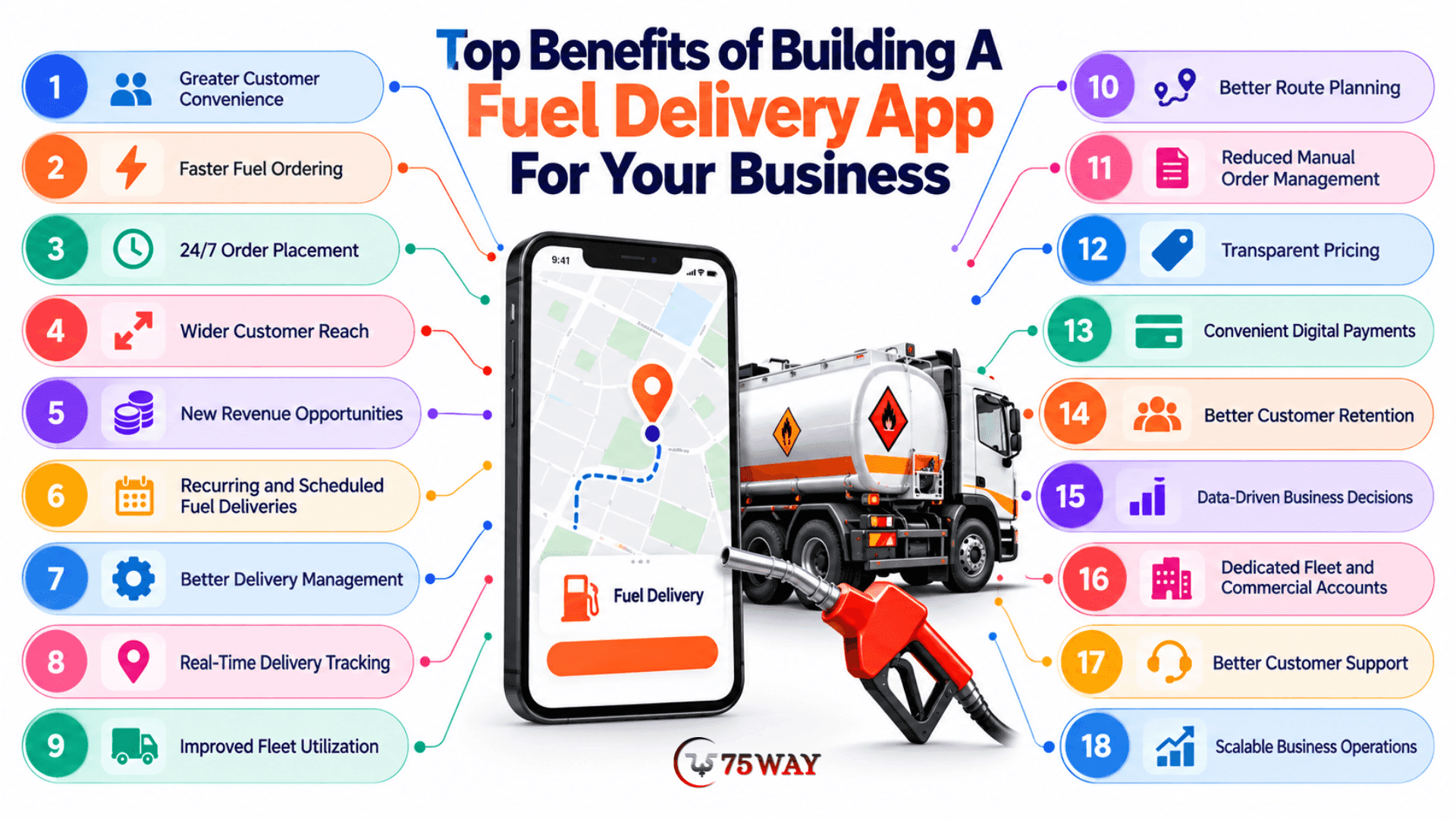
Top Benefits of Building A Fuel Delivery App For Your Business
A fuel delivery app can change where your next order comes from, how quickly it reaches the customer, and how often that customer returns. For business owners, that creates value across both the customer journey and daily operations. The biggest business benefits of building a fuel delivery app are explained below.
1. Greater Customer Convenience
Convenience is one of the clearest benefits of fuel delivery apps.
Customers can request fuel from a mobile device without making a separate trip to a gas station. Instead of interrupting work, travel, or daily activities, they can place an order for delivery to a specified location.
This can be especially valuable when customers are dealing with:
- Low fuel levels
- Equipment operating at remote locations
- Fleet refueling requirements
- Emergency fuel needs
- Generators and backup power systems
- Construction or agricultural equipment
The app turns fuel ordering into a service that can fit around the customer's schedule.
2. Faster Fuel Ordering
A digital ordering process removes several steps associated with traditional fuel purchasing.
Customers can save delivery locations, vehicle or equipment information, preferred fuel types, and payment details where appropriate. Returning customers can then place orders without entering the same information repeatedly.
This creates a shorter path from “I need fuel” to “My delivery is scheduled.”
For businesses, a structured digital order also means fewer details need to be collected manually over phone calls or messages.
3. 24/7 Order Placement
A physical location may have operating hours, but a digital ordering platform can allow customers to submit requests at any time.
The actual delivery schedule can still depend on driver availability, operating policies, location, fuel availability, and service hours. However, customers do not necessarily have to wait for a phone line or office to open before submitting an order.
This can be particularly useful for commercial customers with operations that continue outside conventional business hours.
4. Wider Customer Reach
A fuel delivery model allows businesses to serve customers beyond those who are willing or able to visit a particular station.
Depending on licensing, logistics, service areas, and local requirements, a business can expand its delivery coverage across multiple locations.
The app can make this expanded service area easier to manage by connecting customers with available delivery capacity.
For growing fuel businesses, this creates a path toward serving new neighborhoods, commercial customers, facilities, and geographic markets without requiring every customer to visit a physical station.
5. New Revenue Opportunities
One of the strongest business benefits of fuel delivery app development is the ability to create additional revenue channels.
Instead of relying only on fuel sales at physical locations, businesses can generate revenue through delivery-based services and digital customer relationships.
Potential models include:
- Delivery charges
- Service fees
- Convenience fees
- Subscription plans
- Recurring commercial orders
- Fleet contracts
- Business accounts
- Premium delivery options
- Partnerships
- Marketplace commissions
The appropriate model depends on whether the platform is operated by a fuel supplier, delivery company, marketplace, or another type of business.
6. Recurring and Scheduled Fuel Deliveries
Some customers need fuel regularly rather than occasionally.
Commercial fleets, generators, agricultural operations, construction companies, and other businesses may have predictable consumption patterns.
A fuel delivery platform can support scheduled or recurring orders based on the business model. Customers can arrange deliveries ahead of time instead of repeatedly placing individual requests.
For the fuel business, recurring orders can create more predictable demand and strengthen long-term customer relationships.
7. Better Delivery Management
A fuel delivery app can connect customer orders with dispatch and delivery workflows.
Instead of managing every request through separate calls, messages, or spreadsheets, the business can centralize order information and assign deliveries through a structured system.
Dispatch teams can view relevant order details, delivery locations, requested fuel types, timing requirements, and driver assignments from one platform.
This can reduce administrative friction as order volume grows.
8. Real-Time Delivery Tracking
Customers want to know when their fuel will arrive, particularly when the delivery is time-sensitive.
Real-time tracking can allow customers to view the delivery status and, where appropriate, the driver's location.
For businesses, tracking can provide better visibility into the delivery operation and help support teams answer customer questions without contacting drivers for every status update.
The feature becomes even more useful when combined with estimated arrival times and automated notifications.
9. Improved Fleet Utilization
Fuel delivery businesses need to manage vehicles, drivers, routes, schedules, and fuel loads.
A digital platform can provide operational visibility that helps teams understand how delivery resources are being used.
Depending on the platform's sophistication, managers may monitor:
- Active deliveries
- Driver assignments
- Vehicle status
- Delivery schedules
- Completed orders
- Service areas
- Route information
- Driver performance
This information can help businesses identify operational bottlenecks and make better fleet-management decisions.
10. Better Route Planning
Fuel delivery involves more than accepting an order. The business also needs to determine how and when that order will be fulfilled.
Route planning can help dispatch teams organize deliveries based on location, delivery windows, vehicle capacity, traffic conditions, and other operational constraints.
For businesses handling multiple deliveries, better route planning can reduce unnecessary travel and help drivers complete more suitable delivery sequences.
The exact optimization approach should depend on the size and complexity of the delivery network.
11. Reduced Manual Order Management
Phone-based ordering can become difficult to manage when order volume increases.
Staff may need to collect customer details, confirm fuel requirements, check availability, coordinate drivers, record payments, and provide status updates manually.
A digital fuel delivery platform can automate or centralize many of these activities.
That does not eliminate the need for human operations. Instead, it gives teams a structured system for managing work that would otherwise require multiple manual steps.
12. Transparent Pricing
Customers want to understand what they are paying before confirming an order.
A fuel delivery app can present fuel pricing, delivery charges, service fees, discounts, and the total amount before payment.
Clear pricing can reduce confusion and make the purchasing process more predictable.
For businesses, centralized pricing controls can also make it easier to manage different rates according to fuel type, location, customer category, delivery conditions, or other commercial requirements.
13. Convenient Digital Payments
Digital payments remove the need to depend entirely on cash or manual payment collection at delivery.
Depending on the market and business model, customers may be able to pay using supported cards, digital wallets, or other payment methods.
The application can also provide payment confirmations and digital receipts.
For businesses, digital transactions create a clearer record of sales and can simplify reconciliation when payment information is integrated properly with backend systems.
14. Better Customer Retention
Convenience can encourage customers to return, but retention depends on the entire service experience.
A fuel delivery app can support repeat business through saved preferences, order history, recurring deliveries, loyalty programs, personalized offers, and timely notifications.
Businesses can also use customer insights to understand ordering patterns and identify opportunities for relevant services.
The objective should be to make repeat ordering genuinely easier rather than overwhelming customers with promotional messages.
15. Data-Driven Business Decisions
Every digital order can generate useful operational and commercial information.
Businesses may analyze:
- Order frequency
- Popular fuel types
- Delivery locations
- Peak ordering periods
- Average order value
- Cancellation patterns
- Repeat purchases
- Delivery performance
- Customer segments
These insights can help businesses make more informed decisions about service areas, staffing, pricing, fleet capacity, promotions, and expansion.
Data becomes particularly valuable as the platform accumulates enough activity to reveal meaningful patterns.
16. Dedicated Fleet and Commercial Accounts
A consumer fuel delivery model is only one possible use case.
Businesses can build dedicated workflows for commercial customers that need fuel regularly. Fleet operators, construction businesses, agricultural companies, facilities managers, and other organizations may require multiple vehicles, locations, users, and billing arrangements.
A business account can support features such as:
- Multiple delivery locations
- Multiple authorized users
- Centralized billing
- Order approvals
- Purchase history
- Spending controls
- Recurring orders
- Account-level reporting
This can help fuel businesses move beyond individual transactions toward larger commercial relationships.
17. Better Customer Support
A digital platform can centralize customer communication around orders.
Customers can receive automated confirmations, delivery updates, payment receipts, and status notifications. If an issue occurs, support teams can access relevant order information rather than asking customers to repeat every detail.
This can make it easier to handle questions related to:
- Delivery status
- Order changes
- Payment issues
- Cancellations
- Refunds
- Incorrect delivery information
- Fuel requirements
The result is a more organized support experience for both customers and internal teams.
18. Scalable Business Operations
A manual fuel delivery process may work when order volume is low but become increasingly difficult to manage as the customer base grows.
A properly designed platform can provide a centralized infrastructure for customers, orders, drivers, payments, and administrative operations.
As the business expands, additional capabilities can be introduced without rebuilding the entire customer journey.
This makes scalability an important consideration from the beginning of fuel delivery app development.
Benefits of Developing Fuel Delivery Apps for Different Businesses
The same fuel delivery app can create different value for a retailer, fleet operator, fuel distributor, or commercial supplier. Each business has its own customers, order patterns, and delivery challenges to address. The benefits for different fuel businesses are covered below.
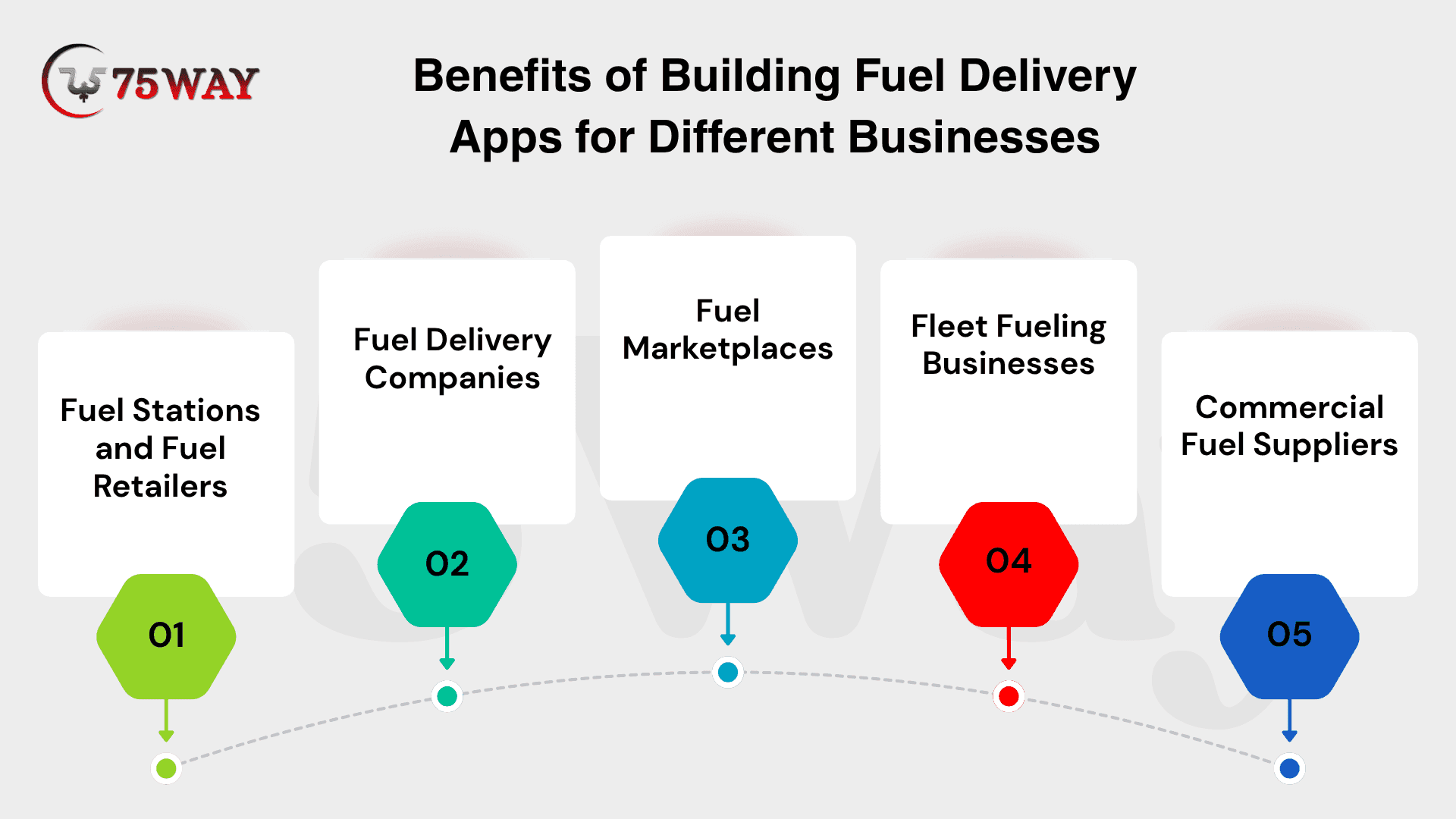
- Fuel Stations and Fuel Retailers
Existing fuel businesses can use delivery apps to create an additional sales channel and reach customers who prefer fuel delivery over station visits.
- Fuel Delivery Companies
Dedicated delivery businesses can use an app to manage customer orders, dispatch operations, drivers, payments, and service areas from a connected platform.
- Fuel Marketplaces
A marketplace can connect customers with multiple fuel suppliers or delivery providers while managing orders, payments, commissions, and provider relationships.
- Fleet Fueling Businesses
Fleet-focused platforms can help organizations arrange fuel delivery for multiple vehicles or operational locations.
- Commercial Fuel Suppliers
Businesses serving industrial, construction, agricultural, or other commercial customers can use digital ordering to support recurring deliveries and account-based relationships.
How Does AI-Powered Fuel Delivery App Solutions Increase Revenue?
Revenue growth does not come from the app itself. It comes from the business model and the additional customer and operational opportunities that the app enables. A fuel delivery platform can contribute to revenue by helping businesses:
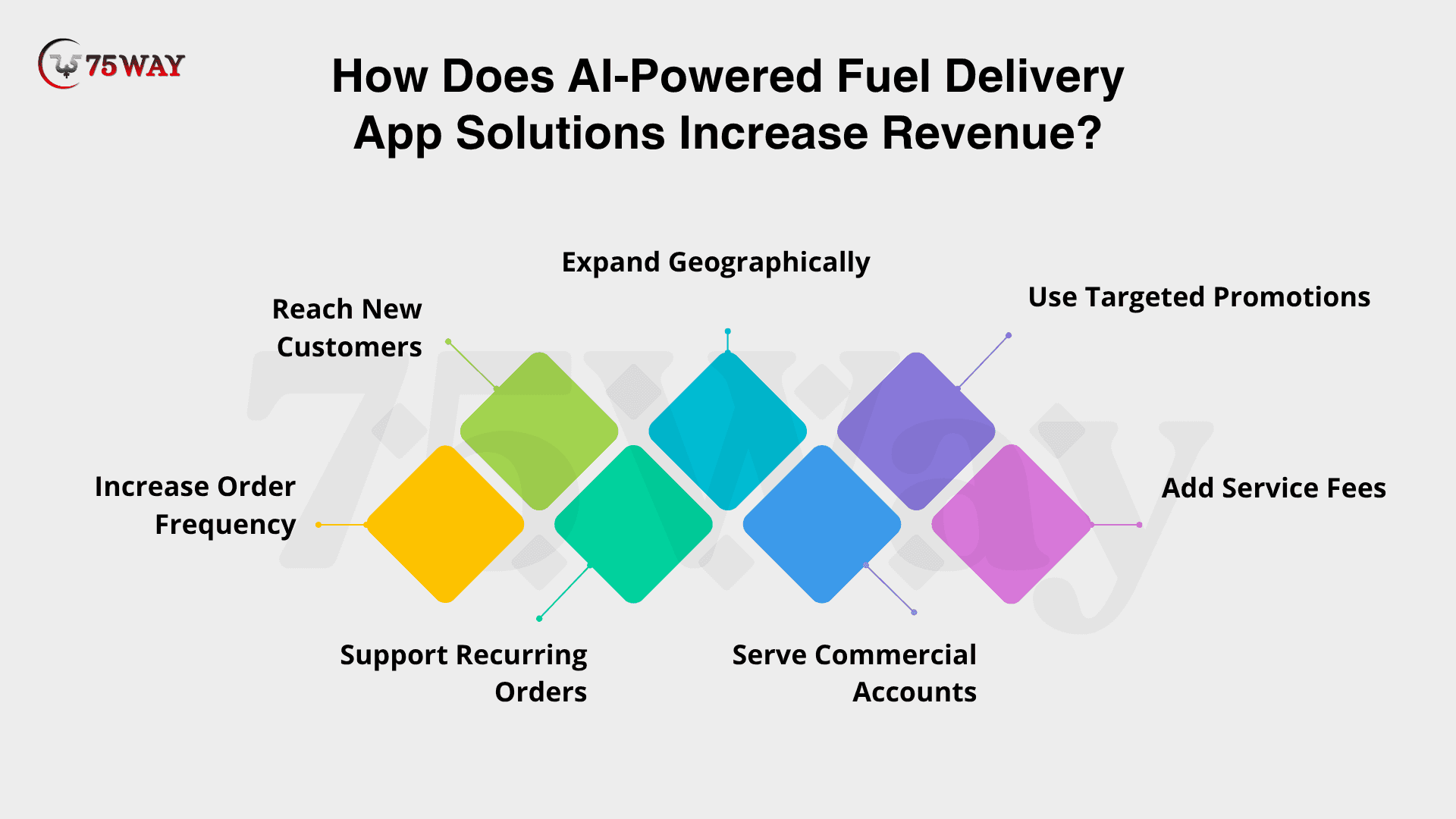
- Reach New Customers: Delivery expands access beyond customers who visit physical locations.
- Increase Order Frequency: Faster repeat ordering can make it easier for existing customers to purchase again.
- Support Recurring Orders: Scheduled deliveries can create predictable purchasing relationships.
- Serve Commercial Accounts: Business customers can generate larger or recurring order volumes.
- Add Service Fees: Delivery, convenience, or premium service charges can create additional revenue.
- Use Targeted Promotions: Customer and order data can support more relevant offers.
- Expand Geographically: Digital ordering can help businesses manage broader delivery territories when logistics support expansion.
The strongest revenue strategy usually combines several of these opportunities rather than relying on a single fee.
Factors Businesses Must Consider Before Developing a Fuel Delivery App
Building the application should begin with the operating model, not the feature list. Before development, businesses should answer several questions.
1. Target Customer
Is the platform designed for individual drivers, fleet operators, businesses, industrial customers, emergency fuel users, or several customer segments?
2. Category of Fuel Products
The product catalog, storage requirements, vehicle requirements, and operational workflows may differ depending on the fuel products involved.
3. Types of Deliveries To Be Offered
The service area affects fleet requirements, delivery times, staffing, logistics, and operational costs.
4. Order Fulfillment
Businesses should define how orders are assigned, how drivers receive them, how delivery status is updated, and how exceptions are handled.
5. Revenue Model
The business should determine whether revenue comes primarily from fuel margins, delivery fees, subscriptions, commissions, commercial contracts, or a combination.
6. Required Integrations
The application may need to connect with payment systems, maps, fleet-management software, fuel inventory systems, accounting tools, notifications, or other business infrastructure.
7. Security And Compliance
Fuel delivery involves physical products, customer information, payment data, vehicles, and location information. Businesses should identify applicable safety, transportation, environmental, payment, privacy, and local regulatory requirements before development.
Final Thoughts
The benefits of fuel delivery app development extend far beyond customer convenience. A well-planned platform can create a new sales channel, simplify fuel ordering, improve delivery visibility, support recurring customers, strengthen commercial relationships, and provide businesses with operational data for better decisions.
For customers, the value comes from ordering fuel when and where they need it. For businesses, the bigger opportunity lies in connecting customer demand with fuel inventory, drivers, payments, dispatch, and analytics through one digital ecosystem.
If you want to turn your fuel delivery idea into a scalable digital platform, hire a renowned on-demand app development agency to plan, build, and launch your solution.
Frequently Asked Questions (FAQs)
How Can A Fuel Delivery App Stand Out In A Competitive Market?
A differentiated value proposition can focus on specialized customers, faster service, reliable delivery, transparent pricing, or distinctive experiences. Competitive research helps identify underserved customer needs.
When Should A Fuel Delivery Business Upgrade Its Existing App?
Businesses should consider upgrades when users report recurring friction, technology becomes difficult to maintain, or operational demands exceed current capabilities. Regular assessments help prioritize improvements based on measurable needs.
How Can Businesses Improve Fuel Delivery App Adoption Among Existing Customers?
Businesses can encourage adoption through simple onboarding, introductory incentives, personalized communication, and clear explanations of customer benefits. Existing relationships can provide an initial audience for digital adoption.
What Role Does Customer Feedback Play In Fuel Delivery App Improvement?
Customer feedback reveals usability problems, unmet expectations, and service issues that analytics may not fully explain. Combining qualitative feedback with behavioral data supports better product decisions.
How Often Should A Fuel Delivery App Receive Updates?
Update frequency should reflect security requirements, platform changes, user feedback, and business priorities rather than an arbitrary schedule. Regular maintenance keeps the application reliable, secure, and adaptable.