AI Summary
An RTA Sharjah-style app development solution connects transport services, digital payments, and real-time mobility tools. This guide explores its business model, features, AI opportunities, and development process. It explains cost drivers and launch decisions.
Key Takeaways
- RTA Sharjah surpassed 100,000 downloads across Android and iOS platforms.
- App development may cost AED 30,000–350,000+ (~$8000–$95,300+), based on scope.
- A business model balances user convenience, partnerships, and revenue streams.
- AI can improve route predictions, support, personalization, and operational decision-making.
- Successful development starts with clear requirements, integrations, security, and scalability.
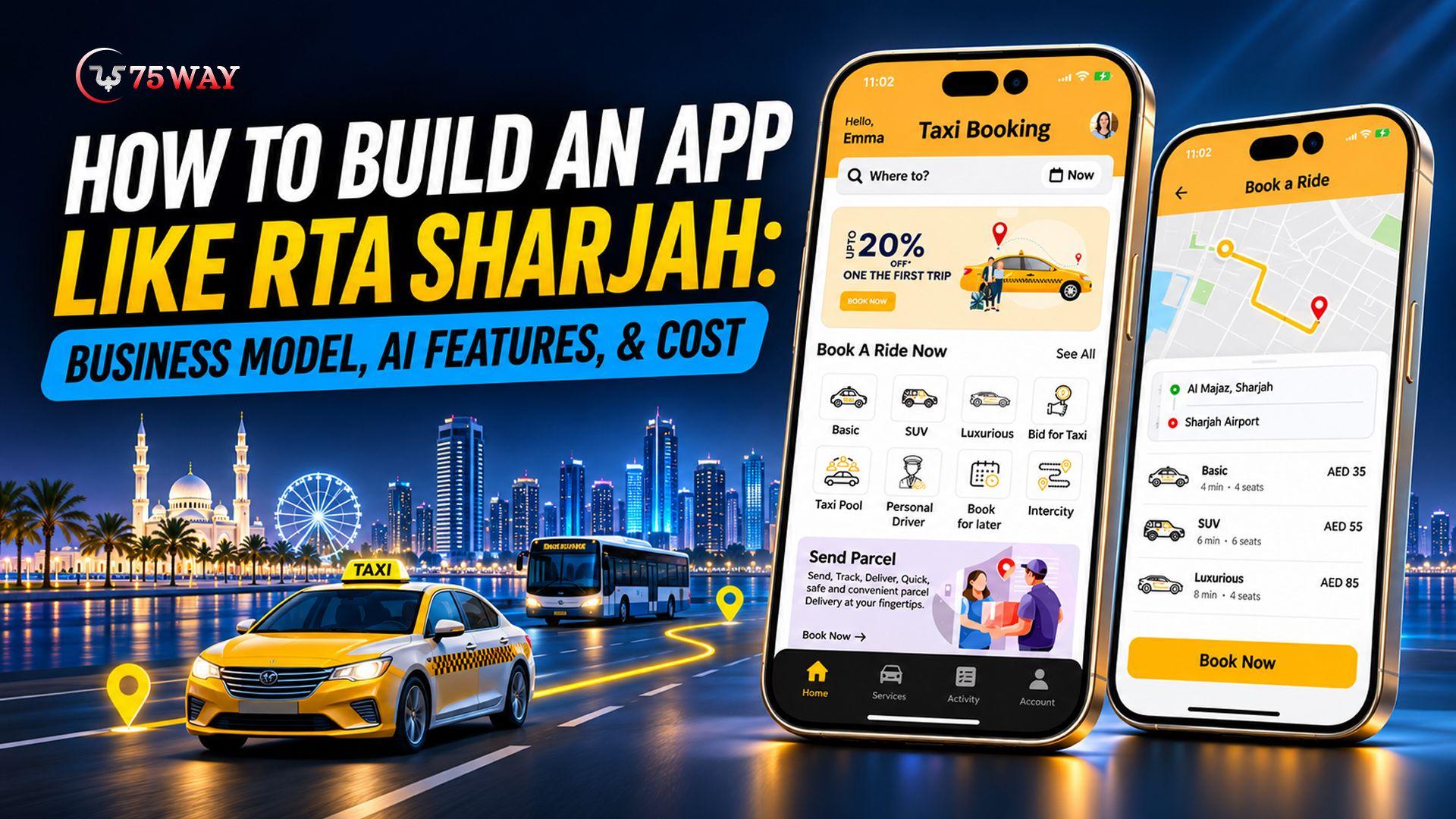
A single transportation app can make daily travel much easier by bringing multiple services together. That is the opportunity businesses can tap into when they build an app like RTA Sharjah.
From residents checking bus routes to visitors booking taxis or paying for parking, a connected mobility platform can serve a wide range of users. The real value comes from making everyday travel less complicated.
Users should be able to access transport information, manage payments, find parking, and receive timely travel updates without switching between multiple apps. AI-powered capabilities can make these experiences smarter with traffic predictions, intelligent route suggestions, and virtual travel assistance.
If you're considering entering the smart mobility market with an RTA Sharjah-like taxi booking app development solution, where should you begin? This guide explains how to build an eHail app like RTA Sharjah, including its business model, essential features, AI capabilities, development process, technology requirements, and estimated costs.
What Is The RTA Sharjah App, And How Does It Work?
The RTA Sharjah app is an official digital service platform developed by the Sharjah Roads and Transport Authority (SRTA). It brings several transportation-related and administrative services into one mobile application, allowing individuals and businesses to interact with the authority without depending entirely on physical service locations.
- Developer: Sharjah Roads & Transport Authority
- Platforms:Android and iOS
- App Category: Travel & Local
- Core Audience: Individual and business users
- Google Play Downloads: 100K+
Instead of developing separate applications for taxi reservations, public transportation information, licensing, and customer support, the platform provides access to these services through a shared digital interface.
Its functionality can be understood through four connected layers:
- User Interface: Provides access to transport services, account information, service requests, and notifications.
- Service Management: Processes taxi bookings, applications, complaints, fines, and other requests.
- Integration Layer: Connects the application with relevant transport, payment, location, and administrative systems.
- Administrative Backend: Allows authorized teams to manage service information, requests, records, and operational activities.
For example, a user who wants to book a taxi can access the booking service, while someone traveling by bus can check schedules and locate bus shelters. A business user may need licensing information or an applicable permit service.
This multi-service structure is what makes the platform an interesting reference for entrepreneurs planning a smart mobility application.
Why Invest in RTA Sharjah-Like App Development in Dubai: Market Insights
Dubai's growing demand for smart mobility services makes RTA Sharjah-like app development an attractive business opportunity. Residents and tourists increasingly expect convenient ways to book rides, access public transport, and manage daily travel. Here's what the market reveals about this investment opportunity.
- RTA Sharjah app has surpassed 100,000 downloads across Android and iOS, contributing to SRTA’s broader smart mobility network.
- During the first half of 2026, smart transport solutions recorded approximately 875,000 uses, while Sharjah’s public transport and taxi services collectively served 25.7 million passengers.
- In Dubai, app-based e-hailing represented 45% of the 120.1 million taxi journeys recorded in 2025, according to Roads and Transport Authority (RTA) figures.
- Dubai's taxi network comprises more than 14,346 registered vehicles, which collectively carried 209 million passengers, accounting for approximately 26% to 27% of total public transport and shared mobility usage in the city.
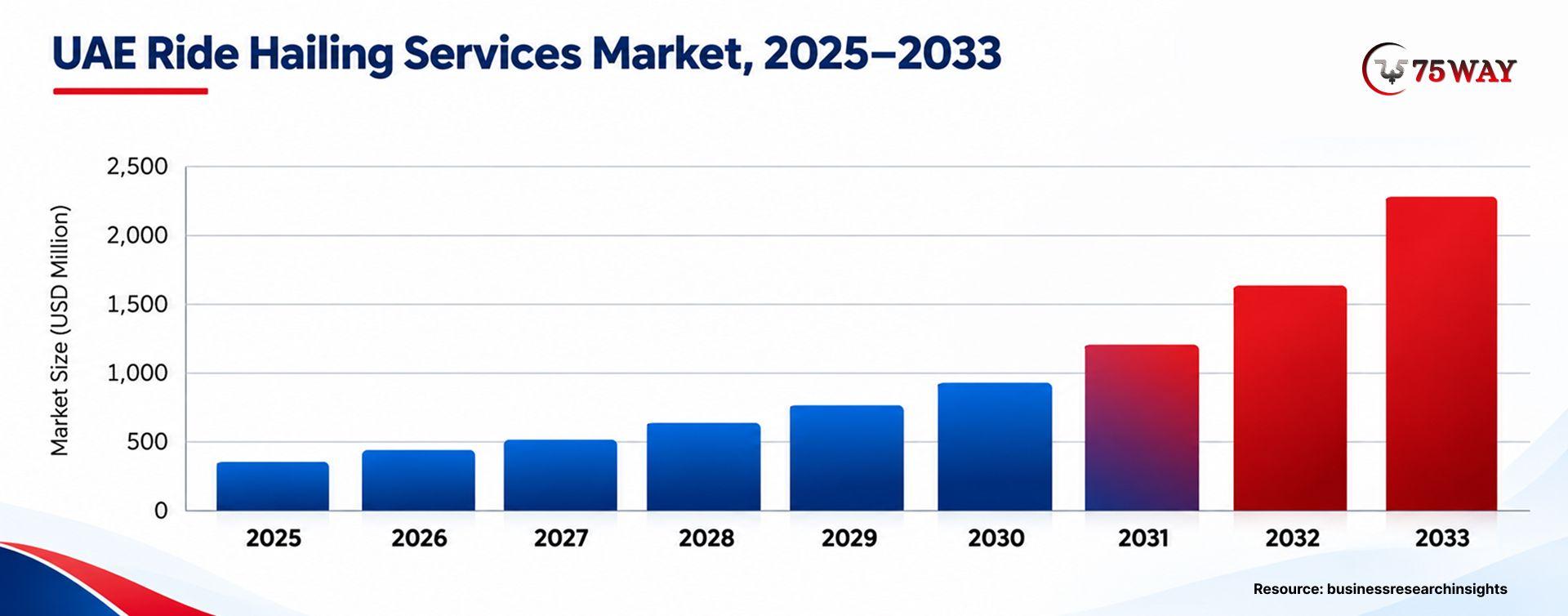
- The UAE ride-hailing services market is forecast to generate US$2,366.3 million in revenue by 2033, growing at a CAGR of 18.7%.
Services You Can Offer in RTA Sharjah App-Like Ehail App Development
Before planning development, understand the services that make the RTA Sharjah-like transportation app useful. Its functionality extends beyond passenger transportation and covers administrative processes, customer communication, and transport-related business services.
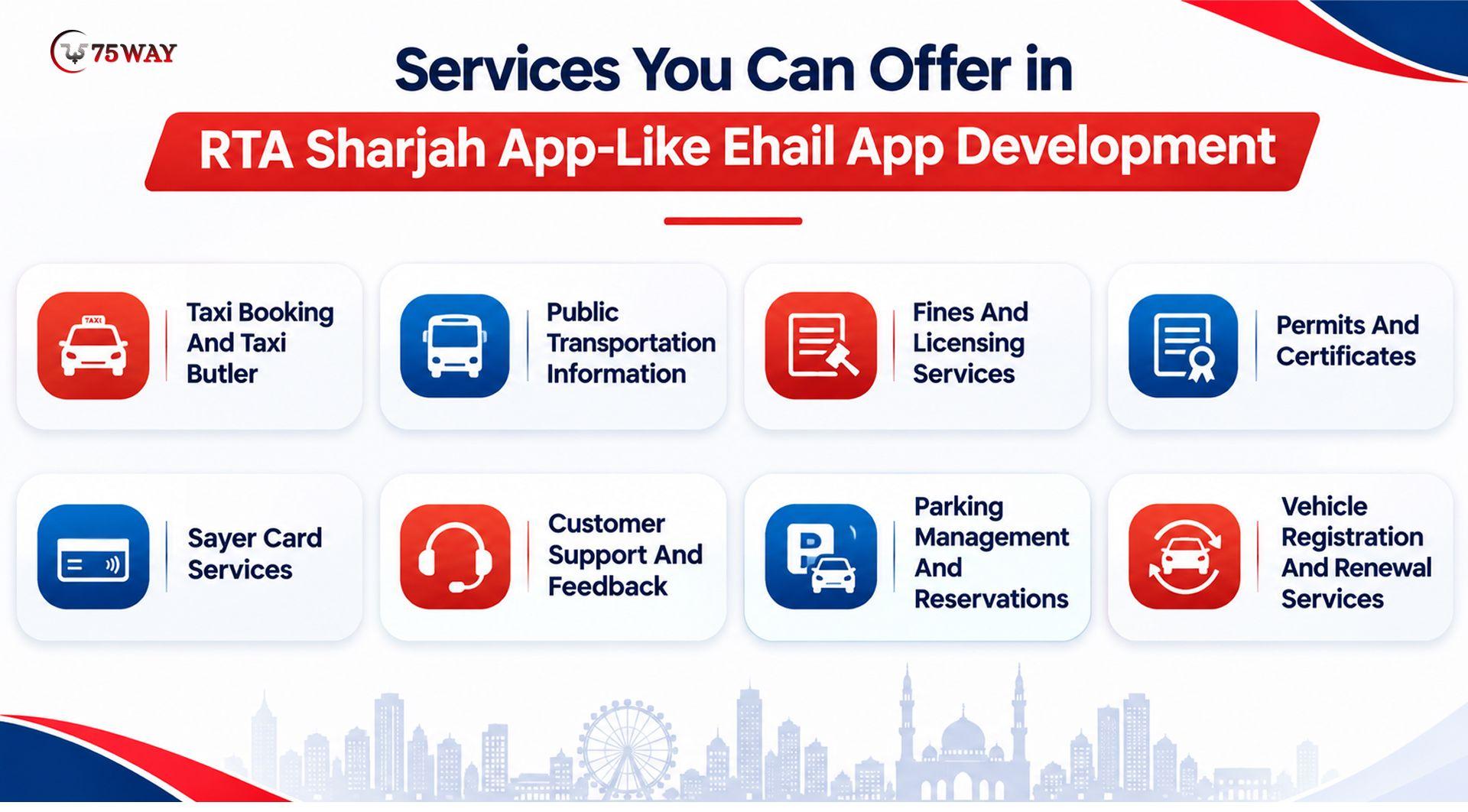
- Taxi Booking And Taxi Butler
Taxi reservations become easier when passengers can request a ride directly through the application. Users can select pickup and drop-off locations, confirm bookings, view driver assignments, check fare details, and access their previous trips.
- Public Transportation Information
A well-organized transport schedule helps passengers plan their journeys with fewer complications. The application provides bus schedules, route information, and bus shelter locations, allowing users to identify boarding points and plan local or intercity travel.
- Fines And Licensing Services
Transportation-related paperwork becomes easier to manage through digital service access. Users can check SRTA traffic fines, access licensing services, make eligible payments, and track license-related requests without depending entirely on physical service visits.
- Permits And Certificates
Essential transportation and administrative documents are easier to access through a centralized digital platform. Users can apply for No Objection Certificates (NOCs), request construction completion certificates, and access traffic accident damage evaluation reports.
- Sayer Card Services
Regular bus passengers need convenient access to their smart travel card information. The application allows users to register their Sayer Cards and check available balances, helping them monitor their public transportation payments.
- Customer Support And Feedback
A convenient support system helps passengers report transportation issues and receive assistance. Users can submit suggestions, report road or bus-related problems, raise taxi complaints, and access lost-and-found services.
- Parking Management And Reservations
A dedicated parking module can make urban travel more convenient for drivers. Users can locate nearby parking facilities, check available spaces, view applicable charges, reserve spots, make digital payments, and extend parking sessions through the application.
- Vehicle Registration And Renewal Services
Digital vehicle management can reduce the effort involved in handling registration-related paperwork. A similar platform can allow users to submit registration requests, upload supporting documents, track application progress, receive renewal reminders, and access digital certificates.
Business Model of RTA Sharjah-Like App Development Solution
The business model of an app like RTA Sharjah goes beyond taxi bookings and public transport services. It brings multiple mobility services and revenue opportunities together under one digital platform. The following breakdown explains how this model works.
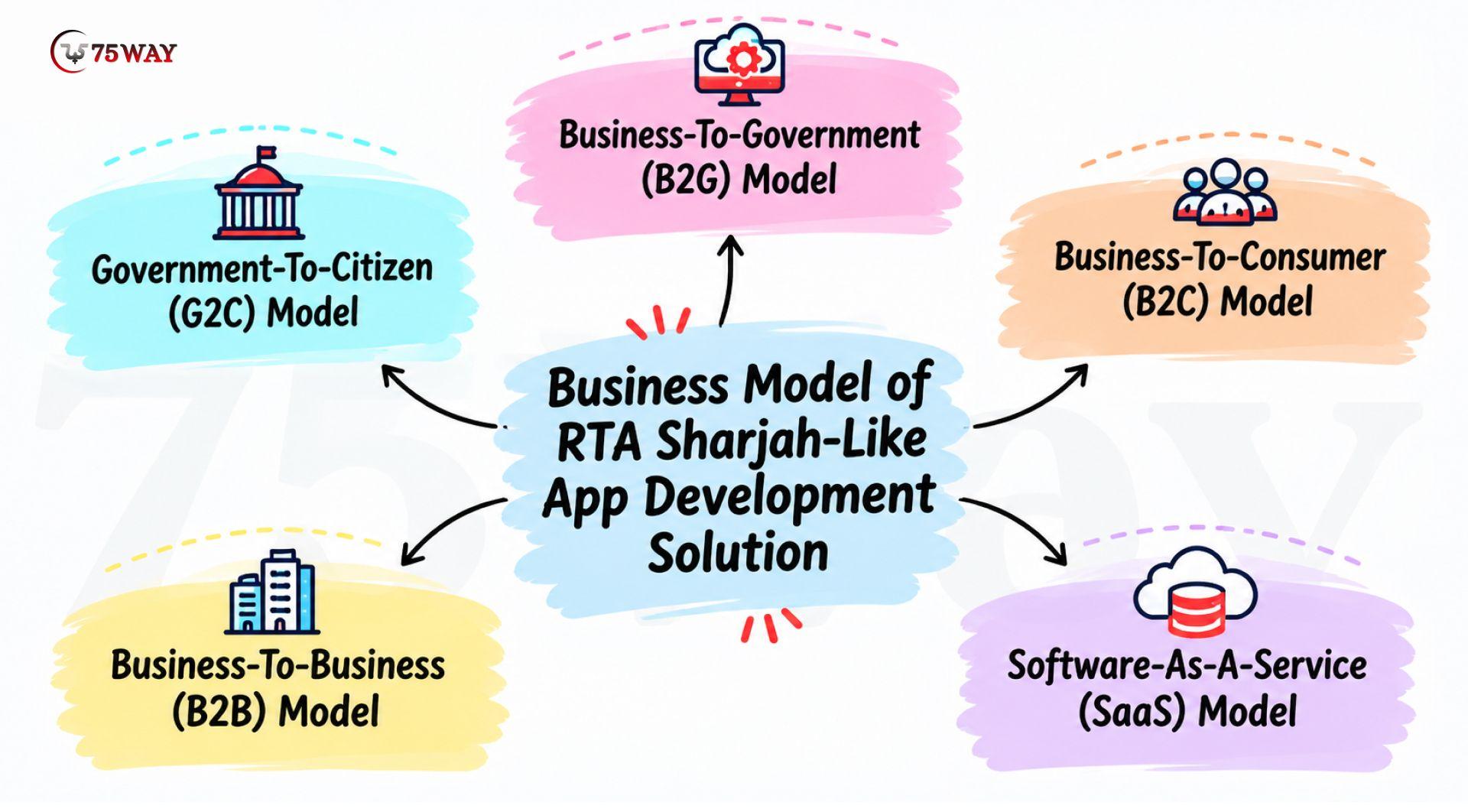
1. Government-To-Citizen (G2C) Model
The G2C model allows government organizations and public authorities to deliver transportation and administrative services directly to citizens through digital platforms.
The platform becomes a centralized channel for accessing services such as public transportation information, permits, fine inquiries, complaints, and digital applications.
How It Works:
- Government organizations provide approved digital services.
- Users access services through a mobile application.
- Integrated systems process applications and requests.
- Administrative teams manage submissions and service delivery.
Revenue Approach: The application may operate through public funding, departmental budgets, or government technology contracts rather than direct user subscriptions.
Suitable For: Government departments, transport authorities, municipal organizations, and public-service providers.
2. Business-To-Government (B2G) Model
In this model, a technology company develops and supplies a transportation management platform to government organizations or public authorities.
Instead of earning money directly from passengers, the software provider generates revenue through enterprise agreements, implementation projects, customization, and ongoing technical support.
How It Works:
- A software company develops the mobility platform.
- A public organization licenses or commissions the solution.
- The platform is customized around operational requirements.
- The provider maintains the software under an agreed service contract.
Revenue Approach: Development fees, annual licensing, maintenance contracts, integration charges, and enterprise support agreements.
Suitable For: Software companies, enterprise technology providers, and government technology contractors.
3. Business-To-Consumer (B2C) Model
A B2C transportation application connects individual users with mobility services such as taxi booking, car rentals, shuttle services, and local transportation providers.
The platform focuses on passenger convenience and makes booking, payments, and trip management accessible through mobile devices.
How It Works:
- Users register and select a transportation service.
- The platform connects them with available providers.
- Users confirm bookings and make payments.
- The platform manages booking records and customer communication.
Revenue Approach: Booking commissions, service fees, premium subscriptions, and optional convenience charges.
Suitable For: Mobility startups, taxi operators, car rental businesses, and private transportation companies.
4. Business-To-Business (B2B) Model
The B2B model focuses on providing transportation services and management tools to other businesses.
For example, a company may need employee transportation, fleet management, scheduled shuttle services, or centralized travel management.
How It Works:
- Businesses create corporate accounts.
- Administrators configure employee transportation requirements.
- Drivers or service providers receive assigned trips.
- Companies monitor usage, payments, and operational reports.
Revenue Approach: Monthly subscriptions, per-vehicle charges, corporate contracts, and customized enterprise packages.
Suitable For: Fleet operators, logistics companies, corporate transportation providers, and employee mobility businesses.
5. Software-As-A-Service (SaaS) Model
A mobility SaaS platform allows multiple transportation businesses to use a shared software solution without building their own applications from scratch.
For instance, a software provider can offer taxi operators a customizable booking application, an administrative dashboard, driver management, and payment integration.
How It Works:
- The provider develops a centralized software platform.
- Businesses subscribe to the service.
- Each customer receives configured access.
- The provider manages hosting, updates, and technical support.
Revenue Approach: Monthly or annual subscriptions, usage-based pricing, setup fees, and premium feature charges.
Suitable For: Mobility technology startups, software vendors, and companies serving multiple transportation operators.
Which Business Model Should You Choose To Build RTA Sharjah-Style App?
Your business model should reflect who pays for the service, who uses the application, and who controls the transportation infrastructure.
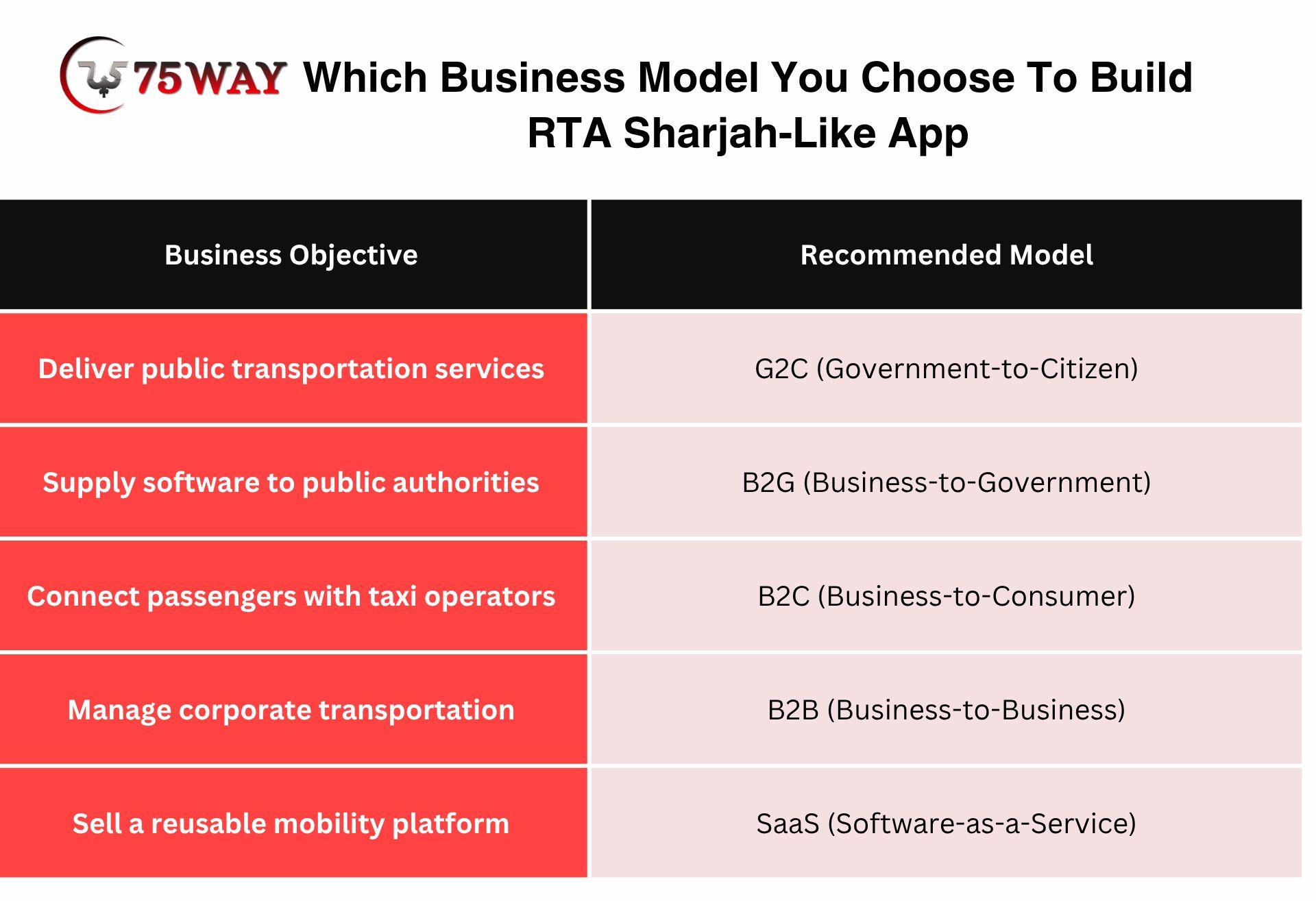
For startups, a B2C or SaaS approach can provide a practical entry point because it allows them to validate demand without building an entire public-service ecosystem. Businesses pursuing authority-level projects should evaluate B2G opportunities, procurement requirements, and integration permissions much earlier.
How To Build An App Like RTA Sharjah: Step-By-Step Development Process
If you are developing a multi-service mobility application like RTA Sharjah, you need to create coordination between business planning, UI/UX design, backend engineering, third-party integrations, and quality assurance. The following RTA Sharjah-inspired app development process explains how to move from an initial business idea to a working application.
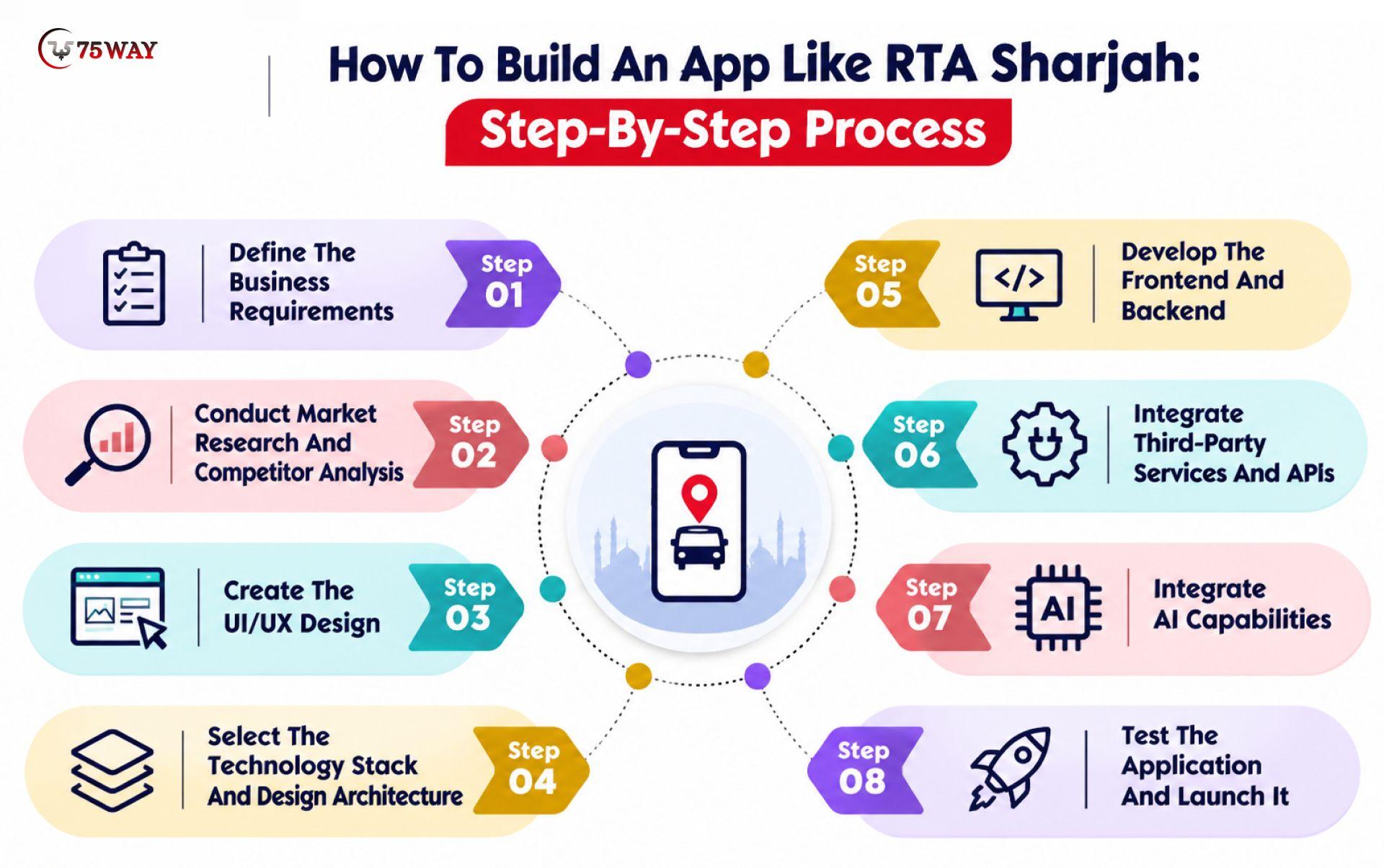
Step 1. Define The Business Requirements
The first step is to determine what the application should accomplish and which users it should serve.
For example, a taxi operator may need booking and driver management, while a mobility startup may want to combine taxi reservations, public transport information, and digital payments.
These are different product requirements and should not share an identical development scope.
Activities Involved:
- Identify the target audience.
- Research existing transportation services.
- Define the application's primary purpose.
- Identify user roles and permissions.
- Select the initial feature set.
- Document functional and non-functional requirements.
- Establish business and technical objectives.
Development Deliverables: Business requirements document, user personas, product scope, and initial project roadmap.
Step 2. Conduct Market Research And Competitor Analysis
Before investing in development, understand how existing mobility applications serve their customers and where users experience difficulties.
Do not limit competitor research to copying visible features. Study how users complete tasks, where they encounter delays, and what operational problems the application needs to solve.
Activities Involved:
- Analyze competing mobility applications.
- Review app store feedback.
- Study user booking and payment journeys.
- Identify missing or poorly implemented services.
- Evaluate competitor pricing and service coverage.
- Identify opportunities for differentiation.
For example, if users frequently struggle to find bus schedules, a simplified journey planner could become your first competitive advantage.
Development Deliverables: Competitor analysis, market positioning, feature prioritization, and product differentiation strategy.
Step 3. Create The UI/UX Design
A transportation application can contain dozens of services, so navigation must remain straightforward. Users should be able to find essential actions without exploring multiple menus.
The design team should create separate user journeys for passengers, drivers, business customers, and administrators.
Activities Involved:
- Develop user journey maps.
- Create information architecture.
- Prepare wireframes.
- Design interactive prototypes.
- Establish a consistent design system.
- Create accessible interface components.
- Conduct usability testing.
For example, the home screen can prioritize taxi booking, bus schedules, service requests, and payment access instead of displaying every feature with equal importance.
Development Deliverables: Wireframes, high-fidelity UI designs, interactive prototypes, and design specifications.
Step 4. Select The Technology Stack And Design Architecture
The technology stack determines how the application will handle user requests, payments, location updates, service integrations, and future expansion.
For an RTA Sharjah-style platform, a modular architecture is generally more practical than placing every business function inside one tightly coupled backend.
Technology Stack For RTA Sharjah-Like Application Development
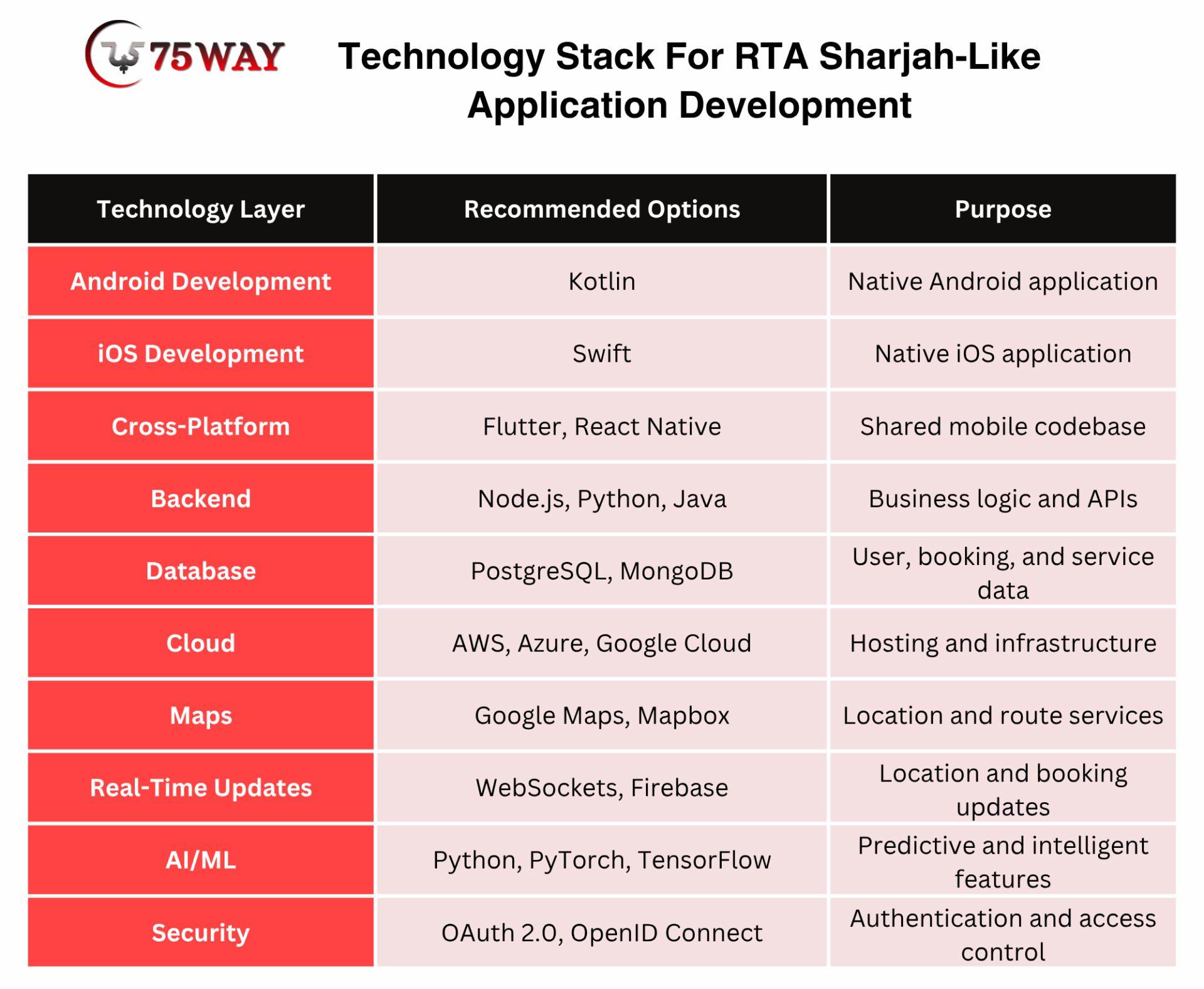
The final selection depends on integration requirements, development budget, team expertise, expected traffic, and long-term maintenance needs.
Architecture Considerations:
- Separate authentication and authorization.
- Create independent service modules.
- Use API gateways for controlled communication.
- Implement secure payment processing.
- Design scalable location and booking services.
- Maintain centralized monitoring and logging.
- Establish backup and recovery procedures.
Development Deliverables: Architecture diagrams, technology specifications, API documentation, and database design.
Step 5. Develop The Frontend And Backend
Once the designs and architecture are approved, development begins.
The frontend handles the screens and user interactions, while the backend processes requests, manages application data, and connects different services.
For example, when a passenger books a taxi, the frontend collects the pickup and destination details. The backend validates the request, checks driver availability, initiates the assignment process, and returns the booking status.
Frontend Development Includes:
- User registration and login
- Home screen and service directory
- Taxi booking interface
- Route and schedule screens
- Payment interface
- Notifications
- User profile and history
Backend Development Includes:
- Authentication and user management
- Booking and dispatch services
- Driver and vehicle management
- Payment processing
- Administrative workflows
- Document and permit management
- Notification services
- Reporting and analytics
Development Deliverables: Functional mobile applications, backend APIs, database services, and administrative dashboard.
Step 6. Integrate Third-Party Services And APIs
A transportation platform depends on external systems for several important capabilities. Integrations must be selected according to the services your business is authorized and technically able to provide.
Important Integrations Include:
- Mapping APIs for maps, routes, and geocoding.
- GPS services for location tracking.
- Payment gateways for digital transactions.
- SMS and email providers for verification.
- Push notification services for alerts.
- Government APIs for authorized public-service connections.
- Transit data feeds for public transportation information.
One important point: government service integrations are not automatically available to private application developers. Access may require formal approval, commercial agreements, technical certification, and compliance with the relevant authority's requirements.
Where an official API is unavailable, you may need a separate service provider or a manually managed workflow.
Development Deliverables: Integrated APIs, authentication credentials, sandbox testing, and integration documentation.
Step 7. Integrate AI Capabilities
AI implementation should follow the actual requirements of the product rather than become an unnecessary development expense.
For example, a basic transportation MVP may only need a service chatbot, while an enterprise fleet platform may require demand forecasting and intelligent dispatch.
Activities Involved:
- Identify suitable AI use cases.
- Prepare relevant datasets.
- Select AI models and infrastructure.
- Connect models with backend services.
- Implement access controls and data protection.
- Test prediction accuracy and response quality.
- Establish monitoring and human review.
For an AI chatbot, the development team can connect an LLM with a RAG-based knowledge system containing verified service information. For route optimization, the team can combine mapping data, routing algorithms, and forecasting models.
Development Deliverables: Integrated AI services, model evaluation results, monitoring workflows, and AI safety controls.
Step 8. Test The Application And Launch It
Before launch, test the entire application rather than checking individual screens alone. A booking flow may work independently, but problems can emerge when it interacts with payments, notifications, driver assignment, or external services.
After testing, the team can prepare the production environment, submit the application to the relevant app stores, configure monitoring, and launch the product.
Development Deliverables: Tested mobile applications, production backend, release documentation, and post-launch support plan.
AI Features You Must Include in an App Like RTA Sharjah
Today's commuters expect more than basic route information and online payments. They want faster updates, personalized travel suggestions, and reliable assistance throughout their journey. The right AI features can help your RTA Sharjah-like app deliver these experiences.
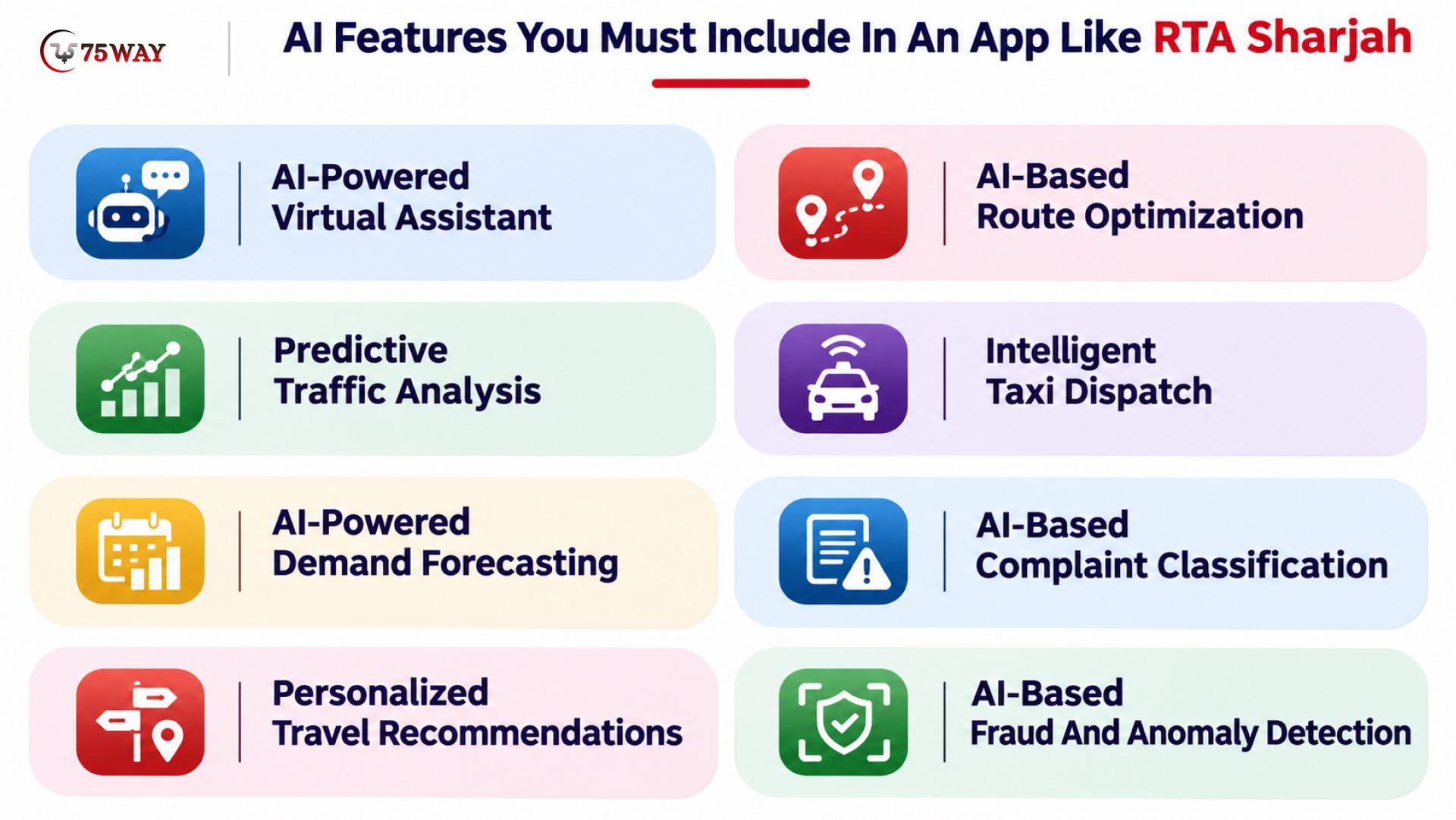
1. AI-Powered Virtual Assistant
Users often struggle to find the right service when an application contains multiple categories. An AI-powered virtual assistant can help them navigate the platform using natural language.
For example, a passenger might ask, "How can I check my bus schedule?" Instead of navigating multiple screens, the assistant can identify the relevant service and direct the passenger to the correct page.
2. AI-Based Route Optimization
Finding the shortest route is not always the same as finding the most suitable route. Traffic congestion, road closures, travel time, and passenger preferences can change the best available option.
An AI-based route optimization engine can analyze available transportation data to recommend routes based on multiple conditions.
3. Predictive Traffic Analysis
Unexpected traffic congestion can affect taxi availability, bus schedules, and overall passenger experience. Predictive traffic analysis helps transportation operators identify potential delays before they become major operational problems.
The system can analyze historical traffic patterns, current traffic feeds, weather information where available, and road conditions to estimate congestion.
4. Intelligent Taxi Dispatch
A taxi booking platform must do more than receive a passenger's request. It also needs to identify available drivers, evaluate pickup distances, assign trips, and manage booking changes.
An intelligent dispatch system can use optimization algorithms and machine learning to recommend suitable drivers based on location, availability, vehicle category, and estimated arrival time.
5. AI-Powered Demand Forecasting
Transportation demand changes throughout the day. Business districts, airports, commercial areas, and residential locations may experience different passenger volumes depending on the time and day.
AI-powered demand forecasting can help operators anticipate these changes and allocate resources accordingly.
6. AI-Based Complaint Classification
Transportation applications receive complaints about road conditions, bus services, taxi experiences, lost belongings, and other issues. Manually reviewing every submission can create administrative delays.
An AI-powered complaint classification system can read incoming messages, identify their subject, and assign them to the appropriate department for review.
7. Personalized Travel Recommendations
Different passengers have different travel preferences. Some prioritize shorter journeys, while others prefer fewer transfers, lower fares, or accessible transportation options.
A recommendation engine can analyze user-selected preferences and relevant travel information to suggest suitable routes and services.
8. AI-Based Fraud And Anomaly Detection
Applications handling payments, digital accounts, permits, and booking transactions need safeguards against suspicious activities.
Machine learning models can help identify unusual transaction patterns, repeated failed payment attempts, abnormal booking activity, and potentially fraudulent account behavior.
Our recommendation: Start with an AI assistant and intelligent service discovery if your platform contains multiple service categories. Add predictive analytics and dispatch intelligence when sufficient operational data becomes available. This approach prevents unnecessary AI expenditure during the initial development phase.
Essential Features For RTA Sharjah Clone App Development
From checking bus schedules to paying for parking, commuters want everyday transport tasks to feel simple. Your RTA Sharjah clone app should bring these services together without making navigation complicated. The following features can help you deliver that experience.
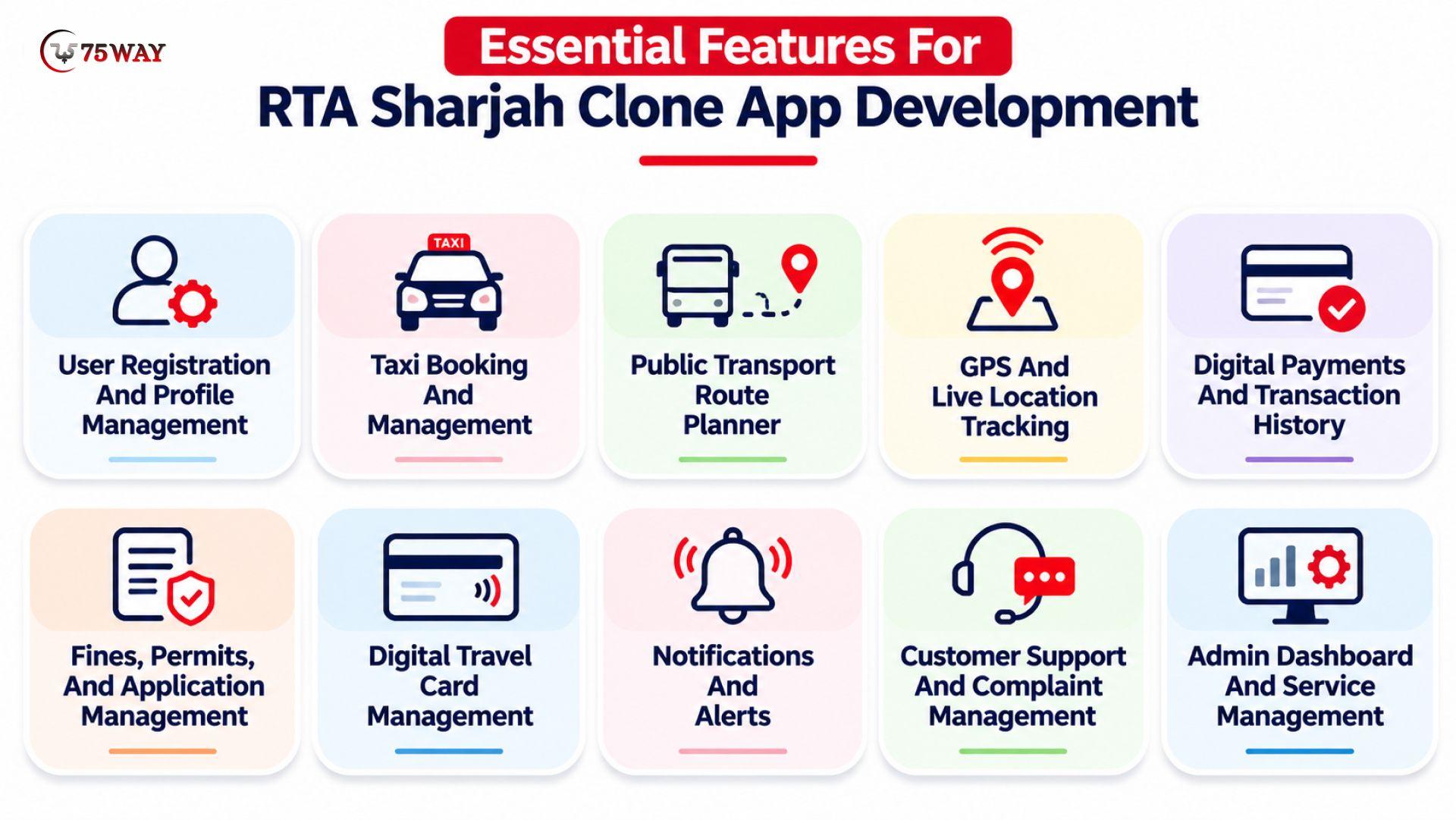
1. User Registration And Profile Management
A secure registration system allows users to create accounts and access personalized services.
Features To Include:
- Email and mobile number registration
- OTP-based verification
- Social login, where appropriate
- User profile management
- Saved addresses and travel preferences
- Account settings and session management
2. Taxi Booking And Management
The taxi booking module allows passengers to request transportation without contacting an operator manually.
Features To Include:
- Pickup and destination selection
- Vehicle category selection
- Fare estimates
- Driver assignment
- Live trip tracking
- Booking confirmation and cancellation
- Trip history and receipts
- Ratings and feedback
3. Public Transport Route Planner
A route planner helps passengers understand available transportation options and organize their journeys.
Features To Include:
- Bus route information
- Intercity bus schedules
- Bus stop and shelter locations
- Boarding and destination details
- Estimated journey duration, when supported by live data
- Route maps
- Service disruption notifications
4. GPS And Live Location Tracking
Location-based functionality supports taxi booking, vehicle monitoring, route navigation, and nearby transport discovery.
Features To Include:
- GPS-based location detection
- Interactive map integration
- Driver location updates
- Pickup location confirmation
- Geofencing for selected operational areas
- Location permission management
A critical technical consideration is location update frequency. Sending GPS coordinates continuously can increase battery consumption, network traffic, and backend costs. The application should use different update intervals depending on whether a vehicle is idle, approaching a passenger, or completing a trip.
5. Digital Payments And Transaction History
A payment module allows users to complete eligible transactions without leaving the application.
Features To Include:
- Credit and debit card payments
- Apple Pay and Google Pay, where supported
- Payment gateway integration
- Digital receipts
- Refund management
- Transaction history
- Failed payment handling
Payment processing should use a compliant payment provider rather than storing sensitive card information directly in the application's database.
6. Fines, Permits, And Application Management
For a platform serving administrative requirements, service request management is an important functionality.
Features To Include:
- Fine inquiry
- Online payment, where authorized
- Permit application forms
- Document uploads
- Application status tracking
- NOC request management
- Certificate downloads
- Renewal reminders
These workflows require more than frontend forms. They need backend validation, document management, authorization rules, and integrations with the relevant administrative systems.
7. Digital Travel Card Management
A smart travel card module allows passengers to access card-related information through the application.
Features To Include:
- Card registration
- Balance inquiry
- Transaction history
- Recharge functionality, where supported
- Lost card reporting
- Card status information
8. Notifications And Alerts
Push notifications help users stay informed about bookings, service requests, payment confirmations, and transportation updates.
Features To Include:
- Booking confirmations
- Driver arrival notifications
- Payment receipts
- Permit and application updates
- Bus service alerts
- Important service announcements
- Personalized notification settings
9. Customer Support And Complaint Management
An integrated support module gives users a convenient way to report problems and receive assistance.
Features To Include:
- Complaint submission
- Lost-and-found requests
- Feedback forms
- Ticket numbers
- Complaint status tracking
- Document and image attachments
- In-app chatbot
- Human support escalation
10. Admin Dashboard And Service Management
The admin dashboard is the operational center of the application. It allows authorized staff to manage users, services, bookings, payments, and administrative requests.
Features To Include:
- Role-based access control
- User and driver management
- Service category management
- Booking and request monitoring
- Payment and transaction reports
- Complaint management
- Notification management
- Analytics and operational reports
- Audit logs
How Much Does It Cost To Build An App Like RTA Sharjah?
The cost to build an app like RTA Sharjah typically ranges from AED 30,000 to AED 350,000+ (~$8,000–$95,300+), depending on the application's features, platform requirements, AI capabilities, integrations, and backend complexity. Here is a practical breakdown of the estimated development costs.
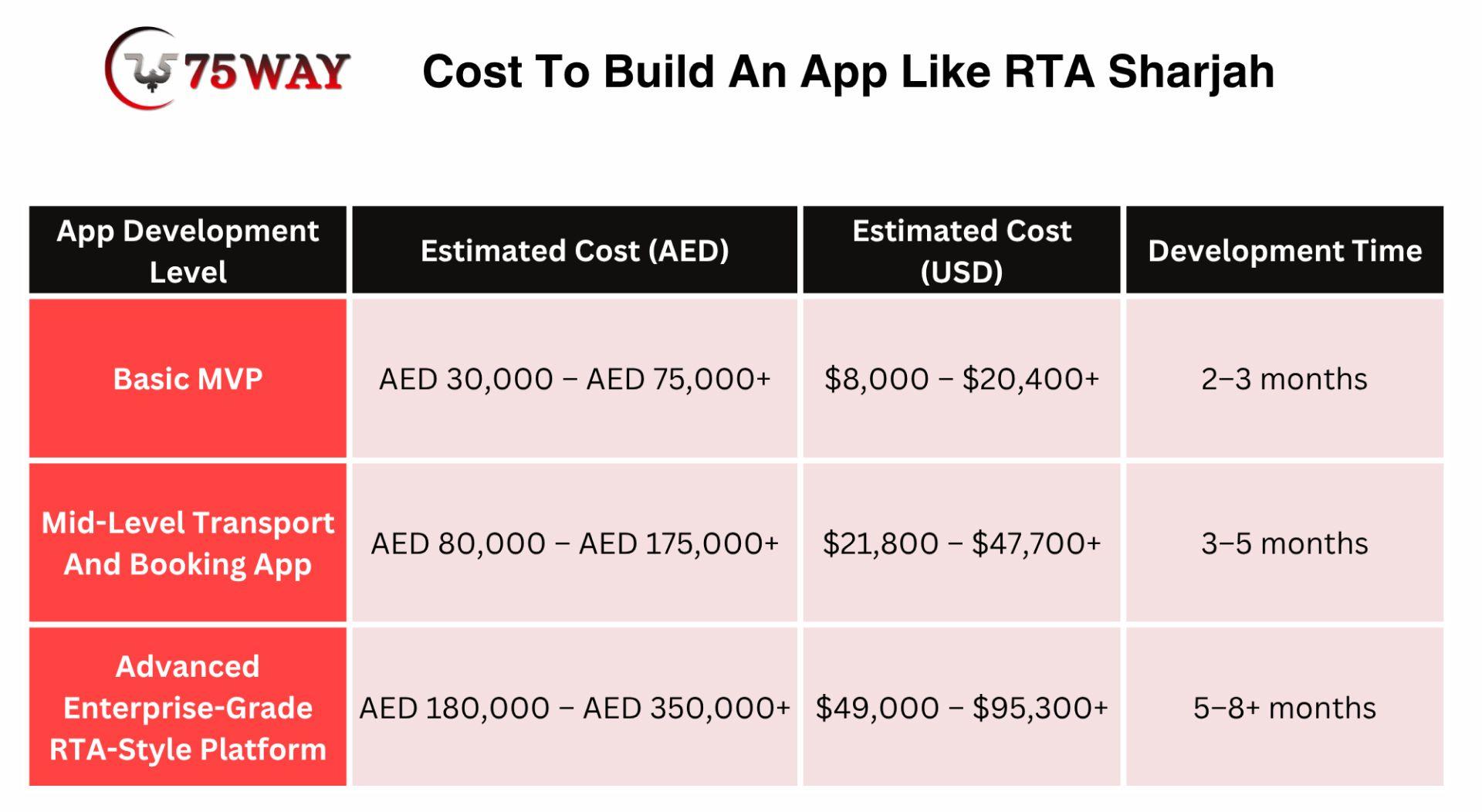
1. Basic MVP RTA Sharjah-Like App Cost: AED 30,000 – AED 75,000+ (~$8,000 – $20,400)
A basic MVP focuses on validating the application concept through essential transportation information and simple digital services.
Features: User authentication, service directory, static pages, feedback forms, profiles, and basic admin panel.
Timeline: 2 to 3 months.
Suitable For: Startups, entrepreneurs, and businesses testing an initial mobility application concept before investing in advanced functionality.
2. Mid-Level RTA Sharjah-Like App Cost: AED 80,000 – AED 175,000+ (~$21,800 – $47,700)
A mid-level application introduces interactive transportation services, real-time location capabilities, digital transactions, and multiple user roles.
Features: GPS tracking, digital payments, parking reservations, notifications, dashboards, booking management, and analytics.
Timeline: 3 to 5 months.
Suitable For: Taxi operators, mobility startups, transport service providers, and businesses planning to launch an operational booking platform.
3. Advanced/Enterprise RTA Sharjah-Like App Cost: AED 180,000 – AED 350,000+ (~$49,000 – $95,300+)
An advanced application combines multiple transportation services, complex administrative workflows, real-time data processing, and enterprise-level infrastructure.
Features: Live transport feeds, GIS mapping, taxi booking, cloud infrastructure, multilingual support, API integrations, AI chatbots, and analytics.
Timeline: 5 to 8+ months.
Suitable For: Established transportation companies, enterprise mobility providers, government technology contractors, and businesses developing multi-service transportation ecosystems.
1Which platforms do you want to develop for?
Single choice2What type of application are you planning?
Single choice3Which core features do you need?
Multiple choice4What is your estimated development budget?
Single choiceHow Can You Optimize The Development Budget of RTA Sharjah-Like App?
A common mistake is trying to develop every feature before launching the first version. This increases initial investment and delays market validation.
A better approach is to divide the product into development phases.
Phase 1 – MVP
Launch user registration, service information, basic requests, and an administrative dashboard.
Phase 2 – Core Operations
Introduce booking, GPS tracking, payment processing, and notifications.
Phase 3 – Intelligent Features
Add AI assistance, route optimization, demand forecasting, and advanced analytics.
Phase 4 – Enterprise Expansion
Integrate additional transport services, authorized government systems, and advanced operational controls.
This approach allows businesses to validate user demand before committing to expensive integrations and advanced functionality.
Native Vs. Cross-Platform Development: What to Choose For Building RTA Sharjah-Like App
The decision depends on the application's functionality, budget, and expected performance requirements.
Native Development: Kotlin and Swift provide platform-specific development capabilities. They are suitable when the application requires advanced device integrations, complex background location handling, and platform-specific functionality.
Cross-Platform Development: Flutter and React Native allow businesses to develop Android and iOS applications using a shared codebase. This can reduce duplicated development work and simplify feature maintenance.
For an MVP or a typical mobility application, Flutter can be a practical option. However, complex background tracking, specialized hardware integrations, and platform-specific requirements should be evaluated before selecting the final framework.
Security & Compliance Requirements To Build A Transport App Like RTA Sharjah
A transportation application handles sensitive operational and user information, including account details, location data, payment transactions, and service records. Security must therefore be considered during architecture planning, not added after development. The following measures are important.
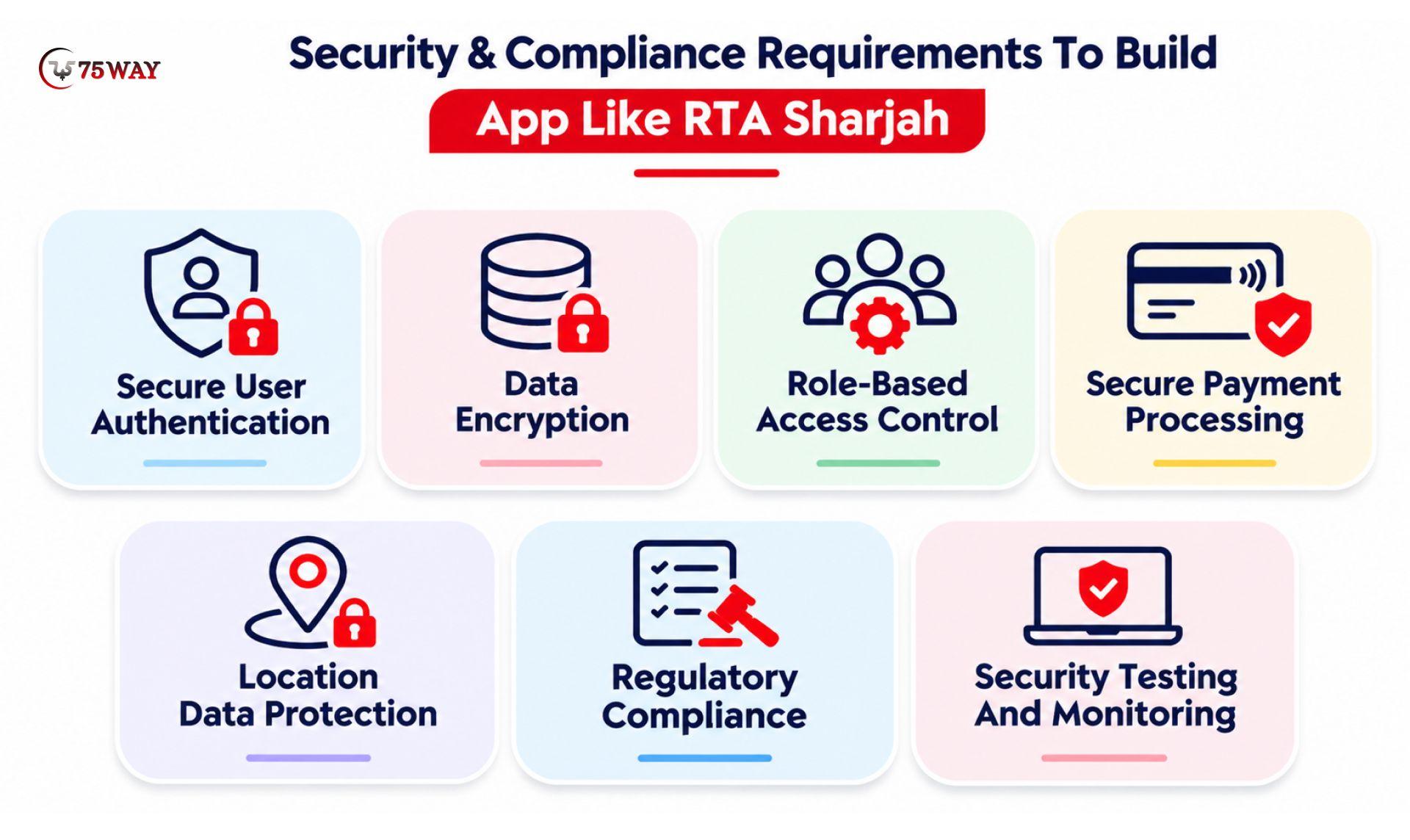
1. Secure User Authentication
Implement OTP verification, secure session management, and multi-factor authentication where appropriate. Administrative accounts should have stronger authentication requirements than ordinary user accounts.
2. Data Encryption
Protect sensitive information through encryption during transmission and storage. Use secure communication protocols and appropriate key management practices.
3. Role-Based Access Control
Passengers, drivers, inspectors, business customers, and administrators should only access information relevant to their responsibilities.
For example, a driver should not be able to access another driver's account information or administrative records.
4. Secure Payment Processing
Use reputable payment gateways and avoid storing raw payment card details. Implement transaction verification, payment status reconciliation, and appropriate fraud prevention controls.
5. Location Data Protection
Collect location information only when necessary for the requested service. Provide clear permission controls and define how long location records will be retained.
6. Regulatory Compliance
Evaluate applicable privacy, payment, cybersecurity, and transportation regulations based on the markets where the application operates.
For businesses serving users in different regions, this may include GDPR requirements, applicable local data protection legislation, and relevant payment security standards.
7. Security Testing And Monitoring
Conduct vulnerability assessments, penetration testing, API security reviews, and regular infrastructure monitoring.
For applications connecting with public authorities, also evaluate contractual security requirements, data residency obligations, integration approvals, and audit requirements.
Common Mistakes To Avoid When Building An App Like RTA Sharjah & Solutions
Even a technically sound application can struggle if the product strategy and development decisions are not aligned with actual user requirements. Here are some mistakes worth avoiding.
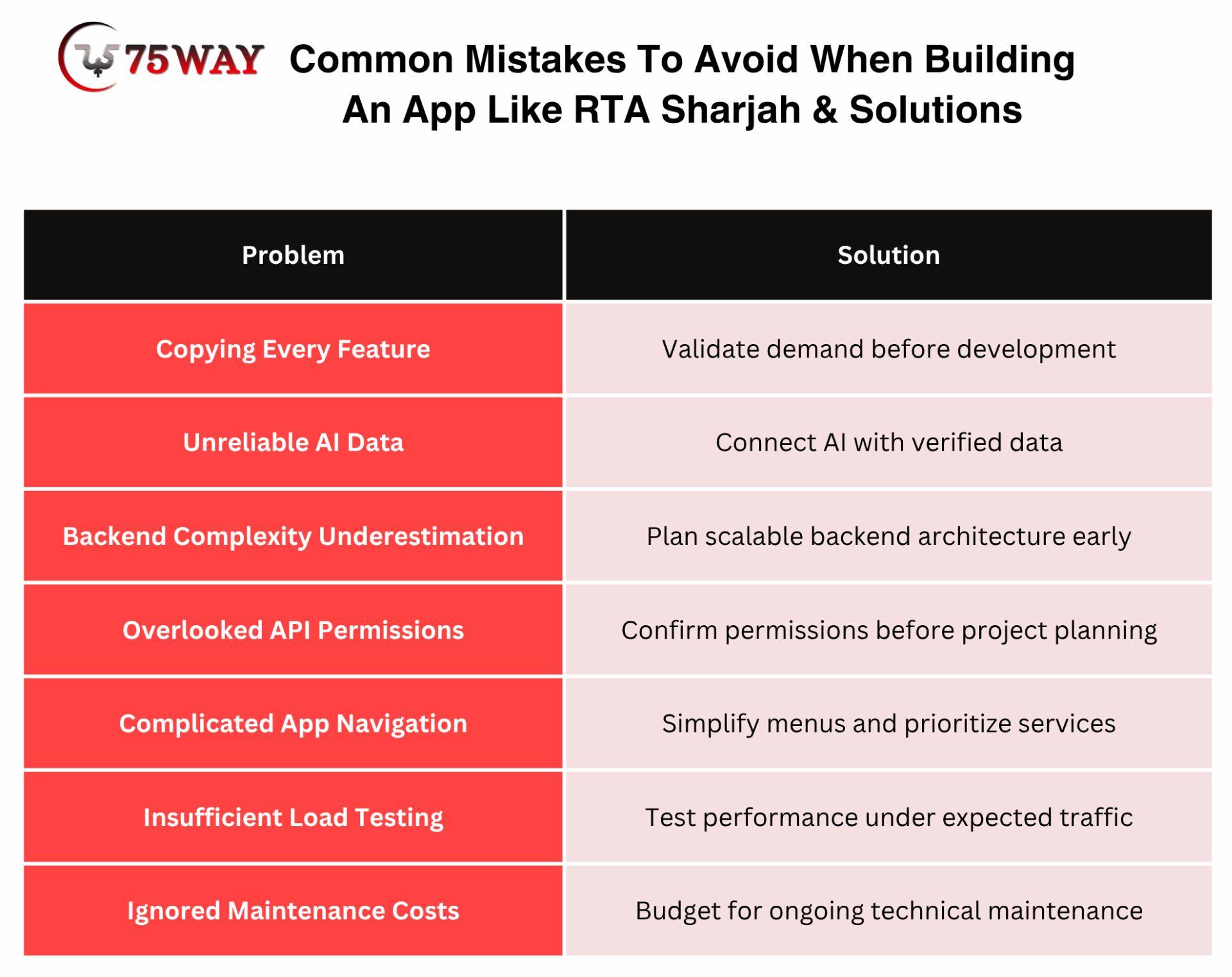
1. Copying Every Feature Without Validating Demand
An existing application may contain dozens of services, but that does not mean your first version needs all of them. Prioritize features based on actual customer problems.
2. Treating AI As A Replacement For Reliable Data
An AI chatbot cannot provide accurate bus schedules or application statuses if the underlying information is outdated. Connect AI systems with verified data sources.
3. Ignoring Backend Complexity
Taxi booking, payment processing, and real-time tracking depend on reliable backend services. Underestimating this complexity can lead to performance issues during launch.
4. Overlooking Third-Party API Permissions
Some transport and government services require official authorization. Confirm integration availability before including these services in the project scope.
5. Designing Complicated Navigation
Users should not have to explore several menus to find a taxi booking option or bus schedule. Prioritize frequently used services on the home screen.
6. Launching Without Load Testing
A system that performs well with 100 test users may not handle thousands of simultaneous requests. Evaluate expected traffic and infrastructure capacity before launch.
7. Ignoring Maintenance Costs
Application development does not end when the product enters the app stores. Plan for infrastructure, security updates, API changes, and ongoing technical support.
Future Trends To Follow for Building AI-Powered Transportation App Like RTA Sharjah
Transportation applications are evolving beyond basic booking and route information. Advances in machine learning, connected infrastructure, and real-time data processing are creating opportunities for more intelligent mobility services. Here are some developments businesses should consider when planning their product roadmap.
1. Predictive Mobility Management
Predictive systems can analyze travel patterns and transportation demand to help operators allocate vehicles and resources more effectively.
2. Conversational Service Automation
LLM-powered assistants and AI voice agents can help users discover services, understand procedures, and access relevant information through natural language conversations.
3. Connected Vehicle Ecosystems
Connected vehicle technologies can provide operational information about vehicle location, condition, and usage. When supported by suitable hardware and integrations, these capabilities can improve fleet management.
4. Multimodal Journey Planning
Future applications can combine taxis, buses, shared mobility, and other available transportation options into one journey-planning experience.
5. Predictive Fleet Maintenance
Machine learning models can analyze vehicle performance and maintenance records to identify patterns that may indicate future maintenance requirements.
6. Smart Parking Management
Intelligent parking systems can use authorized sensor feeds and occupancy information to help drivers identify available parking spaces and manage reservations.
These capabilities should be introduced according to business requirements, data availability, and operational readiness rather than added simply because they are emerging technologies.
How To Choose The Right RTA Sharjah Clone App Development Company?
A company that specializes in basic mobile application development may not necessarily have the experience required to build a complex mobility ecosystem. Before finalizing a development partner, evaluate the following:
- Transportation Domain Experience: Check whether the team understands taxi booking, fleet management, GPS tracking, payment workflows, and transportation operations.
- Technical Expertise: Evaluate its experience with mobile frameworks, backend architecture, cloud infrastructure, APIs, and AI integration.
- Integration Capabilities: Ask how the team handles payment gateways, mapping services, external APIs, and authorized government integrations.
- Security Practices: Understand its approach to authentication, encryption, data protection, access management, and application testing.
- Development Transparency: Review its project planning, deliverables, development milestones, communication process, and post-launch support arrangements.
How 75way Technologies Develops Apps Similar To RTA Sharjah
At 75way Technologies, as a prominent app and AI development company in Dubai, we turn complex transportation requirements into practical mobile app experiences. Our development team focuses on features that make everyday journeys, bookings, payments, and administrative services easier to manage. From the first idea to final deployment, every stage receives careful attention to functionality, security, and user needs.
- Planning begins with research into passenger needs.
- Designers create simple, accessible transportation app experiences.
- Developers build secure booking, payment and tracking modules.
- API integrations connect essential third-party transportation services.
- Rigorous testing checks performance, security, and usability.
- Post-launch support keeps features updated and reliable.
Final Remarks
To wrap up, building an app like RTA Sharjah gives an opportunity to bring transportation services, digital transactions, and administrative workflows together through one connected platform.
However, successful development depends on more than selecting features or integrating AI. Businesses need a clear revenue model, a scalable technical architecture, reliable external integrations, and a development budget aligned with their actual requirements.
If you are planning a transportation or mobility application similar to RTA Sharjah, you can connect with a renowned ride-hailing app development firm to discuss your requirements, evaluate the development scope, and plan your custom app development project.
Frequently Asked Questions (FAQs)
How Much Does It Cost To Build An App Like RTA Sharjah?
Developing an app like RTA Sharjah can cost approximately AED 30,000–AED 350,000+ ($8,200–$95,300+). The final estimate depends on the features, platform selection, backend architecture, AI capabilities, integrations, and security requirements.
How Long Does It Take To Develop An RTA-Style Application?
A basic MVP generally takes 2–3 months, a mid-level transportation application takes 3–5 months, and an advanced enterprise-grade platform can require 5–8+ months. Complex integrations and approval requirements may extend these timelines.
Can I Build An App Like RTA Sharjah Using Flutter?
Yes. Flutter can support Android and iOS development through a shared codebase. It is suitable for many transportation applications, including booking, user management, payments, and service directories. However, platform-specific requirements may still require native development.
What APIs Are Required To Develop A Transportation App?
Common integrations include mapping APIs, GPS services, payment gateways, SMS verification, push notifications, and public transportation data feeds. Government service APIs may also be required, depending on the application scope and available authorization.
How Can A Transportation Application Generate Revenue?
A commercial transportation application can generate revenue through taxi booking commissions, service charges, subscriptions, corporate transportation contracts, SaaS licensing, and enterprise software agreements. Government-operated applications may follow different funding arrangements.
Is It Possible To Integrate Government Services Into A Private Transportation App?
Yes, where the relevant authority provides access and grants the required permissions. Integration may require formal agreements, API documentation, security assessments, technical certification, and compliance with applicable regulations.
What Is The Difference Between An RTA-Style App And A Taxi Booking App?
A taxi booking application primarily connects passengers with drivers and manages reservations. An RTA-style platform can support a broader service ecosystem, including public transportation information, licensing, permits, fines, complaints, payments, and administrative workflows.
Should I Develop An MVP Or A Full-Scale Transportation Application?
An MVP is generally a better starting point for startups and businesses validating a new mobility concept. It allows them to test essential services, collect user feedback, and assess demand before investing in advanced integrations and enterprise functionality.