AI Summary
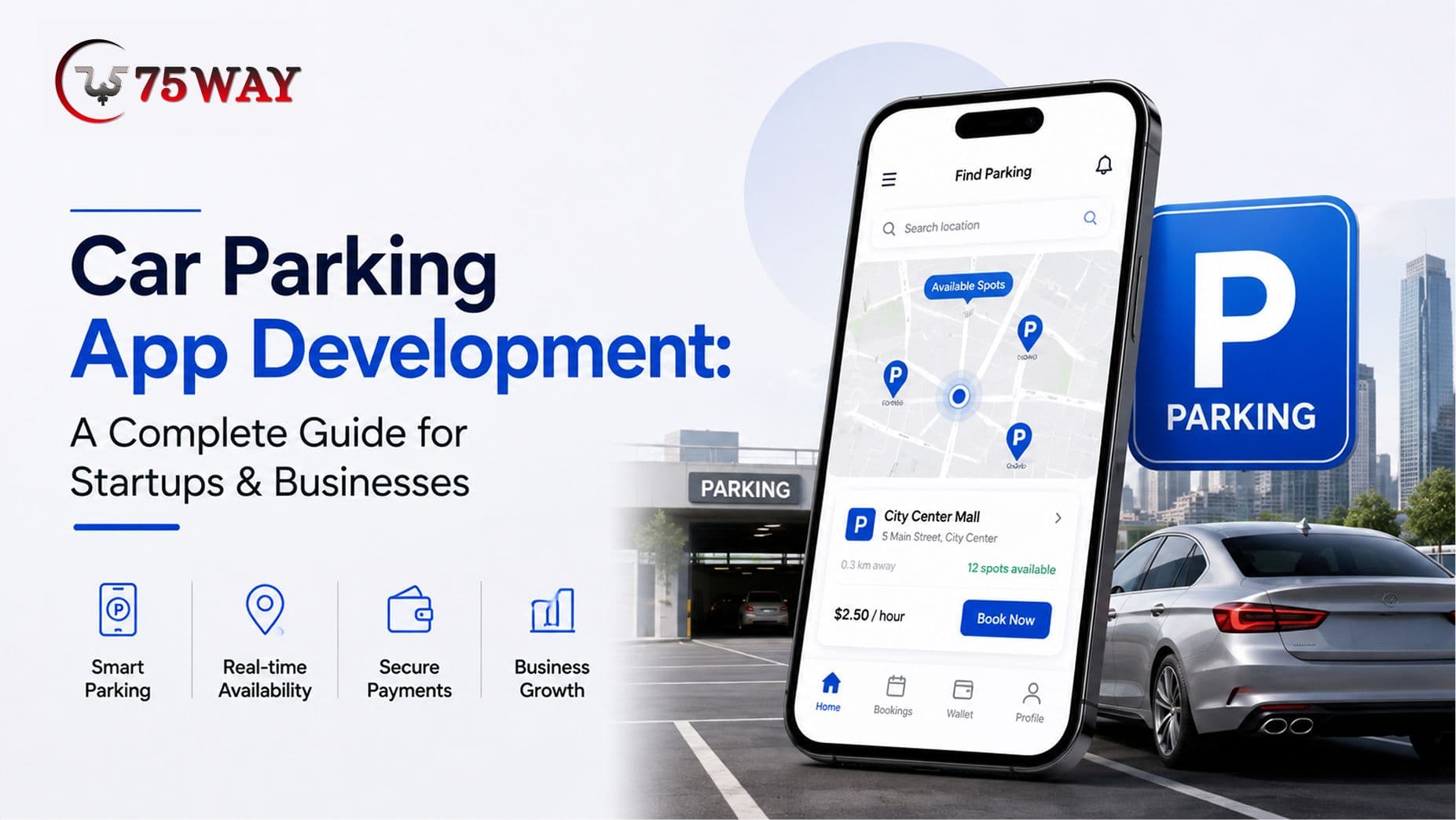
Car parking app development helps businesses connect drivers with available spaces through smarter digital experiences. The U.S. Parking Finder App market could reach $2,157.21 million by 2034, creating strong opportunities. Development costs typically range from $15,000–$150,000+, depending on complexity. This guide covers features, costs, process, technology, and monetization.
Key Takeaways
- Parking apps connect users with available spaces and reservations.
- Parking Finder Apps could reach $2,157.21 million by 2034.
- Parking app development costs range from $15,000–$150,000+ overall.
- Features, platforms, integrations, and complexity significantly influence development costs.
- Choosing the right parking model can influence growth and profitability.
Finding a parking spot should not feel like a scavenger hunt every time you drive into a busy area. Yet drivers still spend valuable time searching, while many parking businesses lack a simple digital way to expose availability, manage reservations, and keep customers informed.
A well-designed car parking app development solution can bring those two sides together by making parking easier. Such an app development for parking garages can bring those two sides together by making parking availability more visible and transactions easier to manage.
The product becomes more valuable when it handles the complete parking journey. Drivers should be able to find a suitable space, compare options, reserve it when available, navigate there, pay digitally, and receive timely updates without jumping between different services.
If you are planning to enter the parking technology market, an AI-powered car parking finder mobile app needs to be designed around both sides of the transaction. This guide walks through the car parking app development process, essential features, technology stack, integrations, costs, monetization strategies, and other factors involved in building a car parking app.
What Is Car Parking App Development?
Car parking app development is the process of creating mobile or web-based software that helps drivers discover, reserve, navigate to, and pay for parking while enabling parking businesses or operators to manage their inventory and transactions.
Depending on the business model, a parking platform can function as:
- A parking spot finder
- A parking reservation platform
- A parking garage finder
- A parking payment app
- A public parking finder
- A city parking finder
- A private parking marketplace
- A smart parking management platform
- An EV parking and charging platform
- A parking management system for garages and lots
The important distinction is that not every parking app needs the same architecture.
How Does a Car Parking App Work?
A typical parking platform works through several connected layers.
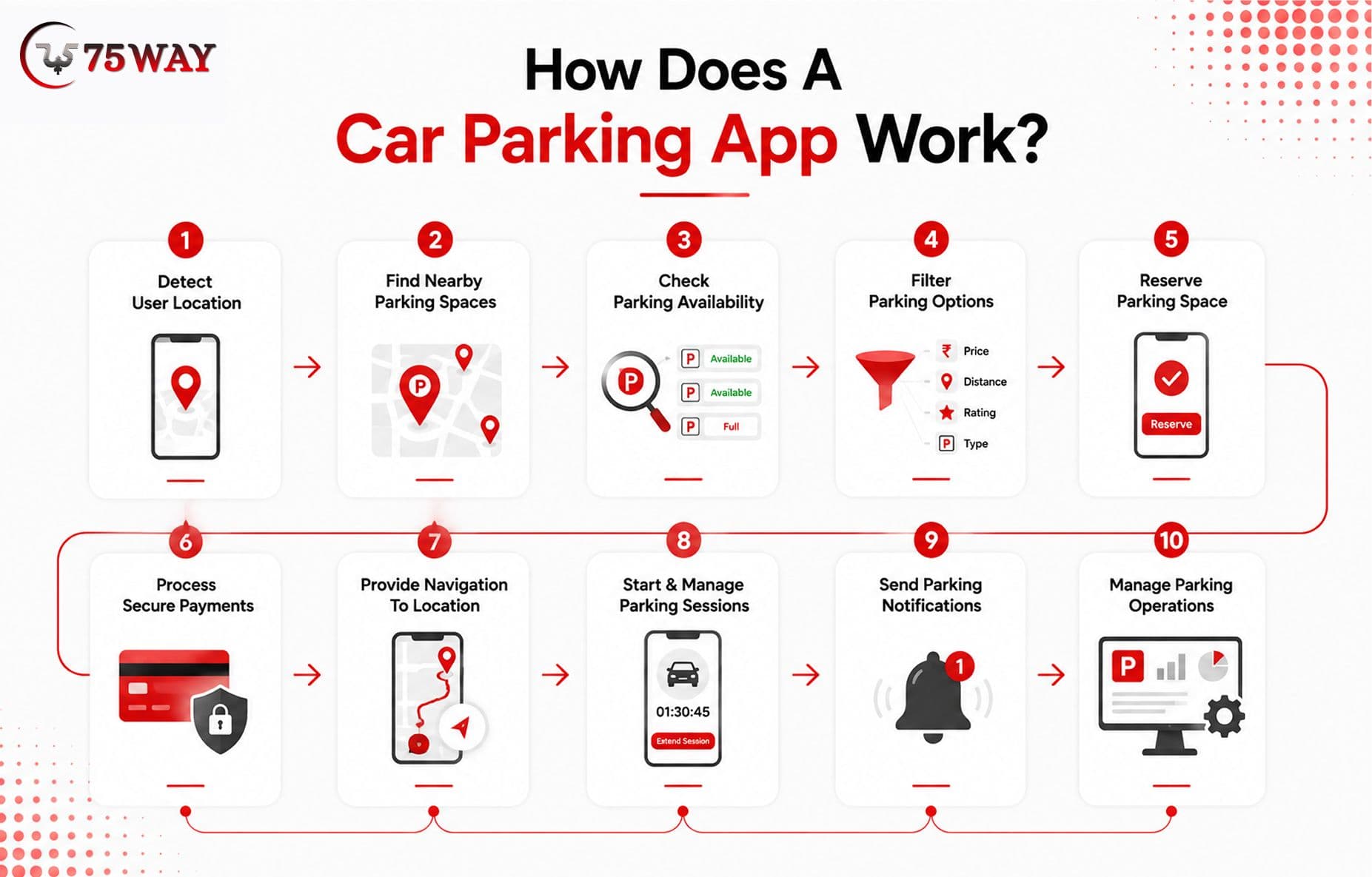
1. Detect User Location: The app identifies the driver's current location or destination.
2. Find Nearby Parking Spaces: The backend retrieves parking locations matching the user's search criteria.
3. Check Real-Time Parking Availability: The platform checks available inventory from operators, APIs, sensors, or other data sources.
4. Filter Parking Options: Users can narrow results based on price, distance, availability, EV charging, accessibility, hours, and other requirements.
5. Reserve A Parking Space: If advance booking is supported, the system temporarily holds or confirms the selected space.
6. Process Secure Payments: The customer completes payment through an integrated payment provider.
7. Provide Navigation To The Parking Location: The application provides directions to the selected parking location.
8. Start & Manage Parking Sessions: Depending on the product, the session may start manually, through geofencing, QR codes, license plate recognition, or garage integrations.
9. Send Parking Notifications: The user receives reminders about the parking session, expiration, reservation changes, or payment status.
10. Manage Parking Operations: Parking businesses can monitor bookings, inventory, revenue, occupancy, and customer activity through an administrative dashboard.
This architecture is why parking app development is more than a front-end mobile project. The reliability of the backend and parking-data layer directly affects the user experience.
Why Invest in Car Parking Finder App Development in the USA?
The U.S. parking market presents an opportunity for businesses that can make parking discovery, booking, and management easier for drivers and operators. However, market growth alone is not enough reason to develop a car parking finder app with AI integration. The stronger opportunity comes from solving specific parking problems.
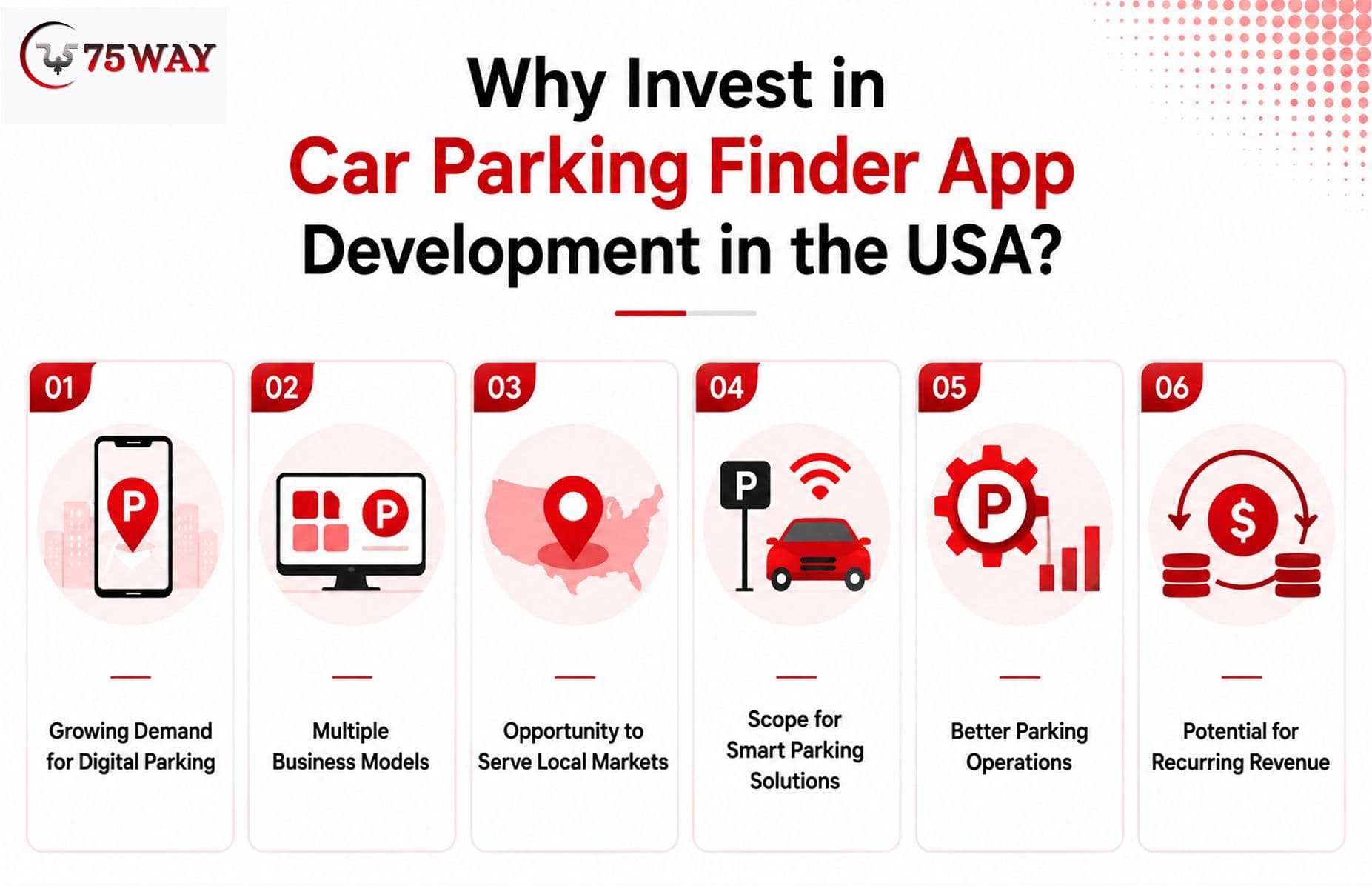
- Growing Demand for Digital Parking
Drivers increasingly expect to search, compare, reserve, and pay for services through their smartphones. A parking application can bring these activities into one platform instead of requiring users to rely on multiple websites, meters, or physical payment methods.
- Multiple Business Models
A parking app can support different revenue models depending on the target market. Businesses can earn through booking commissions, transaction fees, subscriptions, parking management software, promoted listings, or B2B partnerships.
- Opportunity to Serve Local Markets
A new parking platform does not need to compete nationally from day one. Businesses can start with a specific city, airport, downtown district, university, event venue, or parking category.
A focused launch can make it easier to build parking supply, understand local demand, establish partnerships, and improve the product using actual customer behavior.
- Scope for Smart Parking Solutions
Modern parking platforms can go beyond basic space discovery. Businesses can integrate real-time availability, IoT sensors, and automated access systems where the required infrastructure is available.
This creates opportunities to build specialized solutions for parking garages, municipalities, commercial properties, airports, campuses, and other high-demand locations.
- Better Parking Operations
The opportunity is not limited to drivers. Parking operators can use dedicated dashboards to manage spaces, reservations, pricing, occupancy, payments, customer activity, and performance data.
This makes a parking platform potentially valuable on both sides of the marketplace: drivers receive a more convenient parking experience, while operators gain tools for managing and monetizing their inventory.
- Potential for Recurring Revenue
Unlike a simple one-time utility, parking platforms can generate recurring transactions. Repeat bookings, monthly parking plans, operator subscriptions, corporate accounts, and parking management services can create multiple revenue opportunities.
For startups and established businesses, this makes parking booking app development particularly relevant when the underlying parking inventory and customer demand can support repeat usage.
A strong opportunity could involve a focused parking niche, underserved geographic market, specialized customer segment, or technology-enabled parking workflow. Validating that opportunity before investing heavily in development can reduce unnecessary costs and create a clearer path toward product-market fit.
Market Size & Growth Opportunities of Parking App Development in United States
A parking space has value only when someone can find it and actually use it. That simple idea is creating an interesting business opportunity for parking operators, property owners, and entrepreneurs looking to make parking more convenient and commercially useful. The U.S. market size, growth potential, and opportunities worth exploring are covered here.
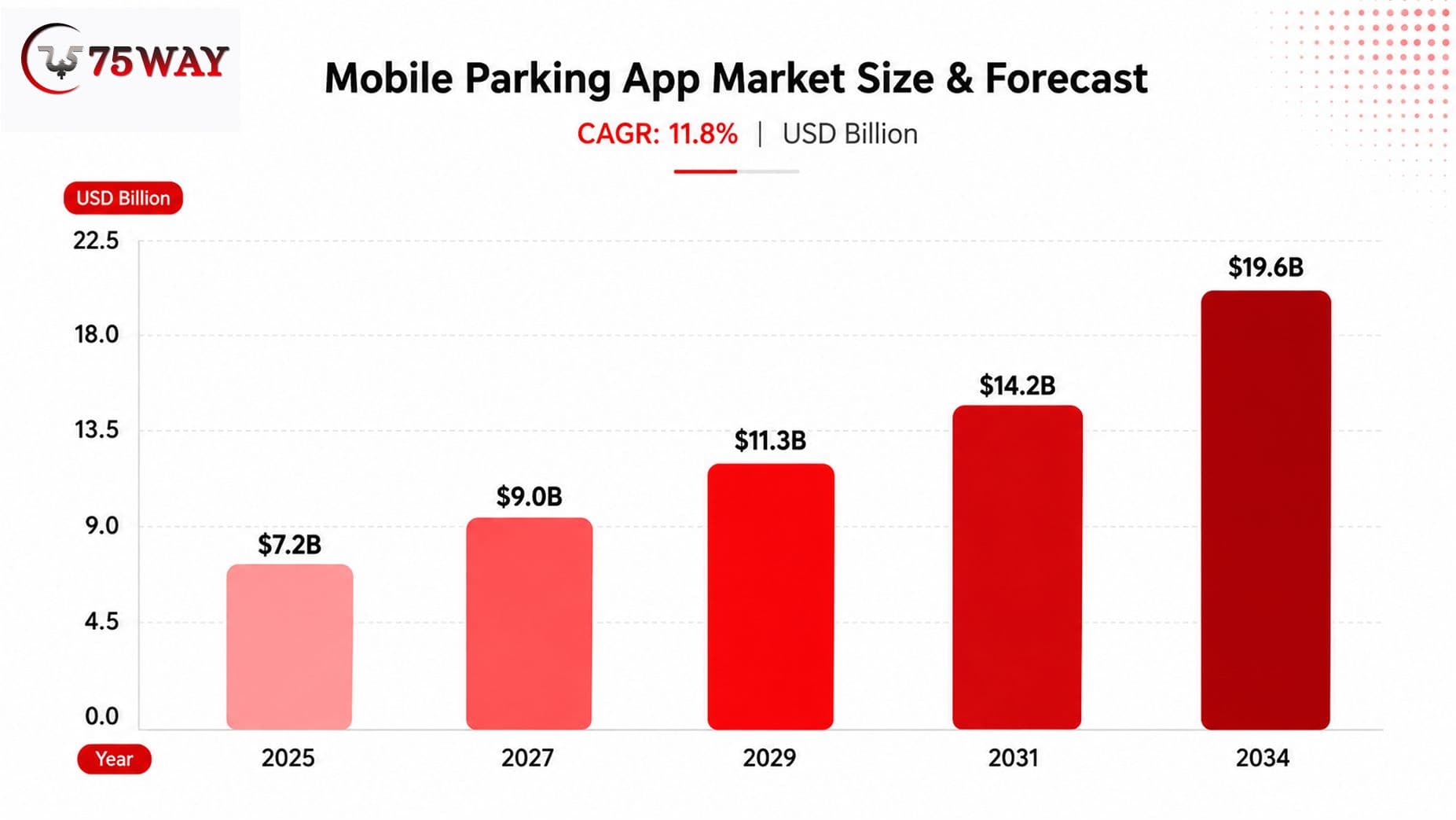
1. Market Growth & Opportunity
- The global mobile parking app market is projected to reach $19.6 billion by 2034, expanding at a CAGR of 11.8%.
- By 2035, the global parking finder apps market is projected to reach $2,648.4 million at 17.6% CAGR.
2. Market Segments & Regional Demand
- Free Version apps are likely to account for 62.5% share of the app type segment.
- North America held a dominant market position, capturing more than a 36.4% share, holding $160.5 million in revenue.
- On-street parking led with 34.4% share, supported by high demand in urban areas with limited parking spaces.
- Mobile applications (iOS & Android captured 68.3% share, as users preferred easy-to-use apps with real-time updates.
3. Smart Parking Impact
- Automated parking systems can reduce parking space needs by up to 50%, while smart parking solutions are capable of cutting search time by 40%.
What Types of Car Parking Apps Can Businesses Develop?
Before starting car parking app development, you should define the type of platform you want to build because each category requires different features, integrations, revenue models, and technical architecture.
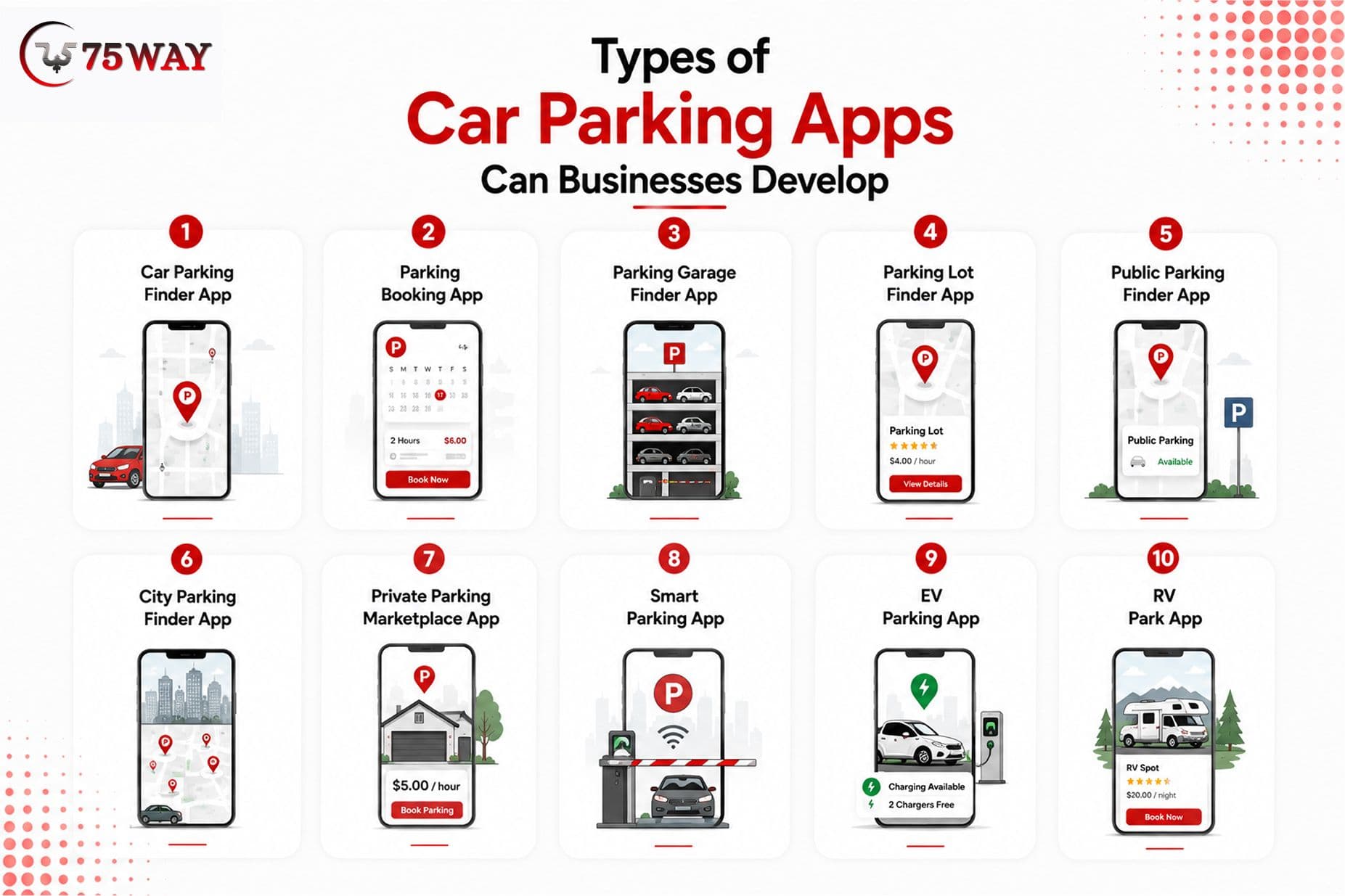
1. Car Parking Finder App
A parking finder app helps drivers locate available or nearby parking spaces based on their destination, current location, preferred price, parking duration, and vehicle requirements.
The car parking finder app development solution usually displays parking locations on an interactive map and may provide information about distance, pricing, availability, user reviews, and navigation. Its primary purpose is to make parking discovery faster and more convenient.
Famous U.S.-related examples include SpotHero, ParkWhiz, and BestParking. These platforms help users search for parking locations, compare prices, and view parking options near destinations such as airports, downtown areas, stadiums, and event venues.
Estimated Cost: $30,000-$150,000+
2. Parking Booking App
A parking booking app lets drivers reserve a parking space before reaching their destination, making it useful when parking demand is high or availability is limited. Users can select parking dates, time slots, duration, vehicle details, and payment preferences while receiving digital booking confirmation.
SpotHero, ParkWhiz, and Way.com are relevant examples of reservation-focused parking platforms, giving customers the ability to book parking ahead of arrival at airports, stadiums, downtown areas, and event venues.
Estimated Cost: $45,000-$200,000+
3. Parking Garage Finder App
A parking garage finder app is designed specifically for drivers who prefer structured parking facilities over street spaces or open lots. It can help users compare garages using location, rates, operating hours, height restrictions, amenities, availability, and distance from their destination.
Platforms such as Parkopedia, BestParking, and SpotHero provide garage discovery capabilities across U.S. locations, helping motorists evaluate facilities and identify parking options that fit their trip.
Estimated Cost: $35,000-$180,000+
4. Parking Lot Finder App
A parking lot finder app makes it easier to locate open-air parking lots near shopping centers, airports, offices, entertainment venues, and other destinations. Users can evaluate nearby lots according to price, distance, capacity, operating hours, and parking conditions before choosing where to park.
BestParking, SpotHero, and ParkWhiz apps feature numerous surface lots in their parking inventories, allowing drivers to compare locations and choose convenient spaces around busy destinations.
Estimated Cost: $30,000-$150,000+
5. Public Parking Finder App
A public parking finder app brings information about municipal and publicly accessible parking into a single mobile experience. Depending on the city, users may be able to locate public garages, parking meters, municipal lots, street parking, payment zones, accessible spaces, and applicable parking rules.
ParkMobile, Passport Parking, and PayByPhone serve numerous municipalities, supporting mobile parking payments and other services associated with publicly managed parking facilities and city transportation systems.
Estimated Cost: $40,000-$250,000+
6. City Parking Finder App
A city parking finder app concentrates on the parking needs of one particular city or metropolitan area instead of attempting nationwide coverage. It can combine local parking facilities, street-parking information, rates, regulations, payment services, availability, reservations, alerts, and navigation in one platform.
Examples such as ParkNYC, LA Express Park, and SFMTA parking services show how parking technology can be developed around the specific infrastructure, regulations, and transportation requirements of individual U.S. cities.
Estimated Cost: $40,000-$300,000+
7. Private Parking Marketplace App
A private parking marketplace connects people who have unused parking spaces with drivers looking for short-term or long-term parking. Owners can list spaces such as driveways, garages, private lots, and commercial spaces, while drivers can search, compare, book, and pay for available options.
Marketplace models such as Neighbor, Spacer, and AirGarage connect parking supply from property owners and businesses with drivers seeking convenient spaces.
Estimated Cost: $50,000-$250,000+
8. Smart Parking App
A smart parking app combines parking software with connected infrastructure to automate and improve parking operations. Depending on the implementation, it can work with occupancy sensors, cameras, license plate recognition, parking gates, digital meters, access-control systems, and automated payment technologies.
Flowbird, ParkMobile, and Passport Parking illustrate different approaches to technology-enabled parking, including digital payments, connected meters, parking management, and smart infrastructure services.
Estimated Cost: $70,000-$500,000+
9. EV Parking App
An EV parking app helps electric vehicle owners find locations where they can park and charge their vehicles. Search functionality can include charger type, connector compatibility, charging speed, availability, parking fees, charging rates, operating hours, and distance from the destination.
ChargePoint, PlugShare, and Electrify America offer examples of digital platforms that help drivers locate charging infrastructure, evaluate station details, plan trips, and manage charging services.
Estimated Cost: $50,000-$300,000+
10. RV Park App
An RV park app caters to recreational vehicle travelers searching for suitable places to stay or park during their journeys. Along with location and availability, users may need information about site dimensions, hookups, campground facilities, pet policies, vehicle restrictions, pricing, reviews, and route accessibility.
Campendium, RV LIFE, and The Dyrt represent established U.S. RV travel platforms where users can research campgrounds and RV parks, compare amenities, read traveler feedback, plan routes, and identify suitable places to stay.
Estimated Cost: $40,000-$220,000+
Essential Features Required For Parking Booking App Development
The right features depend on whether you are building a parking finder, booking marketplace, garage management platform, or smart parking solution. However, a commercially viable car parking app development project should make the core journey simple: find a suitable space, understand the cost and availability, reserve or pay when required, and reach the location without unnecessary friction.
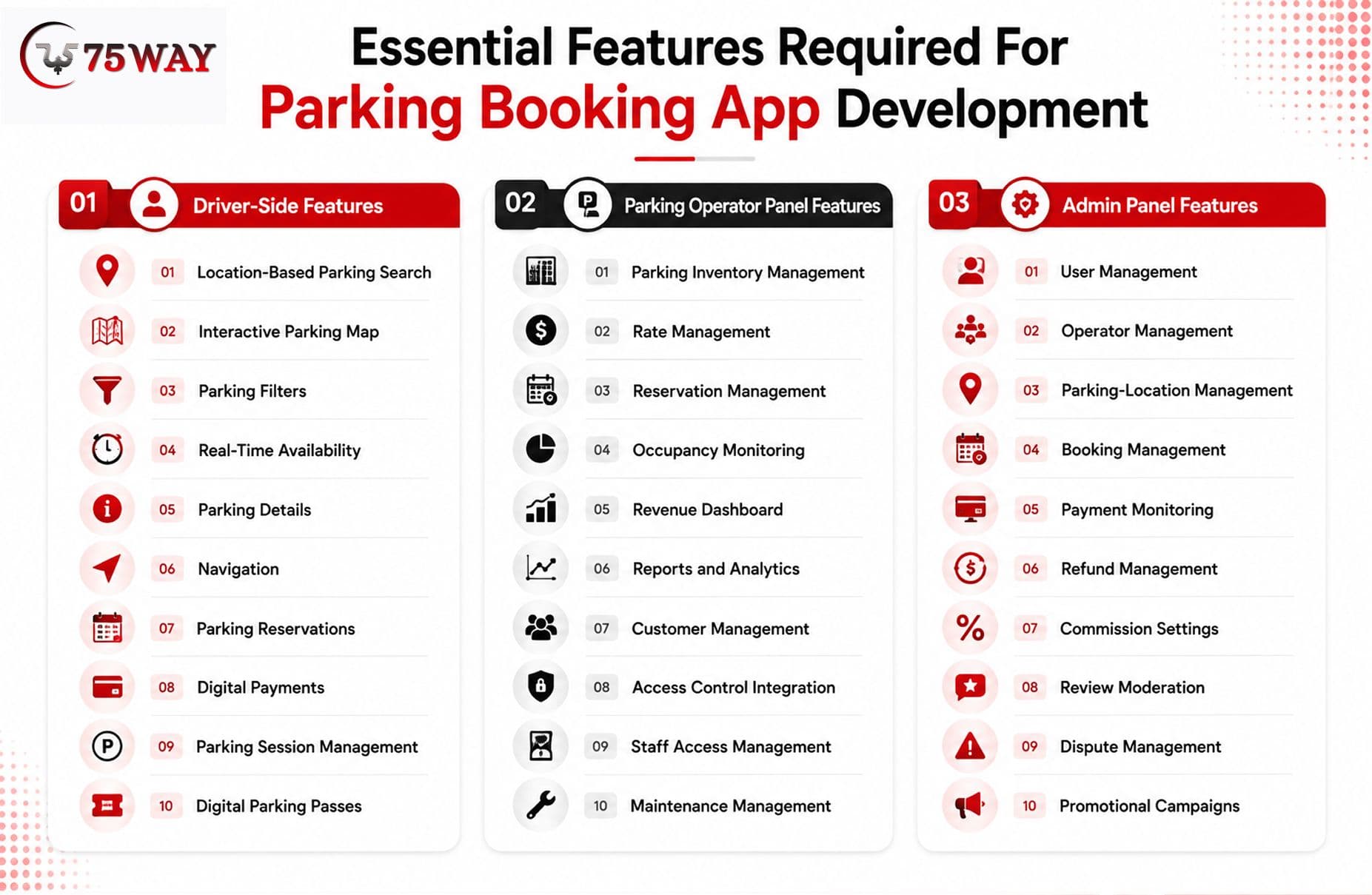
1. Driver-Side Features
- Location-Based Parking Search
GPS-based search allows users to discover parking around their current position or a selected destination. Manual address search should also be available for users planning a trip before leaving home.
- Interactive Parking Map
A map gives users a visual view of nearby parking facilities and their relative locations. Markers can display essential information such as parking type, distance, price, and availability without forcing users to open every listing.
- Parking Filters
Filtering helps users narrow down a large number of options according to their actual requirements. Useful filters can include: price range, distance, parking type, EV charging, and reservation availability.
- Real-Time Availability
If reliable live data is available, the application can show whether parking spaces are currently available. This information may come from parking operators, APIs, sensors, cameras, or connected parking systems.
- Parking Details
Each listing should give drivers enough information to make a decision before they arrive. Depending on the parking facility, details can include rates, operating hours, entrance information, restrictions, amenities, height limits, EV charging, accessibility, and cancellation policies.
- Navigation
Once a user selects a parking location, the application can provide directions through integrated mapping services. Advanced solutions can also provide garage entrance information or other location-specific instructions when reliable data is available.
- Parking Reservations
Reservation functionality allows users to secure parking for a defined period. The system should manage inventory, booking confirmation, cancellation rules, extensions, and availability updates to prevent conflicting reservations.
- Digital Payments
Users should be able to pay through supported digital payment methods without unnecessary steps. Depending on the market and business model, the application can support cards, digital wallets, saved payment methods, and other payment options.
- Parking Session Management
A parking application can allow users to start, monitor, extend, or end parking sessions. The exact workflow depends on how the parking facility handles access and session tracking.
- Digital Parking Passes
For facilities that support advance reservations, the application can provide a digital pass, QR code, booking number, or other access credential. This can reduce dependence on printed tickets and simplify entry procedures.
2. Parking Operator Panel Features
A parking platform also needs functionality for the businesses supplying the parking inventory.
- Parking Inventory Management
Operators can add facilities, manage available spaces, update parking details, set operating hours, and control which inventory is available for booking.
- Rate Management
Parking businesses can define hourly, daily, monthly, event-based, or other pricing structures. More advanced platforms can support predefined dynamic pricing rules.
- Reservation Management
Operators should be able to view upcoming bookings, check customer details, manage cancellations, update availability, and handle operational exceptions.
- Occupancy Monitoring
Where data integrations are available, operators can monitor occupancy and parking utilization through dashboards. This can help identify demand patterns and improve inventory planning.
- Revenue Dashboard
A business dashboard can display bookings, revenue, transaction volume, refunds, commissions, and other financial metrics relevant to the parking operation.
- Reports and Analytics
Analytics can help operators understand occupancy trends, peak periods, popular parking locations, booking behavior, and revenue performance.
- Customer Management
Operators can view customer profiles, booking history, parking activity, and support requests from one dashboard. This helps parking businesses manage recurring customers, resolve booking issues, and deliver more personalized services.
- Access Control Integration
Integration with gates, QR scanners, license plate recognition, or other access systems can automate entry and exit at supported facilities. This reduces manual verification and creates a smoother parking experience for both drivers and operators.
- Staff Access Management
Assign role-based permissions to staff, controlling access to bookings, pricing, inventory, reports, and customer information.
- Maintenance Management
Mark parking spaces unavailable during maintenance, repairs, cleaning, or temporary closures to prevent incorrect bookings.
3. Admin Panel Features
The central admin panel gives the platform owner control over the entire ecosystem. Important capabilities can include:
- User Management
Centralize customer accounts, activity records, profile information, account restrictions, and support-related actions for smoother platform administration.
- Operator Management
Handle operator onboarding, verification, account approvals, permissions, and performance monitoring from a single dashboard.
- Parking-Location Management
Add, update, approve, or remove parking facilities while maintaining information such as pricing, operating hours, amenities, and availability.
- Booking Management
Track reservations, monitor booking statuses, process cancellations, and address booking-related issues across different parking locations.
- Payment Monitoring
Keep track of completed, pending, and failed transactions, along with commissions, fees, and other payment-related activities.
- Refund Management
Review refund requests, verify eligibility, process approved refunds, and monitor their status until completion.
- Commission Settings
Configure platform fees, operator commissions, transaction charges, and revenue-sharing rules according to the selected business model.
- Review Moderation
Maintain trustworthy ratings by reviewing reported feedback, removing inappropriate submissions, and managing potentially misleading reviews.
- Dispute Management
Provide a centralized workflow for resolving conflicts related to bookings, payments, cancellations, operators, or customer complaints.
- Promotional Campaigns
Create discount codes, location-based offers, referral incentives, and seasonal promotions to encourage bookings and improve customer retention.
Advanced Features for Competitive Parking Platforms
Once the core product is validated, additional capabilities can differentiate the platform.
AI Parking Prediction
Machine learning can analyze historical occupancy, time patterns, events, traffic, and other variables to estimate future parking availability.
License Plate Recognition
LPR can identify vehicles at supported facilities and connect entry or exit activity with a parking session, reducing manual interaction.
IoT Parking Sensors
In IoT-driven car parking apps, connected sensors can detect occupancy at individual parking spaces and transmit status information to the application or operator dashboard.
Dynamic Pricing
Parking operators can adjust rates according to demand, occupancy, time, events, or predefined pricing rules.
EV Charging Integration
The platform can combine parking discovery with charger availability, connector information, charging status, and charging payments.
AI Parking Assistant
A custom chatbot can allow users to search for parking using natural-language requests such as, “Find affordable parking near downtown after 6 PM.” When connected to current parking inventory, the AI assistant can return options matching the user's requirements.
Must-Have Vs. Advanced Features For Parking Garage Finder App Development
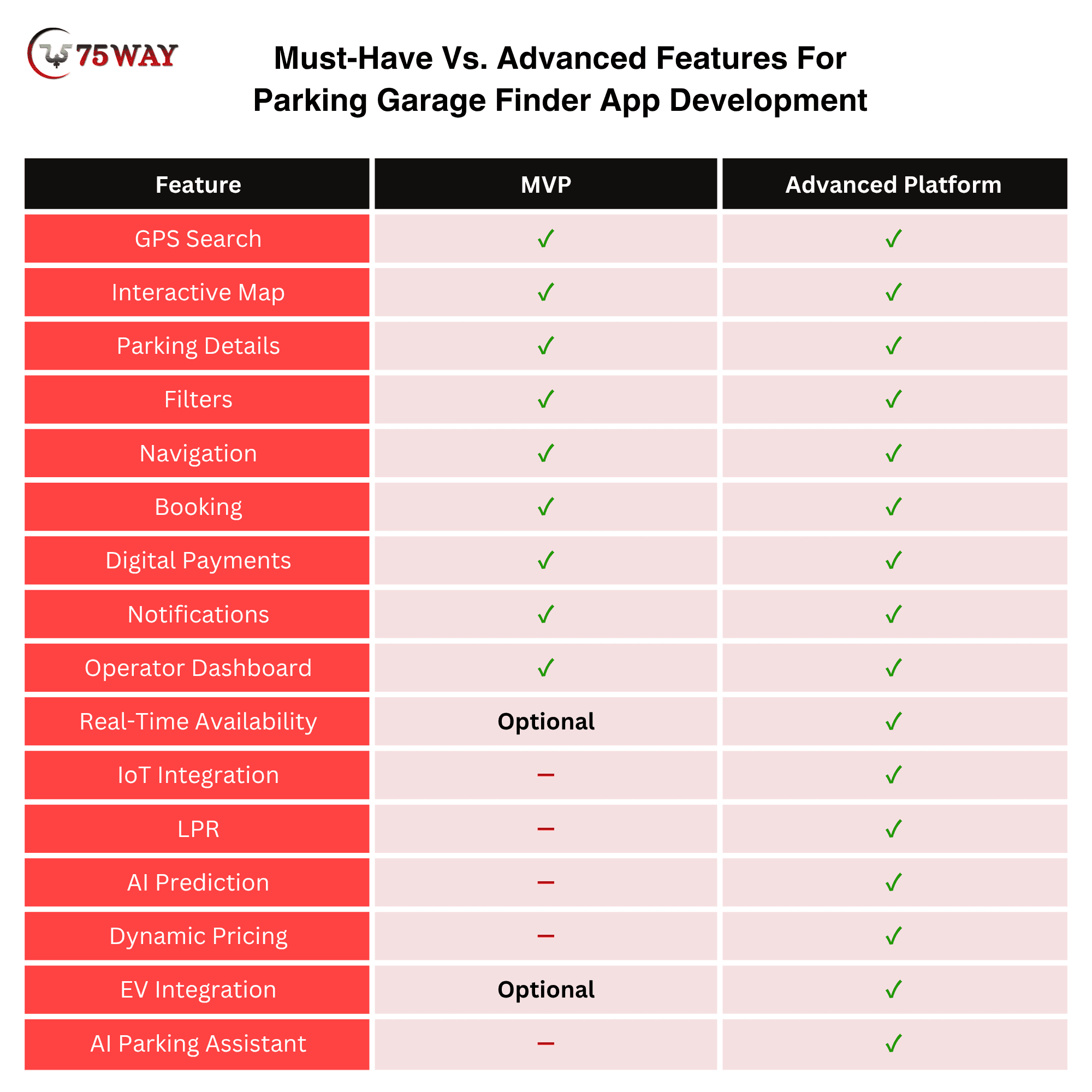
The goal should not be to launch with every available capability. For most startups, a focused MVP with reliable search, parking information, availability, booking, payment, navigation, and operator tools provides a stronger foundation. Advanced features should be introduced when they solve a demonstrated customer or operational problem.
How To Develop Car Parking Finder App: Comprehensive Process
Imagine opening an app, seeing nearby parking options, choosing one that fits your needs, and knowing where to go before you reach the destination. Creating that experience requires more than putting parking pins on Google Maps. The complete car parking app development process explains what needs to happen behind that simple user journey.
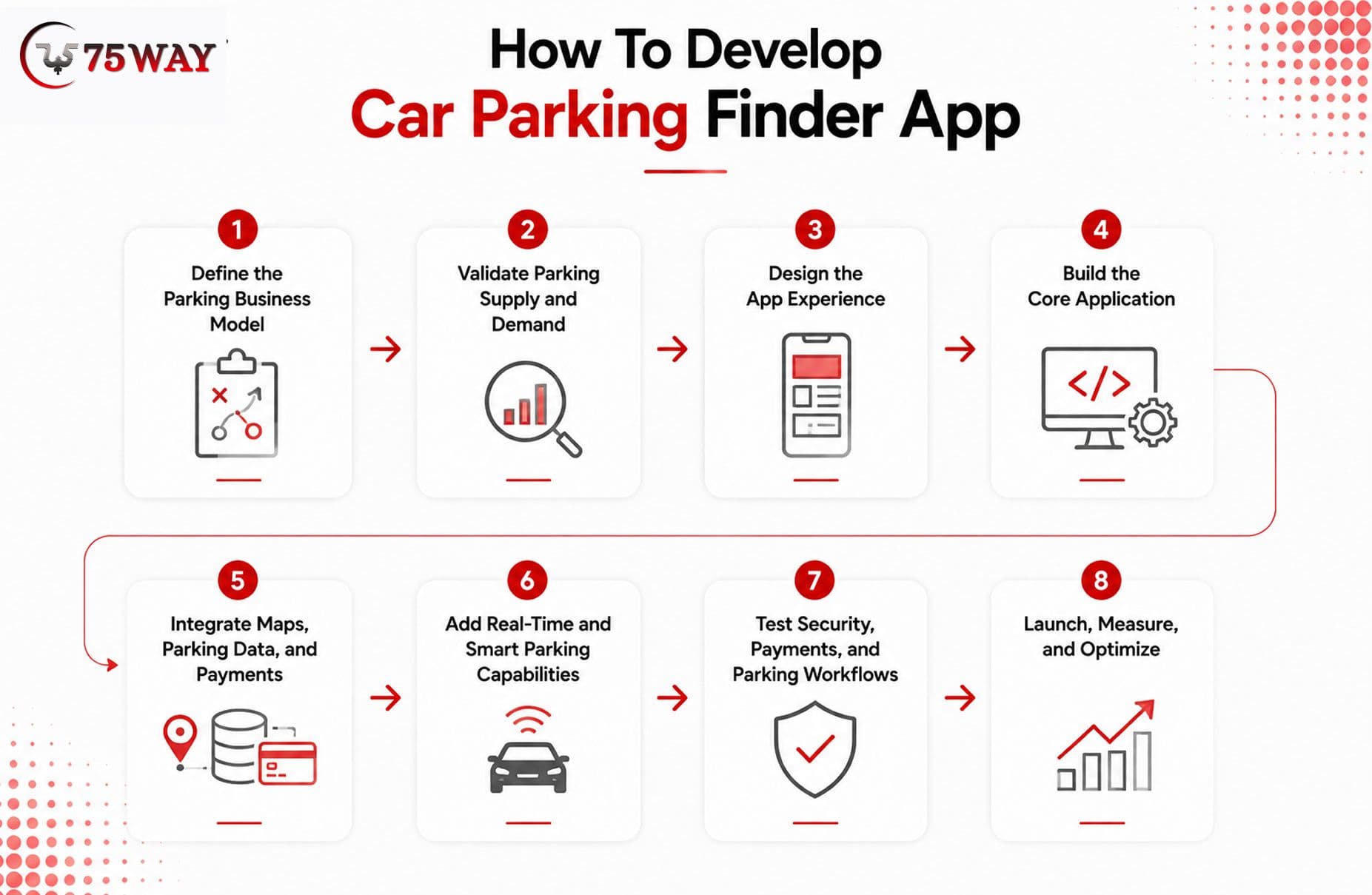
1. Define the Parking Business Model
A well-defined business model determines the commercial direction of the parking platform before technical decisions begin. This stage identifies the target users, parking problem, geographic market, revenue model, parking inventory, and value proposition.
A startup may target drivers, parking operators, municipalities, property owners, or businesses, with each audience requiring a different product strategy.
2. Validate Parking Supply and Demand
Market validation establishes whether the proposed parking solution has enough supply, demand, and commercial potential to justify development.
Research should cover competitor offerings, target locations, parking availability, customer behavior, pricing, operator partnerships, and local market conditions. The outcome should be a validated opportunity with clearly defined users, parking sources, and an initial market-entry strategy.
3. Design the App Experience
A validated product strategy provides the foundation for designing user journeys that match real parking scenarios.
This stage translates business requirements into driver, operator, and administrator workflows, showing how each user moves through the platform. Wireframes and prototypes help identify unnecessary steps, confusing interactions, and workflow gaps before those issues become expensive development changes.
4. Build the Core Application
A scalable technical architecture forms the foundation for the application's main functionality and future expansion.
Development covers the mobile application, backend, database, APIs, operator panel, and administration system required by the approved product scope. The architecture should support parking listings, availability, reservations, payments, user accounts, and operational data without creating unnecessary complexity for the MVP.
5. Integrate Maps, Parking Data, and Payments
Reliable external integrations connect the application with the services required to deliver an end-to-end parking experience.
Mapping enables location discovery and navigation, while parking data supplies information about spaces, prices, and availability. Payment integrations handle transactions, and reservation synchronization keeps inventory accurate when bookings, cancellations, extensions, or releases occur.
6. Add Real-Time and Smart Parking Capabilities
The validated MVP architecture can later support advanced parking technologies when business requirements justify their cost and complexity. Real-time occupancy, IoT sensors, LPR, EV charging, AI prediction, dynamic pricing, and automated access can improve parking operations and customer convenience.
This stage should prioritize technologies according to measurable outcomes rather than adding advanced features without sufficient data or infrastructure.
7. Test Security, Payments, and Parking Workflows
A production-ready parking platform requires validation across technical, financial, operational, and user-facing scenarios.
Testing confirms that availability, reservations, payments, refunds, navigation, notifications, APIs, and operator workflows behave correctly under normal and unexpected conditions.
Security and performance testing are equally important because the platform handles accounts, transactions, location information, and potentially vehicle-related data.
8. Launch, Measure, and Optimize
A controlled market launch turns the developed product into a measurable business experiment rather than treating deployment as the final development milestone.
Initial performance should be evaluated through booking conversion, search behavior, repeat usage, cancellations, payment success, customer acquisition, and operator participation.
These insights reveal where the product needs improvement and provide evidence for expansion into new locations, customer segments, and capabilities.
What Technology Stack Is Required for Parking Spot Finding App Development?
The moment a driver searches for parking, the app has to do several things quickly: identify their location, find relevant spaces, check availability, calculate routes, and present useful options. That experience depends heavily on the technology chosen underneath the interface. The core technologies and integrations required for parking spot-finding app development are explained below.
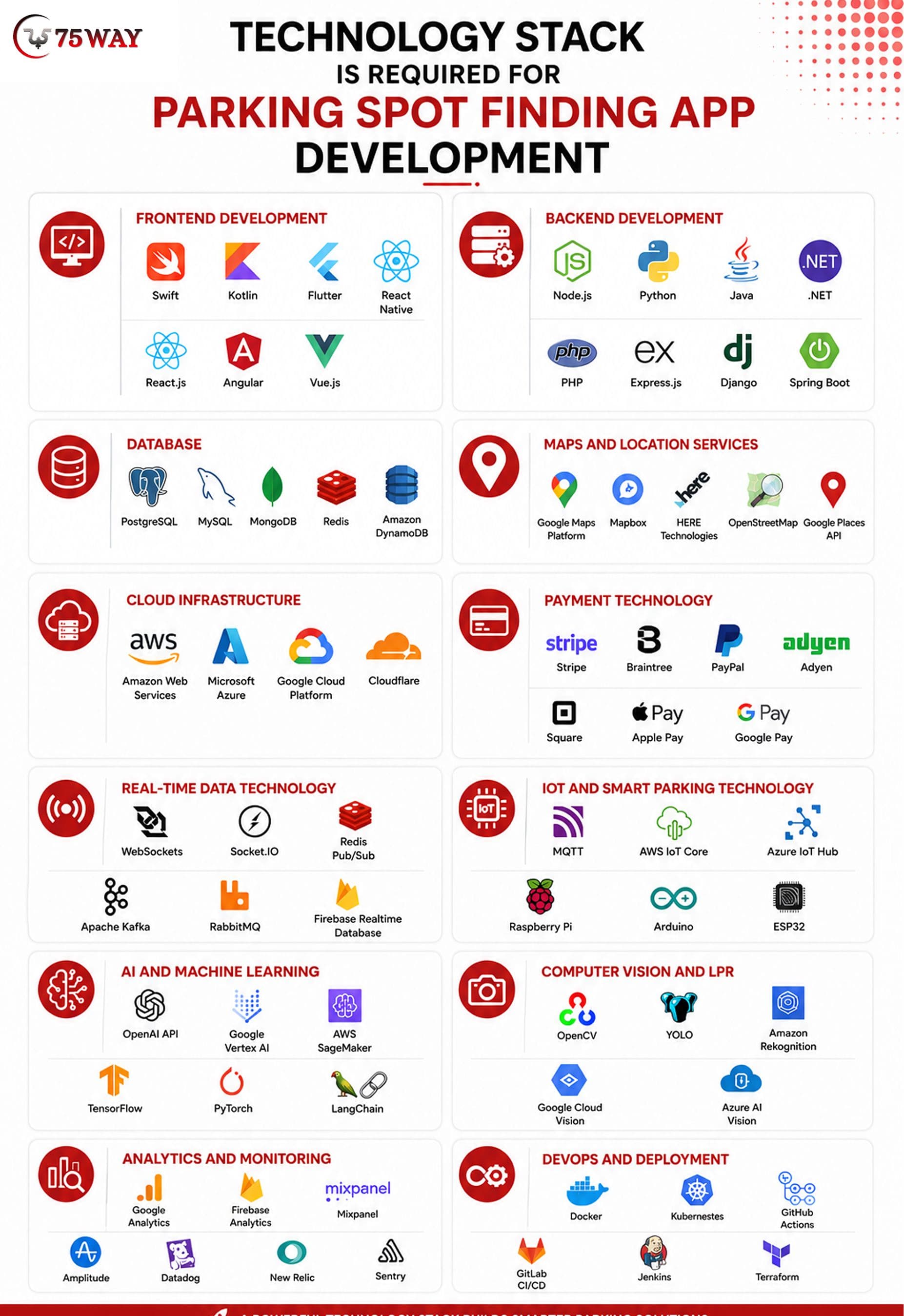
Frontend Development: Swift, Kotlin, Flutter, React Native, React.js, Angular, Vue.js
Create responsive interfaces for drivers, parking operators, and administrators across mobile and web platforms.
Backend Development: Node.js, Python, Java, .NET, PHP, Express.js, Django, Spring Boot
Process application logic, manage APIs, handle bookings, synchronize availability, and coordinate backend parking operations.
Database: PostgreSQL, MySQL, MongoDB, Redis, Amazon DynamoDB
Store users, parking locations, reservations, transactions, availability, operator records, reviews, and application data securely.
Maps and Location Services: Google Maps Platform, Mapbox, HERE Technologies, OpenStreetMap, Google Places API
Provide maps, geolocation, route planning, geocoding, distance calculations, navigation, and location-based parking discovery.
Cloud Infrastructure: Amazon Web Services, Microsoft Azure, Google Cloud Platform, Cloudflare
Provide hosting, storage, databases, networking, monitoring, security, and scalable infrastructure for parking applications.
Payment Technology: Stripe, Braintree, PayPal, Adyen, Square, Apple Pay, Google Pay
Process parking transactions, refunds, saved payment methods, recurring charges, commissions, and operator payouts securely.
Real-Time Data Technology: WebSockets, Socket.IO, Redis Pub/Sub, Apache Kafka, RabbitMQ, Firebase Realtime Database
Synchronize availability, occupancy, bookings, pricing, and parking-session updates across connected application users.
IoT and Smart Parking Technology: MQTT, AWS IoT Core, Azure IoT Hub, Raspberry Pi, Arduino, ESP32
Connect parking sensors and devices, transmitting occupancy, access, and infrastructure data between physical systems.
AI and Machine Learning: OpenAI API, Google Vertex AI, AWS SageMaker, TensorFlow, PyTorch, LangChain
These tools support availability prediction, demand forecasting, recommendations, conversational assistants, computer vision, and intelligent parking automation.
Computer Vision and LPR: OpenCV, YOLO, Amazon Rekognition, Google Cloud Vision, Azure AI Vision
These technologies analyze camera feeds to detect vehicles, recognize plates, identify occupancy, and automate parking access workflows.
Analytics and Monitoring: Google Analytics, Firebase Analytics, Mixpanel, Amplitude, Datadog, New Relic, Sentry
Measure user behavior, application performance, errors, conversions, retention, and operational activity after deployment.
DevOps and Deployment: Docker, Kubernetes, GitHub Actions, GitLab CI/CD, Jenkins, Terraform
Automate development, testing, deployment, infrastructure management, scaling, and reliable application delivery across environments.
How Much Does It Cost To Develop A Parking App?
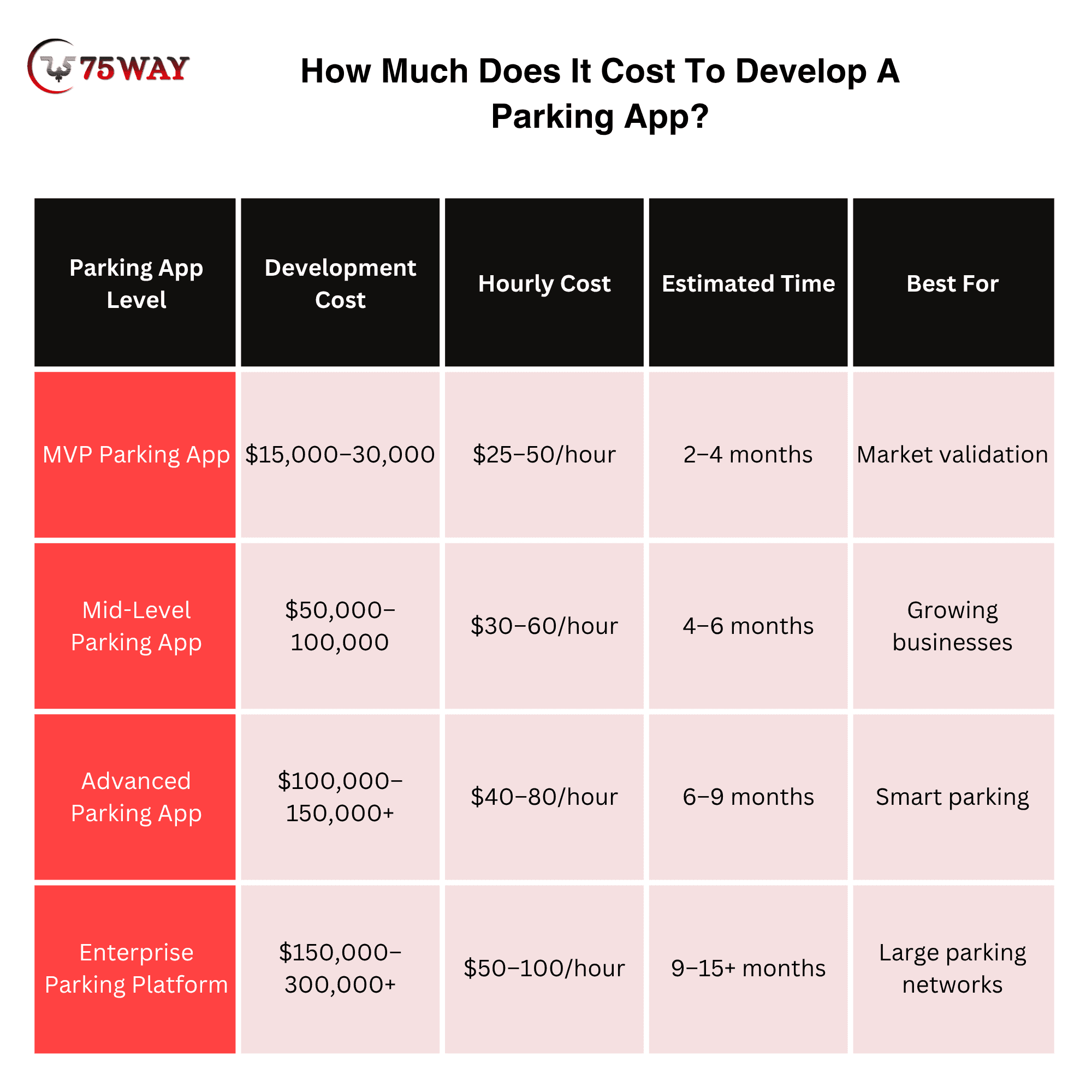
The car parking app development cost generally falls between $15,000 and $150,000+, depending on the product scope and team expertise. A simple parking finder with basic maps and listings requires far less investment than a platform using real-time availability, IoT sensors, AI, or automated license plate recognition.
1. MVP Car Parking App Cost
A basic MVP focuses on helping users discover parking without complex automation or infrastructure. Typical functionality includes interactive maps, static parking listings, basic search and filters, location detection, and manually managed parking information.
Estimated Cost: $15,000 – $30,000
2. Mid-level Parking App Cost
A mid-term car parking application adds functionality for booking parking spaces and processing transactions. The scope can include real-time slot booking, user profiles, secure payment gateways such as Stripe or PayPal, booking confirmations, push notifications, cancellation management, and parking history.
Estimated Cost: $50,000 – $100,000
3. Advanced App Cost
A smart parking platform requires significantly more technology because it connects the application with real-world parking infrastructure. Features may include IoT sensor synchronization, real-time empty-space detection, automated license plate recognition (ALPR/ANPR), occupancy monitoring, dynamic pricing, and intelligent parking management.
Estimated Cost: $100,000 – $150,000+
4. Enterprise-Level Parking Platform Cost
A large-scale parking platform serving multiple cities, operators, or parking networks can require a substantially larger investment. The architecture may need multi-location inventory management, real-time data processing, third-party integrations, and scalable cloud infrastructure.
Estimated Cost: $150,000 – $300,000+
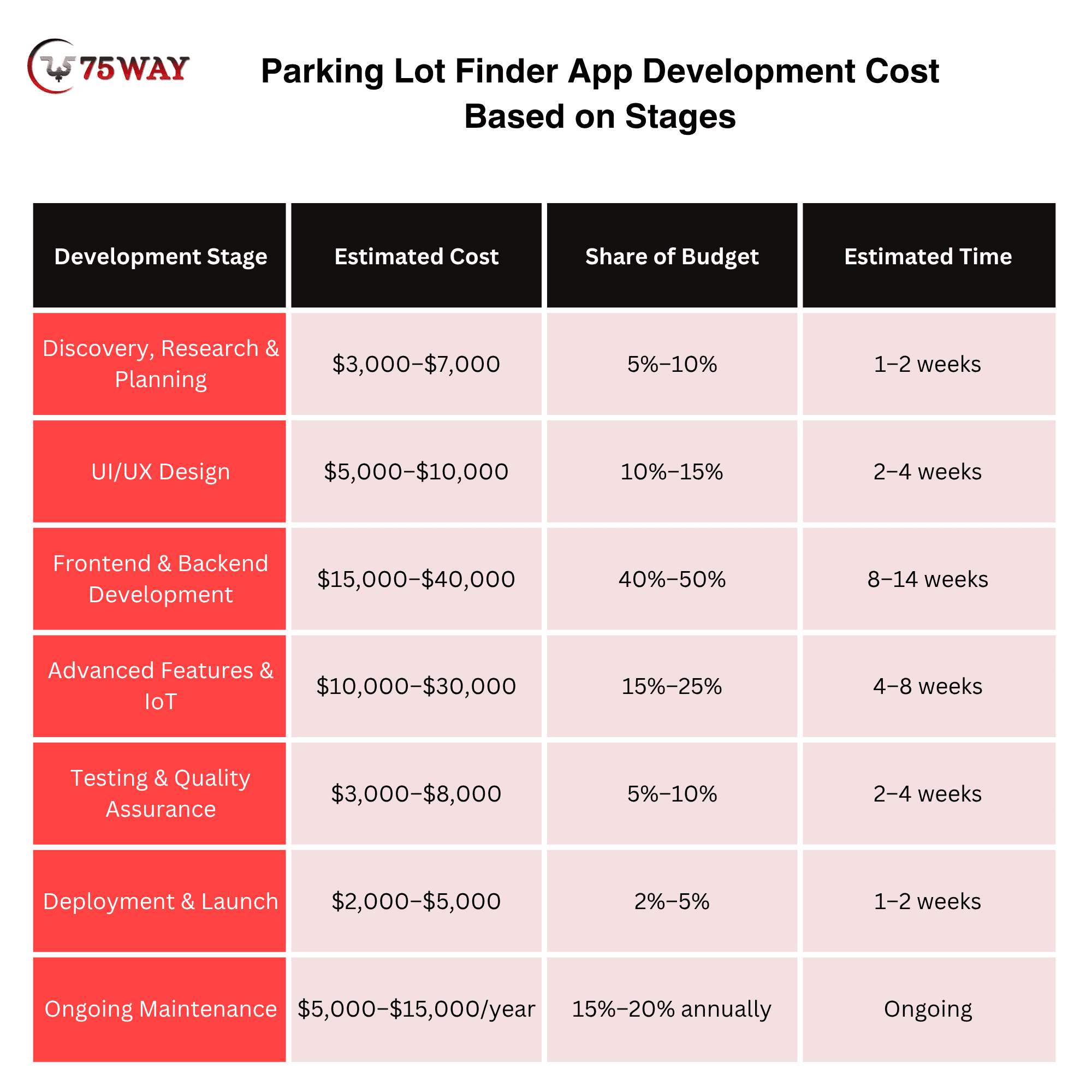
Parking Lot Finder App Development Cost Based on Stages
The total budget also depends on how much work is required at each stage of the development lifecycle.
1. Discovery, Research & Planning
Market research, defining project scope, user personas, and technical specifications.
Estimated Cost: $3,000 – $7,000
2. UI/UX Design
Wireframing, user journey maps, branding, and interactive prototypes for driver and owner interfaces.
Estimated Cost: $5,000 – $10,000
3. Frontend & Backend Development
Core programming, database architecture, API integrations (Google Maps, payment gateways), and admin panel creation.
Estimated Cost: $15,000 – $40,000
4. Advanced Features & IoT
Real-time slot tracking, hardware sensor syncing, or automated license plate recognition (ANPR).
Estimated Cost: $10,000 – $30,000
5. Testing & Quality Assurance
Manual and automated bug testing, security checks, and performance optimization.
Estimated Cost: $3,000 – $8,000
6. Deployment & Launch
Publishing to the Apple App Store and Google Play Store.
Estimated Cost: $2,000 – $5,000
7. Ongoing Maintenance
Server hosting, regular software updates, and bug fixes (typically 15%–20% of initial costs).
Estimated Cost: $5,000 – $15,000 per year
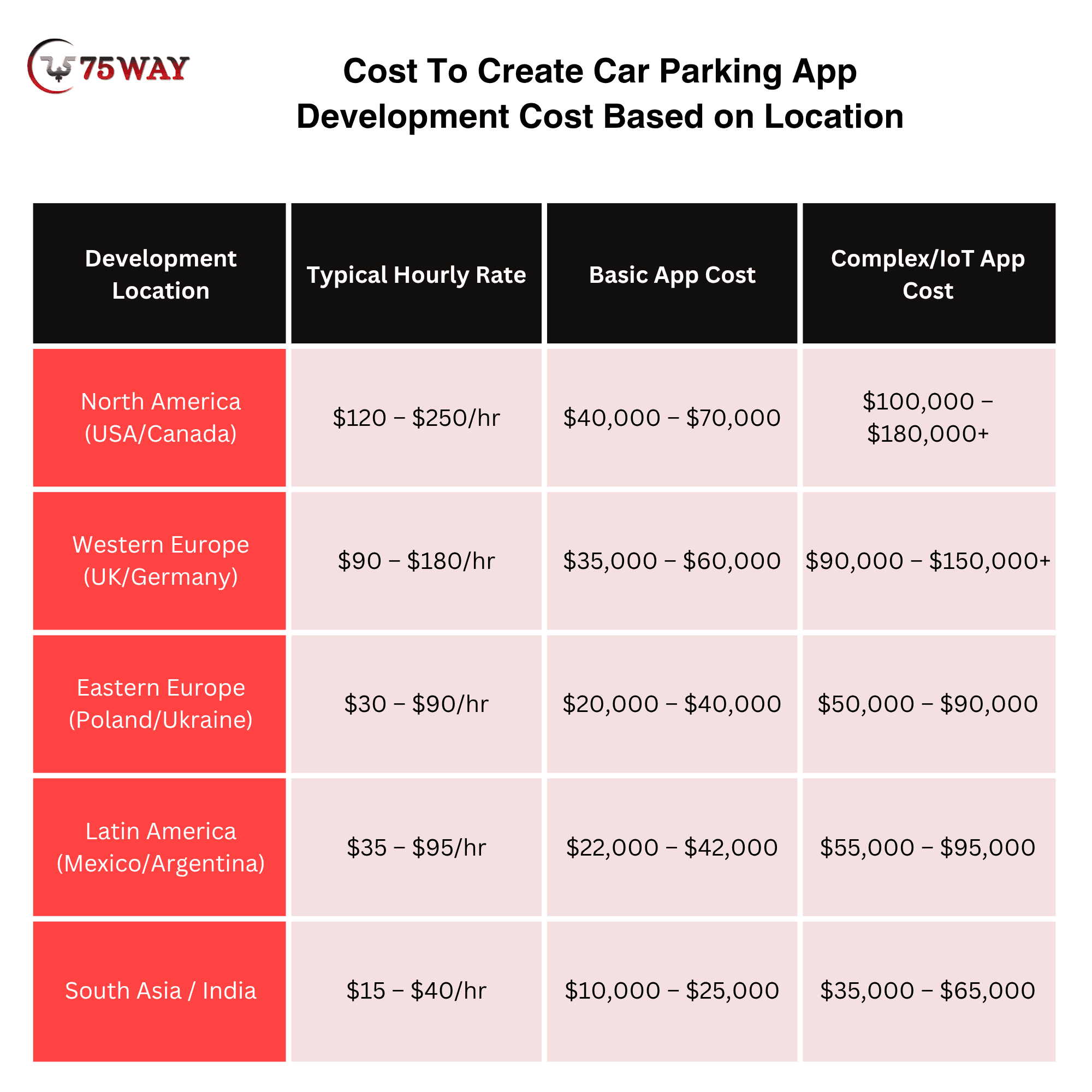
Cost To Create Car Parking App Development Cost Based on Location
North America (USA/Canada)
- Hourly Rate: $120 – $250
- Basic App Cost: $40,000 – $70,000
- Complex/IoT App Cost: $100,000 – $180,000+
Western Europe (UK/Germany)
- Hourly Rate: $90 – $180
- Basic App Cost: $35,000 – $60,000
- Complex/IoT App Cost: $90,000 – $150,000+
Eastern Europe (Poland/Ukraine)
- Hourly Rate: $30 – $90
- Basic App Cost: $20,000 – $40,000
- Complex/IoT App Cost: $50,000 – $90,000
Latin America (Mexico/Argentina)
- Hourly Rate: $35 – $95
- Basic App Cost: $22,000 – $42,000
- Complex/IoT App Cost: $55,000 – $95,000
South Asia / India
- Hourly Rate: $15 – $40
- Basic App Cost: $10,000 – $25,000
- Complex/IoT App Cost: $35,000 – $65,000
Cost To Hire Car Parking App Developers
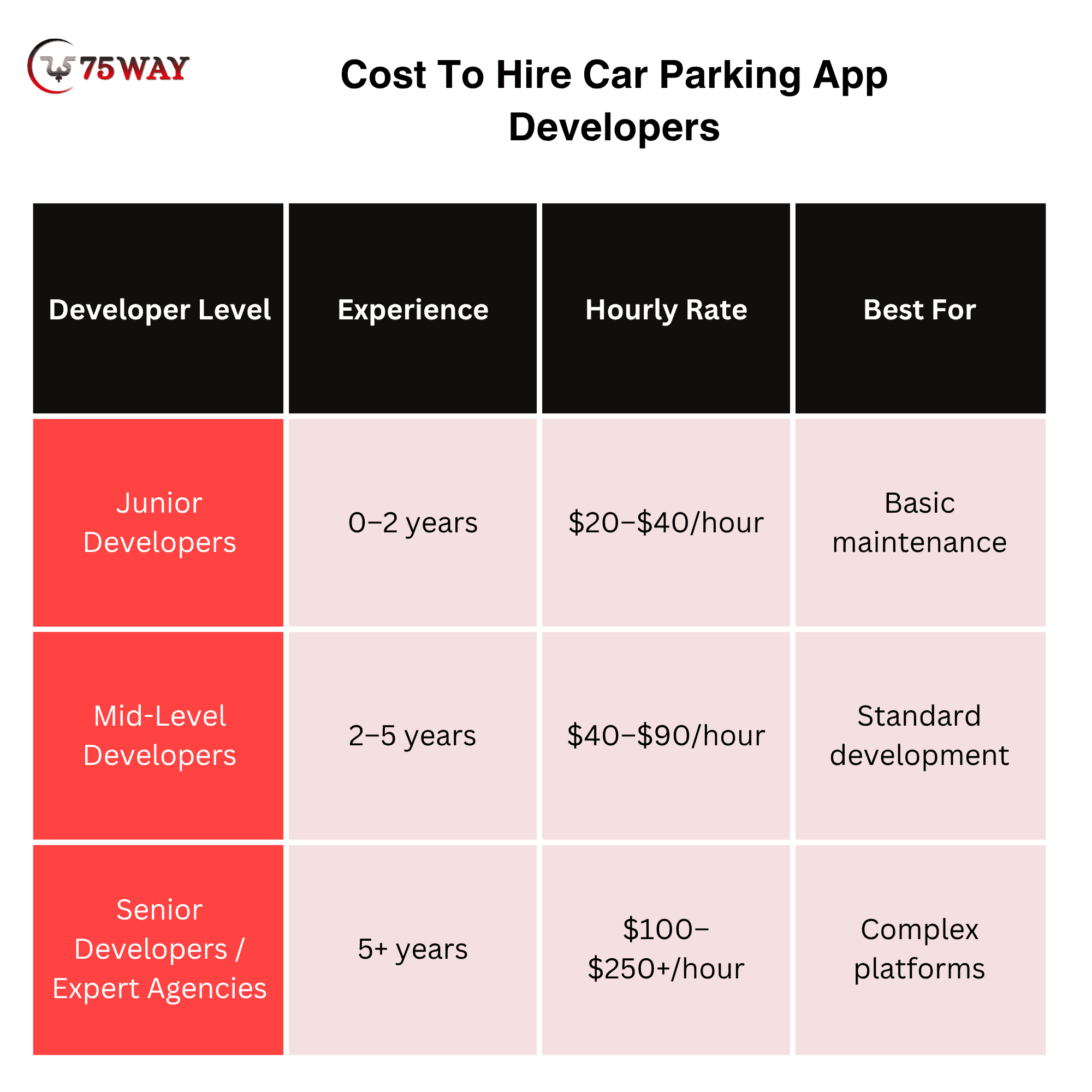
Hiring parking app developers is not simply a matter of comparing hourly rates. The final budget can change based on the app’s complexity, developer location, and whether you need a single specialist or a complete development team. The major cost factors and hiring options are discussed below.
Junior Developers (0–2 years)
- Hourly Rate: $20 – $40 per hour
Best for basic bug fixes or simple UI components.
Mid-Level Developers (2–5 years)
- Hourly Rate: $40 – $90 per hour
Capable of building standard map integrations, user profiles, and secure payment setups.
Senior Developers / Expert Agencies (5+ years)
- Hourly Rate: $100 – $250+ per hour
Necessary for complex IoT integrations, real-time map tracking, scalable backend infrastructure, and high security.
What Factors Affect the Cost of City Parking Finder App Development?
The development budget can change significantly even when two parking apps appear similar to users. The underlying data sources, integrations, infrastructure, platform scope, and operational requirements can create major differences in development effort.
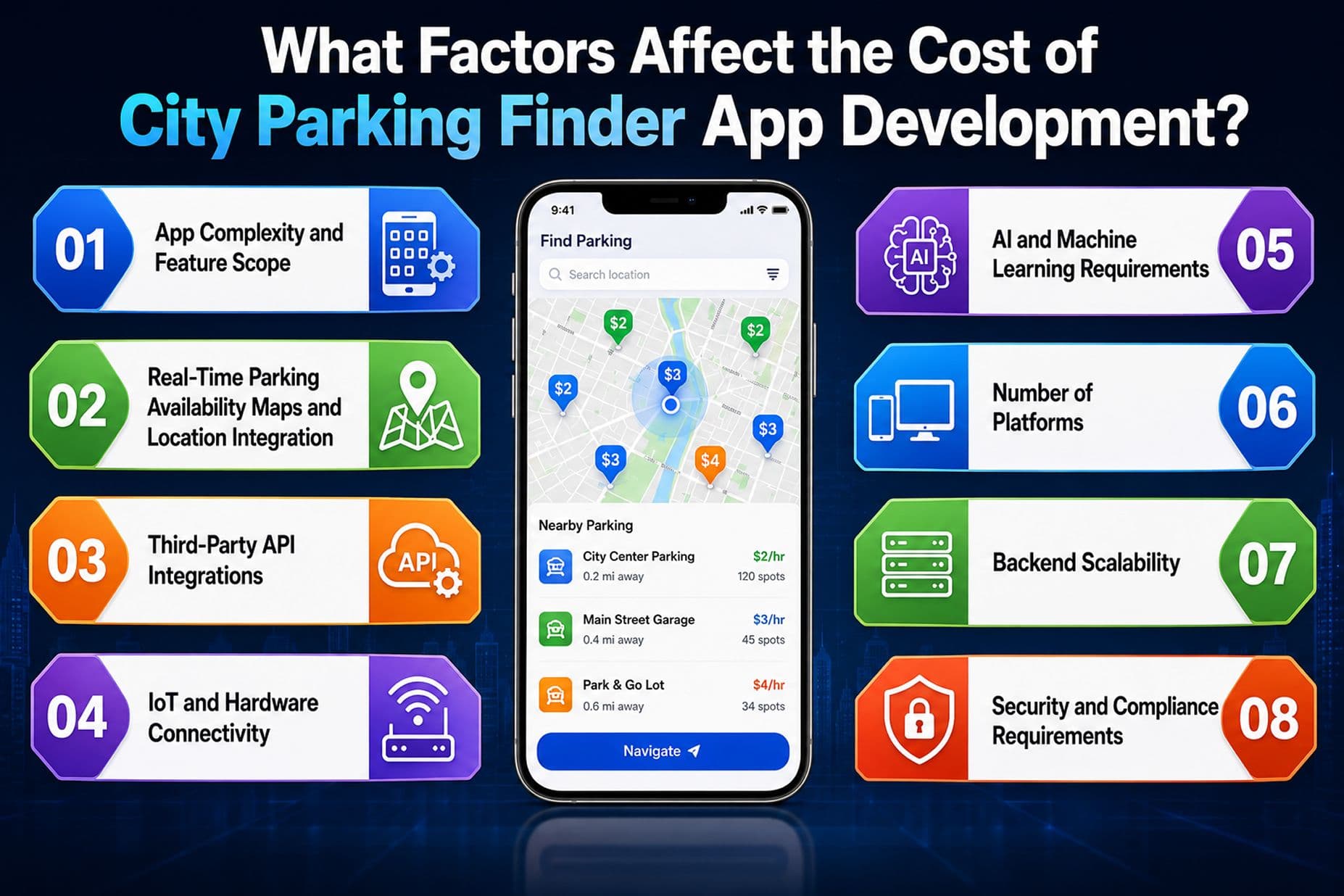
- App Complexity and Feature Scope
A basic parking finder with maps and listings requires less development than a platform supporting reservations, payments, real-time availability, operator dashboards, and smart parking infrastructure. Every additional workflow also increases development, testing, and maintenance requirements.
- Real-Time Parking Availability
Showing live parking availability requires more than storing parking locations in a database. The application may need APIs, operator systems, sensors, cameras, or other data sources to continuously receive and process occupancy information.
- Maps and Location Integration
Parking applications depend heavily on location services. Costs can increase based on mapping requirements, geocoding, route planning, navigation, location accuracy, API usage, and the geographic coverage your platform needs.
- Third-Party API Integrations
External services can expand both development effort and recurring operating expenses. Payment gateways, mapping platforms, parking-data providers, SMS services, authentication tools, analytics systems, EV charging networks, and other APIs may require separate integration and ongoing management.
- IoT and Hardware Connectivity
A smart parking solution can require integration with physical infrastructure such as occupancy sensors, parking meters, gates, cameras, or license plate recognition systems. Hardware compatibility, communication protocols, data processing, and field testing can substantially increase the project budget.
- AI and Machine Learning Requirements
AI-based availability prediction, demand forecasting, dynamic pricing, recommendation engines, computer vision, or conversational parking assistants require additional development and infrastructure. The complexity depends on whether you use an existing AI API or build and maintain customized models.
- Number of Platforms
Building only an iOS application costs less than developing iOS, Android, web, operator, and admin applications together. Cross-platform development can reduce duplicated work, but the final choice depends on performance, device requirements, integrations, and product scope.
- Backend Scalability
A platform operating in one city with limited parking inventory has different infrastructure requirements from a service supporting thousands of facilities across multiple U.S. markets. Higher scale requires stronger architecture for databases, APIs, caching, traffic management, monitoring, and real-time data processing.
- Security and Compliance Requirements
Parking apps can handle account information, location data, payment transactions, and business records. Strong authentication, access controls, encryption, secure APIs, payment security, monitoring, and appropriate data-protection practices can add to development and testing effort.
How To Earn Profit From Custom Car Parking Mobile App Development?
A parking app can generate revenue from drivers, parking operators, property owners, advertisers, or a combination of these groups. The strongest model depends on whether your product functions as a parking marketplace, reservation platform, discovery service, or technology provider.
1. Commission on Parking Bookings
The platform can charge a percentage of every completed parking reservation. For example, if a driver books a $25 parking session, the platform can retain an agreed commission while transferring the remaining amount to the parking operator.
This model works particularly well for parking booking app development because platform revenue grows alongside booking volume.
2. Service or Convenience Fees
A fixed or percentage-based service fee can be added to customer transactions. The fee can cover platform operations, booking infrastructure, payment processing, customer support, or other services provided through the application.
The pricing should remain transparent so users understand the total amount before completing payment.
3. Parking Operator Subscriptions
Parking garages and lot operators can pay a recurring subscription to use the platform's management tools. Different plans can provide access to features such as inventory management, reservations, analytics, automated notifications, and revenue reporting.
This approach creates recurring B2B revenue without relying entirely on individual booking transactions.
4. Featured Parking Listings
Parking businesses can pay to receive greater visibility within relevant search results. Featured placements can be useful when users search for parking near airports, stadiums, shopping districts, business centers, or other high-demand destinations.
Paid placements should remain clearly distinguishable from organic search results to maintain user trust.
5. Advertising Revenue
A parking application can display relevant advertisements from businesses located near parking destinations. Restaurants, hotels, retailers, EV charging providers, entertainment venues, and local services can become potential advertising customers.
Contextual advertising can be more valuable than generic advertisements because users are already searching around a specific destination.
6. Parking Management Software Fees
Businesses operating garages or parking facilities can pay for access to software that manages their parking operations. The platform can charge monthly or annual fees for inventory management, occupancy monitoring, payments, reporting, access control, and other operational tools.
This model can turn a consumer parking application into a broader parking management technology platform.
7. Data and Analytics Services
Aggregated parking insights can support business decisions when collected and handled appropriately. Operators may use analytics to understand occupancy patterns, peak demand periods, booking trends, and revenue performance.
Any data strategy should prioritize privacy, appropriate consent, contractual requirements, and applicable regulations rather than monetizing identifiable user information.
8. Premium User Memberships
Frequent drivers can be offered a paid membership that provides benefits such as reduced booking fees, exclusive parking deals, priority reservations, or other customer-specific advantages.
A subscription model is most suitable when users park frequently enough to perceive clear financial or convenience benefits.
9. EV Charging Partnerships
If the application combines parking with EV charging discovery, businesses can create partnerships with charging networks or parking facilities. Revenue opportunities may include commissions, referral arrangements, platform fees, or bundled parking-and-charging services.
10. Dynamic Pricing and Revenue Sharing
A platform serving parking operators can support demand-based pricing where operators adjust rates according to availability, time, events, or other business rules. The platform can monetize the technology through subscription fees, transaction commissions, or revenue-sharing arrangements.
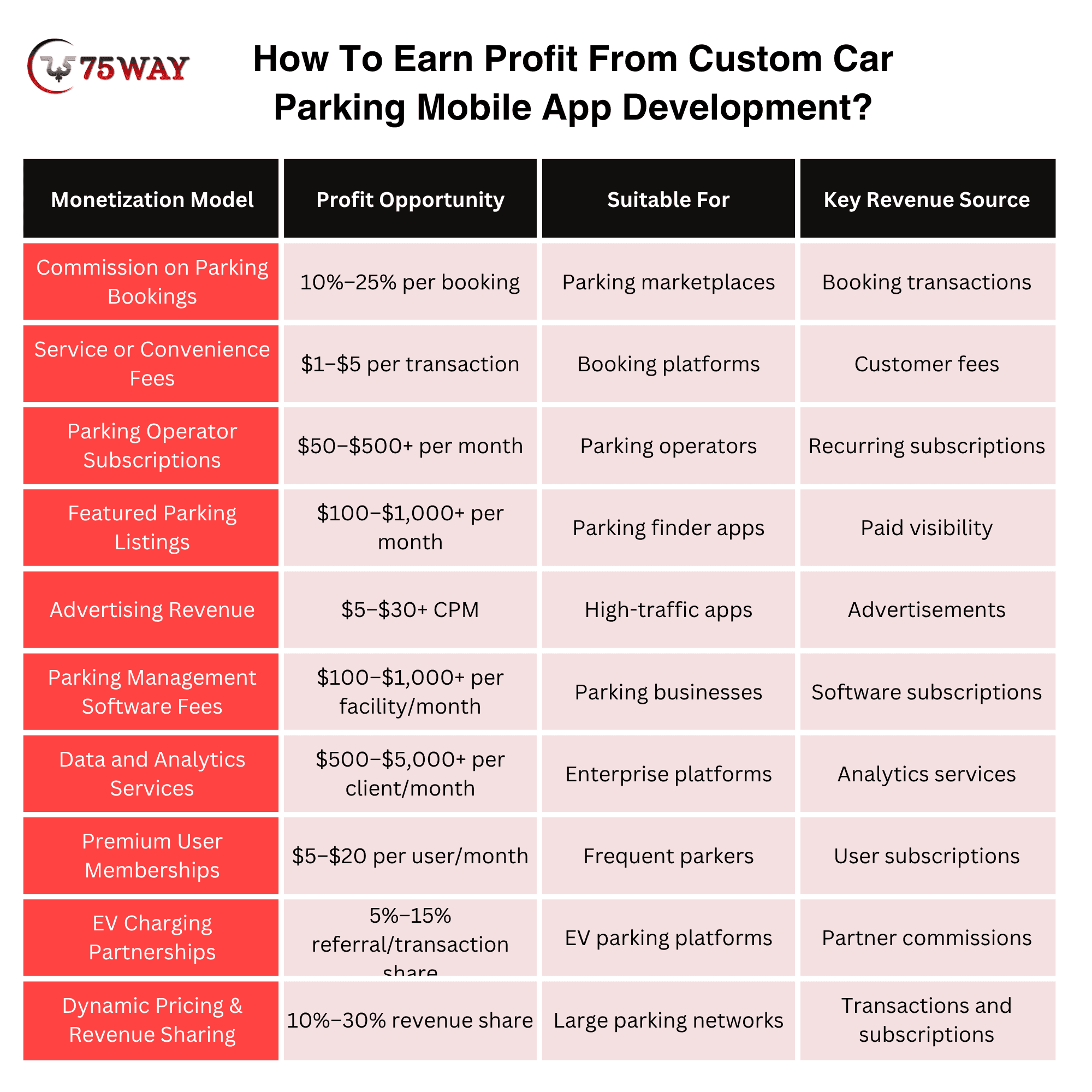
For a startup, a commission + service fee model can work well for a booking marketplace because revenue is directly connected to successful transactions. A B2B parking technology platform may benefit more from operator subscriptions, while a mature marketplace can combine commissions, subscriptions, featured listings, partnerships, and premium services.
The best approach is to select monetization around the parking inventory and customer behavior rather than adding multiple revenue streams before the core parking experience has proven demand.
What Challenges Should You Consider Before Developing a Car Parking Finder App?
A parking app may look simple from the user's perspective, but its backend can involve complex data, infrastructure, payments, integrations, and operational dependencies. Identifying these challenges early helps businesses reduce technical risks and build a more reliable product.
1. Maintaining Accurate Parking Availability
The biggest challenge for a parking finder app is keeping availability information current. If users reach a location and discover that the displayed space is unavailable, the platform can quickly lose credibility.
Solution: Connect the app with reliable operator systems, parking APIs, IoT sensors, or controlled inventory sources. Use real-time synchronization and automated status updates wherever possible.
2. Integrating Multiple Parking Operators
Different parking facilities may use different software, pricing models, reservation systems, and access technologies. Connecting these systems to one platform can require custom APIs and data synchronization.
Solution: Build a flexible API architecture that supports standardized parking data while allowing custom integrations for operators with different systems.
3. Handling Real-Time Parking Data
Live occupancy, pricing, and booking information must be updated quickly. Delays can result in inaccurate listings, stale availability, or duplicate reservations.
Solution: Use real-time communication technologies, event-driven architecture, caching, and automated synchronization to keep parking information updated across the application.
4. Managing Payments and Refunds
Parking transactions can involve cancellations, extensions, failed payments, partial refunds, operator payouts, and platform commissions. A basic payment integration may not cover these scenarios.
Solution: Design the payment workflow around the complete booking lifecycle and integrate a reliable payment gateway that supports secure transactions, refunds, and payout management.
5. Ensuring Location Accuracy
Parking applications rely heavily on GPS and mapping services. Incorrect coordinates, inaccurate facility entrances, weak GPS signals, or outdated location data can make navigation frustrating.
Solution: Combine GPS, geocoding, verified parking coordinates, entrance information, and reliable mapping APIs. Allow operators to review and update their facility locations when necessary.
6. Managing Local Parking Regulations
Parking rules can differ considerably between cities and facilities. Rates, permits, operating hours, accessibility requirements, street-parking restrictions, and enforcement practices may vary by location.
Solution: Build location-specific rules into the platform and work with verified local parking data. Give operators administrative controls to update applicable parking information.
7. Protecting User and Payment Data
A parking platform can handle account information, location data, vehicle details, payment-related information, and operator records. Weak security can expose users and businesses to unnecessary risks.
Solution: Implement secure authentication, role-based access, encryption, protected APIs, payment security, monitoring, regular security testing, and appropriate data-protection practices.
How Can You Choose the Right Car Parking App Development Company?
Choosing the right development partner can affect your app's quality, scalability, security, and long-term costs. Look beyond pricing and evaluate parking experience, technical expertise, communication, and support. A capable team should understand location services, bookings, payments, and real-time parking data. The following factors can help you assess potential development companies before making a decision.
- Check Parking App Development Experience
Choose a company with experience in parking, mobility, booking, marketplace, or location-based applications. Relevant experience can help developers understand parking workflows, inventory management, user journeys, and operational requirements.
- Evaluate Technical Expertise
Review the team's capabilities across mobile development, backend systems, APIs, databases, cloud infrastructure, mapping services, and payment integrations. For advanced products, verify experience with IoT, AI, real-time availability, LPR/ANPR, and EV charging integrations.
- Review Previous Projects and Case Studies
Examine the company's portfolio and case studies instead of relying only on marketing claims. Look for applications involving location services, booking platforms, real-time systems, marketplaces, payments, IoT, or AI.
- Assess Understanding of Your Business Model
Your development partner should understand how the parking platform will generate revenue and how drivers, operators, and administrators will interact with it. Discuss your inventory model, booking process, commissions, operator onboarding, and expansion plans.
- Confirm Integration Capabilities
Parking platforms often depend on external services and systems. Confirm that the company can integrate mapping APIs, payment gateways, parking management software, IoT devices, communication tools, EV charging networks, and other technologies required for your product.
- Discuss Security and Scalability
Ask how the development team will protect user accounts, payment information, location data, and business records. Also understand how the architecture will handle increasing users, parking facilities, transactions, and real-time requests.
- Compare Communication and Project Management
Clear communication can prevent misunderstandings during development. Evaluate how the company handles project updates, milestones, documentation, feedback, meetings, issue tracking, and day-to-day collaboration.
- Understand Post-Launch Support
Application development does not end after deployment. Confirm whether the company provides maintenance, bug fixes, security updates, performance monitoring, API updates, infrastructure support, and future feature development.
Why Choose 75way Technologies to Develop An App For Available Parking Spaces?
A parking app needs to work well beyond the driver's screen. Someone has to manage parking inventory, keep availability updated, process bookings and payments, handle cancellations, and monitor what happens across the platform. That is where the right development partner makes a difference.
At 75way Technologies, we approach car parking app development around these connected workflows rather than treating the project as a standalone mobile application.
The development scope can cover parking search, maps, reservations, payments, navigation, user accounts, operator dashboards, admin controls, notifications, and parking data management based on the actual requirements of the business.
For projects that need more than basic parking discovery, the architecture can also accommodate technologies such as AI, IoT, APIs, cloud services, and real-time data processing. Depending on the use case, these technologies can support occupancy updates, connected parking sensors, availability predictions, automated workflows, intelligent parking assistance, and integrations with existing parking systems.
Final Thoughts
To summarize, car parking app development can create a strong digital solution for drivers, parking operators, and businesses when the product is built around a clear market need. From basic parking discovery and reservations to real-time availability, IoT, AI, and smart parking, the right technology scope depends on your business model and growth plans.
Cost, parking data, integrations, security, scalability, and monetization should be considered before development begins. Starting with a focused MVP can help validate demand before expanding into advanced capabilities. Partnering with an experienced on-demand app development company can help turn the concept into a scalable parking platform.
Frequently Asked Questions (FAQs)
Can A Parking App Support Multiple Parking Facilities And Cities?
Yes. A scalable architecture can allow businesses to onboard multiple garages, parking lots, operators, and geographic markets from one centralized platform.
How Does A Parking App Prevent Double Bookings?
The booking engine can lock inventory during transactions, validate availability before confirmation, and update the parking database immediately after successful reservations.
Can Parking Operators Manage Their Spaces Through The Application?
Yes. An operator dashboard can allow businesses to manage parking inventory, pricing, availability, bookings, facility information, revenue, and customer activity.
Can A Parking App Support Different Vehicle Types?
Yes. Parking listings can include vehicle-specific information for cars, motorcycles, SUVs, EVs, accessible parking, oversized vehicles, and other categories supported by individual facilities.
Can I Add EV Charging To A Parking Finder Application?
Yes. EV charging integrations can allow users to discover parking facilities with charging stations and view relevant availability, pricing, connector information, or charging options.
How Can AI Improve A Parking Finder Application?
AI can analyze parking and user data to support availability forecasting, demand prediction, personalized recommendations, dynamic pricing, automated support, and conversational parking searches.
Can A Parking Application Work With Existing Parking Management Software?
Yes. APIs or custom integration layers can connect the application with existing parking management, reservation, payment, access-control, or occupancy systems.