AI Summary
Zodiac dating apps bring astrology and modern matchmaking together through personalized compatibility experiences. This guide explores zodiac dating app development cost, process, business potential, features, and monetization.
Key Takeaways
- Zodiac dating apps combine astrology, compatibility insights, and personalized matchmaking experiences.
- Birth charts and planetary placements can enrich compatibility assessments.
- Zodiac dating app development costs $5,000–$300,000+ based on requirements
- Successful platforms require thoughtful UX, privacy, retention, and monetization strategies.
What if people could find potential partners based on more than shared interests and attractive profiles? That idea is giving zodiac dating app development a fresh business opportunity in the US dating market.
Astrology adds another layer to matchmaking by connecting personality traits, zodiac signs, and relationship compatibility. For users who enjoy checking horoscopes or comparing birth charts, zodiac-based matchmaking can make dating feel more personal and engaging.
But what does it take to build a zodiac dating app that people actually enjoy using?
You need to understand your target audience, choose the right features, integrate astrology capabilities, and plan a sustainable revenue model.
This guide explains how to approach zodiac dating app development, from validating the business opportunity and selecting essential features to understanding development costs, technology requirements, and monetization strategies.
What Is Zodiac Dating App Development?
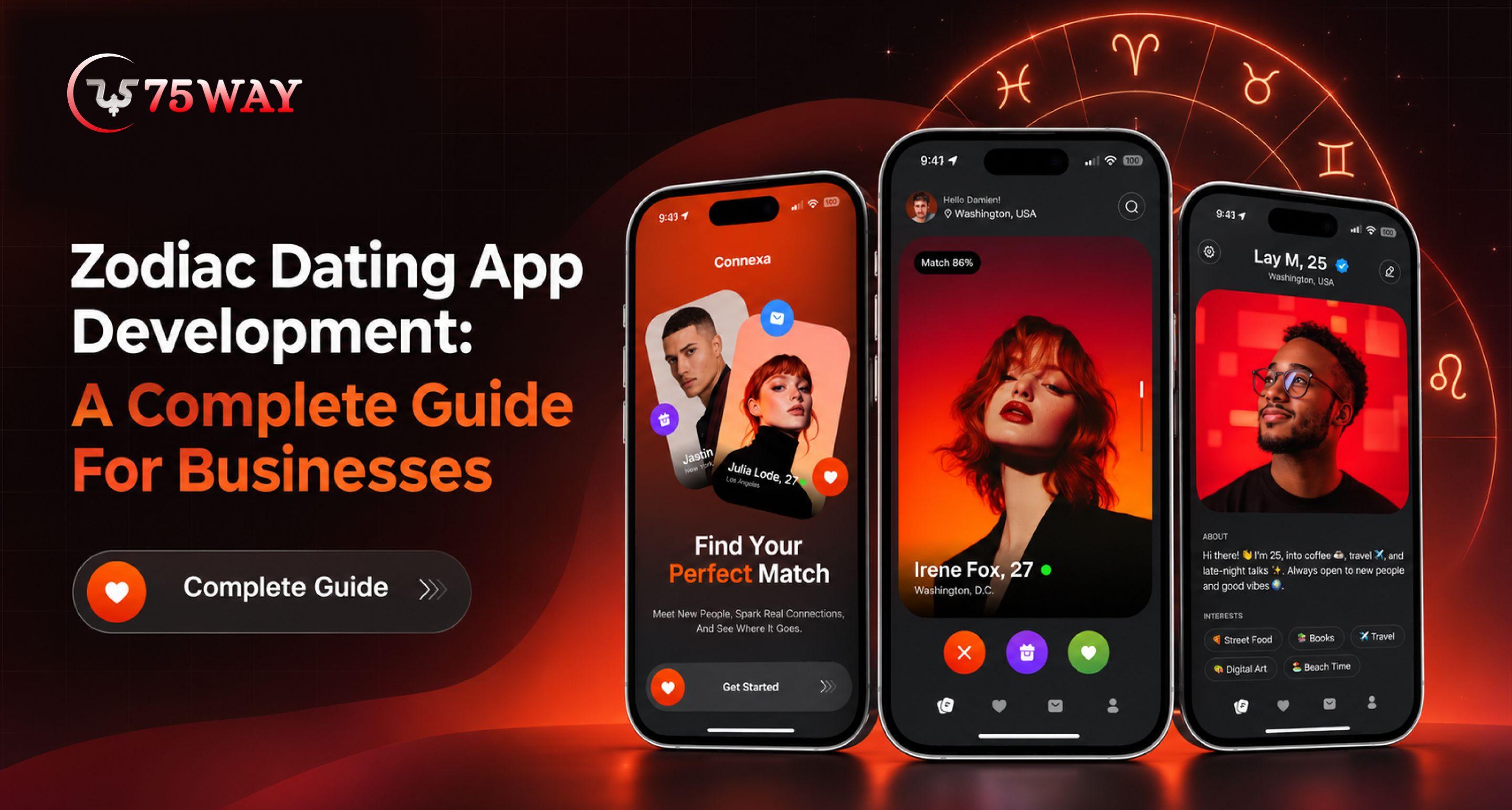
Zodiac dating app development is the process of building a mobile or web-based dating platform that uses astrological information to help users discover potential romantic partners. These platforms combine conventional dating functionality with zodiac signs, birth charts, planetary placements, and compatibility interpretations.
Unlike conventional dating and astrology apps in the USA that primarily recommend people using location, age, interests, and relationship preferences, zodiac dating apps can introduce astrology as an additional discovery and personalization layer.
For example, a user born under Leo might discover potential matches based on their preferred zodiac compatibility, shared interests, relationship goals, and other profile preferences. Users who provide their birth date, exact birth time, and birthplace may also receive more detailed natal-chart-based compatibility insights.
A business can develop zodiac dating apps with different levels of astrology app transit features, UI design, and functionality:
- Sun Sign Matching: Recommends potential partners based on zodiac signs.
- Birth Chart Matching: Compares users' natal charts for deeper compatibility interpretations.
- Synastry Analysis: Examines planetary placements between two birth charts.
- Personalized Astrology: Provides daily horoscopes, relationship insights, and personalized recommendations.
- AI-Assisted Matchmaking: Combines user preferences and compatibility indicators to improve match discovery.
The important distinction is that astrology should complement conventional matchmaking rather than replace it. Users still need meaningful profiles, communication tools, privacy controls, and opportunities to make their own relationship decisions.
Why Should Businesses Invest in Zodiac Dating App Development?
According to Pew Research Center's February 2023 research, 53% of US adults ages 18–29 had used a dating site or app. The corresponding figures were 37% for adults ages 30–49, 20% for those ages 50–64, and 13% for adults 65 and older.
The opportunity lies in creating a dating experience with a recognizable niche rather than competing solely on the number of profiles or swipe-based features. Here are the main business considerations.
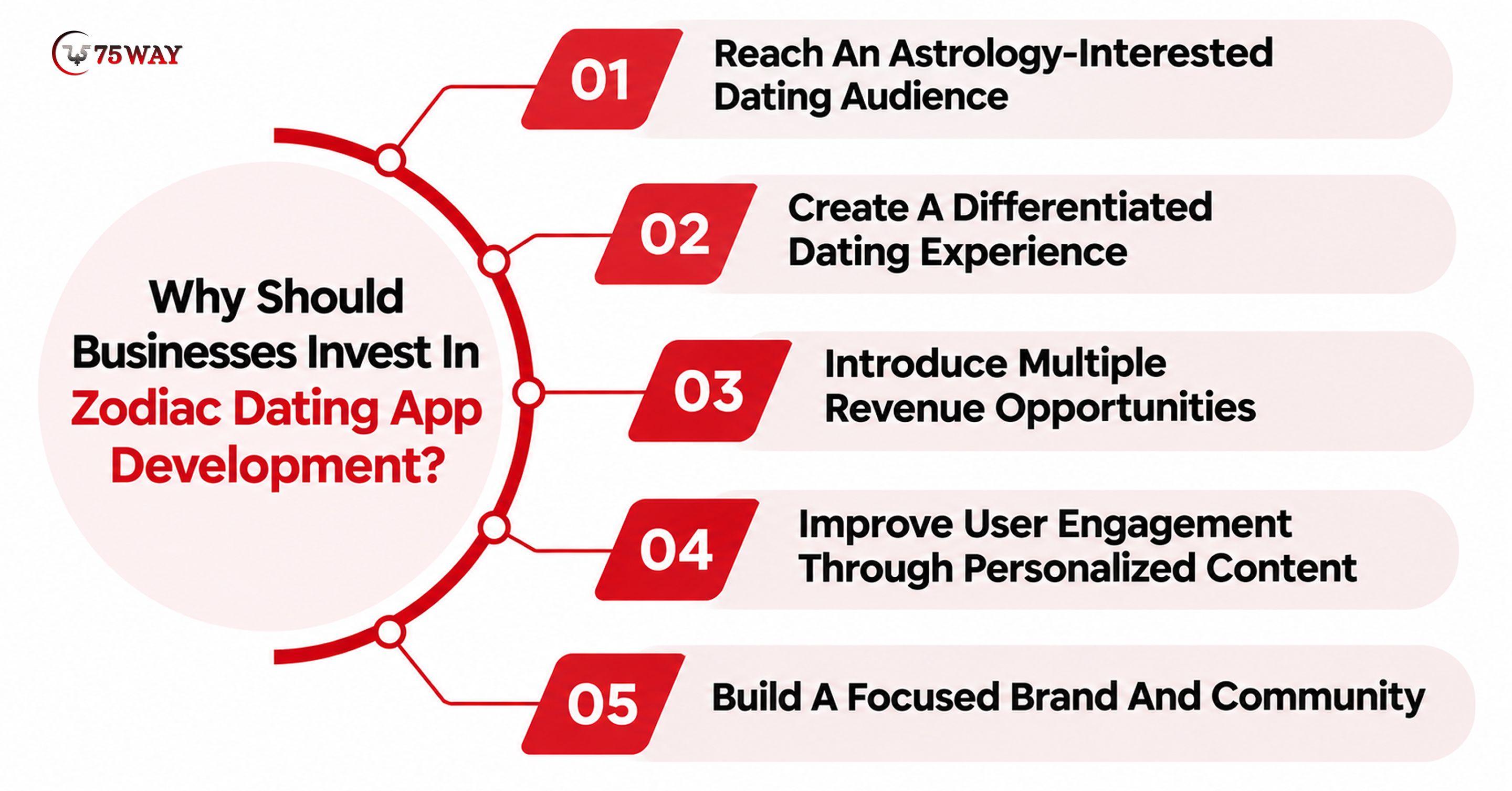
1. Reach An Astrology-Interested Dating Audience
Astrology provides a recognizable theme that can help businesses position their dating products around a specific audience.
Instead of targeting every online dater, founders can focus on people interested in zodiac signs, birth charts, relationship compatibility, and personality-based matchmaking.
This positioning can help define marketing campaigns, product features, brand identity, and community-building strategies.
2. Create A Differentiated Dating Experience
The dating app market already includes platforms built around location-based discovery, relationship preferences, profile recommendations, and social connections.
A zodiac dating app can introduce another discovery layer through astrological compatibility.
For instance, instead of displaying only a profile and distance, the platform could show:
- Zodiac sign and elemental group.
- Sun, Moon, and Rising signs.
- Shared planetary placements.
- Relationship compatibility interpretations.
- Common interests and relationship preferences.
These details give users additional conversation starters and a different way to explore potential connections.
3. Introduce Multiple Revenue Opportunities
Astrology-based dating products can monetize more than basic profile visibility.
Businesses can introduce paid features such as detailed compatibility reports, advanced filters, personalized readings, and subscription-based experiences.
For example, users could access basic zodiac matching for free while subscribing to unlock detailed synastry reports and additional matchmaking filters.
4. Improve User Engagement Through Personalized Content
Daily horoscopes, relationship insights, compatibility updates, and personalized notifications provide reasons to revisit the platform beyond browsing profiles.
However, notifications should offer genuine value rather than repeatedly encouraging users to open the app.
A personalized message such as a new compatibility insight or an update from a mutual match can create a more relevant engagement opportunity.
5. Build A Focused Brand And Community
A zodiac dating app can establish its identity around astrology-driven relationships.
Businesses can build communities through zodiac-themed discussions, compatibility quizzes, relationship content, and virtual events.
Such features can help a new platform develop a recognizable identity and encourage users to participate beyond conventional dating activities.
How Does A Zodiac Dating App Work?
A zodiac dating application typically follows a process that combines user onboarding, astrological data collection, compatibility calculations, profile recommendations, and communication. Understanding this workflow helps businesses plan the application architecture and identify the functionality required before development begins.
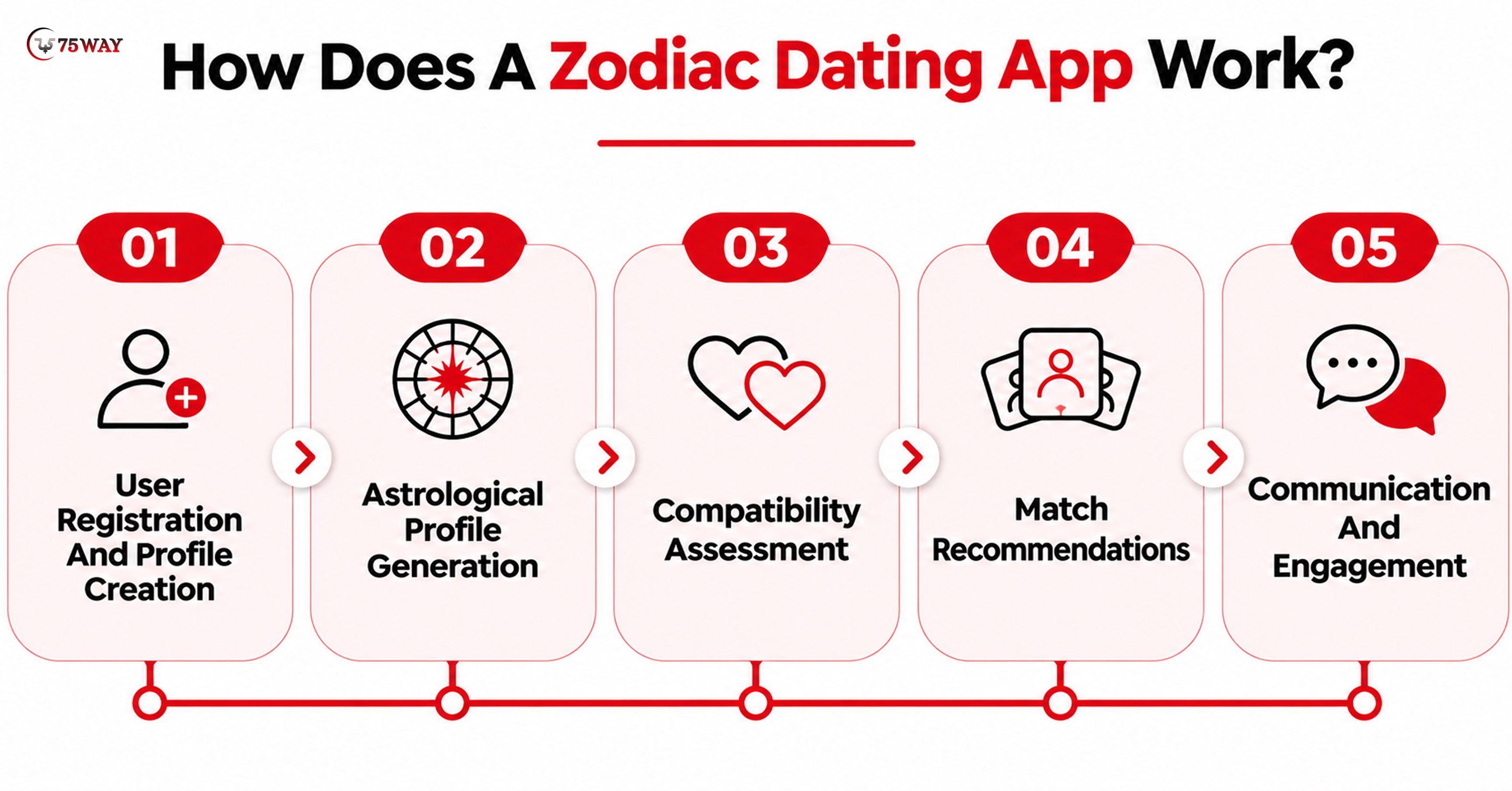
Step 1: User Registration And Profile Creation
Users create an account using email, phone verification, or supported social login options.
During onboarding, the platform collects information required to create a dating profile, including:
- Name and age.
- Gender and dating preferences.
- Location.
- Profile pictures.
- Relationship goals.
- Interests and hobbies.
- Date of birth.
- Birth time, if available.
- Birthplace, if required for chart calculations.
The application should explain why it requests birth details and whether users can skip optional information.
Step 2: Astrological Profile Generation
After registration, the application processes the user's birth information to generate an astrological profile.
Depending on the product scope, this can include:
- Sun sign.
- Moon sign.
- Rising sign or Ascendant.
- Planetary positions.
- Houses and aspects.
- Element and modality classifications.
A third-party astrology API or an internally developed calculation engine can generate the necessary chart data.
The platform should also handle incomplete birth information. For example, if a user does not know their exact birth time, the application should not present an unverified Ascendant as accurate.
Step 3: Compatibility Assessment
The application compares the astrological profiles of potential matches.
A basic version might compare Sun signs, while a more advanced platform can examine planetary placements, aspects, and synastry indicators.
The system can combine these results with conventional dating preferences, including age, location, interests, and relationship goals.
Step 4: Match Recommendations
The application generates a list of recommended profiles using its matchmaking rules.
For example, users may see:
- Recommended zodiac matches.
- Shared interests.
- Compatibility summaries.
- Relationship preferences.
- Distance and location information.
Step 5: Communication And Engagement
Users can express interest, exchange messages, and interact with matches.
The platform can also introduce personalized relationship insights, daily astrology content, and compatibility updates to encourage meaningful engagement.
Types of Zodiac Dating App Development Solutions You Can Consider
Not every astrology-based dating application needs the same functionality. The right product category depends on the target audience, development budget, positioning, and business objectives. Here are different kinds of zodiac dating apps that you can build and launch in USA in 2027.
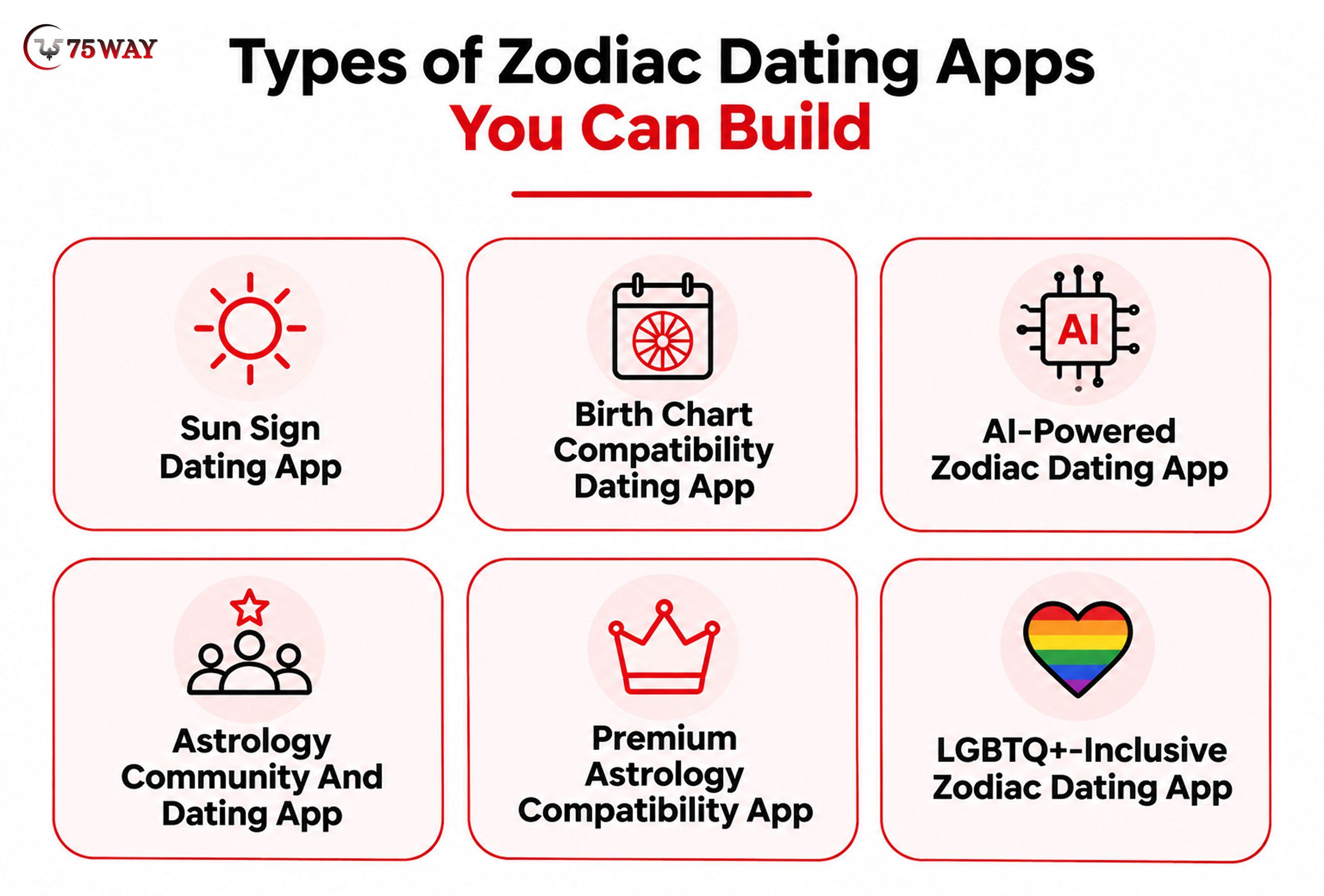
1. Sun Sign Dating App
A Sun sign dating app uses the twelve zodiac signs as the primary matchmaking criteria.
Users enter their birth dates, and the application identifies their zodiac signs before recommending potential matches.
This is a relatively simple product concept because it does not require complete natal-chart calculations.
Suitable for: Startups validating an astrology-based dating concept with a focused MVP.
2. Birth Chart Compatibility Dating App
This type of application uses more detailed astrological information, including Sun, Moon, Rising, and planetary placements.
Users can explore compatibility beyond their primary zodiac signs.
For example, two people with different Sun signs might share compatible Moon placements or other planetary connections.
Suitable for: Businesses targeting users who already understand natal charts and want deeper compatibility experiences.
3. AI-Powered Zodiac Dating App
An AI-powered zodiac dating app combines astrology data with machine learning or recommendation systems.
The platform can analyze user preferences, profile interactions, interests, and feedback to improve match recommendations.
For example, if a user consistently interacts with people who share particular interests and relationship goals, the recommendation system can incorporate those preferences.
Suitable for: Businesses planning a more personalized dating experience with advanced recommendation capabilities.
4. Astrology Community And Dating App
This application combines dating functionality with astrology-focused social networking.
Users can participate in zodiac discussions, join communities, share astrology-related content, and connect with potential partners.
Suitable for: Businesses interested in building a community-driven dating platform with multiple engagement opportunities.
5. Premium Astrology Compatibility App
This model focuses on detailed compatibility reports and personalized relationship insights.
Users can access basic matchmaking for free while purchasing premium reports or subscriptions for more advanced features.
Suitable for: Businesses targeting users willing to pay for personalized astrology experiences.
6. LGBTQ+-Inclusive Zodiac Dating App
This type of platform combines astrology-based discovery with inclusive dating preferences and identity-related profile options.
Businesses can create flexible profile settings, inclusive discovery filters, privacy controls, and community guidelines.
Suitable for: Founders targeting underserved dating niches with a clearly defined community and product strategy.
Essential Features For Custom Zodiac Dating App Development
The right features make a zodiac dating app more than a conventional matchmaking platform. Here are 12 essential features that create personalized astrology experiences while supporting meaningful connections.
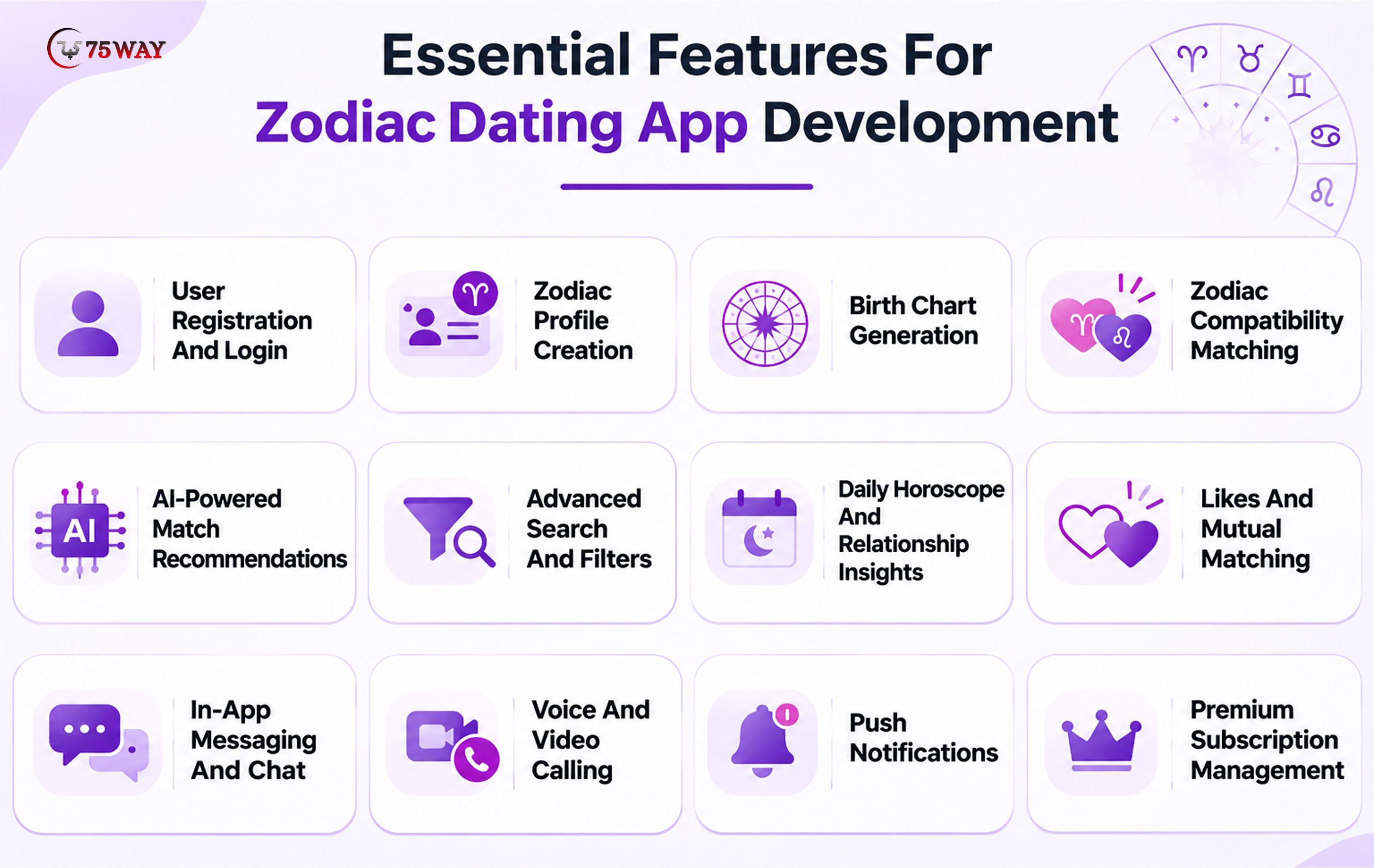
- User Registration And Login
A simple registration process allows users to create accounts through email, phone numbers, or social logins. Secure authentication and profile verification help protect accounts while making onboarding convenient.
- Zodiac Profile Creation
Users can create personalized profiles featuring their zodiac signs, personality descriptions, interests, and relationship preferences. The profile can also display Sun, Moon, and Rising signs to provide a richer astrological identity.
- Birth Chart Generation
Users can enter their birth date, time, and location to generate personalized natal charts. The application can display planetary placements, astrological houses, and other chart details for deeper compatibility insights.
- Zodiac Compatibility Matching
The application compares users' zodiac signs and selected astrological placements to generate compatibility insights. These recommendations give users another way to discover potential partners beyond conventional profile preferences.
- AI-Powered Match Recommendations
AI can analyze user interests, relationship goals, profile interactions, and matchmaking preferences to suggest relevant profiles. Combining these signals with astrological information creates a more personalized discovery experience.
- Advanced Search And Filters
Users can discover potential partners using filters such as age, location, interests, relationship goals, and zodiac signs. These options make profile discovery more relevant and give users greater control over their matches.
- Daily Horoscope And Relationship Insights
Personalized daily horoscopes provide users with astrology-related content based on their zodiac profiles. Relationship insights and compatibility updates can create additional reasons to revisit the application.
- Likes And Mutual Matching
Users can express interest in profiles they find appealing, while mutual likes create opportunities for connections. This feature makes the discovery experience interactive and gives users control over whom they connect with.
- In-App Messaging And Chat
Matched users can communicate through private messaging without immediately sharing their personal contact information. Features such as message notifications, image sharing, and conversation controls can make communication more convenient.
- Voice And Video Calling
Voice and video calling allow matched users to interact through real-time conversations within the application. Consent controls, blocking options, and reporting functionality help create a safer communication experience.
- Push Notifications
Personalized notifications inform users about new matches, incoming messages, profile interactions, and relevant astrology updates. Custom notification preferences help users stay informed without receiving unnecessary alerts.
- Premium Subscription Management
Subscription functionality allows businesses to offer paid features such as detailed compatibility reports, advanced filters, and additional discovery options. Users can view their plans, manage renewals, and access premium benefits directly within the application.
Advanced Features For AI Zodiac Dating App Development For A More Personalized Experience
As the platform grows, businesses can introduce advanced functionality that makes the application more than a conventional dating product.
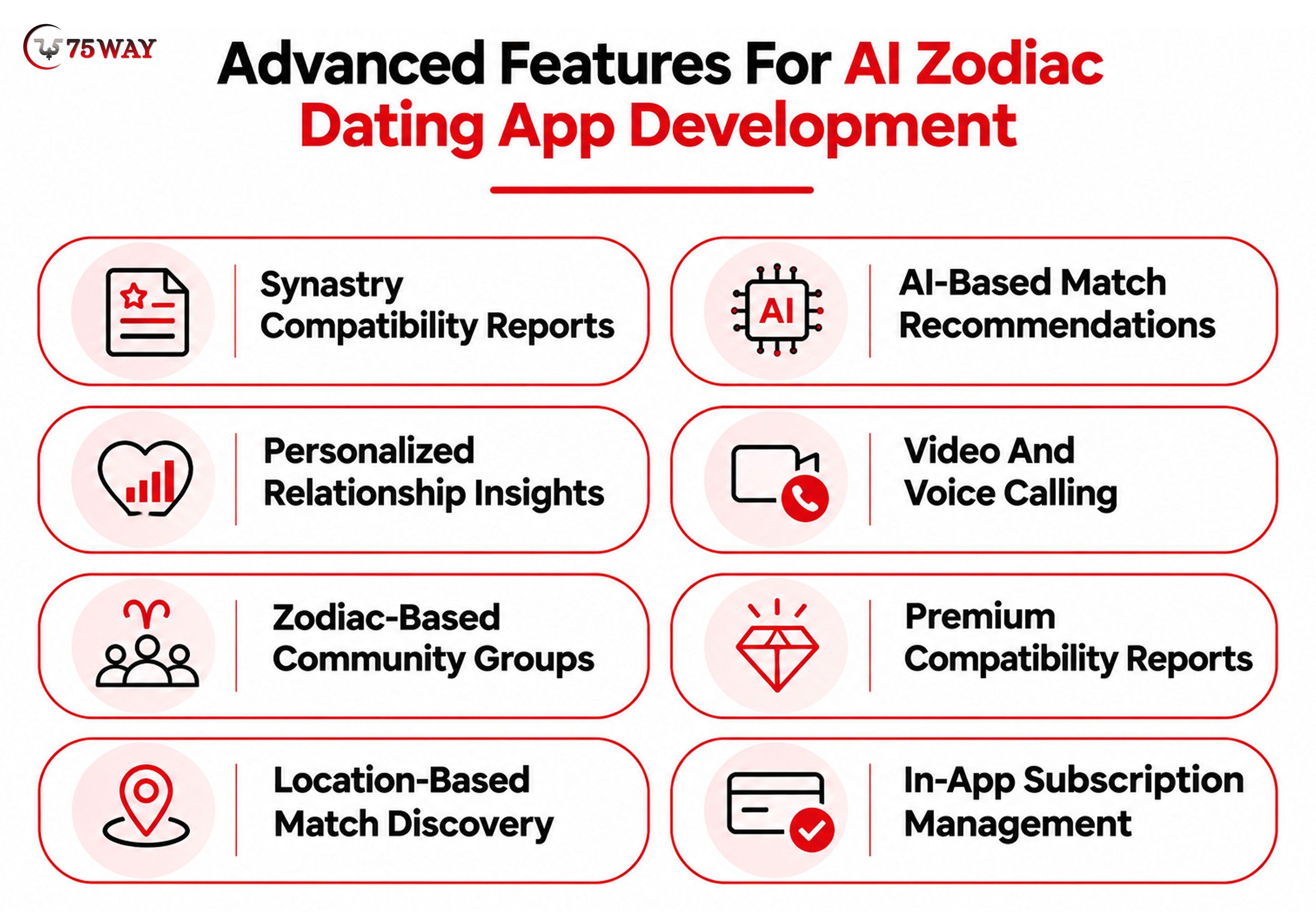
1. Synastry Compatibility Reports
Synastry compares the planetary placements of two individuals to generate relationship-oriented interpretations.
For example, the platform could compare Venus and Mars placements, Moon signs, and planetary aspects to explain different compatibility themes.
2. AI-Based Match Recommendations
An AI-assisted recommendation engine can analyze profile preferences, interactions, and feedback to improve match suggestions.
It should use astrology as one input rather than treating zodiac compatibility as a scientifically established predictor of relationship success.
3. Personalized Relationship Insights
The application can generate relationship-oriented content based on a user's astrological profile and selected preferences.
For example, users might receive explanations about communication styles or emotional compatibility themes.
4. Video And Voice Calling
Video and voice calling allow matched users to communicate without immediately sharing personal phone numbers.
Businesses should include appropriate consent, blocking, and reporting controls.
5. Zodiac-Based Community Groups
Users can join communities based on zodiac signs, astrological interests, or relationship discussions.
These groups can provide additional interaction opportunities beyond one-to-one matchmaking.
6. Premium Compatibility Reports
Users can purchase detailed compatibility reports that explain planetary connections, astrological aspects, and personalized interpretations.
7. Location-Based Match Discovery
Location-based recommendations help users discover potential partners within selected geographical areas.
The platform should request location permissions only when necessary and provide manual location controls.
8. In-App Subscription Management
Users can purchase premium memberships, review subscription details, manage renewals, and access paid features.
The payment implementation must follow the applicable app marketplace requirements.
How Does Zodiac Compatibility Matching App Work Technically?
This is one of the most important development considerations because zodiac dating apps depend on more than displaying two zodiac signs next to each other.
The application needs a defined method for collecting astrological data, generating compatibility interpretations, and translating those results into useful matchmaking recommendations.
Let's understand the technical process.
1. Collect Accurate Birth Information
The first requirement is collecting the information needed to generate an astrological chart.
- Date of Birth: Helps calculate zodiac sign and planetary positions.
- Birth Time: Helps determine Ascendant and house placements.
- Birthplace: Helps establish geographical coordinates and time zone.
- Time Zone: Supports accurate conversion of local birth time.
An important technical detail is daylight saving time. Birthplace-based time-zone handling must account for historical time-zone rules when calculating charts.
If the user does not know their birth time, the platform should identify which calculations are uncertain instead of silently filling in missing information.
2. Generate The Natal Chart
Once the information is collected, the application generates the user's natal chart.
A natal chart represents the positions of celestial bodies at the recorded time and location of birth, according to the selected astrological system.
The calculation may include:
- Sun and Moon positions.
- Ascendant.
- Mercury, Venus, and Mars placements.
- Jupiter and Saturn positions.
- Outer planetary placements.
- Astrological houses.
- Major planetary aspects.
Businesses must decide which astrological system to support.
For example, Western tropical astrology and Vedic sidereal astrology use different zodiac reference systems. The platform should clearly communicate which system powers its calculations.
3. Calculate Astrological Compatibility
After generating two natal charts, the application compares selected placements.
For a Western astrology-based product, the compatibility engine might evaluate:
- Sun Signs: Core identity and personality themes.
- Moon Signs: Emotional expression and comfort themes.
- Venus Placements: Relationship and affection-related interpretations.
- Mars Placements: Energy, attraction, and action-related themes.
- Mercury Placements: Communication-related interpretations.
- Planetary Aspects: Angular relationships between planetary positions.
- House Overlays: How one person's placements fall within another's houses.
These comparisons should be based on documented calculation rules and clearly defined interpretations.
4. Create A Compatibility Scoring System
The platform can convert selected astrological indicators into a compatibility score.
For example, a business may define a weighted model:

Where:
- S = Sun sign compatibility.
- M = Moon sign compatibility.
- V = Venus placement compatibility.
- A = Planetary aspect compatibility.
- P = User preference alignment.
Each input is normalized to a score between 0 and 100.
These weights are illustrative product-design choices, not scientifically validated relationship predictors. Businesses should test different models with actual user feedback and clearly explain what the score represents.
5. Combine Astrology With Conventional Matchmaking
Astrological compatibility alone should not determine which profiles users see.
A stronger recommendation system can combine:
- Relationship goals.
- Age preferences.
- Location preferences.
- Shared interests.
- Communication preferences.
- Profile activity.
- Mutual likes.
- Astrological compatibility indicators.
For example, a user might have a high astrological compatibility score with someone outside their preferred age range. The platform should respect the user's stated preferences rather than recommending that profile simply because of its astrology score.
6. Learn From User Interactions
Once users start interacting with recommended profiles, the system can collect relevant behavioral signals.
These may include:
- Profile views.
- Likes and dislikes.
- Match acceptance.
- Conversation initiation.
- User-reported recommendation relevance.
- Profile hiding and blocking.
A recommendation model can use these signals to improve discovery over time.
However, it should not assume that longer conversations or more profile views automatically indicate relationship success.
Step-By-Step Process For Zodiac Dating Mobile App Development
A great zodiac dating app starts with a clear idea of who you want to serve and what experience you want to offer. From market research to launch, every development stage has a purpose. The following roadmap explains how to approach the process.
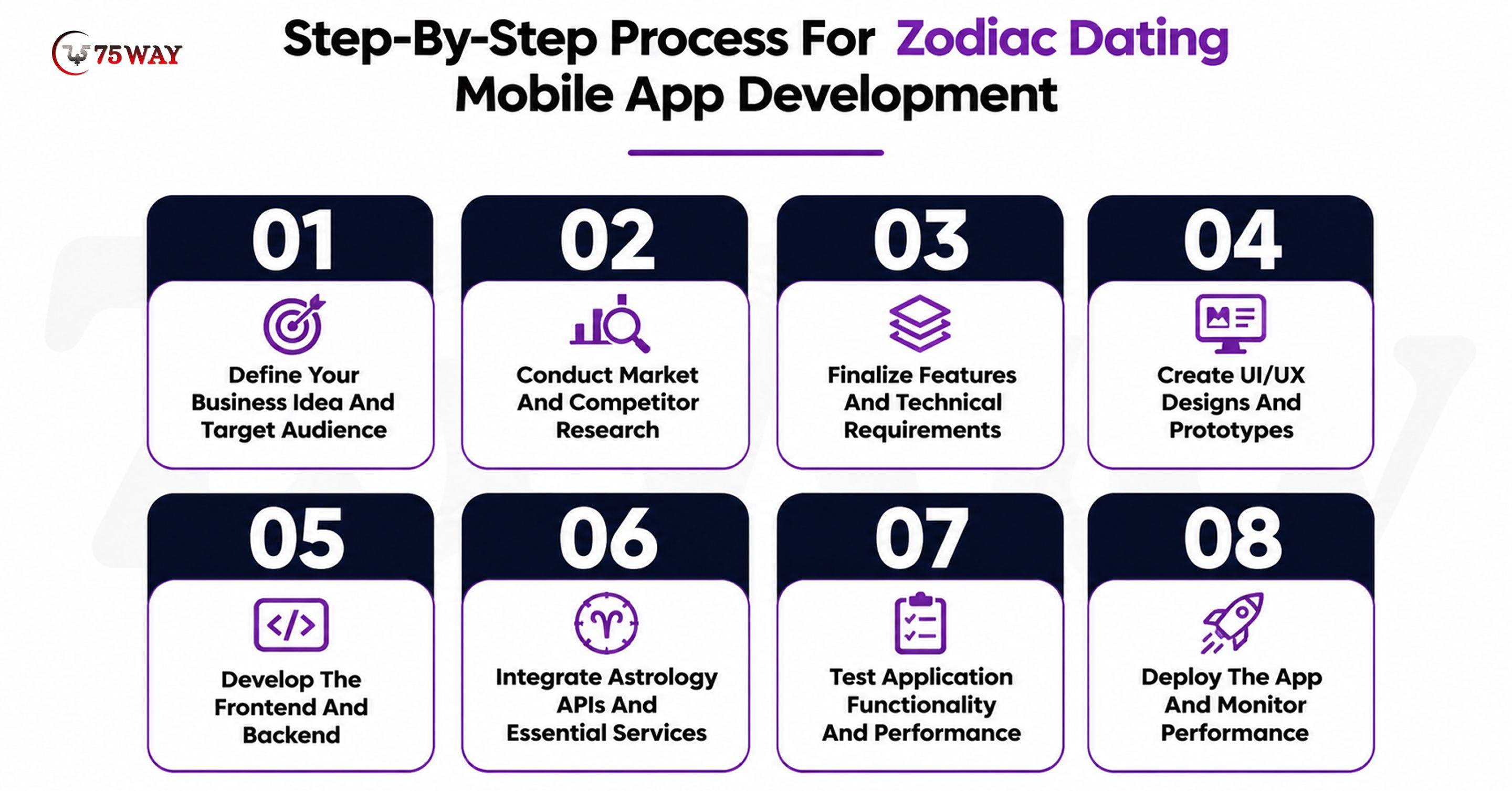
1. Define Your Business Idea And Target Audience
Every successful dating application starts with a clear business direction. Identify whether your platform will focus on Sun sign compatibility, detailed birth-chart matching, AI-powered recommendations, or astrology-based communities.
Once the concept is established, define your target audience, business model, launch location, and unique selling proposition. These decisions will guide the features and technical requirements in the next stages.
2. Conduct Market And Competitor Research
With your business concept defined, research existing dating and astrology applications to understand their features, pricing strategies, and user experiences. Pay particular attention to customer reviews to identify missing functionality and recurring user frustrations.
Use these findings to identify market gaps and opportunities for differentiation. A clear understanding of competitors will help you prioritize features that give your zodiac dating app a distinct identity.
3. Finalize Features And Technical Requirements
After identifying market opportunities, translate your product vision into a detailed feature list and technical specification. Include essential functionality such as user registration, zodiac profiles, birth-chart generation, compatibility matching, messaging, and subscriptions.
Next, define the backend architecture, database structure, third-party APIs, security requirements, and platform preferences. This creates a development roadmap that connects business requirements with actual engineering tasks.
4. Create UI/UX Designs And Prototypes
Once the technical requirements are finalized, focus on designing an interface that makes astrology-based matchmaking easy to understand and navigate. Create wireframes and interactive prototypes for registration, profile creation, compatibility reports, match discovery, and messaging.
Use tools such as Figma to test user journeys before development begins. This stage helps identify usability issues early and gives developers a clear visual reference for implementation.
5. Develop The Frontend And Backend
With the approved designs ready, developers begin building the application's frontend and backend. The frontend handles screens, navigation, and user interactions, while the backend manages authentication, profiles, matchmaking logic, subscriptions, and application data.
Choose suitable technologies based on your product requirements, such as Flutter or React Native for cross-platform development and Node.js or Python for backend services. A modular architecture also makes future feature expansion easier.
6. Integrate Astrology APIs And Essential Services
After establishing the core application architecture, integrate the services required to deliver astrology-based functionality. Astrology APIs can support natal-chart generation, planetary positions, zodiac information, and compatibility-related calculations.
You can also integrate payment gateways, location services, authentication providers, and messaging solutions. Ensure every integration includes proper validation, error handling, and security controls to maintain a reliable user experience.
7. Test Application Functionality And Performance
Before launch, thoroughly test the application to ensure that all features work according to the defined requirements. Validate registration, profile creation, birth-chart calculations, compatibility results, subscriptions, messaging, and notifications.
Also evaluate security, performance, device compatibility, and API reliability. Testing special scenarios, such as missing birth times, incorrect location details, and time-zone differences, helps prevent calculation and usability issues.
8. Deploy The App And Monitor Performance
Once testing is complete, prepare the application for release on the Apple App Store and Google Play Store. Ensure that the application meets marketplace requirements and includes appropriate privacy disclosures, moderation features, and user support options.
After deployment, monitor registrations, profile completion, match interactions, retention, subscriptions, and application performance. Use these insights to improve matchmaking functionality, introduce relevant features, and support long-term business growth.
Technology Stack Required To Build A Custom Zodiac Dating App
Technology selection affects application performance, scalability, security, and long-term maintenance.
The right stack depends on the application's feature requirements, expected traffic, development budget, and integration needs.
Here is a practical technology stack that businesses can consider.
- iOS Development: Swift, SwiftUI
Build native iPhone apps with smooth user experiences.
- Android Development: Kotlin, Jetpack Compose
Create native Android apps with intuitive interfaces.
- Cross-Platform Development: Flutter, React Native
Develop apps for multiple mobile platforms together.
- Frontend Development: React, Next.js
Create responsive web and admin interfaces.
- Backend Development: Node.js, Python, Java
Power application logic, APIs, and server operations.
- Database: PostgreSQL, MongoDB
Store user profiles and application information securely.
- Caching: Redis
Speed up frequently requested data retrieval.
- Cloud Infrastructure: AWS, Google Cloud, Azure
Host applications with scalable cloud infrastructure.
- Real-Time Communication: WebSockets, Firebase
Enable instant messaging and live application updates.
- Push Notifications: APNs, Firebase Cloud Messaging
Deliver timely alerts and personalized user notifications.
- Payment Integration: Stripe, Apple In-App Purchase, Google Play Billing
Manage subscriptions and secure in-app transactions.
- Analytics: Firebase Analytics, Amplitude
Track user behavior and measure app engagement.
Should You Choose Native Or Cross-Platform Development for the Zodiac App?
This decision depends on the expected product complexity and available investment.
Native Development
Native iOS and Android development can provide platform-specific control over performance, device capabilities, and user experience.
It is suitable when the product requires complex interactions, extensive device integration, or highly customized platform experiences.
Cross-Platform Development
Flutter and React Native allow businesses to share a significant portion of their application code across platforms.
This can reduce duplicated development work and simplify feature delivery.
For an early-stage zodiac dating startup, cross-platform development can be a practical starting point. However, the final choice should follow a technical assessment rather than a blanket assumption that one approach is always cheaper.
Third-Party APIs Required For Custom Astrology Dating App Development
Third-party integrations can reduce the time needed to build specialized functionality from scratch.
For an astrology-based dating application, businesses can consider APIs for chart calculations, payments, authentication, messaging, and location services.
1. Astrology APIs
Astrology APIs can provide birth-chart calculations, planetary positions, zodiac information, and compatibility-related data.
Potential providers include:
- AstrologyAPI
- RoxyAPI
Before selecting a provider, check:
- Supported astrological systems.
- Birth-chart calculation accuracy.
- Time-zone and daylight saving support.
- Synastry and compatibility endpoints.
- API response formats.
- Rate limits and pricing.
- Commercial usage rights.
- Data retention and privacy terms.
Businesses should not assume that every astrology API supports complete relationship compatibility calculations. Confirm the specific endpoints and output formats before finalizing the integration.
2. Payment APIs
Payment integrations allow businesses to offer premium subscriptions, paid reports, and additional application services.
Possible options include Stripe for eligible web payment flows and platform-supported billing systems for mobile applications.
3. Authentication APIs
Authentication services support account registration, login, verification, and secure session management.
Options include Firebase Authentication and other established identity providers.
4. Location APIs
Location services can help users discover nearby profiles and calculate distances.
Businesses should consider Google Maps Platform or other suitable location services, depending on the application's requirements.
5. Communication APIs
Messaging and video communication can be developed internally or integrated through third-party providers.
The selection should consider real-time delivery, scalability, moderation capabilities, and communication costs.
How Much Does Zodiac Dating App Development Cost?
The cost of zodiac dating app development generally ranges from $5,000 to $300,000+, depending on the application's complexity, feature requirements, technology stack, integrations, and development team.
A basic application with zodiac profiles and horoscope functionality requires a different investment than an advanced dating platform with natal-chart calculations, AI-assisted matchmaking, real-time messaging, and subscription management.
Here is a breakdown of the estimated development investment.
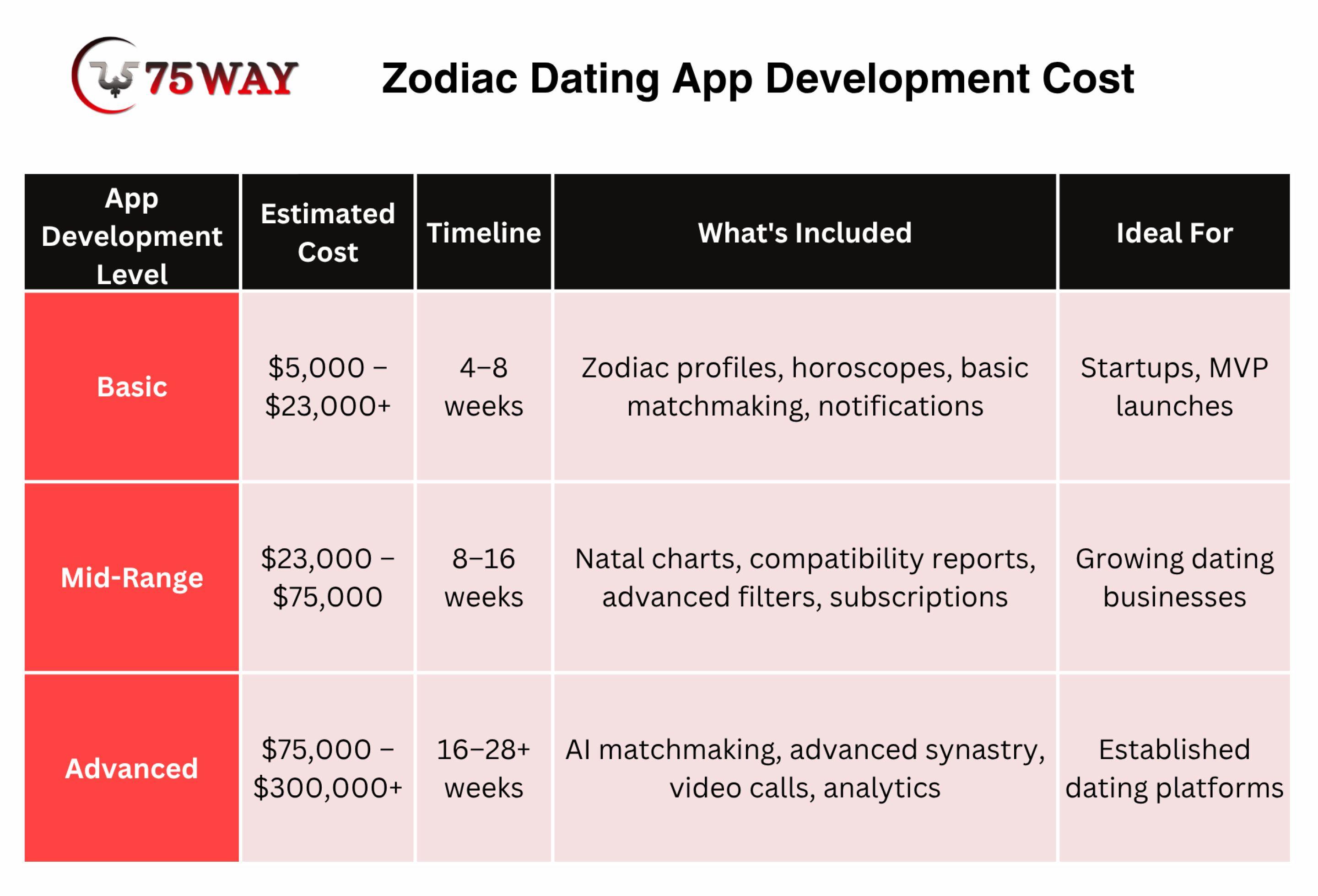
1. Basic Zodiac Dating App Cost: $5,000 – $23,000+
- Basic zodiac profiles, daily horoscopes, and simple matchmaking functionality.
- Standard notifications, straightforward navigation, and third-party content integrations.
Timeline: 4 to 8 weeks.
2. Mid-Range Zodiac Dating App Cost: $23,000 – $75,000
- Natal charts, personalized forecasts, and detailed compatibility reports through astrology APIs.
- User accounts, advanced filters, subscriptions, and integrated payment functionality.
Timeline: 8 to 16 weeks.
3. Advanced Zodiac Dating App Cost: $75,000 – $300,000+
- AI-assisted matchmaking, advanced synastry, and personalized relationship recommendations.
- Real-time messaging, video calling, scalable infrastructure, and advanced analytics.
Estimated Timeline: 16 to 28+ weeks, depending on the scope.
Factors That Influence Zodiac Dating App Development Costs
Several technical and business decisions can change the overall development budget.
1. Feature Complexity
A platform with registration, zodiac profiles, and basic matching requires less development effort than one with advanced compatibility calculations, AI recommendations, and video communication.
2. UI/UX Design Requirements
Custom illustrations, interactive birth charts, animations, and personalized dashboards increase design and implementation requirements.
3. Technology Selection
Native applications, cross-platform frameworks, backend architecture, and cloud infrastructure have different development and maintenance requirements.
4. Third-Party Integrations
Astrology APIs, payment gateways, messaging services, identity verification, and location integrations can introduce setup, usage, and recurring subscription expenses.
5. Security Requirements
Dating applications handle personal profiles, private conversations, location information, and potentially sensitive birth details. Appropriate security controls require dedicated engineering and testing.
6. Development Team Location
Hourly development rates vary by country, company, team experience, and engagement model. The lowest development quote does not necessarily offer the best long-term value.
1What type of zodiac dating app do you want to build?
Single choice2Estimated Development Budget
Single choice3Preferred App Platform
Single choice4Which features do you need?
Multiple choiceMonetization Models To Generate Revenue From Zodiac Dating App
Choosing the right business model is important because development costs need to be supported by a sustainable revenue strategy.
A zodiac dating application can generate revenue through subscriptions, one-time purchases, premium features, and selected partnerships.
Here are five monetization models businesses can consider.
1. Freemium Business Model
The freemium model provides basic application functionality without requiring payment.
Users can register, create profiles, browse selected matches, and access basic zodiac information.
Premium features remain available through subscriptions or individual purchases.
For example, users might access basic Sun sign compatibility for free while paying for detailed synastry reports.
Why It Works: It reduces the initial barrier to entry and gives users an opportunity to experience the application before purchasing premium services.
2. Subscription-Based Business Model
Subscriptions provide access to premium features through recurring payments.
Businesses can introduce monthly, quarterly, and annual membership plans.
Possible premium benefits include:
- Unlimited likes.
- Advanced compatibility reports.
- Detailed birth-chart insights.
- Advanced matchmaking filters.
- Profile visibility controls.
- Personalized astrology content.
- Additional discovery options.
Subscription pricing should reflect the actual value delivered rather than restricting essential safety or communication functionality.
3. In-App Purchases
In-app purchases allow users to pay for individual features without subscribing to a recurring plan.
Examples include:
- One-time compatibility reports.
- Profile boosts.
- Additional likes.
- Premium astrology readings.
- Special profile themes.
This approach can appeal to users who want occasional premium functionality rather than an ongoing subscription.
4. Advertisement-Based Revenue
The application can generate revenue through advertising placements.
Potential advertising formats include:
- Native advertisements.
- Sponsored astrology content.
- Display advertisements.
- Relevant brand partnerships.
Businesses should avoid intrusive advertising that interrupts profile discovery or private conversations.
Advertising partners should not receive personal dating or astrological information without an appropriate legal basis and user disclosures.
5. Paid Astrology Services And Partnerships
An advanced platform can collaborate with professional astrologers, relationship coaches, and relevant content providers.
Users may purchase additional services such as personalized readings, consultations, or educational content.
This model creates opportunities beyond standard dating subscriptions, provided that services are accurately described and their providers are appropriately vetted.
Which Monetization Model Should Businesses Choose?
For most early-stage startups, a freemium model combined with premium subscriptions is a practical starting point.
It allows businesses to build an initial user base while testing which premium features people actually value.
Once the platform establishes demand, additional revenue streams such as paid compatibility reports, one-time purchases, and astrology consultations can be introduced.
Security And Privacy Considerations For Zodiac Dating Apps
Security is a core product requirement for dating applications, not an optional feature to add after launch.
These platforms may collect personal information, profile photographs, birth dates, birth times, locations, preferences, and private conversations.
Some users may also share information about their relationships, sexual orientation, or other sensitive subjects.
Businesses targeting US users should consider applicable federal and state privacy requirements, including relevant consumer privacy and data protection laws.
1. Secure User Authentication
Implement secure authentication with appropriate password handling, session management, and account recovery.
Multi-factor authentication can provide an additional layer of protection, particularly for administrative accounts.
2. Encrypt Sensitive Information
Use encryption in transit and appropriate encryption at rest for sensitive information.
Access to private profile data, birth details, and communication records should be restricted according to business requirements.
3. Protect Location Information
Location data should be collected only when necessary for the application's functionality.
Businesses should avoid exposing precise user coordinates to other users and provide understandable location controls.
4. Implement Reporting And Blocking
Users should be able to report suspicious profiles, block unwanted contacts, and access support.
Moderation processes should cover fake accounts, harassment, spam, inappropriate content, and abusive behavior.
5. Provide Account And Data Deletion
Users should have an understandable way to request account deletion and the handling of associated personal information.
Businesses should establish appropriate retention and deletion policies for application databases, backups, and third-party services.
6. Protect API Integrations
API keys, payment credentials, and administrative secrets should never be exposed in client-side application code.
Use secure backend integrations, access restrictions, monitoring, and appropriate credential rotation.
7. Follow App Marketplace Requirements
Dating applications with user-generated content need suitable content moderation and safety functionality.
Common Mistakes To Avoid During Zodiac Dating App Development
A technically functional application does not automatically become a successful dating business.
Founders should pay attention to product decisions that can affect user trust, retention, and long-term profitability.
1. Depending Only On Sun Signs
Problem: Matching users exclusively through their Sun signs can make the product feel too basic.
Solution: Introduce optional Moon sign, Rising sign, planetary placement, and synastry-based interpretations as the product evolves.
2. Ignoring Conventional Dating Preferences
Problem: Users may receive astrologically interesting recommendations that do not match their relationship goals or preferences.
Solution: Combine astrology-based indicators with age, location, interests, and relationship preferences.
3. Collecting Unnecessary Birth Information
Problem: Requesting exact birth details without explaining their purpose can create privacy concerns.
Solution: Explain why each data point is required, make optional fields clear, and provide appropriate privacy controls.
4. Presenting Compatibility Scores As Scientific Facts
Problem: A percentage score may create unrealistic expectations if presented as an objective measure of relationship success.
Solution: Explain that compatibility scores reflect the application's selected astrological interpretation rules, not a scientifically established prediction of romantic outcomes.
5. Overloading The MVP With Features
Problem: Developing every advanced feature before validating demand can increase costs and delay launch.
Solution: Begin with essential matchmaking functionality and introduce advanced capabilities based on user feedback.
6. Neglecting Profile Authenticity
Problem: Fake accounts, misleading photographs, and spam can damage trust.
Solution: Introduce suitable verification, suspicious-activity detection, reporting, and moderation processes.
7. Treating User Acquisition As A Post-Launch Activity
Problem: A new dating platform can struggle if it launches without a plan to attract enough relevant users.
Solution: Plan audience acquisition, referral programs, partnerships, and launch campaigns alongside product development.
8. Ignoring Long-Term Maintenance
Problem: API changes, security updates, new operating-system versions, and infrastructure requirements can affect application performance.
Solution: Allocate a maintenance budget and establish a clear post-launch support plan.
How Can Businesses Launch And Scale A Zodiac Dating App Successfully?
A zodiac dating app needs more than interesting astrology features to stand out in the competitive US dating market. The right audience, strong user engagement, and a sustainable growth strategy can make a real difference. Let's look at how businesses can launch and scale their platforms.
1. Start With A Clearly Defined Niche
Avoid targeting every person interested in dating or astrology.
Choose a specific audience, such as astrology enthusiasts seeking serious relationships, young professionals interested in compatibility, or users looking for astrology-based social connections.
A focused audience makes product positioning and marketing decisions easier.
2. Build A Balanced User Community
Dating platforms depend on having enough relevant and active users.
Businesses should consider launching in selected cities or regions before expanding nationally.
For example, an initial launch in a few metropolitan areas can help test onboarding, profile discovery, and matchmaking engagement.
3. Create An Effective User Acquisition Strategy
A combination of marketing channels can help attract relevant users.
Consider:
- Search Engine Optimization: Publish astrology compatibility guides, dating resources, and educational content.
- Social Media Marketing: Share zodiac-related content and application updates.
- Influencer Partnerships: Collaborate with astrology creators and dating influencers.
- Referral Programs: Reward users for inviting relevant friends.
- Paid Advertising: Test campaigns targeting specific interests and audiences.
- Community Marketing: Participate in relevant astrology and relationship communities.
4. Focus On User Retention
Acquiring users is only one part of building a dating business.
The application should provide reasons for users to return.
Personalized insights, relevant match suggestions, meaningful conversations, and useful notifications can contribute to engagement.
Businesses should monitor retention cohorts to understand whether users continue using the platform after their first day, week, and month.
5. Continuously Improve Matchmaking
Use user feedback and application analytics to identify weaknesses in the recommendation system.
For example, if users frequently reject suggested profiles because of mismatched relationship preferences, the platform may need to adjust its recommendation rules.
The objective should be to improve match relevance, not simply increase the number of profiles displayed.
How 75way Technologies Helps Businesses With Zodiac Dating App Development
75way Technologies helps businesses turn zodiac dating app ideas into engaging, feature-rich platforms. Our team handles everything from business analysis and UI/UX design to astrology API integration, compatibility algorithms, and secure app development.
Whether you are launching an MVP or building an advanced matchmaking platform, we develop solutions around your business goals. From personalized zodiac profiles to AI-assisted recommendations, we help create a dating experience that attracts users and supports long-term growth.
Conclusion
Zodiac dating app development offers businesses an opportunity to combine astrology-driven personalization with conventional online matchmaking. However, a successful platform requires more than zodiac-based recommendations. It needs reliable chart calculations, relevant match suggestions, intuitive UI/UX, strong privacy controls, and a sustainable monetization strategy. For founders, the best starting point is a clearly defined audience, a focused MVP, and a development roadmap that supports future expansion. To turn your zodiac dating app idea into a business, partner with a renowned astrology app development company to discuss your requirements and development roadmap.
Frequently Asked Questions (FAQs)
How Much Does It Cost To Develop A Zodiac Dating App?
Zodiac dating app development costs approximately 300,000+, depending on features, platform requirements, integrations, and application complexity. A basic MVP costs less, while advanced applications with AI-assisted matchmaking, detailed birth-chart calculations, and real-time communication require a larger investment.
How Long Does It Take To Develop A Zodiac Dating App?
A basic zodiac dating app may take 4–8 weeks, while a mid-range application can require 8–16 weeks. Advanced applications may take 16–28+ weeks or longer, depending on integrations, custom development, and testing requirements.
Can AI Improve Zodiac Dating App Matchmaking?
Yes. AI can analyze user preferences, profile interactions, interests, and feedback to improve match recommendations. It can also generate personalized explanations using astrological data. However, AI should complement clearly defined compatibility rules rather than present astrology as a scientifically proven relationship predictor.
Can I Develop A Zodiac Dating App Without An Astrology API?
Yes. Businesses can develop an internal astrology calculation engine using suitable astronomical data, ephemeris libraries, and established astrological calculation rules. However, this requires specialized implementation, testing, time-zone handling, and ongoing maintenance.
Is Zodiac Compatibility Enough To Recommend Dating Matches?
No. Zodiac compatibility should be one component of the recommendation system. Relationship goals, age preferences, location, interests, communication preferences, and user interactions should also influence match recommendations.