AI Summary
Hiring mobile app developers in Abu Dhabi involves more than comparing prices or portfolios. This guide explains how businesses can evaluate technical expertise, AI capabilities, security, costs, contracts, and support. It also reveals practical questions for selecting the right development partner.
Key Takeaways
- Define app requirements before approaching mobile development companies in Abu Dhabi.
- Compare developers using expertise, portfolios, security, pricing, and support.
- Evaluate AI capabilities without overlooking human engineering and testing.
- Review contracts, ownership, timelines, maintenance, and development responsibilities.
- Choose partners based on business needs, not pricing alone.
Have a mobile app idea that could solve a real customer problem, but not the right development team to turn it into a working product? For businesses, the bigger challenge is to find and hire mobile app developers in Abu Dhabi who understand both the technology and the market.
A capable mobile app development team can handle everything from UI/UX design and backend development to API integration, testing, security, and post-launch improvements. The right hiring approach also depends on your app type, project scope, timeline, budget, and long-term growth plans.
This guide explores what to look for when hiring mobile app developers in Abu Dhabi, including skills, services, costs, hiring models, and other factors that can shape your development decision
Quick Answer: How Do You Hire Mobile App Developers In Abu Dhabi?
To hire mobile app developers in Abu Dhabi, first define your app requirements, then decide whether you need freelancers, an in-house team, or an app development company.
You can shortlist teams based on relevant industry experience, technical capability, portfolio quality, communication, security practices, development process, pricing transparency, and post-launch support.
For most businesses developing a commercial mobile application, the important question is not “Who can build an app?” but “Who can take responsibility for turning the product idea into a reliable, scalable business application?”
That distinction matters because modern app creation involves much more than writing code.
Who Can Hire Mobile App Developers In Abu Dhabi?
Not every business needs a large in-house technology team to launch a mobile app. A startup testing a new concept, a retailer expanding its digital presence, or an enterprise modernising internal workflows may all require external development expertise. The key business categories that may need mobile app developers in Abu Dhabi are covered in the discussion that follows.
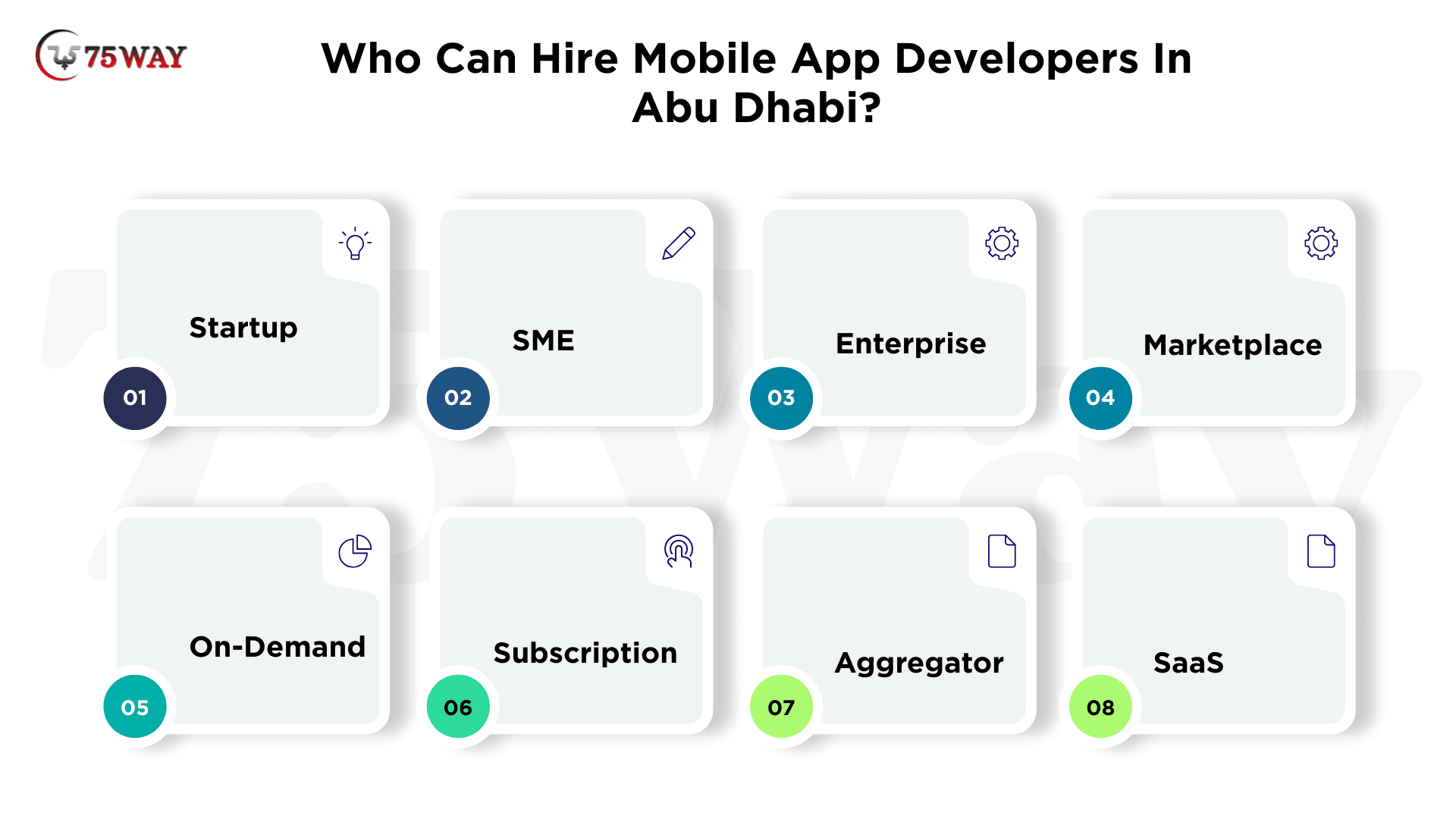
- Startup: Validate app ideas through MVP development and scalable architecture.
- SME: Build customer-facing apps for bookings, commerce, loyalty, and operations.
- Enterprise: Develop secure applications with integrations, analytics, and role-based access.
- Government-related business: Support compliance, accessibility, security, integrations, and reliable digital services.
- Marketplace Business Model: Connect buyers and sellers through listings, transactions, communication, and management tools.
- On-Demand Business Model: Match customers with service providers through bookings, payments, tracking, and notifications.
- Subscription Business Model: Deliver recurring services through subscriptions, billing, renewals, and customer account management.
- Aggregator Business Model: Bring multiple providers together through search, comparison, booking, and transaction features.
- SaaS Business Model: Deliver software services through user accounts, subscriptions, dashboards, integrations, and cloud infrastructure.
Abu Dhabi has also developed a substantial technology and startup ecosystem. Hub71 reported in 2026 that Abu Dhabi entered the world's top 50 emerging startup ecosystems, with its ecosystem value reaching $73.4 billion according to the 2026 Global Startup Ecosystem Report.
That creates a different hiring environment from simply looking for a programmer. Businesses increasingly need product and engineering teams capable of supporting growth, integrations, AI adoption, and sector-specific requirements.
How To Hire Skilled Mobile App Engineers In Abu Dhabi
The right mobile app engineer can influence your app’s performance, security, user experience, and long-term scalability. A clear hiring process helps businesses assess technical skills, project experience, communication, development approach, and overall fit before making a decision. The key steps for hiring skilled mobile app engineers in Abu Dhabi are outlined next.
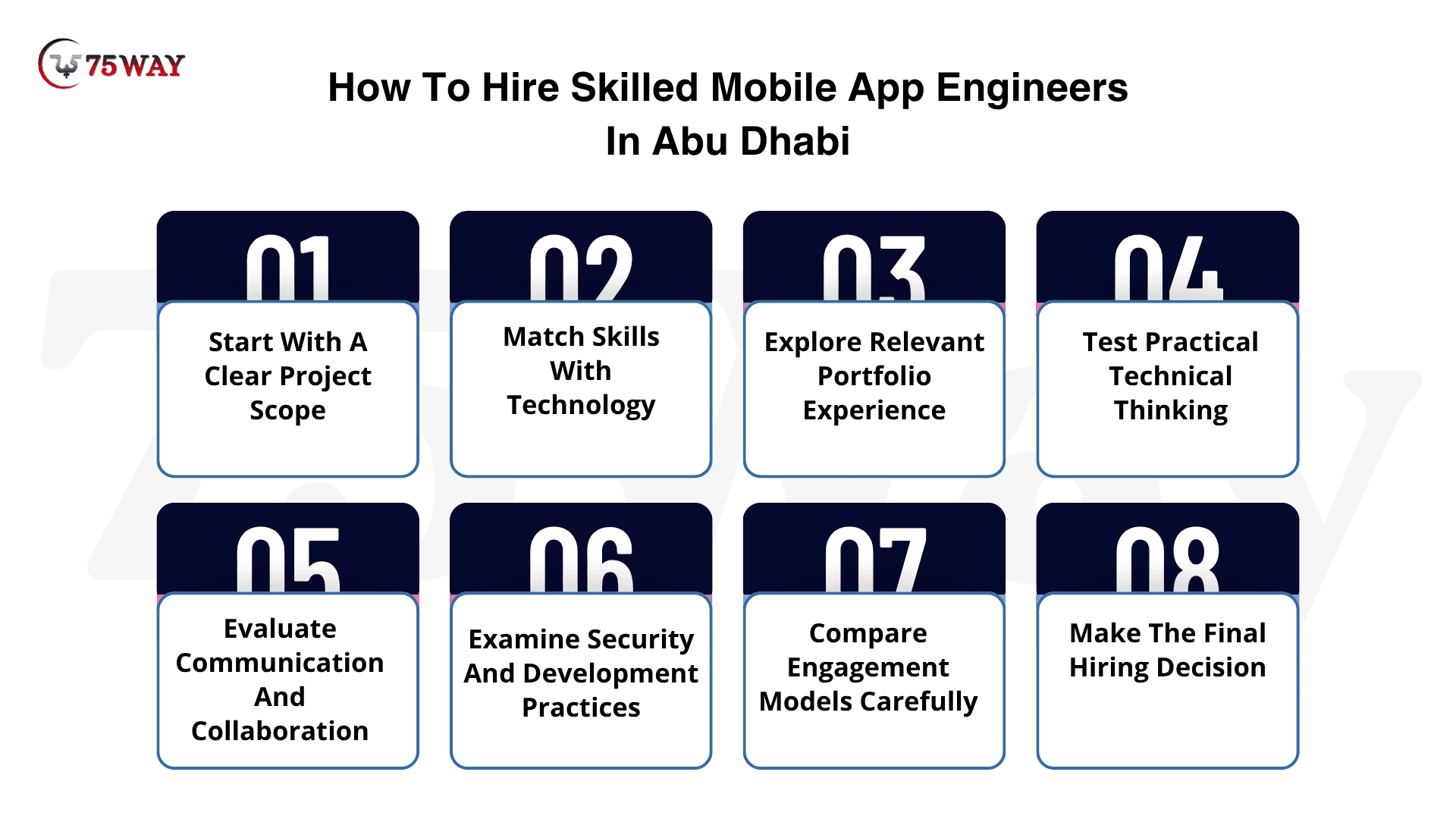
1. Start With A Clear Project Scope
A well-defined project scope gives engineers a clear picture of what needs to be built. Your requirements should cover the audience, platforms, integrations, and expected outcomes. That clarity makes candidate evaluation far more meaningful.
- Map important user journeys before hiring begins.
- Set measurable milestones for development progress.
- Document third-party integration requirements early.
- Define your expected launch timeline clearly.
2. Match Skills With Technology
Your chosen technology stack determines the expertise your project actually needs. A Flutter application requires different strengths from a native iOS product or React Native solution. The right technical match prevents costly skill gaps later.
- Identify native or cross-platform development requirements.
- Consider backend integration and API expertise.
- Include specialised technologies required by features.
- Check experience with your preferred development tools.
3. Explore Relevant Portfolio Experience
A candidate’s previous work often reveals more than a polished résumé. Applications with similar complexity can show practical experience with real users, technical constraints, performance demands, and industry-specific requirements your project may encounter.
- Review applications currently available on app stores.
- Examine projects with comparable functionality levels.
- Look for experience solving similar technical challenges.
- Verify claimed contributions within previous projects.
4. Test Practical Technical Thinking
Technical interviews become more useful when they resemble real project situations. Architecture decisions, debugging scenarios, performance issues, and coding challenges can reveal how an engineer thinks when straightforward solutions are unavailable.
- Discuss architecture choices using realistic scenarios.
- Examine approaches to performance-related challenges.
- Evaluate debugging methods through practical examples.
- Review code quality during technical assessments.
5. Evaluate Communication And Collaboration
Clear communication matters when engineers work alongside designers, product managers, and business teams. A technically capable developer should also explain complex decisions clearly, raise concerns early, and remain receptive to changing project requirements.
- Observe clarity during technical conversations.
- Discuss preferred communication and reporting methods.
- Assess collaboration across multidisciplinary project teams.
- Check responsiveness during the evaluation process.
6. Examine Security And Development Practices
Security deserves attention before a developer receives access to your product. Questions around authentication, encryption, testing, API protection, code reviews, and deployment practices can reveal whether candidates understand the responsibilities behind production-ready applications.
- Review authentication and authorization implementation methods.
- Ask about application testing procedures and coverage.
- Discuss secure API development practices.
- Examine post-launch maintenance and update processes.
7. Compare Engagement Models Carefully
Your project size, timeline, and internal capabilities should influence the hiring model. Individual engineers, dedicated teams, and development partners offer different levels of control, collaboration, technical coverage, and ongoing support.
- Compare project-based and dedicated hiring structures.
- Review availability against your development timeline.
- Clarify responsibilities across internal and external teams.
- Confirm ownership of source code and deliverables.
8. Make The Final Hiring Decision
The final choice should reflect technical capability, project understanding, communication, and long-term reliability rather than hourly rates alone. A structured final interview can uncover practical concerns before development begins and establish stronger expectations from the outset.
- Verify references from relevant previous engagements.
- Confirm availability throughout your development timeline.
- Establish documentation and access procedures beforehand.
- Agree on milestones and reporting expectations.
9. Local Abu Dhabi Knowledge Can Matter
Choosing a developer in Abu Dhabi is not necessarily about requiring every engineer to sit inside the emirate.
The more useful question is whether the development partner understands your operating environment and can work effectively with your stakeholders, customers, integrations, and business requirements.
Abu Dhabi's technology ecosystem includes startups and companies working across areas such as AI, FinTech, ClimateTech, HealthTech, and digital assets. For a business owner, this means your search should go beyond:
“mobile app developer Abu Dhabi”
You should also evaluate industry experience, product capability, technical depth, security, local business understanding, and long-term support.
That combination is much closer to the real hiring intent behind the search.
Key Skills To Look For When Hiring App Developers In Abu Dhabi
A developer’s coding ability is only one part of what makes an app project successful. Businesses also need expertise in mobile frameworks, APIs, databases, security, testing, and problem-solving to build an application that can handle real users. The following skills can help businesses identify capable app developers in Abu Dhabi.
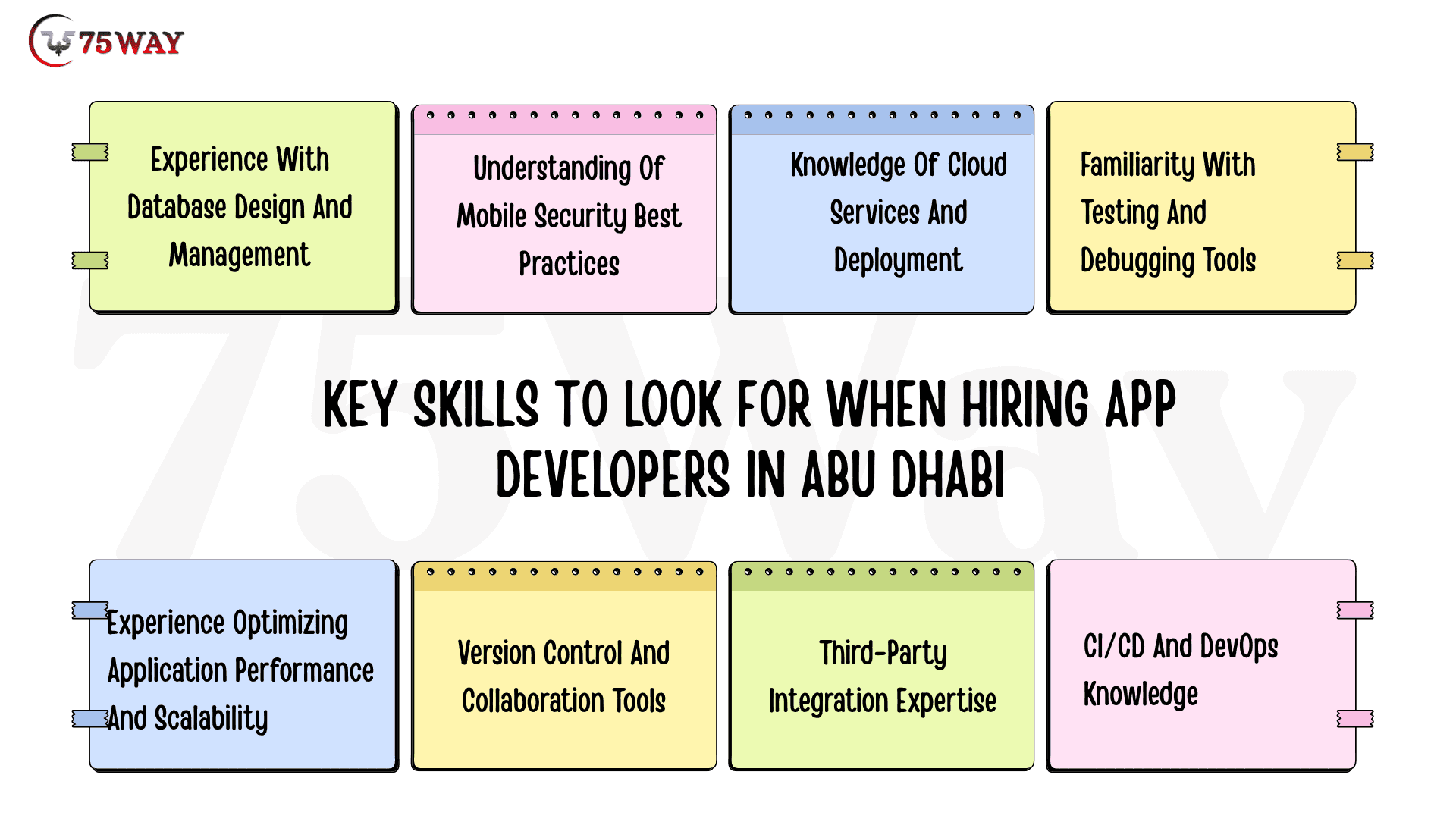
- Experience With Database Design And Management
Strong database knowledge helps developers structure, store, and retrieve application data properly. Practical experience with SQL and NoSQL databases supports different application requirements.
Data modeling skills also matter when user activity and transaction volumes grow. A developer should understand database security, indexing, backups, and optimization.
- Understanding of Mobile Security Best Practices
Mobile security knowledge protects applications from unauthorized access, data exposure, and common vulnerabilities. Developers should understand authentication, authorization, encryption, secure API communication, and protected data storage.
Awareness of secure coding practices can reduce risks throughout development. Experience with security testing adds another layer of protection before launch.
- Knowledge of Cloud Services And Deployment
Cloud expertise gives developers greater control over application hosting, storage, scalability, and deployment workflows. Familiarity with platforms such as AWS, Azure, or Google Cloud can support different infrastructure needs.
Deployment knowledge should cover environments, monitoring, backups, and configuration management. Practical cloud experience also helps teams prepare applications for growing user demand.
- Familiarity With Testing And Debugging Tools
Testing expertise helps developers identify functional issues before they reach users. Knowledge of unit, integration, automated, and device testing supports stronger application quality.
Debugging skills reveal the underlying causes of crashes, performance problems, and unexpected behavior. Familiarity with testing tools can also make release cycles more predictable.
- Experience Optimizing Application Performance And Scalability
Performance expertise becomes important when applications handle increasing users, transactions, or real-time activity. Developers should understand memory usage, API response times, caching, database queries, and network performance.
Scalability knowledge helps applications accommodate higher workloads without unnecessary infrastructure costs. Experience with profiling and performance monitoring can reveal bottlenecks before they affect users.
- Version Control And Collaboration Tools
Version control knowledge helps developers manage code changes across active development cycles. Familiarity with Git supports branching, merging, code reviews, and rollback requirements.
Collaborative workflows become easier when developers understand repository management and pull requests. These practices also reduce conflicts when multiple engineers work on the same application.
- Third-Party Integration Expertise
Third-party integration skills allow developers to connect applications with external services and business systems. Experience with payment gateways, maps, analytics, authentication providers, and communication APIs can expand application functionality.
All developers should understand API documentation, authentication methods, error handling, and integration testing. Reliable integration practices also help prevent external services from disrupting core application workflows.
- CI/CD And DevOps Knowledge
CI/CD expertise helps developers automate application builds, testing, deployment, and release workflows. Knowledge of pipelines, containers, environment configuration, and deployment automation supports smoother development cycles.
App engineers familiar with DevOps practices can identify infrastructure issues alongside application-level problems. This technical coverage becomes valuable when frequent releases and multiple environments are involved.
Ask These Questions Before Hiring Mobile App Developers
A hiring decision can become costly when important questions are left unanswered until development begins. Clear conversations about portfolios, technology stacks, ownership, security, timelines, costs, and maintenance can help businesses understand what they are actually getting. The key questions to raise with potential mobile app developers are explored below.
Experience
- How many mobile applications have you launched?
- Have you built applications similar to ours?
- Can you show live applications?
- Can we speak with relevant clients?
Technical
- Which technology would you recommend and why?
- How will the backend be structured?
- How will APIs and third-party services be integrated?
- How will the application scale if users increase?
Product
- What should be included in our MVP?
- Which features would you postpone?
- What technical risks do you see in our idea?
Security
- How will user data be protected?
- How do you test application vulnerabilities?
- How are third-party dependencies monitored?
Delivery
- Who will manage our project?
- How frequently will we receive builds?
- How will changes be handled?
- What happens if the deadline changes?
Ownership
- Who owns the source code?
- Who owns the designs and documentation?
- Will we receive production credentials?
- What happens if we change development partners?
Support
- What happens after launch?
- What does the maintenance agreement include?
- How are critical production issues handled?
These questions can reveal more about a development company than a polished portfolio page.
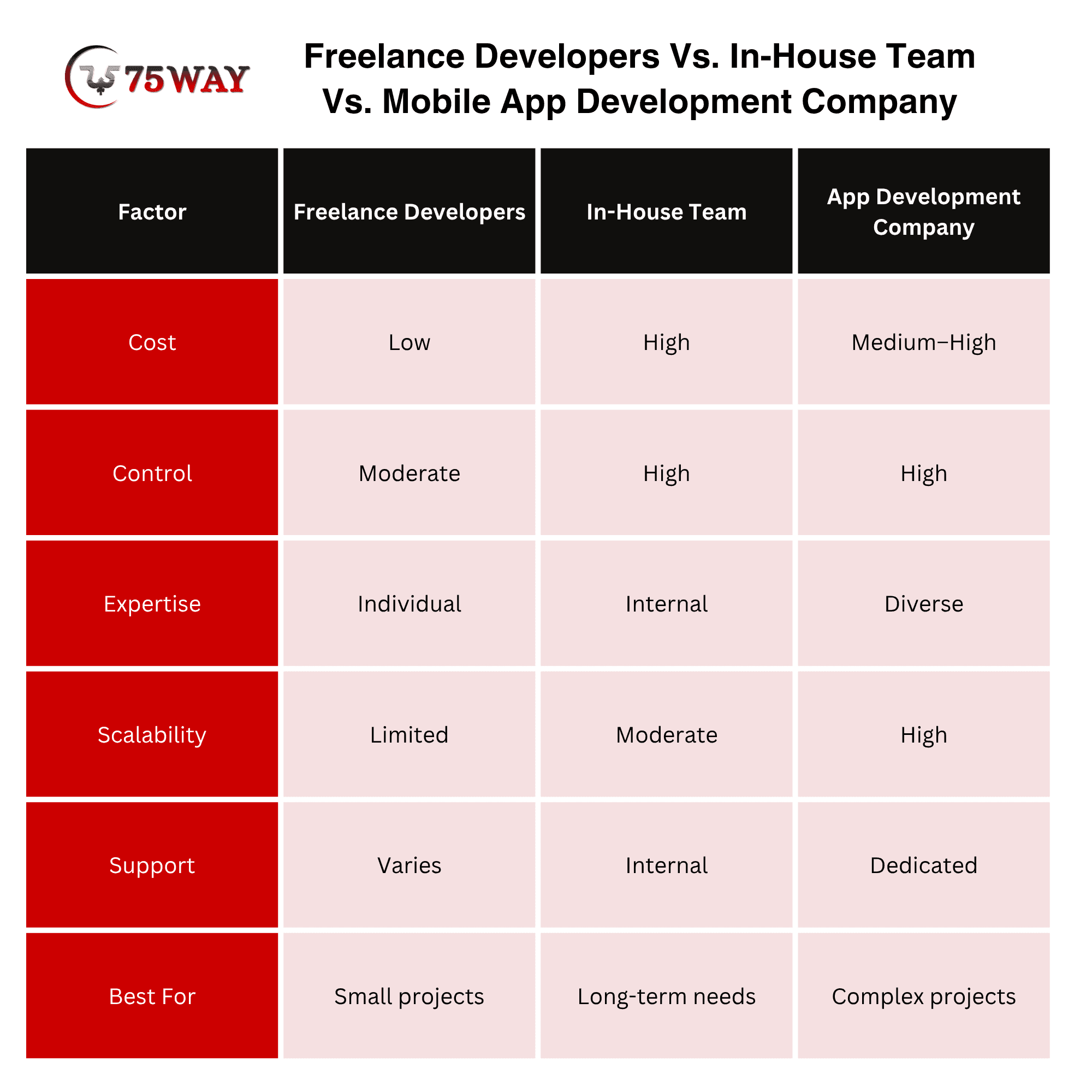
Freelance Developers Vs. In-House Team Vs. Mobile App Development Company
The right development setup depends on more than your app idea or available budget. Freelancers, in-house teams, and mobile app development companies offer different levels of control, expertise, scalability, and ongoing support. The following comparison explains how these three hiring options differ across the factors that matter to your project.
- Freelance Developers
Freelancers can work well for smaller applications, prototypes, individual modules, or projects where an experienced technical lead already exists internally.
The limitation is ownership. If your app requires product management, UI/UX, backend engineering, DevOps, QA, security, and continuous support, one freelancer may not cover the complete delivery lifecycle.
- In-House Development Team
An internal team provides direct control over product development and can be suitable for businesses planning continuous technology investment.
However, hiring multiple specialists creates additional recruitment, management, infrastructure, and employee costs.
- Mobile App Development Company
A development company typically provides multiple capabilities under one delivery structure, including business analysis, UI/UX design, mobile development, backend development, API integration, quality assurance, cloud and DevOps, security implementation, App Store and Google Play deployment, maintenance and support.
For founders and businesses without a large internal technology department, this model can reduce the number of separate vendors they need to coordinate.
Cost To Hire Mobile App Developers in Abu Dhabi
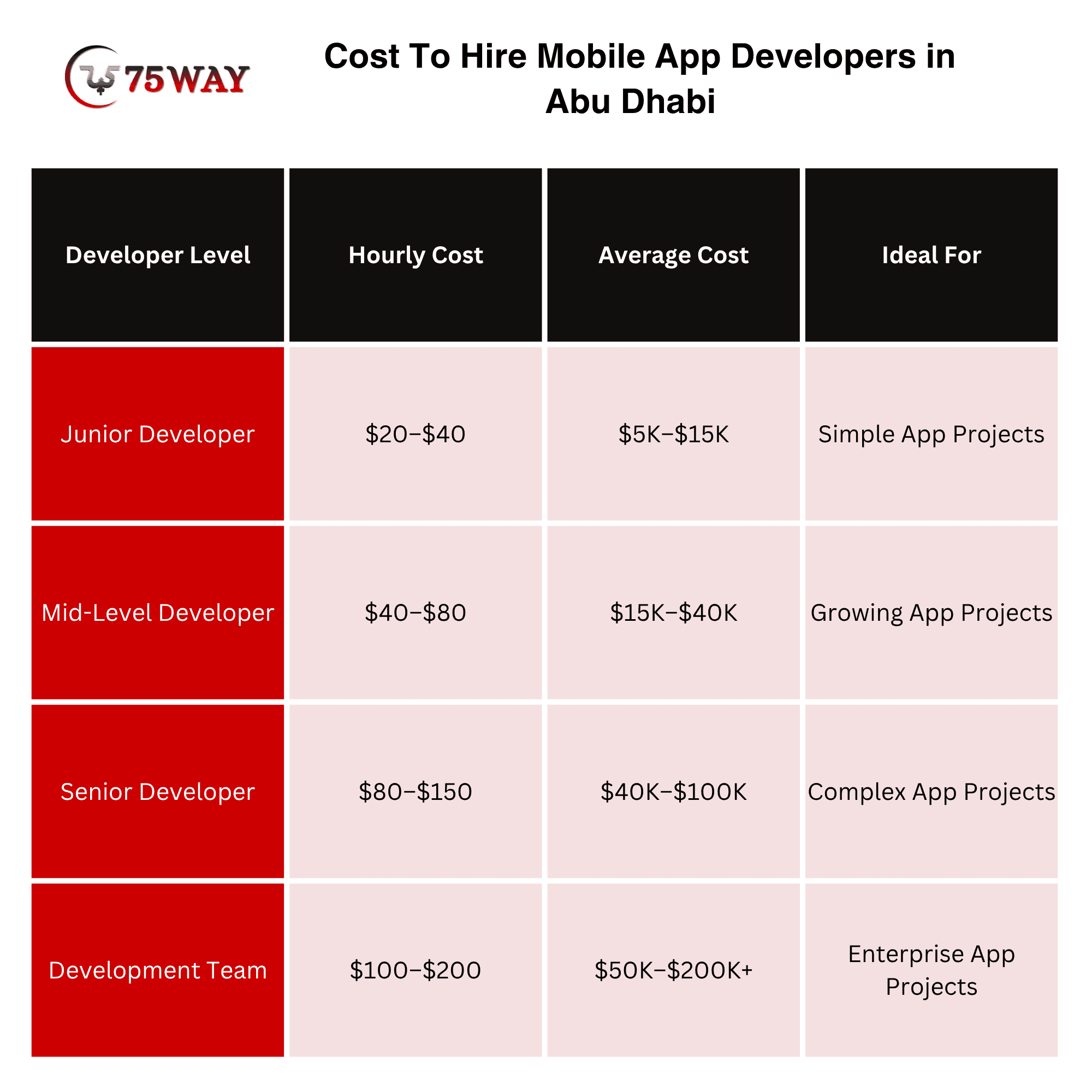
Hiring mobile app developers in Abu Dhabi can cost differently depending on experience, technology, project complexity, and engagement model. A simple application may need a smaller development budget, while advanced products can require a larger team and a longer development cycle. The average cost range and the factors that influence it are explained as follows.
Junior Developer Cost: $20–$40 Per Hour
- Suitable for simpler apps and maintenance
- Works under guidance on defined tasks
Mid-Level Developer Cost: $40–$80 Per Hour
- Handles complex features with limited supervision
- Brings practical experience across development projects
Senior Developer Cost: $80–$150 Per Hour
- Leads architecture and complex technical decisions
- Solves advanced performance and security challenges
Development Team Cost: $100–$200 Per Hour
- Covers multiple specialists across your project
- Suitable for complex, large-scale application development
Should You Hire An Abu Dhabi-Based Developer Or An Offshore Team?
There is no universal answer.
The right hiring choice depends on your project scope, budget, communication needs, and technical requirements.
An Abu Dhabi-based developer can offer closer collaboration and local market familiarity, while an offshore team can provide broader expertise and flexible development capacity. Your priorities around cost, availability, scalability, and long-term support should guide the decision.
An Abu Dhabi-based or UAE-based team can offer easier local communication, timezone alignment, and familiarity with regional business requirements. On the other hand, an offshore team may provide access to a larger talent pool or different cost structures.
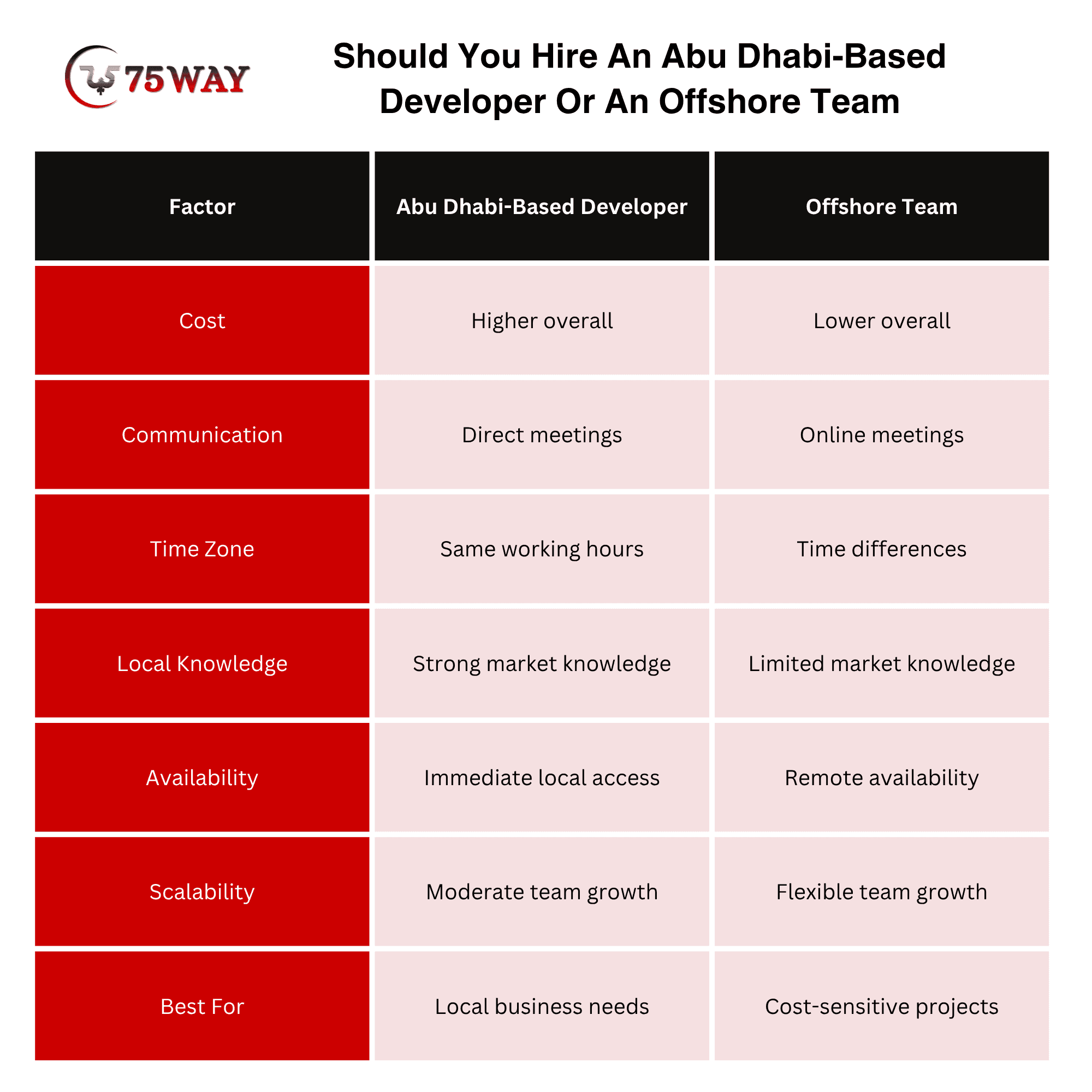
The decision should therefore depend on:
- Project complexity
- Communication requirements
- Availability
- Budget
- Industry requirements
- Security expectations
- Required technology
- Support model
- Time-zone overlap
- Long-term product plans
Instead of choosing purely by geography, evaluate whether the team can take responsibility for the complete product lifecycle.
How To Choose An Experienced Mobile App Developer In Abu Dhabi
The cheapest developer may not always match the needs of a complex mobile product, while the most experienced option may exceed your project requirements. Your app goals, budget, timeline, technology stack, and support expectations should guide the hiring decision. The following factors can help you evaluate and choose a mobile app developer in Abu Dhabi.
Stage 1: Build A Relevant Shortlist
A focused shortlist saves time by narrowing your options to developers with proven technical and industry experience. Your project requirements should guide this first filter, especially around platforms, integrations, and app complexity. The result is a stronger starting pool for deeper evaluation.
Stage 2: Validate Their Actual Capabilities
A company’s portfolio can reveal far more than a service list or sales presentation. Case studies, live applications, client references, technology expertise, and team structure provide useful evidence of practical capabilities. These details help separate genuine experience from broad development claims.
Stage 3: Discuss Your Product Requirements
A detailed conversation gives you a clearer view of how each developer approaches your product. Their recommendations should connect user needs, business objectives, technical architecture, and development priorities. Strong discussions can also reveal whether the team understands your challenges beyond the initial brief.
Stage 4: Compare The Complete Proposal
A meaningful comparison should cover more than development pricing alone. Scope, methodology, security, timelines, ownership, support, technical decisions, and communication all affect your overall engagement. A complete view makes differences between competing proposals easier to understand.
Stage 5: Begin With Defined Milestones
A smaller initial engagement can provide valuable insight before a larger commitment. Discovery work or an early milestone lets you assess communication, technical execution, responsiveness, and working practices in a practical setting. Clear deliverables also create a measurable foundation for the remaining product roadmap.
Why Businesses Should Not Choose App Developers Based Only On Price
The cheapest quotation can be attractive at the beginning, but software costs do not end when the first version launches.
- Poor architecture can create future redevelopment costs.
- Weak testing can create production issues.
- Unclear ownership can create vendor dependency.
- Poor UX can reduce adoption.
- Inadequate security can create business and compliance risks.
- A more useful approach is to evaluate total product ownership cost.
Ask:
What will this application cost to build, operate, maintain, improve, secure, and scale over the next several years?
That question gives founders a much clearer basis for vendor comparison.
Final Thoughts
To summarize, hiring mobile app developers in Abu Dhabi should be treated as a product and business decision, not simply a search for programmers. The right engineer should understand your users, challenge unclear requirements, recommend an appropriate technology approach, build securely, test thoroughly, and remain accountable after launch.
For founders and business owners, the best starting point is a clear product scope, followed by a structured comparison of development partners based on experience, technical capability, security, delivery process, ownership, pricing, and long-term support.
If you are planning a mobile application for the Abu Dhabi market, you can partner with a trusted app development company in Abu Dhabi.
Frequently Asked Questions (FAQs)
How Much Does It Cost To Hire Mobile App Developers In Abu Dhabi?
The cost depends on app complexity, development model, features, platforms, integrations, security requirements, AI functionality, and ongoing support. Ask for a detailed scope-based estimate instead of relying on a generic hourly rate.
How Do I Find Reliable Mobile App Developers In Abu Dhabi?
Shortlist teams using relevant portfolios, live applications, industry experience, technical expertise, client references, security practices, transparent proposals, and post-launch support capabilities.
Should I Hire A Freelancer Or App Development Company?
A freelancer can suit smaller or narrowly defined projects, while a development company may be more appropriate when your application requires coordinated UX, mobile, backend, QA, DevOps, and maintenance capabilities.
Can AI Build My Mobile App?
AI can assist with code, testing, documentation, prototyping, and development workflows, but a production application still requires product decisions, architecture, security, testing, integration, deployment, and human engineering oversight.
What Should I Ask A Mobile App Development Company Before Hiring?
Ask about relevant experience, technology choices, architecture, security, QA, project management, ownership, communication, timeline, pricing, maintenance, and post-launch support.
Should My App Launch On iOS and Android?
It depends on your target customers, budget, product requirements, and expected usage. Your development team should recommend a platform strategy based on your users rather than automatically proposing both platforms.
Do Mobile App Developers Also Provide UI/UX Design?
Many full-service development teams do. Confirm whether UI/UX research, wireframes, prototypes, UI design, design systems, and usability testing are included in the proposal.
Who Owns The Source Code After App Development?
Ownership should be explicitly defined in your development agreement. Confirm source-code access, intellectual property rights, design ownership, documentation, repositories, hosting credentials, and third-party accounts.
Do I Need An Admin Panel For My Mobile App?
Many commercial applications require an admin panel for managing users, content, transactions, reports, notifications, settings, or operational workflows. Its requirements should be defined during discovery.
Can An Abu Dhabi Company Work With An Offshore Development Team?
Yes. The important considerations are communication, timezone overlap, security, technical capability, project management, contractual arrangements, and post-launch support rather than geography alone.