AI Summary
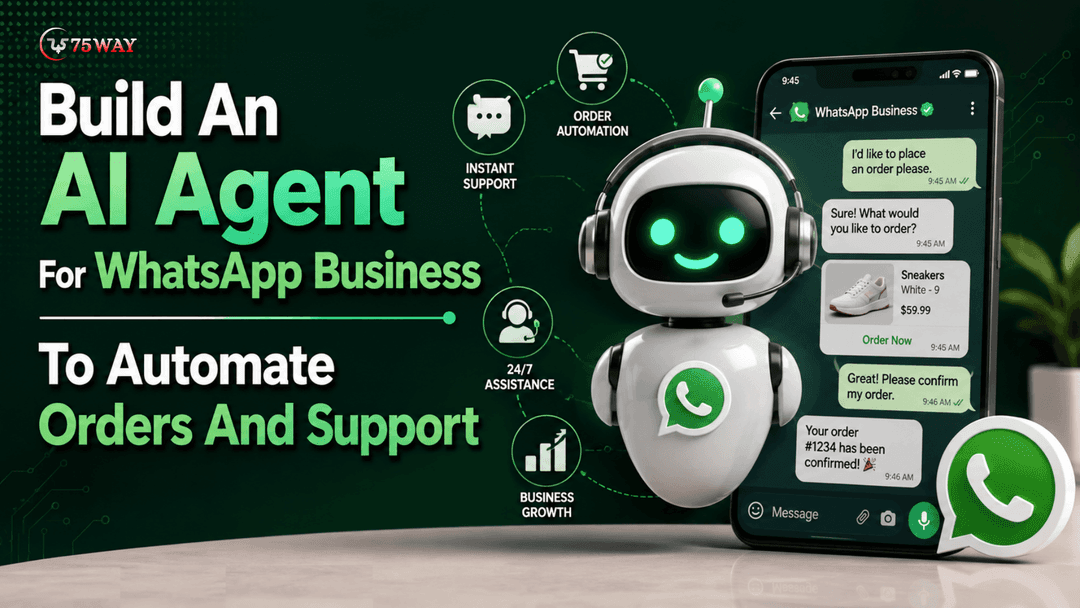
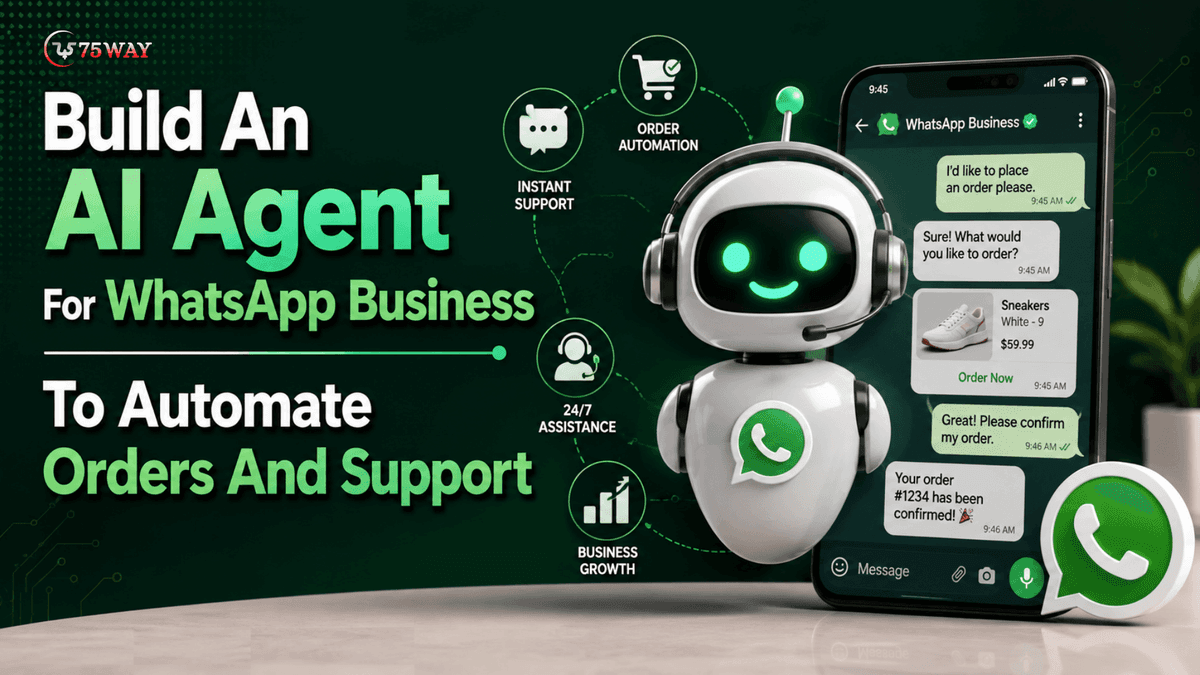
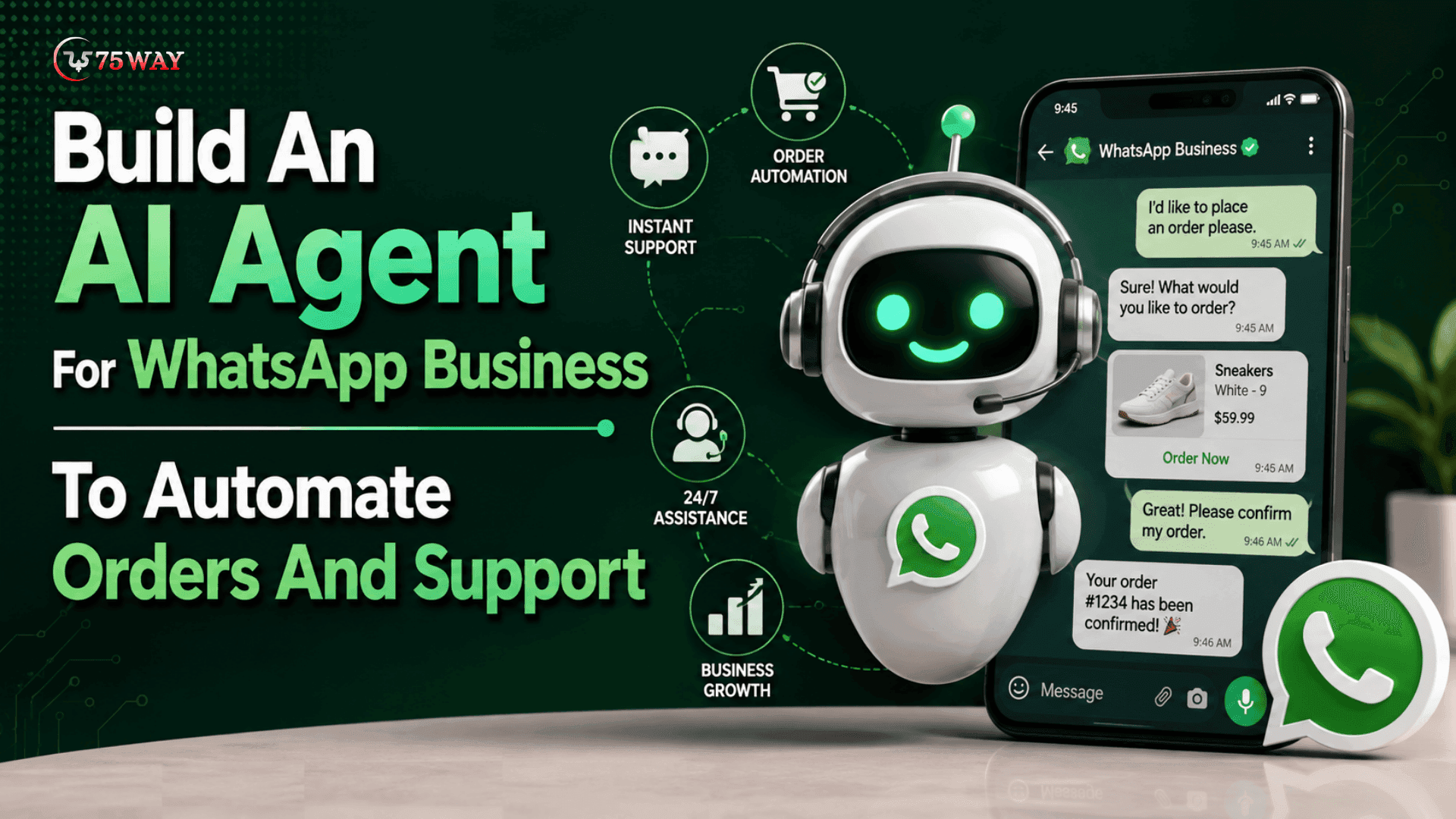
Build a smarter WhatsApp Business experience with AI-powered automation. This guide explains how AI agents streamline customer service, sales, bookings, payments, and order management while improving efficiency and customer satisfaction.
Key Takeaways
- AI agents automate WhatsApp conversations with intelligent, human-like customer interactions.
- Businesses reduce support costs through automated order and inquiry management.
- Faster responses improve customer satisfaction, loyalty, and long-term business growth.
- CRM integrations create personalized conversations using real-time customer information efficiently.
- Strategic AI implementation increases operational efficiency while supporting scalable customer experiences.
Do you remember the last time a customer asked your business a simple question on WhatsApp:
"Is this product available?",
"Where is my order?", or
"Can I book this service?"
Now multiply that conversation by hundreds or thousands of customers every day. That is where many growing businesses begin to face operational pressure.
Adding more support executives may solve the problem temporarily, but it does not always create the consistency and 24/7 availability. So, the simple solution is to adopt AI automation in your business. That is possible with voice AI solutions and AI agents for WhatsApp Business.
Several startups and founders like you are now exploring AI agents that can handle routine conversations and support purchasing decisions on their Whatsapp Business account.
But how to build an AI agent for Whatsapp? Can we easily integrate it into existing Whatsapp Business? What are the essential features and benefits of this agentic AI solution?
To answer all your queries, we have prepared this guide for you. You will walk through how to build a WhatsApp AI agent for business, including the development process, essential features, integrations, and strategic considerations for companies planning to modernise customer communication.
What Is An AI Agent For WhatsApp Business?
An AI agent for WhatsApp Business is like a smart digital team member that helps businesses handle customer conversations and answer questions inside WhatsApp. Unlike traditional chatbots that follow fixed replies, AI agents understand customer intent, use business data, and take actions based on each request.
A good support executive understands the context before responding. An AI agent is built to perform a similar role through artificial intelligence.
For example, imagine a customer messaging a fashion store on WhatsApp:
"I liked the blue jacket I saw yesterday. Do you still have it in medium size, and can I get it delivered before Friday?"
A traditional chatbot may struggle because the customer did not provide a product ID or follow a fixed menu. An AI agent, however, can understand that the customer is asking about a specific product, check availability, review delivery options, and provide a relevant response.
Behind the scenes, these agents combine technologies like Natural Language Processing (NLP), Large Language Models (LLMs), WhatsApp Business API, CRM integrations, and automation workflows to create faster and more personalized customer experiences.
The biggest difference is simple: a chatbot answers questions, while an AI agent helps complete business tasks. It allows companies to automate routine conversations while giving human teams more time to handle complex customer needs.
How Does An AI Agent For WhatsApp Business Work?
When a customer sends a message on WhatsApp, the interaction may look like a simple question-and-answer exchange. However, behind every response from an AI agent, multiple processes work together to understand the customer, access business information, make decisions, and complete tasks.
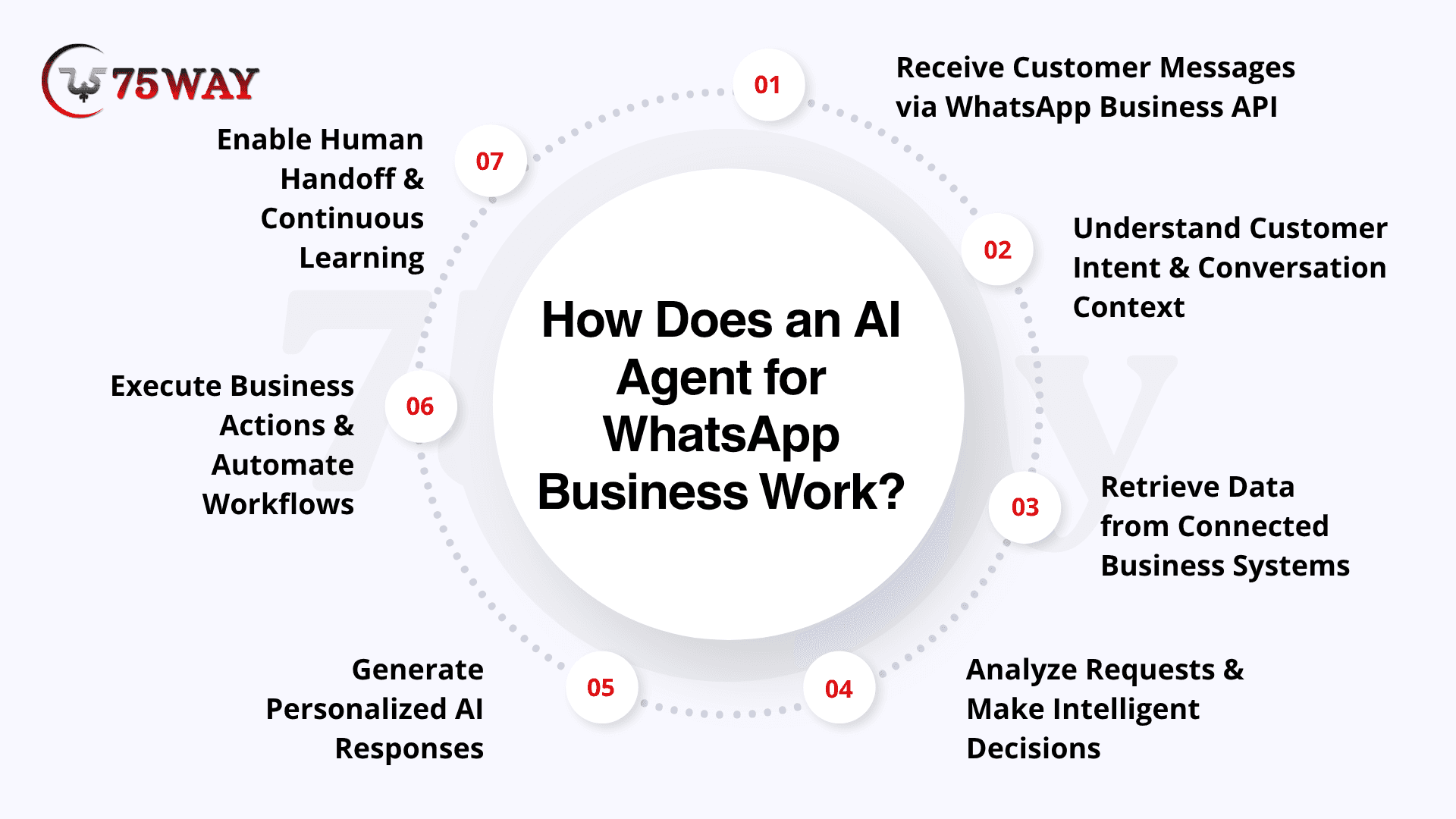
1. Receiving Customer Messages Through WhatsApp Business API
The process starts when a customer sends a message through a company's WhatsApp Business account. The WhatsApp Business API securely transfers that message to the AI agent system, where it becomes the starting point for further analysis.
The message can be a simple question, such as
"Doyouhavethisproductavailable?" or a more detailed request, such as
"Can you check my previous order and change the delivery date?"
At this stage, the AI agent collects the message along with available conversation details to understand the customer's request.
2. Understanding Customer Intent And Conversation Context
The next step is where an AI agent creates a major difference compared with traditional chatbot systems. Instead of searching for exact keywords, it analyzes the meaning behind the customer's message.
For example, when a customer says, "I want the same shoes I bought last month, but in another color," the AI agent needs to understand several things:
- The customer has an existing purchase history.
- They are referring to a previous product.
- They want a new purchase with a specific modification.
Using natural language understanding, the AI agent identifies the customer's intent and understands the conversation context before deciding what to do next.
3. Accessing Business Data Through Integrations
After understanding the request, the AI agent retrieves relevant information from connected business systems. This step allows the agent to provide accurate answers based on real-time company data rather than generic responses.
Depending on business requirements, the AI agent can connect with platforms such as CRM systems, ecommerce platforms, inventory databases, payment gateways, customer support tools, and appointment management software.
For instance, if a customer asks about an order update, the AI agent can check the order management system, find the latest status, and share the correct information instantly.
4. Making Decisions Based On Customer Requests
Understanding a customer's message is only the beginning. The AI agent must also determine the right action based on business rules and available information.
A customer request may require different responses. The AI agent may answer a question, recommend a product, create an order, schedule a service, provide payment instructions, or transfer the conversation to a human representative.
This decision-making ability allows AI agents to support complete customer journeys instead of handling only basic conversations.
5. Generating Personalized Responses
Once the AI agent understands the request and gathers the required information, it creates a response that matches the customer's situation.
The response is generated using conversation history, customer information, business knowledge, and predefined communication guidelines. This helps businesses maintain consistent messaging while making interactions feel more natural.
For example, instead of sending a general delivery message, the AI agent can provide an update based on the customer's specific order details.
6. Executing Business Actions And Updating Systems
Modern AI agents are not limited to sending messages. They can also perform actions inside connected business systems when workflows are properly designed.
For example, an AI agent can create a new customer profile when someone submits an inquiry, update order details when a customer requests changes, send invoices or payment information during purchasing conversations, confirm appointments by checking available schedules, and trigger notifications to keep customers informed about important updates.
These capabilities allow businesses to automate complete processes instead of only automating replies.
7. Human Handoff And Continuous Improvement
Although AI agents can manage many customer interactions independently, some situations require human involvement. A reliable AI agent should recognize when a conversation needs personal attention and smoothly transfer it to a support representative.
During handoff, the human team can receive the conversation history and relevant customer information, allowing them to continue the discussion without asking customers to repeat their concerns.
Over time, businesses can analyze conversations, identify common customer needs, and improve the AI agent's workflows to create better interactions.
How To Build AI Agent For WhatsApp Business: Development Process
A WhatsApp AI agent needs a structured development approach to deliver accurate responses, handle orders smoothly, and provide consistent customer support. Each stage plays an important role. The step-by-step process below explains how businesses can build and launch a WhatsApp AI agent.
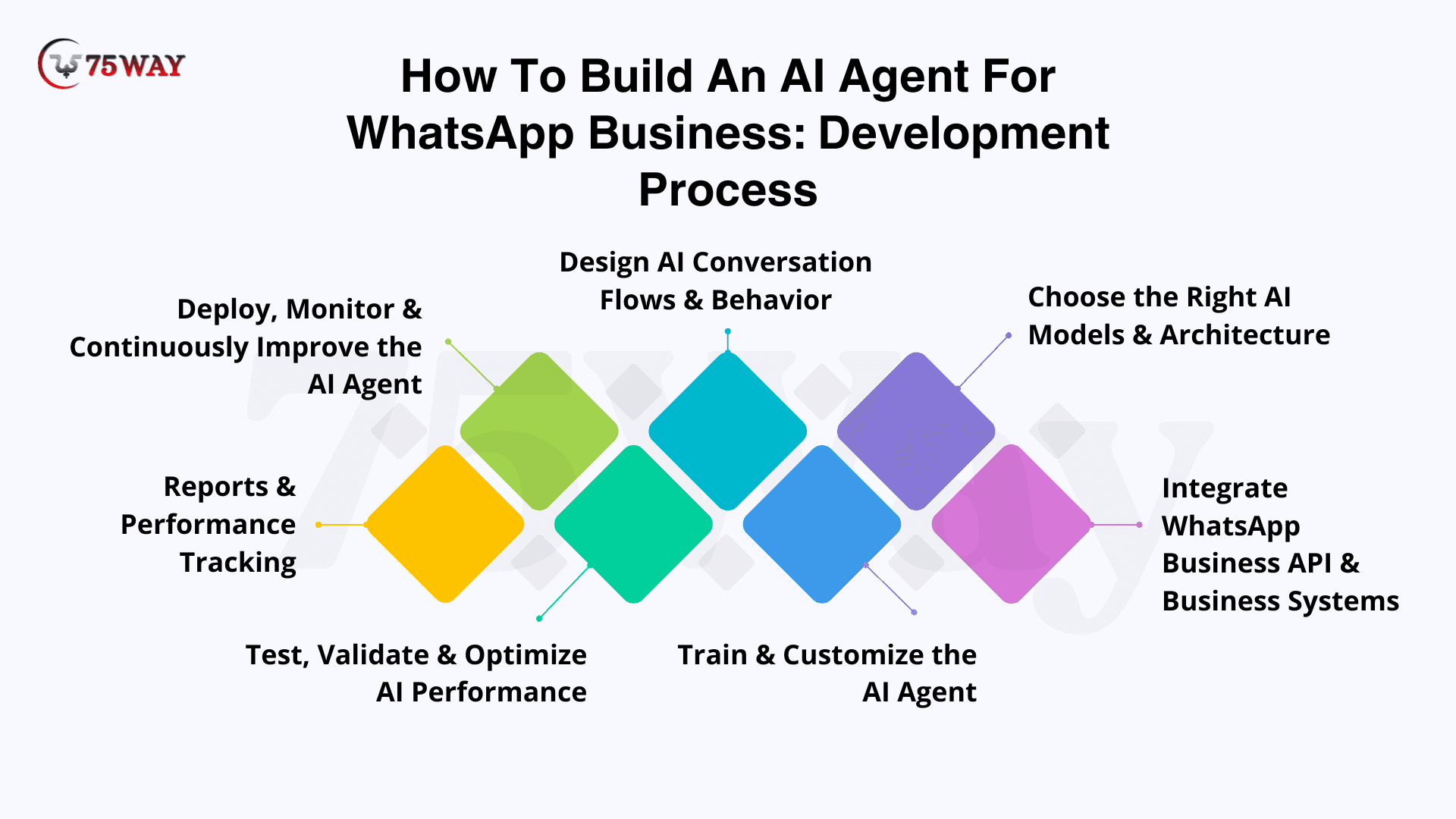
1. Define Business Goals And Customer Requirements
Before selecting any technology, the first step is understanding what the business wants the AI agent to achieve.
Different companies have different expectations from WhatsApp automation. An ecommerce business may want an AI agent to manage product inquiries and orders, while a service-based company may focus on appointment scheduling and customer support.
During this stage, businesses identify:
- The type of customer conversations the AI agent will handle
- Common questions customers ask
- Tasks that should be automated
- Situations requiring human assistance
- Existing systems the agent needs to connect with
This planning stage creates the foundation for building an AI agent that solves real business problems instead of becoming another unused software tool.
2. Design Conversation Flows And AI Behavior
After defining objectives, the next step is designing how the AI agent should communicate with customers.
Unlike traditional chatbots, AI agents do not rely only on fixed conversation paths. However, they still require clear guidelines about how they should respond, what information they can access, and when they should involve human teams.
Businesses need to define:
- Brand communication style
- Common customer journeys
- Response guidelines
- Escalation conditions
- Actions the AI agent can perform
For example, a retail business may allow the AI agent to recommend products and check availability but require human approval before processing high-value orders.
3. Select AI Models And Development Architecture
The next stage involves selecting the right AI technologies and designing the technical architecture behind the agent.
The development team determines which language models, databases, APIs, and automation frameworks are suitable based on business requirements.
Important technical components may include:
- Large language models for conversation understanding
- Retrieval systems for accessing company knowledge
- APIs for WhatsApp Business integration
- Databases for storing relevant information
- Workflow engines for task automation
The right architecture ensures that the AI agent can handle customer conversations while maintaining accuracy, security, and reliability.
4. Integrate WhatsApp Business API And Business Systems
Once the architecture is planned, developers connect the AI agent with WhatsApp Business and other required business platforms.
These integrations allow the agent to communicate with customers and access information needed to complete requests. Common integrations include:
- CRM systems for customer information
- Ecommerce platforms for product and order data
- Inventory systems for availability checks
- Payment gateways for transactions
- Scheduling tools for appointments
For example, when a customer asks about product availability, the AI agent can retrieve live inventory information instead of providing outdated details.
5. Train And Customize The AI Agent
A general AI model does not automatically understand a company's products, policies, or customer expectations. The agent needs customization based on business-specific information.
This process may include adding:
- Product documentation
- Service information
- FAQs
- Company policies
- Customer support guidelines
- Internal knowledge resources
The goal is to help the AI agent provide responses that match the company's requirements while maintaining a consistent customer experience.
6. Test Conversations And Improve Performance
Before launching the AI agent publicly, businesses need to test how it handles different customer situations.
Testing involves reviewing conversations such as:
- Common customer questions
- Complex requests
- Incorrect information scenarios
- Multiple-step tasks
- Human handoff situations
This stage helps identify gaps in understanding, missing information, and areas where the AI agent needs improvement before interacting with real customers.
7. Deploy, Monitor, And Optimize The AI Agent
After testing, the AI agent is deployed on WhatsApp Business and begins handling customer interactions.
However, development does not end after launch. Businesses need continuous monitoring to understand how customers interact with the agent and where improvements are required.
Performance reviews may include:
- Response accuracy
- Customer satisfaction
- Frequently asked questions
- Failed conversations
- Automation opportunities
Regular improvements help the AI agent adapt to changing customer expectations and evolving business needs.
Essential Features To Include In A WhatsApp AI Agent For Business
When businesses start building an AI agent, the focus should not be on adding every possible feature. The important question is whether those capabilities help the agent understand customers better and complete useful business tasks. The following features usually make the biggest difference in real-world implementations.
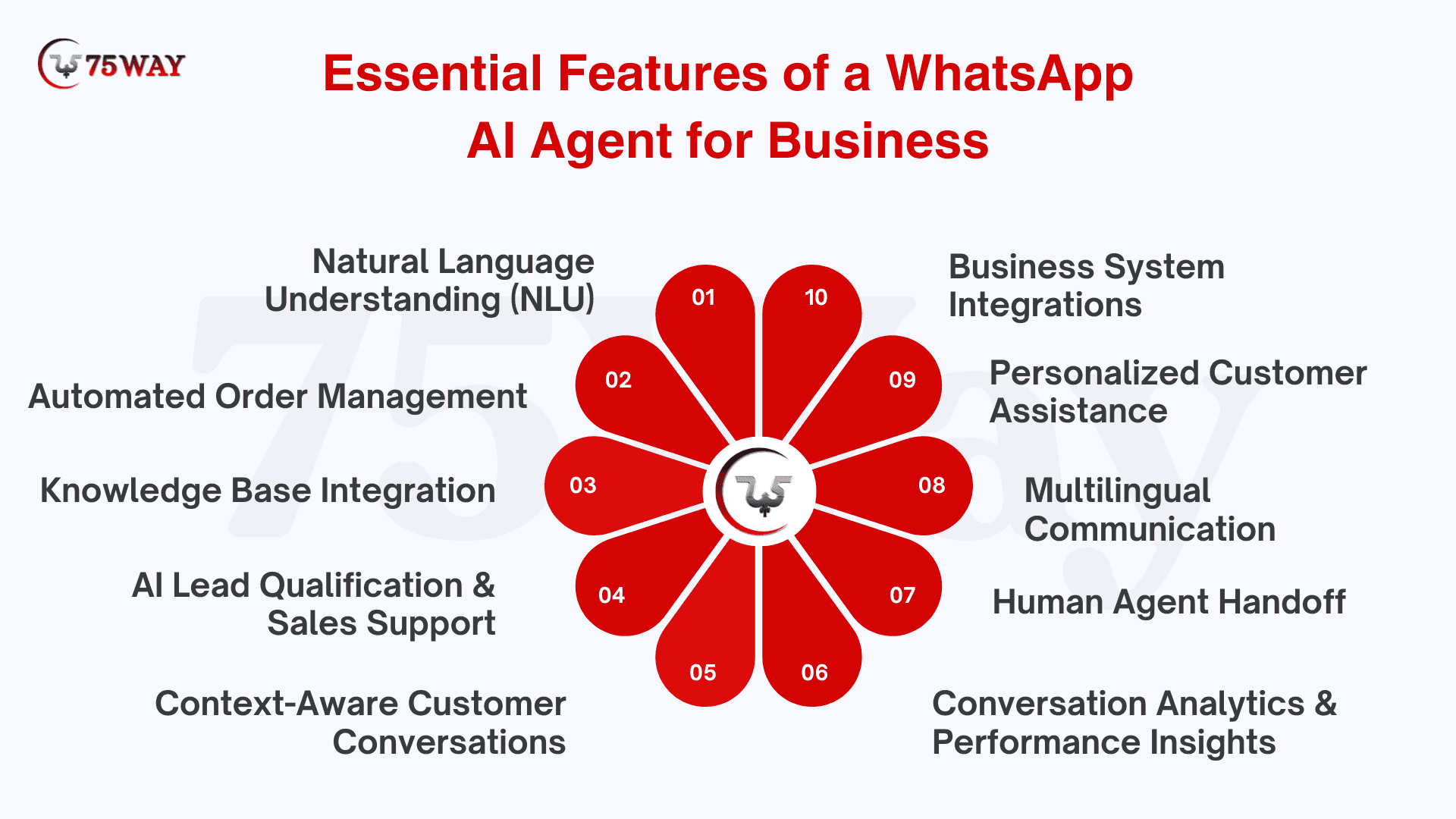
- Natural Language Understanding: Customers do not always type messages in a perfect format. They may write incomplete sentences, use different words, or explain a problem casually. Natural language understanding helps the AI agent understand what the customer actually means instead of depending on fixed commands.
- Order Management Automation: For businesses handling frequent purchases through WhatsApp, order-related conversations can take up a large part of the support team's time. An AI agent can help customers check products, confirm availability, place orders, and receive updates without waiting for manual responses.
- Context-Aware Customer Support: A good customer conversation is not built around individual messages; it depends on the complete discussion. Context awareness allows the AI agent to remember previous messages, understand the situation, and respond based on the customer's actual journey.
- Business System Integration: An AI agent becomes far more useful when it can access the information businesses already use every day. Connecting it with CRM, inventory, ecommerce, or payment systems allows customers to receive accurate answers instead of general responses.
- Personalized Customer Assistance: Customers are more likely to engage when businesses understand their needs. By using available customer information and conversation history, the AI agent can provide relevant recommendations, updates, and assistance based on each interaction.
- Multilingual Communication: Businesses serving different regions often receive customer messages in multiple languages. Multilingual capabilities allow the AI agent to communicate naturally with a wider audience without creating separate support processes for every language.
- Human Agent Handoff: Not every conversation should be handled by AI. When a customer has a complex complaint, requires approval, or needs personal attention, the AI agent should smoothly involve a human representative with the necessary conversation details.
- Conversation Analytics: Improving an AI agent requires understanding how customers interact with it. Analytics help businesses identify common questions, missed requests, and customer behavior patterns so the agent can continue improving after launch.
- Knowledge Base Integration: An AI agent needs access to accurate business information to answer customer questions confidently. By connecting product details, policies, FAQs, and service documentation, the agent can provide responses based on the company's actual knowledge instead of generic information.
- Lead Qualification and Sales Support: For businesses focused on growth, the AI agent can do more than answer inquiries. It can identify customer needs, collect relevant details, recommend suitable options, and help sales teams focus on prospects who are ready for further discussion.
How Businesses Use AI Agents For WhatsApp Business Across Different Industries
After understanding the features that make an AI agent useful, the next question businesses usually consider is, "Where can we actually apply this in our daily operations?" The answer depends on the industry, customer journey, and the type of conversations a business receives most frequently.
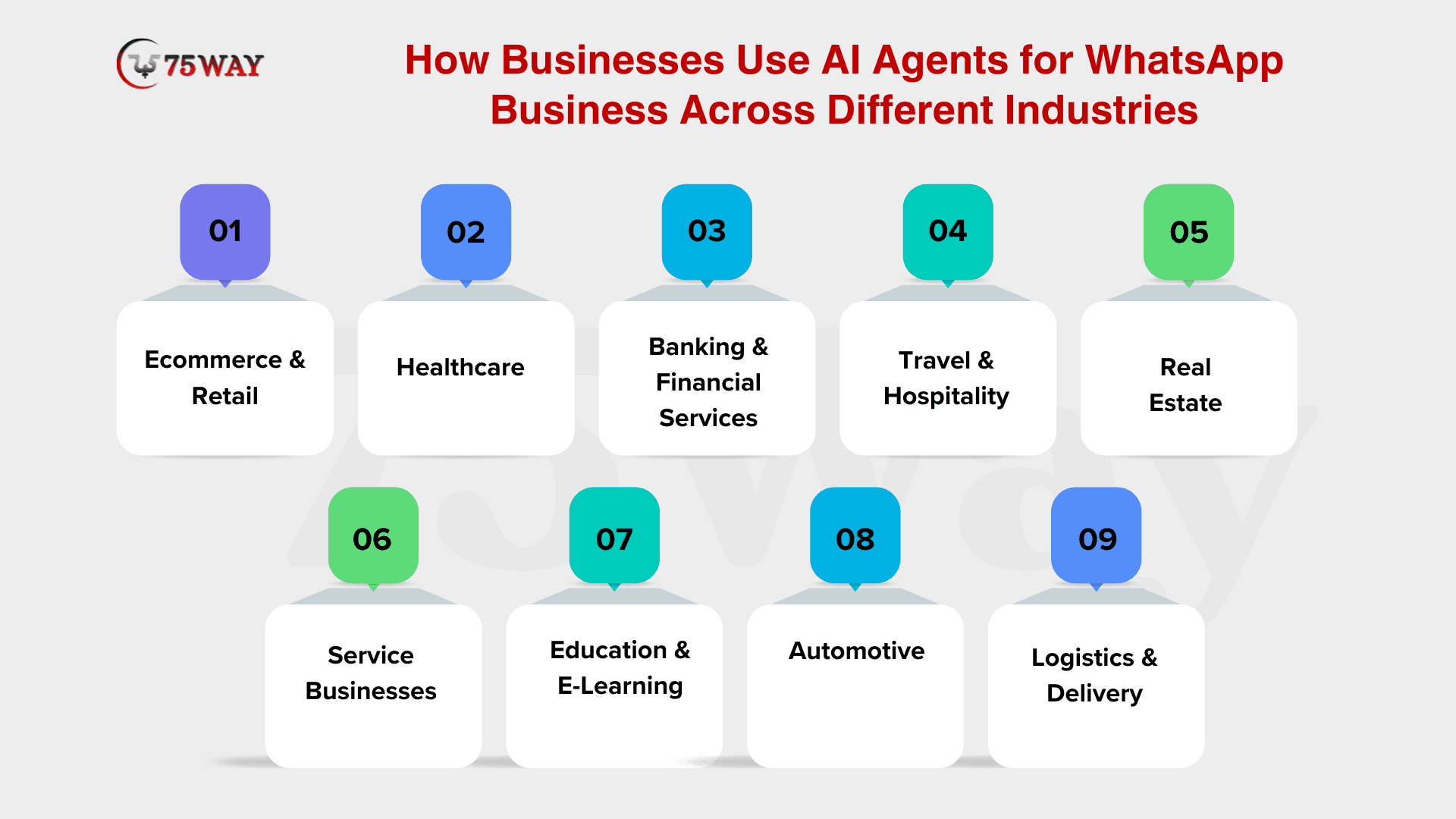
- Ecommerce And Retail: Managing Product Discovery And Orders
For ecommerce businesses, WhatsApp is often the first place where customers ask questions before making a purchase. They want to know about product availability, pricing, delivery options, or recommendations before they decide.
An AI ecommerce agent can assist customers throughout this buying journey by answering product questions, suggesting suitable options, checking inventory, helping with order placement, and providing delivery updates after purchase.
For example, a customer looking for a specific product can describe their requirements in a message, and the AI agent in ecommerce can guide them toward relevant choices instead of making them search through multiple pages.
- Healthcare: Simplifying Patient Communication
Healthcare providers receive many repetitive inquiries related to appointments, services, availability, and basic information. Managing these conversations manually can become challenging, especially during busy periods. But, conversational AI in healthcare makes it easy.
An AI sales agent for healthcare can help patients schedule appointments, share preparation instructions, answer common questions, and provide updates while ensuring sensitive conversations are directed to the appropriate staff members when required.
- Banking And Financial Services: Improving Customer Assistance
Financial institutions handle a wide range of customer queries, from account-related questions to service requests. While security requirements make this sector more complex, agentic AI solutions for banking can still support customers with approved workflows.
They can assist with frequently asked questions, guide users through available services, share application updates, and direct customers to the right support channels when needed.
- Travel And Hospitality: Supporting Bookings And Guest Requests
Travel companies and hotels often receive customer messages about reservations, availability, cancellations, and additional services.
A WhatsApp AI travel agent can help customers explore options, answer booking-related questions, provide confirmation details, and assist with common requests before and during their experience.
- Real Estate: Handling Property Inquiries And Lead Follow-Ups
Real estate businesses receive inquiries from potential buyers and renters at different stages of their decision process. Quick responses often influence whether a lead continues the conversation.
A Whatsapp Business AI agent for real estate can answer property-related questions, collect customer preferences, share available options, schedule visits, and transfer qualified leads to sales representatives for further discussion.
- Service Businesses: Automating Bookings And Customer Requests
Businesses offering services such as repairs, consultations, education, or professional support often spend significant time managing appointments and customer questions.
An AI agent can help customers understand services, check availability, schedule appointments, provide reminders, and answer common queries while allowing teams to focus on service delivery.
- Education And E-Learning: Supporting Student Communication
Educational institutions and online learning platforms receive frequent questions about courses, admissions, schedules, and enrollment processes. An AI agent can help students find relevant information, answer common queries, share course details, and guide them through registration steps without making them wait for manual responses.
- Automotive: Managing Sales And Service Conversations
Automotive businesses handle customer interactions across vehicle inquiries, test drive bookings, service appointments, and maintenance updates. A WhatsApp AI agent can assist customers with vehicle information, schedule service visits, share updates, and connect interested buyers with sales teams when needed.
- Logistics And Delivery: Providing Real-Time Customer Updates
Logistics companies manage thousands of customer questions related to shipment tracking, delivery timelines, and service requests. An AI agent can provide order updates, answer delivery-related questions, collect required information, and help customers resolve common issues through WhatsApp conversations.
Technology Stack Required To Develop A WhatsApp Business AI Agent
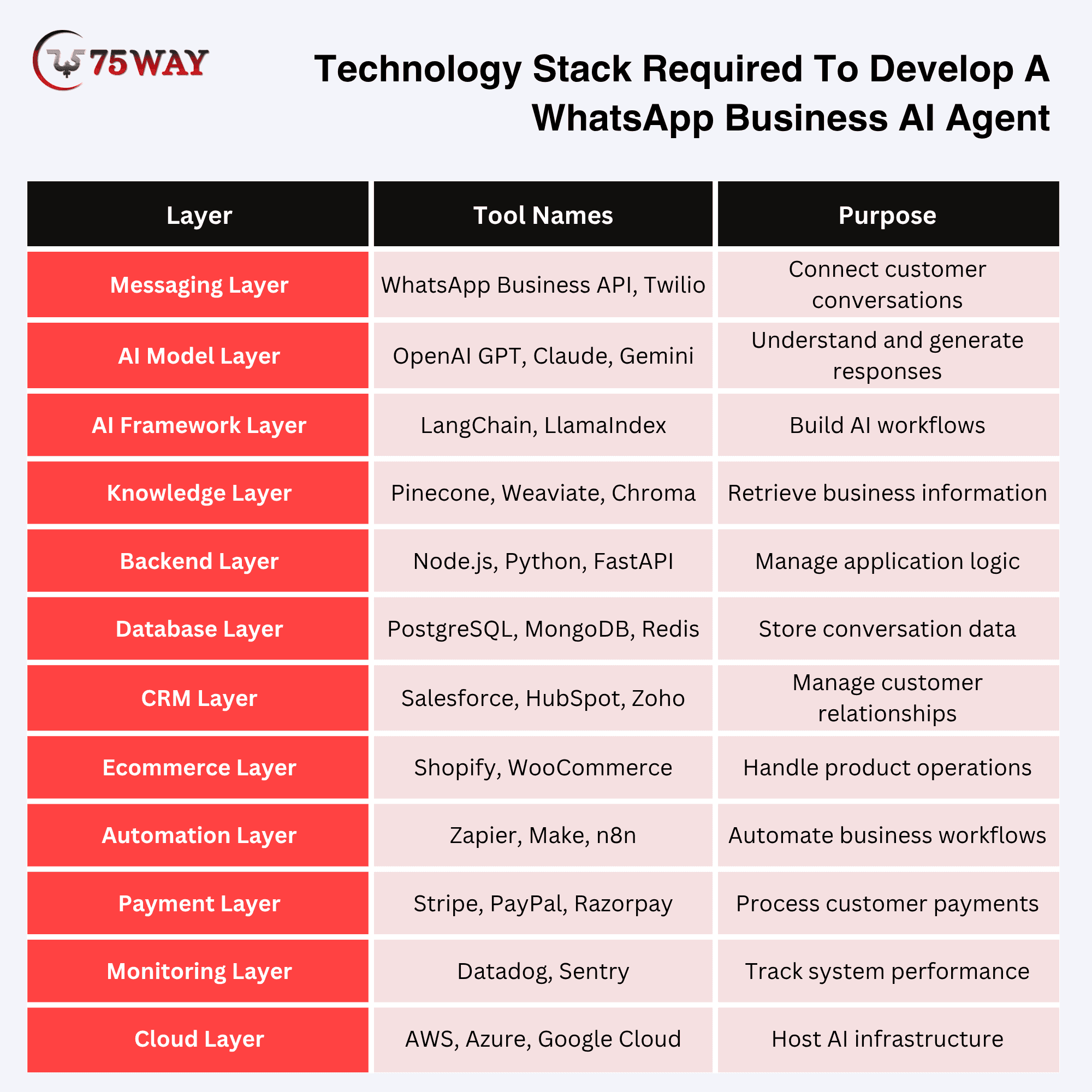
"What technology is actually required to build an AI agent for Whatsapp business?" A WhatsApp AI agent is not created with a single tool. It combines several communication APIs, AI models, and frameworks that work together behind the scenes.
- WhatsApp Business API: This is the foundation that connects the AI agent with customer conversations. Businesses typically use Meta's WhatsApp Business Platform to send messages, receive customer requests, and manage communication through approved API workflows.
- AI Language Models: Large language models such as OpenAI GPT models, Anthropic Claude, and Google Gemini help the agent understand customer messages, maintain conversation context, and generate natural responses based on the situation.
- Natural Language Processing Tools: Technologies such as LangChain and LlamaIndex help developers build AI workflows that allow the agent to understand user intent, retrieve relevant information, and connect AI responses with business logic.
- Knowledge Base and Retrieval Systems: Tools like Pinecone, Weaviate, and Chroma help the AI agent access company-specific information such as product catalogs, FAQs, policies, and service documents before responding to customers.
- Backend Development Frameworks: Frameworks such as Node.js, Python, FastAPI, and Django are commonly used to build the application layer that manages workflows, API connections, authentication, and communication between different systems.
- Database Management Systems: Databases such as PostgreSQL, MongoDB, and Redis help store conversation history, customer information, preferences, and other data required for personalized interactions.
- CRM And Business Integrations: Platforms like Salesforce, HubSpot, Zoho CRM, Shopify, and WooCommerce can be connected with the AI agent to access customer details, manage leads, process orders, and support sales activities.
- Automation And Workflow Platforms: Tools like Zapier, Make, and n8n help connect different applications and automate repetitive business processes without requiring every workflow to be developed from scratch.
- Payment And Transaction Integrations: Payment platforms such as Stripe, PayPal, and Razorpay can be integrated when businesses want the AI agent to share payment links, confirm transactions, or support purchase-related conversations.
- Monitoring And Security Tools: Solutions such as Datadog, Sentry, and cloud security services help businesses monitor performance, identify issues, protect customer data, and maintain reliable AI operations.
Benefits of Implementing Whatsapp Virtual Agent In Your Business Account
A WhatsApp virtual agent helps businesses handle customer conversations faster and more efficiently. The benefits below explain how it improves support, reduces manual work, and creates better customer experiences.
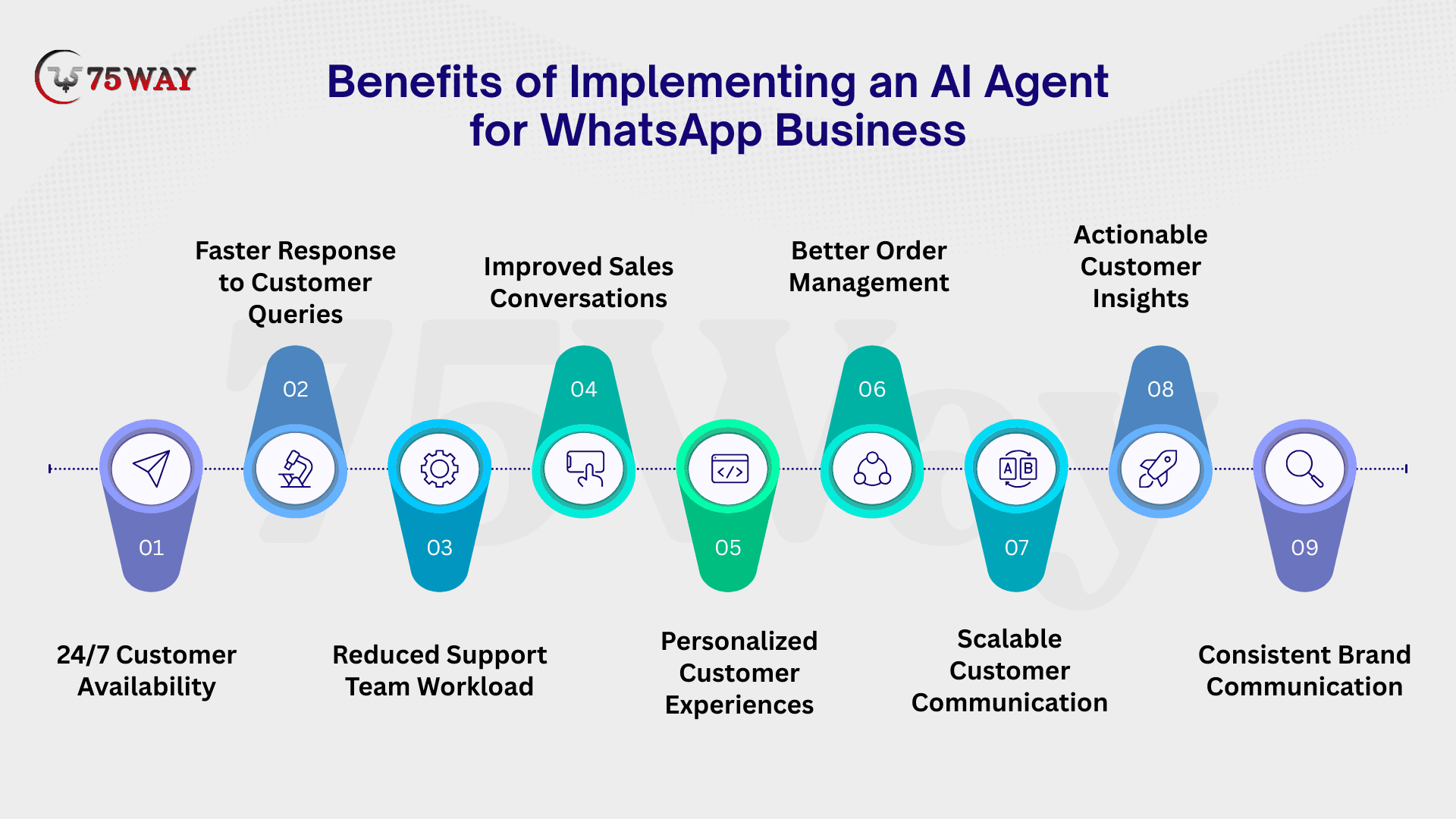
- 24/7 Customer Availability
Customers often reach out outside traditional business hours, and waiting for a response can affect their buying decisions. WhatsApp conversational AI agent allows businesses to provide immediate assistance whenever customers need information, support, or updates.
- Faster Response To Customer Queries
Instead of making customers wait for a support representative to become available, the WhatsApp Business AI assistant can handle common questions instantly and guide customers toward the next step.
- Reduced Support Team Workload
Many support conversations involve repetitive requests such as order updates, product questions, or appointment details. An intelligent WhatsApp assistant can manage these routine interactions while allowing human teams to focus on more complex customer situations.
- Improved Sales Conversations
AI sales agent for WhatsApp can support customers during the buying process by answering product questions, suggesting suitable options, collecting lead information, and helping move interested customers closer to purchase decisions.
- Personalized Customer Experiences
By connecting with CRM systems and customer data, the WhatsApp virtual agent can provide responses based on previous interactions, preferences, and purchase history instead of treating every conversation as a new inquiry.
- Better Order Management
Businesses can use AI assistant for WhatsApp Business to assist with product availability checks, order confirmations, delivery updates, and post-purchase questions, creating a smoother experience throughout the buying journey.
- Scalable Customer Communication
As customer conversations increase, businesses do not always need to expand support operations at the same pace. AI-powered WhatsApp agent can handle multiple conversations simultaneously while maintaining consistent responses.
- Actionable Customer Insights
AI-powered conversations generate valuable information about customer questions, preferences, and common issues. Businesses can analyze these patterns to improve products, services, and customer strategies.
- Consistent Brand Communication
An AI Whatsapp agent follows predefined business guidelines, helping maintain consistent messaging across thousands of customer interactions while still allowing personalized conversations.
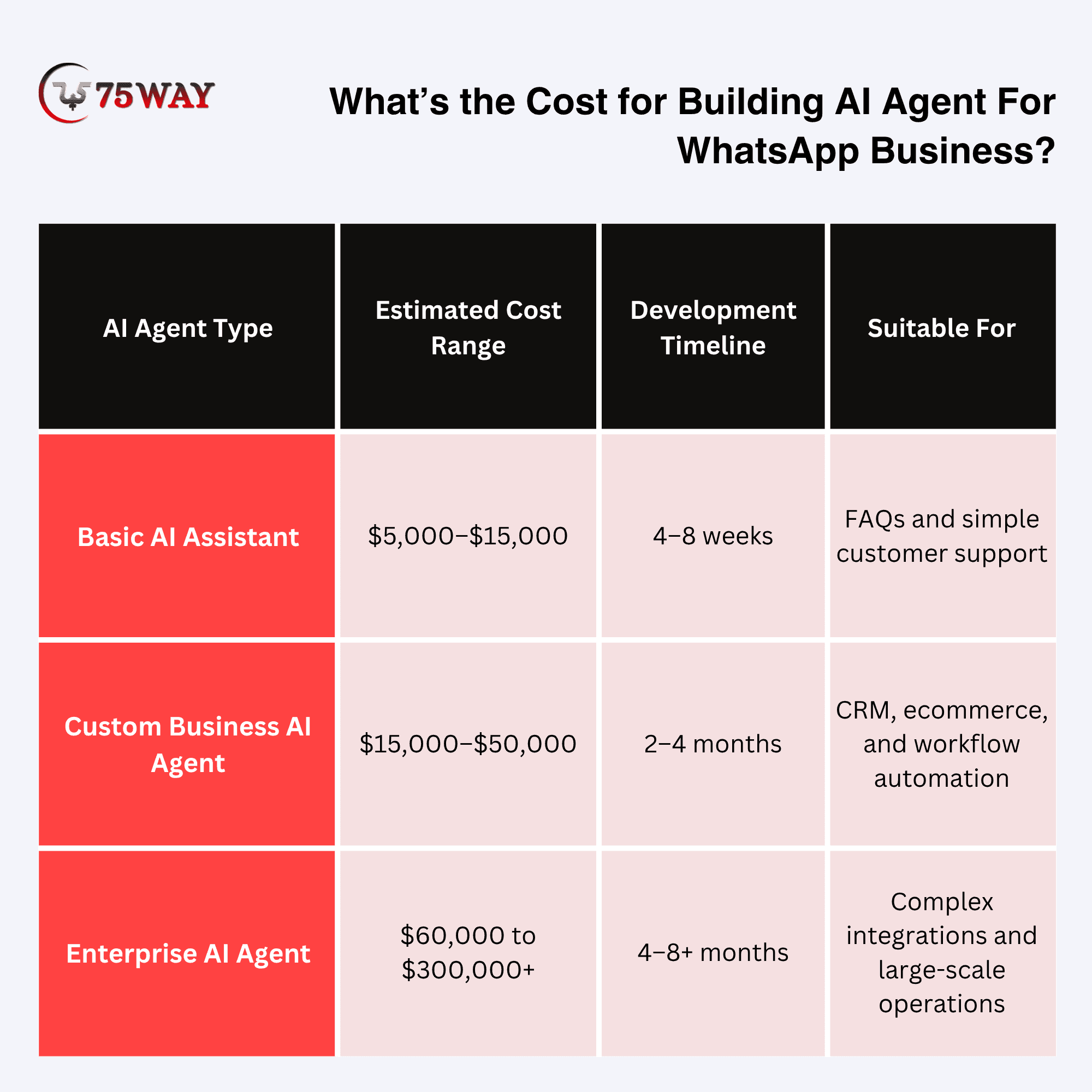
What’s the Cost for Building AI Agent For WhatsApp Business?
Many businesses naturally move toward the next question: "How much does it cost to build an AI agent for WhatsApp Business?" The answer is not a fixed number because the development cost depends on what the agent needs to do, which systems it connects with, and how advanced the automation requirements are. The cost of building an AI agent for WhatsApp Business can vary based on the scope:
- Basic AI Assistant: $5,000–$15,000
- Custom Business AI Agent: $15,000–$50,000
- Enterprise AI Agent: $60,000 to $300,000+
Whatsapp AI Agent Development Cost By Region
- North America & Western Europe
Estimated Cost: $15,000–$60,000+
Custom LLM knowledge agents with senior developer rates averaging $100–$250/hour for advanced implementations.
- Eastern Europe & Latin America
Estimated Cost: $8,000–$25,000
Intermediate-to-advanced API integrations with development rates typically ranging between $35–$70/hour.
- South Asia & Southeast Asia
Estimated Cost: $2,000–$10,000
Complete AI agent setup and training with local developer rates averaging $15–$30/hour.
- No-Code / Low-Code Platforms
Estimated Cost: $30–$300/month
Subscription-based platforms like Tidio, Respond.io, and AiSensy reduce custom development requirements.
Factors That Influence AI Agent Development Cost
- AI Model Selection: The choice of AI model affects development expenses because different models offer different capabilities, usage costs, and performance levels. Solutions using advanced models like OpenAI GPT, Anthropic Claude, or Google Gemini may have different pricing based on usage and complexity.
- Conversation Complexity: The number of customer scenarios the AI agent needs to handle directly impacts development effort. An agent managing simple FAQs requires less work compared with one handling sales conversations, order processing, and customer support workflows.
- Business System Integrations: Connecting the AI agent with CRM platforms, ecommerce stores, inventory systems, payment gateways, or internal software adds development requirements because each integration needs proper setup, testing, and security considerations.
- Knowledge Base Preparation: Businesses need accurate information for the AI agent to provide reliable responses. Preparing product details, service documentation, policies, and internal knowledge sources can influence the overall development timeline and cost.
- Customization Requirements: A highly customized AI agent with specific workflows, brand communication style, advanced automation, and industry-specific requirements usually requires more development effort than a standard solution.
- Security And Compliance Needs: Businesses handling sensitive customer information may require additional security measures, access controls, data protection practices, and compliance-related considerations during development.
How To Choose The Right Approach For Building A WhatsApp AI Agent?
Cost is only one part of planning an AI agent project. Before investing in development, businesses need to decide how they want to build the solution and how much control they need over its capabilities.
Some companies only need an AI assistant to answer common customer questions, while others require a more advanced system that can manage orders, connect with internal software, and support complex workflows. The right approach depends on business goals, customer volume, integration requirements, and future plans.
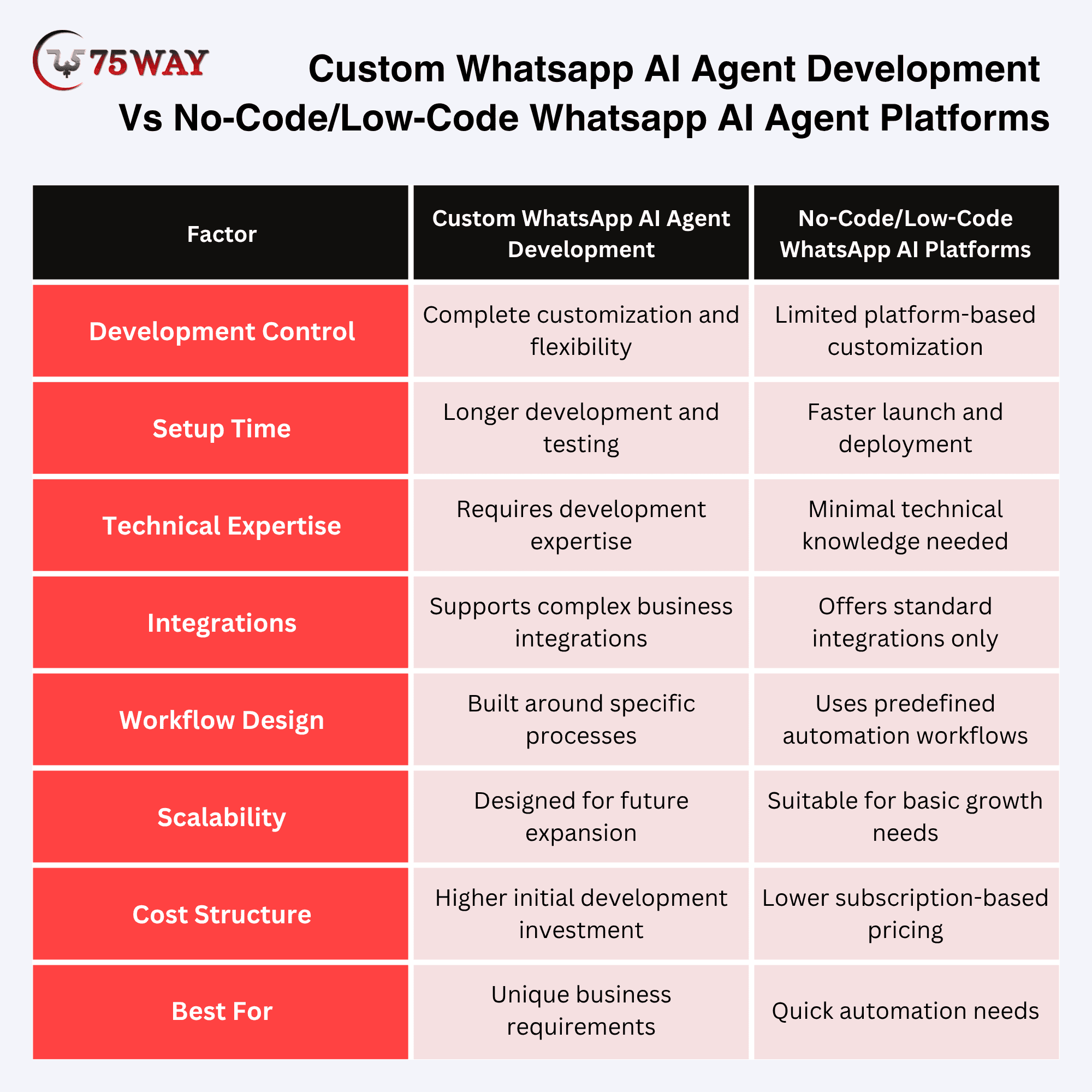
1. Custom Whatsapp AI Agent Development: For Businesses With Unique Workflows
A custom-built AI agent is the right choice for businesses that need complete control over how their automation works. Instead of adjusting business processes around a fixed platform, companies can design the agent according to their specific customer journey.
This approach works well for businesses that require advanced capabilities such as CRM integration, order management, personalized recommendations, internal workflow automation, or industry-specific conversation handling.
With custom development, businesses can decide how the AI agent understands customers, what information it can access, and which actions it can perform.
2. No-Code/Low-Code Whatsapp AI Agent Platforms: For Faster Deployment
Not every business needs to build an AI agent from the ground up. Ready-made platforms can help companies launch WhatsApp automation faster with built-in tools for messaging, workflows, and customer interactions.
Platforms such as Respond.io, Tidio, and AiSensy can be useful for businesses looking to automate basic support conversations, manage customer messages, and create simple workflows.
However, these solutions may have limitations when businesses require deeper integrations, highly customized workflows, or industry-specific AI behavior.
3. Hybrid Approach: Combining Flexibility With Speed
A hybrid approach combines the benefits of ready-made platforms with custom AI development. Businesses can use existing communication tools while adding custom-built features where they need more control.
For example, a company may use a WhatsApp automation platform for managing conversations but develop custom AI workflows for product recommendations, lead qualification, or order processing.
This approach is often suitable for growing businesses that want to start quickly while keeping room for future expansion.
How To Decide The Best Development Approach: Custom Whatsapp AI Agent Development Vs No-Code/Low-Code Whatsapp AI Agent
The right choice depends on several practical factors:
- Business Objectives: A company focused on customer support may need a different solution than one looking to automate sales, orders, and internal operations.
- Required Integrations: Businesses relying on CRM, ecommerce, inventory, or payment systems should consider how easily the AI agent can connect with existing tools.
- Customer Interaction Volume: Companies handling thousands of conversations daily may require a more scalable architecture than businesses with fewer customer interactions.
- Long-Term Plans: The selected approach should support future improvements, additional workflows, and changing customer expectations.
Choosing the right development approach is not about selecting the most expensive or advanced option. It is about building an AI solution that matches the business's current needs while leaving enough flexibility for future growth.
Security And Privacy Considerations To Build AI Assistants for WhatsApp Business
When businesses introduce AI into customer communication, one important area cannot be overlooked: security. An AI agent may handle customer details, order information, payment-related conversations, and other business data, which makes privacy and protection a critical part of the development process.
- Protecting Customer Data During Conversations
Every customer interaction may contain valuable information, including contact details, order history, preferences, or service requests. A properly designed AI agent should ensure that this information is handled securely throughout the conversation lifecycle.
- Managing AI Access To Business Information
An AI agent should only access the data required to complete specific tasks. Giving unnecessary access to internal systems can create security risks and expose sensitive business information. For example, an agent handling product availability does not need access to unrelated financial or employee data. Proper permission controls help maintain safer AI operations.
- Ensuring Accurate & Responsible AI Responses
Security is not limited to protecting data. Businesses also need to ensure that the AI agent provides reliable information and does not share incorrect details with customers. Using verified knowledge sources, predefined business rules, and human review processes helps maintain response quality and prevent misleading communication.
- WhatsApp Business Policy Compliance
Businesses using AI agents on WhatsApp must follow the guidelines provided by Meta for business messaging. This includes using approved communication methods, managing customer consent, and maintaining responsible messaging practices.
- Monitoring & Improving AI Security
AI security requires continuous monitoring because customer needs, business data, and technology environments continue to change. Regular reviews of conversations, access permissions, system performance, and security practices help businesses identify potential issues and improve the reliability of their WhatsApp AI agent over time.
How 75way Helps You Build An AI Agent For WhatsApp Business
At 75way Technologies, we help businesses move from basic WhatsApp automation to intelligent AI-powered customer experiences. Our team focuses on understanding your business goals, customer workflows, and operational challenges before designing an AI agent that fits your requirements.
From conversation design and AI model selection to WhatsApp Business API integration and third-party system connections, we build solutions that support real business operations.
Whether you need an AI agent for customer support, order management, lead qualification, or sales assistance, 75way develops customized solutions based on your industry needs. At our AI marketplace, 75AI Agent Store, you can explore ready-to-deploy agentic AI solutions.
We help businesses create AI agents that can understand customer conversations, access relevant information, complete tasks, and work alongside human teams to deliver better communication experiences.
We developed a WhatsApp AI agent for a retail business to automate product inquiries, order assistance, and customer support conversations. The AI agent was integrated with business systems to provide real-time product information, handle repetitive requests, and guide customers through purchasing steps.
As a result, the business reduced manual support workload, improved response times, and created a more consistent customer communication experience.
Conclusion
AI agents for WhatsApp Business are changing how companies manage customer communication by combining automation with intelligent decision-making. However, successful implementation depends on choosing the right technology, designing suitable workflows, and aligning the AI agent with business objectives. As customer expectations continue to grow, businesses that adopt intelligent communication solutions can build stronger relationships and improve operations. Partner with a reliable AI agent development firm to build a WhatsApp AI solution designed around your business needs.
Frequently Asked Questions
What Industries Can Benefit From WhatsApp AI Agents?
WhatsApp AI agents can support industries including retail, healthcare, education, travel, finance, and professional services. They help businesses manage customer communication and automate repetitive interactions.
Can a WhatsApp AI Agent Understand Customer Emotions?
Advanced AI agents can analyze language patterns and identify customer sentiment during conversations. This helps businesses respond appropriately and provide better support experiences.
Does a WhatsApp AI Agent Replace Human Customer Support Teams?
A WhatsApp AI agent is designed to support human teams rather than completely replace them. It handles repetitive tasks while employees manage complex customer situations.
Can Small Businesses Use AI Agents for WhatsApp Business?
Small businesses can adopt AI agents based on their communication needs and budget. Scalable solutions allow companies to start with essential automation and expand later.
What data does a WhatsApp AI agent need to function properly?
An AI agent requires relevant business information such as product details, policies, and customer workflows. The quality of available data directly affects response accuracy.
How Can Businesses Measure The Success of A WhatsApp AI Agent?
Businesses can evaluate performance through response accuracy, customer satisfaction, conversation completion rates, and automation outcomes. These insights help improve the AI agent over time.