whyMeta Title: Fuel Delivery App Development: A Step-By-Step Guide
AI Summary
Fuel delivery app development involves planning, designing, building, testing, and launching connected customer, driver, and admin platforms. This guide covers development steps, essential features, technology, costs, integrations, security, compliance, monetization, and scaling strategies.
Key Takeaways
- Learn the fuel delivery app development process from ideation to launching a scalable app.
- The mobile fuel delivery market could reach $10.1 billion globally by 2033.
- Fuel delivery app development typically costs $15,000–$150,000+, depending on scope and complexity.
- Discover essential features required for customer, driver, and admin applications.
- Explore fuel delivery app development costs, timelines, monetization, and scalability.
- Understand U.S. compliance considerations before launching your fuel delivery application.
Running out of fuel is rarely a planned event, and waiting for a roadside service or driving to the nearest station is hardly convenient. A fuel delivery app development solution changes that experience by letting customers request fuel from wherever they are, while giving delivery businesses a digital system to manage orders, routes, payments, and customers.
But building an AI-powered fuel delivery app is not just about adding a map and an “Order Fuel” button. The platform has to connect customer requests with fuel inventory, delivery availability, location tracking, secure payments, driver operations, notifications, and administrative controls.
If you are planning to launch a fuel delivery service, the on-demand app development approach can determine how well the platform performs once real orders start coming in. This guide walks through the fuel delivery app development process, covering the key decisions, features, technology, integrations, and practical considerations involved in building the platform.
What Is a Fuel Delivery App?
A fuel delivery app allows customers or businesses to request fuel delivery to a defined location instead of driving to a traditional fueling station.
Depending on the business model, users may order gasoline, diesel, DEF, or other permitted fuel products for vehicles, fleets, construction sites, generators, commercial equipment, or other approved applications.
A typical platform connects three operational layers:
- Customer App: Fuel ordering, location selection, scheduling, payments, tracking, receipts, and support.
- Driver App: Order acceptance, navigation, delivery verification, fuel dispensing workflow, and status updates.
- Admin or Operations Dashboard: Dispatching, fleet management, pricing, inventory, customers, payments, reporting, and compliance records.
For a fuel delivery business, however, the technology is only one part of the product. Transportation, hazardous-material handling, insurance, environmental requirements, state rules, and operating procedures can influence how the platform should be designed.
That is why fuel delivery app development should begin with the business and operating model, not with a list of app screens.
Fuel Delivery Mobile App Market Size and Growth Projections in USA
The fuel industry is beginning to look less like a “drive to the station” business and more like an on-demand service. The global fuel delivery system market is expected to increase from $41.22 billion in 2026 to $52.31 billion by 2034, reflecting growing demand for convenient fuel access. The market data below provides a closer look at its growth and what it means for the U.S. app market.
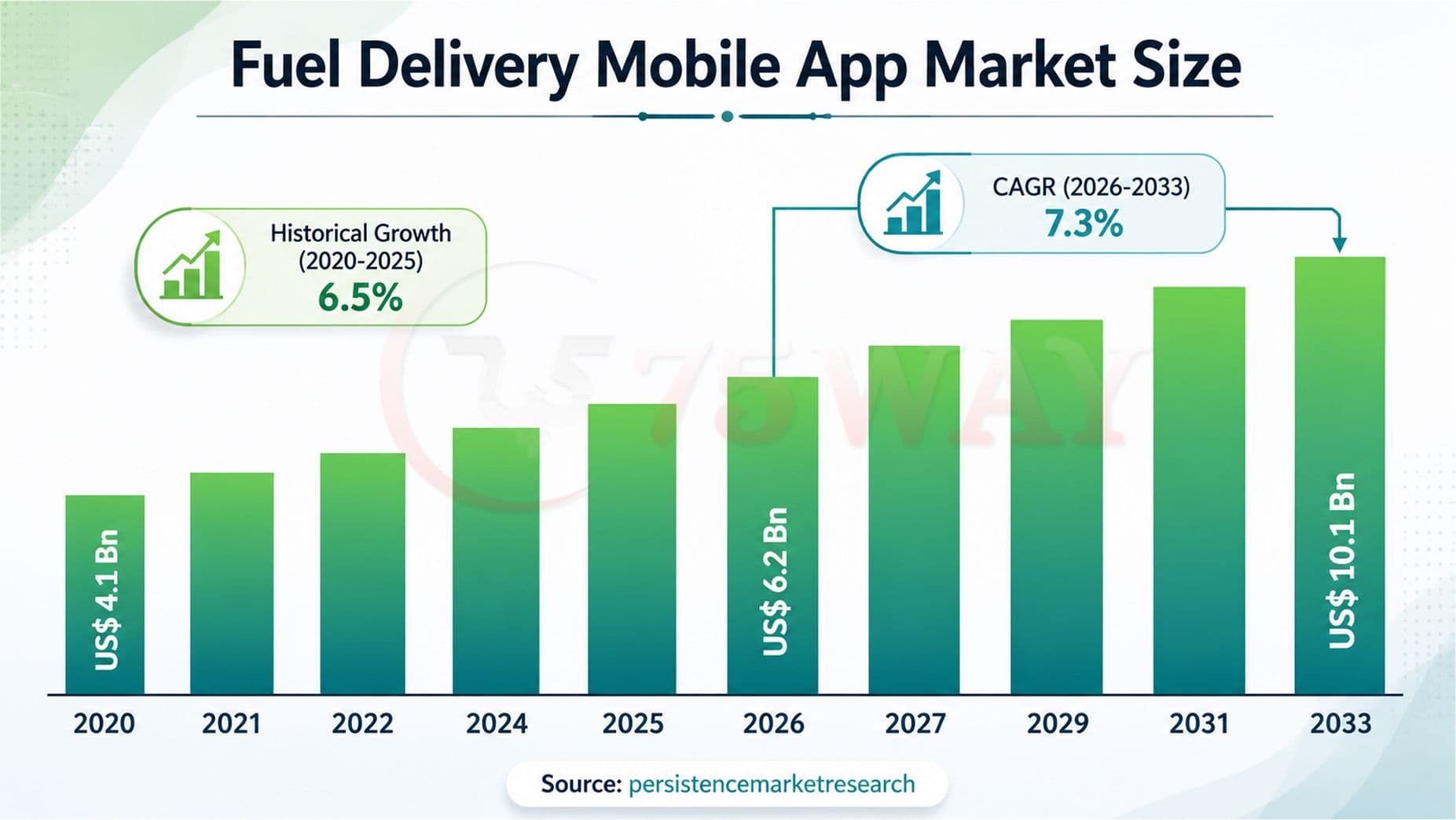
- The global mobile fuel delivery market is projected to grow from $6.2 billion in 2026 to $10.1 billion by 2033, at a CAGR of 7.3%, according to Persistence Market Research.
- The on-demand fuel delivery market is expected to expand from $0.47 billion in 2026 to $1.77 billion by 2035, at a CAGR of 15.97%, as per the Business Research Insights report.
- North America is projected to account for approximately 42% of the market in 2026.
- Diesel is expected to lead with around 62% revenue share in 2026, while gasoline is forecast to be the fastest-growing segment through 2033.
- Leading providers collectively hold approximately 50%–60% of the market, indicating moderate industry concentration.
- Mobile and app-based ordering accounts for around 60% of market adoption, driven by growing demand for convenient doorstep fuel delivery.
How Does a Fuel Delivery Mobile App Work?
A fuel delivery app connects customers, drivers, fuel inventory, payments, and dispatch through a single digital workflow. Here’s how the process typically works:
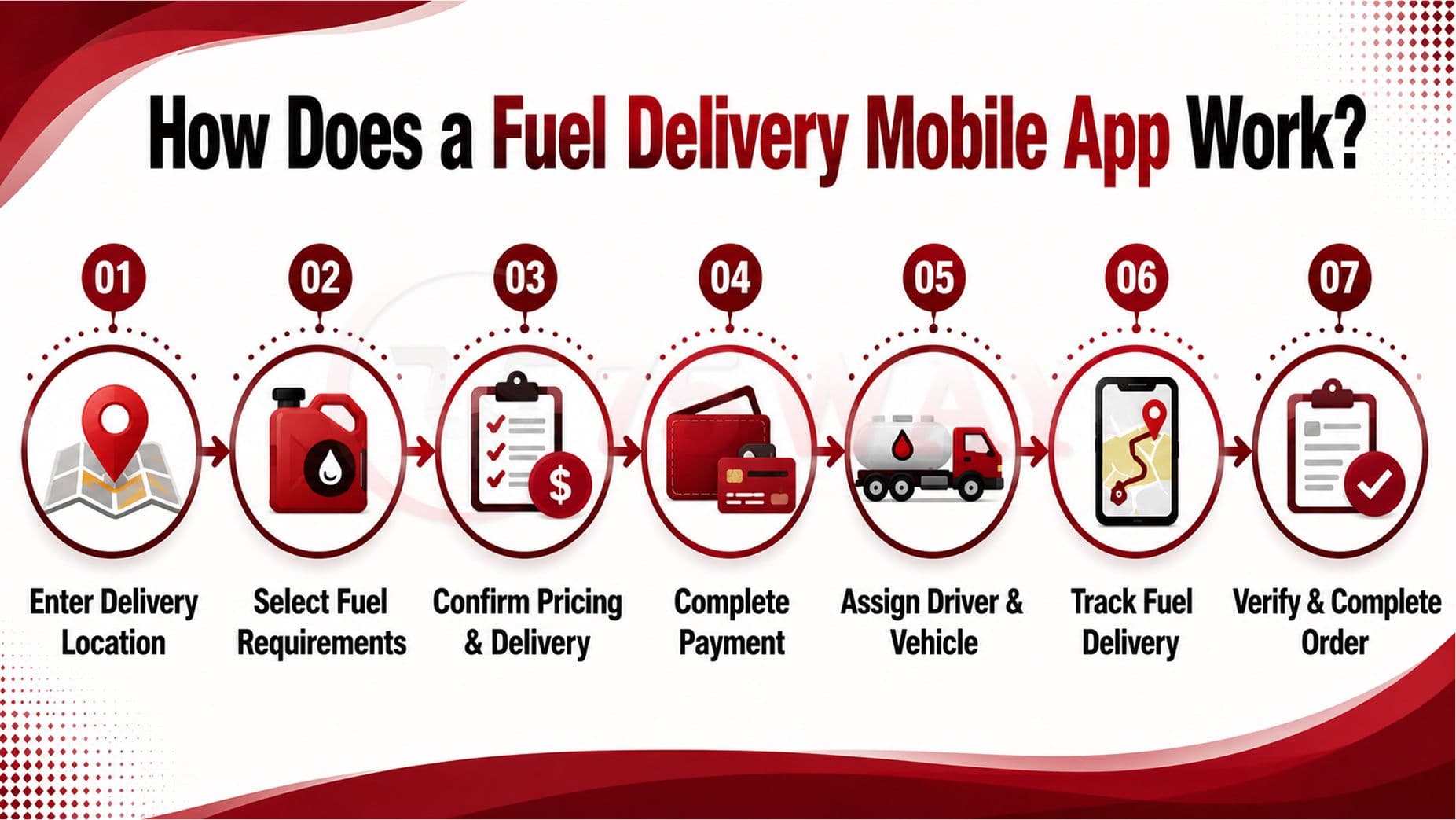
1. Enter Delivery Location
The customer enters or confirms the delivery address, allowing the platform to verify service availability.
2. Select Fuel Requirements
The customer chooses the fuel type, required quantity, and preferred delivery option based on availability.
3. Confirm Pricing & Delivery
The system calculates fuel costs, delivery fees, taxes, and applicable charges before the customer confirms the order.
4. Complete Payment
Customers pay through an integrated payment gateway or use an approved business billing account.
5. Assign Driver & Vehicle
The platform checks driver availability, vehicle eligibility, service area, and delivery requirements before assigning the order.
6. Track Fuel Delivery
The driver receives the order, navigates to the location, and updates delivery status while the customer tracks progress.
7. Verify & Complete Order
The platform records delivery confirmation, quantity, location, timestamp, payment details, and generates a digital receipt.
How to Build Fuel Delivery App: Step-By-Step Development Process
The difficult part of a fuel delivery app is not adding an “Order Now” button. It is making sure the order reaches the right driver with the right fuel at the right location. That requires careful planning across the product, technology, and delivery operation. The fuel delivery app development process below walks through how to build the platform around these requirements.
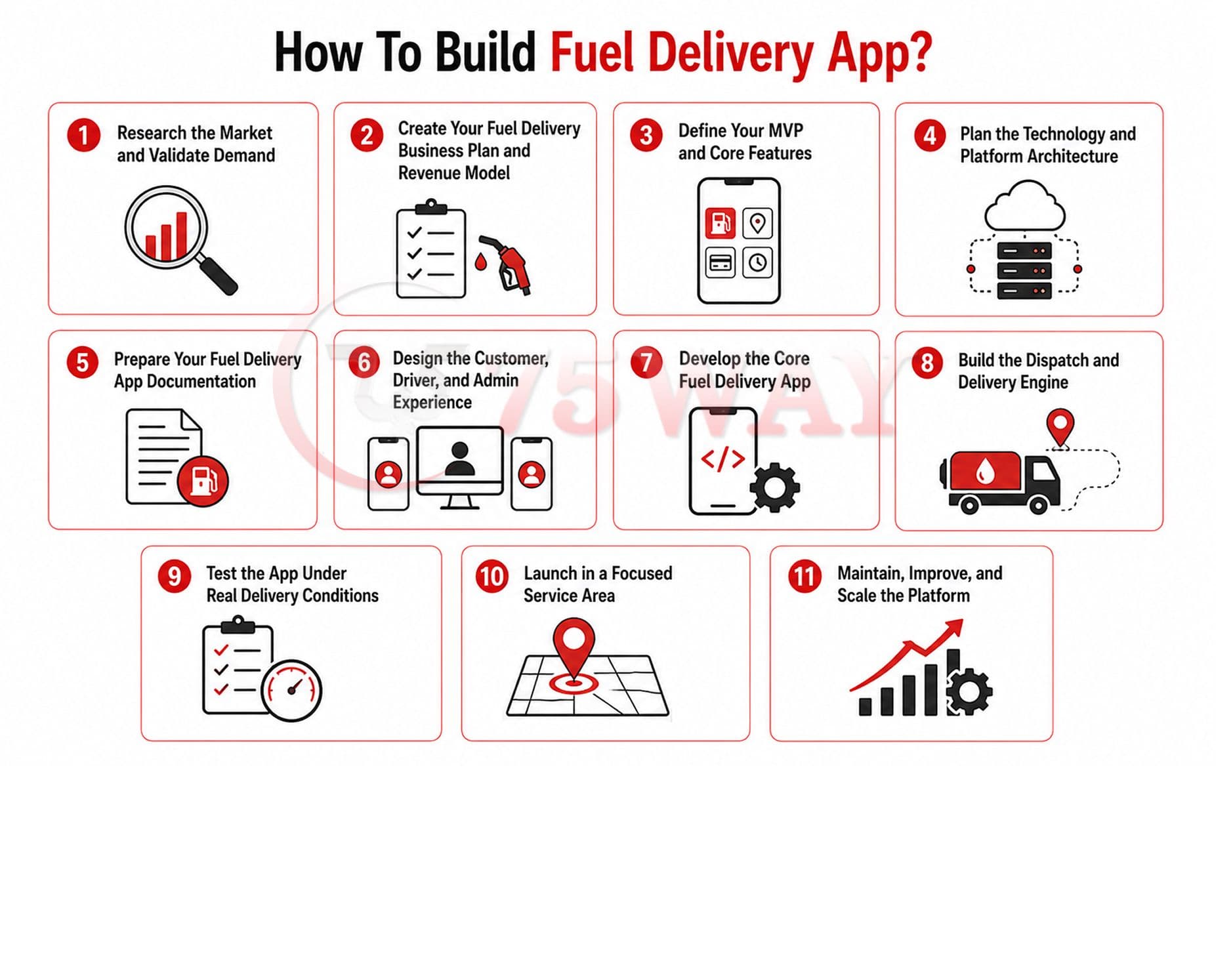
1. Research the Market Before You Build
The first question is not “How much will the app cost?” It is “Who will actually use it, and what problem are we solving for them?”
Start by looking at your target market and the companies already serving it. Study platforms such as Booster, Filld, and CAFU to understand how they approach ordering, delivery, pricing, and customer experience. You are not trying to copy them; you are looking for opportunities they may have left open.
Your research should cover:
- Target Customers: Individual drivers, fleet operators, construction companies, commercial facilities, or other businesses.
- Service Area: One city, several metropolitan areas, or a larger region.
- Fuel Requirements: Gasoline, diesel, DEF, or other products relevant to your model.
- Competitor Pricing: Fuel prices, delivery fees, subscriptions, and business pricing.
- Customer Pain Points: What makes customers choose delivery instead of visiting a fueling station?
- Operational Requirements: Drivers, vehicles, suppliers, delivery windows, and service boundaries.
- U.S. Requirements: Applicable transportation, hazardous-material, environmental, insurance, and state-level considerations.
This research gives you something more valuable than a long feature list: a reason for every major product decision.
2. Create Your Fuel Delivery Business Plan and Revenue Model
Before you spend money on development, you need to know how the fuel delivery business will actually operate and make money. A fuel delivery business plan should define your target customers, fuel products, service area, suppliers, delivery model, pricing, operating costs, revenue streams, and growth goals.
For example, you might serve individual drivers through on-demand deliveries, focus on recurring B2B fleet orders, or operate a marketplace connecting customers with fuel suppliers.
You could choose:
- Per-delivery fees from customers
- Fuel margins based on your commercial model
- Subscriptions for frequent users
- B2B contracts with fleets and businesses
- Marketplace commissions from participating suppliers
- Premium services such as priority delivery or account-based features
The right model depends heavily on your audience. A consumer app may rely on repeat orders and delivery fees, while a B2B platform can generate recurring revenue through scheduled deliveries and business accounts.
The important part: your revenue model should shape the product. If you plan to serve commercial fleets, for example, recurring orders, multiple locations, purchase approvals, and business billing may matter more than consumer loyalty points.
3. Define Your MVP and Decide What Can Wait
This is where many startups go overboard.
You do not need an app packed with AI, IoT, loyalty programs, advanced analytics, and dozens of dashboards on day one. Your first version needs to prove that customers can place an order and that your business can fulfill it profitably.
For the MVP, focus on the core journey:
Order → Validate → Pay → Dispatch → Deliver → Confirm
Features such as AI demand forecasting, IoT fuel monitoring, advanced fleet analytics, and automated recurring orders can be introduced after the basic operation has been validated.
4. Plan the Technology Stack and Platform Architecture
Once you know what you are building, decide how the system will support it.
A typical fuel delivery platform may include:
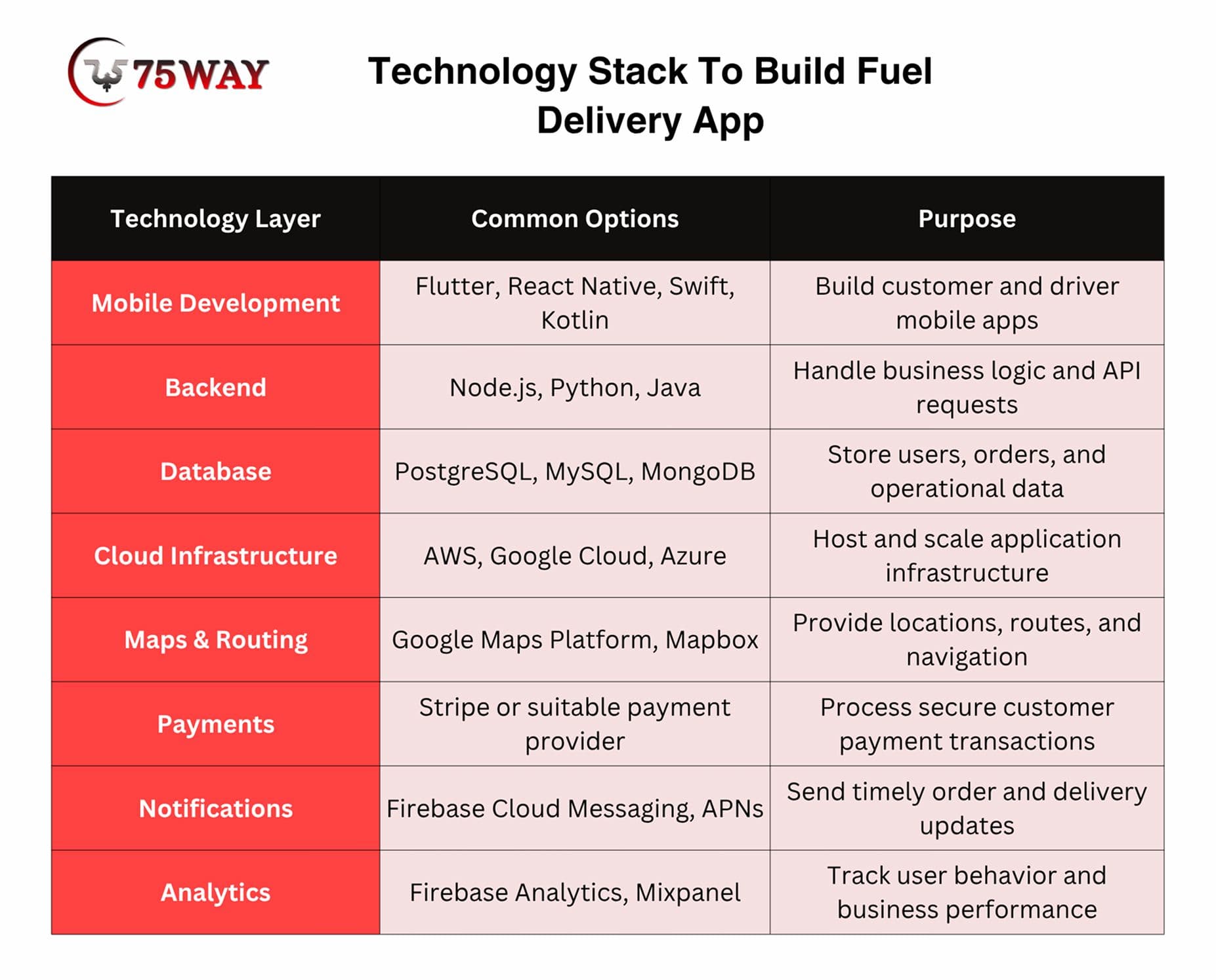
Do not select technologies simply because they appear frequently in other app-development blogs.
Your development team should consider:
- Expected number of users
- Real-time tracking requirements
- API integrations
- Security
- Development budget
- Future expansion
- Maintenance requirements
For example, if you plan to operate across multiple markets later, the backend should be designed so that service areas, pricing rules, taxes, delivery zones, and business settings can be configured rather than hard-coded.
5. Prepare Your Fuel Delivery App Documentation
Once the business model and MVP are clear, document how the application is supposed to work before development begins.
Fuel delivery app documentation gives your designers, developers, testers, and business team a shared reference for features, user roles, workflows, APIs, database requirements, integrations, and technical specifications.
It can cover everything from how a customer places an order to how the system validates the location, calculates pricing, assigns a driver, processes payment, and confirms delivery.
Good documentation also records edge cases, such as failed payments, unavailable drivers, canceled orders, and service-area restrictions, before developers encounter them during coding.
This extra planning may seem like another step, but it can prevent misunderstandings, scope creep, and expensive changes later.
6. Design the Customer, Driver, and Admin Experience
Now comes the part users actually see.
Start with the complete journey instead of designing individual screens separately. Think about what happens when someone opens the app with a low fuel tank and wants to place an order as quickly as possible.
The customer flow should feel straightforward:
Choose location → Select fuel → Select quantity → Review price → Pay → Track delivery
The driver experience needs a different priority. Drivers should be able to see the information they need without digging through unnecessary menus.
The admin interface, meanwhile, should give the operations team a clear picture of what is happening right now:
- Which orders are waiting?
- Which drivers are available?
- Which deliveries are in progress?
- Are any orders delayed?
- Which areas are experiencing higher demand?
- Are there payment or delivery exceptions?
Start with wireframes, move to interactive prototypes, and test the flows with real users before committing heavily to development.
6. Develop the Core Fuel Delivery App
Once the design is approved, development can begin. Instead of trying to build the entire platform simultaneously, break the project into working modules.
- Backend Development: The backend manages user accounts, orders, fuel products, pricing, payments, driver assignments, delivery updates, and notifications across the platform.
- Mobile Development: Build the customer and driver applications around the workflows established during UX planning.
- API Integrations: Connect external integrations to connect the app with maps and navigation, payment gateways, push notifications, SMS or email services, analytics tools, and other business systems required for smooth operations.
- Security: Build authentication, authorization, encryption, secure APIs, access controls, and audit mechanisms into the architecture rather than treating them as a final-stage task.
7. Build the Dispatch and Delivery Engine
This is one of the most important parts of a fuel delivery platform—and one that generic delivery-app advice often overlooks.
When an order arrives, the system should not simply find the closest driver and send the job.
It may need to consider:
- Service Area: Is the location actually covered?
- Vehicle: Is the assigned vehicle appropriate for the delivery?
- Driver: Is the driver available and eligible?
- Fuel: Is the requested fuel available?
- Distance: How far is the delivery?
- Schedule: Can the order be completed within the requested window?
- Current workload: Does the driver already have active deliveries?
Once assigned, the customer can receive delivery updates while the driver gets navigation and order instructions.
The system should also capture important delivery information, including status, location, timestamp, quantity, payment, and proof of completion, according to the business's operating procedures.
8. Test the App Under Real Delivery Conditions
A fuel delivery app can appear perfect in a development environment and still fall apart when real drivers and customers start using it.
That is why testing needs to go beyond checking whether buttons work.
Test situations such as:
- Customer enters an incorrect address
- Driver rejects an order
- Driver becomes unavailable
- GPS accuracy drops
- Internet connection disappears
- Payment authorization fails
- Customer cancels an order
- Multiple customers order simultaneously
- Delivery takes longer than expected
- Admin changes pricing or service availability
You should also conduct:
- Functional Testing: Checks whether each feature performs its intended job.
- Performance Testing: Determines how the system behaves when traffic and order volume increase.
- Security Testing: Looks for weaknesses involving accounts, APIs, payments, and sensitive information.
- Compatibility Testing: Ensures the apps work across supported devices and operating systems.
A limited pilot is particularly valuable because real users often expose workflow problems that internal testing never reveals.
9. Launch in a Focused Service Area
You do not need to cover the entire U.S. on day one. Pick a market where you can realistically manage your:
- Customer acquisition
- Drivers
- Fuel supply
- Delivery capacity
- Support operations
- Service coverage
Before launch, prepare your App Store and Google Play listings, configure analytics, establish customer support, and make sure your operational team knows what happens when an order goes wrong.
Then watch the numbers that actually matter.
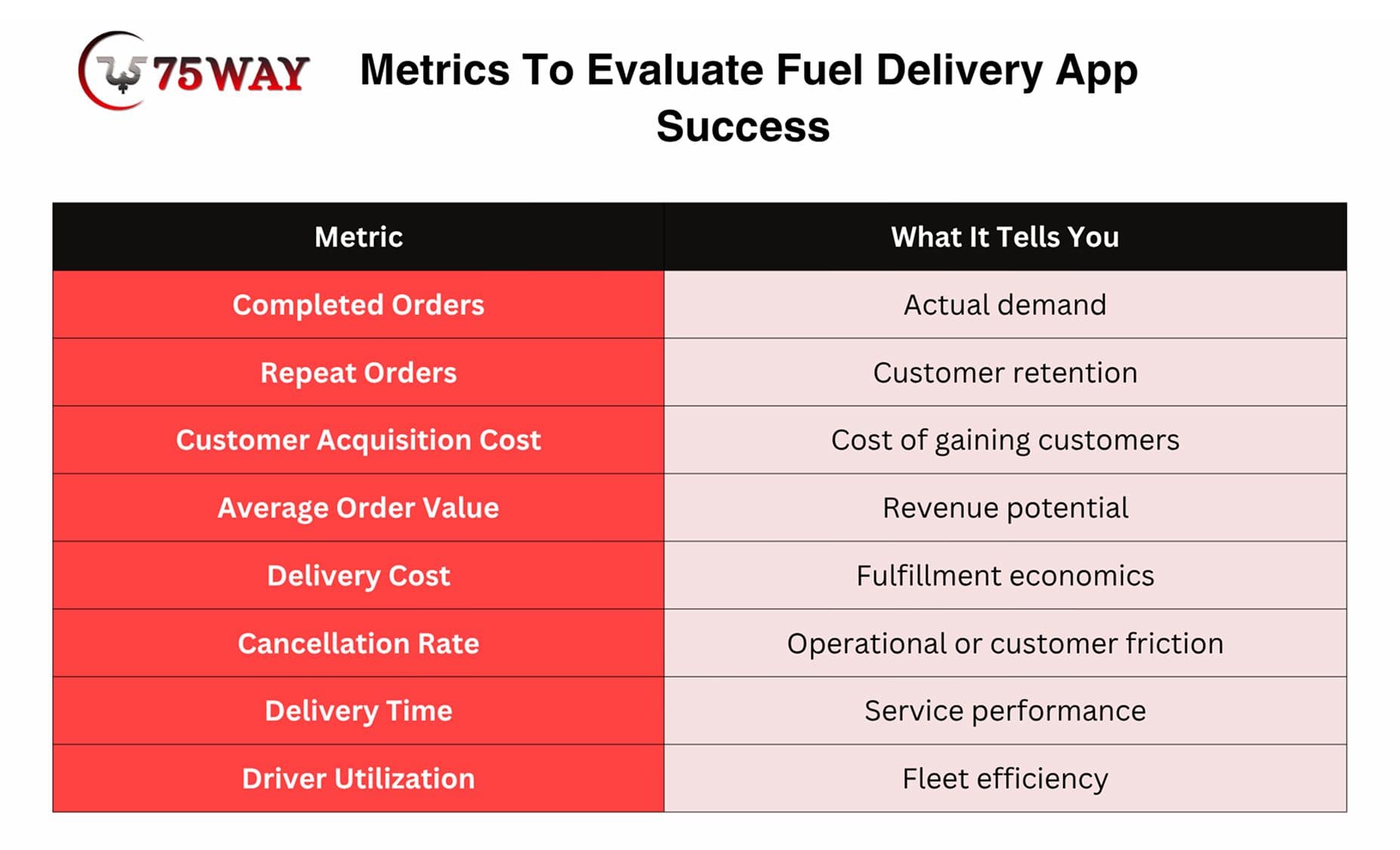
Downloads are useful, but completed profitable deliveries are what validate the business.
10. Maintain, Improve, and Scale the Platform
Launching the app is the beginning of the operating cycle, not the finish line.
After launch, monitor crashes, server performance, payment issues, security concerns, customer feedback, and driver feedback. Your analytics should show where users abandon orders and where your delivery operation loses time.
Then prioritize improvements based on actual evidence.
Once the core model is working, you can expand with:
- Recurring fuel delivery
- B2B account management
- Fleet analytics
- Advanced route optimization
- AI demand forecasting
- IoT integrations
- Multi-location business accounts
- Dynamic pricing
- Loyalty programs
This approach also makes it easier to identify whether the real bottleneck is the app, driver availability, customer acquisition, fuel sourcing, pricing, or delivery economics.
Types of Fuel Delivery App Development Solutions You Can Build
Before fuel delivery app development begins, determine which customer segment the platform will serve. This decision affects features, pricing, logistics, and the technology architecture. A consumer-focused platform may work very differently from a solution built for fleets, businesses, or fuel distributors. Let’s look at the fuel delivery app solutions you can build for different customer segments.
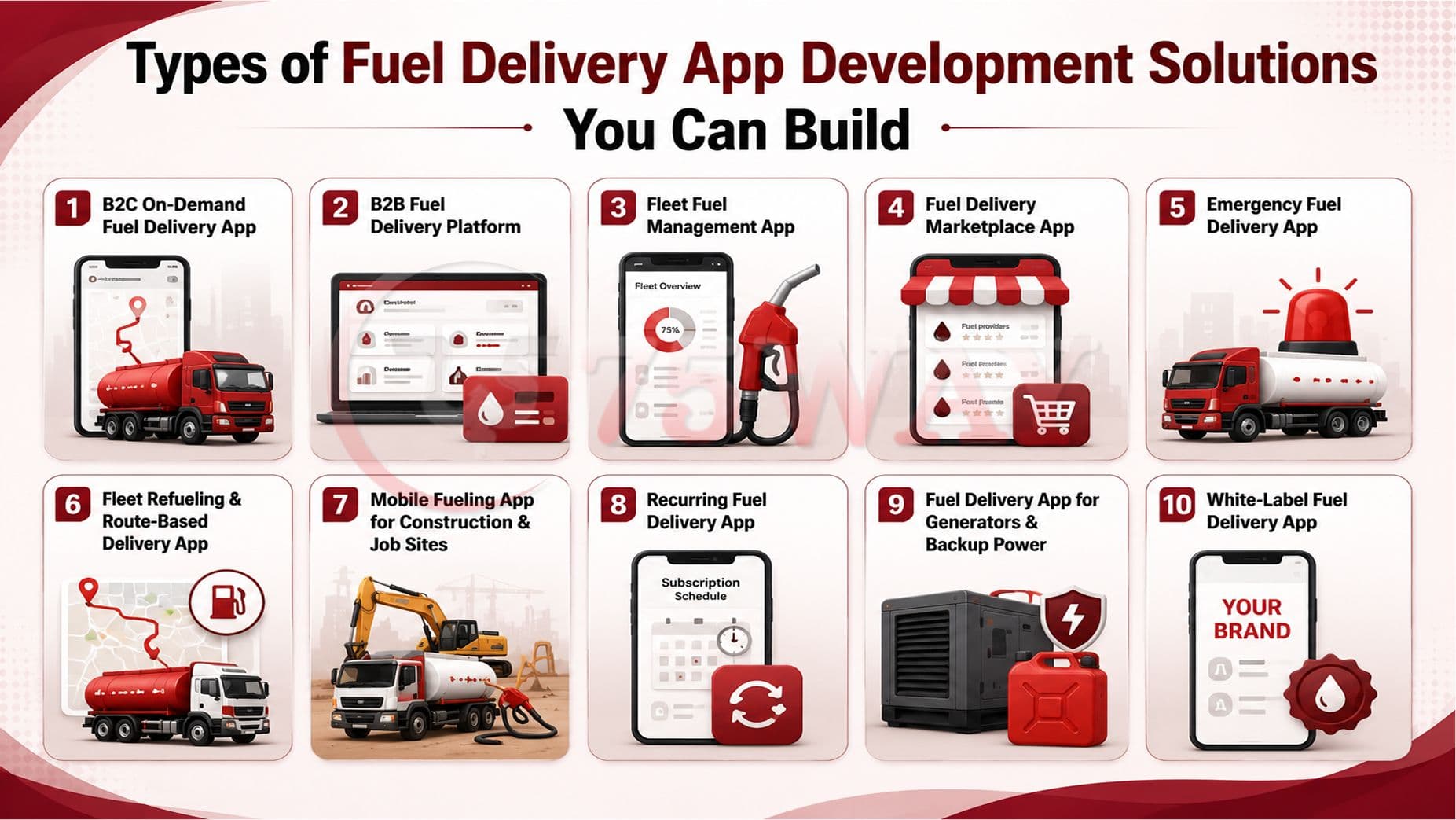
1. B2C On-Demand Fuel Delivery App
A B2C on-demand fuel delivery app brings fuel directly to a customer's vehicle, so they don't have to make an extra trip to a gas station. Think of services like Booster, EzFill, or Yoshi Mobility, where users can request fuel, share their location, choose a delivery time, and pay from their phone.
The real value is convenience, especially when someone is stuck with a low tank, managing a busy schedule, or simply wants fueling handled where their vehicle is parked.
Behind the scenes, the app connects the customer with an available driver, manages the order and payment, provides delivery tracking, and confirms when fueling is complete.
Estimated Development Cost: $30,000–$80,000+
2. B2B Fuel Delivery Platform
A B2B fuel delivery platform is built for businesses that need fuel regularly for fleets, equipment, job sites, generators, or multiple commercial locations. Companies such as Booster and Reeder Distributors illustrate how technology can support commercial fueling and fuel delivery operations beyond individual consumers.
Instead of placing occasional orders, business customers can schedule deliveries, manage several locations, assign users, approve purchases, track fuel usage, and handle business billing from one platform.
The main advantage here is repeat demand, because the app becomes part of a company’s regular fueling and operational process rather than a one-time convenience service.
Estimated Development Cost: $50,000–$120,000+
3. Fleet Fuel Management App
A fleet fuel management app helps companies keep track of where, when, and how their vehicles are being fueled while giving managers better control over fuel-related spending. Platforms such as WEX and Fleetcor show how digital fuel management can connect vehicle data, driver activity, transactions, controls, and reporting in one place.
Depending on the business, the app can support fuel ordering, scheduled refueling, driver accounts, vehicle records, consumption tracking, spending limits, and detailed fleet reports. It is particularly useful for logistics, transportation, construction, delivery, and service businesses where fuel costs can quickly become a major operating expense.
Estimated Development Cost: $60,000–$150,000+
4. Fuel Delivery Marketplace App
A fuel delivery marketplace brings multiple fuel suppliers or delivery operators onto one platform and gives customers a single place to compare and request available services. The concept is similar to how Uber or DoorDash connects customers with independent service providers, although fuel delivery requires a very different operational and safety model.
Customers can select their fuel requirements, compare available options, place an order, pay through the platform, and follow the delivery, while suppliers manage fulfillment through their own operational workflows.
For the marketplace owner, revenue can come from commissions, supplier fees, service charges, subscriptions, or business contracts without necessarily owning the entire delivery fleet.
Estimated Development Cost: $80,000–$180,000+
5. Emergency Fuel Delivery App
An emergency fuel delivery app is designed for situations where customers need fuel brought to them when waiting for a traditional fueling option is not practical. Services such as HONK and Urgent.ly demonstrate the broader roadside-assistance model, where drivers can request help based on their location and immediate needs.
A dedicated fuel-delivery version can connect customers with eligible nearby delivery vehicles, provide an estimated arrival time, process payment, and keep both sides updated until assistance arrives.
The challenge is building reliable dispatch around actual driver availability, operating areas, vehicle capacity, and applicable regulations rather than promising instant service everywhere.
Estimated Development Cost: $40,000–$100,000+
6. Fleet Refueling & Route-Based Delivery App
A route-based fuel delivery app is designed for businesses that know where their vehicles or equipment will be operating and want fueling planned around those locations. Instead of waiting for individual emergency orders, operators can create delivery schedules around routes, job sites, depots, construction projects, or recurring business locations.
The platform can combine scheduled orders, GPS data, driver assignments, delivery windows, fuel requirements, and route planning so dispatchers have a clearer view of the day's work.
This model can be particularly valuable for businesses managing multiple vehicles or sites where avoiding unnecessary trips to fueling stations saves both time and operating costs.
Estimated Development Cost: $70,000–$160,000+
7. Mobile Fueling App for Construction & Job Sites
A construction-focused fuel delivery app allows contractors and site managers to arrange fueling for equipment directly at active or temporary job locations.
The platform can handle equipment details, fuel requirements, delivery schedules, site addresses, driver coordination, purchase approvals, and digital delivery records without requiring workers to move equipment off-site for refueling.
This can be useful for construction companies, infrastructure projects, mining operations, and other businesses where heavy equipment may remain at a job site for extended periods. The real advantage is keeping equipment available for work while giving managers a clearer record of fuel deliveries and associated costs.
Estimated Development Cost: $50,000–$130,000+
8. Recurring Fuel Delivery App
A recurring fuel delivery app is built for customers or businesses that need fuel on a predictable schedule rather than placing every order manually. A fleet manager, facility operator, or commercial customer can set preferred delivery intervals, locations, fuel types, and quantities, allowing the system to generate upcoming orders automatically.
The platform can then notify customers, check availability, calculate pricing, assign deliveries, and maintain a history of completed orders. This model works particularly well when fuel demand is predictable because it can encourage repeat business while making planning easier for both customers and delivery operators.
Estimated Development Cost: $45,000–$110,000+
9. Fuel Delivery App for Generators & Backup Power
A generator-focused fuel delivery app helps businesses arrange fuel deliveries for backup generators at offices, facilities, data centers, events, or other locations where uninterrupted power matters.
Instead of relying entirely on last-minute calls, customers can schedule deliveries, maintain location records, monitor fuel requirements, and receive notifications about upcoming or completed fueling services. The platform can also support multiple facilities, recurring schedules, business accounts, delivery tracking, and digital records for operations teams.
This makes the app less about consumer convenience and more about keeping critical equipment ready when it is needed.
Estimated Development Cost: $50,000–$120,000+
10. White-Label Fuel Delivery App
A white-label fuel delivery app gives fuel companies, distributors, and established delivery businesses a ready-to-brand digital platform under their own name. Instead of building every customer, driver, and administrative system from scratch, the business can customize the branding, service areas, pricing, fuel catalog, payment options, and workflows around its existing operation.
This approach can be attractive for fuel businesses that already have customers, drivers, and supply relationships but need a modern digital ordering experience. The development focus shifts toward customization, integrations, scalability, and adapting the platform to the company's existing processes.
Estimated Development Cost: $40,000–$120,000+
Essential Features Used in On-Demand Fuel Delivery App Development
A fuel delivery app works best when every part of the platform has a clear job, from placing an order to completing the delivery. Customers need a quick ordering experience, drivers need practical tools for handling deliveries, and business teams need control over orders, pricing, payments, and operations. The following three modules cover the core features most fuel delivery platforms need.
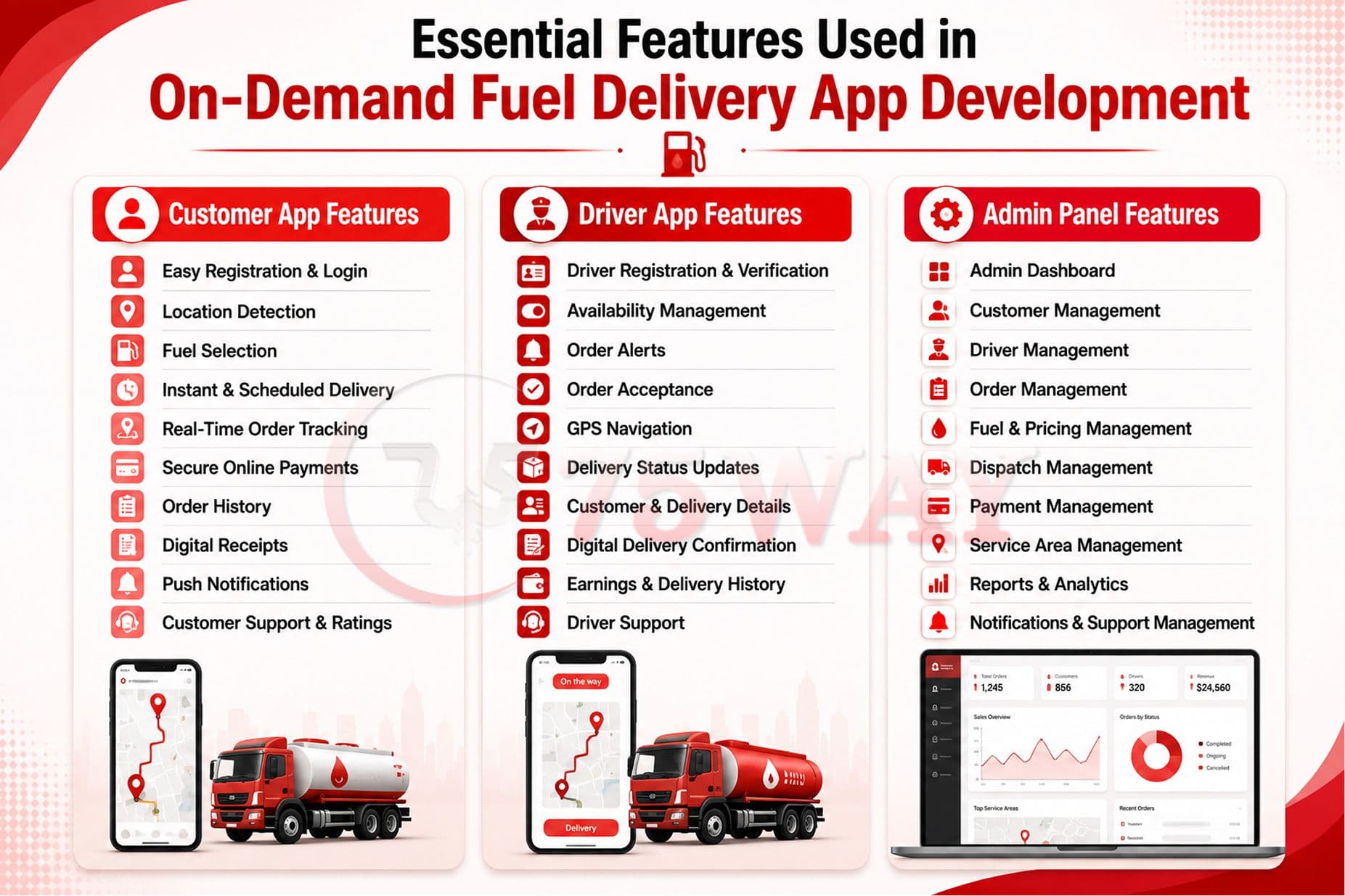
Module 1: Customer App Features
The customer side should make ordering fuel simple, transparent, and convenient, whether the user needs fuel immediately or wants to plan a delivery.
- Easy Registration & Login: Let customers create accounts using phone numbers, email, or supported sign-in options.
- Location Detection: Allow users to share their current location or manually enter the delivery address.
- Fuel Selection: Let customers choose their preferred fuel type and specify the required quantity.
- Instant & Scheduled Delivery: Give users the flexibility to request immediate fueling or schedule delivery for later.
- Real-Time Order Tracking: Allow customers to follow their order status and track the assigned driver's location.
- Secure Online Payments: Let customers pay through cards, digital wallets, or other supported payment methods.
- Order History: Give users access to previous fuel orders, quantities, prices, and delivery information.
- Digital Receipts: Automatically generate and send receipts after successful payment and delivery completion.
- Push Notifications: Keep customers updated about order confirmation, driver assignment, arrival, and delivery completion.
- Customer Support & Ratings: Allow users to contact support, report delivery issues, and rate their overall experience.
Module 2: Driver App Features
The driver application should keep delivery information easy to access while helping drivers manage assignments and update orders throughout the journey.
- Driver Registration & Verification: Allow drivers to submit their personal, identification, and vehicle details for business verification.
- Availability Management: Let drivers mark themselves available, unavailable, or busy based on their current delivery status.
- Order Alerts: Notify drivers when a new fuel delivery request is available in their service area.
- Order Acceptance: Show important order details so drivers can review and accept suitable delivery requests.
- GPS Navigation: Provide turn-by-turn directions to the customer's location through an integrated mapping service.
- Delivery Status Updates: Let drivers update an order as accepted, en route, arrived, and completed.
- Customer & Delivery Details: Display the customer's address, fuel type, quantity, contact details, and relevant delivery instructions.
- Digital Delivery Confirmation: Allow drivers to record delivery completion using the required confirmation details.
- Earnings & Delivery History: Let drivers review completed deliveries, payment information, and applicable earnings from the app.
- Driver Support: Give drivers quick access to the operations team when they face delivery, customer, or technical issues.
Module 3: Admin Panel Features
The admin panel acts as the operational command center, giving business teams visibility and control over the entire fuel delivery platform.
- Admin Dashboard: Give administrators a real-time overview of orders, deliveries, drivers, customers, revenue, and key operations.
- Customer Management: Let the admin view, approve, update, suspend, or manage customer accounts from one place.
- Driver Management: Manage driver profiles, verification status, availability, assigned vehicles, and delivery activity.
- Order Management: Allow administrators to monitor, assign, reschedule, update, or cancel fuel delivery orders.
- Fuel & Pricing Management: Let admins manage fuel types, current prices, delivery fees, discounts, and pricing rules.
- Dispatch Management: Help dispatchers assign suitable drivers based on location, availability, vehicle eligibility, and delivery requirements.
- Payment Management: Track completed payments, failed transactions, refunds, payment status, and other financial activities.
- Service Area Management: Allow administrators to define delivery zones, operating hours, coverage areas, and service availability.
- Reports & Analytics: Provide insights into orders, revenue, customer activity, delivery performance, driver activity, and business trends.
- Notifications & Support Management: Help admins send important updates and manage customer support requests, complaints, and operational issues.
Advanced Features to Add After MVP Development of Fuel Delivery Application
Your first version of the fuel delivery application should prove the business model. The next version should make the operation stronger. Once the basic ordering and delivery workflow is working, advanced features can help your team handle higher demand without adding the same level of manual effort. These are the capabilities worth adding as your fuel delivery application matures.
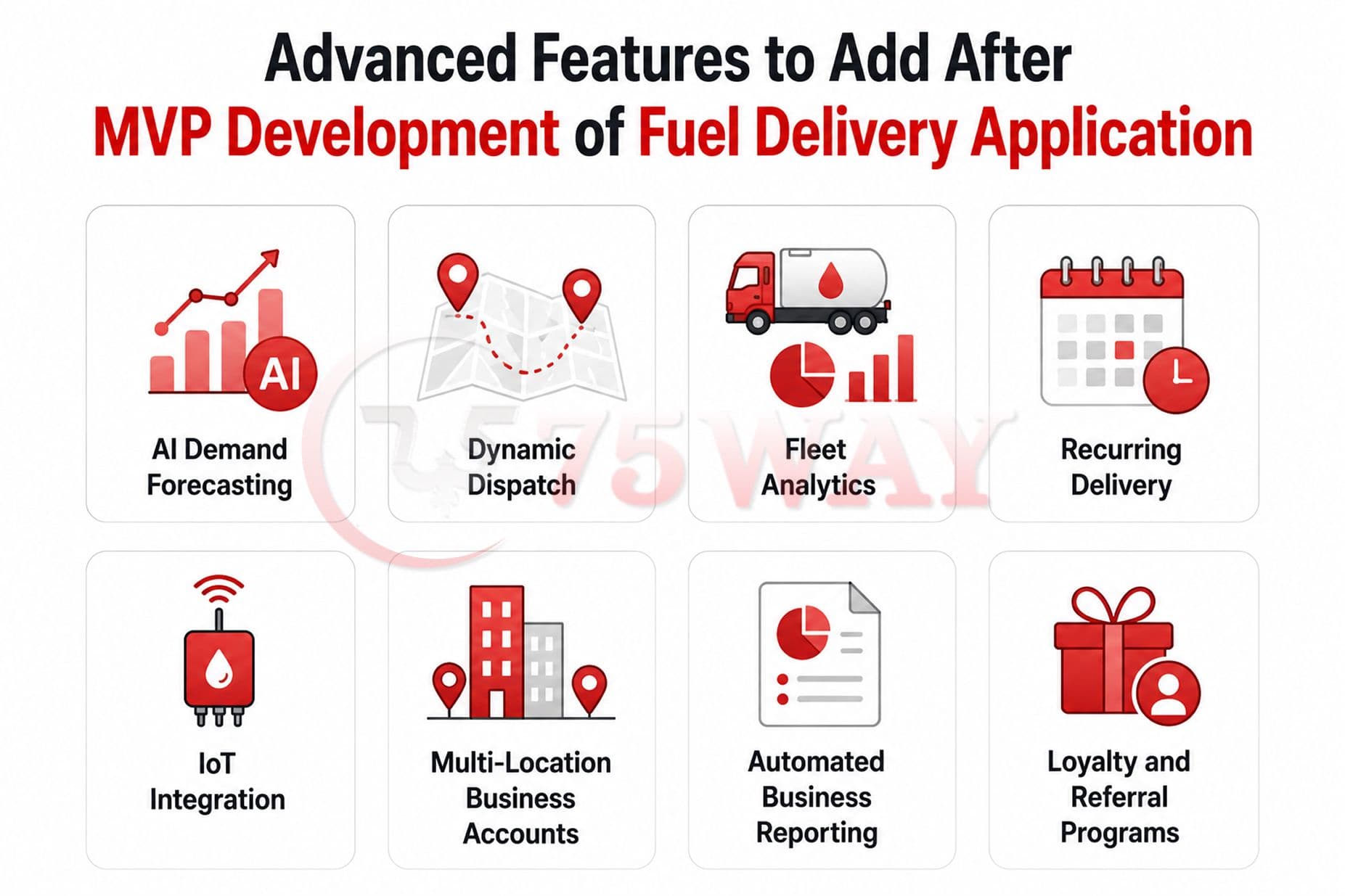
- AI Demand Forecasting
Historical orders, seasonal patterns, customer behavior, and location data can reveal where fuel demand is likely to rise. These insights can help businesses plan inventory, delivery capacity, and driver availability ahead of time.
- Dynamic Dispatch
When several orders come in at once, dispatchers need more than a simple “nearest driver” option. Dynamic dispatch can consider driver location, availability, vehicle capacity, order priority, and delivery windows to make better assignments.
- Fleet Analytics
Fuel spending becomes much easier to understand when vehicle activity, delivery records, consumption, and operating costs are visible together. Fleet managers can use these insights to identify unusual usage, control expenses, and make better day-to-day decisions.
- Recurring Delivery
Some businesses already know roughly when they will need their next fuel delivery, so there is little reason to place the same order manually every time. Recurring delivery lets them set a schedule and keep regular fueling needs on track.
- IoT Integration
Fuel tanks and connected sensors can tell the platform when fuel levels are getting low without relying entirely on manual checks. With the right equipment and setup, that data can support timely alerts and help businesses plan upcoming deliveries.
- Multi-Location Business Accounts
Managing fuel for ten locations through ten separate accounts quickly becomes a headache for a business. A multi-location account brings sites, users, vehicles, orders, and billing under one platform so managers can oversee everything from a central place.
- Automated Business Reporting
Business customers often need more than a receipt after every delivery; they need to know where their fuel budget is going. Automated reports can bring purchases, quantities, delivery activity, and spending into one place for easier review.
- Loyalty and Referral Programs
A customer who regularly orders fuel has a good reason to come back when the app recognizes that loyalty. Points, delivery credits, discounts, or referral rewards can encourage repeat orders without complicating the core fueling experience.
Recommended MVP Vs. Full Platform: Mobile Fuel Delivery App Development
An MVP is the better starting point for most fuel delivery startups because it lets you test the business with a focused set of essential features before making a larger investment.
The goal is to get the complete delivery journey working, from fuel ordering and payment to driver assignment, tracking, and delivery confirmation, without building features you may not need yet.
A full platform makes more sense when you already have established operations, multiple customer segments, or plans to manage larger delivery volumes from the start.
The key is not choosing between “basic” and “advanced,” but building the right capabilities for your current stage and leaving room to expand.
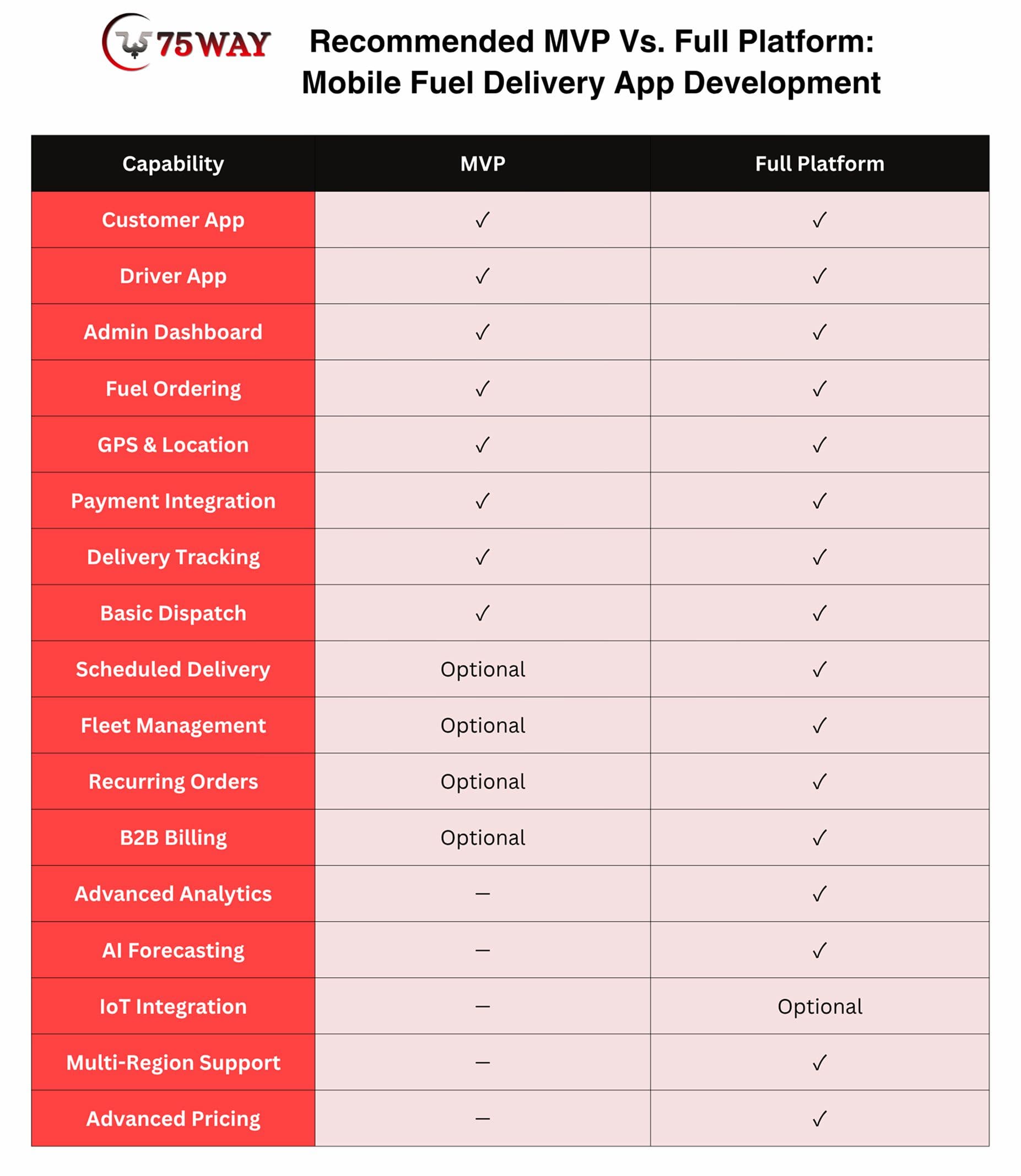
For most startups, the right objective is not to build the biggest fuel delivery platform. It is to build the smallest reliable platform capable of proving the business model.
Why Invest in Advanced Fuel Delivery App Development in 2027?
A fuel delivery business can serve customers beyond the limits of a physical fuel station by bringing refueling directly to where it is needed. For fuel retailers, distributors, and entrepreneurs, this creates a digital channel for handling orders, deliveries, payments, and customer relationships. The key business reasons for investing in fuel delivery app development are explored below.
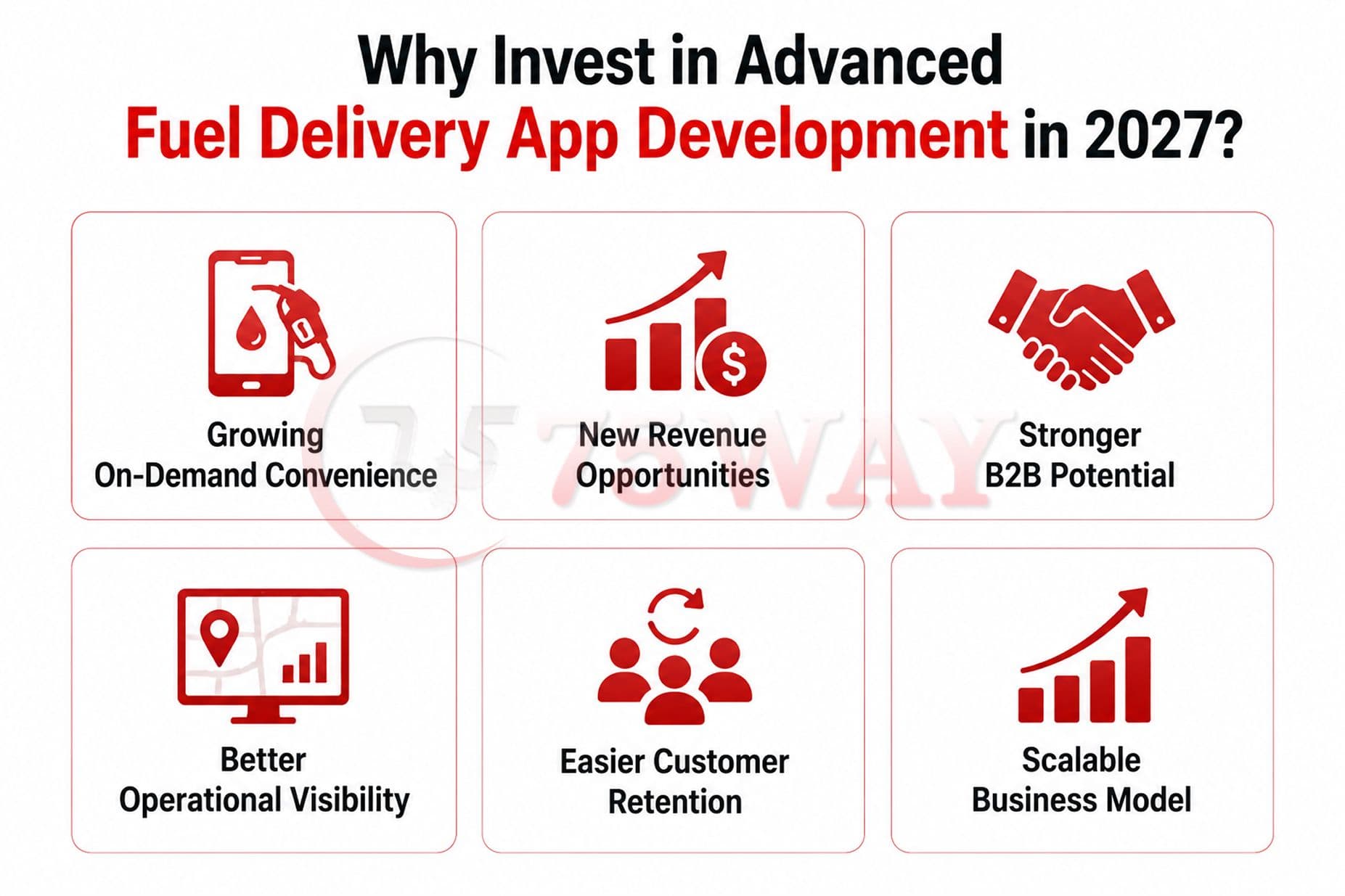
- Growing On-Demand Convenience
Customers increasingly value services that come directly to their location, especially when visiting a fuel station is inconvenient or impractical. A dedicated app can make fuel ordering more accessible through scheduled and on-demand delivery options.
- New Revenue Opportunities
A fuel delivery platform can support multiple revenue streams instead of depending on fuel sales alone. Delivery charges, fuel margins, subscriptions, B2B contracts, marketplace commissions, and premium services can be combined according to the business model.
- Stronger B2B Potential
Fleet operators, construction businesses, logistics companies, and commercial facilities can have recurring fueling requirements. A dedicated platform can make scheduled deliveries, centralized billing, multiple locations, and fuel usage management easier for these customers.
- Better Operational Visibility
Digital orders create a centralized record of customers, deliveries, drivers, payments, locations, and order activity. Business owners can use this information to understand demand, identify operational bottlenecks, and make better decisions.
- Easier Customer Retention
An app gives businesses a direct channel to communicate with customers instead of relying entirely on third-party marketplaces or traditional ordering methods. Loyalty programs, recurring deliveries, personalized offers, and convenient reorder options can encourage repeat business.
Scalable Business Model
A well-planned MVP can start with one focused service area and core delivery capabilities before expanding. As demand becomes clearer, the platform can add fleet management, advanced dispatch, analytics, AI forecasting, multi-location accounts, and additional markets.
How Much Does It Cost to Develop a Fuel Delivery App?
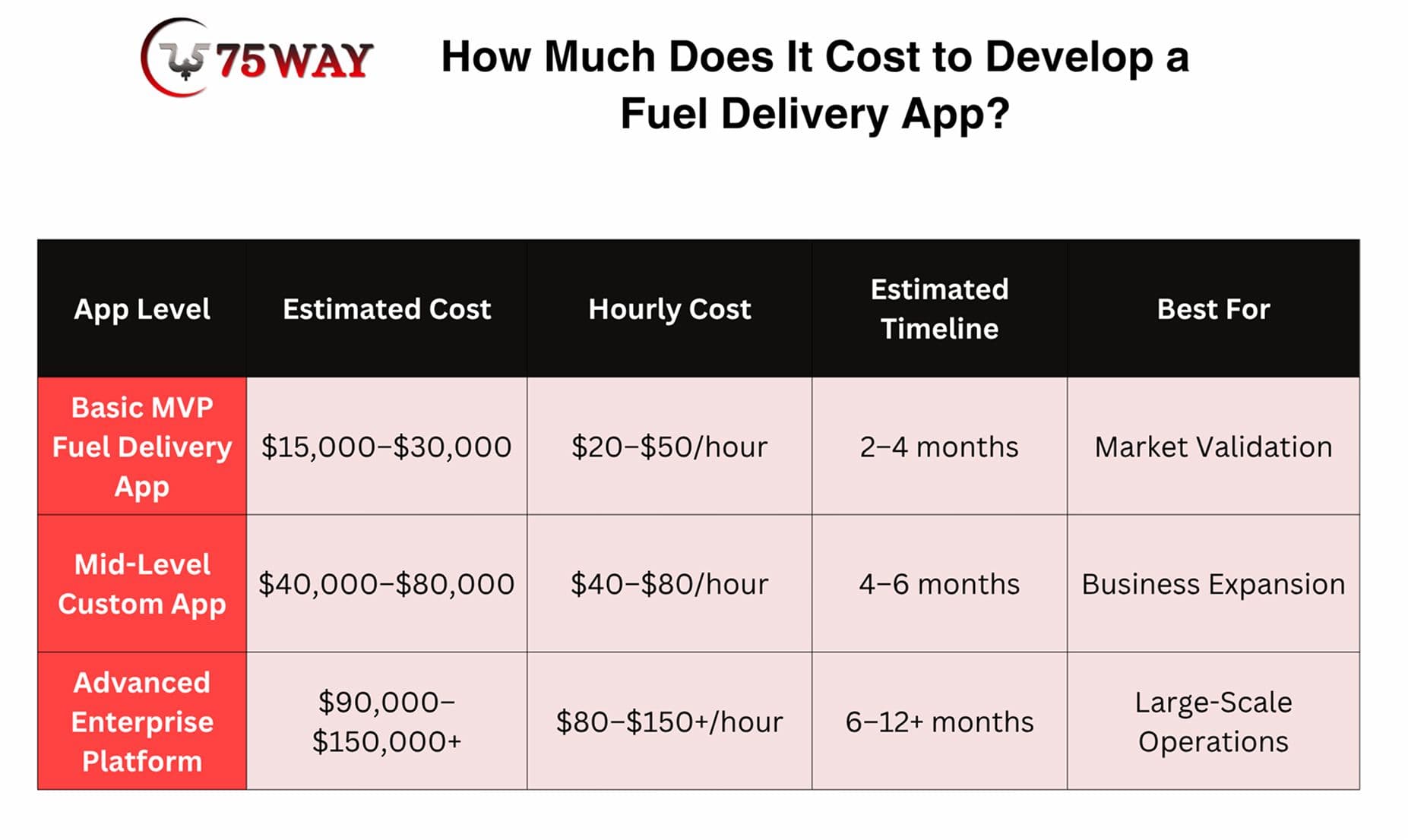
Fuel delivery app development typically costs between $15,000 and $150,000+, depending on the product scope, features, platforms, integrations, development location, and operational complexity.
Basic MVP Fuel Delivery App: $15,000–$30,000
This range generally covers the essentials needed to launch and test the concept, including customer ordering, basic driver allocation, fuel selection, location services, and secure payment processing.
Mid-Level Custom App: $40,000–$80,000
A custom product at this level can include real-time GPS tracking, push notifications, driver dashboards, order history, improved dispatch workflows, and a more tailored customer experience.
Advanced Enterprise Platform: $90,000–$150,000+
Enterprise-level development can involve sophisticated dispatch, fleet management, B2B billing, recurring deliveries, advanced analytics, multi-location accounts, third-party integrations, and infrastructure designed for larger operations.
Region-Wise Rates To Hire Fuel Delivery App Developers
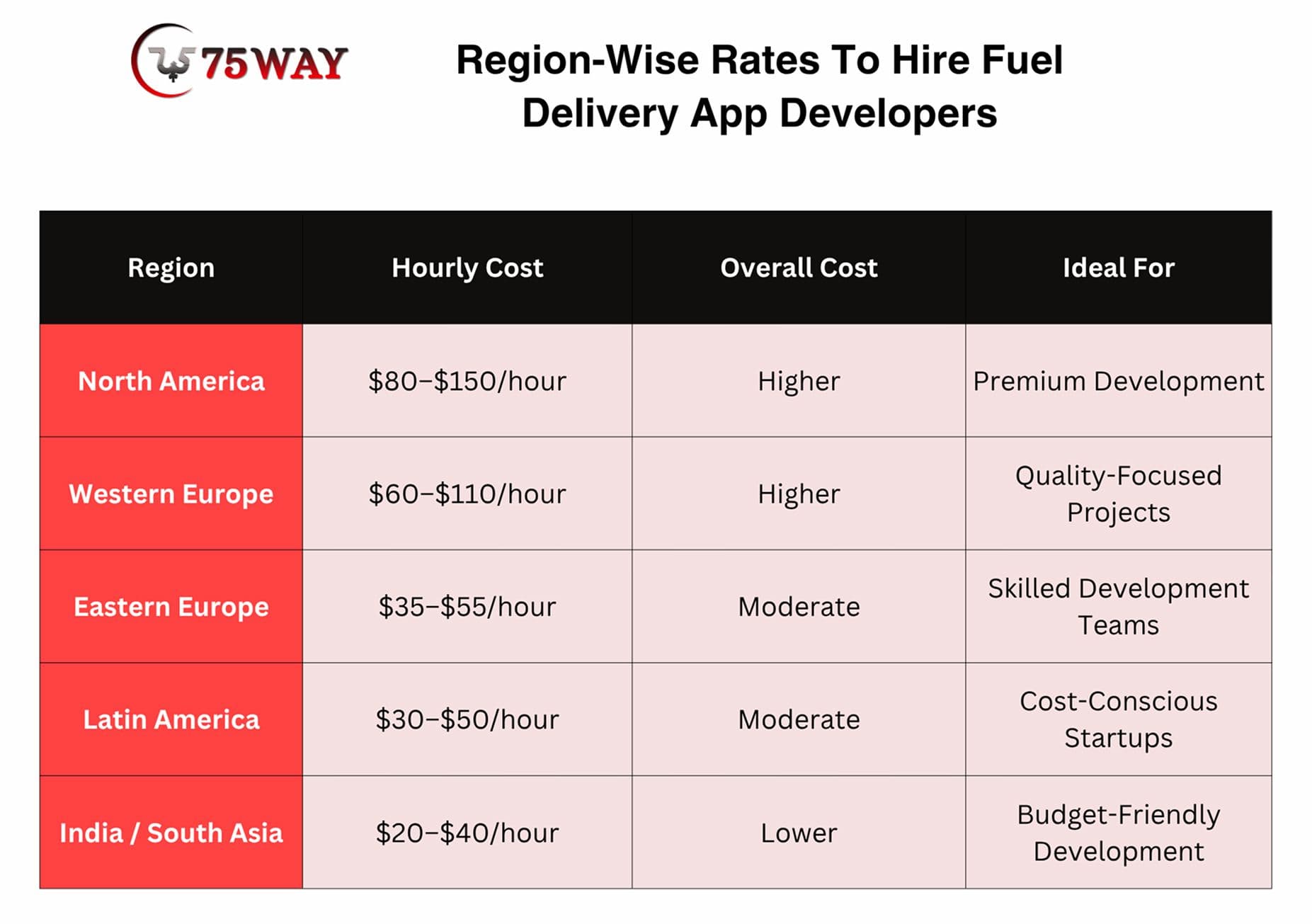
Where your development team is located can have a noticeable impact on the overall project budget. The following ranges are commonly used as broad planning estimates rather than fixed market prices.
- North America: $80–$150/hour
- Western Europe: $60–$110/hour
- Eastern Europe: $35–$55/hour
- Latin America: $30–$50/hour
- India / South Asia: $20–$40/hour
Fuel Delivery App Development Cost Based On Stages
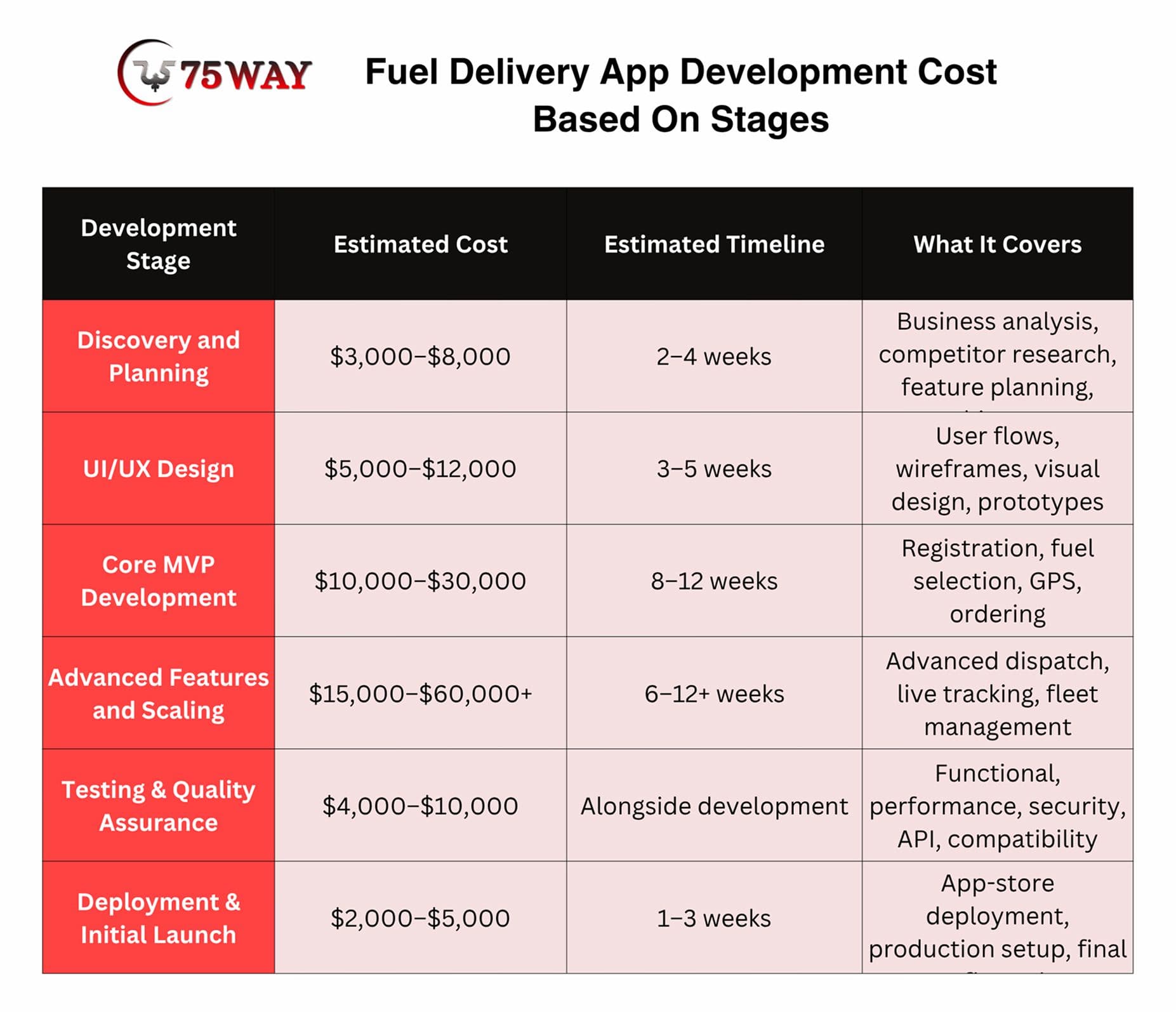
The development budget is also easier to understand when you look at where the money goes throughout the project.
1. Discovery and Planning: $3,000–$8,000
This stage turns the initial idea into a practical development roadmap. It typically covers business analysis, competitor research, feature prioritization, technical planning, system architecture, and identifying relevant compliance considerations before development begins.
Estimated Timeline: 2–4 weeks
2. UI/UX Design: $5,000–$12,000
A fuel delivery platform usually needs different experiences for customers, drivers, and administrators. The design budget can cover user flows, wireframes, visual design, interactive prototypes, and usability testing.
Estimated Timeline: 3–5 weeks
3. Core MVP Development: $10,000–$30,000
This is where the primary product starts taking shape. Development may cover registration, fuel selection, location services, ordering, payment integration, basic dispatch, and delivery confirmation.
Estimated Timeline: 8–12 weeks
4. Advanced Features and Scaling: $15,000–$60,000+
Once the core product is validated, additional investment can go toward advanced dispatch, live tracking, fleet management, recurring orders, B2B capabilities, AI-based features, and CRM or ERP integrations.
Estimated Timeline: 6–12 weeks+
5. Testing and Quality Assurance: $4,000–$10,000
Testing protects the product from problems that could affect payments, orders, location accuracy, security, or delivery workflows. Depending on the project, QA can include functional, performance, compatibility, security, API, and real-world scenario testing.
Estimated Timeline: Runs alongside development and continues through pre-launch.
6. Deployment and Initial Launch: $2,000–$5,000
Getting the application ready for customers involves production configuration, app-store preparation, deployment, final checks, and launch support. The exact amount depends on the platforms, infrastructure, and launch requirements.
A Practical Budget to Keep in Mind
For most startups, $30,000–$80,000 is a practical planning range for a custom fuel delivery MVP or mid-level application, while a sophisticated enterprise platform can move beyond $150,000 as integrations and operational complexity increase. Treat these figures as planning ranges rather than fixed quotes because the actual cost depends on your feature scope, technical architecture, team location, and business requirements.
Factors Affecting The Cost of Developing AI-Powered Fuel Delivery Mobile App?
The final quote is rarely determined by the number of screens alone. Several product and business decisions can move the budget significantly.
- App Complexity: Three connected interfaces, customer, driver, and admin, require more development than a single customer-facing application.
- Platform Choice: Building for both iOS and Android can increase development effort compared with launching on one platform first.
- Real-time Functionality: GPS tracking, live ETAs, driver status, and dynamic dispatch require more backend infrastructure.
- Third-party Integrations: Maps, payments, notifications, analytics, CRM, ERP, and other integrations add development and testing work.
- Business Workflows: B2B billing, recurring orders, multi-location accounts, and supplier management introduce additional logic.
- Advanced Technology: AI forecasting, route optimization, IoT connectivity, and predictive analytics require additional development expertise.
- Security Requirements: Payment processing, account security, access controls, and sensitive business data need appropriate protection.
- Scalability: A platform designed for one local market will have different infrastructure requirements from one intended for multiple regions.
- UI/UX Requirements: Highly customized experiences require more research, prototyping, design, and usability testing.
- Development Team Location: Hourly rates vary considerably depending on where your development team is based.
How to Calculate Fuel Delivery App Development Cost
A simple way to estimate your app budget is to multiply the total development hours by the development team's hourly rate, then add design, testing, integrations, infrastructure, and other project-specific expenses. This gives you a more realistic starting estimate than relying on a single fixed price because every fuel delivery platform has different requirements.
Basic Formula:
Total Development Cost = Development Hours × Hourly Rate + Additional Project Costs
Example:
Suppose your fuel delivery app requires approximately 2,000 development hours, and your development team charges $40 per hour.
Development Cost = 2,000 × $40 = $80,000
If you then budget another $15,000 for UI/UX design, QA, third-party integrations, deployment, and related project expenses:
Estimated Total Cost = $80,000 + $15,000 = $95,000
So, your estimated investment would be around $95,000 for that particular scope.
Note: This is only a planning example. Actual fuel delivery app development costs can vary based on features, platform count, integrations, location-based services, security requirements, and development team rates.
How Does a Fuel Delivery App Make Money: Revenue Models
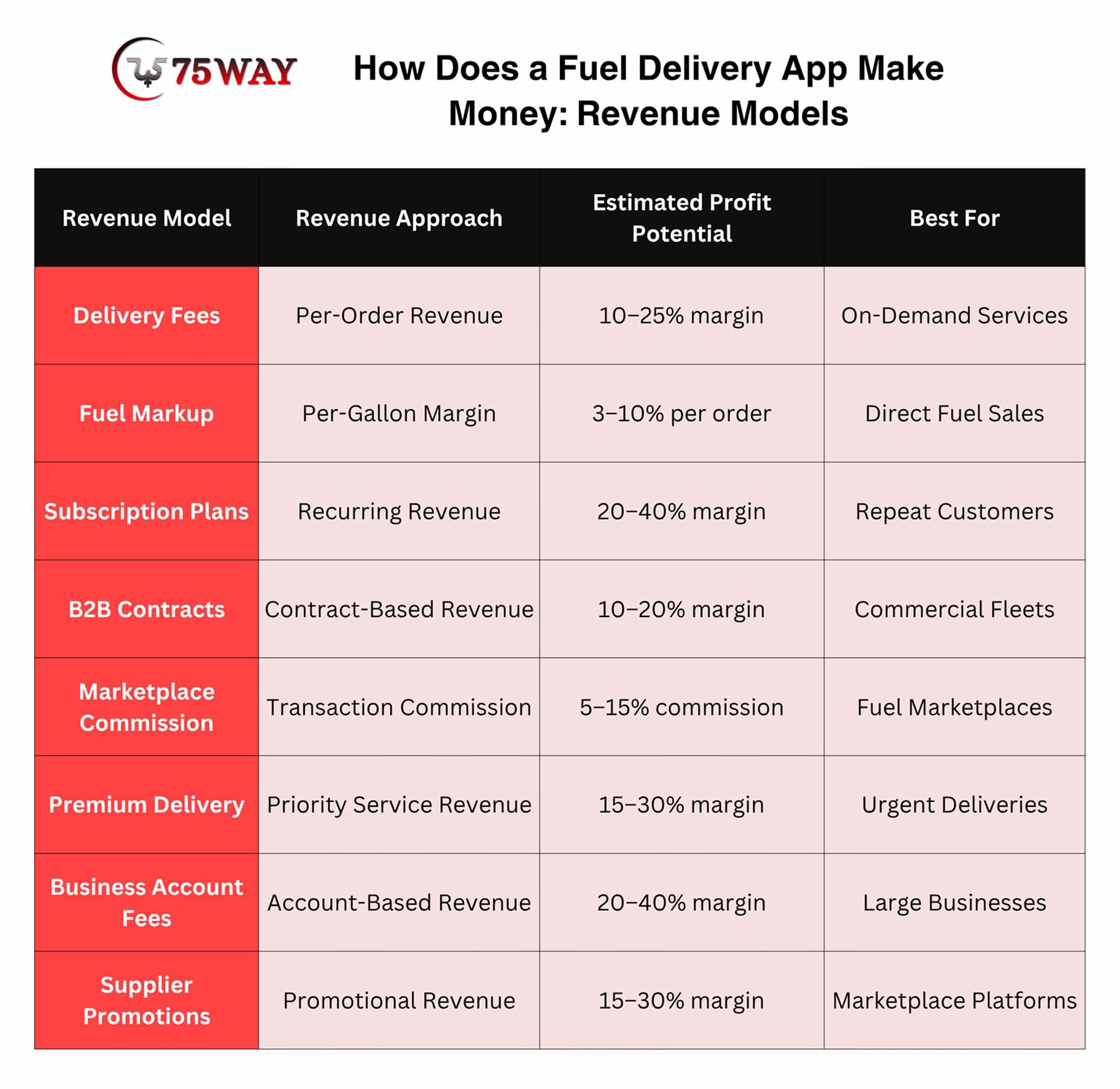
A fuel delivery app can make money through delivery fees, fuel margins, subscriptions, business contracts, and marketplace commissions. The best revenue model depends on whether you serve individual customers, fleets, fuel suppliers, or a mix of audiences. Many platforms can combine two or more models to create recurring revenue while keeping the service attractive to customers.
- Delivery Fees
Customers pay a separate fee for bringing fuel to their location, which can vary based on distance, delivery time, order size, or service type. This model is straightforward and works particularly well for on-demand consumer deliveries.
Estimated Profit Potential: 10–25% margin
- Fuel Markup
The platform can generate revenue by adding a margin to the fuel price charged to customers. Your actual pricing structure will depend on supplier agreements, operating costs, local market conditions, and applicable requirements.
Estimated Profit Potential: 3–10% per order.
- Subscription Plans
Frequent customers can pay a monthly or annual subscription for benefits such as reduced delivery fees, priority scheduling, discounted services, or other premium features. Subscriptions can create more predictable recurring revenue while encouraging customers to place repeat orders.
Estimated Profit Potential: 20–40% margin
- B2B Contracts
Businesses with regular fuel requirements can become valuable long-term customers through negotiated contracts. Fleet operators, construction companies, commercial facilities, and other organizations may pay through recurring arrangements based on delivery volume, locations, or agreed pricing.
Estimated Profit Potential: 10–20% margin.
- Marketplace Commission
If your platform connects customers with independent fuel suppliers or delivery operators, you can charge a commission on completed orders. This model allows the platform to earn from transactions while suppliers handle some or all of the physical delivery operation.
Estimated Profit Potential: 5–15% commission
- Premium Delivery
Customers who need faster or more flexible service can be charged an additional fee for priority delivery, specific time windows, or other premium options. This gives the platform another revenue stream without requiring every customer to pay the higher price.
Estimated Profit Potential: 15–30% margin
- Business Account Fees
For larger customers, you can offer paid business accounts with features such as multiple locations, employee permissions, centralized billing, reporting, and purchase controls. These account fees can become especially valuable when serving companies with recurring fuel demand.
Estimated Profit Potential: 20–40% margin
- Advertising & Supplier Promotions
Fuel suppliers and related businesses can pay for promoted placements within a marketplace-style platform. Sponsored listings, promotional offers, and supplier campaigns can create additional revenue once the platform has enough customer traffic to make those placements valuable.
Estimated Profit Potential: 15–30% margin.
Common Mistakes When Building a Fuel Delivery App
The biggest fuel delivery app mistakes usually happen when businesses focus heavily on the app itself and overlook the operation behind it. A successful platform has to make sense from both sides: customers should find it convenient, while the business must be able to deliver fuel safely, reliably, and profitably.
1. Building Before Validating the Business Model
A polished app will not fix a business model that loses money on every delivery.
Solution: Validate your target customers, delivery costs, fuel margins, service area, pricing, and expected order volume before committing to full-scale development.
2. Treating Fuel Like a Normal Delivery Product
Fuel is not comparable to delivering groceries or restaurant orders because transportation, handling, environmental, and safety considerations can affect the operation.
Solution: Design the platform around your actual fuel-delivery workflow and have qualified professionals assess the applicable requirements for the locations and products you plan to serve.
3. Launching With Too Many Features
Adding AI, IoT, advanced analytics, loyalty programs, and complex dashboards to version one can consume your budget before you know whether customers want the service.
Solution: Start with an MVP covering ordering, payments, location, dispatch, tracking, and delivery confirmation, then add features based on real usage.
4. Ignoring the Driver Experience
Customers may see the mobile app, but drivers are the people who ultimately make the delivery happen.
Solution: Give drivers a simple workflow for receiving orders, checking delivery information, navigating to locations, updating statuses, and confirming completed deliveries.
5. Using Generic Pricing Logic
Fuel pricing is rarely as simple as setting one fixed price for every customer and every delivery.
Solution: Build flexible pricing rules that can accommodate fuel costs, delivery charges, distance, discounts, customer contracts, service areas, and other business-specific pricing factors.
6. Ignoring Serviceability
Accepting every delivery request may look customer-friendly until your team receives an order outside its operating area or without suitable delivery capacity.
Solution: Add service-area rules that check location, operating hours, fuel availability, vehicle eligibility, and other operational conditions before confirming an order.
7. Treating Compliance as a Development Feature
Adding a checkbox labeled “compliant” inside the application does not make the underlying business operation compliant.
Solution: Identify the federal, state, and local requirements relevant to your specific fuel products, vehicles, drivers, storage, transportation, and delivery model before launch, with appropriate professional guidance.
8. Scaling Too Early
Expanding into multiple cities before understanding delivery economics can multiply operational problems instead of multiplying revenue.
Solution: Prove demand, fulfillment capacity, customer retention, and unit economics in a focused market before expanding your service area.
How to Hire a Reliable Fuel Delivery App Development Company in the USA?
The right fuel delivery app development company should understand both app engineering and the operational reality of fuel delivery. Before signing a contract, compare several companies against the same criteria instead of choosing the lowest quote or the most impressive sales presentation.
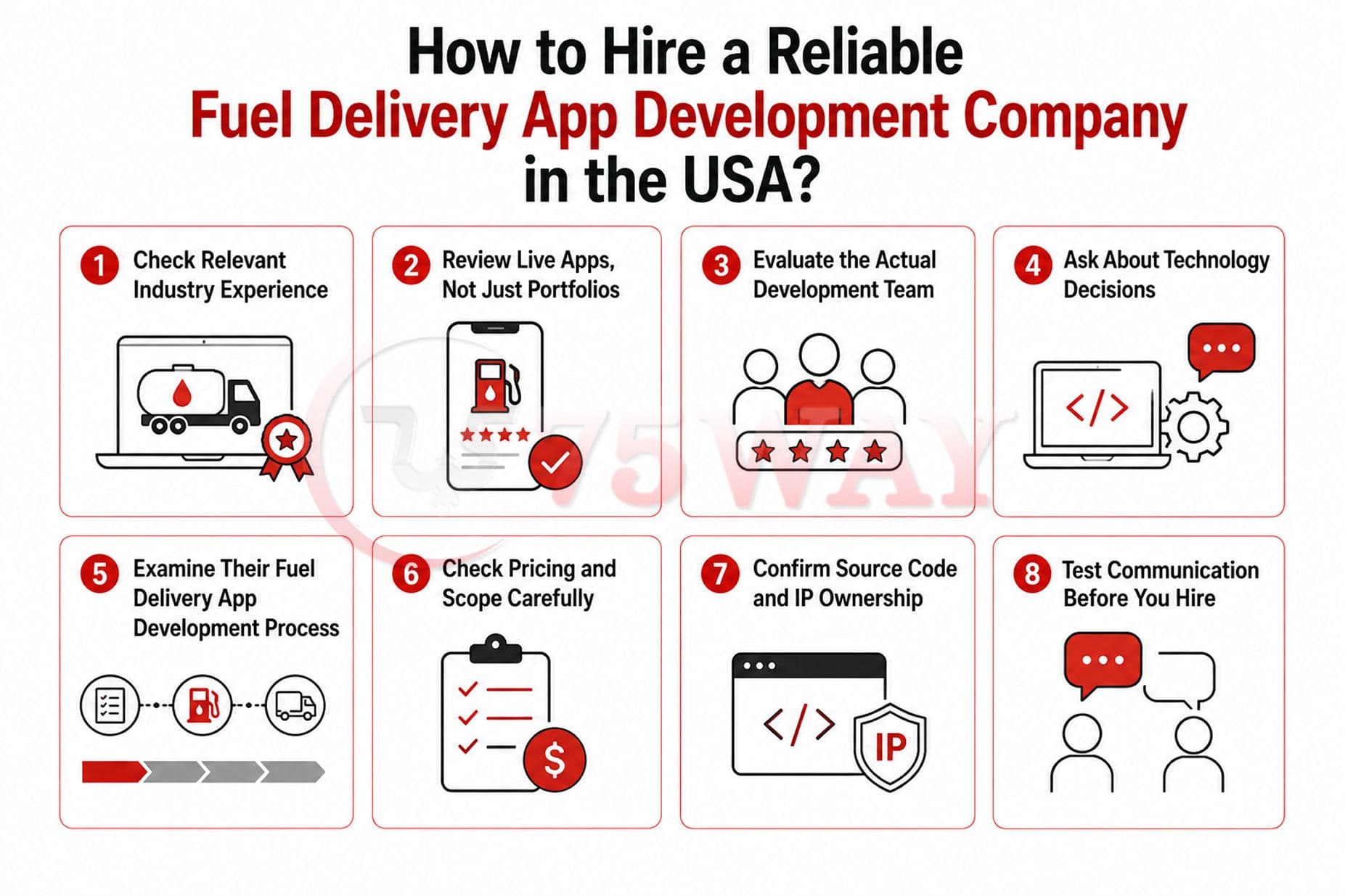
- Check Relevant Industry Experience: A company that has built ordinary mobile apps is not automatically equipped to build a fuel delivery platform. Look for experience with on-demand delivery, GPS tracking, driver applications, dispatch systems, payments, and multi-sided platforms, and ask how those projects handled real operational challenges.
- Review Live Apps, Not Just Portfolios: Screenshots and case-study pages can tell you what an agency claims to have built, but a live application gives you much more to evaluate. Test the app yourself and look at navigation, tracking, speed, ordering, payment flows, and how smoothly different user roles interact.
- Evaluate the Actual Development Team: The salesperson you meet during the first call may not be the person writing your code. Ask who will handle development, UI/UX, backend engineering, QA, and project management, and whether those people will remain involved throughout the project.
- Ask About Technology Decisions: You should receive more than a list of technologies such as Flutter, React Native, Node.js, AWS, or Google Maps. A capable team should explain why a particular stack fits your expected users, real-time requirements, integrations, security needs, and long-term scalability.
- Examine Their Fuel Delivery App Development Process: A dependable partner should be able to walk you through the project from discovery to post-launch support. Look for a process covering requirements, documentation, UI/UX, development, API integrations, testing, deployment, monitoring, and future improvements rather than simply promising to “build the app.”
- Check Pricing and Scope Carefully: Do not compare companies using the headline price alone. Ask what the quote actually includes: customer and driver apps, admin panel, backend, APIs, testing, deployment, third-party integrations, documentation, and post-launch support, and identify anything that could become an additional charge.
- Confirm Source Code and IP Ownership: Your application should not become dependent on a vendor simply because the project is complete. Before signing, clearly establish ownership and access to the source code, design files, documentation, repositories, databases, deployment credentials, and relevant third-party accounts.
- Test Communication Before You Hire: You can learn a lot from the hiring process itself. Notice how quickly the company responds, whether they understand your questions, whether they challenge unrealistic assumptions, and whether they explain technical issues in language your business team can actually follow.
What Should You Ask a Fuel Delivery Application Development Company?
Before hiring a development partner, ask questions that go beyond hourly rates.
Product Experience
- Have you built logistics or on-demand platforms?
- Can you demonstrate relevant production experience?
- How do you handle customer, driver, and admin workflows?
Technical Architecture
- How will real-time tracking work?
- How will dispatch be designed?
- How will payment failures and refunds be handled?
- How will the platform scale across markets?
Security
- How will customer and payment information be protected?
- What authentication and authorization model will you use?
- How will administrative permissions be managed?
Operations
- How will service areas be configured?
- Can pricing vary by location or customer?
- Can the platform support recurring B2B deliveries?
Compliance
- How will regulatory requirements be identified?
- Which requirements are handled by software and which require operational or legal controls?
- Can the architecture accommodate state-specific business rules?
Post-Launch
- Who handles monitoring?
- What is included in maintenance?
- How are production bugs handled?
- How will future features be added?
A strong development partner should be able to discuss business workflows and operational constraints, not just programming languages.
Why 75way Is Best Choice For Fuel Delivery App Development Solutions For Enterprises?
75way Technologies can help turn a fuel delivery concept into a practical digital platform built around your actual business model, target customers, and growth plans. Our approach focuses on defining the right MVP first, then building the customer, driver, and admin experiences around the delivery workflow rather than adding features without purpose.
From UI/UX and backend development to GPS, payments, real-time tracking, dispatch, analytics, and third-party integrations, the platform can be planned as a scalable product from the beginning. We also focus on clear communication, structured development, testing, and post-launch improvements so your product can evolve as real customer and operational data becomes available.
Whether you are validating a startup idea, digitizing an existing fuel business, or building a larger B2B platform, 75way can help you move from product planning to launch with a development strategy aligned with your business goals.
Final Takeaway
Fuel delivery app development is best approached as a technology-enabled logistics business, not simply a mobile application project.
A focused MVP gives startups a practical way to validate demand, understand delivery economics, and gather real-world feedback before investing in advanced capabilities. As the business grows, features such as fleet management, recurring deliveries, AI forecasting, analytics, and multi-location support can expand the platform’s value.
The right technology partner can also reduce development risks by planning the architecture, integrations, security, and scalability from the beginning. If you are ready to turn your idea into a scalable fuel delivery platform, partner with a trusted on-demand delivery app development company.
Frequently Asked Questions (FAQs)
What Is The Cost To Develop A Fuel Delivery App?
A fuel delivery app can cost around $15,000 to $150,000+, depending on the features, platforms, integrations, technology, development team location, and overall business complexity.
How Long Does It Take To Build A Fuel Delivery App?
A basic MVP can take around 2–4 months, while a customized or enterprise-level platform may require 6–12+ months, depending on scope and integrations.
Should I Build An MVP Before A Full Fuel Delivery Platform?
Yes, an MVP is often a practical starting point for startups because it helps validate customer demand and delivery economics before making a larger technology investment.
Can A Fuel Delivery App Support B2B Customers?
Yes. The platform can support fleet operators, construction companies, logistics businesses, commercial facilities, and other organizations through recurring orders, multiple locations, account billing, and reporting.
Can I Add AI To A Fuel Delivery App?
Yes, AI can support areas such as demand forecasting, route planning, customer insights, and operational analytics once the platform has sufficient data and a validated business use case.
Can A Fuel Delivery App Support Multiple Cities Or Regions?
Yes. A scalable architecture can support multiple service areas, location-based pricing, different operating rules, regional delivery teams, and market-specific configurations as the business expands.