Summary
AI voice agents are helping restaurants streamline customer interactions by handling reservations, order taking, and support calls through intelligent automation. This guide explains how restaurant voice AI works, its key features, benefits, technology stack, development costs, and implementation considerations. Businesses can leverage voice automation to reduce missed calls, improve operational efficiency, and create faster guest experiences.
Quick Overview
- AI voice agents help restaurants automate calls, reservations, and order management processes.
- Intelligent voice systems provide customers with instant assistance throughout the day.
- Automated ordering reduces staff workload during busy restaurant operating hours.
- AI integrations improve reservation accuracy, customer satisfaction, and operational efficiency.
- Voice automation creates scalable solutions for restaurants of different sizes.
Missed calls during busy hours can mean missed reservations, lost orders, and unhappy customers. For restaurants, managing phone conversations while keeping service fast has become a daily challenge, especially when customers expect instant responses.
AI voice agents for restaurants are changing how food service providers handle customer communication. The restaurant AI calling agents answer calls, take orders, manage reservations, and provide support 24/7.
Unlike traditional automated phone systems that rely on fixed menus and limited responses, modern AI voice agents understand natural conversations. They can recognize customer intent, remember context, and provide personalized interactions similar to speaking with a restaurant representative.
This guide explores how restaurant AI voice agents work, their key features, benefits, implementation process, costs, and why restaurants are adopting AI voice automation to improve operations and customer experiences.
What Is An AI Voice Agent For Restaurants?
An AI voice agent for restaurants is an intelligent conversational system that manages customer phone interactions using artificial intelligence, speech recognition, and natural language processing. Unlike traditional automated phone systems that depend on fixed menus, AI voice agents understand natural conversations, identify customer needs, and provide relevant responses in real time.
These AI-powered assistants can handle various restaurant operations, including reservation bookings, order taking, menu inquiries, delivery questions, operating hours, customer preferences, and common support requests. By connecting with restaurant systems such as POS software, reservation platforms, and customer databases, they can complete tasks without requiring constant employee involvement.
Modern restaurant AI voice agents work similarly to a virtual front-desk assistant. When a customer calls, the system listens to the request, processes the intent, accesses required information, and responds through a natural voice conversation. For example, a customer can ask about available tables, place a takeaway order, modify an existing booking, or check menu options without waiting for staff availability.
Why Are Restaurants Adopting AI Voice Automation in 2026?
The restaurant industry operates in a fast-paced environment where every customer interaction can influence revenue and brand loyalty. Phone calls remain an important communication channel for reservations, takeaway orders, menu questions, and customer support, but managing high call volumes during peak hours can become challenging for restaurant teams.
AI voice agents help restaurants overcome these challenges by automating repetitive conversations while providing customers with immediate assistance. From reducing missed opportunities to improving service consistency, these systems are becoming valuable tools for restaurants aiming to deliver faster and more convenient experiences.
- Reduce Missed Calls During Peak Hours: Busy service periods often prevent restaurant staff from answering every incoming call. Missed calls can result in lost reservations, abandoned orders, and unhappy customers. AI voice agents respond instantly, allowing restaurants to capture more opportunities even during the busiest hours.
- Automate Reservation Management: Managing table bookings manually can consume valuable staff time, especially during high-demand periods. AI voice agents can check availability, collect customer details, confirm reservations, handle cancellations, and update booking systems automatically without requiring employee assistance.
- Handle Customer Questions Instantly: Customers frequently call restaurants to ask about menu items, operating hours, locations, delivery options, allergens, and special requests. AI voice agents provide immediate answers by accessing restaurant information, reducing repetitive inquiries handled by staff.
- Increase Order Conversion: Slow responses or busy phone lines can cause customers to abandon their orders. AI voice agents guide callers through menu selections, suggest relevant items, confirm order details, and create a smoother ordering experience that helps restaurants capture more sales.
- Reduce Staff Workload: Restaurant employees often balance customer service, food preparation, and operational tasks simultaneously. By managing routine calls and requests, AI voice agents allow staff members to focus on in-person guests while maintaining reliable customer communication.
- Improve Customer Experience: Customers expect quick and convenient service across every interaction. AI voice agents provide consistent support, personalized responses, and 24/7 availability, helping restaurants create smoother experiences that improve satisfaction and encourage repeat visits.
How Voice AI Agents For Restaurants Automate Reservations?
Reservation management is one of the most valuable applications of AI voice agents in restaurants. Instead of placing customers on hold or requiring staff members to manually check availability, voice AI agents for restaurants can handle the complete booking process through natural conversations.
When a customer calls, the AI agent understands their request, collects important details, checks available time slots, and confirms the reservation instantly. The system can also manage changes, cancellations, and special requests while keeping restaurant records updated.
- Customer Call Initiation: The AI voice agent answers incoming calls immediately and identifies whether the customer wants to book, modify, or cancel a reservation.
- Availability Checking: The system connects with reservation software to review available tables, seating capacity, and preferred timings.
- Guest Information Collection: The AI gathers details such as customer name, number of guests, preferred date, contact information, and special requirements.
- Booking Confirmation: After completing the reservation, the system sends confirmation messages through SMS, email, or preferred communication channels.
- Reservation Management: Customers can make changes or cancellations through the same AI conversation without waiting for restaurant employees.
How AI Voice Agents for Restaurants & Food Chains Handle Food Orders?
AI voice agents are transforming traditional phone ordering by creating faster and more accurate ordering experiences. Customers can place takeaway or delivery orders through natural conversations while the AI assistant manages menu selections, customization requests, and order confirmations.
- Menu Understanding: AI agents access updated menus to provide accurate information about dishes, prices, ingredients, and availability.
- Order Customization: Customers can request modifications such as removing ingredients, changing portions, or adding special instructions.
- Upselling Assistance: The AI can recommend complementary items, beverages, desserts, or promotional offers based on customer selections.
- Order Verification: Before final submission, the system confirms order details to reduce errors and improve accuracy.
- System Integration: Orders can connect directly with POS systems or restaurant management software for faster processing.
How To Build And Implement An AI Voice Agent For Restaurants?
The right implementation approach decides how effectively an AI voice agent supports restaurant operations. The process covers planning, development, integrations, and testing. Below are the key steps to build and deploy it successfully.
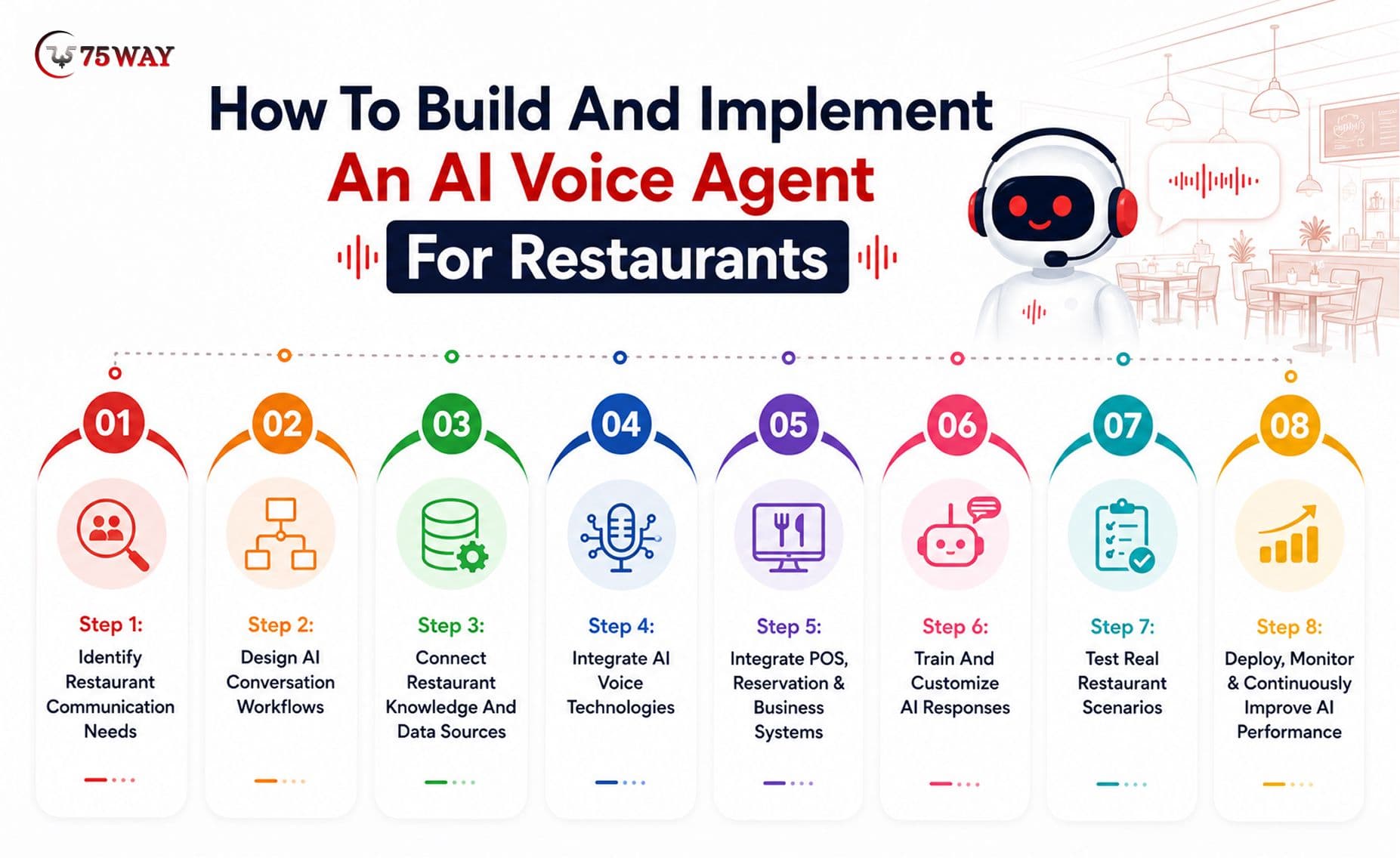
Step 1: Identify Restaurant Communication Needs
The first step is understanding where phone conversations create challenges for the restaurant team. Businesses need to identify common customer requests, peak calling hours, missed opportunities, and repetitive tasks that can be automated. This helps define the AI voice agent’s role and ensures it solves real operational problems.
- Common customer questions
- Reservation handling process
- Order-taking requirements
- Peak call volumes
- Staff workload challenges
- Customer service expectations
Step 2: Design AI Conversation Workflows
Once the restaurant’s needs are clear, the next step is designing how conversations should flow. The goal is to create natural interactions where customers can ask questions, place orders, make bookings, or request support without feeling like they are speaking with a machine.
The workflow defines how the AI responds in different situations, including greetings, follow-up questions, confirmations, and escalation when human assistance is required.
Conversation Elements Include:
- Customer greetings
- Order conversations
- Reservation discussions
- Menu recommendations
- Complaint handling
- Human transfer scenarios
Step 3: Connect Restaurant Knowledge And Data Sources
An AI voice agent needs accurate restaurant information to provide helpful responses. This stage involves connecting essential business data such as menus, pricing, operating hours, locations, offers, and policies. With access to updated information, the AI can answer customer questions confidently and provide restaurant-specific assistance.
Common Data Sources:
- Digital menus
- Restaurant websites
- Pricing information
- Allergen details
- Business policies
- Location information
Step 4: Integrate AI Voice Technologies
This stage brings the voice experience to life by combining speech recognition, language understanding, and voice generation technologies. The system learns how to listen, understand customer requests, process information, and respond naturally through realistic conversations.
The right voice technology selection impacts response speed, accuracy, and overall customer experience.
- Speech-to-text conversion
- Natural language processing
- Large language models
- Text-to-speech generation
- Voice personalization
Step 5: Integrate POS, Reservation & Business Systems
A restaurant AI voice agent becomes more powerful when connected with existing business systems. These integrations allow the agent to check table availability, send orders directly to kitchen systems, access customer history, and keep operations synchronized.
Instead of acting as a separate tool, the AI becomes part of the restaurant’s daily workflow.
- POS systems
- Reservation platforms
- Online ordering systems
- CRM software
- Payment solutions
- Delivery platforms
Step 6: Train And Customize AI Responses
Every restaurant has a unique brand personality and service style. During this stage, the AI is customized with specific conversation guidelines, menu knowledge, tone preferences, and response patterns that match the restaurant’s expectations.
Continuous refinement helps the system handle different customer situations more effectively over time.
Customization Areas Include:
- Brand voice
- Menu recommendations
- Customer service tone
- Promotional offers
- Special requests
- Response rules
Step 7: Test Real Restaurant Scenarios
Before launching publicly, the AI voice agent needs extensive testing with realistic customer situations. Teams simulate different conversations to identify misunderstandings, improve responses, and confirm that integrations work properly.
Testing helps create smoother interactions before real customers start using the system.
- Order modifications
- Reservation changes
- Customer complaints
- Multiple language conversations
- High call volumes
- Complex customer requests
Step 8: Deploy, Monitor & Continuously Improve AI Performance
Launching the AI voice agent is the beginning of ongoing improvement. Restaurants need to monitor conversations, customer satisfaction, response accuracy, and operational performance after deployment. These insights help refine workflows, update information, and improve the overall customer experience.
Regular optimization allows the AI system to adapt as restaurant needs and customer expectations change. Performance metrics to track:
- Call completion rates
- Customer satisfaction
- Order accuracy
- Response time
- Missed call reduction
- Customer feedback
Technology Stack Behind Restaurant AI Voice Agents
Great voice experiences are powered by the right combination of AI, cloud, and communication technologies. Below are the essential components that enable restaurant voice agents to deliver fast, accurate, and human-like interactions.
1. Voice Recognition And Processing
Voice technologies allow AI agents to understand customer conversations, convert speech into text, and generate natural-sounding responses. These systems are responsible for handling different accents, background noise, and real-time communication.
Common Technologies: Whisper, Google Speech-to-Text, Azure Speech Services
These tools help restaurants create smoother voice interactions by improving speech accuracy and enabling multilingual communication.
2. AI Language Model
Large language models power the intelligence behind restaurant voice agents. They help understand customer intent, answer questions, manage conversations, and provide personalized responses based on restaurant information.
Common Technologies: OpenAI GPT Series, Anthropic Claude, Google Gemini, Llama
AI models allow voice agents to handle complex conversations such as menu recommendations, order modifications, reservation requests, and customer inquiries.
3. Backend Development
The backend manages business operations, user requests, integrations, authentication, and communication between different systems. A strong backend architecture helps AI voice agents process multiple customer interactions simultaneously.
Common Technologies: Node.js, Python (FastAPI, Django), .NET
These technologies support scalable APIs, real-time processing, and seamless connections with restaurant management systems.
4. Database And Data Management Layer
Databases store important restaurant information, including menu details, customer preferences, order history, reservation records, and operational data. Proper data management allows AI agents to provide accurate responses.
Common Technologies: PostgreSQL, MongoDB, MySQL
These databases help maintain structured information while supporting fast access during customer conversations.
5. Restaurant System Integrations
AI voice agents become more valuable when connected with existing restaurant tools. Integrations allow the system to complete actions instead of only answering questions.
Common Integrations:
- POS systems
- Reservation platforms
- Delivery applications
- CRM software
- Payment gateways
- Inventory management systems
These connections help restaurants automate complete workflows from customer requests to final order processing.
6. Cloud Infrastructure
Cloud platforms provide the computing power needed to run AI models, store data, manage traffic, and maintain high availability. Scalable infrastructure becomes especially important for restaurant chains handling thousands of customer interactions.
Common Technologies: AWS, Microsoft Azure, Google Cloud Platform
Cloud services support reliable performance, automatic scaling, monitoring, and secure data management.
Key Features of An AI Voice Agent For Restaurants
A successful AI voice agent does more than answer incoming calls. It helps restaurants manage daily customer interactions with speed and accuracy. From handling reservations and processing orders to answering customer questions instantly, the right features determine how effectively the system supports restaurant operations. Below are the key capabilities that make an AI voice agent valuable for modern restaurants.
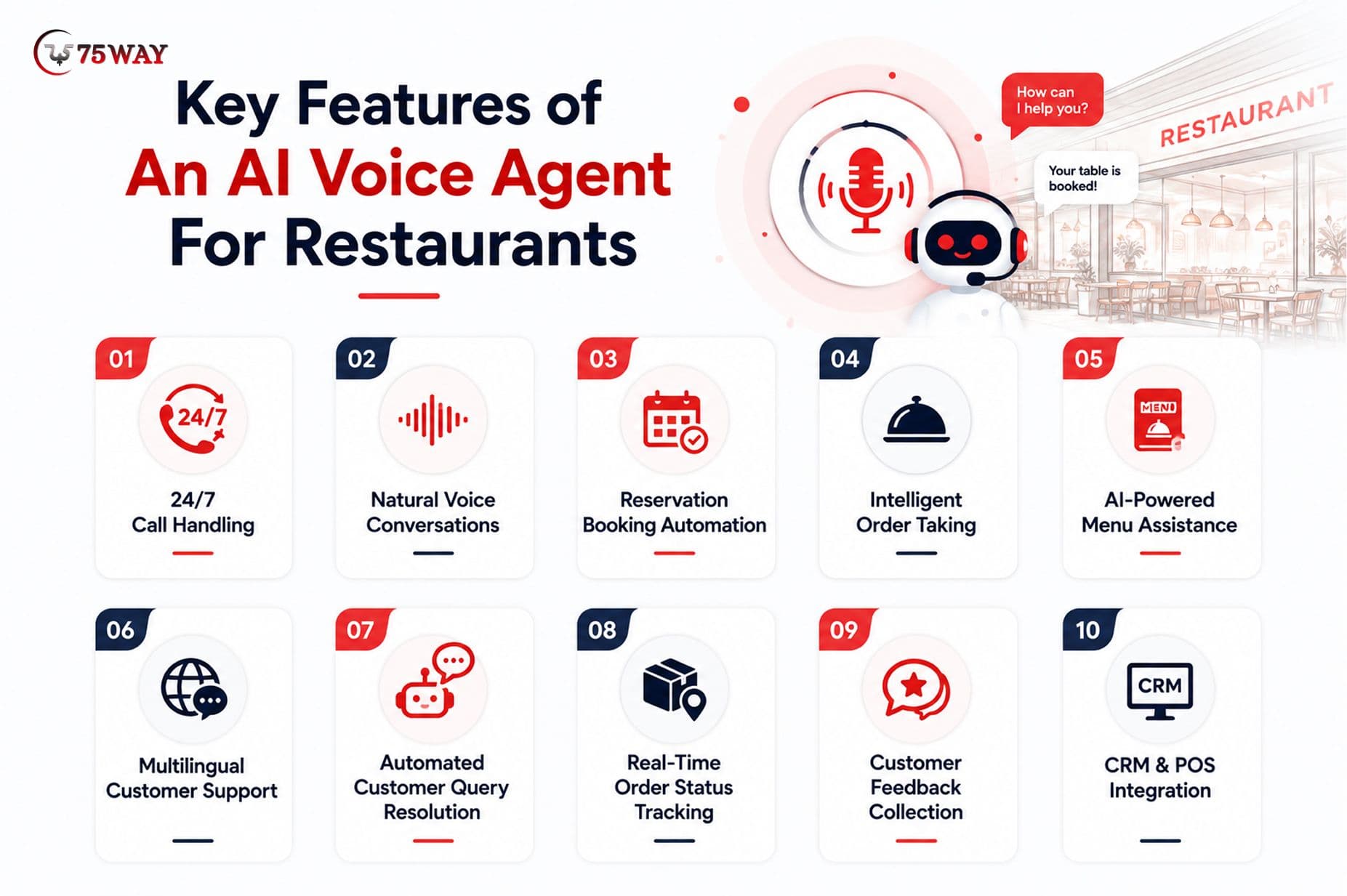
- 24/7 Call Handling: Restaurant calls do not follow business hours, and missed calls can mean lost revenue. An AI voice agent keeps conversations active around the clock by answering customer questions, taking reservations, and handling orders even during busy periods or after closing hours.
- Natural Voice Conversations: Customers prefer conversations that feel simple and human rather than navigating complicated phone menus. Advanced voice technology understands natural speech, follows customer requests, and responds smoothly to create a more comfortable calling experience.
- Reservation Booking: Managing table bookings manually can become challenging during busy hours. The AI voice agent handles reservations by checking availability, collecting guest details, confirming bookings, processing changes, and managing cancellations without creating extra work for restaurant staff.
- Order Taking: Phone orders often require attention to multiple details, from menu choices to special requests. The AI assistant guides customers through selections, captures customizations, confirms order details, and helps create accurate orders before sending them to the right system.
- Menu Assistance: Customers frequently need help deciding what to order or understanding menu options. The AI voice agent provides instant information about ingredients, pricing, allergens, dietary preferences, and recommendations using the restaurant’s latest menu data.
- Multilingual Support: Restaurants serving customers from different language backgrounds can create more welcoming experiences with multilingual conversations. The AI voice agent communicates in multiple languages, helping guests place orders, make reservations, and receive assistance in their preferred language.
- Customer Query Resolution: Guests often contact restaurants with quick questions before visiting or ordering. The AI voice agent provides immediate answers about opening hours, locations, parking details, delivery services, and special offers, allowing staff to focus on serving customers inside the restaurant.
- Order Status Tracking: Customers appreciate knowing when their food will arrive or be ready for pickup. The AI voice agent connects with ordering systems to provide real-time updates about preparation stages, delivery progress, and estimated completion times without requiring staff assistance.
- Customer Feedback Collection: Customer opinions help restaurants identify what works well and where improvements are needed. The AI voice agent collects feedback after orders or visits, gathers ratings, understands concerns, and turns customer experiences into valuable insights for improving service quality.
- CRM And POS Integration: A restaurant’s AI voice agent becomes more powerful when connected with existing business systems. Integration with POS, CRM, and reservation platforms keeps customer information synchronized, streamlines operations, and helps teams deliver faster and more personalized service.
Know More:How AI Voice Agents Are Revolutionizing Customer Interaction in 2026?
How Voice AI Agents for Restaurants Work Behind The Scenes?
An AI voice agent combines multiple technologies to understand customer requests, process information, and deliver human-like responses. Behind every conversation, several AI components work together to create a smooth interaction between customers and restaurants.
1. Customer Voice Input
The process begins when a customer speaks on the phone. The system captures the audio and prepares it for AI processing.
2. Speech Recognition
Speech recognition technology converts spoken words into text, allowing the AI system to understand customer requests accurately.
3. AI Processing Engine
The AI model analyzes the conversation, identifies customer intent, remembers context, and determines the appropriate response or action.
4. Restaurant Knowledge Base
The system accesses restaurant-specific information, including menus, pricing, operating hours, reservation rules, and policies.
5. Business System Integration
The AI connects with POS systems, reservation platforms, CRM tools, and ordering software to complete real-world tasks.
6. Voice Response Generation
The system converts the generated response back into natural speech, allowing customers to continue a seamless conversation with the AI agent.
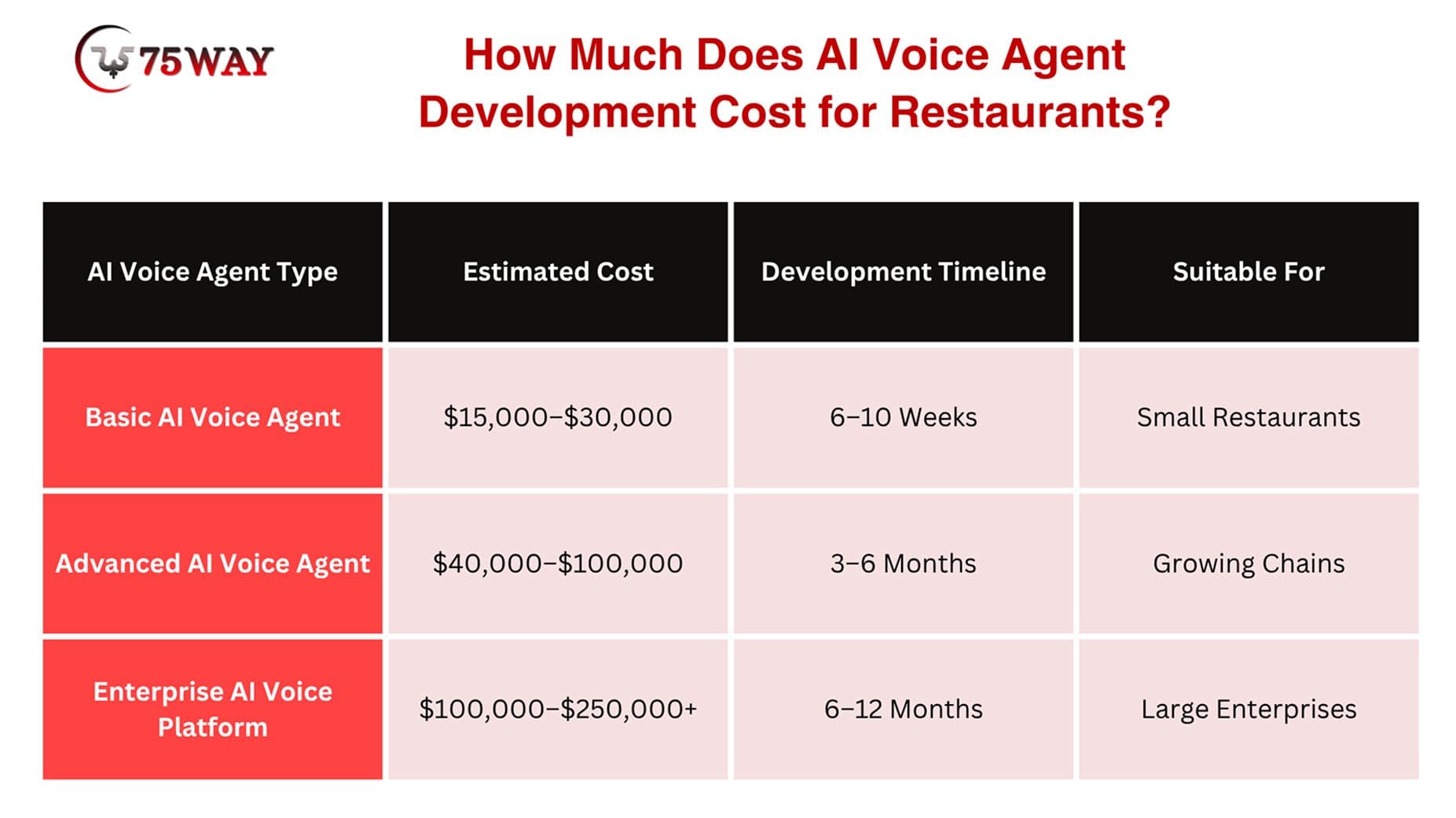
How Much Does AI Voice Agent Development Cost for Restaurants?
The cost of developing an AI voice agent for restaurants depends on automation complexity, integrations, voice capabilities, AI model selection, and customization requirements. A simple calling assistant requires less investment, while large restaurant chains need advanced workflows, multi-location management, and enterprise-level integrations.
Quick Read: What Is the Cost To Build an AI Agent in 2026?
Factors Affecting Restaurant AI Voice Agent Development Cost in 2026
The investment required to build an AI voice agent varies depending on the restaurant’s automation goals, technical requirements, and expected user volume. A simple call-answering assistant and an enterprise-grade ordering platform require different levels of AI capabilities, integrations, and infrastructure.
- AI Model And Voice Technology Selection: The choice of AI models, speech recognition systems, and voice generation technologies directly impacts development and operational costs. Advanced models with better reasoning, multilingual support, and natural conversations may require higher infrastructure spending but deliver improved customer interactions.
- Feature Complexity: The number of features included in the AI voice agent influences development time and budget. Basic call handling requires fewer resources, while advanced capabilities such as automated ordering, reservation management, customer personalization, and analytics require additional development effort.
- Restaurant System Integrations: Connecting the AI voice agent with existing restaurant software increases project complexity. Integrations with POS systems, reservation platforms, payment gateways, delivery applications, and CRM tools require additional development, testing, and maintenance.
- Custom AI Training And Knowledge Base: Restaurants with large menus, multiple locations, or unique service processes may require customized AI training. Preparing restaurant data, organizing knowledge sources, and creating accurate response systems can increase initial development investment.
- Number of Languages Supported: Multilingual voice agents require additional speech models, language processing capabilities, and testing. Restaurants serving diverse customer groups may invest more to provide smooth conversations across multiple languages.
- Security And Compliance Requirements: Restaurants handling customer information and payment-related data need strong security practices. Encryption, access controls, monitoring systems, and compliance requirements can influence overall development costs.
- Maintenance And AI Optimization: AI voice agents require ongoing improvements after launch. Regular updates, performance monitoring, AI response optimization, and system enhancements help maintain accuracy and reliability as restaurant operations evolve.
Restaurant AI Voice Agent Use Cases Across Cafes & Dining Businesses
Different restaurant businesses can use AI voice agents based on their customer communication needs, operational challenges, and service models. From independent restaurants to large chains, voice automation helps improve customer interactions and streamline daily operations.
1. Quick Service Restaurants (QSRs)
Quick-service restaurants handle large volumes of orders and customer inquiries every day. AI voice agents help automate phone ordering, provide menu details, answer common questions, and reduce pressure on employees during rush hours.
- Burger restaurants
- Pizza chains
- Fast-food outlets
- Drive-through businesses
2. Fine Dining Restaurants
Fine dining businesses focus heavily on personalized customer experiences. AI voice agents help manage reservations, collect guest preferences, handle special requests, and provide detailed information about menus and services.
- Luxury restaurants
- Chef-owned restaurants
- Hotel dining establishments
3. Food Delivery Businesses
Delivery-focused restaurants receive frequent calls about order status, menu options, delivery times, and modifications. AI voice agents automate these conversations while helping customers receive faster responses.
- Cloud kitchens
- Online food brands
- Delivery-only restaurants
4. Restaurant Chains And Franchises
Multi-location restaurant brands require consistent customer service across different branches. AI voice agents provide centralized communication management while allowing individual locations to maintain customized menus, availability, and operational details.
- National restaurant brands
- Franchise networks
- Multi-location hospitality groups
Read Too:AI Voice Agent for Real Estate: Automate Property Inquiries 24/7
Major Benefits of Using AI Voice Agents in Restaurants
AI voice agents help restaurants improve customer interactions while making daily operations easier for staff. By handling repetitive phone tasks, answering customer requests, and supporting business workflows, these intelligent assistants allow restaurant teams to deliver faster service, reduce pressure, and create more opportunities for growth.
- Capture More Customer Opportunities
Every unanswered call can represent a missed order, reservation, or potential customer. AI voice agents respond instantly during busy hours, on weekends, and after closing time, helping restaurants stay connected with guests and capture opportunities that might otherwise be lost.
- Improve Order Accuracy
Small mistakes during phone orders can lead to incorrect meals and unhappy customers. AI voice agents carefully collect order details, confirm selections, understand custom requests, and reduce misunderstandings before sending orders for preparation.
- Reduce Operational Pressure
Restaurant employees often handle multiple tasks at once, especially during peak hours. By managing calls, FAQs, and basic requests, AI voice agents reduce repetitive workloads and allow staff to spend more time creating better in-person dining experiences.
- Provide 24/7 Customer Support
Customers do not always contact restaurants during regular operating hours. AI voice agents remain available throughout the day and night, helping guests with reservations, menu questions, order updates, and other common requests whenever they need assistance.
- Increase Revenue Opportunities
AI voice agents can do more than answer calls. They can help drive additional sales. By suggesting popular dishes, highlighting promotions, recommending add-ons, and guiding customers through choices, they create more opportunities to increase order value.
- Deliver Consistent Customer Experiences
Customer service quality should not depend on call volume or employee availability. AI voice agents provide quick and consistent responses across every interaction, helping restaurants maintain reliable service standards whether they manage one location or multiple branches.
Challenges of Implementing AI Voice Agents In Restaurants
AI voice agents can transform restaurant operations, but successful implementation requires thoughtful planning. Understanding common challenges early helps businesses build a solution that delivers smooth customer experiences while supporting day-to-day operations.
- Understanding Different Customer Conversations
Every customer communicates differently. Some speak quickly, change their minds midway, or use informal language, making conversations difficult for a poorly trained AI to interpret accurately.
How To Overcome: Train the AI using real restaurant conversations, include multiple conversation paths, and regularly improve responses based on customer interactions.
- Maintaining Accurate Restaurant Information
Menus, pricing, operating hours, promotions, and item availability often change. If the AI relies on outdated information, customers may receive incorrect answers that lead to confusion or disappointment.
How To Overcome: Connect the AI with your menu management or POS system so updates are reflected automatically, and review business information regularly.
- Handling Complex Requests
Not every customer interaction can be handled through automation. Special celebrations, complaints, refunds, or unique dietary requests often require empathy and human decision-making.
How To Overcome: Allow the AI to recognize complex situations and transfer the conversation to a staff member without making customers repeat their requests.
- Managing Background Noise
Restaurant kitchens, dining areas, and busy streets can create background noise that affects speech recognition during phone conversations.
How To Overcome: Use advanced voice recognition technology, noise reduction capabilities, and test the system in real restaurant environments before launch.
- Customer Acceptance
Some customers still prefer speaking directly with restaurant staff, especially when making special requests or discussing important reservations.
How To Overcome: Keep conversations natural, introduce the AI clearly at the beginning of each call, and provide an easy option to connect with a human whenever needed.
- Integration Complexity
Connecting the AI with POS systems, reservation software, delivery platforms, and CRM tools can become challenging if existing systems are outdated or incompatible.
How To Overcome: Use well-documented APIs, work with experienced integration specialists, and thoroughly test every connected system before going live to prevent operational issues.
Read More:Top 10 AI Voice Agents Transforming Business Communication
What's Next for AI Voice Agents in Restaurant Operations? Future Trends & Beyond
The role of AI voice agents in restaurants will continue expanding as conversational AI becomes more advanced. Future systems will move beyond answering calls and become intelligent customer engagement platforms capable of improving every stage of the dining journey.
- Predictive Ordering Assistance
Future voice AI agents will analyze customer preferences and previous orders to provide personalized recommendations before customers complete their selections.
- Voice-Based Loyalty Programs
Restaurants will use AI voice agents to manage loyalty rewards, personalized offers, membership benefits, and customer retention campaigns through natural conversations.
- Advanced Multilingual Experiences
AI voice agents will support more languages and regional accents, allowing restaurants to serve wider customer communities without additional staffing requirements.
- AI-Powered Customer Insights
Voice interactions will generate valuable insights about customer preferences, frequently requested items, and service improvement opportunities while maintaining appropriate privacy controls.
- Fully Automated Restaurant Communication
Future AI systems may manage reservations, ordering, feedback collection, marketing communication, and customer engagement through one unified voice-based platform.
How 75way Helps You Build & Launch An AI Voice Agent For Restaurants
Building an AI voice agent requires more than integrating speech technology into a restaurant's phone system. At 75way Technologies, we work closely with restaurant owners, cloud kitchens, franchise chains, and food service businesses to understand their operational challenges, customer journey, and business goals before designing a solution that fits their workflow.
Our team manages the complete voice AI agent development lifecycle, from product strategy and conversation design to AI integration, POS connectivity, reservation management, testing, deployment, and post-launch optimization. Every solution is tailored to your menu, ordering process, brand voice, and existing technology stack, helping deliver a seamless experience for both customers and staff.
For businesses looking to launch faster, Talkoo.ai, our AI voice automation platform, helps automate phone orders, table reservations, customer inquiries, order status updates, and other routine restaurant conversations while allowing your team to focus on delivering exceptional dining experiences.
Explore More:Best AI Voice Agent Development Agencies You Can Trust
Final Thoughts
To conclude, AI voice agents are changing how restaurants manage customer interactions by automating reservations, phone orders, menu inquiries, and routine support without compromising service quality. When implemented with the right strategy, they reduce staff workload, improve response times, increase order accuracy, and create better customer experiences around the clock. As restaurants continue embracing digital transformation, AI voice automation offers a practical way to improve efficiency, increase revenue opportunities, and deliver consistent service that keeps customers coming back for more. Partner with a reliable AI voice agent development company to build a custom voice solution for your restaurant.
Frequently Asked Questions (FAQs)
Can AI Voice Agents Handle Multiple Restaurant Locations?
Yes, AI voice agents can manage calls for multiple restaurant locations from a single platform. They automatically identify the correct branch based on customer preferences or location.
Can Restaurant AI Voice Agents Remember Returning Customers?
Yes, they can access previous interactions, reservations, and order history when integrated with CRM systems. This enables more personalized conversations and faster customer service.
Can Restaurants Update Menus Without Rebuilding The AI?
Yes, menu information can be updated through connected databases or content management systems. The AI automatically uses the latest menu details during customer conversations.
Do AI Voice Agents for Restaurants Support Seasonal Promotions?
Yes, restaurants can configure AI voice agents to promote limited-time offers and seasonal menus. The system automatically mentions active promotions during relevant customer interactions.
Can AI Voice Agents Collect Customer Feedback?
Yes, AI voice agents can request customer feedback after reservations, deliveries, or completed orders. Responses are stored for reporting and service improvement analysis.
Can AI Voice Agents Answer Allergy And Dietary Questions?
Yes, they can provide ingredient information, allergen details, and dietary options using restaurant-approved data. This helps customers make informed ordering decisions with greater confidence.
How Long Does It Take To Build An AI Voice Agent For Restaurants?
Development usually takes 6–16 weeks, depending on features, integrations, and customization requirements. Enterprise solutions with advanced workflows generally require longer implementation timelines.
Can AI Voice Agents Work Alongside Restaurant Staff?
Yes, AI voice agents complement employees by handling repetitive customer conversations and routine tasks. Staff can then dedicate more attention to in-person guests and complex requests.