Summary
AI voice agents are changing customer interaction by enabling real-time, human-like communication across phone and digital channels. Businesses use them to automate support, improve engagement, and increase efficiency. This guide explains how voice AI enhances customer experience, reduces operational costs, and helps companies scale communication without increasing human workload.
Quick Overview
- AI voice agents automate customer communication across multiple business interaction channels
- Businesses reduce support costs while improving customer experience and engagement quality
- Real-time voice interaction improves response speed and operational efficiency significantly
- AI enhances sales conversion through intelligent conversational engagement systems
- Scalable voice automation supports business growth without increasing human teams
Customer interaction is no longer limited to human conversations or traditional call centers. In 2026, every conversation between a business and its customers will be faster, smarter, and more automated.
Customers expect instant responses, natural conversations, and seamless support without waiting on long queues or repeating information across channels. Traditional systems struggle to meet this demand at scale.
This gap has led to the rise of intelligent voice systems that can understand, respond, and act like human agents while operating at machine-level efficiency. AI voice agents are now becoming the core communication layer for modern businesses, reshaping how companies handle support, sales, and engagement.
This guide delineates how AI voice agents are revolutionizing customer interaction, improving efficiency, and driving business growth. It also highlights real-world applications and their impact on modern customer engagement strategies.
Why Traditional IVR Or Customer Interaction Are No Longer Effective?
Traditional customer interaction models are struggling to keep up with increasing demand and evolving customer expectations. Systems that rely heavily on human agents and manual handling often face limitations in speed, scalability, and consistency, especially when dealing with high volumes of queries across multiple channels.
These limitations lead to higher operational costs, slower response times, and inconsistent service quality across interactions. As a result, businesses experience reduced customer satisfaction and lower retention rates, which creates pressure to adopt more intelligent, automated communication systems.
What Are AI Voice Agents?
AI voice agents are intelligent systems that use speech recognition, natural language understanding, and machine learning to interact with users in real time. They simulate human-like conversations while processing spoken input and delivering accurate, context-aware responses.
These agentic AI systems go beyond basic automation by handling customer support calls, answering queries, assisting in sales conversations, and performing actions such as booking appointments or processing requests. By operating without continuous human involvement, they improve response speed, reduce workload, and enable scalable customer communication across multiple channels.
How AI Voice Agents Are Transforming Customer Interaction?
AI voice agents change the way businesses communicate with customers by enabling faster, smarter, and more personalized interactions. These conversational AI agent development solutions reduce dependency on human agents, improve response efficiency, and deliver consistent communication across multiple channels. As a result, customer engagement becomes more seamless, scalable, and context-driven in modern business environments.
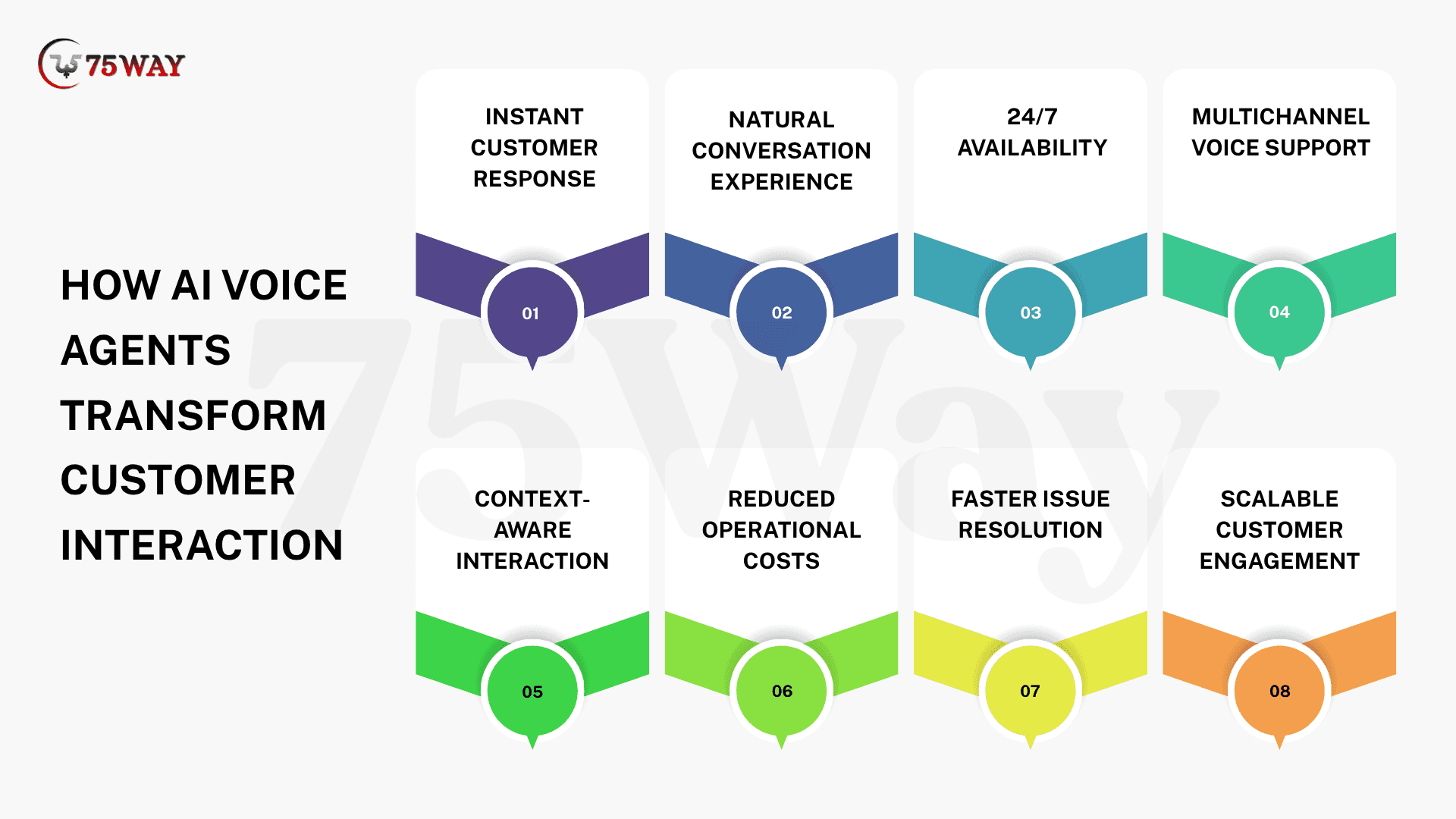
- Instant Customer Response: Eliminate waiting time by processing and responding to customer queries immediately, improving satisfaction and reducing frustration across support interactions.
- Natural Conversation Experience: Create human-like dialogue using advanced language understanding models, making interactions smoother and more intuitive for users across different communication scenarios.
- 24/7 Availability: Operate continuously without breaks, allowing businesses to handle customer queries at any time and improving service reliability across global audiences.
- Multichannel Voice Support: Connect calls, apps, and digital platforms into a unified system, ensuring consistent communication across all customer interaction points.
- Context-Aware Interaction: Remember previous user interactions to deliver more relevant and personalized responses, improving engagement quality and conversation accuracy.
- Reduced Operational Costs: Minimize dependency on large support teams by automating repetitive voice-based tasks, lowering overall customer service expenses for businesses.
- Faster Issue Resolution: Quickly identify customer needs and provide accurate solutions, reducing average handling time and improving overall support efficiency.
- Scalable Customer Engagement: Handle increasing call volumes without performance drops, enabling businesses to scale customer interaction without expanding human resources.
How AI Voice Agents Work? A Complete Architecture
AI voice agents operate through a connected pipeline where each stage depends on the previous one to create smooth, real-time conversational experiences. The system continuously transforms spoken input into structured data, processes meaning, and delivers human-like responses through coordinated layers that ensure accuracy, speed, and contextual understanding.
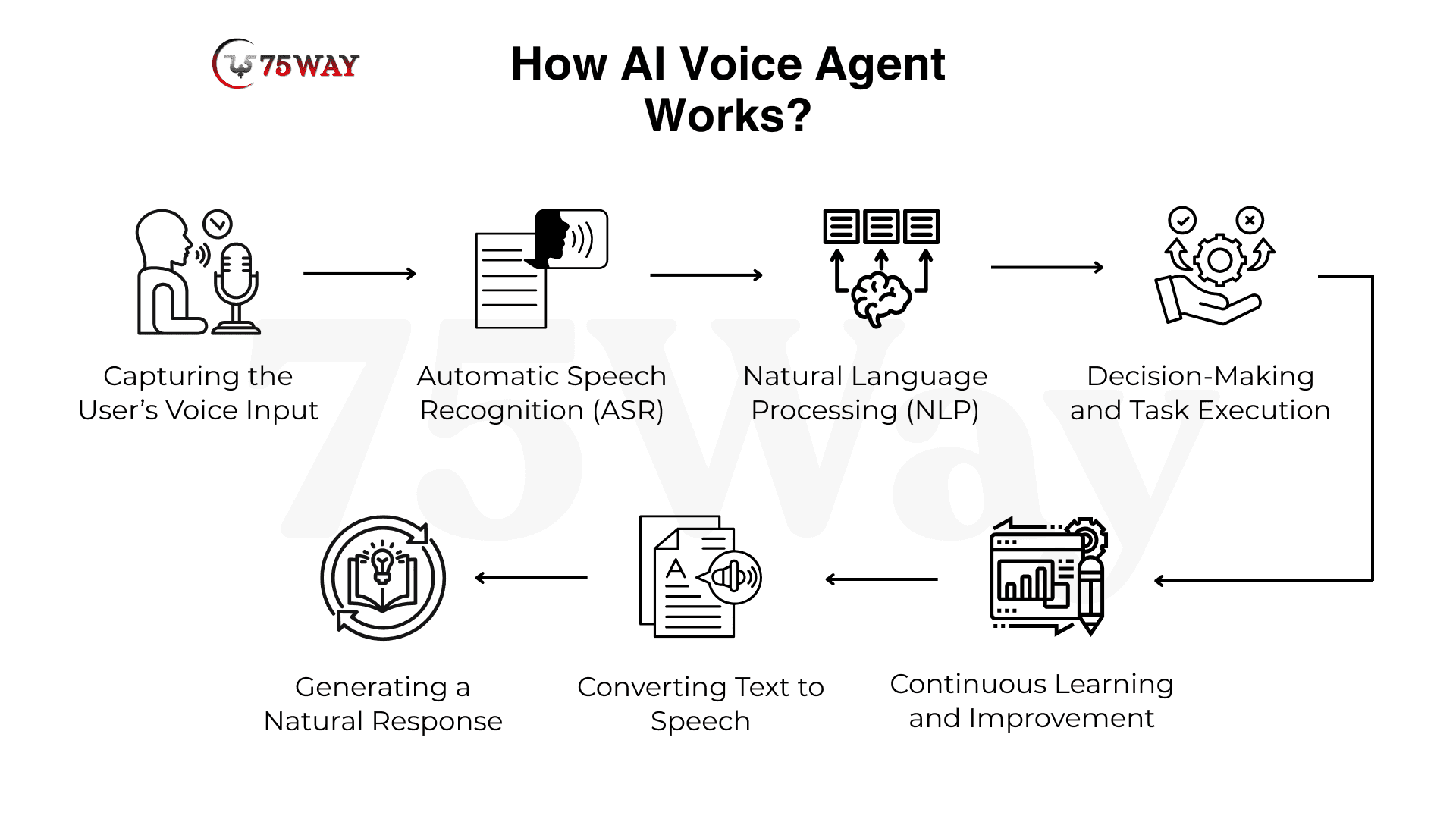
- Speech Input Capture: The interaction begins when spoken language is captured and converted into digital signals, forming the raw input that moves into the processing pipeline for interpretation.
- Language Processing: Once speech is converted, the system organizes and refines the text, breaking it down into structured language that prepares the conversation for deeper analysis.
- Intent Detection: After language structuring, meaning is identified by analyzing user context, keywords, and behavior patterns to determine what action or response is required.
- Response Generation: With intent clearly defined, relevant replies are created using intelligent models that ensure the response aligns with user needs and conversation flow.
- Voice Output Delivery: The final stage converts the generated response into natural speech, completing the loop by delivering information back to the user in real time.
Each layer works together to create real-time conversational intelligence.
Business Impact of AI Voice Agents
AI voice automation is reshaping business communication by improving operational efficiency and reducing reliance on manual customer-handling processes. Businesses experience:
- Lower operational costs
- Faster response cycles
- Higher conversion rates
- Improved customer retention
These improvements collectively enhance revenue generation and support long-term scalability, making voice-driven automation a key driver of modern business growth and customer engagement strategies.
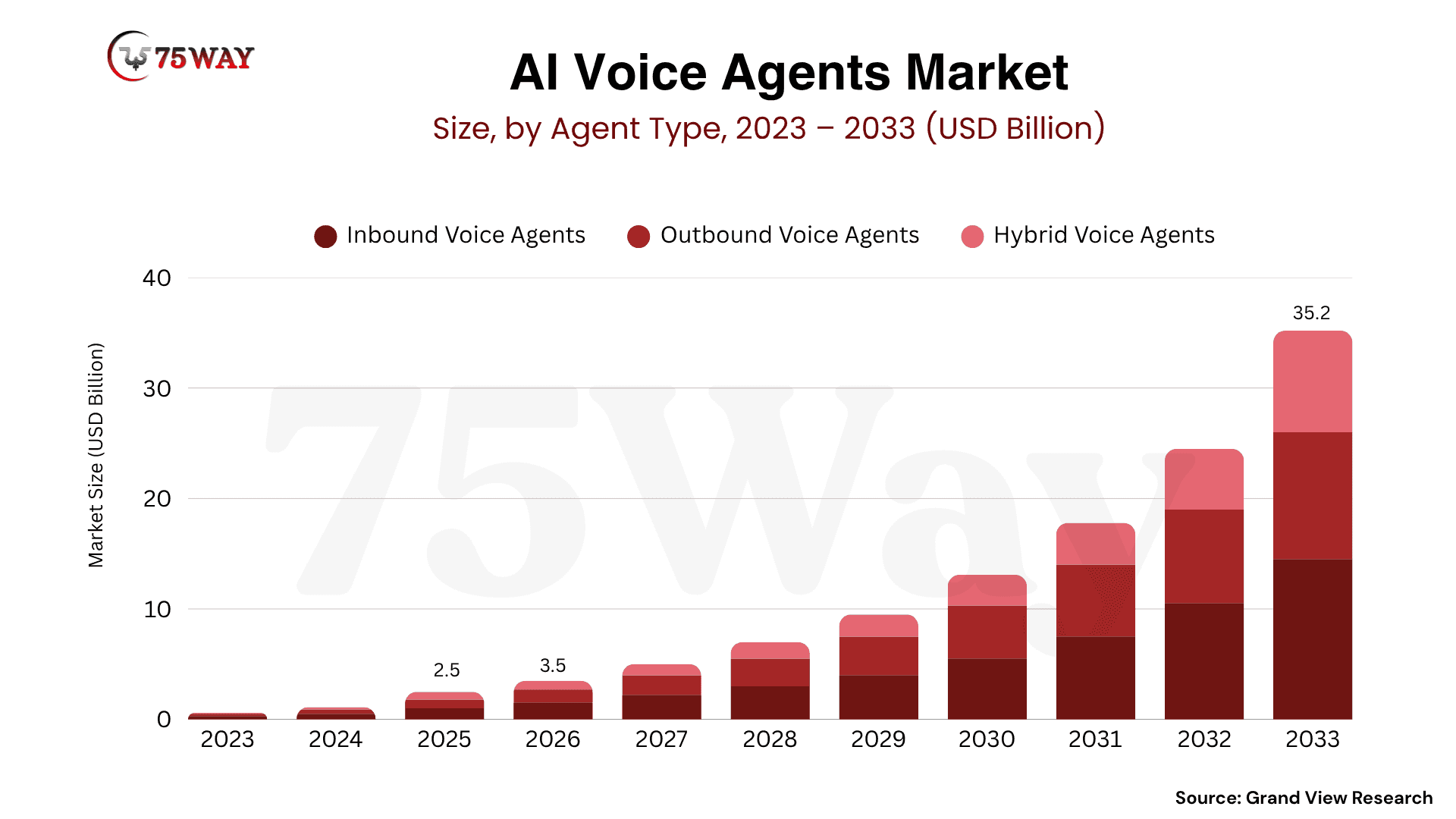
- The global AI voice agents market is projected to reach $35.24 billion by 2033, growing at a CAGR of 39.0%.
- North America holds the largest market share, accounting for 38.1% of global revenue.
- Healthcare is the fastest-growing sector, with AI voice agent applications expected to reach $3.17 billion by 2030.
- Inbound voice agents dominate the market with a 52.1% share, mainly used for customer support automation.
- Around 80% of companies are already using voice agents.
Core Benefits of Adopting AI Voice Agents
Conversational AI assistants are transforming how businesses manage customer communication by introducing automation, speed, and intelligence into every interaction. These systems help organizations reduce manual workload, improve response efficiency, and deliver more personalized experiences at scale. As a result, businesses achieve better performance across customer support, sales, and operational functions.
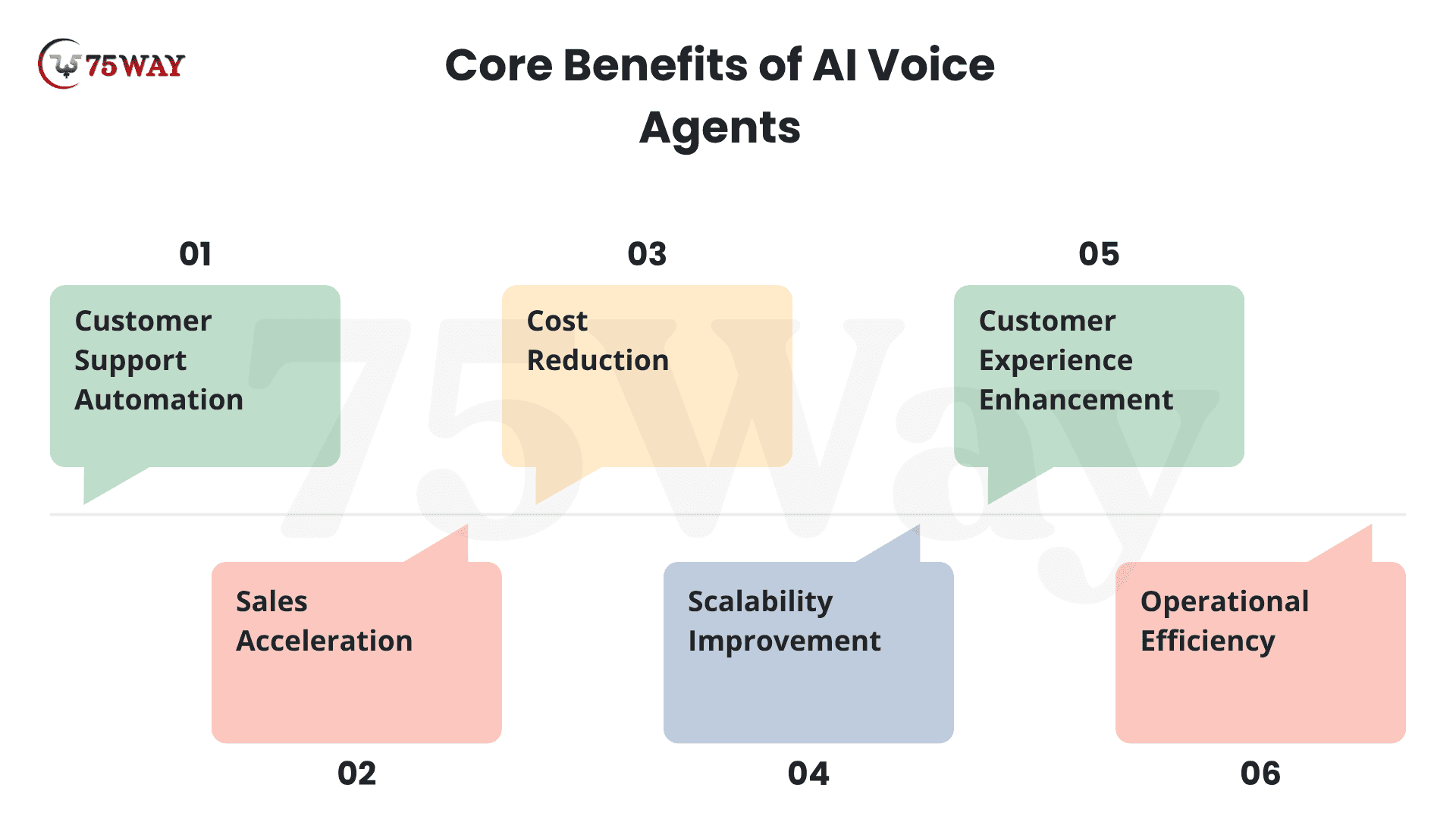
- Customer Support Automation:Customer support AI agents handle high call volumes efficiently without requiring additional support staff or increasing operational workload across customer service teams.
- Sales Acceleration: Engage potential customers instantly during interactions, improving lead conversion rates through timely responses and personalized communication approaches.
- Cost Reduction: Reduce dependency on large call center teams, lowering staffing expenses and decreasing overall customer service operational costs for businesses.
- Scalability Improvement: Allow organizations to manage growing customer interactions smoothly without expanding the human workforce or increasing infrastructure requirements.
- Customer Experience: Deliver faster responses and personalized conversations, improving customer satisfaction levels and strengthening long-term engagement with the brand.
- Operational Efficiency: Streamline repetitive communication tasks and workflow handling, allowing teams to focus on complex issues while improving overall productivity and response coordination across customer interaction systems.
Use Cases of AI Voice Bots Across Industries
AI voice bots are being widely adopted across industries to improve communication, automate routine interactions, and enhance customer engagement. These systems help businesses deliver faster responses, reduce manual workload, and maintain consistent service quality. From healthcare to SaaS, voice-driven automation is reshaping how organizations interact with users at every stage of the customer journey.
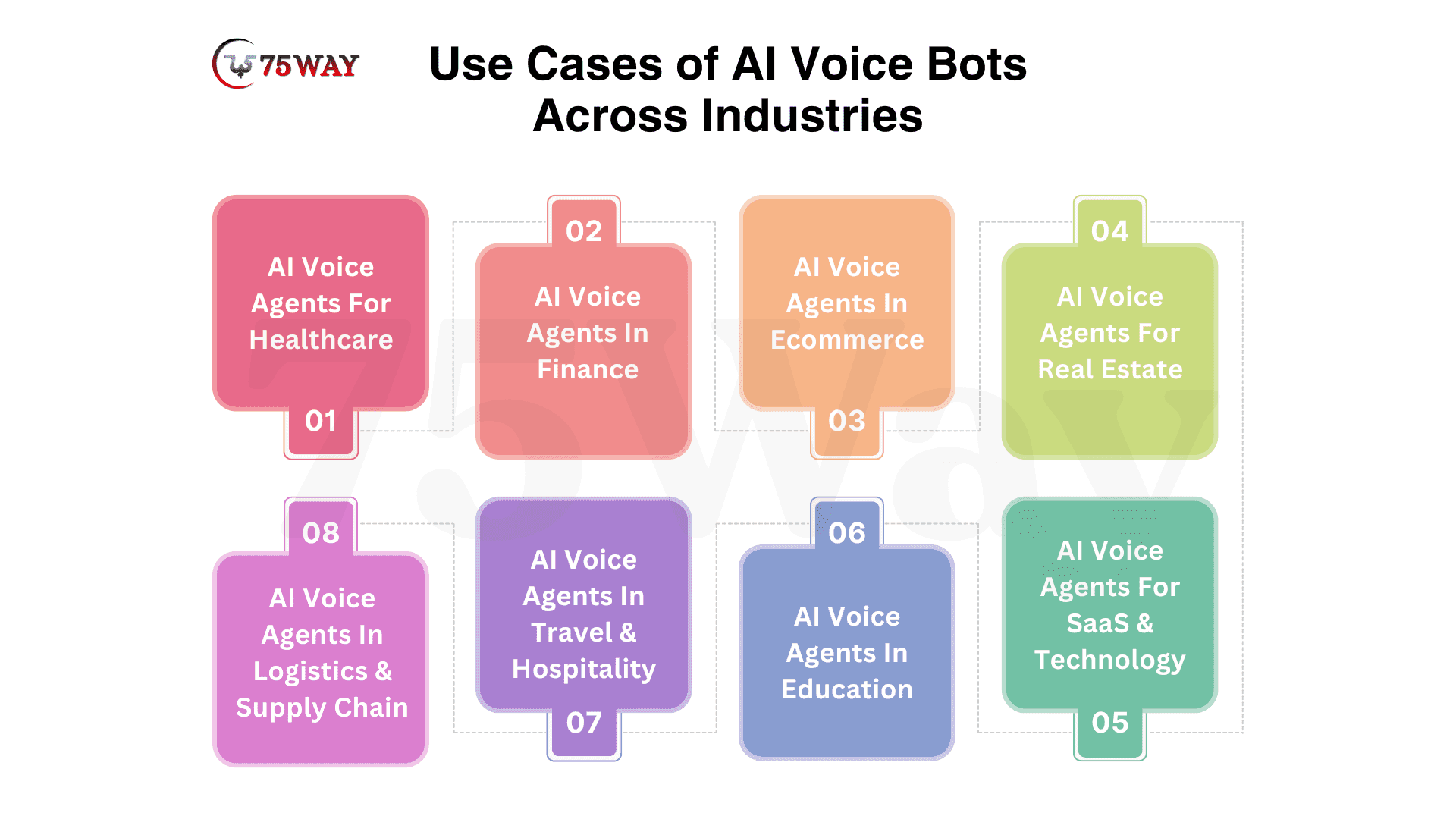
- AI Voice Agents For Healthcare
AI voice agents in healthcare assist in appointment scheduling, send reminders, and support patient communication to improve care coordination and reduce administrative burden across healthcare facilities.
- AI Voice Agents In Finance
Voice AI agents in finance handle account-related queries, provide transaction updates, and deliver fraud alerts to improve customer support efficiency and financial communication accuracy.
- AI Voice Agents In Ecommerce
Voice AI agents in ecommerce support order tracking, answer product-related questions, and offer personalized recommendations to enhance the shopping experience and increase customer satisfaction.
- AI Voice Agents For Real Estate
Conversational AI for real estate manages property inquiries, schedules site visits, and qualifies leads to streamline communication between agents and potential buyers or tenants.
- AI Voice Agents For SaaS & Technology
Assist with user onboarding, resolve technical issues, and improve customer engagement through real-time conversational support across digital platforms.
- AI Voice Agents in Education
Support students with admissions queries, course information, and scheduling assistance to improve communication between institutions and learners while reducing administrative workload.
- AI Voice Agents in Travel & Hospitality
Handle booking confirmations, itinerary updates, and customer inquiries to provide seamless travel experiences and improve service responsiveness across hospitality platforms.
- AI Voice Agents in Logistics & Supply Chain
Assist with shipment tracking, delivery updates, and coordination queries to improve transparency and operational efficiency across logistics networks.
Challenges in the Adoption of Conversational AI Agents
While AI voice agents offer strong operational advantages, businesses face several challenges during implementation. These challenges often relate to technical limitations, system compatibility, regulatory requirements, and user acceptance. Addressing them properly is essential to ensure reliable performance, secure data handling, and smooth integration into existing communication workflows.
- Speech Accuracy Variations: Noisy environments can affect recognition quality, but advanced noise filtering and adaptive speech models improve accuracy in real-world conditions.
- Legacy System Integration: Older communication infrastructure may resist direct integration, which can be resolved using API layers and middleware connectors for seamless connectivity.
- Data Privacy Requirements: Strict compliance standards create challenges, but encryption, access control, and secure data storage help maintain regulatory adherence and trust.
- Domain Training Complexity: Industry-specific conversations require tailored training, which can be addressed using curated datasets and continuous model fine-tuning for accuracy.
- Customer Trust Issues: Users may hesitate to interact with automated systems, but transparent communication and human-like response quality help build confidence over time.
Final Remarks
AI voice agents are redefining how businesses communicate with customers by introducing real-time, intelligent, and scalable interaction systems. They eliminate delays, reduce operational costs, and enhance customer satisfaction through natural and context-aware conversations. As businesses grow, traditional communication systems struggle to keep up with rising demand, making voice automation a necessity rather than an optional upgrade.
Organizations adopting AI voice agents gain a strong competitive advantage through faster response times, improved engagement quality, and consistent service delivery. To implement these capabilities effectively, partnering with a trusted AI voice agent development company can help businesses build scalable conversational systems tailored to their operational needs.
Frequently Asked Questions (FAQs)
How Do AI Voice Agents Learn From Conversations?
AI voice agents learn by analyzing past interactions, user feedback, and conversation patterns to improve accuracy over time. Machine learning models refine responses based on context, helping systems deliver more relevant answers, better intent recognition, and improved conversational flow across repeated interactions.
Can AI Voice Agents Support Multiple Languages?
AI voice agents can support multiple languages using multilingual speech recognition and language processing models. They detect user language automatically or via selection, then respond accordingly. This capability helps businesses serve global customers efficiently while maintaining consistent communication quality across regions.
What Happens When AI Voice Agents Cannot Solve A Query?
When AI voice agents cannot resolve a query, they transfer the interaction to a human agent or support team. This escalation ensures complex or sensitive issues are handled properly while maintaining continuity in customer service without losing conversation context or history.
How Do Businesses Measure AI Voice Agent Performance?
Businesses measure performance using metrics like response accuracy, resolution time, customer satisfaction, and call completion rates. These indicators help evaluate system effectiveness, identify improvement areas, and optimize conversational workflows for better operational and customer engagement outcomes.
Can AI Voice Agents Be Integrated With CRM Systems?
Yes, AI voice agents can integrate with CRM platforms to access customer data, update records, and personalize interactions. This integration enables real-time synchronization of information, improving communication accuracy and allowing businesses to maintain a unified customer experience across channels.
Do AI Voice Agents Improve Sales Conversion Rates?
AI voice agents improve conversion rates by engaging customers instantly, answering product queries, and guiding purchase decisions. Their ability to provide timely responses and personalized recommendations helps reduce drop-offs and increases the likelihood of completing transactions.