Summary
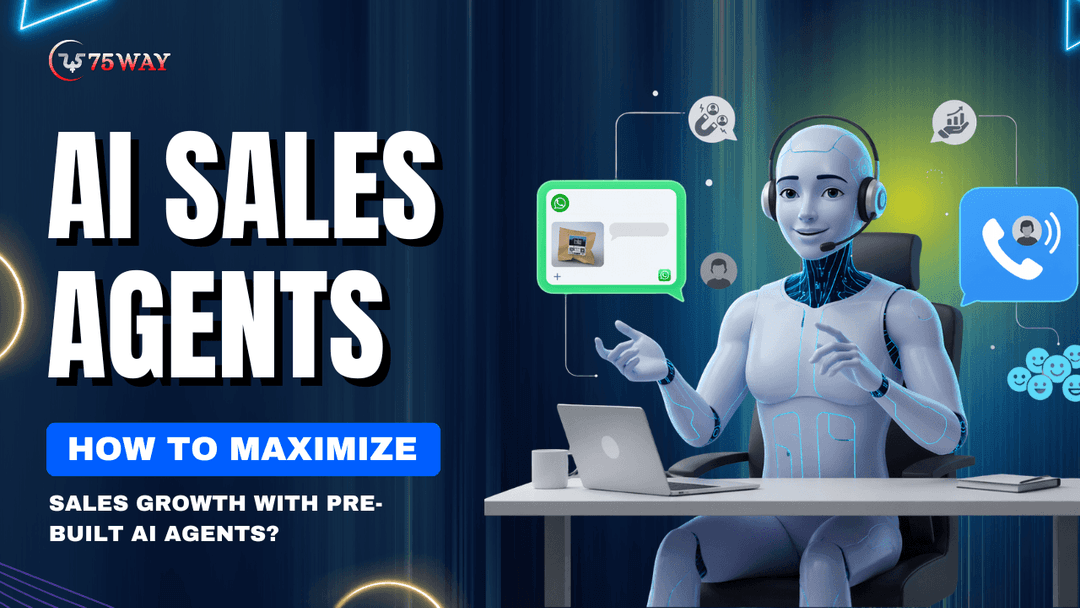
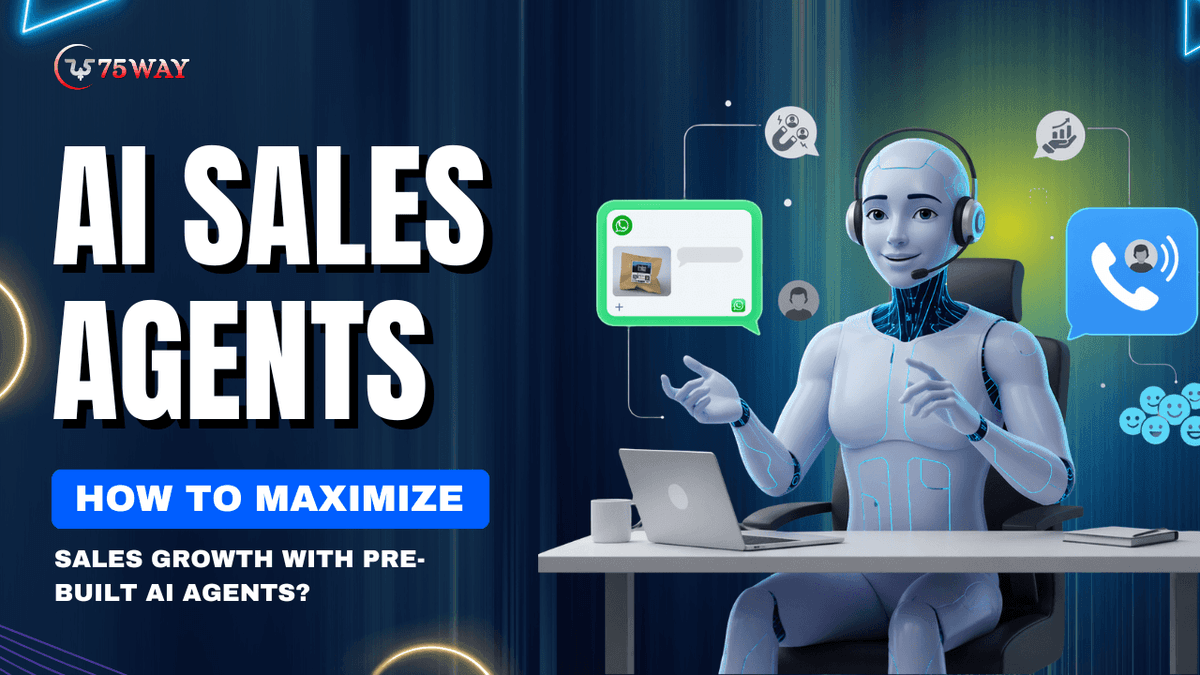
AI sales agents are transforming modern sales operations by automating lead engagement, follow-ups, and conversions. Pre-built AI agents help businesses scale faster without increasing workforce costs. This guide explains how they work, their benefits, implementation strategies, and real-world impact. It also highlights how companies can maximize revenue growth using intelligent AI-driven sales automation systems.
Quick Overview
- AI sales agents automate repetitive sales tasks for faster conversions.
- Pre-built systems reduce deployment time and operational complexity.
- Personalization improves customer engagement and boosts closing rates.
- Businesses scale sales operations without increasing human workforce costs.
- AI-driven insights help optimize decision-making and revenue performance.
Struggling with slow lead response times, missed follow-ups, or low conversion rates even after investing heavily in sales teams and tools?
Many businesses face the challenge of managing growing customer inquiries while maintaining fast, personalized communication across multiple channels. This is where AI sales agents come in.
The AI agents are intelligent, automated systems designed to handle conversations with prospects, manage leads, and support the entire sales process with speed and consistency. Pre-built AI sales agents allow businesses to quickly deploy ready-made automation that improves engagement, streamlines sales pipelines, and increases conversions without adding heavy operational workload.
This guide explains how AI sales agents work, how they improve sales performance, and how businesses can use them effectively to maximize growth.
What Are AI Sales Agents?
AI sales agents are intelligent software systems designed to automate key sales activities, such as lead generation, qualification, nurturing, and conversion. They use machine learning and natural language processing to understand customer queries and respond in a human-like manner. This allows businesses to maintain continuous engagement with prospects without delays or missed opportunities. These systems can work across websites, chat apps, platforms, email, and messaging apps to support the entire sales journey efficiently.
In simple terms, AI sales agents act as digital sales representatives that never stop working. They interact with potential customers 24/7, answer their questions, and guide them through the buying process in a structured and personalized way. By analyzing customer behavior and past interactions, they ensure that each response is relevant, timely, and aligned with the buyer’s intent.
How Does An AI Sales Agent Work?
AI sales agents operate through an intelligent, connected workflow that captures leads, understands intent, engages prospects, and supports conversion in a seamless sales journey. Each stage is linked to the next, ensuring no lead is lost, and every interaction contributes to improving sales outcomes through automation and data-driven decision-making.
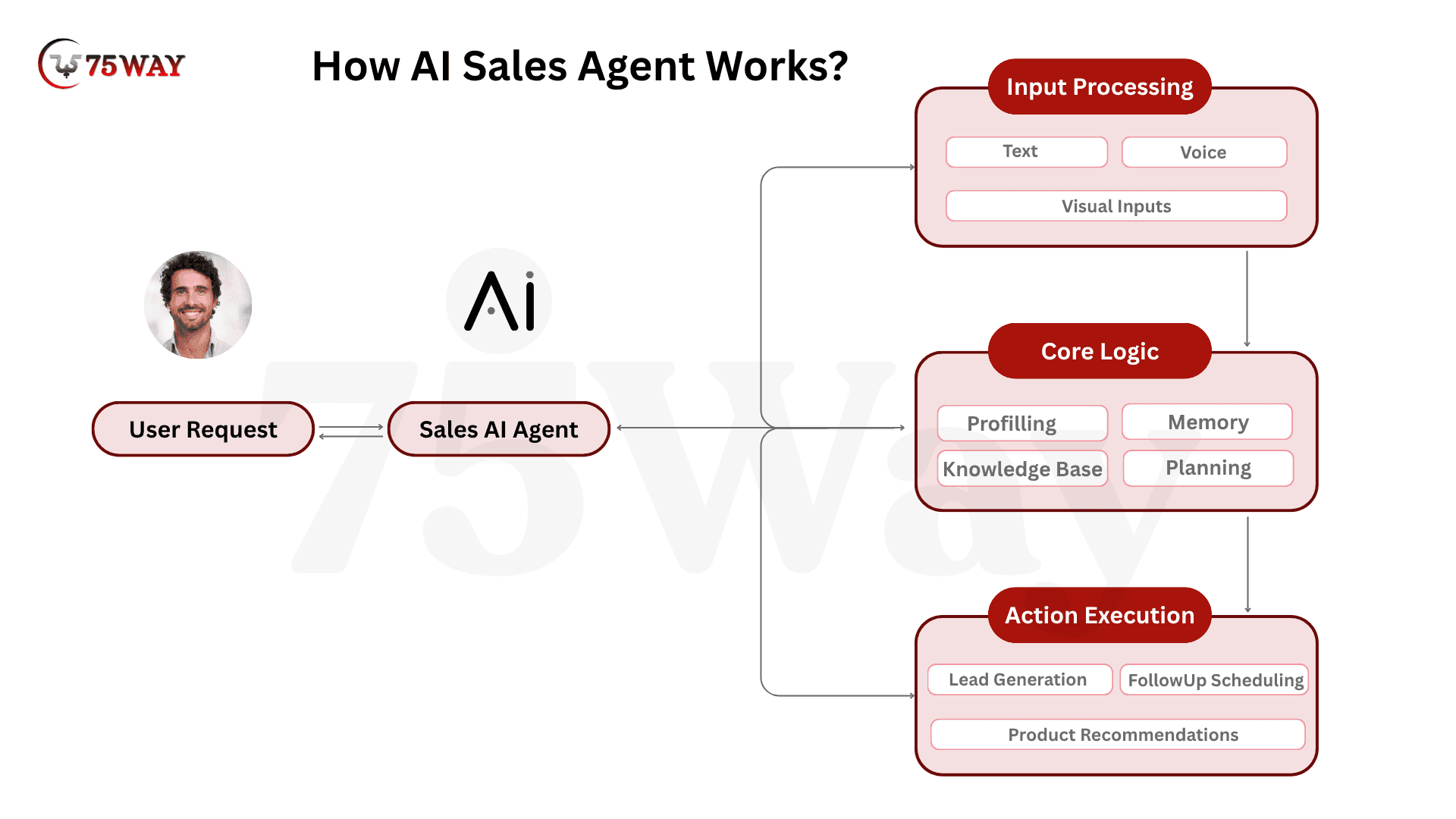
- Lead Data Capture: AI sales agents collect leads from websites, ads, emails, and CRM systems while storing behavioral and contact data for personalized engagement.
- Intent-Based Qualification: Then, the system analyzes user behavior and interaction patterns to understand purchase intent and qualify leads based on their likelihood to convert.
- Real-Time Engagement: AI agents initiate real-time conversations with prospects, providing instant responses, answering queries, and maintaining continuous engagement across multiple digital channels.
- Smart Lead Nurturing: Based on engagement history, AI schedules and sends timely follow-ups that nurture leads progressively and keep them actively moving through the sales funnel.
- Conversion And Handoff: When a lead shows strong buying intent, the AI either completes the conversion process or seamlessly transfers the lead to human sales teams with full context.
Understanding Pre-Built AI Sales Agents
Pre-built AI sales agents are ready-to-use software solutions designed with pre-configured workflows, trained conversational models, and sales automation capabilities. These systems allow businesses to quickly integrate AI into their sales process without having to design or train models from scratch, saving significant time, cost, and technical effort.
Unlike custom-built solutions, pre-built AI sales agents come with tested frameworks that already understand common sales interactions such as lead inquiries, product questions, follow-ups, and objection handling. This makes them immediately functional and highly practical for businesses looking to accelerate their sales automation journey.
Key Features of Pre-Built AI Agents
- Ready-made workflows for sales processes
- Built-in conversational intelligence models
- Easy integration with CRM tools
- Scalable architecture for business growth
How AI Sales Agents Maximize Sales Growth?
AI sales agents significantly improve revenue generation by optimizing every stage of the sales funnel, from lead capture to final conversion. Their automation capabilities ensure consistent engagement and faster response times.
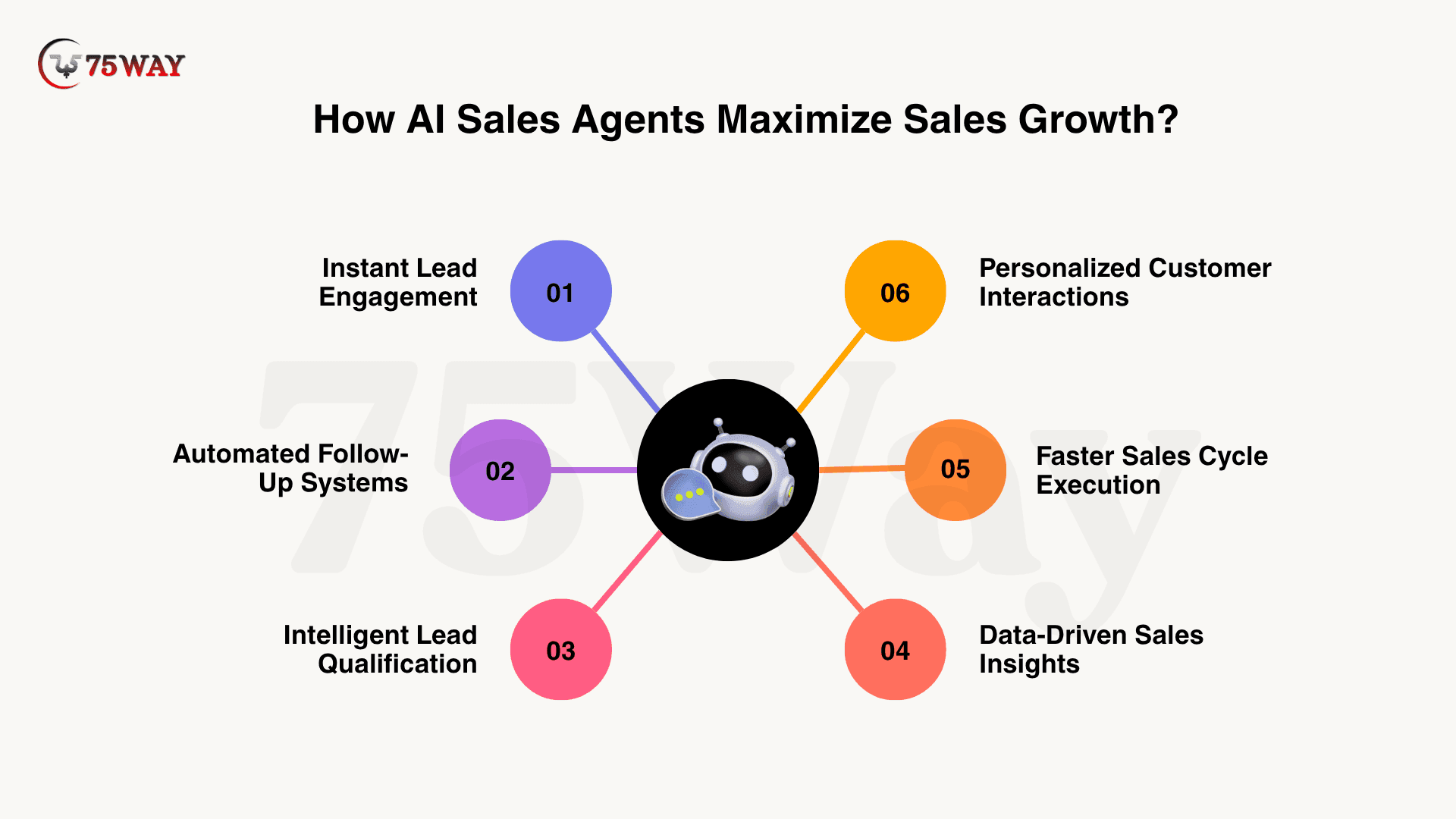
- Instant Lead Engagement: Prospects are engaged immediately upon showing interest, ensuring no opportunities are lost due to delayed response times. This instant interaction creates a smooth starting point, which naturally increases the chances of holding attention and moving the conversation forward effectively.
- Automated Follow-Up Systems: With these sales AI agents, follow-ups continue automatically based on user behavior and engagement level. This continuous communication ensures prospects are not forgotten, helping maintain interest and gradually guiding them toward a purchase decision without manual effort.
- Intelligent Lead Qualification: As engagement continues, customer data and interaction patterns are analyzed to understand purchase intent. This qualification process ensures that only serious prospects are prioritized, creating a smoother transition from interest to opportunity while reducing wasted effort on low-potential leads.
- Personalized Customer Interactions: After lead qualification, conversations become more tailored based on user preferences and past behavior. This personalization strengthens relevance in communication, builds trust over time, and naturally improves the likelihood of conversion through more meaningful interactions.
- Faster Sales Cycle Execution: With engagement, follow-ups, and qualification working together, the entire sales journey becomes more streamlined. Delays are reduced at every stage, allowing prospects to move quickly from initial interest to final purchase decisions with fewer drop-offs.
- Data-Driven Sales Insights: Interaction data is continuously analyzed to identify patterns and improve outcomes. These insights connect all stages together by refining engagement strategies, improving targeting accuracy, and supporting better decision-making for higher revenue growth.
Different Types of AI Sales Agents You Can Develop
AI sales agents can be designed in multiple specialized categories to automate different stages of the sales lifecycle. Each type focuses on a specific business function such as lead scoring, pricing, forecasting, or customer engagement. Together, they help businesses streamline operations, improve accuracy, and increase revenue through structured automation across the entire sales funnel.
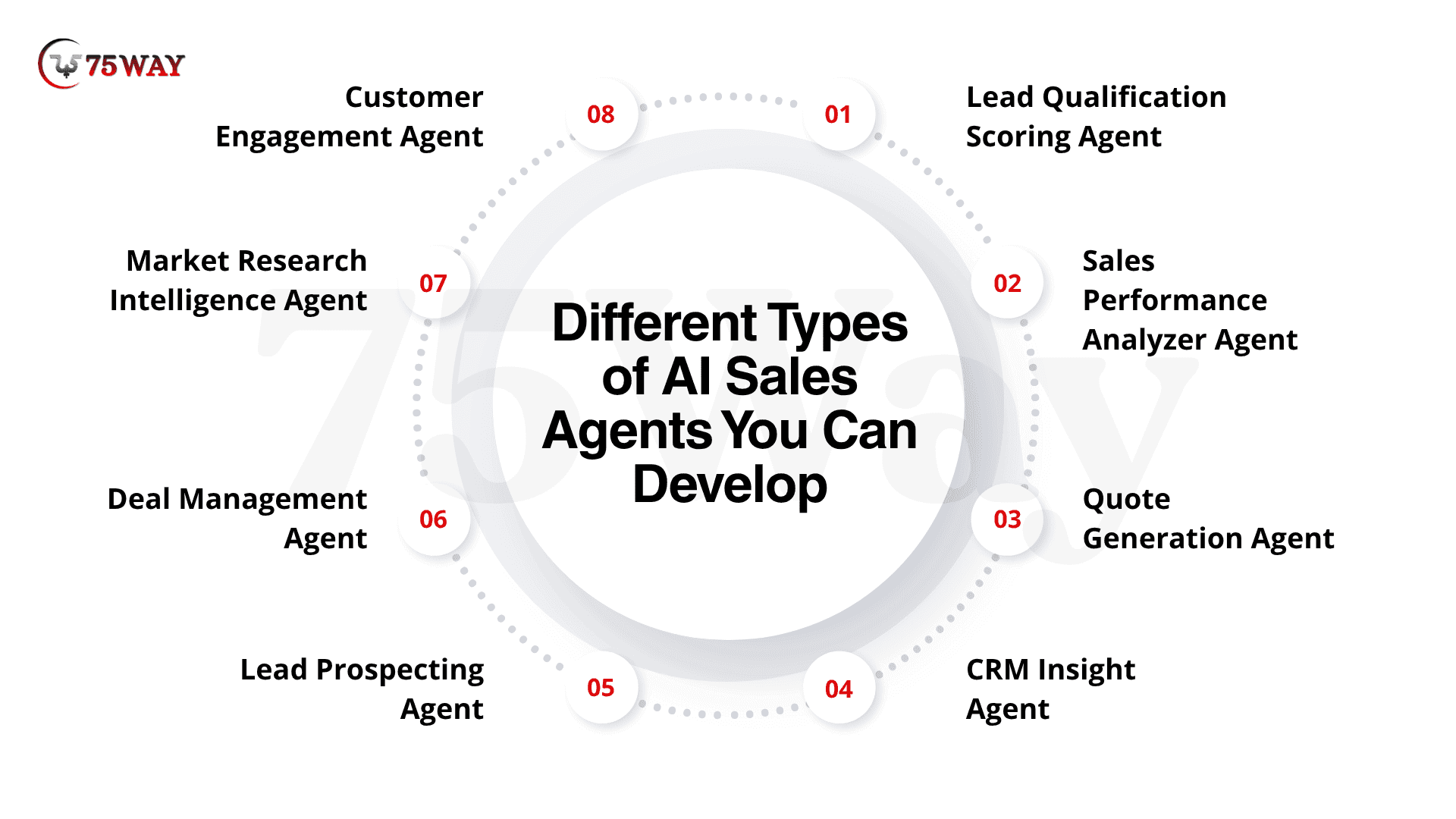
Lead Qualification Scoring Agent
This type focuses on evaluating and filtering incoming leads based on their conversion potential. The lead qualification agents use structured data analysis to help sales teams prioritize high-value prospects and reduce time spent on low-quality leads. This improves efficiency and strengthens overall pipeline performance.
- ICP Recognizer Agent
- Lead Scoring Optimization Agent
- Opportunity Viability Assessment Agent
- Customer Prioritization Agent
- Lead Data Enrichment Agent
- Prospect Segmentation Agent
- Lead Qualification Scoring Agent
Sales Performance Analyzer Agent
This category focuses on analyzing sales activities, tracking performance metrics, and identifying areas for improvement. It helps organizations understand what is working, what is not, and how to optimize revenue outcomes through better decision-making and forecasting accuracy.
- Sales Performance Analyzer
- Close Rate Insight Agent
- Pipeline Health Intelligence Agent
- Sales Activity Management Agent
- Activity Management Integrity Agent
- Activity Quality Guardrail Agent
- Sales Compliance Automation Agent
Quote Generation Agent
Quote generation agent automates the creation of pricing quotes based on products, discounts, and customer-specific conditions. This AI sales agent ensures faster deal processing and reduces manual effort while maintaining accuracy and compliance in pricing and proposal generation workflows.
- Quote Synchronization Agent
- Quote Qualification Agent
- Quote Management Discrepancy Resolution Agent
- Quote Intake Completeness Agent
- Quote Compliance Automation Agent
- Quote Contract Analysis Agent
CRM Insight Agent
This CRM insight agent analyzes CRM data to extract customer insights, buying signals, and engagement trends. It helps sales teams make informed decisions by converting raw data into actionable intelligence that improves targeting and conversion outcomes.
- Customer Profile Unification Agent
- Customer Data Anomaly Detection Agent
- Engagement Insight Capture Agent
- Lead Tracking Orchestration Agent
- Opportunity Audit Intelligence Agent
- Lead Reconciliation Agent
Lead Prospecting Agent
This type identifies and qualifies new prospects using behavioral, demographic, and intent-based signals. It enhances targeting accuracy and helps businesses build a stronger and more relevant sales pipeline for future conversions.
- Lead Prospecting Agent
- Market Prospecting Intelligence Agent
- Smart LinkedIn Prospecting Agent
- Prospect Segmentation Agent
- ICP Recognizer Agent
- Contact Information Verification Agent
- Lead Data Enrichment Agent
Deal Management Agent
This category manages the entire deal lifecycle, including documentation, approvals, and pipeline movement. It ensures structured deal progression while maintaining compliance, accuracy, and transparency throughout the sales process.
- Dynamic Deal Documentation Agent
- Deal Staging Assignment Agent
- Deal Staging Intelligence Agent
- Pipeline Closure Orchestration Agent
- Deal Health Intelligence Agent
- Deal Loss Intelligence Agent
- Contract Finalization Agent
Market Research Intelligence Agent
This type focuses on gathering and analyzing market trends, competitor insights, and industry data. It helps businesses make strategic decisions by aligning sales efforts with real-time market intelligence.
- Market Research Intelligence Agent
- Market Research Alignment Agent
- Territory Risk Intelligence Agent
- Opportunity Data Foundation Agent
- Solution Blueprint Intelligence Agent
- Design Compliance Intelligence Agent
- Market Prospecting Intelligence Agent
Customer Engagement Agent
This category monitors customer interactions across channels and optimizes communication timing and quality. It ensures better engagement, stronger relationships, and higher conversion rates through consistent and personalized interaction strategies.
Benefits of Using Pre-Built AI Sales Agents
Pre-built AI sales agents provide businesses with a fast and efficient way to automate sales processes without building complex systems from scratch. They come with ready-to-use workflows, conversational intelligence, and integration capabilities that help organizations improve engagement, reduce workload, and scale revenue generation more effectively across multiple channels.
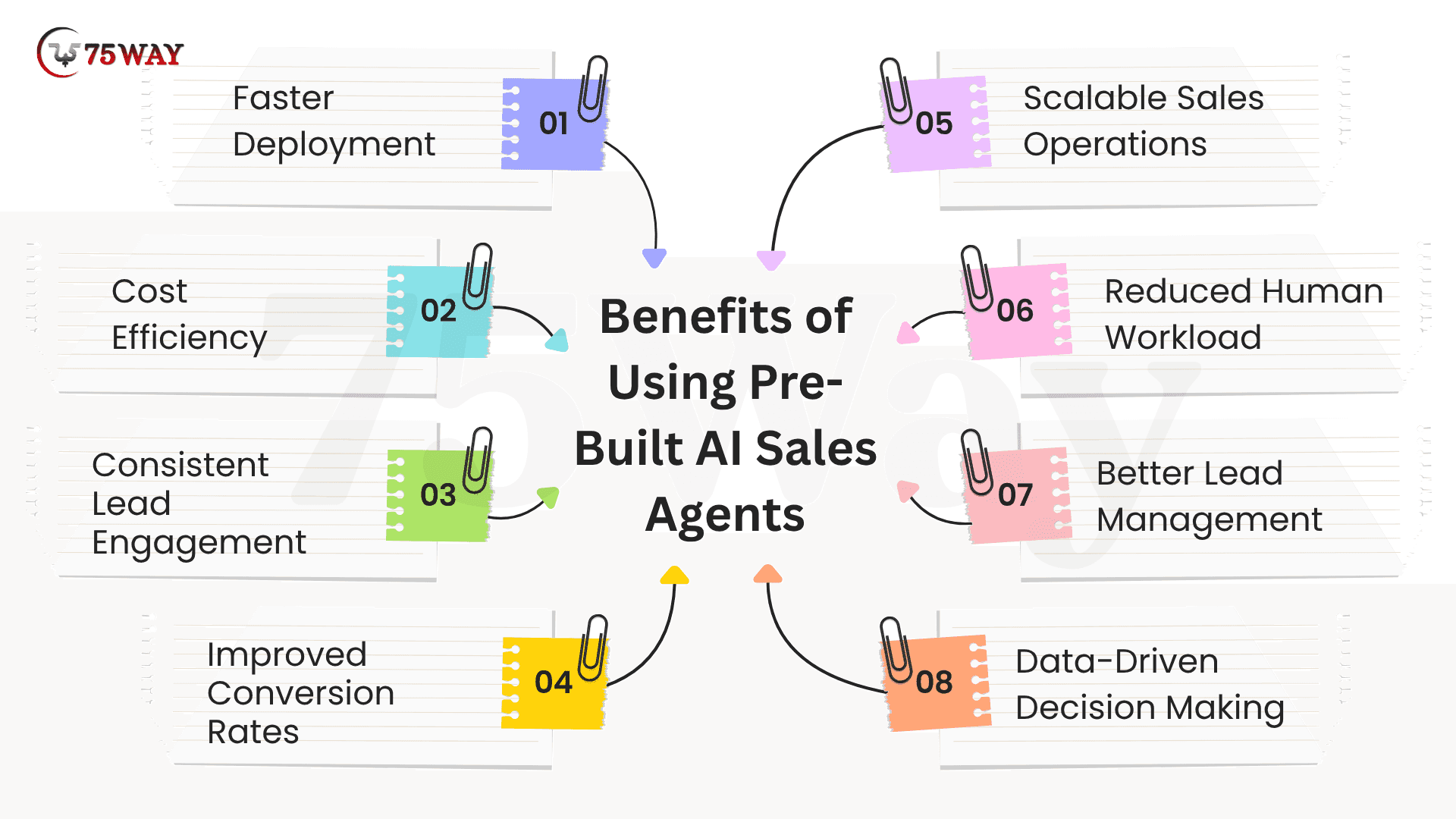
- Faster Deployment: Businesses can quickly launch automated sales systems without long development cycles or technical delays. Ready-made frameworks allow immediate integration, enabling teams to start engaging leads and generating results within a short time frame.
- Cost Efficiency: Operational expenses are reduced as fewer manual resources are needed for repetitive sales tasks. This helps companies maintain strong performance while optimizing budgets and reducing overall staffing costs.
- Consistent Lead Engagement: Customer interactions remain active throughout the entire sales journey without communication gaps. This ensures prospects stay engaged, reducing drop-offs and improving the chances of successful conversions.
- Improved Conversion Rates: Structured workflows guide users smoothly from initial interest to final purchase decisions. Timely responses and personalized communication increase trust and significantly enhance the likelihood of closing deals.
- Scalable Sales Operations: Sales systems can manage increasing lead volumes without requiring additional workforce expansion. This allows businesses to grow efficiently while maintaining consistent performance during high-demand periods.
- Reduced Human Workload: Routine tasks such as follow-ups, lead responses, and initial inquiries are handled automatically. Sales teams can then focus on high-value activities like negotiations and closing deals.
- Better Lead Management: Leads are automatically organized, tracked, and prioritized based on engagement and intent signals. This ensures no opportunity is missed and improves overall sales pipeline efficiency.
- Data-Driven Decision Making: Continuous analysis of customer interactions provides actionable insights for improving sales strategies. These insights help optimize targeting, refine messaging, and consistently enhance overall revenue performance.
How to Implement AI Sales Agents?
Successful implementation requires structured planning, clear objective setting, and seamless integration with existing business systems. Organizations must align sales workflows, data sources, and communication channels before deployment to ensure smooth operation. A well-planned approach helps maximize efficiency, reduce errors, and achieve faster adoption of automated sales processes across teams.
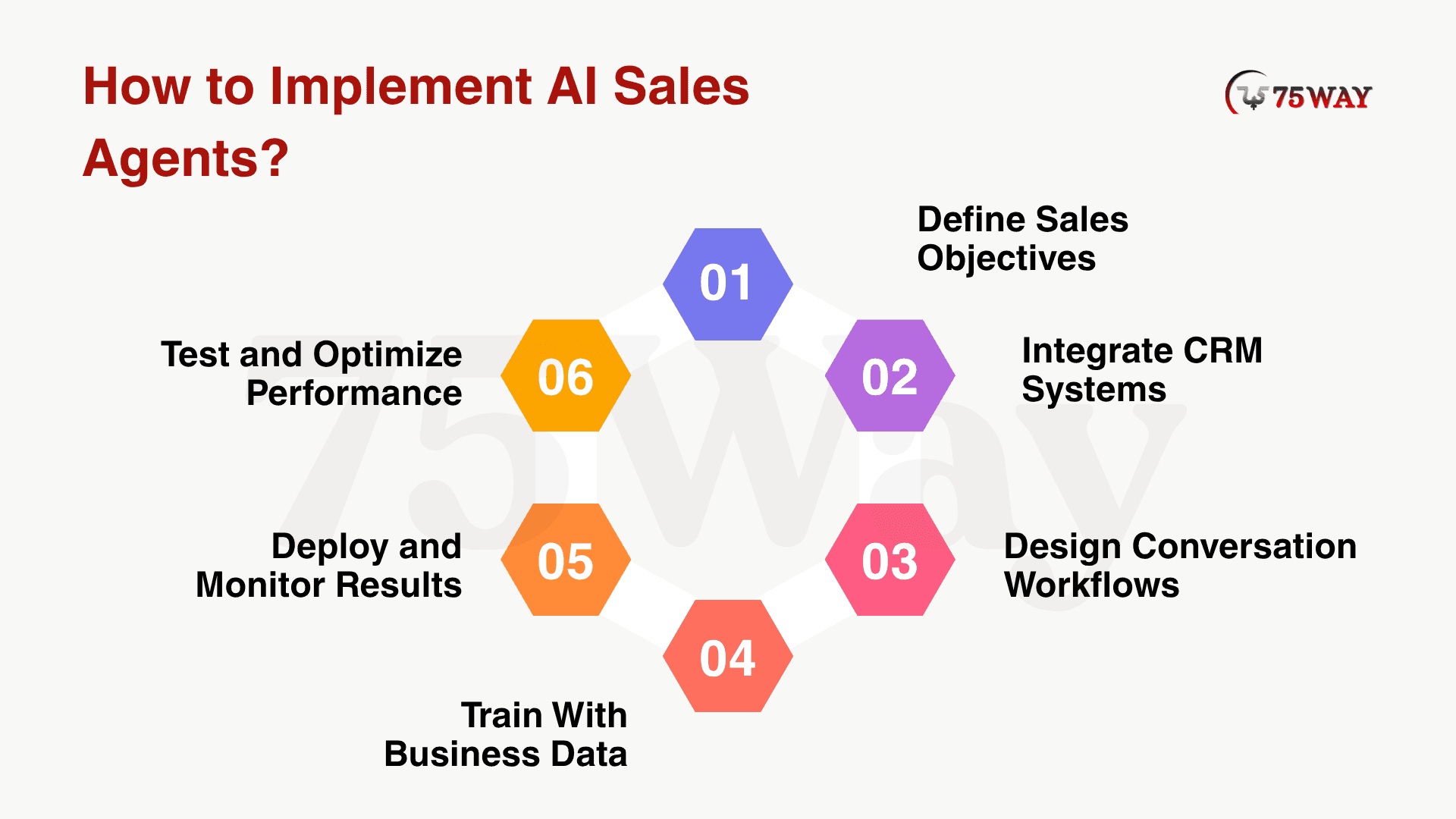
Step 1: Define Sales Objectives
The implementation process begins by setting clear sales objectives that determine what the system should achieve. These goals act as the foundation for every later decision, including integration, workflow design, and performance measurement.
Well-defined objectives ensure alignment between business priorities and automation behavior. They help maintain focus on measurable outcomes such as higher conversions, faster responses, or improved lead quality throughout the entire process.
Step 2: Integrate CRM Systems
After defining objectives, CRM systems are integrated to connect customer data with sales operations. This step ensures that all lead information, interactions, and pipeline updates flow seamlessly into one centralized system.
This integration builds on initial goals by making data accessible and actionable. It ensures that every customer interaction is tracked properly, enabling more accurate execution of strategies defined in the first stage.
Step 3: Design Conversation Workflows
With systems connected, structured conversation workflows are created to guide how customer interactions should progress. These workflows are based on the objectives and data structure established in earlier steps.
This stage ensures that engagement follows a logical path aligned with CRM insights. It connects system data with real communication flows, helping prospects move smoothly through each stage of the sales journey.
Step 4: Train With Business Data
Once workflows are designed, historical business data is used to refine response accuracy and contextual understanding. This training step improves how the system interprets and reacts to real customer behavior.
It builds directly on workflows and CRM data, ensuring responses are aligned with actual sales patterns. This creates more relevant and effective interactions that support the previously defined sales objectives.
Step 5: Test and Optimize Performance
After training, the system is tested across different scenarios to evaluate performance and identify gaps. This step ensures that workflows, data handling, and responses function as expected.
Testing connects back to all previous stages by validating objectives, integration, and training quality. Optimization is then applied to improve accuracy, efficiency, and overall conversion outcomes.
Step 6: Deploy and Monitor Results
Once testing is successful, the system is deployed across sales channels for real-time operations. This final step brings together all previous stages into active business use.
Continuous monitoring ensures that performance remains aligned with initial objectives. Insights from live interactions are used to refine workflows and improve long-term sales effectiveness.
Challenges in Using AI Sales Agents With Solutions
No doubt, AI sales agents improve sales efficiency, but businesses often face operational, technical, and adoption-related challenges during setup and execution. These challenges usually emerge from data inconsistencies, integration issues, workflow gaps, and team resistance. Each challenge directly impacts performance, so addressing them with structured solutions ensures smoother operations, better accuracy, and improved sales outcomes.
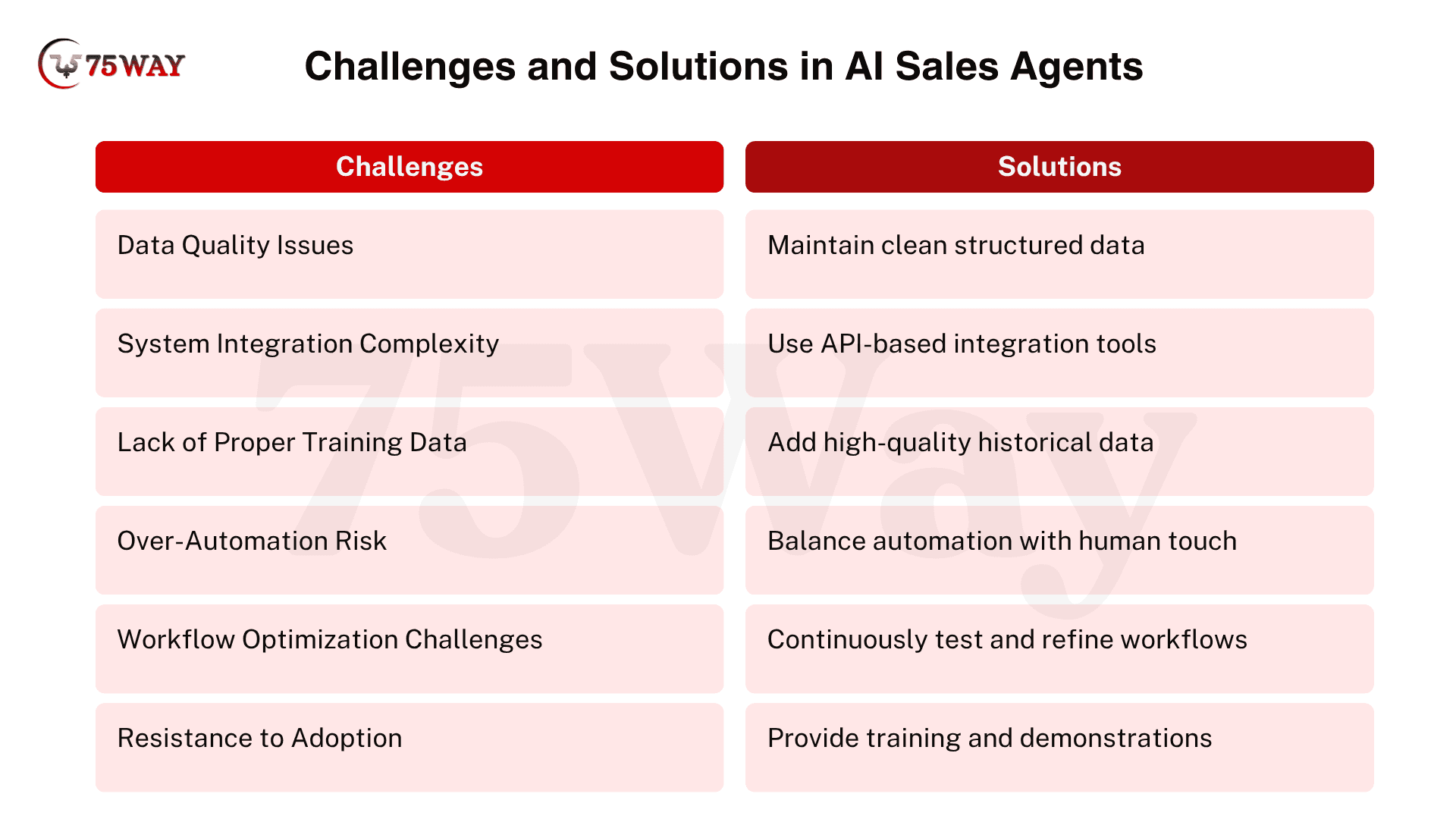
- Data Quality Issues
Poor or inconsistent data reduces the accuracy of customer responses and leads to irrelevant interactions that affect engagement and conversions. Structured and regularly updated data is maintained so the system delivers accurate insights and relevant customer communication.
- System Integration Complexity
Connecting new automation systems with existing CRM and sales tools becomes difficult when platforms are not properly aligned or compatible. API-based integration methods and pre-built connectors are implemented to ensure smooth synchronization between all business systems.
- Lack of Proper Training Data
Insufficient or outdated training data limits the system’s ability to understand customer intent and provide accurate responses during conversations. High-quality historical sales data is continuously added to improve learning accuracy and enhance contextual understanding.
- Over-Automation Risk
Excessive automation reduces human involvement in customer interactions, which can undermine trust and hinder relationship-building with prospects. A balanced model is applied, with automation handling repetitive tasks and human agents managing complex and sensitive interactions.
- Workflow Optimization Challenges
Poorly structured workflows can disrupt the customer journey and lead to inefficient lead handling across stages. Workflows are regularly tested and refined to ensure smooth transitions and improved conversion efficiency across the sales funnel.
- Resistance to Adoption
Sales teams may hesitate to adopt new systems due to a lack of awareness or discomfort with changing traditional processes. Proper training sessions and clear demonstrations of benefits are provided to encourage acceptance and smooth adoption across teams.
Final Thoughts
AI sales agents are transforming how businesses manage leads, automate communication, and drive revenue growth. From qualification and engagement to pricing, forecasting, and retention, these intelligent systems bring structure and speed to every stage of the sales process.
Pre-built solutions make adoption even easier by reducing setup time and enabling faster execution without heavy technical effort. When implemented correctly, they help businesses improve conversions, reduce operational workload, and scale sales performance consistently across channels.
To stay ahead in this competitive landscape, adopt ready-to-use AI-driven sales systems. You can explore advanced pre-built solutions at 75AI Agent Store and accelerate your sales growth with intelligent automation designed for real business results.
Frequently Asked Questions (FAQs)
How Do AI Sales Agents Improve Customer Experience?
AI sales agents improve customer experience by providing instant responses, reducing waiting time, and offering consistent communication. They ensure customers receive accurate information at every stage, creating smoother interactions and increasing satisfaction through timely engagement and personalized support across multiple channels.
Can Sales AI Agents Work Without Human Involvement?
They can handle many sales tasks independently, including lead responses and follow-ups, but human involvement is still important for complex negotiations. A hybrid approach ensures automation manages repetitive work while humans focus on relationship building and strategic decision-making for better outcomes.
Are AI Sales Agents Suitable For Small Businesses?
Yes, small businesses benefit significantly as these systems reduce the need for large sales teams and manual effort. They help manage leads efficiently, improve response speed, and support growth without requiring heavy investment in infrastructure or additional workforce expansion.
What Industries Benefit Most From AI Sales Agents?
Industries like SaaS, e-commerce, real estate, finance, healthcare, and education benefit the most. These sectors handle high volumes of customer interactions, making automation valuable for improving efficiency, maintaining engagement, and increasing conversion rates across competitive markets.
Do AI Sales Agents Require Technical Expertise To Operate?
Most modern solutions are designed for easy use with minimal technical knowledge. Businesses can operate them through dashboards and integrations without deep coding skills, especially when using pre-built systems that come with ready configurations and user-friendly interfaces.
How Secure Is Customer Data With AI Sales Agents?
Customer data security depends on the platform used, but most advanced systems follow strict encryption and compliance standards. Proper implementation ensures data protection, secure storage, and controlled access, reducing risks of breaches and maintaining customer trust.