Summary
AI development services enable businesses to automate operations, improve decision-making, and enhance customer experiences. They reduce costs, increase efficiency, and provide data-driven insights for smarter strategies. By integrating AI solutions, companies achieve scalability, stronger security, and competitive advantage, making AI a key driver of modern digital transformation across industries and business models.
Quick Overview
- AI development services reduce costs while improving operational efficiency.
- AI-powered automation enhances productivity across all business functions.
- AI-driven insights enable faster, more accurate decision-making.
- Customer experience improves through personalization and intelligent engagement systems.
- AI enables scalable, secure, and future-ready business transformation strategies.
AI development services are rapidly transforming the way businesses operate in today’s digital-first environment. From automating routine processes to delivering deep data insights, AI is enabling organizations to work smarter, faster, and more accurately.
Companies across industries are adopting AI development solutions to reduce operational challenges, improve customer experiences, and strengthen decision-making capabilities. These services are not limited to large enterprises; even small and mid-sized businesses are leveraging AI to scale efficiently and stay competitive.
By integrating intelligent systems into core operations, businesses can unlock new opportunities for innovation and growth. AI is also reshaping how companies interact with customers, manage resources, and respond to market changes. This guide provides a detailed overview of the key benefits of AI development services and how they impact modern business success.
Benefits of AI Development Services for Businesses
Artificial intelligence services are reshaping modern enterprises by improving operations, decision-making, and customer engagement. Businesses across industries are adopting AI to stay competitive, reduce costs, and unlock new growth opportunities. These benefits extend beyond automation and directly influence long-term strategic performance and innovation capacity.
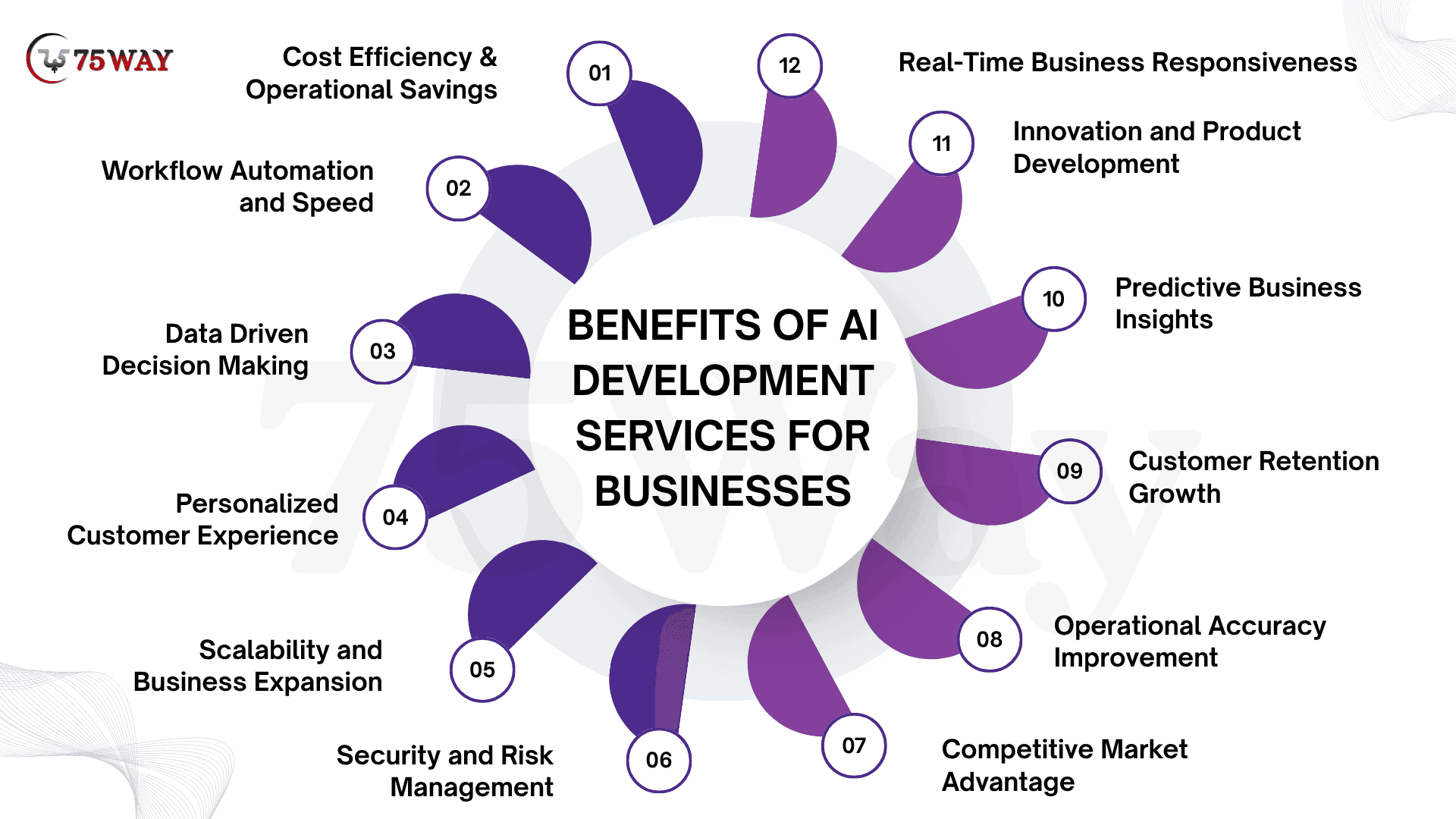
1. Cost Efficiency & Operational Savings
AI development services significantly reduce operational expenses by automating repetitive tasks and improving resource utilization. Businesses can redirect human effort toward strategic activities, improving productivity and financial outcomes over time.
- Lowers staffing-related expenses
- Reduces costly human errors
- Minimizes repetitive task workload
- Optimizes resource usage planning
2. Workflow Automation and Speed
AI enables faster execution of business processes by automating routine tasks and improving cross-departmental coordination. This helps organizations complete tasks more quickly and with greater consistency. These solutions improve operational speed by streamlining workflows and reducing dependency on manual intervention across systems.
- Automates daily routine tasks
- Speeds up internal workflows
- Improves task coordination across teams
- Reduces processing delays
3. Data Driven Decision Making
AI development services empower businesses to analyze large datasets and derive meaningful insights for better strategic decision-making. This improves planning accuracy and business forecasting. It helps organizations make better decisions by transforming raw data into actionable business intelligence.
- Identifies hidden data patterns
- Improves forecasting accuracy levels
- Supports informed decision-making processes
- Analyzes customer behavior trends
4. Personalized Customer Experience
AI helps businesses deliver tailored experiences by understanding customer preferences and behavior. This leads to stronger engagement and improved satisfaction levels. This benefit enhances customer relationships by offering personalized interactions based on user behavior and preferences.
- Delivers customized recommendations with AI chatbots
- Enhances communication quality with users
- Improves response personalization levels
- Strengthens customer interaction experience
5. Scalability and Business Expansion
AI systems allow businesses to grow without major structural changes. They adapt to increasing workloads and support smooth expansion across operations. These solutions enable businesses to scale operations smoothly while maintaining stability and performance consistency.
- Supports scalable business growth
- Adjusts to workload changes
- Handles rising data volume
- Reduces infrastructure dependency needs
6. Security and Risk Management
These automated systems strengthen cybersecurity by detecting threats early and preventing them from escalating. This ensures safer and more reliable operations. You can build an advanced threat protection system in your automated solutions to improve security by continuously monitoring systems and identifying potential risks in real time.
- Detects suspicious system behavior
- Prevents unauthorized access attempts
- Improves data protection strength
- Reduces fraud-related risks
7. Competitive Market Advantage
AI development services help businesses innovate faster and respond quickly to market changes. This strengthens positioning and brand value. These solutions enhance competitiveness by enabling faster innovation and improved responsiveness to industry trends.
- Accelerates product innovation cycles
- Improves responsiveness to market changes
- Strengthens brand trust value
- Enhances digital transformation speed
8. Operational Accuracy Improvement
AI workflow automation systems reduce errors in business processes by improving data handling and workflow execution precision. This ensures consistent results across operations. It enhances the accuracy of business operations by minimizing human error and improving reliability.
- Reduces manual operational mistakes
- Improves data processing accuracy
- Ensures consistent output quality
- Minimizes reporting discrepancies
9. Customer Retention Growth
Artificial intelligence solutions improve customer loyalty by enhancing engagement strategies and delivering better experiences throughout the customer journey. These systems utilize a strong relationship-building model to increase customer retention by improving satisfaction and long-term engagement quality.
- Increases customer satisfaction levels
- Improves repeat purchase rates
- Enhances engagement consistency
- Strengthens long-term relationships
10. Predictive Business Insights
AI tools help businesses forecast future trends and plan strategies using predictive analytics and historical data insights. The AI models support better planning by identifying future market trends and potential opportunities.
- Identifies upcoming market shifts
- Improves demand prediction accuracy
- Supports strategic business planning
- Reduces uncertainty in decisions
11. Innovation and Product Development
AI product development solutions enable businesses to create innovative solutions and improve product development using intelligent technologies and automation. They support new product creation and encourage technology-driven innovation across industries.
- Enables new product creation
- Supports digital transformation initiatives
- Encourages technology-driven solutions
- Expands service capabilities
12. Real-Time Business Responsiveness
AI-powered software solutions provide instant insights that enable businesses to respond quickly to changes in market conditions and operations. These solutions improve responsiveness by delivering real-time data for faster business actions.
- Delivers real-time business insights
- Improves reaction speed to changes
- Supports immediate decision-making
- Enhances operational responsiveness
Benefits of AI Solutions Across Industries
AI solutions are transforming multiple industries by improving efficiency, decision-making, customer experience, and operational accuracy. Across sectors, AI enables organizations to automate processes, reduce costs, and unlock data-driven insights that support sustainable growth and innovation in highly competitive environments.
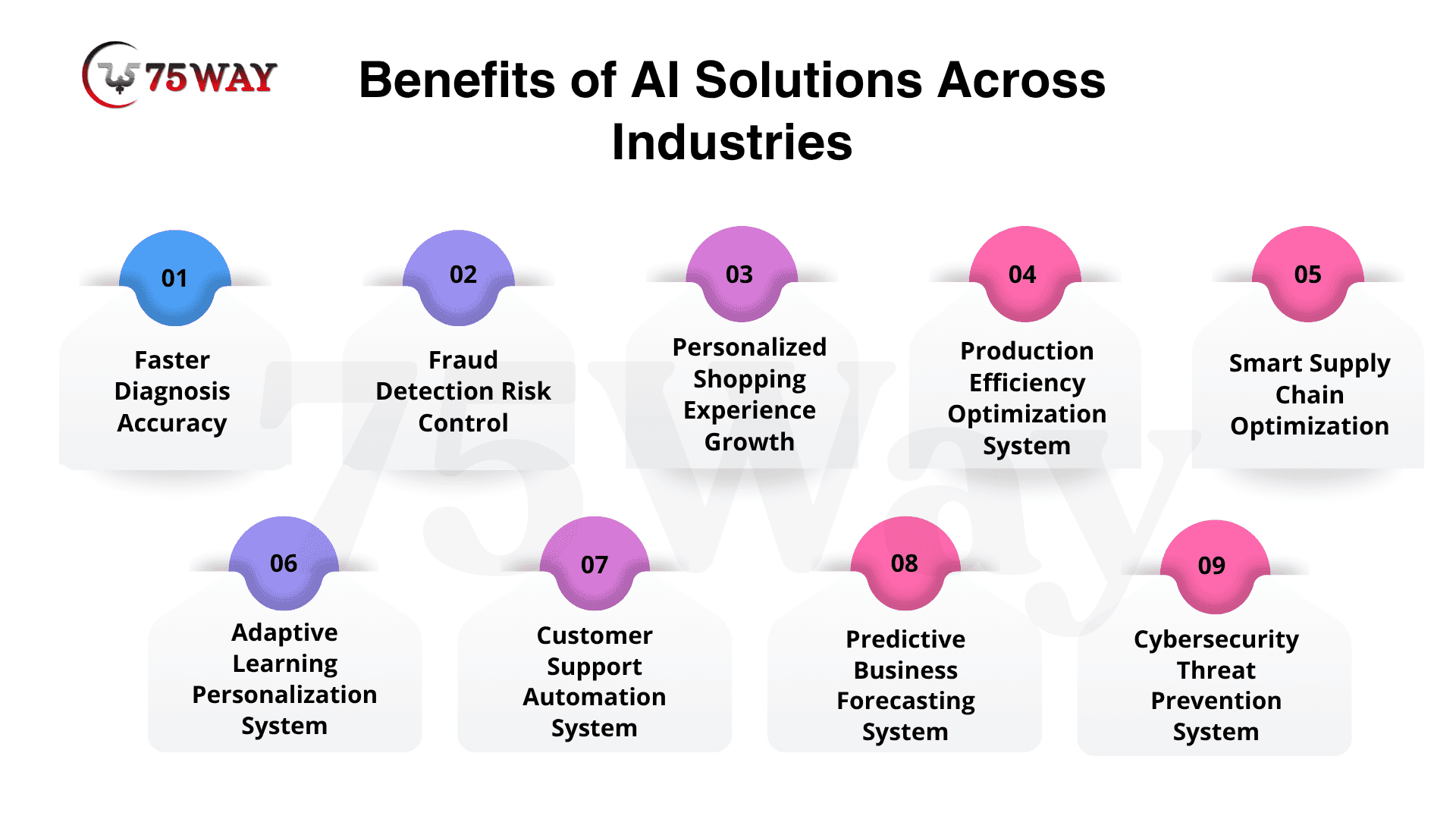
- Faster Diagnosis Accuracy: AI-powered healthcare systems enable quicker and more accurate identification of medical conditions. AI in healthcare supports better treatment decisions and improves patient outcomes through reliable clinical data analysis.
- Fraud Detection Risk Control: AI fintech systems identify suspicious transactions in real time and reduce fraud risks. They strengthen security, improve compliance, and support financial stability through continuous monitoring and analysis.
- Personalized Shopping Experience Growth: Retail platforms and AI ecommerce platforms analyze customer behavior and preferences to deliver personalized recommendations. This improves product discovery, increases engagement, and enhances overall shopping satisfaction across digital channels.
- Production Efficiency Optimization System: Manufacturing operations use predictive maintenance and quality monitoring to reduce machine downtime. Production planning becomes more stable with improved output consistency and streamlined operational control.
- Smart Supply Chain Optimization: AI-driven logistics systems improve route planning, shipment tracking, and inventory management. This results in faster deliveries, fewer delays, and better coordination across supply chain networks.
- Adaptive Learning Personalization System: AI education apps and platforms adjust learning paths based on student progress and performance. Automated assessments and personalized content improve understanding and overall learning outcomes.
- Customer Support Automation System: AI customer support agents handle customer queries instantly and resolve common issues automatically. This increases service availability and reduces response delays across support channels.
- Predictive Business Forecasting System: Advanced analytics systems evaluate historical and real-time data to forecast trends. Businesses gain clearer demand insights, improved planning, and reduced uncertainty in market decisions.
- Cybersecurity Threat Prevention System: Security systems detect unusual activity and identify potential cyber threats in real time. This improves data protection, reduces breach risks, and strengthens overall digital security infrastructure.
Final Thoughts
AI solutions are becoming a core part of modern business transformation across industries. They enhance operational precision, improve workflow execution, and support better strategic planning through data-driven intelligence. Organizations are using these technologies to streamline complex processes, reduce inefficiencies, and improve overall service delivery. Implementing the right strategy with expert support ensures successful integration and measurable results. Partnering with a trusted AI development company can help unlock sustainable innovation and long-term competitive advantage.
Frequently Asked Questions (FAQs)
What Type of Data Is Needed For AI Systems?
AI systems require structured and unstructured data such as customer records, transaction history, text, images, and operational logs. High-quality, well-organized data improves model accuracy, while inconsistent or incomplete data may reduce performance and require additional preprocessing before use.
Is AI Suitable For Non-Digital Traditional Businesses?
Yes, traditional businesses can adopt AI solutions to modernize operations, improve customer service, and automate repetitive tasks. Even basic implementations like chat systems or inventory tracking tools can significantly enhance efficiency and support gradual digital transformation.
How Secure Are AI-Based Business Systems?
AI systems can be highly secure when properly designed with encryption, access controls, and monitoring mechanisms. They also enhance security by detecting unusual activity and preventing threats, though regular updates and maintenance are essential to maintain protection.
What Skills Are Required To Manage AI Tools?
Basic AI tools can be managed with minimal technical knowledge, but advanced systems require an understanding of data, analytical thinking, and system management skills. Many businesses rely on trained professionals or service providers to handle configuration and optimization tasks effectively.
What Are The Main Challenges In Using AI Solutions?
Common challenges include data quality issues, integration complexity, initial investment costs, and workforce adaptation. Businesses also need proper planning and expertise to ensure smooth deployment and alignment with existing processes for effective long-term results.