Michael Anderson

“I finally understood why several high-value deals collapsed late in negotiations. The deal loss intelligence agent uncovered buyer hesitation patterns and competitor influence, guiding stronger strategic responses.”
Every lost deal carries intelligence waiting to be uncovered. The deal loss intelligence agent analyzes deal histories, buyer signals, and negotiation patterns to uncover hidden loss drivers, helping revenue leaders refine strategies and strengthen future pipeline performance.
Bring Business Innovation With AI Automation, AI Agents, Apps, IoT, & Software Solutions. Connect Now!
Bring Business Innovation With AI Automation, AI Agents, Apps, IoT, & Software Solutions. Connect Now!
Bring Business Innovation With AI Automation, AI Agents, Apps, IoT, & Software Solutions. Connect Now!
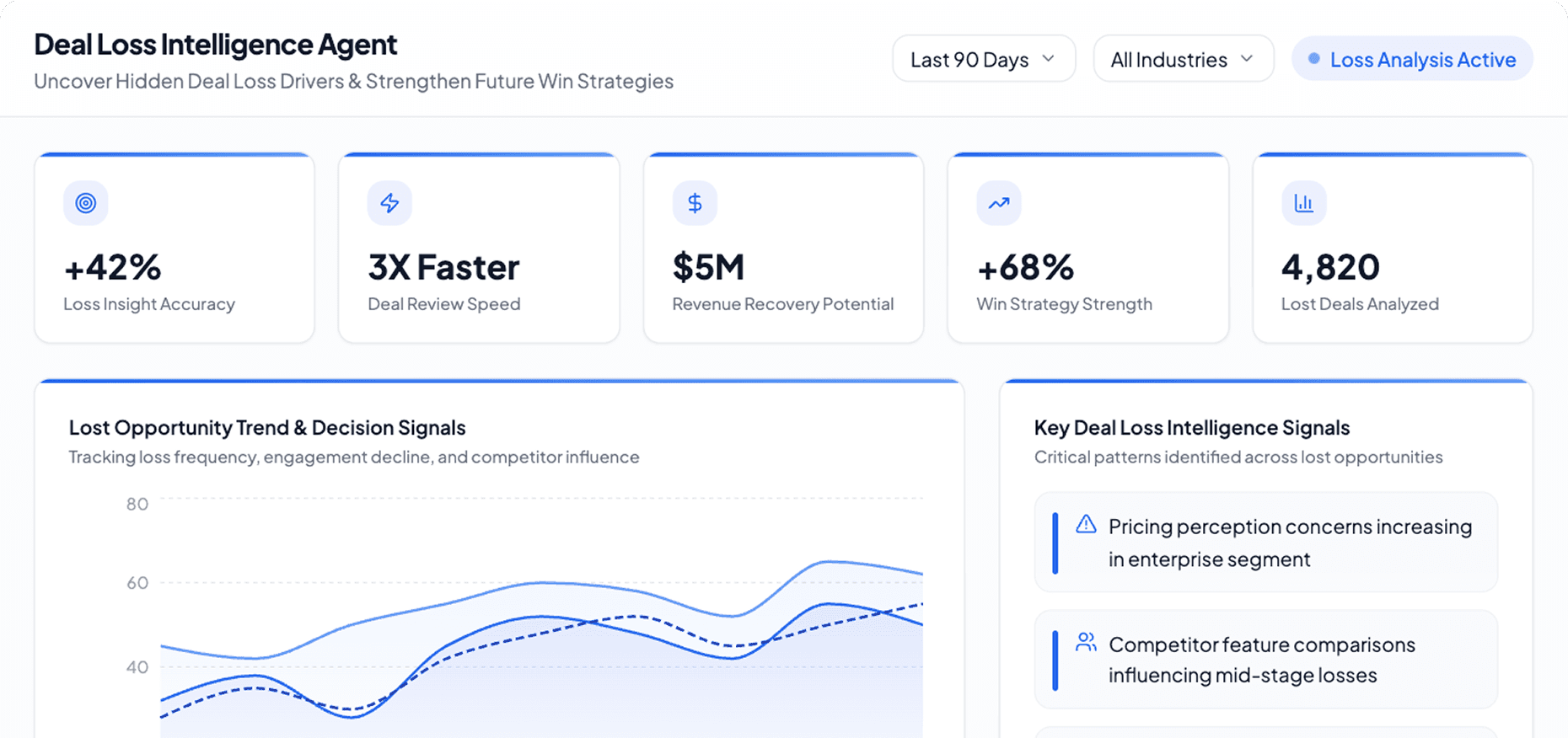
Unexamined deal losses hide patterns that limit growth. The deal loss intelligence agent analyzes sales history and buyer feedback to uncover decision triggers behind lost opportunities.
Better Loss Insights
Faster Deal Reviews
Revenue Recovery Potential
Stronger Win Strategies
The deal loss intelligence agent is an AI-driven analytical system designed to examine lost sales opportunities and identify underlying decision factors. It processes deal conversations, CRM records, pricing history, and competitive signals to detect patterns explaining why prospects decline offers or choose alternatives.
By converting scattered deal information into structured intelligence, the agent reveals consistent loss drivers across products, pricing structures, messaging, and buying stages. Business leaders gain actionable insights that strengthen future deal positioning, refine engagement strategies, and reduce repeated revenue losses.
Understanding lost opportunities becomes easier when decision signals are visible. Explore how the deal loss intelligence agent uncovers hidden deal patterns and reveals insights that guide stronger sales strategies and smarter pipeline decisions.
Many companies record lost deals without examining deeper decision drivers. Valuable intelligence stays buried inside CRM notes, buyer communications, and pricing conversations. Leadership may see declining close rates, yet the true causes remain unclear. Competitive positioning weaknesses, timing gaps, misaligned messaging, and pricing perceptions silently influence outcomes. Without structured analysis, these patterns repeat across quarters, gradually weakening pipeline productivity and limiting predictable revenue expansion.
The deal loss intelligence agent studies historical opportunities, buyer interactions, proposal details, and competitor mentions to reveal consistent loss signals. AI models classify decision triggers, evaluate engagement gaps, and detect negotiation patterns shaping outcomes. Leaders receive structured intelligence highlighting pricing concerns, feature gaps, trust barriers, or timing issues. With these insights, revenue strategies evolve with clarity, reducing repeated deal failures and strengthening future opportunities.
Revenue leaders rarely lack data, but often lack clarity around lost opportunities. The deal loss intelligence agent transforms scattered deal signals into strategic insights, enabling leadership to refine positioning, strengthen buyer engagement, and improve future opportunity outcomes.
Reveals recurring decision triggers behind failed opportunities, enabling leadership to understand competitive pressure, pricing objections, buyer hesitation patterns, and timing gaps.
Analyzes buyer responses, communication signals, and negotiation dynamics to reveal motivations shaping purchasing outcomes across industries and deal sizes.
Converts historical opportunity data into intelligence guiding refined sales strategies, improved messaging alignment, and stronger future deal positioning.
Detects competitor influence across lost opportunities, highlighting product comparisons, feature expectations, and differentiation gaps influencing buyer selections.
Identifies patterns across declining close rates, stalled negotiations, and repeated objections that quietly threaten long-term pipeline performance.
Converts each lost opportunity into structured learning that continuously improves pricing strategies, negotiation approaches, and engagement methods.
The deal loss intelligence agent operates through an analytical workflow designed to examine lost opportunities and uncover their underlying causes. It gathers deal histories, buyer interactions, pricing conversations, and competitive references from multiple revenue systems. Artificial intelligence models evaluate engagement patterns, classify objections, and compare opportunity timelines across industries and deal sizes. Insights are translated into structured intelligence describing why deals failed and how patterns repeat across pipeline stages. Revenue leaders receive clear explanations highlighting decision drivers, messaging gaps, and negotiation dynamics influencing outcomes, allowing strategic adjustments that strengthen future deal positioning and revenue predictability.
The agent gathers opportunity histories, buyer communications, proposal details, pricing discussions, and competitor references from CRM and engagement platforms, forming the analytical foundation for evaluating lost deal signals.
The discovery stage produces a structured dataset describing each lost opportunity. Revenue leaders gain a unified view of deal interactions, negotiation stages, and contextual signals supporting deeper loss analysis and accurate intelligence development.
Extracts lost opportunity records, buyer interactions, communication transcripts, and proposal documentation across sales systems and engagement platforms.
Connects deal activity signals with buyer responses, negotiation stages, and competitive mentions within opportunity histories.
Structures opportunity timelines and engagement records to understand events shaping buyer decisions during the deal lifecycle.
Reviews information completeness, filtering duplicate entries or inconsistent activity signals before advanced analysis begins.
Lost opportunities exist across every industry, yet their causes often remain hidden inside fragmented data sources. The deal loss intelligence agent transforms these signals into structured intelligence, revealing decision patterns influencing revenue outcomes.
Examines product comparisons, pricing discussions, and feature expectations shaping purchasing decisions within competitive software markets.
Evaluates long negotiation cycles, stakeholder involvement, and procurement dynamics influencing complex enterprise opportunity outcomes.
Detects competitor mentions, feature gaps, and positioning weaknesses affecting buyer decisions during evaluation processes.
Identifies repeated pricing concerns and value perception challenges appearing across multiple lost opportunities.
Reveals early engagement indicators suggesting potential deal failures before final opportunity closure.
Analyzes communication sentiment and decision timing patterns influencing purchasing outcomes.
“I finally understood why several high-value deals collapsed late in negotiations. The deal loss intelligence agent uncovered buyer hesitation patterns and competitor influence, guiding stronger strategic responses.”

“Reviewing lost opportunities used to rely on assumptions. This agent revealed exact decision triggers within buyer conversations and proposal discussions, helping leadership refine positioning and improve future deal outcomes.”

“The clarity around pricing objections and engagement gaps surprised me. Instead of guesswork, we now understand why prospects declined offers and adjust strategy with confidence.”

“We discovered repeated competitor comparisons influencing decisions. The deal loss intelligence agent highlighted these signals early, helping us strengthen differentiation and respond more strategically.”

“This intelligence changed how we analyze lost deals. Instead of ignoring failures, we treat them as learning opportunities that continuously strengthen pipeline strategy.”
“I finally understood why several high-value deals collapsed late in negotiations. The deal loss intelligence agent uncovered buyer hesitation patterns and competitor influence, guiding stronger strategic responses.”
“Reviewing lost opportunities used to rely on assumptions. This agent revealed exact decision triggers within buyer conversations and proposal discussions, helping leadership refine positioning and improve future deal outcomes.”
“The clarity around pricing objections and engagement gaps surprised me. Instead of guesswork, we now understand why prospects declined offers and adjust strategy with confidence.”
“We discovered repeated competitor comparisons influencing decisions. The deal loss intelligence agent highlighted these signals early, helping us strengthen differentiation and respond more strategically.”
“This intelligence changed how we analyze lost deals. Instead of ignoring failures, we treat them as learning opportunities that continuously strengthen pipeline strategy.”
“I finally understood why several high-value deals collapsed late in negotiations. The deal loss intelligence agent uncovered buyer hesitation patterns and competitor influence, guiding stronger strategic responses.”
“Reviewing lost opportunities used to rely on assumptions. This agent revealed exact decision triggers within buyer conversations and proposal discussions, helping leadership refine positioning and improve future deal outcomes.”
“I finally understood why several high-value deals collapsed late in negotiations. The deal loss intelligence agent uncovered buyer hesitation patterns and competitor influence, guiding stronger strategic responses.”
“Reviewing lost opportunities used to rely on assumptions. This agent revealed exact decision triggers within buyer conversations and proposal discussions, helping leadership refine positioning and improve future deal outcomes.”
“The clarity around pricing objections and engagement gaps surprised me. Instead of guesswork, we now understand why prospects declined offers and adjust strategy with confidence.”
“We discovered repeated competitor comparisons influencing decisions. The deal loss intelligence agent highlighted these signals early, helping us strengthen differentiation and respond more strategically.”
“The clarity around pricing objections and engagement gaps surprised me. Instead of guesswork, we now understand why prospects declined offers and adjust strategy with confidence.”
“We discovered repeated competitor comparisons influencing decisions. The deal loss intelligence agent highlighted these signals early, helping us strengthen differentiation and respond more strategically.”
“This intelligence changed how we analyze lost deals. Instead of ignoring failures, we treat them as learning opportunities that continuously strengthen pipeline strategy.”
“This intelligence changed how we analyze lost deals. Instead of ignoring failures, we treat them as learning opportunities that continuously strengthen pipeline strategy.”
Uncover the real reasons opportunities fail and convert deal intelligence into actionable strategies that strengthen future pipeline performance and revenue growth.