Summary
AI calling agents for sales automate outreach, lead qualification, and follow-ups using intelligent voice systems. This guide explains how to build AI sales calling agents, core features, development costs, and business benefits. It helps decision-makers understand how AI sales call agents improve conversion rates, reduce manual effort, and scale revenue operations across industries.
Quick Overview
- AI calling agents automate repetitive sales conversations at scale
- They improve lead qualification accuracy using real-time intelligence
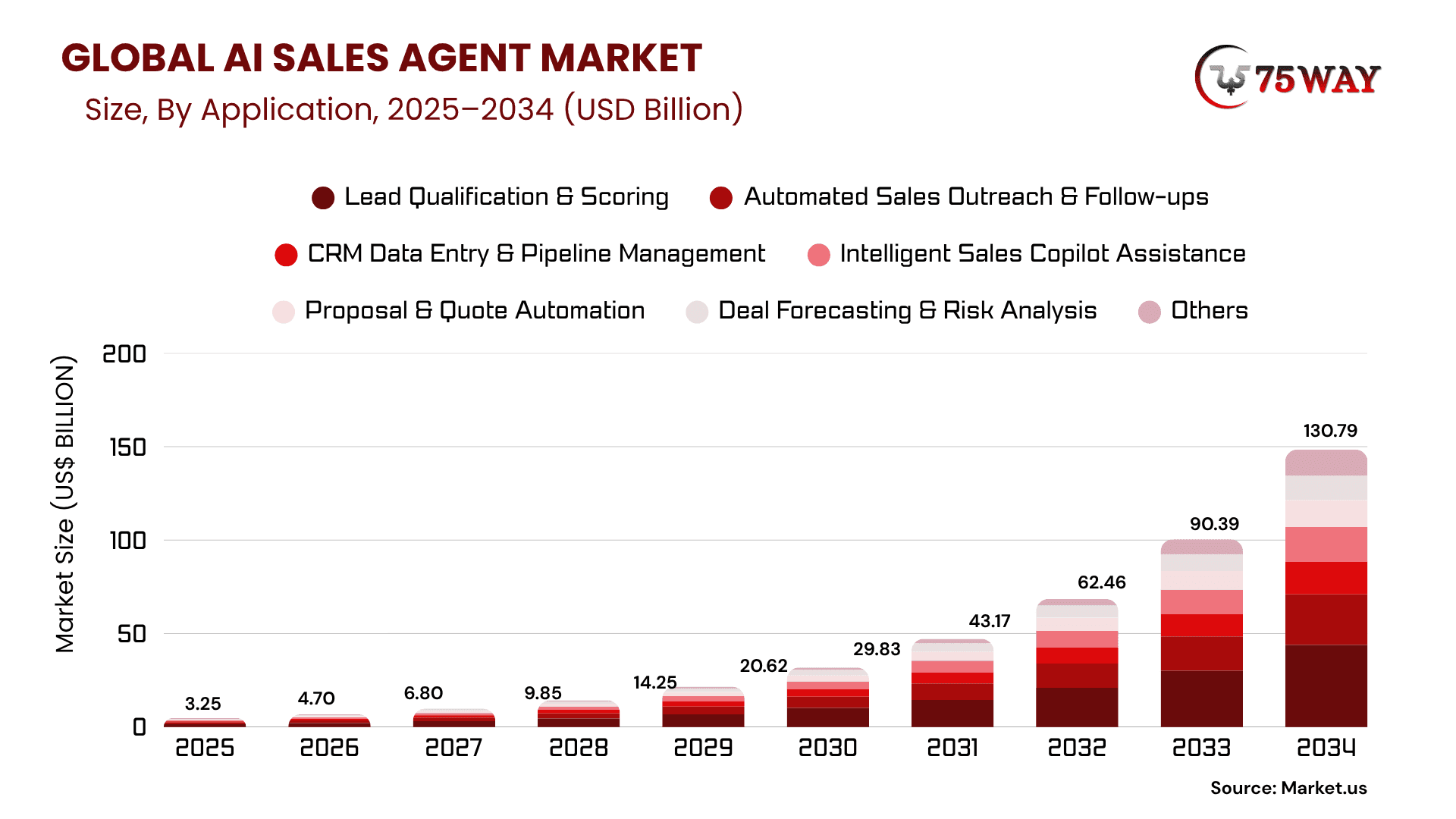
- AI sales agent market projected to exceed $130 billion by 2034
- AI voice systems enhance customer engagement and response rates.
- AI calling agent development cost ranges from $10,000 to $500,000+
Imagine a system that can call thousands of prospects, understand responses in real time, qualify leads, and schedule meetings without human intervention. Seems imaginative? No, it is not. It is already being used by high-growth companies to reduce acquisition costs and improve pipeline efficiency.
For founders, sales leaders, and decision-makers, the magic stick called the AI sales calling agent is not about replacing teams but about enhancing their output. AI calling agents allow sales professionals to focus on closing deals while automation handles repetitive outreach and first-level qualification.
The reason behind this adoption is also reflected in market growth. The AI sales agent segment is projected to expand at a compound annual growth rate of around 44.7% to 46.3%, with potential valuation exceeding $50 billion by 2030, highlighting strong enterprise adoption and long-term demand.
This guide explains how AI calling systems are built, what features they include, how much they cost, and why they are becoming essential in modern sales operations. It also helps decision-makers understand where these AI agent development solutions create measurable business impact and how to approach adoption strategically.
What Are AI Calling Agents for Sales?
AI calling agents are voice-driven systems powered by artificial intelligence that can make, receive, and manage sales conversations without constant human involvement. They can make outbound calls, receive inbound calls, and engage with prospects in real time by understanding spoken language and responding in a natural conversational flow.
They use technologies like natural language processing, machine learning, and speech recognition to understand what a prospect is saying and respond in a natural, human-like manner during live interactions.
In practice, an AI sales calling agent can automatically reach out to potential leads, handle incoming inquiries, qualify prospects based on their responses, and schedule meetings with sales teams. It also manages follow-ups without manual effort. Unlike traditional automated dialers, these agentic AI systems for sales understand intent, context, and conversational flow, making interactions feel more natural and effective.
Why Sales Teams Are Adopting AI Calling Agents?
Sales environments are becoming more competitive and data-heavy. Manual calling alone cannot keep up with modern expectations.
- High Volume Outreach Need
Sales teams need to reach thousands of leads quickly without increasing headcount.
- Declining Response Rates
AI improves engagement by optimizing timing, tone, and personalization.
- Cost Pressure
Hiring large SDR teams is expensive compared to automated systems.
- Speed to Lead
Faster responses to inquiries increase conversion rates.
Another reason is the growing market demand.
- Companies using AI sales tools report 20–30% higher conversion rates and up to 60% lower costs.
- AI call agents typically cost between $0.10 and $0.30 per minute, offering a more cost-effective alternative to maintaining a full SDR team.
- The global AI sales agent market is projected to grow from $4.70 billion in 2025 to $130.79 billion by 2034, at a CAGR of 44.7%.
- AI-driven personalization can improve customer satisfaction by 15–20% and increase revenue by 5–8%, according to McKinsey reports.
How to Build AI Sales Call Agents?
A step-by-step roadmap is required to develop an AI calling system that requires combining voice intelligence, structured sales logic, and scalable automation infrastructure. Each stage plays a specific role in ensuring the system can communicate naturally, understand intent, and support sales teams in handling high-volume outreach without losing personalization or accuracy.
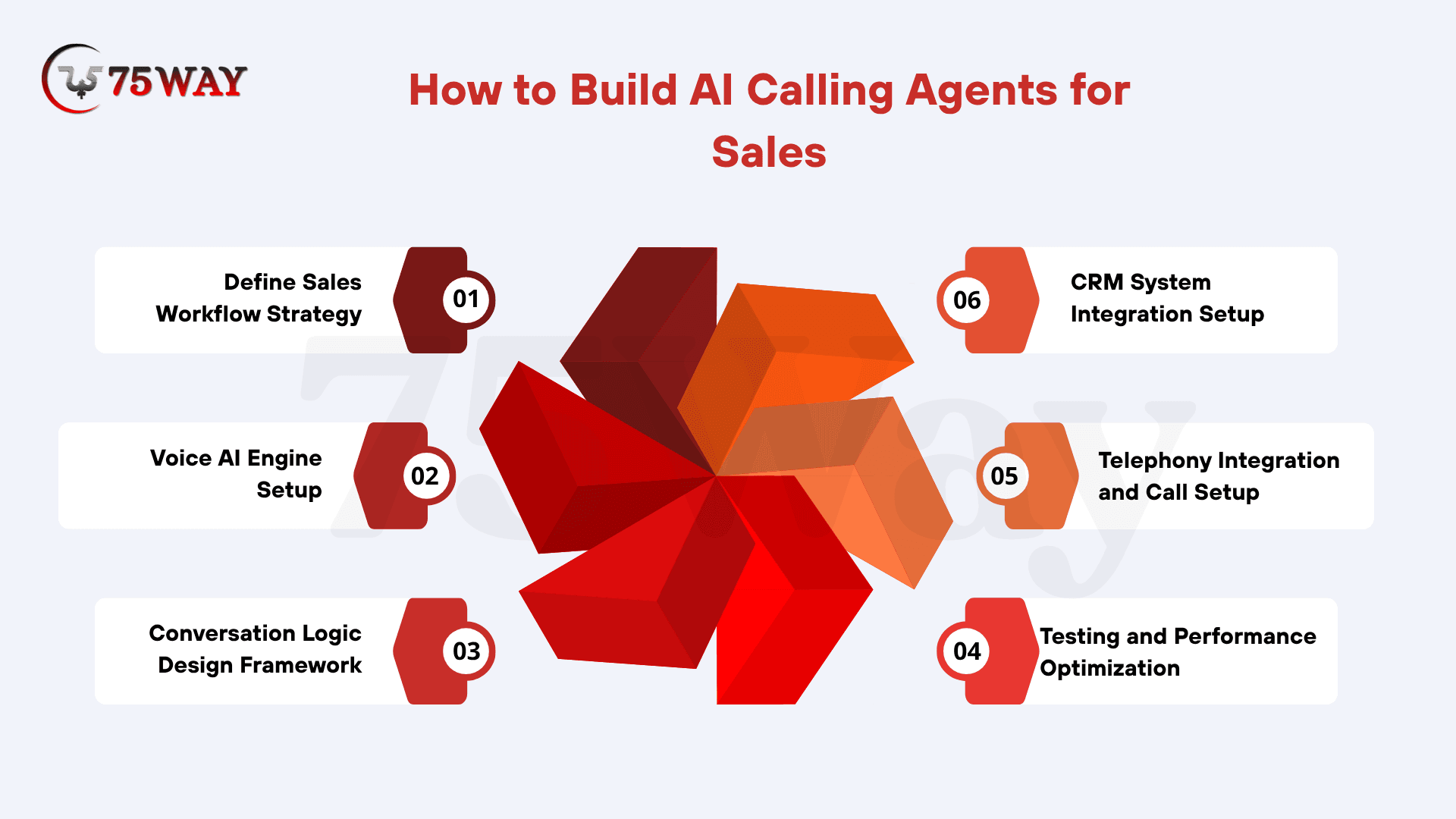
Step 1: Define Sales Workflow
This stage establishes how the AI calling agent will operate within the sales process. It clarifies whether the system is designed for cold outreach, inbound lead handling, or a hybrid model that manages both. A clear workflow ensures the AI aligns with business goals and does not operate in isolation from sales strategy.
- Identify target lead types and customer segments
- Define call objectives, such as qualification or appointment setting
- Map conversation flow based on sales funnel stages
Step 2: Voice AI Engine Setup
This stage focuses on enabling the AI voice agent system to understand and respond in natural spoken language. It serves as the communication backbone for the AI calling agent, enabling it to interact with prospects in a human-like manner.
Speech recognition and conversational AI bots convert spoken responses into text, while text-to-speech systems generate natural-sounding replies. Together, they create a smooth conversational experience that feels interactive rather than robotic.
- Speech Recognition: Convert spoken customer responses into structured text for accurate AI interpretation and processing.
- Text Generation: Create contextual and relevant responses based on user input during live conversations.
- Voice Synthesis: Produce natural human-like speech output for engaging and realistic call interactions.
- Latency Control: Reduce response delay to maintain smooth and real-time conversational flow quality.
Step 3: Conversation Logic Design
This step defines how the AI behaves during live conversations. It ensures the system can handle different responses, objections, and buying signals without human intervention. Decision frameworks and AI models are used to interpret intent, guide dialogue flow, and respond appropriately based on user input. This makes conversations adaptive instead of fixed-script-based.
- Define intent clearly before building the conversation logic layer
- Map objection handling paths for each sales scenario carefully
- Design a dialogue flow that guides the user toward the conversion goal
- Train a model to interpret buying signals from speech patterns
- Test conversation paths using real call interaction data sets
Step 4: CRM Integration
This stage connects the AI calling agent with customer relationship management (CRM) systems to ensure seamless data flow across sales operations. It enables automatic lead storage, call tracking, and pipeline updates. Every interaction is recorded, allowing sales teams to monitor progress, analyze performance, and prioritize high-quality leads more effectively.
Integration also creates a unified view of every prospect across the sales journey. Call outcomes, conversation history, and engagement signals are stored in one system, making it easier for teams to understand lead behavior. This structured data flow supports better decision-making, faster follow-ups, and improved coordination between AI systems and human sales representatives.
Step 5: Telephony Integration
This step enables the AI system to actually place and receive calls using the communication infrastructure. By integrating telephony APIs, the system can manage outbound dialing, inbound call handling, and call routing. This ensures stable connectivity and consistent call quality across large-scale operations.
- Enable Outbound Calls: initiate automated calling campaigns to reach prospects across different regions and time zones.
- Manage Inbound Calls: handle incoming customer calls with routing logic and intelligent AI response handling systems.
- Route Call Traffic: distribute call loads across servers to maintain stability during high-volume communication periods.
Step 6: Testing and Optimization
This final stage focuses on improving system accuracy, conversation quality, and overall performance using real-world call data. The AI calling agent is continuously refined by analyzing user interactions, identifying gaps in responses, and optimizing dialogue flows. This helps the system adapt better to real sales scenarios and maintain consistent communication quality over time.
Testing also involves reviewing live and recorded calls to understand how prospects respond in different situations. Based on these insights, adjustments are made to intent recognition, response timing, and conversation logic. This ongoing refinement process strengthens lead qualification accuracy, improves user engagement, and enhances overall conversion performance across the sales workflow.
Key Features of AI Sales Call Agents
AI calling agents are transforming modern sales communication by introducing intelligent, automated, and data-driven voice interactions. These systems enhance efficiency by handling conversations in real time, qualifying leads, scheduling meetings, and integrating seamlessly with business tools while maintaining personalized and context-aware communication at scale.
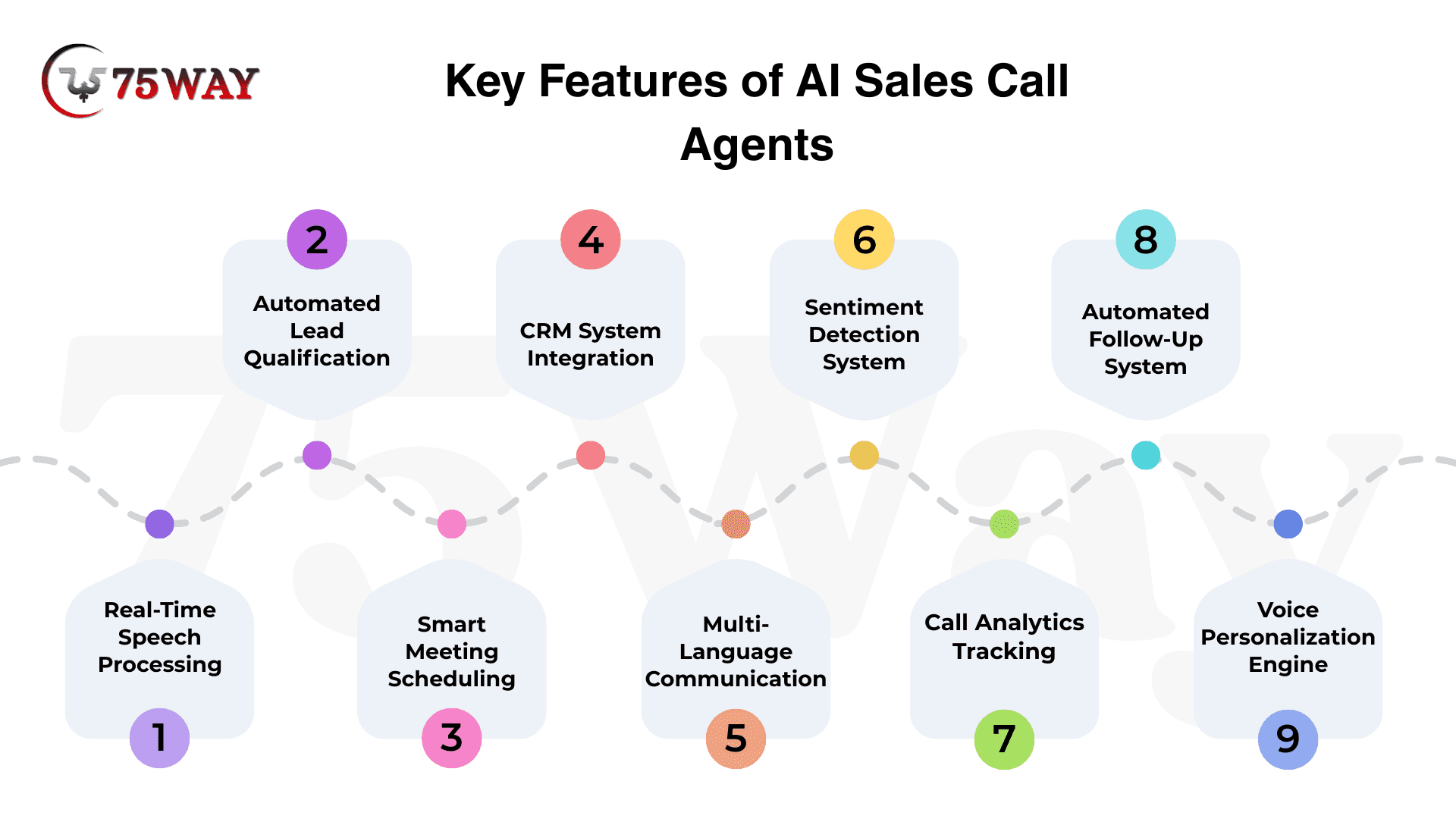
- Real-Time Speech Processing: Instant processing of spoken input allows an AI calling agent to understand user intent and respond during live conversations. This creates a smooth interaction flow without delays. Communication quality remains natural while ensuring accurate and context-aware responses across different sales scenarios.
- Automated Lead Qualification: Based on predefined business rules, an AI sales calling agent evaluates prospects during conversations to identify potential customers. Sales teams receive filtered, high-quality leads. Manual screening effort reduces significantly while pipeline efficiency improves across sales operations.
- Smart Meeting Scheduling: During live interactions, an AI sales call agent directly books meetings according to availability and user preference. Coordination delays are eliminated. Sales conversions increase as scheduling becomes faster and fully automated within the conversation flow.
- CRM System Integration: Seamless synchronization of conversation data happens with CRM platforms in real time. Lead records update automatically. Sales tracking improves while teams maintain accurate and structured customer interaction history across systems.
- Multi-Language Communication: Support for multiple languages enables an AI calling agent in sales to interact with global customers effectively. Language barriers reduce. Businesses expand their reach while maintaining consistent communication quality across diverse markets.
- Sentiment Detection System: Emotional tone analysis helps an agentic AI calling system adjust responses during conversations. Customer mood is identified accurately. Engagement quality improves as communication becomes more empathetic and context-aware.
- Call Analytics Tracking: Detailed conversation insights are recorded after each call for performance evaluation. Sales strategies improve using data-driven insights. Teams identify patterns and optimize future customer interactions effectively.
- Automated Follow-Up System: After initial calls, the AI-powered calling agent triggers follow-up actions based on conversation outcomes. Customer engagement remains continuous. Sales opportunities increase through timely reminders and structured communication sequences.
- Voice Personalization Engine: Generate personalized voice responses based on customer profile and interaction history. Conversations feel more human-like and relevant. Customer trust and engagement improve through tailored communication experiences.
Benefits of Developing AI Phone Call Agents
AI phone call agents bring significant improvements to modern sales operations by transforming how businesses engage with prospects, manage outreach, and scale communication efforts. They reduce manual workload while increasing speed, accuracy, and consistency across every stage of the sales process, enabling teams to focus more on closing deals and strategic growth.
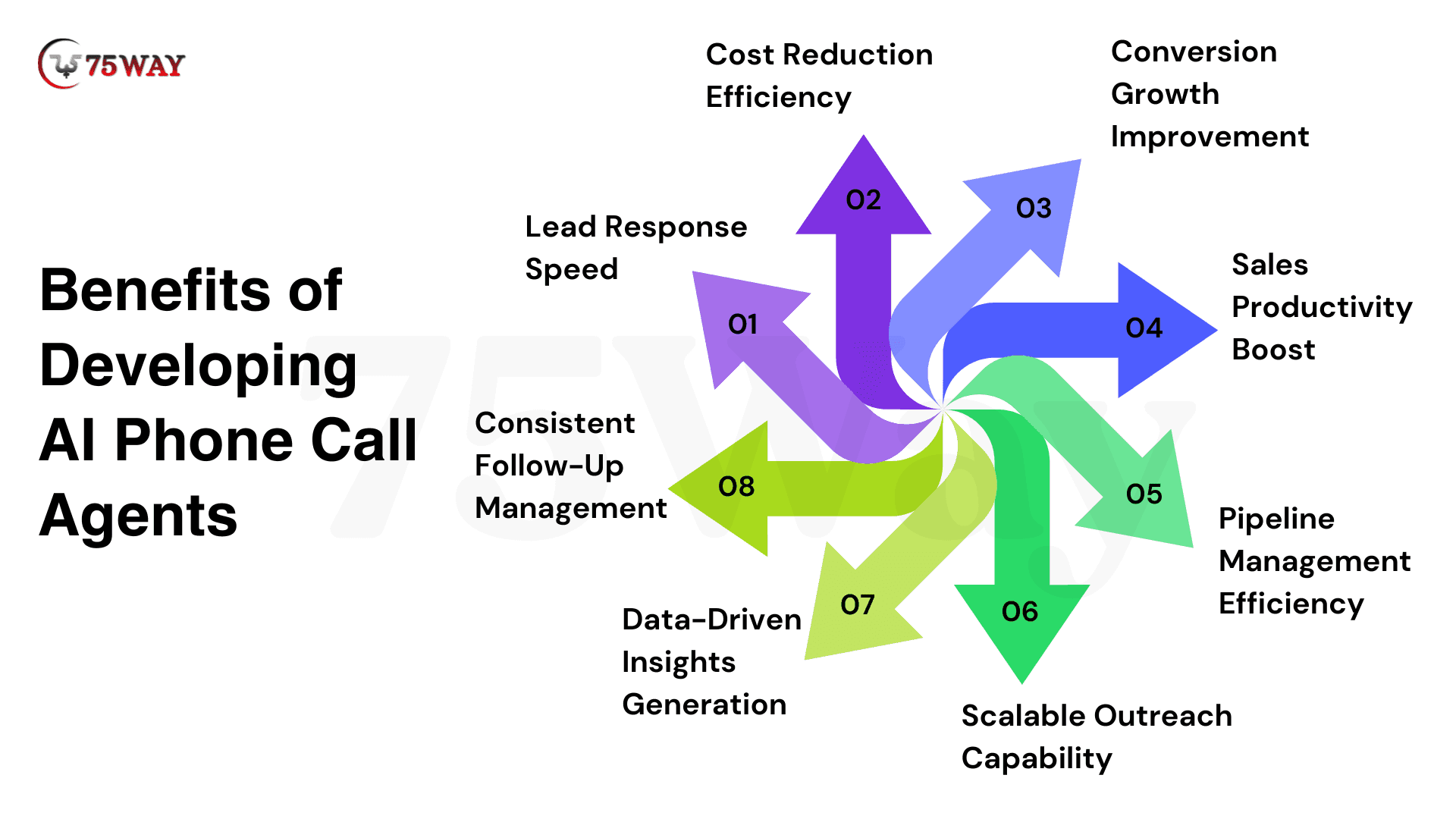
- Lead Speed: Increase response time to prospects and boost engagement across outbound and inbound communication channels.
- Cost Reduction: Reduce operational expenses by automating repetitive calling tasks and minimizing manual sales effort requirements.
- Conversion Growth: Improve sales conversions through consistent follow-ups and timely, relevant prospect interactions.
- Productivity Boost: Enhance sales team output by automating outreach and freeing time for high-value activities.
- Pipeline Efficiency: Streamline sales funnel management with better lead tracking and qualification processes.
- Scalability Reach: Expand outreach capacity without increasing team size or operational complexity.
- Data Insights: Generate actionable insights from call data to improve sales strategy and targeting decisions.
- Follow Consistency: Maintain regular and structured follow-ups to nurture leads effectively across sales cycles.
Use Cases of Conversational AI Sales Calling Agents
AI calling agents are widely applied across industries to improve communication efficiency, streamline lead handling, and enhance customer interactions. They help organizations automate repetitive calling tasks while maintaining personalized engagement at scale. This makes sales and support processes faster, more consistent, and more data-driven across different business models.
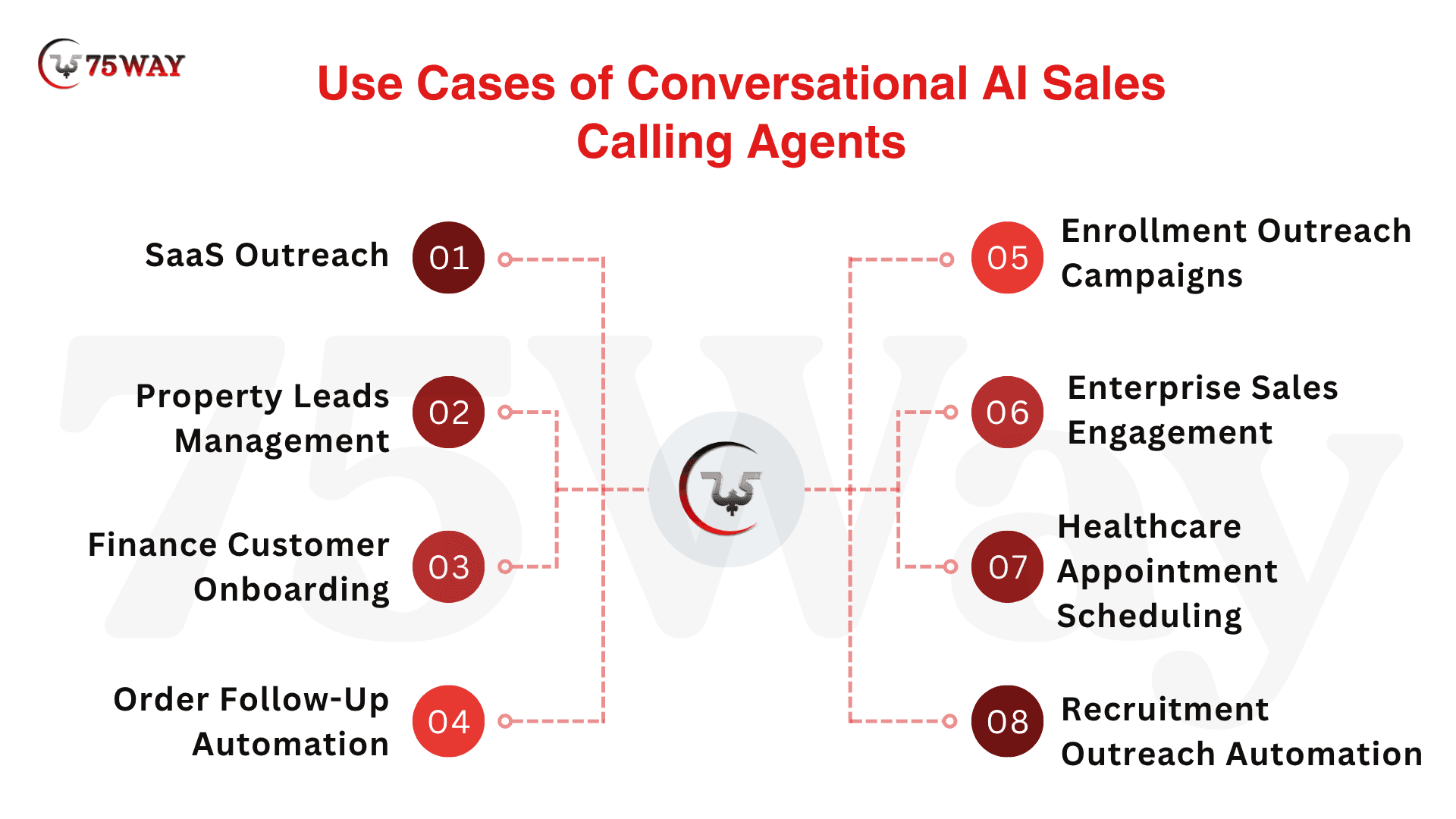
- SaaS Outreach: Automatically engage prospects and qualify leads based on product interest and response behavior. Automation reduces manual sales workload and improves conversion pipeline quality. Growth teams use this approach to scale outreach without increasing sales team size.
- Property Leads: Calling AI agents for real estate handle property inquiries and schedule visits through automated conversational calling systems. Faster response time improves chances of converting interested buyers and renters. Real estate teams rely on this to manage high inquiry volumes efficiently.
- Finance Onboarding: Conduct customer onboarding calls and verify essential financial details through automated voice interactions. Faster verification shortens account activation cycles and reduces dependency on manual checks. Financial institutions adopt this workflow to improve operational speed.
- Order Followups: rack customer orders and collect feedback using automated post-purchase calling workflows. Timely communication improves customer satisfaction and strengthens retention rates. E-commerce platforms apply this to increase repeat purchase behavior.
- Enrollment Outreach: Contact potential students and share admission details through AI-driven calling systems. Higher engagement improves enrollment conversion rates across campaigns. Education providers use this method to manage large applicant databases.
- Enterprise Sales: Engage high-value corporate prospects through structured AI-driven calling workflows. Conversations help qualify decision-makers and gather requirement details. Sales teams use this to shorten enterprise deal cycles and improve pipeline quality.
- Healthcare Scheduling: Connect with patients to confirm appointments and manage rescheduling through automated calls. Conversational AI agents in healthcare reduce no-show rates and improve clinic efficiency. Healthcare providers rely on this to optimize daily appointment management.
- Recruitment Outreach: Contact job candidates for screening, interview scheduling, and follow-up communication. Automated conversations by sales AI agents help filter applicants based on role suitability faster. HR teams use this to streamline hiring workflows and reduce manual coordination efforts.
Cost to Build AI Sales Calling Agents in 2026
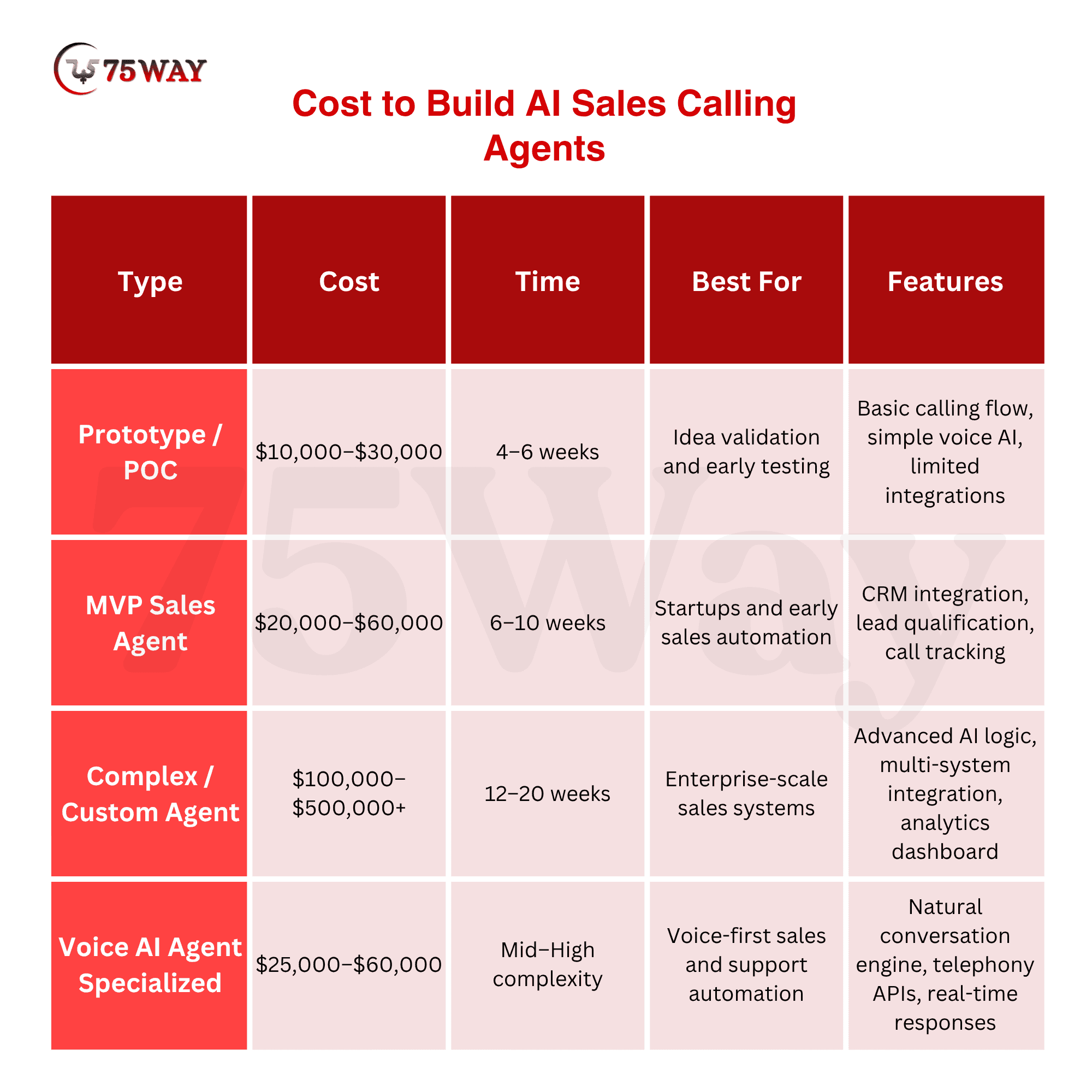
The cost of developing AI calling agents depends on system complexity, integrations, and intelligence level. On average, development costs typically range between $10,000 to $500,000+. Basic versions with limited automation can start at a lower investment range, while advanced enterprise systems with real-time intelligence and full CRM integration require higher budgets.
- Prototype / POC: $10,000 – $30,000
Typically delivered within 4–6 weeks to validate core functionality and concept.
- MVP Sales Agent: $20,000 – $60,000
Built in 6–10 weeks with essential features for lead handling and sales automation.
- Complex/Custom Agent: $100,000 – $500,000+
Developed over 12–20 weeks with advanced capabilities, integrations, and scalability.
- Voice AI Agent (Specialized): $25,000 – $60,000
Designed for mid-to-high complexity use cases with advanced voice processing and interaction capabilities.
Factors That Impact Cost To Create AI Sales Call Agent
The cost of building an AI sales call agent depends on system complexity, integrations, AI capabilities, and required scalability. Advanced features, real-time voice processing, and enterprise-grade infrastructure significantly increase development investment while simpler systems remain more affordable for early-stage implementation.
- Feature Complexity: Determines the depth of AI conversation, automation, and workflow capabilities
- Voice Technology Stack: Impacts cost through speech recognition and synthesis quality requirements
- CRM Integration Level: Affects pricing based on the number and complexity of connected systems
- Telephony Infrastructure: Influences cost depending on call volume handling and API usage
- AI Model Sophistication: Higher intelligence models require more training and computing resources
- Data Processing Needs: Large-scale real-time data handling increases infrastructure expenses
- Security Compliance: Enterprise-grade encryption and compliance add development overhead
- Scalability Requirements: Systems designed for high traffic demand a stronger architecture investment
Future Trends in AI Calling Agents in Sales
The future of AI calling systems is moving toward fully autonomous sales communication networks. These systems will not only handle conversations but also predict buying intent, personalize outreach at scale, and coordinate entire sales cycles without manual intervention.
- Autonomous Sales Workflows: AI systems will manage entire outreach, qualification, and scheduling cycles without manual involvement
- Intent Prediction Models: Advanced algorithms will detect buying signals earlier and prioritize high-value prospects automatically
- Omnichannel Communication: AI calling agents will coordinate voice, email, and messaging into unified sales engagement flows
- Hyper Personalization Engines: Outreach will adapt in real time based on user behavior, context, and interaction history
- Real-Time Decision Systems: AI will adjust conversation strategy instantly during live calls based on responses and sentiment
- Continuous Learning Networks: Systems will improve performance over time by analyzing every interaction and optimizing future conversations
Final Thoughts
AI calling agents are reshaping how modern sales teams approach outreach, lead qualification, and customer engagement. They bring speed, consistency, and intelligence into every interaction, helping businesses scale without increasing operational pressure. From automating repetitive calling tasks to improving conversion quality through real-time insights, these systems create a measurable impact on revenue performance. The key is not just implementation but building systems that continuously learn, adapt, and improve with time, ensuring long-term sales efficiency and growth. For businesses ready to scale intelligent sales operations, partnering with an AI agent development company can accelerate deployment and ensure a future-ready, high-performance solution.
Frequently Asked Questions (FAQs)
How Do AI Calling Agents Improve Customer Engagement In Real Time?
AI calling agents improve engagement by analyzing speech patterns, tone, and response timing during live conversations. They adjust dialogue dynamically to match user intent, creating more relevant interactions. This responsiveness increases trust, reduces drop-offs, and helps maintain consistent communication quality across different customer touchpoints.
What Industries Benefit Most From Voice-Based AI Systems?
Voice-based AI systems benefit industries with high customer interaction volumes, such as finance, healthcare, education, and retail. These sectors rely on frequent communication for onboarding, support, and updates. Automation reduces manual workload while maintaining consistent service quality and faster customer response times.
How Do AI Calling Systems Handle Complex Customer Objections?
AI systems handle objections by recognizing keywords, sentiment, and conversational context in real time. They trigger predefined response strategies or adaptive dialogue flows to address concerns. This structured approach helps maintain engagement, resolve hesitation, and guide conversations toward positive outcomes without human involvement.
What Makes AI Calling Different From Traditional Dialers?
AI calling differs from traditional dialers by using intelligent conversation models instead of pre-recorded scripts. It understands intent, adapts responses, and manages dialogue flow naturally. Traditional systems rely on fixed sequences, while AI systems learn from interactions and improve communication quality continuously over time.
How Secure Are AI-Based Communication Systems For Businesses?
AI-based communication systems use encryption, authentication layers, and secure cloud infrastructure to protect sensitive data. Access controls and compliance frameworks ensure safe handling of customer information. Regular monitoring and updates further reduce risks, making these systems reliable for enterprise-level communication needs.
How Do Businesses Measure the Performance Of AI Sales Calling Agents?
Businesses measure performance using metrics like call success rate, lead conversion rate, response accuracy, and conversation completion time. Analytics dashboards track engagement quality and system efficiency. These insights help teams optimize workflows, improve targeting, and enhance overall sales effectiveness through data-driven decisions.