Summary
Tensions between the United States, Israel, and Iran are disrupting global businesses across industries. Energy prices are rising, supply chains are slowing, and cyber threats are increasing. From aviation disruptions to semiconductor risks, the conflict is reshaping global trade. Advanced technologies such as AI, predictive analytics, and digital supply-chain systems are becoming essential tools for businesses navigating geopolitical uncertainty.
Key Takeaways
- The US-Israel-Iran conflict is disrupting global trade, supply chains, and energy markets
- Airspace closures and shipping risks are affecting aviation and logistics
- Oil and gas supply disruptions are increasing global energy prices
- Technology companies face growing cyberattack threats
- Businesses are adopting AI and digital tools to manage geopolitical risks
- Technology-driven resilience strategies are becoming essential for global operations
Nearly 20% of the world’s oil supply flows through the Strait of Hormuz, a strategic waterway located near Iran. Even minor disruptions in this region can trigger immediate shocks in energy prices, shipping routes, and global markets.
The ongoing geopolitical tensions between the United States, Israel, and Iran are already sending ripple effects across industries worldwide. Airlines are rerouting flights, supply chains are slowing, financial markets are reacting to uncertainty, and energy prices are fluctuating in response to rising risks.
For businesses operating in interconnected global markets, geopolitical conflicts are no longer distant political events. They directly affect logistics networks, technology infrastructure, and operational costs. Businesses across sectors are increasingly turning to advanced technologies such as artificial intelligence solutions, predictive analytics, digital supply-chain platforms, and cybersecurity systems to reduce risks and maintain stability during periods of geopolitical disruption.
The curated guide examines the conflict, its major impacts on global industries, and suggests the role technology can play in helping businesses navigate uncertainty.
What Is US-Israel-Iran Conflict?
The US-Israel-Iran conflict represents one of the most complex geopolitical tensions in the Middle East, involving military actions, political alliances, economic sanctions, and strategic competition for regional influence.
Israel and Iran have long maintained hostile relations, with tensions escalating over Iran’s nuclear program and regional military activities. The United States has historically supported Israel while also imposing economic sanctions and diplomatic pressure on Iran.
Recent developments, including military operations, drone strikes, and cyber activities, have intensified tensions and raised concerns about a broader regional conflict. As the situation evolves, its economic consequences are spreading beyond the Middle East and affecting industries across the global economy.
This geopolitical instability is particularly significant because the region plays a vital role in global energy supply, international shipping routes, and digital infrastructure expansion.
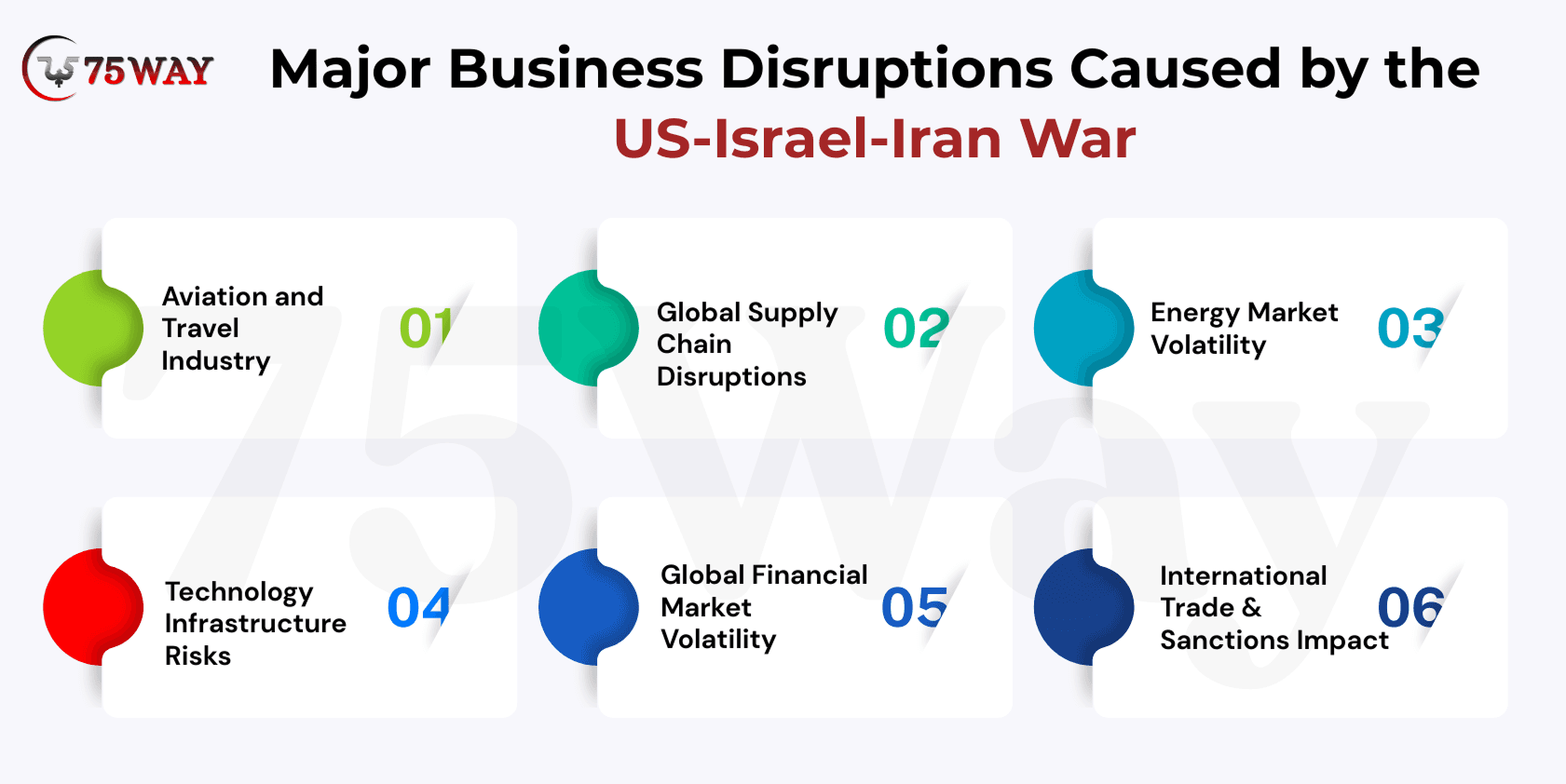
Major Business Disruptions Caused by the US-Israel-Iran War
The escalating confrontation involving the United States, Israel, and Iran has triggered widespread disruptions across global industries. What initially began as a regional military escalation has quickly evolved into an economic shock affecting aviation, energy markets, supply chains, and digital infrastructure worldwide. Businesses are now confronting rising operational costs, volatile markets, and increased uncertainty across critical trade routes.
Aviation and Travel Industry
The aviation sector has experienced one of the most immediate and visible disruptions. Airspace closures across parts of the Middle East forced airlines to cancel roughly 40,000 flights, creating the largest aviation disruption since the pandemic and stranding thousands of passengers across major transit hubs such as Dubai and Doha.
These closures affect not only passenger travel but also global cargo networks. Many international passenger flights carry freight in their cargo holds, meaning cancellations significantly reduce air-freight capacity. Airlines operating between Europe and Asia have been forced to reroute flights around longer corridors, increasing fuel consumption, travel time, and operational costs. In addition, business aviation activity across the Middle East dropped sharply as companies reduced travel due to security risks and logistical uncertainty.
Global Supply Chain Disruptions
Modern supply chains rely heavily on predictable transportation routes and stable logistics infrastructure. The conflict has raised serious concerns about the reliability of trade corridors linking Asia, Europe, and the Middle East.
Cargo shipments ranging from food products and electronics to automobile components have been delayed due to reduced freight capacity and increased shipping risk. Companies across industries are already reporting delays in receiving raw materials and intermediate goods.
Shipping insurers have raised war-risk premiums for vessels operating in the region, while several maritime operators have slowed or paused operations due to security concerns. These disruptions increase transportation costs and extend delivery timelines, creating ripple effects across manufacturing, retail, and global commerce.
Energy Market Volatility
Energy markets have reacted rapidly to the conflict due to the strategic importance of the Gulf region. One of the most critical chokepoints in global energy supply is the Strait of Hormuz, through which roughly 20% of the world’s oil supply passes daily.
Even the possibility of disruption in this corridor can drive significant price volatility. Analysts warn that a severe escalation or closure of the strait could push oil prices above $130 per barrel, dramatically increasing fuel costs for transportation, manufacturing, and logistics industries.
Higher energy prices can quickly translate into rising costs for businesses and consumers, contributing to inflation and slowing economic growth worldwide.
Technology Infrastructure Risks
Modern conflicts increasingly extend beyond physical battlefields into cyberspace. Cyber warfare activity has intensified as state-aligned groups and hacktivist networks target government institutions, energy companies, financial systems, and digital infrastructure.
More than 60 hacking groups have reportedly conducted cyber operations linked to the conflict, including distributed denial-of-service attacks, phishing campaigns, and infrastructure disruptions targeting organizations across multiple countries.
For global businesses, this escalation introduces new cybersecurity risks. Cloud services, financial institutions, and digital platforms are potential targets, forcing companies to increase investments in cybersecurity defenses and threat-monitoring systems.
Global Financial Market Volatility
Geopolitical conflicts typically trigger immediate reactions in global financial markets. Stock indices, commodities, and currency markets often experience rapid fluctuations as investors assess economic risks and geopolitical uncertainty.
Major stock markets recorded declines following the escalation of hostilities, while investors shifted capital toward safe-haven assets such as gold and energy stocks. Analysts warn that prolonged conflict could increase inflation pressures, disrupt trade flows, and weaken economic growth forecasts in several major economies. Investor uncertainty can also slow capital investment, delay expansion plans, and reduce venture funding for startups and emerging industries.
International Trade & Sanctions Impact
Geopolitical conflicts frequently trigger new sanctions, export controls, and trade restrictions that complicate international commerce. Businesses operating across borders must navigate regulatory risks, compliance requirements, and potential supply shortages.
The current conflict has already raised concerns about restrictions on critical raw materials, semiconductor manufacturing inputs, and energy exports. Trade disruptions can affect industries ranging from automotive manufacturing to consumer electronics.
For multinational corporations and global startups, the war highlights the growing importance of geopolitical risk management, diversified supply chains, and resilient logistics networks.
Industries Most Affected by This US-Israel-Iran Conflict
The escalating tensions between the United States, Israel, and Iran are impacting multiple global industries that rely on a stable energy supply, secure trade routes, and predictable logistics networks. Sectors such as energy, aviation, semiconductor manufacturing, global logistics, and automotive production are particularly vulnerable due to rising oil prices, supply-chain disruptions, and shipping risks around the Strait of Hormuz, a corridor responsible for about 20% of global oil trade.
Energy, Gas, & Oil Markets: Energy companies are among the first to feel the impact of geopolitical conflicts in major oil-producing regions. The United States-Israel-Iran war creates uncertainty around oil production and transportation. Any disruption near the Strait of Hormuz, a corridor responsible for a large share of global oil shipments, can trigger sharp price spikes, increase fuel costs, and affect energy-dependent industries worldwide.
Aviation and Tourism: Airlines, travel platforms, and tourism operators are highly sensitive to geopolitical instability. Airspace restrictions across the Middle East force carriers to cancel or reroute flights, increasing operational costs and travel times. Reduced traveler confidence also affects tourism demand, hotel bookings, and international business travel across key global transit hubs.
Semiconductor Manufacturing: The semiconductor industry depends on complex global supply chains involving rare minerals, specialized manufacturing facilities, and international distribution networks. Geopolitical tensions can disrupt access to critical materials, delay shipments of chip components, and increase uncertainty for electronics manufacturers and technology companies that rely on steady semiconductor supply.
Global Logistics and Shipping: Shipping companies and logistics providers face heightened risks when geopolitical conflicts affect major maritime corridors. Insurance premiums for vessels operating near conflict zones increase significantly, while longer shipping routes and port congestion lead to cargo delays. These disruptions ripple across retail, manufacturing, and global trade networks.
Technology Infrastructure: Cloud service providers, telecommunications companies, and data-center operators must strengthen defenses during periods of geopolitical instability. Cyber warfare and digital espionage often escalate during conflicts, making critical infrastructure such as cloud networks, enterprise systems, and communication platforms potential targets for cyberattacks.
Manufacturing and Automotive: Manufacturing sectors rely on global supply chains for raw materials, industrial components, and cross-border distribution. Disruptions to shipping routes, rising energy prices, and geopolitical trade restrictions can delay production cycles and increase manufacturing costs, particularly for automotive and heavy industrial equipment producers.
Financial Services and Banking: Financial institutions face increased volatility during geopolitical crises. Currency fluctuations, commodity price shocks, and rapid shifts in investor sentiment can affect capital markets and investment strategies. Banks must also navigate evolving sanctions regulations and compliance requirements linked to international conflict.
Telecommunications & Digital Infrastructure: Telecommunications networks and digital communication systems are essential for global connectivity. Conflicts can expose these networks to cyberattacks, surveillance risks, and infrastructure disruptions. Protecting internet backbone systems, satellite communication networks, and mobile infrastructure becomes critical for maintaining business continuity in an increasingly digital economy.
How Technology Can Help Businesses Manage Geopolitical Risks?
Technological solutions help businesses manage geopolitical risks by improving visibility, prediction, and operational resilience across global operations. Advanced tools such as artificial intelligence, predictive analytics, cybersecurity systems, digital supply-chain platforms, and logistics software enable businesses to monitor geopolitical signals, anticipate disruptions, secure digital infrastructure, and maintain stable logistics networks during conflicts.
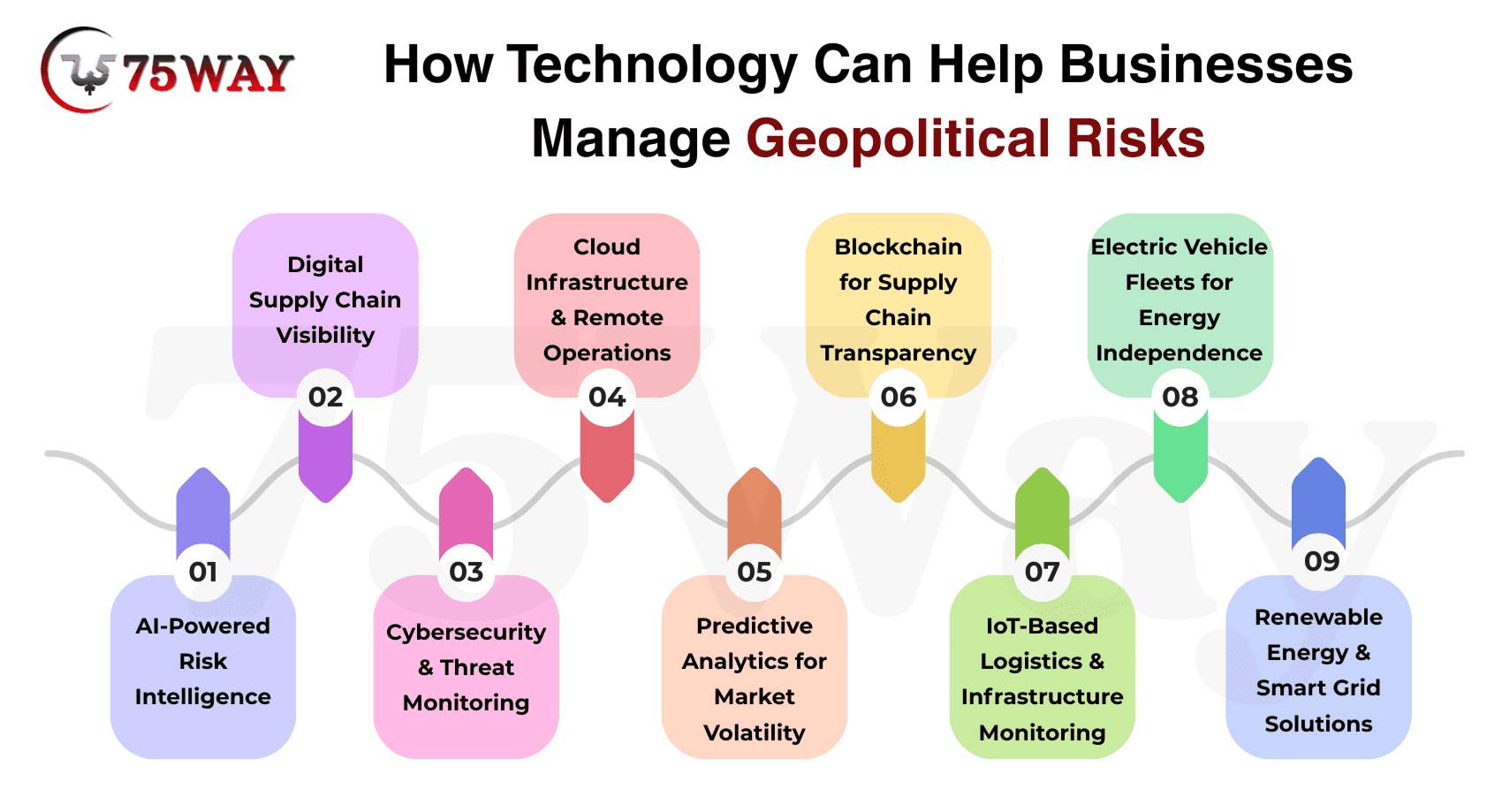
AI-Powered Risk Intelligence: Artificial intelligence platforms analyze geopolitical developments, economic indicators, and global data streams to detect emerging risks. These systems help businesses identify potential disruptions early. It enables faster strategic decisions and proactive responses to conflicts affecting supply chains, energy markets, and international trade operations.
Digital Supply Chain Visibility: Modern digital supply-chain platforms provide real-time visibility into logistics networks, shipments, and supplier activities. Businesses can track cargo movements, identify bottlenecks, and quickly reroute shipments when disruptions occur. Integrating intelligent logistics platforms with e-mobility solutions also improves transportation efficiency and resilience across global delivery networks.
Cybersecurity & Threat Monitoring: Advanced cybersecurity systems are essential during geopolitical conflicts when cyberattacks targeting businesses often increase. AI-driven threat monitoring tools continuously analyze network activity, detect suspicious behavior, and protect critical business infrastructure, cloud environments, and enterprise systems from cyber threats.
Cloud Infrastructure & Remote Operations: Cloud computing enables businesses to maintain operational continuity even when physical offices or infrastructure are disrupted. Distributed cloud environments allow teams to collaborate remotely, store data securely, and operate essential systems from multiple geographic locations, improving resilience during geopolitical crises.
Predictive Analytics for Market Volatility: Predictive analytics platforms analyze financial data, commodity prices, and economic indicators to forecast market fluctuations during geopolitical instability. These insights help companies adjust procurement strategies, manage costs, and respond proactively to changes in oil prices, currency exchange rates, and global demand patterns.
Blockchain for Supply Chain Transparency: Blockchain-powered systems provides secure and transparent transaction records across supply chains. By verifying supplier activities and tracking goods through distributed ledgers, businesses can maintain trust, reduce fraud risks, and ensure compliance even when geopolitical conflicts disrupt traditional supply-chain operations.
IoT-Based Logistics & Infrastructure Monitoring: Internet of Things (IoT) devices enable real-time monitoring of cargo shipments, transportation fleets, and logistics infrastructure. Businesses can invest in IoT development solutions, and wearable apps that use sensors embedded in vehicles, containers, and warehouses help companies track assets, detect disruptions quickly, and optimize logistics management across global transportation networks.
Electric Vehicle Fleets for Energy Independence: Electric vehicle fleets help organizations reduce reliance on fossil fuels that are vulnerable to geopolitical price fluctuations. Companies adopting electric transportation supported by EV software development solutions and AI-powered ride-sharing apps can improve operational efficiency while stabilizing long-term energy and transportation costs.
Renewable Energy & Smart Grid Solutions: Renewable energy systems combined with smart grid technologies allow businesses to generate, store, and manage their own power supply. By integrating solar, wind, and energy-management platforms, companies can reduce dependence on volatile global energy markets and maintain stable operations during geopolitical disruptions.
Critical Challenges Businesses Still Face During Global Instability
Global instability continues to create complex challenges for businesses operating across international markets. Conflicts, geopolitical tensions, and economic uncertainty can disrupt trade routes, energy supply, and financial systems simultaneously. As global economies become more interconnected, companies must navigate regulatory changes, rising operational costs, market volatility, and infrastructure risks while maintaining resilient and sustainable business operations.
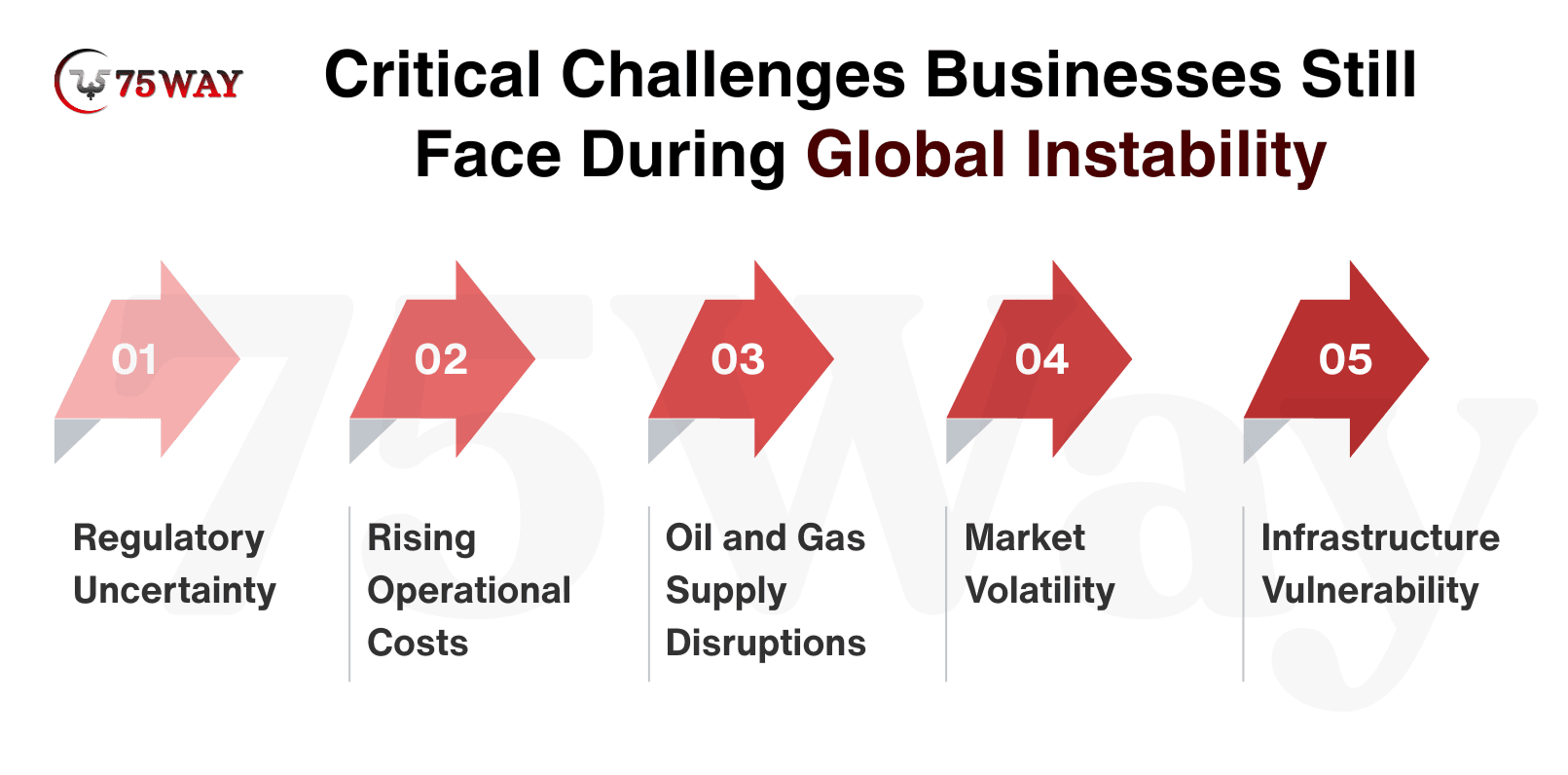
Regulatory Uncertainty: Rapid policy changes, sanctions, and evolving trade regulations often emerge during geopolitical conflicts. Governments may impose export controls, financial restrictions, or new compliance requirements that affect cross-border transactions. These unpredictable regulatory shifts make long-term planning difficult for multinational corporations and global supply-chain operators.
Rising Operational Costs: Geopolitical instability frequently increases operational expenses. Rising fuel prices, higher insurance premiums for cargo shipments, and investments in security infrastructure can significantly impact company budgets. Businesses must also allocate additional resources to protect digital systems, maintain alternative supply routes, and manage logistics disruptions.
Oil and Gas Supply Disruptions: Energy supply uncertainty is one of the most immediate consequences of geopolitical conflicts. Disruptions to oil and gas production or transportation routes can trigger rapid price increases, affecting transportation, manufacturing, and energy-dependent industries. Businesses relying on fuel-intensive operations often experience higher operational costs and supply uncertainties.
Market Volatility: Financial markets often react immediately to geopolitical developments. Commodity prices, currencies, and stock markets can experience sharp fluctuations as investors respond to uncertainty. This volatility can complicate investment decisions, delay expansion plans, and create challenges for companies seeking stable financing or long-term growth strategies.
Infrastructure Vulnerability: Critical infrastructure such as ports, transportation hubs, energy facilities, and communication networks can become strategic targets during conflicts. Damage or disruption to these systems can halt logistics operations, interrupt energy supply, and impact digital connectivity, forcing businesses to develop contingency plans and resilient infrastructure strategies.
Final Thoughts
The US-Israel-Iran conflict demonstrates how geopolitical instability can rapidly disrupt global markets, supply chains, and critical infrastructure. Businesses operating in interconnected international markets must prepare for sudden disruptions that affect logistics networks, energy prices, international trade routes, and digital security. Organizations that adopt advanced technologies, strengthen supply-chain visibility, and invest in cybersecurity and predictive analytics are better positioned to manage uncertainty. Building resilient digital systems, diversified supply chains, and proactive risk-management strategies is essential for maintaining operational stability and long-term growth during periods of geopolitical tension. If you want to build resilient digital systems and future-proof your global operations, partner with a reliable AI-led IT service provider today.
Frequently Asked Questions (FAQs)
What Are The Economic Consequences of Geopolitical Conflicts?
Geopolitical conflicts can trigger widespread economic disruptions by increasing energy prices, interrupting global trade routes, and destabilizing financial markets. Businesses often face higher transportation costs, delayed supply chains, reduced investment confidence, and inflationary pressures. These factors collectively slow economic growth and create operational uncertainty for companies operating across international markets.
Why Do Energy Prices Increase During International Conflicts?
Energy prices typically rise during international conflicts because oil and gas production facilities, pipelines, and shipping routes may be threatened or disrupted. Key transit corridors, such as major maritime oil routes, become vulnerable during geopolitical tensions, creating supply uncertainty that pushes global fuel prices higher.
Which Technologies Help Businesses Manage Global Risks?
Businesses increasingly rely on advanced technologies such as artificial intelligence, predictive analytics, cybersecurity systems, blockchain platforms, and digital supply-chain management tools. These technologies help organizations monitor geopolitical developments, protect digital infrastructure, improve logistics visibility, and respond quickly to disruptions affecting international operations.
Why Are Supply Chains Vulnerable During Wars?
Global supply chains depend on stable transportation networks, predictable logistics operations, and uninterrupted trade agreements. During wars or geopolitical conflicts, airspace closures, shipping delays, sanctions, and infrastructure disruptions can interrupt the movement of goods, creating shortages, delivery delays, and increased operational costs.
How Can Companies Improve Business Resilience During Global Crises?
Companies can improve resilience by diversifying suppliers, adopting digital supply-chain monitoring systems, strengthening cybersecurity frameworks, and implementing risk-management strategies. Building flexible logistics networks and investing in technology-driven analytics also help you respond quickly to unexpected disruptions.
Why Is Cybersecurity Important During Geopolitical Tensions?
Cybersecurity becomes critical during geopolitical tensions because modern conflicts often include cyber warfare targeting government systems, financial institutions, and corporate infrastructure. Strengthening cybersecurity defenses helps businesses protect sensitive data, prevent operational disruptions, and maintain trust with customers and partners during periods of global instability.