Being a startup founder or entrepreneur, imagine you visit the Las Vegas Convention Centre during CES 2026. There are thousands of tech booths, flashing lights, and the hype of innovation everywhere. Isn't it exciting? Yes, it is! But overwhelming too.
A question suddenly comes to mind, "How does anyone separate hype from real value when every product seems beneficial?" At that time, asking the right questions becomes essential for buyers, founders, investors, and startups.
CES 2026 promises to bring together startups, tech giants, AI innovators, mobility pioneers, and enterprise technology buyers from across the globe. Yet, you have limited time to visit thousands of exhibitors. And speaking to everyone isn’t an option. That's why we're wrapping up a list of must-ask questions for the CES event 2026. So, waiting for what? Let's start.
Why Asking the Right Questions at CES 2026 Matters?
At CES 2026, when you walk past flashy demos and sleek displays, it can feel like walking through a tech wonderland. Everything looks polished, promising, and impressive. But appearances can deceive. Without the right questions, even the most innovative product might be a concept-stage prototype, or worse, a solution that does not fit your market.
A single well-structured conversation can reveal all of that. The right questions to be asked at CES 2026 Las Vegas can act as a filter. A carefully crafted question for AI platforms, EV technologies, robotics, or IoT solutions can help you assess investment, compliance, and long-term viability.
Top Questions to Ask Tech Exhibitors at CES 2026 Las Vegas
Not every booth at CES Vegas 2026 tells the same story. Some exhibitors bring bold ideas; others bring market-ready products; and still others offer complete tech solutions. The right questions help you spot the difference fast. A few thoughtful conversations can reveal what is real and what is still just a promise.
Product & Technology Readiness
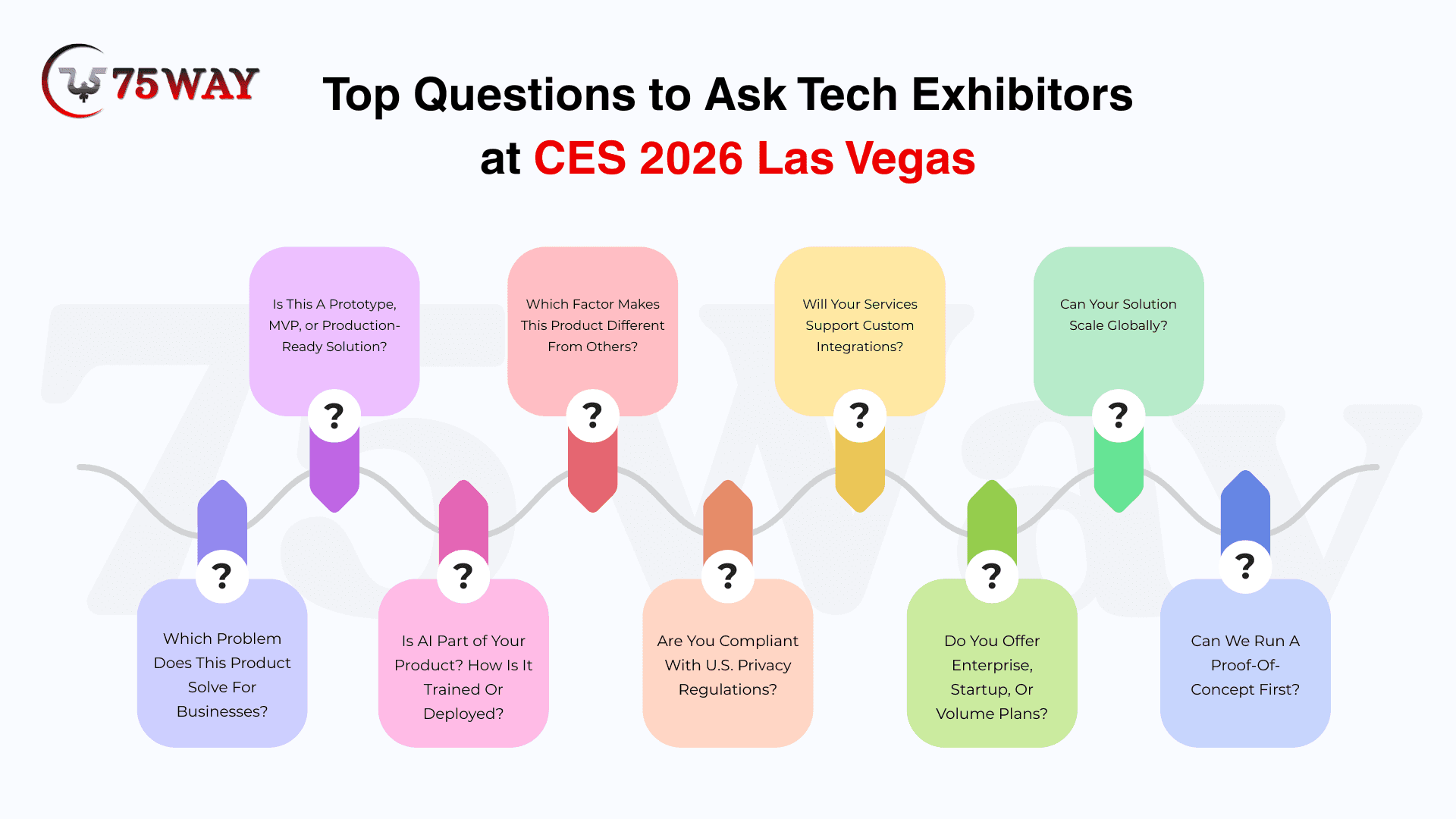
Is AI Part of Your Product? How Is It Trained Or Deployed?
AI solutions sound impressive on the show floor of CES event 2026, yet real value depends on training sources, deployment approach, and reliability. Exhibitors must provide answers to reveal whether artificial intelligence exists in practice or only inside marketing language.
Is this a prototype, MVP, or production-ready solution?
The product stage defines risk. A production-ready solution usually includes stability, documentation, and support, while prototypes focus on vision. This clarity prevents false expectations and saves time during evaluation.
Which problem does this product solve for businesses?
Strong products address specific operational or revenue challenges. Clear problem statements show focus, market awareness, and real demand. Vague responses often point toward concepts rather than deployable solutions.
Which factor makes this product different from others?
Meaningful differentiation appears through performance, cost, speed, or usability. Genuine answers highlight defensible advantages, not surface-level features. This question assesses whether competition is well understood.
Where is this technology already being used successfully?
Live deployments indicate trust and readiness. Real use cases, client references, or pilot outcomes show that the product works beyond demos and controlled environments.
Data Privacy & Security Questions
How do you protect user data?
Data protection practices show responsibility and maturity. Structured policies around access control, internal roles, and monitoring build confidence. Strong answers describe accountability and routine checks rather than vague assurances or marketing language.
Where is data stored and processed?
Data location affects trust and compliance. A disclosure around storage regions and processing centers helps businesses assess legal exposure. Transparency here supports informed decisions across regulated industries.
Are you compliant with U.S. privacy regulations?
Regulatory alignment reduces legal risk. A reference to applicable U.S. privacy laws demonstrates readiness for enterprise use. Confidence grows when compliance remains active rather than aspirational.
Do you comply with SOC 2, HIPAA, GDPR, or similar standards?
Standard adherence reflects operational discipline. Recognized frameworks show internal controls and audit readiness. Buyers often treat this as a baseline for serious consideration.
How do you manage access and internal controls?
Access discipline limits internal risk. Defined permission levels and audit trails indicate control maturity. A complete structure reassures buyers that misuse prevention is in place within the organization.
Integration and Compatibility
Does your product integrate with AWS, Azure, or Google Cloud?
Cloud platform compatibility matters because many businesses rely on these systems daily. Smooth integration prevents delays and simplifies future expansion. Companies can plan deployments with confidence when the vendor clearly supports familiar platforms, avoiding unexpected adjustments later.
Do you support APIs or SDKs?
APIs and SDKs enable software to communicate with existing systems. Clear access here ensures that future customization or feature additions can happen without significant disruptions. This makes adoption faster and keeps internal teams aligned.
Is your solution compatible with major USA systems and hardware?
Compatibility reduces surprises during installation. When software works seamlessly with standard operating systems and hardware, teams can adopt it without technical roadblocks. Confirmed compatibility gives decision-makers confidence that daily operations will not be disrupted.
How does onboarding work?
Onboarding defines the user experience from day one. Structured steps, clear timelines, and available support reduce errors and speed adoption. Smooth onboarding means teams start using the system, which makes early progress and feedback easier to capture.
Will your services support custom integrations?
Custom integrations show flexibility for unique needs. If a product integrates with specialized tools or workflows, adoption becomes easier. Vendors who explain realistic possibilities give buyers confidence that the solution will adapt to business requirements over time.
Business & Pricing Questions
What is your pricing model in the U.S. market?
Pricing in the U.S. market reflects business strategy and client focus. Understanding cost structure allows buyers to plan budgets realistically, and predictable rates create confidence.
Do you offer enterprise, startup, or volume plans?
Different plans demonstrate awareness of diverse organizational needs. Enterprise, startup, and high-volume packages match specific requirements, guiding decision-makers toward the best fit. This flexibility ensures businesses can choose arrangements that meet current demands while allowing gradual growth over time.
Are there setup, licensing, or recurring costs?
Complete knowledge of setup, license, and ongoing fees supports careful planning. Early insight into costs prevents surprises that could disrupt operations or budgets. Businesses feel secure when vendors outline all financial commitments, helping teams prepare without uncertainty or hesitation.
Do you provide pilot programs or trial phases?
Pilot programs provide practical exposure before full adoption and enable evaluation in real-world conditions. Short-term trials reveal performance, compatibility, and usability, which builds trust. You will gain clarity on expectations and reduce risk when making long-term investment decisions.
What does your typical contract term look like?
Contract length and conditions shape planning and commitments. Defined terms for duration, renewal, and exit protect both parties and ensure alignment. This clarity supports resource allocation, minimizes misunderstandings, and allows businesses to focus on execution rather than negotiating or adjusting terms unexpectedly.
Questions Corporate Buyers Should Ask Vendors
Can your solution scale globally?
Global scalability shows readiness for expansion and long-term use. Systems that function across regions reduce operational challenges and allow consistent performance worldwide. Companies gain confidence when vendors can demonstrate a track record of supporting multi-region deployments without interruptions or delays.
Do you meet enterprise security and compliance standards?
Meeting established security and regulatory standards builds trust. Adherence to enterprise requirements ensures risk management and operational integrity. Organizations feel reassured when vendors provide documented compliance, showing preparedness to handle sensitive data across multiple departments without unexpected liabilities.
Do you offer SLAs and uptime guarantees?
Service commitments define reliability expectations. Explicit uptime guarantees and response agreements help businesses plan operations with certainty. Confidence grows when vendors provide documented service levels, reducing disruption risk and allowing buyers to rely on consistent support for critical processes.
How do you handle multi-department onboarding?
Onboarding across multiple teams requires coordination and structured support. Clear roles, schedules, and training reduce delays and improve adoption. Companies can integrate new products efficiently when vendors explain processes, ensuring smooth transitions without excessive dependence on internal staff or trial-and-error adjustments.
Can we run a proof-of-concept first?
Proof-of-concept trials provide practical insight into performance and fit. Evaluating real results helps organizations measure impact before full investment. Confidence increases when vendors allow testing in controlled environments, reducing risk and confirming expectations are met in everyday operations.
What support models are available for enterprise clients?
Support offerings determine long-term usability and the speed of issue resolution. Dedicated teams, structured escalation paths, and ongoing assistance maintain business continuity. Companies gain reassurance when vendors outline available support, ensuring challenges can be addressed promptly without disrupting critical operations.
Questions Investors Should Ask Startups
What is your business model?
The business model shows how the company generates revenue and sustains growth. Investors gain insight into long-term viability when the approach is explained earlier. Transparent models also highlight market focus and how resources are allocated for future expansion.
How do you acquire customers today?
Customer acquisition methods reveal market traction and efficiency. Companies with repeatable and measurable strategies demonstrate a practical approach to growth. Investors can assess scalability when acquisition paths are defined and supported by real-world results rather than theoretical plans.
What traction or revenue do you currently have?
Existing performance provides tangible evidence of market acceptance. Revenue figures and usage metrics indicate demand and operational capability. Investors evaluate risk and potential returns when startups share measurable results rather than relying on projections alone.
Who are your competitors, and what differentiates you?
Market awareness reflects strategy and positioning. Understanding competitors and unique advantages helps investors gauge potential success. Clear differentiation demonstrates insight into customer needs and highlights areas where the company can gain a sustainable advantage over similar offerings.
What is your burn rate and current runway?
Financial health determines operational sustainability. Knowing cash flow and available runway helps investors assess risk and plan follow-on support. Transparency around spending and runway allows strategic decisions and prepares stakeholders for upcoming funding or operational requirements.
What is your funding stage and capital requirement?
Funding stage and capital needs reveal readiness for investment. Investors understand the company’s financial position and potential dilution or stake considerations. Clear articulation of required resources helps assess whether funding aligns with growth objectives and operational plans.
Still Have Questions? Connect With 75way At CES 2026 To Resolve
75Way delivers access to advanced technology solutions, including AI, agentic AI, IoT, Web 3.0 platforms, and innovative digital tools. Attendees gain clarity on complex technologies, explore real-world applications, and discover practical options tailored to specific business goals during CES 2026.
One-to-One Sessions: We provide personalized sessions with our experts. Attendees can examine solutions relevant to their needs, ask detailed questions, and receive guidance on adoption strategies.
Demonstrations and Live Insights: Hands-on demonstrations showcase products in real-time use and performance. Visitors observe functionality, integration possibilities, and potential benefits. These live insights support informed decisions.
Expert Guidance Across Technologies: Our team offers clarity on AI, agentic AI, IoT, and Web 3.0 systems. Attendees receive explanations of emerging trends and implementation considerations. This guidance makes complex concepts accessible and allows confident assessment of innovative solutions.
Structured Follow-Ups: Follow-up support ensures continuity beyond CES. Notes, contacts, and session takeaways are organized for future reference, enabling deeper evaluation and strategic planning. Structured follow-ups help attendees act on insights, solidify connections, and support informed decision-making after the event.

How to Prepare & Track Answers at CES 2026?
CES presents thousands of exhibitors, innovative products, and intense networking. With limited time, attendees benefit from structured planning. Organized preparation makes interactions meaningful, provides valuable connections, and supports confident decisions based on clear information rather than assumptions or impressions.
Research Exhibitors In Advance: Detailed knowledge of companies and their offerings helps attendees focus. Early insight reduces wasted time and ensures each booth visit provides a practical understanding of products and services relevant to objectives.
Book Meetings Before The Event: Scheduled discussions provide the opportunity for deeper conversation and focused evaluation. Reserved time prevents rushed interactions, allowing participants to ask relevant questions and gain insights directly from key personnel.
Group Your Questions By Role: Organizing questions according to audience enhances relevance. It enables thoughtful discussion, focused interaction, and easier comparison after the event, supporting informed follow-up and strategic decisions.
Use a Structured Note-Taking Template: Capture details such as pricing, roadmap, integrations, and contact information to maintain reliable records. Systematically compiled notes allow attendees to compare vendors objectively and make informed decisions.
Request Demos & Case Studies: Demonstrations and real-world examples provide clear evidence of performance. Observing practical applications and case studies helps attendees understand product functionality, limitations, and potential impact.
Compare Vendors Objectively: Assessment based on alignment, readiness, and support reduces subjective bias. Objective comparison enables the selection of partners most suitable for long-term goals and ensures strategic decisions extend beyond immediate impressions from CES displays.
Final Thoughts
CES 2026 offers unparalleled access to innovations, connections, and insights from leading technology companies. Attendees who prepare thoughtfully and organize their questions carefully gain the most value. The right approach allows identification of partners, technologies, and opportunities that align with long-term goals. Whether you’re a buyer, investor, founder, analyst, or tech enthusiast, structured conversations help you separate signal from noise and build relationships that continue long after the show lights dim in Las Vegas. To resolve any queries related to AI, IoT, and advanced technology solutions, you can connect with 75way at North Hall, Booth 8700, for personalized guidance.
FAQs
When is CES 2026?
CES 2026 is scheduled from January 6 to January 9, 2026, in Las Vegas, Nevada. However, early access and media previews begin on January 5. The event brings together industry leaders to showcase innovations in AI, smart homes, mobility, and more at the Las Vegas Convention Center.
How Many People Are Attending CES 2026?
CES attracts a large international audience, including industry professionals, investors, media representatives, and business leaders. Previous editions recorded over 140,000 participants from more than 150 countries. The event remains a key platform for networking, discovering innovations, and engaging with global technology trends.
How Much Does A CES 2026 Pass Cost?
CES event 2026 offers multiple pass options tailored to different attendees' needs. Exhibits Plus Passes range from $149 for early registration to $350 at standard pricing, granting access to the show floor. Deluxe Conference Passes provide full event access, priced between $1,400 and $1,700, depending on registration timing. Early bird pricing ends on December 12025, while standard registration continues until January 9, 2026.
Exhibits Plus Pass: $149 early bird, $350 standard, access to the show floor only.
Deluxe Conference Pass: $1,400 early bird, $1,700 standard, access to all sessions, keynotes, and the show floor.
What New Technologies Are Coming At CES 2026?
CES 2026 highlights innovations across multiple fields, with integrated AI taking a central role. Advanced automotive systems feature Level 4 autonomy and sensor fusion. Displays with richer colors and improved brightness, digital health wearables, and practical consumer robotics also gain attention. Moreover, CES conference 2026 trends include edge AI for privacy, sustainable technology, and smarter home and energy solutions, supported by powerful new chips from Intel, AMD, and Qualcomm.
What Questions Should I Ask About AI Products At CES Event?
For AI solutions, clarity on functionality and reliability is essential. The training methods, real-world applications, and security measures provide confidence in adoption. Transparent discussion of deployment, data handling, and compatibility with existing systems ensures alignment with organizational needs and practical use cases.