Summary
The top 10 decentralized crypto wallets provide secure, non-custodial solutions with complete private key control, multi-chain support, and DeFi integration. US adoption is high, with wallets projected to capture 31–38% of the global market. Costs to develop a wallet range from $20,000 to $150,000, based on features, security, and blockchain integrations, making them ideal for businesses and investors.
Key Takeaways
- Decentralized crypto wallets give users full private key control, ensuring maximum security and autonomy.
- Most crypto wallets support multiple blockchains, enabling seamless cross-chain transactions and decentralized finance participation.
- The cost to build a crypto wallet ranges from $20,000 to $150,000 based on features and security complexity.
- US crypto wallet adoption is growing, projected to capture 31–38% of the global market.
- Top crypto wallets include staking, NFT support, integrated exchanges, atomic swaps, and biometric security features.
The decentralized crypto wallet ecosystem is expanding, and the USA is leading adoption with millions of active digital asset users. These wallets give users full control over their private keys, secure cryptocurrency storage, and access to Web3 opportunities such as DeFi and NFTs. The market is projected to expand at a CAGR of 26.3–26.7% through the early 2030s, reaching nearly USD 100.77 billion by 2033.
With this growth, now is the right time for startups and founders to invest in a crypto wallet solution tailored to the US market. But which are the top 10 decentralized crypto wallets? How to develop them? This guide defines business-focused insights and step-by-step guidance to build your own secure crypto wallet.
What is Decentralized Crypto Wallet?
A decentralized crypto wallet, often called a non-custodial wallet, is a type of digital wallet that allows users to store, manage, and transact cryptocurrencies and digital assets without relying on any central authority or third-party provider. Unlike traditional or centralized wallets, where a company holds and controls the user’s private keys, a decentralized wallet gives complete ownership and control of the funds directly to the user.
Private Key Ownership: A decentralized crypto wallet begins its operation by generating a unique pair of cryptographic keys for the user: a private key and a public key. The private key is essentially a secret password that grants the wallet owner full access to their digital assets. Unlike centralized wallets, no company or provider holds this key, which means only the user can initiate transactions, transfer funds, or access wallet contents. Losing the private key or seed phrase is equivalent to permanently losing access to the assets that define the importance of careful management and secure storage.
Blockchain Integration: The crypto wallets operate directly on blockchain networks such as Ethereum, Binance Smart Chain, Polygon, or Bitcoin. Every transaction is broadcast, verified, and recorded on the blockchain, making it transparent, immutable, and tamper-proof. This direct integration removes intermediaries, reduces dependency on third-party services, and ensures that every transaction can be independently verified. By connecting wallets to blockchain nodes, users can send, receive, and interact with decentralized applications (dApps) without compromising security or control.
Self-Sovereignty & Autonomy: One of the most critical advantages of a decentralized wallet is self-sovereignty. Users maintain full control over their funds and assets at all times. There is no central authority that can freeze, block, or reverse transactions. This autonomy allows users to participate freely in decentralized finance (DeFi), manage NFTs, and store crypto assets securely without relying on banks or custodians. However, this freedom comes with responsibility: users must safely back up their wallets using seed phrases, securely manage private keys, and ensure their devices are protected against cyber threats.
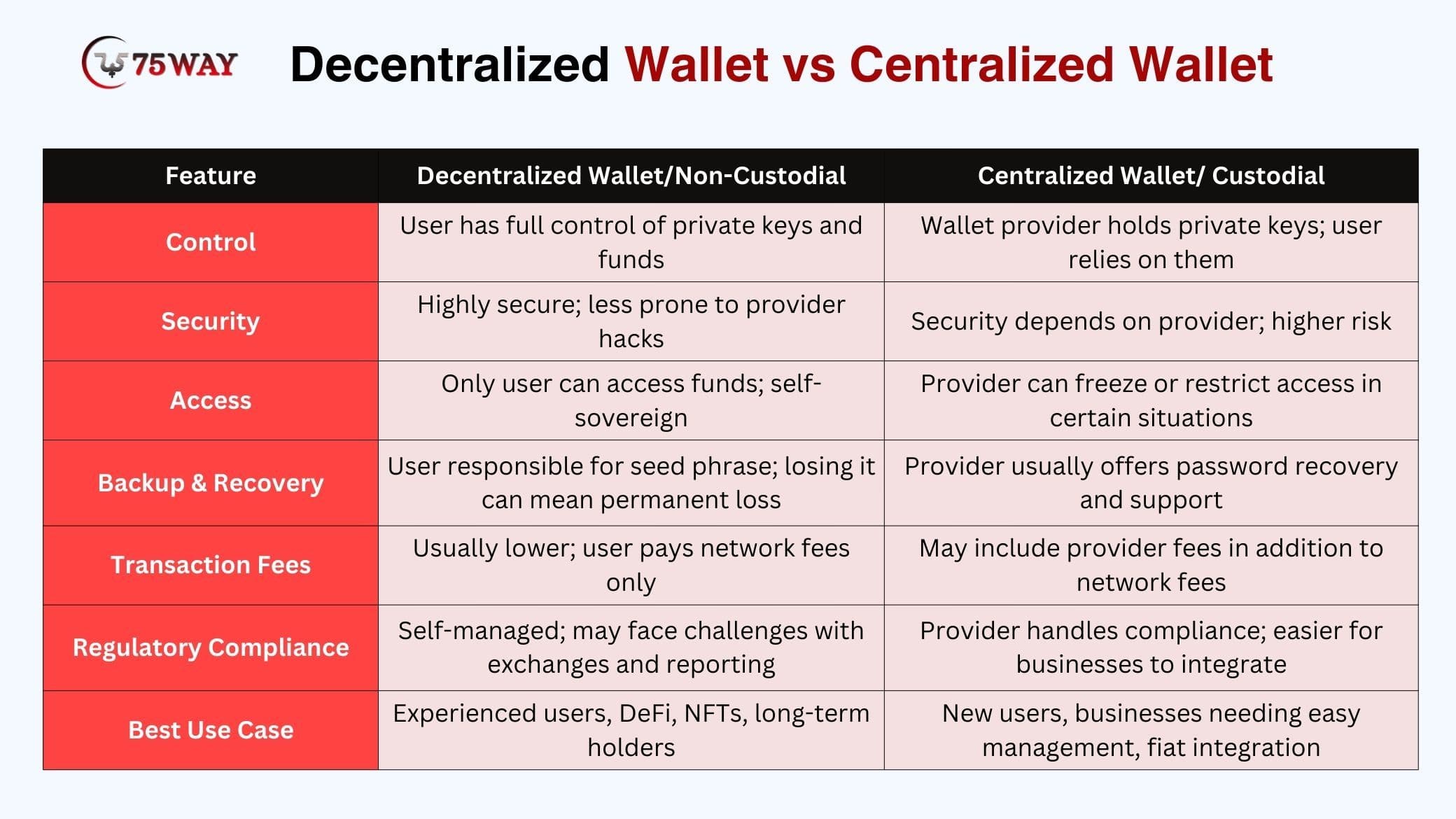
Decentralized Wallet Vs Centralized Wallet?
A decentralized wallet (non-custodial) gives users full control of private keys and funds, offering higher security, privacy, and autonomy. On the other hand, a centralized wallet (custodial) stores keys with a provider, making access easier but less secure, with potential restrictions. Decentralized wallets suit experienced users, while centralized wallets favor beginners and businesses.
10 Best Decentralized Crypto Wallets For 2026
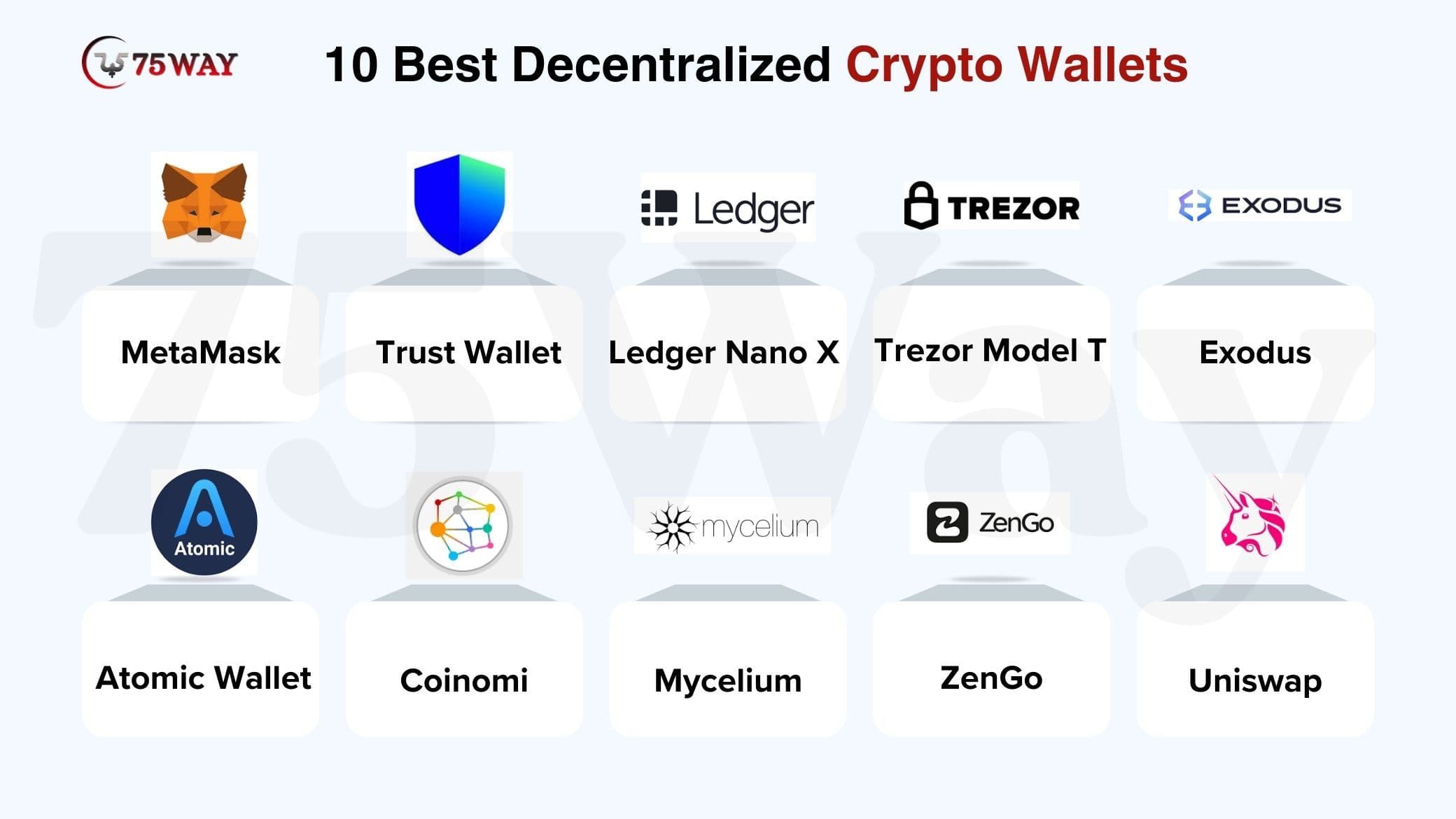
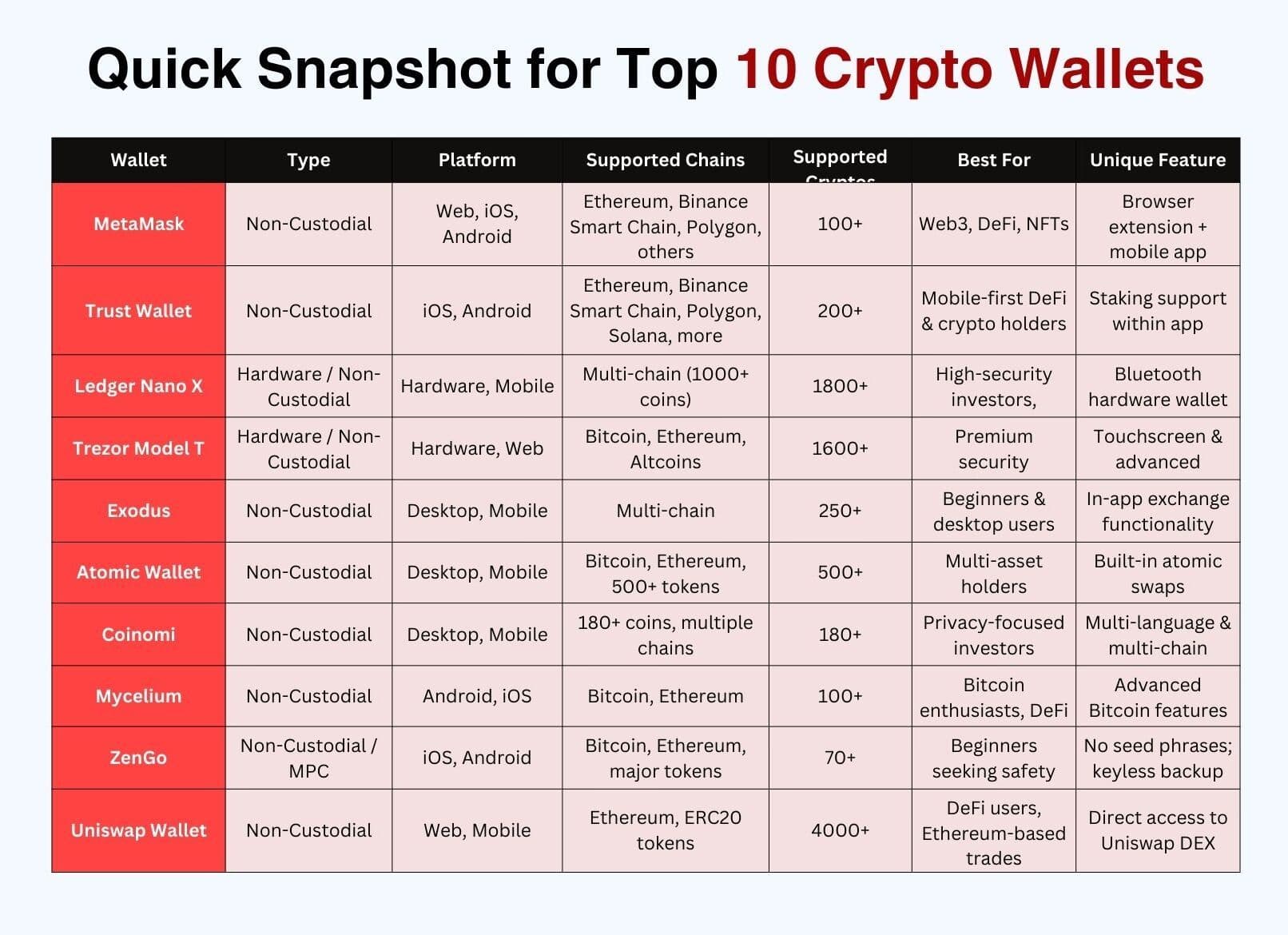
The 10 best decentralized crypto wallets for 2026 combine security, usability, and multi-chain support to meet the growing demands of US crypto users. From MetaMask and Trust Wallet to Ledger Nano X and Uniswap Wallet, these platforms offer private key control, DeFi access, NFT management, and seamless blockchain interactions for investors and businesses.
MetaMask
MetaMask is a leading non-custodial wallet designed for Web3 users, enabling secure crypto management, DeFi participation, and multi-chain transactions across Ethereum, Binance Smart Chain, and Polygon, with both browser and mobile accessibility. Its seamless interface and private key control make it a preferred choice for investors, developers, and NFT enthusiasts in the USA. Its key features are:
- Integrates directly with Ethereum-based dApps, allowing users to interact seamlessly without leaving the wallet environment securely.
- Provides synchronized mobile and desktop apps, ensuring users can access their accounts conveniently anytime, anywhere.
- Supports Ethereum, BSC, Polygon, and other EVM-compatible chains for flexible multi-chain asset management.
- Allows management of over 100 cryptocurrencies, including tokens and NFTs, giving users diverse investment and collection opportunities.
- Facilitates DeFi activities such as staking, lending, and swapping through built-in, secure decentralized finance features.
- Stores private keys locally on user devices for complete ownership and control over digital assets.
Trust Wallet
Trust Wallet is a mobile-first non-custodial wallet designed for beginners and experienced users, offering multi-chain cryptocurrency support, integrated DeFi access, staking, and NFT management. It is compatible with iOS and Android. This crypto wallet allows users to store, send, and swap digital assets while maintaining complete control over private keys, providing a secure and flexible experience for crypto holders.
- Supports 200+ cryptocurrencies across Ethereum, Binance Smart Chain, Polygon, and Solana, which allows diverse multi-chain asset management.
- Mobile interface provides easy navigation and interaction with cryptocurrencies, dApps, and NFT marketplaces on Android and iOS devices.
- Built-in staking features allow users to earn rewards on select cryptocurrencies directly within the wallet application.
- Integrated dApp browser connects users to decentralized applications without leaving the wallet, enabling convenient DeFi and NFT participation.
- Private keys are stored locally on the user device, giving full control over digital assets and transactions.
- Supports multiple languages, making cryptocurrency management accessible to global users with diverse backgrounds and technical experience.
Ledger Nano X
Ledger Nano X is a hardware non-custodial wallet designed for high-security storage of cryptocurrencies and tokens. It supports over 1,800 assets across multiple chains and offers Bluetooth connectivity for mobile management and Ledger Live integration for portfolio tracking, staking, and secure transactions. Ideal for investors and enterprises. It prioritizes offline key storage and robust crypto protection.
- Stores private keys offline in secure hardware, preventing unauthorized access and reducing exposure to online hacks or malware.
- Supports over 1,800 cryptocurrencies, providing wide multi-chain asset management for investors and institutional users.
- Bluetooth connectivity allows secure mobile transactions and portfolio updates while maintaining offline key storage for protection.
- Ledger Live software provides real-time portfolio tracking, staking options, and seamless cryptocurrency management across devices.
- Advanced encryption and PIN protection prevent illegal access even if hardware device is lost or stolen.
- Compatible with multiple operating systems, including Windows, macOS, Android, and iOS, for versatile crypto management options.
Trezor Model T
Trezor Model T is a premium hardware wallet that offers secure, offline cryptocurrency storage with a touchscreen interface and advanced encryption. It supports over 1,600 cryptocurrencies, offers integration with DeFi apps and portfolio trackers, and provides seed phrase backup. It is designed for investors seeking high-security, multi-asset management and direct interaction with blockchain applications.
- Touchscreen interface allows users to manage assets and sign transactions intuitively without complicated steps or external devices.
- Supports over 1,600 cryptocurrencies, enabling diverse multi-chain storage for Bitcoin, Ethereum, and other digital assets.
- Advanced encryption and PIN protection safeguard wallets from hacking attempts and physical device compromises.
- Integration with third-party apps enables access to DeFi, portfolio tracking, and decentralized finance platforms seamlessly.
- Multi-asset management supports complex investment strategies and diversified crypto holdings across different blockchains.
Exodus
Exodus is a non-custodial desktop and mobile wallet designed for beginners, offering multi-chain cryptocurrency management, in-app exchange, and portfolio tracking. It supports over 250 assets, integrates with hardware wallets, and provides an intuitive interface. Its seamless UX allows users to send, receive, and swap digital assets without external exchanges.
- Supports over 250 cryptocurrencies and tokens, providing users with diverse investment options within a single wallet interface.
- In-app exchange allows seamless token swaps without leaving the wallet, saving time and simplifying transactions.
- Desktop and mobile compatibility allows synchronized access and crypto management across multiple devices.
- Private keys remain on the user device, giving full control over funds and asset management.
- User-friendly interface with customizable themes enhances accessibility for beginners and casual investors.
Atomic Wallet
Atomic Wallet is a non-custodial wallet supporting over 500 cryptocurrencies, offering multi-chain asset management, atomic swaps, staking, and cross-chain transactions. Available on desktop and mobile, it provides integrated exchange services and portfolio tracking. Users maintain full control of private keys while participating in decentralized finance and token swaps.
- Supports over 500 cryptocurrencies, allowing diverse multi-chain asset management and token storage for investors.
- Atomic swaps enable peer-to-peer exchanges of different blockchain assets without relying on external platforms.
- Staking support allows users to earn passive income from select cryptocurrencies directly within the wallet.
- Private keys remain locally, giving full control over funds and transaction authorization for each operation.
- Integrated exchange services and portfolio analytics allow monitoring performance and performing swaps efficiently in one interface.
Coinomi
Coinomi is a privacy-focused non-custodial wallet supporting 180+ cryptocurrencies across multiple blockchains. It offers desktop and mobile access, multi-language support, and integrated exchange functionality. Coinomi provides strong privacy features, secure local key storage, and cross-chain asset management for global users seeking versatile and secure crypto wallet solutions.
- Trade 180+ cryptocurrencies across multiple blockchains, enabling diverse asset management and multi-chain transactions.
- Multi-language support allows global users to navigate the wallet interface easily without technical language barriers.
- Private keys and seed phrases remain on user devices, giving complete control over cryptocurrency funds and access.
- Integrated exchange enables token swaps and trading without relying on third-party platforms or intermediaries.
- Privacy-focused design restricts tracking and data collection, maintaining user anonymity and protecting confidential assets.
Mycelium
Mycelium is a Bitcoin-focused, non-custodial wallet that provides advanced features for experienced users and DeFi participants. It supports hardware wallets, offers transaction analytics, and mobile accessibility. Mycelium emphasizes Bitcoin management, secure private key storage, and integration with decentralized finance services for investors seeking control and advanced functionality.
- Focused on Bitcoin and Ethereum, offering specialized tools for the secure management of primary digital assets efficiently.
- Hardware wallet integration provides offline storage for private keys and protection against online hacking attempts.
- Advanced Bitcoin features include cold storage, multisig wallets, and transaction tracking for experienced investors.
- Private keys remain local, giving users full control over funds without reliance on third-party custodians.
- Transaction analytics tools provide insights into market performance, helping users make informed investment decisions.
ZenGo
ZenGo is a non-custodial wallet using MPC technology, eliminating seed phrases and simplifying secure crypto management. It supports Bitcoin, Ethereum, and major tokens, providing keyless backup, biometric authentication, and mobile-first accessibility. ZenGo focuses on making cryptocurrency storage and transactions safe and user-friendly for beginners and security-conscious investors. MPC technology splits key control across multiple devices to reduce the risk of key compromise or single-point failure.
- Supports Bitcoin, Ethereum, and major tokens, providing versatile multi-asset storage for diverse investment portfolios.
- Keyless backup removes the need for seed phrases while maintaining full access and recovery options.
- Biometric authentication allows secure login and transaction authorization using face or fingerprint recognition.
- Mobile-first design offers convenient access to crypto assets, portfolio management, and DeFi interactions on smartphones.
- Provides secure storage and transactions without exposing private keys, keeping assets safe from online attacks.
Uniswap
Uniswap Wallet is a non-custodial Web3 crypto wallet designed for Ethereum and ERC20 tokens. It offers direct integration with the Uniswap decentralized exchange, mobile and web access, and portfolio tracking. Users maintain full control of private keys while participating in DeFi, trading, and token swaps directly on Ethereum.
- Exchange Ethereum and all ERC20 tokens, providing users direct access to a wide range of DeFi assets.
- Direct Uniswap DEX integration enables seamless swapping and liquidity provision without leaving the wallet.
- Private keys remain locally, giving full control and ownership of digital assets and transactions.
- Portfolio tracking provides real-time analytics and insights into investments and token performance.
- Designed for DeFi users, enabling secure trading and participation in Ethereum-based decentralized financial applications.
Get More Insights: How to Build IoT Apps in 2026: A Guide for Startups, Founders & Business Owners
Why Investing in a Crypto Wallet in 2026 Is a Smart Move?
Businesses invest in crypto wallets to secure digital assets, streamline payments, and access decentralized finance opportunities. They enable safe multi-currency management, faster cross-border transactions, and integration with dApps. By securely managing private keys and ensuring compliance, wallets empower startups and enterprises to innovate, scale, and remain competitive in the expanding crypto ecosystem.
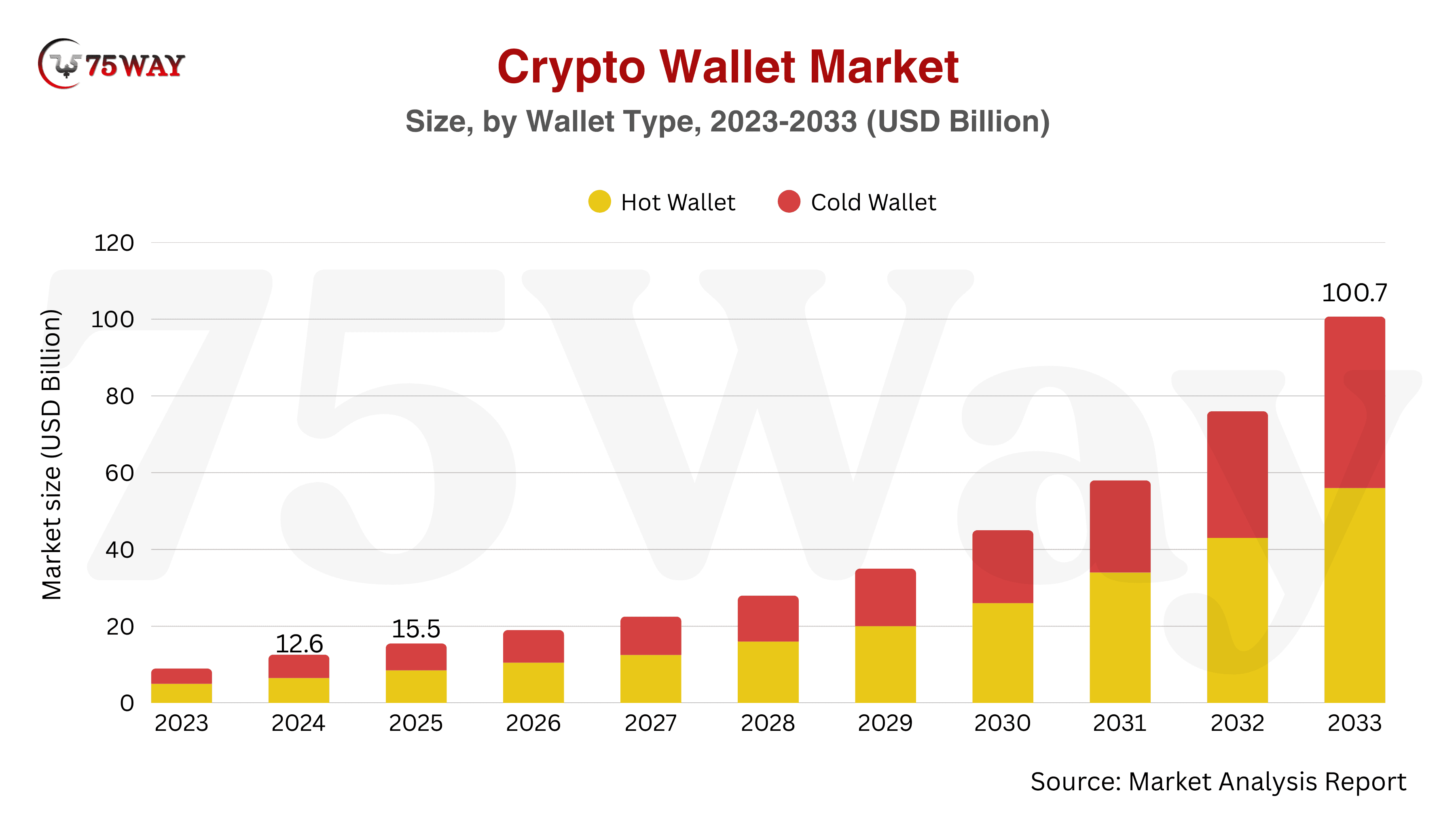
- According to Market Analysis Report, the global crypto wallet market is projected to reach USD 100.77 billion by 2033, expanding at a CAGR of 26.3%.
- The crypto wallet market is estimated at USD 5.43 billion in 2026 and projected to reach USD 56.74 billion by 2035, growing at a CAGR of 29.81%, according to Business Research Insights.
- North America is expected to continue leading the crypto wallet market from 2026 to 2035, holding approximately 31–38% of the global share.
- Around 65% of digital asset users rely on crypto wallets for secure transactions and efficient asset management.
- The top 10 crypto wallet providers account for roughly 55% of the market, while startups continue to drive innovation and new features.
- Approximately 45% of new crypto wallet releases include enhanced security features and improved user interfaces.
Learn More: How to Build a Self Driving Car Software: A Complete Roadmap
How to Choose the Right Wallet For Your Business?
The right decentralized crypto wallet helps startups and businesses manage digital assets safely. It covers multiple cryptocurrencies, fits the target users, connects with existing systems, and grows with business needs. Choosing carefully protects funds, improves efficiency, and supports future expansion in crypto and blockchain operations.
Asset Support: A crypto wallet that covers all the cryptocurrencies and tokens your business uses keeps operations smooth. Businesses can manage transactions and investments without switching wallets, saving time and reducing errors.
Security Level Needed: Private keys, encryption, and multi-factor protection keep assets safe. Strong security protects funds and builds trust with clients, partners, and investors in the business environment.
Target Audience: Wallets designed for beginners, experienced users, or enterprises match user needs. Proper fit increases adoption and reduces confusion or support requests.
Integration Needs: Compatibility with apps, dApps, or payment systems allows smooth workflows. A wallet that works with existing systems avoids delays and extra development work.
Scalability: A wallet that handles more users, higher transaction volumes, and multiple blockchains supports growth. Businesses can expand into DeFi, NFTs, and other crypto opportunities without replacing their wallet.
Read Also: Top 10 IoT Development Companies in USA
Step‑by‑Step Roadmap: Build Your Own Decentralized Crypto Wallet
A decentralized crypto wallet provides businesses with full control over digital assets. This roadmap guides startups through planning, security, technology, and design. Following a structured approach helps create a reliable wallet that fits user needs, scales with growth, and meets regulatory standards.
Choose Your Wallet Type: Deciding between custodial and non-custodial wallets defines control, risk, and user experience. The choice impacts security, compliance, and how the wallet interacts with multiple blockchains.
Design Secure Wallet Architecture: Architecture defines wallet strength and reliability. Multi-chain support, key management, and transaction protocols create a solid foundation for safe and efficient operations.
Create UX/UI Wireframes: This stage aims to build an intuitive user interface and navigation flow. The clear design of every screen provides easy onboarding, wallet access, and transaction management for beginners and advanced users alike.
Implement Core Blockchain Technologies: In this stage, you have to choose compatible technologies enables multi-chain support and future integrations. Blockchain nodes, smart contracts, and encryption systems manage transactions and balances.
Check Security & Compliance: Private key management, multi-factor protection, and regulatory alignment safeguard funds. Compliance with USA rules and reporting obligations builds trust with customers and partners.
Perform Comprehensive Wallet Testing: Once your crypto wallet is developed, the next step is to test it to identify vulnerabilities. This stage is essential to maintain performance and validate user experience. Regular testing and testnet trials confirm that your wallet is secure and functional before launch.
Launch & Maintain Wallet: Your crypto wallet development does not end here. Your last stage includes deployment, monitoring, and user support. Continuous updates and maintenance keep security up-to-date and support wallet growth in features and users.
Learn More: How to Build an Astrology App Like Co-Star? A Strategic Guide 2026
Estimated Cost & Timeline for Building A Crypto Wallet
A strategic approach to crypto wallet development requires planning, resources, and time. The cost to create a crypto wallet varies according to the complexity, features, and business requirements. Startups and enterprises in the USA can choose a wallet type that fits their budget, user base, and desired functionality, balancing security, scalability, and technology needs.
Simple Crypto Wallet: The development of a basic crypto wallet usually takes 3 to 5 months and costs between $20,000 and $55,000. It includes core features like sending and receiving crypto and single-chain support. This option works for startups needing essential wallet functions.
Medium Crypto Wallet: Crypto wallets with moderate features require 5 to 7 months of development and cost $55,000 to $95,000. They offer multi-currency support, dApp integration, enhanced user experience, and basic analytics. This fits businesses expanding functionality without full multi-chain deployment.
Advanced Crypto Wallet: High-complexity crypto wallets take 9 to 12 months or more and cost between $95,000 and $150,000. These crypto wallet apps offer multi-chain support, DeFi integration, staking, and advanced security features such as MPC or HD wallets. Enterprise-ready wallets suit companies aiming for complete crypto ecosystem functionality.
Cost Based on Crypto Wallet Types
- The cost to build a custodial wallet ranges from $35,000 to $83,000, with the provider controlling user private keys.
- Creating a non-custodial wallet costs $45,000 to $99,000, allowing users complete control over their keys.
- Developing a multi-currency wallet requires $35,000 to $92,000, supporting multiple cryptocurrencies in a single platform.
- A DeFi wallet can cost $50,000 to $113,000, enabling decentralized finance functions and staking options.
Crypto Wallet Development Cost Based on Region (Hourly Rates)
- Hiring developers in North America typically costs $100–$200 per hour, reflecting high expertise and standards.
- Development in Europe usually ranges $50–$150 per hour, providing a balance of quality and affordability.
- In India or Southeast Asia, hourly development rates are $25–$50, offering cost-effective solutions for scalable apps.
Core Components & Features Affected Cost of Crypto Wallet Development
- UI/UX design for a wallet app generally costs $10,000 to $50,000, covering interface and user experience.
- Backend and API integration work ranges from $30,000 to $95,000, including server logic and database setup.
- Security measures, audits, and KYC implementation typically cost $30,000 to $100,000 to ensure compliance and protection.
Know More: How AI Development Help US Companies Scale Faster
Final Remarks
To summarize, businesses have to select the right decentralized crypto wallet to be launched in the USA. With a deep understanding of crypto wallet types, their security features, supported assets, and integration needs, you can make an informed decision that fits your business goals. Whether you prefer MetaMask, Ledger Nano X, Trust Wallet, or building your own wallet, the right solution offers security, scalability, and a smooth user experience. If you want to build your own secure crypto wallet, you can partner with an experienced crypto wallet development company. A reliable partner helps you navigate complex blockchain architecture, multi-chain support, and regulatory compliance and execute your wallet development process easily.
FAQs
What Is The Safest Decentralized Crypto Wallet?
The safest decentralized crypto wallets are typically hardware wallets like Ledger Nano X and Trezor Model T, as they store private keys offline. Non-custodial wallets with multi-factor authentication (MFA), MPC (multi-party computation), and encrypted seed phrases are also highly secure. Choosing a wallet with a strong track record, open-source code, and regular security updates ensures maximum protection.
Is MetaMask Better Than Trust Wallet?
MetaMask is better than Trust Wallet if your focus is on Web3, DeFi, and Ethereum-based dApps, as it offers both a browser extension and mobile support, making it ideal for seamless integration with decentralized applications. Trust Wallet, however, is a mobile-first, multi-chain wallet with staking capabilities and a user-friendly interface, perfect for beginners or mobile-focused users. For startups and businesses in the USA, MetaMask is often better suited for dApp integration and complex crypto operations, while Trust Wallet offers a simpler, more accessible experience for everyday mobile use.
How Do Decentralized Wallets Earn Money?
Decentralized wallets earn primarily through transaction fees, swaps, and premium services:
- In-app crypto swaps or exchanges may include small fees.
- Staking services let wallets take a percentage of rewards.
- Some wallets offer partner programs or DeFi integrations that generate revenue.
Unlike custodial wallets, decentralized wallets don’t earn from holding users’ funds, keeping the model trust-friendly.
Can Businesses Use Decentralized Wallets?
Yes, businesses can use decentralized wallets to manage crypto payments, DeFi operations, and treasury assets. Non-custodial wallets give companies full control over private keys, enhanced security, and multi-chain support. However, businesses must ensure regulatory compliance in the USA, including IRS reporting and SEC guidelines, to stay legally protected.