Summary
Enterprise sales teams are rapidly adopting AI sales agents to improve productivity, reduce operational inefficiencies, strengthen customer engagement, and accelerate revenue growth. This guide explores 10 practical AI agent use cases that help organizations automate workflows, personalize communication, improve forecasting, optimize pipelines, and create stronger buyer experiences across complex enterprise sales environments.
Quick Overview
- AI agents reduce repetitive enterprise sales tasks and improve operational efficiency.
- AI sales automation agents help sales teams respond faster to high-value customers.
- Predictive analytics improves revenue forecasting accuracy across sales pipelines.
- AI personalization enhances customer trust and long-term business relationships.
- Enterprises achieve scalable sales operations using an advanced AI sales agent.
Enterprise sales have become far more complicated than most teams expected. Buyers reply more slowly, sales cycles stretch longer, and revenue targets keep increasing every quarter. At the same time, sales professionals spend countless hours updating CRMs, qualifying leads, and preparing proposals, rather than actually selling. Sound familiar?
That is exactly why AI sales agents are becoming a major part of modern enterprise sales strategies. These agentic AI sales solutions identify high-intent prospects, analyze customer behavior, automate workflows, personalize outreach, and help sales teams close opportunities faster.
The biggest advantage is simple: AI agents allow sales teams to focus more on conversations, relationship building, and decision-making while repetitive tasks happen automatically in the background.
And honestly, this change is already happening now. Enterprise organizations adopting ready-made AI agents for sales are seeing stronger pipelines, better customer engagement, and faster response times.
In this guide, you will explore the top 10 use cases where AI agents are changing enterprise sales operations and helping organizations build smarter revenue strategies.
Why Enterprise Sales Teams Are Investing In AI Agents?
Enterprise sales environments generate enormous amounts of data every single day. Managing this information manually often creates inefficiencies, delays, and missed opportunities. AI sales agents help organizations process these large volumes of information quickly. Several factors are accelerating the adoption of AI agent development solutions across enterprise sales organizations.
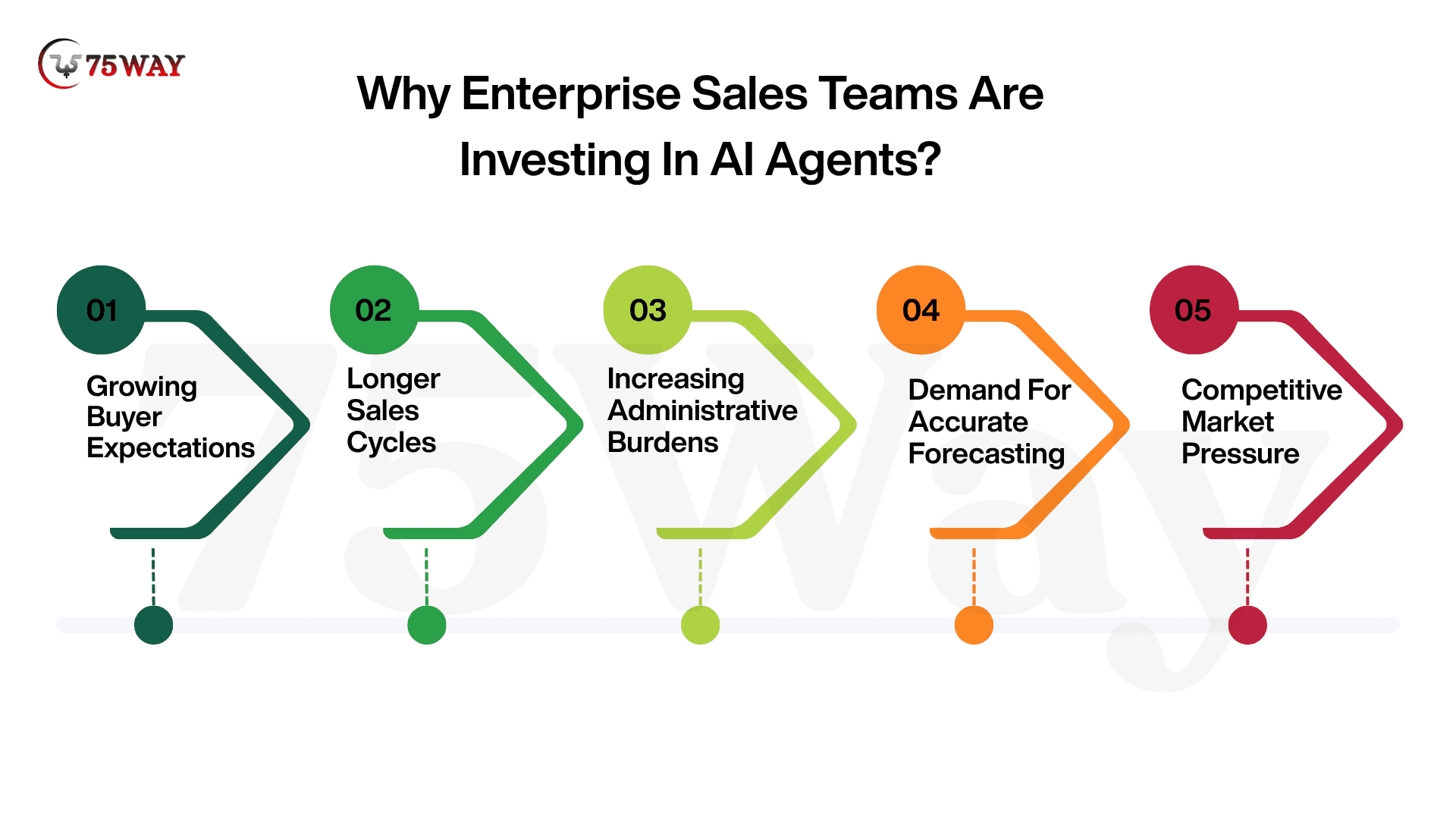
- Growing Buyer Expectations: Modern buyers expect highly personalized communication. Generic sales messaging no longer creates meaningful engagement. AI sales agents analyze customer behavior, preferences, and interactions to help sales teams deliver more relevant experiences.
- Longer Sales Cycles: Large enterprise deals often involve multiple stakeholders, approvals, negotiations, and lengthy evaluation periods. Sales AI agents help manage these complexities by automating tracking, sending reminders, and providing predictive insights.
- Increasing Administrative Burdens: Sales representatives spend substantial time updating CRMs, scheduling meetings, generating reports, and handling repetitive tasks. AI-driven automation reduces this workload significantly.
- Demand For Accurate Forecasting: Revenue forecasting remains one of the most challenging areas within enterprise sales. AI agents improve prediction accuracy by analyzing historical performance patterns, pipeline activity, and customer behavior.
- Competitive Market Pressure: Organizations constantly compete for customer attention. Faster response times, smarter engagement strategies, and better pipeline visibility create stronger competitive advantages.
10 Major Use Cases of AI Sales Agents in 2026
AI sales agents are rapidly becoming essential for enterprise growth in 2026. From lead qualification to forecasting and customer engagement, businesses now use sales AI agents to reduce manual workloads and make data-driven decisions.
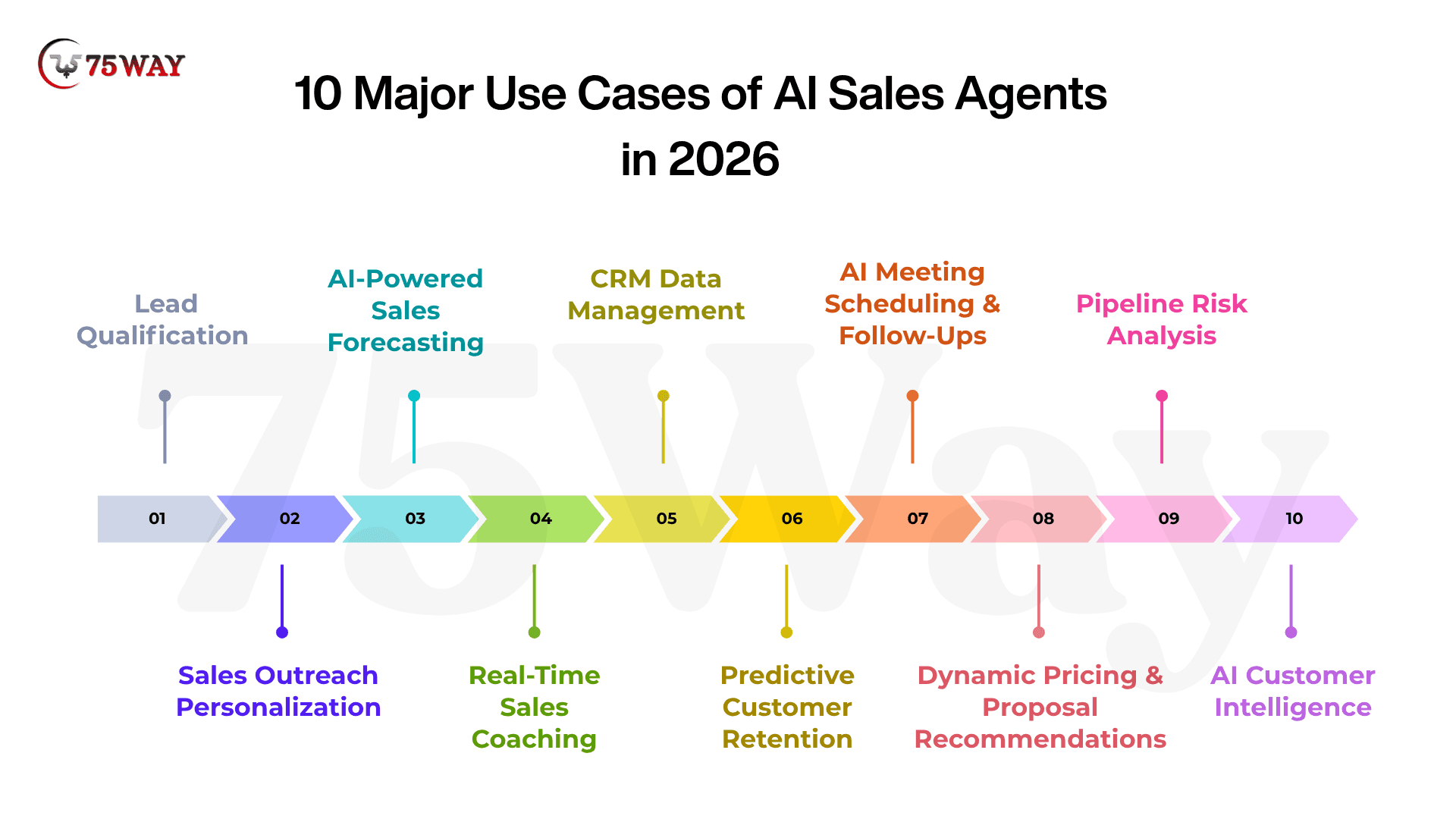
1. Intelligent Lead Qualification
One of the most valuable use cases for AI sales agents in enterprise sales involves intelligent lead qualification. AI lead qualification agents solve this problem by analyzing customer behavior, engagement history, firmographic data, website activity, communication patterns, and purchasing signals in real time.
- Faster Prioritization: Sales representatives immediately understand which prospects deserve immediate attention. This reduces wasted effort and improves productivity.
- Improved Conversions: By focusing on high-intent leads, organizations increase conversion opportunities while shortening sales cycles.
- Better Resource Allocation: Enterprise sales teams can allocate time, budget, and outreach efforts more strategically across valuable accounts.
2. Automated Sales Outreach Personalization
AI sales agents help solve this challenge through automated outreach personalization. AI-powered sales agents generate context-aware messaging tailored to specific industries, job roles, challenges, and customer interests. For enterprise sales organizations, cold outreach agents create meaningful engagement opportunities.
- Personalized Email Campaigns: SalesAI agents create customized email sequences based on prospect behavior and engagement history.
- Adaptive Messaging Strategies: Communication changes dynamically depending on customer responses and interaction patterns.
- Better Timing Optimization: AI systems identify ideal outreach timing based on behavioral signals and engagement trends.
- Increased Engagement Rates: Personalized messaging significantly improves open rates, click-through rates, and meeting conversions.
3. AI-Powered Sales Forecasting
Sales AI agents improve forecasting accuracy through advanced predictive analytics. They analyze historical sales data, deal velocity, customer engagement levels, pipeline activity, market trends, and behavioral indicators to generate more reliable revenue predictions. This offers several advantages.
- Accurate Revenue Predictions: Organizations gain stronger visibility into future performance trends.
- Early Risk Identification: AI agents identify deals likely to stall, decline, or experience delays.
- Improved Strategic Planning: Leadership teams make more informed operational and financial decisions.
- Sales Pipeline Visibility: Sales managers understand pipeline health more clearly across multiple territories and teams.
4. Real-Time Sales Coaching
Agentic AI systems for sales now provide real-time coaching support during sales conversations. Instead of waiting for post-call reviews, sales representatives receive instant recommendations helping improve performance during active conversations.
- Objection Handling Support: AI voice agents for sales suggest relevant responses when buyers raise concerns or hesitation.
- Conversation Insights: Sales representatives gain visibility into customer sentiment and engagement trends.
- Communication Consistency: Organizations maintain stronger messaging consistency across sales teams.
- Employee Development: New sales representatives improve more quickly through continuous guidance and feedback.
5. Automated CRM Data Management
CRM systems remain essential for enterprise sales operations. However, maintaining accurate records often becomes frustrating and time-consuming for sales representatives. Sales AI agents automate much of this process. This dramatically improves operational efficiency.
- Reduced Administrative Work: Sales representatives spend less time updating systems manually.
- Data Accuracy: Automated updates reduce human error and missing information.
- Reporting Quality: Leadership teams access more reliable performance insights.
- Customer Visibility: Organizations maintain clearer customer interaction histories across departments.
6. Predictive Customer Retention
Sales AI agents help organizations predict customer churn risks before relationships deteriorate. When potential retention risks emerge, they alert sales and customer success teams immediately.
- Early Churn Detection: Businesses identify warning signs before customers disengage completely.
- Personalized Retention Strategies: Teams create targeted engagement plans addressing specific customer concerns.
- Customer Relationships: Proactive communication improves trust and long-term loyalty.
- Increased Lifetime Value: Retaining enterprise customers strengthens long-term revenue stability.
7. AI-Driven Meeting Scheduling And Follow-Ups
Scheduling meetings across enterprise organizations can become surprisingly complicated. AI sales agents simplify this process. The follow-up intelligence agents automatically schedule meetings, coordinate participant availability, send reminders, manage follow-ups, and generate post-meeting summaries.
- Faster Scheduling: Prospects secure meetings more quickly without extended email exchanges.
- Reduced Missed Opportunities: Automated reminders improve attendance consistency.
- Follow-Up Discipline: AI systems ensure timely communication after meetings.
- Customer Experience: Buyers experience smoother and more professional interactions.
8. Dynamic Pricing And Proposal Recommendations
AI pricing strategy documentation agents assist sales teams by analyzing market conditions, competitor activity, historical pricing trends, customer purchasing behavior, and deal profitability. These insights help organizations create more strategic proposals.
- Smarter Pricing Decisions: AI systems recommend pricing strategies aligned with customer value and profitability goals.
- Faster Proposal Generation: Sales teams create customized proposals more efficiently.
- Competitive Positioning: Organizations respond more effectively to changing market dynamics.
- Reduced Margin Losses: AI-driven insights prevent unnecessary discounting during negotiations.
Pricing intelligence becomes increasingly important as enterprise buyers demand greater transparency and value justification.
9. Sales Pipeline Risk Analysis
Enterprise sales pipelines often contain hidden risks difficult to identify manually. AI sales agents continuously monitor these patterns. These AI sales automation systems identify at-risk deals based on behavioral indicators and historical trends.
- Early Warning Systems: Sales managers receive alerts about vulnerable opportunities before deals collapse.
- Deal Management: Teams intervene earlier with targeted recovery strategies.
- Pipeline Accuracy: Organizations maintain clearer visibility into actual revenue potential.
- Sales Accountability: Managers support representatives more effectively through data-driven insights.
Pipeline intelligence improves overall sales predictability and operational confidence.
10. AI-Powered Customer Intelligence
Enterprise sales success depends heavily on understanding customer needs, priorities, challenges, and decision-making behavior. This creates a more complete understanding of enterprise buyers.
- Customer Insights: Sales teams understand customer motivations more clearly.
- Strategic Conversations: Representatives engage prospects with stronger contextual understanding.
- Cross-Selling Opportunities: AI customer support agents identify additional customer needs and expansion potential.
- Long-Term Relationships: Organizations deliver more meaningful and value-driven experiences.
Customer intelligence strengthens relationship quality across every stage of the enterprise sales process.
Challenges Businesses Must Consider Before Implementing AI Agents
Despite the growing benefits, AI agent implementation is not as simple as installing new software and expecting immediate results. Many businesses struggle because they adopt AI too quickly without preparing their teams, workflows, or systems. Before investing heavily, organizations must understand the practical challenges that directly affect long-term success and adoption.
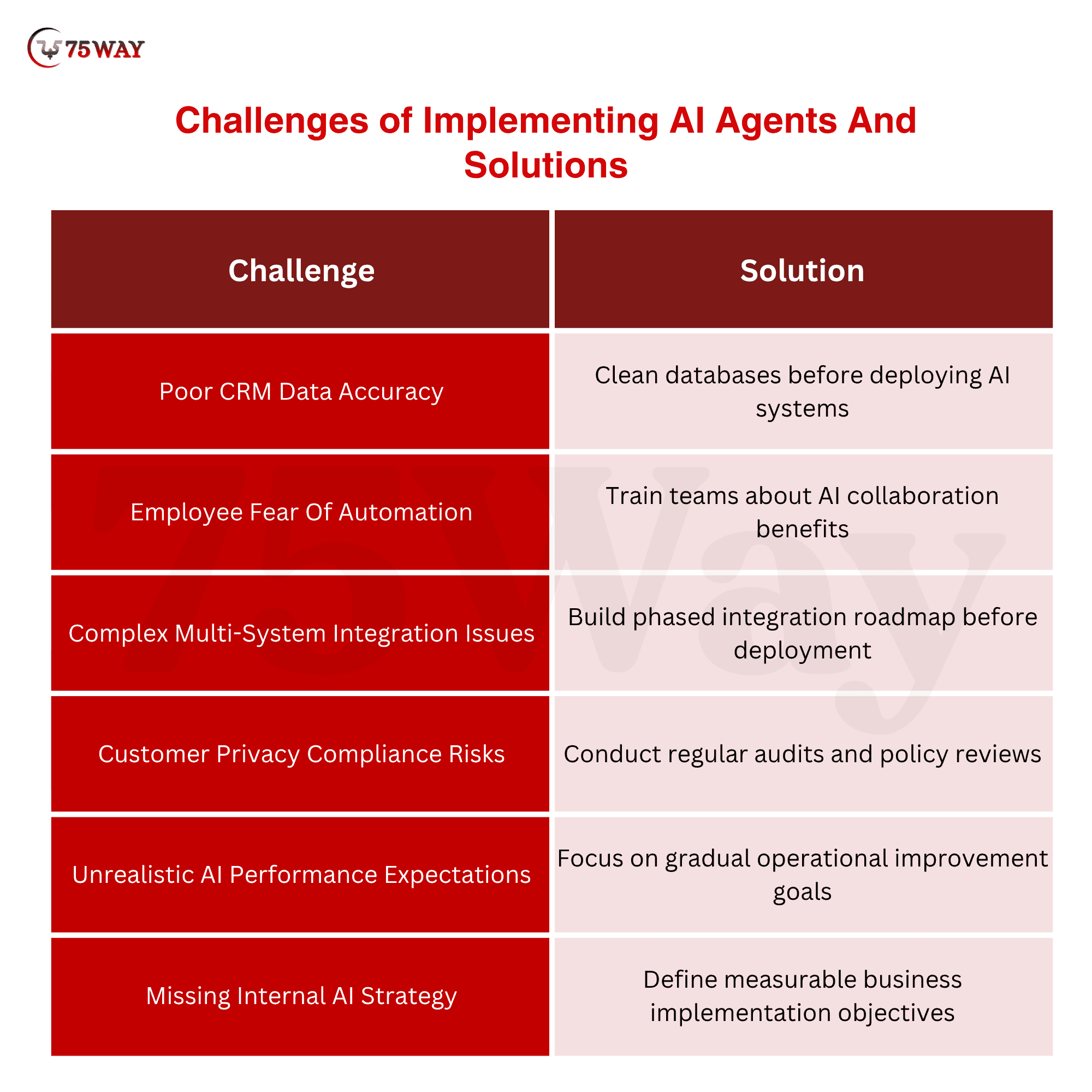
- Data Quality Issues
AI agents rely heavily on structured and accurate business data to generate useful insights and recommendations. If CRM records contain outdated information, duplicate entries, or incomplete customer profiles, AI outputs become unreliable. Businesses should regularly clean, organize, and standardize data before implementation to improve overall performance.
- Employee Resistance
Many sales professionals worry that AI automation could eventually reduce the importance of human roles within organizations. This fear often creates resistance, lower adoption rates, and hesitation toward new technologies. Companies should educate teams properly and position AI sales agents as productivity assistants that remove repetitive workloads instead of replacing human expertise.
- Integration Complexities
Enterprise organizations usually operate across multiple platforms, including CRMs, communication systems, analytics tools, and customer databases. Integrating AI agents with these systems can become technically complicated and time-consuming without proper planning. Businesses should create a clear integration roadmap before deployment to avoid workflow disruptions later.
- Privacy And Compliance Concerns
AI systems frequently process sensitive customer information, financial records, and communication history across multiple channels. Poor governance or weak security practices can create serious compliance risks and legal complications. Organizations should establish strong data privacy policies and conduct regular compliance reviews before scaling AI usage internally.
- Unrealistic Expectations
Some businesses expect AI agents to solve every operational challenge immediately after implementation, which often leads to disappointment. AI improves productivity, forecasting, and automation, but human decision-making and relationship-building still remain essential in enterprise sales. Companies should focus on gradual improvement goals instead of expecting overnight operational changes.
- Lack of Internal Strategy
Many organizations adopt AI models simply because competitors are doing the same, not because they have a clear business objective. Without defined goals, teams struggle to measure success or align AI initiatives with revenue priorities. Businesses should identify specific operational problems first and implement AI around measurable outcomes and long-term growth plans.
The Human Side Of AI In Enterprise Sales
One of the biggest misconceptions surrounding AI agents involves the belief that automation removes human connection from sales. In reality, the opposite often happens.
When repetitive tasks disappear, sales professionals gain more time for meaningful conversations, strategic thinking, and relationship development. Instead of spending hours updating spreadsheets or writing repetitive emails, teams focus on understanding customer goals and building trust.
Enterprise buyers still value empathy, confidence, honesty, and emotional intelligence. AI cannot replace genuine human relationships. What it can do is remove operational friction, thereby enabling sales teams to deliver better experiences.
The strongest enterprise sales organizations will combine intelligent automation with authentic human engagement. That balance will define successful sales strategies moving forward.
Future Trends Shaping Enterprise AI Sales Agents
AI-driven sales technologies are evolving faster than most businesses expected. What started as automation is rapidly becoming intelligent revenue assistance. As enterprise sales environments grow more competitive, AI agents will continue influencing how businesses engage customers, analyze opportunities, manage workflows, and make strategic decisions across increasingly complex sales ecosystems.
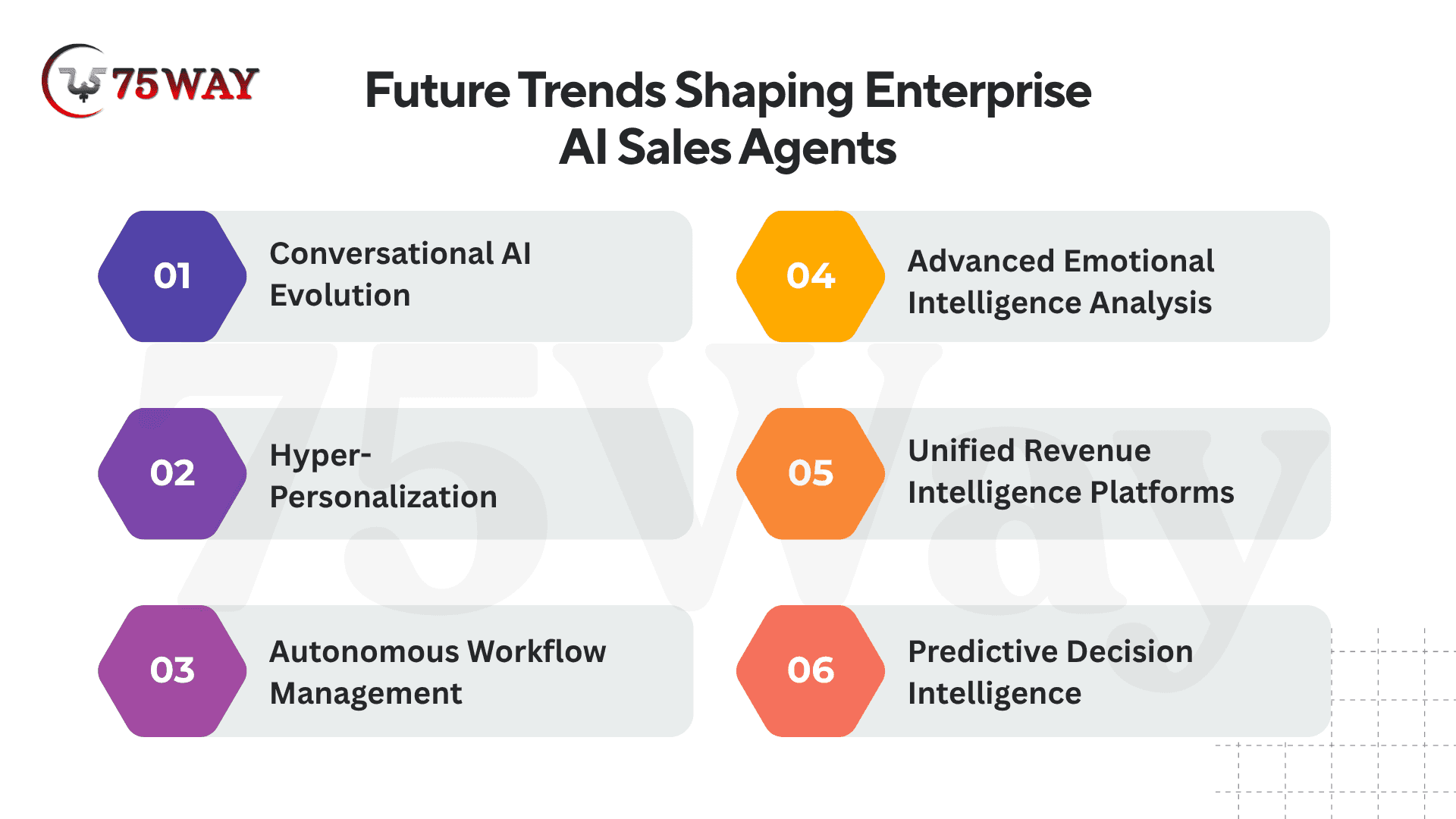
Conversational AI: Conversational AI voice agents will handle complex customer conversations naturally across channels while understanding intent, context, and engagement patterns.
Hyper-Personalization: Sales interactions will become deeply personalized using behavioral analysis, predictive insights, customer preferences, and real-time engagement activity data.
Autonomous Workflow Management: AI sales systems will independently manage repetitive sales workflows, including follow-ups, reporting, scheduling, approvals, and operational coordination tasks automatically.
Advanced Emotional Intelligence Analysis: Future AI sales agents will analyze emotional signals, urgency levels, tone variations, and hesitation patterns during customer conversations.
Unified Revenue Intelligence Platforms: Businesses will combine sales, marketing, finance, and operational datasets into centralized AI-powered revenue intelligence ecosystems for decision-making.
Predictive Decision Intelligence: AI sales agents will proactively recommend sales actions using predictive modeling, opportunity analysis, engagement timing, and customer behavior forecasting insights.
Conclusion
AI sales agents become practical business assets for enterprise sales teams to handle growing workloads and manage complex customer journeys. From lead qualification and forecasting to customer engagement and pipeline intelligence, AI-driven systems are helping organizations build smarter and more scalable revenue operations. Still, technology alone is not enough. Long-term growth depends on combining intelligent automation with authentic human relationships and strategic thinking. If you are looking to build customized enterprise AI solutions for sales, contact a trusted agent development company. You can also adopt ready-to-deploy AI sales agents from AI marketplaces like 75AI Agent Store.
Frequently Asked Questions (FAQs)
How Do AI Agents Improve Enterprise Sales Productivity?
AI agents automate repetitive tasks like CRM updates, lead qualification, scheduling, reporting, and follow-ups. This allows enterprise sales representatives to spend more time building customer relationships, managing strategic opportunities, and focusing on high-value activities.
What Industries Benefit Most From AI Sales Agents?
Industries with complex sales cycles and relationship-driven buying processes benefit significantly from AI sales agents. Technology, healthcare, manufacturing, finance, logistics, telecommunications, and professional services organizations frequently use AI sales agents to improve forecasting, customer engagement, and sales pipeline management.
Are AI Sales Agents Difficult To Integrate Into Existing Systems?
The integration complexity of sales AI agents depends on organizational infrastructure, software compatibility, and operational readiness. Many AI sales agents support integration with CRMs, communication tools, and analytics systems.
Can Sales AI Agents Help Improve Sales Team Collaboration?
Yes, AI sales agents centralize customer information, meeting updates, pipeline insights, and communication history across departments. This improves alignment between sales, marketing, and customer success teams. These AI sales agents reduce miscommunication, duplicate efforts, operational delays, and inconsistent customer experiences.
What Makes AI Sales Agents Different From Traditional Sales Automation Tools?
Traditional automation tools follow predefined rules and repetitive workflows. AI agents continuously learn from customer interactions, behavioral patterns, sales outcomes, and operational data, enabling smarter recommendations, adaptive communication strategies, predictive insights, and more intelligent decision-making across enterprise sales environments.
Can AI Agents Improve Enterprise Sales Training Programs?
AI agents analyze conversation quality, objection handling, communication patterns, and sales performance metrics to identify improvement areas. Managers use these insights to deliver personalized coaching, accelerate onboarding processes, and strengthen employee confidence