Summary
AI sales agents development automates lead engagement, qualification, and conversion processes. These intelligent systems integrate with CRMs, communication channels, and analytics tools to simulate human-like sales interactions. Businesses adopt them to reduce manual effort, improve response time, enhance customer experience, and increase conversion rates across digital sales pipelines.
Quick Overview
- AI sales agents automate lead engagement and accelerate business revenue growth
- Businesses integrate AI agents with CRM systems for better sales tracking
- Conversational AI improves customer interaction quality and response accuracy significantly
- Cost of AI sales agent development projects fall between $15,000 and $60,000
- Automation reduces dependency on human sales teams for repetitive tasks
- AI-driven sales pipelines improve conversion rates through real-time optimization
Building an AI sales agent is no longer a futuristic idea. It becomes a practical necessity for businesses trying to scale revenue in 2026. Sales teams today are under constant pressure to respond faster, personalize outreach, qualify leads accurately, and follow up without delays.
When these steps are handled manually, opportunities are often missed, and conversion rates drop without anyone even noticing. Thus, AI sales agents are changing the game.
Instead of acting like simple automation tools, modern AI agents for sales can analyze leads, understand customer intent, generate personalized messages, schedule follow-ups, update CRM records, and even guide prospects through the entire sales funnel with minimal human intervention. They work continuously in the background, ensuring that no lead goes cold and every interaction moves closer to conversion.
Whether it is SaaS, e-commerce, real estate, or service-based industries, delays in communication often mean lost revenue. AI sales agents solve this by engaging prospects in real time, adapting responses based on behavior, and maintaining consistent communication across multiple channels.
So the real question is not whether AI sales agents are useful anymore. It is how quickly businesses can build and deploy them to stay competitive.
In this guide, we will break down exactly how to build an AI sales agent in 2026, including architecture, key components, technology stack, workflow design, integrations, training methods, costs, and real-world use cases that are already transforming modern sales systems.
What Is An AI Sales Agent?
An AI sales agent is an intelligent software system designed to interact with potential customers, qualify leads, and support the sales process autonomously. Unlike traditional chatbots, AI sales agents:
- Understand context and intent
- Handle multi-step conversations
- Integrate with CRM systems
- Learn from historical interactions
- Adapt responses based on user behavior
They act as virtual sales representatives operating 24/7 across digital platforms.
Why Build AI Sales Agents in 2026?
Businesses are increasingly adopting AI sales agents to streamline sales operations, improve lead handling efficiency, and enhance customer engagement across digital platforms. These intelligent systems reduce manual workload while improving speed, accuracy, and scalability in modern sales processes.
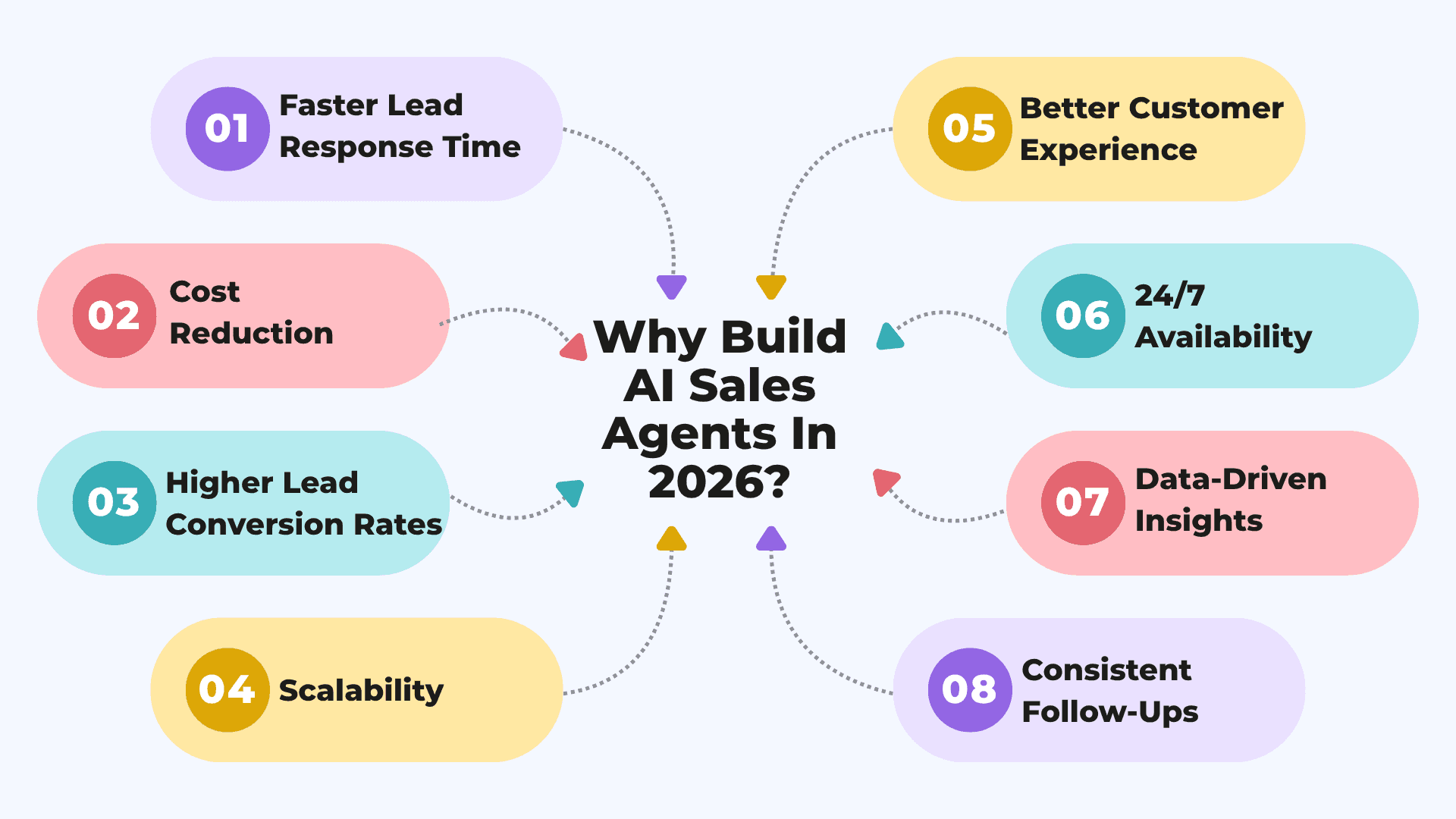
- Faster Lead Response Time: AI sales agents instantly respond to incoming leads, ensuring no opportunity is missed. Quick engagement increases conversion probability significantly by reducing response delays in competitive sales environments.
- Cost Reduction: AI systems reduce dependency on large sales teams by automating repetitive tasks. This lowers operational costs while maintaining consistent lead handling and customer communication quality.
- Higher Lead Conversion Rates: AI agents nurture leads continuously through personalized follow-ups and timely interactions. This consistent engagement improves trust and significantly increases overall conversion rates.
- Scalability: A single AI sales agent can manage thousands of customer conversations simultaneously. This allows businesses to scale operations without increasing human workforce requirements or costs.
- Better Customer Experience: AI provides personalized, instant responses that improve customer satisfaction and engagement. This creates smoother communication and builds stronger trust between businesses and potential buyers.
- 24/7 Availability: AI sales agents operate continuously without breaks or downtime. This ensures businesses capture and respond to leads at any time across global time zones.
- Data-Driven Insights: AI systems analyze customer interactions to generate actionable insights. These insights help businesses refine sales strategies and improve targeting accuracy.
- Consistent Follow-Ups: AI ensures every lead receives timely and structured follow-ups. This eliminates missed opportunities and maintains continuous engagement throughout the sales funnel.
Step-By-Step Process To Build AI Sales Agent in 2026
Building an AI sales agent requires a structured development approach that combines AI models, backend systems, CRM integration, and communication channels. Each step ensures the system is capable of handling real customer interactions, automating sales tasks, and delivering scalable business performance.
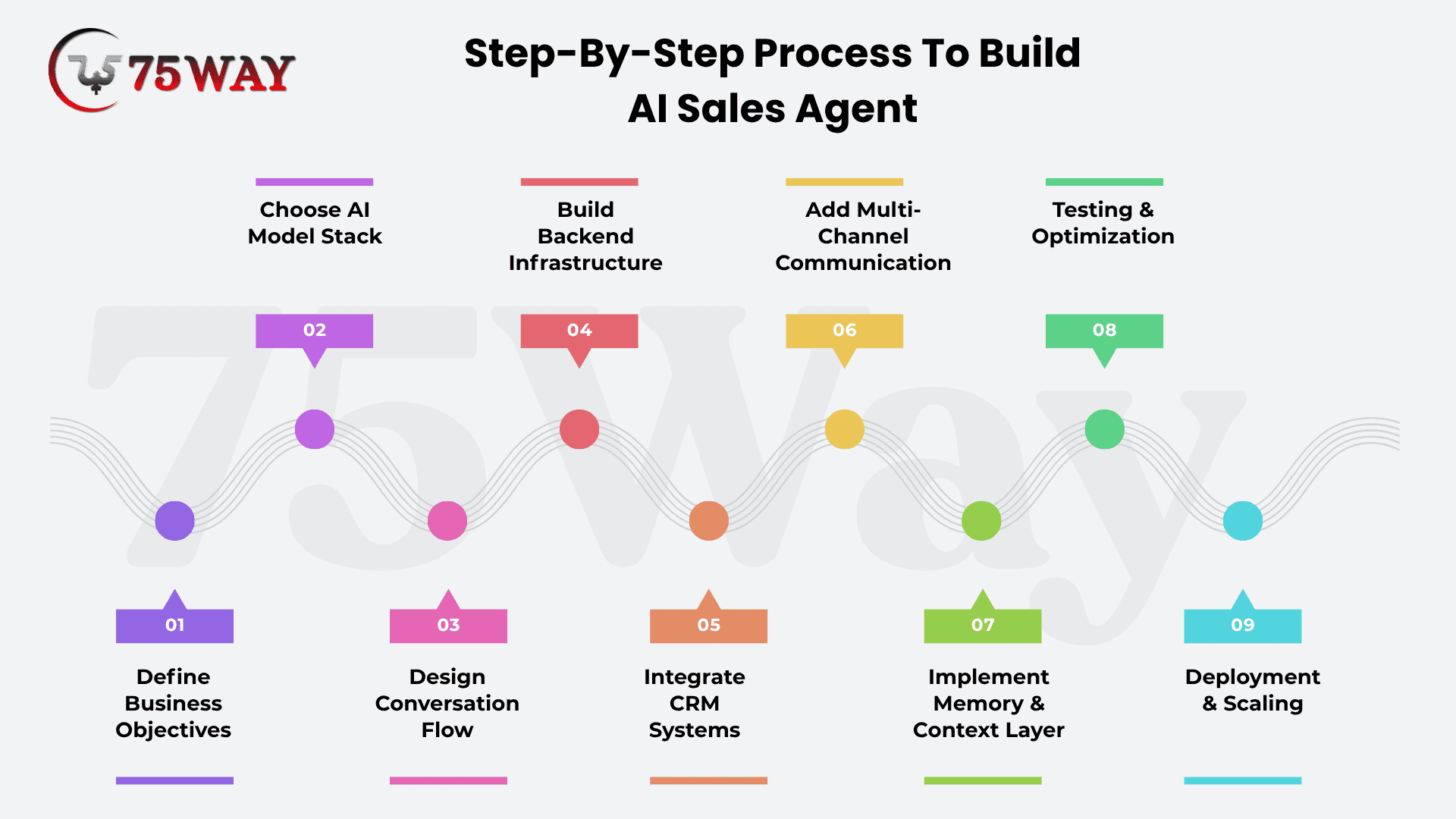
Step 1: Define Business Objectives
The first step involves identifying the primary purpose of the AI sales agent, such as lead generation, lead qualification, customer support, or closing sales. Clear objectives help define system behavior, workflows, and overall design direction effectively.
This step also helps align technical development with business goals, ensuring the agent delivers measurable outcomes like improved conversions, faster response times, and reduced manual workload across sales operations.
Step 2: Choose AI Model Stack
This step focuses on selecting the right AI models, such as GPT-based systems, Claude models, or open-source LLMs like Llama or Mistral. The choice depends on cost, performance accuracy, scalability needs, and business requirements.
It is also important to evaluate latency, fine-tuning capability, and integration flexibility, as these factors directly impact response quality and system efficiency in real-time customer interactions.
Step 3: Design Conversation Flow
Conversation flow design maps the entire customer journey from awareness to conversion. It ensures structured dialogue across different stages, helping the AI agent guide users smoothly toward decision-making and successful conversions.
This stage also includes building fallback responses and intent recognition paths to handle unexpected queries while maintaining natural and engaging conversations throughout the sales process.
Step 4: Build Backend Infrastructure
Backend development involves creating APIs, logic systems, and databases using technologies like Node.js, Python, FastAPI, or Express. It manages data storage, request handling, and core system operations for the AI sales agent.
Additionally, backend architecture must ensure scalability, security, and fast processing to handle high volumes of user interactions without performance delays or system failures.
Step 5: Integrate CRM Systems
CRM integration connects the AI agent with platforms like HubSpot, Salesforce, or Zoho. It enables lead tracking, customer data synchronization, and sales pipeline management for better personalization and business efficiency.
This integration also ensures real-time updates across sales teams, improving collaboration, reducing data duplication, and enabling smarter decision-making based on unified customer information.
Step 6: Add Multi-Channel Communication
This step deploys the AI agent across multiple platforms such as websites, WhatsApp, email, and social media. It ensures consistent customer engagement across all communication channels.
It also improves accessibility by allowing users to interact through their preferred platforms, increasing engagement rates, and ensuring no lead is missed across different touchpoints.
Step 7: Implement Memory & Context Stage
The memory layer allows the AI agent to remember past conversations and user preferences. It improves personalization, strengthens engagement, and ensures continuity in ongoing customer interactions.
It also helps the system build long-term customer profiles, enabling smarter recommendations, better follow-ups, and more human-like conversational experiences over time.
Step 8: Testing & Optimization
Testing evaluates response accuracy, user experience, conversion flow, and edge-case handling. Optimization improves performance by refining conversation logic and enhancing system reliability.
This stage also involves A/B testing different conversational strategies to identify the most effective approaches for improving engagement and increasing conversion rates.
Step 9: Deployment & Scaling
The final step involves deploying the system on cloud platforms like AWS, Google Cloud, or Azure. Scaling is achieved using containerization tools such as Docker and Kubernetes for high performance.
Post-deployment monitoring ensures system stability, while continuous scaling strategies allow the AI sales agent to handle growing traffic and expanding business requirements
Core Components Of AI Sales Agent Development
AI sales agents rely on multiple interconnected components that enable intelligent conversations, automation, and seamless sales operations. These components work together to understand customer intent, process data, and execute actions across platforms, improving personalization and conversions in modern digital sales systems.
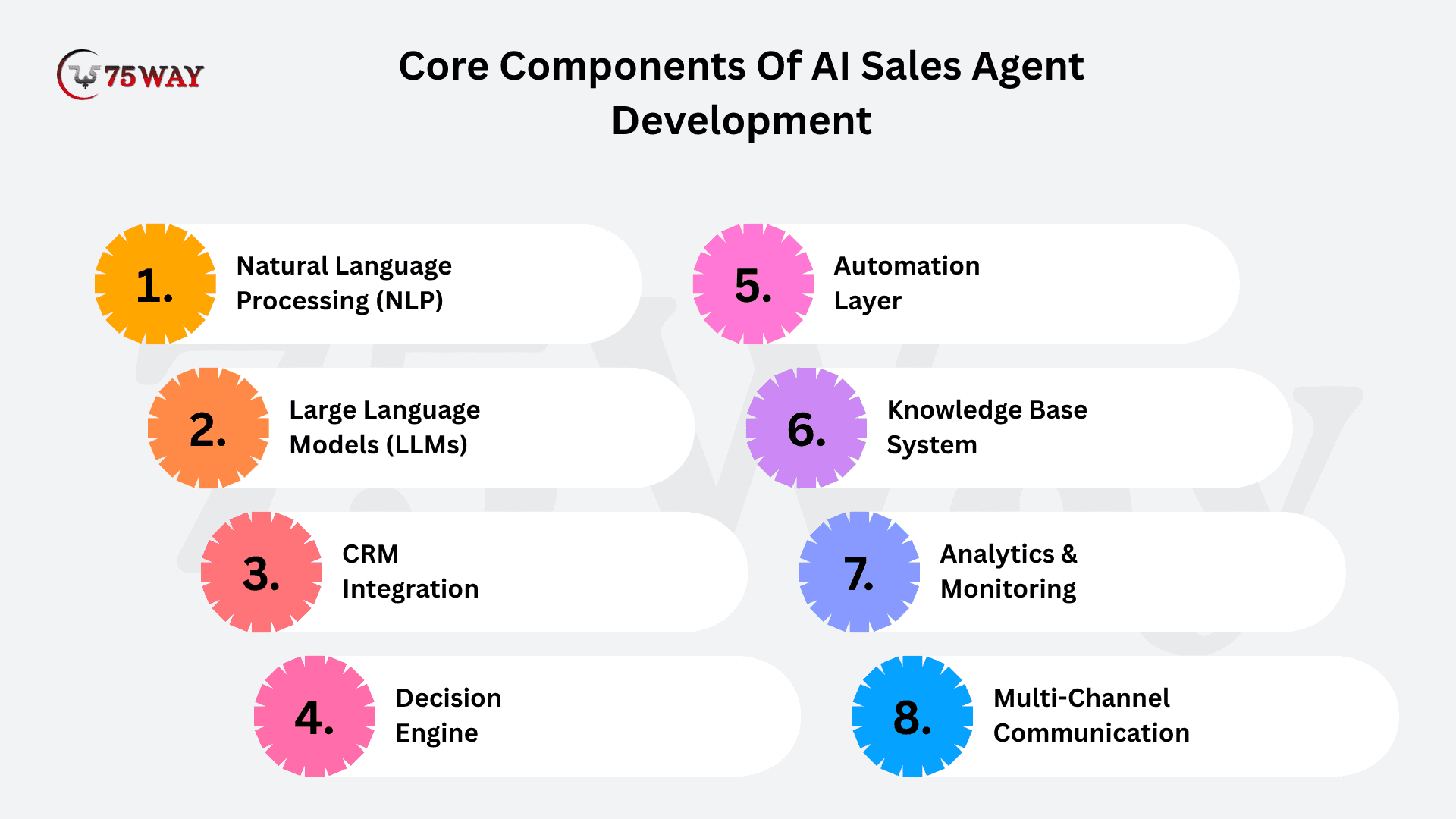
- Natural Language Processing (NLP): Natural Language Processing enables AI sales agents to understand customer queries, interpret intent, and extract meaningful context from conversations. It processes human language accurately and converts it into structured data. This allows the system to respond appropriately across different communication channels and improve interaction quality.
- Large Language Models (LLMs): LLMs power conversational AI by generating human-like responses based on vast training data. They understand context, maintain dialogue flow, and produce natural replies. This helps AI sales agents deliver personalized communication and simulate realistic human sales conversations effectively.
- CRM Integration: CRM integration layer connects AI agents with customer relationship management systems to access leads, customer history, and sales pipelines. It ensures seamless data synchronization across platforms. This enables personalized engagement and improves decision-making based on real-time customer insights and business records.
- Decision Engine: The decision engine analyzes customer behavior, intent, and historical data to determine appropriate responses. It selects actions such as follow-ups, recommendations, or escalation. This ensures AI agents make intelligent decisions that align with business goals and improve conversion rates.
- Automation Layer: AI automation layer executes repetitive sales tasks such as sending emails, scheduling meetings, and managing follow-ups. It reduces manual workload and ensures consistent customer engagement. This improves operational efficiency and accelerates lead conversion across multiple communication channels.
- Knowledge Base System: The knowledge base system stores product information, FAQs, pricing details, and company policies. It enables AI agents to provide accurate and consistent responses. This improves customer trust, reduces errors, and ensures reliable information delivery during conversations.
- Analytics & Monitoring Engine: Advanced analytics tracks user interactions, conversation performance, and conversion metrics. It provides insights into customer behavior and agent efficiency. This helps businesses optimize sales strategies and improve overall performance through data-driven decision-making.
- Multi-Channel Communication Layer: The multi-channel communication layer enables AI agents to interact across platforms like chat, email, WhatsApp, and websites. It ensures consistent communication across all touchpoints. This improves customer accessibility, engagement, and response reach across multiple digital channels.
Tech Stack Behind Robust AI Sales Agent Development
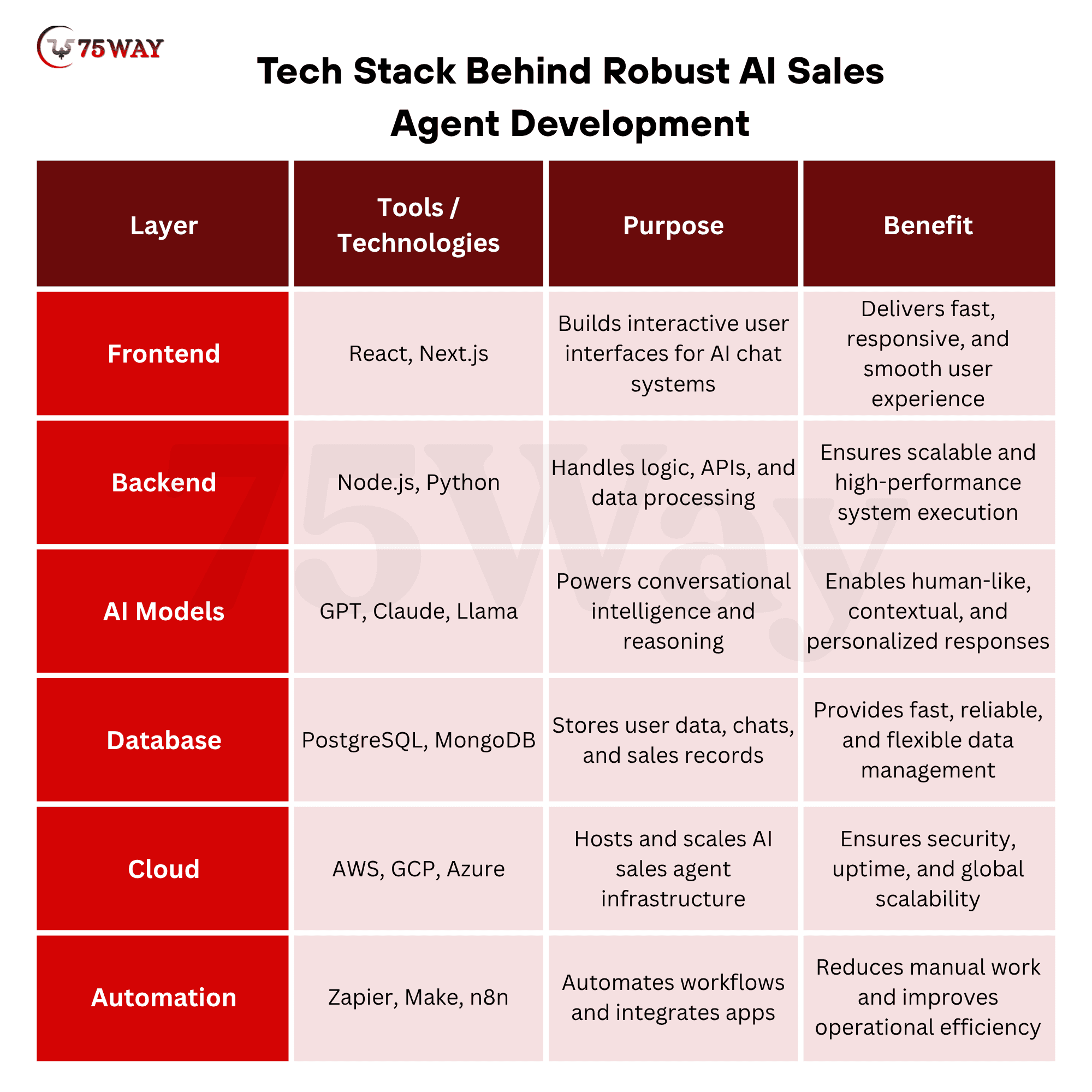
AI sales agents rely on a modern technology stack that combines frontend interfaces, backend systems, AI models, databases, cloud infrastructure, and automation tools. This stack ensures smooth conversations, fast processing, scalable performance, and seamless integration with business systems like CRMs and communication platforms.
- Frontend: React / Next.js powers interactive and responsive user interfaces for AI sales agents. These frameworks enable real-time chat experiences, fast rendering, and smooth user interactions across web platforms for better customer engagement.
- Backend: Node.js / Python handles core logic, API requests, and data processing for AI sales agents. These technologies ensure fast execution, scalable architecture, and reliable handling of multiple user conversations.
- AI Models: GPT / Claude / Llama provide the intelligence layer for generating human-like responses. These models understand user intent, maintain context, and deliver personalized conversations that improve engagement and conversion rates.
- Database: PostgreSQL / MongoDB stores customer data, conversation history, and sales records. They ensure structured and unstructured data handling, enabling fast retrieval and efficient management of user information.
- Cloud: AWS / GCP / Azure provides scalable infrastructure for hosting AI sales agents. They ensure high availability, security, and performance while supporting global deployment and traffic scalability.
- Automation: Zapier / Make / n8n automate workflows like lead routing, follow-ups, and notifications. These tools reduce manual effort and improve operational efficiency by connecting different business applications.
Use Cases of AI Sales Agents Driving Revenue Across Industries
AI sales agents are widely used across industries to automate customer engagement, improve lead conversion, and streamline sales operations. These intelligent systems help businesses scale revenue by handling inquiries, qualifying leads, and supporting transactions across multiple digital channels.
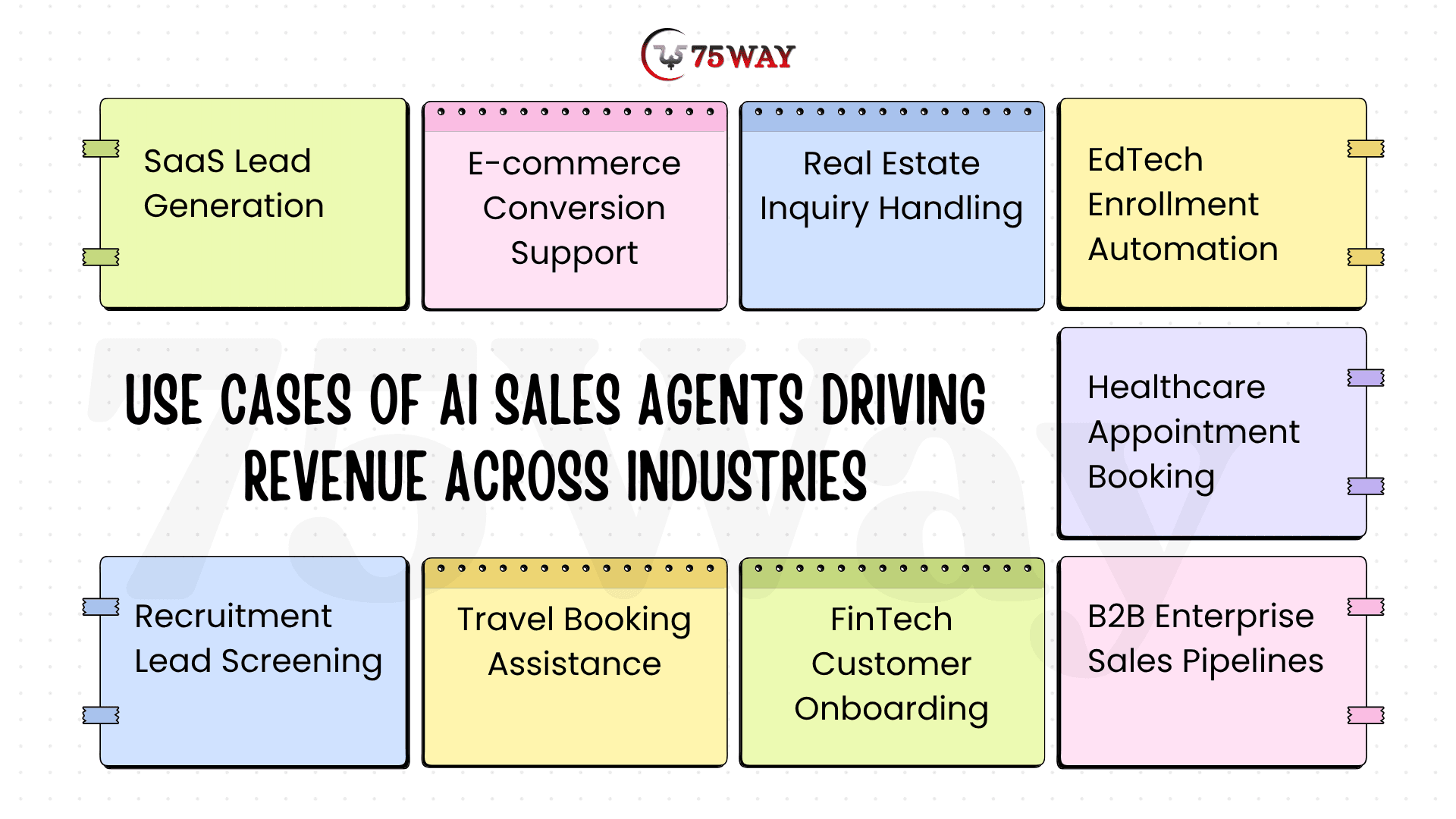
- SaaS Lead Generation: AI sales agents identify potential customers, engage website visitors, and qualify leads for SaaS platforms. They automate demo bookings and nurture prospects through personalized conversations that improve conversion rates.
- E-commerce Conversion Support: AI agents assist online shoppers by recommending products, answering queries, and reducing cart abandonment. They provide real-time support that increases purchase confidence and boosts sales.
- Real Estate Inquiry Handling: AI systems manage property inquiries, schedule site visits, and share listing details instantly. They help real estate businesses capture leads faster and improve customer engagement efficiency.
- EdTech Enrollment Automation: AI sales agents guide students through course selection, answer program-related questions, and automate enrollment processes. This improves admissions efficiency and increases student sign-ups.
- Healthcare Appointment Booking: AI agents simplify appointment scheduling, reminders, and patient queries. They reduce administrative workload and improve patient experience in healthcare organizations.
- B2B Enterprise Sales Pipelines: AI systems manage complex B2B lead journeys, track interactions, and automate follow-ups. They help enterprises shorten sales cycles and improve deal closure rates.
- FinTech Customer Onboarding: AI agents streamline account setup, document verification, and user onboarding for financial platforms. They improve compliance and reduce onboarding time significantly.
- Travel Booking Assistance: AI systems help users plan trips, compare packages, and book tickets or hotels. They enhance customer experience and increase booking conversions.
- Recruitment Lead Screening: AI agents screen candidates, answer job queries, and schedule interviews. They help HR teams reduce manual effort and speed up hiring processes.
What’s The Cost of AI Sales Agent Development?
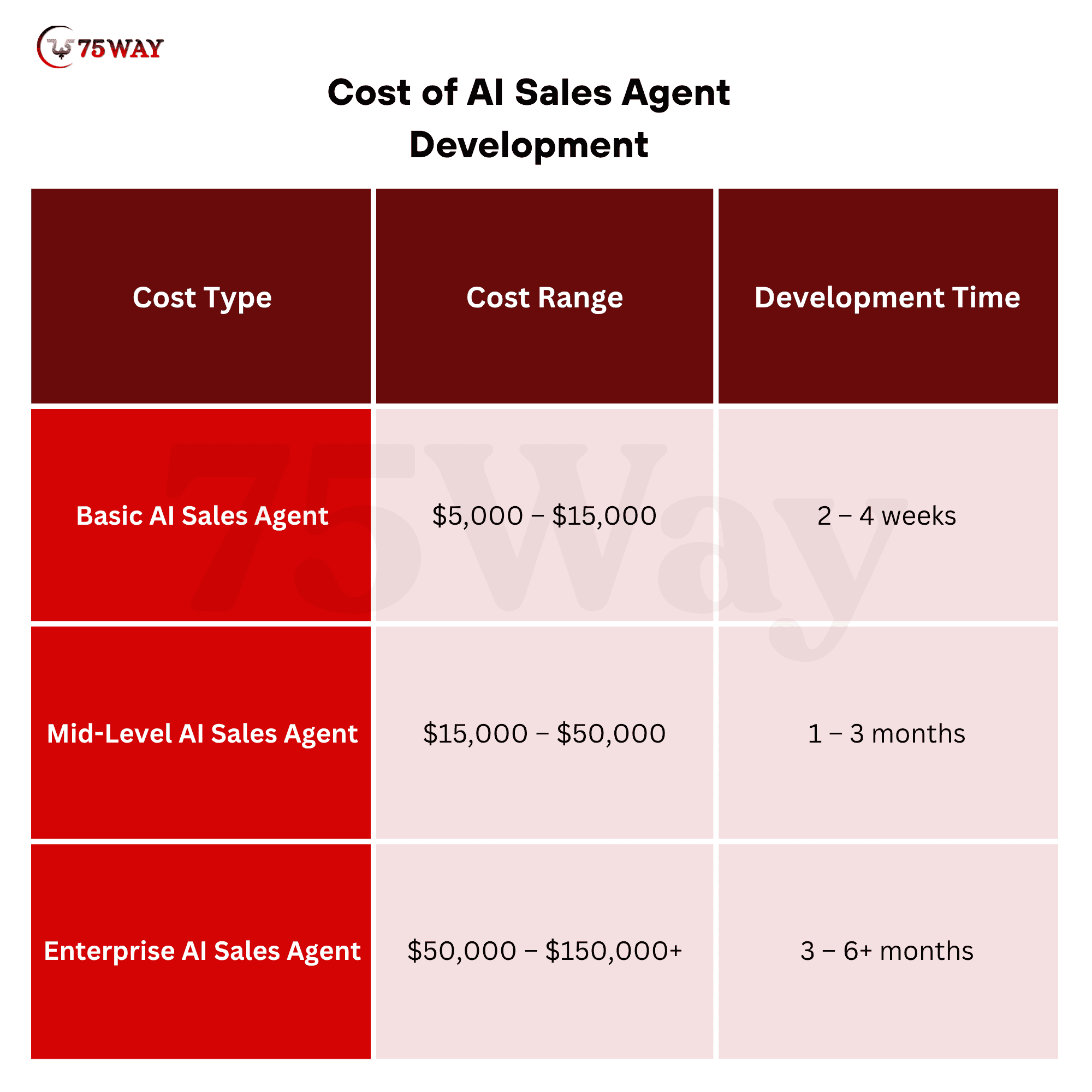
The cost of developing AI sales agents depends on complexity, integrations, and scalability requirements. Simple systems are budget-friendly. However, advanced enterprise solutions require higher investment due to AI capabilities, infrastructure, and automation features. Timeframes also vary based on system complexity and feature depth. On average, most AI sales agent development projects fall between $15,000 and $60,000 depending on required features and scale.
- Basic AI Sales Agent: $5,000 – $15,000
This range includes simple chat-based agents with limited automation, basic conversation flows, and minimal integrations. It is suitable for startups testing AI-driven customer engagement with low complexity requirements and small-scale usage.
- Mid-Level AI Sales Agent: $15,000 – $50,000
This category includes CRM integration, multi-channel communication, and improved AI capabilities. It supports lead qualification, automated follow-ups, and better personalization, making it suitable for growing businesses with moderate sales automation needs.
- Enterprise AI Sales Agent: $50,000 – $150,000+
This level includes advanced AI models, deep CRM integrations, analytics dashboards, and scalable cloud infrastructure. It is designed for large enterprises requiring high performance, security compliance, and complex sales workflow automation.
- Additional Cost Factors
Ongoing expenses include cloud hosting, API usage, model training, and maintenance. These recurring costs ensure system optimization, performance improvements, and continuous updates for long-term efficiency and reliability.
Challenges In Developing AI Sales Agent With Solutions
Developing AI sales agents comes with several technical and operational challenges that businesses must address to ensure accuracy, scalability, and compliance. These challenges often arise due to data limitations, system integrations, and the need for reliable AI-driven decision-making in real-world sales environments.
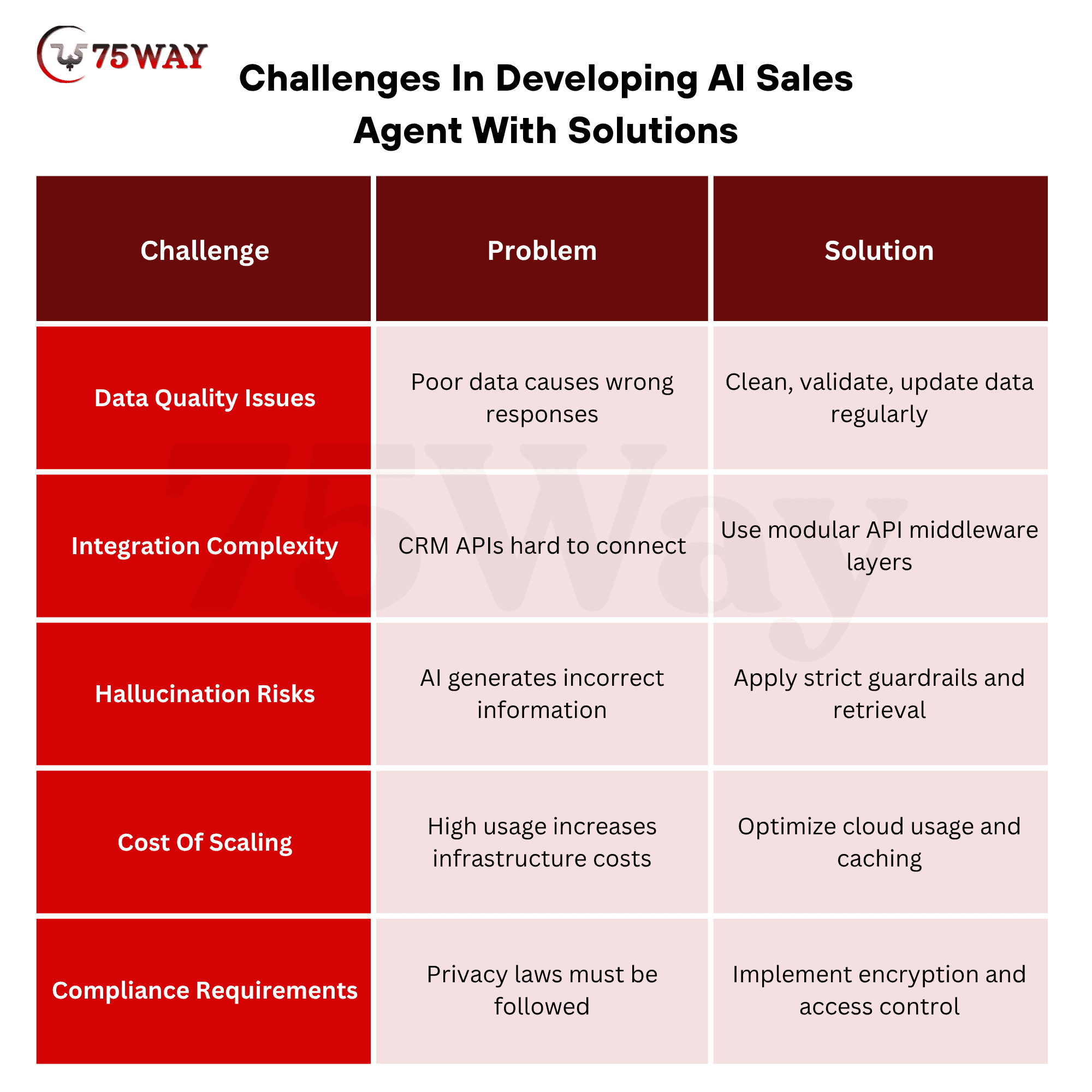
- Data Quality Issues: Poor or incomplete data leads to incorrect responses from AI systems. Improving data quality requires structured data cleaning, validation pipelines, and continuous dataset updates to ensure accurate and reliable AI outputs.
- Integration Complexity: CRM and API integration can be challenging across multiple platforms. Using standardized APIs, middleware solutions, and modular architecture helps simplify integration and ensures smooth connectivity between systems.
- Hallucination Risks: AI may generate incorrect or misleading sales information. Implementing retrieval-augmented generation, strict guardrails, and verified knowledge bases reduces hallucinations and improves response accuracy.
- Cost of Scaling: High usage can significantly increase infrastructure and operational costs. Optimizing cloud resources, using efficient model selection, and implementing caching strategies help control and reduce scaling expenses.
- Compliance Requirements: Data privacy laws must be strictly followed. Adopting encryption, access control, and compliance frameworks like GDPR ensures secure handling of customer data and regulatory adherence.
Final Thoughts
AI sales agent development transforms the way modern businesses automate lead generation, engagement, qualification, and conversion processes. These intelligent systems help organizations reduce operational costs, improve customer experience, and scale sales operations efficiently without increasing manual workload. By delivering faster responses and personalized interactions, they significantly enhance conversion rates and revenue performance. If you want to build revenue-generating AI agents for sales, you can contact a reliable AI development company and visit AI marketplaces like 75AI agent store to buy, customize, and launch pre-built AI sales agents.
Frequently Asked Questions (FAQs)
How Do AI Sales Agents Improve Customer Engagement?
AI sales agents improve engagement by responding instantly and maintaining consistent communication. They personalize interactions based on user behavior and preferences. This creates a smoother experience that increases trust, satisfaction, and long-term customer relationships effectively.
Are AI Sales Agents Suitable For B2B Companies?
Yes, AI sales agents are highly effective for B2B companies. They manage long sales cycles, qualify leads, and automate follow-ups. This helps sales teams focus on high-value prospects and improves pipeline efficiency and deal closure rates.
What Happens If AI Sales Agents Fail To Understand Queries?
When AI fails to understand queries, fallback systems or human escalation are triggered. This ensures customers still receive support without disruption. Continuous training and model improvements help reduce misunderstanding and enhance accuracy over time.
Can AI Sales Agents Be Customized For Different Businesses?
Yes, AI sales agents are fully customizable based on business needs. Companies can adjust tone, workflows, and integrations. This flexibility allows businesses to align AI behavior with brand identity and specific sales strategies effectively.
How Do AI Sales Agents Improve Conversion Rates?
AI agents improve conversions by responding instantly, nurturing leads consistently, and delivering personalized communication based on user behavior. This reduces drop-offs and keeps potential customers engaged throughout the entire sales journey.
Why Is Multi-Channel Deployment Important For AI Sales Agents?
Multi-channel deployment ensures customers can interact with AI agents through websites, WhatsApp, email, and social media. This increases accessibility, engagement rates, and overall lead capture opportunities for businesses.