AI Summary
Short video apps have become powerful digital products, but successful platforms require more than an attractive interface. This guide explains short video app development costs, features, technology, monetization, scalability, and strategic decisions businesses need before investing in short-form video platforms.
Key Takeaways
- Short video platforms could reach $4.2 billion globally by 2033.
- Short video app development projects can cost $25,000 to $250,000+.
- Successful short video apps combine engaging UI/UX, recommendation systems, monetization, and scalability.
- AI can improve recommendations, moderation, personalization, content creation, and platform operations.
- Strategic MVP planning reduces development risk while validating demand before scaling.
What makes someone watch one more video, follow a creator, or open the same app again tomorrow? The answer is rarely the swipe gesture itself. Content relevance, loading speed, recommendations, creator tools, social interactions, and the overall experience give a short video app its staying power.
For businesses, that creates an interesting opportunity and a difficult development challenge at the same time. A focused short video app development solution can serve a specific audience or industry, but its technology must be ready for heavy video traffic, growing content libraries, changing user behaviour, and increasing infrastructure demands.
This guide breaks down short video app development through the decisions that matter most, including features, AI capabilities, technology, costs, monetization, development stages, scalability, and common mistakes.
Market Size & Insights of Short Video App in USA Businesses Should Know
The market outlook demonstrates why short video platforms remain commercially attractive, particularly for businesses targeting mobile-first audiences. These statistics can help founders assess market potential before deciding their product positioning, target users, and investment strategy.
- The global short video platforms market is projected to grow from $2.1 billion in 2026 to $4.2 billion by 2033, representing a 10.2% CAGR during 2026–2033.
- North America accounted for approximately 38.0% of global market revenue, highlighting strong commercial potential in the region.
- The iOS segment held the leading position, capturing more than 42.0% of market revenue.
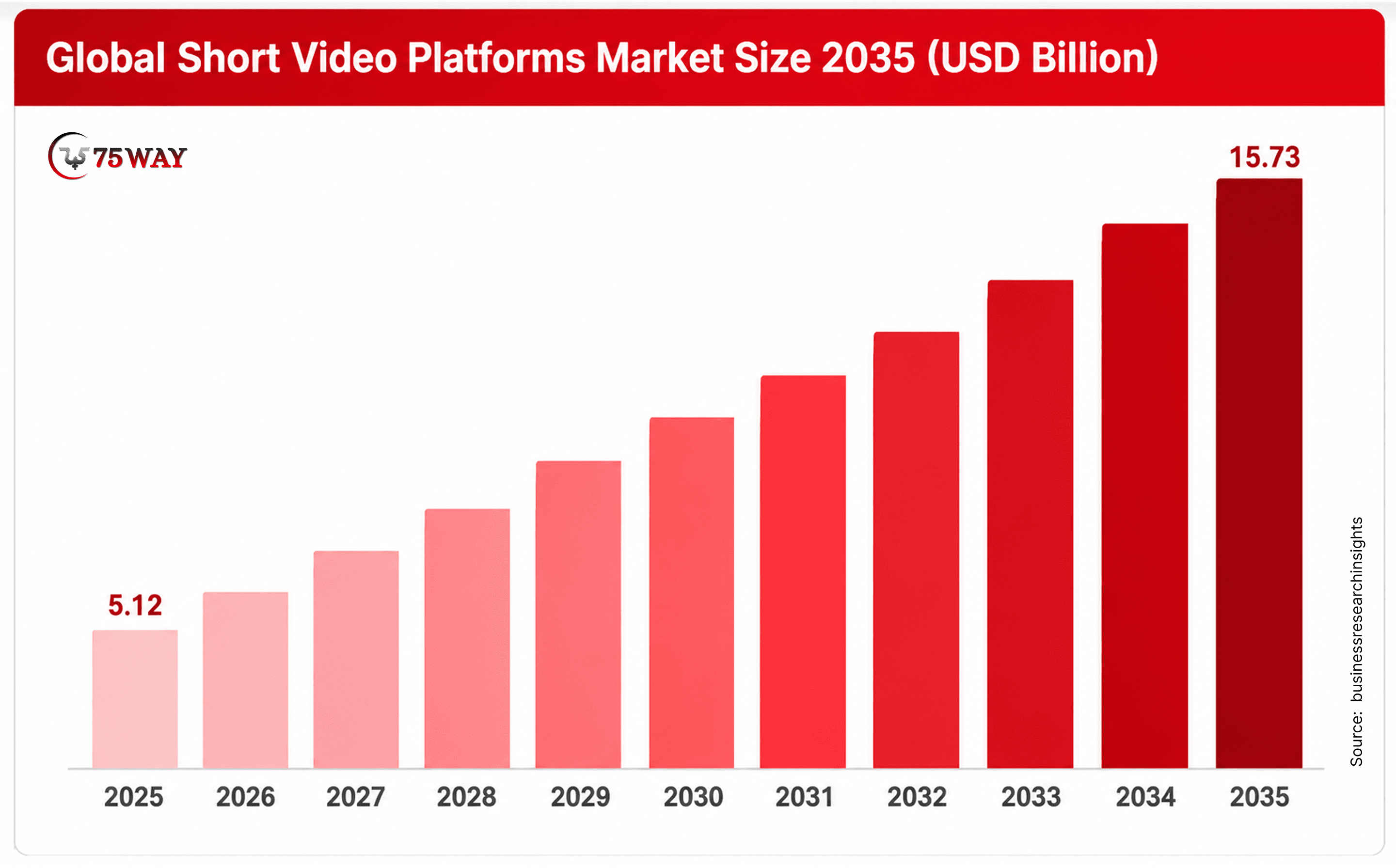
- Another market forecast estimates that the global short video platforms market could expand from $6.66 billion in 2026 to $15.73 billion by 2035, at approximately a 10% CAGR.
- More than 5.6 billion smartphone users worldwide access digital content, while over 2.5 billion users engage with short-form videos each month.
What Is Short Video App Development?
Short video app development involves designing and building a mobile or web platform where users can create, upload, discover, watch, interact with, and potentially monetize short-form video content.
A basic product may support video recording, editing, profiles, feeds, likes, comments, sharing, and notifications. A more advanced platform can include personalized recommendations, AI-powered moderation, creator monetization, live streaming, advertising, social commerce, analytics, and automated content processing.
The development approach depends heavily on the business model.
For example, a niche creator platform may prioritize creator tools and monetization, while a social commerce video platform may require product catalogs, shopping integrations, checkout, affiliate tracking, and seller dashboards.
That is why businesses should define the product strategy before selecting features or technology.
Different Types of Short Video Apps Businesses Can Build
Businesses do not necessarily need to build another general-purpose social network. A focused platform can create a clearer value proposition and potentially reduce initial development complexity.
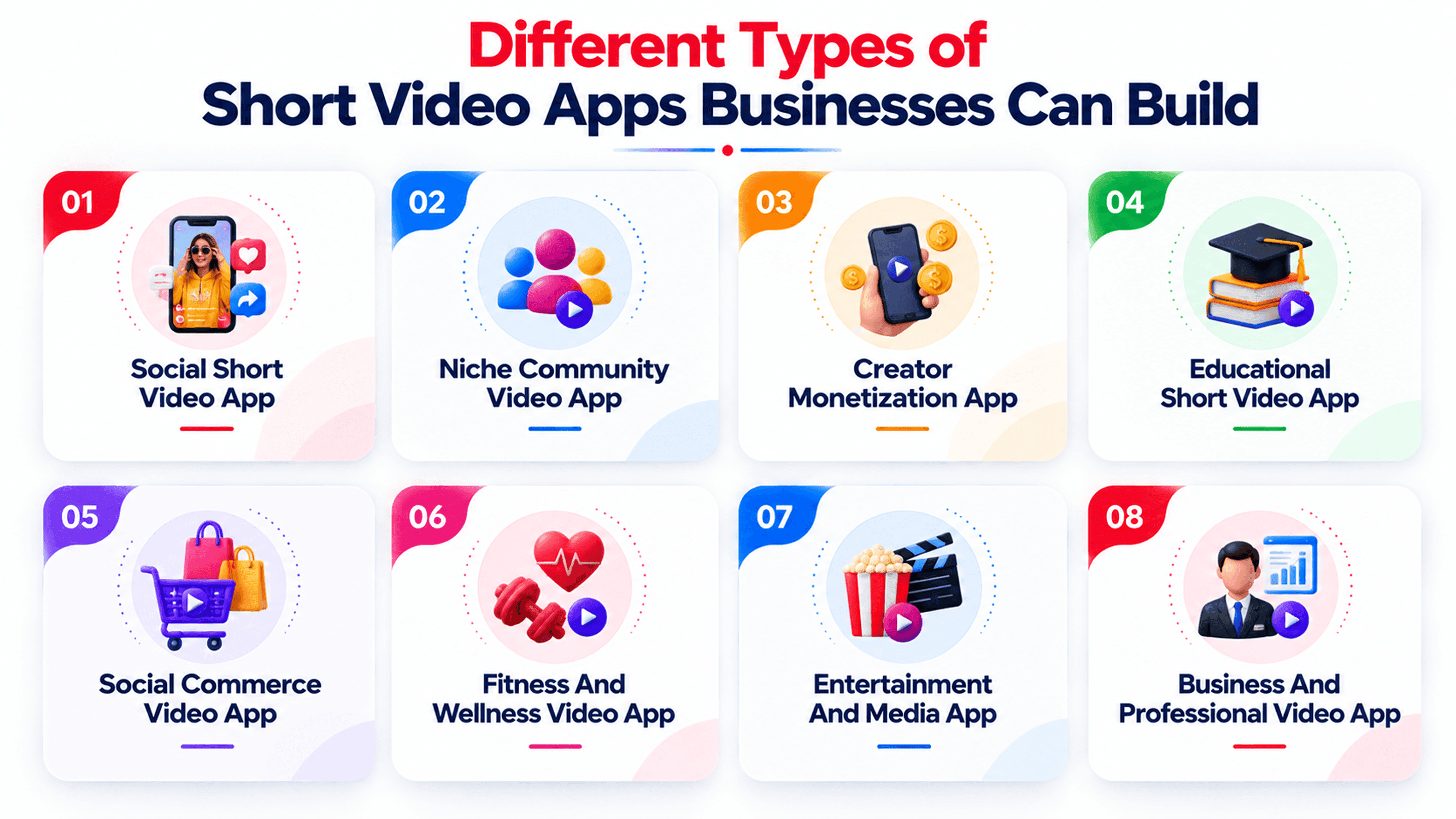
- Social Short Video App
A social short video app lets users create, discover, and share entertaining videos while building communities around creators and interests. The product typically relies on personalized feeds, social interactions, trending content, and creator profiles to encourage repeat visits.
Estimated Cost: $50,000–$150,000+
- Niche Community Video App
A niche video platform serves a clearly defined audience instead of competing for everyone’s attention. Fitness enthusiasts, travelers, gamers, professionals, or hobbyists can find content specifically aligned with their interests. This focused positioning can make audience acquisition and community building more manageable.
Estimated Cost: $40,000–$120,000
- Creator Monetization App
A creator-focused platform gives independent creators better ways to publish content and earn from their audiences. Features can include subscriptions, virtual gifts, paid content, tipping, creator analytics, and brand collaboration tools. The business earns by facilitating transactions across the creator ecosystem.
Estimated Cost: $60,000–$180,000
- Educational Short Video App
An educational video app turns complex subjects into short, digestible learning experiences for students, professionals, or lifelong learners. Businesses can combine expert-created videos with quizzes, progress tracking, personalized recommendations, and certificates. This model works particularly well for focused learning communities.
Estimated Cost: $45,000–$130,000
- Social Commerce Video App
A social commerce platform connects short-form videos directly with product discovery and purchasing. Brands, sellers, and creators can demonstrate products, tag items, recommend products, and drive viewers toward checkout without separating entertainment from shopping. Revenue can come from commissions or transaction fees.
Estimated Cost: $70,000–$200,000+
- Fitness And Wellness Video App
A fitness video platform can deliver short workouts, exercise demonstrations, nutrition content, coaching clips, and personalized routines. Businesses can add trainer profiles, subscription plans, progress tracking, challenges, and premium programs. The model creates opportunities for recurring revenue beyond advertising.
Estimated Cost: $45,000–$140,000
- Entertainment And Media App
An entertainment platform can bring together comedy, music, celebrity content, movie clips, behind-the-scenes videos, and original productions. Instead of relying entirely on user-generated content, businesses can build a controlled content ecosystem around licensed or proprietary media.
Estimated Cost: $60,000–$180,000+
- Business And Professional Video App
A professional short-video platform can help experts, companies, and industry communities share quick insights, tutorials, product demonstrations, and professional knowledge. Unlike entertainment-first platforms, its value comes from expertise, networking, lead generation, and industry-specific discovery.
Estimated Cost: $50,000–$160,000
How To Build A Short Video App: Process From Idea To Launch
One good video can attract attention, but a successful short video app needs a reason for users to keep scrolling. Fast playback, relevant content, creator participation, social interactions, and reliable infrastructure all contribute to that experience. The development journey starts with bringing these business and technical requirements together into one product.
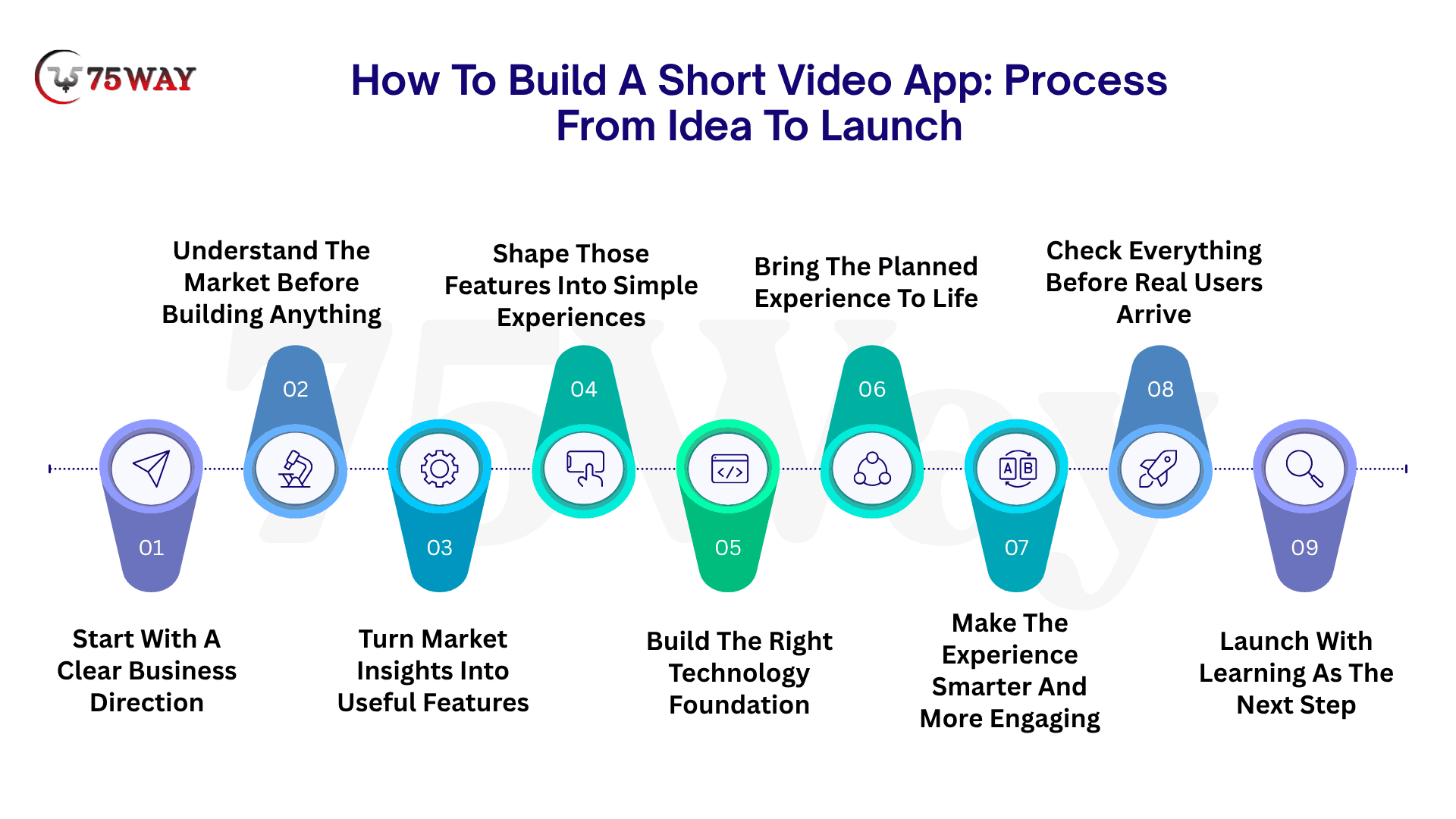
Step 1: Start With A Clear Business Direction
Every short video app needs a reason to exist beyond endless scrolling. Your business goal gives the product that reason. A defined audience makes the direction clearer. Your niche shapes the content experience. That foundation makes the research ahead far more useful.
Step 2: Understand The Market Before Building Anything
That foundation naturally leads to market research, where real user expectations become important. Audience behavior can reveal what keeps viewers watching. Competitor analysis shows what already works. Their weak spots may reveal opportunities. Those insights give your feature planning a practical direction.
Step 3: Turn Market Insights Into Useful Features
Once those opportunities become clear, your feature list can take shape. Users need simple ways to watch and create content. Profiles, feeds, comments, likes, sharing, and search support engagement. Your MVP should stay focused. Later features can grow from actual user feedback.
Step 4: Shape Those Features Into Simple Experiences
A feature list alone cannot make an app enjoyable. The next focus is how people move through it. Video discovery should feel natural. Content creation should require minimal effort. Clear prototypes can connect these moments into one familiar experience.
Step 5: Build The Right Technology Foundation
With those user journeys mapped out, technology decisions become much more meaningful. Video platforms need dependable storage and streaming. Backend systems must handle growing activity. Cloud infrastructure supports changing demand. The right architecture keeps the experience stable as development moves forward.
Step 6: Bring The Planned Experience To Life
Now the product starts becoming something users can actually experience. Developers connect screens, databases, APIs, and backend services. Account management and video uploads come first. Feeds and interactions follow naturally. Regular reviews keep the finished product close to the original vision.
Step 7: Make The Experience Smarter And More Engaging
Once the core experience works, smarter capabilities can add another layer of value. Personalized recommendations can improve discovery. AI moderation can support safer content. Filters and effects can encourage creation. These additions should strengthen the experience rather than distract from it.
Step 8: Check Everything Before Real Users Arrive
Those capabilities now need to work reliably together, not just individually. Testing covers uploads, playback, navigation, security, and performance. Different devices can expose hidden problems. Realistic network conditions reveal further weaknesses. Fixing these issues early creates a much stronger launch experience.
Step 9: Launch With Learning As The Next Step
A successful launch is really the beginning of the next product cycle. Early users show where the experience succeeds or struggles. Analytics reveal engagement patterns. Feedback explains the reasons behind them. Those lessons can guide updates, new features, and long-term business growth.
Essential Features You Must Integrate In Custom Short Video App Development
A strong short video app depends on features that make content discovery, creation, interaction, and retention feel natural. The right feature mix also gives businesses better control over content and user activity. Here are the essential capabilities worth considering.
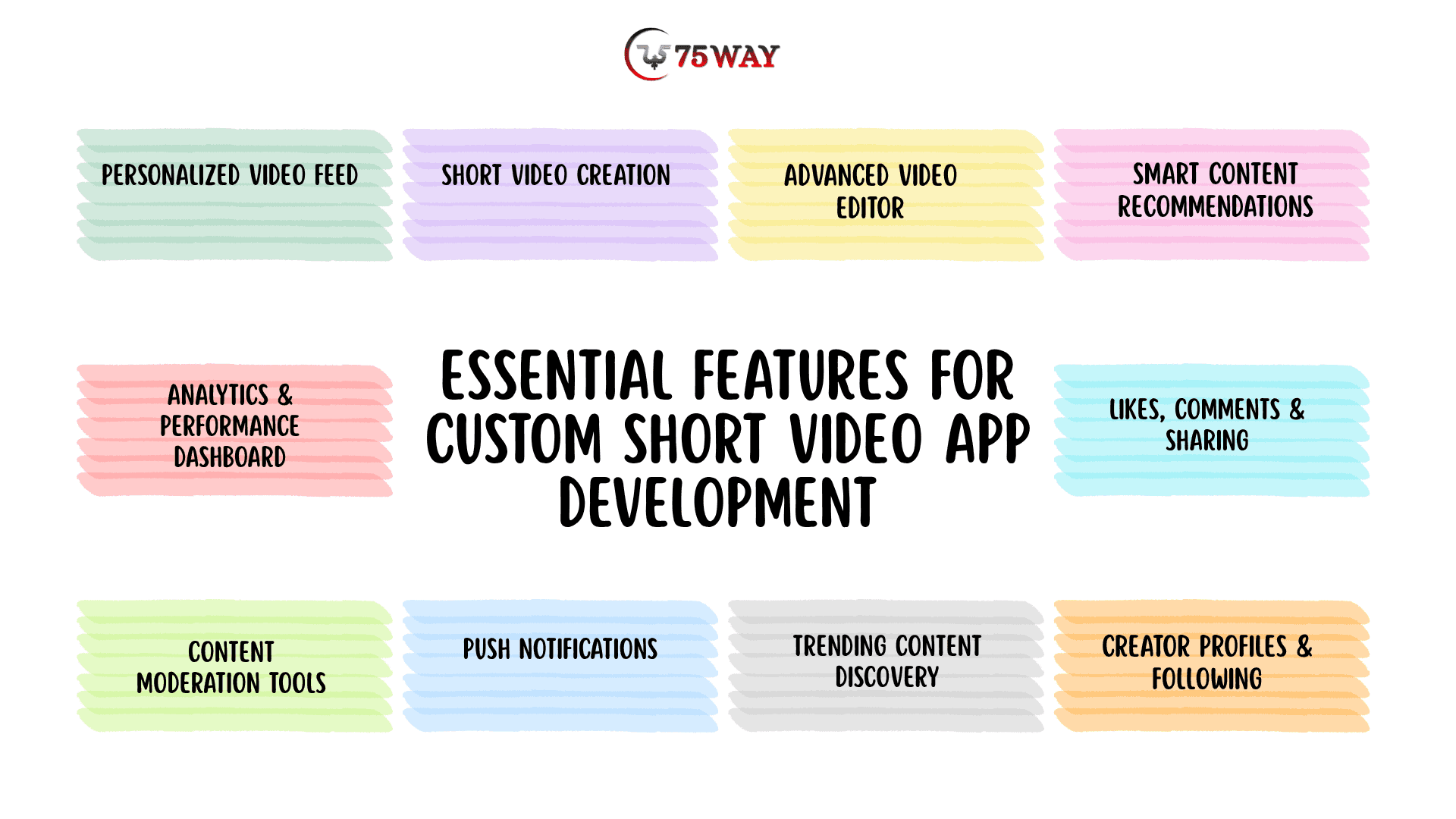
- Personalized Video Feed
A personalized feed recommends videos based on viewing history, interests, interactions, and engagement patterns. Relevant content keeps users exploring while creating a more engaging experience from their first session.
- Short Video Creation
Built-in video creation lets users record and upload short clips directly from the app. Simple recording controls, trimming, speed adjustments, and camera options can make content creation accessible.
- Advanced Video Editor
An integrated editor can provide transitions, filters, effects, text overlays, music, stickers, and trimming tools. These capabilities give creators more freedom to produce polished videos without external editing applications.
- Smart Content Recommendations
Recommendation algorithms can analyze user behavior and content preferences to suggest relevant videos. Better recommendations can increase watch time, content discovery, and overall user engagement across the platform.
- Likes, Comments & Sharing
Social interactions give viewers simple ways to respond to content and share interesting videos. Likes, comments, saves, and sharing can create stronger connections between creators and their audiences.
- Creator Profiles & Following
Dedicated creator profiles can showcase published videos, follower counts, and engagement information. Following functionality allows users to build personalized creator networks and receive content from accounts they enjoy.
- Trending Content Discovery
Trending sections can highlight popular videos, creators, hashtags, or challenges based on current engagement. This feature gives users another discovery path beyond their personalized feeds.
- Push Notifications
Timely notifications can inform users about new followers, comments, likes, messages, and fresh content from followed creators. Relevant alerts can encourage users to return without creating unnecessary interruptions.
- Content Moderation Tools
Moderation capabilities help businesses identify inappropriate, harmful, or policy-violating content. Automated detection combined with reporting and administrative review can support a safer and more manageable platform.
- Analytics & Performance Dashboard
Analytics provide visibility into views, watch time, engagement, retention, follower growth, and content performance. These insights help businesses and creators understand user behavior and make informed content decisions.
Advanced Features To Differentiate Your AI Social Media Platform Development
Once your MVP starts attracting users, advanced features can give people more reasons to stay, create, and return. The trick is not adding everything at once, but choosing capabilities that solve real platform or business challenges.
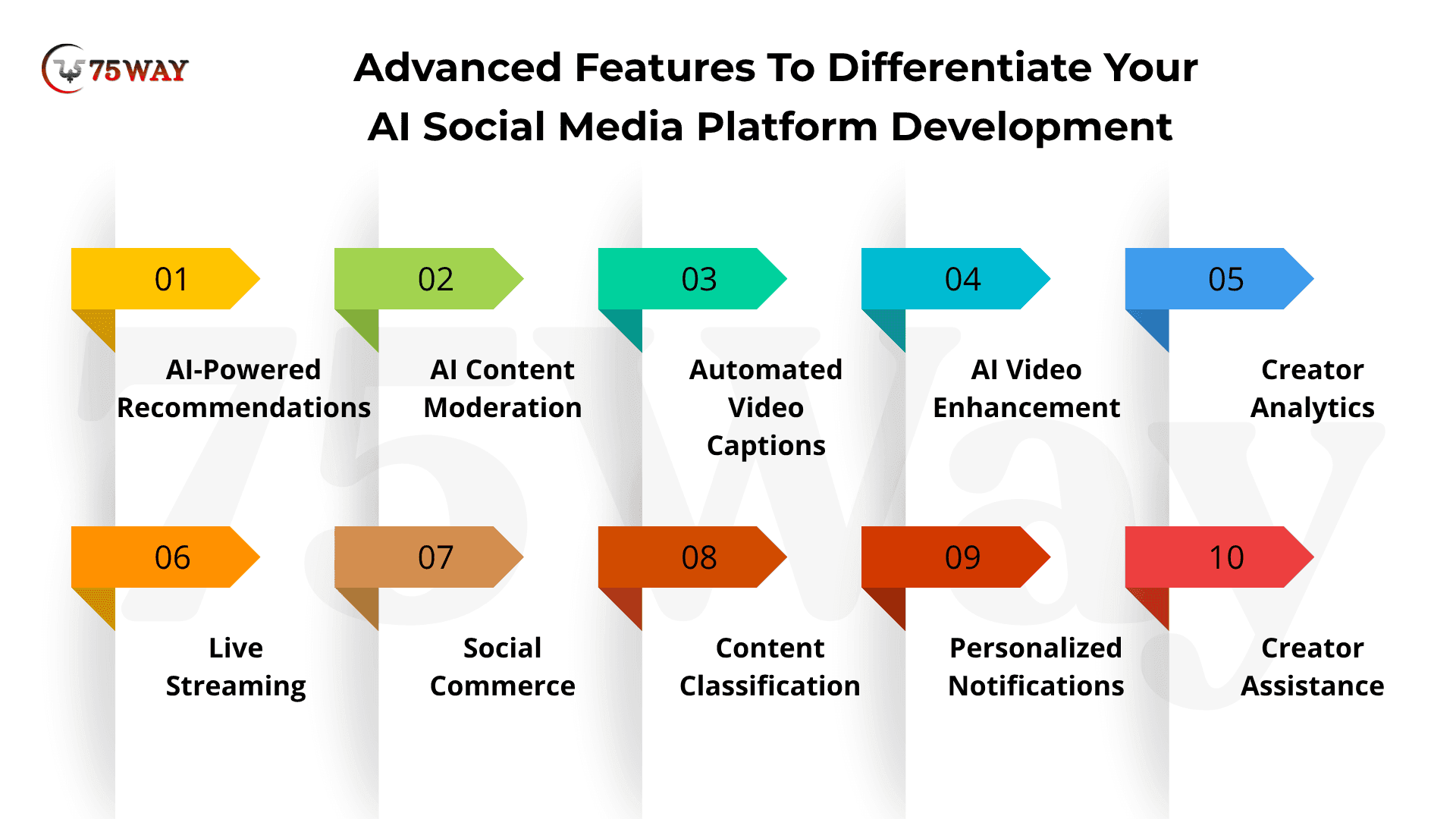
- AI-Powered Recommendations
A user opens your app, watches three videos, and expects the next one to feel even more relevant. AI-powered recommendations learn from those viewing signals to personalize what appears next. Better content discovery can translate into longer sessions and stronger retention.
- AI Content Moderation
A growing video library can quickly become difficult to monitor manually. AI moderation can scan uploaded content for potentially harmful or restricted material and route uncertain cases for human review. This combination gives your team greater control as the platform scales.
- Automated Video Captions
Many users watch videos without sound, making captions more than an accessibility feature. Speech-to-text technology can create captions automatically as creators upload their videos. The result is a more accessible viewing experience without asking creators to type everything themselves.
- AI Video Enhancement
Not every creator has professional lighting, cameras, or editing skills, yet viewers still expect good-quality videos. AI enhancement can improve clarity, reduce unwanted noise, and optimize visual frames automatically. A better-looking video can make everyday creator content feel considerably more polished.
- Creator Analytics
Creators need more than views to understand whether their content is working. Detailed analytics can reveal watch-time trends, audience retention, engagement patterns, and follower growth. These insights turn performance data into practical clues about what creators should produce next.
- Live Streaming
Recorded videos capture attention, but live streaming creates a different kind of connection. Creators can interact with viewers during events, discussions, demonstrations, or exclusive sessions. Real-time participation can also introduce revenue opportunities through subscriptions, virtual offerings, and other interactive experiences.
- Social Commerce
A viewer discovering a product inside a video does not necessarily want to leave the app to purchase it. Product tagging, creator partnerships, and integrated checkout can shorten that journey. For businesses, engaging content can therefore become a direct path toward measurable sales.
- Content Classification
Thousands of videos can become difficult to organize as your platform grows. Intelligent classification can understand topics, objects, speech, and other content signals to organize videos automatically. Better organization can strengthen search, discovery, recommendations, and content management behind the scenes.
- Personalized Notifications
Too many notifications can push users away, while too few can make an app feel inactive. Personalized alerts can focus on updates that genuinely matter to each user. Relevant timing and preferences can make notifications feel useful rather than like constant interruptions.
- Creator Assistance
Creating regularly can be difficult when creators face blank screens, tight schedules, or repetitive editing work. AI assistance can suggest scripts, captions, hashtags, summaries, and content ideas based on the creator's needs. Such support can make publishing easier without taking creativity away from the user.
Robust Technology Stack For Custom Short Video Mobile App Development
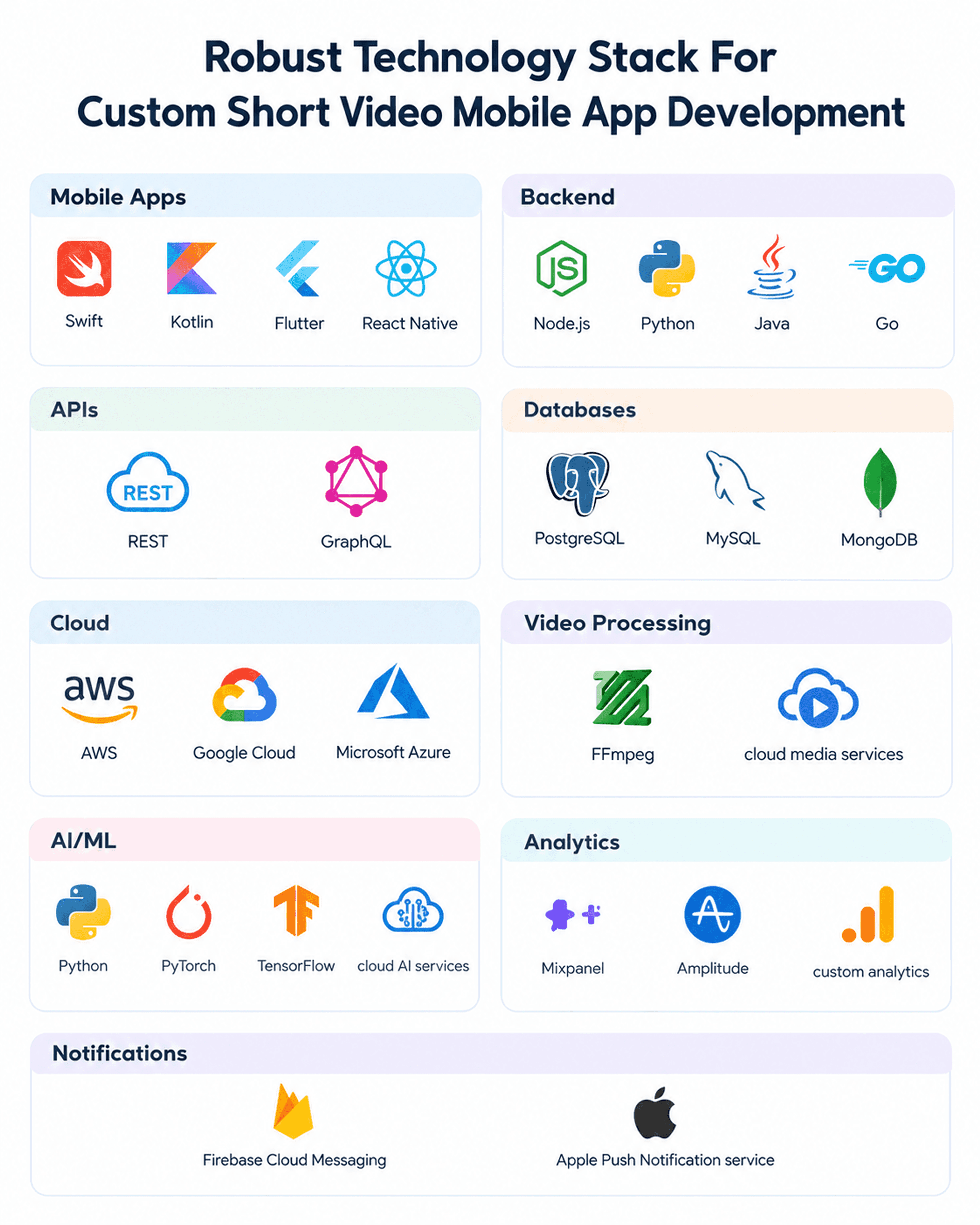
Choosing the technology stack becomes easier when every technology has a specific job inside the app. For example, Flutter or React Native works well when you want one codebase for both mobile platforms, while Swift and Kotlin are better choices when you need deeply native iOS or Android experiences.
Short Video App Architecture: What Makes It Different?
Video applications have different infrastructure requirements from standard content or marketplace applications.
A typical short video platform architecture may include:
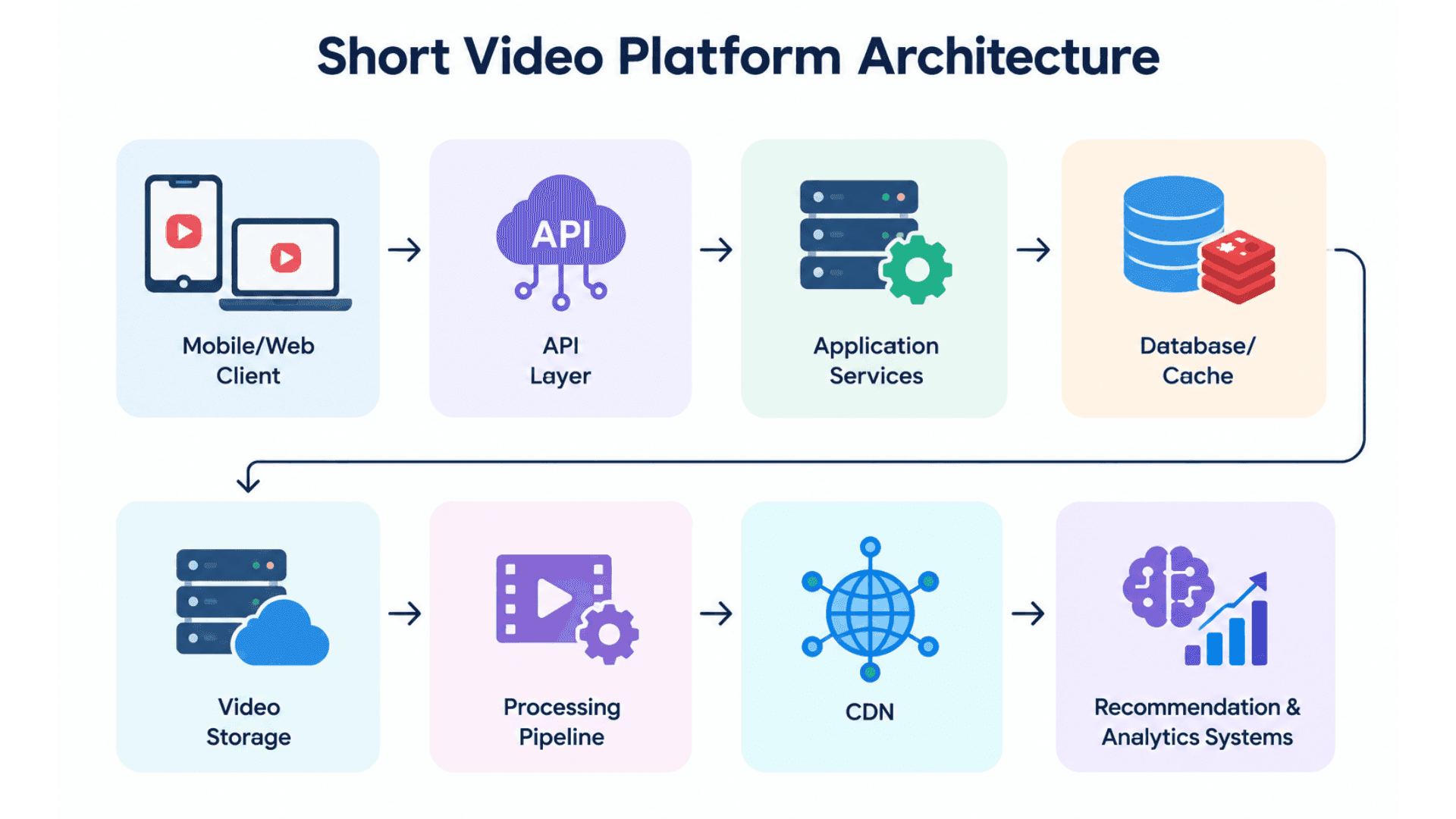
When a user uploads a video, the system may need to:
- Receive and validate the file.
- Store the original video.
- Transcode it into multiple resolutions.
- Generate thumbnails.
- Run moderation checks.
- Extract metadata.
- Store processed versions.
- Deliver the content through a CDN.
- Record viewing and engagement signals.
- Feed those signals into analytics and recommendation systems.
This pipeline is one reason why short video app development can become considerably more complex as user and content volumes increase.
How Much Does It Cost To Develop A Short Video App?
The cost of short video app development can range from approximately $25,000 to $250,000+, depending on the product's scope, platforms, design complexity, backend architecture, video infrastructure, AI capabilities, integrations, security requirements, and development team. A practical planning range looks like this:
1. Basic MVP Short Video App: Core video features that help validate market demand before larger development investments.
- Estimated Cost: $25,000 – $45,000
- Timeline: 3–5 months
- Suitable For: Early-Stage Startups, New Businesses
2. Mid-Level Short Video App: Advanced engagement and discovery features designed for stronger user experiences and platform growth.
- Estimated Cost: $50,000 – $90,000
- Timeline: 5–8 months
- Suitable For: Growing Businesses, Established Startups
3. High-End Short Video App: AI, AR, advanced infrastructure, and sophisticated capabilities built for large-scale video platforms.
- Estimated Cost: $90,000 – $250,000+
- Timeline: 8–12+ months
- Suitable For: Scaled Businesses, Enterprise Platforms
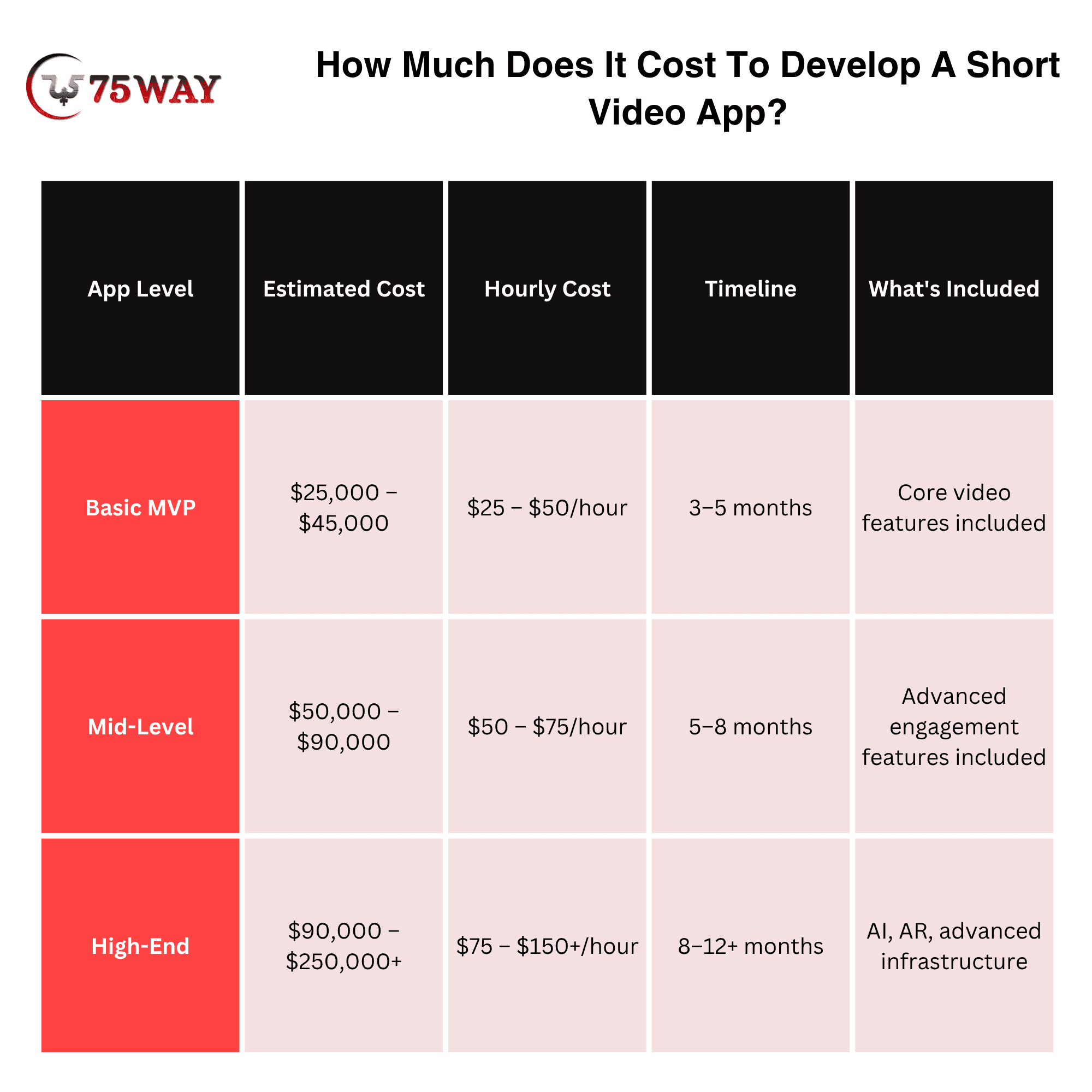
These are planning estimates, not fixed quotations.
Which Factors Affect the Cost of Short Video App Development
Several factors have the greatest impact on the budget.
- Number of Platforms: Building native iOS and Android applications separately can increase development effort.
- Feature Complexity: Advanced editing, live streaming, social commerce, subscriptions, and creator tools require additional engineering.
- Video Infrastructure: Storage, transcoding, delivery, CDN usage, and bandwidth create ongoing infrastructure costs.
- AI Requirements: Recommendation systems, moderation, personalization, and AI creation tools can significantly increase engineering complexity.
- Backend Scalability: A platform designed for millions of users requires a different architecture from an early-stage MVP.
- Third-Party Integrations: Payment gateways, analytics, authentication, music libraries, cloud services, and other integrations affect both development and maintenance.
- Security Requirements: Authentication, authorization, data protection, abuse prevention, and monitoring add development effort.
What’s Exact Timeline To Develop A Short Video Mobile App
A typical project can take approximately 3 to 12+ months, depending on scope.
1. Discovery And Planning: 2–4 Weeks
Business requirements, target users, competitive research, technical planning, feature prioritization, and product documentation are completed.
2. UI/UX Design: 3–6 Weeks
User journeys, wireframes, visual design, prototypes, design systems, and usability testing are developed.
3. MVP Development: 8–16 Weeks
The core mobile application, backend, database, video functionality, authentication, feed, social interactions, and admin functionality are developed.
4. Advanced Development: 8–20+ Weeks
AI, recommendation systems, monetization, advanced analytics, live streaming, social commerce, and other advanced features can extend the timeline.
5. Testing And Launch: 3–6 Weeks
Testing, performance optimization, security validation, deployment, analytics configuration, and launch preparation are completed.
These phases can overlap, so total project duration should not be calculated simply by adding every phase together.
Revenue Models: How Do Short Video Apps Make Money?
Millions of views may look like success, but a short video app still needs a clear path from attention to revenue. Advertising, creator subscriptions, virtual gifts, premium content, and commerce can turn user engagement into different income streams. The right model depends on your audience, content strategy, and how you want the platform to grow.
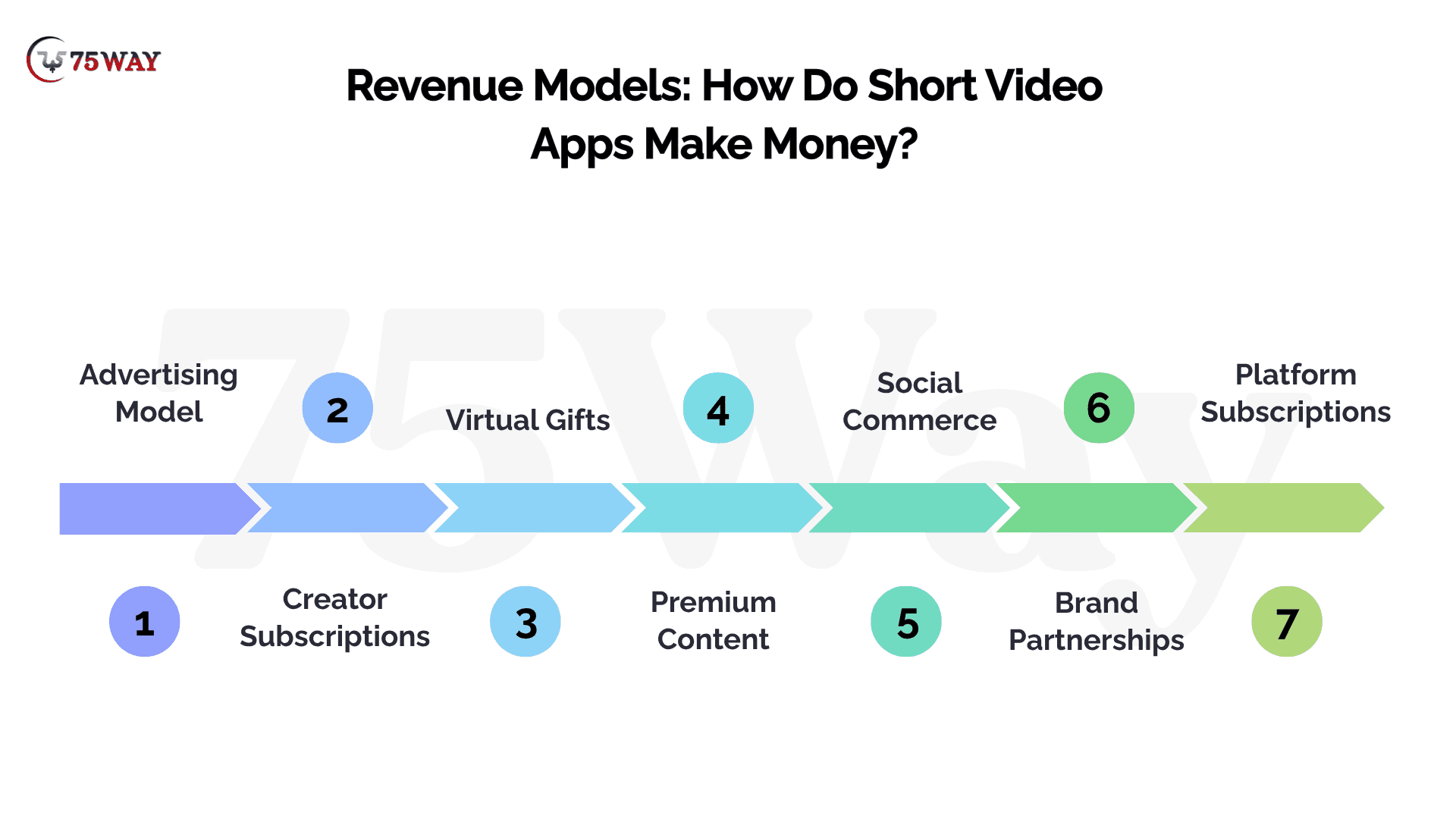
- Advertising Model: Advertising can become the primary revenue stream once your platform has strong traffic and watch time. Revenue can come from video ads, sponsored placements, native promotions, and branded campaigns.
For instance, if advertisers generate $20,000 in monthly revenue and your advertising-related operating costs are $8,000, your gross margin would be approximately 60%.
- Creator Subscriptions: Paid subscriptions allow users to support individual creators in exchange for exclusive videos, communities, or member benefits.
The platform can retain a percentage of each subscription while sharing the remainder with creators. For example, if subscribers generate $10,000 and creators receive $7,000, the platform retains $3,000, representing a 30% share before platform expenses.
- Virtual Gifts: Virtual gifts allow viewers to purchase credits and send digital gifts during videos or live interactions. The platform can retain a percentage while distributing the remaining amount to creators.
To illustrate, $15,000 in gift purchases with $9,000 distributed to creators leaves $6,000 for the platform, giving it a 40% share before applicable payment and operating costs.
- Premium Content: Premium content gives creators or businesses an opportunity to charge users for individual videos, collections, courses, or exclusive material. The platform can earn through a transaction commission.
For instance, $12,000 in premium content sales with a 25% platform commission would generate $3,000 in platform revenue, before payment processing and other expenses.
- Social Commerce: Social commerce connects videos directly with products, allowing platforms to earn through commissions, affiliate arrangements, or transaction fees.
For example, if users purchase $50,000 worth of products through your platform and your commission rate is 10%, the platform generates $5,000 in revenue from those transactions.
- Brand Partnerships: Brand partnerships can connect businesses with relevant creators for sponsored videos, campaigns, and product promotions.
The platform can charge campaign management fees or retain a percentage of partnership revenue. For example, a $20,000 sponsored campaign with a 15% platform fee would generate $3,000 in revenue before campaign-related expenses.
- Platform Subscriptions: A premium membership can provide users with additional features, exclusive content, enhanced customization, or an ad-free experience.
For example, 2,000 subscribers paying $5 monthly would generate $10,000 in recurring revenue. If $3,000 goes toward servicing those subscriptions, the remaining $7,000 represents a 70% gross margin.
The most suitable model is rarely a single option. A platform may begin with advertising and creator monetization, then add subscriptions, commerce, or premium offerings as its audience and transaction volume grow.
How To Scale Your Custom Short Video Platform Development Solution
Scalability should be considered before the platform experiences rapid growth.
Important considerations include:
- CDN-based video delivery
- Cloud object storage
- Adaptive video streaming
- Distributed backend services
- Database optimization
- Caching
- Asynchronous processing
- Queue-based video processing
- Automated infrastructure scaling
- Monitoring and observability
- Content delivery optimization
- Recommendation infrastructure
A useful approach is to build the initial architecture for controlled growth, rather than paying for the complexity of massive-scale infrastructure before the business has users.
Security And Privacy Considerations For Short Video Application Development
Short video applications handle user accounts, uploaded videos, engagement activity, payments, and behavioral data. Strong authentication, encryption, role-based access, and secure APIs help protect this information from unauthorized access.
Platform safety also needs protection against misuse. Abuse prevention, rate limiting, secure account recovery, content reporting, moderation controls, and audit logging can help manage suspicious activity and harmful content.
Privacy planning should happen before launch, not afterward. Clear data protection, retention, consent, infrastructure monitoring, and backup-and-recovery practices can help businesses protect user information while maintaining reliable platform operations.
How To Choose A Short Video App Development Company
Your short video app idea may be strong, but the wrong development company can turn it into a slow, costly, and difficult product. Experience with video-heavy applications, backend architecture, AI, third-party integrations, and post-launch scaling can make a major difference. A closer evaluation of these areas can help you choose a partner with the technical depth your app requires.
- Relevant Short Video Experience
Look for a company with experience building video-focused platforms, social applications, creator tools, or media-heavy products. Such experience indicates familiarity with challenges around video processing, streaming, feeds, engagement, and scalable infrastructure.
- Strong Technical Expertise
The development team should have expertise across mobile development, backend systems, cloud infrastructure, databases, APIs, AI, and video technologies. This broader capability helps ensure different parts of your platform work together smoothly.
- Portfolio And Case Studies
A company's previous projects can reveal more than its service page. Review relevant case studies, product functionality, technical challenges, and measurable outcomes to understand whether the team can handle a project similar to yours.
- Development Process And Communication
A transparent development process makes collaboration easier from planning through launch. Ask how the company handles requirements, milestones, testing, feedback, progress updates, and changes so expectations remain clear throughout development.
- Security And Scalability Approach
Short video apps can experience rapid growth in users, uploads, and traffic. Your development partner should therefore have a clear approach to data security, cloud infrastructure, video delivery, performance optimization, backups, and future scalability.
- Post-Launch Support And Pricing
The relationship should continue after the app reaches the stores. Compare development costs alongside maintenance, technical support, upgrades, infrastructure assistance, and future enhancement services to understand the actual long-term investment.
MVP Vs Full-Scale Short Video App Development
The main difference between an MVP and a full-scale short video app is the development scope, investment, and level of functionality. An MVP focuses on essential features needed to launch, attract initial users, and validate the business idea, while a full-scale app includes advanced capabilities built for larger audiences and long-term growth.
For most startups and businesses entering an unvalidated market, an MVP offers a practical way to test demand before making a larger investment. Once user behavior, engagement, retention, and revenue potential become clearer, the platform can expand with advanced recommendations, monetization, AI capabilities, stronger analytics, and larger infrastructure.
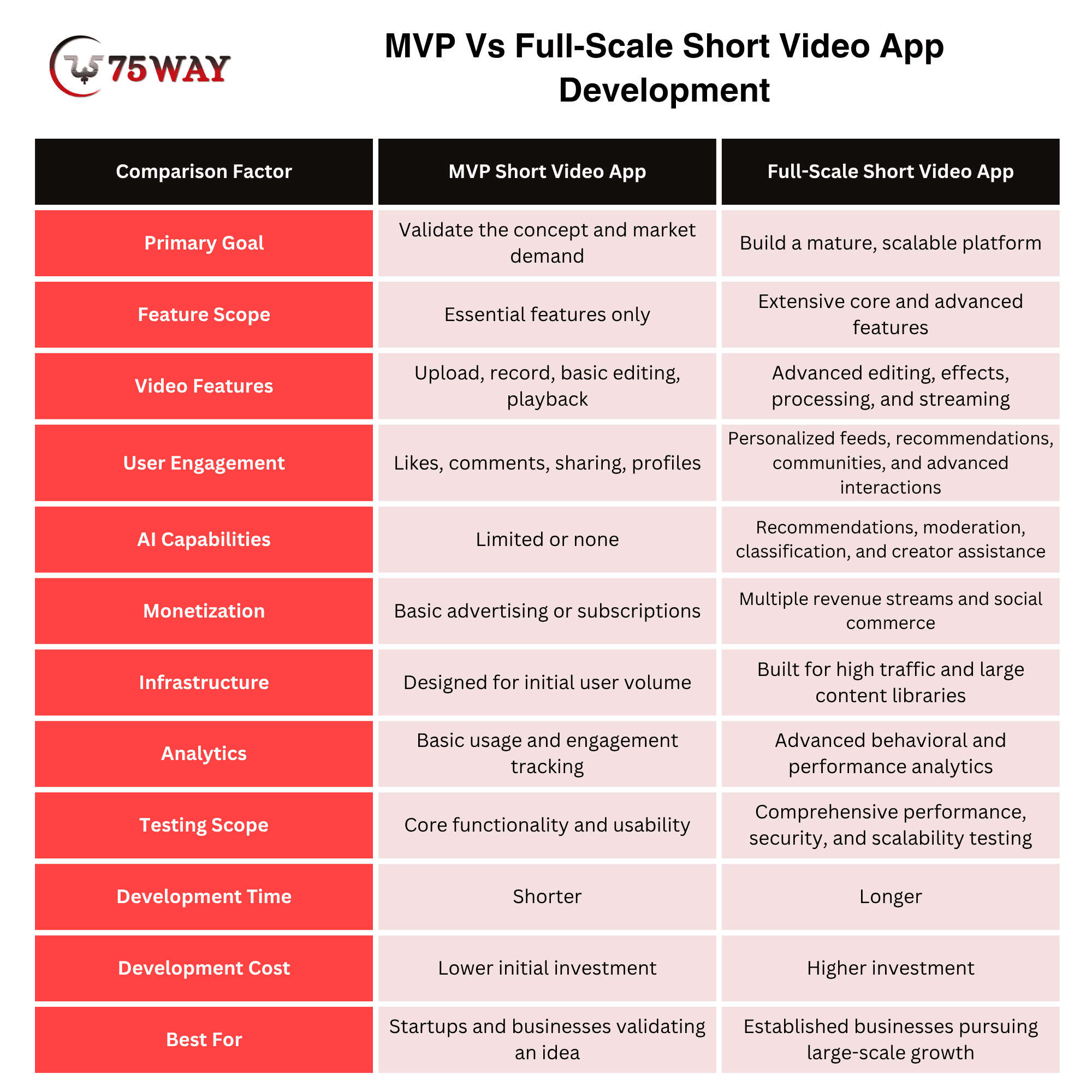
The objective is not to build the smallest possible product. It is to build the smallest product capable of testing the most important business assumptions.
Final Thoughts
To sum up, short video app development is no longer simply about creating a vertical scrolling feed. The real product includes the content ecosystem, recommendation experience, creator incentives, video infrastructure, moderation system, monetization strategy, analytics, and long-term scalability plan.
For businesses, the strongest starting point is a focused product strategy, a well-defined audience, and an MVP that tests genuine market demand. Once user behavior validates the concept, advanced AI, monetization, personalization, and infrastructure can be expanded around measurable business outcomes.
To turn your short video app idea into a scalable digital product, start planning your MVP with an experienced on-demand app development team today.
Frequently Asked Questions (FAQs)
How Much Does It Cost To Develop A Short Video App?
Short video app development can cost approximately $25,000 to $250,000+, depending on features, platforms, video infrastructure, AI capabilities, integrations, scalability, and development requirements.
How Long Does It Take To Build A Short Video App?
A basic MVP may take around 3–5 months, while a more advanced platform can require 8–12+ months, depending on functionality and technical complexity.
Should A Startup Build an MVP First?
An MVP is usually a practical approach when the business concept, audience, or monetization model has not yet been validated. It allows the team to test core assumptions before making larger investments.
What Makes Short Video App Development Expensive?
Video processing, storage, bandwidth, CDN delivery, advanced recommendation systems, AI, live streaming, social commerce, multiple platforms, security, and large-scale infrastructure can substantially increase development costs.
How Can A Short Video App Compete With Established Platforms?
A new platform can compete by serving a clearly defined niche, offering differentiated creator economics, solving an underserved user problem, developing stronger community experiences, or combining video with a specialized business model.
Is A Short Video App Profitable?
A short video app can become profitable through advertising, subscriptions, creator monetization, commerce, premium content, or transaction-based models. Profitability depends on user acquisition, retention, engagement, monetization, and operating costs.