AI Summary
Prediction markets are becoming a major fintech opportunity, but building one requires more than a trading interface. This guide explains how to develop a Kalshi-like platform, covering features, architecture, compliance, costs, monetization, security, and scalability.
Key Takeaways
- Kalshi reached a nearly $40 billion valuation, highlighting prediction-market growth potential.
- Prediction market development requires trading, settlement, compliance, security, and scalability.
- Kalshi-like platforms can support diverse event-based trading markets globally.
- Development costs range from $5,000 to $400,000+, depending on scope.
- Strong infrastructure and compliance foundations support sustainable platform growth.
A prediction can be worth more than an opinion when thousands of people are willing to put money behind it. That simple shift has helped prediction markets attract attention far beyond their original niche, with platforms like Kalshi showing the commercial potential of event-based trading.
However, building a prediction market platform like Kalshi requires much more than creating a marketplace where users choose “Yes” or “No.” Behind every trade are rules for creating contracts, systems for matching orders, methods for determining prices, payment infrastructure, identity checks, settlement logic, risk controls, and a long list of compliance responsibilities.
So, the opportunity is bigger than building an app that looks similar to Kalshi. Businesses need to think about the kind of markets they want to offer, the users they want to serve, the regulations that apply, and the technology required to support trading at scale. Those decisions form the foundation of a viable prediction market platform.
This guide explains how to develop a prediction market platform like Kalshi, including its business model, core mechanics, essential features, compliance considerations, security requirements, and scalability.
What Is A Prediction Market Platform?
A prediction market platform is an online marketplace where people trade contracts based on the possible outcome of future events.
Users can buy or sell positions on questions such as whether a candidate will win an election, a sports team will win a match, or interest rates will change. The market price reflects the crowd’s collective expectations, helping participants express what they believe is likely to happen.
Let’s understand it with a real-life example. For instance, a group of friends predicting whether it will rain tomorrow. If most people believe rain is likely, they may be willing to pay more for a “Yes” outcome, while others who expect clear weather may choose “No.”
A prediction market turns this kind of everyday forecasting into a structured digital marketplace where participants can potentially earn money when their predictions are correct.
How Does A Kalshi-Like Prediction Market Work?
The basic process can be understood through a simple trading cycle:
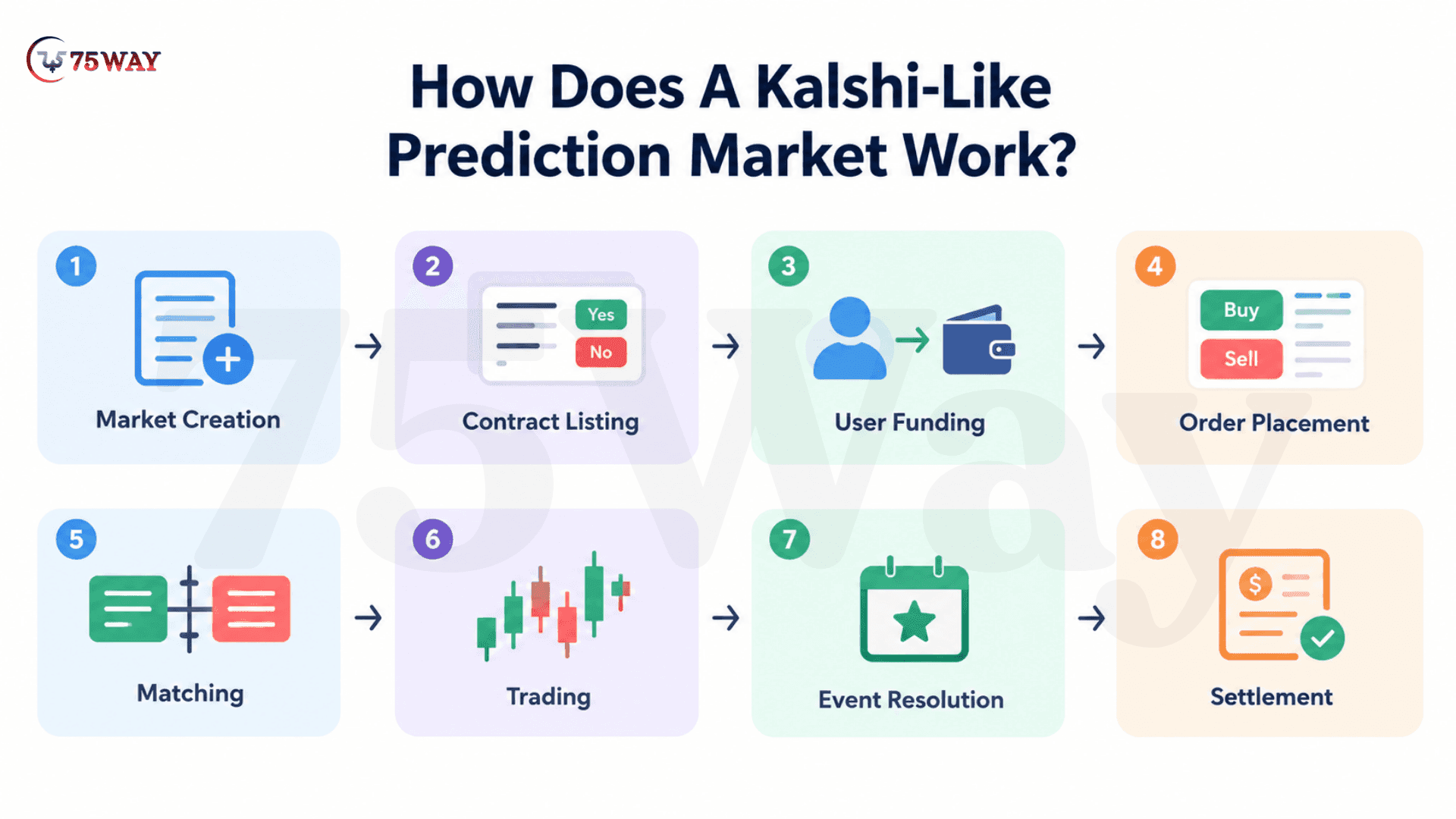
For example, imagine a platform creates a contract around whether a defined economic event will occur before a specified date.
A user who believes the event will happen can purchase a “Yes” contract. Another participant may take the opposing position.
The platform records the trades, maintains the relevant positions, monitors activity, and eventually settles the contract according to predefined resolution rules and an authoritative data source.
This creates several technical requirements that ordinary prediction or polling applications do not have.
Market Growth & Size of Prediction Market App Like Kalshi in USA & Global
Kalshi has helped put prediction markets into a much bigger business conversation. Rising participation, expanding event categories, and growing interest from different markets are prompting entrepreneurs to look beyond the platform itself and study the opportunity. The market size and growth trends offer useful context for understanding the potential of this emerging industry.
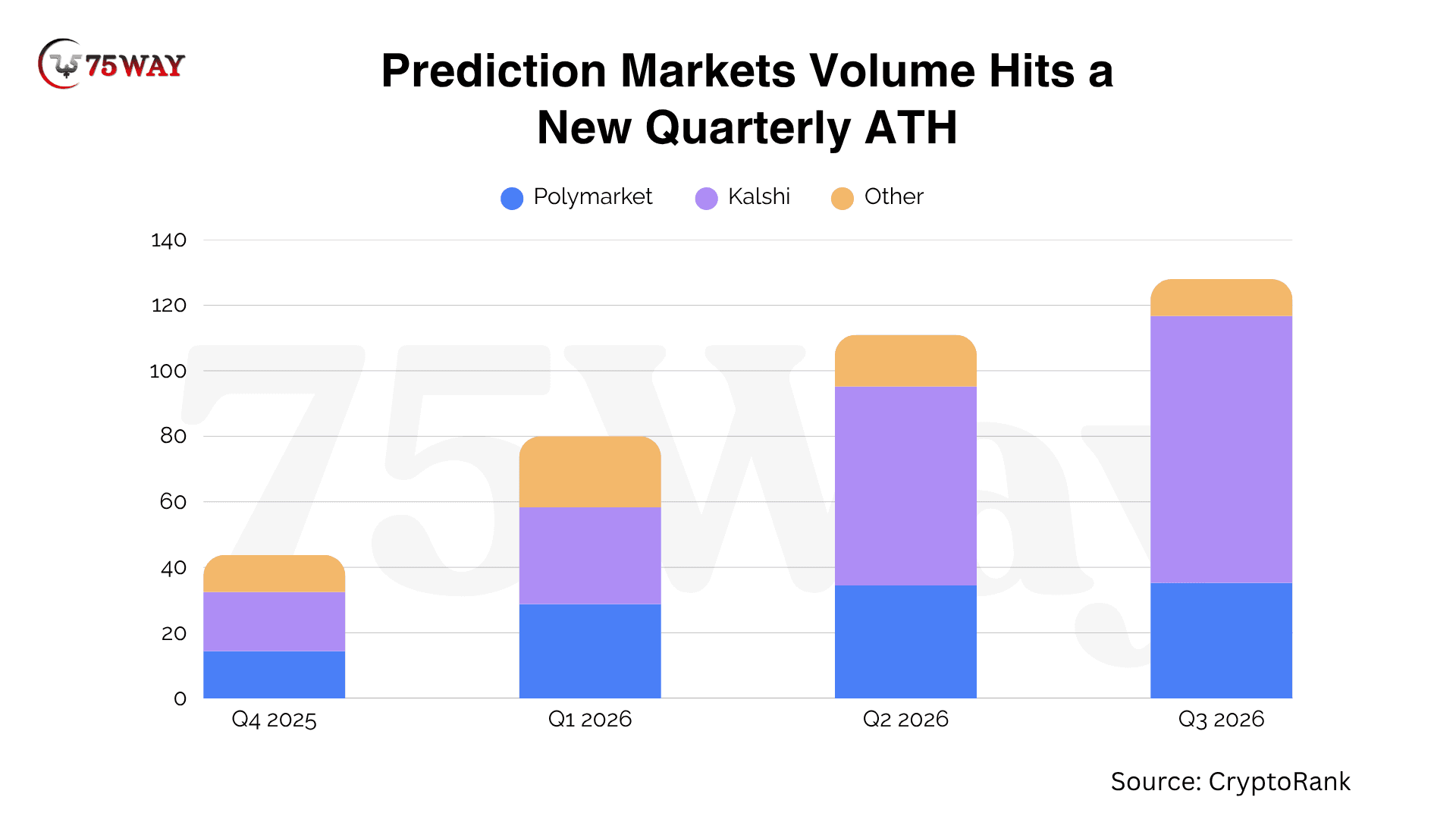
- The record tracked by CryptoRank was nearly 70% higher than the previous quarter, with Kalshi contributing the majority.
- Kalshi reached a $22 billion valuation after securing a $1 billion Series F funding round led by Coatue Management in May 2026.
- Its trading volume surged to $178 billion, up from $52 billion six months earlier, with weekly volumes frequently surpassing $1 billion.
- The platform reached approximately 2 million monthly active users, while non-traders viewed markets at a 5:1 ratio for information gathering.
- Kalshi’s annualized revenue surpassed $1.5 billion.
Why Are Businesses Building Prediction Market Platforms in 2027?
Prediction markets are gaining attention because they bring two powerful forces together: people’s interest in uncertain outcomes and their willingness to express a view. Businesses can build platforms around that behaviour while creating new ways to generate revenue and user engagement. The appeal becomes clearer when the market opportunities, user demand, and business benefits are considered together.
- Alternative Event Trading
Businesses can create specialized markets around permitted event categories and serve audiences interested in forecasting specific outcomes.
- Financial Technology Innovation
Fintech companies can use event-based contracts as a differentiated product within broader trading or financial ecosystems.
- Data And Forecasting
Aggregated market activity can provide useful signals about participant expectations, although these signals should not automatically be treated as objective predictions.
- Niche Communities
A platform can focus on a specific community, industry, or event category rather than attempting to serve every possible market.
- Media And Audience Engagement
Media businesses can potentially use prediction-oriented products to create interactive experiences around events, subject to applicable legal and regulatory requirements.
Business Model Working Behind Kalshi-Like Prediction Market App Development
The business model should be defined before Kalshi-like app development because monetization directly affects platform architecture and user flows.
A platform may generate revenue through mechanisms such as:
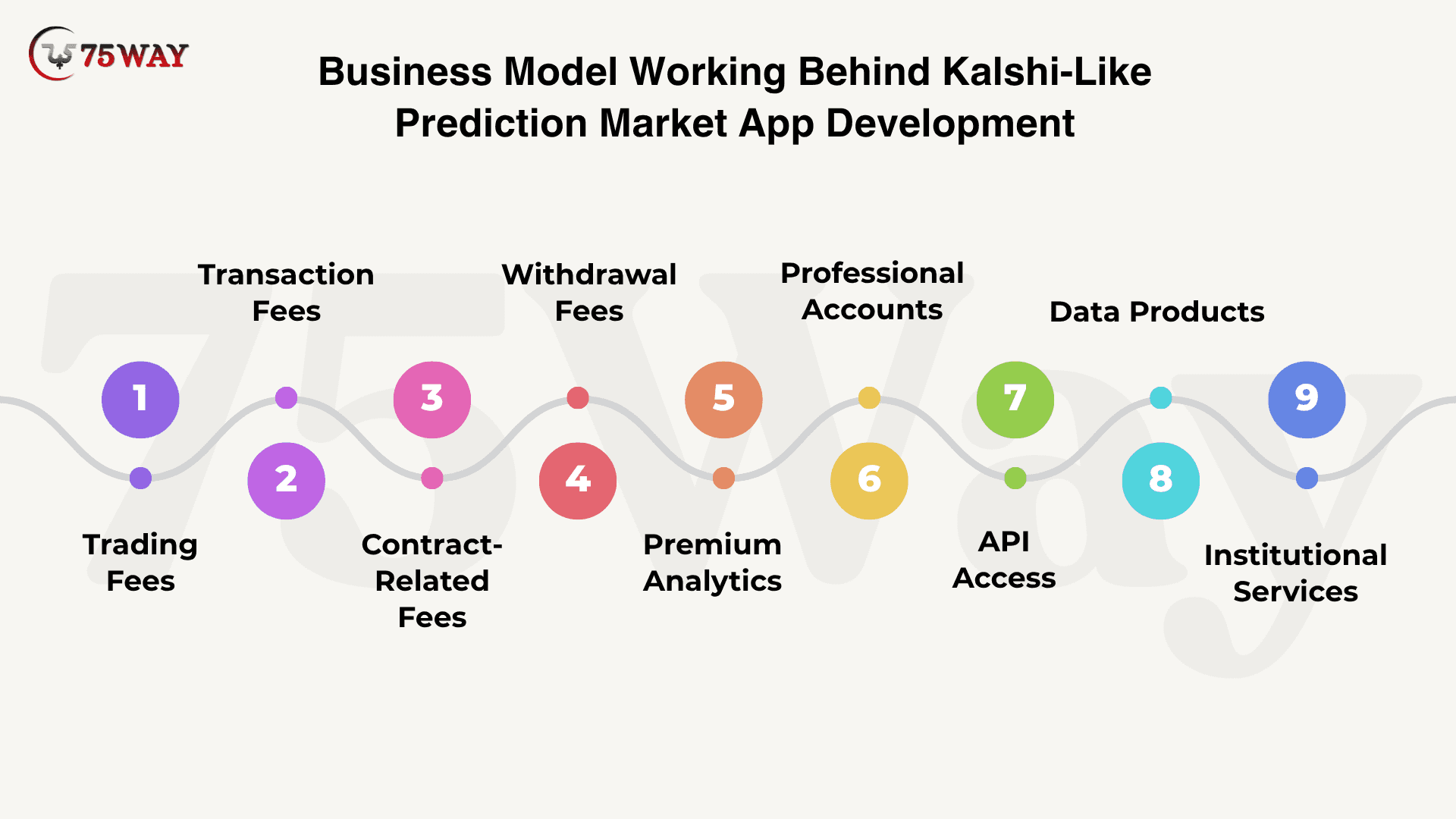
- Trading Fees: Charges applied to trades executed on the platform.
- Transaction Fees: Fees charged for processing each completed transaction.
- Contract-Related Fees: Charges associated with creating or settling prediction contracts.
- Withdrawal Fees: Charges applied when users withdraw funds from accounts.
- Premium Analytics: Paid access to advanced market insights and analytics.
- Professional Accounts: Specialized accounts offering enhanced tools for professional traders.
- API Access: Paid access to platform data and trading functionality.
- Data Products: Curated market data packages sold to external customers.
- Institutional Services: Specialized solutions designed for organizations and large-scale market participants.
The specific model depends on the platform's regulatory structure, target audience, market liquidity, and operating costs.
A useful principle is to avoid designing monetization around trading volume alone. The platform also needs sufficient liquidity, trustworthy settlement, user retention, and sustainable market creation.
How To Build A Kalshi-Like Platform: Step-By-Step Process
A prediction market can begin with a simple question and two possible outcomes, but turning that idea into a real platform takes careful planning. Every part, from contract creation and order matching to payments, verification, settlement, and security, needs to fit together properly. The development journey shows how to build each part into a reliable Kalshi-like platform.
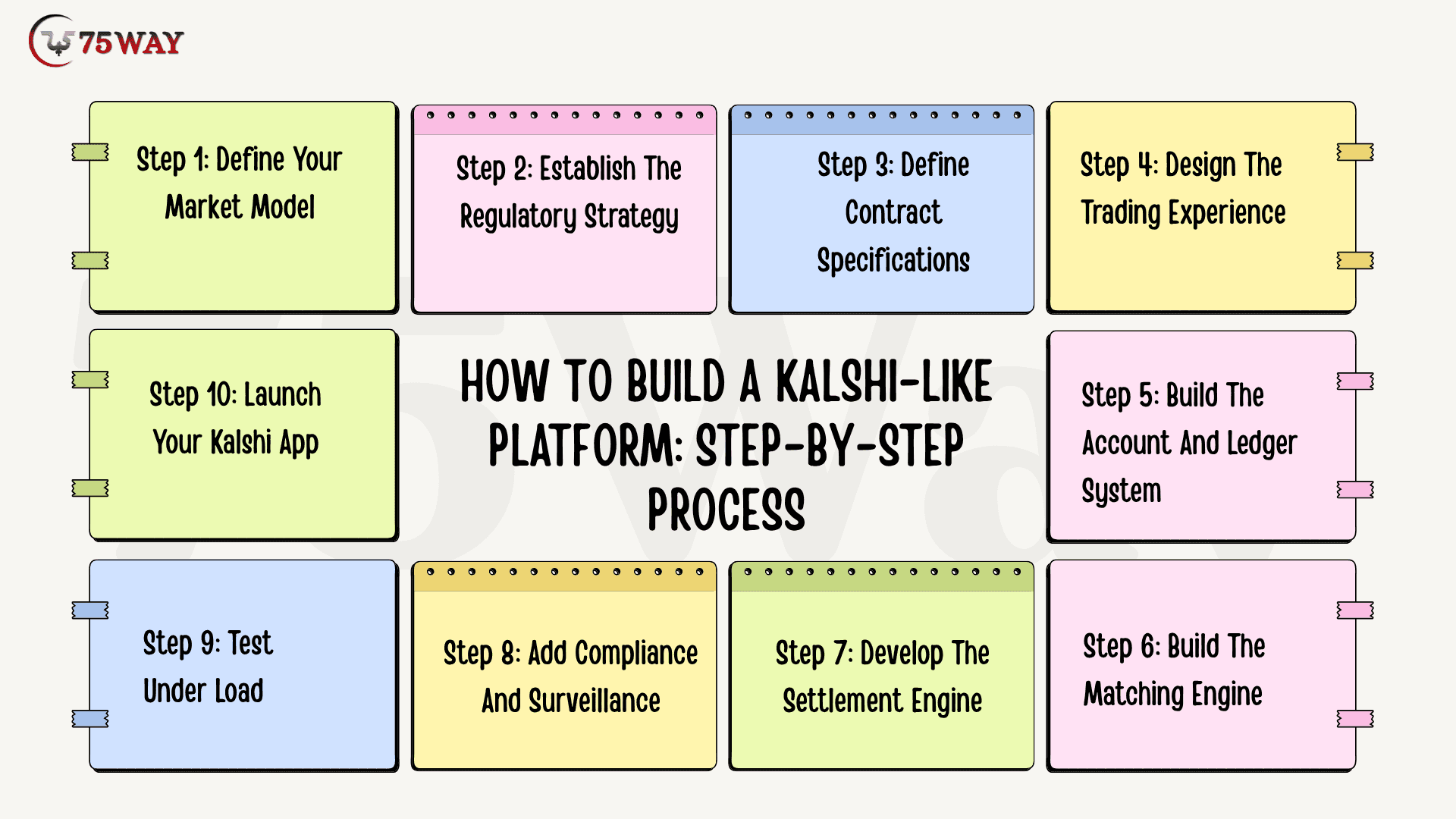
Step 1: Define Your Market Model
Before thinking about screens or code, decide what people will actually predict on your platform. You might focus on economic events, weather conditions, sports outcomes, or another clearly measurable category.
Your contract model should make it obvious what users are predicting and what makes a position successful. At this stage, think about your audience too, because their interests will shape which markets deserve attention.
Once you know what you want people to trade, you can determine where and how the platform can legally operate.
Step 2: Establish The Regulatory Strategy
A prediction market can look simple to a user, but the legal structure behind it can be anything but simple. You need to identify your target jurisdiction, understand the applicable rules, and determine whether your proposed product requires specific approvals or licensing.
This is where qualified legal and compliance professionals become important, particularly when your contracts involve financial outcomes or regulated activities. Their advice can influence everything from user eligibility to payments and market design.
With those boundaries understood, you can define contracts that are both useful to traders and clear enough to govern every possible outcome.
Step 3: Define Contract Specifications
Now give every market a rulebook of its own. A question such as “Will this event happen?” is not enough unless everyone knows exactly what counts as a Yes, what counts as a No, and which source decides the result.
Define the expiration, settlement process, payout, data source, and what happens when information is delayed or contradictory. These details may seem small while you are building the product, but they become critical when real money is involved.
Once the rules are settled, you have a much stronger foundation for designing the trading experience around them.
Step 4: Design The Trading Experience
A prediction market should not make users feel like they need a finance degree before placing their first order. Give them a straightforward path from discovering a market to understanding its rules, choosing a position, placing an order, and tracking what happens next.
Important information, such as Yes and No prices, expiration, trading activity, and settlement rules, should appear where users naturally expect it.
You can also use watchlists, alerts, and simple portfolio views to make repeat participation easier. With the user journey taking shape, the next challenge is making sure every action is backed by reliable account and financial records.
Step 5: Build The Account And Ledger System
Behind every simple-looking balance is a system that needs to know exactly where every dollar belongs. Your platform should securely manage accounts, deposits, withdrawals, fees, open positions, completed trades, and settlement proceeds.
A proper ledger records each financial movement, giving your team a dependable history instead of relying on a number displayed on the screen. Security controls should protect accounts, while eligibility and identity checks can be applied according to your business and regulatory requirements.
Once this foundation is dependable, you can start building the machinery that actually matches traders with one another.
Step 6: Build The Matching Engine
This is where the platform starts behaving like a real marketplace. Imagine one trader placing a Yes order at $0.60 while another trader is willing to sell at that price. The matching engine decides whether those orders can meet and records the resulting trade.
Behind that simple interaction are rules for price priority, time priority, cancellations, order status, balances, positions, and execution records.
Even a small timing error can create incorrect trades or inconsistent balances when activity rises. That is why the engine needs careful architecture and testing before you expose it to meaningful trading volume.
Step 7: Develop The Settlement Engine
Trading is only half the journey because every contract eventually needs a final answer. When a market closes, your settlement system should use the predefined source and contract rules to determine the outcome.
It can then resolve the contract, calculate applicable payouts, update positions, and record the transaction in the ledger. Automated data connections can make this process faster, but they should never operate without safeguards for missing, delayed, or conflicting information.
A reliable settlement process also creates the records your compliance and administrative teams may need to review later.
Step 8: Add Compliance And Surveillance
Once trading and settlement are connected, you need controls that help keep the entire marketplace trustworthy.
Depending on your jurisdiction and product structure, these may include identity verification, eligibility checks, transaction monitoring, market surveillance, reporting, account restrictions, and audit trails. Your administrative team should be able to investigate unusual activity and take appropriate action without depending on developers for every intervention.
Building these controls into the platform early is far easier than trying to retrofit them after launch. With the operational safeguards ready, you can finally test how the whole system behaves under pressure.
Step 9: Test Under Load
A platform may work perfectly with a few test users and still struggle when hundreds or thousands of orders arrive together.
You should test realistic situations, including sudden market activity, simultaneous orders, cancellations, partial executions, duplicate requests, failed data sources, and unexpected service interruptions. Settlement should receive the same attention because an error after trading ends can be just as damaging as an execution problem.
Security and recovery testing can also reveal weaknesses that ordinary feature testing misses. These results give you a practical list of improvements before real users begin depending on the platform.
Step 10: Launch A Controlled MVP
Your first launch does not need to contain every market, feature, or trading capability you can imagine.
A controlled MVP lets you introduce a limited set of contracts and users while closely watching system performance, trading behavior, settlement accuracy, and operational issues. You can learn which markets attract attention, where users become confused, and which workflows need improvement.
Those real-world findings are far more valuable than assumptions made during development. Once the platform proves its core model, you can expand the market universe, user base, infrastructure, and advanced capabilities with greater confidence.
Which Industries Can Build A Prediction Market App Like Kalshi?
A prediction market fits naturally wherever people closely follow uncertain events and have strong opinions about what will happen. Sports, finance, entertainment, media, and other industries all have audiences that could engage with this model in different ways. The given industry examples show where a Kalshi-like platform could find its strongest opportunities.
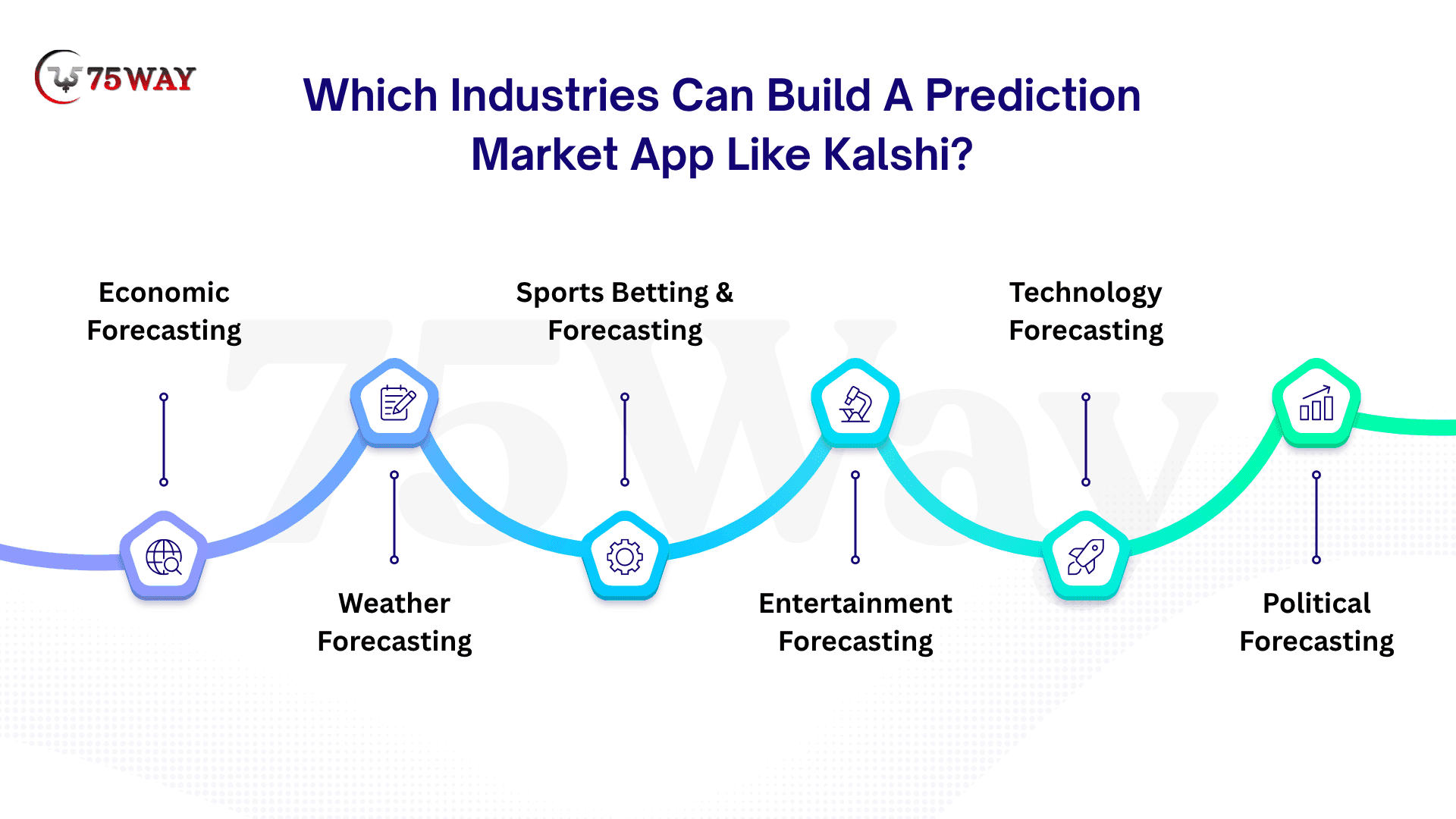
- Economic Forecasting
Users can trade contracts connected to economic indicators, interest rates, inflation, employment, or other measurable economic outcomes.
- Weather Forecasting
Contracts can be based on measurable weather outcomes, such as temperature, rainfall, snowfall, or other predefined conditions.
- Sports Betting & Forecasting
Sports contracts can allow users to trade outcomes related to games, competitions, or measurable sporting events, subject to applicable rules.
- Entertainment Forecasting
Contracts can cover measurable entertainment outcomes, such as awards, releases, rankings, or other predefined events.
- Technology Forecasting
Businesses can create platforms around technology milestones, product launches, adoption metrics, or measurable industry events.
- Political Forecasting
Political event contracts are particularly sensitive and require careful regulatory analysis. A platform should never assume that because another exchange offers a particular contract, the same product can automatically be offered under another structure or jurisdiction.
Core Contract And Trading Infrastructure For A Kalshi-Like Web App Development
The trading screen is only the visible part of a prediction market. Underneath it, contract logic determines what users are actually trading, while matching engines, pricing systems, order books, market data, and settlement services determine how each trade works. A reliable Kalshi-like platform depends on getting these connected systems right from the foundation.
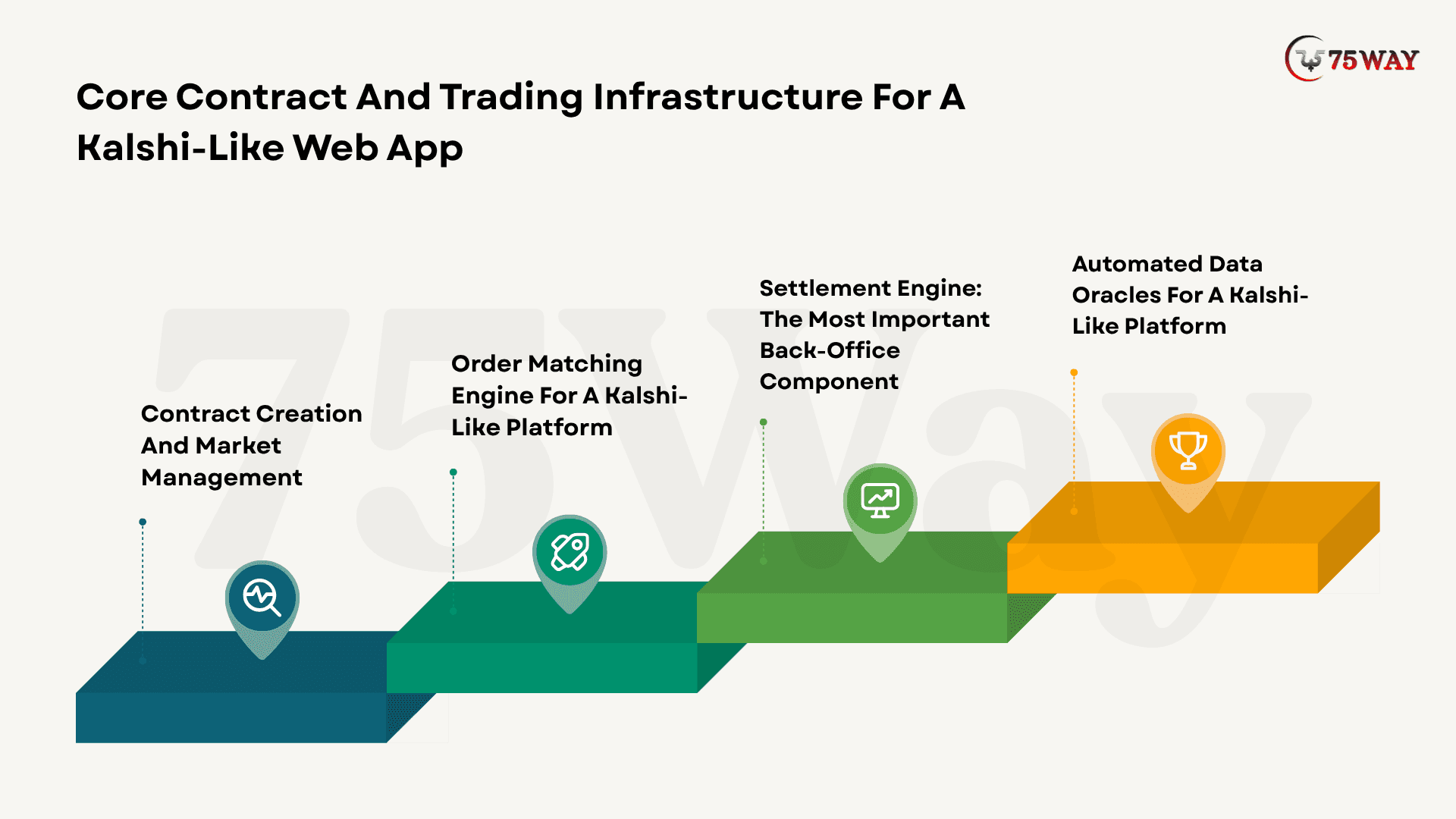
1. Contract Creation And Market Management
One area that differentiates a Kalshi-like platform is contract specification. The platform needs a structured process for defining what exactly users are trading. A contract specification should establish:
- Question: What event is being measured?
- Outcome: What qualifies as Yes or No?
- Expiration: When does trading stop?
- Determination: When and how is the result established?
- Source: Which authoritative data source determines the result?
- Settlement: What happens to winning and losing positions?
- Exceptional Conditions: What happens if the source becomes unavailable, changes methodology, or provides conflicting information?
This prevents ambiguity when the market reaches expiration.
Kalshi's published market lifecycle emphasizes predetermined sources and rules for determining outcomes before contracts settle.
2. Order Matching Engine For A Kalshi-Like Platform
The matching engine is the technical heart of the platform.
Suppose one trader wants to purchase a Yes contract at $0.60 while another is willing to sell at the matching price. The engine determines whether the orders satisfy the platform's matching rules and, if they do, executes the trade.
The engine must maintain accurate states for:
- Orders
- Users
- Positions
- Available balances
- Executed trades
- Market prices
- Order-book depth
Why The Matching Engine Matters
A slow or unreliable matching engine can create:
- Delayed execution
- Incorrect balances
- Duplicate orders
- Race conditions
- Inconsistent positions
- Poor trading experiences
For a serious platform, the matching engine should be isolated from non-critical application functions and designed for predictable execution.
3. Settlement Engine: The Most Important Back-Office Component
A prediction market cannot simply stop trading and declare a winner. The platform needs a controlled settlement workflow.
- Market Closure
The system prevents new trades after the defined closing condition.
- Outcome Verification
The platform retrieves or verifies the result using the contract's predetermined source.
- Resolution
The result is recorded against the contract.
- Position Settlement
Winning positions receive the applicable settlement amount.
- Ledger Update
Balances and transaction records are updated.
- Audit Record
The system records when, why, and based on what evidence the contract was settled.
Kalshi's rulebook describes clearing and settlement processes and specifies that contracts can settle at a defined settlement value when their payout criteria are satisfied.
4. Automated Data Oracles For A Kalshi-Like Platform
Automated settlement requires reliable external data.
For example, if a contract depends on an economic statistic, weather measurement, sports result, or another measurable event, the platform needs a trusted source to determine the final outcome.
An oracle or data integration layer can:
- Connect to approved data sources.
- Retrieve relevant information.
- Validate the response.
- Apply predefined contract rules.
- Trigger resolution.
- Create an auditable record.
However, automation should not mean blind automation.
The platform should have exception handling for missing, delayed, conflicting, or suspicious data.
Core Features Required For Building A Kalshi-Like Mobile App
A Kalshi-like mobile app needs to make trading feel simple even when the mechanics behind each prediction are anything but simple. Users need clear markets, live prices, quick order placement, secure payments, accurate settlement, and enough information to make informed decisions. These core capabilities shape the experience users expect when they trade event-based contracts.
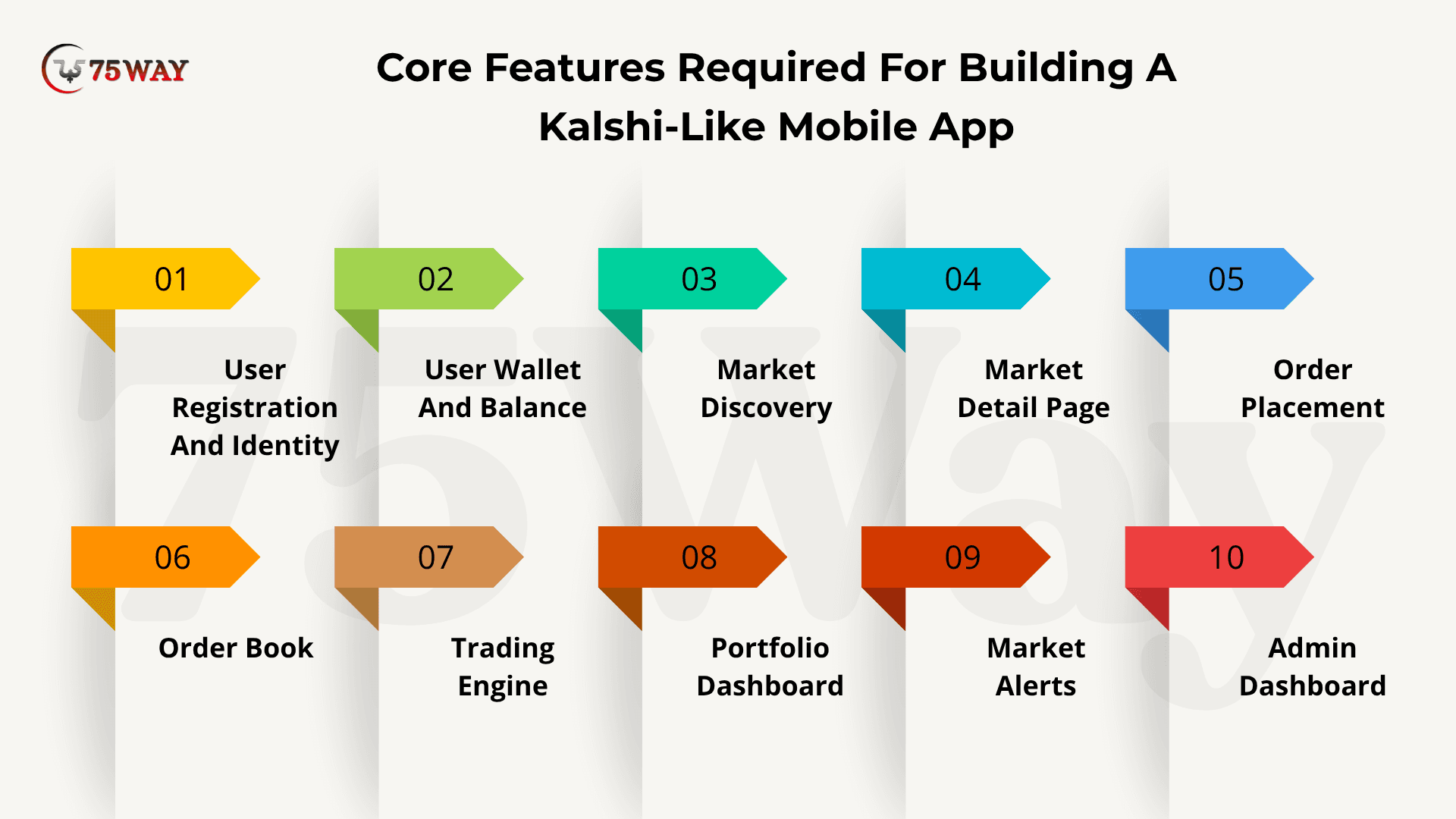
- User Registration And Identity
Secure account creation forms the starting point for the platform. The system should support authentication, identity verification, eligibility checks, account recovery, and profile management. For regulated products, these requirements should align with the legal and compliance model.
- User Wallet And Balance
A secure wallet gives users a clear view of their funds. It can show available balances, committed funds, positions, deposits, withdrawals, fees, and settlement proceeds. A reliable transaction ledger should keep displayed balances accurate.
- Market Discovery
A simple discovery system helps users find relevant contracts quickly. It can include new markets, popular markets, closing-soon contracts, categories, search, watchlists, and alerts. These tools become more important as the number of markets grows.
- Market Detail Page
The market detail page should show all important contract information. This includes the question, Yes and No prices, order book, volume, expiration, rules, and settlement criteria. The page should also identify the data source and relevant disclosures.
- Order Placement
Order placement gives users control over their trading activity. The platform can support market orders, limit orders, buy orders, and sell orders. Users should also be able to cancel orders and view open, filled, and historical orders.
- Order Book
Each active contract can have its own order book. It shows available bids and asks from participants. This information helps the platform support price discovery and order matching.
- Trading Engine
The trading engine handles incoming orders and executes eligible trades. It follows predefined matching rules. The system must also track order status, balances, positions, executions, prices, and transaction records.
- Portfolio Dashboard
A portfolio dashboard brings important trading information into one place. Users can view open and closed positions, entry prices, current values, and potential payouts. The dashboard can also show realized gains, losses, transaction history, and market exposure.
- Market Alerts
Market alerts keep users informed about important changes. Notifications can cover price movements, new markets, order fills, approaching expirations, and settlement events. Users can customize alerts based on their preferences.
- Admin Dashboard
The admin dashboard gives operators centralized platform controls. Administrators can create and approve markets, manage contracts, suspend markets, and restrict accounts. The system can also support settlement, disputes, reporting, content management, and audit logs.
How Much Does It Cost To Develop A Kalshi-Like Platform?
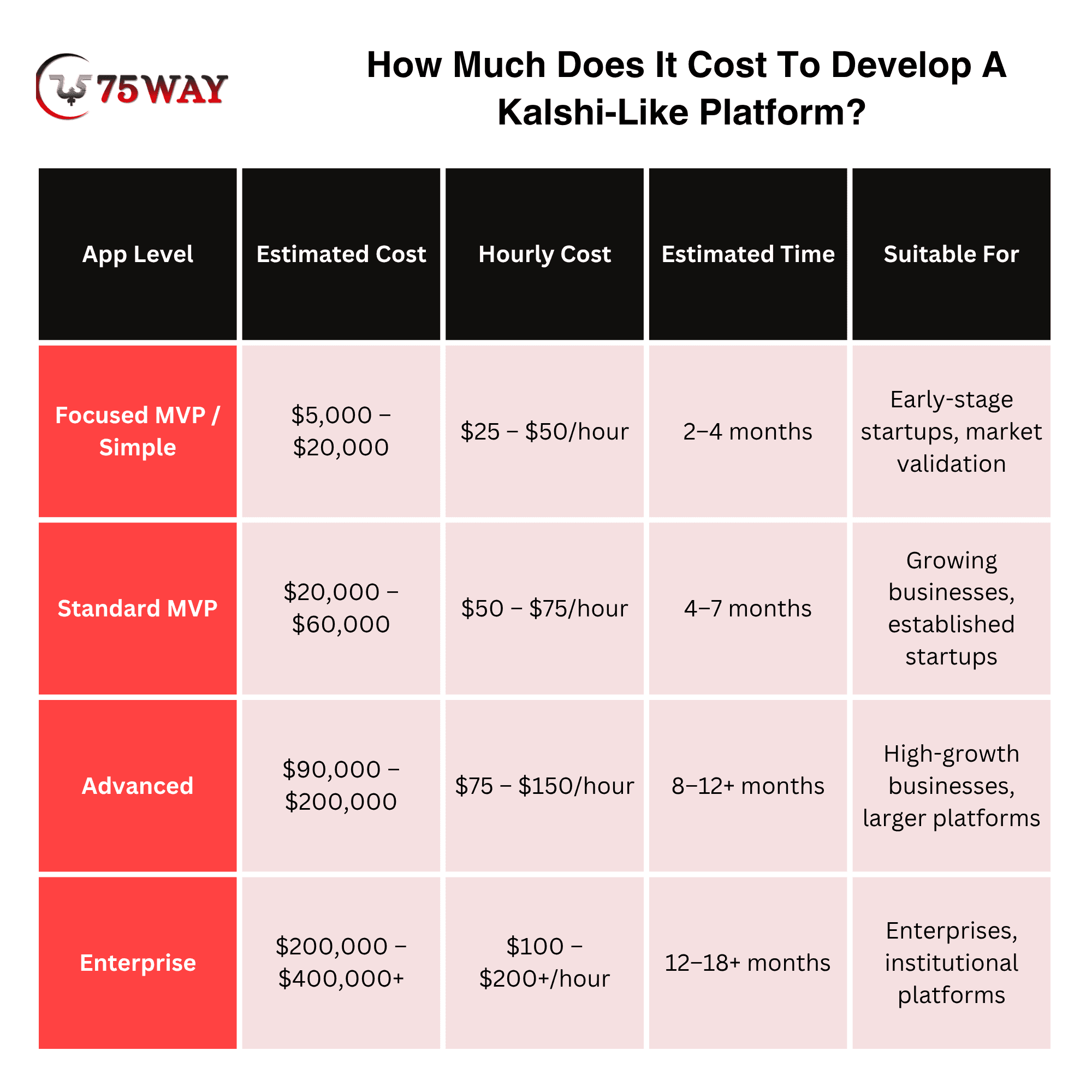
The cost depends heavily on whether you are building a concept prototype, focused MVP, trading platform, or enterprise-grade exchange infrastructure. On average, the cost to build an app like Kalshi ranges between $5000 – $400,000+.
1. Focused MVP/Simple Kalshi-Like App Cost: $5,000 – $20,000
- Basic contract creation and trading features included within scope.
- Secure user accounts, wallet, and essential administration features supported.
Estimated Time: 2–4 months
2. Standard MVP Kalshi-Like App Cost: $20,000 – $60,000
- User dashboard, market discovery, and basic matching engine included.
- Manual settlement, transaction tracking, and administration features supported.
Estimated Time: 4–7 months
3. Advanced Kalshi-Like App Cost: $90,000 – $200,000
- Custom trading interface and automated data oracles integrated.
- High-concurrency infrastructure, advanced analytics, and compliance tools supported.
Estimated Time: 8–12+ months
4. Enterprise Kalshi-Like App Cost: $200,000 – $400,000+
- High-concurrency trading infrastructure and enterprise-grade security integrated.
- Advanced compliance, surveillance, APIs, analytics, and institutional tools supported.
Estimated Time: 12–18+ months
Factors Influencing Kalshi-Like App Development Cost
- Trading Engine Complexity
A basic matching engine is significantly less complex than a high-throughput trading system with advanced order handling.
- Number of Markets
More contracts require stronger market management, search, data processing, monitoring, and settlement infrastructure.
- Automated Settlement
Manual settlement can reduce initial complexity, while automated oracle-based settlement requires additional integrations and safeguards.
- Real-Time Trading
Live order-book updates and execution notifications require additional infrastructure.
- Compliance
Identity verification, monitoring, surveillance, reporting, and auditability can add substantial development requirements.
- Mobile Applications
Building separate native iOS and Android applications increases development scope compared with launching a web-based MVP.
- Institutional APIs
External trading access requires authentication, rate controls, documentation, monitoring, permissions, and scalable API infrastructure.
How To Build Liquidity Into A Kalshi-Like Platform
Liquidity is one of the biggest challenges for a new prediction market.
A technically impressive platform can still struggle if users cannot find counterparties.
You need a strategy for:
- Initial market liquidity
- Market-maker participation
- Creator incentives
- High-interest contracts
- Market discovery
- Competitive spreads
- Trading volume
- Institutional participation
The platform should also monitor liquidity by market instead of assuming that overall platform volume represents healthy liquidity everywhere.
Kalshi's institutional materials demonstrate the importance of order-book liquidity and also describe block-trade functionality for larger transactions.
How To Scale Your App-Like Kalshi: Complete Strategy
Scalability should be planned around orders, market updates, users, contracts, and settlement events, not just registered accounts. Important infrastructure includes:
- Horizontally scalable API services
- High-performance matching services
- Distributed caching
- Event-driven processing
- Queue-based workflows
- Database optimization
- WebSocket infrastructure
- CDN delivery
- Real-time monitoring
- Automated failover
- Disaster recovery
- Data replication
The matching engine and financial ledger deserve particularly strong reliability controls because errors in those systems can directly affect customer positions.
What Should Be Automated After MVP Validation of App Similar to Kalshi?
Once the core product demonstrates demand, automation can be introduced where it produces measurable operational benefits.
Stage 1
Automate market data ingestion.
Stage 2
Automate contract monitoring.
Stage 3
Introduce automated outcome verification.
Stage 4
Automate settlement workflows with exception handling.
Stage 5
Introduce advanced surveillance and anomaly detection.
Stage 6
Expand API infrastructure for professional users.
This phased approach allows the business to increase automation without taking on unnecessary complexity at the beginning.
How To Choose A Prediction Market Platform Development Company To Build App Like Kalshi?
A prediction market needs more than a polished interface to work properly. The development team should understand how contracts are created, orders are matched, funds are recorded, and outcomes are settled when a market closes.
Experience with real-time trading systems, financial ledgers, external data sources, and compliance-driven products can make a meaningful difference when these pieces come together.
The right fit also becomes clearer through the questions a company asks about your idea. A thoughtful team will want to understand your target users, market categories, contract rules, launch scope, and growth plans before suggesting a technical solution.
Their proposal should clearly explain the architecture, development stages, testing approach, estimated investment, and responsibilities, giving you enough substance to judge whether the partnership makes sense.
Wrap Up
Developing a prediction market platform like Kalshi requires considerably more than reproducing a familiar trading interface. The real product is a connected ecosystem of event contracts, order books, matching infrastructure, financial ledgers, settlement systems, compliance workflows, APIs, and scalable infrastructure.
For a startup, the practical route is to begin with a focused market model and a controlled MVP, validate user demand and trading behavior, and then progressively introduce automated settlement, advanced analytics, institutional APIs, sophisticated surveillance, and higher-performance infrastructure.
Most importantly, treat regulatory strategy as a product requirement, not a post-development checklist. To build a Kalshi-like prediction market platform, reach out to a reliable prediction market platform development firm.
Frequently Asked Questions (FAQs)
How Much Does It Cost To Develop A Platform Like Kalshi?
A software MVP can start around $5,000–$20,000, while advanced and enterprise implementations can range from $90,000 to $400,000+, depending on trading infrastructure, settlement, compliance, scalability, and integrations.
How Long Does It Take To Build A Kalshi-Like Platform?
A focused MVP may take approximately 2–4 months, while an advanced platform can require 7–12 months or longer depending on functionality and infrastructure.
What Is The Most Important Feature Of A Kalshi-Like Platform?
The trading engine, order book, contract lifecycle, account ledger, and settlement system form the technical foundation of a serious Kalshi-like platform.
Can I Build A Prediction Market Platform Without A Matching Engine?
A basic prototype can use simplified transaction logic, but a platform designed around exchange-style trading requires an appropriate order-matching mechanism.
How Does A Kalshi-Like Platform Settle Contracts?
The platform closes trading, determines the outcome using predefined contract rules and sources, and then settles winning and losing positions according to those rules.
Is A Kalshi-Like Prediction Market Legal In The US?
Legality depends on the platform's structure, contracts, jurisdiction, and regulatory status. US prediction markets can fall under the CFTC's derivatives framework, so businesses should obtain qualified legal and regulatory advice before launching.
What Data Is Needed For Prediction Market Settlement?
The platform needs reliable, predefined sources capable of objectively determining the contract outcome. The source and settlement methodology should be specified before trading begins.
How Can A Prediction Market Platform Make Money?
Potential revenue sources include trading fees, applicable transaction fees, institutional services, API access, premium data, and analytics, depending on the platform's business and regulatory structure.
How Can A New Prediction Market Compete With Kalshi?
Instead of copying Kalshi broadly, a new platform can target an underserved market, a specialized audience, stronger analytics, differentiated contract types, professional users, or a specific business use case.