
AI Summary
Choosing an automation company can reshape costs, speed, and customer experience. This guide compares leading US automation service providers across AI, RPA, workflows, and custom development. You’ll see who fits different business needs best. Selection criteria are explained throughout.
Key Takeaways
- Compare USA’s leading automation companies across AI, RPA, workflows, and custom development.
- Understand which automation providers best match enterprise and startup requirements.
- Evaluate providers using capabilities, experience, scalability, integration, and business fit.
- See practical differences between platforms, consultants, and custom automation development.
- Choose automation expertise based on outcomes, complexity, budget, and plans.
A business can automate almost anything these days, but that does not mean every automation company can handle every business need.
One provider may excel at enterprise workflows, another at AI-powered automation, while a specialized automation agency may be better suited to a custom process that off-the-shelf software cannot handle. That selection among top automation companies in USA matters when automation becomes part of your core operations.
The right automation provider should fit the problem you are trying to solve, your existing technology, your budget, and your plans for growth. Service range matters, but practical experience, AI integration expertise, scalability, and the ability to deliver measurable business value deserve equal attention. A strong comparison therefore needs to look beyond company names and generic service lists.
This guide highlights 10 leading automation agencies in the USA, with a closer look at what each provider is known for. The comparison can help startups, growing businesses, and enterprises narrow their options with greater confidence.
Quick Answer: Which Are The Top Automation Companies In United States
A long list of automation providers does not make the buying decision easier. Businesses need to know which companies have proven capabilities, relevant expertise, and solutions that can fit different operational needs. The top automation companies in the USA are highlighted here to make that choice easier.
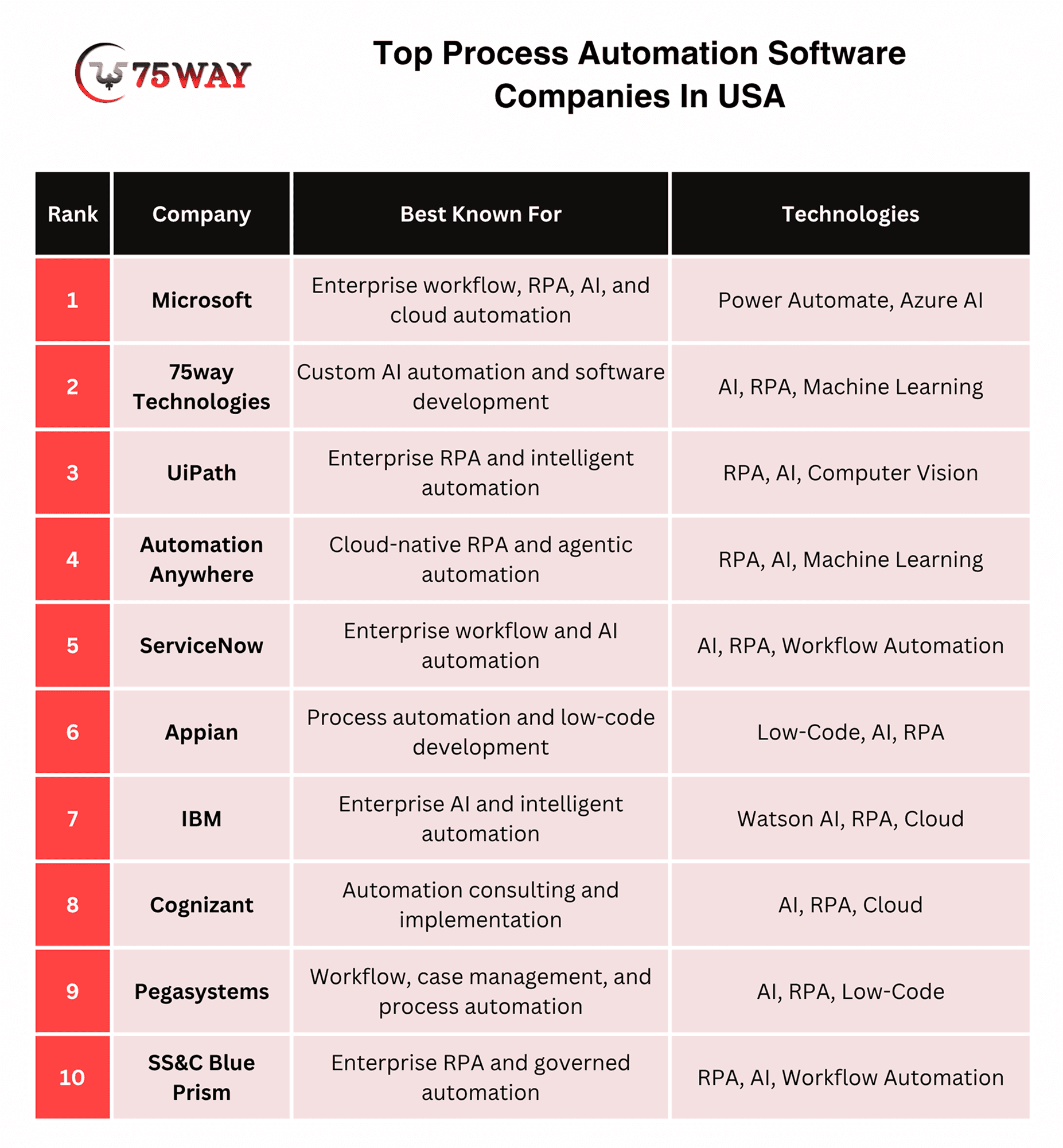
Best USA-Based Automation Companies: A Detailed List
The right automation partner can change how a business handles repetitive work, workflows, and daily operations. But with so many providers in the market, knowing which names deserve your attention is not always easy. These top automation companies in the USA offer strong options for different business requirements.
1. Microsoft
Rating: 5/5
Min. Project Size: 50000+
Team Size: Enterprise-scale
Location: Redmond, Washington
Year Founded: 1975
Technologies: Microsoft combines Power Automate, Azure Logic Apps, Copilot Studio, and cloud services to automate workflows across business systems.
Services They Offer
- Power Automate workflow development and implementation
- Robotic process automation for business operations
- AI agent development and orchestration
- Azure-based integration and workflow automation
- Enterprise automation governance and optimization
Suitable For: Large enterprises and Microsoft-centric businesses
Microsoft is particularly relevant when automation needs to operate inside an existing Microsoft environment. Its ecosystem can connect business applications, cloud infrastructure, productivity tools, workflows, and AI capabilities.
2. 75way Technologies
Rating: 5/5
Min. Project Size: $5,000+
Team Size: 100–150+
Location: California
Year Founded: 2015
Technologies: It focuses on custom software, AI automation, and business workflow solutions tailored to specific operational requirements.
75way Technologies is a custom development provider that can be useful when an organization has a workflow that does not fit neatly into an existing automation platform. This model can also make sense when automation needs to connect proprietary software, internal databases, APIs, customer portals, or specialized business logic.
Services They Offer
- Custom AI automation solution development services
- Business process automation and workflow implementation
- AI agent development for business operations
- API integration and system connectivity services
- Custom AI software development for automation initiatives
Suitable For: Startups, SMBs, and growing enterprises
Best Fit: Businesses that need custom automation rather than only packaged automation software.
For a buyer, the key question is not simply whether a provider offers “AI automation.” Ask whether the team can understand your current process, identify automation opportunities, integrate the required systems, and maintain the resulting solution.
3. UiPath
Rating: 5/5
Min. Project Size: 25000+
Team Size: Enterprise-scale
Location: New York
Year Founded: 2005
Technologies: RPA, process orchestration, AI agents, document processing, process mining, and application integration
Services They Offer
- Enterprise robotic process automation implementation services
- AI-powered document processing and automation solutions
- Process discovery and mining implementation services
- Workflow orchestration across enterprise applications
- Automation governance and Center of Excellence support
Suitable For: Large enterprises with complex processes
UiPath is one of the strongest names for organizations building structured enterprise automation programs. Its capabilities extend beyond traditional screen-based RPA toward orchestration, AI, process intelligence, and broader automation.
4. Automation Anywhere
Rating: 5/5
Min. Project Size: 25000+
Team Size: Enterprise-scale
Location: San Jose, California
Year Founded: 2003
Technologies: Cloud-native intelligent automation combining RPA, AI-powered document processing, process orchestration, and agentic capabilities.
Services They Offer
- Cloud-based robotic process automation implementation
- Intelligent document processing and extraction solutions
- AI-powered business process automation services
- Enterprise workflow orchestration and management
- Automation governance and performance monitoring solutions
Suitable For: Enterprises scaling cloud automation programs
Automation Anywhere is particularly relevant to companies looking for cloud-based automation across multiple business functions. Its positioning has expanded from conventional RPA toward intelligent and agentic automation.
5. ServiceNow
Rating: 5/5
Min. Project Size: 25000+
Team Size: Enterprise-scale
Location: Santa Clara, California
Year Founded: 2004
Technologies: Workflow orchestration, AI agents, integrations, and governance for organizations managing complex cross-functional operations across departments.
Services They Offer
- Enterprise workflow automation implementation and optimization
- IT service management workflow automation solutions
- Employee workflow automation across internal operations
- Customer service process automation and orchestration
- AI agent integration for business workflows
Suitable For: Enterprises managing cross-functional workflows
ServiceNow is a strong consideration when automation extends beyond individual repetitive tasks and becomes part of a broader enterprise workflow strategy.
6. Appian
Rating: 5/5
Min. Project Size: 30000+
Team Size: Enterprise-scale
Location: McLean, Virginia
Year Founded: 1999
Technologies: Low-code application development, process orchestration, workflow automation, RPA, data management, and AI capabilities.
Services They Offer
- Low-code business application development and automation
- Enterprise process orchestration and workflow implementation
- Robotic process automation for repetitive tasks
- Case management and operational workflow solutions
- AI-powered process automation and decision support
Suitable For: Complex process-driven enterprise operations
Appian stands out when a business needs more than isolated task automation. Its platform combines application development and process management with automation, making it relevant for organizations redesigning complex business processes.
Appian appears in Gartner’s RPA vendor evaluation and was also identified as a leading provider in recent automation and orchestration research.
7. IBM
Rating: 5/5
Min. Project Size: 45000+
Team Size: Enterprise-scale
Location: Armonk, New York
Year Founded: 1911
Technologies: AI, workflow orchestration, integration, and automation technologies across hybrid cloud environments.
Services They Offer
- Enterprise AI automation strategy and implementation
- Intelligent document processing and workflow automation
- Hybrid cloud automation and system integration
- AI agent development for enterprise operations
- Business process optimization and automation consulting
Suitable For: Large organizations with complex environments
IBM is most relevant when automation intersects with enterprise AI, hybrid cloud, integration, data, and existing technology infrastructure.
8. Cognizant
Rating: 4.5/5
Min. Project Size: 45000+
Team Size: Enterprise-scale
Location: Teaneck, New Jersey
Year Founded: 1994
Technologies:
Cognizant provides automation consulting and implementation services across RPA, intelligent process automation, AI, analytics, workflow orchestration, and digital operations. Its service-led model supports organizations that need transformation strategy, implementation expertise, integration, and managed services scalably.
Services They Offer
- Intelligent process automation consulting and strategy
- RPA implementation across enterprise business processes
- AI-powered operations automation and optimization
- Workflow integration across enterprise technology systems
- Managed automation services and operational support
Suitable For: Enterprises pursuing broad digital transformation
Cognizant is different from a pure automation software vendor because its value proposition is heavily service-led. That can matter when an enterprise needs consulting, implementation, integration, transformation management, and ongoing operational support.
Its automation portfolio spans RPA, intelligent document processing, conversational AI, process mining, workflow orchestration, and analytics.
9. Pegasystems
Rating: 4.5/5
Min. Project Size: Custom pricing
Team Size: Enterprise-scale
Location: Cambridge, Massachusetts
Year Founded: 1983
Technologies: Workflow automation, customer engagement, case management, decisioning, and intelligent process automation.
Services They Offer
- Enterprise workflow automation and process redesign
- Customer service process automation implementation services
- Intelligent decisioning and case management solutions
- RPA implementation for repetitive enterprise processes
- AI-powered customer and operational workflow automation
Suitable For: Complex customer and operational processes
Pega is particularly relevant when automation involves customer journeys, decisioning, case management, and complex processes rather than simple repetitive tasks.
Pegasystems is included in major RPA and process automation evaluations, including Gartner’s RPA research and current RPA technology assessments.
10. SS&C Blue Prism
Rating: 4.5/5
Min. Project Size: Custom pricing
Team Size: Enterprise-scale
Location: Windsor, Connecticut
Year Founded: 2001
Technologies: RPA, workflow orchestration, AI, digital workers, and governed automation.
Services They Offer
- Enterprise RPA implementation and automation consulting
- Digital worker development for repetitive operations
- Intelligent workflow orchestration across business systems
- AI-powered automation for complex enterprise processes
- Automation governance and centralized process management
Suitable For: Regulated enterprises needing governed automation
Blue Prism remains relevant for organizations where automation governance, centralized management, digital workers, and complex enterprise processes are important considerations.
Gartner includes SS&C Blue Prism in its RPA vendor evaluation, while current automation comparisons continue to position it around enterprise-grade automation and complex workflows.
How We Selected These Automation Agencies in US
Not every automation agency deserves a place on a “top companies” list. A strong provider needs more than an impressive website or a long list of services; its capabilities, experience, technology expertise, and ability to solve real business problems matter too. These factors guided our selection of the automation agencies featured here.
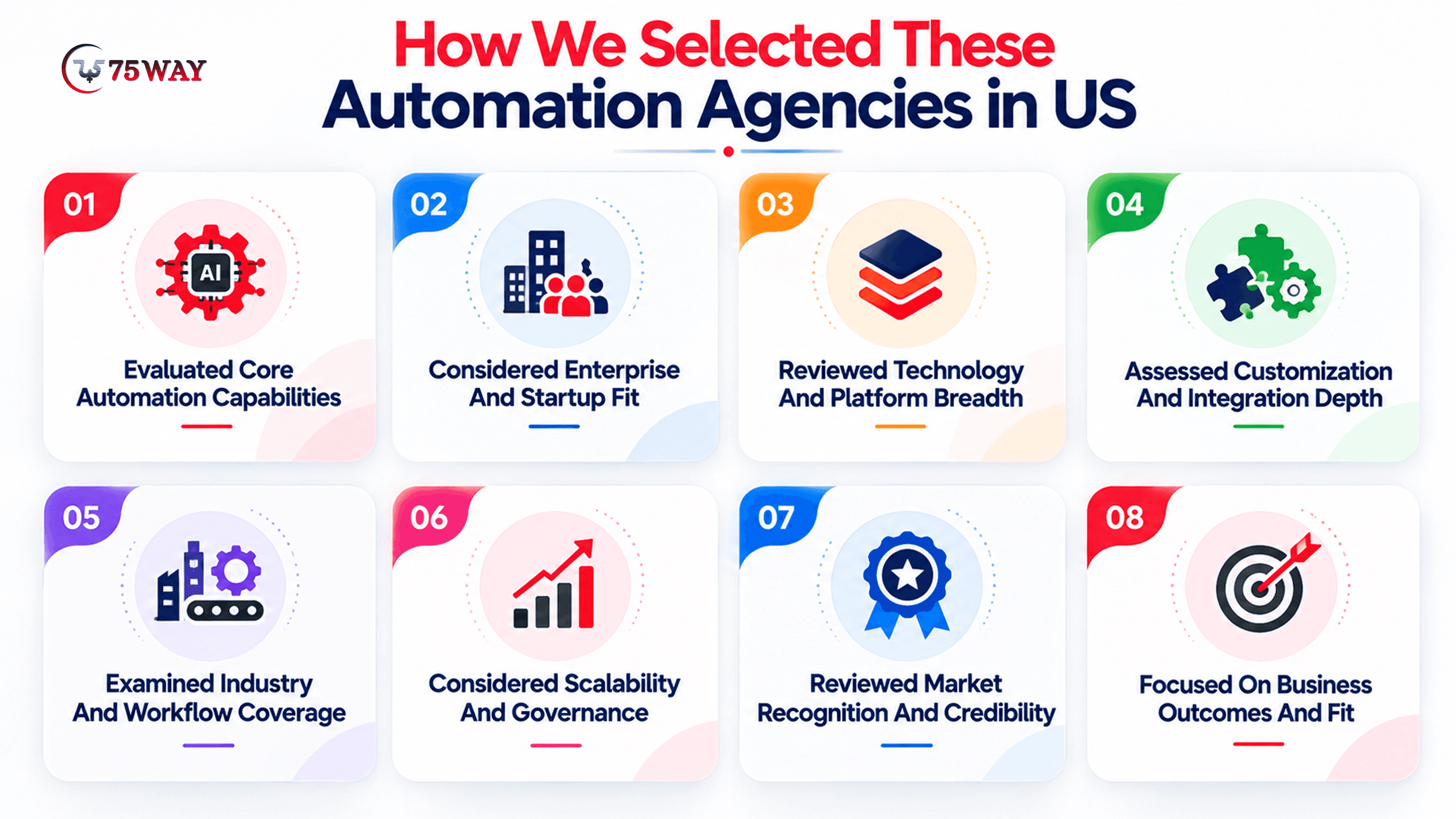
1. Evaluated Core Automation Capabilities
We reviewed capabilities spanning RPA, AI automation, workflow management, orchestration, integrations, and intelligent process automation.
2. Considered Enterprise And Startup Fit
Different businesses need different automation approaches, so we considered suitability across startups, SMBs, mid-market companies, and enterprises.
3. Reviewed Technology And Platform Breadth
Technology breadth matters when automation must connect applications, APIs, databases, cloud services, AI models, and existing business platforms.
4. Assessed Customization And Integration Depth
Providers were considered for their ability to adapt automation to existing processes instead of forcing businesses into rigid workflows.
5. Examined Industry And Workflow Coverage
We considered the range of business functions that automation can support, including finance, IT, HR, customer service, sales, and operations.
6. Considered Scalability And Governance
Large automation programs require monitoring, access control, security, governance, reliability, and centralized management.
7. Reviewed Market Recognition And Credibility
Established companies were prioritized because business buyers generally need providers with recognizable technology capabilities and demonstrated market presence.
8. Focused On Business Outcomes And Fit
The final consideration was whether a provider could help businesses reduce manual work, improve processes, connect systems, and create measurable operational value.
What Can USA’s Leading Automation Service Providers Automate?
A business may have dozens of tasks that seem too small to automate individually, yet together they consume countless employee hours. Leading automation providers can connect those tasks across departments, systems, and workflows to reduce manual intervention. The real opportunities become clearer when automation is mapped to specific business functions.
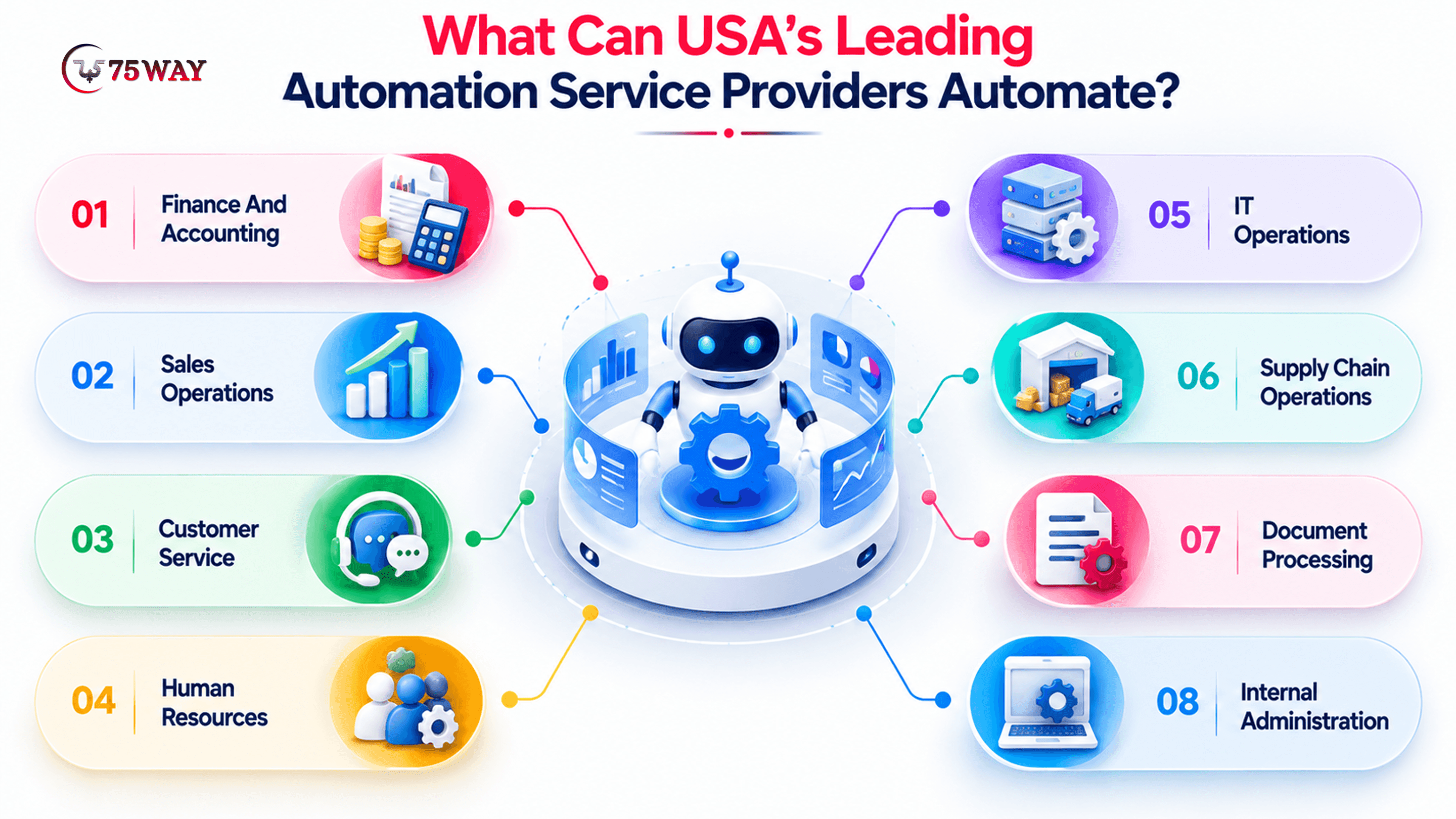
- Finance And Accounting
Enhance invoice processing, payment workflows, reconciliation, expense management, reporting, and financial data transfers.
- Sales Operations
Streamline lead routing, CRM updates, follow-ups, proposal workflows, sales notifications, and customer-data synchronization.
- Customer Service
Automate ticket classification, customer responses, routing, knowledge retrieval, escalation, and post-service workflows.
- Human Resources
Manage employee onboarding, document collection, approvals, leave workflows, HR notifications, and employee data updates.
- IT Operations
Automate incident routing, service requests, system monitoring, access workflows, ticket management, and repetitive administrative tasks.
- Supply Chain Operations
Improve order processing, inventory updates, procurement workflows, shipment notifications, and supplier communications.
- Document Processing
Automate data extraction, classification, validation, routing, approvals, and information entry from business documents.
- Internal Administration
Complete repetitive reporting, approvals, scheduling, notifications, data entry, and cross-department workflows.
Why US Businesses Are Investing In Automation Solutions
Automation has shifted from a cost-cutting experiment to a broader operating strategy. For business leaders, the value usually comes from four areas:
- Lower Operational Workload: Employees spend less time performing repetitive administrative activities.
- Faster Execution: Automated workflows can move tasks between systems without waiting for manual intervention.
- Fewer Manual Errors: Structured automation can reduce mistakes caused by repetitive data handling.
- Greater Scalability: Businesses can process higher volumes without increasing headcount at the same rate.
The strongest automation projects, however, focus on business outcomes rather than automation for its own sake.
How To Select The Best Automation Company In United States
A good automation partner should solve a business problem, not simply introduce another tool into your technology stack. The right company needs to understand what is slowing your operations, which systems must connect, and what results you expect after automation. These considerations can help you evaluate providers and make a more informed hiring decision.
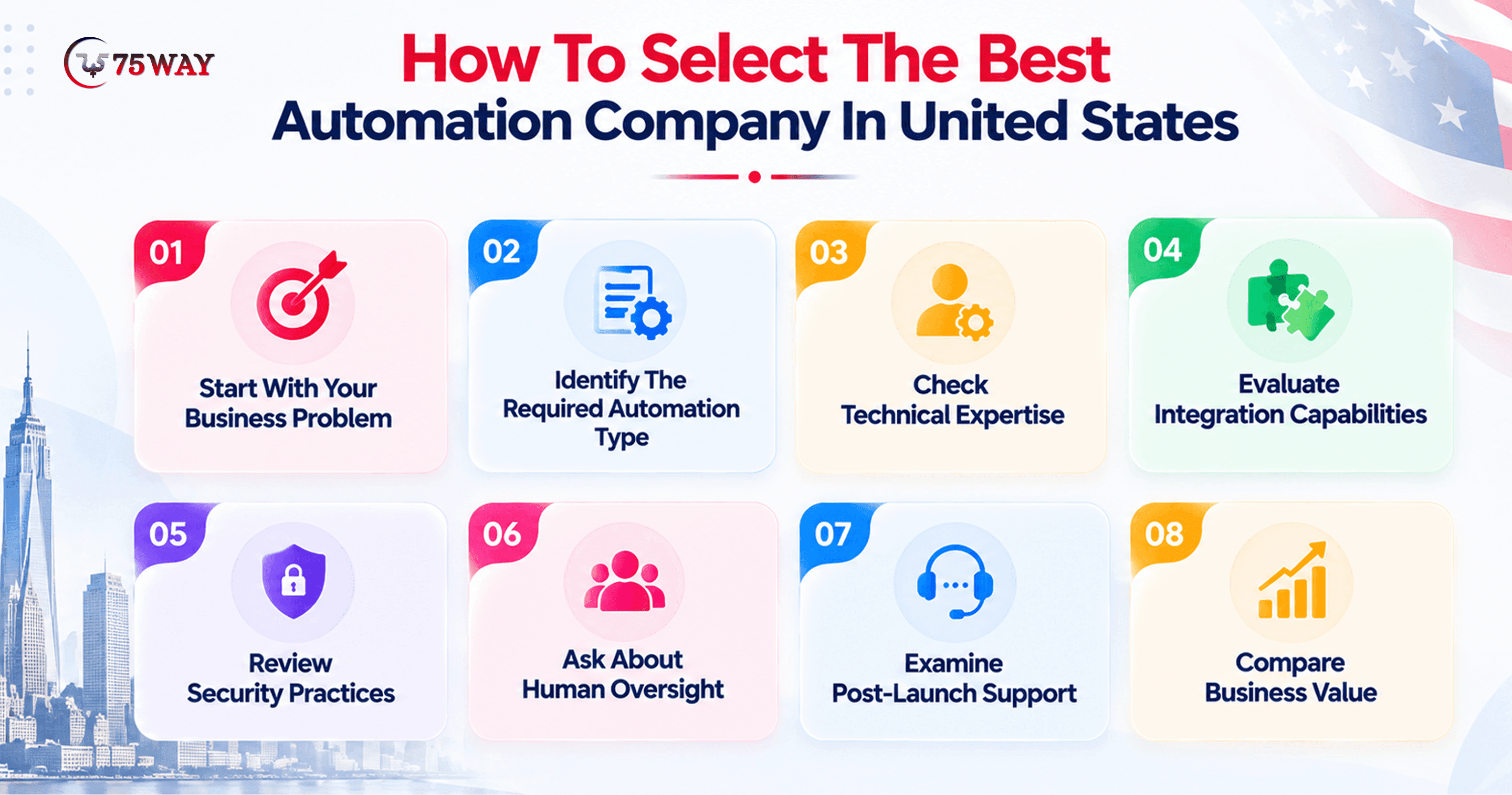
1. Start With Your Business Problem
Define exactly what you want to improve before discussing technology with providers.
2. Identify The Required Automation Type
Determine whether you need RPA, AI automation, workflow automation, integration, document processing, AI agents, or custom software.
3. Check Technical Expertise
Review experience with your programming environment, APIs, databases, cloud platforms, business applications, and automation technologies.
4. Evaluate Integration Capabilities
Ask how the provider will connect the automation with your current technology stack.
5. Review Security Practices
For sensitive business processes, evaluate authentication, access controls, monitoring, encryption, data handling, and auditability.
6. Ask About Human Oversight
Understand how the solution handles exceptions, approvals, sensitive decisions, and situations where automation should stop.
7. Examine Post-Launch Support
Confirm who handles monitoring, maintenance, troubleshooting, integrations, upgrades, and future improvements.
8. Compare Business Value
Look beyond development pricing and compare the expected time savings, operational improvements, scalability, and long-term cost.
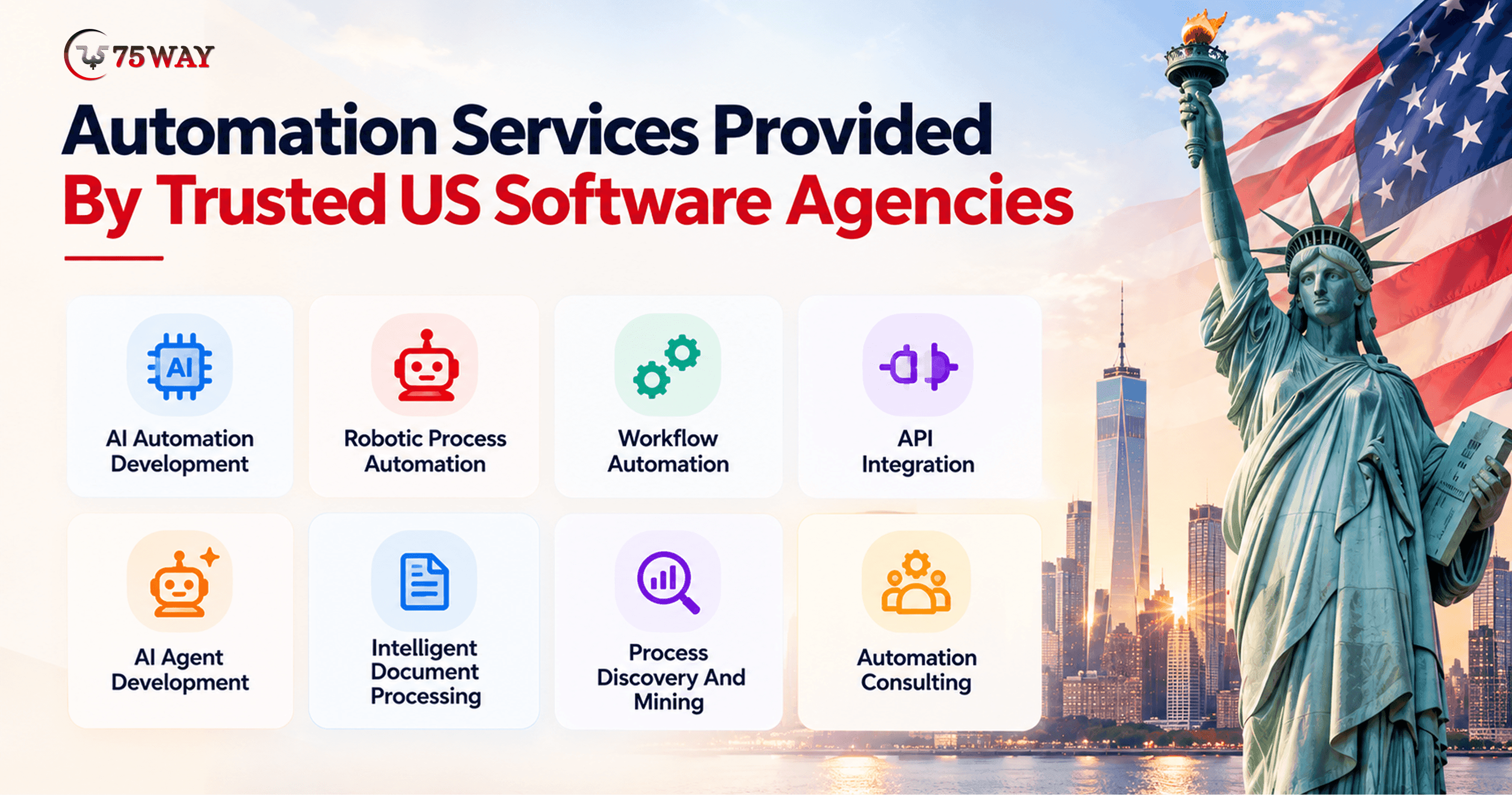
Automation Services Provided By Trusted US Vendors
Automation agencies and implementation providers can support much more than basic RPA. Depending on the provider, businesses can purchase individual services or build a broader automation program.
- AI Automation Development
Businesses can automate repetitive decisions, internal workflows, document handling, customer interactions, and operational tasks using AI-powered systems.
- Robotic Process Automation
RPA is useful when employees repeatedly perform predictable actions across applications that may not have modern APIs.
- Workflow Automation
Workflow automation connects business steps, approvals, notifications, assignments, data movement, and system actions into structured processes.
- API Integration
Integration services connect CRM, ERP, payment, communication, analytics, databases, and proprietary business applications.
- AI Agent Development
AI agents can perform multi-step tasks by interpreting information, selecting tools, retrieving data, and taking approved actions within defined boundaries.
- Intelligent Document Processing
Document automation can extract and classify information from invoices, contracts, forms, applications, claims, and other business documents.
- Process Discovery And Mining
Process intelligence helps organizations understand how work actually moves through systems before deciding what should be automated.
- Automation Consulting
AI consultants can identify automation opportunities, prioritize use cases, calculate expected value, select technology, and create implementation roadmaps.
In-House Team Or Custom Automation Service Providers In USA?
The choice depends on your resources and automation maturity. An internal team can make sense when you already have software engineers, automation specialists, product managers, DevOps professionals, and technical leadership. A specialized provider can make more sense when you need automation expertise without hiring an entire team.
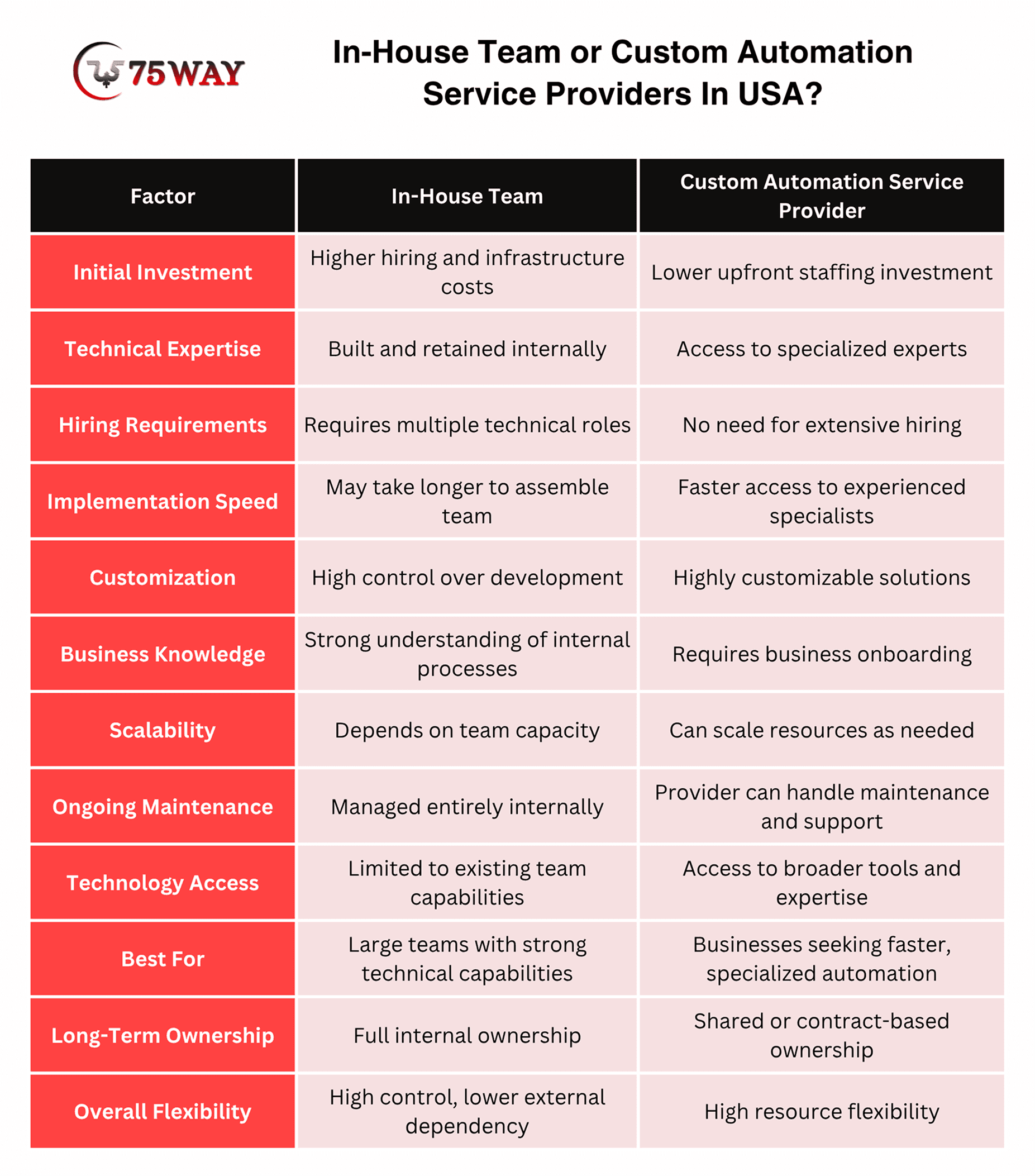
Some businesses keep product ownership internally while outsourcing specialized automation architecture, AI development, integrations, or initial implementation. The better model is the one that matches your technical resources, automation complexity, timeline, and long-term ownership requirements.
Quick Pick: Find The Right Automation Vendor in USA
- To Build Automation For Your Startup: 75way Technologies & Microsoft
- For Large Enterprise RPA: UiPath
- For Microsoft-Based Operations: Microsoft, 75way Technologies
- For Complex Enterprise Workflows: ServiceNow, Appian
Final Thoughts
The right automation partner can become a valuable growth enabler by reducing manual workloads, improving productivity, connecting disconnected systems, and supporting scalable operations.
Your ideal automation provider will depend on your processes, technology environment, budget, security requirements, and long-term business objectives.
A practical approach starts with identifying high-value workflows and evaluating providers based on technical expertise, integration capabilities, implementation support, customization, and ongoing maintenance.
The right automation strategy should solve genuine operational challenges while delivering measurable business value without unnecessary complexity. Clear priorities, solution validation, and strong provider alignment can help you build automation that supports sustainable growth.
Frequently Asked Questions (FAQs)
What Do Automation Companies Do?
Automation companies help businesses automate repetitive tasks, workflows, processes, data movement, document handling, and operational activities using technologies such as RPA, AI, APIs, and workflow platforms.
What Are The Main Types of Business Automation?
The major categories include RPA, AI automation, workflow automation, intelligent document processing, API integration, process orchestration, and AI-agent automation.
How Do I Choose An Automation Company in USA?
Define your process first, identify required technologies and integrations, evaluate technical expertise, check security practices, compare implementation approaches, and assess long-term support.
Is RPA The Same As AI Automation?
No. RPA primarily follows predefined rules, while AI automation can interpret information and handle more variable tasks.
Can Automation Companies Integrate Existing Software?
Yes. Depending on the systems involved, providers can use APIs, connectors, databases, middleware, RPA, and custom development to connect existing applications.
What Business Processes Should Be Automated First?
Prioritize repetitive, high-volume, rule-based workflows with measurable outcomes, significant manual effort, and relatively predictable exceptions.
Is Automation Suitable For Startups?
Yes. Startups can use automation to reduce repetitive operational work, support small teams, improve processes, and handle increasing workloads without proportional headcount growth.
Should Businesses Build Automation Internally Or Outsource It?
Both models can work. The decision depends on internal technical expertise, project complexity, available resources, implementation speed, ownership requirements, and long-term maintenance needs.