AI Summary
Finding the right process automation software company can cut manual work, connect disconnected systems, and improve operational visibility. This guide compares leading providers across capabilities, pricing, technologies, and business fit. Use it to shortlist automation partners with confidence.
Key Takeaways
- Compare process automation companies in USA by platform depth, services, technologies, and fit.
- Choose providers based on complexity, integrations, governance, scalability, and goals.
- Custom partners address unique processes packaged platforms cannot easily cover.
- Enterprise platforms provide orchestration, RPA, AI, analytics, integrations, and governance.
- Pricing varies based on workflows, users, integrations, models, and support.
The best process automation company is not necessarily the company with the longest service list. For a U.S. business, the right partner should understand the process being automated, the systems involved, the data moving between them, the required level of human oversight, and the business outcome expected after deployment.
This list focuses primarily on process automation software companies in USA rather than simply ranking packaged automation products.
That distinction matters because many businesses searching for process automation software companies actually need a partner to design workflows, integrate existing systems, build custom automation, introduce AI or RPA, and maintain the resulting solution.
Our evaluation considers AI automation expertise, software engineering depth, integration capabilities, technology coverage, project economics, team scale, U.S. delivery presence, and suitability for different business scenarios.
Therefore, the process automation software development companies in USA below should be viewed as buyer-focused recommendations, not an absolute universal ranking.
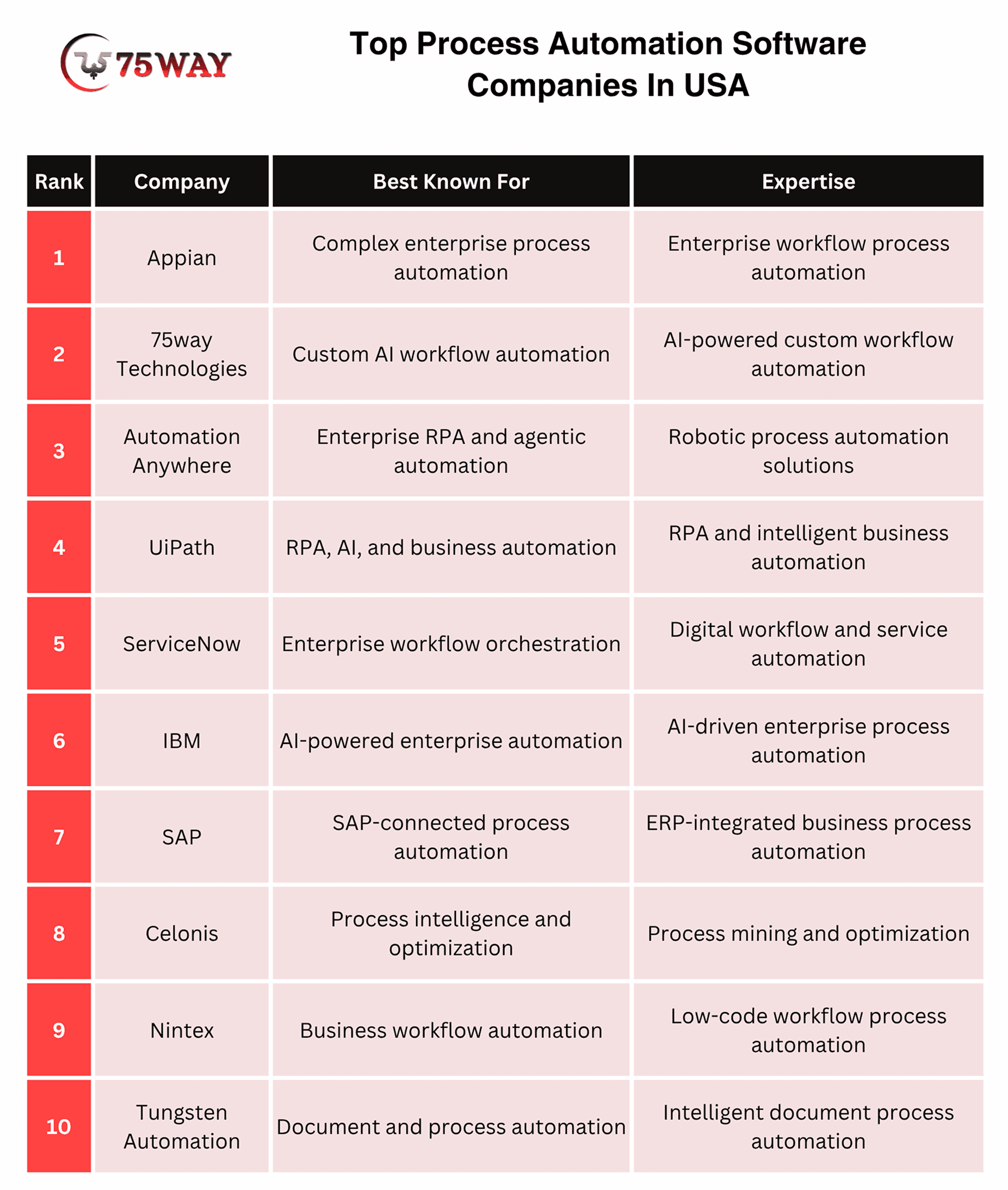
Top Process Automation Software Companies In USA: Quick List
A business does not need more software simply for the sake of automation; it needs technology that removes real workflow bottlenecks. The right provider can connect processes, reduce repetitive work, and give teams more time for higher-value tasks. This quick list highlights process automation software companies worth putting on your radar.
Leading Process Automation Software Agencies in USA
What makes one process automation agency more worth considering than another? The answer often comes down to its ability to understand business workflows, connect existing systems, and build automation around practical goals. This list brings together leading agencies businesses can evaluate for process automation projects.
1. Appian
Rating: 5/5
Min. Project Size: 30000+
Hourly Cost: $50 - $90/hr
Team Size: 2,500+
Location: McLean, Virginia
Year Founded: 1999
Appian helps enterprises design, automate, and optimize complex workflows through a low-code platform combining process orchestration, data, AI, RPA, and integrations. Its enterprise focus suits regulated, process-heavy organizations. The platform supports measurable operational outcomes today.
Technologies: Appian uses low-code development, AI, RPA, process mining, APIs, data fabric, workflow orchestration, and business rules.
Services You Can Avail
- Enterprise process automation platform implementation services
- Low-code workflow application development and modernization
- Business process management and optimization consulting
- AI, RPA, and integration orchestration services
Why Choose Appian?
Appian is a strong choice when automation involves multiple departments, systems, data sources, rules, and approval stages. Its low-code approach can help organizations build process applications without relying entirely on traditional software development.
Suitable For: Large enterprises, government organizations, financial services, healthcare, insurance, and other regulated industries.
2. 75way Technologies
Rating: 5/5
Min. Project Size: $5,000+
Hourly Cost: $20 - $50/hr
Team Size: 150+
Location: San Jacinto, California
Year Founded: 2015
75way Technologies builds custom AI-driven workflow automation for businesses needing tailored processes rather than off-the-shelf software. Its team combines AI, RPA, machine learning, integrations, and software engineering. Solutions align automation with business requirements successfully today.
Technologies: 75way combines artificial intelligence, machine learning, RPA, NLP, generative AI, predictive analytics, APIs, and workflow orchestration. Its stack supports custom automation across business applications and operational workflows.
Services You Can Avail
- Custom AI workflow automation development services
- Business process analysis and optimization services
- Enterprise system integration and orchestration solutions
- Automation monitoring, AI analytics, and support services
Why Choose 75way Technologies?
75way is different from traditional automation software vendors because it can build automation around a company's existing processes rather than asking the company to reshape operations around a fixed platform.
Its current AI workflow automation offering covers consulting, process analysis, custom AI automation development, implementation, system integration, data processing, and workflow orchestration. Its stated technology capabilities include machine learning, computer vision, generative AI, agentic AI, predictive analytics, conversational AI, NLP, and RPA.
Suitable For: Startups, SMBs, enterprises, and businesses requiring custom automation.
3. Automation Anywhere
Rating: 5/5
Min. Project Size: 25000+
Hourly Cost: $50 - $100/hr
Team Size: 2,000+
Location: San Jose, California
Year Founded: 2003
Automation Anywhere provides enterprise automation through Automation 360, combining RPA, AI, document processing, process discovery, and orchestration. It fits organizations seeking governed automation across repetitive, rules-based, and document-heavy workflows. Its platform supports enterprise-scale automation programs.
Technologies: Automation Anywhere combines RPA, generative AI, intelligent document processing, process discovery, APIs, and workflow orchestration.
Services You Can Avail
- Enterprise RPA implementation and consulting services
- Intelligent document processing automation solutions
- Process discovery and automation opportunity analysis
- Workflow orchestration and automation management services
Why Choose Automation Anywhere?
Automation Anywhere is particularly relevant when a business has large volumes of repetitive work that spans applications, documents, data entry, approvals, and back-office operations.
Suitable For: Large enterprises, shared-service centers, financial services, healthcare, manufacturing, and operations-heavy organizations.
4. UiPath
Rating: 4.9/5
Min. Project Size: 25000+
Hourly Cost: $50 - $90/hr
Team Size: 4,000+
Location: New York, New York
Year Founded: 2005
UiPath offers an enterprise automation platform covering process discovery, RPA, AI, orchestration, and intelligent document processing. Its ecosystem suits companies modernizing repetitive operations while connecting employees, applications, and digital workers. It supports complex enterprise environments.
Technologies: UiPath combines RPA, AI, process mining, document understanding, APIs, orchestration, and automation agents. Its platform connects digital workers, applications, data, and human decisions across complex workflows and teams.
Services You Can Avail
- Enterprise RPA strategy and implementation services
- Intelligent document processing automation solutions
- Process discovery and mining consulting services
- AI agent and workflow orchestration services
Why Choose UiPath?
UiPath remains one of the most recognizable names in enterprise automation because it covers the automation lifecycle from discovering processes to building, deploying, managing, and measuring automations.
UiPath also maintains a significant U.S. presence, including its New York headquarters and offices in Austin, Seattle, and Denver.
Suitable For: Enterprises with mature automation programs and complex application environments.
5. ServiceNow
Rating: 4.9/5
Min. Project Size: 25000+
Hourly Cost: $50 - $90/hr
Team Size: 20,000+
Location: Santa Clara, California
Year Founded: 2004
ServiceNow helps enterprises automate workflows across IT, employee operations, customer service, and business functions through its platform. It is useful when automation must connect departments, approvals, service processes, and governance. Its ecosystem supports workflow orchestration.
Technologies: ServiceNow uses workflow orchestration, AI integrations, APIs, low-code development, process automation, and enterprise data.
Services You Can Avail
- Enterprise workflow automation implementation services
- IT service management workflow automation solutions
- Employee and customer workflow orchestration services
- Low-code application and process development services
Why Choose ServiceNow?
Organizations can connect IT workflows, employee requests, customer operations, approvals, cases, and other business processes through a common platform. Its enterprise platform capabilities also make governance and workflow visibility important parts of the buying decision.
Suitable For: Large enterprises, IT organizations, shared services, customer operations, and complex service environments.
6. IBM
Rating: 4.8/5
Min. Project Size: 45000+
Hourly Cost: $50 - $90/hr
Team Size: 280,000+
Location: Armonk, New York
Year Founded: 1911
IBM supports enterprise automation through watsonx Orchestrate and related AI, integration, and workflow capabilities. Its strength combines automation with enterprise AI, governance, data, and complex technology environments. This makes it relevant for transformation programs today.
Technologies: IBM combines watsonx Orchestrate, AI, APIs, integration, automation, data, and workflow technologies.
Services You Can Avail
- Enterprise AI automation strategy and implementation
- Agentic workflow orchestration and development services
- Business process automation consulting and integration
- AI governance and enterprise automation support
Why Choose IBM?
IBM is suited to organizations that want automation connected with broader enterprise AI, data, integration, governance, and transformation initiatives.
Suitable For: Large enterprises, financial institutions, government, healthcare, telecommunications, and highly governed environments.
7. SAP
Rating: 4.8/5
Min. Project Size: 25000+
Hourly Cost: $50 - $90/hr
Team Size: 100,000+
Location: Newtown Square, Pennsylvania
Year Founded: 1972
SAP combines workflow management, RPA, AI-assisted capabilities, and low-code tools for business process automation. It suits organizations already operating SAP applications and seeking connected enterprise workflows. Integration extends automation across business systems.
Technologies: SAP combines low-code workflows, RPA, AI, machine learning, document processing, APIs, and business rules.
Services You Can Avail
- SAP workflow automation implementation and consulting
- Business process automation design and development
- RPA and document processing integration services
- SAP and third-party application integration services
Why Choose SAP?
SAP Build Process Automation allows teams to create workflows, forms, decision logic, RPA automations, intelligent actions, and process visibility through low-code and no-code capabilities. It can also connect process automation with SAP and third-party applications.
Suitable For: SAP customers, manufacturers, financial organizations, supply-chain businesses, and global enterprises.
8. Celonis
Rating: 4.8/5
Min. Project Size: 25000+
Hourly Cost: $50 - $90/hr
Team Size: 3,000+
Location: New York, New York
Year Founded: 2011
Celonis uses process intelligence, process mining, AI, and orchestration to identify operational bottlenecks and guide automation opportunities. It is strongest when leaders need evidence about how processes run before redesigning workflows. This supports automation decisions.
Technologies: Celonis combines process mining, process intelligence, AI, machine learning, digital twins, orchestration, and data integration.
Services You Can Avail
- Process mining implementation and consulting services
- Process intelligence assessment and optimization services
- Automation opportunity discovery and prioritization services
- Enterprise process orchestration and improvement services
Why Choose Celonis?
Celonis is different from traditional RPA-first platforms because its core strength is understanding how processes actually operate before deciding what should change.
The platform combines process data and business context to create a digital representation of operations, helping organizations identify bottlenecks, deviations, inefficiencies, and automation opportunities.
Suitable For: Enterprises pursuing process intelligence before automation.
9. Nintex
Rating: 4.6/5
Min. Project Size: 25000+
Hourly Cost: $50 - $90/hr
Team Size: 1,000+
Location: Bellevue, Washington
Year Founded: 2006
Nintex provides process management and automation tools helping business teams map, automate, manage, and optimize workflows. Its approachable platform suits organizations seeking broader business-user participation without building every workflow from scratch. It supports process improvement programs.
Technologies: Nintex combines workflow automation, process mapping, document generation, integrations, forms, analytics, and process management.
Services You Can Avail
- Workflow automation design and implementation services
- Business process mapping and optimization services
- Document automation and approval workflow services
- Process management and analytics integration services
Why Choose Nintex?
Nintex can be a practical choice when business teams need greater control over workflow creation and process improvement without depending entirely on professional developers.
Its headquarters are in Bellevue, Washington, making it a relevant U.S.-based vendor for organizations looking for a domestic enterprise automation provider.
Suitable For: Mid-market companies, enterprises, operations teams, and business-led automation programs.
10. Tungsten Automation
Rating: 4.5/5
Min. Project Size: 25000+
Hourly Cost: $50 - $90/hr
Team Size: 2,000+
Location: Irvine, California
Year Founded: 1985
Tungsten Automation provides enterprise automation spanning document intelligence, workflow automation, RPA, and process orchestration. Its capabilities suit organizations handling high-volume documents, repetitive tasks, and complex operational workflows. It supports automation across document-intensive business environments today.
Technologies: Tungsten combines RPA, intelligent document processing, workflow automation, process orchestration, APIs, analytics, and AI.
Services You Can Avail
- Intelligent document processing automation implementation services
- RPA workflow development and deployment services
- Enterprise process orchestration and integration services
- Document workflow optimization and analytics services
Why Choose Tungsten Automation?
Tungsten is worth evaluating when document processing is central to the automation opportunity.
Organizations dealing with invoices, forms, claims, contracts, records, and other high-volume documents may need more than basic workflow automation. Intelligent document processing can extract and classify information before downstream workflows execute.
Suitable For: Finance, insurance, healthcare, logistics, document-heavy operations, and enterprise back offices.
What Is Process Automation Software?
Process automation software uses technology to execute repetitive, structured, or rule-based business activities with less manual intervention.
Instead of asking employees to repeatedly copy information, check records, send emails, update systems, generate documents, or request approvals manually, automation software can coordinate those activities through predefined workflows, APIs, RPA bots, AI models, business rules, or software agents.
Modern process automation is moving beyond isolated RPA bots. Current enterprise platforms increasingly combine workflow orchestration, process intelligence, AI, machine learning, integrations, document processing, and governance. ISG's 2026 research describes this evolution as a move toward enterprise execution layers that coordinate workflows across systems, teams, and data.
How We Rank Process Automation Software Firms in the US
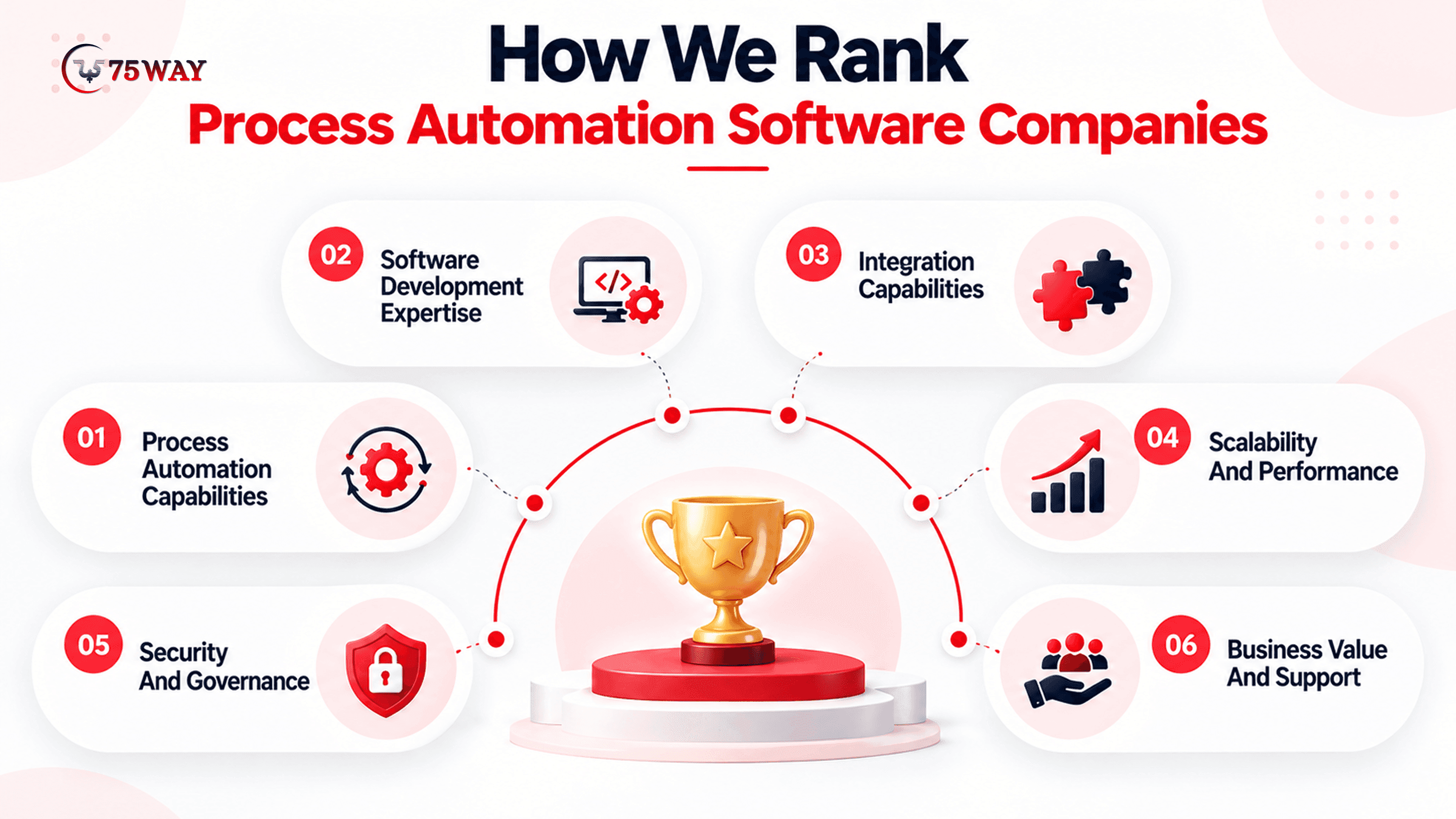
Our ranking evaluates each process automation software firm against the capabilities that matter most when businesses select an automation technology partner. We consider platform strength, development expertise, integration capabilities, scalability, security, and overall business value.
1. Process Automation Capabilities
We assess workflow automation, RPA, AI automation, process orchestration, document processing, and business process management capabilities.
2. Software Development Expertise
We evaluate custom development skills, automation architecture, low-code capabilities, AI integration, APIs, and the ability to build solutions around unique business workflows.
3. Integration Capabilities
We examine how well providers connect automation solutions with ERP, CRM, databases, APIs, legacy applications, cloud platforms, and third-party business software.
4. Scalability And Performance
We consider whether automation solutions can handle growing users, workflows, transaction volumes, data loads, departments, and enterprise-level operational requirements.
5. Security And Governance
We evaluate access controls, authentication, data protection, audit trails, compliance support, monitoring, permissions, and governance features for business automation.
6. Business Value And Support
We consider implementation expertise, customization, pricing transparency, support, maintenance, measurable ROI, and the provider's ability to deliver long-term automation value.
How To Choose The Right Process Automation Software Vendor in United States?
The best automation provider is not necessarily the company with the largest customer base or the longest feature list. Your decision should depend on the processes you need to automate and the business outcome you expect.
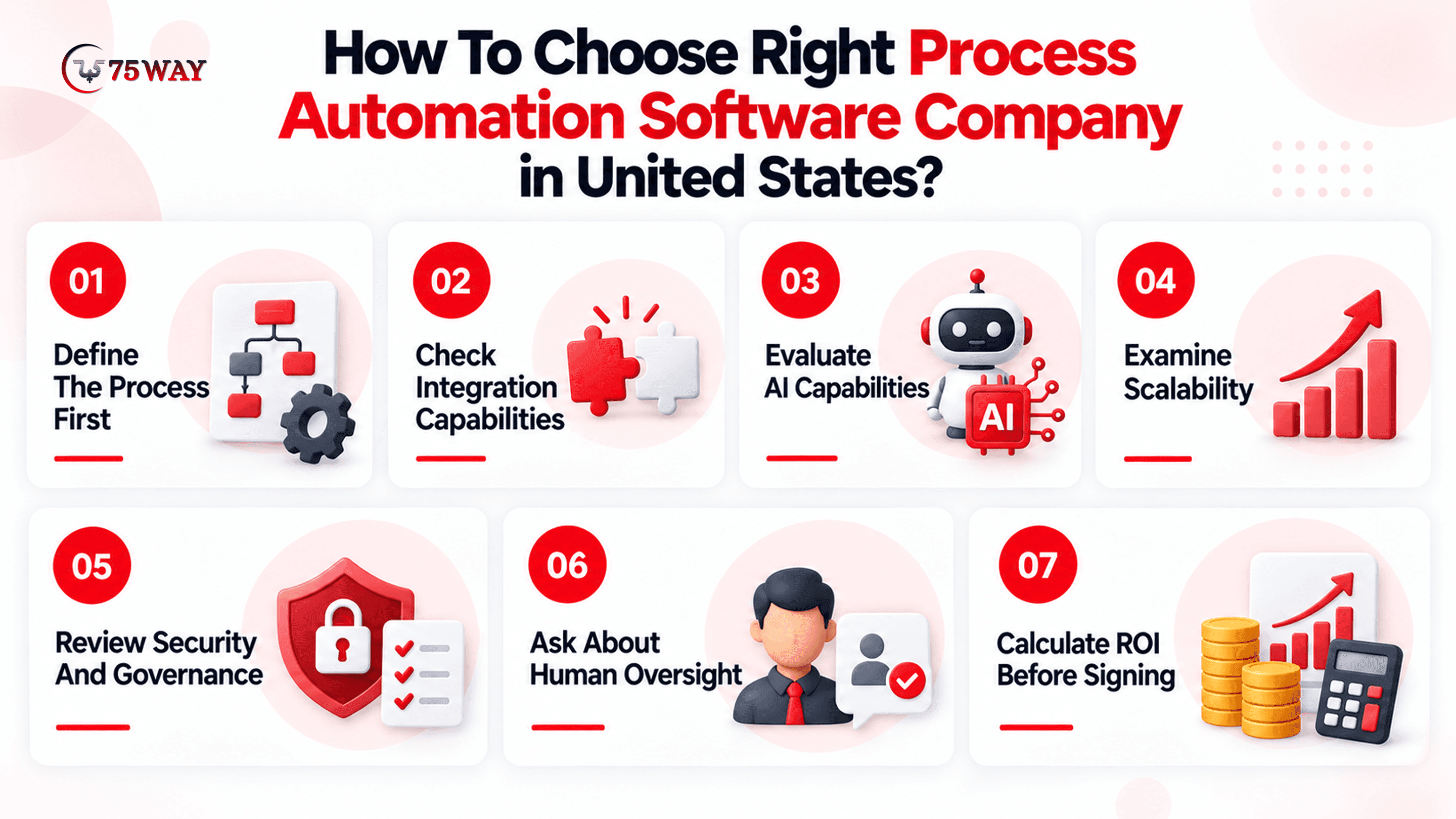
1. Define The Process First
Do not start by selecting software.
Start by documenting the workflow, identifying manual steps, measuring processing time, calculating error rates, and identifying where employees lose the most time.
A strong process automation software partner should help you determine whether the process should be automated before deciding how it should be automated.
2. Check Integration Capabilities
Your automation platform must work with your existing technology stack.
Evaluate support for:
- CRM systems
- ERP platforms
- Accounting software
- HR systems
- Databases
- APIs
- Cloud platforms
- Legacy applications
- Internal applications
- Third-party SaaS tools
Integration limitations can turn an apparently simple automation project into a costly implementation.
3. Evaluate AI Capabilities
AI can help automation systems handle unstructured information, make recommendations, classify documents, understand language, predict outcomes, and support decision-making.
However, AI should not be added simply because it is popular.
Ask:
- Does the workflow actually require AI?
- Can the system explain decisions?
- How is sensitive data handled?
- Can humans review important decisions?
- What happens when the model produces an incorrect result?
- Can the AI connect with your existing workflow?
4. Examine Scalability
A workflow that works for 500 transactions may fail at 500,000.
Evaluate:
- Transaction volume
- Concurrent users
- Automation capacity
- Infrastructure
- Monitoring
- Error handling
- Queue management
- Data processing
- Disaster recovery
- Geographic deployment
5. Review Security And Governance
Security should be part of the buying decision from the beginning.
Check:
- Role-based access
- Authentication
- Encryption
- Audit logs
- Data retention
- Compliance controls
- Permission management
- Human approvals
- AI governance
- Monitoring
This is especially important for healthcare, finance, insurance, government, and other regulated industries.
6. Ask About Human Oversight
Not every process should become completely autonomous.
A good automation architecture should identify where human review remains necessary, especially for financial decisions, compliance actions, customer disputes, sensitive documents, and high-impact decisions.
7. Calculate ROI Before Signing
Measure the expected value using practical metrics.
For example:
Annual Automation Value = Labor Savings + Error Reduction + Faster Processing Value + Revenue Impact
Then compare the expected value against:
Total Automation Cost = Software + Development + Integration + Infrastructure + Maintenance + Training
This provides a better business case than comparing vendor license prices alone.
Who Can Benefit From Process Automation Software Services?
Process automation can benefit organizations across industries, but the strongest candidates usually share several characteristics.
- Startups
Startups can automate repetitive operations without expanding headcount at the same pace as transaction volume.
- SMBs
Growing businesses can reduce administrative workload, connect disconnected applications, and standardize recurring processes.
- Enterprises
Large organizations can orchestrate complex workflows across departments, applications, employees, AI agents, and legacy systems.
- Regulated Industries
Healthcare, finance, insurance, government, and other regulated sectors can automate controlled processes while maintaining approvals, auditability, and governance.
- Operations-Heavy Companies
Manufacturing, logistics, retail, and service organizations can automate high-volume workflows involving orders, documents, inventory, reporting, and customer operations.
Quick Picks: Trusted Process Automation Vendors For Different Business Needs
- For Startups & Growing Businesses: 75way Technologies, Nintex
- For Large-Scale Enterprises: Appian, 75way
- For Enterprise AI Automation: IBM, Automation Anywhere
- For Service & IT Workflows: ServiceNow, 75way
Final Verdict
The best process automation software company depends on what you are actually trying to automate. The strongest choice should simplify repetitive work while supporting integrations, security, scalability, governance, and future AI capabilities.
Startups may prioritize flexibility and development speed, while larger organizations often need orchestration, enterprise controls, and dependable support. Before signing a contract, evaluate implementation requirements, pricing models, integration capabilities, customization, and measurable outcomes.
A thoughtful comparison can prevent expensive technology mismatches and create a stronger foundation for long-term automation. Review your highest-value processes first, define measurable goals, and select a partner capable of growing alongside your operational needs.
Frequently Asked Questions (FAQs)
Is RPA The Same As Process Automation?
No. RPA automates specific software-based tasks, while process automation can coordinate complete workflows involving applications, APIs, business rules, people, AI, documents, and RPA.
How Much Does Process Automation Software Cost?
Pricing varies based on users, workflows, automation volume, integrations, AI requirements, deployment model, and support. Enterprise vendors commonly provide customized pricing rather than one public hourly rate.
Should Startups Buy Automation Software Or Build Custom Automation?
Startups should compare both options. Standard software can provide faster deployment, while custom automation can be better when workflows are unique or require specialized integrations.
Can AI Be Integrated Into Process Automation?
Yes. AI can support document understanding, classification, natural-language processing, prediction, decision support, intelligent routing, and agentic workflow execution.
How Long Does Process Automation Software Implementation Take?
Simple workflows may be implemented relatively quickly, while enterprise automation involving multiple systems, complex rules, AI, security, and governance can require substantially more planning and development.