AI Summary
Property management software development brings leasing, tenants, and property operations into one platform. This guide explains essential features, development stages, costs, integrations, AI opportunities, and scalability considerations. It also helps businesses plan smarter software investments.
Key Takeaways
- The global market could reach $61.41 billion by 2034, signaling substantial opportunity.
- Property management software centralizes leasing, tenants, payments, maintenance, accounting, and operations.
- A well-planned MVP helps validate demand before expanding into advanced capabilities.
- Property management software development costs typically range from $40,000 to $250,000+.
- AI can automate communications, maintenance workflows, reporting, tenant support, and operational decisions.
When a property portfolio grows, the work rarely grows neatly. A few more tenants can mean dozens of extra messages, rent follow-ups, maintenance requests, documents, and updates for your team to keep track of.
Property management software can bring these moving pieces into one place, so managers spend less time jumping between spreadsheets, emails, calls, and disconnected tools.
But building real estate management software is not about cramming every possible feature into one platform. The software needs to fit the way your business actually operates, from how properties and tenants are managed to how rent is collected, maintenance is assigned, documents are handled, and owners receive updates.
That is where the development decisions start to matter. This guide walks through what it takes to build property management software, including the features, user roles, property management software development process, technology stack, integrations, costs, and other practical factors worth considering before you start.
Property Management Software Market Size & Growth in USA
As property portfolios expand, managing rent, maintenance, tenant communication, and property records through scattered tools becomes harder to sustain. The U.S. property management software market is expected to reach USD 1.28 billion by 2034, rising from USD 709.2 million in 2025. The market size, growth trajectory, and business opportunities behind this expansion are discussed below.
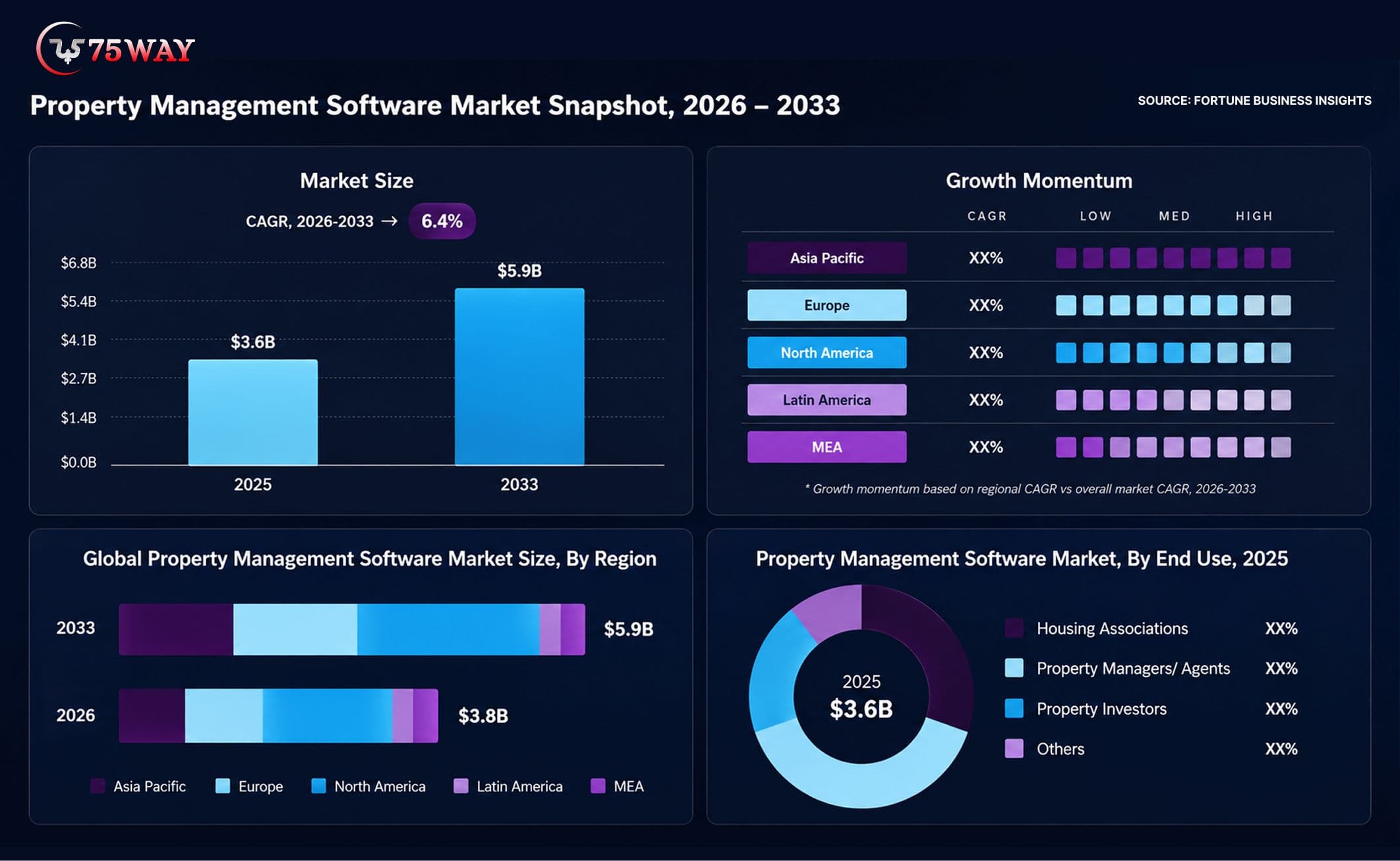
- The global property management software market is projected to grow from $29.19 billion in 2026 to $61.41 billion by 2034, at a CAGR of 9.70%, according to Fortune Business Insights.
- Another estimate places the market at $3.8 billion in 2026, rising to $5.9 billion by 2033, at a CAGR of 6.4%, according to Grand View Research.
- North America dominated the market with a 35.10% share in 2025.
- The cloud segment led the market, accounting for 61.2% of revenue.
- According to Mordor Intelligence, the market is expected to grow from $6.53 billion in 2026 to $9.93 billion by 2031, at a CAGR of 8.74%.
- Mobile property management solutions can deliver 20% better tenant engagement and reduce task-completion time by up to 15%.
- Lease management software is projected to record the highest CAGR of 9.5% during the forecast period.
- Residential properties accounted for 58.19% of spending in 2025, while industrial and logistics properties are projected to grow at a 10.34% CAGR.
What Is Property Management Software?
Property management software is a digital platform that helps property owners and managers handle rentals, tenants, leases, payments, maintenance, accounting, communication, and reporting from one system.
Instead of managing these activities across spreadsheets, email, payment tools, and disconnected applications, businesses can bring daily property operations into a centralized workflow.
For a growing portfolio, the value goes beyond replacing manual work. The right platform gives property managers better visibility into occupancy, rent collection, lease status, maintenance requests, tenant communication, property performance, and owner reporting, helping teams manage more properties without adding the same level of administrative overhead.
What Can Real Estate Management Software Manage?
A modern property management platform can bring the core activities of running a rental portfolio into one connected system. Depending on the business model and property types, it can manage everything from tenant onboarding and lease administration to payments, maintenance, accounting, and performance reporting.
- Property Management: Store property profiles, unit details, availability, occupancy status, amenities, and portfolio information in one centralized system.
- Tenant Management: Manage tenant profiles, applications, documents, communications, service requests, and important tenant-related records throughout the rental lifecycle.
- Lease Management: Create and manage leases, track renewal and expiration dates, maintain lease terms, and organize digital agreements for easier access.
- Rent Collection: Support online rent payments, recurring charges, payment tracking, receipts, outstanding balances, and automated reminders for overdue payments.
- Maintenance Management: Let tenants report issues, create work orders, assign vendors or maintenance teams, schedule repairs, and track each request through completion.
- Accounting: Record rental income, expenses, invoices, transactions, security deposits, and other financial data while generating useful financial reports.
- Owner Management: Give property owners access to property performance, financial statements, reports, updates, and other information relevant to their investments.
- Communication: Centralize tenant, owner, vendor, and property-team communication through messages, announcements, reminders, alerts, and automated notifications.
- Analytics and Reporting: Monitor occupancy, rental income, payment activity, maintenance performance, property-level metrics, and portfolio trends through dashboards and customizable reports.
Why Businesses Invest in Custom Property Management Software Development?
Off-the-shelf platforms can cover standard property management needs, but they may not fit every company's workflows, portfolio structure, integrations, or growth plans. Custom property management software allows businesses to design workflows around their specific operating model rather than forcing teams to adapt to someone else's system.
- Business-Specific Workflows: Custom software can mirror your existing leasing, tenant, maintenance, accounting, and approval processes instead of requiring teams to change established workflows.
- Scalable Portfolio Management: Growing portfolios may require flexible architecture that supports additional properties, units, users, transactions, and locations without creating operational bottlenecks.
- Third-Party Integrations: Direct connections with accounting systems, payment gateways, CRM platforms, listing services, communication tools, and other business applications can reduce disconnected processes.
- Advanced Automation: Automated rent reminders, maintenance assignments, lease alerts, tenant communications, reporting, and recurring administrative tasks can reduce repetitive work across property management teams.
- Greater Data Control: A custom platform provides greater control over business data, user permissions, workflows, reporting structures, and system configurations as operational requirements evolve.
Who Can Build Real Estate Property Management Software?
The team you choose to build your property management platform can influence everything from its core workflows to how easily it scales later. You may work with in-house developers, freelancers, or a specialized software development company depending on your requirements and budget. Let’s look at which option makes the most sense for different property businesses.
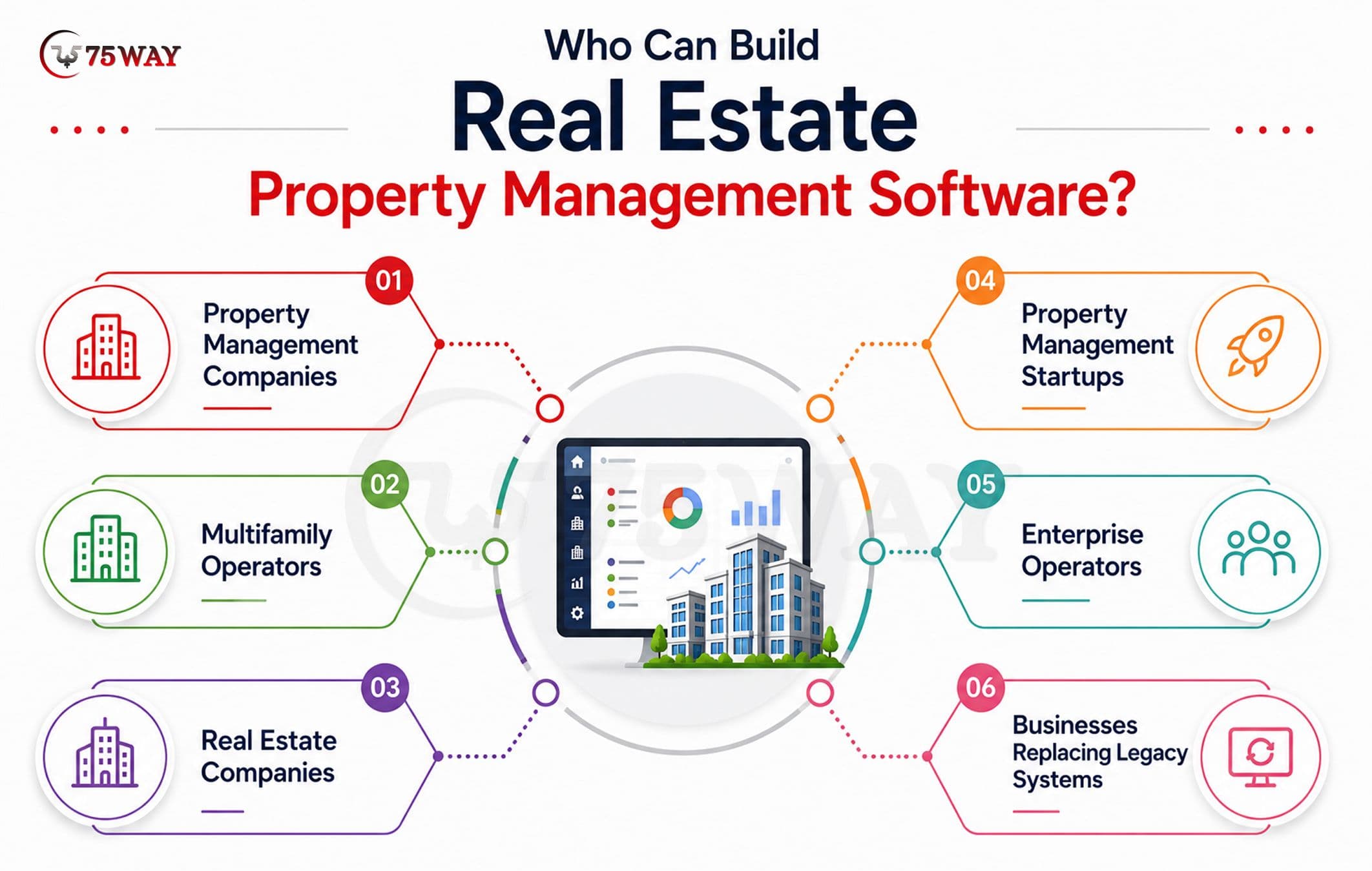
- Property Management Companies: Large and growing portfolios often require centralized tools for tenants, leases, payments, maintenance, accounting, and property operations. Custom platforms can connect workflows across teams.
- Multifamily Operators: Multiple buildings and units create complex requirements for tenant management, leasing, payments, maintenance, and reporting. Centralized software provides portfolio-wide visibility and coordinated daily operations.
- Real Estate Companies: Diverse properties and business units often involve different operational requirements, workflows, and reporting structures. Custom software can connect these processes while supporting property-specific configurations.
- Property Management Startups: Differentiated SaaS products require flexible platforms built around specific customer problems and market opportunities. Custom development supports unique features, integrations, automation, workflows, and scalable business models.
- Enterprise Operators: Large portfolios and distributed teams demand sophisticated permissions, integrations, reporting, and scalable infrastructure. A robust platform can support increasing users, properties, transactions, and operational complexity.
- Businesses Replacing Legacy Systems: Outdated applications, spreadsheets, and disconnected tools can create fragmented property operations and limited visibility. Custom software brings essential workflows together while introducing automation and modern capabilities.
The development strategy should therefore begin with the business model and operational problems, not with a long list of software features. That distinction becomes important when deciding what belongs in the MVP, what should be automated, and which capabilities can wait until later releases.
Key Features of Properties Management Software Development
A scalable properties management platform should be organized around the workflows different users perform daily. The following modules cover the core functionality businesses typically prioritize when planning properties management software development.
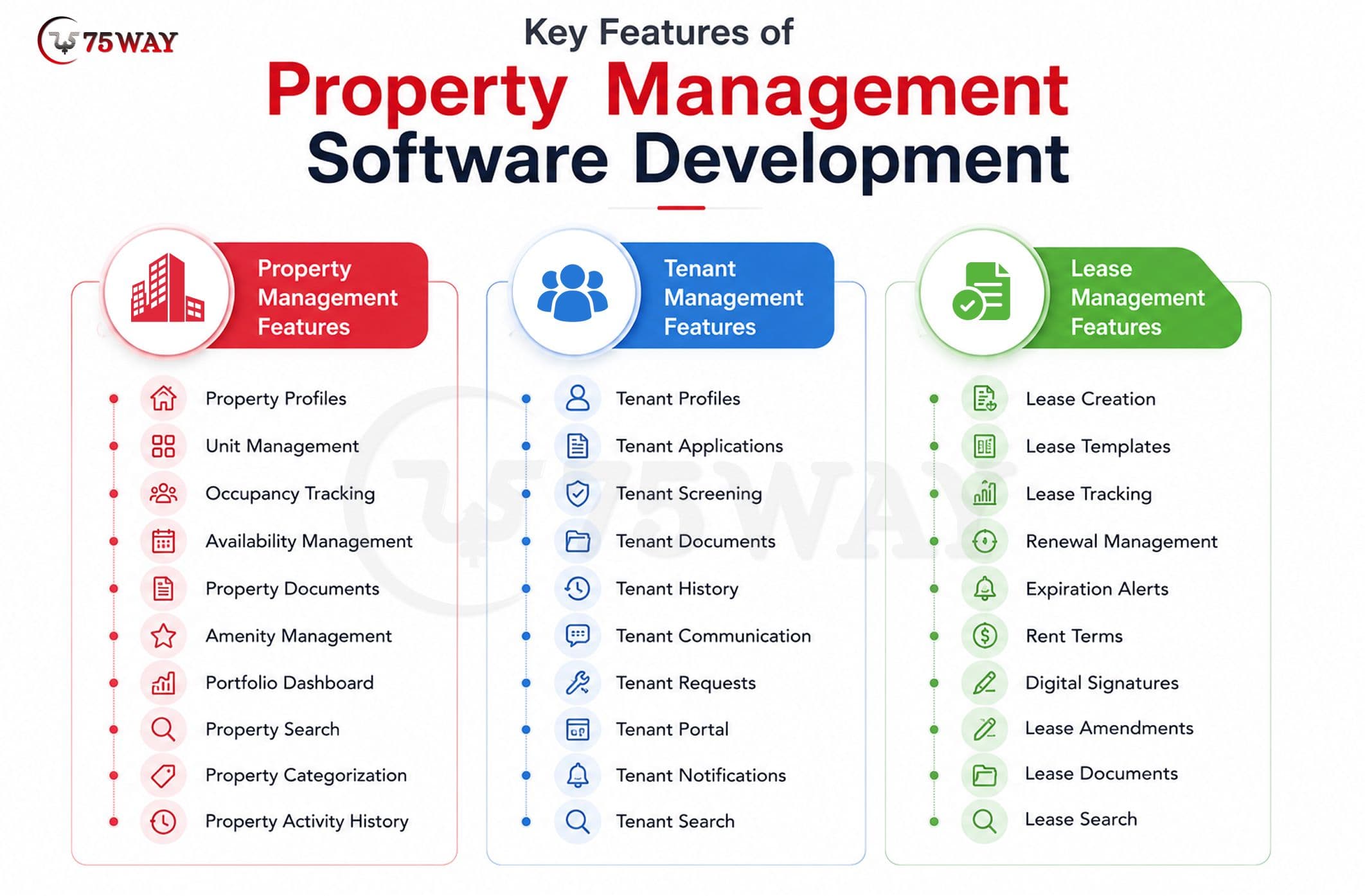
1. Property Management Features
This module gives property teams centralized control over buildings, units, occupancy, availability, and property-level information.
- Property Profiles: A centralized record keeps addresses, ownership details, amenities, property types, and operational information organized in one place. Managers can quickly access reliable property data when reviewing individual assets or the broader portfolio.
- Unit Management: Individual unit records capture size, rental rates, amenities, availability, occupancy, and tenant assignments. This gives property teams a clear view of every space without depending on scattered spreadsheets or disconnected records.
- Occupancy Tracking: Live occupancy information shows which units are occupied, vacant, reserved, or unavailable across the portfolio. Managers can identify vacancy patterns, monitor utilization, and respond faster to changing property conditions.
- Availability Management: Up-to-date unit availability helps leasing teams know which spaces are ready, leased, reserved, or temporarily unavailable. Accurate status information also prevents prospective tenants from receiving outdated or conflicting availability details.
- Property Documents: Important records such as inspection reports, ownership documents, certificates, and agreements can remain organized within property profiles. Authorized users can retrieve the right document quickly instead of searching through separate folders or email threads.
- Amenity Management: Parking spaces, gyms, pools, storage areas, and other facilities can be recorded against individual properties or units. Accurate amenity information supports better leasing communication and gives teams a clearer picture of available property resources.
- Portfolio Dashboard: A centralized dashboard brings occupancy, vacancies, property counts, and operational indicators into a single view. Decision-makers can review portfolio conditions quickly without manually compiling information from multiple property records.
- Property Search: Advanced search helps users locate properties and units using filters such as location, property type, availability, and status. Faster retrieval becomes particularly valuable when teams manage large portfolios with thousands of individual records.
- Property Categorization: Properties can be grouped by location, asset type, ownership structure, market, or business segment. Flexible categorization makes complex portfolios easier to organize, filter, analyze, and manage as the business expands.
- Property Activity History: A chronological record captures important property updates, changes, and user actions within the platform. Managers gain greater accountability and can understand what changed, when it happened, and who performed the action.
2. Tenant Management Features
This module manages tenant information from application and onboarding through communication, documentation, payments, and ongoing tenancy.
- Tenant Profiles: Each resident can have a centralized profile containing contact information, lease details, payment activity, documents, and service requests. Staff gain a complete tenant view without switching between separate systems to understand an account.
- Tenant Applications: Digital application workflows collect applicant information, documents, and application status within a structured process. Leasing teams can monitor progress more easily and reduce manual coordination during tenant onboarding.
- Tenant Screening: Screening workflows can connect third-party verification services with applicant records for a more organized review process. Property teams can manage screening information alongside applications while limiting access to authorized users.
- Tenant Documents: Identification, applications, agreements, notices, and supporting files can remain connected to individual tenant profiles. Centralized document access reduces searching time and helps teams maintain organized resident records throughout the tenancy.
- Tenant History: A chronological tenant history can include previous leases, payments, maintenance requests, communications, and account activity. This context helps property teams understand past interactions when handling current questions or service needs.
- Tenant Communication: Centralized communication keeps messages, updates, notices, and conversations connected to the relevant tenant record. Teams can reduce communication gaps while maintaining an accessible history of important resident interactions.
- Tenant Requests: Residents can submit questions, concerns, and service needs through a dedicated request workflow. Property teams can categorize, assign, prioritize, and monitor each request until the issue reaches resolution.
- Tenant Portal: A self-service portal gives residents direct access to payments, leases, documents, maintenance requests, and communications. Routine activities can happen without requiring staff assistance for every simple tenant interaction.
- Tenant Notifications: Automated alerts can remind residents about payments, lease deadlines, maintenance updates, applications, and property announcements. Timely notifications help reduce missed actions while keeping tenants informed about important account events.
- Tenant Search: Authorized staff can quickly locate residents using names, properties, units, lease status, or contact details. Powerful filtering becomes especially useful when managing large tenant databases across multiple buildings or locations.
3. Lease Management Features
This module organizes lease agreements, important dates, renewals, documents, and tenancy terms throughout the complete leasing lifecycle.
- Lease Creation: Digital workflows bring tenant, property, unit, pricing, and agreement information together during contract preparation. This reduces repetitive data entry and helps teams create leases with fewer avoidable administrative errors.
- Lease Templates: Predefined templates provide standardized structures for different property types, lease arrangements, or business requirements. Teams can prepare agreements faster while maintaining approved language and consistent documentation practices.
- Lease Tracking: A centralized lease tracker displays active, pending, expired, and upcoming agreements across the portfolio. Managers can quickly identify important lease statuses without manually checking individual files or spreadsheets.
- Renewal Management: Renewal workflows highlight approaching lease expirations and organize follow-up activities for property teams. Earlier visibility gives managers more time to communicate with tenants and plan retention or turnover activities.
- Expiration Alerts: Automated alerts notify managers before important lease deadlines arrive. These reminders help teams coordinate renewals, notices, documentation, and other time-sensitive actions without relying entirely on personal calendars.
- Rent Terms: Lease records can capture rent amounts, increases, deposits, concessions, payment schedules, and other financial conditions. Keeping these terms connected to agreements helps ensure that billing and lease administration remain aligned.
- Digital Signatures: Tenants, owners, and authorized representatives can complete agreements electronically from supported devices. This reduces paperwork, simplifies remote execution, and gives teams better visibility into the signing process.
- Lease Amendments: Changes to existing agreements can be documented without losing the connection to the original lease. Teams can maintain a clearer history of approved modifications, updated terms, and supporting documentation.
- Lease Documents: Signed agreements, amendments, notices, and related files can remain attached to the appropriate lease record. Authorized users can retrieve complete documentation from one location whenever questions or administrative needs arise.
- Lease Search: Search functionality helps users find agreements using tenants, properties, units, expiration dates, or lease status. Faster retrieval makes it easier for teams to respond to requests and manage large volumes of lease records.
Property Management Software Development Process: From Ideation To Launch
A successful property management platform starts with business requirements rather than coding. The development process should progressively turn operational problems into validated features, reliable workflows, secure infrastructure, and a scalable product.
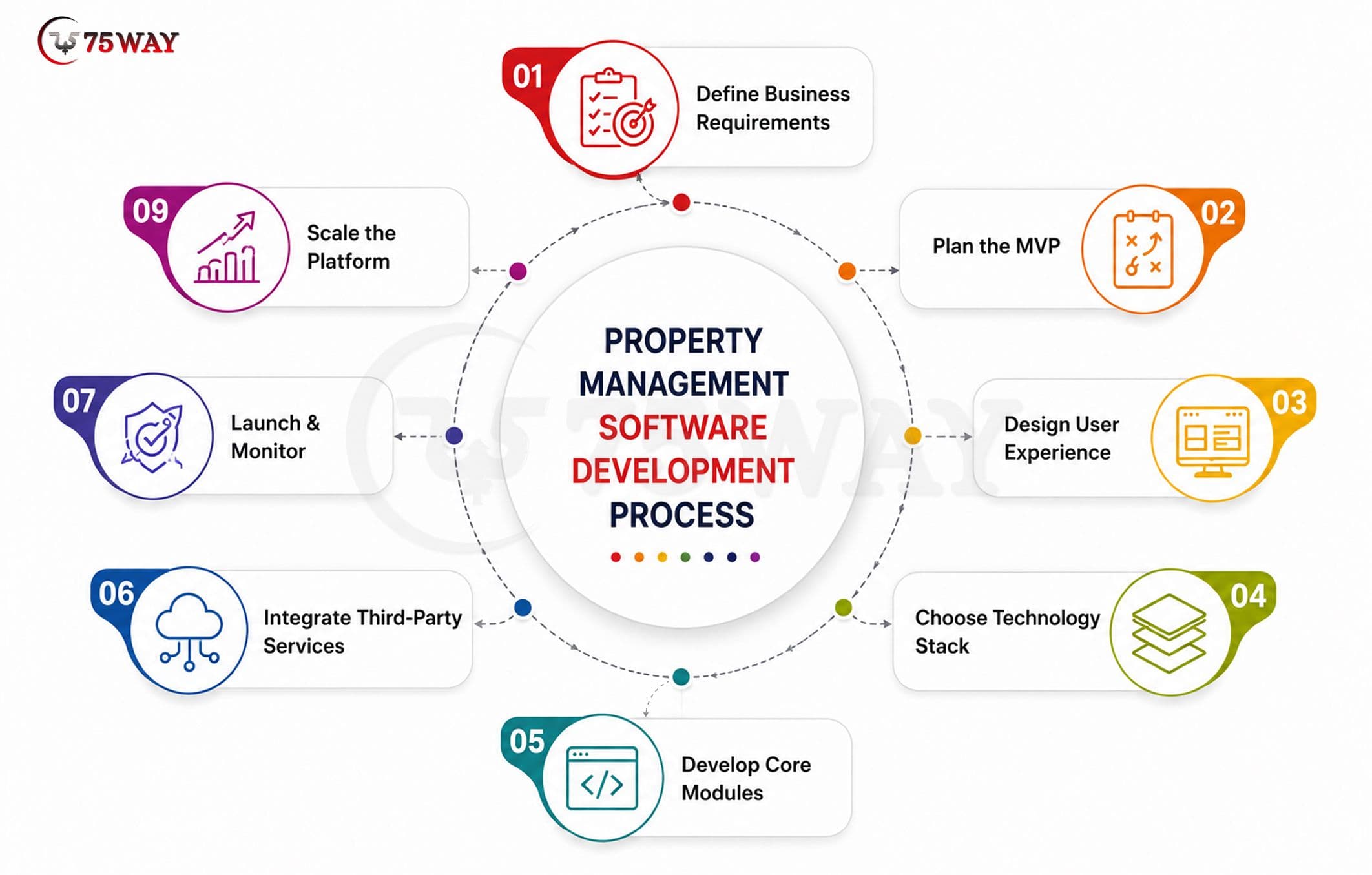
1. Define Business Requirements
Start by identifying who will use the platform, which properties it will support, and which operational problems require improvement. This stage establishes the product scope, user roles, workflows, integrations, business goals, and measurable outcomes before development begins.
Key considerations:
- Target users and property types
- Current operational challenges
- Core workflows
- User roles and permissions
- MVP requirements
- Third-party integrations
- Business objectives
2. Plan the MVP
An MVP should focus on the workflows that provide immediate value instead of attempting to replicate every capability of a mature property management platform. Prioritize essential functionality such as property management, tenants, leases, payments, maintenance, and basic reporting.
MVP features may include:
- Property and unit management
- Tenant profiles
- Lease management
- Rent collection
- Maintenance requests
- Basic accounting
- Notifications
- User authentication
- Dashboards
- Reporting
3. Design User Experience
The interface should reflect how property managers, tenants, owners, administrators, and vendors actually interact with the system. Clear navigation and role-specific dashboards can reduce unnecessary steps and make frequently performed tasks easier to complete.
- Simple navigation
- Role-based dashboards
- Mobile responsiveness
- Self-service workflows
- Accessible forms
- Clear notifications
- Consistent interface patterns
4. Choose Technology Stack
Technology decisions should support the platform's expected users, transaction volume, integrations, security requirements, and long-term growth. The stack should also make it practical to introduce additional modules, automation, analytics, and AI capabilities later.
Typical technology considerations include the frontend framework for responsive user interfaces, backend framework for business logic, and database architecture for storing property, tenant, lease, payment, and maintenance data. Cloud infrastructure supports deployment and scalability, while API architecture enables connections with external platforms and services.
Authentication protects user accounts and permissions, payment infrastructure supports rent transactions, and notification services handle alerts and reminders. Analytics enables operational reporting, while AI services can later power capabilities such as intelligent tenant support, document analysis, predictive maintenance, and automated insights.
5. Develop Core Modules
Development transforms the approved designs and requirements into functional property management workflows. Teams typically build the foundation first, followed by individual modules, integrations, automation, dashboards, and supporting administrative capabilities.
Development may cover:
- Backend development
- Frontend development
- API development
- Database implementation
- Payment integration
- Third-party integrations
- Admin panel
- Automated workflows
6. Integrate Third-Party Services
Property management software rarely operates independently because businesses often depend on payment processors, accounting systems, communication services, screening providers, e-signature tools, listing platforms, and other applications. API integrations connect these systems while reducing duplicate data entry.
Potential integrations include:
- Payment gateways
- Accounting software
- Banking services
- Tenant screening
- E-signature platforms
- Email and SMS services
- CRM systems
- Property listing platforms
7. Test Security & Performance
Testing should evaluate more than whether individual features work correctly. The platform should also be assessed for security vulnerabilities, authorization issues, payment reliability, API behavior, performance under load, data integrity, and usability across supported devices.
Testing areas include:
- Functional testing
- Security testing
- API testing
- Payment testing
- Performance testing
- Load testing
- User acceptance testing
- Cross-device testing
8. Launch & Monitor
A controlled launch puts the property management platform into real-world use without exposing every user to potential issues at once. An initial rollout helps the team validate workflows, identify technical problems, and understand how users interact with the product.
After deployment, error and performance monitoring becomes essential for identifying crashes, slow screens, failed transactions, and unexpected behavior. Analytics tracking and user feedback also reveal which features are being used, where users struggle, and which workflows need refinement.
Post-launch maintenance should cover bug resolution, security updates, performance improvements, and feature enhancements. Continuous monitoring keeps the platform reliable while ongoing improvements allow it to adapt to changing property management requirements and user expectations.
9. Scale the Platform
Growth can introduce new properties, users, transactions, integrations, and operational workloads that were not present during the MVP stage. Scalable architecture allows the platform to accommodate this growth without requiring a complete rebuild.
Scaling priorities include:
- Database optimization
- Cloud scalability
- API performance
- Caching
- Infrastructure monitoring
- Advanced reporting
- Additional integrations
- AI-powered capabilities
For most businesses, a phased development approach is more practical than attempting to build the complete platform at once. Start with the workflows that directly address the primary business problem, validate them with real users, measure adoption, and expand the product based on actual requirements.
This approach can help control the initial property management software development cost, reduce unnecessary features, and create a stronger foundation for future modules and integrations.
Types of Commercial Real Estate Software Businesses Can Develop In 2027
Property management software is not a one-size-fits-all product. The right platform depends on the property type, portfolio size, operating model, users, and workflows the business needs to manage. Existing platforms such as AppFolio, Yardi, RealPage, Buildium, and MRI Software illustrate how the market is divided across different property-management needs.
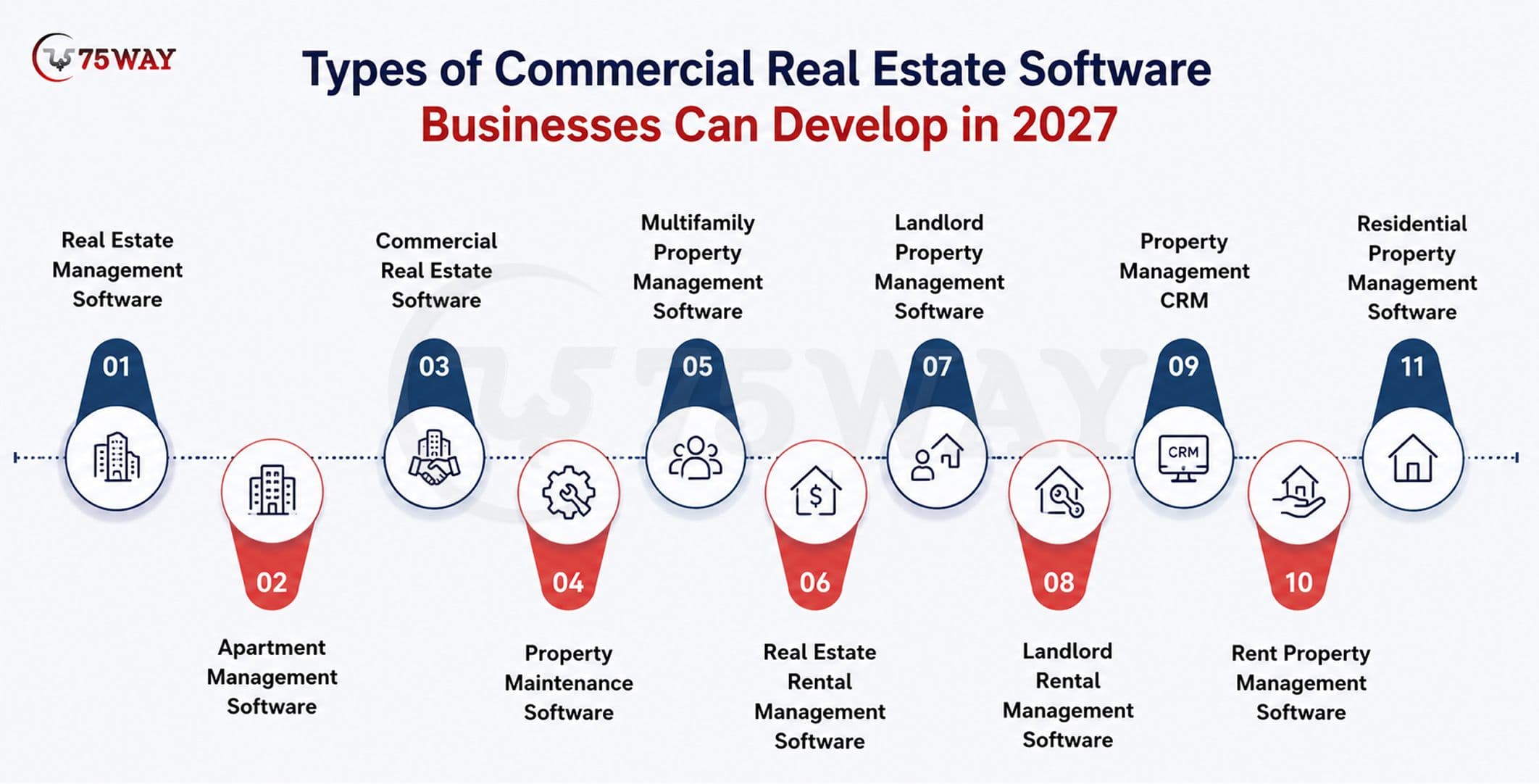
- Real Estate Management Software: Real estate management software gives owners and operators a single place to oversee properties, leases, tenants, finances, maintenance, and portfolio performance.
It becomes especially valuable when scattered spreadsheets and separate tools make it difficult to understand what is happening across multiple properties.
Yardi is a well-known example, helping real estate businesses manage property operations, accounting, leasing, and related workflows from a connected platform.
Estimated Cost: $80,000–$250,000+
- Apartment Management Software: Managing hundreds of apartments involves far more than keeping track of occupied and vacant units.
This type of software brings leasing, resident communication, rent payments, maintenance, and community operations together so apartment teams can manage daily work from one place.
AppFolio is a well-known example, offering tools for residential and multifamily operators to manage leasing, accounting, maintenance, and resident-related workflows.
Estimated Cost: $50,000–$180,000+
- Commercial Real Estate Software: Office buildings, retail centers, and industrial properties often come with complicated leases, financial arrangements, and tenant requirements that basic property tools cannot handle well.
Commercial real estate software provides the deeper leasing, financial, reporting, and asset-management capabilities needed to keep these operations organized across a portfolio.
MRI Software is a recognized example, supporting commercial and mixed-asset real estate operations.
Estimated Cost: $100,000–$300,000+
- Property Maintenance Software: A maintenance request can quickly become a larger operational problem when nobody knows who owns it, which vendor is handling it, or when the repair will be completed.
Property maintenance software creates a clear path from issue reporting and work-order assignment to scheduling, vendor coordination, and final resolution.
AppFolio, for example, includes maintenance workflows that help property teams manage service requests and related work.
Estimated Cost: $40,000–$120,000+
- Multifamily Property Management Software: Multifamily operators have to keep residents, units, leases, payments, maintenance, and property teams moving together across often large portfolios.
Multifamily property management software is built around these interconnected requirements, giving operators greater control over both resident experiences and property-level operations.
Entrata is a prominent example, offering a platform designed around multifamily leasing, resident, operational, and financial workflows.
Estimated Cost: $80,000–$250,000+
- Real Estate Rental Management Software: Rental operations become harder to coordinate as the number of properties and tenants grows, particularly when applications, leases, payments, and maintenance are handled through separate systems.
Rental management software connects these recurring activities so owners and property managers have a clearer view of their rental business.
Buildium is a well-known example serving residential property management businesses with leasing, accounting, maintenance, rent collection, and tenant-management capabilities.
Estimated Cost: $50,000–$150,000+
- Landlord Property Management Software: Individual landlords often need many of the same capabilities as larger property businesses but without the complexity of an enterprise system.
Landlord property management software helps owners keep tenant records, lease information, rent payments, maintenance, and financial details organized as their rental portfolio grows.
Buildium is one example used by landlords and property management businesses for managing residential rental operations.
Estimated Cost: $30,000–$100,000+
- Landlord Rental Management Software: Keeping up with rent due dates, tenant communication, lease records, and repair requests can become surprisingly time-consuming for landlords managing several rental units.
Rental management software takes these everyday responsibilities out of scattered records and places them into a more organized digital workflow.
Rentec Direct is an example that provides tools for landlords and property managers handling rental operations.
Estimated Cost: $30,000–$90,000+
- Property Management CRM: Leasing teams can lose valuable prospects when inquiries, follow-ups, property interests, and conversations are spread across email, spreadsheets, and disconnected systems.
A property management CRM centralizes these relationships, helping teams track leads and communication while creating a clearer path from initial inquiry to lease conversion.
Entrata, for example, combines CRM and leasing capabilities with broader multifamily property management functionality.
Estimated Cost: $40,000–$130,000+
- Rent Property Management Software: Rent collection can become a recurring administrative burden when payments, overdue balances, receipts, and tenant reminders are handled manually.
Rent-focused property management software brings these financial interactions into one workflow, making it easier to monitor incoming payments and outstanding balances.
AppFolio is an example of a broader property management platform that includes online rent payment and accounting capabilities.
Estimated Cost: $40,000–$120,000+
- Residential Property Management Software: Residential portfolios need a connected way to handle everything from tenant onboarding and lease management to rent collection, maintenance, and property reporting.
This software gives residential property managers a centralized operating environment as the number of homes, apartments, and residents increases.
AppFolio and Buildium are established examples serving residential property management businesses with different levels of functionality and scale.
Estimated Cost: $50,000–$180,000+
Technology Stack used To Develop Online Property Management Software
The technology stack determines how well a property management platform performs, integrates with external systems, handles growing data, and supports future product expansion. The right choices should match the platform's functionality, expected scale, security requirements, budget, and development roadmap.
1. Frontend Technologies
React, Next.js, Angular, and Vue.js are widely used to create responsive dashboards, tenant portals, owner interfaces, and administrative screens with smooth user interactions.
- React: A flexible JavaScript library for building reusable interface components, making it suitable for complex property dashboards with frequently changing data.
- Next.js: A React-based framework that supports server-side rendering, routing, and optimized web applications, making it useful for scalable property management platforms.
- Angular: A structured framework suited to large applications requiring organized architecture, reusable components, and strong support for complex enterprise-level interfaces.
- Vue.js: A lightweight and approachable framework that can simplify development for property management applications requiring responsive interfaces without excessive frontend complexity.
2. Backend Technologies
Node.js, Python, Java, and .NET provide the server-side foundation for business logic, APIs, authentication, payments, integrations, and data processing.
- Node.js: Its event-driven architecture works well for applications handling numerous concurrent requests, notifications, API interactions, and real-time property management activities.
- Python: Python supports rapid development and has a strong ecosystem for APIs, automation, analytics, and AI-powered property management capabilities.
- Java: Java provides a mature and scalable environment for large property management systems requiring complex business logic, high reliability, and enterprise integrations.
- .NET: Microsoft's .NET ecosystem supports secure, scalable applications and can be a strong choice for businesses already operating within Microsoft technologies.
3. Databases
PostgreSQL, MySQL, MongoDB, and Redis can manage structured records, flexible data, transactions, caching, and high-speed application operations.
- PostgreSQL: A powerful relational database suited to structured property, tenant, lease, payment, and accounting data requiring strong consistency and complex queries.
- MySQL: A widely adopted relational database that can support property records, user accounts, transactions, and other structured application data.
- MongoDB: A document-oriented database useful when applications require flexible data structures, evolving schemas, or certain types of high-volume operational data.
- Redis: An in-memory data store commonly used for caching, sessions, queues, and fast-access data to improve application responsiveness.
4. Cloud Infrastructure
AWS, Microsoft Azure, and Google Cloud provide computing, storage, databases, monitoring, security, backups, and scalable infrastructure for property management platforms.
- AWS: Offers a broad collection of cloud services for hosting applications, databases, storage, security, analytics, monitoring, and scalable infrastructure.
- Microsoft Azure: Provides cloud infrastructure with strong integration across Microsoft's enterprise ecosystem, making it suitable for organizations already using Microsoft business technologies.
- Google Cloud: Provides scalable computing, storage, databases, analytics, and AI services for platforms requiring modern cloud infrastructure and data-driven capabilities.
5. APIs and Integration Technologies
REST, GraphQL, payment APIs, communication APIs, authentication services, and third-party integrations connect property management software with external business systems.
- REST APIs: Provide a widely adopted approach for connecting applications and exchanging property, tenant, payment, and operational data between systems.
- GraphQL: Allows applications to request specific data through flexible queries, which can be useful for complex interfaces requiring information from multiple resources.
- Payment APIs: Connect the platform with payment providers to support rent payments, recurring billing, transaction processing, receipts, and payment status updates.
- Communication APIs: Enable email, SMS, push notifications, and other communication workflows for tenants, owners, vendors, and property management teams.
- Authentication Services: Support secure login, identity verification, session management, and access controls across different user types and application interfaces.
6. Analytics and AI Technologies
Analytics platforms, machine-learning frameworks, large language models, and AI services can transform property data into automation, predictions, recommendations, and operational insights.
- Analytics Platforms: Convert property, tenant, payment, occupancy, and maintenance data into dashboards and reports that support operational and financial decisions.
- AI Services: Enable capabilities such as tenant support, document analysis, automated communication, maintenance classification, and intelligent workflow assistance.
- Machine Learning: Can analyze historical property data to identify patterns and support predictive maintenance, occupancy forecasting, payment-risk analysis, and other advanced use cases.
Which Technology Stack Is Most Cost-Effective?
For a cost-conscious MVP, a combination such as React or Next.js + Node.js or Python + PostgreSQL + AWS can provide a practical balance between development speed, scalability, ecosystem support, and long-term maintainability.
For example, React + Node.js + PostgreSQL can work well when the primary requirement is a web-based property management platform with dashboards, tenant management, leases, payments, maintenance, APIs, and third-party integrations.
For an AI-heavy product, Next.js + Python + PostgreSQL + AWS can be a strong option because Python provides a mature ecosystem for AI, machine learning, automation, and data processing.
The most cost-effective stack is not necessarily the one with the lowest development rate. A slightly higher initial investment in a suitable architecture can reduce future expenses related to performance problems, rewrites, scalability limitations, and difficult integrations.
Recommended Stack for Property Management Software
For most modern property management platforms, a practical starting combination would be:
- Frontend: React or Next.js
- Backend: Node.js or Python
- Database: PostgreSQL
- Cloud: AWS
- APIs: REST
- Authentication: OAuth 2.0 / OpenID Connect-based services
- Payments: Third-party payment APIs
- Communication: Email and SMS APIs
- Analytics: Product and business analytics platform
- AI: Python-based AI services or suitable third-party models
This stack can support an MVP while leaving room for advanced analytics, AI automation, mobile applications, additional integrations, and portfolio-scale growth as the product evolves.
What’s Cost To Build Property Management Software Cost?
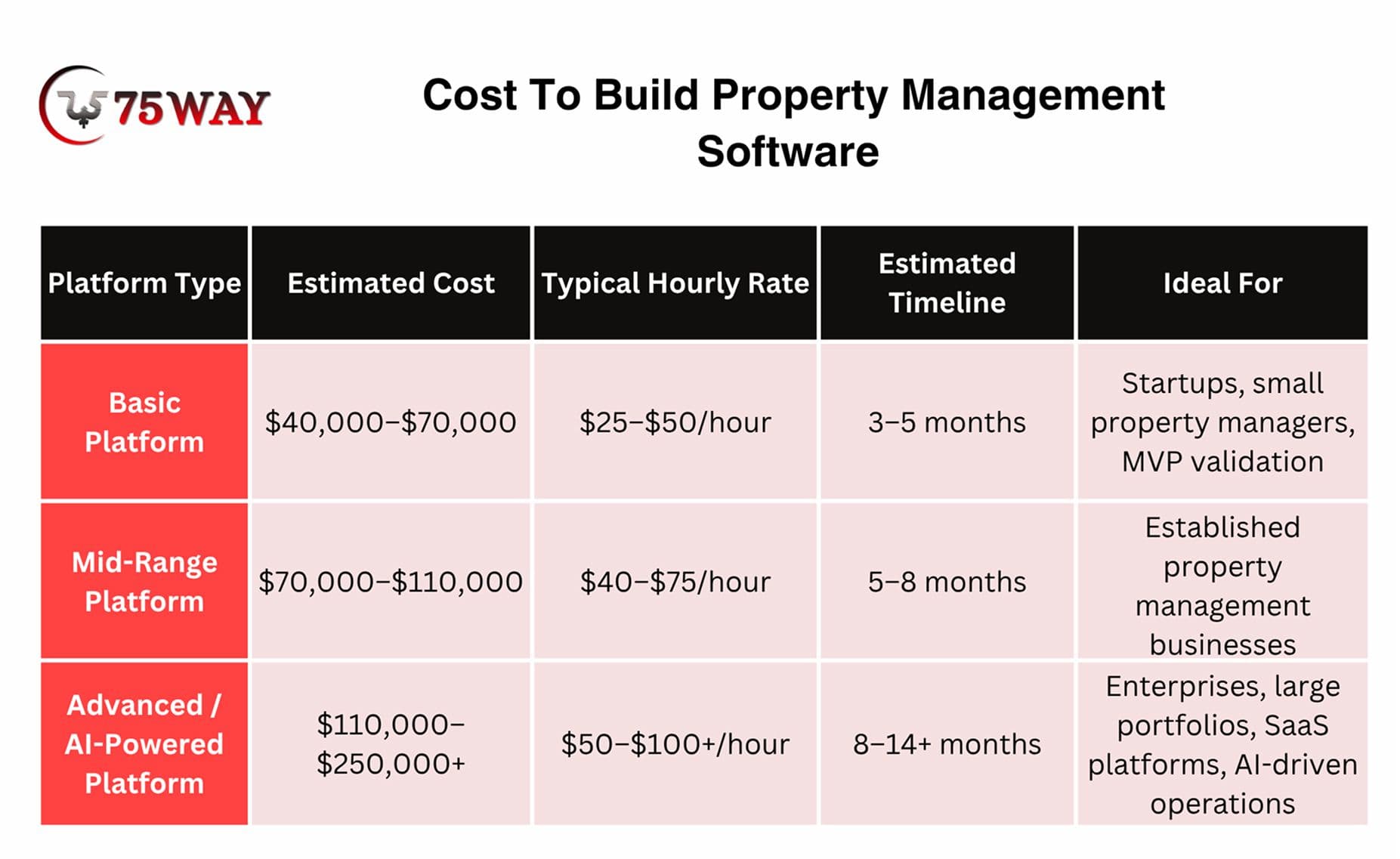
The average property management software development cost can range from $40,000 to $250,000+, depending on the platform’s features, complexity, integrations, security requirements, technology stack, and development team. A basic platform may stay closer to the lower end, while an enterprise or AI-powered product can move well beyond $250,000.
Basic Platform: $40,000–$70,000
A basic property management platform focuses on the essential workflows needed to manage properties and tenants digitally.
This option can suit startups validating a property management SaaS idea or smaller businesses replacing spreadsheets and manual processes. The goal is to launch a focused MVP without investing heavily in advanced automation or complex integrations.
Mid-Range Platform: $70,000–$110,000
A mid-range platform adds broader operational capabilities for businesses managing more users, properties, and workflows.
This level is often appropriate when the software needs to support established property management operations rather than simply validate an initial product concept.
Advanced or AI-Powered Platform: $110,000–$250,000+
Advanced platforms combine core property management functionality with sophisticated automation, analytics, integrations, and AI-driven capabilities.
The final investment can exceed $250,000 when the platform requires enterprise-grade architecture, extensive third-party integrations, complex permissions, high transaction volumes, or multiple native applications.
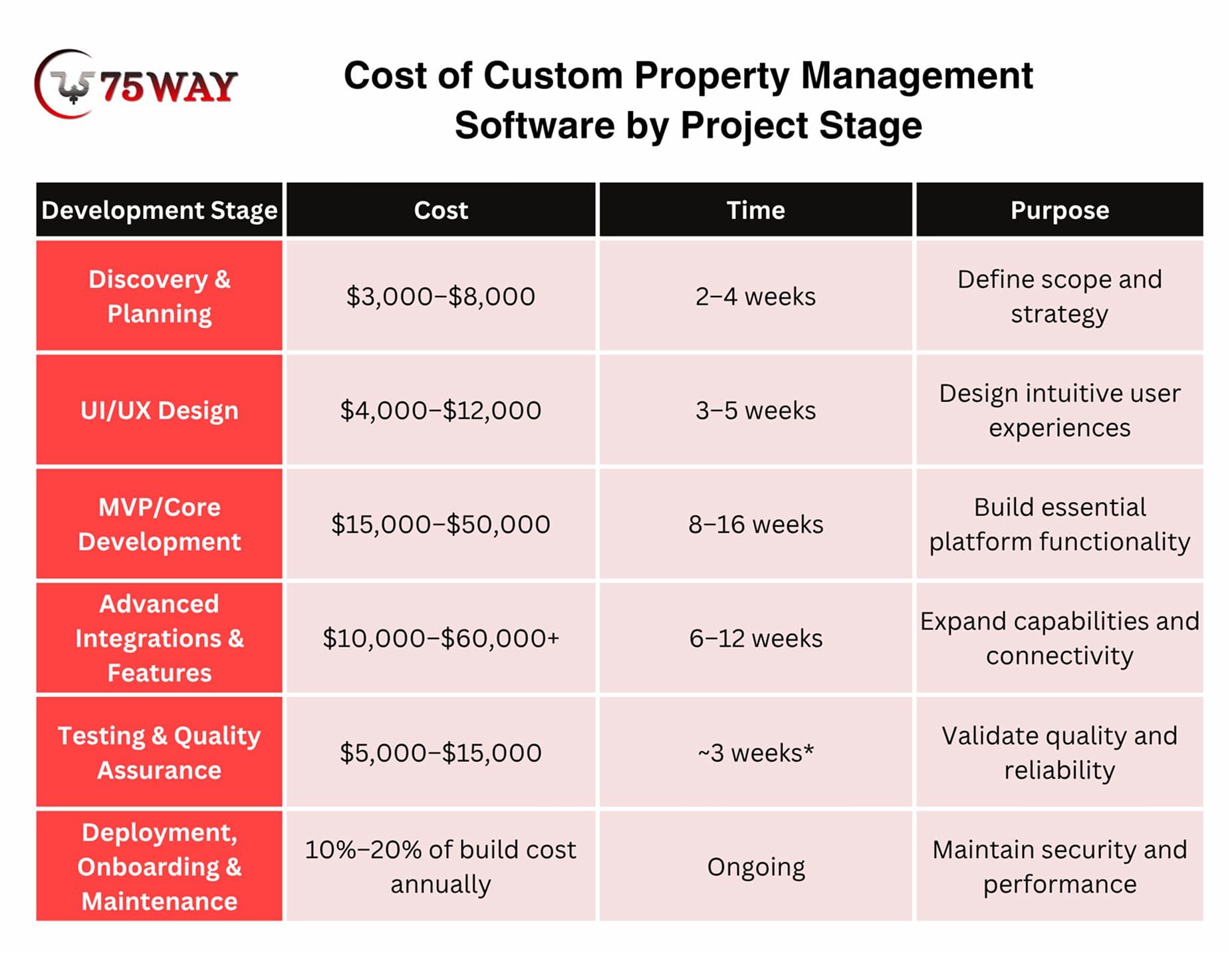
Development Cost of Custom Property Management Software by Project Stage
The overall budget is also influenced by how much work is required at each development stage. Understanding these cost components helps businesses create a realistic budget instead of evaluating software development using a single headline price.
1. Discovery and Planning: $3,000–$8,000
Discovery establishes what the software needs to accomplish before development begins. This stage typically covers business requirements, market research, user workflows, feature prioritization, technical planning, and initial system architecture.
Typical timeline: 2–4 weeks.
2. UI/UX Design: $4,000–$12,000
UI/UX design transforms business workflows into practical interfaces for property managers, tenants, owners, administrators, and other users. Wireframes, prototypes, design systems, responsive screens, and usability considerations are typically addressed during this stage.
Typical timeline: 3–5 weeks.
3. MVP/Core Development: $15,000–$50,000
Core development turns the approved product requirements and designs into a working platform. Backend services, databases, frontend interfaces, authentication, and essential modules such as tenant management, leases, payments, and maintenance are developed during this phase.
Typical timeline: 8–16 weeks.
4. Advanced Integrations and Feature Expansion: $10,000–$60,000+
Integrations and advanced functionality can significantly increase development effort because each external system introduces its own APIs, authentication requirements, data structures, and testing needs. Common additions include payment gateways, accounting platforms, AI services, communication APIs, advanced analytics, and smart-building integrations.
Typical timeline: 6–12 weeks, depending on integration complexity.
5. Testing and Quality Assurance: $5,000–$15,000
Quality assurance validates whether the platform performs reliably across its core workflows, devices, integrations, and user roles. Testing can include functional validation, security testing, API testing, performance testing, payment testing, and user acceptance testing.
Typical timeline: Testing continues throughout development, with approximately three additional weeks often allocated for dedicated final QA.
6. Deployment, Onboarding, & Maintenance: 10%–20% of Build Cost Annually
Launching the platform is not the end of the development investment. Businesses should budget for infrastructure, monitoring, security updates, bug fixes, third-party API changes, performance improvements, technical support, and future feature development.
Typical timeline: Ongoing after launch.
Factors that Affect Cost To Build Landlord Rental Management Software
The biggest cost difference usually comes from what the software needs to do, rather than simply how many screens it contains. Several factors can substantially change the final development budget:
- Number of user types: Supporting tenants, owners, managers, vendors, administrators, and other roles increases workflow and permission complexity.
- Advanced automation: Automated rent workflows, maintenance routing, notifications, approvals, and business rules require additional backend logic.
- Third-party integrations: Payments, accounting, tenant screening, banking, CRM, communication, and listing integrations increase development and testing requirements.
- AI functionality:AI assistants, document analysis, predictive maintenance, recommendations, and intelligent automation require additional infrastructure and specialized implementation.
- Mobile applications: Separate native iOS and Android applications can increase the scope compared with a responsive web platform.
- Security requirements: Financial transactions, tenant records, identity information, and sensitive documents require stronger security controls and testing.
- Scalability: A platform designed for thousands of properties and users requires more robust architecture than a small internal management application.
Cost of Building AI-Powered Property Management Software Based on Development Location
Development rates vary significantly by region, but hourly rate alone should not determine which development team you choose. A lower hourly rate can become expensive if poor architecture, communication problems, rework, or missed requirements extend the project.
For businesses targeting the North American market, development teams in North America commonly charge around $100–$250+ per hour, while Western European teams may fall around $80–$170 per hour.
Eastern European teams can commonly range from $40–$80 per hour, while teams across countries such as India, Vietnam, and the Philippines may range from approximately $20–$45 per hour.
Latin American teams may commonly charge around $30–$65 per hour, with time-zone overlap potentially offering an operational advantage for North American businesses.
These are broad market estimates rather than fixed pricing rules. The final quote should be based on scope, team composition, architecture, integrations, security requirements, and delivery expectations—not geography alone.
How to Reduce Cost of On-Demand Property Management Software Development?
The smartest way to control the budget is not necessarily to choose the cheapest development team. It is to control product scope before development begins.
A practical approach is to launch an MVP around the highest-value workflows, validate adoption with real users, and introduce advanced modules after the product demonstrates demand. Businesses can also reduce initial costs by using proven third-party services for payments, communication, authentication, analytics, and other infrastructure instead of building every capability from scratch.
This approach allows companies to invest the initial $40,000–$70,000 around a focused product before committing to the broader capabilities required for a $110,000–$250,000+ platform.
AI-Powered Property Management Software Development Cost Calculator
Estimated Cost = Development Hours × Hourly Rate + Additional Services
For a practical estimate, readers can consider:
Suppose a property management company wants to build a mid-range platform with tenant management, lease tracking, online rent collection, maintenance management, owner access, accounting integration, notifications, and reporting.
For example, assume the project requires 2,000 development hours at an average rate of $50 per hour:
Development Cost = 2,000 × $50 = $100,000
Additional costs may apply for specialized integrations, advanced security, AI capabilities, mobile applications, cloud infrastructure, and ongoing maintenance. Therefore, the final project budget could reasonably fall around $100,000–$120,000, depending on the confirmed scope.
Example estimate:
- Core development: $100,000
- Additional integrations and refinements: $10,000
- Estimated project budget: $110,000
This example shows why property management software development cost should be estimated from actual functionality and development effort, rather than using a single fixed price for every project.
How Long Does It Take to Make Property Management Software?
A property management software MVP can typically take 3 to 6 months, while a feature-rich platform may require 6 to 12 months or longer. The actual timeline depends on product scope, integrations, design requirements, testing, team size, and the complexity of business workflows.
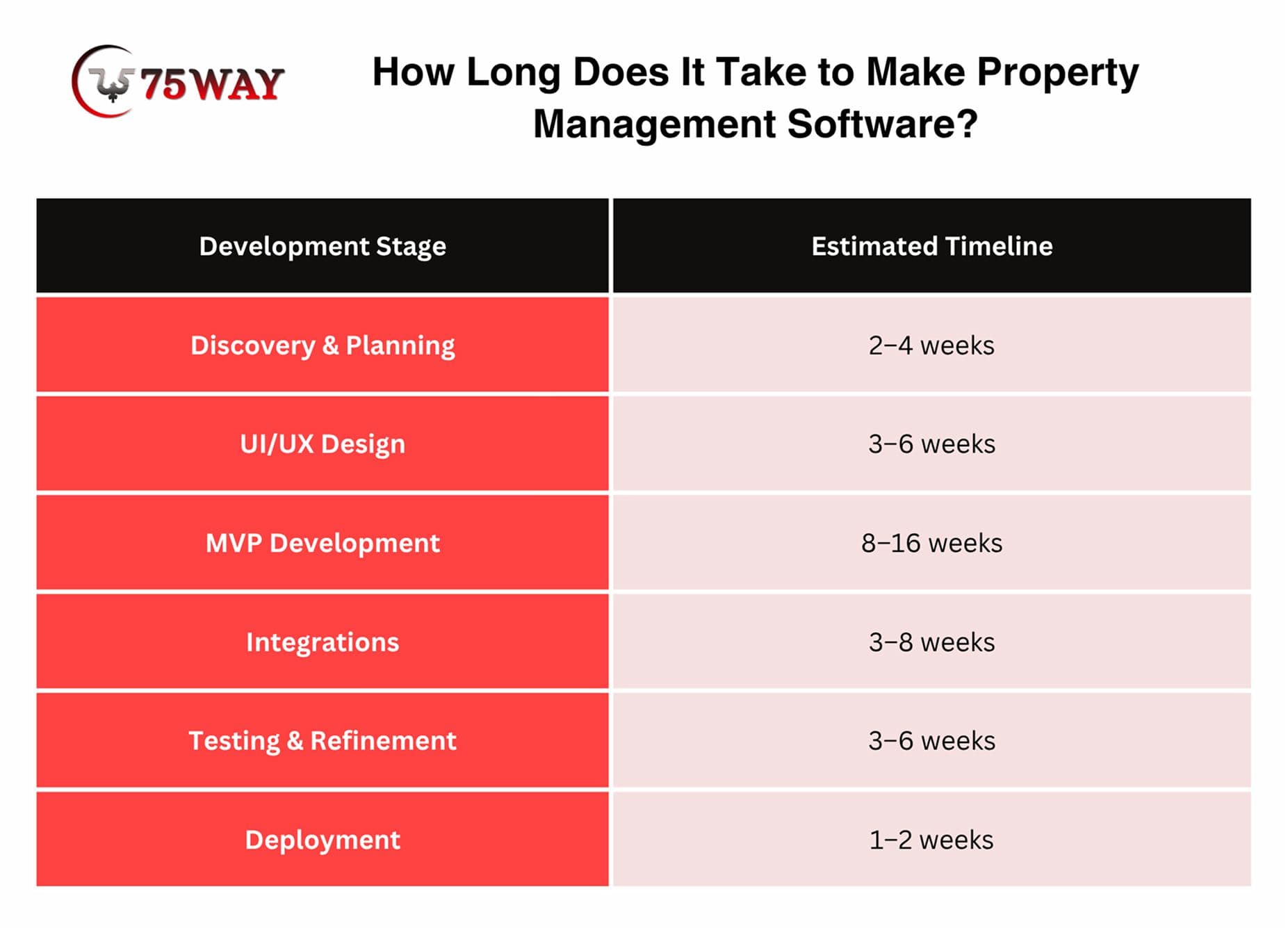
These stages can overlap, so the total project timeline should not simply be calculated by adding every range together.
How to Choose the Right Property Management Software Development Company?
The development partner you choose can influence the software’s architecture, security, scalability, delivery timeline, and long-term maintenance requirements. Instead of comparing vendors only by hourly rates, evaluate their technical capabilities, development approach, communication, and understanding of property management workflows.
- Property Operations Know-How
Real property workflows matter more than generic software experience. Look for a partner that understands how leasing, tenant onboarding, rent collection, maintenance requests, renewals, owner reporting, and property-level operations connect.
- Portfolio Complexity
Your portfolio structure should shape the product architecture from day one. Discuss how the team will handle multiple properties, buildings, units, user roles, locations, ownership structures, and different operating rules without creating unnecessary complexity.
- Payments & Financial Workflows
Money movement deserves special attention in property software. Your partner should understand recurring rent, deposits, refunds, late fees, payment records, reconciliation, invoices, and connections with financial or accounting platforms.
- Tenant-Facing Experience
A property platform succeeds partly through the tenant experience. Evaluate how the company approaches tenant portals, maintenance requests, lease documents, payments, notifications, communication, mobile access, and other interactions that happen outside the property manager’s dashboard.
- Maintenance Workflow Expertise
Maintenance is a real-world workflow, not simply a ticketing feature. The development team should understand request intake, urgency, assignment, vendor coordination, scheduling, status updates, costs, approvals, and completion records.
- Integration Strategy
Property software rarely operates as an isolated system. Ask how the team will connect payment processors, accounting software, CRM platforms, tenant screening services, communication tools, listing platforms, smart-building systems, and other external services.
- Data & Access Control
Property data often needs different visibility for owners, managers, tenants, vendors, and administrators. The development partner should demonstrate a clear approach to permissions, document access, financial information, authentication, encryption, backups, and audit trails.
- Growth-Ready Architecture
The platform should accommodate portfolio growth without forcing a complete rebuild. Discuss expected property counts, concurrent users, transaction volumes, reporting requirements, integrations, and future modules before the technical architecture is finalized.
- Post-Launch Product Ownership
Property software continues evolving after the first release. Clarify who handles production issues, third-party API changes, security patches, infrastructure monitoring, performance improvements, analytics, and new functionality as your property operations expand.
- Relevant Case Studies
Comparable products provide stronger evidence than a visually impressive portfolio. Ask for examples involving property, real estate, rental, tenant, facilities, or operations software and examine the actual problems, integrations, workflows, and outcomes involved.
Build Vs. Buy: Which Property Management CRM Development Approach Is Better?
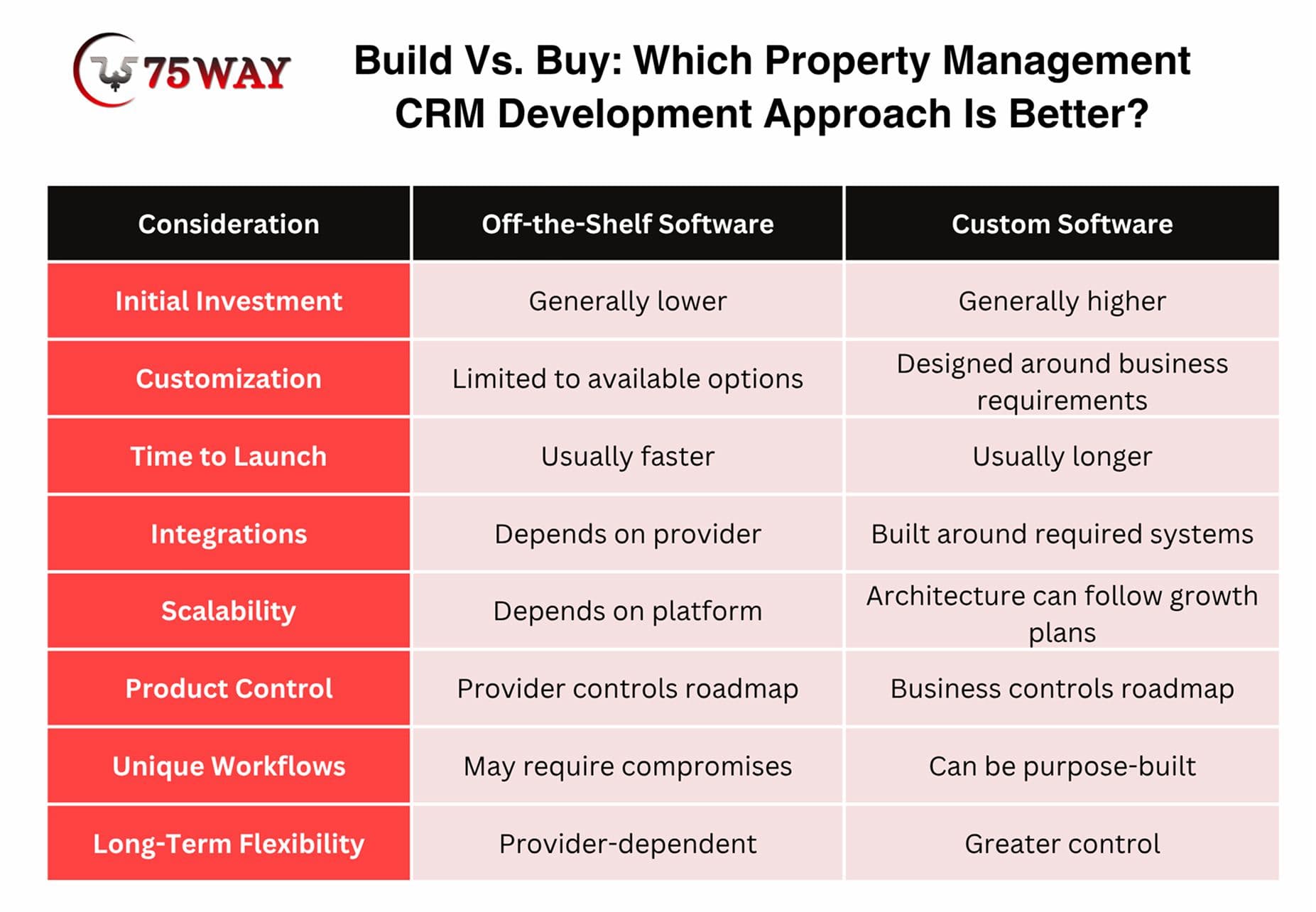
The decision between building custom property management software and purchasing an existing platform depends on how closely available products match your workflows and business objectives.
Off-the-shelf software can be practical when your requirements are standard and you want to start using a platform quickly. It generally reduces initial development work but may limit customization, integrations, workflows, and control over the product roadmap.
Custom software development makes more sense when your business has specialized workflows, unique operational requirements, complex integrations, proprietary processes, or plans to create a differentiated SaaS product.
How AI Can Improve Property Management And Accounting Software?
AI can turn property management software from a system that simply stores information into a platform that helps teams interpret data, automate routine work, and respond faster. The strongest use cases focus on repetitive tasks, large datasets, tenant interactions, and decisions that benefit from predictive insights.
- AI Tenant Support
AI-powered assistants can answer common tenant questions about payments, leases, property policies, maintenance requests, and account information. This gives residents self-service support while reducing the volume of routine questions handled manually by property teams.
- Intelligent Maintenance Triage
AI agent for property management can analyze maintenance descriptions submitted by tenants and categorize issues based on type, urgency, and potential priority. The system can then route requests to the appropriate team or vendor, helping reduce unnecessary delays.
- Predictive Maintenance
Historical work orders, equipment information, maintenance patterns, and property data can help AI identify potential maintenance risks before they become major problems. Property teams can use these insights to prioritize inspections and preventive maintenance.
- Automated Rent Reminders
AI real estate agent can personalize payment reminders based on tenant behavior, payment history, due dates, and account status. Automated communication can encourage timely payments while reducing repetitive follow-up work for property managers.
- Lease Document Analysis
AI can extract important information from lease documents, including dates, rental terms, renewal conditions, deposits, and specific clauses. This can make large collections of lease records easier to search and review.
- Rent Insights
AI can analyze rental, occupancy, property, and market data to identify pricing patterns and potential opportunities. These insights can support rental pricing decisions while keeping final recommendations under appropriate business oversight.
- AI Property Search
Natural-language search allows users to ask questions such as finding vacant units within specific locations, price ranges, or property types. Instead of navigating multiple filters, users can describe what they need conversationally.
- Automated Reporting
AI can turn operational data into readable summaries covering occupancy, revenue, maintenance activity, payment performance, and property trends. Managers can spend less time interpreting raw reports and more time acting on important findings.
- Lead Qualification
AI can evaluate incoming property inquiries and identify prospects based on information such as property preferences, budget, location, and move-in requirements. This can help leasing teams prioritize promising inquiries and respond with relevant information.
- AI Communication
AI can assist teams in drafting tenant notices, payment reminders, maintenance updates, property announcements, and owner communications. Suggested responses can reduce writing time while allowing staff to review and approve messages before sending.
Premium Benefits of Creating Residential Property Management Software
The business value of property management software extends beyond digitizing existing processes. A well-designed platform can connect operational data, reduce administrative friction, improve visibility, and create a stronger foundation for portfolio growth.
- Centralized Operations
Property, tenant, lease, payment, maintenance, accounting, and communication information can reside within one connected environment. Teams spend less time moving information between spreadsheets, emails, and separate applications.
- Faster Maintenance Resolution
Digital work orders make it easier to receive, prioritize, assign, and monitor maintenance requests. Managers can track progress while tenants receive clearer updates about their service requests.
- Better Tenant Experience
Self-service portals allow tenants to make payments, access documents, submit maintenance requests, and communicate with property teams from a convenient digital interface. This can make routine interactions easier for both residents and staff.
- Improved Financial Visibility
Connected payment and accounting workflows give managers better visibility into rent collection, outstanding balances, expenses, and property-level financial activity. Owners can also receive more accessible financial information through dedicated dashboards and reports.
- Reduced Administrative Work
Automation can handle repetitive activities such as notifications, reminders, payment updates, document workflows, and routine communications. Property teams can redirect more time toward higher-value responsibilities instead of repeatedly completing manual tasks.
- Portfolio-Level Insights
Centralized analytics can help decision-makers compare occupancy, revenue, maintenance activity, and other performance indicators across properties. This broader view can support more informed operational and investment decisions.
- Easier Business Scaling
A scalable platform can accommodate additional properties, users, transactions, and workflows as the business expands. This allows companies to grow their operations without relying on the same level of manual administrative processes.
How to Make Property Management Software Scalable?
Scalability should be planned before user and transaction volumes increase. A platform that works for a small portfolio may experience performance limitations when thousands of properties, tenants, payments, maintenance requests, and documents are processed.
- Scalable Cloud Infrastructure
Cloud infrastructure allows computing resources, storage, databases, and other services to expand according to application requirements. Proper monitoring and resource management can help maintain performance as usage increases.
- Modular Architecture
Separating major capabilities into well-defined modules makes the platform easier to maintain and expand. New functionality can be introduced without unnecessarily affecting unrelated parts of the application.
- Database Optimization
Property management platforms can generate substantial volumes of tenant, payment, lease, maintenance, and activity data. Appropriate database design, indexing, query optimization, and data management strategies help maintain application performance as records grow.
- API-First Design
Well-designed APIs make it easier to connect mobile applications, third-party services, partner platforms, and future products. This approach also supports a more flexible architecture as integration requirements evolve.
- Performance Monitoring
Continuous monitoring can identify slow queries, infrastructure bottlenecks, API failures, application errors, and unusual traffic patterns. Early visibility allows technical teams to address performance problems before they significantly affect users.
Property Management Software Security Standards and Tools
Security is a critical part of property management software because the platform may process tenant information, lease documents, payment-related data, identity records, owner information, and business communications. The security architecture should combine recognized standards, secure development practices, continuous testing, and appropriate infrastructure controls.
- OWASP Application Security Verification Standard (ASVS): Provides a structured framework for verifying application security controls. Development teams can use it to evaluate authentication, access control, input validation, session management, cryptography, and other application-security requirements.
- OWASP Top 10: OWASP Top 10 helps development teams identify common web application security risks, including broken access control, injection, authentication failures, and security misconfiguration. It can serve as a practical baseline during application development and security testing.
- SOC 2: It offers a framework for evaluating controls related to security, availability, processing integrity, confidentiality, and privacy. Businesses building property management software for other organizations may consider SOC 2 readiness particularly important for enterprise sales.
- ISO/IEC 27001: Provides requirements for establishing and maintaining an information security management system. It can help organizations create structured processes for identifying security risks, implementing controls, and continuously improving information security practices.
- NIST Cybersecurity Framework: A structured approach around identifying, protecting, detecting, responding to, and recovering from cybersecurity risks. Development teams can use its principles to build broader security and risk-management processes around the platform.
- PCI DSS: PCI DSS becomes relevant when the platform handles payment-card data or connects payment functionality to card-processing workflows. Using a compliant payment provider and minimizing the storage of sensitive card information can reduce the platform's payment-security exposure.
- Role-Based Access Control: RBAC limits platform functionality and data according to user responsibilities. Separate permissions for tenants, owners, property managers, vendors, administrators, and support staff help reduce unauthorized access.
- Multi-Factor Authentication: MFA adds another verification layer beyond passwords. It can provide stronger account protection for administrators and other users with access to sensitive property, financial, or tenant information.
- Security Testing Tools: Security testing tools help identify vulnerabilities before and after deployment. Depending on the application architecture, teams may use tools such as OWASP ZAP, Burp Suite, Snyk, SonarQube, Dependabot, and cloud-native security services.
- Audit Logging: Audit logging records important actions such as logins, permission changes, document access, payment events, administrative updates, and account modifications. Detailed logs support security investigations, troubleshooting, accountability, and compliance activities.
For enterprise-focused platforms, businesses should additionally evaluate whether SOC 2, ISO/IEC 27001, PCI DSS, or other contractual and regulatory requirements apply to their specific data flows and business model.
How 75way Helps Build Property Management Software
75way Technologies brings custom property management software development closer to the way your business actually operates. From tenant and lease management to rent collection, maintenance, accounting, dashboards, integrations, and AI-powered workflows, the platform can be shaped around your specific processes instead of forcing your team into a fixed software model.
A scalable product roadmap gives businesses room to start with an MVP and expand as their requirements grow. 75way can support the journey across UI/UX design, web and mobile development, third-party integrations, testing, deployment, and post-launch improvements, helping turn a property management software idea into a practical digital product.
Final Thoughts
Property management software can become a valuable operational asset when it solves real workflow challenges instead of simply adding another digital interface. A focused MVP helps businesses validate demand before investing in advanced capabilities, while scalable architecture keeps future expansion practical.
Success also depends on thoughtful UX, secure integrations, reliable infrastructure, and continuous improvements after launch. For businesses planning a differentiated platform, the development strategy should balance functionality, usability, security, scalability, and commercial objectives. Partner with a trusted real estate development company to turn your software vision into reality.
Frequently Asked Questions (FAQs)
What Problems Can Property Management Software Solve?
It can reduce scattered information, repetitive administrative work, missed follow-ups, and limited portfolio visibility. Centralized workflows give teams better control over everyday property operations.
Can Property Management Software Support Multiple Property Types?
Yes, custom platforms can support residential, commercial, multifamily, mixed-use, and other property categories. Configurable workflows allow businesses to accommodate different operational and leasing requirements.
Can Property Management Software Support Multiple Business Locations?
Yes, multi-location functionality can separate properties by region, branch, portfolio, or management team. Centralized administration can still provide leadership with broader organizational visibility.
Can Existing Property Data Be Migrated Into New Software?
Existing property, tenant, lease, payment, and document data can often be migrated into a new platform. Proper mapping and validation help preserve accuracy throughout the transition.
Can Property Management Software Be Customized For Different Brands?
Custom software can support separate branding, domains, interfaces, workflows, and user experiences when multiple business entities operate through one platform. This structure can support franchise or multi-brand models.
Can Property Management Software Support White-Label Products?
A properly designed platform can support white-label deployments for businesses selling software under different brands. Separate branding and configurable experiences can provide flexibility without rebuilding the underlying system.
Can Property Management Software Handle Multiple Currencies?
Multi-currency functionality can support businesses operating across markets with different currencies and financial requirements. Exchange-rate handling, reporting, and transaction rules should be planned within the financial architecture.
What Should Businesses Prepare Before Starting Development?
Clear user roles, workflows, feature priorities, integrations, business goals, and technical requirements create a stronger starting point. Early preparation also helps reduce scope confusion and unnecessary development costs.